Larry Johnson: AIR POWER CANNOT BEAT an ENTRENCHED ENEMY LIKE IRAN
Daniel Davis / Deep Dive – March 4, 2026
Larry Johnson argues that Iran will not back down because it sees the conflict as existential, while the U.S. lacks the long-term resolve to sustain another major war—citing failures since the Vietnam War.
He claims Iran has effectively neutralized much of the U.S. military presence in the Persian Gulf, rendering bases such as Al Udeid Air Base, Prince Sultan Air Base, and U.S. naval facilities in Bahrain combat-ineffective, and destroying key radar systems. He argues that airpower alone—referencing “shock and awe” from the Iraq War—cannot secure victory without ground forces.
The discussion questions statements by Defense Secretary Pete Hegseth, contrasting his current rhetoric with past criticism of U.S. interventionism. The speaker suggests current leadership is overstating progress and creating unrealistic expectations that Iran will soon collapse.
He further argues that despite heavy bombardment, Iran remains capable of striking Israel and that damage inside Israeli cities is being underreported due to social media censorship. He claims missile defenses such as Patriot, THAAD, and Iron Dome are being depleted or are ineffective.
Strategically, he contends the U.S. and Israel lack the capacity to conquer Iran, noting its vast size, mountainous terrain, and the logistical impossibility of a ground invasion—drawing comparisons to difficulties in Afghanistan. He also points to Israel’s ongoing struggle in the Gaza Strip since October 2023 as evidence that overwhelming airpower does not guarantee political or military victory.
Overall, the speaker concludes that U.S. leadership is misrepresenting the situation, underestimating Iran’s resilience, and setting itself up for strategic and political failure.
Report- U.S. and Israel Are Targeting ‘Hospitals, Residential Buildings And Schools Across Tehran’
The U.S. and Israel Are Repeating The Gaza Strategy In Iran
The Dissident | March 4, 2026
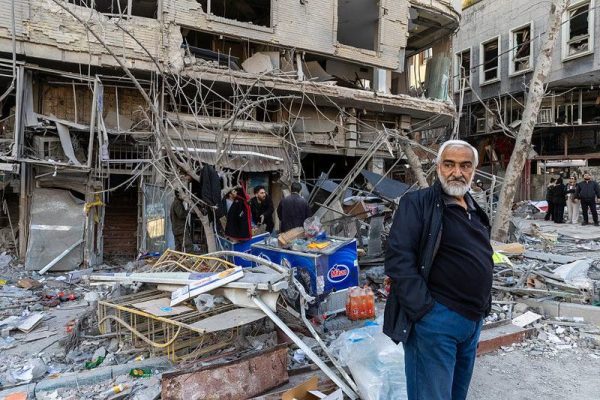
Failing to achieve regime change, the U.S. and Israel are bombing civilian areas in Tehran, in an attempt to destroy Iran as a nation.
A report in the Telegraph, a mainstream British newspaper, wrote , “Tehran an ‘apocalypse’ of hospitals in flames and children buried beneath rubble”.
The report noted, “American and Israeli aircraft bombed hospitals, residential buildings and schools across Tehran on Tuesday in what residents described as ‘an apocalypse’” adding, “Millions of civilians are trapped under relentless bombardment as food and medical supplies dwindle and the death toll mounts.”
One resident of Tehran told the paper, “They have been bombing us without pause today, and the sound of explosions never stops. They don’t care where they are hitting. I have felt the shockwaves several times already”.
He added, “They are striking buildings where families live. After each explosion, people rush to help – and then another bomb hits the same area.”
The report added:
Families ration meals to make supplies last. Children go to bed hungry. Elderly residents with medical conditions cannot find their medications.
Diabetics run out of insulin. Parents water down milk to make it stretch further. Some families have not eaten in two days. Bakeries that remain open face long lines.
It went on to write:
Areas around Revolution Square in central Tehran were struck on Tuesday, causing extensive damage to residential homes in one of the capital’s most densely populated districts.
The Haft-e-Tir neighbourhood, also in central Tehran, was hit. Video footage showed destroyed apartment buildings and rescue workers digging through rubble.
A hospital in southern Bushehr was destroyed, with emergency workers frantically evacuating newborn babies as the building was struck.
Kamran ( Tehran resident) said: “Many people are trapped under the rubble. Hospitals are filled with injured patients, and staff are overwhelmed. They are even striking hospitals where the wounded are being treated.”
The scene echoed strikes on Gandhi Hospital in Tehran and multiple other medical facilities across the country.
The destruction of hospitals means the wounded have nowhere to go. Nurses carry premature infants through smoke-filled corridors as bombs fall on maternity wards.
Burn victims lie on floors because all beds are full. Surgeons operate by torchlight when electricity fails.
Medical staff work until they collapse from exhaustion, then wake and work again. Some doctors have not left their hospitals in three days, sleeping in supply closets between emergency procedures.
Millions remain trapped in Tehran, a city under sustained aerial assault.
The report added, “‘An apocalypse is unfolding here,’ said Ashkan, another Tehran resident. ‘Today has been the worst day. Those who had cars fled. Those of us without cars are left here under the bombs.’”
It went on to note:
The strikes have created a humanitarian crisis that casualty figures do not fully convey.
Food supplies have become scarce in several parts of the city as distribution networks break down and stores close.
‘I don’t know if any of my relatives are dead or alive,’ Ashkan said. ‘One kilo of potatoes is now 200,000 tomans. That was 30,000 tomans last week.’
The report also documented the repeated use of “double tap” strikes on rescue workers, writing:
The Red Crescent said more than 100,000 rescue and relief workers across the country are on full alert, but residents said help often arrives too late or cannot reach victims at all.
“By the time rescuers arrive, another bomb falls on the same place,” Kamran said, describing what appeared to be “double-tap” strikes where initial attacks are followed by secondary strikes targeting first responders – a tactic that violates international humanitarian law.
Middle East Eye reported that the U.S./Israeli slaughter 165 children at the school for girls in Minab was also the result of a “double tap” strike, writing, “The girls’ school in Iran, where 165 people were killed by an apparent US-Israeli attack, was hit with two strikes, with the second missile killing sheltering survivors, two first responders and the parent of a slain child have told Middle East Eye.”
One Red Crescent member told the outlet, “When the first bomb hit the school, one of the teachers and the principal moved a group of students to the prayer hall to protect them. The principal called the parents and told them to come and pick up their children. But the second bomb hit that area as well. Only a small number of those who had taken shelter survived.”
The father of one victim told the outlet that, “his daughter survived the first strike and was moved to the prayer hall. The second strike hit before he could reach her.”
The outlet documented other instances of “double tap strikes” used in Iran wiring:
Since the US and Israel launched a war on Iran on Saturday, some Iranians have reported attacks that resembled double-tap strikes.
A video circulating on social media shows one woman in central Tehran in distress saying: “They dropped one bomb, people went inside, then they bombed again. They killed people.”
Another shows two men on a motorcycle, with one of them describing a near-death experience.
“We went to drag out people from under the rubble, and then the jet returned twice and pounded the same location four more times. We would have been dead if we weren’t still under the rubble,” he says.
A resident of Tehran who left for Turkey told Reuters , “We saw a lot of buildings destroyed, especially on the way leaving the country. There were a bunch of buildings, a bunch of cars and streets were destroyed. People are panicking to leave the country. They don’t know what to do”.
According to the Western group “Human Rights Activists News Agency, “the total number of reported civilian deaths stands at 1,114, including 181 children”.
As academic Glenn Diesen noted, referring to this report , “The US and Israel are bombing hospitals, schools, residential buildings, and Mehrabad international airport in Tehran. Having failed to regime change Iran, the new objective appears to be terror-bombing Iran into submission”.
Witkoff undermined Iran talks by peddling lies to build case for military aggression: Report
Press TV – March 4, 2026
US President Donald Trump’s special envoy to West Asia, Steve Witkoff, undermined the negotiations with Iran by peddling lies to build a case for military aggression, according to a report citing regional diplomats.
“In that first meeting, both the Iranian negotiators said to us directly, […], that they controlled 460 kilograms of 60%,” Witkoff said Monday in a Fox interview, referring to the uranium’s level of enrichment.
“And they’re aware that that could make 11 nuclear bombs, and that was the beginning of their negotiating stance,” he claimed.
“They were proud of it,” Witkoff further claimed. “They were proud that they had evaded all sorts of oversight protocols to get to a place where they could deliver 11 nuclear bombs.”
However, a Persian Gulf diplomat with direct knowledge of the talks told MS NOW that Witkoff’s description of the conversation was false.
The Iranians told Witkoff that Iran was willing to give up the enriched uranium as part of a new agreement with Trump, according to the unnamed Persian Gulf diplomat.
The Iranians also told Witkoff that Iran enriched the uranium after Trump pulled out of a 2015 nuclear agreement brokered by the Obama administration.
“I can categorically state that this is inaccurate,” said the diplomat, referring to Witkoff’s account. “He was explaining that all of this material can all go away should we have a deal and Iran can be relieved from sanctions.”
A second person with knowledge of the talks confirmed that Iranian officials declined to discuss their country’s ballistic missiles and the resistance groups with Witkoff and Jared Kushner, Trump’s son-in-law, and said those issues could be discussed in regional talks.
While Iran was engaged in the negotiations, on Saturday, the US and Israel, similar to previous times, started their unprovoked military assault, launching attacks on multiple cities across the country.
Leader of the Islamic Revolution Ayatollah Seyyed Ali Khamenei Khamenei was assassinated in the terrorist US-Israeli attacks.
Iran began to swiftly retaliate against the criminal aggression by launching barrages of missile and drone attacks on the Israeli-occupied territories as well as on the US bases in regional countries.
Iraqi Resistance reports drone attacks on US targets in Erbil
Al Mayadeen | March 4, 2026
The Islamic Resistance in Iraq – Saraya Awliya al-Dam announced that its fighters carried out an attack using a swarm of drones targeting a US forces base near Erbil International Airport, a hotel in Erbil used by US forces as accommodation for their soldiers, and a vital target in Jordan.
The group said the operations came in retaliation for the assassination of Iranian Leader Sayyed Ali Khamenei, and as a deterrent against the aggression that led to the martyrdom of several young Iraqi resistance fighters.
In a separate statement, the Islamic Resistance in Iraq said its fighters carried out 27 operations on Tuesday, using dozens of drones and missiles targeting “enemy bases in Iraq and across the region.”
In a related development, the Popular Mobilization Forces (PMF) announced that US occupation forces targeted one of the headquarters belonging to the Al-Jazira Operations Command in Jurf al-Nasr, confirming that the attack did not result in any casualties or losses.
Iraq asserts stance with Iraq
In a separate development, Al Mayadeen’s correspondent in Baghdad reported that a vehicle belonging to Iraq’s Popular Mobilization Forces (PMF) was targeted on the Musayyib–Iskandariya road, north of Babil province.
The correspondent added that the Iraqi government has taken what were described as significant positions regarding the US-Israeli aggression against Iran, reflecting Baghdad’s official stance amid the escalating regional tensions.
He also noted that mourning gatherings have been held in most Iraqi cities for Sayyed Ali Khamenei, with councils of condolence organized in several provinces.
US Bases Targeted
The developments come amid a widening regional confrontation following the US-Israeli military aggression on Iran, which has triggered a series of retaliatory actions by groups aligned with the Axis of Resistance across the region.
In recent days, Iraqi resistance factions have warned that US military installations in Iraq and neighboring countries would remain legitimate targets as long as Washington continues its military operations against Iran and its allies.
The escalation has raised concerns about the growing vulnerability of US bases across West Asia, many of which host American troops as part of the so-called “anti-ISIS coalition” but have increasingly come under attack since the outbreak of the broader regional conflict.
Iran warns all Israeli embassies ‘legitimate targets’ if Lebanon embassy attacked
Press TV – March 4, 2026
Iran has warned that all Israeli embassies worldwide will be legitimate targets if its diplomatic mission or representatives in Lebanon are hit by the regime.
The warning, issued by General Abolfazl Shekarchi, spokesman for the Iranian Armed Forces, follows an ultimatum from the Israeli war machine demanding that Iranian representatives leave Lebanon immediately within 24 hours.
In a statement, General Shekarchi addressed recent Israeli threats against the Iranian embassy in Lebanon. “Until now, out of respect for the countries of the world, despite our capabilities, we have not taken action against Israeli embassies around the world,” General Shekarchi stated.
However, he warned that any strike on Iranian diplomatic soil would result in a total shift in that policy.
“Should Israel commit such a crime, we will be forced to treat everyone of their embassies across the globe as a legitimate target.
This will certainly be carried out, as Iran is determined to bring Israel and the United States to their knees.”
The threats came against the backdrop of U.S.-Israeli aggression against Iran, which began on Saturday with airstrikes assassinating Leader of the Islamic Revolution Ayatollah Seyyed Ali Khamenei. The following strikes have killed over 1,000 people and damaged civilian infrastructure.
In the meantime, Israeli airstrikes across Lebanon have intensified, killing at least 50 people and injuring 350 in the last 48 hours alone.
The Lebanese group Hezbollah has launched waves of attacks on Israeli military sites, citing both the defense of Lebanon and the assassination of Ayatollah Khamenei.
Iran has launched massive waves of drone and missile attacks at the Israeli-occupied territories and US assets across West Asia.
Veteran War Correspondent Reveals How to Tell When Analysts Talking About Iranian Losses Are Lying
Sputnik – 04.03.2026
“In every war, destroying a launcher is a very popular claim because it implies that the Israelis have reduced future attacks. This is a domestic and international message that ‘we have achieved the main objectives of the military campaign’,” says Elijah Magnier, a prolific journalist and war reporter covering Middle East conflicts since the 80s.
“But the standard of evidence it’s another matter,” the veteran observer told Sputnik.
“What is credible is before and after imagery. So showing an identifiable launcher vehicle, and they have to be authentic, not a decoy. And then geolocated strike footage, with clear launcher signature, and [a] pattern of fire decline consistent with launcher attrition,” Magnier explained.
“The Americans and the Israelis can claim that they’ve hit a ‘suspected’ launch site and they’ve used this term a lot, which means there is no proof of a launcher present, or there are strikes on empty pads or decoy equipment,” Magnier stressed.
Pointing to the intensity of Iran’s counterstrikes in the first days of the conflict, and its adoption of the strategy learned during the June 2025 war that enemy defenses start running out of interceptors after a few days of intense fire, Magnier says the real measurable sign of whether enemy attacks are degrading Iran’s capabilities will be whether its missiles continue firing after ten days or more.
Did Kuwait really shoot down three US F-15s?
There are some technical holes in the Pentagon’s official “friendly fire” story
RT | March 4, 2026
The US military wants you to believe that its worst day of air combat losses since the Vietnam War was the result of a “friendly fire” mishap. But do some digging and that story begins to look far-fetched.
Three US F-15E Strike Eagle fighter jets were shot down over Kuwait on Monday morning in what US Central Command (CENTCOM) called “an apparent friendly fire incident.” All six crew members – two per plane – ejected safely and suffered no serious injuries.
The incident made Monday the joint worst day of losses for the US Air Force since the Vietnam War. Only once in the five decades since Vietnam has the USAF lost three fighter jets in a single day: when two F-16s and an F-15 were shot down over Iraq on the second day of Operation Desert Storm in 1991.
CENTCOM claimed that the F-15s “were mistakenly shot down by Kuwaiti air defenses.” While this story may well be true, some inconvenient plot holes suggest that someone else may have been responsible.
The Patriot problem
Video footage suggests that the F-15s suffered hits to their engines, indicating that they were taken out by heat-seeking missiles.
However, none of Kuwait’s surface-to-air missiles operate this way. Kuwait has 35 M902 Patriot missile batteries, and a smaller number of HAWK, NASAMS, and Italian-made Spada 2000 systems. Those systems all fire radar-guided, not heat-seeking, missiles.
The Patriot’s PAC-3 missiles physically slam into the center mass of incoming jets or ballistic missiles, while the missiles fired by Kuwait’s other systems detonate a fragmentation warhead in close proximity to incoming threats. Used against jets, they typically detonate between the target’s fuel tanks and cockpit.
The trails typically left behind by PAC-3 and similar missiles were not visible in the sky at the time the F-15s were shot down.
Assuming Kuwait used its most numerous and modern Patriot systems against the F-15s, the fact that all six crew members survived is a statistical anomaly. No pilot, friend or foe, has ever survived a successful Patriot missile interception. Ukrainian fighter pilot Aleksey Mes was killed when his US-supplied F-16 was shot down by a US-supplied PAC-3 missile in 2024, while both the pilot and navigator of a British Tornado reconnaissance jet were killed instantly when a PAC-3 missile hit their aircraft over Iraq in 2003.
Friends and foes
Patriot and other US air defense systems are equipped with IFF (Identification Friend or Foe) technology. IFF transponders on US warplanes broadcast an encrypted signal that ground radars can read, indicating that the aircraft is friendly and preventing the release of weapons against it. It is extremely unlikely that American jets would have been operating over Kuwait without an IFF connection with Kuwaiti air defense, although such mistakes have happened before: the deaths of Aleksey Mes in 2024 and the British crew in 2003 were blamed on failure by air and ground crews to share IFF codes before missions.
Clues in the statements
CENTCOM’s statement includes one potentially telling line, stating that at the time of the shootdowns, “attacks from Iranian aircraft” were ongoing. The presence alone of Iranian jets does not mean that they were responsible for shooting down the F-15s, just that the possibility cannot be excluded at present.
CENTCOM said that “Kuwait has acknowledged this incident,” but a statement by the Kuwaiti Defense Ministry made no mention of any friendly fire. Instead, it said that “several” US aircraft crashed, and that there were “a number of hostile aerial targets” overhead at the time.
Who shot down the F-15s?
There are two competing theories. CENTCOM’s “friendly fire” explanation is not technically watertight and isn’t backed up by Kuwait, but remains possible. The Pentagon is currently investigating the incident, and has promised that “additional information will be released as it becomes available.”
On the other hand, the Iranian military has claimed responsibility for downing at least one of the jets. In a statement on Monday, the Khatam Al-Anbiya Air Defense Base said that “an F-15 fighter jet [belonging] to the intruding US army which intended to attack the country has been targeted by the Islamic Republic of Iran’s Air Defense and brought down.”
Located in Tehran, Khatam Al-Anbiya Air Defense Base coordinates air defense activity between Iran’s army and the Islamic Revolutionary Guard Corps (IRGC).
It is possible that Iranian interceptors could have reached the skies over Kuwait, but Iran’s medium-long range air defense systems also fire large radar-guided missiles that typically obliterate enemy aircraft. Therefore, it may seem an obvious conclusion that the planes were taken down by short-range heat seeking missiles like the R-73 or R-74 projectiles used by the Iranian Air Force. However, with only official statements from both sides to work with, RT cannot speculate as to whether this was the case.
Two wartime constants are that mistakes happen, and militaries lie about their wins and losses. For the US, neither explanation paints a positive picture: it either lost three jets in one day to incompetence and confusion between its personnel and their allies, or to an enemy deemed inferior and on the verge of defeat. For now, the truth remains shrouded in the fog of war.
Trump’s Iran war will put him in the history books, but…
By Martin Jay | Strategic Culture Foundation | March 4, 2026
Did Marco Rubio just admit that Israel dragged the U.S. into the war with the first strike? The whole world is just waking up and realizing that the war is based on no strategy whatsoever. How very Trump.
Churchill’s comment about history being kind to him, because it will be him (Churchill) who will write it, isn’t going to apply to Donald Trump, who is the first U.S. president to succumb to Israel goading America into a war with Iran.
Things aren’t going very well for Israel and the U.S. in the war with Iran. Even though Iran is pounded by missiles daily, it would seem that no real effect has been felt on its military infrastructure which, itself, continues to have significant success against its enemy. While the GCC countries quickly run out of U.S. air defence missiles, many of their citizens are waking up to a new reality: that many of the missiles and bombs exploding are, in fact, not even coming from Iran but have been placed by Mossad agents whose objective is to drag these countries into the war. Despite days passing now and rumours of this happening on social media, it is unlikely this will happen, though, as those leaders are afraid that Iran’s main ace – an obliteration of the oil infrastructure – has yet to be played, which would wipe out those countries’ economies within hours. And yet there is some cruel poetic justice being played out here, as those same GCC countries went to great lengths before the war kicked off to underline their lack of support, on a practical level, for Israel and the U.S. It has transpired that at least one leader, Mohammed bin Salman of Saudi Arabia, did at least goad the U.S. on to go ahead with the attack. The Iranians didn’t need to read this in the British broadsheet Daily Telegraph, as their own intelligence probably tipped them off about such a discussion, but it is hardly surprising now that they still consider the GCC countries as potential enemies and retain the threat of destroying their oil fields.
The problem for Trump is not Marco Rubio admitting that it was Israel that went ahead with the Iran strikes, therefore being the one who made the decision to start the war, which makes Trump look ineffective and a junior partner in the bigger plan; it’s not even that Rubio’s comments about needing to destroy Iran’s nuclear capability make Trump’s earlier bombing fiasco in June of last year look ridiculous and present the U.S. president as a liar and a fraud. The real problem for Trump is not even the constant, repetitive nature of a chaotic communications strategy where someone like Rubio seems to be working from a different set of messages.
Trump’s real problem is two-fold. One, he is not in command, but Bibi is. And two, even if he was in command or had some influence over the outcome or the methodology, he doesn’t have a strategy. For Israel, having no strategy is not a problem, as American lives are ten a dime for the Zionists. All Bibi wants to do is to go to war with Iran, with or without a strategy, and use American money and lives in the process. The foaming-at-the-mouth zeal of these Zionists overrides reason and rationale, and by the time everyone realizes this, it’s too late. Yes, Israel showed great capability on the battlefield twice in ’67 and ’73, but that was in a regional war with only Egypt and Syria to contend with. Iran is a different case altogether, and the plain truth is that Mossad’s impressive intelligence gathering, which tracks individuals and located Iran’s leader at his home compound, has not been put to good use to work out the realities of how long the country can sustain bombing. Israel and the U.S. have seriously underestimated Iran’s military capability and overestimated their own. The fact that the U.S. is already taking THAAD and Patriot missile systems from South Korea and shipping them to the region is an indication that despite Trump talking of weeks, in reality the truth is that he was probably told by Bibi that it would all be over in a couple of days. America’s own bases in the Middle East have also proved to be woefully under-protected, and the anger by local people in many of these GCC countries that they have been left so vulnerable and that they are often victims when those bases are struck is boiling over now and giving elites there a new problem to contend with, as a political uprising is now a reality.
It would seem almost all of the planning was ill-advised in the first place and based on wishful thinking and ignorance. The greatest example of this is the assassination of the Supreme Leader. The Israelis no doubt told Trump that this would be a critical factor in the regime collapsing, but they couldn’t have been more wrong. It has galvanized support even more behind the regime to fight this war once and for all and to reset history. Iranians are tired of being a convenient enemy for successive U.S. presidents and the Zionists who don’t even follow their own script on why they want to go to war with Tehran in the first place. Of all of Trump’s blunderings in his second term, this one will be remembered for generations to come. The worry, of course, is that the same miscalculation will be mulled over for the nuclear option, probably by the Israelis first, when they see that slowly but surely Israel is being erased from the map. The astonishing takeaway from the last few days, though, is not the buffoonery of Trump but the sombre strategizing by Iran and in how much it holds back.
The murder of Iranian schoolchildren cannot be whitewashed
By Eva Bartlett | RT | March 4, 2026
In Iran, under ongoing US-Israeli attacks, a mass funeral took place today for 168 Iranian schoolgirls aged 7-12, killed by an Israeli airstrike on February 28.
The strike hit the Shajareh Tayyebeh girls’ primary school in Minab, southern Iran, in broad daylight, when the children were at school. Fourteen teachers were also killed in the bombing. The bombing occurred as part of US-Israeli attacks sadistically dubbed ‘Operation Epic Fury’, attacks which have to date targeted schools, hospitals, residential areas and other civilian infrastructure.
It was a scene all too familiar to Palestinians: grief-stricken parents collapsing sobbing at the site of their daughters’ murders, clutching bloodstained backpacks, pulling out schoolbooks and personal items of their slain daughters. Children’s desks covered in debris from the bombing. A child’s shoe in the rubble. Death where life had flourished.
None of this is being conveyed by Western legacy media – only ghoulish gloating over the US-Israeli bombardment of Iran and the murder of Ayatollah Ali Khamenei, Iran’s supreme leader, and his young granddaughter and children.
On March 2, Iranian Foreign Minister Abbas Araghchi posted a photo of the graves being dug on X, noting, “These are graves being dug for more than 160 innocent young girls who were killed in the US-Israeli bombing of a primary school. Their bodies were torn to shreds. This is how “rescue” promised by Mr. Trump looks in reality. From Gaza to Minab, innocents murdered in cold blood.”
At the time of this writing, 69 of the murdered girls remain unidentified.
International reaction: Silence
If the bombed school had been in Israel or Ukraine, news of it would have been plastered on front pages of Western media for days, with widespread demands for retaliation, or at least for justice and accountability. Back in 2016, Western media alleged Syria or Russian planes had injured Aleppo boy Omran Daqneesh. His photo went viral, for weeks, even years. A CNN news anchor fake-sobbed for the boy. In 2017, in his home, his father told me their home was not hit in an airstrike, but rather terrorists shelled it and used the boy in a cynical, and effective, photo op.
Footage shared on Telegram and on X clearly show horrific scenes of some of the young girls torn apart in the US-Israeli bombing of their school. But just like the untold thousands of Palestinian children killed by Israel, as well as the half a million Iraqi children killed by US sanctions, these Iranian children’s lives don’t merit Western media outrage. Instead, they produce cynical reports that not only lack any semblance of empathy, but suggest that Iran is either lying about or is to blame for the murders.
Take the BBC’s report, which describes the massacre as a “reported” strike on a school, which “Iran has blamed the US and Israel” for. Casting doubt is standard for legacy media whitewashing the US and Israel’s crimes. The US is “looking into reports.” Israel is “not aware.” Just one of those mysterious unknown strikes.
The BBC then overtly blamed the Iranian government as untrustworthy, writing, “Deep mistrust of the Iranian regime, however, makes official reports difficult for many to accept, and some Iranians directly blamed the regime for the attack.”
The BBC did similarly dishonest and deceptive journalism in 2014 in Damascus after terrorists in eastern Ghouta had shelled an elementary school, killing one child and injuring over 60. The BBC later reported: “the government is also accused of launching [mortar strikes] into neighborhoods under its control.” The BBC could have easily learned about the trajectory of mortars and from where the strike in question could only have come: the terrorist “moderates” east of Damascus.
The New York Times also got the memo, likewise omitting Israel from the headline and implying Iran is lying. But when it comes to blaming Iran for its retaliation, the NYT has no problem stating whose missile strike it was. And there is no “Israel says.”
CNN ran the headline “A girls’ elementary school was hit in Iran. Here’s what we know.” Its video report not only doesn’t mention the US or Israel, but insinuates Iranian blame: In an Israel-like tactic (recall Israel’s claiming Gaza’s Shifa hospital was a “Hamas base”, and staging weapons as “proof”), CNN claims the children’s school could be connected to an Iranian Revolutionary Guards (IRGC) base. But The Cradle noted that the school had operated independently as a civilian institution for over a decade, with separate entrances, playgrounds, and classrooms.
CNN’s report did, at least, debunk online claims that the school was hit by a failed missile launch by Iran, noting the photo shared online as “proof” of the claim was actually taken 800 miles from Minab. But, hello? If it wasn’t a failed Iranian missile there is clearly one remaining explanation: the schoolgirls were killed by US-Israeli bombing.
Most Western media cite The US military’s Central Command (Centcom) as saying it was “looking into reports of the incident,” and the Israeli army as saying it was “not aware of any IDF operations in the area.” Ah yes, the guilty shall investigate themselves. Right.
Even if you set aside the actual culprit of the school bombing, legacy media reports are devoid of any concern for the slaughtered children: no details, no empathy, no mention that they were murdered in the Muslim holy month of Ramadan. The tone would be radically different were the children Israeli, Ukrainian or American. We would see names, ages, stories about them. They would be humanized – if only they were not Iranian (or Palestinian, or Lebanese, or Syrian).
Since the February 28 Minab school massacre, US-Israeli strikes have attacked still more civilian infrastructure, killing and injuring more Iranian civilians.
One man recounted to RT how after the bombing of central Tehran’s Enghelab Square he’d seen a decapitated person in front of his café. Walking around showing the destruction, RT’s Tehran bureau chief Hami Hamedi pointed out residential buildings, cars, shops, damaged and destroyed in recent bombings where a police station was among those targeted.
This was the same tactic which Israel used on December 27, 2008, when it unleashed over 100 bombs nearly simultaneously on Gaza, targeting police stations, police academies, universities and more, destroying and damaging shops and residential buildings around them.
I was in Gaza at the time and saw the immediate aftermath of the initial bombings, the chaos and destruction in every direction. Shifa hospital, Gaza’s main hospital, was an endless circuit of cars and ambulances bringing the dead and injured.
That was 17 years ago, and Israel has repeated this brutal tactic over and over again in Gaza, Lebanon and now Iran. We’ve seen this US-Israeli strategy of terrorizing the people by widely attacking civilian infrastructure repeatedly in Gaza, Lebanon, Iraq, to list only some of the targeted regions – as well as being replicated by the Kiev regime in the Donbass. The intent is always destabilization and instigation of fear in hopes of causing the people to turn against their government. It never works, but it invariably kills countless innocent civilians and flattens infrastructure.
To add further insult, days after the girls’ school massacre, Melania Trump presided over a UN Security Council meeting on children in conflict. You can’t make this insanity up. The wife of a US president who is co-waging a war on children in Iran feigns concern over children in conflict.
The US and its bought media have so little regard for Iranian lives that they don’t even bother to try to explain, much less apologize for, the murders of the 168 schoolgirls. Outrageously, it is as if they simply never existed to Western media.
But it is true that every war crime, every murdered child, fuels support not only to their government but to resistance in general. And Iran is resisting and retaliating in ways that will make the US wish it hadn’t co-started this war on the people of Iran.
Eva Bartlett is a Canadian independent journalist. She has spent years on the ground covering conflict zones in the Middle East, especially in Syria and Palestine (where she lived for nearly four years).
How Germany became Israel’s enabler-in-chief
By Tarik Cyril | RT | March 3, 2026
Say what you will about Germany’s current ‘elites’, but they are consistent: Once they don’t give a damn about international law, elementary fairness, rudimentary human decency, and, last but not least, basic logic, they really won’t quit before their country’s reputation is ruined as it has not been since 1945. Hyperbole, you think? Can it really be that bad, you wonder?
Leave it to Chancellor Friedrich Merz and company to achieve what seems almost impossible. For almost two-and-a-half years, not one but two German governments have been, in effect, complicit in Israel’s continuing Gaza genocide. Under former Chancellor Olaf Scholz from the centrist Social-Democrats – otherwise remembered for gutless evasion when US ex-president Joe Biden announced, in essence, that he was going to blow up Nord Stream – as well as under the unusually dishonest Merz from the centrist Christian-Democrats, Berlin has supplied Israel with arms (and probably misled the International Court of Justice about it), diplomatic cover, legal support, media propaganda, and the often brutal suppression of protests against Israel’s crimes.
Indeed, recently a UN special rapporteur has identified the “use of anti-terrorism laws to restrict advocacy for Palestinian rights” as “a primary concern” in a report warning that the “space for freedom of expression is shrinking” in Germany.
Against this awful and shameful background, the fresh war of aggression launched by Israel and its American auxiliaries – that’s the technically correct term for troops serving a foreign nation – could, conceivably, have been a very late wake-up call. Perhaps, an eternal optimist may have thought, the sheer brazenness of the attack will make even Berlin hesitate. Nope. Instead, Friedrich Merz and official Germany in general have radicalized their virtually nihilistic denial of law, ordinary ethics, and common sense.
One day after the beginning of the Israeli-American war of aggression, Merz took the lead and set the tone by going public with a perverse misreading of the situation. Starting by labeling the heinous assault – launched, according to US and Israeli custom, under the cover of ongoing negotiations – “massive military strikes,” Merz acknowledged that they had killed members of the Iranian government (which he, of course, caricatured as a “Mullah” and “terror regime”) including “the religious leader” Ayatollah Khamenei. If you expected the slightest sign of disapproval or even just discomfort at these cold-blooded murders of high government officials, you don’t know Friedrich Merz yet.
Instead the German chancellor – or in his terms, perhaps, ‘vassal regime’ leader? – highlighted the need to help German tourists stranded in the warzone and to protect public order in Germany by preventing “antisemitic and anti-American attacks.” Translation from Berlin officialese: by ramping up suppression of all and any criticism of Israel and America.
Then, after a catalogue of Israeli and American propaganda talking points against Iran – nuclear this, ballistic that… you know the drill – reproduced with the earnest assiduity of an eager pet pupil, Merz went on to assure “many Iranians” that his Berlin regime shared their relief at, in effect, being properly bombed, again.
In general, the chancellor’s speech was a textbook example of perpetrator-victim inversion. Clearly approving of the Israeli-American assault, Merz had the chutzpah to sternly demand that Tehran must “at once” stop its “indiscriminate attacks.” Those, of course, do not, actually, exist. Because Iran is acting in clear and obvious self-defense – the only legitimate reason, apart from a UN mandate, for resorting to military force – and, as before, its counter-strikes at those attacking it are still remarkably selective and restrained.
To be fair even to Merz, at least, he was a little less disingenuous than usual. He frankly, if in stilted language, admitted that he could not care less about international law. Friedrich, to be honest, we have always known that much about you – despite your hypocritical invocation of “rules” and “values” whenever you feel like going after Russia again – but it’s nice you’re coming out so openly now.
But Merz got back to his usual, absurdly devious self very quickly. Because, you see, it’s Iran that is to blame when Friedrich Merz treats international law as utterly dispensable. At least according to Friedrich Merz, who explained that all those beautifully law-based measures taken regarding and, really, against Iran before this fresh war, did not work. Oh, Tehran, really how uncouth of you! Neither devastating sanctions, nor the US cancelling the JCPOA agreement, nor ongoing assassination and subversion campaigns waged by Israel and its friends, nor last year’s ‘12-day’ war of aggression made you submit.
For, clearly, according to Berlin logic, these must be those international-law based operations Merz was referring to. Make it make sense. Now, in his defense, for a man who sees no problem with his US and Polish ‘allies’ and Ukrainian dependents blowing up Germany’s vital infrastructure, the Iranian insistence on not being bullied and defending national sovereignty must be truly incomprehensible. So maybe, Merz isn’t really morally and legally perverse but just a tad out of his very shallow depth.
By the way, Merz’s justifying a war of aggression by Iran not having bent the knee even after decades of “comprehensive sanctions packages” is likely to be noted with great interest in Moscow: If that’s how German elites see the world now – first we sanction you and then, if you still don’t knuckle under, we have a de facto right to attack you – the Russian leadership is certain to draw the obvious conclusions. Again, Merz probably didn’t even understand the insanely destabilizing implications of what he was saying. But they are there, nonetheless.
In short, Merz’s address was stunningly absurd and a horrific moral and intellectual failure, a disgrace for his country. It should be noted, however, that polls show that this atrocious line of unconditional compliance with both Benjamin Netanyahu’s genocidal apartheid Israel and Donald Trump’s Make-Israel-Greater US is not shared by all Germans. On the contrary, 57% of respondents of a poll are against the attack. Less than a third – 29% – approve of it. Likewise, even in Germany, a preponderant majority – 83% – has finally learned to consider Israel’s actions in Gaza unjustified: In the fall of 2023, when Israel started its genocide, 50% of respondents thought they were justified.
Such polls are nothing to be proud of: German society as a whole is still far too wrongheaded and submissive, when it comes to Israel’s crimes and those of the US, too. But if you know the level of crude media propaganda and relentlessly one-sided indoctrination that Germans are subject to, these numbers still show that for the nation – unlike for its “Atlanticist” elites – there may be some hope.
For now, however, the failure that Merz represents is still in control. He himself has gone to Washington to flatter Donald Trump by praising his latest crime to his face. Netanyahu, meanwhile, may well be in Berlin, in which case German politicians, judges, prosecutors, and police are criminally liable for failing to arrest the war criminal, as the warrant of the International Criminal Court unambiguously requires. Even if his plane parked in Germany is only part of a deception operation, Berlin’s taking part in such a ruse is also morally repulsive and possibly criminal, too.
Germany as a whole has failed the tests of both the Gaza genocide and the wars of aggression against Iran. Its “elites” are a disgrace represented all too well by its chancellor. That is a sad thing to have to state. Yet there is no chance of political and moral renewal without facing this fact. We are back to an old question: What would it take for Berlin to grow a conscience?
Tarik Cyril Amar is a historian from Germany working at Koç University, Istanbul, on Russia, Ukraine, and Eastern Europe, the history of World War II, the cultural Cold War, and the politics of memory.
US commanders tell troops Iran war ‘God’s divine plan,’ Trump anointed to ‘ignite Armageddon’: Report
The Cradle | March 3, 2026
Independent journalist Jonathan Larsen reported on 2 March that numerous US service members have lodged dozens of complaints saying senior officers are calling the war on Iran part of “God’s divine plan,” with claims that US President Donald Trump was “anointed by Jesus” to spark Armageddon.
“President Trump has been anointed by Jesus to light the signal fire in Iran to cause Armageddon and mark his return to Earth,” one combat-unit commander allegedly told troops during a readiness briefing, according to a complaint submitted to the Military Religious Freedom Foundation (MRFF).
The complaint is one of more than 110 logged within 48 hours, spanning over 40 units across at least 30 military installations, with soldiers telling the MRFF that commanders are describing the Iran campaign as divinely ordained and tied to the Book of Revelation.
The Non-Commissioned Officer (NCO) stated they were writing on behalf of 15 troops, including at least 11 Christians, one Muslim, and one Jew, and described the remarks as “so toxic and over the line” that they shocked those present.
The email sent to Larsen argued that such rhetoric “destroy[s] morale and unit cohesion and [is] in violation of the oaths we swore to support the Constitution.”
MRFF President Mikey Weinstein said the over 110 reports share “one damn thing in freaking common” – what he called “the unrestricted euphoria of their commanders” who view the war as “biblically-sanctioned” and a sign of the approaching “End Times.”
Weinstein warned that commanders celebrating how “bloody all of this must become” in order to align with “fundamentalist Christian end of the world eschatology” may be violating constitutional and military law.
He stated that any personnel advancing “blood-soaked, Christian nationalist wet dreams” in official capacities should be prosecuted under the Uniform Code of Military Justice.
The reports also coincide with a pattern of senior US figures framing geopolitical policy through explicitly biblical narratives.
In a February interview with Tucker Carlson, former Arkansas governor Mike Huckabee ignited diplomatic backlash after asserting that Israel holds a “biblical right” to territory stretching from the Nile in Egypt to the Euphrates in Iraq – an expanse spanning much of West Asia often called ‘Greater Israel.’
Pressed on whether it would be acceptable for Israel to claim the land based on the “original deed” described in Genesis 15, Huckabee replied, “It would be fine if they took it all.”
Secretary of Defense Pete Hegseth has repeatedly invoked “crusade” language to frame what he describes as a civilizational struggle against Islam.
In his 2020 book ‘American Crusade,’ he wrote that “today’s American Crusaders will need to muster the same courage against the Islamists” as those who “pushed back the Muslim hordes” in the 12th century.
Hegseth has also drawn scrutiny for several tattoos, including the Crusader rallying cry “Deus Vult” – meaning “God wills it” – and a more recent Arabic inscription reading “Kafir,” translated as “infidel,” inked on his bicep.
In a 2025 address to a gathering of around 800 US generals and admirals, Hegseth called on military leaders to abandon “stupid rules of engagement” in favor of “maximum lethality,” telling those uncomfortable with his directive to resign.
Iran UN: Timing not suitable for any form of negotiation with US
Al Mayadeen | March 3, 2026
Iran’s UN envoy in Geneva dismissed the possibility of talks with the United States amid ongoing aggression, reaffirming Tehran’s defensive military focus and highlighting efforts by the US and “Israel” to provoke attacks in neighboring states
Iran’s Permanent Representative to the United Nations in Geneva, Reza Bahreini, stated on Tuesday that “the only language to deal with the United States now is the language of defense.”
Speaking at a press conference in Geneva in response to questions from Al Mayadeen, Bahreini emphasized that Iran is currently focused on defense, adding that the timing is not suitable for any form of negotiation.
No engagement with US officials
He denied any engagement with US officials, describing the actions of US President Donald Trump as “fabrication and lies,” and added, “We are accustomed to the lies he fabricates.”
Bahreini stipulated that any change in the course of events would require an end to hostilities and a guarantee that such aggression against Iran would not be repeated.
Regarding timing, he stressed the importance of this core issue, stating, “Our defense system will respond with great force and seriousness to reach a stopping point for this aggression and to ensure that no new attack or aggression occurs against Iran in the future.”
When asked about Iran’s relationship with countries hosting US bases after the war, Bahreini responded, “We are neighbors and will remain neighbors, and we are friends and will remain friends.”
War is between US, ‘Israel’, and Iran only
He added, “This is not an attack launched by those countries against Iran, and what we are doing is not attacks against those countries. As I told you, this is a war between Iran, the United States, and Israel.”
Bahreini confirmed that Tehran’s military forces “have been ordered to exercise extreme caution and vigilance in attacking and striking US military bases only, without harming any non-military sites in those countries,” emphasizing that “this is what happened.”
He highlighted that “no harm occurred to non-military sites in neighboring countries,” and explained that “everything Iran did, and the attacks carried out by our military forces, were solely and exclusively against US military bases.”
Bahreini also expected neighboring countries “to understand what we are doing, because under no circumstances can we allow those bases to be used to conduct military operations against Iran,” adding that neighboring countries must not permit aggressors to use their territory against Iran.
He concluded by underscoring the principles at stake. “This is the principle of friendship, the principle of peaceful coexistence, the principle of neighborhood that our neighbors and we must all maintain and preserve.”
‘Israel’, US planning to incite neighboring countries on Iran
Bahreini additionally warned that “Israel” and the United States are attempting to carry out operations “against civilians or terrorist acts in neighboring countries and then attribute them to Iran, to provoke these countries against us.”
Bahreini added that he is “confident they will not succeed if neighboring countries show sufficient vigilance and are aware and prepared for any scenario, for any bad scenario that the United States and Israel may execute.”
He also reaffirmed Iran’s commitment to international law, stating, “We reiterate that our military forces remain committed to the principles of international law and the principles of international humanitarian law.”
Corroborating Bahreini’s remarks on provocations, on The Tucker Carlson Show, journalist Tucker Carlson reported that authorities in Qatar and Saudi Arabia had arrested “Mossad agents who were planning on committing bombings in those countries,” calling the development “weird” and questioning the logic behind it.
“Why would the Israelis be committing bombings in two Gulf countries, which are also being attacked by Iran? Aren’t they on the same side?” Carlson asked, before answering himself: “Israel wants to hurt Iran and Qatar and UAE and Saudi and Bahrain and Oman and Kuwait.”
Featured Video

Iran FM Araghchi: “Hormuz Will No Longer Be the Same”
or go to
Aletho News Archives – Video-Images
From the Archives
Sam Husseini: The entire US establishment helped lie their way into the Iraq war
By Slava Zilber | American Herald Tribune | October 14, 2019
Sam Husseini is a senior analyst with the Institute for Public Accuracy, independent journalist and contributor to The Nation and FAIR.
Slava Zilber: Sam, three years ago, you appeared on Talk Nation Radio with David Swanson and spoke about the case of the GCHQ whistleblower Katharine Gun. You pointed out that the people involved in the spying on the UN and the people authorizing the Iraq War were not held accountable:
“Virtually everybody who went along with the war, whether it is Kerry or Clinton, of course, the Bush administration themselves has falsified their own records in terms of why, what they did, when they did, why they did it, to the extent that they’ve been scrutinised at all.”
You also address it in a recent article. And recently, Joe Biden has been lying about his position on the Iraq War. How can such an important issue escape meaningful scrutiny? … continue
Blog Roll
 Aletho News
- The Mecca Pact Courts Iran: Containment Comes Full Circle
- Oman FM: Persian Gulf states, Iran, Iraq should form security pact excluding US
- Trump peddles fresh falsehoods, claims Iran ‘started the war’ as US aggression drags on
- Ukraine quagmire? Yes, but it’s for NATO, not Russia
- US intelligence hypes Chinese, Russian space threats while accelerating its own military buildup in orbit
- Iran FM Araghchi: “Hormuz Will No Longer Be the Same”
- EU facing trillion-euro debt hole while seeking more cash for Kiev
- How US, Europe, Persian Gulf states exhausted missile stockpiles, splurged billions to defend Israel
- Up in arms… Koreans reject U.S. empire’s plan to make South Korea the next Ukraine
- Iran, Turkey, Pakistan, Saudi Arabia could advance region-led security framework in Tehran: FM spox
- If Americans Knew
- An error has occurred; the feed is probably down. Try again later.
- No Tricks Zone
- Sudden Stratospheric Warming, Powerful El Niño Combination May Lead To Extreme Europe Cold, Energy Crisis!
- Two New Studies Find Thwaites Glacier Melt Cannot Be Driven By Human Activity Or A Warming Ocean
- E-Cars Reduce CO2 Emissions By Only 41% Compared To Internal Combustion Engine Vehicles
- Predictions Made By Renowned Climate Professor Over Past Decades Have Been Proven To Be Poor
- New Study Suggests Large Regions Of The Pacific Ocean Have Been Cooling For The Last 80 Years
- Germany’s Green Energy Debacle: High Energy Costs Force Kahla Porzellan to Close After 182 Years!
- New Study: 50 Years Of The Most Aggressive ‘Net Zero’ Policies Can Only Affect The Global Climate By 0.03°C
- US September “Heat” Was No Record…Many Records Set Decades Ago
- Latest European Green Energy Debacle; Portugal’s Largest Flagship Solar Park Insolvent!
- Green Energy Debacle: German Expert Professor Fritz Vahrenholt Warns Of Severe Economic And Social Consequences

