The Case for Stripping Former Officials of their Security Clearances
By John Kiriakou | Consortium News | July 25, 2018
Libertarian senator Rand Paul, a Kentucky Republican, said on Monday that in a personal meeting with President Donald Trump, he urged the president to revoke the security clearances of a half dozen former Obama-era intelligence officials, including former CIA director John Brennan, former Director of National Intelligence James Clapper, and former National Security Advisor Susan Rice. I couldn’t agree more with Paul’s position, not specifically regarding these three people, but for any former intelligence official. No former intelligence official should keep a security clearance, especially if he or she transitions to the media or to a corporate board.
The controversy specifically over Brennan’s clearance has been bubbling along for more than a year. He has been one of Trump’s most vocal and harshest critics. Last week he went so far as to accuse Trump of having committed “treason” during his meeting in Helsinki, Finland with Russian president Vladimir Putin. Brennan said in a tweet, “Donald Trump’s press conference performance in Helsinki rises to & exceeds the threshold of ‘high crimes and misdemeanors.’ It was nothing short of treasonous. Not only were Trump’s comments imbecilic, he is wholly in the pocket of Putin. Republican patriots: Where are you???” The outburst was in response to Trump’s unwillingness to accept the Intelligence Community position that Putin and the Russians interfered in the 2016 presidential election.
Other intelligence professionals weighed in negatively on Trump’s Helsinki performance, including Republicans like former Defense Secretary Chuck Hagel and former CIA director Mike Hayden.
Why are these people saying anything at all? And why do they have active Top Secret security clearances if they have no governmental positions? The first question is easier to answer than the second. Before answering, though, I want to say that I don’t think this issue is specific to Donald Trump. Former officials of every administration criticize those who have replaced them. That’s the way Washington works. It’s a way for those former officials to remain relevant. Donald Trump happens to be an easy target. His actions are so wildly unpredictable—and frequently so disingenuous on the surface of things—that he proves wrong the oft-quoted observation by the late Egyptian president Gamal Abdel Nasser: “The genius of you Americans is that you never make clear-cut stupid moves. You only make complicated stupid moves, which make the rest of us wonder at the possibility that we might be missing something.”
Cashing In
I’ve known John Brennan for 30 years. He was my boss in the CIA’s Directorate of Intelligence decades ago. John was hard to get along with. His superiors generally didn’t like him. He was once fired from a job at the CIA. He’s not particularly bright. And then he found a patron in former CIA director George Tenet, who saved his career. Brennan has had his run. He succeeded beyond his wildest dreams. He’s been CIA Director, deputy National Security Advisor, director of the Transnational Terrorism Information Center, and deputy Executive Director of the CIA. That’s pretty heady stuff for a kid from Bergen, New Jersey.
He also has very low self-esteem from those early days at the CIA. Almost everybody else had more degrees, spoke more languages, and went to better schools. Until Tenet, Brennan never had a political rabbi and was stuck at the GS-15 (journeyman) level for years. Now, all these years later, he again doesn’t have anyone to help his career. Barack Obama isn’t president anymore. And Brennan desperately wants to be Secretary of Defense. He says it to anybody willing to listen. That is what’s supposed to be his legacy, at least in his mind.
Besides legacy, Brennan and the others have cashed in on their government service. They’ve all become rich by sitting on corporate boards. Brennan is on the board of directors of a company called SecureAuth + CORE Security. He also serves on the board of The Analysis Corporation, which he helped found before joining the Obama Administration. Finally, and most importantly, Brennan is now the official talking head and “Intelligence Consultant” for NBC News and MSNBC.
To me, this is the point that is the most obviously wrong. How is it that former officials who now have no role in government are able to keep their active security clearances? This has abuse written all over it. First, these officials run the risk of exposing classified information in a television interview, either inadvertently or not. Second, and more cynically, what is to keep them from propagandizing the American people by simply spouting the CIA line or allowing the CIA to use them to put out disinformation? What’s to keep them from propagandizing the American people by selectively leaking information known only to the intelligence agencies and Congress? Or to release information passed to them by the FBI?
No former intelligence officials should have a security clearance. There’s no purpose for it other than propaganda and personal enrichment. And if Brennan or Hayden or Clapper or any other former intelligence official becomes an employee of a media company, he or she should not have a security clearance. Period. Donald Trump ought to act right now.
John Kiriakou is a former CIA counterterrorism officer and a former senior investigator with the Senate Foreign Relations Committee. John became the sixth whistleblower indicted by the Obama administration under the Espionage Act – a law designed to punish spies. He served 23 months in prison as a result of his attempts to oppose the Bush administration’s torture program.
High Crimes and Misdemeanors – Not by Trump but Obama and Democrats
By Ajamu Baraka | Black Agenda Report | July 25, 2018
 Increasing evidence emerges that confirms what ex-CIA analyst Ray McGovern suggests was a classic off-the-shelf intelligence operation initiated during the last year of Obama’s presidency against the Trump campaign by employees of, and others associated with, the CIA, FBI, and the NS. Yet the public is being counseled to ignore possible proof of state misconduct.
The historic and unprecedented timing of Special Counsel Robert Mueller’s indictment of twelve Russia military intelligence officers on the eve of Trump’s meeting with Putin, was clearly meant to undercut Trump’s authority. This still did not pique the journalistic curiosity of an ostensibly independent press to at least pretend to question the possible motivation for these indictments at such a specific moment. Instead of critical questions, Democrats, along with the corporate liberal media, flipped the script and suggested that those questioning the allegations of Russian manipulation of the 2016 U.S. elections, which supposedly included the active or tacit support of the Trump campaign, was ipso-facto evidence of one’s disloyalty to the state — if not also complicit with implementing the Russia inspired conspiracy.
This narrative has been set and is meant to be accepted as veracious and impermeable to challenges. Powerful elements of the ruling class, operating with and through the Democratic party in an attempt to secure maximum electoral success, decided that Trump’s alleged collusion with Russia shall be the primary narrative to be utilized by Democrats — from the increasing phony opposition represented by the Sanders wing of the party, to the neoliberal, buck-dancing members of the Congressional Black Caucus. All are expected to fall in line and do the ruling class’s bidding.
When Trump met with the arch-enemy Vladimir Putin in Helsinki and didn’t declare war on Russia for conspiring against Clinton, charges of treason were splashed across the headlines and editorial pages of the elite press with some of the loudest denunciations coming from Black liberals.
Not being at war with Russia, at least not in the technical sense, was just one of those inconvenient facts that didn’t need to get in the way of the main objective, which was to smear Trump.
And while evidence of collusion continues to surface, it’s actually not between Trump and the Russians, rather it’s between intelligence officials in the Obama administration and the Clinton campaign. The latest revelation of this evidence was reported by John Solomon in, The Hill, a Washington insider publication. According to Solomon, former FBI attorney Lisa Page gave testimony to the House Judiciary committee that seemed to confirm the partisan intentions of Peter Strzok and other high officials in the agency.
Page was one of the authors of the infamous text messages between her and Peter Strzok (the two were also in a personal relationship at the time) while they both worked together at the FBI. The texts soon became the objective of endless speculation ever since they were revealed last summer. Exchanges shared between Strzok and Page during the 2016 campaign season, appear to point to Strzok’ participation in a vast conspiracy to gather intelligence on the Trump campaign and then to undermine his presidency on the unexpected chance of his election.
“There’s no big there there.”
Two days after Deputy Attorney General Rod Rosenstein named Mueller as special counsel, Strzok, who at that time was the lead investigator on the Russia probe texted, “There’s no big there there.”
Peter Strzok wasn’t just a minor bureaucrat with the bureau, as some outlets tried to imply in their coverage of the issue. He was the Chief of the FBI’s Counterespionage Section, and lead investigator into Clinton’s use of a personal server. He then led the FBI’s investigation of Russia interference as the Deputy Assistant Director of Counterintelligence Division until he was replaced in the summer of 2017.
Page confirmed that the no “there there” was in fact the quality of the Russia investigation. This means that a special counsel was appointed even though key FBI officials knew that there wasn’t anything there.
Page’s testimony provides strong confirmation that the decision by Deputy Attorney General Rod Rosenstein to name Mueller as special counsel, who then brought in Strzok to lead the Russia-gate team, was not an objective, innocent affair. In actuality, it points to criminal use of the government’s counterintelligence capabilities to engage in a partisan manipulation of the electoral process.
Some liberals, and even some radicals, pose questions like, “Even if those officials engaged in questionable activity, why should that be of concern for progressive forces, especially since this presidency represents the forefront of a neo-fascist movement in the U.S?”
There are three interconnected reasons why progressives should be concerned:
First: The normalization of the assault on bourgeois democracy: If elements of the capitalist class, in coordination with the major intelligence agencies, can successfully conspire to undermine and/or control an individual duly elected by the processes of U.S. democracy, as flawed as it may be, what does it suggest for a strategy that sees the electoral arena as a primary space for advancing progressive candidates and oppositional movements?
The ruling class will go to great depths to maintain power: The fact that elements of the ruling class are prepared to undermine a member of their own class because that individual represents social forces that the financial and corporatist elite have determined are a threat to their interests must make us question “What would happen if a true radical was able to win high office? We are already seeing the effects as so-called progressives and radicals are aligning with and supporting these elements due to their shared hatred for Trump is still largely a reactionary approach that contains no long-term strategy for building and sustaining actual power.
Second: By aligning politically with the U.S. based transnational ruling class that sees Trump as a threat to their interests, liberals and some left forces have abandoned positions and left them to the radical right, with the objective result of providing support for the very same narrow, racist, U.S.-centric, and proto-fascist forces that liberals and the left claim to be opposed to.
The critique and rejection of NATO, supporting de-escalation of tensions with Russia, exposing hegemony of finance capital, revealing the anti-democratic nature of the European Union, opposing international “trade” agreements like the Trans-Pacific Partnership and trans-Atlantic Investment Partnership, demanding that U.S. forces withdraw from Syria and questioning the role of Saudi Arabia in spreading right-wing Wahhabism throughout the world, are now positions taken up by the right because the imperial left has aligned itself with the agenda of transnational capital and its imperialist objectives in lieu of presenting a people’s agenda.
Third: Consequently, the criticism of Trump’s foreign policies, including approaches on North Korea and Russia by Democrats, is coming from positions to the right of Trump! The result is a political environment in which the possibility of escalating military conflicts with Russia, Iran or even at some point with China, is becoming a more normalized and realistic possibility.
The Clinton News Network (CNN) along with MSNBC, the Washington Post and New York Times are desperately trying to salvage the underlying theme of the assault on the Trump administration: that it’s supposed collusion with foreign sources, specifically the Russians, may have had a significant impact on why Clinton lost the election. And they also hold that any deviation from that declaration by Trump and his administration are just attempts at obstruction of justice.
With the revelations about the role and activities of Peter Strzok and Lisa Page, the Comey leak to the press, with the express purpose to create a pretext for the appointment of a special counsel, the placing of an FBI informant in the Trump campaign, the role of Andrew McCabe in covering up for his subordinates and leaking classified information to the press, the “primary narrative” of the Democrat party and liberals is starting to unravel.
Abuse of state power is nothing new.
This would not be the first time that powerful unelected elements in the state have moved to manipulate political outcomes based on an agenda that the public had no knowledge of or even to remove a president. People have forgotten or didn’t make the correct connection that the famous source of information that brought down Richard Nixon, Bernstein’s and Woodman’s “deep throat” was Mark Felt, the Associate Director of the FBI!
And like the question raised to Nixon and Watergate then, but will only be raised by the Black Agenda Report today is, “What did Obama know and when did he know it?”
Ajamu Baraka is the national organizer of the Black Alliance for Peace and was the 2016 candidate for vice president on the Green Party ticket. His latest publications include contributions to Jackson Rising: The Struggle for Economic Democracy and Self-Determination in Jackson, Mississippi. He can be reached at: Ajamubaraka.com
Graham, Menendez team up for bipartisan anti-Russia bill
RT | July 24, 2018
Senators Lindsey Graham (R-South Carolina) and Bob Menendez (D-New Jersey) are working on a draft law that would impose sanctions on Russian sovereign debt and demand Senate approval for US quitting NATO, among other things.
The two senators announced on Tuesday they will be introducing the new sanctions law “to ensure the maximum impact on the Kremlin’s campaign against our democracy and the rules-based international order.”
The US must make it clear it will “not waver in our rejection of [Russian President Vladimir Putin’s] effort to erode western democracy as a strategic imperative for Russia’s future,” Graham and Menendez said.
Although the bill is still being drafted, Graham and Menendez said it would include increased sanctions on Russian energy and financial sectors, “oligarchs and parastatal entities” and on sovereign debt as well as sanctions against “cyber actors in Russia.”
It will also establish a National Center to Respond to Russian Threats and a sanctions coordinator office at the State Department, demand reports on implementing the Countering America’s Adversaries Through Sanctions Act (CAATSA), and authorize financial aid to “bolster democratic institutions across Europe to defend against Russian interference.”
Last, but not least, the bill would impose a Senate approval requirement for US withdrawal from NATO.
Graham is an outspoken foreign policy hawk and long-time wingman of the Russia-obsessed Senator John McCain (R-Arizona). Last week, he called for the World Cup soccer ball, presented as a gift to President Donald Trump by his Russian counterpart at the summit in Helsinki, Finland to be examined for surveillance devices.
As the ranking member on the Senate Foreign Relations Committee, Menendez is a powerful voice among the Democrats, who continue blaming Russia for the outcome of the 2016 US presidential election.
It is unclear how much support the Graham-Menendez bill will get in the Senate. However, CAATSA was approved 98-2 last year.
Just last week, the Senate voted 98-0 on a nonbinding resolution expressing the sense that the “United States should refuse to make available any current or former diplomat, civil servant, political appointee, law enforcement official or member of the Armed Forces of the United States for questioning by the government or Vladimir Putin,” in response to false reports that former US ambassador to Russia Michael McFaul would be “handed over” to Moscow.
Towards Ending the 65 Years of Armistice: Understanding the process for peace in Korea

ZoominKorea interview with Gregory Elich | July 24, 2018
July 27, 2018 marks the 65th anniversary of the Armistice Agreement which brought about a ceasefire to the Korean War. The agreement was signed by North Korean General Nam Il representing both the Korean People’s Army (KPA) as well as the Chinese People’s Volunteer Army (PVA) and U.S. Army Lieutenant General Harrison, Jr. representing the United Nations Command (UNC).
While the purpose of the agreement was to “ensure a complete cessation of hostilities and of all acts of armed force in Korea until a final peaceful settlement is achieved,” the effect was an unending Korean War with decades of escalating military tension on the Korean Peninsula. And a number of arrangements made on July 27, 1953 have yet to be implemented. Most notably, the U.S. has failed to contribute a plan for withdrawing its troops within the timeframe that was discussed in Article IV of the agreement:
In order to ensure the peaceful settlement of the Korean question, the military Commanders of both sides hereby recommend to the governments of the countries concerned on both sides that, within three (3) months after the Armistice Agreement is signed and becomes effective, a political conference of a higher level of both sides be held by representatives appointed respectively to settle through negotiation the questions of the withdrawal of all foreign forces from Korea, the peaceful settlement of the Korean question, etc.
While all other foreign forces eventually withdrew, the U.S. military never left Korean soil. To this day, the U.S. has more than 28,500 of its troops stationed all over South Korea.
With the anniversary of the Armistice Agreement just around the corner, ZoominKorea spoke with Gregory Elich — member of the Solidarity Committee for Democracy and Peace in Korea and frequent contributor for ZoominKorea — about the significance of the armistice and the conditions necessary to establish permanent peace on the Korean Peninsula.
ZoominKorea: July 27 marks the 65th anniversary of North Korea (with China) and the U.S. (representing UN forces) signing the armistice to agree on a temporary ceasefire to the Korean War. Can you tell us more about the agreement — what was it supposed to do and what actually transpired following the signing?
Elich: The armistice was meant to be an interim measure to implement a ceasefire until a peace treaty would be signed. Technically speaking, then, the parties to the conflict remain at war. The armistice agreement stipulated that within three months the three sides would meet to negotiate the terms of a peaceful settlement of the war. That deadline was missed, but once the meeting did take place, the U.S. representatives were unwilling to discuss the subject of a peace treaty. Decades later, that remains the position of the United States.
On the rare occasions that U.S. media address the topic of a peace treaty, the general attitude is that the matter does not involve the United States, and dark motives are likely behind North Korea’s wish to sign a peace treaty that would formally end the Korean War.
However, the United States, along with China and North Korea, committed to negotiating a peace treaty when they signed the armistice agreement. That responsibility remains with the three parties, including the U.S. No one else can formally end the Korean War, nor can any single nation do so without the agreement of the others.
ZoominKorea: Although it is critical for the American public to understand that cooperation by the U.S. is necessary to ensure permanent peace in Korea, the cooperation between North and South Korea is also immensely important in establishing meaningful and lasting peace.
How do you see the April 27 Panmunjom Declaration playing a role in ending the Korean War?
Elich: The third section of the Panmunjom Declaration explicitly states that ending the “unnatural state of armistice” and establishing a peace regime should not be delayed. The declaration identifies this as a matter of urgent concern. So in a real way, the subject of a peace treaty is now on the South Korean agenda. That will make it more difficult for the United States to dismiss the issue.
Beyond that, the Panmunjom Declaration has enormous potential for the future of the Korean Peninsula, going far beyond the signing of a peace treaty. It is interesting to note that the first article specifies that the two Koreas will determine their destiny on their own accord. The unmistakable message is that only Koreans can choose their future, not the United States. In Kim Jong-Un’s eyes, that is the path the two Koreas should be following now. I am not sure the ever-cautious South Korean President Moon Jae-in is entirely on board with that perception, though, and he may feel that for the foreseeable future nothing can be done without the permission of the United States.
The declaration lays out specific measures to be taken to reduce tensions between the two Koreas and to build mutual trust. That comes as a welcome development after the damage done to relations by the two previous South Korean presidents. Of particular importance is the provision to implement the October 4, 2007 economic agreements between the two Koreas that former South Korean President Lee Myung-bak killed off. Those agreements hold great potential for the economic development of the entire peninsula. Unfortunately, no progress on those can be expected before the lifting of sanctions on North Korea.
ZoominKorea: North Korea has emphasized the importance of ending the Korean War, not only in its recent negotiations with South Korea and the U.S. but also for decades, since the Armistice Agreement. Progressive Koreans in the South and Overseas have also called for the end to the military conflict and signing of a peace treaty. To them, that is the priority.
To the majority of the Washington establishment and the U.S. media, however, denuclearization is the priority.
Indeed, there are many agreements to be made between signing the peace treaty and denuclearizing the Korean Peninsula — but what do you think is the most logical process for establishing peace in Korea?
Elich: In general, it makes logical sense for a peace treaty to be among the initial steps adopted in repairing relations. I see this mainly as cleaning up unfinished business from decades ago. There are complications, though.
As you point out, North Koreans and progressive Koreans in the South and abroad attach tremendous importance to the signing of a peace treaty. There is a good deal of hope that other benefits are inherent, such as an end to enmity and the withdrawal of U.S. forces from the peninsula. I don’t believe we can expect anything more from a peace treaty, in and of itself, beyond its symbolic value and the encouragement it gives to ongoing talks. After a peace treaty is signed, every other step to improve relations is a matter for further negotiation and determined struggle.
On its own, a peace treaty will not trigger a withdrawal of U.S. forces. After all, World War II ended 73 years ago, yet the U.S. military remains firmly ensconced in Germany, Japan, and Okinawa. There is no sign that the United States has any intention of ever departing.
Aside from North Korea, in the years since the Second World War the United States has officially been at peace with all of the nations it has sanctioned, threatened, subverted, bombed, and invaded. North Korea will need more solid security guarantees than a peace treaty if it is going to denuclearize.
U.S. policymakers envision expanding the role of U.S. Forces Korea (USFK) beyond the Korean Peninsula, and that will make it extremely difficult to dislodge troops from the Korean Peninsula.
Washington think tanks argue that USFK should shift from the so-called North Korea deterrence role to a regional contingency force. That is, the objective is for U.S. forces based in South Korea to be poised to intervene anywhere in Asia. This concept is in line with the Defense Department’s National Defense Strategy document, which calls for “increased strategic flexibility and freedom of action.” In the context of that policy, an improvement in U.S.-North Korean relations is irrelevant to regional plans for USFK.
There is the additional factor that USFK is a critical component in the overarching policy of encircling China and Russia, one which U.S. military planners are not going to relinquish willingly.
That does not mean the two Koreas should not pursue the withdrawal of USFK in talks with the United States. My point is that immediate removal of U.S. forces is improbable and the challenges should not be underestimated. At the very least, it will take a determined struggle to effect change. One of the main barriers that Korean progressives will have to overcome is that the U.S. military doesn’t care what citizens in any host country think about its forces. U.S. bases have been established abroad to serve imperial interests, not those of the host countries.
For the U.S. side, signing a peace treaty would make sense as a low-cost means of demonstrating goodwill and reciprocity to its interlocutors on the North Korean side. A peace treaty obligates the United States to nothing while giving North Korea something it fervently desires. That would only improve the atmosphere in talks and hasten progress toward a final agreement.
In the months ahead, if the Trump administration proves resistant to the idea of a peace treaty, then that would probably be an indication that think tank advisors are negatively influencing the U.S. negotiating strategy.
No matter what the Trump administration decides, a peace treaty may not be in the cards in the near term. A peace treaty would require approval by a two-thirds majority in the U.S. Senate before Trump could ratify it. In the current U.S. political environment, that seems like an insurmountable hurdle. Consequently, the reality is that while a peace treaty is a logical first step, it is far more likely to take place among the final stages. The completion of denuclearization may reduce the ferocity of Senate resistance to a level that would allow approval. The Trump administration may decide to postpone the signing until late in the process so as to avoid the awkwardness of Senate disapproval during negotiations with North Korea.
I see Korean reunification as a long-term goal that can only come about after U.S.-North Korean relations have substantially improved and South Korea is better able to act in its own best interests without seeking permission from the United States. Otherwise, American interference would present too high an obstacle.
ZoominKorea: What do you make of the U.S. media and its coverage of the negotiations in progress between the Trump administration and North Korea? Pundits as well as members of Congress (including members of the Democratic Party) have been vocal about criticizing Trump and his cabinet for the way they have been handling the negotiations with the North Korean leadership. Many have called out Trump for appeasing the North Koreans “too much.” What do you assess to be the motivation behind this? What kind of an impact could this have on the talks moving forward?
Elich: The Washington establishment is uneasy over President Trump’s erratic behavior. Indeed, one could even say there is open panic. There is concern over whether Trump can be consistently counted on to pay the expected fealty to the Washington consensus on foreign policy and prioritize the needs of large corporations and military contractors. The fear is that at some point Trump, through sheer misunderstanding and carelessness, may put at risk the entrenched “values” of aggressive militarism and global economic and political domination.
The hysterical cries of treason over Trump’s meeting with Russian President Vladimir Putin are another manifestation of that panic.
There are two immediate concerns. One is that normalizing relations with North Korea would lead to a growing demand among South Koreans for U.S. forces to leave the peninsula. The other is that without North Korea as an official enemy, the pretext for stationing troops in South Korea would vanish.
One does not have to search very long among Washington think tank documents to encounter warnings that signing a peace treaty would be a trap which would remove U.S. forces from the region so that North Korea could be free to attack the South. One wonders if these analysts genuinely believe this nonsense or if that is their way of dissuading the Trump administration from agreeing to a peace treaty.
In addition to these generalized concerns, military contractors, whose lobbyists are quite active on Capitol Hill, have specific worries. Over the last five-year period, South Korea ranks second behind Saudi Arabia in the value of arms purchased from the United States. For arms manufacturers, a peaceful resolution of tensions on the Korean Peninsula would be a disastrous development that would eventually cut into future profits. Investor jitteriness was displayed when the five largest U.S. military contractors lost $10 billion in stock market value on the day of the signing of the Panmunjom Declaration.
Vociferous complaints by Western media and politicians about the Singapore Summit and ongoing talks are intended to undermine the process and block any possibility of a diplomatic settlement.
ZoominKorea: While the U.S. media have been critical of the results of the Singapore Summit, many progressive Korean American and U.S.-based activists have welcomed this first major step to the peace process. Since more than a month has passed, how do you now assess the results of the summit?
Earlier this month, as a follow-up to the Singapore Summit, State Secretary Pompeo visited Pyongyang to further discuss the denuclearization deal. From North Korea’s perspective, the latest visit was somewhat of a setback because of the United States’ recapitulation of hardline demands for a denuclearization process similar to that of the Complete Verifiable Irreversible Denuclearization (CVID) approach that undermines the spirit of the Singapore Summit. Pompeo, on the other hand, claimed that the meeting was conducted in good faith and he had “made progress on almost all central matters.”
With the U.S. still unable to acknowledge that it is not doing enough to build trust with North Korea, how do you foresee the negotiations to move forward?
Elich: The first point I would like to make is the fact that talks are happening at all should be regarded as a victory. Eight years of the Obama administration refusing to negotiate, followed by Trump’s bluster and threats during the first year of his administration, have done nothing positive for the region or the international situation. During that time, Washington’s attitude was that pressure and threats “haven’t worked,” therefore more pressure and threats are needed. The rational conclusion that no progress can be made without dialogue was dismissed out of hand.
Chairman Kim Jong Un made a bold move to change the narrative this year, announcing a unilateral freeze on nuclear development and missile testing, while explicitly expressing his intention to denuclearize in the context of an agreement with the U.S. Then came the demolition of North Korea’s nuclear test site. North Korea’s peace drive prompted Washington to re-engage with North Korea. In a positive response, the U.S. implemented a temporary pause in military exercises on the Korean Peninsula as long as talks continue.
Contrary to what Western critics assert, the Singapore Summit was never intended to produce a detailed agreement. The meeting was a declaration of intent to negotiate a mutually beneficial deal. Given the hostile rhetoric that dominated relations and which continues to characterize U.S. media, the summit was an essential initial step in the direction of positive change.
The various shifts in the U.S. position seem to indicate that there is a dichotomy of views within the Trump administration concerning what avenue to follow in negotiations, and each side appears to be struggling to gain the upper hand.
The default position is the unworkable notion that diplomacy should consist of making endless demands on the other party while offering little or nothing in return. However, North Korea is not negotiating from a position of weakness. In its nearly complete nuclear weapons program it has something substantial to trade. It would be a mistake to imagine that North Korea would consider giving that up without receiving anything meaningful in return.
It is the job of the U.S. media to discipline U.S. negotiators and pressure them into rejecting normal diplomatic give-and-take and stick to the pattern of making demands for unilateral concessions. This pressure may explain Secretary of State Mike Pompeo’s recent assertions that sanctions will remain in place until after denuclearization is complete. Presumably, Pompeo’s recent statements are meant to reassure critics, who in any case will not be mollified by anything less than the total abandonment of diplomacy and a return to saber rattling.
It is true that the U.S. and North Korea have divergent concepts on how talks should proceed, with the U.S. expecting something along the lines of the Libyan model, where the other party must meet all U.S. demands in exchange for vague promises of future compensating measures. North Korea, quite reasonably, wants a measured, step-by-step approach, where both parties give each other something as they advance towards their ultimate goals.
It should also be pointed out that from the North Korean perspective denuclearization of the Korean Peninsula is not entirely a one-way road. It would also entail a commitment by the United States to no longer send nuclear-capable B-2 and B-52 bombers flying over the Korean Peninsula.
The main component in an agreement is a security guarantee to North Korea. Its nuclear deterrent, after all, was developed in response to the hostile policy of the U.S., as well as the vivid object lessons provided by the bombing of Yugoslavia and Libya, and the invasion of Iraq. It is difficult to imagine, though, what kind of security guarantee the United States can offer that could be trusted. A piece of paper is not going to do it. It may be that the Trump administration would be sincere in signing such a document. But the next U.S. administration may have no compunction in abandoning it. I assume that a reliable security guarantee will have to involve not only the U.S. but also Russia and China in some manner.
Despite all of the hindrances, once negotiations are seriously underway I see a real prospect of favorable results. I feel that at some point as U.S. negotiators meet with their North Korean counterparts it will become apparent that they have an opportunity to achieve their goals, but only by adopting a more even-handed approach. That realization should provide the impetus to adopt a more flexible manner. Whether or not that path is followed remains to be seen, as a more even-handed approach is sure to engender a determined backlash from the Washington establishment and U.S. media. My feeling is that the desire to achieve denuclearization will override the impact of political opposition, and there is a more than even chance of a diplomatic settlement.
Gregory Elich is on the Board of Directors of the Jasenovac Research Institute and a Korea Policy Institute associate. He is a member of the Solidarity Committee for Democracy and Peace in Korea, and a columnist for Voice of the People. He is the author of Strange Liberators: Militarism, Mayhem, and the Pursuit of Profit, and has two chapters in the anthology Killing Democracy: CIA and Pentagon Operations in the Post-Soviet Period, published in the Russian language. In 1999, he was a member of a team that visited Yugoslavia to investigate NATO war crimes.
In letter to UN, Iran urges end to ‘illegal’ US support for MKO terrorists

Maryam Rajavi, chief of the MKO terror group (L), and President Donald Trump’s personal lawyer Rudy Giuliani
Press TV – July 24, 2018
The Iranian ambassador to the United Nations has called for an end to the US unlawful support for terrorists Mujahedin Khalq Organization (MKO), saying Washington is responsible for the crimes perpetrated by the notorious anti-Iran group.
In a letter addressed to the UN Security Council, Gholamali Khoshroo denounced the participation of some American political figures and government officials, including President Donald Trump’s personal lawyer Rudy Giuliani, in an MKO gathering in Paris, France, on June 30.
He enumerated the terror outfit’s many atrocities ranging from the massacre of thousands of Iranians to collaboration with the enemies’ spy agencies in the assassination of Iranian nuclear scientists in 2010-2015 and assistance to the former Iraqi regime in its war on Iran and carnage of its own citizens in 1980s.
The notorious anti-Iran group, he wrote, had bribed American political lobbies in 2012 to facilitate its removal from the US State Department’s list of designated terrorist organizations, adding that this shows Washington’s “dual and selective” approach to fighting terrorism.
The letter added that Washington bears the responsibility for the international crimes committed by the MKO.
Iran strongly condemns the US government’s illegal measures against the Iranian people such as supporting and funding the MKO as a terrorist group, the letter read. This illegal move violates international law, the principles of the UN Charter and international rules on fighting terror, it added
The US government should abandon these policies and end such illegal measures, the letter emphasized.
Israel’s spy agency Mossad has openly acknowledged colluding with MKO terrorists to implicate Iran in a would-be bombing in Paris.
The MKO is listed as a terrorist organization by much of the international community. Its members fled Iran in 1986 for Iraq, where it enjoyed the support of former Iraqi dictator Saddam Hussein.
The MKO has carried out numerous attacks against Iranian civilians and government officials over the past three decades.
Out of the nearly 17,000 Iranians killed in terrorist assaults since the victory of Iran’s 1979 Islamic Revolution, about 12,000 have fallen victim to MKO’s acts of terror.
The Burden Of Proof Is On The Russiagaters
By Caitlin Johnstone | Medium | July 23, 2018
I saw a Twitter thread between two journalists the other day which completely summarized my experience of debating the establishment Russia narrative on online forums lately. Aaron Maté, who is in my opinion one of the clearest voices out there on American Russia hysteria, was approached with an argument by a journalist named Jonathan M Katz. Maté engaged the argument by asking for evidence of the claims Katz was making, only to be given the runaround.

I’m going to copy the back-and-forth into the text here for anyone who doesn’t feel like scrolling through a Twitter thread, not because I am interested in the petty rehashing of a meaningless Twitter spat, but because it’s such a perfect example of what I want to talk about here.
Are you aware of what Russian agents did during the 2016 presidential election, by chance?
— Jonathan M. Katz 🐱 (@KatzOnEarth) July 19, 2018
Katz: Are you aware of what Russian agents did during the 2016 presidential election, by chance?
Maté: I’m aware of what Mueller has accused Russian agents of — are we supposed to just reflexively believe the assertions of prosecutors & intelligence officials now, or is it ok to wait for the evidence? (as I did in the tweet you’re replying to)
Katz: Why are you even asking this question if you’re just going to discard the reams of evidence that have supplied by investigators, spies, and journalists over the last two years?
Maté: Why are you avoiding answering the Q I asked? If I can guess, it’s cause doing so would mean acknowledging your position requires taking gov’t claims on faith. Re: “reams of evidence”, I’ve actually written about it extensively, and disagree that it’s convincing.
Katz: Yeah I’m familiar with your work. You’re asking for someone to summarize two years of reporting, grand jury indictments, reports from independent analysts, give agencies both American and foreign, and on and on just so you can handwave and draw some vague equivalencies.
Maté: No, actually I’ve asked 2 Qs in this thread, both of which have been avoided: 1) what evidence convinces you that Russia will attack the midterms 2) are we supposed to reflexively believe the assertions of prosecutors & intel officials now, or is it ok to wait for the evidence?
Katz: See this is what you do. You pretend like all of the evidence produced by journalists, independent analysts and foreign governments doesn’t exist so you can accuse anyone who doesn’t buy this SF Cohen Putinist bullshit you’re selling of being a deep state shill.
Maté: Except I haven’t said anything about anyone being a “deep state shill”, here or anywhere else. So that’s your embellishment. I’m simply asking whether we should accept IC/prosecutor claims on faith. Mueller does lay out a case, that’s true, but no evidence yet.
Katz: No. You should not accept a prosecutor’s claims on faith. You should read independent analyses, evidence gathered by journalists and other agencies, and compare all it to what is known on the public record. And you could if you wanted to.
Katz continued to evade and deflect until eventually exiting the conversation. Meanwhile another journalist, The Intercept‘s Sam Biddle, interjected that the debate was “a big waste of” Katz’s time and called Maté an “inverse louise mensch”, all for maintaining the posture of skepticism and asking for evidence. Maté invited Katz and Biddle to debate their positions on The Real News, to which Biddle replied, “No thank you, but I have some advice: If everyone has gotten it wrong, you should figure out who really did it! If not Russia, find out who really hacked the DNC, find out who really spearphished American election officials. Even OJ pretended to search for the real killer.”
Biddle then, as you would expect, blocked Maté on Twitter.

If you were to spend an entire day debating Russiagate online (and I am in no way suggesting that you should), it is highly unlikely that you would see anything from the proponents of the establishment Russia narrative other than the textbook fallacious debate tactics exhibited by Katz and Biddle in that thread. It had the entire spectrum:
Gish gallop — The tactic of providing a stack of individually weak arguments to create the illusion of one solid argument, illustrated when Katz cited unspecified “reams of evidence” resulting from “two years of reporting, grand jury indictments, reports from independent analysts, give agencies both American and foreign.” He even claimed he shouldn’t have to go through that evidence point-by-point because there’s too much of it, which is like a poor man’s Gish gallop fallacy.
Argumentum ad populum — The “it’s true because so many agree that it is true” argument that Katz attempted to imply in invoking all the “journalists, independent analysts and foreign governments” who assert that Russia interfered in a meaningful way in America’s 2016 elections and intends to interfere in the midterms.
Ad hominem — Biddle’s “inverse louise mensch”. You have no argument, so you insult the other party instead.
Attempting to shift the burden of proof — Biddle’s suggestion that Maté needs to prove that someone else other than the Russian government did the things Russia is accused of doing. Biddle is implying that the establishment Russia narrative should be assumed true until somebody has proved it to be false, a tactic known as an appeal to ignorance.
I’d like to talk about this last one a bit, because it underpins the entire CIA/CNN Russia narrative.
“Extraordinary claims require extraordinary evidence.”
~ Sagan
“What can be asserted without evidence can be dismissed without evidence.”
~ Hitchens
“We have to believe that Russia is attacking our democracy because the TV and the CIA told us to.”
~ Russiagaters— Caitlin Johnstone (@caitoz) July 22, 2018
As we’ve discussed previously, in a post-Iraq invasion world the confident-sounding assertions of spies, government officials and media pundits is not sufficient evidence for the public to rationally support claims that are being used to escalate dangerous cold war tensions with a nuclear superpower. The western empire has every motive in the world to lie about the behaviors of a noncompliant government, and has an extensive and well-documented history of doing exactly that. Hard, verifiable, publicly available proof is required. Assertions are not evidence.
But even if there wasn’t an extensive and recent history of disastrous US-led escalations premised on lies advanced by spies, government officials and media pundits, the burden of proof would still be on those making the claim, because that’s how logic works. Whether you’re talking about law, philosophy or debate, the burden of proof is always on the party making the claim. A group of spies, government officials and media pundits saying that something happened in an assertive tone of voice is not the same thing as proof. That side of the Russiagate debate is the side making the claim, so the burden of proof is on them. Until proof is made publicly available, there is no logical reason for the public to accept the CIA/CNN Russia narrative as fact, because the burden of proof has not been met.
This concept is important to understand on the scale of individual debates on the subject during political discourse, and it is important to understand on the grand scale of the entire Russia narrative as well. All the skeptical side of the debate needs to do is stand back and demand that the burden of proof be met, but this often gets distorted in discourse on the subject. The Sam Biddles of the world all too frequently attempt to confuse the situation by asserting that it is the skeptics who must provide an alternative version of events and somehow produce irrefutable proof about the behaviors of highly opaque government agencies. This is fallacious, and it is backwards.
I understand why skeptics are eager to come up with counter-narratives which contradict the 2016 Russian hacking allegations, but remember: that’s not how the burden of proof works. You don’t need to prove the Russians didn’t do it, the US government needs to prove that they did.
— Caitlin Johnstone (@caitoz) July 16, 2018
There are many Russiagate skeptics who have been doing copious amounts of research to come up with other theories about what could have happened in 2016, and that’s fine. But in a way this can actually make the debate more confused, because instead of leaning back and insisting that the burden of proof be met, you are leaning in and trying to convince everyone of your alternative theory. Russiagaters love this more than anything, because you’ve shifted the burden of proof for them. Now you’re the one making the claims, so they can lean back and come up with reasons to be skeptical of your argument. Empire loyalists like Sam Biddle would like nothing more than to get skeptics like Aaron Maté falling all over themselves trying to prove a negative, but that’s not how the burden of proof works, and there’s no good reason to play into it.
Until hard, verifiable proof of Russian election interference and/or collusion with the Trump campaign is made publicly available, we are winning this debate as long as we continue pointing out that this proof doesn’t exist. All you have to do to beat a Russiagater in a debate is point this out. They’ll cite assertions made by the US intelligence community, but assertions are not proof. They’ll cite the assertions made in the recent Mueller indictment as proof, but all the indictment contains is more assertions. The only reason Russiagaters confuse assertions for proof is because the mass media treats them as such, but there’s no reason to play along with that delusion.
There is no good reason to play along with escalations between nuclear superpowers when their premise consists of nothing but narrative and assertions. It is right to demand that those escalations cease until the public who is affected by them has had a full, informed say. Until the burden of proof has been met, that has not even begun to happen.
TRUDEAU TO ADMIT TERRORIST AUXILIARIES INTO CANADA
The Hamilton Coalition To Stop The War | July 23, 2018
The fact that Canada is admitting as refugees at least 250 White Helmets and their family members exposes the involvement of the Trudeau government, like the Harper government before it, in the illegal, US-led, regime-change operation in Syria.
These two federal governments are collectively responsible for setting up and continuing the international coalition that produced the proxy war against Syria, using terrorist mercenaries as its foot soldiers; leading the international regime of brutal economic sanctions against Syria which turned about four million Syrians into refugees – (the international sanctions regime was drawn up in a meeting in Ottawa in June 2013); demonizing the legitimate government of Syria, breaking off diplomatic relations with it, and trying to delegitimize it in international forums; supporting armed rebels against Syria, a member state of the United Nations, by bringing their leaders to Ottawa and giving them funds; overflying Syria on military missions without the express consent of its government; and supporting the propaganda arm of the regime change operation through the White Helmets.
Now that the Syrian government has liberated Deraa, where the western-sponsored regime-change operation began in 2011, the “rebels” and their auxiliaries have had to scramble to find places of refuge. Thus, the Trudeau government has felt obliged to admit as refugees to Canada some of their foreign policy assets, namely the White Helmets.
Who are the White Helmets? The White Helmets claim to be a “fiercely independent” organization of volunteer first responders in Syria helping Syrian civilians injured in the war.
In fact, the White Helmets are a fiercely partisan organization of relatively well-paid employees, set up by British and US intelligence services inside of Turkey (a belligerent in the war against Syria) in 2013. A Madison Avenue public relations firm was contracted to develop the concept of the White Helmets as a humanitarian agency for public consumption in the West – to provide a ‘sugar-coating’ to an ugly and illegal imperial war. John Lemesurier, a former British military intelligence officer and later “military contractor”, was hired to front the organization, which has been funded to the tune of about 150 million dollars by the governments of the USA, UK, France, Holland, Denmark, Japan, New Zealand, and Canada, among others. In 2016, Canada donated $4.5 million dollars to the White Helmets. Currently, a Freedom of Information request is seeking to determine if the Canadian government has made repeated donations of $4.5 million in 2017 and 2018. On top of the donations, the Canadian government has organized two cross-Canada publicity tours of White Helmet personnel in recent years in various cities. This past March, a delegation of White Helmets was welcomed to speak to the Canadian parliament’s Human Rights Committee. In addition, the New Democratic Party endorsed the White Helmets for the Nobel Peace Prize, which it failed to win.
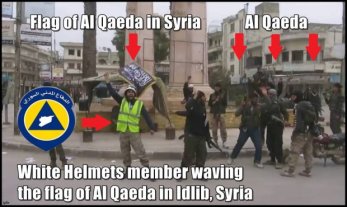 The White Helmets are embedded in the Al-Qaeda terrorist network and operate exclusively in terrorist-held areas of Syria. Though it also calls itself the Syrian Civil Defence, the government of Syria created the real Syrian Civil Defence in 1953 and was a founding member of the International Civil Defence Organization.
Once in place inside the terrorist-occupied enclaves inside of Syria, the true role of the White Helmets emerged. The group specialized in making videos of dramatically-staged rescues of children from among the rubble of part of cities which Al-Qaeda (and sometimes other terrorist groups) had managed to seize and occupy. Two notorious staged videos stand out: the staged rescues of Omran Daqneesh in Aleppo and Hassan Diab in Douma. Occasionally, however, the White Helmets joined in recreational video competitions, such as the Mannequin Challenge. The twofold principal purposes of the child-rescue videos was, first, to demonize the Syrian government as a brutal tyranny, even though it was lawfully defending its sovereign territory against foreign invasion, and, secondly, to promote the western regime change operation in Syria as a humanitarian intervention.
Specifically, the White Helmet videos were timed to promote calls by western governments for direct military intervention in Syria by such means as a no-fly zone (similar to the one imposed on Libya in 2011) or a “civilian corridor”. And, on at least two occasions, the tactic worked. In April 2017, the White Helmets staged a false flag chemical attack on Khan Sheikhoun which prompted a US missile attack on the Sharyat Air Base in Syria. A recent outstanding example of the propaganda use of such videos was the staging of a fake nerve agent attack in Douma, Syria, on April 7 of this year. The incident, though later revealed as a hoax by the Organization for the Prohibition of Chemical Weapons (OPCW), nonetheless resulted in over one hundred missile strikes by the USA, UK, and France on Syria on April 13, 2018.
In addition, the White Helmets’ true role as an auxiliary to terrorism was captured on film on several occasions when they participated in Al-Qaeda summary executions and by Facebook postings by numerous White Helmets on their personal accounts showing themselves moonlighting as armed Al-Qaeda fighters and heaping praise on Al-Qaeda leaders. Contrarily, civilians inside the enclaves in Syrian cities liberated from Al-Qaeda and ISIS told many western reporters that the White Helmets provided no medical help or assistance to them, but rather only to the armed terrorists. Moreover, real Syrian Civil Defence workers testified that many of their comrades were killed by Al-Qaeda fighters and their equipment and vehicles given to the White Helmets.
The rescue of the White Helmet “rescuers” by Israel through the Golan Heights should not come as a surprise because Israel has been a major player in the illegal, failed, regime change operation in Syria. Israel has bombed Syria more than one hundred times during the war. Israel openly supported FSA fighters with arms, intelligence, and funding in southern Syria and routinely transferred wounded terrorists to hospitals inside Israel for medical treatment before returning them to the front. Israeli PM Netanyahu posed for photos in one of those hospitals at the bedside of wounded terrorists last year. Today (July 22, 2018), in a tweet, Netanyahu stated that both President Trump and Prime Minister Trudeau personally asked for his help in rescuing the White Helmets from Syria.
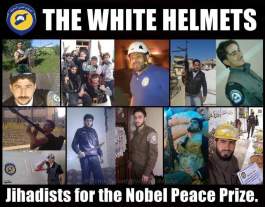 Syria is well rid of these White Helmets. But, if Canadians understood who these people really were, they would strongly object to the settling of terrorists in our midst. Last November in the House of Commons, Trudeau asserted that Canadians returning from terrorist activities in Syria and Iraq would not be charged with criminal offences. Rather, he asserted, “We also have methods of de-emphasizing or de-programming people who want to harm our society, and those are some things we have to move forward on.” At the end of the day, then, the Trudeau government in effect embraces terrorist fighters and their auxiliaries.
That the Canadian government is planning to admit White Helmets personnel to Canada as refugees should gravely concern Canadians. These civil defence poseurs are ideologically committed to terrorism, personally connected to Al Qaeda, and have the blood on their hands of many Syrians whose country they helped to invade and occupy. The potential for them to cause harm in Canada is high.
We urge Canadians immediately to contact their MP’s about this matter, to spread the alarm via social media, and to write letters to newspapers. We also urge the Canadian government to do the following:
- withdraw from the US-led military coalition in Syria and Iraq;
- end Canada’s punishing economic sanctions against Syria;
- re-establish diplomatic ties with the Syrian government;
- participate in the reconstruction of Syria through payments of reparation.
Published by the Hamilton Coalition To Stop The War
hcsw.ca
hcsw@cogeco.ca
For further info, please contact Ken Stone at 289-382-9008 or at kenstone@cogeco.ca
Israel challenges the world: I am an Apartheid state, what are you going to do about it?
By Professor Kamel Hawwash | MEMO | July 23, 2018
Remember the date, 19 July 2018 is when Israel’s pretense of democracy, the Knesset passed the Nation State Bill, which could more aptly be called, the “Jewish State Apartheid Law” where Jews dominate the Israeli Palestinian Arabs who are lesser than them, even if they are citizens. I deliberately did not say Israeli Jews because the law gives all rights in historic Palestine to Jews, not only in Israel but across the world, including those Jews that do not identify with the state.
My mother, who was born in Jerusalem before Israel was created, has no rights in the Holy city or her homeland but a Jewish lady with no connection to Israel can “return”, to a place she does not come from. The invaders, since they were not invited into our homeland, have enshrined the right to have my Palestinian homeland as theirs in law and also annulled my mother’s right to return, which is enshrined not in state but in international law. I can hear cries of “this is the Jewish homeland because we were here thousands of years ago”, really? If Jews – and it is only Zionists – believe they are entitled to return after thousands of years -which I reject – then how can they deny Palestinians the right to return after 71 years? In fact UN resolution 194 enshrined in international law gives Palestinians the Right of Return but there is no reference in international law to Jews having a “right to return” to historic Palestine.
Let me be clear, I am not denying Jewish, Christian or Muslim connection to holy sites in historic Palestine. However, Palestinians reject the notion of singling Jews out for a “right of return” to our homeland now and forever. No other people are afforded the right to a freehold on a plot of land forever and Jews should be no different.
Israel’s prime minister pushed the adoption of this bill now as he sees an opportunity to make major wins while US President Trump is in office and has given Israel carte blanche to implement any policies it wishes.
“A hundred and twenty-two years after [the founder of modern Zionism Theodore] Herzl made his vision known, with this law we determined the founding principle of our existence,” Benjamin Netanyahu said, adding that this is a “defining moment” for Israel. “Israel is the nation state of the Jewish people, and respects the rights of all of its citizens.”
What Netanyahu did not tell us was where exactly are the borders of this state? What rights do its non-Jewish but indigenous Palestinian citizens have within its internationally recognised borders? Netanyahu and supporters of Israel should remember that the 20 per cent “minority” that they form would not have been a minority if it had not been for the ethnic cleansing of 750,000 of their brothers and sisters in 1948. Had they not been forced out through Jewish terror, their numbers would have been equal if not larger than the Jewish Israelis that now reside in historic Palestine. It would have been Jews that formed the minority.
Netanyahu also failed to explain the status of the occupied Palestinians who are not afforded citizenship in this state. What rights do they have? They are not citizens of Israel or Palestine.
Much has been written since the Nation State Law was approved, but there has been insufficient outrage. The law has mostly been seen at worst as “controversial”. Israel has challenged the world to say no to state racism and Apartheid but the world has only expressed concern that the law could impede the now long dead peace process and wait for it, the two-state solution. Netanyahu challenged the world and the world is not ready for a fight for basic equality between citizens of a state.
Through its silence, the world arguably agrees that historic Palestine is homeland only for Jews. It agrees that the indigenous Palestinians have no rights, except those that the Jewish state agrees to give them out of the goodness of its heart and only if Israeli Jews agree. Jews can build settlements only for Jews and admissions committees can decide whether to allow the people whose land it is, the Palestinians, to live amongst them. They can decide whether Palestinian children can play in kindergartens with Jewish children and whether they can swim together in one pool.
By confirming “United Jerusalem” as their eternal capital, Israeli Jews can decide for how long Al-Aqsa Mosque can remain, majestically from a Palestinian point of view, on the “Jewish Jerusalem” skyline. Who can forget the image of the notorious Palestinian hater and so called US Ambassador David Friedman beaming as he held a poster showing a Jewish temple in place of the Dome of the Rock?
Perhaps the US has already obtained assurances from some Arab and Muslim leaders that since Muslims already have two holy mosques in Makkah and Madina and Jews do not have one, that it would be acceptable to give Al-Haram Al-Sharif up for that purpose. After all it seems protection from the Iranian “threat” carries a heavy price. The installation of the Jewish temple could be part of the “deal”. I of course do not know if that is the case, but we live in bizarre times.
Israel has already curtailed the calling of the Muslim call for prayer, the Athan, because it disturbs the illegal Jewish settlers. Now, the language in which the call is made, Arabic, has been demoted from an official language of the state to having “a special status”. Another attack on the indigenous Palestinians.
If Israel was not a racist endeavour when created, it is now most certainly a racist state, unless of course a new definition of racism has been created which gives exception to the self-proclaimed Jewish state. A racist state deserves to be criticised, ostracised and isolated until it repents and removes all its racist laws. This law is only one of tens of laws that already discriminate against non-Jews.
However, what is most bizarre is that confirmation by Israel that it is a racist entity through the passing of the law could, according to the so called IHRA definition of anti-Semitism label as anti-Semites anyone daring to call it a racist or Apartheid entity.
There is no excuse for the world’s lack of action against racist Israel.
How can the US, the land of the free, support it now? The Zionist and Israel apologist Trump trio of Greenblatt, Kushner and Friedman have not issued any statement on this law. They, especially Greenblatt who is effectively tweeting for Israel, helped Israel with recognition of Jerusalem as Israel’s capital and are working to deny Palestinian refugees their right to return. Their vision for peace almost supports the rapid implementation of the new law rather than condemn it.
The EU has, true to form, talked the talk but not walked the walk, expressing concern but no condemnation.
The Palestinian leadership has sleepwalked into this, typically with no strategy to counter it. The appropriate response to the passing of the law in the early hours of the 19th of July should have been for the PLO to declare an end to the disastrous Oslo Accords, to dissolve the Palestinian Authority with an immediate effect including an end to the immoral security coordination with the Apartheid state. The PLO has been mandated to de-recognise Israel by its Palestine National Council. That time has come. How can the Palestinians continue to recognise an Apartheid state which also denies all their rights and then sit with its representatives to negotiate a two-state solution which this law prohibits?
It is time for the Palestinians to review their struggle and adopt a call for equal rights for all who inhabit historic Palestine and a return for the refugees to their homes. The struggle would continue until these rights are realised.
All states, but particularly those that claim to be western style democracies, should have severed relations with Apartheid Israel, including those Arab states that have established relations with it.
As for the rest of those that support Israel both as individuals and organisations, enough is enough. This Israel is not a state that anyone can support or declare a friend. In particular, “friends of Israel” groups in UK political parties should shut themselves down or rename themselves appropriately as “Friends of Apartheid Israel”. That is what it should say on the tin. Honourable and Right Honourable members should then resign from these racism-supporting groups and instead join the BDS movement.
If Apartheid Israel is tolerated, next it will be Apartheid Myanmar and the door will be open for other states to court Apartheid. For the sake of our children let us not allow racism to be tolerated anywhere.
The Myth of US ‘Inaction’ in Syria
By William Van Wagenen – The Libertarian Institute – July 8, 2018
Introduction
When the Russian military intervened in the Syrian war in October 2015, many in the Western press complained bitterly, demanding that US planners intervene directly in Syria on behalf of the anti-government rebels in response. Reuters alleged that “The Middle East is angry and bewildered by US inaction in Syria,” arguing that “The question on everyone’s mind is: will the United States and its European and regional Sunni allies intervene to stop President Vladimir Putin from reversing the gains made by mainstream Syrian rebels after more than four years of war? Few are holding their breath.” The Washington Post similarly argued that Russian president Vladimir Putin was “exploiting America’s inaction,” while the Guardian lamented the “western inability to care enough about the plight of Syrians.” As Russian and Syrian forces battled rebels one year later in Aleppo, more dramatic accusations of US inaction emerged, with Foreign Policy describing US policy in Syria under Obama as “inaction in the face of genocide.”
 The idea that the United States has not intervened in Syria and is guilty of “inaction,” is a myth however. The United States and its Western and Gulf Allies have intervened in the Syrian conflict from early on. US planners have been fighting what the New York Times described as a “$1 Billion Secret C.I.A. War in Syria” while providing weapons to rebels through a program considered “one of the costliest covert action programs in the history of the C.I.A.” Starting in the fall of 2012, the US and its Gulf partners, under the direction of then CIA director David Petraeus, were openly sending “a cataract of weaponry” into Syria. It is likely that such shipments began much earlier without public acknowledgment, via the “rat line” from Libya, as reported by journalist Seymour Hersh. US Special Envoy to Syria Michael Ratner, in a meeting with members of the Syrian opposition, explained that “The armed groups in Syria get a lot of support, not just from the United States but from other partners,” while Secretary of State John Kerry added in the same meeting, “I think we’ve been putting an extraordinary amount of arms in,” and “Qatar, Turkey, Saudi Arabia, a huge amount of weapons [are] coming in. A huge amount of money.”
Also a myth is the idea that any US intervention in Syria would seek to protect civilians. While allegations that Syrian and Russian forces were committing genocide in Aleppo proved baseless, US planners have themselves supported rebels intent on committing genocide and sectarian mass murder. This was clearly evident in the Syrian city of Latakia, which by the time of the Russian intervention in October 2015 was on the verge of falling to a coalition of Syrian rebel groups including al-Qaeda (known in Syria as the Nusra Front) and the US-armed and funded Free Syrian Army (FSA).
Robert Worth of the New York Times writes that “In Latakia, some people told me that their city might have been destroyed if not for the Russians. The city has long been one of Syria’s safe zones, well defended by the army and its militias; there are tent cities full of people who have fled other parts of the country, including thousands from Aleppo. But in the summer of 2015, the rebels were closing in on the Latakia city limits, and mortars were falling downtown. If the rebels had captured the area — where Alawites are the majority — a result would almost certainly have been sectarian mass murder. Many people in the region would have blamed the United States, which armed some of the rebels operating in the area. . . Andrew Exum, who worked in the Pentagon at the time, told me that the military drew up contingency plans for a rapid collapse of the regime. The planning sessions were talked about as ‘catastrophic success [emphasis mine].’”
Alawite civilians in Latakia faced the prospect of being massacred if rebels had been able to capture the city, due to the virulently anti-Alawite views of Nusra Front members. Nusra religious clerics draw on the writings of the fringe 14th century Islamic scholar Ibn Taymiyya to argue that Alawites are “infidels” deserving of death. Syria analyst Sam Heller described Nusra clerics as promoting “toxic — even genocidal — sectarianism.” Rebels from the FSA, which have fought alongside and “in the ranks” of the Nusra Front throughout the conflict, also posed a threat to Alawite civilians in Latakia. While typically considered moderate in the Western press, many FSA battalions have been armed and funded by the Syrian Muslim Brotherhood (MB). Thanks to the influence of Brotherhood ideologue Said Hawwa, the Syrian Brotherhood strongly promoted the anti-Alawite sectarian views of Ibn Taymiyya from the 1960’s until the 1980’s. This anti-Alawite sectarianism re-emerged in segments of the Syrian opposition, including in elements of the FSA, when peaceful protests and armed insurrection against the Syrian government simultaneously erupted in Syria in the spring of 2011.
While the Syrian and Russian militaries managed to protect Latakia and prevent a massacre of the city’s Alawite civilians, the broader effort to prevent the fall of the country to al-Qaeda and its FSA allies exacted a huge toll on Syria’s Alawites. The Telegraph noted that already by April 2015, “The scale of the sect’s losses is staggering” and that of some 250,000 Alawite men of fighting age “as many as one third are dead” and that “Alawite villages nestled in the hills of their ancestral Latakia province are all but devoid of young men. The women dress only in mourning black.”
While arming rebels threatening the massacre of Alawite civilians in Latakia, US planners were at the same time welcoming the potential massacre of Syrian civilians in Damascus. The Syrian capital was on the verge of falling to the Islamic State (ISIS) in the summer of 2015 after ISIS, with the help of Nusra, captured all of the Yarmouk Palestinian refugee camp in the southern Damascus suburbs. The New York Times acknowledged the ISIS threat to Damascus at this time, observing that “By seizing much of the camp” ISIS had “made its greatest inroads yet into Damascus,” while the Washington Post noted that “Their new push puts [ISIS] within five miles of the heart of the capital . . . even as they are on the retreat in Iraq.”
In a private meeting with members of the Syrian opposition, Secretary of State John Kerry acknowledged that US planners had actually welcomed the ISIS advance on Damascus, in an effort to use it as leverage to force Assad to give up power. Kerry explained that, “the reason Russia came in is because ISIL [ISIS] was getting stronger. Daesh [ISIS] was threatening the possibility of going to Damascus. And that is why Russia came in. They didn’t want a Daesh [ISIS] government and they supported Assad. And we know this was growing. We were watching. We saw that Daesh [ISIS]was growing in strength. And we thought Assad was threatened. We thought we could manage that Assad might then negotiate. Instead of negotiating, he got Putin to support him [emphasis mine].”
Because the US was bombing ISIS in defense of its Kurdish allies in Northeastern Syria and its Iraqi government allies in Northwestern Iraq, the fact that US planners at the same time welcomed the ISIS push on Damascus against the Syrian government was largely obscured.
Had Damascus fallen to ISIS, it is clear that many civilians in the city, including Christians, Alawites, Shiites, members of the LGBTQ community, and pro-government Sunnis, would have been killed. While commenting on the Russian intervention, Michael Kofman of the Wilson Center acknowledged that “Assad may be irredeemable in the eyes of the United States, but it is equally clear that a high human price would be paid when the Islamic State [ISIS] or al-Nusra seizes the major population centers in Syria that he still controls.”
It is also clear that US planners were deliberately supporting al-Qaeda (Nusra), despite its genocidal intentions towards Syria’s Alawites, by flooding Syria with weapons. Because FSA brigades that received funding and weapons from the US and its Gulf Allies were fighting side by side with militants from Nusra throughout the country, in practice much of the money and weapons sent to the FSA ultimately benefited al-Qaeda.
For example, US-made TOW anti-tank missiles sent by US planners to FSA groups in Idlib played a crucial role in helping Nusra conquer the entire province in the spring of 2015. Syria analyst Hassan Hassan observed in Foreign Policy during this period that “The Syrian rebels are on a roll” and that “The recent offensives in Idlib have been strikingly swift — thanks in large part to suicide bombers and American anti-tank TOW missiles,” which the FSA and Nusra deployed in tandem. Syria analyst Charles Lister, also writing in Foreign Policy, described how US planners explicitly encouraged the FSA groups they were arming to fight alongside Nusra in Idlib. Rebel victories in Idlib, in particular the town of Jisr al-Shughour, allowed Nusra and the FSA to then threaten the massacre of Alawites in Latakia.
When Russia intervened militarily in Syria in October 2015, US planners responded by immediately increasing shipments of TOW anti-tank missiles to FSA groups, some of which then helped Nusra capture the strategic town of Murek in central Syria one month later in November 2015.
This prompted Daveed Gartenstein-Ross of the Foundation for Defense of Democracies (FDD) to observe that “it is impossible to argue that U.S. officials involved in the CIA’s program cannot discern that Nusra and other extremists have benefited” from CIA weapons shipments to Syrian rebels, “And despite this, the CIA decided to drastically increase lethal support to vetted rebel factions following the Russian intervention into Syria in late September.”
Nusra did not only benefit from fighting alongside FSA rebels armed with US-supplied weapons, but acquired many of these weapons themselves. That Nusra regularly purchased weapons from the Western-backed military councils supplying the FSA was confirmed in October 2014, when the New York Times reported that Shafi al-Ajmi, a Nusra fundraiser, told a Saudi news channel that “When the military councils sell the weapons they receive, guess who buys them? It’s me.”
That al-Qaeda was purchasing US supplied weapons seemed of little concern to US planners. When journalist Sharmine Narwani asked why US-supplied weapons allegedly meant for FSA groups were showing up in Nusra hands, CENTCOM spokesman Lieutenant Commander Kyle Raines responded: “We don’t ‘command and control’ these forces—we only ‘train and enable’ them. Who they say they’re allying with, that’s their business.”
Obama administration officials themselves acknowledged tacit US support for al-Qaeda, admitting in November 2016 to the Washington Post that they had struck “a deal with the devil,” years before, “whereby the United States largely held its fire against al-Nusra because the group was popular with Syrians in rebel-controlled areas and furthered the U.S. goal of putting military pressure on Assad,” thereby confirming long standing Russian accusations that the US had been “sheltering al-Nusra.”
More recently, Ben Rhodes, deputy national security advisor under the Obama administration, acknowledged providing military support to Syrian rebels, even though it was clear that Nusra comprised a good portion of the Syrian opposition as a whole. Rhodes explained that “there was a slight absurdity in the fact that we were debating options to provide military support to the opposition at the same time that we were deciding to designate al-Nusra, a big chunk of that opposition, as a terrorist organization.”
Despite designating Nusra as a terror group already in 2012, US planners nevertheless provided weapons to the Syrian rebels, of which Nusra comprised a “big chunk,” for the next 7 years. As Sharmine Narwani observes, “U.S. arms have been seen in Nusra’s possession for many years now, including highly valued TOW missiles, which were game-changing weapons in the Syrian military theater. When American weapons end up in al-Qaeda hands during the first or second year of a conflict, one assumes simple errors in judgment. When the problem persists after seven years, however, it starts to look like there’s a policy in place to look the other way.”
US planners welcomed rebel gains in Syria, including by rebel groups advocating genocide against Syria’s Alawite population, such as ISIS and Nusra, because these gains bolstered the broader US goal of toppling the Syrian government, in an effort to weaken its close allies, Iran and Hezbollah. US planners wished to see rebel gains in Syria, in spite of the obviously catastrophic consequences for Syrian civilians, including for Syria’s Sunnis, which rebel success would bring. US support for the rebels belies the myth of US “inaction” in Syria, and the myth that any US intervention would be for the sake of preventing massacres and even genocide, rather than in support of it.
In the remainder of this essay, I will review the US support for rebel advances in the spring and summer of 2015 in Idlib, Latakia, Palmyra, Yarmouk, and Homs. I will describe how these rebel advances nearly led to the massacre of Syrian civilians in two of the country’s main population centers, Latakia and Damascus, if not for the Russian intervention which halted the rebel advance.
Idlib
In March of 2015, rebels from the Jaish al-Fatah coalition, which included Nusra and the jihadist rebel group Ahrar al-Sham, launched a coordinated assault along with brigades from the FSA on Idlib province, leading to the capture of the province as a whole from Syrian government forces two months later.
Rebels captured Idlib city itself on March 29. Al-Jazeera quoted the pro-opposition Syrian Observatory for Human Rights (SOHR) as declaring “Al-Nusra Front and its allies have captured all of Idlib,” in a battle that led to some 130 deaths. Al-Jazeera also quoted representatives of the Western-backed Syrian National Council (SNC) as declaring the capture of Idlib city as “an important victory on the road to the full liberation of Syrian soil from the Assad regime and its allies,” showing the close relationship between the US-supported Syrian political opposition in exile and al-Qaeda affiliated militants on the ground in Syria. Rebels captured the last major Syrian army base in the province on March 19 near the town of Mastouma. Rebel control of Idlib was completed with the ouster of the Syrian army from the town of Ariha at the end of May, causing government forces to retreat to bases on the coast in Latakia.
The rebel offensive in Idlib succeeded largely due to the lethal combination of Nusra suicide bombers and US-provided TOW anti-tank missiles. FSA commander Fares Bayoush from the Fursan al-Haq brigade explained to the LA Times “that his group’s TOW missiles played an important role in repelling government tanks during a March offensive in Idlib province spearheaded by an Islamist coalition called the Army of Conquest, which includes Al Nusra Front.” It was during this period that Syria analyst Hassan Hassan observed in Foreign Policy that, “The Syrian rebels are on a roll,” and that “the recent offensives in Idlib have been strikingly swift — thanks in large part to suicide bombers and American anti-tank TOW missiles,” as well as that,“For the first time since the conflict began, Assad’s heartlands in the Western region [Latakia] seemed exposed.”
The close cooperation between FSA brigades and rebels from the al-Qaeda affiliated Nusra Front in Idlib was encouraged by US planners. Syria analyst Charles Lister, also writing in Foreign Policy, observed that “The involvement of FSA groups, in fact, reveals how the factions’ backers have changed their tune regarding coordination with Islamists. Several commanders involved in leading recent Idlib operations confirmed to this author that the U.S.-led operations room in southern Turkey, which coordinates the provision of lethal and non-lethal support to vetted opposition groups, was instrumental in facilitating their involvement in the operation from early April onwards. That operations room — along with another in Jordan, which covers Syria’s south — also appears to have dramatically increased its level of assistance and provision of intelligence to vetted groups in recent weeks [emphasis mine].”
Lister, who has testified several times before the US House Foreign Affairs Committee to make policy proscriptions for US planners in Syria, argued at that time that US cooperation with al-Qaeda (Nusra) is the best option: “[T]here still remains no better alternative to cooperating with al Qaeda, and thus facilitating its prominence. If the West wants a better solution, it must broaden and intensify its engagement with Syria’s insurgent groups and considerably expand its provision of assistance to a wider set of acceptable groups” echoing a popular view among Western and Gulf think tank analysts that al-Qaeda was worthy of US support.
Predictably, US efforts to help al-Qaeda conquer Idlib had grim consequences for many of its residents, large numbers of whom fled after rebels took control of the city and province. The Guardian reported that while under Syrian government control, Idlib city, with a population of some 165,000 before the war, “had been swollen by hundreds of thousands of displaced people, who had fled there to escape fighting elsewhere.” In contrast, when the rebels came, many civilians fled. The New York Times reported that although “some Idlib residents celebrated Saturday, cheering as fighters ripped down posters of Mr. Assad or embracing insurgent relatives who returned to the city for the first time in years, others streamed out of the city, with convoys of loaded cars and trucks blocking roads.” Citing the United Nations, the NYT reported that already by April 1, just two days after the rebel arrival, at least 30,000 residents had fled the city. One Idlib resident who fled when the rebels arrived explained that “The rebels that attacked Idlib at the end of March 2015 came from all sorts of countries. I even saw children carrying weapons. The rebels had a list of names of people who were to be killed, in the majority of cases because they held pro government views. One of my friends, a teacher, was on the list and was shot. . . . I left Idlib with my cousin who had a car. Afterwards, my house was occupied and looted by the rebels. I had planned to sell my house to enable my daughter to study medicine. Now it’s too late. I also worry about our old Christian neighbors. I am a Muslim but the religion of these rebels is not my Islam. I detest Salafism, and do not want to live under it.”
On April 25, rebels from the Jaish al-Fatah coalition, which included the jihadist rebel groups Nusra, Ahrar al-Sham, and Jund al-Aqsa, captured the strategic town of Jisr al-Shughour, which lies on the highway connecting Latakia to Aleppo. The rebel capture of the town came one month after the capture of Idlib city. The Guardian quoted one senior opposition member who had supplied weapons to the rebels taking Jisr al-Shughour as noting, “I would put the advances down to one word . . .Tow,” referring to missiles made in the US and purchased by Saudi Arabia for supply to the rebels. The opposition member noted as well that “Saudi is not as concerned as it was by who among the rebel groups is winning, as long as it’s not [Isis]. They’ve convinced everyone involved in Syria that the real enemy is Iran,” suggesting Saudi comfort in militarily supplying jihadist rebels from al-Qaeda. Rebel media posted video of civilians fleeing Jisr al-Shughour after its capture, claiming they wished to escape in anticipation of a pending regime bombardment now that the city had fallen. The Guardian also quoted one resident as noting that FSA groups participated alongside the Nusra-led Jaish al-Fatah coalition in taking the city, in accordance with the familiar pattern: “There were people from the normal opposition there. They were strong too, but the jihadists were stronger.”
Though the city fell on April 25, hundreds of Syrian army soldiers and some women and children fled to the National Hospital complex, which remained under siege by rebels for the next month. The soldiers managed to repel multiple suicide car bombs, targeting them with rocket propelled grenades. Rebels then began preparing to detonate a large tunnel bomb below the hospital to destroy it and kill the soldiers inside. The soldiers then attempted to flee the hospital under air cover from the Syrian air force. Of this incident, the Telegraph reports, “Syrian rebel leaders have described massacres of hundreds of Assad troops and fighters in grim detail as the regime’s defenses begin to crumble in the face of revived attacks on several fronts. President Bashar al-Assad had promised to rescue hundreds of his men who were surrounded in a last stand at a hospital in the key north-western town of Jisr al-Shughour. Eventually, the men tried to run for it under the cover of a regime aerial attack, pre-empting a final assault by rebels including Jabhat al-Nusra, the Syrian branch of al-Qaeda, and other Islamist groups. Instead, many of the soldiers were shot down as they were cornered in orchards on the edge of town, a rebel spokesman said.” Rebels claimed to have killed 208 Syrian soldiers, including several high ranking officers, while pro-government sources claimed up to 80 soldiers managed to escape. One soldier who managed to escape alive described the ordeal to Chinese state media, adding that a number of civilians escaped with the soldiers.
Jisr al-Shughour fell four years after rebels initially attempted to take the city in June 2011, just three months after the beginning of anti-government protests. Several hundred rebels attacked the local police station with dynamite, killing a number of soldiers inside, and then ambushed and killed as many as 120 Syrian army soldiers sent as reinforcements. This event was known as the “massacre” of Jisr al-Shughour. The killings were widely attributed to the Syrian army itself at the time, as activists implausibly blamed the Syrian army for the killing of its own soldiers. The story of government responsibility for the killings was widely believed, and reported as such in the Western press, as the rebel attacks took place at a time before armed rebel activity in Syria was widely acknowledged. This was despite correct reporting on the killings at the time by Syria expert and University of Oklahoma professor Joshua Landis. Rebel responsibility for the killings was later confirmed by journalist Rania Abouzeid, who was able to return to Jisr al-Shughour years later and interview witnesses who confirmed rebels had killed the soldiers, as recounted in her book, “No Turning Back: Life, Loss, and Hope in Wartime Syria (pages 55-60).”
Latakia
The defeat of government forces in Idlib, in particular in Jisr al-Shughour, allowed rebels to then push on toward Latakia province on the Western coast of Syria, and to threaten the massacre of the large Alawite population there, as discussed above. A representative from the rebel group Ahrar al-Sham explained to Reuters that “Jisr al-Shughour is more important than Idlib itself, it is very close to the coastal area which is a regime area [Latakia], the coast now is within our fire reach.”
Alawites, which comprised some 50% of the population in Latakia, faced the prospect of being massacred if rebels from Nusra had been able to capture the city, due to the virulently anti-Alawite views of Nusra members, who draw on the writings of the fringe 14th century Islamic scholar Ibn Taymiyya in order to deem Alawites “infidels” deserving of death.
Syrian analyst Sam Heller cites the views of the supreme Nusra religious official Sami al-Oreidi to show that Nusra promotes “toxic — even genocidal – sectarianism” against Syria’s Alawite population. Heller writes that “[T]he verdict on Syria’s Alawites, Oreidi makes clear, is death. Oreidi cites medieval Islamic jurist Imam al-Ghazali, who wrote, ‘Proceed with [the Alawites] as you would with apostates…. The land must be purged of them.’ He also quotes Islamic scholar Ibn Taymiyyah, himself Syrian and among the formative influences on modern Salafism: This people called the ‘Nuseiriyyah [Alawites] . . . are more infidels than the Jews and the Nasara [Christians]; more infidels, in fact, than many polytheists. Their harm to the nation of Muhammad, peace be upon him, is greater than the infidels waging war on it.’”
But it was not only jihadist fighters from the Nusra Front that held strongly sectarian, anti-Alawite views, but also many fighters from the FSA as well, due to the Syrian Muslim Brotherhood (MB) roots of many FSA battalions. Thanks to the influence of Brotherhood ideologue Said Hawwa, the Syrian MB promoted the anti-Alawite sectarian views of Ibn Taymiyya from the 1960’s until the 1980’s.
Islam scholar Itzchak Weismann of the University of Haifa writes that “In defining his attitude toward the ‘Alawis, Hawwa alludes to a fatwa of Ibn Taymiya, which although it concerns a particular Ismal’ili sect can be applied, in his opinion, to any analogous sect in the Muslim world. According to this fatwa jihad against this sect precedes jihad against polytheists (musbrikun) or against ahl al-kitab, as it belongs to the category of jihad against murtaddun [apostates]. Thus, in Hawwa’s view, Syria is a unique case of a Muslim state that is ruled by a heretical batini government, and in such a case he sees no escape from a violent confrontation. The Sunni majority, led by the Islamic movement, must wage an uncompromising war against Assad’s regime and against ‘Alawi dominance in Syria.”
This view helped inspire some Brotherhood members, such as Marwan Hadid, to split from the broader Syrian MB organization and initiate an armed insurrection against the Syrian government in Hama in 1964. Upon Hadid’s death in government custody in 1976, his followers, known as the Fighting Vanguard, initiated an assassination campaign targeting Alawite members of the Syrian government bureaucracy and security forces. As part of this campaign, Fighting Vanguard militants massacred 83 Alawite army cadets in Aleppo in June 1979, while attempting to assassinate President Hafez al-Assad himself in June 1980. In response, Assad ordered the massacre of some 500 MB members then being held in Tadmur prison. The Syrian MB joined the Fighting Vanguard in launching an armed insurrection (which they called a jihad) against the Syrian government in Hama in 1982. Islamist militants attacked police stations, Ba’ath party offices and Syrian army units, forcing the army to withdraw from the city. The army regrouped however, and (in)famously suppressed the insurrection, with the use of considerable violence, leaving thousands dead and much of the city in ruins (for a review of this period, see “Ashes of Hama” by Rafael Lefevre and “The Struggle for Power in Syria” by Nikolaos van Dam).
While the Syrian MB has espoused more moderate positions after the group was defeated in Hama, anti-Alawite sectarianism which colored its conflict with the Syrian government in the 1980’s re-emerged in some segments of the Syrian opposition at the outset of anti-government protests in 2011, and was taken up by some FSA rebel groups.
In some anti-government protests in the spring of 2011, protestors chanted the slogan “Christians to Beirut, Alawites to the grave,” while in June 2011, Syrian opposition cleric and FSA supporter Adnan Arour threatened to put Alawites supporting the government in “meat grinders” and “feed their flesh to the dogs.”
In the summer of 2011, Lebanese Sunnis from the city of Tripoli were entering Syria to fight for the FSA-affiliated Farouq Brigade in Homs, with encouragement from Lebanese cleric Masen al-Mohammed, who insisted that “Assad is an infidel,” because he is a member of the Alawite faith and that “It is the duty of every Muslim, every Arab to fight the infidels.”
FSA groups inquired of Islamic scholars in March 2012 whether it was allowed to raid Alawite villages and kill their women and children in response to alleged crimes committed by the Syrian army.
On April 10, 2011, just weeks after the first anti-government protests in Syria, anti-government activists loyal to local Salafi cleric and protest leader Anas Ayrout murdered an Alawite farmer in Banias named Nidal Janoud. Video emerged of the activists stabbing Nidal to death in the street. In July 2013, Ayrout, by then a rebel commander and member of the Western-backed Syrian National Council (SNC) told Reuters that “We have to drive them [Alawites] out of their homes like they drove us out. They have to feel pain like we feel pain,” and that “(Alawites) are relaxed while areas that have slipped out of regime control are always under shelling (by government forces), always in pain. . . If you do not create a balance of terror, the battle will not be decided.”
Similarly, in September 2013, Zahran Alloush, a Salafi preacher and founder of the Saudi-supported opposition rebel group Jaish al-Islam, called for “cleansing Damascus” of all Alawites, while calling Shiite Muslims, of which Alawites are considered an offshoot, “unclean” and threating to “destroy your skulls” and “make you taste the worst torture in life before Allah makes you taste the worst torture on judgment day.” Proof that Jaish al-Islam was welcomed by the mainstream and Western-backed political opposition became clear when Zahran’s cousin and co-founder of Jaish al-Islam, Mohammad Alloush, was appointed as the lead negotiator for the Syrian opposition at the Geneva peace negotiations in January 2016.
The anti-Alawite incitement promoted by opposition clerics such as Alloush, al-Mohammed, Arour, and Ayrout was at times translated into action. In December 2012, FSA battalions carried out a mass kidnapping of Alawite civilians in the town of Aqrab. Alex Thomsen of Channel 4 News reported that according to residents of the town who had escaped, “rebels wanted to take the women and children to al-Houla to use them as human shields against bombardment from government forces, and they believed they would kill the remaining men.”
In August 2013, one month after Ayrout’s threats against Alawites, fighters under the command of FSA head Salim Idriss participated alongside Nusra and ISIS in the massacre and kidnapping of Alawite civilians in 10 villages in Latakia, according to the BBC. Human Rights Watch (HRC) investigated the massacre further, and reported that on August 4, rebels overran a Syrian army position, killing some 30 Syrian soldiers. Rebels then massacred 190 civilians, including 57 women and 18 children and 14 elderly men. Rebels also kidnapped and held hostage some 200 additional civilians, the majority women and children. Many of the hostages were released 9 months later as part of a ceasefire deal to end fighting between the Syrian army and rebels in Homs, and victims were able to recount horrific details of their captivity to the pro-Syrian government Lebanese newspaper, al-Akhbar.
The massacre came as part of a rebel offensive, led by ISIS, to capture Tartous, a port town crucial for the Syrian army receiving weapons shipments by sea from its Iranian allies. The Telegraph reported that Western-backed Syrian National Council (SNC) denied that rebels were targeting civilians based on their religious identity, but that the SNC nevertheless “praised” the ISIS led-offensive “stating that the villages had been used as launching posts from which pro-government militias had shelled rebel held villages in the north of the province.” At the same time, the Telegraph reported that “Video footage posted showed rebel groups indiscriminately launching rockets in the direction of Qardaha, the Assad village, and many of the comments made in the footage were clearly sectarian.”
In November 2015, Jaish al-Islam placed Alawite prisoners, both kidnapped civilians and captured Syrian soldiers, in metal cages in public squares. The Telegraph cited SOHR reporting that “Jaish al-Islam is using these captives and kidnapped people – including whole families – as human shields,” allegedly in an effort to prevent Syrian government bombing.
Christians in Latakia also feared the rebels. In March 2014, the Armenian Christian village of Kassab in northern Latakia province was overrun by rebels crossing the Syrian border from Turkey. Saudi owned al-Arabia reports that “Kassab’s residents fled after rebels seized their village on March 23, as part of a rebel offensive in the coastal Syrian province of Latakia, Assad’s ancestral heartland.” One resident who fled when the rebels came told al-Jazeera that “There was no obvious reason to invade, no heavy Syrian military presence. . . But that morning, shelling was pouring down like hail.” Once the residents fled, rebels looted their homes and farm equipment. “They have taken the televisions, radios and microwaves to Kassab Square, and they’ve gathered all the tractors at the Kassab Tourist Resort,” a media representative for the Armenians in the town told al-Jazeera. The Washington Post reported that a “mother of three said that after she arrived in Latakia with her children, she called home, and a man who identified himself as a member of Jabhat al-Nusra answered” and told her “Come back, why did you leave your home? We have come here to protect you,” before also telling her “she should convert to Islam before returning.” The mother described how “I pleaded with him, ‘Eat and drink whatever you like, but please don’t destroy the house.’” American celebrity personality Kim Kardashian, herself Armenian, attempted to bring attention to the plight of Kassab’s residents and the danger they faced from al-Qaeda rebels. In response, the Daily Beast published an article making light of her concerns, suggesting Kardashian was simply an apologist for dictators.
Despite rebel attacks on various villages in Latakia province as described above, Latakia city and its some 400,000 residents had largely been spared the violence engulfing much of the country, with some 200,000 displaced persons finding refuge in Latakia, many of whom were housed in tents and pre-fabricated homes in the city’s sports stadium complex.
By the spring of 2015, however, rebels were encroaching closer and closer on Latakia city. In March 2015, Saudi-owned al-Arabiya reported that rebels had detonated a car bomb in Qardaha, President Assad’s hometown, located just 30 kilometers Latakia city, and that the Syrian army was conducting operations in an effort to “put to an end the frequent shelling of loyalist villages and towns on the coasts. Morale is reportedly cracking in the regime strongholds due to repeated artillery shelling.”
When Jisr al-Shughour in Idlib province fell to the rebels in April 2015, pro-opposition Orient News reported that the coming rebel advance on Latakia would be considerably more difficult and complicated, not just for military reasons, but due to demographic ones as well, as Latakia is primarily populated by supporters of the government. Orient News also acknowledged that many towns and cities in Latakia taken by the rebels would be depopulated, explaining that the “entry of the opposition to these regions will cause a large wave of displaced persons, as occurred when the opposition took control of the villages of Ishtabrak and al-Rasmania and Ghania, which are villages surrounding Jisr al-Shughour and whose residents support the government,” noting as well that the capture of these towns by the opposition “led to residents of these towns fleeing to areas under government control in the Sahel [Latakia].”
In June 2015, one Latakia resident told Syria Deeply that, the “opposition’s proximity to Latakia is what everyone talks about these days. People expect that Latakia is next, after Idlib and Jisr al-Shughour. When the opposition took over Idlib, people in Latakia were disappointed, but when they took over Jisr al-Shughour, people were scared.” The resident noted that many young men from Latakia had already died fighting with the Syrian army against rebels elsewhere in Syria: “Many Latakians were killed fighting with the army and serving their country. More than 150 people from my neighborhood were killed in service. Their pictures are hung along the main street. All streets in Latakia are like this.” Despite the fear of a rebel takeover of Latakia, the resident suggested many were encouraged by the fact that prominent Syrian general Suhail al-Hassan, who had had considerable success in defeating rebels elsewhere, had been appointed to re-take Jisr al-Shughour. The resident concluded his comments by stating that “The army is our only hope that Syria would become peaceful again.”
While the threat of the massacre of Alawite civilians in Latakia city loomed in the summer of 2015, Syria’s Alawite community had already suffered terrible losses at the hands of the rebels elsewhere. In April 2015 the Telegraph had noted that “The scale of the sect’s losses is staggering: with a population of around two million, a tenth of Syria’s population, the Alawites boast perhaps 250,000 men of fighting age. Today as many as one third are dead, local residents and Western diplomats say. Many Alawite villages nestled in the hills of their ancestral Latakia province are all but devoid of young men. The women dress only in mourning black [emphasis mine].” The Telegraph quotes a Latakia resident as explaining that “Every day there at least 30 men returned from the front lines in coffins. In the beginning of the war their deaths were celebrated with big funerals. Now they are quietly dumped in the back of pick-up trucks,” which caused some Alawite mothers to “set up ‘road blocks’ at the entrances to some of the mountain villages to prevent the army from forcibly taking their sons to the military draft” and to tell military commanders to “Go and bring the sons of the big shots to war and after that we will give you our children.” Resentment due to the high casualties among Alawite army conscripts had begun years before. The Telegraph reported in October 2012 that “as families see their young soldiers coming home in body bags ‘everyday’ that support [for Bashar al-Assad] is cracking” in his hometown of Qardaha, where “The walls are covered in posters showing the faces of the young men that have been killed.”
On September 2, 2015 rebels detonated a car bomb outside a school in Latakia city, killing 12. In providing context for the bombing, the BBC noted that “Latakia has largely escaped the conflict that has devastated most of Syria and left 250,000 people dead. But a rebel alliance that includes al-Qaeda’s local affiliate, al-Nusra Front, has been advancing on the city and within its surrounding province after driving government forces out of much of neighboring Idlib province earlier this year.” The BBC chose not acknowledge the threat to civilians of the rebel advance, characterizing it instead as simply “the latest in a series of setbacks for the president.” Al-Jazeera cited SOHR as reporting this was “the biggest car bomb attack in Latakia since the war began” and that “This is rare for Latakia city, which is usually hit by rockets.” Al-Jazeera added that “Rebel fighters entrenched in the hilly terrain around Latakia regularly fire rockets and other missiles into the city.”
Robert Worth of the New York Times writes of this period that “the rebels were closing in on the Latakia city limits, and mortars were falling downtown. If the rebels had captured the area — where Alawites are the majority — a result would almost certainly have been sectarian mass murder. Many people in the region would have blamed the United States, which armed some of the rebels operating in the area. . . Andrew Exum, who worked in the Pentagon at the time, told me that the military drew up contingency plans for a rapid collapse of the regime. The planning sessions were talked about as ‘catastrophic success [emphasis mine].’”
The phrase “catastrophic success” is an odd one. Presumably, the rebel takeover of Latakia and possible collapse of the Syrian government would be catastrophic, given the large numbers of people that would have been massacred. Such an outcome would have nevertheless constituted a success, from the perspective of US planners, as the fall of the Syrian government was long a strategic US goal, due to the desire to weaken Syria’s close allies, Iran and Hezbollah.
For example, Flynt Leverett, the former Middle East specialist for the State Department, CIA and National Security Council during the Bush Administration described how, “The unrest in Syria started in March 2011. . . . and by April of 2011, just one month into this the Obama administration was backgrounding David Sanger from the New York Times and other sympathetic reporters that they were looking at the situation in Syria as a way of pushing back and undermining Iran. That if you could bring about regime change in [Syria] the argument was that this would really weaken Iran’s regional position and reignite the Green Movement and produce regime change in Iran. . . This has been very much the real strategic driver for American policy toward the situation.”
Central Syria (Homs and Hama)
In late March 2015, ISIS fighters moved south and west from their stronghold in Raqqa to initiate an offensive to take control of territory in central Syria, in Homs and Hama provinces. Both provinces are strategically important as the M5 highway, which connects Damascus to the major population centers in the north, in particular Aleppo, runs directly through both Homs and Hama and constitutes Syria’s economic and military lifeline. ISIS gains in Homs and Hama, in particular in the ancient city of Palmyra, also helped open the road toward Damascus.
On March 23, 2015 ISIS fighters assaulted the town of Sheikh Hilal, in an effort to control the larger Salamiya area in Hama. Reuters cited the SOHR as reporting that ISIS had killed 74 Syrian government soldiers during the assault, which according to Syrian government officials were either off-duty soldiers or members of the locally formed defense groups. ISIS released photos of five Syrian soldiers its militants had beheaded. On June 27, ISIS raided Sheikh Hilal once again. Al-Arabiya quotes SOHR as reporting that ISIS fighters killed “40 government loyalists, including soldiers and members of the National Defense Forces,’ a local pro-regime militia.” Sheikh Hilal was an important target for ISIS because according to SOHR, “If they seize control of this road, they’ll cut off the regime forces in Aleppo, since the government won’t be able to send reinforcements or supplies there.”
On March 30, 2015 ISIS fighters assaulted the town of Mabouja, 30 km west of Sheikh Hilal. Al-Jazeera cites the SOHR as reporting that “ISIL [ISIS] had killed entire families and that the dead included people who were burned alive. The population of Mabouja includes Alawites and Ismailis — sects deemed heretical by the radical brand of Sunni Islam espoused by ISIL [ISIS], said Rami Abdulrahman, who runs the Observatory. But he said that Sunni residents were among the dead, too [emphasis mine].” Al-Jazeera also observed that, “ISIL [ISIS] fighters have mounted numerous attacks in government-held areas in the provinces of Hama and Homs in recent weeks, even as it has lost ground in the north and northeast under pressure from a Kurdish militia backed by U.S.-led airstrikes.” The New York Times reports that according to a journalist from the area near Mabouja, “48 bodies had been buried on Wednesday, and that residents were angry that the government had not sent ‘real army, tanks and heavy weapons’ to back up lightly armed pro-government militias” from the National Defense Forces (NDF) which had been tasked with protecting the town. According to pro-Syrian government al-Masdar News, fighters from the NDF were able to finally repel the ISIS assault with help from the “Syrian Arab Air Force’s (SAAF) Hind Helicopters,” while the “NDF was successful in retaking all lost territory in Al-Maba’ouji, while also killing over 40 enemy combatants from ISIS, including a number of foreigners from Tunisia, Chechnya, Saudi Arabia, Kuwait, and Bosnia,” while the NDF suffered 31 dead and 23 injured.
On May 20, 2015 ISIS conquered the city of Tadmur at the site of ancient Palmyra, famous for its Roman ruins, and which lies in Homs province on the road between Deir Ezzour and Damascus. CNN reported of the ISIS assault to take Palmyra that “After at least 100 Syrian soldiers died in fighting overnight, Syrian warplanes carried out airstrikes Thursday in and around Palmyra.”
Shortly after capturing the city, ISIS released video of its fighters throwing two allegedly gay men from the top of a building, and then stoning them. CBS News cites an eyewitness as claiming that “ISIS militants blared on loudspeakers for men to gather. Then a black van pulled up outside the Wael Hotel, and Mallah and Salamah were brought out. The first to be thrown off was Mallah. He was tied to a chair so he couldn’t resist, then pushed over the side. He landed on his back, broken but still moving. A fighter shot him in the head. Next was Salameh. He landed on his head and died immediately. Still, fighters stoned his body, Omar said. The bodies were then hung up in Palmyra’s Freedom Square for two days, each with a placard on his chest: ‘He received the punishment for practicing the crime of Lot’s people.’” ISIS also released video of teenage boys carrying out the mass execution of 25 captured Syrian soldiers in the city’s ancient amphitheater. Agence France Presse (AFP) reported that ISIS executed as many as 200 people after taking the city. ISIS militants also murdered Khalid al-Asaad, the 83 year old retired director of antiquities for Palmyra. The New York Times reports that “After detaining him for weeks, the jihadists dragged him on Tuesday to a public square where a masked swordsman cut off his head in front of a crowd, Mr. Asaad’s relatives said. His blood-soaked body was then suspended with red twine by its wrists from a traffic light, his head resting on the ground between his feet, his glasses still on, according to a photo distributed on social media by Islamic State supporters.”
CNN commented that despite these atrocities, “there’s no indication that Syrian ground forces will try to take back the city, 150 miles northeast of Damascus, the capital. Nor that any other countries such as the United States will come to the rescue. ‘The world does not care about us,’ the Palmyra resident said. ‘All they are interested in is the stones of ancient Palmyra.’”
US planners could have indeed bombed convoys of ISIS fighters moving across the open desert from Raqqa to assault Palmyra, but chose not to. The LA Times reported of this period that “as Islamic State [ISIS] closed in on Palmyra, the U.S.-led aerial coalition that has been pummeling Islamic State in Syria for the past 18 months took no action to prevent the extremists’ advance toward the historic town — which, until then, had remained in the hands of the sorely overstretched Syrian security forces. The U.S. approach in Palmyra contrasted dramatically with the very proactive U.S. bombardment of Kobani during 2014-15 on behalf of U.S.-allied Kurdish militias fending off a furious Islamic State offensive [Emphasis mine].” US planners were willing to come to the aid of their Kurdish allies in northeastern Syria against ISIS, but refused to do the same for residents in Palmyra, as the city had been under Syrian government control.
One year later, in March 2016, Russian and Syrian forces were able to retake Palmyra and liberate it from ISIS, to the displeasure of US planners. The LA Times noted that White House officials have “difficulty publicly lauding advances against Islamic State by Assad and his allies, including the Russians and Iranians, after years of calling for Assad’s fall” and that the Russian success in combating ISIS created a “dilemma” for US planners, because “Washington has endeavored to portray the battle against Islamic State as a project of the United States and its allies, while accusing Moscow of attacking ‘moderate’ rebels instead of the extremists. Palmyra seems to embody an alternative narrative.” US dissatisfaction at the defeat of ISIS in Palmyra was also expressed by State Department spokesperson Mark Toner at a press briefing in March 2016, when Toner refused “to laud” the Syrian and Russian effort to liberate the city.
The fall of Palmyra in May 2015 resulted in ISIS control of some 50% of Syrian territory, and constituted “another strategic defeat that could expose Homs and Damascus to the terror group’s advances,” according to the Guardian. Al-Jazeera acknowledged the same, explaining that the “fall of the city potentially opens the way for ISIL [ISIS] to advance towards key government-held areas, including the capital and Homs.”
After capturing Palmyra, ISIS militants attempted multiple times to assault the nearby T4 airbase, located 40 km west to the west of the ancient city in Homs province. Crowd-sourced journalism site Bellingcat reported that “The Islamic State’s [ISIS] offensive in Central Syria has not only allowed the fighters of the Islamic State [ISIS] to expand their operations into areas previously out of reach, but it now also threatens the regime’s gas supplies, its presence on numerous fronts, its control over the only road leading to the vitally important T4 airbase and the airbase itself, the largest of its kind in Syria.”
On August 6, 2015 ISIS advanced further toward the Damascus by capturing the town of al-Qaryatain, which lays roughly half way between Palmyra and the Syrian capital. United Press International (UPI) reports that “37 pro-government forces were killed, as were 23 IS militants. The battle began with suicide bombings at checkpoints of the town of about 40,000; the population of the community, a mix of Sunni Muslims and Christians, has been reduced by the flight of refugees. The capture of al-Qaryatain indicates IS [ISIS] can move troops and supplies across central Syria without interference, from Palmyra in the east and southwestward to al-Qaryatain.” CNN cited SOHR as reporting that “The Islamic extremists [ISIS] have abducted more than 200 people, said Rami Abdurrahman, the observatory’s executive director. Up to 500 people are unaccounted for, but Abdurrahman said the observatory has confirmed that at least 230 people have been taken hostage. He said that ISIS militants targeted Christians, some of whom were abducted from the town’s Dar Alyan monastery, as well as people believed to have alliances with the Syrian regime.” To be considered a collaborator or as having “alliances with the regime” by ISIS, it was often enough to simply have a picture of Bashar al-Assad on one’s phone, despite the fact that “lots of people have a picture of Bashar on the phone because it helps them get through checkpoints,” according to one former ISIS captive. ISIS militants then bulldozed the 1,500 year old monastery and its church, while the senior priest, Father Jacques Mouraud, was among the kidnapped.
The capture of Qaraytain also allowed ISIS forces to threaten to take control of the strategic M5 highway on month later. Patrick Cockburn of the Independent reported in September 2015 that “Islamic State (Isis) forces in Syria are threatening to capture a crucial road, the loss of which could touch off a panic and the exodus of several million refugees from government areas, in addition to the four million who have already fled. Isis fighters have advanced recently to within 22 miles of the M5 highway, the only major route connecting government-held territory in Damascus to the north and west of the country. . . The four million Syrians who are already refugees mostly came from opposition or contested areas that have been systematically bombarded by government aircraft and artillery, making them uninhabitable. But the majority of the 17 million Syrians still in the country live in government-controlled areas now threatened by Isis. These people are terrified of Isis occupying their cities, towns and villages because of its reputation for mass executions, ritual mutilation and rape against those not obedient to its extreme variant of Sunni Islam. Half the Syrian population has already been displaced inside or outside the country, so accurate figures are hard to estimate, but among those particularly at risk are the Alawites (2.6 million), the Shia heterodox sect that has provided the ruling elite of Syria since the 1960s, the Christians (two million), the Syrian Kurds (2.2 million), and Druze (650,000) in addition to millions of Sunni Arabs associated with the Syrian government and its army [emphasis mine].”
Yarmouk
By April 2015, ISIS and Nusra had also captured the Yarmouk Palestinian refugee camp, known as the capital of the Palestinian diaspora, in the southern suburbs of Damascus, and just kilometers from the presidential palace. This allowed ISIS and Nusra to control territory that could be used as a base to assault the heart of the Syrian capital itself.
Flush with newly delivered weapons supplied by the CIA and its Saudi partners, rebels from the FSA and Nusra had invaded and occupied Yarmouk camp two and a half years previously, on December 15, 2012. Rebels entered the camp against the will of Yarmouk’s resident’s, despite explicit requests from the PLO that the rebels not invade, as Palestinians wished to remain neutral in the conflict.
Some 800,000 Yarmouk residents, both Palestinian and Syrian, fled the camp to escape the dangers of the subsequent fighting. Residents, fearing both the rebel mortars and Syrian government MiG airstrikes, sought refuge in other Damascus neighborhoods, in the Palestinian camps in Lebanon, in Turkey, and even in Europe, with the scale of the displacement numerically rivaling that of the 1948 Nakba.
Rebels soon began looting homes, taking over hospitals and stealing medicine. The Syrian government imposed a siege on Yarmouk, which prevented the rebels from advancing further toward Damascus, but which made food, water, and basic necessities scarce, forcing residents to depend heavily on intermittent UNRWA humanitarian aid deliveries. Government and rebel use of heavy artillery and mortars while fighting one another led to significant destruction in the camp, and scores of civilian deaths.
The few remaining civilians, roughly 20,000, became trapped in the camp because, as one Yarmouk resident told the Guardian, “rebel groups were eager to keep people in the camp, she said, particularly men and boys. Their departure was seen as defection from the opposition cause as well as potentially making it easier for government troops to enter the camp by force and regain control.” While the Syrian government encouraged civilians to leave, many nonetheless feared being detained by the Syrian security forces which were screening exiting civilians for fighters. The rebel occupation and government siege continued for years, causing hundreds of deaths due to starvation and lack of medical care.
In April 2015, Nusra fighters facilitated the entry of ISIS fighters into Yarmouk. The BBC reported that “Monitors say IS [ISIS] and the al-Qaeda-affiliated al-Nusra Front, who have fought each other in other parts of Syria, are working together in Yarmouk.”
Several thousand residents who managed to escape the camp and take shelter in a school in an area under Syrian army control told of ISIS atrocities, including one boy who saw ISIS fighters using a severed head as a soccer ball, and a woman who described how “’Daesh’s [ISIS] arrival meant destruction and massacre. Their behavior’s not human and their religion is not ours.”
Clashes between ISIS and local Palestinian rebels (who were loyal to Hamas and had previously supported Nusra’s initial invasion of the camp) exacerbated the humanitarian situation, forcing UNRWA to cease the already limited aid deliveries to Yarmouk. The Guardian quoted one Yarmouk resident as stating, “There is no food or electricity or water, Daesh [ISIS] is killing and looting the camp, there are clashes, there is shelling. Everyone is shelling the camp. . . As soon as Daesh entered the camp they burned the Palestinian flag and beheaded civilians.”
The Syrian government tightened the siege, reaffirming their concern that ISIS fighters controlled territory so near the heart of the Syrian capital. Al-Jazeera reporter Stefanie Dekker explained that “It is a complex situation. The government forces control the northern part [of the camp] towards Damascus. It is their priority to keep the capital safe. . . The fact that ISIL [ISIS] fighters are less than 10km away is of a huge concern. If they allow a humanitarian corridor, who will be coming out?” Despite these concerns, al-Jazeera reported that the Syrian government did indeed allow residents to leave, as some 2,000 were able to be evacuated at this time, with many finding shelter in government schools in neighboring areas.
Fighters from the pro-government Popular Front for the Liberation of Palestine-General Command (PFLP-GC) confronted ISIS fighters at the northern edge of the camp to stop their advance, while the Syrian military bombed ISIS positions. Foreign Policy quoted one PFLP-GC fighter originally from Yarmouk as saying “I will not stop until they [ISIS] leave the camp. . . I have no problem staying here in this position, not sleeping, digging out tunnels, and fighting. We need to do this,” while quoting another PFLP-GC fighter who felt that “If we weren’t here fighting, [the militants] would be able to access Damascus. . . We’re here to protect the camp and Damascus.”
The New York Times acknowledged the ISIS threat to Syrian capital at this time, observing that “By seizing much of the camp” ISIS had “made its greatest inroads yet into Damascus,” while the Washington Post noted that “Their new push puts [ISIS] within five miles of the heart of the capital . . . even as they are on the retreat in Iraq.”
As a result of this threat, 14 Palestinian factions agreed to form a joint operations room with the Syrian army to try defeat ISIS militarily and purge its militants from the camp. PLO Executive Committee member Ahmed Majdalani told a press conference that “The decision will be jointly made by the two sides to retake the camp from the obscurantist terrorists who seize it now.” However, the PLO soon reversed course, claiming the Palestinians should not be dragged into any conflict, allegedly as a result of pressure on Palestinian President Mahmoud Abbas from Saudi Arabia and Qatar.
The US preference for the advance of ISIS toward Damascus, even as US warplanes were bombing the terror group in Eastern Syria and Iraq, was explained by Secretary of State John Kerry. Kerry shockingly admitted that US planners actually welcomed the ISIS push toward Damascus, which they felt they could leverage to put pressure on Assad to give up power to the US-backed opposition. As discussed above, Kerry explained that, “We were watching. We saw that Daesh [ISIS]was growing in strength. And we thought Assad was threatened. We thought we could manage that Assad might then negotiate. Instead of negotiating, he got Putin to support him.” The New York Times reported in detail on the meeting, an audio recording of which was leaked, as did the Guardian and CNN. Despite Kerry’s shocking comments, none of these three news outlets mentioned his admission that US planners welcomed the ISIS advance on Damascus, presumably due to requests by US intelligence officials. CNN initially posted the full audio of the leaked tape, but later took it down, claiming in an editor’s note to have done so for the safety of participants in the meeting.
Russia Intervenes
The Nusra/FSA advance on Latakia and ISIS advance on Damascus and the M5 highway provides the context in which Russian forces intervened in Syria in September 2015. Writing in the New York Review of Books, Charles Glass confirmed Secretary of State Kerry’s view that Russia intervened in the conflict to prevent the fall of the Syrian government to jihadists from Nusra and ISIS. Glass quoted “one analyst familiar with Russian decision making” as noting that by autumn 2015, “it was clear Damascus could fall,” which was a “red line” that “Russia could not abide.” As a result, Russia “increased air support and sent ground forces to guarantee the survival of Syria’s government, army, and institutions. Its action saved Damascus from an insurgent onslaught and gave the Syrian army the upper hand in the long seesaw war.”
US planners responded to Russian efforts to save Damascus and Latakia from Nusra and ISIS respectively by immediately increasing shipments of TOW anti-tank missiles to the FSA, despite their knowledge these weapons had helped Nusra conquer Idlib and threaten Latakia.
The New York Times reported on October 12, 2015, just two weeks after the start of the Russian intervention, that rebels were now receiving as many TOW missiles as they asked for. One FSA commander explained, “We get what we ask for in a very short time,” while another rebel official in Hama called the supply “carte blanche,” suggesting, “We can get as much as we need and whenever we need them.” The NYT also acknowledged that FSA cooperation with Nusra constituted a “tactical alliance that Free Syrian Army commanders describe as an uncomfortable marriage of necessity, because they cannot operate without the consent of the larger and stronger Nusra Front.”
Daveed Gartenstein-Ross of the Foundation for Defense of Democracies (FDD) observed that “at this point it is impossible to argue that U.S. officials involved in the CIA’s program cannot discern that Nusra and other extremists have benefited” from CIA weapons shipments to Syrian rebels, “And despite this, the CIA decided to drastically increase lethal support to vetted rebel factions following the Russian intervention into Syria in late September.”
TOW Missiles Just “Rhetoric”
Understanding that TOW shipments were benefitting al-Qaeda, US planners stopped short of also providing anti-aircraft missiles to FSA groups. US planners have strongly supported Syrian rebel groups, but not at any cost. The New York Times noted that the Russians “appear to be using techniques honed in Afghanistan, where the occupying Soviet Army fought insurgents who were eventually supplied with antiaircraft missiles by the United States. Some of those insurgents later began Al Qaeda. That specter hangs over American policy, and has kept Syrian insurgents from receiving what they most want: antiaircraft missiles . . .”
Opposition supporters, including many oddly identifying as socialists, complained bitterly that US planners were not willing to take the step of providing anti-aircraft missiles to the FSA, for the ultimate benefit of al-Qaeda. Author and opposition supporter Leila al-Shami bizarrely suggested the US refusal to provide anti-aircraft missiles to the rebels proves that “The United States support for Free Syrian Army militias on the ground has never really been any more than rhetoric. It’s never really given any serious support to them.” Al-Shami ignores the over $1 billion of weaponry and assistance provided by the CIA to the rebels directly, not to mention the much larger amounts of aid provided by America’s Gulf partners to both the FSA and Salafi rebel groups Ahrar al-Sham and Jaish al-Islam since the start of the Syrian conflict, with US approval. Some opposition supporters expressed to Secretary of State Kerry that they would not be satisfied unless the US military intervened directly on behalf of the rebels to depose Assad, despite the illegality of doing so under international law, and potential that such an intervention could trigger a direct conflict between the US and Russia. Rebel-affiliated media activists tweeting under the guise of the young girl, Bana al-Abed, suggested the US should come to the aid of the al-Qaeda-dominated rebels in Aleppo even at the risk of starting World War III with Russia.
Conclusion
US planners welcomed rebel gains in Syria, including by jihadist groups advocating genocide against Syria’s Alawite population such as ISIS and Nusra, because these gains bolstered the broader US goal of toppling the Syrian government, in an effort to weaken its close allies, Iran and Hezbollah. US planners wished to see rebel gains in Syria, in spite of the obviously catastrophic consequences for Syrian civilians that rebel success would bring. US support for the rebels belies the myth of US “inaction” in Syria, and the myth that any US intervention would be for the sake of preventing massacres and even genocide, rather than in support of it.
The Syrian government is an authoritarian police state that has long been in need of drastic reform. Like all governments fighting a war, the Syrian government has killed civilians and committed crimes against innocent people during the course of the Syrian conflict (though the extent of these crimes has been massively inflated and often even fabricated in the Western press). Similarly, the Russian military deserves harsh criticism, as it has undoubtedly killed civilians unnecessarily during air strikes against the rebels. The deaths of these civilians are tragic, as are the deaths of civilians in Raqqa and Mosul killed by US bombs in the effort to defeat ISIS in those cities.
It is unclear however, how Syrian civilians generally would have benefited if US planners had succeeded in accomplishing their goal of helping the predominantly jihadist Syrian rebels, including al-Qaeda and ISIS, topple the Syrian government. One Syrian fighting for a pro-government militia articulated why he and many Syrians in general oppose the rebels and the Syrian political opposition which supports them: “At first, my family sympathized with the protesters. But then it became obvious that the hardliners among the secular opposition work in the interests of Turkey and the Arab monarchies. Plus the course for Islamization was visible early on, and that was a concern. Like pretty much all normal people, my family, my friends and everyone I know in Syria are strongly against Wahhabis and religious extremism in general [emphasis mine],” with Wahhabism referring to the state ideology of Saudi Arabia, from which al-Qaeda and ISIS draw much of their inspiration.
In Syria’s major population centers, civilians are terrified that the rebels will come, and look to the Syrian army to protect them. Large numbers of civilians leave any city where rebels gain a foothold and seek refuge primarily in government controlled areas of the country or outside of Syria itself. The threat of Syrian and Russian bombing certainly plays a role in this, but it is clear that rebel looting, the murder of minorities and those sympathetic to the government, and the imposition of extremist religious rule do not endear the rebels to Syria’s civilian population.
Contrary to most reporting on Syria, which suggests the civil war has pitted Syria’s entire Sunni population against its Alawite, Christian, Druze, Shia and other minorities, in fact many Syrian Sunnis support the government and oppose Salafi-Jihadism, the extremist religious ideology undergirding most rebel groups in Syria. The Syrian government would have fallen long ago, if not for Sunni support. For example, the rebels were hated even in the majority Sunni city of Aleppo and many Sunnis continue to fight in the Syrian army against the rebels, while many Syrian Sunnis have been killed by the rebels for this support of the government. For this reason, describing the rebels as “Sunni” is misleading. A more accurate description of Syria’s rebels would be “Salafi-Jihadi” or “Wahhabi,” or “Takfiri,” or “religious fundamentalist” rather than “Sunni.”
Had Damascus and Latakia fallen to the rebels, not only Alawites and Christians, but also pro-government Sunnis and Sunnis opposed to Salafi-Jihadi ideology would have been massacred, not to mention members of Syria’s LGBTQ community. The Russian intervention in Syria then, by all indications, prevented this horrific outcome for Syrians of all ethnic and religious identities, despite the best efforts of US planners to achieve the “catastrophic success” in Syria they had hoped for.
Moon-Strzok No More, Lisa Page Spills the Beans
By Ray McGovern | Consortium News | July 23, 2018
Former FBI attorney Lisa Page has reportedly told a joint committee of the House of Representatives that when FBI counterintelligence official Peter Strzok texted her on May 19, 2017 saying there was “no big there there,” he meant there was no evidence of collusion between the Trump campaign and Russia.
It was clearly a bad-luck day for Strzok, when on Friday the 13th this month Page gave her explanation of the text to the House Judiciary and Oversight/Government Reform Committees and in effect threw her lover, Strzok, under the bus.
Strzok’s apparent admission to Page about there being “no big there there” was reported on Friday by John Solomon in The Hill based on multiple sources who he said were present during Page’s closed door interview.
Strzok’s text did not come out of the blue. For the previous ten months he and his FBI subordinates had been trying every-which-way to ferret out some “there” — preferably a big “there” — but had failed miserably. It is appearing more and more likely that there was nothing left for them to do but to make it up out of whole cloth, with the baton then passed to special counsel Robert Mueller.
The “no there there” text came just two days after former FBI Director James Comey succeeded in getting his friend Mueller appointed to investigate the alleged collusion that Strzok was all but certain wasn’t there.
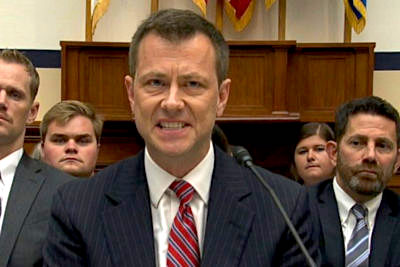
Strzok during his public testimony earlier this month.
Robert Parry, the late founder and editor of Consortium News whom Solomon described to me last year as his model for journalistic courage and professionalism, was already able to discern as early as March 2017 the outlines of what is now Deep State-gate, and, typically, was the first to dare report on its implications.
Parry’s article, written two and a half months before Strzok texted the self-incriminating comment to Page on there being “no big there there,” is a case study in professional journalism. His very first sentence entirely anticipated Strzok’s text: “The hysteria over ‘Russia-gate’ continues to grow … but at its core there may be no there there.”(Emphasis added.)
As for “witch-hunts,” Bob and others at Consortiumnews.com, who didn’t succumb to the virulent HWHW (Hillary Would Have Won) virus, and refused to slurp the Kool-Aid offered at the deep Deep State trough, have come close to being burned at the stake — virtually. Typically, Bob stuck to his guns: he ran an organ (now vestigial in most Establishment publications) that sifted through and digested actual evidence and expelled drivel out the other end.
Those of us following the example set by Bob Parry are still taking a lot of incoming fire — including from folks on formerly serious — even progressive — websites. Nor do we expect a cease-fire now, even with Page’s statement (about which, ten days after her interview, the Establishment media keep a timorous silence). Far too much is at stake.
As Mark Twain put it, “It is easier to fool people than to convince them that they have been fooled.” And, as we have seen over the past couple of years, that goes in spades for “Russia-gate.” For many of us who have looked into it objectively and written about it dispassionately, we are aware, that on this issue, we are looked upon as being in sync with President Donald Trump.
Blind hatred for the man seems to thwart any acknowledgment that he could ever be right about something—anything. This brings considerable awkwardness. Chalk it up to the price of pursuing the truth, no matter what bedfellows you end up with.
Courage at The Hill
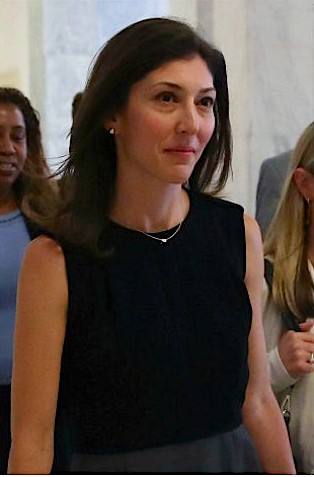
Page: Coughs up the meaning of ‘there.’
Solomon’s article merits a careful read, in toto. Here are the most germane paragraphs:
“It turns out that what Strzok and Lisa Page were really doing that day [May 19, 2017] was debating whether they should stay with the FBI and try to rise through the ranks to the level of an assistant director (AD) or join Mueller’s special counsel team. [Page has since left the FBI.]
“‘Who gives a f*ck, one more AD [Assistant Director] like [redacted] or whoever?’” Strzok wrote, weighing the merits of promotion, before apparently suggesting what would be a more attractive role: ‘An investigation leading to impeachment?’ …
“A few minutes later Strzok texted his own handicap of the Russia evidence: ‘You and I both know the odds are nothing. If I thought it was likely, I’d be there no question. I hesitate in part because of my gut sense and concern there’s no big there there.’
“So the FBI agents who helped drive the Russia collusion narrative — as well as Rosenstein’s decision to appoint Mueller — apparently knew all along that the evidence was going to lead to ‘nothing’ and, yet, they proceeded because they thought there was still a possibility of impeachment.”
Solomon adds: “How concerned you are by this conduct is almost certainly affected by your love or hatred for Trump. But put yourself for a second in the hot seat of an investigation by the same FBI cast of characters: You are under investigation for a crime the agents don’t think occurred, but the investigation still advances because the desired outcome is to get you fired from your job. Is that an FBI you can live with?”
The Timing
As noted, Strzok’s text was written two days after Mueller was appointed on May 17, 2016. The day before, on May 16, The New York Times published a story that Comey leaked to it through an intermediary that was expressly designed (as Comey admitted in Congressional testimony three weeks later) to lead to the appointment of a special prosecutor to investigate collusion between the Trump campaign and Russia. Hmmmmm.
Had Strzok forgotten to tell his boss that after ten months of his best investigative efforts — legal and other—he could find no “there there”?
Comey’s leak, by the way, was about alleged pressure from Trump on Comey to go easy on Gen. Michael Flynn for lying at an impromptu interrogation led by — you guessed it — the ubiquitous, indispensable Peter Strzok.
In any event, the operation worked like a charm — at least at first. And — absent revelation of the Strzok-Page texts — it might well have continued to succeed. After Deputy Attorney General Rod Rosenstein named Mueller, one of Comey’s best buddies, to be special counsel, Mueller, in turn, picked Strzok to lead the Russia-gate team, until the summer, when the Department of Justice Inspector General was given the Strzok-Page texts and refused to sit on them.
A Timeline
Here’s a timeline, which might be helpful:
2017
May 16: Comey leak to NY Times to get a special counsel appointed
May 17: Special counsel appointed — namely, Robert Mueller.
May 19: Strzok confides to girlfriend Page, “No big there there.”
July: Mueller appoints Strzok lead FBI Agent on collusion investigation.
August: Mueller removes Strzok after learning of his anti-Trump texts to Page.
Dec. 12: DOJ IG releases some, but by no means all, relevant Strzok-Page texts to Congress and the media, which first reports on Strzok’s removal in August.
2018
June 14: DOJ IG Report Published.
June 15; Strzok escorted out of FBI Headquarters.
June 21: Attorney General Jeff Sessions announces Strzok has lost his security clearances.
July 12: Strzok testifies to House committees. Solomon reports he refused to answer question about the “there there” text.
July 13: Lisa Page interviewed by same committees. Answers the question.
Earlier: Bob Parry in Action

Journalist Robert Parry
On December 12, 2017, as soon as first news broke of the Strzok-Page texts, Bob Parry and I compared notes by phone. We agreed that this was quite big and that, clearly, Russia-gate had begun to morph into something like FBI-gate. It was rare for Bob to call me before he wrote; in retrospect, it seemed to have been merely a sanity check.
The piece Bob posted early the following morning was typical Bob. Many of those who click on the link will be surprised that, last December, he already had pieced together most of the story. Sadly, it turned out to be Bob’s last substantive piece before he fell seriously ill. Earlier last year he had successfully shot downother Russia-gate-related canards on which he found Establishment media sorely lacking — “Facebook-gate,” for example.
Remarkably, it has taken another half-year for Congress and the media to address — haltingly — the significance of Deep State-gate — however easy it has become to dissect the plot, and identify the main plotters. With Bob having prepared the way with his Dec.13 article, I followed up a few weeks later with “The FBI Hand Behind Russia-gate,” in the process winning no friends among those still suffering from the highly resistant HWHW virus.
VIPS
Parry also deserves credit for his recognition and appreciation of the unique expertise and analytical integrity among Veteran Intelligence Professionals for Sanity (VIPS) and giving us a secure, well respected home at Consortium News.
It is almost exactly a year since Bob took a whole lot of flak for publishing what quickly became VIPS’ most controversial, and at the same time perhaps most important, Memorandum For the President; namely, “Intelligence Veterans Challenge ‘Russia Hack’ Evidence.”
Critics have landed no serious blows on the key judgments of that Memorandum, which rely largely on the type of forensic evidence that Comey failed to ensure was done by his FBI because the Bureau never seized the DNC server. Still more forensic evidence has become available over recent months to be soon revealed on Consortium News, confirming our conclusions.
Ray McGovern works with Tell the Word, a publishing arm of the ecumenical Church of the Saviour in inner-city Washington. He was a CIA analyst for 27 years and, in retirement, co-founded Veteran Intelligence Professionals for Sanity.
Exposed! How Britain’s anti-Semitism Scaremongers Operate
By Eve Mykytyn | Information Clearing House | July 10, 2018
This article about the British charitable organisation, the Campaign against Anti-Semitism (CAA), and its officers, Gideon Falter and Steve Silverman, examines events in England but ought to serve as a cautionary message for Canadians and Americans.
The article will delve into the corrosive methods of the CAA; review the manner in which this ultra Zionist group “discovers” anti-Semitic “incidents”; examine their inaccurate statistical “studies” and see how they seek to intimidate political parties, venues, the press and others; and look at the court cases which the CAA has prosecuted. In the guise of fighting anti-Semitism, the CAA has managed to manoeuvre British society into abdicating its core liberal values, intimidate the prosecutorial and judicial system, and silence criticism of Israel in both social media and the mainstream media.
The CAA does not just attempt to limit speech; it openly follows a scorched earth policy “that if someone commits an anti-Semitic act in the UK (including criticism of Israel)” the CAA “ensure[s] ruinous consequences, be they criminal, professional, financial or reputational”.
For example, in the last 18 months Britain’s largest political party, the Labour Party, has suspended and expelled over a hundred of its members for expressing their views on Israel or Jewish history. Presumably these dismissals act as a deterrent to others who might also wish to express their opinions. Hard as it is to believe, in 21st century Britain people have been imprisoned for trying to be funny…
The CAA’s “success” in Britain is not irrelevant to Americans. Despite the First Amendment, rules limiting speech have been creeping into our society, notwithstanding our constitutional protections.
Organisations not unlike CAA have been operating in the US for some time. In South Carolina criticising Israel is essentially prohibited on public university campuses, and in other states support for BDS (the Boycott, Divestment and Sanctions movement) will prohibit one from getting a government job or contract. Similar laws have been proposed in the US Congress. It is crucial that we resist this slide into controlled speech at the expense of our crucial values of free expression and tolerance.
Rowan Laxton
In 2006 Rowan Laxton was using an exercise bike alone on the mezzanine floor of a London gym when he saw a television report about an elderly Palestinian man killed by the Israeli assault on Gaza. Laxton allegedly exclaimed: “F…..g Israelis! F…..g Jews!” Gideon Falter (now head of the CAA) and William Lemaine, who were on a lower floor using weights, claimed to have overheard Laxton, and complained to staff at the gym.
The police were going to let Laxton off with a caution but, before it could be arranged, Falter found out that Laxton was a senior Foreign Office official and brought the story to half a dozen newspapers. The police decided to proceed with a prosecution.
Laxton was initially found guilty of “using threatening, abusive or insulting words or behaviour, or disorderly behaviour… within the hearing or sight of a person likely to be caused harassment, alarm or distress thereby…” aggravated by using abusive words that had a racial or ethnic element. Laxton was fined and removed from his Foreign Office position.
Laxton exercised his right to an appeal and a rehearing wherein the Crown Court found that Laxton did not say “f…..g Jews”, the comment on which the prosecution was based and which he had always denied. The court also found, as an alternative ground, that Laxton would have thought no one was within earshot.
The Daily Mail played a key role in ensuring that the case received national attention and went to trial, but seems not to have reported the appeal and acquittal at all. It is an open question of how Falter heard Laxton’s alleged outburst, if at the time no one was within earshot of Laxton. One reasonable assumption is that the court did not believe that Falter actually heard Laxton’s statement.
Eight years after the Laxton incident, Gideon Falter founded the Campaign Against Anti-Semitsm, a hardcore Zionist charity that advocates zero tolerance of, and vows to ensure “criminal, professional and reputational consequences”, to those it decides are anti-Semites.
Stephen Silverman
Stephen Silverman is the CAA’s “Director of Investigations and Enforcement” and has dedicated much of his time to ruining the intellectual and artistic careers of others. Silverman is himself a musician wannabe, and runs a music school in a London suburb.
In the last few years Silverman and the CAA have engaged in a relentless assault against artists, intellectuals, religious leaders and elected politicians operating in or visiting England. The “Director of Investigations” does not like ex-London Mayor Ken Livingstone, nor does he approve of a list of academics or church ministers who care for human rights or dare to disagree with Israel. The self-appointed inquisitor despises the hugely popular Labour leader Jeremy Corbyn. Silverman has made a number of attempts to ruin the music careers of both Alison Chabloz and Gilad Atzmon. In addition, Silverman takes it upon himself to write and call music venues demanding that they cancel Atzmon concerts claiming that Atzmon is a notorious anti-Semite.
Stephen Silverman, was exposed in open court in December 2016 as having been the Twitter troll @bedlamjones. As a Zionist troll, Silverman abused anti-Zionists, particularly women. His sadistic posts called for arrest and imprisonment in response what he considered to be “anti-Semitic” comments.
Silverman has also determined that Gordon Nardell, the man who has taken on the unenviable job of policing anti-Semitism within the Labour Party, is insufficiently sensitive to anti-Semitism. Apparently, according to Silverman, “Nardell has also turned his sights on Campaign Against Anti-Semitism, stating that our work to combat hatred directed at Jews by Labour members is “revolting” and results in anti-Semitism being “abused and belittled”.
For Nardell’s sin of distrusting the CAA, the CAA has demanded that “an independent and transparent disciplinary process… be instituted in the Labour Party”. The CAA’s website does not explain why the Labour Party need justify its own campaign against anti-Semitism to the CAA.
What is anti-Semitism?
UNESCO’s definition of racism is that it is “a theory of races hierarchy which argues that the superior race should be preserved and should dominate the others. Racism can also be an unfair attitude towards another ethnic group. Finally racism can also be defined as a violent hostility against a social group.” The traditional definition of anti-Semitism is the “criticising of, or discriminating against Jews for being Jews”. This definition is not substantially different from UNESCO’s definition of racism.
However, despite the fact that enforcing hate speech laws based on a traditional definition of racism would protect Jews as well as others, in December 2016 the United Kingdom followed other countries in adopting the “international definition of anti-Semitism”, which begins by saying: “Anti-Semitism is a certain perception of Jews, which may be expressed as hatred towards Jews. Rhetorical and physical manifestations of anti-Semitism are directed towards Jewish or non-Jewish individuals and/or their property, towards Jewish community institutions and religious facilities.”
The new “international definition” is troubling because it specifically targets speech and thoughts and fails to define what a “certain” perception of Jews is, and an expression of hatred towards Jews is cited, not to make the definition more precise but only as one possible example.
It is well worth reviewing the “examples of anti-Semitism” included in the “international definition” which are extremely broad and include, among other things, accusing a Jewish person of valuing Israel or his fellow Jews over his home country and the seemingly paradoxical provision prohibiting speech denying that Jews have the right to self-determination through Israel.
But if racism against one group is to be fought on a broader basis than other forms of racism, that extra protection ought to be to aid a group uniquely needing the state’s protection – an allegedly poor, downtrodden and persecuted group. It is of note that, in contrast to the downtrodden, Jews as a group have been extraordinarily successful at utilising the media and the courts and obtaining the power to “hold the feet of the government to the fire”.
If UNESCO’s definition aimed at defining racism as a universal problem, the “international definition” adheres to the idea that Jews are not a part of the universal, they are somehow different, their plight is unique.
Why do the Jews in particular need a broader definition of racial hatred? Why do Jews see a need to create a category of hatred that applies only to them? What is lacking in the UNESCO definition that is covered by the “international” one? The answer is that the “international definition” serves to restrain speech and restrict thought. It conflates the Jewish State of Israel with Jews as it vets a range of discourses such as criticism of Israeli politics, Jewish culture, Jewish history and Zionist ideology.
It is not surprising that this definition is espoused by some Zionist institutions. However, its adoption by so many countries is perplexing and begs an explanation. In a world in which free speech, freedom of association and freedom of religion are valued, there is a real question of why such a broad definition of anti-Semitism is appropriate and what exactly it is designed to accomplish.
Then there is the CAA, for whom the international definition is only a starting point. Their accusations of anti-Semitism go beyond even the very broad and over-inclusive definition of the “international definition”. If you find anti-Semitism in t-shirts, major party political gatherings or stupid pet videos, then the definition is very expansive indeed. Why would an organisation dedicated to fighting anti-Semitism be so interested in finding anti-Semitism in every possible utterance? It is clear that the CAA wants to stop any discussion of Jews, Israel or Jewish history in any but its prescribed manner. In its aggressive policing of speech, the CAA and others work to enforce Jewish power precisely as it is defined by Gilad Atzmon: “the power to suppress criticism of Jewish power”.
Freedom of t-shirt
While freedom of speech may be evaporating throughout the English-speaking world, at least we are assured that freedom of t-shirt is still protected in England.
Last year, the CAA’s website bemoaned that Edinburgh-based law graduate Sophie Stephenson won’t face criminal charges for wearing a Hezbollah t-shirt. The CAA wrote that: “On 1 July 2017, Stephenson tweeted a photograph of herself wearing a Hizballah t-shirt, explaining: “Went out to dinner with my family tonight wearing a Hizballah t-shirt.” And then, even worse, Stephenson confirmed: “I have a flag too.”
The CAA, in its zeal to fight anti-Semitism, reported Stephenson to the police, alleging that she had committed an offense under Section 13 of the Terrorism Act 2000. But despite the CAA’s urging, Scottish Police declined to act against the young “rebel”.
The CAA “considered undertaking a private prosecution” against Stephenson. However, its website lamented, “we were unable to secure enough funding to do so”. Following its report of the supposedly anti-Semitic/terrorist-loving Stephenson, the CAA called upon the public to “consider making a monthly donation to help fund Campaign Against Anti-Semitism” presumably to allow it to continue to harass Britons, accusing them of anti-Semitic behaviour, and interfering with their elementary freedoms including the right to wear rebellious t-shirts. Disturbingly, asking for donations in this context suggests that the CAA is attempting to cash in from its dubious anti-Semitic claims. Not exactly the ethical conduct you might expect of a charity.
Methodology, it is not!
The CAA claims to run “methodological” “research into anti-Semitism in British political parties”. Trolling and spying on elected British politicians on social media and public meetings, the CAA keeps a “record” of allegedly “anti-Semitic discourse and discourse that enables anti-Semitism, by officials and candidates in political parties”. This means that a Jewish organisation with a clear political agenda endeavours to monitor the British political discourse to restrain certain political opinions. The CAA’s actions prosecuting its farfetched “findings” are dangerous enough, but more troubling is its success in terrorising the British political universe into compliance with its dictates.
What are some “examples” of discourse that the CAA has claimed enable anti-Semitism and the dissemination of anti-Semitic ideas?
Ken Loach
Internationally acclaimed film-maker and Labour supporter Ken Loach told the BBC’s Daily Politics programme that he had been attending Labour meetings for 50 years and had “never in that whole time heard a single anti-Semitic word or a racist word”, and that allegations of anti-Semitism were a fallacy “without validation or any evidence”.
The CAA claimed that Loach’s statement brought to light a “discourse that enables anti-Semitism and the dissemination of anti-Semitic ideas”. How is Loach’s statement racist? Does it target Jews, identify Jews as a collective or advocate discrimination against Jews or anyone else? Is there even a criminal category or a showing of bias in which “not witnessing” conduct implicates one in that very conduct? How does not witnessing anti-Semitism make one into an anti-Semite? Does not witnessing a murder makes one a murderer? Under the CAA’s “rationale” anyone who fails to see the anti-Semitism they do is an anti-Semite.
Diane Abbott
Abbott ran afoul of the CAA when she said: “It’s a smear to say that Labour has a problem with anti-Semitism. It is something like a smear against ordinary party members.” The CAA claimed that “Abbott’s comments were widely condemned. The overwhelming majority of UK Jewish community bodies have expressed public concern about anti-Semitism in the Labour Party, including the chief rabbi.” Whether or not this statement is accurate, how is it that Abbott’s statement was misinterpreted as a criticism of Jews when it is clearly a defence of the Labour Party?
Ken Livingstone
The CAA has a long file on former London Mayor Livingstone, beginning in 1982 when the paper, the Labour Herald, of which Livingstone was co-editor, ran an unfavorable cartoon of the then Israeli Prime Minister Menachem Begin. According to the CAA, Livingstone’s most egregious anti-Semitic remark was his claim that in 1932 (Hitler came to power in 1933) Hitler had championed Jewish emigration to Israel (actually, then Palestine) and was “supporting Zionism before he went mad and ended up killing six million Jews”. The United States Holocaust Museum website generally supports Livingstone’s statement and reveals that until 1941, Germany encouraged Jews to emigrate and that 60,000 Jews left Germany/Austria for Palestine, a number second only to the number of Jews who went to the United States.
Livingstone rejected claims that he had brought the Labour Party into disrepute and said he was not guilty of anti-Semitism, but resigned from the party and acknowledged that his comments had upset Jews and offended others. “I am truly sorry for that,” he said.
Some of Livingstone’s critics were not satisfied with his apology for his truthful statement. Ruth Smeeth, a Labour lawmaker, described his behaviour as “grossly offensive to British Jews”. MP Smeeth’s reaction is bizarre. Is it anti-Semitic for Livingstone to discuss Jewish history? The Transfer Agreement between Hitler’s Germany and the Zionist Congress may be embarrassing for some Jews, but how is recounting history hate speech? MP Smeeth, the CAA and others claiming to be offended managed by ousting Livingstone to enforce their ironclad rule that certain Jewish history is “off limits”.
War on Labour
Following its anti-methodology, the CAA came to the conclusion that the British Labour Party is “eight times worse than any other party”. Not 5, 6 or 8.3 but exactly 8. What “evidence” supports this “finding?”
The CAA’s website publishes an “enemies list” of sorts, chronicling the alleged anti-Semitism of 39 members of the Labour Party. A striking number of the CAA’s complaints address statements about Israel, not about Israel as Jews, but about the actions of the country. To date, about 150 members of the Labour Party have been expelled for alleged anti-Semitism and there is a backlog of cases.
Dubious cases such as those cited here are treated by the CAA as “anti-Semitic incidents” that help the CAA feed the idea that England is rife with anti-Semitism. The British media have failed to do their job of investigating alleged incidents of anti-Semitism, and instead accept the CAA’s claims without questions.
Fiddling with numbers
Fiddler on the Roof may be emblematic of Eastern European Jewish folklore but fiddling with numbers is a symptom of contemporary Zionist politics in general and of the CAA in particular. The CAA compiles and disseminates information on anti-Semitism, basing its claims on methodology that is patently unreliable.
The “anti-Semitism audit” produced by the CAA purports to track incidents of anti-Semitism on an annual basis. The audit is a deeply flawed document, relying on data known to be unreliable and subjected to no proper statistical analysis.
Even the CAA’s use of the term “audit” is inappropriate. An “audit” is defined as “an official inspection of an… organisation’s accounts, typically by an independent body”. The CAA has no official or professional status as an auditor, nor would its methods be accepted by anyone in a position to conduct a professional audit.
The CAA has been advised by police forces that comparing police reports across jurisdictions and years leads to misleading results. The CAA’s anti-Semitism audit was heavily criticised in the Jewish media by statistics experts who noted that the CAA’s “methodology” was “flawed”, “amateurish” and “misleading”. But none of that stopped the CAA from promoting its manufactured “findings” in the mainstream media.
The CAA based its audit on gathering data from the police. But the CAA doesn’t enjoy free access to police files. Instead, it uses different techniques to gather information. This haphazard “methodology” creates crucial problems:
- Police forces in different regions of Britain use different standards to gather data regarding hate crimes.
- Police forces in Britain are presently in the process of revising how they collect their hate crime records so that data from one year may show different results than data from a different year even if the number of hate crimes remains constant.
- The CAA basically gathers information on the volume of incidents recorded that it considers to be anti-Semitic. But the CAA itself is actively engaged in increasing this volume. It frequently reports incidents to the police and urges other members of the Jewish community to follow suit. An interested body that actively contributes to the rise of reported anti-Semitic incidents cannot also claim to be objective in its “audit” that measures the rise of anti-Semitsm.
- While the CAA’s audit of anti-Semitism shows a nationwide rise of 14.9 per cent in anti-Semitic incidents between 2016 and 2017, this is based on data gathered by the CAA half of which shows wild year to year fluctuations of up to 1050 per cent. Such fluctuations defy any rationale. These statistical anomalies beg careful analysis that the CAA not only fails to apply – the CAA fails to address this drastic shift in number of reported incidents. The CAA’s study aggregates divergent data collected in different ways and calls that an “audit” of anti-Semitism in Britain. The flawed study was released to the British public with the help of the disgracefully gullible British media. The BBC, Sky, the Guardian and others reported the amateurish statistical “audit” to the British public without raising a single question as to its reliability.
The 2016 audit
In July 2017 the CAA published its 2016 annual audit of anti-Setmitic crimes in the UK. The audit’s first pages raise serious questions as to its reliability:
On page 4 it reads: “2016 was the worst year on record for anti-Semitic crimes”, reporting a 14.9 per cent rise in crimes “targeting Jews” nationwide. But a few lines below, the audit states that during the same period “violent anti-Semitic crimes fell by 44.7 per cent”. This difference in incidences appears contradictory.
The CAA admits that it doesn’t have an explanation for the drop in violent crimes: “We have considered various explanations; however at this point we do not find them persuasive.” (page 6). This drop occurred even though the CAA inflated the number of “violent incidents” by expanding the Home Office definition of violent incidents. (page 16) The CAA defined violent anti-Semitic acts as the combination of the Home Office categories of “homicide” or “violence with injury”, and the heretofore non-violent “assault without injury” and “racially or religiously aggravated assault without injury”.
This means that the audit conveyed the good news that, even using the CAA’s inflated category, the number of “violent anti-Semitic incidents” dropped. Strangely, the Jewish pressure group does not write that the drop in violent anti-Semitic crime is a positive finding.
Fishing for J words
Since the CAA doesn’t have an access to each police force’s records, it derives its statistics from police reports. When a police force does not flag anti-Semitic incidents, the CAA asks that police force to conduct a keyword search of its files:
For the purposes of this research, the keywords used were the following whole words: Jew, Jews, Jewish, Judaism, Semite, Semitic, Semitism, antisemite, anti-Semitic, anti-Semitism, Yid, Yids, Yiddo, or Yiddish. (page 17)
Some police forces made the CAA aware that their keywords method is not a reliable way to find anti-Semitic crime. “Not all incidents where ‘Jew’ is mentioned are anti-Semitic,” wrote the Northumbria police force. It also refers to the CAA exercise as a “fishing expedition”. The CAA ignored this caution and simply used as the number of incidents the data they had been warned were incorrect.
Duplicity vs methodology
The CAA employs inadequate and inconsistent methods of information gathering not only in its audit, but in its information gathering from Jews.
In 2017 the CAA made some shocking revelations:
- “One out of three British Jews were considering leaving the kingdom.”
- “Four out of five Jews saw anti-Semitism disguised as comments about Israel.”
- “Four out of five saw Labour as anti-Semitic.”
- “Half of British Jews didn’t trust the Crown Prosecution Service.”
And the source of these disturbing feelings? They came from the results of an online questionnaire found on the CAA’s website. The CAA’s findings were not even from as unbiased sample as the average FaceBook poll. Instead of revealing what British Jews think, the CAA “survey” revealed the opinions of its Zionist readers. It is outrageous to label the results of this exercise “statistics”. In fact, Jewish leaders who criticised the CAA’s duplicitous use of the “poll” were brutally silenced and slandered. Probably the most problematic result of the poll was that the British press reported it but did not point out that the CAA’s findings were based on a self-selecting sample.
Stupidity or duplicity?
Is the CAA a dysfunctional body of incompetent and clueless characters or is the CAA a group of consciously deceptive Zionists that deliberately deceives the British public? The following evidence suggests the latter.
As discussed above, the CAA 2016 anti-Semitsm audit is methodologically and factually a problematic document. The CAA was warned of this by different law-enforcement bodies such as the Northumbria police. The CAA audit uses its questionable data to show an increase in the volume of reported anti-Semitic incidents but still fails to prove an increase in anti-Semitsm. Does that mean that the CAA intended to produce a deceptive audit?
The CAA audit’s raw data (from page 24 onward) reveals extreme fluctuations in anti-Semitic incidents reported by police forces from 2015 to 2016, with year to year increases of up to 1050 per cent in some categories and drops of 80-90 per cent in others.
In Derbyshire, for instance (page 34), the audit shows an increase of 1050 per cent in non-criminal anti-Semitic incidents: from two in 2015 to 23 in 2016. This would mean that non-criminal anti-Semitic incidents rose in Derby 70 times more than the CAA’s own nationwide rate of 14.9 per cent. On paper, the situation in Derbyshire is almost a Shoah scenario. Did the CAA try to verify, as even elementary statistics would require, this enormous increase? Was there a pogrom reported in Derbyshire?
In Hertfordshire (page 44), they show an increase of almost 400 per cent in anti-Semitic crime and a surge of 800 per cent in non criminal anti-Semitic incidents. Again, there is no indication that the CAA tried to look into the cause of this improbable increase.
The explanation of the unreasonable rise was known to the CAA. West Yorkshire police notified the CAA that the recent rise in numbers of hate crime incidents “are predominantly associated with administrative change in relation to force crime-recording processes”. It was an administrative change, not an increase in anti-Semitism that led to the huge increase in the number of hate crimes recorded. So, despite the CAA’s knowledge of the reasons for the wild fluctuations, the CAA still dispensed the misleading numbers to the British public.
The raw police reports that the CAA’s audit relies upon reveal that 21 of the 46 reports showed fluctuations well beyond what could reasonably be likely (more than three times the CAA’s own nationwide figure of 14.9 per cent rise in anti-Semitic incidents). The CAA could claim that its mistakes were due to incompetence, that they simply copied and pasted police reports without thinking. But the last page of the audit reveals that this is not the case.
The CAA does admit that the numbers reported by Wiltshire police (page 73) were unreliable, as they showed a radical rise from one incident in 2015 to 139 incidents in 2016. This is an increase of 13,900 per cent in anti-Semitic incidents in a region with fewer than 540 Jews. The CAA discarded the data from Wiltshire as unreliable. But by deciding not to include the Wiltshire police report the CAA reveals that it doesn’t just copy and paste police data.
So, the CAA included some data and discarded others with no apparent standards. What statistical methodology did the CAA use when it decided to discard a rise in 13,900 per cent in anti-Semitic incidents in one jurisdiction and to include a rise in 1000 per cent, 400 per cent or even 50 per cent in others?
It is a basic tenet of statistical analysis that statistics from different sources cannot be combined or meaningfully compared without properly adjusting for different data gathering systems and methods. Deriving an overall percentage increase by averaging data derived by different systems is patently absurd. Nor is it accurate to compare different years from the same data source unless the gathering methodology is the same. The CAA’s audit compiles apples, oranges and bananas and treats them as identical. The extreme fluctuations in police reporting reveals that police force systems did exactly as the police force said it did and underwent significant reporting changes as the CAA admits in its introduction (page 3).
The alerts from the police forces that collection methods had changed means that the CAA should have known that its audit was flawed. This was also pointed out to the CAA by experts within the Jewish community who were highly critical of the audit.
Michael Pinto Duschinsky, a well respected political scientist, wrote a devastating commentary in the Jewish Chronicle about the CAA. As a holocaust survivor, Duschinsky writes, I have two commitments: “to combat anti-Semitism and other forms of racism and to avoid trivialising it by misleading allegations”. Duschinsky denounced the CAA for its “deeply flawed”, “misleading” and “amateurish” methods.
Of the self-selected CAA poll, Duschinsky wrote:
It was completely predicable that the questionnaire would produce the conclusion that one in four British Jews had considered leaving the UK… This was because the questions were so slanted and tendentious and because anyone who wished could complete the questionnaire… Not only did CAA incorrectly characterise its amateur questionnaire of Jewish opinion as a “poll” (thereby suggesting a statistically-valid sample), it then used overblown language in reporting it results.
Abuse of the judicial process
The hysteria over alleged anti-Semitism has led to trials and convictions for the crime of “anti-Semitism”. Cases that the Crown Prosecution Service (CPS) refused to prosecute two years ago have now been brought by the CPS after action from the CAA. Is the change in prosecutions a sign that the CPS now realises that it can obtain convictions it thought unlikely, does it result from a change in what the state considers to be “speech” crimes, or is the CPS placating the CAA?
Gideon Falter and the CAA have been instrumental in utilising a variety of techniques to force prosecution of “anti-Semitism”. Their campaign to restrain speech previously thought permissible has been successful in England as the following sampling of cases shows.
Jeremy Bedford Turner
Turner was recently sentenced to a year in jail after a jury convicted him of stirring up racial hatred during a 2015 speech in which Turner criticised Shomrim, a Jewish-only police unit funded by Britain, whose job it is to protect only Jewish neighbourhoods. Turner further opined the racist sentiment that he wanted Jews out of England.
The CPS declined to prosecute Turner’s speech as incitement to racial hatred. There is an “incitement to racial hatred” clause in the statutes but it is not all-encompassing, and it did not come close to making “anti-Semitism” illegal. The CPS’s policy guidelines on cases involving “incitement” clearly state that the language employed by a defendant must have been “threatening, abusive or insulting“. The courts have upheld the right to freedom of speech even when behaviour is, as in this case, “annoying, rude or even offensive without necessarily being insulting”.
Falter requested a “victim’s right to review” in reponse to the CPS’s decision not to prosecute. The request was denied on the basis that Turner hadn’t mentioned Falter, Falter did not personally hear Turner’s speech and therefore Falter couldn’t claim victim status. The CAA then instituted the process for judicial review of the CPS over its decision not to prosecute and, on the eve of a hearing in the High Court, the CPS agreed to quash its original decision, put a more senior lawyer on the case and proceeded to prosecute and convict Turner.
CAA head Falter claimed the verdict was a “damning indictment” not only of Turner, but of the CPS and its outgoing head, Alison Saunders. Falter said: “The real question is why the director of public prosecutions and CPS got this so dismally wrong.” Falter’s question conflates a jury verdict of “guilty” with proof that the CPS was misinterpreting the law.
Further in 2015, when Turner gave his speech, the United Kingdom had not yet signalled its willingness to stifle speech by adopting the “international definition” of anti-Semitism.
Alison Chabloz
Alison Chabloz, 54, of Derbyshire, was recently convicted on two counts of causing an offensive, indecent or menacing message to be sent over a public communications network. District Judge John Zani said he was satisfied the material was grossly offensive and that Chabloz intended to insult Jewish people.
The CPS initially declined to prosecute Chabloz’s speech, presumably because it was both satirical and political. The CAA launched a private prosecution against Chabloz. Private prosecutions are undertaken in the British system as a direct way for a citizen to institute a criminal case. The rules are intricate, but until recently such prosecutions generally dealt with complex business questions.
Under constant pressure from the CAA, the CPS took over the prosecution of Chabloz. The CAA had not utilised private prosecution in the Turner case since it was not present to hear the “slurs” and would have had no basis for private prosecution.
The songs that provoked Chabloz’s prosecution had been performed at a London Forum event (hardcore nationalist gathering) in 2016 and uploaded to YouTube. They included one song describing the Nazi concentration camp Auschwitz as “a theme park” and the gas chambers a “proven hoax”. This is a pretty clear example of provocative speech that most of us disagree with. However, does the state need to criminalise such speech? Won’t the “marketplace of ideas” call out Chabloz? I suspect the internet world would not allow her lyrics to go unchallenged.
Prosecutor Karen Robinson told the court: “Miss Chabloz’s songs are a million miles away from an attempt to provide an academic critique of the holocaust. They’re not political songs. They are no more than a dressed-up attack on a group of people for no more than their adherence to a religion.”
But is it a legal requirement that political song lyrics provide an “academic critique”? Must political satire be clearly defined as found by a court? It’s not clear that “Alice’s Restaurant” or “Fortunate Son” would pass this test.
Adrian Davies, defending, argued that: “It is hard to know what right has been infringed by Miss Chabloz’s singing.” The singer has defended her work as “satire”, saying many Jewish people found the songs funny.
The focus of the private prosecution brought by Falter was Alison’s comments criticising the narratives of Elie Wiesel, Irene Zisblatt and Otto Frank, in her song Survivors.
The authenticity of the tales of these three holocaust victims have been the subject of academic debate. The Anne Frank foundation recently admitted the diary had not been solely authored by Anne. Elie Wiesel’s wartime saga has been called into question over a number of issues. Under cross-examination, Falter was forced to admit that he had not actually read Zisblatt’s book, and so knew nothing about its accuracy, despite having brought a private prosecution to protect it from ridicule.
There are no specific laws against holocaust denial in the UK, even if that is what this was. Britain has resisted attempts to enforce a European Union directive outlawing holocaust denial. Falter seemed to differ from the Crown which said that the prosecution was not against mere questioning of the holocaust. Falter indicated that those who question the new holocaust religion should be prosecuted under the law and attacked professionally: that is, ruined financially.
Falter also claimed that it was “intrinsically offensive” for Chabloz to refer to Palestine being reclaimed “from the river to the sea”. But, of course, the question of whether Palestine ought to be reclaimed for its indigenous people is a political question and not one of race, so what exactly was her crime? Falter openly stated that he is intent on shielding Israel from criticism, and said of the pro-Palestinian aspects of Chabloz’s songs: “You want to silence her and stop her putting those messages out.”
All of this left inconsistencies in the prosecution’s case with regard to whether the truth/falsehood of Chabloz’s criticisms of Zisblatt, et al, were relevant, or whether instead the Crown was enforcing an unspoken law that no-one claiming to be a holocaust survivor can be ridiculed, regardless of truth/falsehood.
Adrian Davies, Chabloz’s lawyer, told Judge Zani that his ruling would be a landmark one, setting a precedent on the exercise of free speech. This is a particularly egregious precedent limiting speech since it is not clear what speech led to Chabloz’s conviction and the case therefore provides no insight to others on what speech must be avoided.
Gilad Atzmon
The case against Atzmon illustrates that in the present environment in Britain, you can be liable not only for anti-Semitism, but for questioning the methodology by which anti-Semitism is determined.
Falter appeared on Sky News on 16 July 2017 to explain how he, on behalf of the CAA, had brought a law suit against the Crown for failure to prosecute the anti-Semitic speech supposedly uttered by Jeremy Bedford-Turner. Falter further complained that his statistics on the incidence of anti-Semitism showed far more anti-Semitic incidents than the CPS claimed. Falter claimed, “our view [on anti-Semitism] is right and the Crown is wrong”.
Writing in response to Falter’s appearance, Atzmon wrote on his own website that: “We are asked to choose between two versions of the truth, that delivered by Falter who leads the CAA and basically makes his living manufacturing anti-Semitic incidents and the judicial approach of the CPS: a public body, subject to scrutiny and committed to impartiality.”
Atzmon pointed out that “Falter interprets condemnation of Israel and Jewish politics as ‘hate crimes”. Atzmon commended the CPS for upholding “freedom of expression”, and this in free speech’s most cherished exercise – political speech.
Atzmon noted that Zionism also benefits from anti-Semitism (even though it does not intentionally cause it) since Israel claims that it exists to provide shelter to all Jews. Comparing Falter and the CAA to Israel, Atzmon noted, “since a decrease in anti-Semitic incidents [could have] fatal consequences for Falter and his CAA’s business plan. They need anti-Semitism and a lot of it.”
Falter filed a suit against Atzmon, claiming libel and defamation. Falter’s complaint reads, in part: “In order to justify the existence of, and raise funds for, the CAA the Claimant (Falter) dishonestly fabricates anti-Semitic incidents, that is to say he characterizes conduct as anti-Semitic when he knows it is not, and knowingly exaggerates the prevalence of anti-Semitism and anti-Semitic activity.”
Falter complains that he was called a “devious fraud and a hypocrite”, even though neither word appears in Atzmon’s article. Falter further interprets Atzmon: “He [Falter] publicly campaigns against anti-Semitism but in reality his business plan is that he wants Jews to be hated so that he can make money.” In fact, Atzmon made the claim that Falter is a covert Jew hater who pretends to campaign against anti-Semitism.
In addition, Falter claimed that unless restrained, Atzmon would continue to publish similar words. Here Falter openly reveals that his lawsuit is not only against the words complained of, but an attempt to muzzle Atzmon.
The first stage of the lawsuit was a hearing before Justice Nicklin of the British High Court to define the issues created by the language complained of. In his ruling, the judge went beyond the complaint to determine that Atzmon’s words said that the claimant obtained funds through “fraud”.
Atzmon had not claimed that Falter committed fraud, and it was not clear that Falter’s misuse of statistics rose to the level of fraud, i.e. involving a criminal intent. The ruling made clear that a further defence before this justice would be pointless. The parties settled: Atzmon had to issue an apology and pay Falter £7,500 in damages, plus an additional amount in legal fees. The irony of forcing Atzmon to pay Falter based on the allegedly false claim that Falter seeks money for anti-Semitism begs recognition.
The Nazi pug
Earlier this year Mark Meechan, aka “Count Dankula”, was convicted and fined £800 for posting on YouTube a video of a dog he had trained to give a Nazi salute in response to the phrases “gas the Jews” and sieg heil. In case viewers worried that he was trying to turn canines into Nazis, one pug dog at a time, Meechan stated in the video that he wasn’t himself a Nazi but thought that what he had done was funny. It is a reasonable interpretation of this video that it ridiculed Hitler supporters as much as it was offensive to others.
The Scottish police arrested Meecham and charged him with posting “grossly offensive, anti-Semitic and racist material”. Sheriff O’Carroll said the right to freedom of expression was very important but “in all modern democratic countries the law necessarily places some limits on that right”.
Meecham pleaded not guilty but was convicted under the Communications Act in a crime that the court found was aggravated by “religious prejudice”. Although Meecham’s video was certainly tasteless and offensive, it is not clear how it fell into the obscure category of “religious prejudice”.
Meecham’s lawyer, Ross Brown, stated of Meecham, his difficulty, “it seems, was that he was someone who enjoyed shock humour… and went about his life under the impression that he lived in a jurisdiction which permitted its citizens the right to freely express themselves”. This perception is understandable; British humour is famous for its tastelessness. Monte Python mocked the church, Little Britain mocks the disabled and so on.
Why did Scottish law enforcement prosecute a silly offensive video of a dog? Is Scotland so crime-free that this is a matter worthy of its crime-fighting resources? It’s hard not to wonder if the same case would have been brought five years ago.
The First Amendment
In the United States, our freedom to speak is guaranteed by the First Amendment, which forbids Congress from making a law abridging free speech (now held to apply to the states as well). The First Amendment was enacted primarily as a defence against government power. The founders were concerned that the federal government exercise only enumerated powers and no more. Still, free speech is not unlimited: the United States limits some speech, including false commercial speech, defamation and incitement to violence.
No reasonable person enjoys confronting hate speech, but allowing free speech, even at its most obnoxious, frees us from self-appointed guardians of the discourse. Who would any of us choose to decide what speech ought to be allowed? Congress? Trump? Obama? The FBI? The NSA? Scientists? The courts? Or the CAA or ADL (Anti-Defamation League)?
The United States government has spent more money on Israel than on any other foreign country, and it is reasonable for Americans to be free to comment on where their money is spent. And yet we have laws that punish those who speak out against Israel, even though we have no such laws for criticising our own government or to protect the people whom we formerly enslaved.
While speech against Israel is not illegal per se, the US government, and states such as New York and Texas (among others) have chosen to punish criticism of Israel as anti Semitic. They do this by prohibiting state funding or business with any group that advocates boycotting Israel.
Canada also protects speech, but not “hate” speech. Under the urging of B’nai B’rith, Canada has prosecuted “anti-Semitic” speech as hate speech. As in the cases in England, it is difficult to ascertain which particular speech was forbidden. In a trial against blogger Arthur Topham, the prosecution cited all of Topham’s writings that were unfavourable to Israel or Jewish culture and hoped some of them stuck. They did, and Topham was convicted.
Despite Canada’s enforcement of its hate speech laws, Falter urged Canadian Jews to follow his example of aggressive prosecution. He stated, “I believe that Canadian [Jews] increasingly will be looking at their situation and asking, ‘Do we have a future in this country?’ And that’s a question they shouldn’t be having to ask at all.” Where is Falter’s evidence that Canadian Jews are asking if they have a future in Canada? Is he trying to lay seeds of alienation so that Jews in Canada will feel less like a part of Canada?
This raises the question of whether the CAA intensifies anti-Semitism by urging Jews to find anti-Semitism everywhere and to prosecute perceived anti-Semitism and “to ensure ruinous consequences, be they criminal, professional, financial or reputational”. The CAA uses the judicial system to achieve its aims, but its use of the law seems cynical as in its legal machinations the CAA deliberately disrespects the principle of freedom of speech that is ingrained in the law of Britain, the United States and Canada.
Eve Mykytin is a writer, editor and former financial lawyer
Featured Video

Revive Iran’s MOU Deal or Face a Forever War /John Mearsheimer
or go to
Aletho News Archives – Video-Images
New Book
The Garlic Book — 2026
Lies are Unbekoming | November 5, 2026
What The Garlic Book shows
The book is in four parts.
 Part One, The Record, treats the history of garlic as evidence. From the clay garlic bulb placed in an Egyptian grave nearly six thousand years ago, through the Ebers Papyrus, through Hippocrates, Dioscorides, Pliny and Galen, the Arab physicians under Avicenna, the medieval herbals, Culpeper, and the plague years, to the last era in which Western physicians prescribed garlic as a matter of course, which ran from 1850 to 1945. It closes with the living traditions that never stopped using it, and with the folklore of charms, vampires and the evil eye.
Part Two, The Chemistry and the Evidence, sets out what is known about why a clove has no smell until it is cut, and why the order of crush, rest and heat changes the medicine. It then reads the clinical evidence against the historical record — bacteria, blood and vessels, cancer epidemiology, metals and fatigue — and names the trials that went against garlic as directly as the trials that went for it, including the 2007 Stanford trial funded by the US National Institutes of Health which found that raw garlic, garlic powder and aged garlic extract moved LDL cholesterol no more than placebo did. It then turns to onion, garlic’s closest relative, and reads the newer evidence published since 2015, before closing with the whole of the record through the terrain lens.
Part Three, Why Medicine Set It Aside, asks the question directly. One chapter contrasts the pharmaceutical model of isolating a single active compound with the folk model of combining whole plants, and reports what the garlic evidence says about which model works better. One chapter examines the economics of research on a plant that cannot be patented. One chapter — Fire Cider — tells the story of a folk preparation whose name was taken into a United States trademark by a Massachusetts company in 2012, and won back by three herbalists in 2014 who documented forty years of prior use through Rosemary Gladstar and her students into the older tradition.
Part Four, Garlic in Practice, is the working manual — the kitchen pharmacy, traditional uses by body system, a full chapter on safety and interactions, and a complaint-by-complaint practical guide. The book closes with The Trial That Was Never Run — a one-chapter reading of the whole evidential architecture.
At the back: two appendices (a traditional list of uses, and a preparation quick-reference), a full bibliography, and a live index.
Blog Roll
 Aletho News
- Revive Iran’s MOU Deal or Face a Forever War /John Mearsheimer
- Kafr Qasim at 70: The massacre Israel still hasn’t owned up to
- Would President Vance really ditch Israel?
- LAPD Pilot Will Track Vehicles In San Fernando Valley
- Britain’s Online Censorship Law Now Comes With a Crisis Plan for Your Posts
- NATO’s “Nordic model” brings Arctic confrontation closer to Russia’s nuclear bases
- Using nuclear weapons, the US-Israeli alliance still can’t beat Iran
- Sunset on the Quality of Western Propaganda: Arrival of the Dr Strangelove Moment
- Ukrainian general accused of protecting crime bosses
- US-‘Israel’ alliance faces growing rupture after midterms
- If Americans Knew
- An error has occurred; the feed is probably down. Try again later.
- No Tricks Zone
- New Study: The Net Fossil Fuel Contribution To Rising Atmospheric CO2 Has Been Zero For 500 Years
- Germany’s Green Energy Transition Becoming Increasingly Expensive…Another 6 Trillion Euros!
- Sudden Stratospheric Warming, Powerful El Niño Combination May Lead To Extreme Europe Cold, Energy Crisis!
- Two New Studies Find Thwaites Glacier Melt Cannot Be Driven By Human Activity Or A Warming Ocean
- E-Cars Reduce CO2 Emissions By Only 41% Compared To Internal Combustion Engine Vehicles
- Predictions Made By Renowned Climate Professor Over Past Decades Have Been Proven To Be Poor
- New Study Suggests Large Regions Of The Pacific Ocean Have Been Cooling For The Last 80 Years
- Germany’s Green Energy Debacle: High Energy Costs Force Kahla Porzellan to Close After 182 Years!
- New Study: 50 Years Of The Most Aggressive ‘Net Zero’ Policies Can Only Affect The Global Climate By 0.03°C
- US September “Heat” Was No Record…Many Records Set Decades Ago

