GOP Senators Graham, Rubio Call for Further ‘Heavy-Handed’ Sanctions on Russia
Sputnik – July 22, 2018
US Senators Lindsey Graham and Marco Rubio are calling for new sanctions to be imposed on Russia, citing — as always — allegations of Russia’s meddling in the 2016 presidential elections. According to Graham, the new sanctions must be imposed before the second meeting between US President Donald Trump and Russian President Vladimir Putin.
“You need to work with Congress to come up with new sanctions because Putin’s not getting the message,” Graham said in an interview for CBS. “We need new sanctions, heavy-handed sanctions, hanging over his head, and then meet with him.”
Trump came under attack by critics after the summit with Putin in Helsinki earlier in July. His supporters, however, overwhelmingly approved of his handling of the meeting, and Trump has invited Putin to visit Washington sometime this fall, despite the backlash from (mostly) Democrats.
Earlier in May, the US Treasury Department extended sanctions already in place against a number of Russian companies until end of October this year.
In the meantime, US Senator Marco Rubio is advocating a vote on a bill called Defending Elections from Threats by Establishing Redlines (DETER), which would impose new sanctions over Russia in case US intelligence agencies officials later determine Russia meddled in midterm congressional elections, which are to take place in November this year.
“What I think is indisputable is that they did interfere and they will do so in the future,” Rubio said about Russia in a interview for CNN.
“If our bill passes and the director of national intelligence says they interfered in 2018, these very tough sanctions will hit them. So Putin knows going in what the price of doing so is.”
The bill will also make imposing new sanctions more automatic, requiring simply a report by the US Director of National Intelligence to Congress that election meddling took place. As per the bill, the DNI’s word would make imposing sanctions mandatory. The sanctions would be triggered within 10 days after any meddling is said to have been found.
The bill has been backed by Senate Majority Leader Mitch McConnell, who called it a potential step Congress could take to “push back against Russia,” Reuters reports. Senate Minority leader Chuck Schumer also called for sanctions, as well as for other deterrents.
US oil and gas industry companies are lobbying against tougher sanctions on Russia, fearing the sanctions might jeopardize their investments in the world’s biggest oil producing country.
Following the 2016 election that swept Trump into the Oval Office, the US intelligence community claimed Russia interfered in the contest through cyber-attacks and messaging on social media networks, with an aim to boost Trump’s candidacy.
The Kremlin has repeatedly denied that Russia tried to influence the presidential election, and the claims have been met with skepticism by some in the US.
Russophobia digest: 5 top Russia scares launched by MSM this week
RT | July 22, 2018
 Russia has lately been accused of numerous deadly sins, as politicians and media throw around scary-sounding but unverified stories and opinions. To help you plot a course in the roiling sea of Russophobia, RT has compiled a list.
With the Helsinki summit between US President Donald Trump and Russia’s Vladimir Putin hitting the news on Monday, this week didn’t wait to erupt in headline upon headline of Trump and Russia bashing, including the long-sought “proof” of the Kremlin’s interference in the US. Many of those were quickly adopted by the anti-Trump #Resistance for obvious political gain.
Putin ‘confirms’ he interfered in 2016 election
One bombshell that fell during the post-summit press conference in Helsinki, and one that the CNN immediately picked up, was Putin’s supposed first-hand confirmation that he had ordered interference in the 2016 presidential election to help Trump win. This proved to be a translation mistake.
Putin was responding to a question by a Reuters reporter, who asked whether he had wanted Trump to win in 2016, and whether he had dispatched any of his officials to help Trump win.
What Putin really said was yes, he did want Trump to win, because Trump was talking about normalizing the relations between the US and Russia. With the help of a faulty translation this transformed into a “Yes I did. Yes I did,” making multiple #Resistance fighters scream bloody murder online.
Trump ‘agrees’ to send US officials to Russia for questioning
Another memorable take-away from the press conference was Putin’s suggestion that Moscow be allowed to interview some of the persons of interests in Russian criminal investigations who are now in the US, and in exchange the FBI Special Counsel Robert Mueller and his Russiagate team would be granted the opportunity to question the Russians indicted on “meddling” charges. Since Trump did not dismiss that option out of hand, an outcry rose in the establishment media and officials, escalating to farcical suggestions online that the president was about to haul American citizens off to be tortured in the KGB cellars.
Central to this was former ambassador Michael McFaul, who Moscow believes may have facilitated the shady dealings of UK financier and tax dodger Bill Browder, wanted in Russia. Considering there are no charges against McFaul and no extradition treaty between the US and Russia, the worst that could have awaited the ex-envoy was an interview on American soil. Still, the Senate discussed the proposal to allow for the questioning of US officials by Russia, and voted it down 98-0.
‘Traitor’ Trump invites Putin to Washington
After the summit in Helsinki, which Trump hailed as a success and his opponents branded a disaster, the White House announced that the president was inviting Vladimir Putin to visit Washington DC this fall. While some might have seen it as a potential diplomatic breakthrough, the usual suspects could not forgive such a new level of “treason” on part of the POTUS.
Responses ranged from calling the planned diplomatic visit event the “fall of Democracy,” all the way through accusing Trump of choosing “Putin over the American people” and down to comparing it to George W. Bush inviting Osama bin Laden to the White House right after 9/11.
The most widely-publicized reaction was that of Trump’s own Director of National Intelligence Dan Coats, who was caught flat-footed by the news in the middle of a TV interview. His incredulous “say that again?” was promptly interpreted as a sign of resistance and an omen that he could soon be fired – so much so, that Coats later had to explain himself, admitting his reaction was “awkward,” but no disrespect was implied.
GOP Congressman Rohrabacher is a ‘Russian hire’
Browder, who resides in the US and deems himself a personal enemy of Putin, was speaking at the Aspen Security Forum this week along with numerous other adherents of the ‘Russiagate.’ Among other things, Browder accused Republican Dana Rohrabacher of being “on the payroll of Russia,” because of his lobbying to overturn the Magnitsky Act – a piece of legislation that led to sanctions against Russian officials accused of human rights violations. It began with Browder’s accusations against Moscow over the death of a member of his staff in a Russian jail.
Faced with a request for evidence, Browder downplayed the accusation, saying he didn’t really mean Rohrabacher was a full-blown Russian agent, just “under some type of influence by the Russian government.” In any case, Browder didn’t have the “bank transfers to prove it.”
Russia planted ‘honey trap’ Butina in GOP – and going to ‘war’ to get her back
Detained late last week in the US, Russian student and gun rights activist Maria Butina has been charged with being an unregistered Russian agent on American soil. The prosecution’s claims include her using sex to get into a position of influence with Republican officials. Russia believes the arrest is a political stunt, especially considering it was timed to the Helsinki meeting between Trump and Putin, while charges against Butina have been fabricated.
The Russian Foreign Ministry’s attempt to defend Butina online with a hashtag and a user pic change was met with a torrent of mockery, expletives and puns from the US establishment’s digital conscripts. One award-winning journalist went as far as equating the Foreign Ministry’s support campaign to a declaration of war. She clarified she had meant a “troll war,” but that didn’t spare her a few reminders by concerned commentators of what a real war actually looks like.
Read more:
US establishment rallies around martyr figure of ex-ambassador McFaul
Accused fraudster Browder claims GOP Congressman Rohrabacher is ‘on Russia’s payroll’
One FBI text message in Russia probe that should alarm every American
By John Solomon | The Hill | July 19, 2018
Lisa Page and Peter Strzok, the reported FBI lovebirds, are the poster children for the next “Don’t Text and Investigate” public service ads airing soon at an FBI office near you.
Their extraordinary texting affair on their government phones has given the FBI a black eye, laying bare a raw political bias brought into the workplace that agents are supposed to check at the door when they strap on their guns and badges.
It is no longer in dispute that they held animus for Donald Trump, who was a subject of their Russia probe, or that they openly discussed using the powers of their office to “stop” Trump from becoming president. The only question is whether any official acts they took in the Russia collusion probe were driven by those sentiments.
The Justice Department’s inspector general is endeavoring to answer that question.
For any American who wants an answer sooner, there are just five words, among the thousands of suggestive texts Page and Strzok exchanged, that you should read.
That passage was transmitted on May 19, 2017. “There’s no big there there,” Strzok texted.
The date of the text long has intrigued investigators: It is two days after Deputy Attorney General Rod Rosenstein named special counsel Robert Mueller to oversee an investigation into alleged collusion between Trump and the Russia campaign.
Since the text was turned over to Congress, investigators wondered whether it referred to the evidence against the Trump campaign.
This month, they finally got the chance to ask. Strzok declined to say — but Page, during a closed-door interview with lawmakers, confirmed in the most pained and contorted way that the message in fact referred to the quality of the Russia case, according to multiple eyewitnesses.
The admission is deeply consequential. It means Rosenstein unleashed the most awesome powers of a special counsel to investigate an allegation that the key FBI officials, driving the investigation for 10 months beforehand, did not think was “there.”
By the time of the text and Mueller’s appointment, the FBI’s best counterintelligence agents had had plenty of time to dig. They knowingly used a dossier funded by Hillary Clinton’s campaign — which contained uncorroborated allegations — to persuade the Foreign Intelligence Surveillance Act (FISA) court to issue a warrant to monitor Trump campaign adviser Carter Page (no relation to Lisa Page).
They sat on Carter Page’s phones and emails for nearly six months without getting evidence that would warrant prosecuting him. The evidence they had gathered was deemed so weak that their boss, then-FBI Director James Comey, was forced to admit to Congress after being fired by Trump that the core allegation remained substantially uncorroborated.
In other words, they had a big nothing burger. And, based on that empty-calorie dish, Rosenstein authorized the buffet menu of a special prosecutor that has cost America millions of dollars and months of political strife.
The work product Strzok created to justify the collusion probe now has been shown to be inferior: A Clinton-hired contractor produced multiple documents accusing Trump of wrongdoing during the election; each was routed to the FBI through a different source or was used to seed news articles with similar allegations that further built an uncorroborated public narrative of Trump-Russia collusion. Most troubling, the FBI relied on at least one of those news stories to justify the FISA warrant against Carter Page.
That sort of multifaceted allegation machine, which can be traced back to a single source, is known in spy craft as “circular intelligence reporting,” and it’s the sort of bad product that professional spooks are trained to spot and reject.
But Team Strzok kept pushing it through the system, causing a major escalation of a probe for which, by his own words, he knew had “no big there there.”
The answer as to why a pro such as Strzok would take such action has become clearer, at least to congressional investigators. That clarity comes from the context of the other emails and text messages that surrounded the May 19, 2017, declaration.
It turns out that what Strzok and Lisa Page were really doing that day was debating whether they should stay with the FBI and try to rise through the ranks to the level of an assistant director (AD) or join Mueller’s special counsel team.
“Who gives a f*ck, one more AD like [redacted] or whoever?” Strzok wrote, weighing the merits of promotion, before apparently suggesting what would be a more attractive role: “An investigation leading to impeachment?”
Lisa Page apparently realized the conversation had gone too far and tried to reel it in. “We should stop having this conversation here,” she texted back, adding later it was important to examine “the different realistic outcomes of this case.”
A few minutes later Strzok texted his own handicap of the Russia evidence: “You and I both know the odds are nothing. If I thought it was likely, I’d be there no question. I hesitate in part because of my gut sense and concern there’s no big there there.”
So the FBI agents who helped drive the Russia collusion narrative — as well as Rosenstein’s decision to appoint Mueller — apparently knew all along that the evidence was going to lead to “nothing” and, yet, they proceeded because they thought there was still a possibility of impeachment.
Impeachment is a political outcome. The only logical conclusion, then, that congressional investigators can make is that political bias led these agents to press an investigation forward to achieve the political outcome of impeachment, even though their professional training told them it had “no big there there.”
And that, by definition, is political bias in action.
How concerned you are by this conduct is almost certainly affected by your love or hatred for Trump. But put yourself for a second in the hot seat of an investigation by the same FBI cast of characters: You are under investigation for a crime the agents don’t think occurred, but the investigation still advances because the desired outcome is to get you fired from your job.
Is that an FBI you can live with?
John Solomon is an award-winning investigative journalist whose work over the years has exposed U.S. and FBI intelligence failures before the Sept. 11 attacks, federal scientists’ misuse of foster children and veterans in drug experiments, and numerous cases of political corruption. He is The Hill’s executive vice president for video.
In Nicaragua, is Operation “Contra bis” failing?
By Alex Anfrus | Journal of Our Americas, Investig’Action | July 21, 2018
Thrown under the spotlight since mid-April, the homeland of Sandino is still facing an intense political crisis. From now on, the crisis seems to be approaching its final resolution. On the one hand, the Nicaraguan people are mobilizing more and more alongside the authorities to help them dismantle barricades in insurgent spots. And on the other hand, in one week two big demonstrations for peace took place. Against the wishes of an opposition camp and spokespersons of the US administration, the message of Daniel Ortega during the march for peace of July 7 in Managua was crystal clear: “Here it is the people who set the rules in the Constitution of the Republic. They will not change overnight by the will of some coup leaders. If the putschists want to come to the government, let them seek the people’s vote in the next elections. With all the destruction they have provoked, we will see what support they will have.” But these facts are minimized by the private media and major news agencies, which continue to hide the evolution on the ground and blow on the embers of the dispute. Which side will tip the scales?
A dreadful propaganda scheme
In a recent article, I examined a number of contradictions in the treatment by international media of Nicaragua. Notably, one can recognize one of the principles of war propaganda which is to reverse the aggressor and the victim. The scheme works as follows: first, an opposition sector, one that refuses dialogue with the government, plans to control some parts of the capital and other cities by means of barricades. These areas are then considered “liberated from tyranny”, and thus represent the hearth of insurgency that must recur throughout the country, to defeat the operations of “repression” of police forces. This tactic of deploying barricades has been theorized as an effective means of preventing the authorities from gaining control over the national territory, because it is “impossible for the government to have enough personnel to control every inch of the country”. The first obvious thing to emphasize is that this is not a completely spontaneous crisis that emerges from a massive popular mobilization, but that there is indeed an insurrectional plan in place capable of standing up to the authorities for months. We are witnessing the first phase in the development of an unconventional war to overthrow a democratically elected government.
Then, a number of clashes take place in these areas “liberated” by the opposition. At this point, it is not trivial to note that the activists who defend these barricades are no longer peaceful protesters that the mainstream media has portrayed. Images of hooded youths handling homemade mortars and other explosive devices are impossible to conceal. In fact, they even contribute to the creation of a “romantic” dimension of popular resistance in the context of face-to-face contact with the professional police corps. This is where the second phase of the unconventional war comes in, namely the decisive role of media corporations that contribute to the production of a dominant and one-sided narrative of the crisis. It is easier to identify with a young demonstrator who is rebelling than a young police officer compelled to use force to enforce the law. Thus, when there have been deaths around the barricades, it becomes complicated for an outside observer to know the truth.
Who is not concerned with these victims?
A simple and quick tour of private media news will make anyone realize that the idealized dimension mentioned above serves only to delegitimize government action. No one is asking themselves this simple question: “Was the victim a pro-government Sandinista helping the police dismantle the barricades, or an opponent who defended them?” Many testimonies in favor of the first version have been systematically dismissed! Indeed, the role of the private media is fundamental in order to give maximum credibility to the opposition’s side of the story. Would the latter be manipulating the victims’ memory with the complicity of some private media in Nicaragua? This is quite a strong point for us: what about the many cases of victims whose membership in the pro-government camp has been proven?
In the framework of the peace talks, the Nicaraguan government first accepted that the IACHR (Note: Inter-American Commission on Human Rights, organ of the Organization of American States (OAS)) lead a human rights observation mission. But it went on to denounce that its report does not include the description of many cases of attacks against civilian victims, including public officials, as a result of the violence unleashed by the opposition. Are the dice loaded? Here are some recent examples that illustrate a much more nuanced situation than that described by some media:
– On June 19, the authorities launch an operation in Masaya to release the Deputy Director of the National Police Ramon Avellan and his agents, who were entrenched in the police station, surrounded by barricades since June 2. Every night, protesters fired mortar at the police station, accompanied by threats: “What do you think? That there were only “güevones” (rascals) in this fight? Here again, here is my little sister… ” Then, the mortar fire would start again near the police station… Under the pretext of playful action, a video shows how protesters positioned behind a barricade sing menacing songs against General Avellan, accompanied by shots. According to the Pro-Human Rights Nicaraguan Association ANPDH organization, as a result of the police rescue operation, six people – including three whose identity remains to be verified – were murdered in several surrounding neighborhoods.
– On June 30, in the context of an opposition march, a protester was shot dead. Recorded a few minutes before the tragedy by a journalist who was there, a video shows how opposition members surround a private security officer and ask him to handover his weapon, simulating a hostage situation in order to justify their action. Then, the images show a person who stands behind the agent, points a pistol at his temple and steals his rifle. Later, the protesters will attribute the death to government repression.
– On July 3, two people were kidnapped in Jinotepe by a group of armed hooded men: police major Erlin García Cortez and Enacal worker Erasmo Palacios. Three days later, Bismarck de Jesús Martínez Sánchez, a worker from the Managua City Hall, was also kidnapped. A week later, relatives had still not received any sign of life from them.
– On July 5, the lifeless body of National Police officer Yadira Ramos was found in Jinotepe. She had been kidnapped, raped and tortured. She had been forced to get off her vehicle and her husband had been killed on the spot.
– On July 6, FSLN member Roberto Castillo Cruz was killed by opposition hoodlums who held barricades in Jinotepe. His son, Christopher Castillo Rosales had been killed just a week before him. In a video published shortly before his own murder, Castillo Cruz denounced the murderers: “This criminal gang of the right has killed my son, I only ask for justice and that peace prevails so that our children do not lose their lives!”
– On July 8, during a nighttime clash in Matagalpa, a 55-year-old man named Aran Molina was killed while rescuing Lalo Soza, a Sandinista activist who was under attack. The following day, Frente Sandinista de Liberación Nacional (FSLN) paid tribute to him through a procession. The same day, two other people were killed: social worker Tirzo Ramón Mendoza, executed by hooded people after being kidnapped, and a third victim whose identity remains unknown.
– On 9 July, the authorities dismantled the barricades that prevented free movement in the towns of Diriamba and Jinotepe. Many residents then testified about the many violent actions of the opposition, including torture against the Sandinistas. At the same time, representatives of the Episcopal Conference arrived. Citizens of Jinotepe then entered the church, where they found opposition members disguised as members of the clergy. Residents accused church officials of protecting them and not saying anything or doing anything to stop the violence unleashed in the last two months. In Diriamba, the inhabitants also discovered an arsenal of mortars hidden in the church of San Sebastian.
– On July 12, a criminal gang attacked the Morrito Town Hall in Rio San Juan. A historical Sandinista fighter, Carlos Hernandez, was kidnapped there. Seriously wounded and unable to escape, a youth Sandinista activist, two police officers and their superiors are murdered. A Sandinista activist received a bullet in the abdomen. Later, schoolmaster Marvin Ugarte Campos would succumb to his injuries. The version of the opposition? It says the massacre was … a “self-attack by paramilitaries”!
It seems that some deaths and violent acts have no value, while others are erected as martyrs for a sacred cause. In the end, does everything depend on the prism through which we look at reality? Are we already placed in a camp in a conflict without knowing it or even suspecting it? In this case, would it be a waste of time to try to form one’s own opinion from fact analysis? The search for peace and truth prevents us from succumbing to such resignation.
In a remarkable 46-page work entitled “The monopoly of death – how to inflate figures to assign them to the government”, Enrique Hendrix identified the numerous inconsistencies in the various reports presented by the three main human rights organizations, the CENIDH (Nicaraguan Center for Human Rights), the IACHR and the ANPDH. Comparing the various reports from the beginning of the crisis to the date of the last reports presented (from April 18 to June 25), he concluded that the three organizations recorded a total of 293 deaths. In 26% of cases (77 citizens), information on the deaths is incomplete and remains to be verified. In 21% of cases (60 citizens), the dead are persons murdered by the opposition, either public officials or Sandinista militants who were murdered for helping the authorities dismantle the barricades. In 20% of the cases (59 citizens), the dead were protesters, opposition members or people who erected barricades. In 17% of cases (51 citizens), the dead do not have a direct relationship with the demonstrations. Finally in 16% of the cases (46 citizens), the dead were passers-by who did not take part in the clashes.
As can be seen in this study, the balance sheets of these organizations are sorely lacking in rigor and mix all sorts of victims (fights between gangs, road accidents, murders in the context of vehicle theft, conflict between land owners, police officers, a pregnant woman in an ambulance blocked by barricades …). Conclusion: if we take into account the exact circumstances of each death, it is obvious that we cannot attribute the responsibility to the government alone. In light of these elements, we have the right to challenge the international media about their lack of objectivity. Why such an alignment with a sector of the opposition who has declared itself fiercely hostile to any dialogue?
Who is not interested in dialogue?
This propaganda mechanism is completed by the “blackout” of other information that is not considered relevant. However, while the media focuses on the clashes, other sectors of the opposition continue to participate in the various sessions of the “dialogue tables for truth, peace and justice”, organized to listen to different points of view and seek to establish responsibility in the wave of violence ravaging the country. Moreover, the final conclusions of the various human rights observation missions in the country had not yet been made, they were to be discussed and include new elements. But what can we expect from the dialogue between the two parties, when a number of observers have already decided in advance that the government alone is responsible for the violence?
All over the world, the role of the police is to repress in case of “disturbance of public order”. But we struggle to understand why the authorities would order it to attack civilians wildly and arbitrarily at the same time as the peace dialogue is taking place. On the other hand, one could expect such an attitude from those who, refusing to participate in the dialogues, would seek to sabotage it, having an interest in the derailment of this process. In this case, it is not unlikely that hooded thugs have been posing as police forces on several occasions.
In any case, it is no less credible than the version of these same hooded thugs, who say that the government of Daniel Ortega would have given the green light to disguised civilians to destroy infrastructure and kill other civilians! Still, the government did not deny that at the beginning of the crisis some police officers sometimes acted using disproportionate violence, and it responded that justice will have to determine their responsibility in actions punishable by law. The National Assembly, for its part, has launched an initiative to create a “Commission for Truth, Justice and Peace” with the aim of reporting on the responsibilities of human rights violations within three months.
But in the fairy tale that the mainstream media is manufacturing from dawn to dusk, and on the internet 24 hours a day, it is not even conceivable that the government of Nicaragua is facing difficulties whose causes would be complex and numerous. The media hype and the positions of foreign political figures serve as irrefutable proof! As has been the case in Venezuela in recent years, taking the public hostage in this way is an insult to its intelligence. Of course, not everything is explained by the tentacles of the imperialist octopus. But for those who are interested in the history of inter-American relations for the last two centuries, it is not serious to forget about its weight and consider that this influence is a thing of the past.
How to export democracy in dollars
It seems that few observers are really shocked by the rapid progression of these events, which are shaped like a breadcrumb trail towards a single objective: condemning the Ortega government and demanding early elections. That’s where the hiccup is: Latin American countries where assassinations of trade unionists, peasants and social leaders have been a common thing for years, where the peace efforts of governments are considered, at best, as totally ineffective, and at worst as non-existent, such as Colombia, Honduras or Mexico, are not at all worried about the image of their “democracies”. There is something wrong, isn’t it? To shed some light on this mystery, a reminder of the history of the twentieth century is worth the detour.
The coups and destabilizations fomented from abroad, such as in the Dominican Republic or in Guatemala, show that in the second half of the 20th century the Latin-American context was still marked by the military interventionism of the Monroe Doctrine and the “manifest destiny” of the United States. It was nothing more than an imperialist policy of controlling the resources and raw materials of Latin America, now presented as an anticommunist “crusade” in the context of the Cold War. On the other hand, the dominance of the United States would not be limited to a demonstration of force based on the “regime change” and the sending of troops on the ground, but it would also take forms of cultural domination, in particular through the so-called “development aid” policies.
In his speech in January 1949, US President Harry Truman described non-industrialized countries as “underdeveloped” countries. Thus, in 1950, the American Congress passed an Act for International Development (AID). On September 4, 1961, a US Congress law replaced the AID by USAID, which was to implement a new, more comprehensive vision of “development assistance” directed anywhere in the planet. As can be seen in the coup against Jacobo Arbenz in Guatemala in 1954, the anti-communist struggle was only a pretext. The main concern of the US government was to prevent the development of national consciousness within the armies and police of “underdeveloped countries”. That is why, from 1950 to 1967, “the United States government spent more than $ 1,500 million on military aid to Latin American countries.” (1)
After the victory of the Cuban Revolution in 1959, John Kennedy announced the Alliance for Progress in 1961. It was a similar initiative to the Marshall Plan in Europe. Between 1961 and 1970, the Alliance for Progress provided $ 20 billion in economic assistance to Latin America. One of the objectives was the stabilization of the regimes that fought against communism and the influence of Cuba.
“John F. Kennedy and his advisers are developing an action plan for the region, the Alliance for Progress, consisting of a $ 20 billion investments for economic development and massive military assistance. The decade of the sixties is marked by the formation of a new generation of Latin American military and the transfer of capital and technology from the US military to Latin America. The Pentagon and the CIA draw their strategy to halt the advance of socialism: the US Army-run Panama School trains the cadres of the Latin American armed forces “. (2)
Under the fallacious concept of “development aid policies”, the “creation of strong armies and police” and “military aid to reactionary and pro-imperialist regimes” served to offer to the monopolies “the most favorable conditions of exploitation of underdeveloped countries “. (3) In other words, this “aid” represented above all a political weapon in favor of the economic interests of the countries of the Global North. These were represented in the OECD (Organization for Economic Co-operation and Development), founded in 1961 and also known as the “Rich Country Club”. It consisted of 27 countries, mostly those of North America, Western Europe and Japan.
Resistance emerges sooner or later
But the new reality resulting from decolonization in Asia and Africa also represented an awareness: the strength of the liberated countries now resided in their unity. This would enable them to exercise some orientation on the agenda of the United Nations General Assembly, and to defend the autonomous “right to development”. Thus, in the 1970s, the United Nations Conference on Trade and Development (UNCTAD) would play an important role in defending the interests of the Group 77. Created in 1964, UNCTAD was characterized by the Common Declaration of the 77 countries as a “historic turning point”.
The invasion and the military occupation of Nicaragua by the United States makes it possible to better appreciate the historical value of the Sandinista Popular Revolution and the resistance to the interferences which it showed in the 1980s. The scandal of the financing of Contras by the CIA through the drug trade in Central America was proof that these plans are not infallible. Despite the many interferences and destabilizations suffered throughout history, the peoples of the South have an advantage over the powerful: collective memory and intelligence.
After the dictatorships’ repression, the debt crisis and the rule of the IMF in the 1970s and 1980s, Latin America was to experience many social revolts in the 1990s, paving the way for the arrival of new progressive governments in Brazil, Ecuador, Venezuela or Bolivia. The next step was to launch the Bolivarian Alliance for the Peoples of Our America (ALBA), a regional cooperation body created in 2004 to defeat the proposed Free Trade Area of the Americas (ALCA in Spanish) by the United States.
What remains today of yesterday’s meddling?
Since the 1990s, at the end of the Cold War, US aid no longer had the pretext of restraining communism. It then took the form of “counter-terrorism” or “security and anti-drug policies”. Here are the main recipients of US aid in Latin America: $ 9.5 billion for Colombia; $ 2.9 billion for Mexico; and since 2016, aid to all countries in the Northern Triangle of Central America (El Salvador, Guatemala and Honduras) has exceeded that of the first two. (4) Which explains why we systematically condemn some countries and not others… regardless of reality and the degree of violence.
Yet the Cold War is not over in the minds of some. Thus, OAS Secretary General Luis Almagro believes it is necessary in 2018 to comply with White House requirements, and to harass night and day countries such as Nicaragua or Venezuela at the risk of being ridiculed. Indeed, when in a special session of the OAS the US spokesperson has just criticized the violence in Nicaragua and attributed it exclusively to the government, can we take his word for it? It would be better to remind him that his country does not have the slightest legitimacy to talk about Nicaragua, because it invaded and occupied it militarily for 21 years, then went on to support the clan of the dictator Somoza for another 43 years!
The “conservative restoration” of recent years, with the “soft coups” to overthrow Lugo in Paraguay, Zelaya in Honduras, Rousseff in Brazil; the failure of the peace process in Colombia, the judicial persecution against Jorge Glas, Lula Da Silva and now Rafael Correa, is the ideal context for the OAS, this obsolete organization, to try to put an end to the memory of the social achievements of recent years.
Since the US did not invent hot water, to reach their ends they must use the means at hand. Unsurprisingly, Freedom House, funded among others by USAID and the National Endowment for Democracy (NED), decided to create a special task force to fight the FSLN in Nicaragua in 1988. It is always opportune to hear NED Co-Founder Allen Weinstein: “A lot of what we do today was done covertly 25 years ago by the CIA. The biggest difference is that when such activities are done overtly, the flap potential is close to zero. Openness is its own protection.”. (5)
Today, the interference keeps going through the financing of opposition movements, framed by training programs for “young leaders” ready to defend tooth and nail the values of the sacrosanct “democracy” and to overthrow “dictatorships” from their countries of origin. From 2014 to 2017, the NED has dedicated up to $ 4.2 million to Nicaraguan organizations such as IEEPP (Institute for Strategic Studies and Public Policy), CPDHN (Human Rights Permanent Commission in Nicaragua), Invermedia, Hagamos Democracia and Fundacion Nicaraguense para el Desarrollo Economico y Social. When we remind this to young opponents and their sympathisers, they pretend not to understand…
While it may have been extremely effective in some countries like Ukraine in 2014, the pattern we have described must be confronted with the reality and political traditions of each country. In Nicaragua, the FSLN is the dominant political force that has won democratically in the last three elections. It is significant that opposition sectors that rely on the support of the US, the right wing, and local employers are forced to use references to Sandinismo in an attempt to gain credibility. However, this practice goes too far when it tries to compare the Sandinista government and the dictatorship of Somoza, thus demonizing Daniel Ortega.
The march for peace convened by the FSLN on July 13, in tribute to the 39th anniversary of the historic “tactical retreat” of Sandinism in Masaya, was a new show of strength of the Nicaraguan people and its willingness to defeat the violent strategy of the opposition. Will the peoples of the world live up to the solidarity that this moment demands?
Notes
1) Yves Fuchs; La coopération. Aide ou néo-colonialisme ? Editions Sociales. Paris, 1973, pp. 55 (Cooperation. Help or neo-colonialism?)
2) Claude Lacaille; En Mission dans la Tourmente des Dictatures. Haïti, Equateur, Chili : 1965-1986. Novalis, Montreal, 2014. p 23. (In Mission in the Torment of Dictators. Haiti, Ecuador, Chile: 1965-1986)
3) Gustavo Esteva, “Desarrollo” in SachsWolfgang (coord.) Diccionario del Desarrollo, Lima, PRATEC, 1996. p. 52.
4) https://www.wola.org/es/analisis/ayuda-militar-de-estados-unidos-en-latinoamerica/
5) Washington Post, 22 September 1991.
Oded Yinon Speaks Again
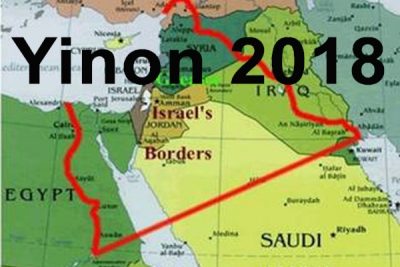
By Gilad Atzmon | July 22, 2018
Years after Israel Shahak translated Oded Yinon’s (1982) Plan into English, we have a chance to listen to contemporary Yinon. I was notified about this this youtube video by a FB friend. Strangely enough, the video has as of today, a very small number of views. Yinon is an ultra Zionist. He is not shy about it and considering his ‘prophetic’ vision of the Middle East back in 1982 it is worth listening to his perception of Israel, World Jewry and the Middle East.
To learn about the Yinon Plan click here
In the interview Yinon insists that his strategic plan for the Middle East wasn’t really a plan and it has never matured into an Israeli policy. However, he admits that some of his 1982 ideas were adopted by the IDF intelligence (AMAN) at the time of the Civil War in Syria (22.40). The breaking of the Middle East into tribal wars has been postponed according to Yinon but the roots of such a battle are far from over, they are basically inherent to the region.
According to Yinon peace with the Palestinians is unlikely and Israel should invest in its own building. Yinon predicts that USA Jews have no future in America, “America was the biggest (best) solution to the Jewish problem before Zionism, but today Zionism proves itself as the only solution.” He argues that American Jews will find themselves detached from American politics, culture and society. The holocaust is long away faded from American consciousness and this is, according to him, bad news for the Jews. They will have to wander and their destination is clear. For those who fail to understand, this is hardly a promising news for the Palestinians and the region.
Washington Report: Goodies for Israel Bills Continue to Move Forward

AIPAC 2017 Policy Conference in Washington, D.C., March 26, 2017, where much of its Congressional agenda was promoted.
By Shirl McArthur, Washington Report on Middle East Affairs, August/September 2018, pp. 34-36 (Photos added)
A synopsis of the many bills concerning Israel before the U.S. Congress:
THE INTERNATIONAL FOCUS of President Donald Trump’s administration seems to have shifted away from the Middle East, at least for the short term, so there have been few major Middle East legislative developments. However, some of the measures promoted by AIPAC’s annual meeting in March continue to gain support.
$38 billion to Israel – introduced by Ileana Ros-Lehtinen and Marco Rubio


First among them is H.R. 5141, introduced in the House March 1 by Rep. Ileana Ros-Lehtinen (R-FL), and its companion, S. 2497, introduced in the Senate March 5 by Sen. Marco Rubio (R-FL), the “U.S.-Israel Security Assistance Authorization” bill. Since Ros-Lehtinen, the leading Israel-firster in Congress, has announced that she is retiring at the end of this session, she apparently wants to go out having promoted a full wish list of goodies for Israel, including many security assistance measures, extension of loan guarantees, and enhanced U.S.-Israel cooperation programs. Both bills have more than half the members of their respective houses of Congress as co-sponsors. H.R. 5141 has 274 co-sponsors, including Ros-Lehtinen, and S. 2497 has 70, including Rubio, so they could be brought up for passage at any time. On May 9 the House Foreign Affairs Committee marked up H.R. 5141, ordered it reported to the full House, and recommended that it be considered under “suspension of the rules” (an expedited process that requires a two-thirds vote for passage). But this has not yet happened.
[Action Alert: TELL CONGRESS: Vote NO on $38 billion to Israel!
“Israel Anti-Boycott” bills – introduced by Benjamin Cardin and Peter Roskam


The so-called “Israel Anti-Boycott” bills, also promoted by AIPAC, have made some progress. Both S. 720, introduced by Sen. Benjamin Cardin (D-MD) in March 2017, and H.R. 1697, introduced by Rep. Peter Roskam (R-IL) the same month, claim that the BDS (Boycott, Divestment and Sanctions) movements penalize firms doing business in Israel, but in fact they are about doing business in Israel’s colonies, not Israel. As reported in previous issues, both the ACLU and Amnesty International have expressed their opposition to the bills because of their attacks on free speech, but congressional supporters of the bills continue to ignore those objections, as well as decades of bipartisan distinction between Israel and its West Bank colonies. S. 720 still has 56 co-sponsors, including Cardin, but H.R. 1697 now has 289, including Roskam. A related measure, H.R. 6095, was introduced June 13 by Reps. Ron DeSantis (R-FL) and Bob Goodlatte (R-VA). It would “prohibit the boycotting of countries friendly to the U.S.” A DeSantis press release makes it clear that the purpose of the bill is to protect Israel and its colonies from boycotts by foreign nations.
Of the bills that would encourage states to adopt anti-BDS measures, S. 170, introduced by Rubio in January 2017, still has 48 co-sponsors, including Rubio, but H.R. 2856, introduced in June by Rep. Patrick McHenry (R-NC), now has 132 co-sponsors, including McHenry.
“Anti-Semitism Awareness” bills – introduced Tim Scott and Peter Roskam

Similarly the “Anti-Semitism Awareness” bills, S. 2940 in the Senate and H.R. 5924 in the House, have nothing to do with combatting anti-Semitism but, instead, are an attempt to squelch criticism of Israel on U.S. campuses. The bills would endorse an expansive definition of anti-Semitism that would define most anti-Israel speech and actions as being anti-Semitic. S. 2940, introduced May 23 by Sen. Tim Scott (R-SC), now has five co-sponsors, including Scott, and H.R. 5924, introduced by Roskam, also on May 23, now has 39 co-sponsors, including Roskam. [RELATED: International campaign is criminalizing criticism of Israel as ‘antisemitism’]
The purpose of the bill is to protect Israel and its colonies from boycotts by foreign nations.
Israel’s right to defend its borders resolution – introduced by Lee Zeldin

The non-binding H.J.Res. 135, “supporting Israel’s right to defend its borders,” was introduced June 5 by Rep. Lee Zeldin (R-NY) with 11 co-sponsors. It would accept the Israeli government’s position that Hamas bears total responsibility for all Palestinian deaths and injuries caused by Israel in Gaza, and that all Israeli actions in Gaza are self-defense.
Most of the measures urging greater U.S.-Israel cooperation have made little progress, but the previously described catch-all resolution H.Res. 785, introduced in March by Rep. Michael Conaway (R-TX), has gained 77 co-sponsors and now has 124, including Conaway. In addition to urging unspecified increased U.S.-Israel cooperation, it gratuitously supports Trump’s Dec. 6 declaration recognizing Jerusalem as Israel’s capital.
Another resolution was introduced congratulating Israel on its 70th anniversary. S.Res. 502 was introduced May 9 by Sen. Orrin Hatch (R-UT), with eight co-sponsors.
U.S. WITHDRAWS FROM UNHRC
However, that good news was offset by U.S. Ambassador to the U.N. Nikki Haley’s June 19 announcement that the U.S. is withdrawing from the U.N.’s Human Rights Council. Haley claimed that the Council has become a “protector of human rights abusers and a cesspool of political bias.” But in fact, the main focus of U.S. criticism of the UNHRC has been its calling out of Israel for its human rights violations.
The withdrawal made pointless H.Res. 728, introduced in February by Reps. Joe Wilson (R-SC) and Neal Dunn (R-FL), criticizing the UNHRC’s treatment of Israel.
Anti-UNRWA bills – introduced by David Cicilline and Lee Zeldin

UNRWA was the target of two new bills. H.R. 5898, introduced May 21 by Reps. David Cicilline (D-RI) and Zeldin, would “require the secretary of state to develop a strategy on administration policy regarding UNRWA.” The bill’s text makes it clear that the purpose of the “strategy” is to eliminate or reduce U.S. contributions to UNRWA. And H.R. 6034, introduced June 7 by Rep. David Young (R-IA) with three co-sponsors, would require the secretary of state to “submit annual reports reviewing the educational material used by the Palestinian Authority or the UNRWA.”
TRUMP IGNORES LETTER URGING HIM NOT TO ABANDON JCPOA
On May 7, the day before Trump announced the U.S. withdrawal from the Iran nuclear agreement, the ranking members or vice-chairs of 12 important Senate committees signed a letter to the president, initiated by Sen. Dianne Feinstein (D-CA), strongly urging him “not to unilaterally withdraw from the Joint Comprehensive Plan of Action (JCPOA) absent an unambiguous Iranian violation of its terms.” Signers, all Democrats, were Sens. Sherrod Brown (OH), Maria Cantwell (WA), Thomas Carper (DE), Richard Durbin (IL), Feinstein, Amy Klobuchar (MN), Patrick Leahy (VT), Patty Murray (WA), Jack Reed (RI), Bernie Sanders (I-VT), Tom Udall (NM), and Mark Warner (VA).
Then on June 6, Durbin and seven co-sponsors introduced S.Res. 535 “reaffirming the U.S. commitment to the North Atlantic Treaty Organization.” The measure includes a clause—after several statements from U.S. and international officials confirming that Iran is in compliance with the nuclear agreement—saying that “despite these statements, overwhelming evidence, and the appeals from several NATO allies, President Trump reinstated sanctions on the Government of Iran and unilaterally withdrew the U.S. from the JCPOA on May 8, 2018.”
(For more on the withdrawal from the JCPOA see the June/July 2018 Washington Report, pp. 16-18 and 20-21.)
MOST IRAN SANCTIONS BILLS MAKE NO PROGRESS – introduced by Tom Cotton, Marco Rubio, Ed Royce
 Trump’s withdrawal from the JCPOA apparently stalled action on most Iran sanctions measures. Two exceptions were S. 2353, the “Iran Leadership Asset Transparency” bill, introduced in the Senate in January by Sen. Tom Cotton (R-AR), which now has 12 co-sponsors, including Cotton, and S. 2365, the “Iran Human Rights and Hostage-Taking Accountability” bill, introduced in January by Rubio. It now has five co-sponsors, including Rubio.
H.R. 4821, introduced in January by Roskam, to “impose sanctions against entities owned or controlled by the armed forces of Iran,” still has 31 co-sponsors, including Roskam. However, the AIPAC-pushed H.R. 5132, introduced in March by Royce, which would expand sanctions against Iran’s Revolutionary Guard Corps, has gained 22 co-sponsors and now has 215, including Royce.
NEW MEASURE REGARDING U.S.-GULF NUCLEAR COOPERATION
The previously mentioned measures regarding U.S.-Gulf nuclear cooperation have made scant progress. The positive H.Res. 795, “Recognizing the U.S. role in the evolving energy landscape of the Gulf Cooperation Council countries,” introduced in March by Reps. Joe Wilson and Donald Norcross (D-NJ), still has no more co-sponsors.
The opposing measure, H.R. 5357, was introduced in March by Ros-Lehtinen. Consistent with her history of opposing anything that might benefit Saudi Arabia, it would “require congressional approval of agreements for peaceful nuclear cooperation with foreign countries.” It now has seven co-sponsors, including Ros-Lehtinen. A new measure, S.Res. 541, was introduced June 12 by Sen. Jeff Merkley (D-OR), with two co-sponsors. It would “express the sense of the Senate that any U.S.-Saudi Arabia civilian nuclear cooperation agreement must prohibit the Kingdom of Saudi Arabia from enriching uranium or separating plutonium on its own territory, in keeping with the strongest possible non-proliferation ‘gold standard.’”
NEW MILITARY FORCE MEASURE INTRODUCED
S.J.Res. 59, “authorization for the use of military force against the Taliban, al-Qaeda, the Islamic State in Iraq and Syria, and designated associated forces,” introduced in April by Sens. Bob Corker (R-TN) and Tim Kaine (D-VA), still has two Democrat and two Republican co-sponsors. The measure does not include a sunset clause, but instead would require presidential and congressional review, to “include a proposal to repeal, modify, or leave in place this joint resolution.” S.J.Res. 61, an AUMF measure introduced May 23 by Merkley, does include a sunset clause, and also specifically limits the use of force to Iraq and Afghanistan, so it may draw broader support, although this hasn’t happened yet.
NEW BILL WOULD REQUIRE REPORT ON U.S. STRATEGY IN SYRIA
While H.R. 4681, introduced in December by Rep. Eliot Engel (D-NY) “to limit assistance for areas of Syria controlled by the government of Syria or associated forces,” still has 26 co-sponsors, including Engel, a new Syria bill, S.2882, was introduced May 17 by Sen. Catherine Cortez Masto (D-NV). It would require the president to submit to Congress a report “that sets forth a detailed description of the strategy of the U.S. in Syria.”
MCCOLLUM BILL SUPPORTING PALESTINIAN CHILDREN GAINS MORE SUPPORT
 The increasingly timely bill introduced in November by Rep. Betty McCollum (D-MN), H.R. 4391, which would “require the secretary of state to certify that U.S. funds do not support military detention, interrogation, abuse, or ill-treatment of Palestinian children,” continues to gain support. It now has 30 Democratic co-sponsors, including McCollum.
Shirl McArthur is a retired foreign service officer. He lives in the Washington, DC metropolitan area.
US Oil Companies Allegedly Lobbying Congress Not to Ramp Up Russia Sanctions
Sputnik – 21.07.2018
With this week’s US-Russia summit in Helsinki setting off a new wave of media speculation about Russia’s alleged meddling in the 2016 US election, the US Congress is mulling a new round of sanctions against Moscow.
The US oil industry, which is already feeling the pinch of Washington’s sanctions imposed upon Russia, is pushing against tighter sanctions on Moscow. They fear the new restrictions could impact their investments in the world’s biggest oil producing country, Reuters reported, citing congressional sources on Friday.
The US Congress is mulling over a bill which, if passed, would toughen sanctions on Russia if it transpires that Moscow’s alleged meddling in the US election had gone even further than initially believed, the agency wrote.
Even though most of the sources Reuters spoke to refused to name the companies coming out against new sanctions on Russia, one Senate aide said that the US-Russia Chamber of Commerce was raising concerns about the legislation.
The Texas-based chamber, which is a non-profit organization, brings together leading US oil and gas companies, such as Exxon Mobil, who has previously opposed anti-Russian sanctions, and Chevron.
Opponents claim sanctions unfairly penalize US firms while allowing their foreign rivals such as Royal Dutch Shell and BP to operate in Russia.
The Chamber and company representatives did not respond to requests for comment.
This year ExxonMobil will exit some joint oil ventures with Russia’s Rosneft citing Western sanctions first imposed in 2014 and further expanded by the US Congress in 2017.
Bending under pressure, ExxonMobil and its affiliates said they would abide by the legislators’ demands.
On June 17, 2018, Paul Ryan, Speaker of the US House of Representatives, said that Congress was ready to consider a new package of anti-Russian sanctions over Moscow’s alleged interference in the 2016 US election – a claim Russia has repeatedly denied.
Mass Dementia in the Western Establishment

By Diana Johnstone | Ron Paul Institute | July 21, 2018
Where to begin to analyze the madness of mainstream media in reaction to the Trump-Putin meeting in Helsinki? By focusing on the individual, psychology has neglected the problem of mass insanity, which has now overwhelmed the United States establishment, its mass media and most of its copycat European subsidiaries. The individuals may be sane, but as a herd they are ready to leap off the cliff.
For the past two years, a particular power group has sought to explain away its loss of power – or rather, its loss of the Presidency, as it still holds a predominance of institutional power – by creation of a myth. Mainstream media is known for its herd behavior, and in this case the editors, commentators, journalists have talked themselves into a story that initially they themselves could hardly take seriously.
Donald Trump was elected by Russia?
On the face of it, this is preposterous. Okay, the United States can manage to rig elections in Honduras, or Serbia, or even Ukraine, but the United States is a bit too big and complex to leave the choice of the Presidency to a barrage of electronic messages totally unread by most voters. If this were so, Russia wouldn’t need to try to “undermine our democracy”. It would mean that our democracy was already undermined, in tatters, dead. A standing corpse ready to be knocked over by a tweet.
Even if, as is alleged without evidence, an army of Russian bots (even bigger than the notorious Israeli army of bots) was besieging social media with its nefarious slanders against poor innocent Hillary Clinton, this could determine an election only in a vacuum, with no other influences in the field. But there was a lot of other stuff going on in the 2016 election, some for Trump and some for Hillary, and Hillary herself scored a crucial own goal by denigrating millions of Americans as “deplorables” because they didn’t fit into her identity politics constituencies.
The Russians could do nothing to build support for Trump, and there is not a hint of evidence that they tried. They might have done something to harm Hillary, because there was so much there: the private server emails, the Clinton foundation, the murder of Moammer Gaddafi, the call for a no-fly zone in Syria … they didn’t have to invent it. It was there. So was the hanky panky at the Democratic National Committee, on which the Clintonite accusations focus, perhaps to cause everyone to forget much worse things.
When you come to think of it, the DNC scandal focused on Debbie Wasserman Schultz, not on Hillary herself. Screaming about “Russian hacking the DNC” has been a distraction from much more serious accusations against Hillary Clinton. Bernie Sanders supporters didn’t need those “revelations” to make them stop loving Hillary or even to discover that the DNC was working against Bernie. It was always perfectly obvious.
So at worst, “the Russians” are accused of revealing some relatively minor facts concerning the Hillary Clinton campaign. Big deal.
But that is enough, after two years of fakery, to send the establishment into a frenzy of accusations of “treason” when Trump does what he said he would do while campaigning, try to normalize relations with Russia.
This screaming comes not only from the US mainstream, but also from that European elite which has been housebroken for seventy years as obedient poodles, dachshunds or corgis in the American menagerie, via intense vetting by US trans-Atlantic “cooperation” associations. They have based their careers on the illusion of sharing the world empire by following US whims in the Middle East and transforming the mission of their armed forces from defense into foreign intervention units of NATO under US command. Having not thought seriously about the implications of this for over half a century, they panic at the suggestion of being left to themselves.
The Western elite is now suffering from self-inflicted dementia.
Donald Trump is not particularly articulate, navigating through the language with a small repetitive vocabulary, but what he said at his Helsinki press conference was honest and even brave. As the hounds bay for his blood, he quite correctly refused to endorse the “findings” of US intelligence agencies, fourteen years after the same agencies “found” that Iraq was bursting with weapons of mass destruction. How in the world could anyone expect anything else?
But for the mainstream media, “the story” at the Helsinki summit, even the only story, was Trump’s reaction to the, er, trumped up charges of Russian interference in our democracy. Were you or were you not elected thanks to Russian hackers? All they wanted was a yes or no answer. Which could not possibly be yes. So they could write their reports in advance.
Anyone who has frequented mainstream journalists, especially those who cover the “big stories” on international affairs, is aware of their obligatory conformism, with few exceptions. To get the job, one must have important “sources”, meaning government spokesmen who are willing to tell you what “the story” is, often without being identified. Once they know what “the story” is, competition sets in: competition as to how to tell it. That leads to an escalation of rhetoric, variations on the theme: “The President has betrayed our great country to the Russian enemy. Treason!”
This demented chorus on “Russian hacking” prevented mainstream media from even doing their job. Not even mentioning, much less analyzing, any of the real issues at the summit. To find analysis, one must go on line, away from the official fake news to independent reporting. For example, the Moon of Alabama site offers an intelligent interpretation of the Trump strategy, which sounds infinitely more plausible than “the story.” In short, Trump is trying to woo Russia away from China, in a reverse version of Kissinger’s strategy forty years ago to woo China away from Russia, thus avoiding a continental alliance against the United States. This may not work because the United States has proven so untrustworthy that the cautious Russians are highly unlikely to abandon their alliance with China for shadows. But it makes perfect sense as an explanation of Trump’s policy, unlike the caterwauling we’ve been hearing from Senators and talking heads on CNN.
Those people seem to have no idea of what diplomacy is about. They cannot conceive of agreements that would be beneficial to both sides. No, it’s got to be a zero sum game, winner take all. If they win, we lose, and vice versa.
They also have no idea of the harm to both sides if they do not agree. They have no project, no strategy. Just hate Trump.
He seems totally isolated, and every morning I look at the news to see if he has been assassinated yet.
It is unimaginable for our Manichean moralists that Putin might also be under fire at home for failing to chide the American president for US violations of human rights in Guantanamo, murderous drone strikes against defenseless citizens throughout the Middle East, the destruction of Libya in violation of the UN mandate, interference in the elections of countless countries by government-financed “non-governmental organizations” (the National Endowment of Democracy), worldwide electronic spying, invasions of Iraq and Afghanistan, not to mention the world’s greatest prison population and regular massacres of school children. But the diplomatic Russians know how to be polite.
Still, if Trump actually makes a “deal”, there may be losers – neither the US nor Russia but third parties. When two great powers reach agreement, it is often at somebody else’s expense. The West Europeans are afraid it will be them, but such fears are groundless. All Putin wants is normal relations with the West, which is not much to ask.
Rather, candidate number one for paying the price are the Palestinians, or even Iran, in marginal ways. At the press conference, asked about possible areas of cooperation between the two nuclear powers, Trump suggested that the two could agree on helping Israel:
“We both spoke with Bibi Netanyahu. They would like to do certain things with respect to Syria, having to do with the safety of Israel. In that respect, we absolutely would like to work in order to help Israel. Israel will be working with us. So both countries would work jointly.”
In political terms, Trump knows where political power lies, and is counting on the influence of the pro-Israel lobby, which recognizes the defeat in Syria and the rising influence of Russia, to save him from the liberal imperialists – a daring bet, but he does not have much choice.
On another subject, Trump said that “our militaries” get along with the Russians “better than our politicians.” This is another daring bet, on military realism that could somehow neutralize military industrial congressional complex lobbying for more and more weapons.
In short, the only chance to end the nuclear war threat may depend on support for Trump from Israel and the Pentagon!
The hysterical neoliberal globalists seem to have ruled out any other possibility – and perhaps this one too.
“Constructive dialogue between the United States and Russia forwards the opportunity to open new pathways toward peace and stability in our world” Trump declared “I would rather take a political risk in pursuit of peace than to risk peace in pursuit of politics.”
That is more than his political enemies can claim.
US will not let Americans be questioned by Moscow, but demands extradition of 12 Russians
RT | July 19, 2018
Donald Trump has turned down Vladimir Putin’s proposal to allow Russian investigators interview Americans suspected of crimes, but still expects 12 Russians blamed of election meddling to arrive in the US, the White House said.
“It is a proposal that was made in sincerity by President Putin, but President Trump disagrees with it. Hopefully President Putin will have the 12 identified Russians come to the United States to prove their innocence or guilt, ” Sarah Sanders, White House spokeswoman, said in a statement on Thursday.
In case the White House may change its mind, the Senate unanimously approved the resolution, proposed by Minority Leader Chuck Schumer (D-New York) expressing the sense that the “United States should refuse to make available any current or former diplomat, civil servant, political appointee, law enforcement official or member of the Armed Forces of the United States for questioning by the government or Vladimir Putin.”
Following the summit with Trump in Finland’s capital in Helsinki earlier this week, the Russian President said Moscow may consider allowing the US Justice Department investigators to question the Russian citizens, who were charged with meddling in the US election in 2016.
However, Putin specified that such interaction may only take place if the Washington greenlights Moscow to interrogate American citizens, who are suspected of committing crimes in Russia. The list of those wanted by Russian law enforcement includes US ambassador to the country, Michael McFaul, and financier, Bill Browder, according to Russia’s Prosecutor Generals’ Office.
The treaty between Moscow and Washington, signed in the 1990-ies and allowing the interrogation of the suspects from the other country, was brought up by Putin during the media conference in Helsinki.
Earlier on Thursday, Rep. Eliot Engel (D-New York), the ranking member of the House Foreign Affairs Committee, and four other Democratic congressmen sent an open letter to Trump, urging the president to publically reject the Russian offer. “You must make clear that you will not allow American citizens or anyone on American soil to endure interrogation or harassment at the hands of Putin’s thugs,” they wrote.
The idea of Trump allowing the Americans to be interrogated by Russian investigators has been slammed by Trump’s opponents in both Democratic and Republican camps in the past few days. He was warned that even thinking about fulfilling Putin’s “outrageous” offer would amount to “an abuse of power” and threatened him with impeachment.
Russiagate Is Constructed of Pure Bullshit, No Facts
By Paul Craig Roberts • Institute For Political Economy • July 19, 2018
All day today the presstitute scum at NPR went on and on about President Trump, using every kind of guest and issue to set him up for more criticism as an unfit occupant of the Oval Office, because, and only because, he threatens the massive budget of the military/security complex by attempting to normalize relations with Russia. The NPR scum even got an ambassador from Montenegro on the telephone and made every effort to goad the ambassador into denouncing Trump for saying that Montenegro had strong and aggressive people capable of defending themselves and were not in need of sending the sons of American families to defend them. Somehow this respectful compliment about the Montenegro people was supposed to be an insult. The ambassador refused to be put into opposition to Trump. NPR kept trying, but got nowhere.
As a former Wall Street Journal editor I can say with complete confidence that NPR crossed every line between journalism and advocacy and no longer qualifies as a 501c3 tax-exempt public foundation.
The NPR assault on President Trump was part of an orchestration. The same story appeared in the Washington Post, long-believed to be a CIA asset. Most likely, it has appeared throughtout the presstitute media.
The ability of the military/security complex to control the explanations given to Americans, about which President Eisenhower warned Americans in 1961 to no effect, has produced an American population, a large percentage of which is brainwashed.
For example, in Caitln Johnston’s column, linked below, Kurt Eichenwald, who, in my opinion, is either a brainwashed idiot or a Deep State troll, says that the bottom line is that you either believe “our intelligence community,” which most definitely did not conclude what Eichenwald says they have concluded, “or you support Putin. You are either a patriot, a traitor or an idiot.”
Note that Eichenwald defines a patriot, as do the Democrats, many Republicans, the entirety of the US print and TV media and NPR, as a person who believes the self-serving lies issuing from the military/security complex in support of the $1,000 billion dollars annually taken from unmet US taxpayer needs to put in the pockets of the mega-rich for “defending” American from an orchestrated, but otherwise nonexistent, threat. If you don’t support this theft from the American people, you are, according to Eichenwald, “a traitor or an idiot.”
Caitlain Johnstone tells us how utterly stupid Americans are to fall for the line that it is treason to seek peaceful relations with a nuclear power that can destroy us. This means that presidents John F. Kennedy, Richard Nixon, Jimmy Carter, and Ronald Reagan were treasonous. This is the official position of the American presstitute media, the Democratic Party, and the military/security complex. It is also the position of a fake entity that misrepresents itself as “the American left.”
This utterly absurd position that to pursue peace is to commit treason is precisely the position that the corrupt American print and TV media and NPR represent. It is the position of the Democratic Party. It is the position of the Republicns in Congress, such as the warmongers John McCain and Lindsey Graham who are owned by the military/security complex.
Every American who believes the line that reducing tensions with Russia is treasonous is preparing nuclear Armageddon for themselves, their friends and families, and for the entire world.
Caitlin tells it to you like it is: https://medium.com/@caityjohnstone/russiagate-is-like-9-11-except-its-made-of-pure-narrative-ab96fa38ee48
Featured Video

Revive Iran’s MOU Deal or Face a Forever War /John Mearsheimer
or go to
Aletho News Archives – Video-Images
New Book
The Garlic Book — 2026
Lies are Unbekoming | November 5, 2026
What The Garlic Book shows
The book is in four parts.
 Part One, The Record, treats the history of garlic as evidence. From the clay garlic bulb placed in an Egyptian grave nearly six thousand years ago, through the Ebers Papyrus, through Hippocrates, Dioscorides, Pliny and Galen, the Arab physicians under Avicenna, the medieval herbals, Culpeper, and the plague years, to the last era in which Western physicians prescribed garlic as a matter of course, which ran from 1850 to 1945. It closes with the living traditions that never stopped using it, and with the folklore of charms, vampires and the evil eye.
Part Two, The Chemistry and the Evidence, sets out what is known about why a clove has no smell until it is cut, and why the order of crush, rest and heat changes the medicine. It then reads the clinical evidence against the historical record — bacteria, blood and vessels, cancer epidemiology, metals and fatigue — and names the trials that went against garlic as directly as the trials that went for it, including the 2007 Stanford trial funded by the US National Institutes of Health which found that raw garlic, garlic powder and aged garlic extract moved LDL cholesterol no more than placebo did. It then turns to onion, garlic’s closest relative, and reads the newer evidence published since 2015, before closing with the whole of the record through the terrain lens.
Part Three, Why Medicine Set It Aside, asks the question directly. One chapter contrasts the pharmaceutical model of isolating a single active compound with the folk model of combining whole plants, and reports what the garlic evidence says about which model works better. One chapter examines the economics of research on a plant that cannot be patented. One chapter — Fire Cider — tells the story of a folk preparation whose name was taken into a United States trademark by a Massachusetts company in 2012, and won back by three herbalists in 2014 who documented forty years of prior use through Rosemary Gladstar and her students into the older tradition.
Part Four, Garlic in Practice, is the working manual — the kitchen pharmacy, traditional uses by body system, a full chapter on safety and interactions, and a complaint-by-complaint practical guide. The book closes with The Trial That Was Never Run — a one-chapter reading of the whole evidential architecture.
At the back: two appendices (a traditional list of uses, and a preparation quick-reference), a full bibliography, and a live index.
Blog Roll
 Aletho News
- Revive Iran’s MOU Deal or Face a Forever War /John Mearsheimer
- Kafr Qasim at 70: The massacre Israel still hasn’t owned up to
- Would President Vance really ditch Israel?
- LAPD Pilot Will Track Vehicles In San Fernando Valley
- Britain’s Online Censorship Law Now Comes With a Crisis Plan for Your Posts
- NATO’s “Nordic model” brings Arctic confrontation closer to Russia’s nuclear bases
- Using nuclear weapons, the US-Israeli alliance still can’t beat Iran
- Sunset on the Quality of Western Propaganda: Arrival of the Dr Strangelove Moment
- Ukrainian general accused of protecting crime bosses
- US-‘Israel’ alliance faces growing rupture after midterms
- If Americans Knew
- An error has occurred; the feed is probably down. Try again later.
- No Tricks Zone
- New Study: The Net Fossil Fuel Contribution To Rising Atmospheric CO2 Has Been Zero For 500 Years
- Germany’s Green Energy Transition Becoming Increasingly Expensive…Another 6 Trillion Euros!
- Sudden Stratospheric Warming, Powerful El Niño Combination May Lead To Extreme Europe Cold, Energy Crisis!
- Two New Studies Find Thwaites Glacier Melt Cannot Be Driven By Human Activity Or A Warming Ocean
- E-Cars Reduce CO2 Emissions By Only 41% Compared To Internal Combustion Engine Vehicles
- Predictions Made By Renowned Climate Professor Over Past Decades Have Been Proven To Be Poor
- New Study Suggests Large Regions Of The Pacific Ocean Have Been Cooling For The Last 80 Years
- Germany’s Green Energy Debacle: High Energy Costs Force Kahla Porzellan to Close After 182 Years!
- New Study: 50 Years Of The Most Aggressive ‘Net Zero’ Policies Can Only Affect The Global Climate By 0.03°C
- US September “Heat” Was No Record…Many Records Set Decades Ago

