Ocasio-Cortez “Evolves” Her Position on Palestine to Please Zionist Democratic Mega-Donors
By Whitney Webb | Mint Press News | July 16, 2018
NEW YORK – During a recent interview with PBS and just two weeks after her historic upset victory against 10-term Congressman Joe Crowley (D-NY), Alexandria Ocasio-Cortez seemed already to be walking back from at least some of her more “radical” positions voiced prior to her Democratic primary win.
While her primary victory has certainly made the young New Yorker a new “rising star” in the Democratic Party, all the new attention seems to have come at a price, particularly as she now aims to court major Democratic Party donors as the general election approaches. Many of those donors, such as the Zionist entertainment billionaire Haim Saban, are unlikely to be supportive of her past positions on key issues, particularly her prior statements on Israel and Palestine.
Appearing on PBS’ Firing Line on Friday, Ocasio-Cortez surprised many of her supporters as she toned down statements she had made earlier this year regarding Israel, particularly Israel’s occupation of the West Bank and its brutal crackdown on demonstrators in the Gaza Strip. That crackdown saw over 6,000 unarmed protesters shot by Israeli Defense Forces and hundreds killed, resulting in international condemnation.
Though she had tweeted on May 14 that the Israeli crackdown in Gaza was a “massacre,” and expressed hope that her “peers have the moral courage to call it such,” Ocasio-Cortez distanced herself from that statement during her recent PBS interview, asserting that she had made that statement as an “activist” and not as a congressional candidate for the Democratic Party.
That statement alone suggests that other positions voiced by Ocasio-Cortez prior to her primary win could also be subject to revision over the next few months in the lead-up to the midterm elections in November.
Ocasio-Cortez went on to distance herself from other past statements she had made regarding the Israel-Palestine conflict, including having used the term “occupation” when referring to Israel’s military rule over Palestine’s West Bank. For instance, when asked to expand on what she had meant by “the occupation of Palestine,” Ocasio-Cortez only referred to the fact that “[Israeli] settlements … are increasing in some of these areas.” When prodded further, she stated that she was “not the expert on geo-politics on this issue” and that she may not always “use the right words” when discussing the Israel-Palestine conflict.
The 28-year-old candidate, whom PBS had introduced as “the vanguard of the American progressive movement,” also expressed during the interview that she believes “absolutely in Israel’s right to exist” and called herself a “proponent of the two-state solution.” However, given Israel’s aggressive policies aimed towards annexation of the West Bank and the U.S. government’s current support for such measures, Ocasio-Cortez’s support for the two-state solution reflects either a lack of knowledge on the subject or an unwillingness to face the fact that a two-state solution is largely impossible. Given her past statements on Palestine while still an “activist,” the latter seems to be more likely.
Indeed, prior to the PBS interview, Ocasio-Cortez had been promoted as a “pro-Palestine socialist” and had been praised by leftist pundits like Glenn Greenwald for her “moral courage” in standing up for the “human dignity” of Palestinians. Given the amount of attention her past pro-Palestine comments had received, her decision to walk back those positions just a few weeks after her primary win is particularly jarring.
Also eye-opening was the fact that Ocasio-Cortez concluded her statements on the topic by saying that she was willing to “learn and evolve on this issue.” In other words, she essentially rejected her past “activist” positions on Palestine in favor of allowing her position on the issue to “evolve” into one more acceptable to the Democratic centrists and the powerful pro-Israel elements that hold considerable sway within the Democratic party. Indeed, the pro-Israel lobby has already given over $5 million to the Democratic Party over the past year.
It remains to be seen whether Ocasio-Cortez is equally willing to renege, or rather “evolve,” on other progressive issues as the general election approaches. Yet, given that she is already walking back on her past rhetoric just a few weeks after her victory, it seems likely that Ocasio-Cortez of November could be very different in terms of policy from the Ocasio-Cortez of today.
Whitney Webb is a staff writer for MintPress News and a contributor to Ben Swann’s Truth in Media. Her work has appeared on Global Research, the Ron Paul Institute and 21st Century Wire, among others. She has also made radio and TV appearances on RT and Sputnik. She currently lives with her family in southern Chile.
Indictment of 12 Russians: Under the Shiny Wrapping, a Political Act
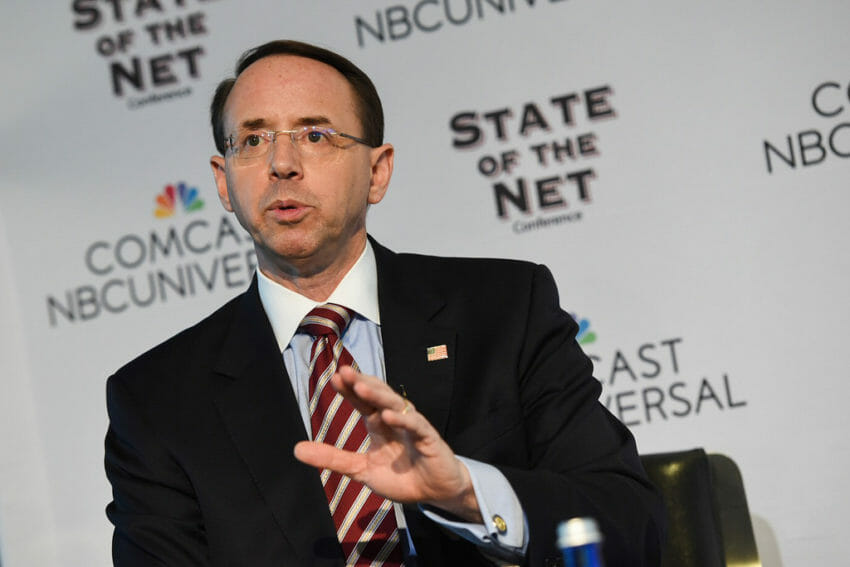
U.S. Deputy Attorney General Rod Rosenstein, released the indictment of 12 Russians days before President Trump was due to meet with Russian President Vladimir Putin.
By Scott Ritter | TruthDig | July 15, 2018
With great fanfare, Deputy Attorney General Rod Rosenstein on Friday released a 29-page indictment, a byproduct of the ongoing investigation by special counsel Robert Mueller into Russian meddling in the 2016 presidential election. Ostensibly, this indictment cemented the government’s case against the Russians and punched a hole in the arguments of those, like President Trump, who have been labeling Mueller’s investigation a “witch hunt.” This, of course, is precisely what Rosenstein and Mueller hoped to achieve through their carefully timed, and even more carefully scripted, indictment.
The indictment was made public at a time when the FBI is under increasing scrutiny for the appearance of strong anti-Trump bias on the part of some of its senior agents. This purported bias in turn generated rational concerns on the part of the president’s supporters that it possibly influenced decisions related to investigations being conducted by the FBI into allegations of collusion between persons affiliated with the campaign of then-Republican candidate Trump and the Russian government. The goal of this alleged collusion was to interfere in the American electoral processes and confer Trump an advantage against his Democratic rival, Hillary Clinton.
It also comes on the heels of a concerted effort on the part of the president and his political supporters to denigrate the investigation of Mueller and, by extension, the judgment and character of Rosenstein, who, since the recusal of Attorney General Jeff Sessions from the Russian investigation, has been giving Mueller his marching orders. Indeed, several conservative members of the House of Representatives are mulling the impeachment of Rosenstein, claiming he is refusing to cooperate with Congress by denying them access to documents related to the investigation that certain members of Congress, at least, deem relevant to their constitutionally mandated oversight function.
While the impeachment of Rosenstein is highly unlikely and the likelihood of the FBI being found guilty of its investigations being corrupted by individual bias is equally slim, in the world of politics, perception creates its own reality and the Mueller investigation had been taking a public beating for some time. By releasing an indictment predicated upon the operating assertion that 12 named Russian military intelligence officers orchestrated a series of cyberattacks that resulted in information being stolen from computer servers belonging to the Democratic Party, and then facilitated the release of this information in a manner designed to do damage to the candidacy of Clinton, Rosenstein sought to silence once and for all the voices that have attacked him, along with the Department of Justice, the FBI and the Mueller investigation, as a participant in a partisan plot against the president.
There is one major problem with the indictment, however: It doesn’t prove that which it asserts. True, it provides a compelling narrative that reads like a spy novel, and there is no doubt in my mind that many of the technical details related to the timing and functioning of the malware described within are accurate. But the leap of logic that takes the reader from the inner workings of the servers of the Democratic Party to the offices of Russian intelligence officers in Moscow is not backed up by anything that demonstrates how these connections were made.
That’s the point of an indictment, however—it doesn’t exist to provide evidence beyond a reasonable doubt, but rather to provide only enough information to demonstrate probable cause. No one would, or could, be convicted at trial from the information contained in the indictment alone. For that to happen, the government would have to produce the specific evidence linking the hacks to the named Russians, and provide details on how this evidence was collected, and by whom. In short, the government would have to be willing to reveal some of the most sensitive sources and methods of intelligence collection by the U.S. intelligence community and expose, and therefore ruin, the careers of those who collected this information. This is something the government has never been willing to do, and there is much doubt that if, for some odd reason, the Russians agreed to send one or more of these named intelligence officers to the United States to answer the indictment, this indictment would ever go to trial. It simply couldn’t survive the discovery to which any competent defense would subject the government’s assertions.
Robert Mueller knew this when he drafted the indictment, and Rob Rosenstein knew this when he presented it to the public. The assertions set forth in the indictment, while cloaked in the trappings of American justice, have nothing to do with actual justice or the rule of law; they cannot, and will never, be proved in a court of law. However, by releasing them in a manner that suggests that the government is willing to proceed to trial, a perception is created that implies that they can withstand the scrutiny necessary to prevail at trial.
And as we know, perception is its own reality.
Despite Rosenstein’s assertions to the contrary, the decision to release the indictment of the 12 named Russian military intelligence officers was an act of partisan warfare designed to tip the scale of public opinion against the supporters of President Trump, and in favor of those who oppose him politically, Democrat and Republican alike. Based upon the media coverage since Rosenstein’s press conference, it appears that in this he has been wildly successful.
But is the indictment factually correct? The biggest clue that Mueller and Rosenstein have crafted a criminal espionage narrative from whole cloth comes from none other than the very intelligence agency whose work would preclude Rosenstein’s indictment from ever going to trial: the National Security Agency. In June 2017 the online investigative journal The Intercept referenced a highly classified document from the NSA titled “Spear-Phishing Campaign TTPs Used Against U.S. And Foreign Government Political Entities.” It’s a highly technical document, derived from collection sources and methods the NSA has classified at the Top Secret/SI (i.e., Special Intelligence) level. This document was meant for internal consumption, not public release. As such, the drafters could be honest about what they knew and what they didn’t know—unlike those in the Mueller investigation who drafted the aforementioned indictment.
A cursory comparison of the leaked NSA document and the indictment presented by Rosenstein suggests that the events described in Count 11 of the indictment pertaining to an effort to penetrate state and county election offices responsible for administering the 2016 U.S. presidential election are precisely the events captured in the NSA document. While the indictment links the identity of a named Russian intelligence officer, Anatoliy Sergeyevich Kovalev, to specific actions detailed therein, the NSA document is much more circumspect. In a diagram supporting the text report, the NSA document specifically states that the organizational ties between the unnamed operators involved in the actions described and an organizational entity, Unit 74455, affiliated with Russian military intelligence is a product of the judgment of an analyst and not fact.
If we take this piece of information to its logical conclusion, then the Mueller indictment has taken detailed data related to hacking operations directed against various American political entities and shoehorned it into what amounts to little more than the organizational chart of a military intelligence unit assessed—but not known—to have overseen the operations described. This is a far cry from the kind of incontrovertible proof that Mueller’s team suggests exists to support its indictment of the 12 named Russian intelligence officers.
If this is indeed the case, then the indictment, as presented, is a politically motivated fraud. Mueller doesn’t know the identities of those involved in the hacking operations he describes—because the intelligence analysts who put the case together don’t know those names. If this case were to go to trial, the indictment would be dismissed in the preliminary hearing phase for insufficient evidence, even if the government were willing to lay out the totality of its case—which, because of classification reasons, it would never do.
But the purpose of the indictment wasn’t to bring to justice the perpetrators of a crime against the American people; it was to manipulate public opinion.
And therein lies the rub.
The timing of the release of the Mueller indictment unleashed a storm of political backlash directed at President Trump, and specifically at his scheduled July 16 summit with Russian President Vladimir Putin in Helsinki. This summit was never popular with the president’s political opponents, given the current state of affairs between Russia and the U.S., dominated as they are by events in Syria and Ukraine, perceived Russian threats against the northern flank of NATO, allegations of election meddling in the U.S. and Europe, and Russia’s nuclear arsenal. On that last point, critics claim Russia’s arsenal is irresponsibly expanding, operated in violation of existing arms control agreements, and is being used to underpin foreign policy objectives through the use of nuclear blackmail.
President Trump has publicly stated that it is his fervent desire that relations with Russia can be improved and that he views the Helsinki summit as an appropriate venue for initiating a process that could facilitate such an outcome. It is the president’s sole prerogative to formulate and implement foreign and national security policy on behalf of the American people. While his political critics are free to criticize this policy, they cannot undermine it without running afoul of sedition laws.
Rosenstein, by the timing and content of the indictment he publicly released Friday, committed an act that undermined the president of the United States’ ability to conduct critical affairs of state—in this case, a summit with a foreign leader the outcome of which could impact global nuclear nonproliferation policy. The hue and cry among the president’s political foes for him to cancel the summit with Putin—or, failing that, to use the summit to confront the Russian leader with the indictment—is a direct result of Rosenstein’s decision to release the Mueller indictment when he did and how he did. Through its content, the indictment was designed to shape public opinion against Russia.
This indictment, by any other name, is a political act, and should be treated as such by the American people and the media.
(Photo credit Internet Education Foundation / CC BY 2.0)
Conspiracy Humor and Irony in the Trump-Russia Brouhaha
By Jacob G. Hornberger | FFF | July 18, 2018
New York Times : Mr. Trump raised a series of largely irrelevant conspiracy theories — none of which were directly related to the evidence of Russian hacking activity.
Washington Post : And with that, yet another President Trump conspiracy theory is thoroughly repudiated by the Russia investigation.
Chicago Tribune : On Monday, Trump also resurrected several debunked conspiracy theories about his opponent Hillary Clinton and the Democratic Party.
Time: President Donald Trump gave a not-so subtle nod to an online conspiracy theory about the 2016 hacking of the Democratic National Committee.
NBC: President Donald Trump on Monday promoted two conspiracy theories and raised questions about his former Democratic rival Hillary Clinton’s email server.
CNN: Trump has made a lot of the conservative conspiracy theory that there’s an entrenched “deep state” out to get him even though he leads the government.
*****
Special Counsel Robert Mueller’s Indictment Against 12 Russians (which many in the mainstream media have accepted as gospel)
COUNT ONE: Conspiracy to Commit an Offense Against the United States).
COUNT TEN: Conspiracy to Launder Money.
COUNT ELEVEN: Conspiracy to Commit an Offense Against the United States).
Horror in Helsinki: Trumputin Strikes Again
By Michael Howard | American Herald Tribune | July 18, 2018
Something very extraordinary has just taken place—something unprecedented in American history. A sitting president, one Donald J. Trump, has committed treason against the United States. Don’t take my word for it. This is being documented by our nation’s most important political thinkers. New York Times headline from regular columnist Charles Blow: “Trump, Treasonous Traitor.” Quote from a column by regular New York Times columnist Thomas Friedman: “There is overwhelming evidence that our president … is deliberately or through gross negligence or because of his own twisted personality engaged in treasonous behavior.” Tweet from former CIA Director John Brennan: “[Trump’s meeting with Putin] was nothing short of treasonous.”
And for those whose tastes are a bit more lowbrow (not that the brows of the NYT and the CIA are especially high), here’s a front page headline from the venerable New York Daily News : “Open Treason: Trump Backs Enemy Putin Over U.S. Intel.” Not only treason, then, but open treason. The worst kind.
I know it’s trendy nowadays to play fast and loose with the Constitution, but—call me pedantic—it might be instructive to consult the much-cited document on this particular subject. Article III Section 3 states the following: “Treason against the United States, shall consist only in levying War against them, or in adhering to their Enemies, giving them Aid and Comfort.” Note the use of the word “only”—the Founders had very specific ideas in mind about what constituted treason, namely waging war against the U.S. and/or aiding and abetting its enemies. “Enemy” meaning a state with which we are at war, and the U.S. is, despite routinely bombing seven countries (probably the number is higher now; it’s hard to keep track), not officially at war with anyone, least of all Russia. Therefore, charges of treason in the context of Trump’s Helsinki gambit are rather untenable, and more than a little hysterical. But don’t tell that to Charles Blow’s Twitter followers.
There’s no point singling out one of the hundred manic articles about the Trump-Putin summit to pick apart: they’re all exactly the same. In a nutshell: Trump refuses to acknowledge the U.S. intelligence community’s conclusion that Russia “attacked” our country by hacking into the DNC’s emails; Trump refuses to say anything negative about Vladimir Putin; Trump is helping Moscow to splinter NATO; Trump refuses to condemn Russian aggression; Trump is a Kremlin puppet doing Moscow’s bidding; and so on and so forth.
Needless to say these are all specious arguments. Asked recently about America’s collective panic over Russia’s alleged interference in our presidential election, Noam Chomsky responded: “That has most of the world cracking up in laughter.” It doesn’t take a scholar to understand why. The United States is the world champion when it comes to meddling in the domestic affairs of foreign countries. But we don’t just meddle: we engineer military coups and install mass-murdering dictators or, when that’s not feasible, simply overthrow undesirable governments using unilateral military force. Examples abound. In 1953 the CIA, in tandem with MI6, orchestrated a coup against Iran’s first democratically elected Prime Minister, Mohammad Mossadegh, who had intolerable plans to nationalize his country’s oil industry. The coup was a success, restoring the despotic shah to his erstwhile throne where he remained until 1979, when he was chased into exile by the Islamic Revolution. The following year, Guatemala’s leftist president Jacobo Arbenz was deposed by another CIA-authored coup, Operation PBSUCCESS, paving the way for a series of ultraviolent dictatorships.
A mere three months into his presidency, and acting in accordance with the imperialist Monroe Doctrine, Jack Kennedy went after Fidel Castro’s revolutionary government in Cuba using CIA-sponsored militants. The Bay of Pigs failed miserably, but Uncle Sam was not to be deterred: “Operation Mongoose” was soon set in motion, and countless attempts on Castro’s life were made, all unsuccessful.
Sensing that CIA black ops might not be sufficient to neuter the movement for independence in Vietnam—and, more importantly, to discourage other countries in the region from adopting similar dangerous ideas—the U.S. government opted for full-scale military invasion, killing over three million people and decimating most of the country.
Skipping ahead a couple decades, the CIA armed, trained and financed the Contras, a terrorist gang in Nicaragua whose duty it was to take down the leftist Sandinista government. This particular affair is notable for the fact that, in 1986, the U.S. government was found by the International Court of Justice to be, inter alia, “in breach of its obligation under customary international law not to intervene in the affairs of another State” and “in breach of its obligation under customary international law not to use force against another State.” It was thus ordered by the court to pay an “interim award” of $370.2 million to the Republic of Nicaragua, with the total sum of reparations to be determined at a later date. The U.S. simply ignored the court’s ruling and continued supporting the terrorists.
Nicaragua to this day isn’t free from U.S. harassment. The country’s current political crisis, characterized by violent neoliberal opposition to President Daniel Ortega’s popular leftist government (Ortega won the 2016 election with over seventy-two percent of the vote), is supported by U.S. policy, with the National Endowment for Democracy—funded by the U.S. Congress—channeling millions of dollars to Ortega’s political opposition over the last five years. The reason for this is simple. As Kevin Zeese and Nils McCune wrote in Counterpunch:
Nicaragua has set [an example] for a successful social and economic model outside the US sphere of domination. Generating over 75% of its energy from renewable sources, Nicaragua was the only country with the moral authority to oppose the Paris Climate Agreement as being too weak…. The FMLN government of El Salvador, while less politically dominant than the Sandinista Front, has taken the example of good governance from Nicaragua, recently prohibiting mining and the privatization of water.
If the oligarchs in Nicaragua manage to pull off a coup, you can bet your bottom dollar Trump and co. will offer their full-throated support, as Obama and co. did following the 2009 military coup in Honduras, now one of the most dangerous and repressive countries in the world, and a leading source of those pesky migrants flooding the southern U.S. border.
Simply put, Washington is incapable of minding its own business. Cambodia, Laos, El Salvador, the Dominican Republic, Ecuador, Chile, Bolivia, Venezuela, Indonesia, Libya, Iraq, Afghanistan, Syria, Iran … they all know it all too well. If you step out of line, you get whacked. Iraq, Libya and Syria have been taught the ultimate lesson—they’ve all been pulverized. Iran may yet receive the sledgehammer treatment as well, given that various non-military means of destabilization and subversion have failed to bear fruit, and especially given that the hawkish theocrats governing Israel, along with their mouthpieces in Washington, would like nothing more than to see the mullahs blown to bits.
So yes, it’s easy to see why, in Chomsky’s words, “Russia-gate”—even if we grant that its core allegations are factual—“has most of the world cracking up in laughter.”
Nearly as laughable is the claim, made over and over again, that Trump is a “Russian asset.” Anyone leveling this charge is either a fool or a demagogue. Those amenable to it should put on their thinking caps for a moment. Would a Russian asset impose a series of damaging sanctions on Russian companies and individuals, including those accused of human rights abuses, as Trump has done? Would a Russian asset expel dozens of Russian diplomats from the U.S. in retaliation for a nerve agent attack on a former double agent in Britain that may or may not have been ordered by Moscow, as Trump did? Would a Russian asset twice order the (illegal) use of military force against the Syrian government, Russia’s ally, risking direct military confrontation with Russia, in retaliation for dubious chemical weapons attacks, as Trump did? Would a Russian asset void the Iranian nuclear accord of which Russia is strongly in favor, as Trump did? Would a Russian asset approve the sale of missiles to Ukraine’s stridently anti-Russian government, knowing those weapons will likely be used against pro-Russian counterrevolutionary fighters in the east, as Trump did? Would a Russian asset demand that NATO member states, most if not all of them adversarial toward Russia, increase their defense spending, as Trump did?
Ah, yes, but Trump has never said anything mean about Putin! True enough, but then has he ever criticized el-Sisi, whose security forces massacred over eight-hundred political protestors in the streets of Cairo in 2013? How about Mohammed bin Salman, whose air force daily bombs hospitals, weddings, funerals, mosques and schools in Yemen? Rodrigo Duterte, whose drug war includes widespread summary executions? George W. Bush, Dick Cheney, et al, who invaded two countries and instituted torture centers around the world? Trump has never had an unkind word for any of the forgoing thugs. Most strikingly, he’s offered only fulsome praise for “Bibi” Netanyahu, whose crimes are too numerous to record here. If Trump’s an “asset,” he’s plainly Israel’s.
All in all, the media delirium over Trump’s humdrum meeting with Putin pushes us ever further into the political Twilight Zone. Soon a fanatical opposition to all things Russian will serve as a litmus test for Democratic presidential candidates. Just as the GOP uses gays and guns to energize an otherwise disaffected base, so the Democrats will use this new and more dangerous form of McCarthyism. All this is by design: they understand they can’t rely on their actual policies, created for and by our corporate masters, to secure votes. Hence the diversionary tactics, all of which are beginning to merge into a rabid Russophobia—one that, if allowed to inform policy-making at the highest levels of government, may well get us all vaporized. In the words of Allen Ginsberg: America this is quite serious.
While His Opponents Cry Treason Trump Sues for Peace
By Tom LUONGO | Strategic Culture Foundation | 18.07.2018
For the second time in as many months President Trump went against the grain of US foreign policy.
I will not mince words. I was hoping for more from the Trump-Putin Summit in Helsinki; something concrete. Even a small agreement about a quid pro quo in Syria would have been welcome.
But, given the level of histrionics on display in the US media and on the left I guess I should have tempered my expectations. Cries of Trump being guilty of ‘treason’ and ‘high crimes and misdemeanors’ are rampant.
And they aren’t going to stop.
Crying treason for opening up diplomatic contact with a foreign leader whom we are not at war with is beyond hyperbole. It is the height of insanity. And I don’t use that term lightly.
Trump’s opponents both from members of the Deep State and media as well as those citizens supporting ‘The Resistance’ are so unhinged they have become indistinguishable from Colonel Jack T. Ripper from Dr. Strangelove.
I swear I saw a tweet from Obama Administration CIA Director John Brennan discussing bodily fluids, but I may have misread it.
They have nurtured their own angst and denial at having lost an election they have erected a bogeyman in Vladimir Putin as the only way in which the disgusting Trump could possibly have won.
And the Deep State of permanent government has cultivated this psychological poison perfectly. Now there are truly millions of otherwise normal people frothing at the mouth about everything Trump does is proof that he is the puppet of Putin, his evil master.
This has placed them firmly in the camp of wanting perpetual, undeclared war with everyone Trump wants peace with.
All because they don’t have the emotional maturity to accept reality.
And Trump, never one to miss an opportunity to twist the knife, in a moment of near sublime statesmanship during the post-summit press conference declared, “I would rather take a political risk in pursuit of peace than to risk peace in pursuit of politics. I will not make decisions on foreign policy in a futile effort to appease partisan critics, the media, or Democrats who want to resist and obstruct.”
That statement won his candidates the mid-term elections and likely won him re-election in 2020. It’s a statement that he can campaign on and give not only his base a boost but convince even more of the political center to reject the insanity of the left and side with him.
After all, he just put something above politics and that something is the very thing that got him elected in the first place, peace.
And that is eternally to his credit.
It is also in stark contrast to his ill-conceived bombing of the Al-Shairat airbase while hosting Chinese Premier Xi Jinping in April of 2017. This was an act of pure political optics, designed to appease his virulent critics.
But, as he learned from that act and many others since then, nothing will appease these people than his removal from the office. The Resistance needs it to vindicate their descent into madness. The Deep State needs it to ensure the gravy train keeps flowing.
There are too many cozy relationships at risk, too many think tank jobs on the block, and too many weapons contracts at stake and too many more taxpayer-funded junkets to attend for Trump and Putin to remake the post-WWII political order.
Putin, for his part, was obviously firm in his dealings with Trump. There were many rumors of offers being made which were rejected. As myself and many others have pointed out, Trump didn’t have much to offer Putin in concrete terms on many of the outstanding issues of the day.
I believe the only thing they can agree on is that Syria is nearly settled in Assad’s favor and all that needs to be done now is convince the Israelis and Iran to behave themselves. In all of the furor over Trump’s meeting with Putin this tweet from uber-hawk and MIC-mouthpiece, Senator Lindsay Graham is the most telling.
“It is beyond absurd to believe that Russia will ‘police Iran’ or drive them out of Syria. Iran is Assad’s biggest ally – even more so than Russia. Russia policing Iran makes about as much sense as trusting Russia to police the removal/destruction of chemical weapons in Syria.” — Lindsay Graham, July 16th
No one that I know of other than myself and a very small handful of equally obscure political commentators have broached the subject of Russia policing Syria after the US picks up and leaves as any Grand Bargain for Middle East Peace.
Remember, Graham was just in Syria trying to drum up further support for Kurdish independence in a clear attempt to undermine what he just told everyone Trump’s plan was.
So, to me, this signals strongly that peace in Syria is what Trump and Putin discussed at length in their meeting and why the Deep State has so thoroughly gone off the deep end. Graham just told everyone what the plan is, folks.
And the plan is peace in the Middle East.
Trump and Putin both referenced working with Israeli Prime Minister Benjamin Netanyahu to craft a post-Civil War plan of action in Syria. Putin mentioned restoring Syria to the 1974 border of the Golan Heights while Trump made it clear he no longer wants our people there.
Moreover, Trump sent an envoy from the US to sit down and talk peace with the Taliban in Afghanistan, putting paid Secretary of State Mike Pompeo’s assertion that the US is ready to talk. Lindsay must be shaking in his thigh-highs over the prospect of this as well.
Remember, the US only negotiates when it knows it is losing. Empires dictate terms, they don’t sue for peace.
And that is exactly what Trump is beginning to do with Russia on a number of fronts across Central Asia. And for this he is being vilified by his opponents for being a traitor. A traitor to what?
Chaos.
US Senate Democrats Demand Probe of Putin-Trump Summit
Sputnik – July 18, 2018
Democratic leaders are demanding an open hearing in which Trump administration officials, including the American translator, would explain what transpired in Monday’s meeting between President Donald Trump and Russian President Vladimir Putin.
“This is too important not to get the full story out before the Senate and the American people,” Senate Minority Leader Chuck Schumer said at a press conference on Tuesday while flanked by senior Democratic lawmakers.
In addition, Schumer demanded that the administration turn over to Congress all contemporaneous notes from the summit.
Trump’s first official summit with Putin featured a two hour long one-on-one meeting, followed up by an expanded bilateral meeting in Helsinki, Finland.
The two leaders positively assessed the results of the summit, where they discussed the most pressing international issues as well as Russia’s alleged meddling in the 2016 US election. Trump said after the meeting Washington was to blame for the poor state of bilateral relations, and cast doubt on the US intelligence community’s conclusion on the interference in the US vote.
Schumer and other Senators said the investigation should feature testimony from Secretary of State Mike Pompeo, Director of National Intelligence Dan Coats, US Ambassador to Russia Jon Huntsman and the American translator in the one-on-one meeting between Trump and Putin.
Senator Bob Menendez called Monday a “day of infamy” for the United States, borrowing a phrase used by President Franklin Roosevelt to describe the Japanese attack on Pearl Harbor.
“He violated his oath of office to protect and defend the constitution of the United States,” Menendez added.
Senator Ben Cardin called for immediate action to protect the United States from alleged Russian aggression.
“We need to use the independence of Congress to protect the national security of America, particularly in light of what President Trump has done with Mr. Putin,” Cardin said.
Senator Jeanne Shaheen called on the Foreign Relations Committee to hold a hearing with the American translator who was present during the private, two-hour meeting between Trump and Putin to determine what was discussed and what Trump agreed to on behalf of the United States.
What did Trump promise Putin? Bring his interpreter to Congress & find out, Democrats insist
RT | July 18, 2018
Did Donald Trump secretly surrender America to Vladimir Putin in Helsinki? Suspicious Democrats want to know the truth by bringing the State Department interpreter to testify before Congress.
The first direct Trump-Putin talks on Monday were savaged by the critics. The US president was branded a “traitor” and “Putin’s poodle,” with political opponents and some members of his own party accusing him of “siding with the enemy.”
Trump predictably took a lot of flak for the statements he made during the press conference after the talks ended. But what did he and Putin actually discuss at their two-hour meeting? Some Democrats are keen to find out, and suggest his interpreter should clear things up.
The idea was initially voiced by Congressman Joe Kennedy III. “Trump’s translator should come before Congress and testify as to what was said privately immediately,” he tweeted shortly after the president parted ways with Putin in Helsinki.
The call to subpoena the interpreter was picked up by Senator Jeanne Shaheen, who said the State Department official will “uncover” what Putin and Trump discussed privately and help determine what the US president “shared with or promised Putin on our behalf.”
Congressman Bill Pascrell penned a letter to the leadership of the House Committee on Oversight and Government Reform, urging it to hold a public hearing with the US interpreter present at the Helsinki talks. This will reveal what was agreed “behind closed doors,” he wrote.
The State Department interpreter in question is Marina Gross who has been accompanying US delegations overseas since the days of the George W. Bush administration. If subpoenaed to appear before Congress, she would be required to testify under oath. It means Gross can be tried for perjury if she lies or otherwise willingly misleads the public.
The disclosure of private conversations by interpreters usually goes against codes of conduct adopted by professional organizations.
“In general, any information that’s confidential has to remain confidential even if you’re an interpreter. For example, attorney-client confidentiality extends to the interpreter,” American Translators Association spokeswoman Judy Jenner told The Hill. “But as a diplomatic interpreter, you are probably aware of how precarious things could possibly be.”
The notion that Trump might be having shady talks with Putin behind everybody’s back was floated by several prominent Democrats, such as House Minority Leader Nancy Pelosi and the head of the CIA under Barack Obama, John Brennan. “Why did Trump meet 1 on 1 with Putin? What might he be hiding from Bolton, Pompeo, Kelly, & the American public?” Brennan tweeted as the Helsinki talks were commencing.
READ MORE:
Lost in translation: CNN claims Putin admitted to election-meddling. He did not.
Detente Bad, Cold War Good
By Craig Murray | July 17, 2018
The entire “liberal” media and political establishment of the Western world reveals its militarist, authoritarian soul today with the screaming and hysterical attacks on the very prospect of detente with Russia. Peace apparently is a terrible thing; a renewed arms race, with quite literally trillions of dollars pumped into the military industrial complex and hundreds of thousands dying in proxy wars, is apparently the “liberal” stance.
Political memories are short, but just 15 years after Iraq was destroyed and the chain reaction sent most of the Arab world back to the dark ages, it is now “treason” to question the word of the Western intelligence agencies, which deliberately and knowingly produced a fabric of lies on Iraqi WMD to justify that destruction.
It would be more rational for it to be treason for leaders to blindly accept the word of the intelligence services.
This is especially true on “Russia hacking the election” when, after three years of crazed accusations and millions of man hours by lawyers and CIA and FBI investigators, they are yet to produce any substantive evidence of accusations which are plainly nuts in the first place. This ridiculous circus has found a few facebook ads and indicted one Russian for every 100,000 man hours worked, for unspecified or minor actions which had no possible bearing on the election result.
There are in fact genuine acts of election rigging to investigate. In particular, the multiple actions of the DNC and Democratic Party establishment to rig the Primary against Bernie Sanders do have some very real documentary evidence to substantiate them, and that evidence is even public. Yet those real acts of election rigging are ignored and instead the huge investigation is focused on catching those who revealed Hillary’s election rigging. This gets even more absurd – the investigation then quite deliberately does not focus on catching whoever leaked Hillary’s election rigging, but instead seeks to prove that the Russians hacked Hillary’s election-rigging, which I can assure you they did not. Meanwhile, those of us who might help them with the truth if they were actually interested, are not questioned at all.
The Russophobic witch hunt has its first real life victim in 29 year old Maria Butina, whose life is to be destroyed for chatting up members of the NRA in order to increase Russian influence. With over 20 years of diplomatic experience, I can tell you that every country, including the UK and US, has bit part players of its own nationals who self-start in a country to make their way, and if they gain any traction are tapped by their national security service as potential “agents of influence”. I could name quite literally scores of such people, but have no desire to get anyone in trouble. The elevation of Butina into a huge threat and part of a gigantic plot, is to ignore the way the United States and the United Kingdom and indeed all major governments’ Embassies behave around the globe.
The war-hawks who were devastated by the loss of champion killer Hillary now see the prospect of their very worst fear coming true. Their very worst fear is the outbreak of peace and international treaties of arms control. Hence the media and political establishment today has reached peaks of hysteria never before seen. Pursuing peace is “treason” and the faux left now stand starkly exposed.
US Media is Losing Its Mind Over Trump-Putin Press Conference
By Joe Lauria | Consortium News | July 16, 2018
The reaction of the U.S. establishment media and several political leaders to President Donald Trump’s press conference after his summit meeting with Russian President Vladimir Putin on Monday has been stunning.
Writing in The Atlantic, James Fallows said:
“There are exactly two possible explanations for the shameful performance the world witnessed on Monday, from a serving American president.
Either Donald Trump is flat-out an agent of Russian interests—maybe witting, maybe unwitting, from fear of blackmail, in hope of future deals, out of manly respect for Vladimir Putin, out of gratitude for Russia’s help during the election, out of pathetic inability to see beyond his 306 electoral votes. Whatever the exact mixture of motives might be, it doesn’t really matter.
Or he is so profoundly ignorant, insecure, and narcissistic that he did not realize that, at every step, he was advancing the line that Putin hoped he would advance, and the line that the American intelligence, defense, and law-enforcement agencies most dreaded.
Conscious tool. Useful idiot. Those are the choices, though both are possibly true, so that the main question is the proportions … never before have I seen an American president consistently, repeatedly, publicly, and shockingly advance the interests of another country over those of his own government and people.”
As soon as the press conference ended CNN cut to its panel with these words from TV personality Anderson Cooper: “You have been watching perhaps one of the most disgraceful performances by an American president at a summit in front of a Russian leader, surely, that I’ve ever seen.”
David Gergen, who for years has gotten away with portraying himself on TV as an impartial political sage, then told CNN viewers:
“I’ve never heard an American President talk that way but I think it is especially true that when he’s with someone like Putin, who is a thug, a world-class thug, that he sides with him again and again against his own country’s interests of his own institutions that he runs, that he’s in charge of the federal government, he’s in charge of these intelligence agencies, and he basically dismisses them and retreats into this, we’ve heard it before, but on the international stage to talk about Hillary Clinton’s computer server …”
“It’s embarrassing,” interjected Cooper.
“It’s embarrassing,” agreed Gergen.
White House correspondent Jim Acosta, ostensibly an objective reporter, then gave his opinion: “I think that sums it up nicely. This is the president of the United States essentially taking the word of the Russian president… over his own intelligence community. It was astonishing, just astonishing to be in the room with the U.S. president and the Russian president on this critical question of election interference, and to retreat back to these talking points about DNC servers and Hillary Clinton’s emails when he had a chance right there in front of the world to tell Vladimir Putin to stay the HELL out of American democracy, and he didn’t do it.”
In other words Trump should just shut up and not question a questionable indictment, which Acosta, like nearly all the media, treat as a conviction.
The Media’s Handlers
The media’s handlers were even worse than their assets. Former CIA director John Brennan tweeted: “Donald Trump’s press conference performance in Helsinki rises to & exceeds the threshold of ‘high crimes & misdemeanors,.’ It was nothing short of treasonous. Not only were Trump’s comments imbecilic, he is wholly in the pocket of Putin. Republican Patriots: Where are you???”
Here’s where the Republican Patriots are, Brennan: “That’s how a press conference sounds when an Asset stands next to his Handler,” former RNC Chairman Michael Steele tweeted.
Representative Liz Cheney, the daughter of the former vice president, said on Twitter: “As a member of the House Armed Services Committee, I am deeply troubled by President Trump’s defense of Putin against the intelligence agencies of the U.S. & his suggestion of moral equivalence between the U.S. and Russia. Russia poses a grave threat to our national security.”
All these were reactions to Trump expressing skepticism about the U.S. indictment on Friday of 12 Russian intelligence agents for allegedly interfering in the 2016 U.S. presidential election while he was standing next to Russian President Vladimir Putin at the press conference following their summit meeting in Helsinki.
“I will say this: I don’t see any reason why it would be” Russia, Trump said. “I have great confidence in my intelligence people, but I will tell you that President Putin was extremely strong and powerful in his denial today.”
The indictments, which are only unproven accusations, formally accused 12 members of the GRU, Russian military intelligence, of stealing Democratic Party emails in a hacking operation and giving the materials to WikiLeaks to publish in order to damage the candidacy of Trump’s opponent, Hillary Clinton. The indictments were announced on Friday, three days before the summit, with the clear intention of getting Trump to cancel it. He ignored cries from the media and Congress to do so.
Over the weekend Michael Smerconish on CNN actually said the indictments proved that Russia had committed a “terrorist attack” against the United States. This is in line with many pundits who are comparing this indictment, that will most likely never produce any evidence, to 9/11 and Pearl Harbor. The danger inherent in that thinking is clear.
Putin said the allegations are “utter nonsense, just like [Trump] recently mentioned.” He added: “The final conclusion in this kind of dispute can only be delivered by a trial, by the court. Not by the executive, by the law enforcement.” He could have added not by the media.
Trump reasonably questioned why the FBI never examined the computer servers of the Democratic National Committee to see whether there was a hack and who may have done it. Instead a private company, CrowdStrike, hired by the Democratic Party studied the server and within a day blamed Russia on very dubious grounds.
“Why haven’t they taken the server?” Trump asked. “Why was the FBI told to leave the office of the Democratic National Committee? I’ve been wondering that. I’ve been asking that for months and months and I’ve been tweeting it out and calling it out on social media. Where is the server? I want to know, where is the server and what is the server saying?”
But being a poor communicator, Trump then mentioned Clinton’s missing emails, allowing the media to conflate the two different servers, and be easily dismissed as Gergen did.
At the press conference, Putin offered to allow American investigators from the team of special counsel Robert Mueller, who put the indictment together, to travel to Russia and take part in interviews with the 12 accused Russian agents. He also offered to set up a joint cyber-security group to examine the evidence and asked that in return Russia be allowed to question persons of interest to Moscow in the United States.
“Let’s discuss the specific issues and not use the Russia and U.S. relationship as a loose change for this internal political struggle,” Putin said.
On CNN, Christiane Amanpour called Putin’s clear offer “obfuscation.”
Even if Trump agreed to this reasonable proposal it seems highly unlikely that his Justice Department will go along with it. Examination of whatever evidence they have to back up the indictment is not what the DOJ is after. As I wrote about the indictments in detail on Friday:
“The extremely remote possibility of convictions were not what Mueller was apparently after, but rather the public perception of Russia’s guilt resulting from fevered media coverage of what are after all only accusations, presented as though it is established fact. Once that impression is settled into the public consciousness, Mueller’s mission would appear to be accomplished.”
Still No ‘Collusion’
The indictments did not include any members of Trump’s campaign team for “colluding” with the alleged Russian hacking effort, which has been a core allegation throughout the two years of the so-called Russia-gate scandal. Those allegations are routinely reported in U.S. media as established fact, though there is still no evidence of collusion.
Trump emphasised that point in the press conference. “There was no collusion at all,” he said forcefully. “Everybody knows it.”
On this point corporate media has been more deluded than normal as they clutch for straws to prove the collusion theory. As one example of many across the media with the same theme, a New York Times story on Friday, headlined, “Trump Invited the Russians to Hack Clinton. Were They Listening?,” said Russia may have absurdly responded to Trump’s call at 10:30 a.m. on July 27, 2016 to hack Clinton’s private email server because it was “on or about” that day that Russia allegedly first made an attempt to hack Clinton’s personal emails, according to the indictment, which makes no connection between the two events.
If Russia is indeed guilty of remotely hacking the emails it would have had no evident need of assistance from anyone on the Trump team, let alone a public call from Trump on national TV to commence the operation.
More importantly, as Twitter handle “Representative Press” pointed out: “Trump’s July 27, 2016 call to find the missing 30,000 emails could not be a ‘call to hack Clinton’s server’ because at that point it was no longer online. Long before Trump’s statement, Clinton had already turned over her email server to the U.S. Department of Justice.” Either the indictment was talking about different servers or it is being intentionally misleading when it says “on or about July 27, 2016, the Conspirators attempted after hours to spearphish for the first time email accounts at a domain hosted by a third party provider and used by Clinton’s personal office.”
This crucial fact alone, that Clinton had turned over the server in 2015 so that no hack was possible, makes it impossible that Trump’s TV call could be seen as collusion. Only a desperate person would see it otherwise.
But there is a simple explanation why establishment journalists are in unison in their dominant Russian narrative: it is career suicide to question it.
As Samuel Johnson said as far back as 1745: “The greatest part of mankind have no other reason for their opinions than that they are in fashion …since vanity and credulity cooperate in its favour.”
Importance of US-Russia Relations
Trump said the unproven allegation of collusion “has had a negative impact upon the relationship of the two largest nuclear powers in the world. We have 90 percent of nuclear power between the two countries. It’s ridiculous. It’s ridiculous what’s going on with the probe.”
The American president said the U.S. has been “foolish” not to attempt dialogue with Russia before, to cooperate on a range of issues.
“As president, I cannot make decisions on foreign policy in a futile effort to appease partisan critics or the media or Democrats who want to do nothing but resist and obstruct,” Trump said. “Constructive dialogue between the United States and Russia forwards the opportunity to open new pathways toward peace and stability in our world. I would rather take a political risk in pursuit of peace than to risk peace in pursuit of politics.”
This main reason for summits between Russian and American leaders was also ignored: to use diplomacy to reduce dangerous tensions. “I really think the world wants to see us get along,” Trump said. “We are the two great nuclear powers. We have 90 percent of the nuclear. And that’s not a good thing, it’s a bad thing.”
Preventing good relations between the two countries appears to be the heart of the matter for U.S. intelligence and their media assets. So Trump was vilified for even trying.
Ignoring the Rest of the Story
Obsessed as they are with the “interference” story, the media virtually ignored the other crucial issues that came up at the summit, such as the Middle East.
Trump sort of thanked Russia for its efforts to defeat ISIS. “When you look at all of the progress that’s been made in certain sections with the eradication of ISIS, about 98 percent, 99 percent there, and other things that have taken place that we have done and that, frankly, Russia has helped us with in certain respects,” he said.
Trump here is falsely taking credit, as he has before, for defeating ISIS with only some “help” from Russia. In Iraq the U.S. led the way against ISIS coordinating the Iraqi and Kurdish security forces. But in the separate war against ISIS in Syria, Russia, the Syrian Arab Army, Kurdish forces, Iranian troops and Hizbullah militias were almost entirely responsible for ISIS’ defeat.
Also on Syria, Trump appeared to endorse what is being reported as a deal between Russia and Israel in which Israel would accept Bashar al-Assad remaining as Syrian president, while Russia would work on Iran to get it to remove its forces away from the northern Golan Heights, which Israel illegally considers its border with Syria.
After a meeting in Moscow last week with Putin, Israel Prime Minister Benjamin Netanyahu said he accepted Assad remaining in power.
“President Putin also is helping Israel,” Trump said at the press conference. “We both spoke with Bibi Netanyahu. They would like to do certain things with respect to Syria, having to do with the safety of Israel. In that respect, we absolutely would like to work in order to help Israel. Israel will be working with us. So both countries would work jointly.”
Trump also said that the U.S. and Russian militaries were coordinating in Syria, but he did not go as far as saying that they had agreed to fight together there, which has been a longstanding proposal of Putin’s dating back to September 2015, just before Moscow intervened militarily in the country.
“Our militaries have gotten along probably better than our political leaders for years,” Trump said. “Our militaries do get along very well. They do coordinate in Syria and other places.”
Trump said Russia and the U.S. should cooperate in humanitarian assistance in Syria.
“If we can do something to help the people of Syria get back into some form of shelter and on a humanitarian basis… that’s what the word was, a humanitarian basis,” he said. “I think both of us would be very interested in doing that.”
Putin said he had agreed on Sunday with French President Emmanuel Macron on a joint effort with Europe to deliver humanitarian aid. “On our behalf, we will provide military cargo aircraft to deliver humanitarian cargo. Today, I brought up this issue with President Trump. I think there’s plenty of things to look into,” Putin said.
Joe Lauria is editor-in-chief of Consortium News and a former correspondent for The Wall Street Journal, Boston Globe, Sunday Times of London and numerous other newspapers. He can be reached at joelauria@consortiumnews.com and followed on Twitter @unjoe .
Helsinki: What did Trump want from Putin, really?
By Denis Rancourt | Dissident Voice | July 16, 2018
I just did a live Sputnik International radio interview about the Trump-Putin summit in Helsinki. This is the essence of my answers.
Trump is the USA and the USA mainly wants two things from Russia.
First, it wants Russia’s credibility. In the words of Trump: “I really think the world wants to see us get along.”
USA world credibility has crashed after Iraq-Afghanistan-Libya. The USA is known to abandon its allies and to work for gain even at the price of making long-term enemies.
The USA is habituated to being the most powerful and the most powerful can afford to make enemies. But the world is changing. The new multipolarity is accompanied by greater risks if the USA insists on maintaining the same degree of dominance.
In the words of Trump “We have a world to run”. This means the USA can gain much from collaboration with Russia. But, as usual, this does not mean that Russia can draw benefit from any such collaboration, only avoid some otherwise imposed punishment (sanctions, blockades, military pressures).
Second, the USA desperately “needs” to prevent democratization of effective weapons that can defend against its military intimidation and destruction campaigns.
The USA needs to prevent the emerging nations that it traditionally exploits by military force and intimidation from acquiring air-defence systems, ballistic missiles capable of retaliation, and weapons that can target large ships such as aircraft carriers. Aircraft carriers are the main hardware of USA military projection.
North Korea, Iran and Russia itself represent possible vectors of the said democratization of military technology. An example is seen in Yemen, where ground-to-air defence missiles are transformed into ground-to-ground retaliatory missiles. If Yemen had secured better such technologies, it would be defending itself more effectively.
The same is true for Gaza. Increased military technology would allow proper defence and a balance that could produce negotiation rather than bulldozer displacement policies and genocidal destruction campaigns.
The USA and Israel are terrified at such prospects. Israel’s approach would be all-out USA-backed war against Iran. The USA approach is to threaten war but extract collaboration from Russia to control and prevent military advancement of the nations the USA wants to control, which resist its bribes and threats.
In all of this, the USA (the elite faction supporting Trump) has come to understand that it must revitalize the domestic USA and its middle-class, that a strong empire cannot have an empty core. Trump will do anything to achieve this, including ruffle allies and break long-standing agreements.
The USA wants a strong NATO that it controls. It wants more commitment from NATO members. That was Trump’s main message. It needs NATO to legitimize any “needed” military destruction campaigns in Africa, the Middle East and Asia. And it is prepared to use these strong NATO-club ties to extract relative advantages to re-build its domestic economy.
NATO is about: securing Europe against trade and co-development with Russia, legitimizing criminal wars of aggression in the service of the empire, and projecting power into Africa, the Middle East and Asia, for the benefit of the NATO-club members but mostly the USA. It also forces Russia to spend enormous resources on defence.
This is what Trump is doing with NATO, which has nothing to do with pleasing Putin.
Election interference, whether true or not, is just an ancillary USA domestic matter. Everyone knows it’s bullshit. Putin did not write the Clinton emails. Democracies claim to want “transparency”.
Crimea is also a non-issue. Crimea folks overwhelmingly wanted incorporation into Russia, following the Ukrainian meltdown and military violence. Everybody knows that. Compare Russia’s actions in Crimea to the NATO mass-crime that is Libya. There is no comparison.
Finally, whether our goodiness brains allow us to see it or not, from a geopolitical perspective, Trump is the “progressive” here that wants domestic development rather than solely all-out hawkish globalism irrespective of domestic hollowness. He also wants to negotiate with Russia to limit Iran rather than risk long-term world and USA consequences from a large-scale regional war, which the Clintonite crazies say they want.
Two related prior articles are:1 and2
- Denis Rancourt. “Cause of USA Meltdown and Collapse of Civil Rights”, Dissident Voice, September 7, 2017.
- Denis Rancourt. “Social Animals have Two Modes of Being”, Dissident Voice, July 2, 2018.
Trump-Putin Summit Meets Expectations: Reviving Hopes for Better Future
By Andrei AKULOV | Strategic Culture Foundation | 17.07.2018
There is no doubt that the Trump-Putin summit in Helsinki is a significant step forward. As expected, there were no breakthroughs and the tide was not exactly turned but guardrails to the bilateral relationship were restored to pave the way for substantial progress.
Evidently, only a full-fledged summit could stop further deterioration of the bilateral relations and it happened. True, it was too brief to produce strides but it created a positive atmosphere for launching the process of repairing the damage. The meeting met the expectations of those who wanted the bilateral ties to improve.
The importance of cooperation between the militaries was emphasized. No doubt, it will become closer and more intensive from now on. National security teams will revive the much-needed dialogue on a range of burning issues, including separate talks on cyber security. The fate of the New START Treaty will be addressed to prevent the erosion of arms control. This is a very important and timely development. The parties will coordinate their actions in Syria. President Putin stressed the need to resume public diplomacy to boost contacts between the peoples. These are tangible results. As President Trump said at the news conference, the relationship was at the rock bottom but it has changed now.
The lawmakers’ support is a must for implementation of the president’s plans. Will Donald Trump have congressional backing for his “hit it off with Putin” policy? It brings to the fore the issue of GOP prospects for the US midterm elections on November 6, which are a kind of referendum on Donald Trump’s performance. On this date, Americans will answer the question whether they trust President Trump, including his Russia policy.
Alabama already held its primary run-off elections on July 17 launching the countrywide process to last till mid-September. The party in power normally loses seats in Congress as a result of midterm elections. That’s what Democrats are banking on. Since the days of the Civil War (1861-1865) the incumbent president’s party has lost ground in 36 out of 39 midterm elections to the House. Over the past 21 midterm elections, the GOP has gained seats in both houses only twice.
If Democrats score a win to get a majority in one of the houses, the “election meddling story” will be a drag on the development of the relationship. With Democratic majority in Senate, treaties with Russia will have a slim chance to be ratified and new snags on the way of normalizing the relationship may be codified, even if it means encroachment on president’s prerogatives.
Today, the GOP has the 236-193 majority in the House and the 51-47 majority in the Senate. Two senators are independent. They tend to side with Democrats. According to the Cool Political Report issued just a few days ago, Republicans have a good chance to win the House. There are lower chamber 36 seats in the “toss up” or “lean” category. Another report published this month says the GOP will preserve the current majority in the Senate. Republicans can afford a loss of only one Senate seat to preserve the lead. Democrats have 26 seats in the Senate for re-election out of 35. This is a chance to increase the advantage. The GOP candidates are leading in North Dakota and Florida. A Republican victory would give a chance for Senate’s approval of Trump-nominated Brett Kavanaugh as Supreme Court Justice to strengthen the president’s position.
Indeed, a GOP success will be unprecedented but it looks quite achievable at present. Many things can sway the public opinion but today most Americans want to see the relations with Russia improved. They see it as a feather in President Trump’s cap. Despite all the ballyhoo raised about “election meddling” and other things, the percentage of all Americans who view Russia is an ally or friendly to the US rose to 31% from 26% in 2014. There has been no change in the percentage of Americans identifying Russia as an enemy or unfriendly to their country. The number of Republicans who say Russia is an ally or a friendly state rose from 22% to 40% since 2014.
The economic outlook under Trump is positive to increase the Republican chances. “Over the first half of this year, overall economic activity appears to have expanded at a solid pace,” the Federal Reserve concluded in its recent report.
With a Republican majority in Congress, President Trump could do much more for improving the relations with Moscow. A GOP win would pave the way for arms control and security agreements to be approved by Senate.
Hopefully, the summit results are not just a flash in the pan to disappear with another president taking office. The facts adduced above indicate the main thing – Donald Trump is far from being a lamp duck. He is a serious interlocutor who can advance his cause and do it with solid support in Congress and among voters. Improving the relations with Russia was Donald Trump’s pre-election promise given to American people who voted for him. As one can see, the US president remains true to his word.
Featured Video

Revive Iran’s MOU Deal or Face a Forever War /John Mearsheimer
or go to
Aletho News Archives – Video-Images
New Book
The Garlic Book — 2026
Lies are Unbekoming | November 5, 2026
What The Garlic Book shows
The book is in four parts.
 Part One, The Record, treats the history of garlic as evidence. From the clay garlic bulb placed in an Egyptian grave nearly six thousand years ago, through the Ebers Papyrus, through Hippocrates, Dioscorides, Pliny and Galen, the Arab physicians under Avicenna, the medieval herbals, Culpeper, and the plague years, to the last era in which Western physicians prescribed garlic as a matter of course, which ran from 1850 to 1945. It closes with the living traditions that never stopped using it, and with the folklore of charms, vampires and the evil eye.
Part Two, The Chemistry and the Evidence, sets out what is known about why a clove has no smell until it is cut, and why the order of crush, rest and heat changes the medicine. It then reads the clinical evidence against the historical record — bacteria, blood and vessels, cancer epidemiology, metals and fatigue — and names the trials that went against garlic as directly as the trials that went for it, including the 2007 Stanford trial funded by the US National Institutes of Health which found that raw garlic, garlic powder and aged garlic extract moved LDL cholesterol no more than placebo did. It then turns to onion, garlic’s closest relative, and reads the newer evidence published since 2015, before closing with the whole of the record through the terrain lens.
Part Three, Why Medicine Set It Aside, asks the question directly. One chapter contrasts the pharmaceutical model of isolating a single active compound with the folk model of combining whole plants, and reports what the garlic evidence says about which model works better. One chapter examines the economics of research on a plant that cannot be patented. One chapter — Fire Cider — tells the story of a folk preparation whose name was taken into a United States trademark by a Massachusetts company in 2012, and won back by three herbalists in 2014 who documented forty years of prior use through Rosemary Gladstar and her students into the older tradition.
Part Four, Garlic in Practice, is the working manual — the kitchen pharmacy, traditional uses by body system, a full chapter on safety and interactions, and a complaint-by-complaint practical guide. The book closes with The Trial That Was Never Run — a one-chapter reading of the whole evidential architecture.
At the back: two appendices (a traditional list of uses, and a preparation quick-reference), a full bibliography, and a live index.
Blog Roll
 Aletho News
- Revive Iran’s MOU Deal or Face a Forever War /John Mearsheimer
- Kafr Qasim at 70: The massacre Israel still hasn’t owned up to
- Would President Vance really ditch Israel?
- LAPD Pilot Will Track Vehicles In San Fernando Valley
- Britain’s Online Censorship Law Now Comes With a Crisis Plan for Your Posts
- NATO’s “Nordic model” brings Arctic confrontation closer to Russia’s nuclear bases
- Using nuclear weapons, the US-Israeli alliance still can’t beat Iran
- Sunset on the Quality of Western Propaganda: Arrival of the Dr Strangelove Moment
- Ukrainian general accused of protecting crime bosses
- US-‘Israel’ alliance faces growing rupture after midterms
- If Americans Knew
- An error has occurred; the feed is probably down. Try again later.
- No Tricks Zone
- New Study: The Net Fossil Fuel Contribution To Rising Atmospheric CO2 Has Been Zero For 500 Years
- Germany’s Green Energy Transition Becoming Increasingly Expensive…Another 6 Trillion Euros!
- Sudden Stratospheric Warming, Powerful El Niño Combination May Lead To Extreme Europe Cold, Energy Crisis!
- Two New Studies Find Thwaites Glacier Melt Cannot Be Driven By Human Activity Or A Warming Ocean
- E-Cars Reduce CO2 Emissions By Only 41% Compared To Internal Combustion Engine Vehicles
- Predictions Made By Renowned Climate Professor Over Past Decades Have Been Proven To Be Poor
- New Study Suggests Large Regions Of The Pacific Ocean Have Been Cooling For The Last 80 Years
- Germany’s Green Energy Debacle: High Energy Costs Force Kahla Porzellan to Close After 182 Years!
- New Study: 50 Years Of The Most Aggressive ‘Net Zero’ Policies Can Only Affect The Global Climate By 0.03°C
- US September “Heat” Was No Record…Many Records Set Decades Ago

