Election Omens: Blue Wave or 2018 Flushes?
By Thomas L. Knapp – William Lloyd Garrison Center – June 7, 2018
Coming out of the 2016 presidential election, Democrats had reason for optimism about their House and Senate prospects in 2018. In the last 21 midterm elections (starting with FDR’s first term), the president’s party has gained seats in both houses of Congress only twice (1934 and 2002) while gaining seats in one house but not both four times (1962, 1970, 1982, and 1998). On average, the president’s party loses 30 House seats and four Senate seats.
So, are we in for a “Blue Wave,” or for the electoral equivalent of a commercial for blue-toned water swirling in the toilet?
As I write this, no combination of Republican/Democratic control of the houses is trading at more than 41 cents (of a possible dollar) on PredictIt, where people have real money riding on the outcome. That’s a bad sign for the opposition.
Democrats are outpacing Republicans on the national “generic ballot,” but each House district is a separate contest, most of them gerrymandered as a “safe” seat for one party or the other. The CBS/YouGov Battleground Tracker, as of early June, rates the House as a tossup: Democrats climbing from 194 seats to a one-seat majority of 219, but with a nine-seat margin of error.
The Blue Wave isn’t shaping up as a tsunami. Why?
One clue might be the gigantic collective yawn greeting rumors that former Starbucks CEO Howard Schultz might run for president in 2020. His centrist “Democrats need to look more like Republicans to win” message — also pushed by the Democratic National Committee versus upstart progressive midterm primary candidates around the country — just doesn’t excite anyone very much.
A second clue: In California’s June 5 primaries, five independents, two Greens, and one Libertarian battled their way past the state’s “Top Two” primary barrier and onto November’s general election ballot, from which the “Top Two” scheme was expressly designed to exclude them in favor of Republicans and Democrats (mostly Democrats). Independents come in all flavors, but Greens and Libertarians reliably run from the Democratic establishment’s left on civil liberties issues.
The message: Putting a “D” next to your name, not liking Donald Trump, and telling scary stories about the Russians is not enough this year. Traditionally Democratic constituencies are up for grabs because their usual party of preference isn’t offering them anything of substance.
In the short term, Democrats are courting losses that could have been wins. In the long term, they may finally be creating an opening for the third party America desperately needs.
Thomas L. Knapp (Twitter: @thomaslknapp) is director and senior news analyst at the William Lloyd Garrison Center for Libertarian Advocacy Journalism (thegarrisoncenter.org).
‘Civilians deaths increased due to rise in use of US assassination drones’
Press TV – June 9, 2018
Delegation of authority to field level military commanders to use “US assassination drones” has resulted in a surge in the number of innocent civilians being killed.
Media sources reported recently that US President Donald Trump has delegated to battlefield commanders the authority to order lethal drone strikes.
The authority to call for assassination drone strikes was limited to the White House or Washington security officials when Trump’s predecessors, namely, George Bush and Barack Obama were in office.
Trump’s decision to delegate the decision-making process to the military resulted in the number of drone strikes increasing, and in turn, the number of innocent civilians getting killed going up, according to Michael Burns, a political and military analyst in New York.
Burns made the remarks in an interview with Press TV on Friday while commenting on the US military’s illegal extrajudicial killings by using assassination drones in some Muslim states, and now planning to expand the practice to other regions across the globe.
“The reason it [the use of assassination drones] has increased so substantially is because more decision-making authority is being given to military commanders to use these systems.”
Burn says the increase in the use of drones aims to project US military power worldwide.
“The increase in the use of drones — which are officially known as ‘unmanned aerial systems’ to mask their vicious ability — to project power in other regions of the world has increased substantially under the Trump administration.”
The analyst also links the increase in the use of drone systems to other reasons including the cost-effectiveness of the weapon compared to other means available to the US government to project its military power across the globe.
Afghan Taliban announce three-day ceasefire for Eid holiday for 1st time
RT | June 9, 2018
Taliban militants in Afghanistan have announced they will suspend hostilities with the government forces for three days to mark the Muslim holiday of Eid. Foreign forces in Afghanistan are excluded from the truce, however.
The announcement comes after Afghan President Ashraf Ghani on Thursday declared his own unconditional, week-long ceasefire against the Taliban, but not against other militant groups. The armistice will coincide with Eid celebrations at the end of the fasting month of Ramadan, which comes next Thursday.
Ghani’s ceasefire comes after the recommendation from a group of Islamic clerics, and it will last until June 20. The Taliban have not specified when their ceasefire will begin or end, Reuters reports.
This is the first time that the Taliban have ever extended an offer of this kind to the Afghan government, while Ghani previously declared an unconditional truce in 2014.
The Taliban, an Islamic fundamentalist militant group, are estimated to control 30 to 50 percent of Afghan territory, and they have a presence in up to 70 percent. US-led foreign combat troops withdrew from the country in 2014, but foreign personnel still remain there in training and support capacities. Airstrikes by the US have been continuing, though, and have risen sharply under President Donald Trump, as did the civilian casualties they caused.
Afghan President Ghani has been pushing for peace with the Taliban. In April, he suggested that the group should run in parliamentary elections as a legitimate political party.
The Taliban previously disapproved of the idea of holding direct talks with the Afghan government, insisting on negotiating with the US first. In February, the Taliban published an open letter to the “American people” and “peace-loving congressmen,” urging US troops to withdraw and calling for negotiations with US officials. However, Washington believes the conflict should be settled through direct talks between the insurgents and Afghan officials.
It was reported in late May that the Taliban held secretive talks with Afghan officials to discuss the prospects of a ceasefire. The talks, according to the US commander in Afghanistan, General John Nicholson, featured international organizations and foreign representatives. The Taliban denied the reports, calling them “a false claim” by the US side.
When Private Ryan is shamed by quiet heroes in the Syrian Arab Army
RT | June 9, 2018
Stories of wartime heroism abound in Hollywood movie history, the gung-ho, swashbuckling images that saturate our cinema screens promote US military personnel to cult figures, ‘saving the world’.
It is the victory of fantasy over realism that distances the American public from the horrors of war.
Wars that are never on US soil but waged in distant lands, but always in the “interests of national security”. Consent is manufactured for these wars by fabricating fear and insecurity, the amplification of terrorism threats as the ever-present danger menacing the American people, held at bay by military intervention at an imagined ‘source’.
“US airstrikes on Syria were in the “vital national security and foreign policy interests” of the United States” President Trump told Congress, after the tripartite alliance of US, France and UK had unlawfully attacked Syria. An attack carried out under the pretext of a trumped-up charge of chemical attacks by the Syrian Arab Army (SAA) in the last moments of Douma’s liberation from Saudi-financed and UK-promoted extremists, Jaysh al-Islam.
Cinema is escapism and Hollywood excels in distracting a public already bamboozled by a corporate media’s expert distortion of fact to generate the narratives that instil fear and dehumanize the latest foe in the foreign policy crosshairs.
In Saving Private Ryan, the horror of battle is surround-sound deafeningly conveyed. Unremitting reality confronts our sensibility, the scream of bullets tearing into flesh, the clamour of the dying; nothing is left to the imagination. It is full frontal war.
In the movie, a detail of American soldiers is dispatched to France to bring Private Ryan home to his mother after General Marshall learns that his three brothers were killed in action. We are led to believe that the assuaging of Mama Ryan’s grief is of paramount national importance. It is an all-American feel-good-factor movie with the familiar “true grit”, the hard-bitten courage of ‘real men’ fighting to save the world and their own souls. As the movie’s tagline informs us: “In the last great invasion of the last great war, the greatest challenge for eight men… was saving one.”
As US Defence Secretary, James Mattis, said recently, when trying to explain away the wholesale devastation in Raqqa following a sustained bombing campaign by the US-led coalition – “we are the good guys and the innocent people on the battlefield know the difference” – I doubt the “innocent people” who were deliberately targeted by the coalition “precision” bombs would agree. The proclaimed war on terror, in this case Islamic State (IS, formerly ISIS/ISIL), invariably results in the massacre of innocent people whose mangled remains are dismissed as “collateral damage” in another US campaign that protects “national security”.
A campaign fought illegally in the skies above or on the ground of a sovereign nation that has never presented a threat to US security. Syria has effectively been defending US and European “national security” for seven long and tortuous years. The hordes of extremists under a variety of monikers are armed, financed and equipped by our governments and their allies in the Gulf States, to enable regime change in Syria, but you would never know it from the rhetoric they use to drown out their responsibility.
Syria is stemming the terrorist tide within its territory and the SAA is fighting and dying to contain the threat. Alongside its allies, Russia, Iran, Hezbollah – Syria is sacrificing everything to prevent the spread of a cataclysmic contagion that has been created and imposed upon them by the nations whose claims of moral superiority ring hollow when confronted by the bloodshed they leave in their wake.
The SAA is dehumanized and criminalised by media in the West, it is reduced to ‘Assad’s army”, a ‘Shia militia’ – portrayed as a ‘murderous squad of sectarian thugs’. Nothing could be further from the truth, in my experience. I have met with many families of martyred soldiers who have given their lives to defend their homeland, their people, their honour and their way of life. They fight because “a fallen building can be rebuilt, but a fallen homeland is lost forever.”

Om Al Fouz outside her home in Taldara with ISIS fighters less than 1km away. © Vanessa Beeley
There are thousands of ‘Mama Ryans’ in Syria, brave, fearless women who have suffered indescribable loss but who remain steadfast, proud of their children’s role in protecting their future. Om Al Fouz from Taldara, close to Salamiyah, has lost five sons in the genuine “war on terror”.
“When I lost the first one, I felt as if I had broken my back, I lost the second one only fifteen days later – I thought my heart had broken. Then the third, the fourth, the fifth, each time I grew stronger”.
Om Al Fouz also told me: “I have 25 grandsons, I am ready to give all my children for this battle. We are all ready to be martyred, this is our country, our dignity, our honour, our morals. We will never leave this country to anyone else”.
I met Hala in January 2018 in Salamiyah. Hala is a beautiful young girl whose husband was killed fighting with the SAA to defend her hometown and her country. Like so many families in Salamiyah, Hala expressed great pride her husband’s martyrdom but the sadness in her eyes told me she has lost her love and the father of her child.
Her husband, Fadi Afif al-Qasir, was killed defending Western Salamiyah from Nusra Front. He was 31 years old. Hala proudly showed me their wedding photographs, a stunning young couple just beginning their married life with so many hopes and dreams.
Hala told me: “When they called him to serve the homeland, he left immediately so he could defend his land, to defend his land, to defend his values……so that Syria’s voice could reach all of the countries, so that peace for Syria could prevail, so that peace would not only happen for us, so peace would be for all countries. What is entering here that we are fighting against, it is going to go outside of Syria, and if it went outside of Syria it is going to destroy all the people. So, my husband, Fadi Afif al-Qasir he offered his soul, he offered his heart, he offered his blood, to redeem the homeland”.

Hannah Al Ayek with a photo of her martyrd son Saed Nizar and alongside his brother Mohammed, her husband Ashour, daughters Sally and Isra © Vanessa Beeley
I also met Hannah Al Ayek and her family early in 2018 in Salamiyah. Her son, Saed Nizar, was not even 22-years-old when he was killed. Saed had been a helicopter engineer with the Syrian Arab Air Force. He was killed on 22 January 2013. He was on board a helicopter ferrying supplies into the base when it was brought down by a Free Syrian Army TOW missile, according to his family.
Hannah said to me: “Your coming here and talking to me about my son gives us strength. We beg you to take our voices as far as you can. My son and all our Martyrs have sacrificed themselves for the world, not just for Syria. Maybe they don’t all have the same face, but they do have the same soul.”

Ahmed Jabr with his family and photo of his martyrd son, Mohammed, in Salamiya © Vanessa Beeley
Every family I met with and interviewed made similar statements. Ahmed Jabr lost his 23-year-old son, Mohammed, on the 4 March 2013, fighting with the SAA against IS in Qaryatayn.
Ahmed told me: “We have a great army and we represent the army. The army represents us and they have sacrificed so much but thank God we have the victory on our side. They brought every foreign terrorist in the universe to our country. It is the Western countries bringing us this terrorism. Thank God we stand by our Army as one hand. Our Army defends the whole Arab world and the World from this terrorism because it will spread from Syria to the World.”
The SAA is made up of conscripts. In many cases ordinary young men and women have taken up arms to defend their people, as in Salamiyah surrounded on four sides by IS, Nusra Front, Ahrar al-Sham and a variety of extremist splinter groups. These soldiers are often inexperienced in military strategy and combat. They are facing a professional force of battle-hardened mercenaries, well equipped with more sophisticated weapons and machinery thanks to their sponsors in the West and Gulf States.

In every city, town and village in Syria you will find the displays of photos of Martyrs who have given their lives to defend their people. This is Salamiyah. © Vanessa Beeley
We in the West owe an infinite debt of gratitude to these young men and women who have resisted the terrorist spawn of our own imperialist nations. There will be no ‘Private Ryan’ films depicting their courage and bloodshed. There will be no commemorative statues erected in Washington or London in honour of their sacrifices. There will be no recognition of their unity, no acknowledgement of their dignity in Western media.
It falls upon us, the people, to salute these heroes, these defenders of humanity who have given their lives to prevent us living their torment. This is not some romantic vision of a world of complex nuances and multi-faceted truths, it is the realistic admission that without the SAA, we would be awash with extremism from the Euphrates to the Thames. Far from the din and cacophony of Hollywood generated conflict, these soldiers are the quiet heroes who have undeniably earned “the right to go home”.
Hundreds Flee US-Held Refugee Camp in Syria to Government-Controlled Areas
Sputnik – June 9, 2018
Damascus has repeatedly called the US presence in the southern Syrian town of al-Tanf “illegal” and has insisted that American forces withdraw from the region immediately.
Hundreds of refugees from the US-led coalition-controlled Rukban refugee camp bordering Jordan have traveled several hundred kilometers west to the Damascus suburbs seeking assistance from Syrian authorities.
Speaking to journalists, some of the refugees said the lack of humanitarian aid drove them to make the journey west. Students from a Damascus university are helping to organize the provision of food and shelter for the refugees.
“We thought we would be saved there [at the Rukban camp] but as a result nearly died of hunger. It turned out that there was nothing there; nothing at all,” Muttrah Ramadan Houdour, one of the refugees, said. “Even the food and medicine we did have were brought to us by friends from Damascus, and we paid for it. We gave everything we had,” she added.
Others confirmed that the Rukban camp has problems with the supply of food and water.The Rukban refugee camp is located in the Al-Tanf district in Homs province and surrounded by opposition militants. Tens of thousands of civilians fled to the area in 2014, hoping to cross into neighboring Jordan, when Daesh (ISIS) began its assault into eastern Syria. Jordanian authorities did not let them into their territory, resulting in the creation of the Rukban camp.
An estimated 60,000 refugees are presently based at Rukban and the US-occupied al-Tanf military base. There have been numerous reports of militants creating problems for the refugees, from blocking them from leaving to preventing the delivery of humanitarian aid. The United Nations has described the situation at the camp a “humanitarian disaster.” The US has been training Syrian opposition militia (some of them presumed to be ex-jihadists) at al-Tanf since 2016. Damascus and Moscow have repeatedly accused Washington of “spewing Daesh mobile groups” from the area and turning southern Syria into “a 100-kilometer ‘black hole’ on the Syrian-Jordanian state border.”
Last week, Syrian Foreign Minister Walid al-Muallem slammed the continued US military presence in the region and called on America to withdraw. Last month, senior Syrian diplomat Bashar Jaafari called the US presence at al-Tanf and Rukban “pure aggression and occupation.”
All remaining ISIS resistance zones in Syria are in US-controlled areas – Russian MoD
RT | June 9, 2018
Islamic State still keeps its presence in Syria, but only in US-controlled areas while those liberated by Syrian government forces areas are slowly recovering after terrorists’ defeat, according to the Russian Defense Ministry.
“All the remaining pockets of resistance of ISIS terrorists in Syria are only in areas controlled by the United States,” Major-General Igor Konashenkov, a defense ministry spokesman, said on Saturday.
Earlier, US Defense Secretary Jim Mattis said in a bold statement that pulling out of the Arab Republic “must avoid leaving a vacuum in Syria that can be exploited by the Assad regime or its supporters,” in apparent reference to Iran and Russia.
Russia has been fighting terrorists in the country on the invitation of the Syrian government, while the US presence there has been deemed aggressive by Damascus.
Konashenkov pulled no punches on the US military official, reminding him that the Washington-led invasion in Iraq under a false pretext in fact led to the rise of Islamic State (IS, formerly ISIS) and eventually its expansion into war-ravaged Syria.
“Further expansion of ISIS in Syria became possible due to criminal inaction of the US and the so-called ‘international coalition,’ which resulted in quickly gaining control by ISIS militants over the main oil-bearing areas of Eastern Syria and constant flow of funds from the illegal sale of oil products,” Konashenkov said.
Washington supplied arms worth hundreds of millions to the “fictitious” Syrian opposition, while the vast majority of it ended up in hands of Al-Qaeda offshoot Al-Nusra Front, and Islamic State, he claimed. That, in Konashenkov’s view, shows that the terrorists groups’ goals in Syria coincide with Washington’s policies.
Meanwhile, not a cent from the US budget has come to facilitate the recovery of the former conflict zones now controlled by the Syrian government.
“In the Syrian provinces controlled by the legitimate authorities of the [Syrian Arab] Republic, peaceful life is now actively restored, settlements are being demined; enterprises, markets, schools and kindergartens are working. Humanitarian aid and food is arriving there, from which there is not even a piece of packaging, paid from the budget of the United States.”
Earlier, mass loss of civilian life in Islamic State-held Raqqa, inflicted by the US-led coalition, was slammed by Amnesty International. Its damning report, published earlier this week, said that residents were trapped as fighting raged in the streets between Islamic State militants and the Kurdish-led Syrian Democratic Forces (SDF), who were supported by coalition airstrikes.
Manufacturing Dissent: US NGO’s Build Opposition in Thailand
By Joseph Thomas | New Eastern Outlook | June 9, 2018
Should decidedly anti-British government organisations be found across the United Kingdom to be funded and directed by Russians, we could only imagine the reaction. Even whispers of hints of Russian influence have resulted in legislation, sanctions and quite literally years of punditry warning of the Kremlin’s insidious reach.
When the tables are turned, it is clear London, Washington and Brussels understand the inappropriateness of one nation interfering in the internal affairs of another.
Yet this acute awareness has not informed US or European foreign policy, including components of what could be called “soft power,” or influence operations. While soft power implies non-coercion, in practice it is always used in conjunction with coercive means toward exacting concessions from targeted nations.
Hiding US Funding
In the Southeast Asian Kingdom of Thailand, a growing army of such influence operations has formed the foundation of an opposition to the current government. It is an opposition that without its current funding and support from abroad otherwise would not exist.
Just as was done for years against nations like Syria, Libya, Ukraine and Egypt (nations to have recently suffered or nearly suffered the impact of Western-sponsored regime change), Thailand faces long-term interference in its internal affairs as a direct result of these influence operations.
The opposition in Thailand itself is minute and unpopular. However the organisations supporting them enjoy a veneer of credibility owed primarily to their efforts to obfuscate from audiences their foreign funding and their actual role in organising and leading the opposition.
One example can be seen in the local English-language newspaper, the Bangkok Post. Its article, “The fight for basic rights,” interviews the American founders of a supposed nongovernmental organisation called, “Fortify Rights.” Fortify Rights has consistently used its platform to support anti-government protests under the pretext of defending human rights.

Nowhere in the interview are Matthew and Amy Smith asked where their money comes from and how, as Americans, it is their moral imperative to involve themselves in critical issues faced by Asia.
Throughout the interview, the Smiths repeatedly admit to reporting back to the United States government, including testifying before US Congress and lobbying in Washington for issues related to Myanmar’s ongoing refugee crisis. The interference in Asia by a nation residing on the other side of the planet seems almost taken for granted by both the Smiths and the interviewer, as if the United States is imbued with the authority to arbitrate universally.
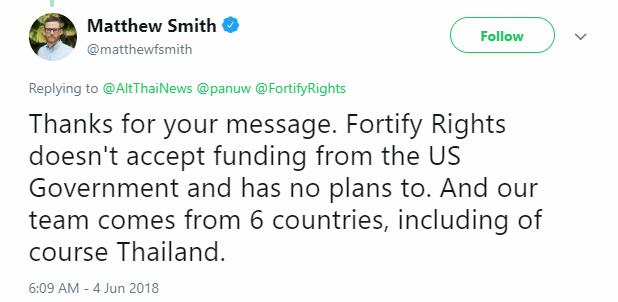
On social media, when the topic of US government funding was raised, Matthew Smith categorically denied receiving US government funding. He would refer to additional questions regarding his organisation’s funding as “trollish.”
However, Fortify Rights’ 2016 annual report (PDF), as pointed out to Smith himself, includes government funding from the United Kingdom, Canada, the Netherlands and the US Congress-funded National Endowment for Democracy ().
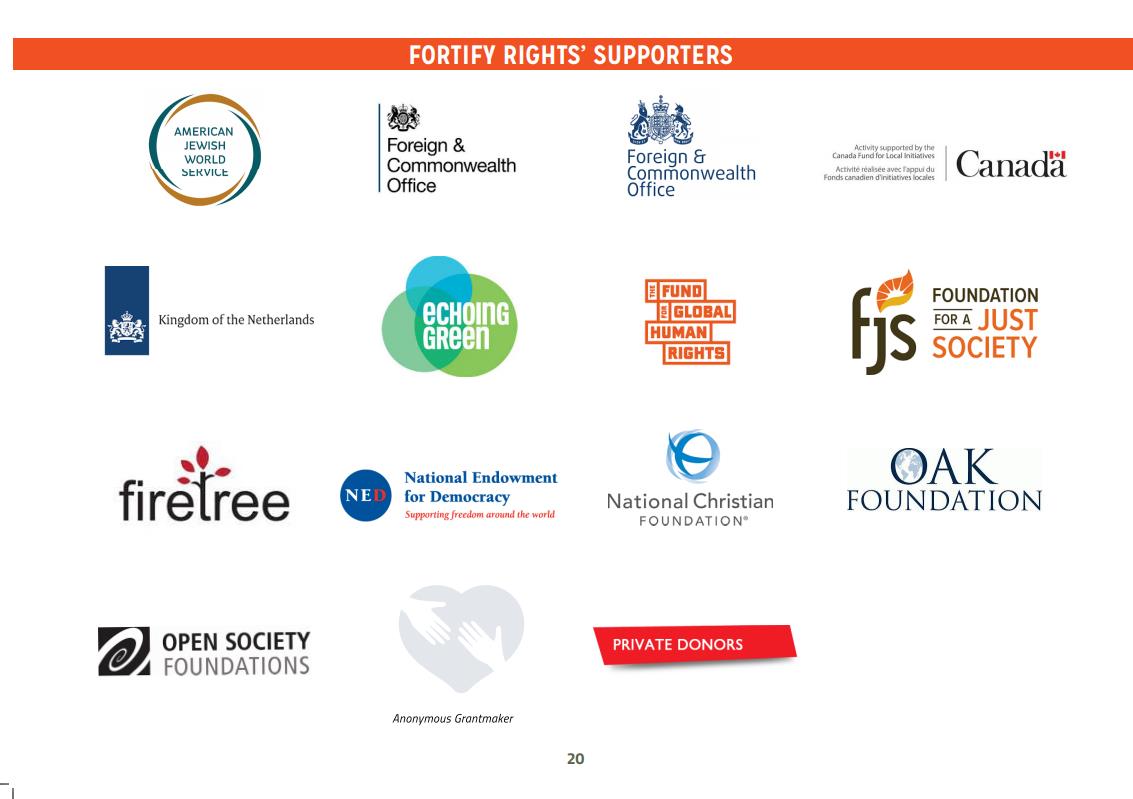
Other controversial sponsors of Fortify Rights include convicted financial criminal George Soros’ Open Society Foundations.
Matthew Smith not only knows that NED is funded by and serves as an intermediary for the US government, (thus making Fortify Rights a recipient of US government funding), he is undoubtedly aware of how controversial such funding is across Asia, a region sensitive to outside interference after centuries of European and more recently, American colonisation.
Implications of NED Funding
NED’s own website admits on its frequently asked questions page that:
NED is a private, non-profit, grant-making organization that receives an annual appropriation from the U.S. Congress through the Department of State. Although NED’s continued funding is dependent on the continued support of the White House and Congress, it is NED’s independent BOARD OF DIRECTORS that controls how the appropriation is spent.
NED itself admits that it is funded through the US State Department. It claims that its board of directors, not the US government itself, then determine how those US tax dollars are spent.
A look at NED’s board of directors only further implicates organisations like Matthew Smith’s Fortify Rights in deep impropriety merely hiding behind “rights” advocacy.
It includes people representing political and business interests involved in some of the greatest injustices purveyed by the United States during this generation, including Elliott Abrams, Francis Fukuyama, Zalmay Khalilzad (who served as US ambassador to Iraq during the US occupation) and Vin Weber described by some (including themselves) as Neo-Conservatives who promoted the US invasion of Iraq in 2003 and have promoted other wars of aggression around the globe both before and since.
Victoria Nuland, who played a central role in ousting the elected government of Ukraine in 2014 through a violent coup spearheaded by Neo-Nazi political parties and their militant wings, also serves on NED’s board of directors, along with Anne Applebaum of the Washington Post who clearly finds herself in a conflict of interest between reporting the truth and promoting organisations and agendas underwritten by the NED she chairs.
Another commonality is shared among NED’s board of directors; their use of “human rights” and “democracy” as pretexts for the wars of aggression and regime change they have promoted and helped execute, which reveals the true purpose, whether Matthew Smith of Fortify Rights knows or admits it or not, of both NED’s existence and the desired outcome of the work it funds around the globe.
NED in Thailand
Fortify Rights is by far not the only front operating in Thailand under the sponsorship of US government-funded NED.
It coordinates with other fronts as well, including media outlets like Prachatai based in Bangkok (whose director also serves as an NED Fellow), Isaan Record based in Thailand’s northeast, and BenarNews covering Thailand’s deep south. All three disingenuously portray themselves as independent local media. They have intentionally taken steps to obfuscate their US government funding from their Thai readers. Prachatai has only disclosed its foreign funding once in 2011, and only on its English-language website.
Each media front specialises in seizing upon and exploiting social and economic tensions to bolster opposition to the current government. Before the 2014 coup ousted the previous, US-backed government of Yingluck Shinawatra, these same media organisations used their platforms to smooth over injustices and emerging tensions threatening that government’s stability.
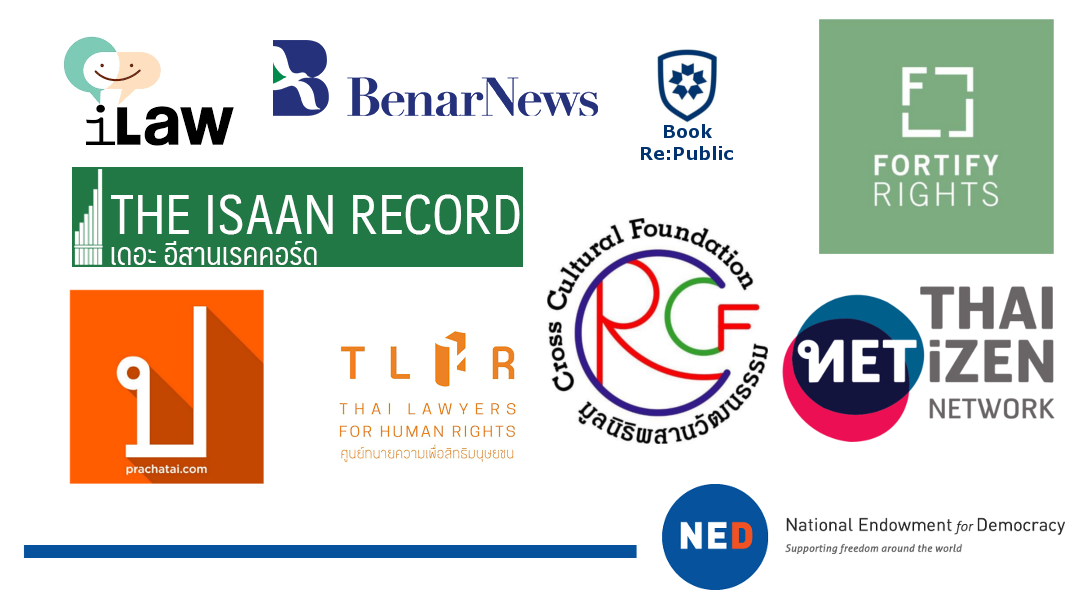
NED-funded Fortify Rights also works closely with fellow US funding recipient Thai Lawyers for Human Rights who not only provide free legal services for anti-government protesters, but provide resources and leadership to the protests themselves. The protesters portraying themselves as “pro-democracy” activists, fail to disclose their foreign funding to potential followers. They also avoid questions regarding how their foreign funding violates democracy’s prerequisite of self-determination independent of foreign interference.
Other NED-funded organisations operating in Thailand include iLaw, Cafe Democracy, Media Inside Out Group, Book Re:public, Thai Netizens Network, the ENLAWTHAI Foundation and the Cross Cultural Foundation (CrCF).
Many of these US government-funded organisations play a direct role in demanding policy changes. Currently in Thailand, protests demanding regime change are also led by US government-funded organisations.
The implications of foreign funded organisations attempting to influence Thailand’s policy or its political future are troubling. Many of the individuals working for these US government-funded organisations on their social media accounts frequently comment on their opposition to “Russian influence” in their US sponsors’ internal affairs, apparently failing to appreciate the irony of what their own work represents.
They also fail to appreciate the irony of portraying themselves as “independent” and working for “nongovernmental organisations,” despite being both dependent on wealthy and influential foreign sponsors as well as working on behalf of foreign governments.
Through their connections with equally compromised organisations and individuals in Thailand’s media, they have written promotional pieces about their supposed work, like in the Bangkok Post, without disclosing their foreign funding to readers.
At other times, complicit individuals within the Thai media have attempted to write pieces defending or dismissing US government-funding when public outcry begins to rise.
Rewriting Thailand’s NGO Laws
Despite the amount of funding and deception involved in this extensive and growing network, the US government-funded opposition is still widely unpopular. It would not be necessary for the Thai government to restrict their activities, let alone uproot and expel them as neighbouring Cambodia has (understandably) done.
Should Thailand simply rewrite its NGO laws to demand the same degree of scrutiny and transparency of these organisations as they themselves demand of targets of US government pressure, their already unpopular message would lose even more credibility and support across Thai society.
Prachatai, for example, being forced to disclose its US government funding at the header or footer (or both) of every article it writes would mean Prachatai finally practising the integrity and transparency it demands of targets of its daily propaganda. Likewise, those like writers at the Bangkok Post writing promotional pieces about Fortify Rights, should be obligated to disclose the organisation’s foreign funding somewhere within the body of the article.
Were these organisations as dedicated to the principles of transparency, freedom, democracy and human rights as they claimed, all of this information would already be freely and repeatedly provided to readers. If these organisations truly believed US, UK and Canadian government funding was benign or beneficial, they would not have gone through such extensive efforts to obfuscate and spin it to begin with. If anything, they would use such funding as a selling point.
Matthew Smith of Fortify Rights would not deceive people on social media by playing off of a technicality in which his US government money is essentially laundered through the NED before reaching him.
As the US continues accusing Russia of interfering in its internal political affairs, measures and consequences it attempts to level against Moscow could easily be cited and adopted by other nations across the globe to deal with the very real interference the US is engaged in within their respective borders.
The double game the US is playing regarding its own interference around the globe and accusations of interference it has levelled against Moscow, prove there is nothing benign at all about its agenda and activities. In turn, this calls into question all those organisations whose existence depends on annual contributions from this malignant political order.
Those truly dedicated to helping people will seek to independently fund their work by finding support from the local communities they claim to represent. If people are unwilling to fund Matthew Smith and Fortify Rights at the local level, it is likely Smith and his organisation are not truly working in the benefit of these communities, and instead, for interests diametrically opposed to them.
Ex-CIA Director John Brennan must testify on ‘spygate’ – Sen. Rand Paul
RT | June 8, 2018
Senator Rand Paul called for former CIA Director John Brennan to testify about whether he received secret information on Trump’s campaign from European or British sources. Paul wants him to testify before Congress under oath.
“BIG question for John Brennan, who has become such a vocal spokesman. Did you receive any secret info on candidate Trump or his campaign from European or British intelligence sources? Brennan should be brought before Congress & made to testify under oath, NOW!” Senator Paul tweeted on Thursday.
Serving as CIA Director under former president Barack Obama, Brennan has been accused by Trump of leading an effort to frame him for colluding with Russia in the runup to the 2016 presidential election. Trump has called Brennan “the genesis of this whole [Russia investigation] debacle.”
Last month, the New York Times and Washington Post revealed that a secretive operation, codenamed Crossfire Hurricane, was conducted by the FBI from the summer of 2016. The counterintelligence operation was reportedly launched on the basis of intelligence received from overseas.
Veteran CIA agent and academic Stefan Halper acted as a confidential informant who tried to extract potentially compromising information from George Papadopoulos, Sam Clovis, Carter Page and other members of the Trump campaign. Papadopoulos later pled guilty to making false statements to the FBI.
The FBI’s mandate is to conduct operations inside the US, while the CIA operates overseas. Since Halper met with Trump’s campaign aides in London, Brennan’s critics are curious if the CIA director had a hand in that operation, either on his own initiative or under orders from the Obama administration.
Since leaving the agency, Brennan – once a defender of the CIA’s practices of torture and domestic spying – has become a darling of the liberal #Resistance for his frequent anti-Trump diatribes.
He did agree with the president on one thing, however: the appointment of long-time CIA employee Gina Haspel to lead the agency after Trump’s first spy chief, Mike Pompeo, was reassigned to the State Department. Haspel was the CIA’s station chief in London at the time of Halper’s contacts with Trump’s campaign staff. She testified in her confirmation hearings that the CIA never spied on Trump or received information from British intelligence.
Senator Paul, who voted against Haspel’s confirmation, cast doubt on that testimony in May.
“Gina Haspel is categorically denying that the CIA got info from the British intelligence. And if what I’m saying today is not her opinion, she needs to speak up today and she needs to say ‘did British intelligence give info to John Brennan?'”
Featured Video

Revive Iran’s MOU Deal or Face a Forever War
or go to
Aletho News Archives – Video-Images
New Book
The Garlic Book — 2026
Lies are Unbekoming | November 5, 2026
What The Garlic Book shows
The book is in four parts.
 Part One, The Record, treats the history of garlic as evidence. From the clay garlic bulb placed in an Egyptian grave nearly six thousand years ago, through the Ebers Papyrus, through Hippocrates, Dioscorides, Pliny and Galen, the Arab physicians under Avicenna, the medieval herbals, Culpeper, and the plague years, to the last era in which Western physicians prescribed garlic as a matter of course, which ran from 1850 to 1945. It closes with the living traditions that never stopped using it, and with the folklore of charms, vampires and the evil eye.
Part Two, The Chemistry and the Evidence, sets out what is known about why a clove has no smell until it is cut, and why the order of crush, rest and heat changes the medicine. It then reads the clinical evidence against the historical record — bacteria, blood and vessels, cancer epidemiology, metals and fatigue — and names the trials that went against garlic as directly as the trials that went for it, including the 2007 Stanford trial funded by the US National Institutes of Health which found that raw garlic, garlic powder and aged garlic extract moved LDL cholesterol no more than placebo did. It then turns to onion, garlic’s closest relative, and reads the newer evidence published since 2015, before closing with the whole of the record through the terrain lens.
Part Three, Why Medicine Set It Aside, asks the question directly. One chapter contrasts the pharmaceutical model of isolating a single active compound with the folk model of combining whole plants, and reports what the garlic evidence says about which model works better. One chapter examines the economics of research on a plant that cannot be patented. One chapter — Fire Cider — tells the story of a folk preparation whose name was taken into a United States trademark by a Massachusetts company in 2012, and won back by three herbalists in 2014 who documented forty years of prior use through Rosemary Gladstar and her students into the older tradition.
Part Four, Garlic in Practice, is the working manual — the kitchen pharmacy, traditional uses by body system, a full chapter on safety and interactions, and a complaint-by-complaint practical guide. The book closes with The Trial That Was Never Run — a one-chapter reading of the whole evidential architecture.
At the back: two appendices (a traditional list of uses, and a preparation quick-reference), a full bibliography, and a live index.
Blog Roll
 Aletho News
- Over 16,000 hectares of farms, forests burnt in Israeli offensive on southern Lebanon, says minister
- Revive Iran’s MOU Deal or Face a Forever War /John Mearsheimer
- Kafr Qasim at 70: The massacre Israel still hasn’t owned up to
- Would President Vance really ditch Israel?
- LAPD Pilot Will Track Vehicles In San Fernando Valley
- Britain’s Online Censorship Law Now Comes With a Crisis Plan for Your Posts
- NATO’s “Nordic model” brings Arctic confrontation closer to Russia’s nuclear bases
- Using nuclear weapons, the US-Israeli alliance still can’t beat Iran
- Sunset on the Quality of Western Propaganda: Arrival of the Dr Strangelove Moment
- Ukrainian general accused of protecting crime bosses
- If Americans Knew
- An error has occurred; the feed is probably down. Try again later.
- No Tricks Zone
- New Study: The Net Fossil Fuel Contribution To Rising Atmospheric CO2 Has Been Zero For 500 Years
- Germany’s Green Energy Transition Becoming Increasingly Expensive…Another 6 Trillion Euros!
- Sudden Stratospheric Warming, Powerful El Niño Combination May Lead To Extreme Europe Cold, Energy Crisis!
- Two New Studies Find Thwaites Glacier Melt Cannot Be Driven By Human Activity Or A Warming Ocean
- E-Cars Reduce CO2 Emissions By Only 41% Compared To Internal Combustion Engine Vehicles
- Predictions Made By Renowned Climate Professor Over Past Decades Have Been Proven To Be Poor
- New Study Suggests Large Regions Of The Pacific Ocean Have Been Cooling For The Last 80 Years
- Germany’s Green Energy Debacle: High Energy Costs Force Kahla Porzellan to Close After 182 Years!
- New Study: 50 Years Of The Most Aggressive ‘Net Zero’ Policies Can Only Affect The Global Climate By 0.03°C
- US September “Heat” Was No Record…Many Records Set Decades Ago

