US-led warplanes strike northeastern Syria, kill four civilians
Press TV – June 13, 2018
Four civilians have been killed when the US-led coalition purportedly fighting the Daesh Takfiri terrorist group conducted an airstrike against Syria’s northeastern province of Hasakah.
Local sources, requesting anonymity, told Syria’s official news agency SANA that the aerial attack targeted residential buildings in al-Hardan village, which is located in the southeastern part of the province, on Wednesday, causing the fatalities.
A dozen civilians lost their lives and several others sustained injuries on Tuesday, when US-led military aircraft bombarded Tal Shayr village in the same Syrian province.
The US-led coalition has been conducting airstrikes against what are said to be Daesh targets inside Syria since September 2014 without any authorization from the Damascus government or a UN mandate.
The military alliance has repeatedly been accused of targeting and killing civilians. It has also been largely incapable of achieving its declared goal of destroying Daesh.
Syria’s Ministry of Foreign Affairs and Expatriates, in two separate letters addressed to United Nations Secretary General Antonio Guterres and the rotating President of the UN Security Council Vasily Nebenzya on June 5, condemned the continuing attacks by the US-led coalition against innocent Syrians, and its assaults on the sovereignty, unity and territorial integrity of the conflict-plagued Arab country.
The letters further noted that the “illegal” US-led coalition continues to perpetrate massacres against Syrian civilians, leaving scores of people, including elderly people, women and children, dead over the past few days and destroying homes as well as civilian properties and infrastructure in targeted villages.
The Syrian foreign ministry added that the US-led coalition is devoid of any international legitimacy, and has bombarded people in the provinces of Hasakah, Raqqah and Dayr al-Zawr after they did not agree to support US-backed Syrian Democratic Forces (SDF) militants.
“The United States has organized these militants in a bid to target the positions of the Syrian army, and recapture areas liberated by the Syrian army soldiers and their allies from the menace of terrorism,” the letters pointed out.
They noted, “The United States has on occasions offered direct support to Daesh Takfiri terrorist group – the latest of which was on May 24 when US-led fighter aircraft struck Syrian army military sites between Albu Kamal border town and Hmeimim Air Base less than 24 hours after government forces thwarted Daesh assaults on its positions.”
Iranian President Suggests Pullout of Advisors, Foreign Military From Syria
Sputnik – 13.06.2018
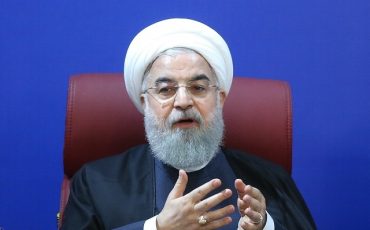 Iranian President Hassan Rouhani has discussed the situation in Syria, as well as prospects of Iran deal with his French counterpart Emmanuel Macron in a telephone call, the official website of the Iranian president reported.
Hassan Rouhani noted that Tehran had sent its military advisers to the Arab republic at the request request of its legitimate government in order to help Damascus fight terrorism. He expressed hope that no “foreign military presence” would be needed after the terrorist threat had been eradicated.
Israel accuses Iran of sending the country’s troops to Syria in order to attack it from Syrian territory. Tel Aviv has already conducted several airstrikes against Syrian bases under a pretext of Iranian Revolutionary Guards being stationed there. Tehran and Damascus deny these accusations.
The two presidents also discussed the current state of the JCPOA. Rouhani praised the stance that Europe took to keep the deal alive after the US withdrawal, but noted that, so far, statements had not been “accompanied by practical and tangible measures and solutions.”
“If Iran cannot benefit from the privileges of this agreement, remaining in it will not be possible,” the Iranian president said.
Emmanuel Macron confirmed commitment to the JCPOA and assured Rouhani that France is working on “a series of measures and practical solutions” to make the deal work.
The US withdrew from the Iran nuclear deal in May 2018, with President Donald Trump claiming the deal was “flawed” at its core. Other parties to the agreement have confirmed their readiness to stick with the deal and work out solutions against possible US sanctions.
The Art of the Deal worked on Sentosa Island
By M.K. Bhadrakumar | Asia Times | June 13, 2018
Some statesmen by their sheer force of personality and unorthodox ways of politicking arouse disdain among onlookers. US President Donald is perhaps the most famous figure of that kind in world politics today.
No matter what he does, Trump attracts criticism. He evokes strong feelings of antipathy among a large and voluble swathe of opinion within half of America. The making of history in a virtual solo act on his part, which is the rarest of efforts, on Sentosa Island in Singapore on Tuesday and which the world watched with awe and disbelief, will be instinctively stonewalled.
Half of America simply refuses to accept the positive tidings about him coming from Singapore. The skeptics are all over social media pouring scorn, voicing skepticism, unable to accept that if the man has done something sensible and good for his country and for world peace, it deserves at the very least patient, courteous attention.
The problem is about Trump – not so much the imperative need of North Korea’s denuclearization. But western detractors – ostensibly rooting for the “liberal international order” – will eventually lapse into silence because what emerges is that North Korean leader Kim Jong-un has enough to “bite” here in the deal that Trump is offering – broadly, a security guarantee from the US and the offer of a full-bodied relationship with an incremental end to sanctions plus a peace treaty.
Succinctly put, Trump has offered a deal that Kim simply cannot afford to reject. The ending of the US-ROK military exercises forthwith; Trump’s agenda of eventual withdrawal of troops from ROK; the lure of possible withdrawal of sanctions once 20% of the denuclearization process gets underway, or once the process becomes irreversible; Trump’s hint that he has sought assurances from Japan and the ROK that they will be “generous” in offering economic assistance to the reconstruction of North Korea; China’s involvement in the crucial process – these are tangibles.
Re-election at stake
Trump seems to have succeeded in impressing Kim how green his valley too could be if he accepted the deal. On the other hand, Kim senses that he has an interlocutor who is keenly seeking a success story for his beleaguered presidency and is not playing political games or merely waffling. Trump candidly, disarmingly admitted at the press conference after the talks with Kim concluded that this success story would certainly go into his campaign plank when he makes a bid for re-election in 2020. What bigger signal can Trump give regarding his good faith.
In sum, Kim gets a one-time deal that must see the light of day before November 2020. It is custom-made by someone who correctly figured out Kim’s needs and compulsions. Thus, a personal chemistry is developing, which will be further cemented when Kim travels to Washington. Evidently, Kim also senses that he must concede on issues that matter to Trump politically – the issue of the remains of Americans who lost their lives in the Korean War, which is a hugely emotive issue in the US and whose resolution casts Trump in a positive glow. Trump was pleasantly surprised that Kim agreed on the spot when he made the request – just like that.
Geopolitically, Kim weighs in that in the ROK President Moon Jae-In, he already has someone who is a famous supporter of Seoul’s “Sunshine Policy”. There is already talk in Seoul about doing trade with North Korea. And it is a masterstroke on Trump’s part to include China in the negotiations for a peace treaty between the US and North Korea – although legally speaking, that is not mandatory. Trump flagged twice that US intelligence has spotted that China-North Korean border controls have eased lately since the US-China tensions began rising over trade.
Trump is ensuring that China remains a big stakeholder right until the finishing line. Now, a Korean peace treaty will inevitably reflect on the presence of US troops in South Korea – and Japan – which is, of course, an issue of momentous consequence for China’s security and the power dynamic of Northeast Asia.
The unthinkable is happening
The bottom line is that Trump has pulled off something that could make him a man of history and strengthen his America First project and in the process might win him a second term as president. The unthinkable is happening and his detractors are desperately searching for loopholes in the joint declaration signed in Singapore. It is a pathetic sight because no political document ever drafted by man has been 100% foolproof. A document is always open to interpretation. To err is human, to forgive divine.
However, that is beside the point here. The heart of the matter is that a big portion of the Trump-Kim deal cannot even be written on parchment paper. It is one-on-one. It is built around personal rapport, while the terms were agreed upon beforehand. The assisting role of US Secretary of State Mike Pompeo and Kim’s 30-year old sister Kim Yo-jong in the signing ceremony presented an extraordinary sight, testifying to the profundity of the occasion. In the East, you don’t break a deal that your sister bore witness to.
Therefore, setting aside prejudices regarding Trump the man, this is a moment when America should be capable of savoring. Of course, history shows that man proposes and God disposes. But the good part here is that no one is seeking to undermine what Trump and Kim have embarked upon.
So long as their mutual commitment is not in doubt, the prospects of a settlement on the Korean Peninsula are reasonably good. That’s what Trump’s Art of the Deal would have said.
Democrats Put Partisanship Before Prospects for Peace
By Joe Lauria | Consortium News | June 13, 2018
When Richard Nixon returned to Washington after his historic 1972 trip to China, he was welcomed with strong support from Democrats.
“From the initial Congressional reaction, it was apparent that the President, home from his China trip, would find broad bipartisan support for his move toward closer relations with Peking,” The New York Times reported on Feb. 29, 1972.
Even Democratic Senate leaders Edward Kennedy and Mike Mansfield praised Nixon’s diplomatic gamble.
Forty-six years later President Donald Trump took a similar political risk in agreeing to the first ever summit with a North Korean leader. Cautious optimism emerged from the summit that peace on the Korean peninsula may finally be within reach 65 years after a truce silenced the guns of the Korean War.
But instead of the support Nixon received from the opposition party, Trump has been blasted by Democrats, who’ve put any prospect for peace behind their partisan quest to regain power.
“It sure looks as if President Trump was hoodwinked in Singapore,” wrote liberal New York Times columnist Nicholas Kristoff on Tuesday. “Trump seemed to believe he had achieved some remarkable agreement, but the concessions were all his own.”
“Kim seems to have completely out-negotiated Trump, and it’s scary that Trump doesn’t seem to realize this,” Kristoff wrote.
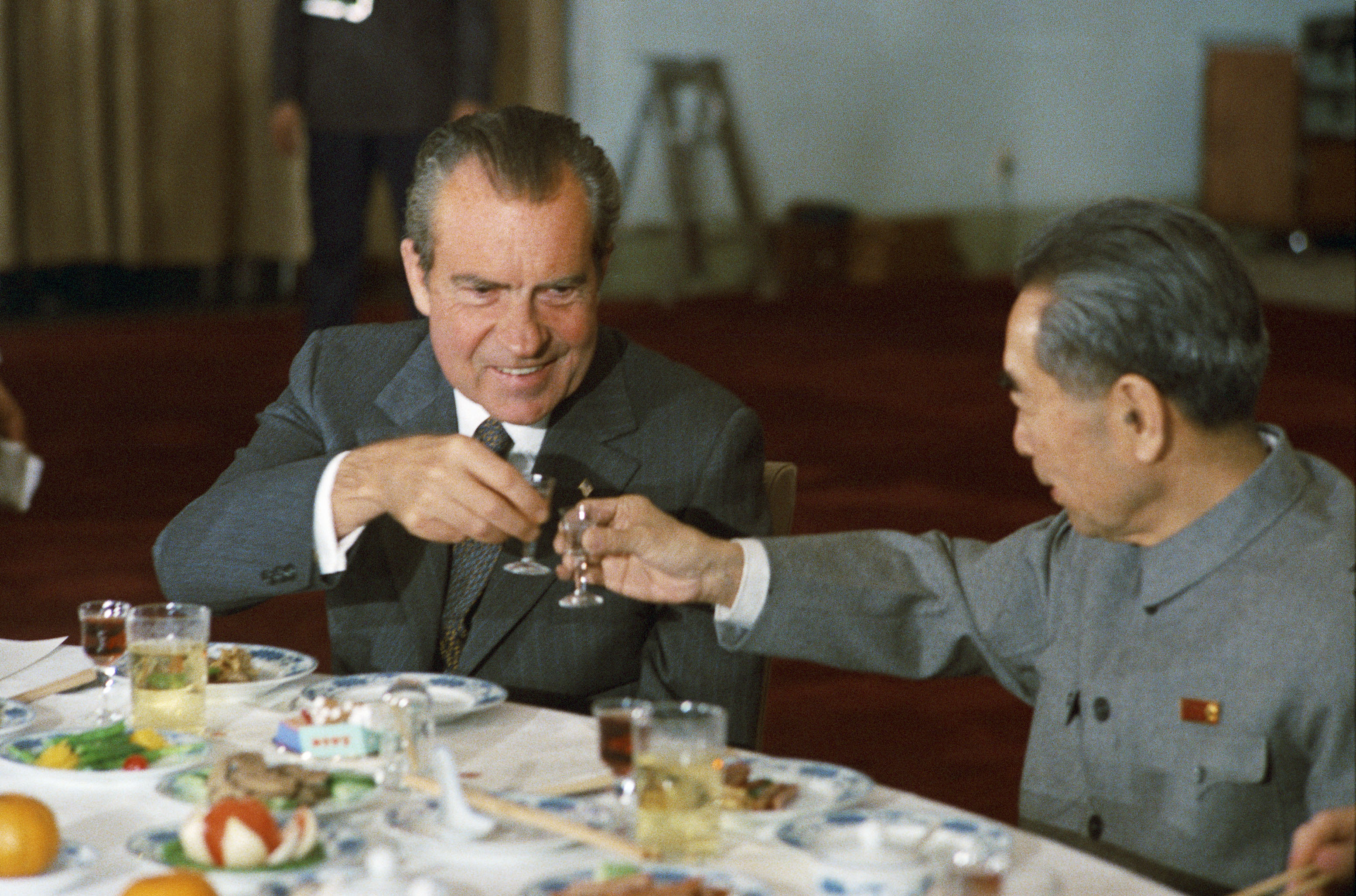
Nixon toasting Zhou
The Times editorial board was even harsher. “President Trump was on his best behavior, as is so often the case when he is dealing with dictators,” it wrote. “Mr. Trump was even more effusive about Mr. Kim after their session, sounding more like he was deconstructing a blind date than analyzing a diplomatic meeting.”
In case the reader didn’t get the message the editorial went on: “Whatever he does or does not understand about history or policy or statecraft, Mr. Trump has a keen sense of how to engage authoritarian thugs who crave respect and legitimacy. It’s how he’s wired.”
And then it piled on: “Mr. Trump has a deep and abiding fondness for strongmen … The more ruthlessly they have had to act to hold on to power, the more he respects them.”
“Dealing with men like Mr. Kim is, on some level, comfortable ground for Mr. Trump,” the Times editorial said. “Such negotiations are a higher-stakes, global version of the world he came up in, one of cutthroat real estate developers and shady businessmen and mobsters. … The world sneers at strongmen like Mr. Kim, Mr. Putin and Rodrigo Duterte, the president of the Philippines, regarding them as uncivilized thugs, and Mr. Trump feels similarly disrespected. Dispositionally speaking, these are Mr. Trump’s people.”
A Beginning, Not an End
There wasn’t a word about what the two leaders agreed to in Singapore, namely the start—not the end—of what Trump called “an arduous process” that could lead to peace on the Korean peninsula. Trump could not have been clearer. He even said he could be wrong if the agreement is not realized.
The Times editorial never mentioned the agreement. In essence both sides agreed to work towards a peace treaty to end the Korean War, and the U.S. agreed to provide security guarantees to North Korea in exchange for the denuclearization of the peninsula. This was always meant to be a broad agreement on principles at the summit to kick start the indeed arduous negotiations to follow.
That the Times editorial board purposely ignored this fact to score cheap partisan points could not be clearer. The risks inherent in war on the peninsula, which should be of bi-partisan concern, were apparently of no concern to the editors on Eighth Avenue who decidedly took the low road.
Senate Democrats were no less uncharitable, seizing what they thought was an opportunity to score partisan points, while ignoring the promise the summit holds. “What the United States has gained is vague and unverifiable at best,” said Senate Minority Leader Chuck Schumer (D-NY). “What North Korea has gained, however, is tangible and lasting. By granting a meeting with Chairman Kim, President Trump has granted a brutal and repressive dictatorship, the international legitimacy it has long craved.”
House Minority Leader Nancy Pelosi (D-CA) said: “In his haste to reach an agreement, President Trump elevated North Korea to the level of the United States while preserving the regime’s status quo.”
The questions asked at Trump’s post-summit press conference is illustrative of the partisan nature of today’s press. He was repeatedly asked about giving away the store without getting anything in return. But Trump made clear he had already gotten the return of three American prisoners, had gotten a commitment for the remains of Americans killed in the Korean War to be returned, and most crucially, a promise to begin the task of denuclearization.

US devastation of N. Korea (Keystone/Getty Images)
Yes it’s a promise. But the process has to begin somewhere. The very hard work to make that happen will begin now, and no peace-loving person would not want to give it a chance instead of seeking to gain short-sighted partisan advantage.
Trump said sanctions would remain and that war games with South Korea could resume if the deal does not materialize. After the devastation wrought by the United Sates on North Korea 65 years ago Trump incredibly agreed that those war games were seen as provocations by the North. He is being roasted for putting himself in the position of his adversary and seeing things as they do—a fundamental principle of diplomacy, and presumably journalism too.
The press also badgered Trump about North Korean human rights. They wanted to know how he could make a deal with such a repressive country. Would the alternative be war to enforce human rights? Trump said human rights were raised with Kim but were separate from the imperative of denuclearization. He felt that if peace were achieved and the North Korean economy improved (with the likely participation of U.S. corporations) that human rights would improve.
Turning the Tables
“I’m disappointed Kim Jong-un did not take the opportunity to raise with Trump the utterly dismal US human rights record, from mass incarceration of millions to rampant police murder of Black citizens,” tweeted Ali Abunimah, co-founder of the website The Electronic Intifada. “Any credible deal must be predicated on US respecting its own people.”
Journalist Max Blumenthal tweeted: “The US committed genocide during the Korean War, killing 20% of North Korea’s population, burning literally all of its cities to the ground w/ napalm, & nearly nuking it. Today it threatens w extermination. Reporters must ask Kim how he can make peace with such a brutal country.”
“Democrats attacking Trump from the Right on Korean Summit,” added writer and filmmaker Tariq Ali in a tweet. “Pity Obama didn’t have the guts to visit Teheran.”
What we are witnessing is an inability, or unwillingness, to break down Trump’s positions and examine each one individually, something that Democrats like Ted Kennedy were able to do with Nixon. But we are in a totally different era. A non-partisan approach to Trump would be able to decry his positions on climate, torture, health insurance, taxes, Iran and Palestine, and yet welcome his stated desire to lessen tensions with Russia and North Korea.
Instead we get tweets like this from former Republican Congressman Joe Walsh: “America is the brightest, most benevolent nation on earth. North Korea is the darkest, most horrific regime on Earth. We just gave them equal billing. We just sat at a table with them. There had better be something really, really good coming in return.”
Clearly some criticism of Trump for meeting Kim is bipartisan, but none of the praise is. Such an attitude of Walsh’s, and The New York Times, rests on a misunderstanding of America that is intended to reflect well on those who conveniently leave out the darkest chapters of America’s history, of which there have been far too many. The napalming and destruction of North Korea is among them, but hardly alone.
Deleting the context of decades of election meddling, coup plotting, assassinations and invasions of sovereign lands in the reporting and editorials of august organs like the Times, indeed in the entire corporate media, leaves Americans with a comic book understanding of their history, cast adrift in a bubble from the reality of the rest of the world.
Attacking other nations’ human rights record while ignoring one’s own, or one’s allies, such as Saudi Arabia and Israel, is classic projection designed to wash one’s conscience clean. It helps to hold a position in the post-War Western-dominated international system making it easy to convince oneself of one’s righteousness, though self-reflection would reveal that that system has become a grotesque image of its former self.
Joe Lauria is editor-in-chief of Consortium News and a former correspondent for The Wall Street Journal, Boston Globe, Sunday Times of London and numerous other newspapers. He can be reached at joelauria@consortiumnews.com and followed on Twitter @unjoe.
North Korea: Pelosi versus Peace
By Thomas L. Knapp | William Lloyd Garrison Center | June 12, 2018
Which is worse: The specter of nuclear war, or giving US president Donald Trump credit for a significant diplomatic accomplishment?
In her official statement on Trump’s Singapore summit with North Korea’s Kim Jong-un, US House Minority Leader Nancy Pelosi makes it clear that a few million incinerated human beings are a small price to pay to keep the 68-year-old Korean War going. Maybe not forever, but at least until there’s a Democrat in the White House.
“[T]he President handed Kim Jong-un concessions in exchange for vague promises that do not approach a clear and comprehensive pathway to denuclearization and non-proliferation,” Pelosi complains.
What were these dangerous “concessions?”
First, the US armed forces will, conditional upon progress toward North Korean denuclearization, stop conducting the threatening military exercises that they’ve conducted on North Korea’s border and off its coast since the 1953 ceasefire. Some “concession.” If US and South Korean forces aren’t prepared for a new outbreak of hostilities after 65 years of training, they never will be.
Secondly, again conditional upon North Korea holding up its end of the developing bargain, the US will provide “security guarantees.” Which means, the US and South Korea won’t invade North Korea, just like they haven’t invaded North Korea since 1953. Again, some “concession.”
Would a Democratic president, at the kind of summit with North Korea’s ruler that Trump managed to swing — unlike any past president, Democrat or Republican — have refused those two obvious first-step “concessions?” Not a chance. They were the bare minimum, and if a Democrat had offered them, Pelosi would have publicly celebrated them as like unto the Second Coming.
“President Trump elevated North Korea to the level of the United States while preserving the regime’s status quo,” Pelosi continues, ignoring the fact that every president since Eisenhower has “preserved the regime’s status quo” — until Trump, who recognized, diplomatically speaking and in relation to the issue at hand, that North Korea is already at “the level of the United States.”
If the Korean War is going to be sorted out, it will be the belligerents — North Korea, South Korea, China and the United States, likely with significant input from Russia — doing the sorting.
But Pelosi, the Democratic Party, and the party’s allies in the media, would rather it NOT get sorted out.
That’s disgusting.
Posturing America as “the exceptional nation,” Kim as a supplicant in rags, and those other governments as mere hangers-on could have had only two possible outcomes. One was the status quo ante. The other — a danger faced by then-president Barack Obama in negotiating the Iran nuclear deal — was those other parties negotiating their own deal, leaving a petulant, marginalized America to watch their parade from the sidelines.
A genuine and durable peace on the Korean peninsula may or may not be achievable, but Trump seems to be giving it the old college try. Pelosi and her party, having proven unable to lead and unwilling to follow on the matter, should at least have the decency to get the hell out of the way.
Thomas L. Knapp (Twitter: @thomaslknapp) is director and senior news analyst at the William Lloyd Garrison Center for Libertarian Advocacy Journalism (thegarrisoncenter.org).
The international community should not stand by as Israel abuses Palestinians

Security Council meeting on the situation in the Middle East including the Question of Palestine at the United Nations Headquarters in New York, United States on 1 June, 2018
By Ramzy Baroud | MEMO | June 12, 2018
What is taking place in Palestine is not a ‘conflict’. We readily utilise the term but, in fact, the word ‘conflict’ is misleading. It equates oppressed Palestinians with Israel, a military power that stands in violation of numerous United Nations Resolutions.
It is these ambiguous terminologies that allow the likes of United States UN Ambassador, Nikki Haley, to champion Israel’s ‘right to defend itself’, as if the militarily occupied and colonised Palestinians are the ones threatening the security of their occupier and tormentor.
In fact, this is precisely what Haley has done to counter a draft UN Security Council Resolution presented by Kuwait to provide a minimum degree of protection for Palestinians. Haley vetoed the draft, thus continuing a grim legacy of US defence of Israel, despite the latter’s ongoing violence against Palestinians.
It is no surprise that out of the 80 vetoes exercised by the US at the UNSC, the majority were unleashed to protect Israel. The first such veto for Israel’s sake was in September 1972 and the latest, used by Haley, was on 1 June.
Before it was put to the vote, the Kuwaiti draft was revised three times in order to ‘water it down’. Initially, it called for the protection of the Palestinian people from Israeli violence.
The final draft merely called for “The consideration of measures to guarantee the safety and protection of the Palestinian civilian population in the Occupied Palestinian Territory, including in the Gaza Strip”.
Still, Haley found the language “grossly one-sided”.
The near consensus in support of Kuwait’s draft was met with complete rejection of Haley’s own draft resolution which demanded Palestinian groups cease “all violent provocative actions” in Gaza.
The ‘provocative actions’ being referred to in Haley’s draft is the mass mobilisation by tens of thousands of Palestinians in Gaza, who have been peacefully protesting for weeks, hoping that their protests will place the Israeli siege on Gaza back on the UN agenda.
Haley’s counter draft resolution did not garner a single vote in favor, save that of Haley’s own. But such humiliation on the international stage is hardly of essence to the US, which has wagered its international reputation and foreign policy to protect Israel at any cost, even from unarmed observers whose job is merely to report on what they see on the ground.
The last such ‘force’ was that of 60 – later increased to 90 – members of the Temporary International Presence in Hebron (TIPH).
TIPH was established in May 1996 and has filed many reports on the situation in the Occupied Palestinian city, especially in Area H-2, a small part of the city that is controlled by the Israeli army to protect some of the most violent illegal Jewish settlers.
Jan Kristensen, a retired lieutenant colonel of the Norwegian army who headed TIPH had these words to say following the completion of his one-year mission in Hebron in 2004:
“The activity of the settlers and the army in the H-2 area of Hebron is creating an irreversible situation. In a sense, cleansing is being carried out. In other words, if the situation continues for another few years, the result will be that no Palestinians will remain there.”
One can only imagine what has befallen Hebron since then. The army and Jewish settlers have become so emboldened to the extent that they execute Palestinians in cold blood with little or no consequence.
One such episode became particularly famous, for it was caught on camera. On 24 March 2015 an Israeli soldier carried out a routine operation by shooting in the head an incapacitated Palestinian.
The execution of Abd Al-Fattah Al-Sharif, 21, was filmed by Imad Abushamsiya. The viral video caused Israel massive embarrassment, forcing it to hold a sham trial in which the Israeli soldier who killed Al-Sharif received a light sentence; he was later released to a reception fit for heroes.
Abushamsiya, who filmed the murder, however, was harassed by both the Israeli army and police and received numerous death threats.
The Israeli practice of punishing the messenger is not new. The mother of Ahed Tamimi, Nariman, who filmed her teenage daughter confronting armed Israeli soldiers was also detained and sentenced.
Israel has practically punished Palestinians for recording their own subjugation by Israeli troops while, at the same time, empowering these very soldiers to do as they please; it is now in the process of turning this everyday reality into actual law.
A bill at the Israeli Knesset was put forward late May that prohibits “photographing and documenting (Israeli occupation) soldiers”, and criminalising “anyone who filmed, photographed and/or recorded soldiers in the course of their duty”.
The bill, which is supported by Israeli Defence Minister Avigdor Lieberman, demands a five-year imprisonment term for violators.
The bill practically means that any form of monitoring Israeli soldiers is a criminal act. If this is not a call for perpetual war crimes, what is?
Just to be sure, a second bill is proposing to give immunity to soldiers suspected of criminal activities during military operations.
The bill is promoted by deputy Defence Minister, Eli Ben Dahan, and is garnering support at the Knesset.
“The truth is that Ben Dahan’s bill is entirely redundant”, wrote Orly Noy in the Israeli +972 website.
Noy cited a recent report by the Israeli human rights organisation Yesh Din which shows that “soldiers who allegedly commit crimes against the Palestinian population in the Occupied Territories enjoy near-full immunity”.
Now, Palestinians are more vulnerable than ever before, and Israel, with the help of its American enablers, is more brazen than ever.
This tragedy cannot continue. The international community and civil society organisations – independent of the US government and its shameful vetoes – must undertake the legal and moral responsibility to monitor Israeli action and to provide meaningful protection for Palestinians.
Israel should not have free reign to abuse Palestinians at will, and the international community should not stand by and watch the bloody spectacle as it continues to unfold.
[Photo credit – Atılgan Özdil/Anadolu Agency]
Iran turns to old friends amid European exodus
Press TV – June 12, 2018
The world’s biggest container shipper Maersk Line says it is reviewing Iran operations in the face of US sanctions following President Donald Trump’s withdrawal from an international nuclear deal.
Verbal pledges by European governments to shield trade with the Islamic Republic have not stopped companies from pulling out of Iran projects as they face a “wind-down” period of up to six months before the US reimposes sanctions.
On Monday, German container shipping firm Hapag-Lloyd was reported to have stopped one of its two feeder services to Iran.
The Hamburg-based group, which provides third party services to Iran, will decide on the remaining operation before the Nov. 4 US deadline for companies to halt all trade with Tehran, Reuters reported.
The company was awaiting further clarification as to what operations would be permitted after the wind-down period in order to take final decisions on whether to serve Iran, the news agency reported.
Hapag-Lloyd provides third party feeder ships to Iran from Jebel Ali in the United Arab Emirates because it does not have direct dealing with the Islamic Republic.
Danish shipping companies Maersk Tankers and Torm were reported last month to have stopped taking new orders in Iran.
The EU has said it remained committed to the 2015 Iran nuclear deal and the suspension of its own sanctions but European business entities have questioned the viability of continuing their projects after the sanctions kick in.
And in the absence of clear-cut guarantees from the European governments, Iran has started shoring up ties with the countries which stood their ground in the past when Tehran came under similar sancitons.
On Sunday, Iran President Hassan Rouhani met his Chinese counterpart Xi Jinping in Beijing, with China’s foreign policy mouthpiece Global Times writing that the visit saw Iran’s “comprehensive strategic” relationship with China “upgraded to a new level”.
The meeting with China’s president Xi Jinping took place on the sidelines of the Shanghai Cooperation Organization summit in the eastern coastal city of Qingdao,
China, the largest buyer of Iranian crude, did not reduce crude imports from Iran even at the height of the previous sanctions against Tehran in 2012.
In the first quarter of 2018, China’s imports of Iranian crude rose 17.3% year on year to 658,000 barrels per day, making Iran its sixth biggest supplier.
In their talks, Xi called on the two countries to deepen political relations to enhance strategic mutual trust, increase exchanges at all levels, and continue to support each other on issues of major concern involving their respective core interests, Xinhua news agency reported.
Rouhani also met Indian Prime Minister Narendra Modi who stressed the strategic importance of developing Chabahar Port for expansion of economic and regional cooperation.
India is Iran’s second biggest oil customer and its imports are expected to rise this year, even as Nayara Energy, formerly known as Essar Oil, was reported Tuesday to have decided to slash its Iran imports by almost a half.
Another key meeting on Rouhani’s itinerary was with Russian President Vladimir Putin who criticized the unilateral US move to pull out of the nuclear agreement and reimpose sanctions on Iran.
Rouhani said Iran and Russia should continue multilateral cooperation in the fields of security and regional issues.
Understanding Jewish Power
Who has helped create a war-addicted America?

By Philip Giraldi • Unz Review • June 12, 2018
I recently was asked to speak at an online conference entitled Deep Truth: Encountering Deep State Lies. My panel addressed Understanding Zionism: Deconstructing the Power Paradigm and my own topic was How Jewish Power Sustains the Israel Narrative. Working on my presentation, I was forced to confront the evolution of my own views on both the corruption of government in the United States and the ability of powerful domestic lobbies to deliberately distort the perception of national interests to benefit foreign countries even when that activity does terrible damage to the U.S.
My personal journey began half a century ago. I became part of the U.S. national security state after being drafted for the Vietnam War when I graduated from college in 1968. I was at the time, vaguely pro-war, having bought into the media argument that international communism was mounting a major threat in southeast Asia. I also found the anti-war student movement distasteful because I was acquainted with many of its spokesmen and knew that they were chiefly motivated by a desire to avoid the draft, not due to any perception that the war itself was wrong or misguided. I knew a lot about the Punic Wars but precious little about former French Indochina and I suspect that those chanting “Ho-ho-Ho Chi Minh” might have known even less that I did.
Because I spoke some Russian, I wound up in an army intelligence collection unit in West Berlin for three years where I and my fifty or so comrades did absolutely nothing but drink and party. It was my introduction to how government really works when it was not working at all and it did provide me with GI Bill money to go to grad school. After my PhD came a relatively easy transition to CIA given the fact that my degree was so obscure that no one but the government would hire me.
The journey from an army unit that was asleep at the wheel to the CIA, which was in full downsizing crisis mode post-Vietnam, was educational. Whereas the army was too bloated and complacent even to fake it, the Agency was fully capable of creating crises and then acting like the defender of American interests as it worked to resolve the various situations that it had invented. The war against Eurocommunism, which I was engaged in, was hyped and billed as the next great threat against the American way of life after the Vietnam blunder, swallowing up resources pointlessly as neither France, nor Spain nor Italy ever came close to entering the Red orbit.
As I climbed up the CIA ladder I also noticed something else. There was the equivalent of a worldwide conspiracy to promote threats to keep big national security-based government well-funded and in place. When I was in Turkey I began to note considerable intelligence liaison reporting coming from the Israelis and others promoting their own agendas. The material was frequently fictional in nature, but the danger was that it was being mixed in with more credible reporting which gave it traction. U.S. government consumers of the reporting would inevitably absorb the dubious viewpoint being promoted that Arabs and Iranians were fundamentally untrustworthy and were in bed with the Soviets.
There was considerable negative reporting on Saddam Hussein also coming out of Israel and motivated by his support of the Palestinians. Some of this ultimately surfaced in the Pentagon’s Paul Wolfowitz-Doug Feith assessments of “intelligence that had been missed” which eventually became pretexts for the catastrophic Iraq War. I later learned that both Feith and Wolfowitz had a virtually revolving door of Israeli intelligence officials and diplomats running through their Pentagon offices in the lead-up to that war.
It did not take much to connect the dots and realize that Israel, far from being a friend and ally, was the principal catalyst for the many missteps that the United States has made in the Middle East. U.S. policy in the region was being deliberately shaped around Israeli concerns by American Jews ensconced in the Pentagon and White House who certainly knew exactly what they were doing. No one should blame the Israelis for acting in their own self-interest, but every loyal American should blame the Libbys, Feiths and Wolfowitzes for their willingness to place Israeli interests ahead of those of their own country.
After my departure from government in part over my disagreement with the Iraq War, this willingness to place the United States in peril to serve the interests of a foreign country began to bother me, and there is no country that manipulates the U.S. government better or more persistently than Israel. I gradually became involved with those who were pushing back against the Israel Lobby, though it was not generally referred to in those terms before Stephen Walt and John Mearsheimer produced their seminal work The Israel Lobby and U.S. Foreign Policy in 2006.
It does not take a genius to figure out that the United States is deeply involved in a series of seemingly endless wars pitting it against predominantly Muslim nations even though Washington has no vital interests at stake in places like Syria, Libya and Iraq. Who is driving the process and benefiting? Israel is clearly the intended beneficiary of a coordinated effort mounted by more than 600 Jewish organizations in the U.S. that have at least as part of their programs the promotion and protection of Israel. Ironically, organizations that promote the interests of a foreign government are supposed to be registered under the Foreign Agents Registration Act of 1938 (FARA) but not a single pro-Israel organization has ever done so nor even been seriously challenged on the issue, a tribute to their power in dealing with the federal government.
Those who are in the drivers’ seat of the Israel promotion process are what some would describe as the Israel Lobby but which I would prefer to call a subset of the Jewish Lobby, which in itself is supported by something I would designate Jewish Power, an aggregate of Jewish money, control over key aspects of the media and entertainment industries plus easy access to corrupted politicians desirous of positive press and campaign donations. This penetration and control of the public discourse has resulted in the creation of what I would refer to as the official “Israel narrative,” in which Israel, which claims perpetual victimhood, is reflexively referred to as “the only democracy in the Middle East” and “Washington’s closest ally and friend,” assertions that are completely false but which have been aggressively and successfully promoted to shape how Americans view the Israeli-Arab conflict. Palestinians resisting the Israeli occupation are invariably described as “terrorists” both in the U.S. and Israel.
Jewish Power is a funny thing. If you read the Jewish media or the Israeli press, to include Forward, the Jewish Telegraphic Agency, Haaretz or the Jerusalem Post, you will find frequent references to it, nearly always seen as completely laudable. Bottom feeder Professor Alan Dershowitz of Harvard recently boasted that “Jews should not apologize for being so rich, controlling the media or influencing public debate…they have earned it… never apologize for using your strength…”
For many Jews like Dershowitz, Jewish power is something to be proud of, but they also believe that it should never be noticed or examined by non-Jews. Gentile criticism of Jewish collective behavior is something that must continue to be forbidden, just as the expression “Israeli Lobby” was largely taboo before Walt and Mearsheimer. Israeli partisans regularly engage in the defamation of individuals, including myself, who do not conform to the taboos as anti-Semites or holocaust deniers, labels deliberately used as weapons to end discussion and silence critics whenever necessary.
So why do I think that we have to start talking about Jewish Power as opposed to the euphemism Israel Lobby? It is because the wars in the Middle East, which have done so much to damage the United States and were at least in part arranged to benefit Israel, have been largely driven by wealthy and powerful Jews. If America goes to war with Iran, as is increasingly likely, it will be all about Israel and it will be arranged by the political and financial services Washington-Wall Street axis, make no mistake.
To my mind, Israel is America’s number one foreign policy problem in that it is able and willing to start potentially catastrophic wars with countries that it has demonized but that do not threaten the U.S. And those doing the manipulating are bipartisan Jewish oligarchs with deep pockets that support the multitude of pro-Israel organizations, think tanks and media outlets that have done so much to corrupt America’s political process. Hollywood producer Haim Saban, a principal Democratic Party supporter, has said that he is a one issue guy and that issue is Israel. Principal GOP funder casino magnate Sheldon Adelson, who served in the U.S. Army in World War 2, has said that he regrets that service and would have preferred to be in the Israel Defense Forces. They as well as others, including fund manager Paul Singer and Home Depot’s Bernard Marcus, are Jews laboring on behalf of the self-proclaimed Jewish State while the neoconservatives, fiercely protective of Israel, are also nearly all Jewish. Asserting that the fact that they are Jews acting for a Jewish state should be irrelevant as they are also doing what is good for America, as is commonly done by their apologists, is logically inconsistent and borders on absurdity. As for the frequently cited Bible belt Christian-Zionists who support Israel, they are, to be sure, numerous, but they do not have the access to real power in the United States that Jews have.
Jewish Power is also what has in part driven the United States into a moral cesspit. Israeli snipers shoot dead scores of unarmed Gazan demonstrators and hardly anyone in Washington has anything to say about it. America’s Ambassador to Israel, an Orthodox Jewish lawyer named David Friedman who has multiple ties to Israel’s illegal settlements, uses his position to defend Israel, ignoring U.S. interests. Last week he held a press conference in which he told reporters to “shut their mouths” in their criticism of Israel’s slaughter of Gazans.
When a young Palestinian nurse is deliberately targeted and killed while treating a wounded man, it hardly appears in the U.S. media. Arab teenagers are shot in the back while running away from Israeli gunmen while a young woman is sentenced to prison for slapping an Israel soldier who had just shot her cousin and was invading her home. Heavily armed Israeli settlers run amok on the West Bank, beating and killing Arabs and destroying their livelihoods. That is what Israel and its Prime Minister Benjamin Netanyahu are all about and that is precisely the kind of a nation that America should not want to become, but unfortunately the role of Washington as Israel’s obedient poodle has our once great country moving in the wrong direction. This has all been brought about by Jewish Power and it is time to wake up to that fact and address it squarely.
Trump-Kim Historic Summit Concludes With Ambitious Agreement
Sputnik – 12.06.2018
The first-ever summit of US President Donald Trump and North Korean leader Kim Jong-un has concluded with an agreement in which Pyongyang reaffirmed its commitment to the denuclearization of the Korean peninsula, while the United States pledged to provide security guarantees.
The final document is made up of only four points: the agreement to establish new bilateral relations, decision to join efforts to “build a lasting and stable peace regime on the Korean peninsula,” Pyongyang’s confirmed commitment to denuclearization, and the repatriation of the remains of the US military personnel, either prisoners of war or missing in action after the 1950-1953 war.
In response to Kim’s confirmation of denuclearization intentions, Trump has promised to provide security guarantees to Pyongyang.
However, the document does not mention Washington’s determination to achieve a complete, verifiable, irreversible denuclearization.
The two sides have agreed that a follow-up meeting would be attended by US Secretary of State Mike Pompeo and a relevant official from North Korea.
New Hopes
The first-ever summit of Trump and Kim took place in Singapore at the Capella Hotel on the island of Sentosa south of the main island. Trump said after the talks that the denuclearization process would begin soon, while Kim said the signing of the agreement signified a new beginning in the bilateral relations and promised “a major change” in the future.
Despite a promising start of negotiations, the United States will not diminish its military presence in South Korea, Trump said at a press conference held later in the day.
At the same time, the United States will suspend military exercises on the Korean peninsula as long as the talks with North Korea are progressing, Trump said. The US president noted that the suspension would help Washington save “a tremendous amount of money.”
Trump added that the sanctions against North Korea would remain in place as long as nuclear weapons remain in the picture. Nevertheless, Trump said that, as a concession to Pyongyang, he had halted plans for 300 new sanctions.
Neighbors Welcome Results
North Korea’s neighbors have welcomed the potential progress in the resolution of the crisis.
Russia is not only welcoming the potential progress but is ready to provide assistance in the form of political support or specific proposals, Russian Deputy Foreign Minister Sergey Ryabkov told Sputnik.
Ryabkov expressed hope that the movement forward on the Korean issue would unblock the possibility for economic cooperation on the Korean peninsula.
Russian Foreign Minister Sergey Lavrov said that the very fact of the meeting was possible, but noted that the Russian side has not seen any documents yet.
China, in turn, said that the results of the Trump-Kim meeting were an important step toward denuclearization and lasting peace on the peninsula.
Japanese Chief Cabinet Secretary Yoshihide Suga has refrained from an assessment of the summit but expressed hope that North Korea would change its policy in the future.
The Japanese official stressed that Tokyo appreciated the efforts made by Trump, but would like to learn about the details of the summit from the US side.
US Foreign Minister Taro Kono has said that the full dismantlement of nuclear facilities in North Korea may take decades, but the destruction of nuclear weapons and relevant facilities would not take long.
South Korean presidential adviser Moon Jung-in has expressed a similar opinion in an interview to the Nikkei newspaper, arguing that the settlement of all issues related to North Korean missile and nuclear programs as well as the dismantlement of relevant facilities would take a decade.
According to Moon, North Korea may demand political, economic and military guarantees in exchange for denuclearization.
International Community
The Trump-Kim joint statement is a clear sign that the complete denuclearization of the Korean peninsula is achievable, EU foreign policy chief Federica Mogherini said.
“The ultimate goal, shared by the entire international community and as expressed by the United Nations Security Council, remains the complete, verifiable and irreversible denuclearization of the Korean Peninsula. The Joint Statement signed by the U.S. and DPRK leaders today gives a clear signal that this goal can be achieved,” Mogherini said in a statement.
UK Foreign Secretary Boris Johnson welcomed the results of the summit and called the talks between Trump and Kim “constructive.”
How Corporate Media Got the Trump-Kim Summit All Wrong
By Gareth Porter | truthdig | June 11, 2018
For weeks, the corporate media have been saying that the Trump-Kim summit could have only two possible results: Either Trump will walk away angrily or Kim Jong Un will trick him into a deal in which he extracts concessions from Trump but never commits to complete denuclearization.
The idea that North Korea could not possibly agree to give up its nuclear weapons or its intercontinental ballistic missiles (ICBMs) has become an article of faith among the journalists covering the issue for big media. Two themes that have appeared again and again in their coverage are that the wily North Koreans are “playing” Trump and that previous administrations had also been taken by North Korea after signing agreements in good faith.
But the media have gotten it all wrong. They have assumed that North Korea cannot live without nuclear weapons—without making any effort to understand North Korea’s strategy in regard to nuclear weapons.They have invariably quoted “experts” who haven’t followed North Korean thinking closely but who express the requisite hostility toward the summit and negotiating an agreement with the Kim regime.
One of the few Americans who can speak with authority on North Korea’s calculus regarding nuclear weapons is Joel S. Wit, who was senior adviser to the U.S. negotiator with North Korea, Ambassador Robert L. Gallucci, from 1993 to 1995, and who from 1995 to 1999 was coordinator for the 1994 “Agreed Framework” with North Korea. More importantly, Wit also participated in a series of informal meetings with North Korean officials in 2013 about North Korea’s thinking on its nuclear weapons.
At a briefing on the Trump-Kim summit last week sponsored by the website 38 North, which he started and still manages, Wit made it clear that this dismissal of North Korea’s willingness to agree to denuclearization is misguided. “Everyone underestimates the momentum behind what North Korea is doing,” he said. “It’s not a charm offensive or a tactical trick.”
Wit revealed in an article last month that the North Koreans had informed the American participants in those 2013 meetings that Kim was already anticipating negotiations with the United States in which North Korea would agree to give up nuclear weapons in return for steps by the United States that removed its threatening posture toward North Korea. Wit said his North Korean interlocutors had pointed to a June 2013 statement by the National Defense Commission of North Korea—the nation’s highest policymaking body—which they stated emphatically had been ordered by Kim himself to indicate a readiness to negotiate with the United States on denuclearization. The statement declared, “The denuclearization of the Korean Peninsula is the behest of our leader” and “must be carried out . . . without fail.” And it went on to urge “high-level talks between the DPRK [North Korea] and the U.S. authorities to . . . establish peace and security in the region.”
The statement came a few months after Kim had resumed nuclear testing in an intensive effort to establish a credible nuclear deterrent. In part that was because of the young Kim’s conviction that the United States believed it could “bully” his regime in the transition after Kim father, Kim Jong Il, died in December 2011, according to Wit’s North Korean interlocutors.
But those same North Korean officials also told Wit that the new buildup would be of limited duration—only until it became possible to improve relations with the United States. That explanation suggested that Kim was pursuing a military capability primarily to serve as an incentive for Washington to come to the negotiating table and as a set of bargaining chips to obtain what it really wanted—an end to the hostile policy toward the regime by the United States.
Wit revealed that in the private meetings with Americans, North Korean officials presented a concrete plan for a three-phase agreement with the United States on denuclearization in which each side would undertake a set of related steps simultaneously.The American participants were told that the first stage of North Korea’s implementation would be a freeze on its nuclear weapons development, followed by disabling key facilities and finally dismantling the facilities as well the nuclear weapons. The U.S. steps would include diplomatic recognition, ending economic sanctions and removing the U.S. military threat to North Korea, in part by finally bringing the Korean War to a formal conclusion.
It was the same approach to a denuclearization agreement to which North Korea had agreed in 1994 and again in 2005 and 2007, but which had failed primarily because of the reluctance of the Clinton and Bush administrations to commit to entering into a normal political and economic relationship with North Korea.
The political context for U.S.-North Korean negotiations has changed dramatically since 2013. The most obvious change is that North Korea has an ICBM capable of reaching the United States for the first time. Although it provoked threats by the Trump administration in 2017 to attack North Korea if it completed work on the ICBM, it also has prompted the White House to consider going further than previous administrations in meeting North Korean diplomatic demands.
Furthermore, in 2013, the South Korean government was hostile to diplomacy with the North, and the Obama administration was unwilling to consider any major political or security concessions to North Korea until after it had given up its nuclear weapons. Now South Korean president Moon Jae-in has gone further than any previous government in pushing to end the 70-year military tension and formal state of war between North and South. Moon’s commitment to a Korean peace agreement appears to be the single biggest reason that Kim switched gears so dramatically in a New Year’s Day speech that presaged dramatic diplomatic moves in 2018.
Reflecting the new political-diplomatic situation, in April Kim put forward a new strategic line calling for the bulk of the state’s resources to go to economic development. That replaced the bjungjin line that Kim had introduced in March 2013 putting economic rebuilding and military needs on an equal footing.
Kim has made major adjustments in the North Korean negotiating posture that prevailed when the 2013 meetings were held with nonofficial Americans. The North Koreans had insisted then that the United States would have to remove their troops from South Korea as part of any agreement, according to Wit. But that demand has now been dropped, as Moon told Trump in mid-April.
Kim also has frozen his entire nuclear weapons and ICBM programs by suspending testing and blowing up facilities and tunnels at its nuclear test facility in front of foreign journalists in advance of negotiations with the United States. What gives the freeze far-reaching significance is the fact that North Korea still has not shown that it has mastered the reentry technology or the guidance system necessary to have a convincing deterrent capability, as Defense Secretary James Mattis observed last December. And then CIA Director Mike Pompeo agreed in January that it would take a “handful of months” for North Korea to be able to master the remaining technological challenges—but that would require additional testing. The willingness to freeze the program before it had reached its goal indicates the predominance of Kim’s diplomatic aim over North Korea’s military ambitions.
Contrary to the idea relentlessly repeated in media coverage that there is no objective basis for a denuclearization agreement, it has become clear to Pompeo that Kim is serious about reaching such an agreement. Pompeo noted in his press conference that he had spent “a great deal of time” discussing the prospective deal in two meetings with Kim himself and three meetings with Kim’s special envoy, Kim Yong-chol. And based on the many hours of discussion with them, Pompeo said he believes “they are contemplating a path forward where they can make a strategic shift, one that their country has not been prepared to make before.”
Trump and Kim will be able to agree only on a broad statement of principles that reflect Pompeo’s meetings with the North Koreans, leaving significant differences remaining to be resolved in negotiations over the coming weeks. But this summit between what is surely the oddest couple in modern diplomatic history may well launch the most serious effort yet to end the U.S.-North Korean conflict.
Featured Video

Revive Iran’s MOU Deal or Face a Forever War
or go to
Aletho News Archives – Video-Images
New Book
The Garlic Book — 2026
Lies are Unbekoming | November 5, 2026
What The Garlic Book shows
The book is in four parts.
 Part One, The Record, treats the history of garlic as evidence. From the clay garlic bulb placed in an Egyptian grave nearly six thousand years ago, through the Ebers Papyrus, through Hippocrates, Dioscorides, Pliny and Galen, the Arab physicians under Avicenna, the medieval herbals, Culpeper, and the plague years, to the last era in which Western physicians prescribed garlic as a matter of course, which ran from 1850 to 1945. It closes with the living traditions that never stopped using it, and with the folklore of charms, vampires and the evil eye.
Part Two, The Chemistry and the Evidence, sets out what is known about why a clove has no smell until it is cut, and why the order of crush, rest and heat changes the medicine. It then reads the clinical evidence against the historical record — bacteria, blood and vessels, cancer epidemiology, metals and fatigue — and names the trials that went against garlic as directly as the trials that went for it, including the 2007 Stanford trial funded by the US National Institutes of Health which found that raw garlic, garlic powder and aged garlic extract moved LDL cholesterol no more than placebo did. It then turns to onion, garlic’s closest relative, and reads the newer evidence published since 2015, before closing with the whole of the record through the terrain lens.
Part Three, Why Medicine Set It Aside, asks the question directly. One chapter contrasts the pharmaceutical model of isolating a single active compound with the folk model of combining whole plants, and reports what the garlic evidence says about which model works better. One chapter examines the economics of research on a plant that cannot be patented. One chapter — Fire Cider — tells the story of a folk preparation whose name was taken into a United States trademark by a Massachusetts company in 2012, and won back by three herbalists in 2014 who documented forty years of prior use through Rosemary Gladstar and her students into the older tradition.
Part Four, Garlic in Practice, is the working manual — the kitchen pharmacy, traditional uses by body system, a full chapter on safety and interactions, and a complaint-by-complaint practical guide. The book closes with The Trial That Was Never Run — a one-chapter reading of the whole evidential architecture.
At the back: two appendices (a traditional list of uses, and a preparation quick-reference), a full bibliography, and a live index.
Blog Roll
 Aletho News
- Over 16,000 hectares of farms, forests burnt in Israeli offensive on southern Lebanon, says minister
- Revive Iran’s MOU Deal or Face a Forever War /John Mearsheimer
- Kafr Qasim at 70: The massacre Israel still hasn’t owned up to
- Would President Vance really ditch Israel?
- LAPD Pilot Will Track Vehicles In San Fernando Valley
- Britain’s Online Censorship Law Now Comes With a Crisis Plan for Your Posts
- NATO’s “Nordic model” brings Arctic confrontation closer to Russia’s nuclear bases
- Using nuclear weapons, the US-Israeli alliance still can’t beat Iran
- Sunset on the Quality of Western Propaganda: Arrival of the Dr Strangelove Moment
- Ukrainian general accused of protecting crime bosses
- If Americans Knew
- An error has occurred; the feed is probably down. Try again later.
- No Tricks Zone
- New Study: The Net Fossil Fuel Contribution To Rising Atmospheric CO2 Has Been Zero For 500 Years
- Germany’s Green Energy Transition Becoming Increasingly Expensive…Another 6 Trillion Euros!
- Sudden Stratospheric Warming, Powerful El Niño Combination May Lead To Extreme Europe Cold, Energy Crisis!
- Two New Studies Find Thwaites Glacier Melt Cannot Be Driven By Human Activity Or A Warming Ocean
- E-Cars Reduce CO2 Emissions By Only 41% Compared To Internal Combustion Engine Vehicles
- Predictions Made By Renowned Climate Professor Over Past Decades Have Been Proven To Be Poor
- New Study Suggests Large Regions Of The Pacific Ocean Have Been Cooling For The Last 80 Years
- Germany’s Green Energy Debacle: High Energy Costs Force Kahla Porzellan to Close After 182 Years!
- New Study: 50 Years Of The Most Aggressive ‘Net Zero’ Policies Can Only Affect The Global Climate By 0.03°C
- US September “Heat” Was No Record…Many Records Set Decades Ago

