Pundits Worry Threat of Nuclear War Is Being Reduced
By Gregory Shupak | FAIR | June 14, 2018
Media outlets don’t want America to negotiate with North Korea; they want the US to hold North Korea for ransom.

MSNBC‘s Rachel Maddow (6/12/18) appears dismayed by the manifestation of a US president meeting with an Official Enemy.
On MSNBC’s Rachel Maddow Show, the host was aghast (6/12/18) that the US says it will halt the annual war games it conducts with South Korea on North Korea’s doorstep, because doing so is “an absolute jackpot for the North Korean dictator,” “one of the things he wants most on earth,” and now Washington “has just given them that for free, for nothing.”
Maddow implied that Trump has taken this step out of fealty to Russia, and complained that pausing war games that threaten North Korea benefits Russia and China. She twice called the Kim/Trump summit a “wedding,” twice said that the two leaders “love” each other, and referred to Kim as Trump’s “best friend.” In other words, de-escalation is for wimps, and what’s needed is toughness, even if it risks nuclear war.
Not once did Maddow demonstrate the slightest concern with avoiding war. The message of her segment is that the US should subject all 25 million people in North Korea to the threat of nuclear annihilation until its leaders do what the US says, a threat that necessarily extends to the rest of East Asia, since it would be decimated in any nuclear exchange, to say nothing of the likely devastating effects on the rest of the world.

The Washington Post (6/12/18) warned against trusting “a cruel and unpredictable ruler whose motives and aims are far from clear”.
The editorial board of the Washington Post (6/12/18) says that diplomacy “is certainly preferable to the slide toward war that appeared to be underway last year,” but opposes taking steps to prevent another Korean War—a nuclear one, this time. The editorialists complain that the joint statement issued by the leaders of the US and North Korea makes no mention of “US terms for disarmament”: What the editorial, tellingly titled “No More Concessions,” is saying is that the predetermined outcome of diplomacy should be complete North Korea acquiescence to US demands—which, of course, isn’t diplomacy at all.
Similarly, the New York Times’ editorial board (6/12/18) writes that “after months of venomous barbs and apocalyptic threats of war, the meeting between President Trump and the North Korean leader, Kim Jong-un, was unquestionably a relief.” Trump, they wrote, “seems seized with the need to resolve it peacefully. That is to the good.” Yet the editorial lists measures that Times believes the Democratic People’s Republic of Korea (DPRK, North Korea’s official name) needs to take, without saying that America should do anything, and expresses anxiety over the break in war games.
In the same vein, Nicholas Kristof of the New York Times (6/12/18) says that “it certainly is better for the two leaders to be exchanging compliments rather than missiles,” but describes the US suspending military exercises with South Korea as a “concession” for which America is getting “astonishingly little” in return. He purports to be against the exchanging of missiles, but thinks it’s a mistake to take steps to minimize the threat of exchanging missiles.

While acknowledging Trump being “snookered” is “far better than war,” NYT’ Nicholas Kristof (6/12/18) fears “the cancellation of military exercises will raise questions among our allies.”
“Astonishingly,” Kristof writes, Trump
even adopted North Korean positions as his own, saying that the United States military exercises in the region are “provocative.” That’s a standard North Korean propaganda line.
The columnist failed to explain how military exercises on North Korea’s doorstep, involving 50,000 South Korean troops and 17,500 of their American counterparts, are anything other than “provocative,” but evidently Kristof would have no problem with joint DPRK/Mexico maneuvers near the US southern border pretending to launch an attack featuring 67,500 soldiers, along with simulated nuclear bomber attacks (FAIR.org, 4/3/13).
The Times’ editorial is as bemused as Kristof, writing that Trump “even endorsed the North Korean view of such joint exercises as ‘provocative.’”
Kristof criticized the joint statement because it says
nothing about North Korea freezing plutonium and uranium programs, nothing about destroying intercontinental ballistic missiles, nothing about allowing inspectors to return to nuclear sites, nothing about North Korea making a full declaration of its nuclear program, nothing about a timetable, nothing about verification, not even any clear pledge to permanently halt testing of nuclear weapons or long-range missiles.
At no point did Kristof call on the US to take any remotely comparable steps.

The Washington Post‘s Anne Applebaum (6/12/18) does not seem to see Trump and Kim ceasing to threaten each other’s countries with nuclear destruction as a “gain” for those countries.
For Anne Applebaum of the Washington Post (6/12/18), provisionally scaling back American hostility to North Korea should be understood as a humiliation. She wrote that
had any previous American president, Republican or Democrat, emerged from an event like this, in which so much was given away with so little to show for it, he would have been embarrassed.
Her article was headlined, “Trump and Kim Got What They Wanted. The Rest of the World, Not So Much.” It’s likely, however, that “the rest of the world” does not want nuclear war, and might want steps that could help avert that danger—such as, say, an end to nuclear-armed America antagonizing another nuclear power by having “tens of thousands of US and [South Korean] troops, aircraft and naval vessels engaged in mock clashes” with that power.
Shining City on a Hill
Under-girding the view that the United States should only negotiate with North Korea when “negotiation” means “forcing the DPRK under nuclear duress to do whatever America says” are entrenched notions of intrinsic US superiority.
Probably the most blatant example of this is the view that the United States is “legitimizing” DPRK by meeting with its leaders. MSNBC’s Maddow seems to find it blasphemous that the summit “billed” North Korea “as a nation equal in stature to the United States.” According to the Times, Kim got a “win” by receiving the “legitimacy of being treated as an equal as a nuclear power on the world stage, country flags standing side by side.” The Post was incensed that Kim was “able to parade on the global stage as a legitimate statesman,” while Applebaum said that “the flags and the handshake will reinforce Kim’s legitimacy and make him harder to depose.”
States, and the parties that govern them, are not granted legitimacy by the United States. Legally, that legitimacy comes from United Nations recognition or its absence; as a practical matter, states and their leaders establish legitimacy through what the Italian political theorist Antonio Gramsci described as a combination of coercion and consent. Believing that the US has the power to confer or deny legitimacy on other countries or their leaders is part of the same imperial hubris that makes pundits panic about tentative moves in the direction of curtailing American belligerence toward North Korea, and thus the threat of nuclear war.

We would find it absurd if pundits complained that Kim failed to extract a promise from Trump to halt the thousand or so extrajudicial executions that take place in the US every year.
A comparable dynamic is at work in the commentariat concern-trolling about North Korean human rights. Maddow was perplexed that the US would meet with North Korea without the North Korean leadership making any promises about “their behavior toward their own people.” The Times’ editors considered it “startling” that the joint Kim/Trump statement contains no reference to human rights in DPRK.
In this conception, America is the shining city on a hill that must free the people of the DPRK, though these analysts don’t ask who will liberate US citizens living under a regime with the highest incarceration rate in the world, rampant judicial and extrajudicial execution, widespread racism, obscene wealth inequality and an undemocratic political system. Calling for a US government crusade for change inside North Korea while overlooking all of these features of US society is another dimension of the imperial arrogance that insists it’s legitimate to subject the entire population of other nations to crushing sanctions and violent threats until their governments give Washington everything it wants.
Nor do any of these commentators address the possibility that the US ruling class might need to change its global conduct: The hanging of Saddam Hussein and the sodomizing to death of Moammar Gadhafi, neither of whom possessed nuclear weapons with which to deter America from invading and destroying the countries they governed, could be a reason why the leaders of North Korea want nuclear weapons.
For the punditry, the goal of US/North Korea talks isn’t lasting peace on the Korean peninsula, it’s total North Korean submission to US commands. Corporate media appear to be more worried about the United States being successfully defied than it is about nuclear war.
Tension escalates as U.S Navy battle group arrives off Syria’s coast
By Paul Antonopoulos | Fort Russ News | June 14, 2018
A US naval group, led by the aircraft carrier USS Harry S. Truman, entered the Mediterranean Sea on Sunday. Military analyst Konstantin Sivkov points to the possible goal of the aircraft carrier.
Earlier, the US Navy reported that the naval group led by the aircraft carrier Harry S. Truman entered the eastern Mediterranean Sea to participate in operations against ISIS in Syria and Iraq.
For the Russian analyst, the naval force may have moved to the Mediterranean Sea to prepare an attack with cruise missiles and even aviation bombs against the Syrian army.
“I suppose it’s really about preparations for a cruise missile attack. They might also use manned aviation. As the previous attacks have shown, a cruise missile attack is not efficient, so they will use aviation to protect the missiles when they attack,” Konstantin Sivkov said.
According to Sivkov, the United States will use drones as well as airplanes that will attack air defense systems with anti-radar missiles, “that is, the whole set of measures to assure the missile attack.”
“There will probably be an attack on Syria’s own air defense systems, and then Syrian troops may be attacked, but by manned aviation using standard bombs,” he added.
The United States, Britain and France launched on April 14 more than 100 missiles against Syrian targets in response to the alleged use of chemical weapons by Damascus against civilians in the city of Douma in Eastern Ghouta that supposedly occurred on April 7. Most of the projectiles launched were intercepted by Syrian air defense systems. The allegations were later proven to be false by international experts visiting the scene.
The United States has also attacked Syria on other occasions, usually when the Syrian Army are making rapid progress against terrorist forces. Washington justifies the attacks supposedly because of chemical weapons used by the Syrian Army which conveniently always occurs when the Syrian Army are about to win a major battle, not at the beginning of the battle.
Congress to bind President’s hands on troop removal from Korean peninsula
US congressmen are concerned that a peace arrangement might be brokered with North Korea
By Frank Sellers | The Duran | June 14, 2018
When the President wants to wage a war somewhere, he just does it, and no one bats an eye. But for the first time in a very long time, as opposed to escalating tensions, invading, and bombing somewhere, a US president is proposing to deescalate a situation and establish peace somewhere.
That’s a major thing in and of itself. But that’s not alright in the minds of US congressmen, who are concerned that a peace arrangement might be brokered with North Korea if Trump withdraws American troops from the Korean peninsula.
Due to this worry, predicated on the reality that they simply don’t trust Trump at his word [to maintain the occupation], quite openly, they are drafting up some legislation, in both houses, that would bind the president’s hands in order to prevent any meaningful reduction or removal of US military presence in Korea.
ABC News reports:
A pair of Senate Democrats introduced a bill Wednesday that would prevent President Donald Trump from unilaterally drawing down the American troop presence on the Korean peninsula – not necessarily because he’s said he will, but because they don’t want to rely on his word that he won’t.
Other measures that also tie the president’s hands, but don’t go as far, are already closer to being passed as part of an essential military policy bill.
The new legislation, from Sens. Chris Murphy, D-Conn., and Tammy Duckworth, D-Ill., would prevent Trump from withdrawing troops from South Korea unless the secretary of defense says it’s in the interest of national security and that it would not undermine the security of allies in the region.
“U.S. troops are not bargaining chips to be offered up in an off-handed manner,” Duckworth said in a statement.
During his summit with North Korean dictator Kim Jong Un, Trump announced the U.S. would be ending large-scale annual military exercises conducted with South Korea but insisted that the status of the 28,500 American soldiers on the peninsula is not up for negotiation.
“They are going to stay. We didn’t even discuss that, that wasn’t discussed,” Trump said in an interview with Voice of America.
But he also said, during a press conference, that he still wants to draw down troops in Korea at some point – just not as part of negotiations over the North’s nuclear capability.
“At some point, I have to be honest. I used to say this during my campaign… I want to bring our soldiers back home. We have 32,000 soldiers in South Korea. I would like to be able to bring them back home. That’s not part of the equation. At some point, I hope it would be,” he said.
That type of uncertainty was enough for Murphy to try to establish some new restrictions.
“I don’t think it’s smart policy for Congress to rely on the word of the president,” the Connecticut Democrat told ABC. “This time he gave away exercises for nothing, what’s to stop him from giving away troops for nothing?”
The two Democrats want their amendment added to the Senate’s version of the National Defense Authorization Act, which sets military policy for the next fiscal year. The House’s version already has a similar provision, which would limit funds that can be used to reduce troop levels in South Korea, and the Senate includes a “sense of the Senate” provision stipulating that “the significant removal of the United States military forces from the Korean Peninsula is a non-negotiable item” as it relates to North Korea’s denuclearization.
Once each chamber passes its respective NDAA, the two must be merged in what is known as a conference committee.
So while Murphy would obviously like to see his bill passed, he acknowledged that this year’s NDAA will be making some sort of a statement warning the president not to try to reduce troop levels in South Korea unless there is a national security imperative.
Sen. Dan Sullivan, R-Alaska, who wrote the sense of the Senate resolution, said he is concerned Trump might try to limit troop numbers on the Korean peninsula, which he warned would play right into China’s desires to have an unchallenged presence in the region.
“The Chinese have probably been coaching Kim Jong Un to seek that as part of the nuclear negotiation goals,” he told ABC.
Last month, Trump ordered the Pentagon to issue options for reducing the American presence in South Korea, despite his administration’s assurances that they were not a bargaining chip in the Kim talks.
Sen. Lindsey Graham, a South Carolina Republican, said those kinds of comments indicate that it might be time to consider tying the president’s hands when it comes to defense on the peninsula.
“I generally wouldn’t be open to that, but I might be now,” he told ABC, although he added that the Senate should hold a hearing on the Murphy/Duckworth proposition before any votes are contemplated.
As we see, the American government really isn’t all that interested in a peace scenario being established on the Korean peninsula, and, one might well argue, anywhere else, for that matter. Consider Syria, when Trump announced he wanted to pull US troops out of Syria and to bring our boys home. What happened? Well, the military’s top brass and advisers raised a stink about it and insisted that the troops stay.
And, conveniently, Assad just happened to decide at that time to launch a gas attack on his own citizens, the perfect excuse to maintain a military presence in Syria, and maybe even to escalate US participation in the region by getting some allies together to blow some stuff up. The same sort of scenario, after a fashion, appears to be going on here.
Trump says he wants to bring America’s finest home and then the government raises a stink about it and tries to find a way to force Trump to not interfere with the war situation in Korea. That might ruin other US interests in the region, together with reducing the apparent budget requirements for the Pentagon, as well as damage any good pretexts for attempting some sort of regime change operation in North Korea, after the Libya model, of course. Apparently, the war mongering mentality isn’t something limited to John Bolton or Mad Dog Mattis, but looks to be shared by the rest of the Federal government as well.
However, that such measures would actually be of any use isn’t really all that certain, given that all Trump would have to do is to assign some national security priority to the denuclearization process in North Korea, indicating that such a withdrawal is therefore necessary for America’s security against a nuclear North Korea. Afterall, Trump’s tariffs regimes against China, the EU, the other members of NAFTA, and most of the rest of the planet, are all in the name of national security. So, all Trump really needs to do is utter those words, and his will is carried out, even if the US congress isn’t too excited that Trump happens to be the Commander-in-chief of the US armed forces, maybe with some emphasis on that chief part.
Nukes: Intentions Matter More Than Weapons
By Graham E. Fuller | June 13, 2018
The fascinating, elaborately choreographed diplomatic pas de deux in Singapore between Donald Trump and Kim Jong Un mesmerized the world over two days. Most pundits look at the (perhaps more than) half empty glass of water on the table. Indeed, most Democrats and all Trump-haters refuse to grant the summit any worth lest it lend strength to Trump’s political power. The high priests of denuclearization (an admittedly arcane discipline) are parsing the agreement; so far they have found very little of nuclear substance.
Yet instant gratification in the quest for immediate and complete denuclearization of North Korea is highly unrealistic given the dark layers of past conflict. Worse, evaluating the summit by the degree of denuclearization achieved is truly naive in geopolitical terms. This step taken at the summit, like it or not, is just that, a first but very significant step along a long and important road. This first step indeed may never be succeeded by a second—but the chances are good that it will. How it will all come out in the end is anybody’s guess.
Yet the calming of the rabid language and ferocity of threats between the US and North Korea over decades must be considered a major accomplishment in itself. It was not necessarily destined to happen at all. You don’t reach settlements against a backdrop of escalating rage. The emergence of a new civility and the de-demonization of the other party is an vital prerequisite for any further progress. Without it you have nothing.
And there is a yet more important strategic point about nuclear weapons that many critics miss. In the end, it is the nature and intentions of those who possess nuclear weapons that matter, often much more than the mere possession of them. The British and the French could both blow the US out of the water tomorrow with their nuclear arsenals. Yet we don’t lose sleep over it. Why not? Because we have some reasonable confidence that the intentions of the British and the French governments are extremely unlikely to bring about a nuclear attack on the US.
China today can devastate the US with its nuclear weapons. Indeed, there were real grounds for concern when founding leader of communist China Mao Zedong was at the helm because he was perceived as dangerously ideological and erratic in his political impulses, at home and abroad. So even though the Communist Party still runs China today, its newer generations of leadership and the nature of its functional ideology and its nuclear intentions today are perceived as much more rational. In addition, China was gradually admitted into the international community—which has a way of gradually dampening excessive radicalism. In this respect, the step towards greater international legitimization of North Korea, for all the country’s ugly domestic facets, will likely serve to slowly impel it towards some greater acknowledgment of “international norms.”
Even the collapse of the Soviet Union brought considerable change to the thinking of both Washington and Moscow. The intentions of communist Russia—its ideology, its closed world view—changed overnight as the bastions of the communist empire fell. A mood of far greater international relaxation emerged as a result.
(Sadly, the US then decided to pursue a concerted effort to keep Russia weak and diminished. Remember Obama publicly describing Russia as nothing more than “a regional power?” This demeaning language accompanied US moves to push NATO forces right up to Russia’s very doorstep— in violation of George Bush senior’s understanding with Gorbachev that the US would explicitly not seek to exploit Russia’s new weakness. Indeed, Moscow’s response (in Crimea, Ukraine) to western military moves along Russia’s borders served to further unnerve the region and exacerbate the situation.)
But the general point remains valid. There are far less grounds to fear Russian nukes today than there were during the Cold War. Neither side speaks of ideological conflict today, although Washington has declared Russia to be the number one threat to the US—a charge not reciprocated by Russia.
In dealing with Pyongyang, the ability of North Korean nukes to reach the US or its allies in East Asia is naturally a cause for concern and is closely monitored. When each side excoriates the other with extreme rhetoric, fears of inadvertent nuclear incidents or strategic miscalculations rise dramatically. When that rhetoric is calmed and exchanges become more civil, immediate fears recede a bit. The longer civility and dialog can prevail, the greater the relaxation of tensions. The nukes may not go away for quite a while. But the grounds for their use greatly recede.
All weapons are dangerous and nuclear weapons especially so. It would be eminently desirable to see a general global denuclearization, making war a little bit less devastating. Meanwhile there is a nuclear club whose members have fought their way into membership without invitation, and jealously guard the gates lest their own power be correspondingly diluted by still newer members seeking to join the club. One can argue that the more nukes there are, the greater the likelihood of their use. Yet that perspective has yet to be borne out by the facts of international life: so far the US is the only country in the world to have used nuclear weapons in conflict—against Japan at the end of World War II. Maybe nukes’ devastating power brings greater sobriety to regional conflicts, as it so far seems to have done, say, between Pakistan and India, both nuclear powers.
So there is something to be celebrated in the Singapore summit between Trump and Kim. It has de-demonized both sides in the eyes of the other, and the exchanges have taken on greater mutual respect at the personal level. The strategic aspirations of both sides point to a diminution of confrontation rather than perpetuation of an unstable status quo. At least for now the apparent intentions of Pyongyang have receded to something already less threatening.
This event contains striking implications for Iran. The US and Iran desperately need to engage in a wide exchange of views designed to de-escalate those intentions and lower the threat threshold. The first step is to sit down in civility with Tehran with a wide-open agenda. John Kerry brought those qualities—reciprocated by Iran— to the Iran nuclear agreement. The agenda, however, was very narrow. Regrettably neo-conservative, liberal interventionists and pro-Zionist forces in the US really don’t want any agreement with Iran to take place short of total regime change in Tehran.
There is no question that Iran needs to de-escalate its rhetoric and move more guardedly in its regional actions—but so too must its neighbors who are hyping the “Shi’ite threat.” Iran is massively outgunned and beggared by the US and all its regional allies. And the US is still driven by an anti-Iran obsession that is bolstered daily by Israel.
When the barrel of the pistol is removed from Tehran’s head, it too may start finding a source of emulation in Kim Jong Un’s new diplomatic gambit.
Graham E. Fuller is a former senior CIA official, author of numerous books on the Muslim World; his first novel is “Breaking Faith: A novel of espionage and an American’s crisis of conscience in Pakistan.”
UN General Assembly condemns Israel for ‘excessive use of force’ on Gaza border
RT | June 13, 2018
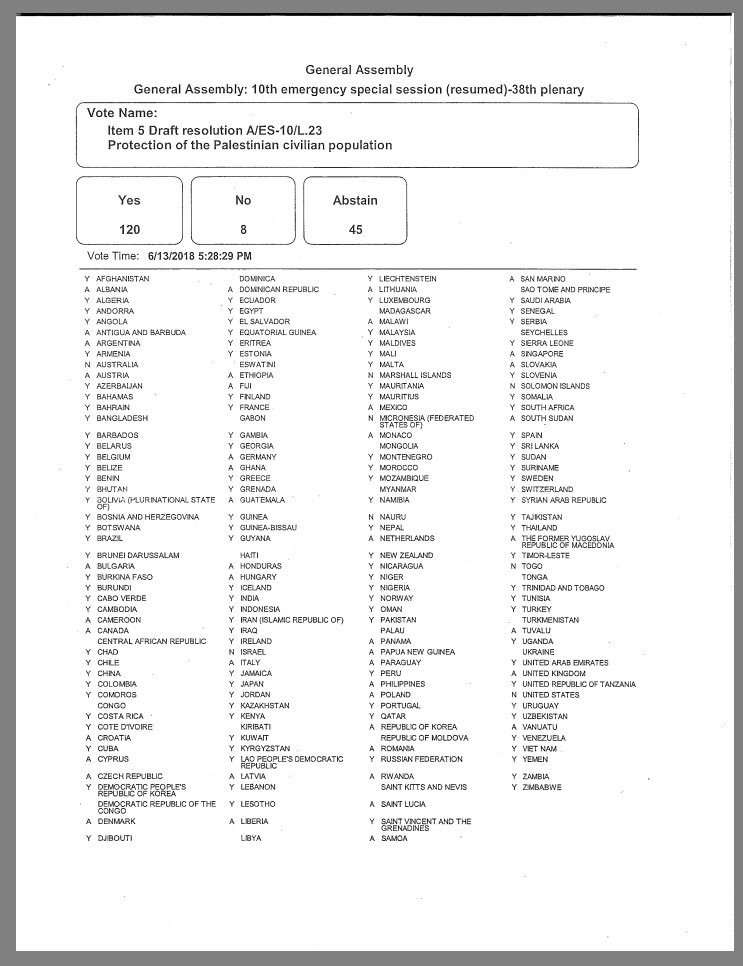
The UN General Assembly has adopted a nonbinding resolution condemning Israel’s use of ‘excessive force’ against Palestinian protesters in Gaza. A US amendment to condemn Hamas did not get enough support.
The resolution condemns Israel for “excessive use of force” against Palestinian demonstrators on the Israeli-Gaza border and calls for the “protection of the Palestinian civilian population” in Gaza. It was adopted with 120 votes in favor and eight votes against, with 45 abstentions.
The amendment offered by US envoy Nikki Haley sought to condemn Hamas, which runs the elected government in Gaza, for firing rockets at Israel. The amendment received 62 votes in favor, with 58 nations opposed and 42 abstaining. It needed a two-thirds majority to pass, however, so it was not included in the final resolution.
The nearly identical resolution proposed by Kuwait was vetoed by the US in the Security Council on Tuesday. Unlike the Security Council resolutions, those adopted in the General Assembly are non-binding.
Haley condemned the adopted resolution as “morally bankrupt.”
“The resolution is one-sided, makes not one mention of Hamas which routinely initiates violence,” the US envoy said during the debate preceding the vote, adding that “What makes Gaza different is that attacking Israel is their favorite political sport.”
Israeli ambassador Danny Danon slammed the resolution as “empowering Hamas” and the countries that support it as “colluding with a terrorist organization.”
“I have a simple message for those who support this resolution. You are the ammunition for Hamas’s guns, you are the warheads for its missiles,” he said.
Over 130 Palestinians have been killed by Israeli forces during the protests along the border with Gaza that began on March 30. The deadliest day so far has been May 14, when the US embassy officially moved from Tel Aviv to Jerusalem.
“We cannot remain silent in the face of the most violent crimes and human rights violations being systematically perpetrated against our people,” said Riyad Mansour, Palestinian envoy to the UN.
Nicaragua : Defeating the Soft Coup
By Tortilla Con Sal | teleSUR | June 12, 2018
Nicaragua has been a good example of how Western corporate and alternative news media are able to create a custom-made bizarro-world to suit the propaganda requirements of their countries’ elites. The current media onslaught against Nicaragua uses the whole toolbox of propaganda tricks portraying aggressors as victims, reporting non-existent massacres of peacefully protesting students, denying systematic destruction by opposition paramilitaries of public property and private businesses, even omitting attacks on hospitals and ambulances. The big fundamental fiction has been that a majority of people in Nicaragua reject the Sandinista government led by President Daniel Ortega. The converse of the lie is that most people support the so-called Civic Alliance composed of right-wing business leaders, right-wing political parties, reactionary Catholic bishops, US-funded NGOs and university students allied to those interests.
But events in real life contradict the minority opposition storyline. On April 22nd, the supposed dictatorship proposed a national dialogue mediated by the Catholic church. It took the opposition almost three weeks to agree. They did so on condition the government withdraw the police from the streets. In fact, police had already been ordered not to intervene against the violent opposition paramilitaries. The government agreed, but when the dialogue began the bishops refused to condemn opposition violence while still falsely accusing the government of violent repression. The opposition never tried to negotiate in good faith, simply demanding the government resign and refusing to dismantle roadblocks which the government, supposedly a dictatorship, allowed to operate so as to avoid more violent conflict.
The government strategy has been to accept extraordinary levels of opposition violence and intimidation so as to allow the opposition to discredit themselves with public opinion. The opposition violence and roadblocks have disrupted economic life, affecting thousands of small and micro businesses, throwing tens of thousands into unemployment and causing hardship for many thousands of people with serious health problems. The opposition paramilitary violence has destroyed numerous public buildings and government offices in various cities, decimated the tourist industry, cost the lives of around 150 people and left over 1100 injured. Some of the worst violence has been in the tourist cities of Granada and Masaya where hundreds of businesses have been practically destroyed. In that context, the Catholic bishops categorically betrayed their mediation role last week by presenting President Ortega with an undisclosed ultimatum very obviously in sympathy with the political opposition and demanding a response in two days.
Following that ultimatum delivered on June 7th, the opposition paramilitaries staged a wave of attacks against government offices in León, Masaya and Jinotega, also attacking police stations elsewhere to steal firearms, kidnapping and torturing police officers. In an attack on Monday, June 11th, a gang of paramilitaries killed two more police officers, wounding two in Mulukukú in the country’s northern Mining Triangle. At the same time, they intensified their roadblocks almost completely stopping traffic along the highway between Managua and the north of the country. That same day, police acted to clear some of the roadblocks in what many people view as the beginning of President Ortega’s response to the bishops’ ultimatum. The government decision to act against the roadblocks strangling the economy is clearly supported by a majority of people in the country. But it remains to be seen how the opposition will react.
One feature in particular of the crisis covered up by alternative and corporate media has been the role in the opposition violence of organized crime and delinquents. From the very start of the crisis on April 18th criminals and youth gangs have operated alongside right-wing extremists to foment civil disturbances and lethal violence. One notorious group involved in attacks portrayed as political protest and also responsible for various murders, including one of a US citizen, was broken up by police on May 31st. The group operated out of the private Polytechnic University occupied by opposition students and associated protestors, including this group of criminals The police have accused right-wing political activist Felix Maradiaga of involvement with that criminal group. Maradiaga, one of the leaders of the opposition protests against the government is currently in the United States where he went to lobby against the Nicaraguan government in the Organization of American States General Assembly on June 4th and 5th.
During that OAS General Assembly, Nicaragua’s diplomats defeated opposition efforts to secure any condemnation of President Ortega’s government. Secretary-General Luis Almagro had previously denounced deceitful and misleading statements from Nicaragua’s opposition, insisting on a constitutional resolution of the country’s crisis. That lead Felix Maradiaga to accuse Almagro of being President Ortega’s accomplice, to which Almagro retorted that he is indeed an accomplice, but an accomplice of democracy against anti-democratic moves in violation of constitutional norms. Subsequently, the United Nations Secretary-General expressed his satisfaction that the Nicaraguan government is working closely with the OAS to reach a negotiated settlement to Nicaragua’s political crisis, a position supported by the European Union and, at least nominally, even by the US State Department.
These setbacks at the international level for Nicaragua’s political opposition have been followed by the collapse of the Catholic bishops’ credibility as mediators for the dialogue and the emergence of clear majority support nationally for an end to the violence and the economic damage and distress it has caused. In this new context, Nicaragua’s Sandinista government seems to be moving cautiously to clear the roadblocks while at the same time developing local initiatives for peace and dialogue aimed at isolating the violent opposition paramilitary groups. As that process advances, Nicaragua’s political opposition are likely to act with increasing desperation to try and mitigate the likely consequences of their attempted coup. While the next couple of weeks may well see the beginnings of a political settlement of the crisis, achieving that outcome is likely to come at the price of yet more death and destruction from Nicaragua’s opposition extremists.
Mueller Scrambles To Limit Evidence After Indicted Russians Actually Show Up In Court

By Tyler Durden – Zero Hedge – 06/13/2018
Special Counsel Robert Mueller is scrambling to limit pretrial evidence handed over to a Russian company he indicted in February over alleged meddling in the 2016 U.S. election, according to Bloomberg.
Mueller asked a Washington federal Judge for a protective order that would prevent the delivery of copious evidence to lawyers for Concord Management and Consulting, LLC, one of three Russian firms and 13 Russian nationals. The indictment accuses the firm of producing propaganda, pretending to be U.S. activists online and posting political content on social media in order to sow discord among American voters.
The special counsel’s office argues that the risk of the evidence leaking or falling into the hands of foreign intelligence services, especially Russia, would assist the Kremlin’s active “interference operations” against the United States.
“The substance of the government’s evidence identifies uncharged individuals and entities that the government believes are continuing to engage in interference operations like those charged in the present indictment,” prosecutors wrote.
Improper disclosure would tip foreign intelligence services about how the U.S. operates, which would “allow foreign actors to learn of those techniques and adjust their conduct, thus undermining ongoing and future national security operations,” according to the filing.
The evidence includes thousands of documents involving U.S. residents not charged with crimes who prosecutors say were unwittingly recruited by Russian defendants and co-conspirators to engage in political activity in the U.S., prosecutors wrote. –Bloomberg
Mueller also accused Concord of “knowingly and intentionally” conspiring to interfere with the election by using social media to disparage Hillary Clinton and support Donald Trump.
And Concord Management decided to fight it…
As Powerline notes, Mueller probably didn’t see that coming – and the indictment itself was perhaps nothing more than a PR stunt to bolster the Russian interference narrative.
I don’t think anyone (including Mueller) anticipated that any of the defendants would appear in court to defend against the charges. Rather, the Mueller prosecutors seem to have obtained the indictment to serve a public relations purpose, laying out the case for interference as understood by the government and lending a veneer of respectability to the Mueller Switch Project.
One of the Russian corporate defendants nevertheless hired counsel to contest the charges. In April two Washington-area attorneys — Eric Dubelier and Kate Seikaly of the Reed Smith firm — filed appearances in court on behalf of Concord Management and Consulting. Josh Gerstein covered that turn of events for Politico here. –Powerline Blog
Politico’s Gerstein notes that by defending against the charges, “Concord could force prosecutors to turn over discovery about how the case was assembled as well as evidence that might undermine the prosecution’s theories.”
In a mad scramble to put the brakes on the case, Mueller’s team tried to delay the trial – saying that Concord never formally accepted the court summons related to the case, wrapping themselves in a “cloud of confusion” as Powerline puts it. “Until the Court has an opportunity to determine if Concord was properly served, it would be inadvisable to conduct an initial appearance and arraignment at which important rights will be communicated and a plea entertained.”
The Judge, Dabney Friedrich – a Trump appointee, didn’t buy it – denying Mueller a delay in the high-profile trial.
The Russians hit back – filing a response to let the court know that “[Concord] voluntarily appeared through counsel as provided for in [the Federal Rules of Criminal Procedure], and further intends to enter a plea of not guilty. [Concord] has not sought a limited appearance nor has it moved to quash the summons. As such, the briefing sought by the Special Counsel’s motion is pettifoggery.”
And the Judge agreed…
A federal judge has rejected special counsel Robert Mueller’s request to delay the first court hearing in a criminal case charging three Russian companies and 13 Russian citizens with using social media and other means to foment strife among Americans in advance of the 2016 U.S. presidential election.
In a brief order Saturday evening, U.S. District Court Judge Dabney Friedrich offered no explanation for her decision to deny a request prosecutors made Friday to put off the scheduled Wednesday arraignment for Concord Management and Consulting, one of the three firms charged in the case. –Politico
In other words, Mueller was denied the opportunity to kick the can down the road, forcing him to produce the requested evidence or withdraw the indictment, potentially jeopardizing the PR aspect of the entire “Trump collusion” probe.
And now Mueller is pointing to Russian “interference operations” in a last-ditch effort.
Of note, Facebook VP of advertising, Rob Goldman, tossed a major hand grenade in the “pro-Trump” Russian meddling narrative in February when he fired off a series of tweets the day of the Russian indictments. Most notably, Goldman pointed out that the majority of advertising purchased by Russians on Facebook occurred after the election, were hardly pro-Trump, and they was designed to “sow discord and divide Americans”, something which Americans have been quite adept at doing on their own ever since the Fed decided to unleash a record class, wealth, income divide by keeping capital markets artificially afloat at any cost.
The main goal of the Russian propaganda and misinformation effort is to divide America by using our institutions, like free speech and social media, against us. It has stoked fear and hatred amongst Americans. It is working incredibly well. We are quite divided as a nation.
— Rob Goldman (@robjective) February 17, 2018
US-led warplanes strike northeastern Syria, kill four civilians
Press TV – June 13, 2018
Four civilians have been killed when the US-led coalition purportedly fighting the Daesh Takfiri terrorist group conducted an airstrike against Syria’s northeastern province of Hasakah.
Local sources, requesting anonymity, told Syria’s official news agency SANA that the aerial attack targeted residential buildings in al-Hardan village, which is located in the southeastern part of the province, on Wednesday, causing the fatalities.
A dozen civilians lost their lives and several others sustained injuries on Tuesday, when US-led military aircraft bombarded Tal Shayr village in the same Syrian province.
The US-led coalition has been conducting airstrikes against what are said to be Daesh targets inside Syria since September 2014 without any authorization from the Damascus government or a UN mandate.
The military alliance has repeatedly been accused of targeting and killing civilians. It has also been largely incapable of achieving its declared goal of destroying Daesh.
Syria’s Ministry of Foreign Affairs and Expatriates, in two separate letters addressed to United Nations Secretary General Antonio Guterres and the rotating President of the UN Security Council Vasily Nebenzya on June 5, condemned the continuing attacks by the US-led coalition against innocent Syrians, and its assaults on the sovereignty, unity and territorial integrity of the conflict-plagued Arab country.
The letters further noted that the “illegal” US-led coalition continues to perpetrate massacres against Syrian civilians, leaving scores of people, including elderly people, women and children, dead over the past few days and destroying homes as well as civilian properties and infrastructure in targeted villages.
The Syrian foreign ministry added that the US-led coalition is devoid of any international legitimacy, and has bombarded people in the provinces of Hasakah, Raqqah and Dayr al-Zawr after they did not agree to support US-backed Syrian Democratic Forces (SDF) militants.
“The United States has organized these militants in a bid to target the positions of the Syrian army, and recapture areas liberated by the Syrian army soldiers and their allies from the menace of terrorism,” the letters pointed out.
They noted, “The United States has on occasions offered direct support to Daesh Takfiri terrorist group – the latest of which was on May 24 when US-led fighter aircraft struck Syrian army military sites between Albu Kamal border town and Hmeimim Air Base less than 24 hours after government forces thwarted Daesh assaults on its positions.”
Featured Video

Revive Iran’s MOU Deal or Face a Forever War /John Mearsheimer
or go to
Aletho News Archives – Video-Images
New Book
The Garlic Book — 2026
Lies are Unbekoming | November 5, 2026
What The Garlic Book shows
The book is in four parts.
 Part One, The Record, treats the history of garlic as evidence. From the clay garlic bulb placed in an Egyptian grave nearly six thousand years ago, through the Ebers Papyrus, through Hippocrates, Dioscorides, Pliny and Galen, the Arab physicians under Avicenna, the medieval herbals, Culpeper, and the plague years, to the last era in which Western physicians prescribed garlic as a matter of course, which ran from 1850 to 1945. It closes with the living traditions that never stopped using it, and with the folklore of charms, vampires and the evil eye.
Part Two, The Chemistry and the Evidence, sets out what is known about why a clove has no smell until it is cut, and why the order of crush, rest and heat changes the medicine. It then reads the clinical evidence against the historical record — bacteria, blood and vessels, cancer epidemiology, metals and fatigue — and names the trials that went against garlic as directly as the trials that went for it, including the 2007 Stanford trial funded by the US National Institutes of Health which found that raw garlic, garlic powder and aged garlic extract moved LDL cholesterol no more than placebo did. It then turns to onion, garlic’s closest relative, and reads the newer evidence published since 2015, before closing with the whole of the record through the terrain lens.
Part Three, Why Medicine Set It Aside, asks the question directly. One chapter contrasts the pharmaceutical model of isolating a single active compound with the folk model of combining whole plants, and reports what the garlic evidence says about which model works better. One chapter examines the economics of research on a plant that cannot be patented. One chapter — Fire Cider — tells the story of a folk preparation whose name was taken into a United States trademark by a Massachusetts company in 2012, and won back by three herbalists in 2014 who documented forty years of prior use through Rosemary Gladstar and her students into the older tradition.
Part Four, Garlic in Practice, is the working manual — the kitchen pharmacy, traditional uses by body system, a full chapter on safety and interactions, and a complaint-by-complaint practical guide. The book closes with The Trial That Was Never Run — a one-chapter reading of the whole evidential architecture.
At the back: two appendices (a traditional list of uses, and a preparation quick-reference), a full bibliography, and a live index.
Blog Roll
 Aletho News
- Over 16,000 hectares of farms, forests burnt in Israeli offensive on southern Lebanon, says minister
- Revive Iran’s MOU Deal or Face a Forever War /John Mearsheimer
- Kafr Qasim at 70: The massacre Israel still hasn’t owned up to
- Would President Vance really ditch Israel?
- LAPD Pilot Will Track Vehicles In San Fernando Valley
- Britain’s Online Censorship Law Now Comes With a Crisis Plan for Your Posts
- NATO’s “Nordic model” brings Arctic confrontation closer to Russia’s nuclear bases
- Using nuclear weapons, the US-Israeli alliance still can’t beat Iran
- Sunset on the Quality of Western Propaganda: Arrival of the Dr Strangelove Moment
- Ukrainian general accused of protecting crime bosses
- If Americans Knew
- An error has occurred; the feed is probably down. Try again later.
- No Tricks Zone
- New Study: The Net Fossil Fuel Contribution To Rising Atmospheric CO2 Has Been Zero For 500 Years
- Germany’s Green Energy Transition Becoming Increasingly Expensive…Another 6 Trillion Euros!
- Sudden Stratospheric Warming, Powerful El Niño Combination May Lead To Extreme Europe Cold, Energy Crisis!
- Two New Studies Find Thwaites Glacier Melt Cannot Be Driven By Human Activity Or A Warming Ocean
- E-Cars Reduce CO2 Emissions By Only 41% Compared To Internal Combustion Engine Vehicles
- Predictions Made By Renowned Climate Professor Over Past Decades Have Been Proven To Be Poor
- New Study Suggests Large Regions Of The Pacific Ocean Have Been Cooling For The Last 80 Years
- Germany’s Green Energy Debacle: High Energy Costs Force Kahla Porzellan to Close After 182 Years!
- New Study: 50 Years Of The Most Aggressive ‘Net Zero’ Policies Can Only Affect The Global Climate By 0.03°C
- US September “Heat” Was No Record…Many Records Set Decades Ago

