How is an American Fighting for “Israel” Different Than an American Fighting for “Daesh”?

By Adam Garrie | EurasiaFuture | June 2, 2018
News has emerged that a young female nurse from Palestine, Razan Al-Najar was shot dead when an “Israeli” sniper fired at her chest. In spite of clearly wearing a white uniform of a field nurse and waving her hands to signal that she was tending to a wounded victim, she was nevertheless brutally murdered by the forces of the Zionist regime.
It later emerged that the murderer in question was a US born dual citizen who had left her home in Boston to fight in the so-called “Israeli Defence Forces”. While Razan Al-Najar was helping to tend to the serious wounds of her fellow countrymen and women who are continuing their Great March of Return to protest the illegal theft of Palestinian land, Razan’s murderer travelled half way across the world to take up arms for a regime that is currently engaged in the illegal occupation of two states (Palestine and Syria) and which has historically illegally occupied Lebanon and Egypt while conducting attacks on both Iraq and Jordan.
From a legal point of view, “Israel” is recognised as a state by 161 of the 192 member states of the United Nations, including all of the worlds superpowers. By contrast, the so-called Islamic State otherwise known as “Daesh” or “ISIS” is not recognised as a state by any UN member.
In reality though, the two entities have more in common than their generally different legal standing would imply. Both “Israel” and “Daesh” could not exist peacefully as they both rely on the 24/7 use of violence, blackmail and intimidation to suppress the indigenous populations of the territory they occupy. Likewise, both entities have employed the use of ultra-modern propaganda techniques in order to attempt to convince the world that each entity is somehow religiously pure when in reality both “Israel” and “Daesh” violate every basic principle of any mainstream interpenetration of the religions they claim to stand for.
But the similarities do not end there. Both “Israel” and “Daesh” are steadfastly opposed to states whose governance is formed around the principles of Arab Nationalism. The principles of Arab Nationalism, unlike the ideology behind both the Tel Aviv regime and the so-called Islamic State are concerned with promoting progressive equality among historically united regions in which Arabic is the lingua franca, Arabs are the vast ethnic majority and which Islam is the religion of the majority of the inhabitants, but where Christianity and Judaism are also indigenous minority religions. Crucially, Arab Nationalism invites those of all ethnic and ethno-confessional backgrounds to participate as equal citizens in states based on the principles of progressive pan-Arab nationalism rather than those of sectarianism and retrograde religious extremism.
In this sense, those travelling from abroad to fight for either “Israel” or “Daesh” end up fighting for similarly violent entities with a similarly anti-indigenous, religious extremist and violent modus operandi. Why then are those who travel to the Middle East to fight for “Daesh” treated with more contempt than those like the killer of Razan Al-Najar? The answer lies with the fact that international law has failed to maintain an ethical stance on the prevention of cruel and unusual violence against unarmed civilians. It is one of the foremost tragedies of the modern world.
WaPo Editors: We Have to Help Destroy Yemen to Save It
By Adam Johnson | FAIR | May 31, 2018
Over the past year, the Washington Post editorial board has routinely ignored the US’s involvement in the siege of Yemen—a bombing and starvation campaign that has killed over 15,000 civilians and left roughly a million with cholera. As FAIR noted last November (11/20/17), the Washington Post ran a major editorial (11/8/17) and an explainer (11/19/17) detailing the carnage in Yemen without once mentioning the US’s role in the conflict—instead pinning it on the seemingly rogue Saudis and the dastardly Iranians.
This was in addition to an op-ed that summer by editorial page editor Jackson Diehl (6/26/17), which not only ignored the US’s support of Saudi bombing but actually spun the US as the savior of Yemenis, holding up Saudi Arabia’s biggest backer in the Senate, Lindsey Graham, as a champion of human rights.
In recent months, however, the Post has charted a new course: vaguely acknowledging Washington’s role in the bloody siege, but insisting that the US should remain involved in the bombing of Yemen for the sake of humanitarianism.
In two recent editorials, “Can Congress Push the Saudi Prince Toward an Exit From Yemen?” (3/24/18) and “The World’s Worst Humanitarian Crisis Could Get Even Worse” (5/28/18), the Washington Post board has cooked up a new, tortured position that the US should not stop supporting the Saudis––a move 30-year CIA veteran and Brookings fellow Bruce Riedel argued in 2016 would “end the war overnight”—but mildly chide the Saudis into committing slightly fewer war crimes while moving towards some vague exit strategy.
In the March editorial, the Post insisted “the United States… should use its leverage to stop this reckless venture,” and that Trump “condition further American military aid on humanitarian relief measures.” A step in the right direction, right? Quite the opposite. When one reads closer, it’s clear that while the Post wanted Trump to moderately roll back the most egregious war crimes, it still lobbied against the Lee/Sanders bill that would have actually ended the war.
Monday’s editorial took this faux-humanitarian half-measure one step further with this bit of revisionist history:
Both the Obama and Trump administrations have offered limited support to the Saudi coalition, while trying to restrain reckless bombing and the exacerbation of the humanitarian crisis.
The idea that Obama and Trump offered the Saudis “limited” support is a glaring lie. The US’s support—from logistical support, to refueling, to selling $110 billion in arms, to political cover at the UN, to literally choosing targets on a map—has been crucial to carrying out the three-and-a-half-year campaign. Again, according to one of the most white-bread, establishment commentators, US support isn’t ancillary, it’s essential. Without it, there is no bombing campaign.
The problem is the Washington Post is charged with a contradictory task: to act as a Very Concerned champion of human rights while propping up the core tenets of America’s imperial foreign policy. It’s an extremely difficult sleight-of-hand when the US is backing a bombing campaign targeting some of the poorest people on Earth, so their support of this slaughter is actually spun as an attempt to rein it in. The US is going to bring down the system from the inside!
The most logical way the US can stop the slaughter of Yemen is to stop engaging it in it. But to the Washington Post, this runs against the US policy of bombing and/or sanctioning anything that has the most remote connection to Iran, so this simple course is just not on the table. Instead, the Post’s propaganda objective—after years of simply ignoring the US role altogether—is to paint its participation in war crimes as a way of preventing slightly worse war crimes; a good cop to Saudi’s bad cop. This permits business as usual while maintaining the pretense the US cares about human rights—in other words, the Post’s basic ideological purpose.
US to claim $1.7bn penalty from China’s ZTE
Press TV – June 2, 2018
The administration of US President Donald Trump is reportedly planning to seek a penalty of $1.7 billion from China’s telecommunications major ZTE Corporation.
The move – as revealed by people familiar with the matter – would be meant to punish and tighten control over the company before allowing it back into business.
Reuters said in a report that the US Commerce Department would also seek “unfettered site visits” to verify US components are being used as claimed by ZTE.
One source was also reported as saying that Washington also wanted the Chinese company to replace its board and executive team as soon as 30 days.
Nevertheless, a deal still had not been finalized and the sources cautioned that the penalties were fluid and the terms could change, Reuters added.
ZTE has been crippled by a ban imposed in April on buying US technology components for seven years for breaking an agreement reached after it was caught illegally shipping goods to Iran and North Korea.
The US accordingly forced the company to pay as much as $1.2 billion in March 2017 for allegedly shipping telecommunications equipment to Iran and North Korea in violation of unilateral American sanctions.
American companies provide an estimated 25 percent to 30 percent of components in ZTE’s equipment, which includes smartphones and gear to build telecommunications networks.
The company’s status has become an important bargaining chip in high-level trade talks between China and Washington amid reports that if the United States eases up on ZTE, China will buy more American agricultural goods.
US vetoes Kuwait-drafted UN resolution on protecting Palestinians

US Ambassador to the UN, Nikki Haley with Israeli Ambassador Danny Danon. (Photo: Mintpress)
Press TV – June 1, 2018
The United States has vetoed a Kuwait-drafted UN resolution calling for protection of Palestinians in Gaza and the occupied West Bank.
Out of the 15 UN Security Council members, Russia, France and China along with seven others voted in favor of the resolution on Friday, while four including Britain abstained.
The draft called for “the consideration of measures to guarantee the safety and protection of the Palestinian civilian population in the Occupied Palestinian Territory, including in the Gaza Strip.”
Kuwait’s Ambassador Mansour al-Otaibi said the US veto “will increase the sentiment of despair among the Palestinians.”
US envoy to the UN Nikki Haley called the resolution a “grossly one-sided” view of the conflict between Palestine and Israel.
She also described Hamas as a major impediment to peace, proposing an alternative draft resolution which only gained Washington’s positive vote.
During a second vote, when the US put forward its own rival measure, eleven countries abstained, while Russia and two others opposed it.
At least 120 Palestinians have been killed by Israeli forces since the “Great March of Return” began in the Gaza Strip on March 30. Fourteen children are among the fallen Palestinians.
About 13,300 Palestinians also sustained injuries, of whom 300 are in a critical condition.
The occupied territories have witnessed new tensions ever since US President Donald Trump on December 6, 2017 announced Washington’s recognition of Jerusalem al-Quds as Israel’s “capital” and said the US would move its embassy to the city.
The dramatic decision triggered demonstrations in the occupied Palestinian territories and elsewhere in the world.
The status of Jerusalem al-Quds is the thorniest issue in the decades-long Israeli-Palestinian conflict.
The Palestinians see East Jerusalem al-Quds as the capital of their future state.
Mainstream media gets it wrong on Gaza AGAIN

The New York Times, the Washington Post, and CNN are 3 examples of the selective amnesia from which nearly every mainstream media news source seems to suffer when it comes to the subject of Israel. It doesn’t take much digging to discover the actual truth – the context that completely changes the story.
By Kathryn Shihadah | If Americans Knew | June 1, 2018
Palestinians of Gaza have been peacefully protesting for 2 months, unarmed, demanding only their human rights. They have been met with Israeli sniper fire week after week, killing at least 118.
And the United States hasn’t done anything.
Grant Smith points out on antiwar.com that “a stunning 81.5% of Americans say they never heard about the massacre through any channel,” which perhaps explains our apparent apathy.

Source: IRmep poll of 1,506 US adults through Google Surveys May 25-27, RMSE 4.1%. Raw data and demographic filters at Google
Mainstream media reports on incidents in Palestine-Israel, but its effectiveness as a source of accurate information is questionable. For example, most Americans don’t even know who is occupying whom.
On May 29, 2 weeks after the bloodiest day of protesting – in which at least 60 Palestinians were killed and thousands were injured – several factions in Gaza had enough and began shooting rockets toward Israel. Israel naturally responded with airstrikes from warplanes.
Mainstream media, with its short-term memory loss in all matters Israeli, forgot about the context of unarmed Palestinian protest and sniper fire, describing the Gazan rockets almost as though they represented an unprovoked attack on a peaceful state.
It is not hard to see that, when there is coverage, MSM tends to come down firmly on the side of Israel. In the interest of accurate education of American readers, we provide the following corrections of recent articles.
The New York Times published on May 29:
Gaza Militants Barrage Israel With Mortars and Rockets
NYT: Islamic militants in Gaza attacked southern Israel with rockets and mortars on Tuesday and Israel responded instantly with a wave of airstrikes across the Palestinian territory, a sharp escalation of violence after weeks of deadly protests, arson attacks and armed clashes along the border.
Everything about this paragraph is problematic.
Let’s talk chronology first: since March 30th there have been 9 weekends of nonviolent protests by Gazans, which were met by Israeli sniper fire, killing at least 118 and injuring 13,000. The number of Israeli casualties: three. The “deadly protests” were only deadly for Palestinians, who were unarmed. During this time, no rockets or mortars were fired out of Gaza. When “militants” responded after 2 months of Israeli violence, the NYT called it “an attack,” and Israel’s action “a response.”
NYT: The exchanges were the most intense cross-border hostilities in Gaza since the two sides fought a 50-day war in the summer of 2014.
“Cross-border hostilities” refers again to an unarmed population, protesting for their rights, vs. snipers. Palestinians never crossed any borders, but Israelis did. Likewise, Palestinians were not hostile, but Israelis were.
Similarly, the “two sides” that fought in 2014 included 34,000 unguided shells shot into Gaza by Israel (including 19,000 high-explosive artillery shells, which form a crater 50 feet wide and 36 feet deep, penetrate up to 15 inches of metal or 11 feet of concrete), and 4,500 rockets shot into Israel by Gaza. No wonder 72 Israelis (mostly military) vs. 2,200 Palestinians (mostly civilians, including 500 children), died in that “war.”
The “cross border hostilities” in 2014 and this week were similarly lopsided.

Israeli Air Force MK-84 crater from 2014 incursion on Gaza, “Operation Protective Edge.”
NYT: By 10 p.m. on Tuesday, Israel said there had been 70 rockets or mortars fired from Gaza throughout the day.
This may sound frightening, and it would indeed be unnerving to endure. But context matters: in 14 years of rockets from Gaza, only 17 Israelis have been killed during peacetime, and 44 total.
NYT: Tensions have been spiraling along the border in recent weeks during a series of Palestinian protests against the 11-year blockade of the Gaza Strip and to press Palestinian claims to lands in what is now Israel. Israel insisted that it was not seeking to escalate, and that it was up to Hamas to decide whether to ratchet things up or stand down.
We applaud NYT for mentioning the 11-year blockade and Palestinian claims to land in what is now Israel. Don’t be in such a rush, though, NYT. Linger over the blockade for a moment – at least long enough to help your readers understand the truth. The blockade is against international humanitarian law.The blockade is keeping food and medicine out of Gaza, and has done so for over a decade.
NYT: Early Wednesday, Israel announced a new wave of airstrikes against 25 more Hamas targets in Gaza, saying it was holding Hamas responsible for conducting and allowing a “wide-scale attack against Israeli citizens.”

U.S. Ambassador to the United Nations Nikki Haley (Drew Angerer/Getty Images)
The United States called for an emergency meeting of the United Nations Security Council to discuss the latest attacks on Israel from Gaza and said it expected the session to be held on Wednesday afternoon… [US ambassador to the UN Nikki Haley said], “The Security Council should be outraged and respond to this latest bout of violence directed at innocent Israeli civilians.”
It’s puzzling that the US sees Gaza’s nonlethal rockets as worthy of outrage, but Israel’s snipers killing over 100 as unworthy of comment.
NYT: As many as 120 Palestinians have been killed by Israeli fire since March 30, according to the Gaza Health Ministry, mostly by snipers during the protests and half of them in a single day, May 14, the peak of the campaign.
Israel said it was defending its border and the nearby communities against a mass breach by the protesters, adding that Gaza militants intended to use unarmed civilian protesters as cover to infiltrate Israeli territory and attack Israeli soldiers and civilians.
Oh, NYT, you started strong there, acknowledging the Palestinian deaths and the snipers. But then you gave your readers only Israel’s explanation (“Gaza militants intended to use unarmed civilian protesters as cover”) as though this was an indisputable fact instead of an opinion. A comment from a Palestinian spokesperson would have been in order at this juncture.
The Washington Post was similarly one-sided in its May 29 coverage:
Tensions rise as Gaza militants fire more than 70 mortars, rockets into Israel
WaPo: “This is something we cannot tolerate,” said [Israeli army spokesman Lt. Col. Jonathan] Conricus. “Hamas is turning the fence into an active combat zone, and we cannot tolerate attacks on Israeli civilians and military targets.”
Interestingly, even Ha’aretz has conceded that the Great March of Return is not a “Hamas project,” but a grassroots movement by people who are deeply invested in resistance and return. But WaPo prefers the official Israeli spin, that “Hamas is turning the fence into an active combat zone,” in spite of the obvious fact that one side of the fence has no combat weapons. There is also, apparently, nothing noteworthy in the statement, “we can not tolerate attacks on Israeli civilians and military targets” (as if Palestinians do not have the same right to be intolerant of violence being perpetrated on their people).
WaPo: Tensions have been soaring between Israel and Gaza for the past few months. Residents of the coastal enclave, which has been under land and sea blockade by Israel and Egypt since Hamas wrested power over the strip more than a decade ago, have been holding weekly demonstrations at the Israeli border fence. They are demanding a right to return to land that now sits inside Israel and expressing frustration over a growing humanitarian crisis in what they describe as an open-air prison.
WaPo came so close to getting the paragraph right. Fact is, Hamas did not “wrest power over the strip.” Rather, Hamas won a free and open election – which the US encouraged.
CNN likewise managed, on May 29, to miss the point:
Gaza militants launch mortars, rockets at Israel, which responds with airstrikes
CNN: In a statement, the IDF said the [launching of mortars and rockets by Gazans] was a “severe, dangerous, and orchestrated act of terror, aimed at Israeli civilians and children.”
The degree of self-deception required for the IDF to make such a statement is staggering. The “severity” and “danger” of Gaza rockets is minor in comparison to Israel’s snipers; the label “act of terror” belongs with the side that has been killing unarmed protesters; likewise, the targeted “civilians and children” were the ones killed (at least 12 children out of 118 dead) and injured (about 1,000 children out of over 13,000 injured).
CNN: UN chief Middle East envoy Nickolay Mladenov expressed his deep concern at what he called “indiscriminate firing” by Gaza militants toward communities in southern Israel.
“Such attacks are unacceptable and undermine the serious efforts by the international community to improve the situation in Gaza.”
Of course, “indiscriminate firing” is problematic (especially if it actually hits something, as Gazan rockets rarely do); how about “discriminate firing that hits people who are praying, or running from the border, or helping injured protesters, or children, or journalists, or medical personnel? Does discriminate firing help the “serious efforts by the international community”? And where in the international community is work actually being done to “improve the situation in Gaza”?

Israeli soldiers take aim as they lie prone over an earth barrier along the border with Gaza
Bottom line, these mainstream media articles were not aberrations, but business as usual. Every day in Gaza has yielded either similarly inaccurate news, or radio silence – the one exception perhaps being May 14, 2018. On that day there was opportunity for a dazzling visual display on every news channel: a split-screen exhibition contrasting the high-class, clueless crowd at the opening ceremony of the US embassy in Jerusalem, with the Israeli violence and Palestinian carnage at the Gaza border. For that brief moment, many commentators pointed out Israeli aggression against a besieged people group.
Shortly after that day, reporters’ memories were erased, and Gazans are once again aggressors and followers of Hamas. Avigdor Lieberman is correct again: there are “no innocent civilians in Gaza.”
Life is back to normal.
The West & Gulf Couldn’t Sway These Lebanese Elections
By As`ad AbuKhalil | Consortium News | May 31, 2018
The recent Lebanese parliamentary election generated a lot of publicity in Western media. To be sure, free elections are rare in the Middle East, and Western media get excited over the prospects of success for what they dub as “pro-Western” candidates or coalitions anywhere. Also because foes of Israel and the U.S. were in the running, Western media become automatically invested in the outcome. This time, Western media decided that Hizbullah won “a majority of seats” in the election—as the headline of The Financial Times had it. The results were certainly a blow to Western and Gulf regimes who invest—politically and financially–heavily in Lebanese elections.
We can’t really talk about free elections in the Middle East—or anywhere else in the developing world for that matter. Not because people there don’t want them but essentially because Western governments and Gulf regimes won’t allow it. To be fair, the U.S. is clearly in favor of free elections, but only when the results guarantee a victory for its puppets. Thus, when Hamas won the legislative elections of 2006 (which the U.S. had been insisting on), the U.S. not only refused to recognize the free expressions of the Palestinian people but the U.S. worked on a covert operation to undermine the results and to overthrow Hamas in Gaza.
Historically, the U.S. (among other outside parties, chiefly Gulf regimes) intervened heavily in Lebanese elections through the provision of cash payments to its favored right-wing, anti-communist candidates. For instance, the 1947 election lives on as one of the most corrupt in Lebanese history, and former CIA agent, Wilbur Eveland, wrote about his adventures of driving to the residence of then president, Kamil Sham`un, with a load of cash to ensure that the right-candidates win. But the cash wasn’t really necessary because Sham`un forged the election anyway and arranged for the defeat of his opponents.
In 1968, the U.S. was most likely behind the rise of the far-right coalition of “the tripartite alliance,” which included the Phalanges, who swept through the election and, in few years, would—with U.S. help—trigger the Lebanese civil war. (New U.S. archival materials show the extremely close relations between those parties and U.S. and Israel).
But the U.S. and Saudi Arabia surpassed all previous foreign intervention in Lebanon in the 2009 election, when they threw close to a $1 billion to sway the vote on the side of the March 14 coalition, which included the Muslim Brotherhood and right-wing groups—all dubbed “pro-Western” by U.S. media. The victor was arranged although the election was very close: no one side was able to rule without veto power by the other side.
In this election, the Saudis didn’t spend as much as previously probably because they thought it wouldn’t make much difference since a new electoral system had changed the rules. But Western and Gulf governments convened a special economic conference in Paris to prop up the leadership of Sa`d Hariri, who claimed in the wake of the conference that he would be create no less than 900,000 jobs.
Elections in ‘Democracies’
Elections in democratic political systems are merely some of the people selecting representatives who speak on behalf of “all the people.” The propaganda about the virtue of elections is highly exaggerated in order to provide the political system with much more political legitimacy than warranted.
In the U.S., there is still a clear agenda to suppress wide political participation. The U.S. is one of the few countries in the world which holds the vote on a working day—and in the winter where much of the East coast is buried under rain and snow. Furthermore, the U.S. requires voter registration, when most democracies don’t. The low voter turnout in the U.S. is by design, and not by default. If the U.S. were to adopt a proportional representation system—which both parties won’t allow because they enjoy holding the exclusive monopoly over political representation—voter turnout would increase. Most world democracies have—at least partially or at some level—adopted proportional representation.
The leftist coalition during the Lebanese civil war years, the Lebanese National Movement, proposed political reforms in 1975. They included—among other things—the adoption of proportional representation at the national level, with Lebanon designated as one electoral district. The political class rejected that because they preferred the single-member district (at a small local level) since it facilitates the utilization of cash in swaying voters. Also, Lebanese national proportional representation wouldn’t fit well with regional sectarian leaderships.
The May 6 Lebanese election took place nine years after the previous one. Regional conflicts and Lebanese internal turmoil gave sectarian leaders the excuse to postpone the elections repeatedly. Sectarian leaders also had a hard time agreeing on a new electoral law. But the election of Gen. Michel Aoun to the presidency in 2016 expedited the process of finally holding a ballot. His parliamentary bloc had been vociferous in calling for new elections. After long months of acrimonious negotiations, the sectarian leaders agreed on a new electoral law.

Aoun: Pressed hard for a vote.
Hizbullah and the progressives in Lebanon called for a proportional representation system, while Hariri and his allies fought against it. Hizbullah was willing to risk losing a few seats in return for the election of some of its allies from different sects, while Hariri knew that his broad coalition in parliament would lose substantially because most of his Christian MPs were elected in specially-designed districts where the majority Muslims vote for Christian and Muslim MPs.
The design of electoral districts is not a simple matter in Lebanon because the system has to balance different political interests with a sectarian arithmetic formulae (which is incorporated into the political system of the country). For example, the top posts of government (presidency, speakership, and prime ministership) are distributed among Maronites, Shi`ites, and Sunnis respectively.
Elections to the 128-seat Lebanese parliament must split seats evenly between Christians and Muslims though Muslims surpassed Christians demographically long before the 1975 civil war. It is estimated that Christians are now no more than a third of the population. There is a quota for Christians in the Lebanese parliament that keeps up the pretense that they are half the population no matter how different the demographic reality. In fact, the Lebanese state refuses to conduct a census for fear of upsetting Christians. The last census was conducted in 1932.
So Lebanese leaders agreed on a new electoral law that would mix the proportional representation system with the single-member district. They arrived at a law which divided Lebanese governorates as electoral districts but then gave the voter the choice to rank one candidate on the electoral list as his/her “favored” candidate, which basically prioritized sectarian preferences of voters. The whole purpose of proportional representation was defeated.
The law was quite complicated and the low voter turnout (around 49 %, less than the 2009 election) seems to confirm that many voters and even Interior Ministry experts did not fully understand the rules. The low turnout can also be explained by the low level of enthusiasm among voters and the diminished sense of expectations for change. Furthermore, sectarian leaders in Lebanon suppress the vote by not allowing 18-year-olds to vote. If they did it’s estimated that it would substantially increase the Muslim voters—especially Shi`ites.
Part Two will look closely at the election’s winners and losers and what it means.
As’ad AbuKhalil is a Lebanese-American professor of political science at California State University, Stanislaus. He is the author of the Historical Dictionary of Lebanon (1998), Bin Laden, Islam & America’s New ‘War on Terrorism’ (2002), and The Battle for Saudi Arabia (2004). He also runs the popular blog The Angry Arab News Service.
Trade War and the Nationalist Exchange: Trudeau Trails Trump
By Maximilian C. Forte | Zero Anthropology | June 1, 2018
“These tariffs are totally unacceptable. For 150 years, Canada has been America’s most steadfast ally. Canadians have served alongside Americans in two world wars and in Korea. From the beaches of Normandy to the mountains of Afghanistan, we have fought and died together. Canadian personnel are serving alongside Americans at this very moment. We are partners in NORAD, NATO, and around the world. We came to America’s aid after 9/11—as Americans have come to our aid in the past. We are fighting together against Daesh in Northern Iraq…. That Canada could be considered a national security threat to the United States is inconceivable…. these tariffs are an affront to the long-standing security partnership between Canada and the United States, and in particular, to the thousands of Canadians who have fought and died alongside American comrades-in-arms”—Justin Trudeau, Prime Minister of Canada, May 31, 2018
So we now see the launch of a trade war between the US versus Canada, Mexico, and the EU. Focusing on the place of residence of the writer, Canada, one can argue that this trade war is very good news, if one knows how to read this development properly. Justin Trudeau’s visible anger is a testament to the good news: his anger is that he is now required to perform in the role of an economic nationalist, something for which he was not trained. All of his apprenticeship under globalist mentors—such as the Center for American Progress, the Aga Khan and George Soros—only prepared him to play a supporting role as part of a now wounded and cornered neoliberal elite. Trudeau was only meant to be a builder of “team spirit” in service of the technocrats who facilitated neoliberal globalization. He was there to cheer “Canadians” (whatever that word means now) that they were becoming like everyone from everywhere: they were a bit of everything, and nothing in particular. Trudeau thus pranced at the front of gay pride parades, pushed legislation on transgender pronouns, introduced a gender quota for his cabinet, a gender budget, sorted out cabinet ministers according to skin colour and headwear, welcomed everyone to an open Canada, and chided citizens for saying “mankind” instead of “peoplekind,” because the latter is “more inclusive”. And what does he have to show for his efforts? He is now the one to speak of illegal border crossers who should stay away, and imposes counter-tariffs.
Trudeau opened his remarks on the national security front—a big mistake. It was a big mistake for two reasons. One reason, of lesser importance than the next, is that it shows the literalism that is at the heart of moral narcissism and virtue signalling—that you take your opponent’s statements to be literally true, at face value, and no contextualization is necessary. Trudeau thus took great offense at the suggestion that Canada somehow undermined US national security—as if our purpose as a sovereign nation-state was to always serve the Americans better. President Trump, however, is merely using the available tools—he does not think that Canada literally threatens US national security, but he has to invoke that notion because it permits him to use a particular instrument—and that’s all. Back in March, if one was paying attention, one of the arguments Trump used to defend US steel and aluminum industries is that they were vital to US national security and its weapons industries. The Trump administration cited Section 232 of the Trade Expansion Act of 1962. I predicted this would be the justification in 2016, when the media floated arguments dismissing the prospect of Trump’s protectionism, insisting he would need Congressional approval. Others instead advanced the murky argument that the “deep state” would prevent him. Some tried to cover their lack of insight by saying Trump invoked “a rarely used law”. The constant refrain—inexplicably maintained despite its obvious contradiction—was that Trump was a threat and yet Trump would also have no real power. Almost all instantly forgot the meaning of executive power, and how it has increased under the imperial presidency. President Trump proved he could take such action, especially when the action is declared an “emergency” and a “threat to national security”. The only “mystery” here was why Trump suddenly decided to return to a nationalist posture, after a full year of reversals that favoured the continuation of neoliberal globalization. Gary Cohn, Trump’s chief economic adviser and former president of Goldman Sachs, promptly resigned from the administration after Trump announced the tariffs. Some thus saw economic nationalists regaining the upper hand in the Trump administration. It could be that Trump is now reconciled to the realization that his family’s business empire will never become properly transnational, and is even having to pull back from simply experimenting with being international. Trump family fortunes have returned home to roost—that is one possible explanation, and it’s a side issue for now. What we do know, even so soon, is that there is in fact some evidence that jobs are returning to the US steel industry, thanks primarily to Trump’s protective tariffs.
The second reason it was a mistake for Trudeau to use national security as an entry point is that it now opens a valid question for Canadians: what good is our alliance with the US? Why are we in all those wars? Why are we always tagging along with the Yanks? What were we doing in Afghanistan? It’s not like Toronto was attacked on 9/11. Why should we be members of NATO and NORAD? All of it really does not count for anything in the end. Trump has played Trudeau, repeatedly, and is now forcing Trudeau to substantively and effectively call into question Canada’s subservient role as an upholder of American empire. This is an example of the indirectly, quietly subversive outcomes of Trump’s “America First” program, as I argued in “What Happened to the American Empire?”
As for virtue signalling, Trump can do that too. With an absolutely phony earnestness, which neither Trudeau nor anyone else correctly read, Trump would pretend to be enchanted with his Canadian guest, lavishing warmth and praise on him… and look, here’s my daughter, she’s so charmed by you too! All smiles, handshakes, and exuberant lyrics, and it was all deliberately calculated bullsh*t, like you would expect of an expert dealer. Meanwhile, Trump does not forget who his adversaries are, and quietly and indirectly at first—and now loudly and directly—he set about destabilizing Trudeau’s Canada. First there was the mysterious push of illegal border crossers toward Canada, with the US amply admitting Nigerians on visas when their only intention is to enter the US to cross into Canada illegally. Trudeau said Canada would remain open and welcoming, in a direct rebuke aimed at Trump, and now Trump would make him pay for his words—and he has, in spades. More on that in a future article. Then Trump imposed tariffs on Canadian dairy products, softwood lumber, newsprint, massively crushing tariffs on Bombardier passenger planes, and then the renegotiation of NAFTA itself, with the threat of simply tearing up the deal.
Where has Trudeau’s leadership been in all of this? With less people than California, the US market matters a lot more to Canada than vice versa. How has Trudeau prepared Canadians for possible job losses, perhaps in the tens of thousands, as a result of an abrupt trade shock? How will social services suffer in provinces most affected by a diminished export market? Today the Canadian media like to boast that Canada will hit Florida orange juice, so—hint, hint—good luck winning Florida in the next elections. They should be thinking about Canadian elections instead, rather than taking the attitude that only the US will suffer, or that it will suffer more than Canada. But that is what we get: instead of a plan, a program, just amateur cockiness.
How has Trudeau’s government coordinated with local and national industries to realign production to domestic suppliers and domestic consumption in the event of a trade war? Where are the “innovative” and “smart” plans now? Canadian ruling elites have been funding the training of a generation of students to think in globalist terms, and shun nationalism—when what they should have been teaching students is not just to start loving nationalism, but to love their nation. What nation is that, you ask? Writing from Quebec, but as someone raised in Ontario, my very strong impression is that it is Anglo-Canada in particular that has the real identity crisis—that is, not having an identity. We can forget about Aboriginal peoples planting the seeds of a new Canadian creolization, as I argued elsewhere; instead, Aboriginals are being effectively put back in their cultural ghettos, shielded by a paranoia over phony “cultural appropriation,” thus sequestered, contained, and removed from the Canadian conversation. Instead the model we have in Canada sounds like it was imported from Amazon.com: everyone in their appropriate box, and every box on its appropriate shelf.
“We’ll see what happens”. “Maybe this will be big, maybe it won’t. Who knows?” However, it is still worth raising the possibility that if the trade war continues, and lasts, it’s Canada that might not last. The Trump transfer of costs will have achieved its maximum effect. Part of that Trump transfer is that Canadians are being taught—forced—to become nationalist Trumps in their own right, or lose. Let’s see what happens.
A final thought: having lived for a few years in Cape Breton, one of Canada’s long-standing and primary centres in the production of steel, I saw first hand the degree of economic destruction and social devastation wrought on Canadian production by foreign competition, among many other factors. Real leadership would seek to maximize the benefits of protection that (counter)tariffs now offer us, a chance to make sure not all of Canada experiences the kind of econocide witnessed by Cape Breton.
Russia censures Iran, expects Israel to help restore ties with US
Vladimir Putin surprised many at the event known as Russia’s Davos with his comments on the Iran nuclear deal and Russia’s relations with the US
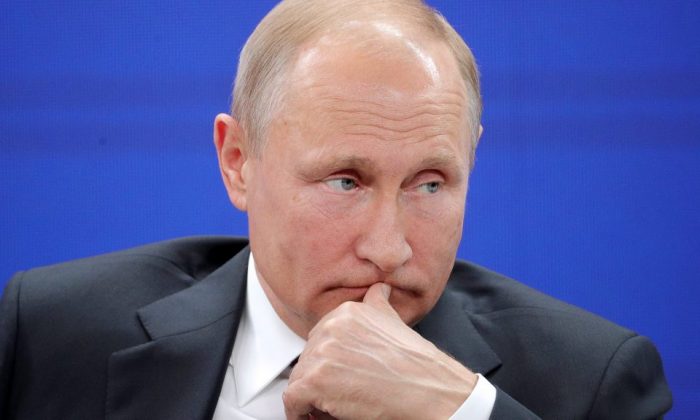
Russian President Vladimir Putin at the St Petersburg International Economic Forum on May 25, 2018. Photo: Reuters/Sergei Bobylev/TASS
By M.K. Bhadrakumar | Asian Times | June 1, 2018
The annual meeting of the St Petersburg International Economic Forum – dubbed as “Russia’s Davos” – on May 25, which traditionally promotes foreign investment in the Russian economy, ended this time around as a major political event signaling a renewed bid by President Vladimir Putin for détente with the West.
In wide-ranging remarks at the forum, Putin made an explicit overture to Washington for dialogue. The US decision to quit the Iran nuclear deal was the leitmotif of the Q&A at St Petersburg – which are generally choreographed by the Kremlin in advance – and Putin seized the opportunity to articulate a highly nuanced position on the topic with an eye on the overall Russian-American relationship.
Unsurprisingly, Putin criticized the US’ rejection of the Iran nuclear deal as a unilateralist move which would have negative consequences. But then, Putin also expressed understanding for President Donald Trump’s domestic compulsion in taking such a decision.
Putin also proposed that the US and Iran, which had negotiated the 2015 pact directly, could resume their negotiations to settle the differences: “Even now, the US President is not closing the door on talks. He is saying that he is not happy about many of the terms of the deal. But in general, he is not ruling out an agreement with Iran. But it can only be a two-way street. Therefore, there is no need for unnecessary pressure if we want to preserve something. Doors must be left open for negotiation and for the final outcome. I think there are still grounds for hope.”
Putin probably sees Russia as a facilitator-cum-moderator between the US and Iran, but at any rate, he has deflected the focus from the EU’s approach, which single-mindedly focuses on the downstream impact of US sanctions against Iran. It is smart thinking on Putin’s part to signal that Moscow does not propose to wade into any transatlantic rift over the Iran issue. He probably doubts if the rift is real enough for outsiders to exploit.
Putin and the Iran nuclear deal
But the really intriguing part was that Putin also brought into the matrix the “good, trust-based relations between us (Russia and Israel).” Significantly, the interpolation occurred while Putin was arguing that the preservation of the Iran nuclear deal was also in Israel’s interests.
Neither Moscow nor Tel Aviv has divulged the details of the recent meeting between Putin and Israeli Prime Minister Netanyahu in Moscow in early May. But Israeli sources have since divulged in bits and pieces that a major understanding might have been reached as regards the imperative need for an holistic approach toward the whole situation surrounding the “Iran question,” including Iran’s presence in Syria, which Israel indeed sees as existential threat.
Interestingly, three days after Putin spoke at St Petersburg, an influential Moscow think tank came up with a commentary regarding the emergent trends in the Syrian situation. Basically, the commentary stressed that Russian policy was switching tack and giving primacy to the search for political settlement and reconstruction of Syria. But it went on to discuss the rising tensions between Iran and Israel in Syria and blamed Iran for using Syria for the “export” of its policy of Resistance against Israel.
Hinting at growing resentment within the Sunni majority in Syria against Iran’s activities, the commentary contextualized Putin’s recent call for the withdrawal of all foreign forces from Syrian soil. It openly rapped the Iranians on the knuckle: “Iran’s operations in Syria go far beyond fighting terrorists and are hardly welcomed by anyone within the region and beyond. This heightens tensions in Israel’s relations with its bitter rivals … Serving as a platform for fighting the ‘Zionist’ enemy is something Syria needs the least.”
Indeed, these are extraordinary statements for an establishment think tank known to be close to the Kremlin. The key elements were: a) Russia holds Iran as responsible for ratcheting up tensions with Israel; b) Russia thoroughly disapproves of Syria being turned into a turf for Iran’s policy of “Resistance” against Israel; and, c) Moscow expects the Assad regime to distance itself from Iran’s anti-Israeli activities.
The patent shift in the Russian stance implies Moscow’s acknowledgment that the fate of the Iran nuclear deal is also linked to Iran’s regional policies. Arguably, this Russian stance harmonizes with what Trump and Netanyahu have been saying all along. Perhaps, Russia hopes to cajole Tehran to walk toward the negotiating table where Trump is waiting. Perhaps, Putin also calculates that such a helpful stance cannot but have positive fallout on US-Russia relations as a whole. Time will tell.
The bottom line is that the close ties between Russia and Israel are sailing into full view. Interestingly, Israel just obliged a famous Russian oligarch who is perceived as close to Putin, by granting him citizenship, which would enable him to visit Britain – although London refuses to renew his residence permit. The influential Kremlin-linked Russian oligarch now de facto becomes the wealthiest Israeli citizen, too.
Suffice to say, it all does seem a cozy condominium between Putin and Netanyahu. The big question will be how far Netanyahu can help Putin to bring about a Russian-American “thaw” under this complex set of circumstances.
US ‘losing its cards’ in Syria: Highlights of RT’s interview with Bashar Assad
RT | May 31, 2018
Washington and its “puppets” tried, and failed, to destroy Syria – and the US military will eventually be forced out of the country: These are a few of the highlights from RT’s exclusive interview with President Bashar Assad.
Speaking with RT’s Murad Gazdiev in Damascus, Assad commented on a range of topics, from the threat of direct conflict between the US and Russia, to why he doesn’t fear Israeli assassination threats.
On Victory: ‘It’s self-evident’ that Syria is ‘moving closer to the end of the conflict’
Assad noted that the “majority” of Syria is now under government control, but said that continued provocations and escalations by the United States and its allies have needlessly prolonged the seven-year conflict. With each Syrian military victory or successful reconciliation effort, the US and its partners have attempted to counteract these gains by “supporting more terrorism, bringing more terrorists to Syria, or by hindering the political process,” Assad said.
However, he stated that it was “self-evident” that “we are moving closer to the end of the conflict,” adding that “without external interference it won’t take more than a year to settle the situation in Syria.”
The Syrian leader said that whenever possible, his government has chosen negotiations and reconciliation over use of force.
“War is the worst choice but sometimes you only have this choice,” Assad told RT. “Factions like Al-Qaeda, like ISIS, like Al-Nusra, and the like-minded groups, they’re not ready for any dialogue… So, the only option to deal with those factions is force.”
He defended the government’s use of ceasefires and allowing extremists to withdraw to Idlib province, describing the agreements as strategically advantageous for the Syrian army. “If you have two or three frontiers, that’s better than having 10, maybe more than 100 at the time.”
On the US: Washington ‘losing its cards’ in Syria
Although the US forces continue to operate illegally in Syria, they will eventually be forced out of the country, Assad told RT.
“The United States is losing its cards. The main card was Al-Nusra, that was called ‘moderate,’ but when scandals started leaking that they’re not moderate, that they’re Al-Qaeda, which is supposed to be fought by the United States, they started looking for another card. This card is the SDF [Syrian Democratic Forces] now,” he said, referring to the US-backed militia group. According to Assad, once Islamic State (IS, formerly ISIS) and Al-Nusra are exterminated, the Syrian military will turn its attention on the SDF.
“We’re going to use two methods to deal with the SDF: The first one, we started opening doors for negotiations – because the majority of them are Syrians. And supposedly they like their country, they don’t like being puppets to any foreigners – that’s what we suppose.” Assad said that these commonly-shared values could allow reconciliation with the government. “We all don’t trust the Americans, [so] the one option is to live with each other as Syrians.” However, if negotiations fail, the Syrian army will be forced to liberate areas occupied by the SDF, with the Americans, or without the Americans.”
On this point Assad was adamant: “This is our land, it’s our right, it’s our duty. To liberate [these areas], and the Americans should leave. Somehow, they’re going to leave. They came to Iraq with no legal basis. And look what happened to them. They have to learn their lesson.”
On Russia: Moscow’s leadership prevented ‘direct conflict’ with US military
Syria’s president heaped praise on Moscow, claiming that Russian “wisdom” had prevented a direct conflict between Russian and American forces in Syria. “We were close to having direct conflict between the Russian forces and the American forces, and fortunately, it has been avoided, not by the wisdom of the American leadership, but by the wisdom of the Russian leadership.”
While Assad reiterated that the United States military was not welcome in Syria, he said that avoiding escalation was the key to restoring Syria’s territorial integrity. “We need the Russian support, but we need, at the same time to avoid the American foolishness in order to be able to stabilize our country.”
He emphasized that Russia has shown restraint – not weakness – in Syria, noting how Russian warnings had likely dissuaded Trump from launching a full-scale attack against Damascus.
“The Russians announced publicly that they are going to destroy the bases that are going to be used to launch missiles, and our information – we don’t have evidence, we only have information, and that information is credible information – that they were thinking about a comprehensive attack all over Syria, and that’s why the threat pushed the West to make it on a much smaller scale,” the Syrian president said.
On Israel: No longer phased by ‘threat of Israeli aggression,’ Tel Aviv in ‘panic’
Assad shrugged off Israeli threats against his own life, telling Gazdiev that “my generation – and most of the generations in Syria now – has lived under the threat of Israeli aggression. This is something in our unconscious feeling. So to say that you are afraid while living with the same threat for decades – this is nonsense.” He said that the fact that Tel Aviv has resorted to threats suggests that the Israelis are panicking.
“The Israelis have been assassinating, killing, occupying for decades now, for around seven decades, in this region, but usually they do all this without threatening. Now, why do they threaten in this way? This is panic, this is a kind of hysterical feeling because they are losing the ‘dear ones,’ the dear ones Al-Nusra and ISIS, that’s why Israel is panicking recently, and we understand their feeling.”
He said reports that Syria was helpless to stop Israeli airstrikes were inaccurate. “Our air defense is much stronger than before, thanks to the Russian support and the recent attacks by the Israelis and by the Americans and British and French proved that we are in a better situation” than at the start of the conflict seven years ago, he said. However, Assad noted that when foreign-backed fighters first poured into Syria, the first thing they did was target air defense systems – suggesting a “direct link” between the terrorists groups and Israel.
On chemical attacks: ‘Is it in our interest? Why? And why now?’
Syria’s president described the string of alleged chemical attacks as provocations that have ultimately failed to persuade the international community to give the US and its allies a military mandate in Syria.
Washington and its allies blamed the last such attack, in April, on Damascus, but Assad insisted that the Western narrative makes no sense.
“The timing of this alleged strike was after the victory of the Syrian troops in Ghouta. Let alone the fact that we don’t have chemical weapons anyway,” he told RT. Pointing to multiple reports of civilians and medical workers in the area having no knowledge of a chemical attack – with some even appearing in the Western press – Assad concluded that the alleged incident was a last-ditch Western attempt to sway international opinion – one that failed.
“They told a story, they told a lie, and the public opinion around the world and in the West didn’t buy their story, but they couldn’t withdraw. So, they had to do something, even on a smaller scale,” Assad said, referring to the joint airstrikes against purported Syrian chemical weapons facilities, carried out on April 14 by the US, UK, and France.
However, Assad acknowledged that nothing was stopping Washington from attempting similar provocations in the future. The US has “trampled on international law,” and “there’s no guarantee that it won’t happen [again].”
Assad asked: “What was the legal basis of [the April missile] attack? [Or] the so-called anti-terrorist alliance, which supports the terrorists, actually? What is the legal basis of their attack on Yemen, Afghanistan? There’s no legal basis.”
On Trump: ‘What you say is what you are’
Asked if he had a nickname for US President Donald Trump, who had previously called Assad an “animal,” Syria’s leader admitted that he wasn’t in the business of name-calling.
“This is not my language, so, I cannot use similar language. This is his language. It represents him,” he said. “I think there is a very well known principle, that what you say is what you are. So, he wanted to represent what he is, and that’s normal,” Assad added.
“The only thing that moves you is what people that you trust, people who are level-headed, people who are thoughtful, people who are moral, ethical, that’s what should move anything inside you, whether positive or negative. Somebody like Trump will move nothing for me,” he said.
On the myth of Syria’s ‘civil’ war: It was foreign-backed regime change
Assad disputed claims that the seven-year conflict has been a “civil war,” pointing out that there is no sectarian or ethnic conflicts in the areas currently controlled by the government. “Now in Damascus, in Aleppo, in Homs, in every area under Syrian government control, you will see [the whole] spectrum of Syrian society. With no exceptions.”
He noted that the term ‘civil war’ had been used widely since the beginning of the conflict in Syria – but it does not correctly characterize the conflict.
“A Syrian civil war means there are lines based either on ethnicities or sects or religion. Or maybe political opinion. In reality, in the areas in direct control by the government, which is now the majority of Syria, you have all this diversity,” Assad said. “So the word civil war is not correct. What we have actually, from the very beginning – mercenaries, Syrians and foreigners being paid by the West in order to topple the government. This is the mere reality. Everything else is just a mask to cover the real intentions.”
Featured Video

Revive Iran’s MOU Deal or Face a Forever War
or go to
Aletho News Archives – Video-Images
From the Archives
China names world’s ‘hacking empire’
RT | March 15, 2022
Calling the US a “hacking empire” of the world, the Chinese Foreign Ministry urged Washington to stop “malicious” cyber activities following reports that American hackers subverted a network in China to launch attacks on Russia and Belarus.
“China is gravely concerned about cyberattacks against other countries that originate from the US and use China as a springboard,” Foreign Ministry spokesperson Zhao Lijian told reporters at a press briefing on Monday.
Zhao was commenting on recent Chinese media reports that hackers, mainly from the US but also from NATO allies Germany and the Netherlands, recently hijacked a Chinese computer network for cyberattacks, 87% of which targeted Russia.
“Against the background of the Ukraine situation, such a move may produce the negative effect of misleading the international community and spreading disinformation,” Zhao said, pointing out that “a former US senior official called publicly for launching cyberattacks on Russia not long ago.”
This appeared to be a reference to Hillary Clinton, former US secretary of state and presidential candidate, who made the calls in an MSNBC interview at the end of February. … continue
Blog Roll
 Aletho News
- Iran-Linked Ships Spotted Hovering over Subsea Cables: Report
- New attack on Iran could devastate ‘Israel’, IOF general warns
- Nuclear deterrence: The US-Israeli military aggression against Iran made the unthinkable legitimate
- U.S. Midterms – a Referendum on Israel and Zionist Power
- Twice as many Canadian Jews serve in Israeli military as Canada’s armed forces: Report
- Thousands of Syrian troops set to join Saudi war on Yemen
- Jared Kushner’s Diplomacy for Hire
- Russia backs Tehran’s conditions in talks with US, Iran’s envoy says
- Irish ‘fake news’ expert exposed as fake
- China expresses strong opposition to Dutch report alleging Chinese cyberattacks
- If Americans Knew
- An error has occurred; the feed is probably down. Try again later.
- No Tricks Zone
- Zonal Asymmetry of Temperature Change in the Antarctic Circumpolar Current
- New Study: The Net Fossil Fuel Contribution To Rising Atmospheric CO2 Has Been Zero For 500 Years
- Germany’s Green Energy Transition Becoming Increasingly Expensive…Another 6 Trillion Euros!
- Sudden Stratospheric Warming, Powerful El Niño Combination May Lead To Extreme Europe Cold, Energy Crisis!
- Two New Studies Find Thwaites Glacier Melt Cannot Be Driven By Human Activity Or A Warming Ocean
- E-Cars Reduce CO2 Emissions By Only 41% Compared To Internal Combustion Engine Vehicles
- Predictions Made By Renowned Climate Professor Over Past Decades Have Been Proven To Be Poor
- New Study Suggests Large Regions Of The Pacific Ocean Have Been Cooling For The Last 80 Years
- Germany’s Green Energy Debacle: High Energy Costs Force Kahla Porzellan to Close After 182 Years!
- New Study: 50 Years Of The Most Aggressive ‘Net Zero’ Policies Can Only Affect The Global Climate By 0.03°C

