US to send upgraded long-range bombs to Ukraine – Reuters
RT | March 14, 2025
The United States has upgraded the Ground-Launched Small Diameter Bombs (GLSDB) to counter Russian jamming and is set to “reintroduce” them onto the battlefield in Ukraine within days, according to a Reuters report.
The GLSDB, jointly developed by Boeing and SAAB AB, combines the GBU-39 Small Diameter Bomb with the M26 rocket motor, creating a weapon with a range of approximately 100 miles (161 kilometers).
The administration of former President Joe Biden sent an undisclosed number of GLSDB units to Kiev, but it has been “months” since Ukrainian forces last used the bomb against Russia after it proved ineffective last year, sources told Reuters.
Russia’s electronic warfare capabilities rendered precision-guided Western munitions – including GLSDB and GPS-guided Excalibur artillery shells – ”useless,” the Wall Street Journal reported in July. With their guidance systems scrambled, some of these weapons were reportedly retired within weeks of being deployed.
Since then, Boeing has introduced several upgrades, including reinforced internal connections to enhance resistance to jamming. According to Reuters sources, at least 19 GLSDBs were test-fired in “recent weeks” to assess the effectiveness of the modifications. The US has stockpiled a significant number of these relatively inexpensive bombs in Europe and is “poised” to resume shipments to Kiev within days, the publication reported.
The potential replacement comes amid reports that Ukraine has depleted its stockpile of US-supplied Army Tactical Missile Systems (ATACMS), which have a longer range of 300 km.
Kiev began using ATACMS missiles for strikes into internationally recognized Russian territory in the autumn of 2024, particularly targeting the border regions of Kursk, Bryansk, Belgorod, and Rostov. However, the stockpile was fully exhausted by late January, the Associated Press reported on Wednesday.
Moscow has repeatedly warned the US and its allies against permitting long-range Ukrainian strikes, arguing that such attacks would make NATO a direct participant in the conflict due to Kiev’s reliance on Western-supplied weapons.
In response to Ukraine’s first ATACMS strikes in November last year, Russia launched its new hypersonic Oreshnik intermediate-range ballistic missile at the Yuzhmash military-industrial facility in the Ukrainian city of Dnepr.
Makary, Bhattacharya Nominations Move to Full Senate Vote, But Trump Pulls Weldon Nomination to Lead CDC
The Defender | March 13, 2025
The U.S. Senate Committee on Health, Education, Labor, and Pensions this morning canceled a scheduled hearing on the nomination of Dr. David Weldon, President Donald Trump’s pick to lead the Centers for Disease Control and Prevention (CDC).
Axios was the first to break the news, stating that Weldon’s “views questioning certain vaccines have garnered attention since he was nominated months ago and were sure to play a prominent role in questioning.”
The New York Times reached Weldon by phone. The former Florida congressman said he learned of the decision last night when a White House official told him that “they didn’t have the votes to confirm” his nomination.
In a statement to media, posted on X, Weldon said, “The concern of many people is that Big Pharma was behind this, which is probably true. They are probably the most powerful lobbying organization in Washington DC giving millions of dollars to politicians on both sides of the aisle.”
Meanwhile, the Senate Health committee today voted 14-9 to endorse Dr. Marty Makary to lead the U.S. Food and Drug Administration (FDA) and 12-11 to endorse Dr. Jay Bhattacharya to lead the National Institutes of Health (NIH).
Both Makary and Bhattacharya “largely breezed through” their Senate confirmation hearings and are now set to be confirmed by a full Senate vote, according to STAT News.
Given the Republican control of the Senate, it is expected that Makary and Bhattacharya will be confirmed.
Weldon nomination pulled amid Texas measles outbreak, CDC plan to study vaccines
Weldon, 71, is a practicing internal medicine doctor and Army veteran. He represented Florida in Congress from 1995 to 2009.
The CDC has a $9 billion budget and staff of around 13,000, according to NBC.
According to the Times, Weldon said he had been excited about the opportunity to help restore the public’s confidence in the CDC and serve his country again.
Weldon had also been looking forward to working on the MAHA (Make America Healthy Again) agenda to address the proliferation of chronic diseases among U.S. Americans, particularly children.
In the days leading up to Weldon’s planned hearing, numerous media outlets ran a slew of articles highlighting Weldon’s history of questioning vaccine safety.
Reuters on March 7 broke the news that the CDC was planning a study on the possible link between vaccines and autism. Some senators “have expressed concerns over Weldon’s views on vaccines,” Reuters said.
The Washington Post confirmed that the CDC planned to “leave no stone unturned in its mission to figure out” why autism rates are soaring, including using the agency’s Vaccine Safety Datalink database to study any possible links between vaccines and autism.
The last-minute plan to pull Weldon’s nomination came against the backdrop of news reports about the CDC’s planned study and the West Texas measles outbreak. On March 10, Forbes reported, “Vaccine Skeptic Dave Weldon Is Up To Lead CDC As Measles And Flu Rage.”
According to Forbes, Weldon was a friend of Health and Human Services (HHS) Secretary Robert F. Kennedy Jr., who “holds similar and, in some cases, seemingly more extreme views on some health matters.”
On March 12, STAT News reported, under the headline, “How CDC nominee Dave Weldon’s support for anti-vaccine theories runs long and deep” that Weldon in 2004 asked the U.S. House Appropriations Committee chair to fund an autism research center that would be led by Dr. Andrew Wakefield.
Wakefield was the first author of the 1998 study, published and later retracted in The Lancet, that linked the MMR vaccine to autism in certain children.
According to STAT News, Weldon requested $1.9 million in the 2005 budget for the center to study “the biological origins” of childhood developmental disorders, including autism spectrum disorder (ASD). However, Congress chose not to fund it.
In 2007, Weldon introduced a bill “to improve vaccine safety research” that would have transferred the responsibility of tracking vaccine safety from the CDC to an independent agency within HHS.
The bill stipulated that the independent agency would:
- Conduct or support safety research and monitor licensed vaccines.
- Develop a vaccine safety research agenda.
- Evaluate means to promote compliance with federal adverse reaction reporting requirements.
- Provide a clearinghouse for vaccine studies.
- Ensure that functions relating to vaccine monitoring or research on adverse reactions are not carried out by anyone with a conflict of interest.
- Oversee the Vaccine Safety Datalink Project.
- Resolve U.S. conflicts of interest related to international agreements, partnerships, and activities.
However, the bill never made it to the House floor for a vote.
This article was originally published by The Defender — Children’s Health Defense’s News & Views Website under Creative Commons license CC BY-NC-ND 4.0. Please consider subscribing to The Defender or donating to Children’s Health Defense.
Infowars reporter mysteriously killed days after network reported on Mossad-Epstein links
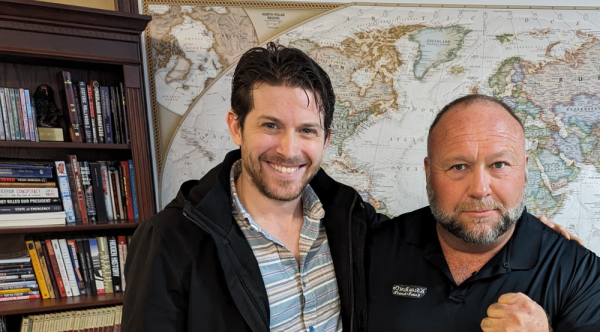
Infowars lead reporter Jamie White (L) (Photo via social media)
Press TV – March 13, 2025
Infowars lead reporter Jamie White has been shot dead outside his Austin apartment, two days after the network aired a report on Mossad’s links to the Epstein sex trafficking ring.
White was found injured near his car late Sunday and later died after being taken to a local hospital.
The Austin police department has claimed that the killing was “likely a random attack.”
Authorities have not yet identified the perpetrator(s).
The murder has led many, including Infowars’ founder Alex Jones, to question if the journalist was the target in a politically-motivated assassination.
“What are the chances in a town of over two million people that an Infowars lead reporter gets butchered?” Jones said in an interview after the murder.
The killing of the Infowars reporter happened two days after the network ran an extensive expose on the links between the Israeli spy service Mossad, and the sex trafficking ring run by Jeffrey Epstein and Ghislaine Maxwell.
The show, which was hosted by Alex Jones and investigative journalist Ian Carrol, said that the sex trafficking network was a “honey trap” operation to gain blackmail on powerful individuals for the benefit of Israel.
The Epstein case is notorious for being linked to a slew of mysterious deaths.
In 2020, the home of Esther Salas, a judge investigating the case, was attacked by an assailant.
The attack left Salas’s son dead and her husband injured. The assailant was later found dead, with authorities claiming the death to be suicide.
In 2022, French modeling agent and Epstein associate Jean-Luc Brunel was found hanged in his prison cell while being investigated for the sex trafficking of minors.
Jeffrey Epstein himself also died under suspicious circumstances in his prison cell in 2019.
While the US government claims that his death was a suicide, many Americans believe the death to have been a murder to prevent the revelation of his connections with powerful people.
Yale suspends Iranian scholar after AI site said she supports a pro-Palestine group

Press TV – March 13, 2025
Yale Law School has suspended an Iranian scholar following accusations stemming from an Israeli AI-powered website article that highlights her advocacy for Palestine and Iran, as well as her outspoken criticism of Israeli genocide during the Gaza war.
Helyeh Doutaghi, who serves as the Deputy Director of the Law and Political Economy (LPE) Project at Yale, in a public statement on Wednesday, denounced her suspension as a retaliatory action against her pro-Palestinian stance and a violation of her constitutional rights to free speech and academic freedom.
“AI is being weaponized to target students, faculty, and organizers who dare to speak out against genocide, systemic starvation, and the ethnic cleansing of Palestinians,” she warned, highlighting the broader implications of the misuse of artificial intelligence in academic and public discourse.
Doutaghi, an expert in international law who held the position of Associate Research Scholar at Yale Law School, was informed of an article published by an obscure AI-powered right-wing Zionist platform, Jewish Onliner, on March 3, which falsely labeled her a “terrorist.”
Doutaghi, who has been vocal about the implications of US military operations, imperialism and the US-Zionist genocide and the ongoing humanitarian crisis in Palestine, reported that the accusations from the article have led to online harassment and even death threats against her.
Less than 24 hours after the article’s release, Yale Law School administration placed Doutaghi on leave.
She criticized the administration for conducting an interrogation based on AI-generated allegations without due process or providing her with sufficient time to attend an interrogation.
Doutaghi also expressed concerns about Yale’s choice of attorney for her interrogation, David Ring from the firm Wiggin and Dana, whose public profile indicates a focus on services related to Israel.
She questioned his neutrality in a case involving a pro-Palestinian academic.
“The actions of YLS constitute a blatant act of retaliation against Palestinian solidarity,” Doutaghi remarked, asserting that the administration prioritized the approval of its Zionist donors over a fair investigation.
Doutaghi pointed out that Yale’s asset managers include firms linked to General Dynamics and Lockheed Martin, which produce components for the F-35 fighter jets used by Israel in committing genocide, asserting that the move creates a conflict of interest that undermines academic integrity.
“This crackdown is a dangerous escalation in state repression, fostering an atmosphere of fear on campus,” said Doutaghi. “We are witnessing a new era of Zionist McCarthyism, where dissent is met with violence, and solidarity with Palestine is rendered a punishable offense.”
“Yale is bending the knee to Trump’s effort to suppress free speech, crush academic freedom, and establish a dictatorship,” Eric Lee, Doutaghi’s lawyer wrote on social media in light of her suspension.
Meanwhile, the US State Department is reportedly considering the use of AI to potentially revoke visas for international students accused of supporting Hamas, raising further concerns about the consequences of such technology on civil liberties.
On Saturday, Mahmoud Khalil, a recent Columbia University graduate who helped lead last year’s solidarity protests in support of the Gaza Strip, was detained by Immigration Customs Enforcement (ICE) and said to be deported despite having a green card.
Following the detention of Khalil, US President Donald Trump declared it was “the first of many to come,” labeling Khalil a “radical foreign pro-Hamas student” and emphasizing that his administration would adopt a strict stance against any pro-Palestinian activities within American universities.
Maybe the reason the Trump administration wants to deport Mahmoud Khalil is because there’s no good reason
By Adam Dick | Peace and Prosperity Blog | March 13, 2025
The Donald Trump administration is offering no good reason to deport Mahmoud Khalil, who was involved in protests at Columbia University in New York City related to the Israel government and to United States government support for that government. He is not charged with a crime of violence or fraud. He is just singled out for advancing communication that challenged US foreign policy — exercising rights listed in the First Amendment of the US Constitution.
Why, many people ask, is the US government so intent on deporting Khalil? Wouldn’t it instead make more sense to go after other noncitizens, making at least arguably credible accusations they committed crimes?
Answers to these questions are suggested by considering the fact that, because Khalil’s accused offense is just speaking up, his arrest, detention, and deportation can have maximum impact in discouraging people from taking a stand the US executive branch may oppose. Speech, assembly, or petition alone, the Trump administration is making clear, is sufficient to bring upon one the wrath of the US government. A Tuesday post at the website of the free speech advocacy organization The Foundation for Individual Rights and Expression (FIRE) titled “Trump administration’s reasons for detaining Mahmoud Khalil threaten free speech provides elaboration:
There are millions of people lawfully present in the United States without citizenship. The administration’s actions will cause them to self-censor rather than risk government retaliation. Lawful permanent residents and students on visas will fear a knock on the door simply for speaking their minds.
If constitutionally protected speech may render someone deportable by the secretary of state, the administration has free rein to arrest and detain any non-citizen whose speech the government dislikes. The inherent vagueness of the “adversarial to the foreign policy and national security interests” standard does not provide notice as to what speech is or is not prohibited. The administration’s use of it will foster a culture of self-censorship and fear.
Khalil is being put forward as an example by the US government. The message to potential critics of the Israel government or US policy related to it is as simple and direct as it is sinister: Shut up or the US government will destroy your life.
Professor at Center of Columbia University Deportation Scandal is Former Israeli Spy
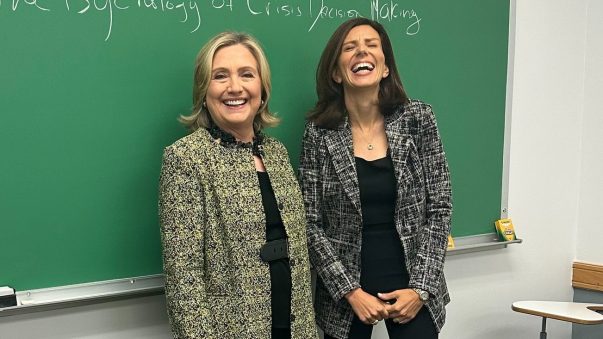
Keren Yarhi-Milo poses with Hillary Clinton during Clinton’s 2023 guest teaching stint at Columbia. Photo | Facebook | Hillary Clinton
By Alan MacLeod | MintPress News | March 11, 2025
The professor at the center of the Columbia University deportation scandal is a former Israeli intelligence official, MintPress News can reveal.
Mahmoud Khalil, a recent graduate of the university’s School of International and Public Affairs (SIPA), was abducted by Immigration Customs Enforcement (ICE) Saturday for his role in organizing protests last year against Israel’s attack on Gaza. Khalil’s dean, Dr. Keren Yarhi-Milo, head of the School of International and Public Affairs, is a former Israeli military intelligence officer and official at Israel’s Mission to the United Nations. Yarhi-Milo played a significant role in drumming up public concern about a supposed wave of intolerable anti-Semitism sweeping over the campus, thereby laying the groundwork for the extensive crackdown on civil liberties that has followed the protests.
Spooks in Our Midst
Before entering academia, Dr. Yarhi-Milo served as an officer and an intelligence analyst with the Israeli Defense Forces. Given that she was recruited into the intelligence services because of her ability to speak Arabic fluently, her job likely entailed surveilling the Arab population.
After leaving the world of intelligence, she worked for Israel’s Permanent Mission to the United Nations in New York. While there, she met and married her husband, Israel’s official United Nations spokesperson.
Although she is now an academic, she has never left the world of international security, making the subject her area of expertise. She has made a point of trying to lift women’s voices in the field. One of these was the then-U.S. Director of National Security, Avril Haines, whom she spoke with in 2023. But even though Khalil was a student in her school, she had nothing to say about his arrest. Indeed, rather than speak out on the issue (as activists have demanded), she instead chose this week to invite Naftali Bennett, prime minister of Israel from 2021 to 2022, to speak at Columbia. Students protesting Tuesday’s event were condemned by university authorities for “harassing” Yarhi-Milo.
Unprecedented Protests, Unprecedented Repression
Columbia was the epicenter of a massive protest movement across university campuses nationwide last year. It is estimated that at least eight percent of all American college students participated in demonstrations denouncing the genocidal attack on Gaza and calling on educational institutions to divest from Israel. The response was equally vast in its scale. Well over 3,000 protestors were arrested, including faculty members themselves.
The nationwide movement began at Columbia on April 17, when a modest Gaza solidarity encampment was established. Protestors were shocked when university president Minouche Shafik immediately called in the New York Police Department – the first time the university had allowed police to suppress dissent on campus since the famous 1968 demonstrations against the Vietnam War.
Mahmoud Khalil was among the leaders of the movement. The Syrian-born Palestinian refugee was willing to speak calmly and cogently to the press about the protest’s goals. A permanent resident of the United States, he was abducted by ICE on Saturday.
“ICE proudly apprehended and detained Mahmoud Khalil, a radical foreign pro-Hamas student on the campus of Columbia University. This is the first arrest of many to come,” President Trump stated. Secretary of State Marco Rubio echoed Trump’s ominous threat, announcing, “We will be revoking the visas and/or green cards of Hamas supporters in America so they can be deported.” In another clear threat, the Trump administration moved to cancel $400 million in funding to Columbia University, citing the institution’s failure to sufficiently crack down on “antisemitic” incidents on campus.
Khalil’s eight-month pregnant wife was initially told that he had been taken to a facility in Elizabeth, New Jersey. In fact, he had been moved halfway across the country to a center in Jena, Louisiana. Journalist Pablo Manríquez of Migrant Insider explained that ICE often goes “immigration ‘judge shopping’ by putting detainees in detention centers under jurisdictions of courts that very rarely decide in favor of migrants.”
The very high-profile attempt to deport the holder of a Green Card because of political speech criticizing a foreign government has left many civil rights lawyers deeply worried. Alec Karakatsanis, for example, stated that “I’ve never seen a more clear-cut First Amendment violation, or a more flagrant government declaration of intent to violate blackletter law.” “The government does not claim he committed a crime, just that he held views that the government doesn’t like about Israel. Bone chilling,” he added.
Columbia’s Billionaire Pro-Israel Backers
Much of Columbia’s funding comes from donations from billionaire benefactors. But those gifts come with strings attached. This became apparent in the wake of the protest movement, as many pro-Israel patrons demanded the university take action. Manufacturing magnate Robert Kraft, for example, publicly announced he was cutting his alma mater off from his lavish funding over its failure to effectively suppress the demonstrations.
Hedge fund manager Leon Cooperman did the same, demanding that Columbia’s “crazy kids” “have to be controlled.” These “kids” evidently also included 61-year-old Jordanian professor Joseph Massad, whose views on the Middle East Cooperman found intolerable, and called for his firing. Soviet-born oligarch Len Blavatnik, meanwhile, urged police to hold the protestors to account.
Between them, Kraft, Cooperman and Blavatnik are believed to have donated nearly $100 million to Columbia, giving them considerable influence over the political direction of the university.
There were also voices from within the university clamoring for the violent suppression of the student movement. Assistant Professor of Business Management Shai Davidai, for example, denounced the protestors as “Nazis” and “terrorists” and called for the National Guard to be set upon the encampment, obliquely referencing the Kent State University Massacre while doing so. Davidai, an Israeli-American, served in the IDF and has publicly expressed his pride in doing so.
Given its most recent addition, it appears unlikely that the School of International and Public Affairs will moderate its pro-Israel positions. In January, the school announced that Jacob Lew would join the faculty. Lew had just left his job as the U.S. Ambassador to Israel under the Biden administration, a role in which he facilitated American complicity in genocide, supplying Israel with weapons and providing it with diplomatic support for its efforts.
Defending Israel, Destroying Free Speech
Longtime readers of MintPress News will be less surprised than many to hear that Israeli military intelligence officials hold such important positions in American public life. Previous MintPress investigations have uncovered giant networks of former Israeli spies working in top jobs in big tech and social media companies, including Microsoft, Google, Meta, and Amazon. Even TikTok, often labeled a Chinese spying app, has hired former Israeli spies to run its affairs. And in October, we revealed that former Israeli spooks are writing America’s news, with multiple former agents working at top U.S. outlets, including CNN, Axios, and the New York Times.
Perhaps, then, the fact that the dean of the very school at the center of a worldwide media storm is a former Israeli military intelligence officer should not be such a shock. But it remains a stark reminder of the level of extraordinary institutional bias in favor of Israel displayed across the United States.
UPDATED – Russia ready for ceasefire: Putin
RT | March 13, 2025
Russia is ready for a ceasefire in the Ukraine conflict, President Vladimir Putin has said, stressing that such an agreement “must lead to long-term peace.”
Moscow believes that the “idea” of a ceasefire is the “right one,” Putin told journalists during a joint press conference with Belarusian President Alexander Lukashenko in Moscow on Thursday. “We absolutely support it,” he added.
“We endorse the idea of resolving the conflict through peaceful means,” the president insisted.
Certain issues still need to be discussed and resolved before a truce can be reached, Putin stated, adding that Moscow particularly needs to discuss them with the US. The dialogue could also require a personal conversation with US President Donald Trump, the Russian leader said.
As of Wednesday evening, Moscow’s forces had liberated 86% of the territory occupied by the Ukrainians in August 2024, according to the head of the Russian General Staff, General Valery Gerasimov. The remainder of Kiev’s units in the area were largely “encircled” and “isolated,” he explained.
Washington and Kiev both endorsed a 30-day temporary truce following a meeting between the two nations’ delegations in Saudi Arabia on Tuesday. US special envoy Steve Witkoff is expected to present the results of those talks during his visit to Moscow later today.
Russia has previously spoken out against any temporary truce in the Ukraine conflict, arguing that Kiev would use it to rearm and continue fighting. Putin has insisted that any resolution to the conflict must address the root causes in order to establish a long-lasting sustainable peace.
Here’s a full transcript of the Russian president’s response:
Before I assess how I view Ukraine’s readiness for a ceasefire, I would first like to begin by thanking the President of the United States, Mr. Trump, for paying so much attention to resolving the conflict in Ukraine.
We all have enough issues to deal with. But many heads of state, the president of the People’s Republic of China, the Prime Minister of India, the presidents of Brazil and South African Republic are spending a lot of time dealing with this issue. We are thankful to all of them, because this is aimed at achieving a noble mission, a mission to stop hostilities and the loss of human lives.
Secondly, we agree with the proposals to stop hostilities. But our position is that this ceasefire should lead to a long-term peace and eliminate the initial causes of this crisis.
Now, about Ukraine’s readiness to cease hostilities. On the surface it may look like a decision made by Ukraine under US pressure. In reality, I am absolutely convinced that the Ukrainian side should have insisted on this (ceasefire) from the Americans based on how the situation (on the front line) is unfolding, the realities on the ground.
And how is it unfolding? I’m sure many of you know that yesterday I was in Kursk Region and listened to the reports of the head of the General Staff, the commander of the group of forces ‘North’ and his deputy about the situation at the border, specifically in the incursion area of Kursk Region.
What is going on there? The situation there is completely under our control, and the group of forces that invaded our territory is completely isolated and under our complete fire control.
Command over Ukrainian troops in this zone is lost. And if in the first stages, literally a week or two ago, Ukrainian servicemen tried to get out of there in large groups, now it is impossible. They are trying to get out of there in very small groups, two or three people, because everything is under our full fire control. The equipment is completely abandoned. It is impossible to evacuate it. It will remain there. This is already guaranteed.
And if in the coming days there will be a physical blockade, then no one will be able to leave at all. There will be only two ways. To surrender or die.
And in these conditions, I think it would be very good for the Ukrainian side to achieve a truce for at least 30 days.
And we are for it. But there are nuances. What are they? First, what are we going to do with this incursion force in Kursk Region?
If we stop fighting for 30 days, what does it mean? That everyone who is there will leave without a fight? We should let them go after they committed mass crimes against civilians? Or will the Ukrainian leadership order them to lay down their arms. Simply surrender. How will this work? It is not clear.
How will other issues be resolved on all the lines of contact? This is almost 2,000 kilometers.
As you know, Russian troops are advancing almost along the entire front. And there are ongoing military operations to surround rather large groups of enemy forces.
These 30 days — how will they be used? To continue forced mobilization in Ukraine? To receive more arms supplies? To train newly mobilized units? Or will none of this happen?
How will the issues of control and verification be resolved? How can we be guaranteed that nothing like this will happen? How will the control be organized?
I hope that everyone understands this at the level of common sense. These are all serious issues.
Who will give orders to stop hostilities? And what is the price of these orders? Can you imagine? Almost 2,000 kilometers. Who will determine where and who broke the potential ceasefire? Who will be blamed?
These are all questions that demand a thorough examination from both sides.
Therefore, the idea itself is the right one, and we certainly support it. But there are questions that we have to discuss. I think we need to work with our American partners. Maybe I will speak to President Trump. But we support the idea of ending this conflict with peaceful means.
Trump administration pulls intelligence pick after his views on Israeli genocide in Gaza surfaced
Press TV – March 13, 2025
The Trump administration has withdrawn Daniel Davis for the post of deputy director of national intelligence for mission integration after his views against the Israeli genocide in Gaza came to light.
The withdrawal came after multiple pro-Zionist organizations and political commentators attacked Davis for his statements on Israel’s actions in Palestine as well as his supportive comments towards Iran.
In a statement posted Wednesday on X, the pro-Zionist Anti Defamation League (ADL) claimed that the appointment of Davis would be “extremely dangerous.”
“He has diminished Hamas’s 10/7 attack, undermined US support for Israel’s right to defend itself, and blatantly denies the grave threat the Iranian regime poses to global stability and American interests,” the official ADL account wrote on X.
Davis is a retired US Army lieutenant colonel who participated in the US invasion of Afghanistan.
After returning from Afghanistan, Davis became a vocal critic of America’s wars in West Asia, later joining the Defense Priorities think tank, which advocates for reducing America’s military involvement.
Davis has criticized Israel’s atrocities in Gaza, stating that the Israeli regime “continues to kill kids and civilians without remorse or military necessity.”
He has also criticized Israeli prime minister Benjamin Netanyahu’s involvement in US politics, claiming that he is “playing the US like a cheap fiddle” while calling US support for Israel’s genocide a “stain on our character as a nation.”
Davis has also stated that Iran’s operation “True promise I” (the retaliation against an Israeli attack on Iran’s embassy) was justified.
Had Davis been appointed, he would have served under the new director of national intelligence, Tulsi Gabbard.
Gabbard herself has also come under attack by war hawks in the US political establishment for her positions on the various conflicts in West Asia.
The national intelligence director has repeatedly criticized Western support for militants in the Syrian conflict, stating that over five hundred million dollars in American taxpayer money was funneled to Syria, which ended up arming al-Qaeda.
Because of these statements, Gabbard was accused of “repeating” Russian, Syrian and Iranian information during her Senate confirmation hearing.
Mr. Trump, you would’ve been lucky to have Dan Davis on your team
By Kelley Beaucar Vlahos | Responsible Statecraft | March 12, 2025
Earlier today the Jewish Insider magazine ran a story saying that the White House tapped retired Lt. Col. Danny Davis for Deputy Director of National Intelligence, working under the newly confirmed DNI Tulsi Gabbard. It was a hit piece by a pro-Israel platform that primarily focused on Davis’s critical views — published only in articles and on his popular podcast — on Gaza and Iran.
Within hours, he was informed there would be no job, Responsible Statecraft has confirmed. “Investigative journalist” Laura Loomer celebrated. We are sure neoconservative radio jock Mark Levin, who helped spread the Insider story to his 4.9 million followers on Wednesday, celebrated. We should not. President Trump should not.
Danny is a friend whose astute, informed military analysis has graced these pages over the last four years. I’ve had the pleasure of interviewing him countless times since 2009 when on active duty he sent a report to Congress and published an article excoriating the Afghanistan War generals— including the much vaunted Stanley McChrystal — for essentially lying to the American people.
In 2009 he had just returned from an inspection tour of the country and was pretty much shocked when what he saw there didn’t line up with what the military was telling Congress and the media here. “I did not need to witness dramatic improvements to be reassured, but merely hoped to see evidence of positive trends, to see companies or battalions produce even minimal but sustainable progress.”
“Instead, I witnessed the absence of success on virtually every level.”
From his explosive Armed Forces Journal article, which is well worth reading today:
When it comes to deciding what matters are worth plunging our nation into war and which are not, our senior leaders owe it to the nation and to the uniformed members to be candid — graphically, if necessary — in telling them what’s at stake and how expensive potential success is likely to be. U.S. citizens and their elected representatives can decide if the risk to blood and treasure is worth it.
That is the very essence of civilian control of the military. The American people deserve better than what they’ve gotten from their senior uniformed leaders over the last number of years. Simply telling the truth would be a good start.
Today, more than 20 years later, everything he said about the war has been born out. The truth was out there and our military and civilian leadership tried to keep it from us — until they couldn’t.
It may be obvious but that is exactly what Secretary of Defense Pete Hegseth and DNI Gabbard said they wanted to bring to the table — a refreshing, dramatic shift from the status quo, which had become sclerotic, secretive, and punishing of dissent. Gabbard herself is an Iraq War-era veteran who risked her career to tell uncomfortable truths about American foreign policy and war. Her very public statements about bad Washington policies and the special interests leading us unto unnecessary wars aligned well with Danny’s important work over the last several years.
So it is not surprising that the most strident voices in the War Party, particularly pro-Israel hawks trying desperately to manage the remembered history of the 9/11 wars, had it in for him. He is an anathema to everything they have stood for over the last two decades: he is against the U.S. trying to impose its interests and values on the world via foreign regime change, he believes the military is overextended and needlessly placed in harm’s way overseas, and he has criticized the military industrial complex for risking troop readiness and basic conventional warfighting capabilities by deferring to the war profiteers in the industry. He has also echoed George Washington’s warning about entangling alliances in his own warnings about unconditional aid to Israel and Ukraine.
Just recently he told me that the entire current generation of generals and admirals need to be replaced so that the military can reform itself, which begins with promoting officers based on merit, not politics and risk aversion.
To me this is the kind of America First guy that the administration needed. He is a Christian conservative with a stern moral compass and had been hopeful for the new administration and its early foreign policy moves. He risked his reputation in 2009, losing out on a typical post-military career in some cushy sinecure mucking it up with other establishmentarians planning the next war, or worse, a board seat at Lockheed or Northrop Grumman. Instead, he has been toiling away at the truth. And this is how the system rewards him. Shame.
All the pressure is now on Zelensky after ceasefire offer – don’t believe the British spin
By Ian Proud | Strategic Culture Foundation | March 12, 2025
I assess that Russia will agree with the U.S. on a proposed ceasefire in Ukraine. This would put the ball back in Zelensky’s court to sign a peace deal that could destroy him politically and may give President Putin the security assurances he has sought for over seventeen years.
In a quite remarkable turn of events, the BBC announced that Britain had helped the U.S. and Ukraine agree on the need for a 30-day ceasefire. This is spin of the most disingenuous kind.
The UK has done everything in its power to prevent the possibility of ‘forcing’ Ukraine into negotiations on ending the three-year war. Indeed, just last week, a prominent UK broadsheet reinforced this point in a searing editorial. The British narrative for three years has been that, with sufficient support and strategic patience, Ukraine could impose a defeat on Russia. To use a British military phrase, that plan ‘didn’t survive contact with the enemy’.
Ukraine’s sudden collapse in Kursk, after Russian troops crawled ten kilometres through a gas pipeline that President Zelensky had, with much fanfare, shut down in January, was an astonishing defeat. It was astonishing because it revealed what many western commentators had said since August 2024, that seizing a small patch of land in Russia would turn out to be a strategic blunder for Ukraine. Since the Kursk offensive was launched, Russia has occupied large tracts of land in southern Donetsk, including several important mines and one of Ukraine’s largest power stations. The basic maths show a significant net loss to Zelensky over the past six months. The bigger picture proves that the overall direction of the war has been moving in Russia’s direction since the failed Ukrainian counter-offensive in the summer of 2023.
In Ukraine itself, the vultures are already circling in the sky as the body of Zelensky’s now six-year presidential term approaches its final breath. Arestovich was quick to call for Zelensky to resign after the damaging shoot-out at the Oval Office. Poroshenko has come out to say Ukraine has no choice but to cut a deal. Even Zelensky’s former press spokeswoman has called for peace and implied that the Ukrainian government tries to limit free speech on the subject of a truce. Team Trump is apparently talking to the egregiously corrupt former Prime Minster Yulia Tymoshenko about the future, heaven help us. The domestic political space for Zelensky to keep holding out with meaningless slogans like ‘peace through strength’, and ‘forcing Russia to make peace’ is rapidly closing around him.
That Ukraine has come to the negotiating table at all is a sign that it has been given no choice, since America paused the military and intelligence gravy train. There is nothing in the Jeddah meeting that suggests any change in the U.S. position towards Ukraine.
All that the ceasefire does, if Russia agrees to it, is pauses the fighting. Indeed, it goes further than the unworkable Franco-Ukrainian idea to pause the fighting only in the air and sea, allowing Ukraine to keep fighting on the ground. Ironically, the Jeddah formulation favours Russia, as a partial ceasefire would have provided succour to the Ukrainian army which does not enjoy strategic air superiority, despite its mass drone attack on Moscow and other parts of Russia.
The joint U.S.-Ukraine statement calls for Ukraine and others to ‘immediately begin negotiations toward an enduring peace that provides for Ukraine’s long-term security’.
If Russia agrees to a ceasefire, the clock will start on 30-days of intensive talks aimed at delivering a durable peace. Russia has said consistently that it will not agree to a ceasefire only; it wants the big questions addressed front and centre. These include Ukraine’s aspiration to join NATO, the status of the four oblasts annexed by Russia since the start of the war and the protection of the Russian language in Ukraine.
The latter should be easier to tick off, at least in theory, although it will face resistance from ultranationalists in Ukraine. The second will be harder, as there is no military route for Ukraine to reclaim occupied lands, so may require some diplomatic finesse in allowing for a freezing of the line. By far the most bitter pill for Ukraine and its European sponsors will be the NATO issue.
Just moments after U.S. Defense Secretary Peter Hegseth said at the Munich Security Conference that Ukraine’s NATO aspiration was unrealistic, Keir Starmer told Zelensky that it was irreversible. There is simply no way in which Britain will be able to finesse the point that a core plank of its strategy on Ukraine will be shattered, at U.S. and Russian insistence. Nor is it likely that Russia will agree to any UK proposal for a NATO-lite peacekeeping force in Ukraine, even if it is in Lviv or some place hundreds of kilometres from the line of contact.
Moreover, Russia will expect some movement in any peace talks on the issue of economic sanctions. Before arriving in Jeddah, the Guardian newspaper published an OpEd from Andriy Yermak calling for more sanctions on Russia as part of any peace plan. This is beyond idiotic. What person with an ounce of political savvy thinks that Russia will sign up a peace process that punishes it for ending a war that it is winning on the battlefield?
While I doubt that Russia expects to achieve a complete lifting of all 20,000 sanctions, they will want many to fall away immediately as part of a longer-term plan. This will also force a reckoning with the issue of the $300bn in seized Russian sovereign reserves, most of which are held in Brussels. Ignoring the issue or hoping that western nations can simply give the money to Ukraine, simply won’t work; detailed thinking needed here too, as I have said several times before.
From my perspective, Ukraine’s readiness to go for a ceasefire illustrates how weak its hand of cards has become. Many on the western side are crowing that Russia will be forced to accept a ceasefire on Ukrainian terms, but this is nonsense. I predict President Putin will see this as an opportunity for NATO to provide him with the longer-term security reassurances on NATO enlargement that he has sought for the past seventeen years, without heed.
Trump invites Putin to a roller coaster ride
By M. K. BHADRAKUMAR | Indian Punchline | March 13, 2025
The political optics of the joint statement issued after the US-Ukrainian talks at Jeddah on March 11 lasting nine hours is hard to tell since President Donald Trump prides himself on his ability to strike deals. Prima facie, the optics are that Ukraine caved in and accepted a Trump administration proposal for a 30-day cease-fire with Russia and on its part, the latter agreed to immediately lift a pause on intelligence sharing with Kyiv and resume military assistance.
The White House Press Secretary Karoline Leavitt during a Fox News TV broadcast said that Trump “put Zelensky in his place and told him that the Americans are serious about a long-term peace deal…And we are very, very pleased with the way that the Ukrainians and this deal today turned out.”
However, there are fine prints in a joint statement, which add the caveat that “Ukraine expressed readiness to accept the U.S. proposal to enact an immediate, interim 30-day cease-fire” if Russia did the same. The statement qualifies that “The United States will communicate to Russia that Russian reciprocity is the key to achieving peace.”
The US Secretary of State Marco Rubio interpreted that the agreement now puts the pressure on Russia to end the war. He said, “We’ll take this offer now to the Russians, and we hope that they’ll say yes, that they’ll say yes to peace. The ball is now in their court.”
Rubio signalled that if Moscow doesn’t sign up to the ceasefire, “then we’ll unfortunately know what the impediment is to peace here.” For sure, coercive diplomacy has crept in.
Curiously, even before talks began in Jeddah, Rubio had told reporters, “It should be clear to everyone that the United States has tools available to also impose costs on the Russian side of this equation, but we hope it doesn’t come to that. What we’re hoping is that both sides realise that this is not a conflict that can end by military means; it can only end by diplomatic means. And the President’s goal is to bring them both to the table to get this resolved. But it’s a reminder that we understand that the United States has tools at its disposal if in fact this falls apart, and — but we’re hoping it doesn’t. We really do. We hope it doesn’t reach that point.”
There has been no public indication so far that Russia would accept an unconditional, month-long ceasefire that compromises the core objectives of the special military operations. Indeed, that’s what the Russian people will expect from President Vladimir Putin.
Of course, Putin himself had indicated in January, “The goal should not be a short truce, not some kind of respite for regrouping forces and rearmament with the aim of subsequently continuing the conflict, but a long-term peace based on respect for the legitimate interests of all people, all nations living in this region.”
It will be politically damaging for Moscow to retract from the terms spelt out by Putin last June in his address to the foreign ministry in Moscow as conditions for Russia agreeing to peace talks. Again, the generals’ opinion has to be taken into account. The Russian forces have managed slow but consistent advances in the east in the Donetsk region and are preparing for breaking through into the neighbouring region of Dnipropetrovsk. Only last weekend, after heavy fighting, they managed a significant breakthrough in the Kursk region, coming close to encircling around 10,000 elite Ukrainian troops.
Clearly, it is not going to be easy for Putin to order the generals that it’s time for a ceasefire that may look like a strategic defeat as the Russian forces are still failing in their core strategic goals. Konstantin Kosachev, chairman of the international affairs committee of the upper house of Russia’s parliament, probably reflected the mainstream elite opinion in a post on Telegram that: “Russia is advancing. Real agreements are still being written there, at the front. Which they should understand in Washington, too.”
On the other hand, there is no question that Putin’s preference will be to avoid unpleasantness with Trump, leave alone a collision course. Putin has to tread with care, as Trump will not like anyone stopping him from getting his deal.
On Monday, in a subtle suggestion that Putin and Trump are sailing in the same boat, Tass carried two reports (here and here) warning that British activities in Odessa directly threaten Russian interests and, furthermore, that “According to the information received by the SVR (Russian Foreign Intelligence Service), the British leadership sees a threat to its interests in the promotion of dialogue between the US and Russia to resolve the Ukrainian conflict… London is extremely irritated by the fact that Donald Trump ‘dialogues with Russia as a superpower and shows disregard to close allies.’”
The SVR statement added, “The British authorities consider it an ‘urgent priority’ to undermine ‘peacekeeping’ efforts of the new US administration on the Ukrainian track. The media and specialised NGOs are tasked with demonising Trump, portraying him as ‘a man with a poor peacekeeping record and susceptible to Kremlin manipulation.’”
Interestingly, Tass also reported on a telephone conversation between Russia’s Foreign Intelligence Service Director Sergey Naryshkin and Chief of the Central Intelligence Agency (CIA) John Ratcliffe. The readout said, “the parties discussed the issues of interaction of both intelligence agencies in areas of common interest and the settlement of crisis situations” and reached an agreement “on maintaining regular contact between the SVR and CIA directors with the aim of facilitating international stability and security and reducing confrontation in relationships between Moscow and Washington.”
Evidently, Zelensky, tutored by his American friends and European advisers, has decided on a play-along strategy to avoid antagonising Trump counting, arguably, that he should leave it to Putin to cross and disappoint Trump. Put differently, in an iterative process, Ukraine needs to project itself as the constructive party.
That said, in the final analysis, the dynamics are such that personal diplomacy rather than ideological commitments or even military achievements may come to prevail. The outcome will depend on the personal agreements — or the lack thereof — between Putin and Trump.
Trump himself told reporters that he thought he would speak with Putin this week and that he hoped a lasting cease-fire would be negotiated in the coming days. Meanwhile, Trump’s envoy Steve Witkoff is reportedly planning to travel to Moscow to meet Putin. He had a meeting with Putin lasting several hours last month.
The bottom line is that one way or another, Moscow will have to decide quickly how to play Trump. To my mind, in this bouquet of thorny roses out of Jeddah, the likelihood is that Putin may opt to string discussions out by offering a succession of counter proposals.
Russia and Trump set the stage for Ukraine, but can Kiev be trusted?
The Jeddah talks have confirmed the long-obvious fact that Zelensky’s regime has no real options
By Sergey Poletaev | Kommersant | March 12, 2025
The most telling aspect of Tuesday’s US-Ukraine talks in Jeddah wasn’t the meeting itself but rather the reaction of Western European leaders. Forced to begrudgingly praise Washington’s supposed efforts for peace, officials – led by EU boss Ursula von der Leyen – were left practically begging for a seat at the negotiating table. But they won’t get one.
For the past month, there has been an ongoing struggle between European globalists and Donald Trump over who will dictate the West’s approach to Ukraine. The outcome of the Jeddah talks makes it clear: the Europeans have lost that battle.
Europe sidelined
Brussels and its allies wanted to continue supplying Ukraine with weapons and funding in a prolonged fight against Russia, all while attempting to drag Washington along. The idea was to assume leadership of the globalist agenda that had been slipping from Joe Biden’s grasp. Emmanuel Macron, the most restless among them, floated various unrealistic initiatives – ranging from sending Western European troops under the guise of peacekeepers to proposing partial ceasefires and other half-measures.
Trump, however, has made no secret of his disdain for this crowd. To him, the liberal interventionists pushing for endless war in Ukraine are ideological opponents. Since Ukraine has been the centerpiece of Western foreign policy for the past three years, stripping Kiev from its European patrons was a crucial step for Trump’s team in its broader battle against the globalist elite.
This strategy played out in the open. First, Vladimir Zelensky was humiliated in Washington, almost being shown the door at the White House. Then, the Trump administration cut off Ukraine’s access to intelligence data and drastically reduced military supplies. Trump made it clear to Zelensky: either fall in line or lose everything, because the Europeans won’t save you.
For Zelensky, the writing was on the wall. He spent the past few days frantically touring European capitals, desperately seeking military guarantees or a last-minute lifeline. Instead, he received only empty words of sympathy and lofty speeches. The reality was unavoidable – the EU was powerless to help.
By effectively signing a political surrender to Trump, Zelensky has pledged loyalty to the American president, committing to his agenda. This was confirmed in Jeddah. Now, Zelensky is expected back in Washington – to cement what is likely a humiliating agreement for Ukraine.
What this means for Russia
Exactly one month ago, Trump placed a call to Vladimir Putin. While the details of their conversation remain unknown, we can speculate. Trump likely expressed his desire for a quick peace deal and inquired about Russia’s conditions. Putin would have reiterated Moscow’s long-standing demands – rooted in the failed Istanbul agreements of 2022 and further solidified by Russia’s terms outlined last June. Most importantly, Putin likely asked Trump a critical question: can you guarantee Ukraine and Europe will abide by any deal?
It appears Moscow and Washington have reached an initial framework for a peace agreement. The broad strokes seem to include no military guarantees for Ukraine, no path to NATO membership, and a change in Kiev’s leadership.
Both sides have spent the past month preparing. Trump has tightened his grip over Ukraine and pushed Western Europe out of the decision-making process, while the Russian military has made decisive gains, particularly in Kursk, a necessary condition for any ceasefire.
A fragile peace?
Trump seems confident that he can strike a deal with Putin, ensure Kiev’s compliance, push the Europeans aside, and secure a lasting peace – cementing his status as a global peacemaker. But the reality is more complicated.
First, we don’t know the precise terms Putin and Trump have discussed, nor whether both leaders interpret them in the same way. The devil is always in the details, and negotiations between Moscow and Washington are never straightforward.
Second, and more critically, Zelensky’s pledge to Trump does not guarantee genuine loyalty. A peace deal on Russia’s terms would mean the collapse of modern Ukrainian nationalism and, inevitably, the slow dismantling of the Ukrainian state in its current form.
Zelensky has already spent the past year resisting peace efforts, pushing for military guarantees, and clinging to Western Europe in hopes of prolonging the war. There is no reason to believe he has suddenly abandoned these instincts. The most logical course for Kiev now would be to publicly cooperate while privately undermining any deal, buying time in hopes that Trump can be outmaneuvered or that European support can be rekindled.
Western Europe’s next move
The EU and the UK are unlikely to sit idly by. Macron and others will undoubtedly work behind the scenes to keep Ukraine on life support, maintaining a political and financial link to Kiev while waiting for an opportunity to reverse course. Their strategy is clear: stall Trump and hope for a new US administration in 2029 that will reignite the conflict.
The Kremlin has experienced this kind of Western deception before. If Moscow has learned anything from past negotiations, it will ensure that any deal struck this time is airtight, leaving no room for Ukraine or its European patrons to wriggle free.
The Jeddah talks mark a turning point. Ukraine is being pulled out of the hands of the Western European elite and placed firmly under Trump’s control. Whether this will lead to a real peace settlement – or merely a new phase in the geopolitical chess game – remains to be seen. What is certain, however, is that Brussels and London have lost their grip on the Ukraine conflict.
Sergey Poletaev is an information analyst and publicist, co-founder and editor of the Vatfor project.
This article was translated and edited by the RT team.
Featured Video

New positive ivermectin evidence
or go to
Aletho News Archives – Video-Images
From the Archives
Fanatical Followers of the Covid Regime: A Jim Jones-Style Cult?
By Professor Roger Watson and Dr. Niall McCrae | The Daily Sceptic | November 15, 2021
As scholars at leading British universities over recent decades, we witnessed the replacement of critical thinking and debate by narrative: facts are discrimination and scientific method is imperialism; truth, instead, is derived from ‘progressive’ values. This educational trend may be a major contributory factor to the ease in which society has been inculcated to the Covid ‘new normal’ of masking, testing, and repeated doses of vaccines for a disease of similar risk to severe influenza.
One doesn’t need much critical reasoning to observe the flawed logic of some vaccination enthusiasts, such as people who respond to experiencing any side effects, however debilitating, by saying “at least I know it’s working”, or, after contracting the disease despite their promised inoculation (over 90% effective, according to initial drug company claims), “I’d have been worse off without the jab.” … continue
Blog Roll
 Aletho News
- ‘Grave, alarming’: Iran mission on Trump’s UNGA ‘annihilation’ threats
- Najaf airport to reopen to Iranian flights within 24 hours: Ambassador
- From ‘How Will This End For Iran’ to ‘When America Walks Away’: A tale of two Economist covers
- Tehran blasts ‘baseless’ speculation linking Iran to alleged bomb plot at UK air base
- The Rise And… Rise Of ‘Color Revolutions’
- The Coming GOP Bloodbath?
- Arctic Scare Stories Melt Away
- Wrong, Euronews: Climate Change Has Not Created a Food, Energy, and Economic “Meta-Crisis”
- New positive ivermectin evidence
- Met Office Caught Fabricating Daily Temperature Record Claims
- If Americans Knew
- Netanyahu Asked UAE Leader to Deny Report on Oct. 7 Warning in Secret Visit, Sources Say
- CNN Chief Int’l Correspondent Clarissa Ward on Journalists in Gaza
- Democratic Party Consultants Surround Troy Jackson with Pro-Israel Donors
- Christian Leader Responds To Netanyahu’s Claims Regarding Palestinian Christians
- In Gaza, ‘Whoever Survives the Bombing Won’t Survive the Rubble’
- Israel kills more Palestinians, amid push to resettle Gaza – Daily Update
- Israel forces Gazans to live in constant peril – Daily Update
- Deconstructing Netanyahu’s pants-on-fire UN rant – Daily Update
- Trump betrayed voters with his campaign lies and prioritized a foreign country once he took office
- Netanyahu calls Israel’s war in Gaza ‘opposite of genocide’ in UN speech to near-empty hall
- No Tricks Zone
- New Study: Earth And Venus Surface Warmth Largely Explained By Convection And Lapse Rate, Not CO2 Or Radiation
- 2025 Nature Paper Claiming Worsening Global Drought Gets RETRACTED …Heavily Flawed
- New Study: ‘Global Drought Shows No Detectable Recent Acceleration Under Climate Warming’
- Economic Masterminds: German Socialists Suggest Taxing Productivity Gains Stemming From Using AI
- The South China Sea Has Not Been Cooperating With The Climate Change Narrative
- Energy Crisis: Germany Enters Heating Season With Historically Low Gas Reserve Fill Levels
- New Study: The Antarctic Ice Sheet Gained Mass From 2020-2024 Due To Staggering Snow And Ice Accumulation
- Study: Ocean Heating Rates From Thousands Of Years Ago ‘Dwarf’ Modern Ocean Heating Rates
- Climate Extremists Target, Attack Large-Scale Power Grid Infrastructure In Germany!
- New Study: Antarctic Ice Melt Has Contributed Less Than 1 Centimeter To Sea Level Rise In The Last 30 Years

