USAID staff rush to shred and burn documents
RT | March 12, 2025
The acting executive secretary of the US Agency for International Development (USAID), Erica Carr, has directed remaining staff to destroy sensitive documents stored at the agency’s former headquarters in Washington, D.C., according to an internal email.
President Donald Trump and Elon Musk, who leads the recently established Department of Government Efficiency (DOGE), have repeatedly accused USAID – the primary US agency for funding political projects abroad – of misusing taxpayer money and fostering corruption. As part of broader efforts to cut government spending, USAID was forced to lay off 2,000 employees and place most of the remaining staff on leave.
In an email first obtained by ProPublica, Carr instructed the remaining staff to convene on Tuesday for an “all-day” effort to clear out classified safes and personnel documents at the Ronald Reagan Building. She advised employees to prioritize shredding documents and to use burn bags sparingly.
“Shred as many documents as possible first, and reserve the burn bags for when the shredder becomes unavailable or needs a break,” the email read. “The only labeling required on the burn bags is the phrase ‘SECRET’ and ‘USAID/(B/IO)’ in dark Sharpie if possible. If you need additional burn bags or Sharpie markers, please let me or the SEC InfoSec team know.”
The email did not specify a reason for the document destruction. However, the building is being vacated following mass layoffs, as US Customs and Border Protection (CBP) recently rented 390,000 square feet of office space in the facility.
The directive has raised concerns among former USAID staff and legal experts, who argue that it could violate federal record-keeping laws and potentially hinder ongoing lawsuits challenging the agency’s restructuring.
“Destruction of evidence is a crime,” Musk wrote on X in response to reports of the latest document purge. The billionaire previously called USAID a “criminal organization,” while Trump has claimed it was mismanaged by “radical lunatics.”
The handling of documents at USAID has already been under scrutiny. Last month, two of the agency’s security officials were placed on administrative leave after allegedly refusing to grant a team of DOGE auditors access to classified materials.
The Trump administration plans to eliminate 90% of USAID contracts, amounting to $54 billion, AP reported last month, citing an internal White House memo and court filings. The National Endowment for Democracy (NED) has also had its government funding frozen. Although officially a US State Department-funded nonprofit that distributes grants to pro-democracy initiatives abroad, the NED has long faced allegations of acting as a CIA front for regime change operations.
Maine Lawmaker Censored: The Facebook Post That Sparked a Free Speech Showdown
By Regina Morrison | Reclaim The Net | March 11, 2025
You’re an elected official. You show up at the state house, ready to do what politicians do: discuss budgets and debate policy. But instead, you find yourself in the middle of a firestorm over a Facebook post. Not because it contains state secrets or classified intel, but because it features photos from a high school track meet.
This is exactly what happened to Maine Representative Laurel Libby, who now finds herself at the center of a storm that is less about sports and more about who gets to decide what speech is acceptable in a democracy.
A Championship, A Facebook Post, and a Political Crisis
It all started with a pole vaulting competition. Libby, a mother of five and a fierce advocate for women’s sports, posted photos from Maine’s Class B state championship in girls’ pole vaulting. The athlete who won had previously competed in the boys’ division, where they finished in fifth place. Now competing in the girls’ category, the athlete cleared 10 feet 6 inches, winning by a wide margin.
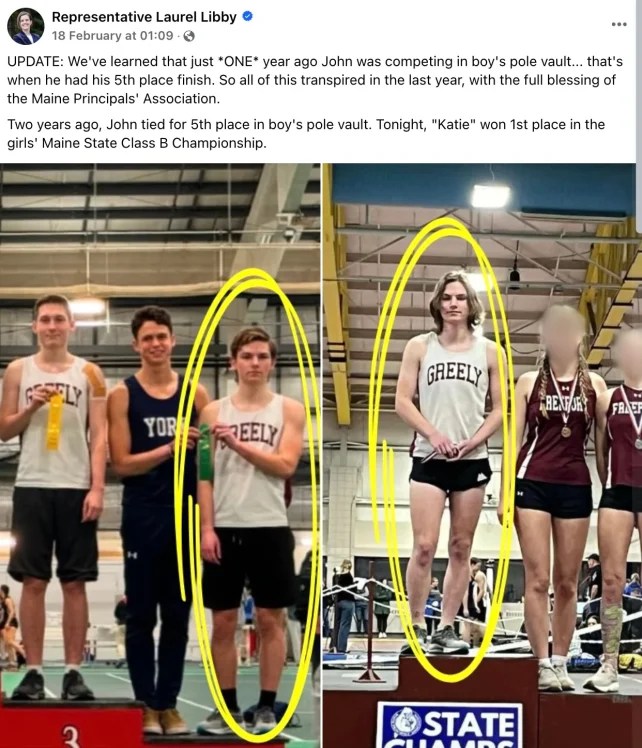
Libby’s post ignited a national conversation — the media ran with it, the White House took notice, and suddenly, a Maine high school sports event became ground zero for the larger battle over transgender athletes in women’s sports.
The Censure Vote and the Ultimatum
Democratic leaders in the Maine legislature quickly stepped in. They demanded she take the post down. Libby refused. The response was a censure vote, which passed 75-70 along party lines.
But that wasn’t enough. The House speaker then took things a step further: Libby would not be allowed to speak or vote on legislation until she deleted the post. In other words, her constituents would now go unheard in state government, all because their representative refused to edit her social media. Normally, removing a legislator would require a two-thirds vote or a recall election, but those formalities were apparently unnecessary when a majority party had other tools at its disposal.
Libby’s critics argue that she could have made her point without sharing the athlete’s photo. “Sharing images of kids online without their consent is a clear violation of the bond of trust and respect between citizens and their legislators,” said Majority Leader Ryan Fecteau. He accused Libby of using a minor to score political points and insisted that serious policy debates should not be waged through viral social media posts.
Libby, however, sees it differently. “Words don’t have the same impact. People need to see what’s happening to understand why it’s unfair,” she explained. Her stance is simple: if an athlete competes in a public championship, they should expect public attention. “If you don’t want attention, don’t put yourself in a public position to receive it.”
Libby’s post, whether you agree with it or not, falls squarely under the First Amendment. She wasn’t revealing state secrets or inciting a riot — she was commenting on a policy set by the Maine High School Principals Association, which allows student-athletes to compete in the gender category with which they identify.
In other words, she was doing exactly what elected officials are supposed to do: debate policies that affect the people they represent. The fact that her speech was met not with counter arguments but with an outright ban from legislative participation raises an uncomfortable question; if lawmakers can be silenced for discussing controversial policies, what does that mean for the rest of us?
US interested in direct talks with Hamas
Al Mayadeen | March 11, 2025
A leader in the Palestinian Resistance has divulged to Al Mayadeen that the United States is “interested in direct communication with Hamas, but within specific expectations,” as Americans do not want to allow the Palestinian Resistance to benefit from this direct communication with the current administration.
The Palestinian leader pointed out that the American envoys confirmed the ability of US President, Donald Trump, to “force Israel to stop the war and reach an agreement with Hamas.” They believe that Hamas’s release of the Israeli-American captive could change Trump’s convictions.
Hamas had previously announced its full commitment to the ceasefire agreement, implementing what was agreed upon, and its readiness to immediately begin negotiations for the second phase.
The movement rejected pressuring attempts, while the Israeli occupation is left without accountability despite evading its obligations.
“Blackmail and threats of war will not be of any use, and there is no way but negotiations and commitment to the agreement,” the leader told Al Mayadeen, emphasizing that any other option would be tampering with the fate of the remaining captives.
Adam Boehler, the US envoy who engaged in direct talks with Hamas, described the meeting as “very helpful” and expressed confidence that a deal to release Israeli captives held in Gaza could be reached “within weeks”.
In an interview for CNN, Boehler acknowledged the unusual nature of the talks, considering that Hamas has been designated a “terrorist” organization by the US since 1997. However, he did not rule out future meetings with the Palestinian group.
Boehler recognized “Israel’s” concerns over the US meeting with Hamas but emphasized his intent to revive “fragile” negotiations.
“In the end, I think it was a very helpful meeting,” he said, adding, “I think something could come together within weeks… I think there is a deal where they can get all of the prisoners out, not just the Americans.”
He hinted at the possibility of further talks, stating, “You never know. You know, sometimes, you’re in the area and you drop by.”
The first phase of a ceasefire concerning the release of some Israeli captives ended earlier this month, but the Palestinian Resistance and “Israel” are now in disagreement over when to transition into the second phase, which aims for a complete end to the war on the Gaza Strip.
While “Israel” wants to extend the first phase until mid-April, Hamas has insisted on moving to the second phase, which is aimed at achieving a permanent end to the war.
During this phase, the Resistance released 25 living captives and the bodies of eight others in exchange for approximately 1,800 Palestinian detainees and prisoners held in Israeli occupation prisons.
Of the 251 individuals taken captive on October 7, 2023, 58 remain in Gaza, including 34 whom the Israeli military has confirmed as dead.
Last week, US President Donald Trump issued a “last warning” to Hamas, threatening additional destruction in Gaza if all remaining captives were not released.
Boehler acknowledged the “consternation” “Israel” felt over the US’ engagement with Hamas, saying, “We’re the United States. We’re not an agent of Israel.”
Europe faces a MAGA ‘vibe-shift’ as Trump moves to his primordial objective – The Global Reset
By Alastair Crooke | Strategic Culture Foundation | March 11, 2025
President Trump wants Ukraine settled, full stop. This is so that he can move ahead quickly – to normalise with Russia, and begin the ‘big picture’ project of setting a new World Order, one that will end wars and facilitate business ties.
The point here – which Europe feigns to not understand – is that the end to the Ukraine conflict simply is Trump’s ‘gateway’ to the entire rationale and platform on which he stood: The Great Reset of the Geo-Political landscape. Ukraine, simply said, is the obstacle to Trump’s pursuit of his primordial objective: The Global Reset.
Starmer, Macron and the eastern wing of the Euro-élites are blind to the sheer scale of the global vibe-shift towards traditionalist U.S. politics and ethics. They miss too, the barely concealed fury in the Trump world that exists behind this nascent revolution. “The Maga Right has none of the inhibitions of its predecessors. It is planning to leverage the power of a recaptured state to annihilate its enemies”, Allister Heath writes.
The European Ruling Class is in desperate trouble and increasingly isolated, in a world shifting ‘Rightward’ at breakneck speed. “The U.S. is now the enemy of the West”, the FT proclaims. European leaders wantonly won’t understand.
The reality is that the U.S. is engaged now in rolling up Europe’s foreign policy. And, is about to start exporting U.S. traditional Republican values to roll up the European wokeist belief-system. The European Ruling strata – far removed from its base – has failed to grasp the threat to its own interests (a scenario outlined here).
The Trump administration is trying to rebuild the ailing Republic, and Americans in this new era do not care for the European obsession with ancient feuds and their entailing wars.
Trump reportedly views with utter disdain the UK and European boast that should the U.S. not do it, then Europe will. The Brussels class claims to be able still – after three years of losing in Ukraine – to be able to inflict a humiliating defeat on President Putin.
More profoundly, however, Team Trump – committed to the task of taking down the American Deep State as the ‘inexorable enemy’ – perceives (rightly) the British security state to be co-joined at the hip with their American counterparts, as a part of its global meta-structure. And its oldest and deepest component has always been the destruction of Russia, and its dismemberment.
So when Macron, in an address to the nation this week, rejected a ceasefire in Ukraine and declared that “peace in Europe is only possible with a weakened Russia”, calling the country a direct threat to France and the continent, many in ‘Trump world’ will interpret this defiant declaration (that ‘Ukraine defeating Russia is preferable to ‘peace’’) is nothing more than Macron and Starmer ventriloquising the aims of the Meta Deep State.
This notion is lent substance by the sudden plethora of articles appearing in the European-(managed) MSM to the effect that Russia’s economy is much weaker than it appears and might collapse in the next year. Of course it is nonsense. This is about managing the European public to believe that keeping the war going in Ukraine is a ‘good idea’.
The absurdity of the European position was perhaps best captured, as Wolfgang Münchau notes, in its full hubris last year by the historian and writer Anne Applebaum when she won a prestigious German peace prize. During her acceptance speech, she maintained that victory was more important than peace, asserting that the West’s ultimate goal should be regime change in Russia: “We must help Ukrainians achieve victory, and not only for the sake of Ukraine,” she said.
Zelensky and his European fans want ‘to negotiate’ – though later, rather than sooner (perhaps in a year, as one European Foreign Minister reportedly told Marco Rubio privately).
“This”, Münchau writes, “is what the very public disagreement in the Oval Office [last week] was all about. Peace through untrammelled victory — essentially the Second World War model — as the lens through which virtually all European leaders, and most commentators view the Russia-Ukraine conflict”.
America sees things differently: It views almost certainly the European Deep State to be putting a spoke into Trump’s ‘normalisation with Russia’ wheel – a normalisation to which they are viscerally opposed. Or, at the very least, as the Europeans chasing a “mirage that no longer exists, stubbornly hiking ‘tax and spend’, whilst doubling down on mass immigration and overpriced energy, oblivious to the flashing red lights in the [financial markets] as government debt yields rocket to their highest levels since 1998”, as Allister Heath outlines.
In other words, the suggestion is that Friedrich Merz, Macron and Starmer are talking about how they are going to turn around their countries – via a massive infusion of debt – into defence superstates. Yet, at some level of consciousness, they must realise that it is not doable, so they settle instead for presenting themselves as ‘world leaders on the international stage’.
The European élites are deeply unstable ‘leaders’ who are risking the prosperity and stability of the continent. It is clear these countries do not have the military capacity to intervene in any concerted manner. More than anything, it is the European economy circling the drain that is the reality at the gates.
Zelensky is accomplice to the European insistence that defeating Russia takes priority over achieving peace in Ukraine, in spite of lacking any strategic rationale as to how it may be achieved after three years of a worsening military situation. Both plans – crushing the Russian economy with sanctions and attrition of the Russian military to the point of collapse – have failed. Why then does Zelensky resist Trump’s peace proposals? On the surface, it makes no sense.
The explanation likely goes back to the post-Maidan era when the western ‘Meta Security State’ (principally, the British and the Americans) entrenched hardline Banderites (then a tiny minority) into the Ukrainian Police, Intelligence and Security State. They are still today the controlling force. Even were this faction to acknowledge that their war cannot be won, they understand what happens if they lose:
Russia will not deal with them. They view them as extremists (if not war criminals) who are in no way ‘agreement capable’ and must be replaced by a leadership who is actually capable of compromise. Russia would likely pursue and bring these men to trial. Zelensky has to be frightened at what the Banderites might do to him (despite his British team of bodyguards).
Well, Trump is not entertaining these European ‘games’: He is administering a slap-down to Zelensky and European leaders, perhaps bringing Zelensky into line; or perhaps not … Team Trump, Politico reports, has now entered into direct talks with the Ukrainian opposition on holding early elections to unseat Zelensky – who is on his way to being removed, members of Team Trump say.
Zelensky may be finished, but interestingly Zaluzhniy wasn’t discussed either. He is being groomed by the British as a replacement – it looks like the Americans are going to make this decision independently of the British, too.
President Trump has ordered intelligence sharing with Ukraine stopped. What he technically did was to stop allowing Ukraine to use exclusive U.S. targeting systems controlled by U.S. Intelligence, the CIA, the National Reconnaissance Office and the U.S. National Geospatial Intelligence Agency. What has been suspended is the exchange of so-called ‘lethal’ data, including information for HIMARS targeting. However, the defensive information needed for protection is still being provided to Ukraine.
“The extent of the intelligence-sharing freeze, which appears to have been imposed alongside the halt in military aid Mr Trump announced on Monday, initially appeared to be somewhat limited … But by Wednesday afternoon it became clear that the Trump administration, ignoring overtures from Mr Zelensky the previous evening, had gone much further. A military intelligence officer in Kyiv told The Telegraph that the freeze amounted to “more or less a total blackout””.
Put bluntly, the earlier munitions freeze will undoubtedly affect Ukraine’s military abilities over time, however the impact might not be felt for some weeks. The loss of vital intelligence, however, will make its mark immediately. It will – simply put – blind Ukraine. In Ukrainian command posts, the battle tracking and satellite online feeds on tablets and TV screens have indeed been disconnected.
What Trump’s slap-down has done is to puncture the fiction that Ukraine is able to defend itself with a little substitute of European support. That has always been nonsensical bravado. NATO, the CIA and the global Intelligence Community have been in control of the war fighting from the outset. And that, for now, has been switched off.
So, Europe wants to shoulder the U.S. burden? Bloomberg reports that European bond markets are in meltdown. If Europe pretends to replace the U.S., it is going to be extremely expensive, very politically costly, and it will fail.
USAID funded Ukraine group that smeared Vance
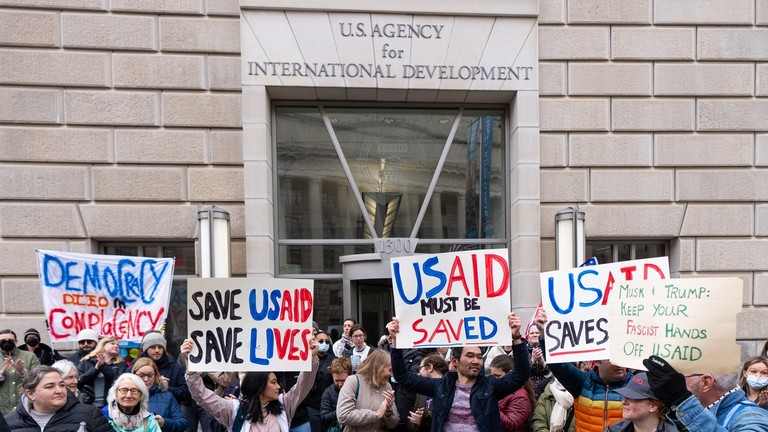
Protesters gather outside USAID headquarters, February 3, 2025 © Bill Clark / CQ-Roll Call, Inc via Getty Images
RT | March 10, 2025
The US Agency for International Development (USAID) has been implicated in funding a Ukrainian organization, Molfar, which labeled Vice President J.D. Vance and other US officials and public figures as “foreign propagandists” aligned with Russia, according to an investigation by The Grayzone.
Molfar, established in 2019, describes itself as an open-source intelligence community platform which “collects lists of Ukrainian enemies to bring war criminals to justice.” The group’s website identifies USAID and the US Civil Research and Development Fund (CRDF) as partners, indicating financial and operational support from US government agencies.
The group’s online blacklist not only targeted Vice President Vance for his statements opposing continued US financial support for Kiev and his stance against Ukraine’s NATO membership, but also targeted other American figures, including US Counterterrorism Director Joe Kent and Representative Thomas Massie. Molfar’s website advocated for their “removal from public positions, the introduction of sanctions, and investigations into personal involvement in crimes.”
In addition to political figures, Molfar has targeted American journalists, including Max Blumenthal, editor-in-chief of The Grayzone. The organization accused Blumenthal of disseminating Russian narratives and threatened to expose his personal information, including home addresses and family details.
Other notable figures targeted by Molfar include billionaire tech entrepreneur Elon Musk, journalists Glenn Greenwald and Tucker Carlson, and award-winning American economist and public policy analyst Jeffrey Sachs.
A report published by Ukraine’s National Coordination Cybersecurity Center (NCSCC), bearing USAID’s logo, highlighted that Molfar assisted in training thousands of Ukrainian government employees in cyber warfare techniques and psychological operations. The report stated that over 2,000 public workers participated in practical assignments covering topics such as open-source searches, contact search, using Telegram bots, psyop as a method of information warfare, human intelligence and social engineering.
According to The Grayzone, Molfar’s activities are part of a broader network of Ukrainian organizations involved in Kiev’s information war efforts at the expense of US taxpayer money.
Another self-styled “fact-checking” outfit, VoxUkraine, has received substantial funding from the National Endowment for Democracy (NED) and USAID. Its VoxCheck project has been involved in censoring Americans’ social media posts deemed pro-Russian. Similarly, the Center for Countering Disinformation (CCD), an official body under Ukraine’s National Security and Defense Council, has collaborated with both Molfar and VoxUkraine to combat “disinformation,” often labeling US public figures as promoters of Russian propaganda, including smearing now-Director of National Intelligence Tulsi Gabbard.
Immediately upon assuming office, President Donald Trump suspended most US foreign assistance pending a three-month review to determine whether programs should continue based on their alignment with the new administration’s “America First” goals.
USAID, Washington’s primary mechanism for funding political projects abroad, has seen tens of billions of dollars’ worth of approved grants frozen as a result. The NED’s government funding was also frozen. Officially a US State Department-funded nonprofit for distributing grants to pro-democracy causes abroad, the NED has long faced allegations of acting as a CIA cutout for toppling foreign governments.
H5N1’S LAB LINK? DR. MCCULLOUGH EXPOSES SHOCKING ORIGINS
The HighWire with Del Bigtree | March 6, 2025
Cardiologist & Epidemiologist, Peter A. McCullough, MD, joins Del with a shocking study linking the origins of the current clade of H1N5 dominating the news cycle and crushing the egg industry can be tracked back to a USDA poultry research lab in Georgia.
Trump’s ingenuity vis-à-vis Russia, Iran
By M. K. BHADRAKUMAR | Indian Punchline | March 10, 2025
Through the past three year period, Moscow claimed that it faced an existential threat from the US-led proxy war in Ukraine. But in the past six weeks, this threat perception has largely dissipated. The US President Donald Trump has made a heroic attempt to change his country’s image to a portmanteau of ‘friend’ and ‘enemy’ with whom Moscow can be friendly despite the backlog of a fundamental dislike or suspicion.
Last week, Trump turned to the Iran question for what could be a potentially similar leap of faith. There are similarities in the two situations. Both Russian President Vladimir Putin and Iranian president Masoud Pezeshkian are quintessential nationalists and modernisers who are open to westernism. Both Russia and Iran face US sanctions. Both seek a rollback of sanctions that may open up opportunities to integrate their economies with the world market.
The Russian and Iranian elites alike can be described as ‘westernists’. Through their history, both Russia and Iran have experienced the West as a source of modernity to ‘upgrade’ their civilisation states. In such a paradigm, Trump is holding a stick in one hand and a carrot on the other, offering reconciliation or retribution depending on their choice. Is that a wise approach? Isn’t a reset without coercion possible at all?
In the Russian perception, the threat from the US has significantly eased lately, as the Trump administration unambiguously signalled a strategy to engage with Russia and normalise the relationship — even holding out the prospects for a mutually beneficial economic cooperation.
So far, Russia has had a roller coaster ride with Trump (who even threatened Russia with more sanctions) whose prescriptions of a ceasefire to bring the conflict in Ukraine to an end creates unease in the Russian mind. However, Trump also slammed the door shut on Ukraine’s NATO membership; rejected altogether any US military deployment in Ukraine; absolved Russia of responsibility for triggering the Ukraine conflict and instead placed the blame squarely on the Biden administration; openly acknowledged Russia’s desire for an end to the conflict; and took note of Moscow’s willingness to enter into negotiations — even conceded that the conflict itself is indeed a proxy war.
At a practical level, Trump signalled readiness to restore the normal functioning of the Russian embassy. If reports are to be believed, the two countries have frozen their offensive intelligence activities in cyber space.
Again, during the recent voting on a UN Security Council resolution on Ukraine, the US and Russia found themselves arrayed against Washington’s European allies who joined hands with Kiev. Presumably, Russian and American diplomats in New York made coordinated moves.
It comes as no surprise that there is panic in the European capitals and Kiev that Washington and Moscow are directly in contact and they are not in the loop. Even as the comfort level in Moscow has perceptively risen, the gloom in the European mind is only thickening, embodying the confusion and foreboding that permeated significant moments of their struggle.
All in all, Trump has conceded the legitimacy of the Russian position even before negotiations have commenced. Is an out-of-the-box thinking conceivable with regard to Iran as well?
In substantive terms, from the Russian perspective, the remaining ‘loose ends’ are: first, a regime change in Kiev that ensures the emergence of a neutral friendly neighbour; second, removal of US sanctions; and, third, talks on arms control and disarmament attuned to present-day conditions for ensuring European and global balance and stability.
As regards Iran, these are early days but a far less demanding situation prevails. True, the two countries have been locked in an adversarial relationship for decades. But it can be attributed entirely to the American interference in Iran’s politics, economy, society and culture; an unremitting mutual hostility was never the lodestar, historically.
A constituency of ‘westernists’ exists within Iran who root for normalisation with the US as the pathway leading to the country’s economic recovery. Of course, like in Russia, super hawks and dogmatists in Iran also have vested interests in the status quo. The military-industrial complex in both countries are an influential voice.
The big difference today is that the external environment in Eurasia thrives on US-Russia tensions whereas, the intra-regional alignments in the Gulf region are conducive to US-Iran detente. The Saudi-Iranian rapprochement, a steady and largely mellowing of Iran’s politics of resistance, Saudi Arabia’s abandonment of of jihadi groups as geopolitical tool and its refocus on development and reform as national strategies — all these mould the zeitgeist, which abhors US-Iran confrontation.
This historic transformation renders the old US strategy to isolate and ‘contain’ Iran rather obsolete. Meanwhile, there is a growing realisation within the US itself that American interests in West Asia no longer overlap Israel’s. Trump cannot but be conscious of it.
Equally, Iran’s deterrence capability today is a compelling reality. By attacking Iran, the US can at best score a pyrrhic victory at the cost of Israel’s destruction. Trump will find it impossible to extricate the US from the ensuing quagmire during his presidency, which, in fact, may define his legacy.
The US-Russia negotiations are likely to be protracted. Having come this far, Russia is in no mood to freeze the conflict till it takes full control of Donbass region — and, possibly, the eastern side of Dniepr river (including Odessa, Kharkhov, etc.) But in Iran’s case, time is running out. Something has to give way in another six months when the hourglass empties and the October deadline arrives for the snapback mechanism of the 2015 JCPOA to reimpose UN resolutions to “suspend all reprocessing, heavy water-related, and enrichment-related activities” by Tehran.
Trump will be called upon to take a momentous decision on Iran. Make no mistake, if push comes to shove, Tehran may quit the NPT altogether. Trump said Wednesday that he sent a letter to Ali Khamenei, Iran’s supreme leader, calling for an agreement to replace the JCPOA. He suggested, without specifics, that the issue could quickly lead to conflict with Iran, but also signalled that a nuclear deal with Iran could emerge in the near future.
Later on Friday, Trump told reporters in the Oval Office that the US is “down to the final moments” negotiating with Iran, and he hoped military intervention would prove unnecessary. As he put it, “It’s an interesting time in the history of the world. But we have a situation with Iran that something is going to happen very soon, very, very soon.
“You’ll be talking about that pretty soon, I guess. Hopefully, we can have a peace deal. I’m not speaking out of strength or weakness, I’m just saying I’d rather see a peace deal than the other. But the other will solve the problem. We’re at final moments. We can’t let them have a nuclear weapon.”
Trump aims at generating peace dividends out of any normalisation with Russia and Iran, two energy superpowers, that could give momentum to his MAGA project. But cobwebs must be swept away first. Myths and misconceptions have shaped contemporary Western thinking on Russia and Iran. Trump should not fall for the phobia of Russia’s ‘imperialistic’ ambitions or Iran’s ‘clandestine’ nuclear programme.
If the first one was the narrative of the liberal-globalist neocon camp, the second one is a fabrication by the Israeli lobby. Both are self-serving narratives. In the process, the difference between westernisation and modernisation got lost. Westernisation is the adoption of western culture and society, whereas, modernisation is the development of one’s own culture and society. Westernisation can at best be only a subprocess of modernisation in countries such as Russia and Iran.
Trump’s ingenuity, therefore, lies in ending the US’ proxy wars with Russia and Iran by creating synergy out of the Russian-Iranian strategic partnership. If the US’ proxy wars only has drawn Russia and Iran closer than ever in their turbulent history as quasi-allies lately, their common interest today also lies in Trump’s ingenuity to take help from Putin to normalise the US-Iran ties. If anyone can pull off such an audacious, magical rope trick, it is only Trump who can,
Much ado about nothing – Macron proposed nuclear umbrella for Europe
By Uriel Araujo | March 10, 2025
France’s President Emmanuel Macron announced last week his intention to extend the French nuclear shield to its European partners, and there are now talks about French-British nuclear deterrence. Germany’s Chancellor-in-waiting Friedrich Merz has urged France and Britain to share their nuclear weapons to “supplement” (not “replace”) the American nuclear shield.
The premise here is that a “pro-Russian” Trump is going to “abandon” Europe and thus leave it vulnerable to Moscow’s “aggression” – and so it is necessary to build an alternative shield. While various analysts and journalists put on serious faces while talking about these issues, underneath the rhetoric, the whole narrative lacks any substantiality, to the point of being laughable.
Let us briefly touch the premisses:
While the situation with borders is indeed far from being a settled matter in the post-Soviet space (with a number of frozen conflicts), there is of course no Russian appetite for attacking, or much less, “conquering” portions of Europe. The whole crisis in Ukraine has in fact more to do with the ethnocratic contradictions of nation-building in the new independent state of Ukraine, and with NATO’s enlargement, a policy denounced by the likes of the late Henry Kissinger himself, George Kennan, and a number of scholars and authorities who predicted it could cause the Ukrainian war since the late nineties.
Albeit partially bent on a kind of “reverse Kissinger” strategy to stop Biden’s dangerous “dual-containment” approach” (of antagonizing both China and Russia simultaneously), Trump is hardly pro-Moscow in any sense beyond that of avoiding an escalation. Moreover, his rhetorical attacks on NATO have more to do with burden sharing than with “ending” the Alliance.
The truth is that Europe embarked on an America’s proxy attrition war, and now that an overburdened Washington is retreating from its very war, puzzled Europeans do not know what to do. Now, let us delve into the idea of European deterrence, as proposed by Macron.
Europe has stayed under Washington’s wings long enough, and Trump does have a point when he says most NATO countries fail to meet the agreed expenses’ goal of using at least 2 percent of their GDP in military spending (which overburdens the US). And now that the Atlantic superpower is really signing its intent on pivoting to the Pacific, partially withdrawing from Eastern Europe, and shifting NATO’s burden onto its European allies, there is weeping and gnashing of teeth amongst Europe and Britain’s political elites.
European powers today are simply not what they once were. Consider the United Kingdom, for instance: it might even lack the capacity to maintain its own nuclear arsenal without American help, as experts have been warning, in the context of Trump’s “burden shift” threats to “abandon” or to leave the American transatlantic allies on their own. In January last, a British “Trident” nuclear missile embarrassingly failed (for the second time) during a test launch, which led to speculations about the realities of Britain’s nuclear deterrence.
Long story short, Paris and London are the only nuclear powers in Europe – and it is unclear however to what extent they would be capable of replacing the so-called American “nuclear umbrella”.
According to Astrid Chevreuil (a visiting fellow with the Europe, Russia, and Eurasia Program at the Center for Strategic and International Studies – CSIS – in Washington, D.C.) and Doreen Horschig (a fellow with the Project on Nuclear Issues at CSIS), there are “significant strategic, doctrinal, and logistical obstacles” to that. More to the point, they add: “in the current situation, the French and British nuclear forces are a complement to US extended deterrence, but they would not constitute a viable solution in the event of an abrupt withdrawal of U.S. nuclear forces.” Elaborating on it, Chevreuil and Horschig argue that:
Both the British and French arsenals are designed, in their size, to respond to attacks “based on their vital interests”: Paris counts on less than 300 nuclear warheads, and London, in turn, possesses less than 250 (Washington in contrast has “a total of 1,700 deployed warheads”).
Moreover, American nuclear weapons stored in Europe today are “airborne capabilities” (and not ground-based or seaborne systems). Only France has such an airborne nuclear component, and “replacing” the US would require enormous efforts from European allies.
Finally, the two experts conclude, Britain and France lack a nuclear doctrine compatible with the very idea of “extending their nuclear deterrence through stationing their weapons in other countries.” Paris does not even participate in NATO’s nuclear planning groups, as the French doctrine “insists on the independence of its nuclear decision making.”
I’ve written before on the challenges Europe faces when it comes to “rearming” itself – they range from de-industrialization to lack of a common legal and bureaucratic framework, or a common EU defense market – according to Sophia Besch (a Carnegie Endowment for International Peace fellow), and Max Bergmann (a former member of the US Policy Planning Staff and Director of the Eurasia Program at the Center for Strategic and International Studies).
One should also keep in mind that Paris’ own relationship with NATO is historically complex, to say the least. Under De Gaulle, France withdrew from the organization’s integrated military structure in 1966, and even expelled all of its headquarters and units on French territory. It was French President Nicolas Sarkozy who finally ended Paris “estrangement” from NATO as recently as 2009 – so it took 43 years for Paris to change its course. To this day, France has not given up “nuclear independence” with regards to NATO, as mentioned. It is hard to change things overnight.
In addition, French ambition’s aside, a quick look at Africa is enough to demonstrate how much of a declining power France really is today: one just needs to consider the French failures in Chad, Niger, Mali, and elsewhere – the French military was basically kicked out of their main bases in the African continent.
Lastly, there is also an element of a power struggle going on. If the overburdened American superpower is partially retreating from a number of theaters, the outcome of it could be a local power vacuum (in Europe) and some actors might have an appetite for filling such a void. Even Poland has eyes on that, as I wrote before. Much of the French rhetoric we are now seeing has a lot to do with that.
To sum it up, Macron is offering Europe something he does not have to counter a threat that does not really exist the way he describes it. He is doing so because of something Trump will not actually do. To put it another way, it is “words, words, words”.
Uriel Araujo, PhD, is an anthropology researcher with a focus on international and ethnic conflicts.
Covid vaccine injured – Silent no More
A book review
Health Advisory & Recovery Team | March 3, 2025
 Was taking the Covid vaccine Worth a Shot? A new book by Caroline Pover, written on behalf of Brianne Dressen who lives in the USA, chronicles the horrific story of how she was severely injured by the Covid vaccine after enrolling on the AstraZeneca trial in November 2020. Caroline sensitively and professionally tells the heart wrenching, eye-opening account of how Brianne Dressen’s life was turned upside down and irreversibly changed forever the day she chose to volunteer to enroll on the UK-led AstraZeneca clinical trial. This book takes the reader along the rollercoaster ride of the devastating injuries caused by the vaccine and the blatant abuse of power by the healthcare system to denigrate, ignore, and cover up her injuries – along with many others labelled – as ‘misinformation’ spreaders by the medical-industrial-military complex. Every person on the planet was misled by governments, NGOs, regulatory agencies, corporations, Big Pharma, healthcare professionals, along with social and mainstream media. From how clinical trials are conducted to the lack of injury compensation, wide scale censorship, corruption and abuse of power, this book shows the myriad ways Brianne fought and continues to fight for truth and justice for the Covid-vaccine injured, who have been completely abandoned and often maligned by society.
The AstraZeneca Clinical Trial
In the introduction, Caroline Pover describes how she had been medically diagnosed with an adverse reaction to the Covid vaccine and was led to believe Brianne Dressen did not exist. It was only when she started posting on social media and heard about another woman who was dropped from a clinical trial because of an adverse reaction to the vaccine, that their paths crossed. Worth a Shot is a book based on real events that impacted on real people and is a narrative account of Brianne’s (Bri’s) story containing brutally honest struggles with how her life has changed irreversibly after the covid vaccine, including her plans to contemplate suicide. Bri had the perfect life: she was a fit, active lady who always pushed herself physically and mentally. She had a wonderful family life, married with two children with a dream house in the mountains. After having children, Bri set up her own preschool to help children who struggled in a typical educational environment. Then in 2020, Covid hit!
When the lockdowns happened and the talk of vaccine trials began, Bri wanted to help in any way possible with contributing to scientific advancements; once “Operation Warp Speed” was being regularly reported in the media, coupled with her husband’s scientific background, Bri felt excited to enrol in the new Covid vaccine trial set up by Oxford University in conjunction with AstraZeneca, which was recruiting in UK, Brazil, South Africa, and the USA. The opening in the USA was in Salt Lake City – just 40 minutes drive from Bri’s home. She had a phone interview with a trial representative for several hours to capture her medical history and was considered an excellent candidate for the trial. Things then went quiet, but out of the blue on 4th November 2020 – the day after the election – she was called into the trial. The consent form she signed was very thorough. It went through all the expectations and explained it was a double-blinded study and that so far 5,000 individuals had received at least one dose, and the side effects were mild to moderate but transient in nature. It also stated that if anyone did experience an adverse reaction they might be withdrawn from the study, but any medical treatment needed for reactions would be covered by AstraZeneca’s insurance policy. Bri took the vaccine, but tingling started within an hour of the injection.
Adverse Reaction
Bri’s reaction was severe. Tingling spread from below her right elbow all the way up her arm and shoulder, then to the other arm. The tingling got progressively worse and her eyes started to blur, and she saw double. Her hearing started to go muffled, but she assumed the symptoms would be gone by the next morning. However, her symptoms intensified, and now both legs were becoming weaker. She called the number on the consent form to report her reactions, but no one answered her call. Within days, she was confined to her bedroom, with drapes covering the window to shut out the light. Within weeks, her condition worsened so she saw a neurologist and visited an out-of-hours emergency clinic. Nausea, vision disturbances, tingling, extreme sensitivity to sound, limb weaknesses, as well as excruciating pain developed all over the body, including her teeth, stomach, bones, joints, legs and arms. She could not eat and lost 20 lbs within weeks. Her body seemed to vibrate and buzz from within constantly, and she could not bear anyone touching her, with extreme sensitivity to sound, light, and food. She spent weeks then months confined to her bed. She lost control of her bladder and her blood pressure was erratic. None of the pain medications helped.
Her husband and other family members and close friends helped with looking after the children and caring for her. Yet Bri and her husband did not want to broadcast these issues publicly when so many were struggling with Covid itself. Weekly and even sometimes daily visits to the hospitals baffled the doctors. Friends visited her but the visible transformation of her appearance shocked them, and she had to wear earplugs and sunglasses. Attempts at exercise were futile, as the pain was too unbearable. She visited multiple experts but to no avail. The principal investigator of the clinical trial suggested she might have multiple sclerosis (MS), but the trial clinic did not recommend any other specialists. Local neurologists recommended she visit the ER. The clinic staff told Bri that the ramifications were serious if she thought there was any possibility the vaccine had caused these symptoms. When she said her reactions were from the vaccine as she was a trial participant, most professionals were not interested and dismissed the symptoms as Covid. She had MRI scans but found nothing significant; there was nothing they could do. Bri was to report back to the trial clinic, which she did. They told her not to worry because AstraZeneca would reimburse all her medical costs – and they would be in touch soon. But no one contacted her.
No Diagnosis
She continued to go through the proper channels and medical experts to get answers. After a series of tests that ruled out MS and other neurological conditions, she was no closer to a diagnosis. By ploughing through scientific papers and doing their own research, Bri discovered post-vaccination transverse myelitis (TM), Guillain-Barre Syndrome (GBS) and acute disseminated encephalomyelitis (ADEM). Both TM and ADEM are conditions relating to inflammation of the spinal cord or central nervous system, which can lead to permanent damage. Despite Bri reporting this to the trial clinic, the trial was not put on hold. She was told to report everything back to AstraZeneca, which she did, but despite all the assurances, no one contacted her. Bri’s multiple trips to the hospital caused by the vaccine meant she was a burden to the healthcare system. Many physicians shrugged off her symptoms as psychiatric because none of the tests produced any explanation. She was put on antidepressants and gabapentin for neurological pain. Nothing had been put in place to deal with anyone who had an unexpected reaction to the vaccine.
On the next visit to her clinic, Bri hoped someone would be able to help her with her condition but was told no one could see her unless she signed a new consent form. She asked what was different about this form but they insisted they could not help her unless she signed it. Bri’s vision was so impaired that she could not read the form. She felt she had no choice but to sign it. Once she signed the form, two nasal swabs were taken and a blood test to confirm she did not have Covid, and she was discharged. Bri reached out to the CDC, and her husband filled out a VAERS report, but no one responded. Bri’s health deteriorated and the medical costs were mounting up, with assurances AstraZeneca would reimburse. After weeks of scouring the internet they discovered that IVIG (intravenous immunoglobulin) might be a possible treatment. When they showed this to the doctors and other experts, they were ignored and refused this treatment. The only interaction from AstraZeneca (via a third party) was that Bri was ‘unblinded’ from the trial at her request as she wanted to know if she had received the vaccine, which was later confirmed. The trial sponsor agreed she would not receive a second dose, but they offered no help or support about her continued deteriorating health.
Losing Hope
Exhausted and losing hope, Bri and her husband reached out to the NIH. They were surprised when a specialist neuroimmunologist, Dr Avinthra Nath, Director of the National Institute of Neurological Disorders and Stroke at the NIH, and a researcher at the National Institute of Allergy and Infectious Diseases (NIAID) who worked directly under Dr Anthony Fauci, responded with interest to learn more about Bri’s condition. An appointment was arranged and he seemed very sympathetic and gave the impression he was keen to help. Bri then learned the shocking news that the AstraZeneca vaccine was authorized for use throughout the UK. Publicly the trials were being celebrated as hugely successful, but Bri knew otherwise. She felt suicidal – she was a climber, skier, and dancer who was now a completely non-functioning member of the family barely able to leave her bedroom. Bri’s circle of friends started to diminish. Their savings were also being rapidly depleted because of the skyrocketing medical costs. What about all the assurances on the consent form? What happened to all the promises of the costs being reimbursed? Bri began to lose hope. A trip into nature with her sister that aimed to be a temporary distraction for her resulted in a candid but dark exchange. Her sister asked her to promise her not to kill herself. Bri replied “I cannot promise you that”. The chapter describes how she planned to take her own life, so she was less of a burden to her family. Mercifully, she changed her mind and instead directed her focus on finding and helping others who might be injured and experiencing the same nightmare she was going through.
The Many Injured
It didn’t take long before Bri joined support groups online. After some time she saw a posting from another lady who was also injured in the AstraZeneca trial. Finally, she could talk to someone who knew exactly what she was going through! Within a few days she found another clinical trial participant (Moderna trial) who also experienced similar debilitating reactions. In this patient’s case, she had her left lymph nodes removed as they were so swollen but she became bedridden owing to complications of the surgery. Bri befriended Dr Danice Hertz, a retired gastroenterologist who had developed Mast Cell Activation Syndrome (MCAS) following the Pfizer jab and was suffering ongoing allergic-type reactions including tinnitus, chest pains, and severe nerve damage to her face. Danice increased the number of patients referred to the NIH and Dr Nath for his study. Soon she was inundated with emails from others who had experienced adverse effects from covid vaccines. Sheryl Reutters was harmed by the Moderna jab, experiencing a severe neurological reaction, and soon became a close friend of Bri. Mary Johnson a front-line ER and critical care physician who was injured by the vaccine, and was driven out of her job and confined to her home. Kristi Dobbs and Candace Hayden were also damaged by the vaccine. Bri trusted the NIH to take care of all these injured and would talk to them each week to learn about their stories.
The number of people with vaccine injuries kept mounting and they were all being ignored by doctors and the drug companies. So, the group decided to create a Covid vaccine injury support group on Facebook. However, anyone publicly criticising the vaccines soon became labelled as ‘conspiracy theorists’ and more prominent healthcare workers with dissenting voices became known as the “Disinformation Dozen”. After taking a default position of always giving the benefit of the doubt, Bri was now beginning to realise they had been strung along for months. Her own children were starting to struggle at school, and were developing anxiety, and her son was afraid of leaving the house. Then Bri discovered Maddie, a 12-year-old girl who was completely healthy before receiving the Pfizer vaccine, who was left unable to walk or eat, incontinent, and with seizures and fainting episodes. Bri and the core group of vaccine injured decided enough was enough – they had to go public!
Going Public
They started to post their testimonies and videos about their experiences on the website; some of the stories were harrowing. The videos found their way onto TikTok and were receiving millions of views, as traffic to their website exploded, with over 300,000 views per week. More and more stories poured in from around the world. Facebook seemed to be where many of the support group interactions were residing. By early 2021, although Bri had yet to find anyone else injured by the AstraZeneca jab, in the UK reports of blood clots were flooding in. Slowly news reporters began contacting them and they promised to cover the stories of the vaccine injured along with statements from governments and drug companies. The group reached out to the CDC, FDA, and VAERS but no one received a significant response. How many others were out there with the same relentless pain, alone and with overpowering thoughts? Petitions were submitted to the FDA, CDC, VAERS, and the White House, after one lady who was part of the injured group took her own life. They went to the top, and contacted Dr Peter Marks, Director of the Centre for Biologics Evaluation and Research at the FDA. Word was now spreading among the vaccine-injured community that the NIH had been contacted about hundreds of people with adverse reactions.
Bri and her newfound friends detected a distinct unease among most doctors and nurses whom they engaged with during their multiple visits to the hospital. Bri spent a week at the NIH having multiple tests, which confirmed she had nerve damage in her legs and autonomic nervous system issues. She was diagnosed with “post-vaccine neuropathy”, and recommended IVIG therapy – the very treatment Bri had pleaded with the doctors to try but were ignored. One of Bri’s friend’s, Casey, was an NIH employee who had suffered severe neurological complications as a result of the vaccine. Casey met with Dr Nath, who had previously reassured them that they were documenting and researching all the injuries. When Casey then confronted Dr Nath about his research he flatly denied any such research was underway even though Bri had spent a week at the NIH having tests and being placed on the IVIG protocol. They had no choice but to get political, so they arranged a call with Wisconsin’s Senator Johnson who had been outspoken about the harms caused by the covid vaccines and the censorship, and had been critical of the lockdown policies. Bri was cautious of accepting Senator Johnson’s help because of how he had been portrayed, but on meeting him found he was full of kindness and willing to expose himself to attack on their behalf.
Senator Johnson agreed to hold a press conference. The vaccine injured community felt the politicisation of their health and ‘vaccine stance’ was very draining. One of the support groups that came together with Bri’s group was named “A Wee Sprinkle of Hope” to reflect the culture of compassion. The real objective of the vaccine injured movement was to help people who were suffering. No headline news from the press conference was on the mainstream media, it was mentioned as an aside before going to the next item. Every vaccine injury was not misinformation and their abandonment by the manufacturers was not misinformation. Instead, the news reporters centred the stories not around the vaccine injuries, but around the fact it was led by what they claimed was a crazy, right-wing ‘conspiracy theorist’: Senator Johnston.
Censorship
Then the censorship started. Within 24 hours of the press conference, Facebook began shutting down the support groups. The injured gathered together and then joined with A Wee Sprinkle of Hope. Thousands had joined, and the group was getting larger by the day. Then 5 days after the press conference, and without warning, Facebook shut down the largest Covid vaccine injury support group in the world. Now the injured could not even talk to each other! The social media platform was actively restricting people suffering from extreme physical and emotional pain from communicating with each other. Soon the group decided to develop code words so they could still communicate under new names. Then a mainstream news article exposed one of the code words, and a new group of 30,000 members was shut down too! Warnings appeared beneath people’s posts on their own pages urging viewers to go to Facebook’s Community Guidelines on ‘accurate’ information about vaccines. The warnings also deterred other Facebook users, suggesting they should not interact with ‘repeat offenders’ posting misinformation about vaccines. People’s posts were also being ‘shadowbanned’ or hidden by Facebook algorithms.
Bri was eventually paid a measly $590.20 from AstraZeneca, which coincided with her learning of other injured people in the UK in early 2021. The injured were getting mixed messages from the NIH. On the one hand, they were paying for people’s tests and diagnosis, but then they denied any research was being done. Eventually Dr Nath stopped responding to emails and the FDA stopped communicating with Danice. The NIH then shut down the entire study of the covid vaccine injured and cancelled Bri’s upcoming trip to the NIH. Some of the “Disinformation Dozen” also had their social media accounts shut down or restricted. By now, authors, doctors, patients, activists and even celebrities were being censored. Bri’s husband studied all the clinical trial study reports that had come out, matching the injured participants they knew of to the recorded reactions and found most had been downplayed or even omitted.
It was becoming clear that the institutions they had previously trusted, such as the media, science, pharmaceutical companies, and the government were hiding the truth or outright lying about Covid vaccine adverse reactions. They were being silenced. Free speech was officially over. But another threat was looming: vaccine mandates! The idea of mandating Covid vaccines was terribly distressing to many of the injured. They knew first hand that no one would be there for anyone if they developed a severe reaction. Being fully vaccinated meant you could go to work, visit restaurants or travel without restriction. Those same ‘privileges’ would not be open to the unvaccinated. The coercion, propaganda, bribes and incentives to get the vaccines was extraordinary. Next they were going to jab children.
Eventually, Bri discovered Dr Doshi, an Associate Professor at the University of Maryland with an interest in the drug approval process and an expert in clinical trials, who was also a Senior Editor at the British Medical Journal. Bri and others set up a call with him, and he suggested organising a roundtable discussion in Washington, with senators, health officials and all media. Other pharmaceutical policy experts were brought in, and Bri and her friends started to gather the vaccine injury testimonials. Fundraising was needed to pay for the injured to travel to the event. Some organizations donated together with crowdfunding efforts that raised £37,000 to pay for everyone’s travel and accommodation. The roundtable event at the Senate lasted over 4 hours, which sparked some media interest. The clinical trial company offered a single ‘full and final settlement’ payment to Bri of £1,243.30. This amount did not even cover one-half of the cost of a single IVIG infusion. It seemed the second consent form that Bri had signed (under duress) had significant changes that included all the symptoms she had suffered since the jab, effectively invalidating the previous consent form. After meeting another vaccine victim, Dr Joel Wallskog, Bri and others formed a new group: React19.
Going Global
A Pfizer Whistleblower, Brook Jackson, had been a regional director at one of the clinical trial sites and expressed serious concerns about how the Pfizer Covid vaccine trial was conducted. Despite the stories some mainstream channels promoted about vaccine misinformation and “anti-vaccine propaganda”, clips of the roundtable event were going viral. Many of the vaccine injured, including healthcare professionals and doctors were risking their careers by speaking out against the vaccines. While React19 was originally set up to support the American’s who were injured, it ultimately became a hub for the vaccine injured all over the world. What became clear was that vaccine injury support groups before the covid vaccines faced similar medical gaslighting. The difference this time was never had a vaccine been administered to so many people at the same time – an estimated 5 billion globally – so the global repercussions would be huge. A chat group was initiated for React19, which grew with international leaders, creating a unified effort. Charlet Crichton set up the UK-based UKCVFamily around the same time as React19, as the healthcare system in the UK is different to the USA and more people in the UK had been given the AstraZeneca vaccine. Both groups now collaborated.
It was also becoming clear that as the vaccine injured community grew, the adverse reactions in all the trials had been hidden or misrepresented. Throughout her journey, Bri had started out searching to find the support she needed, but since taking on a leadership role in React19 she was now the support. The end of the book chronicles how finding allies was not as easy as some might assume. There was still no research paper from Dr Nath from the NIH, and when it finally did materialize on a preprint publication, it only published data from 24 patients (despite having over a hundred cases). Furthermore, any links to the adverse events of the vaccine were completely downplayed. When the injured were invited to speak at events by ‘advocates’ on behalf of the injured, often it was more for appearances. Some people in the freedom movement wanted to raise their profile through association with the vaccine injured, but were not directly offering help. Gradually the environment changed so that it was more ‘acceptable’ to discuss vaccine injuries. The film produced by Mark Sharman (former ITV and BSkyB News Executive) “Safe and Effective: A Second Opinion” released on YouTube in October 2022, was removed from the platform within hours following its mention in a Parliamentary debate, despite amassing over a million views!
Find the Science, Find the Money
The immunization surveillance systems such as VAERS, Yellow Card report scheme and others were not working. It is estimated fewer than 1% of adverse reactions are even logged on these sites and so the true nature and scale of such reactions are far greater than captured on these systems. A staggering statistic of the VAERS system is that in the 30 years of vaccine injury, 50,000 reports had been logged. In 2021, there were 750,000 reports of adverse reactions. In other words, the covid vaccine reports in 1 year outnumbered all adverse event reports from the prior 30 years combined. Many of the VAERS reports were not being followed up or being processed properly. Studies submitted to journals that had any data that questioned the vaccines, were often rejected from multiple journals.
Compounding the issue, the 1986 US National Childhood Vaccine Injury Act (NCVIA) removed any financial liability from the manufacturers if any deaths or injuries were caused by vaccines. Moreover, vaccine damage payment schemes, such as the VICP in the USA, were wholly inadequate as proving vaccine was the cause meant hardly any claims were successful and any moderate payments often took years. The PREP (Public Readiness and Emergency Preparedness) Act established in 2005, also granted pharmaceutical companies immunity from federal or state litigation, in circumstances such as a pandemic. So, the companies making the vaccines have no responsibility for damage and little if any incentives to carry out scientific research into any injuries caused. The vaccine injured had to find the “science to follow” rather than “follow the science”. A combination of the “fact-checkers” who demolished any “anti-vaccine” testimonials and that medical reimbursement was non-existent, the out-of-pocket medical expenses the vaccine injured faced often exhausted personal savings to the point that many were refinancing or selling their homes.
Conclusion
The fear-mongering that had contributed to many of those injured by the vaccine to choose to get vaccinated in the first place was now continuing for this marginalized section of society. Those injured by the Covid-vaccine also learned from people who had been injured by past vaccines. The censorship tale was all too familiar, but the React19 community started doing their own research and discovered alternative therapies – be it pharmaceutical, natural, physical, spiritual – and lifestyle adjustments could help with their symptoms. The Covid vaccine rollout left a trail of devastation and damage in its wake. Social cohesion and disconnection also set in with the vaccine-injured ostracised from society. Whether vaccinated or unvaccinated, most people have been affected by the loss of relatives, friendships, relationships, and often life-long careers and financial autonomy. For many, finding support in such dark times has literally been the difference between life and death. We all need healing from the collective trauma of the Covid era, which is still ongoing. By sharing this poignant story of the many Covid-vaccine injured, we hope this will inspire more kindness, connection, compassion, and courage to be open about the truth. That is Worth a Shot!
Worth a Shot?: Secrets of the Clinical Trial Participant Who Inspired a Global Movement―Brianne Dressen’s Story, told by Caroline Pover, was published in November 2024 by Skyhorse Publishing, ISBN: 9781510783461.
All proceeds from the book go to UKCVFamily and React-19, support vaccine -injured in UK and worldwide.
Five Eyes Would Go Blind Without US Backing: US Army Vet and Intel Specialist
By Ilya Tsukanov – Sputnik – 09.03.2025
Britain’s intelligence establishment reportedly started “rationing” what info to pass on to the US after Trump’s election, and his thrashing of Zelensky at the White House last month has sparked talk of a ‘breakaway’ ‘Four Eyes’ intel-sharing pact. Sputnik reached out to a leading US military intel specialist for details on what this could entail.
Sources told The Mail on Sunday that while joint work intercepting electronic communications could be ‘hard to disentangle’, human intelligence by agents on the ground could be held back from being shared with the US, especially “raw intelligence, which can be very exposing of sources if it falls into the wrong hands.”
Diplomatic sources, meanwhile, told the newspaper that the US intelligence establishment is “in a state of panic” over Trump’s approach, and actively destroying files on assets in Russia.
Five Eyes Without US is Nothing
“The US share is huge,” retired US Army Lt. Col. Earl Rasmussen told Sputnik. “There’s very little the remaining Five Eyes would have without the US,” the observer noted, highlighting that America provides:
- Immense signals intelligence (SIGINT) capabilities including information from satellites (about 5,000 of the world’s roughly 8,000 satellites are American), in Rasmussen’s estimation
- a military feed from the US Defense Intelligence Agency
- substantive human intel
- real-time open-source info collection and analysis capabilities
- security intelligence via cooperation between the FBI and the Five Eyes’ allies’ analogs.
If the Five Eyes were to break up, Rasmussen doesn’t exclude the creation of new, regional intel-sharing alliances, like:
- Australia and New Zealand partnering up with Japan and South Korea
- The UK ramping up intel cooperation with France and Germany
As for the Five Eyes’ “global reach, the fusion of information, the mass experience, the analytical tools that are commonly operated…almost all the major ones have either been operated completely by the United States, or via a shared operation with the United States and another [country],” the observer summed up.
Featured Video
New positive ivermectin evidence
or go to
Aletho News Archives – Video-Images
From the Archives
Fanatical Followers of the Covid Regime: A Jim Jones-Style Cult?
By Professor Roger Watson and Dr. Niall McCrae | The Daily Sceptic | November 15, 2021
As scholars at leading British universities over recent decades, we witnessed the replacement of critical thinking and debate by narrative: facts are discrimination and scientific method is imperialism; truth, instead, is derived from ‘progressive’ values. This educational trend may be a major contributory factor to the ease in which society has been inculcated to the Covid ‘new normal’ of masking, testing, and repeated doses of vaccines for a disease of similar risk to severe influenza.
One doesn’t need much critical reasoning to observe the flawed logic of some vaccination enthusiasts, such as people who respond to experiencing any side effects, however debilitating, by saying “at least I know it’s working”, or, after contracting the disease despite their promised inoculation (over 90% effective, according to initial drug company claims), “I’d have been worse off without the jab.” … continue
Blog Roll
 Aletho News
- Ex-Greek MEP files complaint against Israeli spyware firm over alleged Pegasus surveillance
- Troubling ideas throughout the Torah, Talmud, Mishneh Torah and Tanya
- ‘Grave, alarming’: Iran mission on Trump’s UNGA ‘annihilation’ threats
- Najaf airport to reopen to Iranian flights within 24 hours: Ambassador
- From ‘How Will This End For Iran’ to ‘When America Walks Away’: A tale of two Economist covers
- Tehran blasts ‘baseless’ speculation linking Iran to alleged bomb plot at UK air base
- The Rise And… Rise Of ‘Color Revolutions’
- The Coming GOP Bloodbath?
- Arctic Scare Stories Melt Away
- Wrong, Euronews: Climate Change Has Not Created a Food, Energy, and Economic “Meta-Crisis”
- If Americans Knew
- Netanyahu Asked UAE Leader to Deny Report on Oct. 7 Warning in Secret Visit, Sources Say
- CNN Chief Int’l Correspondent Clarissa Ward on Journalists in Gaza
- Democratic Party Consultants Surround Troy Jackson with Pro-Israel Donors
- Christian Leader Responds To Netanyahu’s Claims Regarding Palestinian Christians
- In Gaza, ‘Whoever Survives the Bombing Won’t Survive the Rubble’
- Israel kills more Palestinians, amid push to resettle Gaza – Daily Update
- Israel forces Gazans to live in constant peril – Daily Update
- Deconstructing Netanyahu’s pants-on-fire UN rant – Daily Update
- Trump betrayed voters with his campaign lies and prioritized a foreign country once he took office
- Netanyahu calls Israel’s war in Gaza ‘opposite of genocide’ in UN speech to near-empty hall
- No Tricks Zone
- New Study: Earth And Venus Surface Warmth Largely Explained By Convection And Lapse Rate, Not CO2 Or Radiation
- 2025 Nature Paper Claiming Worsening Global Drought Gets RETRACTED …Heavily Flawed
- New Study: ‘Global Drought Shows No Detectable Recent Acceleration Under Climate Warming’
- Economic Masterminds: German Socialists Suggest Taxing Productivity Gains Stemming From Using AI
- The South China Sea Has Not Been Cooperating With The Climate Change Narrative
- Energy Crisis: Germany Enters Heating Season With Historically Low Gas Reserve Fill Levels
- New Study: The Antarctic Ice Sheet Gained Mass From 2020-2024 Due To Staggering Snow And Ice Accumulation
- Study: Ocean Heating Rates From Thousands Of Years Ago ‘Dwarf’ Modern Ocean Heating Rates
- Climate Extremists Target, Attack Large-Scale Power Grid Infrastructure In Germany!
- New Study: Antarctic Ice Melt Has Contributed Less Than 1 Centimeter To Sea Level Rise In The Last 30 Years

