Why China is winning the chips race: materials, markets, money, and Moore’s Law
Inside China Business | December 31, 2024
Huawei and SMIC are quickly catching up to global rivals in advanced semiconductor manufacturing, which is surprising to many industry analysts. Chinese tech firms enjoy access to China’s enormous supply chain advantages, such as in refined silicon, and in wafer manufacturing. Chinese companies are also the biggest buyers of semiconductor chips. China is simply too big a market for Western companies to lose, and so they are strongly motivated to go around the export bans, or even set up manufacturing and distribution plants in-country and be outside of US and European oversight. The Chinese central government, a host of local governments, and Chinese companies themselves have invested far over $100 billion in their semiconductor industry in recent years, which is much more than investments made by other countries. But another feature of today’s chip industry is that Moore’s Law is reaching the limits of what semiconductor companies can do. Massive investments in capital and time are required to build the next generation of ever-smaller chips. So companies have turned to “chip packaging” to achieve high productivity gains, using existing chips. Chip Packaging is an area where Chinese companies are already strong, and allows them to employ economies of scale. This plays directly into their industrial strengths. The timing of the semiconductor chips war, therefore, has been beneficial to China. It has allowed Chinese firms to catch up, and fast.
Resources and links:
Substack, for video transcript and direct links https://kdwalmsley.substack.com/p/why…
Nikkei, The great nanometer chip race https://asia.nikkei.com/Spotlight/The…
Nikkei Exclusive: Inside Huawei’s mission to boost China’s tech prowess https://asia.nikkei.com/Business/Tech…
Bloomberg, China Creates $47.5 Billion Chip Fund to Back Nation’s Firms https://www.bloomberg.com/news/articl…
South China Morning Post, Tech war: Beijing sets up US$1.2 billion semiconductor fund as China splurges on chips https://www.scmp.com/tech/tech-war/ar…
SCMP, Tech war: Shanghai injects US$1 billion into chip fund as China strives for self-reliance https://www.scmp.com/tech/tech-war/ar…
The Diplomat, China’s Big Fund 3.0: Xi’s Boldest Gamble Yet for Chip Supremacy https://thediplomat.com/2024/06/china… Substack, The Semiconductor Trade War https://www.apricitas.io/p/the-semico…
China remains crucial for U.S. chipmakers amid rising tensions between the world’s top two economies https://www.cnbc.com/2024/04/12/china…
Semiconductor supply chain: Political and physical challenges in 2024 and beyond https://www.spglobal.com/market-intel…
Bloomberg, US Asks South Korea to Toughen Export Curbs on China Chips https://www.bloomberg.com/news/articl…
Wafer Pro, China’s Dominance in the Global Silicon Supply https://waferpro.com/chinas-dominance…
Inside China Business, Chinese companies are going around US semiconductor export bans. So are American companies.  • Chinese companies are going around US…
Denials of Washington’s Links to Murder of Russian General Igor Kirillov Highly-Suspect
By Henry Kamens – New Eastern Outlook – December 31, 2024
The mysterious assassination of General Igor Kirillov raises suspicions of a covert connection between U.S. biolabs, Ukraine, and the broader geopolitical interests of the West, highlighting potential motives linked to sensitive military research.
Maria Zakharova, speaking for Russia’s Ministry of Foreign Affairs, confidently dismissed U.S. State Department claims of no involvement in the killing of Lieutenant General Igor Kirillov, Russia’s chief of Nuclear, Biological, and Chemical Protection Troops. Zakharova had accused the U.S. of creating and funding the Kyiv regime, supplying it with weapons, and failing to condemn its terrorist acts. The suspicious timing of such assassinations can be compared to historic high-profile killings before major events, from WWI to operations in Afghanistan.
Such assassinations, often aimed at demoralizing Russia and targeting those Kyiv considers war criminals, which Ukraine defends as legitimate wartime tactics, raise many questions. Knowing Kirillov’s access to sensitive documents and possessing many of the same and similar materials, I can offer some insights into the “likely motives” behind him and his deputy being blown up in Moscow.
Peter Daszak, Spooky Guy with a Checkered Past
 A very spooky guy with a Ukrainian father, Peter Daszak, is President of EcoHealth Alliance, a global nonprofit organization dedicated to protecting wildlife and public health from the emergence of disease. It should come as no surprise that this person is connected with BSL 3 labs Worldwide, Ukraine, Georgia and China.
This was also one of the main players at Lugar Lab, Tbilisi, Georgia too, at least when it comes to bat research and diseases transmitted between animals and humans (zoonosis). It is claimed Daszak is a fellow traveller with the Bat Lady from Wuhan, China. Coincidence or not, the British zoologist and president of EcoHealth Alliance Peter Daszak provides much revealing information in a video that was originally taken on Dec. 9, 2019, three weeks before the Wuhan Municipal Health Commission announced an outbreak of a new form of pneumonia.
EcoHealth Alliance presents itself as a nonprofit that protects the world from the emergence of new diseases and predicts pandemics. Since 2014, Daszak’s organization has received millions of dollars of funding from the U.S. National Institutes of Health (NIH), which it has funneled to carry-out research on bat coronaviruses.
There are other suspects to investigate: Daszak was named by the World Health Organization as the sole U.S.-based representative on a team sent to investigate the origins of the COVID-19 pandemic, a team that also includes Marion Koopmans, Hung Nguyen, Fabian Leendertz, and Christian Drosten. This is more than coincidence, especially since many believe COVID is not naturally occurring, and if made in a lab, nature is not picking up where lab workers left off.
Too many ducks are lining up, COVID-19 pandemic. On February 9, 2020, Newt Gingrich invited Daszak as a special guest along with Anthony Fauci on Newt’s World to discuss the coronavirus and how it could potentially evolve into a global pandemic.
A lizard loving kid!
As one source describes, Dasak is not very honest, and the cover face, poster boy, for disguising military research and experiments. He started out in zoology, e.g., a lizard loving kid, who studied reptiles and then was able to help his wife get a job at the CDC in Atlanta, he tagged along unemployed with her and “suddenly” got a job coordinating virus research among seven (7) USAID and DoD universities.
Coincidence or not, Daszak described during the Ebola outbreak in West Africa in 2011,
“Our research shows that new approaches to reducing emerging pandemic threats at the source would be more cost-effective than trying to mobilize a global response after a disease has emerged”.
As the NYT reported, in October 2019, when the federal government “quietly” cut off funding to the ten-year-old program called PREDICT, operated by United States Agency for International Development (USAID)’s emerging threats division, much to the dismay of experts like Daszak, He was worried that shutting PREDICT down, could “leave the world more vulnerable to lethal pathogens like Ebola and MERS that emerge from [unexpected places], such as bat-filled trees, gorilla carcasses and camel barns.”
These disease sources can be considered as Red Herrings, and there is still great speculation that many of these Especially Dangerous Pathogens, EDPs, were manipulated in labs, and not only one country may be involved.
Daszak said, “PREDICT” a USAID project, was an approach to heading off pandemics, instead of sitting there waiting for them to emerge, and then mobilizing” in reaction. But in reality it was to seek out potential bio weapons.
EcoHealth also claims that it looks at the nexus between emerging viruses and how they affect public health, and what is underlying that … and it is claimed that “almost” all emerging disease are linked to some underlying drivers, some cause that’s related to people: travel and trade and building roads into forests around the world,
We have this unprecedented population growth. We’re doing things on the planet that we never used to do. We’re building roads into the remotest forests and what we do is we come into contact with wildlife species and pick up those artists. What we do at EcoHealth is to look at the relationship between people and animal, and the environment, and how that [leads] to pandemics and [then] we try and do something about it.
Peter Daszak plays a central role in discussions about the origins of SARS-CoV-2. According to an expert collaborating with independent scientists investigating military labs, Daszak is widely viewed as a key figure of suspicion, allegedly disguising his self-interest as humanitarian work. Despite potential conflicts of interest due to his close ties with Wuhan and the Chinese Communist Party (CCP), Daszak headed up a WHO group in Wuhan and another group under the Lancet to investigate the virus’s origins.
General Igor Kirillov’s death is most likely connected to sensitive documents reportedly involving Ukraine, Georgia, and the Lugar Lab in Tbilisi. These documents, (still classified and under investigation, detail a joint Georgian-U.S. military research project on diseases potentially affecting Georgian and Ukrainian military recruits. The project, primarily funded by the U.S. Defense Threat Reduction Agency (DTRA) in collaboration with the CDC and other institutions, outlines research objectives, budgets, and criteria for participant selection. Specific pathogens of interest, such as anthrax, are noted for their military relevance.
The WHO’s decision to appoint Daszak to monitor COVID-19 outbreaks in China has been criticized as politically motivated. Articles by Henry Kamens (NEO) and Jeffrey Silverman (Veterans Today ) support the allegation that that Kirillov’s death and the likelihood of U.S.-Ukrainian collusion in bio weapons research are not coincidental.
Silverman, whose work often focuses on Georgia’s unique geopolitical dynamics, has participated in RT documentaries on U.S. biolab activities and foreign policy. These documentaries have faced bans and restrictions on platforms like Facebook, reflecting their controversial nature, and bans for those who share the link with others.
The nexus between Daszak, the Lugar Lab, and broader U.S. geopolitical strategies are more than speculative. The closed-source verification and personally being involved with undisclosed documents, especially some of the actual documents which resonate within the context of broader Russian criticisms of Western intervention and bio-weaponization of animal diseases, (Zoonosis).
Peter Daszak a British zoologist and president of EcoHealth Alliance, which researches emerging diseases and zoonotic pathogens has too many links to controversial funding for bat coronavirus research at the Wuhan Institute of Virology, raising questions about his role in the origins of COVID-19 and the covert development of new bio weapons for offensive purposes, at various BSL3 labs as being funded and operated by the US government in blatant violation of the 1972 bio weapons treaty.
It is clear that what Lieutenant General Igor Kirillov had access to, as confirmed by others, and his knowledge and role in sharing of these documents may have been the main motivation for his murder.
Kirillov “most likely” had a treasure trove of either highly classified or sensitive information about the links of these labs to the acquisition, development, and potential use of weapons of mass destruction, including but not limited to highly resistant strains of anthrax.
US imposes sanctions on IRGC entity over alleged election interference
Press TV – December 31, 2024
The United States has announced sanctions on an entity it says is affiliated with the Islamic Revolution Guard Corps (IRGC) over its alleged interference in the 2024 US presidential elections.
The designation was announced by the US Treasury’s Office of Foreign Assets Control (OFAC) on Tuesday and targeted the IRGC subsidiary, which it identified as the Cognitive Design Production Center (CDPC).
A statement on the Treasury’s website claimed the CDPC had planned influence operations since at least 2023 to incite tensions among the US electorate on behalf of the IRGC.
Iran has repeatedly rejected accusations it has interfered in elections in other countries, including in the US.
Iran’s Permanent Mission to the United Nations issued a statement in late August to reject such allegations.
“Such allegations are unsubstantiated and devoid of any standing,” said the Mission after the US Federal Bureau of Investigation and several other American intelligence agencies claimed that Iran had been involved in the hacking of the campaigns of Trump and his Democratic rival Kamala Harris.
“As we have previously announced, the Islamic Republic of Iran harbors neither the intention nor the motive to interfere with the US presidential election,” said the statement.
Iranian authorities say that Washington’s policy of imposing numerous sanctions on the country is solely aimed at forcing the country into accepting political and military concessions.
Numerous US-British airstrikes target Yemeni capital Sanaa
Al Mayadeen | December 31, 2024
A US-British aggression targeted Tuesday the capital, Sanaa, amid continuous airstrikes, Al Mayadeen’s correspondent in Yemen reported.
Our correspondent indicated that the US-British airstrikes targeted the September 21st Park, located in the northwestern part of Sanaa, which previously housed the First Armored Division.
He also noted that the aggression targeted, with eight airstrikes, a complex that includes the Ministry of Defense and military administrative offices in the Bab al-Yemen area in central Sanaa, as well as the May 22nd Military Industrial Complex in the al-Nahda neighborhood, northwest of Sanaa.
The spokesman for the Yemeni Ansar Allah movement, Mohammad Abdelsalam, pointed out that the aggression against Yemen represents “a blatant violation of the sovereignty of an independent state” and comes in support of “Israel”.
Abdelsalam affirmed that “Yemen will continue to defend itself against any aggression and remains steadfast in supporting Gaza.”
The latest aggression comes a couple of hours after the spokesperson of the Yemeni Armed Forces (YAF), Brigadier General Yahya Saree, announced that the YAF missile force carried out two top-tier military operations against Israeli targets.
The first targeted Ben Gurion Airport in the city of Yafa (Tel Aviv) in occupied Palestine using a hypersonic ballistic missile of the Palestine-2 type, Saree said, adding that the second operation targeted a power station in southern occupied al-Quds with a Zulfiqar-type ballistic missile.
According to the spokesperson, both missiles successfully hit their targets.
Saree pointed out that the two operations coincided with a joint operation conducted by the YAF’s naval, missile, and UAV forces, targeting the US aircraft carrier USS Harry S. Truman with a large number of drones and cruise missiles, while US forces were preparing to launch a major aerial attack against Yemen.
He confirmed that the operation successfully achieved its objectives, thwarting the planned American aerial assault on Yemen.
Elsewhere, Saree reiterated that the operations of the YAF will only cease with the cessation of the Israeli aggression against Gaza and the lifting of the blockade imposed on the Palestinian strip.
US Treasury’s hacking accusation unfounded, China opposes disinformation out of political purposes: FM
Global Times | December 31, 2024
In response to US Treasury’s claim that a China state-sponsored actor infiltrated Treasury workstations in what US Treasury officials are describing as a “major incident,” Chinese Foreign Ministry spokesperson Mao Ning said that regarding these unfounded accusations lacking evidence, we have repeatedly stated our position.
“China has always opposed all forms of hacking attacks, and we are even more opposed to the dissemination of false information targeting China for political purposes,” Mao said on Tuesday at the routine press briefing.
Chinese state-sponsored hackers breached the US Treasury Department’s computer security guardrails this month and stole documents in what Treasury called a “major incident,” according to a letter to lawmakers that Treasury officials provided to Reuters on Monday.
The US has recently amplified accusations of hacking activities allegedly linked to China. Xin Qiang, director of the Taiwan Studies Center at Fudan University, told the Global Times that some US departments, in order to demonstrate their effectiveness, are emphasizing vigilance against China and claim to have discovered “dangerous vulnerabilities.” This kind of hype is actually aimed at enhancing their own presence or even securing budget support.
The H-1B program is about corruption and fraud, not ideology
Instead of selecting for the “best and brightest,'” the program facilitates the interests of a power cartel of middleman agencies.
By Jordan Schachtel | The Dossier | December 30, 2024
Proponents of the H-1B program argue it’s an essential opportunity to import workers with underrepresented occupational skills into America. Detractors say it serves to undermine and displace the American worker.
But before we even engage in an ideological debate between conservatives, liberals, libertarians, and socialists about the merits of H-1B, we must first recognize that the program, in its current 2024 form, is corrupt and fraudulent beyond recognition. Over the last 35 years, massive bureaucratic institutions and middlemen have formed to hijack H-1B, establishing a monopoly that wildly overrepresents certain groups of people over the rest of the world.
First, a bit of history:
The H-1B visa program was established under the Immigration Act of 1990. It was designed to enable U.S. employers to temporarily hire foreign workers in specialized occupations requiring at least a bachelor’s degree or its equivalent. Initially, the program was intended to fill skill gaps in the U.S. workforce, particularly in sectors like technology, engineering, medicine, and education, where there was a perceived shortage of American talent.
The annual cap for H-1B visas started at 65,000, but the program evolved significantly over the years. In 1998, the American Competitiveness and Workforce Improvement Act increased the cap to 115,000 visas, responding to the booming tech industry’s demand for skilled labor. This was followed by further adjustments; for instance, the H-1B Visa Reform Act of 2004 added 20,000 visas for foreign nationals holding a master’s or higher degree from U.S. universities.
Over the years, various legislative efforts have ostensibly aimed to reform the program. The H-1B Visa Reform Act of 2009 increased fees to fund retraining programs for American workers, but critics say it failed in its implementation.
The H-1B program saw its cap reached almost immediately after applications opened in the early 2000s due to high demand, leading to a lottery system for allocation. One well-known lottery-busting tactic from middleman hiring companies in India, which continues to this day, involves submitting multiple applications under different aliases for the same individual to increase their chances of selection.
Today, the H-1B visa allows holders to work in the U.S. for up to three years, extendable to six and has provisions for “dual intent,” allowing visa holders to pursue permanent residency.
According to recent data and analyses, the breakdown of H-1B visas by country of origin shows a significant concentration among two nations, with India and China leading the numbers:
India dominates the H-1B approvals list, accounting for almost three-quarters of all H-1B visa recipients.
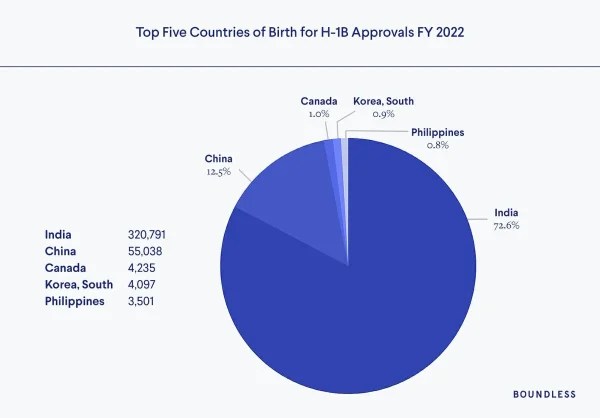
With a billion and a half people, India is still wildly overrepresented in the “talent pool,” especially because the H-1B pipeline in India tends to exclude 95 percent of the country.
India’s caste system is a complex social structure that has shaped the country’s society for millennia. Rooted in ancient Hindu scriptures, the system originally divided people into four social classes: Brahmins (priests and scholars), Kshatriyas (warriors and rulers), Vaishyas (merchants and farmers), and Shudras (laborers). In 2024, India remains a highly stratified society where one’s caste determines not only occupation but also social status, marriage prospects, and even dietary habits.
Brahmins, the elite caste Indians, only amount to about four percent of India’s population, but H-1B caters almost exclusively to Brahmins, especially when it comes to managerial roles.
The issues begin in the American university system, which continues to accommodate foreign students as an increasing percentage of total enrollment, forcing Americans to compete with the entire world for admission into elite STEM programs. The State Department hands out around half a million student visas each year, and there is seemingly no plan to roll back student visas.
Based on available data, there’s a large discrepancy between student visa holders and H-1B holders. Here’s a breakdown of student visas by country of origin in terms of percentage, focusing on the academic year 2022-2023, based on available data:
- China: Approximately 27.4%
- India: Around 25.4%
- South Korea: About 4.1%
- Canada: Roughly 2.6%
- Taiwan: About 2.1%
- Nigeria: Around 1.7%
- Japan: Approximately 1.5%
- Brazil: About 1.5%
- Saudi Arabia: Roughly 1.5%
- Mexico: About 1.4%
Around one-third of H-1B holders are U.S. university graduates, and about half come into the American workforce directly from their country of origin.
Because of the massive corruption and fraud in the talent pipeline, many current H-1B workers lack the social, cultural, and technical aptitude to mesh into an American workplace despite their claimed qualifications, leading to a major headache for their employer and the prospective American applicant who was left behind in the process.
Massive corporations like Infosys, Tata, Cognizant, Wipro, and HCL Technologies exist to facilitate this “talent” pipeline, and they have enormous influence on U.S. foreign labor policy. With a pooled value of hundreds of billions of dollars in market capitalization, they monopolized the H-1B program into a centralized cartel that recruits, hires, and fills roles in major American companies, freezing out applicants outside of the pipeline.
So, instead of finding the “best and brightest” in tech, three-quarters of all of America’s H-1B imports are likely to come from a social caste of around 50 million people, leaving behind 1.35 billion Indians in the process. In a world of 8 billion, the centralization of three-quarters of the H-1B program does no favors to Americans on either side of the debate.
Collapsing Empire: RIP ‘Overt Operations’
By Kit Klarenberg | Al Mayadeen | December 30, 2024
In recent months, a remarkable development in the Empire’s decline has gone almost entirely unnoticed. The National Endowment for Democracy’s grant database has been removed from the web. Until recently, a searchable interface allowed visitors to view detailed records of Washington-funded NGOs, civil society, and media projects in particular countries – covering most of the world – the sums involved, and entities responsible for delivering them. This resource has now inexplicably vanished, and with it, enormous amounts of incontrovertible, self-incriminating evidence of destructive US skullduggery abroad.
Take for example NED grant records for Georgia, the site of recent repeated color revolution efforts, at the forefront of which were Endowment-bankrolled organizations. While still accessible via internet archives, they were deleted during the summer. Today, visitors to associated URLs are redirected to a brief entry simply titled “Eurasia”. The accompanying text describes in very broad terms the Endowment’s aims regionally and the total being spent, but the crucial questions of where and on what aren’t clarified. In a comic hypocrisy too, the blurb boldly states:
“The heart of NED’s work in the region is the need to maintain access to objective information for local populations. Across the region, government actors are attempting to limit the space for citizens to distribute information and communicate freely online.”
Resultantly, independent academics, activists, researchers, and journalists have been deprived of an invaluable resource for tracking and exposing the Empire’s machinations. Yet, the Endowment incinerating its public paper trail can only be considered a significant victory for these same actors. NED’s explicit and avowed raison d’être was to do publicly what US intelligence did – and in many cases still does – covertly. Now, after 40 years of wreaking havoc worldwide in service of the Empire, the CIA front has been forced underground, defeating its entire purpose.
‘Spyless Coups’
NED was founded in November 1983, after the CIA became embroiled in a series of embarrassing public scandals. Then-Agency director William Casey was central to its construction. His objective was to create a public mechanism to conduct traditional CIA meddling overseas, except out in the open. Ever since, the Endowment has financed countless opposition groups, activist movements, media outlets, and trade unions to the tune of millions to engage in propaganda and political activism, to disrupt, destabilize, and displace ‘enemy’ regimes the world over.
The NED’s true nature was openly acknowledged by the mainstream media for many years. In June 1986, Endowment’s president Carl Gershman told the New York Times, “It would be terrible for democratic groups around the world” to be subsidized by the CIA. The exposure of such connivances meant they had been “discontinued”, and farmed out to NED. Several high-ranking interviewees strenuously denied there was any connection between NED and the Agency, although the outlet acknowledged many Endowment programs seemed “superficially similar” to past CIA operations.
At this time, NED was hard at work killing off Communism in the Soviet Union, Warsaw Pact, and Yugoslavia. This included for instance enormous investment in Poland’s famous Solidarity trade union, which became a global emblem of anti-Communist resistance. In September 1991, the Washington Post published a highly laudatory appraisal of these efforts, stating the “political miracles” the Endowment achieved in the former Soviet sphere had ushered in a “new world of spyless coups” and “innocence abroad”:
“The old era of covert action is dead. The world doesn’t run in secret anymore. We are now living in the age of Overt Action… When such activities are done overtly, the flap potential is close to zero. Openness is its own protection. Covert funding for these groups would have been the kiss of death, if discovered. Overt funding, it would seem, has been a kiss of life.”
NED proceeded to take down a number of governments throughout the 1990s and 2000s, very overtly. In many cases, mainstream outlets published highly revealing accounts detailing precisely how. In Ukraine in November 2004, Endowment-trained and bankrolled activists forced a rerun of that year’s presidential election. As The Guardian jubilantly reported, the entire effort was “an American creation” and “sophisticated and brilliantly conceived exercise in Western branding and mass marketing,” which had been repeatedly deployed in the new millennium to “topple unsavoury regimes”:
“Funded and organised by the US government, deploying US consultancies, pollsters, diplomats, the two big American parties and US non-government organisations…the operation – engineering democracy through the ballot box and civil disobedience – is now so slick that the methods have matured into a template for winning other people’s elections.”
‘Kiss of Death’
The next year, USAID published a slick magazine, Democracy Rising, bragging extensively about how it and NED were fundamental to a wave of revolutions in Georgia, Kyrgyzstan, Lebanon, Yugoslavia, and elsewhere during the first years of the 21st century. Fast forward to February 2014, and Ukraine’s government once again fell victim to an Endowment-orchestrated coup, in the form of the Maidan ‘revolution’. Yet, the media either ignored the irrefutable US role in fomenting the upheaval or dismissed the proposition as “Russian disinformation” or conspiracy theory.
This is despite contemporary polls never showing majority Ukrainian support for the Maidan protests; ousted President Viktor Yanukovych remaining the most popular politician in the country until his last day in office; every actor at Maidan’s forefront, including the individuals who started the demonstrations, receiving NED or USAID funding; leaders of US-financed organizations in the country openly advertising their desire to overthrow Yanukovych in the years prior; and the Endowment pumping around $20 million into the country in 2013 alone.
This mass omertà, which has intensified since, may be attributable to ever-rising hostility towards NED by foreign governments and populations, and associated efforts to restrict or outright proscribe the organization. The reality of the Endowment’s raison d’être and modus operandi has thus not only become unsayable but must be vehemently denied by Western journalists. Representatively, a July 2015 Guardian report on Russia banning NED quite unbelievably relied on a brief quote from the organization’s own website to describe its operations.
While the mainstream media may have remained silent on the NED’s mephitic influence overseas over the past decade, the same is not true of independent academics, activists, researchers, and journalists. The Endowment grant database served as an invaluable tool for keeping a close eye on Washington’s international intrigues and mapping the personal and organizational connections of agents and entities of influence. Meanwhile, NED’s status as a CIA front could be simply proven, via multiple public admissions of its own leaders.
Whenever protests erupted somewhere in the world and received widespread Western news coverage, concerned citizens could consult the NED grant database and find in the overwhelming majority of cases, most if not all individuals and groups quoted in media reports were in receipt of Endowment funding. While impossible to quantify, it would be unsurprising if dissident voices calling attention to this fact have averted color revolution efforts, disrupted external meddling campaigns, protected popular governments and political figures, and more.
Of course, despite NED brazenly purging evidence of its vast operations from the web, that conniving continues apace regardless, covertly. One might even argue the Endowment’s chicanery is all the more dangerous now, given individuals and organizations can conceal their funding sources. But the move amply shows NED today cannot withstand the slightest public scrutiny, which its very existence was intended to exemplify. It demonstrates that “overt operations” with open US funding are now the “kiss of death” the Endowment was meant to replace.
Kiev announces US gift of $15bn from seized Russian funds
RT | December 30, 2024
The US will provide Kiev with $15 billion, leveraging future revenues from frozen Russian central bank assets, Ukrainian Prime Minister Denis Shmigal announced on Monday. The Kremlin spokesperson Dmitry Peskov has previously said about Washington’s purported illegal transfer of Russian funds to Kiev that Moscow may challenge it in court.
The American funding is part of a broader $20 billion contribution under the G7’s $50 billion loan framework to Ukraine. The agreement was signed by Ukraine’s Ministry of Finance and the World Bank under the PEACE in Ukraine initiative, Shmigal claimed, in a post on his Telegram channel.
The G7, comprising the US, Canada, Japan, the UK, France, Germany, and Italy, initially pledged the $50 billion loan in June 2022, using profits from frozen Russian assets as collateral. Of the estimated $300 billion immobilized, $213 billion is held in the Brussels-based clearinghouse Euroclear.
Euroclear froze the assets of the Russian central bank in late February 2022, shortly after the EU imposed sanctions on Russia in response to the conflict escalation in Ukraine. The frozen funds have already generated billions in interest, with the clearinghouse transferring €1.55 billion ($1.63 billion) to Ukraine in July.
Moscow has vehemently criticized the asset seizures. Last Wednesday Dmitry Peskov condemned the measures as theft and warned of legal retaliation. He was reacting to Shmigal’s announcement that the US had already transferred to Ukraine the first installment of the $1 billion from the frozen Moscow central bank funds.
Last month, Russian Finance Minister Anton Siluanov said there are plans to mirror the West’s actions, using income from frozen Western assets in Russia.
“We have also frozen the resources of Western investors, Western financial market participants and companies. The income from these assets will also be used,” the official said.
The decision to use frozen Russian assets has previously stirred debate among G7 nations. European members of the club such as Germany, France and Italy have raised concerns over financial market stability and about the legal implications of such actions. The IMF has warned that seizing these assets without robust legal frameworks could erode global trust in the Western financial system.
Deborah Birx’s Bird Flu Fearmongering Campaign
By Daniel McAdams | Peace and Prosperity Blog | December 29, 2024
In June, I wrote about Deborah Birx, one of the key “public health” officials from the orchestration of the American coronavirus scare, being back in action stirring up fear of another disease. This time Birx’s fearmongering was about bird flu. And she was advocating for government to follow a similar disastrous course to supposedly counter this disease as had been pursued in regard to coronavirus in the crackdown begun years back.
Here is an update.
Birx is continuing on her quest to stir up a new bird flu scare in America, and to build public support for a government response harmful to health and liberty. A recent stop on Birx’s bird flu fearmongering campaign was a Friday interview at CNN in which she warned that, like coronavirus early on, bird flu is not being addressed sufficiently by the United States government. Now, she said, routine weekly testing of people who may have been exposed to bird flu needs to be undertaken.
This testing which Birx suggested mirrors testing that was pursued to build up fear of coronavirus through jacking up the number of coronavirus cases via testing that shot out many false positive results. Indeed, Birx stated in the interview that with bird flu much increased testing is needed because “we know from covid most of the spread was asymptomatic.” Got that? The testing is purposed to identify people as sick despite the fact that they are not sick.
Birx has her pandemic propaganda process down pat.
In her CNN interview pitch, Birx tried to butter up her potential victims, declaring “I find the American public to be incredibly smart.” Hopefully, most Americans will prove too smart to fall for Birx’s new fearmongering campaign and the attacks on health and liberty it supports.
Major Winners and Losers of Halting Russian Gas Transit Through Ukraine
By Ekaterina Blinova – Sputnik – 29.12.2024
As the Ukraine gas transit contract with Russia is set to end, Ukraine’s largest private energy company DTEK received its first delivery of liquefied natural gas (LNG) from the US on December 27.
Winners
US LNG producers:
- The halting of Russia’s gas deliveries through Ukraine will increase the US share and reduce competition in the EU market.
- The latest US LNG delivery amounts to 100 million cubic meters of gas (1 TWh of energy, or 3,530,000 MMBtu), bought by D.Trading, DTEK’s pan-European trading subsidiary. The shipment arrived at Greek LNG terminals such as Revithoussa, where it will be “re-gasified” and distributed “through EU and Ukrainian gas networks,” according to DTEK. One network, the Vertical Corridor, will transmit US LNG deliveries between Greece, Bulgaria, Romania, Hungary, Slovakia, Moldova, and Ukraine.
- LNG from the US for Europe is at least 30-40% more expensive than pipeline gas from Russia.
- In December 2022, the US became the world’s leading exporter of LNG amid Europe’s energy crisis and the sabotage attack on Russia’s Nord Stream pipelines.
Losers
- Ukraine: Ukraine will lose almost $1 billion annually from Russian gas transit fees. Additionally, Ukraine is likely to pay more for US LNG coming through the Revithoussa LNG terminal than for Russian pipeline gas, which used to come in the form of a “virtual reverse.”
- Hungary, Austria, and Slovakia which have long relied on Russian gas transit through Ukraine, will face challenges. Being landlocked, access to LNG delivered to marine terminals is costly and difficult. Long-term contracts with Russia’s Gazprom allowed them to buy natural gas considerably cheaper than EU gas spot prices. For instance, Austria had been receiving Russian gas at a price almost three times cheaper than EU spot prices in 2022, according to Reuters.
- European Union: After sliding to $11.79/MMBtu in October, European gas prices rose to almost $15/MMBtu on November 22. On December 27, benchmark futures rose further by 5% on the news of halted Russian gas transit through Ukraine. Stopping the supply of Russian gas through Ukraine will cost Europe around $125 billion in total losses in 2025-2026, according to Slovak Prime Minister Robert Fico.
Featured Video
No Vote, No Representation, No State: Democracy, Israeli Style
or go to
Aletho News Archives – Video-Images
From the Archives
Sanctions, War and the Policy of Dual Containment
By SASAN FAYAZMANESH | March 17, 2008
It is now nearly three decades since the Unites States adopted the policy of dual containment of Iran and Iraq. While much has been written about the containment of Iraq, there has been very little in-depth analysis of this policy when it comes to Iran. In a book that is going to be released on March 31, 2008, entitled The United States and Iran: Sanctions, Wars and the Policy of Dual Containment (Routledge), I attempt to address this shortcoming by investigating when and why the US policy of containment of Iran came about, how it evolved, and where it stands today.[1] To the extent that Israel has been involved in US policy making, the study will also include the role that Israel has played in the containment of Iran. Also, since the fate of Iran has been inextricably linked to that of Iraq, occasionally the investigation will overlap with the containment of Iraq.
The policy of dual containment of Iran and Iraq originated during the Carter Administration, but it was not until the Clinton Administration that the expression “dual containment” became popular. … continue
Blog Roll
 Aletho News
- No Vote, No Representation, No State: Democracy, Israeli Style
- Zionist Bought Senate Blocks Information About American Citizens Killed By Israel
- While Gaza dominates the UN, these are the people keeping it alive
- New Report: “Scholasticide and Genocide in Gaza: Assessment, Testimonies and Legal Analysis”
- ‘THAAD Delusion’: Iran war exposes US missile shield limits – The Atlantic
- Moscow issues warning to NATO over Russian exclave
- Yes, the Iran war has destroyed Trump’s presidency
- The fallacy of US delusions about Iran’s economic collapse
- Hezbollah denies Syria cell link, warns of Israeli plan to sow discord
- The legacy of US sanctions, war, and occupation in Iraq
- If Americans Knew
- Mamdani releases plan to combat antisemitism and hate crimes in New York City
- Iran’s Revolutionary Guards Publish Letter to the American People
- DMFI launches $1 million ad campaign supporting Virginia’s Elaine Luria
- US Senate blocks resolution seeking report on Americans killed by Israel
- Israeli Attacks Kill Ten Palestinians in Gaza
- Massacre at Minab: The School That Became a Grave
- Israeli media: The IDF Shows It Doesn’t Turn a Blind Eye; It Actively Emboldens Settler Havoc
- As settlers ravage West Bank, Israeli forces kill 10 in Gaza – Daily Update
- New Report: “Scholasticide and Genocide in Gaza: Assessment, Testimonies and Legal Analysis”
- Ex-Biden officials are desperate for a Gaza scapegoat
- No Tricks Zone
- Green Energy Debacle: German Expert Professor Fritz Vahrenholt Warns Of Severe Economic And Social Consequences
- Two More Paleo Reconstructions Affirm Meters-Higher Sea Levels Across Ireland, Brazil 7000-6000 Years Ago
- New Study: Earth And Venus Surface Warmth Largely Explained By Convection And Lapse Rate, Not CO2 Or Radiation
- 2025 Nature Paper Claiming Worsening Global Drought Gets RETRACTED …Heavily Flawed
- New Study: ‘Global Drought Shows No Detectable Recent Acceleration Under Climate Warming’
- Economic Masterminds: German Socialists Suggest Taxing Productivity Gains Stemming From Using AI
- The South China Sea Has Not Been Cooperating With The Climate Change Narrative
- Energy Crisis: Germany Enters Heating Season With Historically Low Gas Reserve Fill Levels
- New Study: The Antarctic Ice Sheet Gained Mass From 2020-2024 Due To Staggering Snow And Ice Accumulation
- Study: Ocean Heating Rates From Thousands Of Years Ago ‘Dwarf’ Modern Ocean Heating Rates

