Kiev reveals terms of $20 billion US loan
RT | December 9, 2024
The Ukrainian government has approved the terms of a conditional agreement with the US Federal Financing Bank (FFB) for a 40-year loan of $20 billion which will be backed by profits from frozen Russian state assets.
It’s part of a broader $50 billion G7 loan deal, which includes a separate $20 billion EU commitment, and $10 billion to be split by G7 members Britain, Japan and Canada.
The money will be transferred to the Facilitation of Resources to Invest in Strengthening Ukraine Financial Intermediary Fund, established by the World Bank on October 10, “for the sake of the state,” a resolution issued by Ukraine’s Cabinet of Ministers on Friday stated.
The transfer will be based on a Certificate Purchase Agreement between Ukraine, the FFB, and the US Agency for International Development (USAID), along with a loan guarantee and repayment agreement between Ukraine and USAID.
Under the deal, Ukraine’s Finance Ministry will issue a certificate of indebtedness to the FFB, guaranteed by USAID, the government resolution said.
The loan, which has an annual interest rate of 1.3% plus the current average rate for one-year US Treasury bills, will be repaid using interest earned from immobilized Russian sovereign assets.
The US and its allies froze an estimated $300 billion in assets belonging to the Russian central bank following the escalation of the Ukraine conflict in February 2022. In June, G7 members pledged a $50 billion loan for Kiev, with the frozen Russian assets to be used as collateral, to help Kiev buy weapons and rebuild damaged infrastructure. The agreement was finalized in October.
Moscow has repeatedly denounced the asset freeze as “theft” and argued that tapping into these funds would be illegal and set a dangerous precedent. The Russian Finance Ministry has warned that it will initiate retaliatory measures mirroring the West’s actions against resources of Western investors held in the country.
The latest move is part of the current US administration’s last-minute strategy to bolster Kiev’s war effort, which includes a new $725 million military aid package to Kiev and another round of sanctions against Russia. It comes as uncertainty grows over Washington’s commitments under the upcoming presidency of Donald Trump, particularly after US House Speaker Mike Johnson dismissed President Joe Biden’s request to include $24 billion in additional aid to Ukraine in a government funding bill last week.
Biden claims credit for toppling Syria’s Assad
RT | December 9, 2024
Outgoing US President Joe Biden has claimed credit for the fall of Damascus to a coalition of armed groups, including jihadists from Hayat Tahrir-al-Sham (HTS). Washington had weakened the supporters of former Syrian President Bashar Assad, the American leader has said.
The result of the lightning offensive of anti-government militants in the past two weeks was a “fundamental act of justice” and a “moment of historic opportunity for the long-suffering citizens of Syria,” Biden said in a video address from the White House on Sunday.
“For years, the main backers of Assad have been Iran, [the Lebanese-based militant movement] Hezbollah, and Russia. But over the last week, their support collapsed, all three of them. Because all three of them are far weaker today than they were when I took office,” Biden said.
Washington has been pushing for the ouster of Assad since 2011, when mass protests spiraled into a devastating civil war, in which foreign-armed Islamists emerged as dominant players among anti-government forces. HTS, one of the groups that took over Damascus on Sunday, was formerly known as Jabhat al-Nusra, a Syrian Al-Qaeda affiliate. The war was exacerbated further in 2014 when the terrorist group Islamic State (IS, formerly ISIS) rose as a regional threat amid the collapse of security in Syria.
In his speech, Biden highlighted the sanctions on Syria, as well as the US military presence in the country and its support for Kurdish militias in the northeast, which denied Damascus access to fertile lands and oil fields under their control. The US has also supported Israel in its military campaigns in Gaza and Lebanon and its direct confrontation with Iran, Biden added.
“Our approach has shifted the balance of power in the Middle East,” Biden said, mirroring similar remarks by Israeli Prime Minister Benjamin Netanyahu.
“Through this combination of support of our partners, sanctions, diplomacy, and targeted military force where necessary, we now see new opportunities opening up for the people of Syria and for the entire region.”
The US president claimed that Washington was clear-eyed about HTS and its “grim record of terrorism and human right abuses.” Washington will “assess not just their words, but their actions,” he stated. Biden’s national security adviser, Jake Sullivan, said on Sunday that HTS’ history of terrorism and atrocities is a concern for the US.
Abu Mohammed al-Julani, the current leader of HTS, has had a $10 million bounty posted on his head by the US since 2013. According to the US government, the fighters he led were responsible for kidnappings and massacres of civilians.
Syria falls to rebels who are “a tool of NATO, Israel and Turkey” with US role included
By Uriel Araujo | December 9, 2024
After combating terrorism and rebel groups for over twelve years, the former Syrian President Bashar al-Assad fled the capital of Damascus with his family on December 7, shortly before it fell to the rebels. The victorious insurgents are the Hayat Tahrir al-Sham (HTS) organization along with an umbrella group called the Syrian National Army.
Craig Murray (former British ambassador to Uzbekistan), in a panel about “the end of pluralism in the Middle East”, described the “Syrian rebels” as “a tool of NATO, Israel and Turkey”. This is a complex description for a complex situation indeed. Of the three, many analysts are focusing on the Israeli and Turkish angle—not so much on the American angle, though.
To recap, since the 2011 armed rebellion, Syria has counted on military aid from its allies Iran and Russia. The Iranian Revolutionary Guard, as well as the (Tehran-backed) Lebanese Hezbollah have in fact been the main anti-terrorist actors in the Levant, by deterring the expansion of terrorist group ISIS (Daesh) and thereby making the region safer for Christians and other minorities. Islamic Wahhabi/Salafi extremists were, after all, beheading some of them while kidnapping others and selling women as slaves.
The fact is that the rebels who have won in Syria now are not of a very different persuasion, and it is no wonder many are now concerned. Archbishop Ieronymos of Athens for one has urged the Greek Ministry of Foreign Affairs to aid the Christian population in Syria. He wrote: “The advance of extremist armed groups and the capture of Aleppo threaten… the interfaith composition of the region’s population… there is now a looming danger of the complete eradication… of Greek Orthodoxy and Christianity from the wider region.”
Such concerns are well founded. One should bear in mind that (Saudi-born) Abu Mohammed al-Julani, the very leader of Turkish-backed HTS, the group who has captured Aleppo (Syria’s second largest city), joined Al-Qaeda in Iraq in 2003, later establishing its split branch in Syria, the so-called al-Nusra Front. This group, under al-Julani, cooperated with the infamous Abu Bakr al-Baghdadi, leader of Al-Qaeda’s split offshoot called “Islamic State in Iraq”, later known as ISIL (ISIS) or Daesh.
Al-Julani’s own later split from al-Qaeda and creation of the aforementioned HTS has been described as merely a “bid” to “stress his group’s national, as opposed to transnational, ambitions.” In other words, the group is just another re-branded offshoot of ISIS/Al-Qaeda. And those are the people who have now conquered Syria.
One might disapprove of Assad’s ruling but such a development can hardly be described by most as anything other than a disaster. Turkey (who aids the rebels) and Israel, as already mentioned, do benefit from this outcome, however, for their own reasons—and much is already being talked about that. But not so many analysts are highlighting the American role in all of it.
For example, the US-backed Syrian Free Army (a coalition which has taken control of Hom’s Palmyra district) announced that they are “open to friendship with everyone in the region – including Israel. We don’t have enemies other than the Assad regime, Hezbollah and Iran. What Israel did against Hezbollah in Lebanon helped us a great deal” – while claiming they are not allied with Turkey. The group, being increasingly dependent on Turkey, is a close ally of the United States, and was even hosted at the American military base at al-Tanf. Turkey, despite its differences with Washington is of course also, let us not forget, a NATO member.
The future of Syria and the concerned parties is far from clear now, there being lots of room for infighting among the different rebel factions. Turkey, which has long occupied northern Syria, has taken advantage of the ceasefire in Lebanon to give the rebels the green-light for launching an offensive (with Iran weakened in Syria and Hezbollah cornered in Lebanon). However Turkish-American differences pertaining to the Kurdish question are to remain a focal point for tensions.
HTS is indeed Turkish-backed but, as mentioned, its roots can be traced to Al-Qaeda, ISIS, and other such groups empowered by Washington’s policy. One should not forget the fact that there are still around 900 US troops in Syria (mostly in the northeast, near Turkish strongholds) which witnessed the rebel victory. This has led some analysts to comment that “whether the Pentagon wants to admit it or not”, these troops are “likely involved in the broader conflict unfolding there right now.”
Moreover, there is nothing new about the West praising and empowering brutal terrorism and radicals when such is deemed geopolitically convenient: if former US Secretary of State Hillary Clinton under President Barack Obama had achieved her stated goals, Syria would be in a similar situation to Libya since 2011 – in Libya, coincidence or not, arms provided by the US to rebels there also “ended up” in ISIS hands, according to Amnesty reports.
Back to the Levant region, it is a well-established fact that Washington played a key role in the empowerment of ISIS (or Daesh) both in Syria and Iraq (as well as other brutal radicals), with the Pentagon and the CIA arming mostly foreign Islamic militias that ended up even fighting among themselves. This is consistent with American foreign policy elsewhere too. The infamous Clinton emails also show how the US was aware of their allies Qatar and Saudi Arabia supporting Daesh terror.
The White House National Security Council (NSC) spokesperson Sean Savett said in a recent statement that Washington “has nothing to do with this offensive.” Considering all of the above, one can certainly be justified in taking such statements with a grain of salt. For Washington, further destabilizing Syria might also serve the role of “countering” Russia in the region. The US has consistently aided, funded, armed and trained Fundamentalist rebels who operate in the Levant for over a decade and there is no reason to assume anything is different now with the newest developments.
Finally, still on the topic of the Christian minority, US foreign policy—for a variety of reasons—has actually often involved dividing or destabilizing Eastern Christian (both Orthodox and Miaphysitist) populations or sometimes even aiding or turning a blind eye to the ethnic-religious cleansing of such groups or of Christians in general in the Levant region, for that matter.
This is of course quite ironic for a country such as the US who often hails itself as “one nation under God” or as a “Christian nation”– this being the Republican party line at least. Trump for one has posted that “Syria is a mess, but is not our friend”.
Uriel Araujo, PhD is an anthropology researcher with a focus on international and ethnic conflicts.
Regime Change in Syria: Another Step Towards “Greater Israel”
By Alan Sabrosky • Unz Review • December 8, 2024
“For they have sown the wind,
and they shall reap the whirlwind.”
-Hosea 8:7
The collapse of the Assad government in Syria is certain to be greeted with considerable satisfaction in Jerusalem and Washington. Both capitals of the Zionist Co-Dominium have long seen the Assads much as they did Iraq’s Saddam Hussein and Libya’s Muammar Gaddafi. All were obstacles to Israel’s designs in the region.
All three were also targets of that nefarious policy of “regime change” highlighted by the US after 9/11, as were four other countries in the region. Now the last of the three has fallen, albeit much later than the mostly Jewish neoconservative “chicken hawks” (so called because all advocated war but very few ever served in uniform) had anticipated back in 2001.
So What Caused the Collapse?
Internal dynamics within Syria that played their part, to be sure, but I will focus here on the external factors. A major reason was the unrelenting pressure and considerable resources poured into the assorted militias and jihadists trying to overthrow Syria’s regime. Money talks, and it talked very loudly here. So did the frequent Israeli air and artillery strikes into Syria. Shielded by the US, Russian forces in Syria could do little for their ally.
Then, too, the numerically small but politically significant, open-ended US military presence on the ground in Syria had their own impact, So did the limited but strategically significant direct military attacks by the US and other NATO countries on Syrian government forces and installations. Image matters, and here it mattered greatly.
Syria’s Assad could never match that. Only Russia (to a very limited extent) and Iran (to a even lesser one) really did much of anything. But Russia is caught up with the Ukrainian “tar baby” and Iran is hedging its bets in anticipation of America’s own “regime change.” A scarcity of strong, reasonably reliable allies also counts, and it counted here, but not in a good way.
Second, Syria lost the information and propaganda war, in a very big and very decisive way. The Jewish-dominated media in the US and most of Europe made sure that virtually every claim, no matter how ludicrous, of the jihadists and other anti-government elements in Syria was treated as Gospel truth. Few in the legacy media disputed their assertions, although many did in the alternative media and on social media platforms.
It wasn’t enough. Israel can rip Gaza apart and kill tens of thousands of civilians, but any criticism of its very real war crimes is almost universally denounced in the media and Western capitals as “vicious antisemitism” that needs to be suppressed and punished. That criticism was nothing of the sort, but it demonstrates the exceptional degree of Jewish influence throughout the West. It also underscores the accuracy of the axiom that “truth is the first casualty of war,” at least whenever Israel or its interests are involved.
Third, it is worth noting that this event saw insurgent militias and local jihadists do to the Syrian government forces what the US-backed mujaheddin did to the Afghan government and their Soviet allies, and later the Taliban (the lineal operational descendants of the original mujaheddin) did to another Afghan government and its American patron. It seems that local governments have very great difficulty holding out against insurgents who have an external sanctuary, external assistance, or both.
In all three cases cited above, the insurgents had both. In Syria, the government forces had also to contend with direct military attacks by Israel, the US and other NATO countries. What made it harder for them was that they essentially fought these external forces with one hand firmly tied behind their backs.
Other than in defense, Syrian government forces could only engage in occasional artillery duels with the Israelis, but not respond to air attacks in kind. Nor could the Russians assist them, other than defensively. Any attempt to respond directly to US, Israeli or other attacks meant a direct confrontation with the US, Israel covered by its American puppet, or NATO. The Syrians could not do this alone, and Syria simply was not worth enough to Russia to risk that kind of engagement.
Reflections
It will take some time for the implications of all this to become clearer (perhaps “less murky” would be more accurate). I expect the current Syrian government officials and senior military commanders are wondering if they will still be alive next week. I am not a specialist on Syrian affairs, but the historical track record in these situations would not be reassuring to them.
I expect, however, a major consideration on the part of the winners will be the role intended for them by their foreign patrons. Do we want the new Syrian government to be another Egypt, at least insofar as Israel is concerned? Or is it something else?
Whatever it is, insurgent forces – even heavily infiltrated ones – have shown themselves to be exceptionally difficult to predict or to control, or even to influence, once they are in power. Recall that the people the US armed to fight the Soviets in Afghanistan morphed into a Taliban which employed some of those weapons and techniques to force yet another humiliating American debacle.
The Israeli experience with these things is even more problematic. I was told back in the 1980s by a senior Israeli officer that they had successfully infiltrated every single Arab government and movement, relying principally on Sephardic Jews. So when Israel set up Hamas in the 1980s as a counter-weight to the PLO, I expect they thought they had made a good bargain. Yet it, too, changed over the years. Infiltrated or not, it has given Israel a more “interesting” time than it anticipated.
The case of ISIS and the Syrian jihadists is even more interesting. Now, “false flags” (attacking someone but making people believe someone else is doing it) is something of an Israeli specialty. The motto of Mossad, the best-known Israeli intelligence organization, is aptly “By Deception, Shall You Wage War.
Mossad and its sister organizations have lived up to that motto since the founding of Israel. They have been aided worldwide by dual Israeli citizens, or Jews without Israeli citizenship, some Christian Zionists, and outright mercenaries.
Examples abound. Three of particular relevance to the US, for example, are the Lavon Affair in Egypt (1954), the attack on the USS Liberty (1967) and the 9/11 attacks (2001). Worth looking them up (do NOT trust either Wikipedia or Google search engine!), but here is a start on the last-named one.
The case of ISIS is even more intriguing. Supposedly a militant Islamic organization, it seems to have exceptionally great difficulty hitting Israeli or American targets anywhere in the world. This was a problem Osama bin Laden’s Al-Qaeda, with fewer assets, obviously did not share.
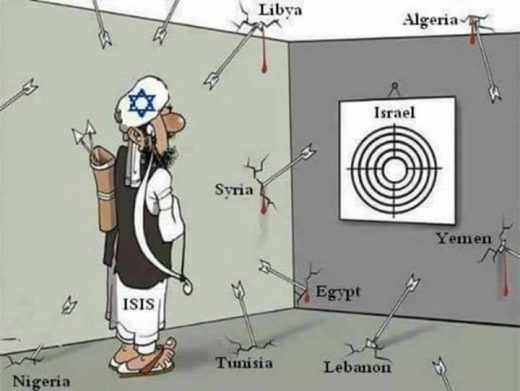
Despite the resources to field fleets of white Toyota pick-up trucks with heavy weapons in their beds and other paraphernalia, they found it an “almost” insurmountable challenge to strike what should be their own principal enemies. Curious, is it not? I wonder how many ISIS leaders have shared drinks with their Mossad and CIA contacts.
Last are the Syrian jihadists, easily the most fascinating facet of the Syrian puzzle. We are told constantly that these people are Islamic fanatics who spend their nights dreaming of how to kill non-believers, and their days trying to do it (or is that backwards?). But apparently there are “good” jihadists and “bad” jihadists. The former are those who do the bidding of Western governments (including Israel) and attack Muslim countries. The latter are those that apparently do not.
Peering Ahead
It is hazardous at best to anticipate what will emerge in the aftermath of the Syrian government’s defeat. At a minimum, I would expect the new rulers to order the Russians out. Of course, the Russians may not go, just as the US ignored the demands of many weaker governments to leave. Imperial powers, even if weakening and in a chaotic world, are often like that.
We may learn a bit more about ISIS and these “good” jihadists in Syria. Precisely what will they do in power? Will they be like the Taliban in Afghanistan? If not, what would that say about their actual character and that of their leaders? Thought-provoking times, at best.
What is clearer is that what happened in Syria will embolden the Israelis to deal with the Palestinians within and Lebanon and Hezbollah without, especially once Trump is President and recognizes Israeli sovereignty over East Jerusalem and the West Bank. Trump is even more beholden to Israel than most US presidents, and Israel will capitalize on it.
Moreover, with Assad’s Syria removed from the game, Iran will move to the regional front burner. No person in the US can now even be a serious candidate for President without being in Israel’s pocket, much less be elected to that office, but the two American political factions have different priorities.
What this means is that the Neo-conservatives stacking up in Trump’s administration are an odds-on certainty to see this as a golden opportunity to complete their 2001 agenda and neutralize Iran. Knowing them, they and Jewish money will push (perhaps I should say “nudge”) Trump to do one of three things: (1) support Israel in attacking Iran, (2) join Israel in doing that, or (3) attacking Iran without Israel.

The net effect is a far more dangerous 2025 than recent years have seen, and they have not been exactly a joy. We face civil upheaval at home and more war abroad, if Trump actually puts his agenda into effect. For Israel, Syria’s defeat and Trump’s presidency augur well on its march to a “Greater Israel.” For Palestinians. Lebanese and so many others in the region, things have gone from bad to an almost unimaginably worse. For Americans, challenging times, indeed.
Alan Ned Sabrosky (PhD, University of Michigan) is a ten-year US Marine Corps veteran. He served in Vietnam with the 1st Marine Division and is a graduate of the US Army War College. Dr. Sabrosky can be contacted at docbrosk@comcast.net
NBC Blasts Trump and Kennedy for Wanting to Conduct Vaccine-Autism Studies
NBC claims this issue has been debunked … but has it?
Injecting Freedom by Aaron Siri | December 8, 2024
NBC today blasted DonaldTrump and RobertKennedyJr for wanting to study a possible connection between “autism and childhood vaccines” because NBC claims it has been “debunked” by “hundreds of studies.” But has it? The answer is unmistakably “no!” Here is the proof:
Most parents with autistic children claim vaccines – including DTaP, Hep B, Hib, PCV13, and IPV, each injected 3 times by 6 months of age – are a cause of their child’s autism.* Yet the studies to support that these vaccines do not cause autism have not been conducted.
In 1986, Congress passed the National Childhood Vaccine Injury Act in which it ordered federal health authorities (HHS) to study whether pertussis vaccine can cause autism due to parental complaints regarding same.
In 1991, the Institute of Medicine (IOM) issued its report on this question and could not find a single study on the question of whether pertussis vaccine causes autism. Meaning, the science had not been done.
In 2012, the IOM was again commissioned to study this question, this time by CDC, and also the question of whether tetanus and diphtheria vaccines can cause autism (DTaP), and again the IOM could not find a single study to support the claim that these vaccines do not cause autism. Not one. But it did find one study supporting that DTaP vaccine is correlated with autism but threw it out since it was based on VAERS data.
In 2018, I deposed the world’s leading vaccinologist about the 2012 finding by the IOM and while admitting there are no studies to support that these vaccines do not cause autism, he said he would nonetheless tell parents vaccines do not cause autism even though he has no evidence to support that claim.
In 2019, we sued CDC for the studies it claims support that the vaccines given in the first six months of life do not cause autism. CDC then identified 20 studies: 18 of those studied a different vaccine (MMR) or an ingredient not in these vaccines (thimerosal), and one irrelevant study looked at antigens. Incredibly, the final study CDC identified was the 2012 IOM review that found no studies supporting that DTaP doesn’t cause autism.
In 2020, in a lawsuit specifically about vaccines and autism, one the world’s leading vaccinologists admitted under oath that there were no studies to support that vaccines given in the first six months of life do not cause autism.
This is why actually studying whether vaccines cause autism is important: Video report
While CDC claims that vaccines do not cause autism, despite demanding the studies to support this claim for the vaccines given in the first six months of life, and asking, suing, deposing, etc., for them for years, we still have not received a single such study.
But NBC doesn’t really care about the facts, rather it just repeats the dogmatic claim that “vaccines do not cause autism” like a mantra.
One final thought: given the lack of studies regarding vaccines and autism – the issue CDC and “health” authorities claimed to have most thoroughly studied – imagine the state of the “science” with regard to the 100 other serious harms (often immune or immune-mediated disorders) parents claim are caused by vaccines. (For more meat on that bone watch Episode 388)
The Pentagon’s new plan to protect Pacific air assets from Chinese missiles may be the dumbest ever
Inside China Business | December 5, 2024
Most of the Western Pacific is easily within range of China’s missile brigades, and Pentagon war planners are gravely concerned that Chinese hypersonic missiles would destroy allied naval and air units, within moments of a breakout in hostilities. The Pentagon has embraced a new strategy, called Agile Combat Employment. It involves new construction and additions to over a dozen new airfields across the Pacific, where crews can land heavy bombers and other aircraft in the event the primary bases are too badly damaged. China has over 2,000 ballistic missiles, and a mere two or three would suffice to cripple a major airfield beyond use. It is difficult to imagine how building twelve more will make much of a difference. But even if so, the public affairs officers involved in these projects have shared sensitive data on these plans with major news outlets, including the Wall Street Journal. What’s more, the strategy presupposes a willingness of other nations to host American nuclear weapons platforms during a hot war with China, in perpetuity.
Resources and Links:
Substack, for video transcript and direct links https://open.substack.com/pub/kdwalms…
Scatter and Survive: Inside a U.S. Military Shift to Deny China ‘Big, Juicy’ Targets https://www.wsj.com/world/us-military…
US beefing up missile deployment in Europe
RT | December 8, 2024
The US is stepping up efforts to increase deployment of intermediate and short-range missiles, including stationing hypersonic weapons in Europe and Asia, according to information obtained by RT. Production and deployment of such systems in the US has reportedly been picking up pace in recent years.
Among the major weapons being developed is the multiple-launch rocket system Dark Typhon, which will be capable of firing Standard-6 missiles with a 500-km range and Tomahawk cruise missiles (2,400-km), as well as a hypersonic missile that is also still being developed. The system is expected to become operational by 2025.
During the NATO summit this past July, Washington and Berlin announced that Dark Typhoon would be stationed in Wiesbaden, Germany starting in 2026, a prospect that Russia slammed as an “escalatory action” given that it would place the missiles within range of Moscow, St. Petersburg, and other major Russian cities. The Pentagon also reportedly plans to deploy the system on the Japanese island of Io by October of next year, which would put the missiles within 2.5 hours flight time of Russia’s Vladivostok.
Among Washington’s most ambitious projects is the Dark Eagle hypersonic missile, which is designed to hit critical land-based targets within a range of 5,500km with strike precision of 3-10 meters. While still being developed, the prototype has passed at least seven tests, four of them successfully.
According to the information obtained by RT, the US plans to start deploying the missiles in Japan by October 2025, which would put them within 8-10 minutes’ flight time from Vladivostok. By 2026, one rocket launcher equipped with 16 missiles is expected to be stationed in Wiesbaden, with a flight time to central Russia also estimated at 8-10 minutes.
Russia has long warned that the US military buildup and the deployment of nuclear-capable missiles will draw a proportionate response. Earlier this week, Russia and Belarus signed a security treaty, which, among other things cemented the deployment of Russia’s brand-new hypersonic ballistic Oreshnik missile systems in the neighboring country next year. The Russian military combat tested the Oreshnik last month, using it to strike a Ukrainian military industrial facility in Dnepropetrovsk with multiple warheads.
Washington unilaterally pulled out of the Intermediate-Range Nuclear Forces Treaty (INF) with Russia back in 2019. Moscow also subsequently abandoned the treaty. Under the INF, both countries were prohibited from new deployments of ground-based ballistic and cruise missiles with ranges between 500 and 5,500km.
US admits much-hyped tanks failed in Ukraine
RT | December 8, 2024
American-made M1 Abrams tanks were “not useful” to the Ukrainian military, despite being billed as a potential “game changer” in the conflict with Russia, US National Security Adviser Jake Sullivan has admitted.
After months of requests from Ukrainian leader Vladimir Zelensky and his officials, the White House approved the transfer of 31 M1 Abrams main battle tanks – enough to equip an entire tank battalion – to Ukraine in January 2023. President Joe Biden said the tanks would help “counter Russia’s evolving tactics and strategy on the battlefield in the very near term,” while multiple US media outlets described them as a “game changer” ahead of Kiev’s planned counteroffensive against Russian forces that summer.
This was not the case, Sullivan said at the Reagan National Defense Forum in California on Saturday. Asked whether the Biden administration could have better prepared Ukraine for the counteroffensive had it supplied Kiev with more heavy weapons, he cited the Abrams tanks as an example of how not everything in America’s arsenal worked in Ukraine.
”When it comes to Abrams tanks, we sent Abrams tanks to Ukraine,” he replied. “These Abrams tank units are actually undermanned because it’s not the most useful piece of equipment for them in this fight.”
Shortly after their deployment, the Russian Defense Ministry began releasing videos of Abrams tanks burning on the battlefield. According to some estimates, as many as 20 of the 31 tanks sent to Ukraine in 2023 have since been destroyed, and Ukrainian commanders began withdrawing the rest from service earlier this year, American officials told AP.
The M1A1 variants sent to Ukraine were first stripped of their depleted uranium armor, leaving them vulnerable to Russian drones and anti-tank missiles.
One of the heaviest main battle tanks in service worldwide, the M1 Abrams weighs in at 60 tons, with the latest M1A2 variant increasing this heft to more than 73 tons. An M1 Abrams tank costs more than $450 per mile in fuel and repairs, according to a 1991 Government Accountability Office (GAO) report adjusted for inflation.
The GAO report stated that the average M1 Abrams needs its track replaced after as little as 710 miles, with engines typically suffering catastrophic “blowouts” after 350 hours of operation.
Even before Biden authorized their delivery to Ukraine, US military officials warned that the Abrams tanks would prove unsuitable for Kiev’s needs.
“The challenge with the Abrams is, it’s expensive. It’s difficult to train on. It is very difficult to sustain. It has a huge, complicated turbine engine that requires jet fuel,” US Undersecretary of Defense for Policy Colin Kahl warned in early January 2023. “Frankly, our assessment is just that the Abrams is not the right capability at this time.”
US, Canadian universities hire Israeli firms to curb pro-Palestinian protests, report says
Press TV – December 7, 2024
A report by an Israeli newspaper reveals that several universities across the United States and Canada have engaged Israeli-linked security firms to suppress pro-Palestinian protests on their campuses.
The report by the Yedioth Ahronoth highlights that following Donald Trump’s election campaign, during which he promised to penalize institutions that didn’t adequately control “radicals and Hamas supporters,” many universities sought Israeli security companies for assistance in managing protest activities.
The City University of New York (CUNY), a significant site for protests in the past year, has recently signed a contract worth $4 million with Strategy Security Corp., owned by Yosef Sordi, a former New York City police officer with professional training in Israel.
The report also draws attention to the involvement of Israeli security firms in violent confrontations that occurred in May at the University of California, Los Angeles (UCLA). Protesters stated that personnel from Magen Am, a company with Israeli military ties, were aggressive in their actions during the demonstrations.
UCLA confirmed that the firm worked alongside local police to manage the protests, with the company receiving $1 million in return.
Additionally, the Contemporary Services Corporation (CSC), which has a specific division in Israel, has been contracted to oversee demonstrations at various US university campuses.
In Montreal, Concordia University has engaged two Israeli security firms: Percentage International and Moshav Security Consulting.
In April, Columbia University students and faculty staged a sit-in opposing Israel’s genocidal actions in Gaza, demanding the administration cut ties with Israeli universities and divest from companies supporting the occupation.
As police intervened and arrested dozens of protesters at US universities, similar demonstrations spread to universities across France, the UK, Germany, Canada, and India, as protesters expressed solidarity with their American counterparts and called for an end to the war on Gaza.
Israel’s ongoing genocidal war on Gaza has killed over 44,664 people, most of them women and children, since October 7, 2023.
Last month, the International Criminal Court issued arrest warrants for Israeli Prime Minister Benjamin Netanyahu and former war minister Yoav Gallant for war crimes and crimes against humanity in Gaza.
Israel is also facing a genocide case at the International Court of Justice due to its genocidal campaign in Gaza.
Germany Deindustrialising & Subordinated
Sevim Dağdelen, Alexander Mercouris & Glenn Diesen
Glenn Diesen | Dec 2, 2024
I had the pleasure to speak with Sevim Dağdelen (member of parliament) and Alexander Mercouris about the changes within Germany and its role in the world. Germany has been the economic powerhouse pulling the EU forward and it represented a peaceful way to do politics. Yet, Germany changed fundamentally within a relatively short period of time as the German economic locomotive has gone off the rails. Germany is de-industrialising, it has subordinated itself to the US, and there is an absence of political leadership. It fuels the proxy war in Ukraine and supports genocide in Palestine. German is pursuing self-harm as it keeps buying Russian oil from India at a much higher cost, buying expensive American LNG after the Americans destroyed their energy infrastructure, and Germany gave Joe Biden a medal even as the US Inflation Reduction Act relocates German industries to the US. Sevim Dağdelen explains how Germany ended up pursuing these seemingly irrational policies, and she outlines alternatives to turn things around.
Watch at Odysee
Growing distrust of the USA globally
By Vladimir Mashin – New Eastern Outlook – December 7, 2024
The special military operation in Ukraine essentially puts an end to the unipolar world in which the Americans considered themselves the supreme ruler, bossing around other countries.
The movement from a unipolar world to a multipolar reality takes several years and this process is not always linear. It is appropriate to recall the words of N. G. Chernyshevsky: history is not the sidewalk of Nevsky Prospekt; it goes in zigzags, with digressions, etc.
At the same time, Israel’s war in Gaza, which began in October, 2023, has noticeably accelerated this process. There are many signs that Israel’s horrible military behaviour in the Palestinian enclave under the guise of self-defence had significant geopolitical consequences, which first and foremost manifested themselves in undermining the US’ status as a global superpower. The world is deeply polarised again; the Global South no longer sees the West as a defender of values and the rule of law.
The United States has seriously weakened the UN Security Council, repeatedly using its veto power to thwart draft resolutions calling for an unconditional ceasefire in Gaza. The fact that many so-called Western liberal democracies defended Israel’s policy of genocide has undermined the functioning of the existing world order.
US ‘mediation’ in favour of Israel
Israel has put itself above the law and it did so with the unconditional support of the United States. For many years, the US, which designated itself the exclusive mediator in the political settlement between Israel and the Palestinians, accepted without any reservations the expansion of illegal Israeli settlements in the occupied territories, ignoring the demolition of Palestinian houses, murder and the imprisonment of thousands of people. In fact, they encouraged the apartheid regime and used their influence in the UN Security Council to curb any attempts to hold Israel accountable.
During the first Trump administration, Washington went even further, unilaterally recognising Israel’s illegal annexation of East Jerusalem and the Syrian Golan Heights. By doing so, the Arab News newspaper emphasised in an article on November 26, “the United States itself became a rogue state violating international law and becoming guilty of Israeli war crimes”.
Israeli extremists assume that the United States will give them the green light to annex the West Bank of the Jordan River and thereby destroy any prospect of creating a Palestinian state.
It is the United States that is guilty of destroying many opportunities to settle the Arab-Israeli conflict. The Israeli newspaper Yedioth Ahronoth noted at the end of November this year that President Bill Clinton, wishing to go down in history as a peacemaker, made a bold diplomatic gesture on December 13, 1998, by visiting Gaza and the site of the future international airport of Palestine. Clinton and his wife Hillary were then greeted by Yasser Arafat and his wife Suha. The US president, whose term in office was ending, privately assured several Arab officials of his intention to declare his support for Palestinian statehood before leaving office. However, as always, his promises only remained on paper.
At the end of November this year, some Americans spread rumours that the Biden administration hinted at the possibility of supporting the Security Council resolution calling for the creation of an independent Palestinian state in an attempt to somehow wash the blood off its hands.
The West is no longer at the helm
Following the sharp international reaction to the war in Gaza, the United States are among the only open supporters of Israel’s actions. This obvious disregard by Washington and its allies for Palestinians lives has seriously undermined their authority and influence in many parts of the globe – and above all in the Global South.
The US position in the world is weakening as a result of Russia’s firm and consistent vector, China’s rapid economic growth, the birth of new coalitions of the Global South (such as BRICS, SCO, ASEAN, etc.). Regional powers such as Türkiye, Iran, Saudi Arabia, Brazil, Indonesia, South Africa, Malaysia, etc. are gaining strength.
The growing global influence of non-Western cultural movements, especially the media, challenges the power of traditional Western media. The proliferation of diverse sources and social media platforms significantly limits the role of the once dominant Western newspapers and TV channels. Not only is America’s position weakening, but there is an unprecedented drop in confidence in government structures in Western Europe.
The transition to a multipolar world is a reality that coincides with the decline of US global hegemony and Trump’s ‘America First’ policy. As the United States retreats to its chambers, its global influence will decrease.
In the United States, there is a growing awareness of the decline of the US role in international affairs. The West is no longer at the helm, the Bloomberg agency wrote on November 20; more and more countries no longer want to play by the old rules. The domestic political situation is so tense that Bloomberg concludes that the US is in a revolutionary situation and that the decline of ordinary people’s well-being decreases trust in the ruling elites.
However, the West is not going to give up its positions without a fight, so we are yet to face new crises and cataclysms.
Australian falsely charged with selling arms to North Korea wants compensation from Canberra
By Jenniffer Seewald | RT | December 7, 2024
A South Korea-born Australian became a worldwide sensation overnight when he was arrested for allegedly attempting to broker several deals with North Korea, a breach of UN sanctions. What made the coverage fly off the shelves was that 59-year-old Chan Han Choi was then charged with having assisted the North Korean weapons of mass destruction program. It was 2017 and the first time anyone was ever prosecuted under Australia’s Weapons of Mass Destruction Act, adopted in 1995. Though the WMD charges against Choi were later dropped, he spent three years in prison and filed for compensation from the Australian government, alleging human rights violations and other illegal actions that he says were committed by the authorities while he was in custody. The violations he reported include torture, ill-treatment, and medical neglect.
During the hearing, Chan Han Choi did not deny having connections to Pyongyang, explaining that he ran a business back when it was legal to sell North Korean products. He also claims that he was acting on behalf of Moon Jae-in, the then-South Korean presidential candidate (who would later become president) as he truly held Seoul’s genuine interests to heart. He insists he was thrown under a bus by South Korean intelligence services after he helped establish a secret communication channel between the candidate and North Korea, to help Moon win the race.
“Through an acquaintance living in Australia, I was connected to a member of Moon Jae-in’s presidential campaign in April 2017. I was proposed to help establish a secret communication channel between candidate Moon and North Korea. Moon’s proposal seemed aimed at protecting the nation’s genuine interests without foreign interference… However, after Moon Jae-in was elected president, he feared the potential fallout if it became known that someone with North Korean ties was involved in his campaign. To avoid impeachment risks, he made me a scapegoat,” Choi asserted during a video call, a sense of sadness and hurt in his voice at what happened.
He was arrested in Canberra in December 2017, several months after Moon Jae-in won the election and at the request of the South Korean government. According to Choi, the Australian Federal Police initially questioned the legitimacy of South Korea’s supposed request, but followed through with their inquiries to help conceal the truth.
“At the time of my arrest, South Korean National Intelligence Service (NIS) agents and consulate officials accompanied the Australian police, attempting to silence me to protect Moon. This political maneuver involved the NIS, the Blue House [presidential residence], and sitting lawmakers.” Choi explains, adding that after his arrest Australia “sent experts to the US for consultations” which led him to believe this was all “orchestrated as a collaborative effort among South Korea, Australia, and a major power.”
However, this wasn’t the first time Choi crossed paths with Seoul’s spy agency; he recalls the NIS attempting to recruit him back in 2010, offering money to work as a spy. He declined the offer but, ever since, has been monitored by the NIS as a person of interest. In 2017, he said his arrest had been used by the South Korean government for, among other things, “propaganda purposes.”
“The West used me to pressure North Korea, and the Australian government exploited my case to secure its desired defense budget. However, I was falsely accused of trading missiles and weapons of mass destruction, and the Australian government detained me for three years without evidence. Spending just one night in an Australian prison turned me into a global sensation,” Choi also recalled, shrugging.
An interesting aspect of the whole affair is that none of the business deals with North Korea were finalized, including a 2008 coal and pig-iron deal that, according to Chan Han Choi, involved a company affiliated with the NIS.
“In 2008, I was introduced by a sitting member of the National Assembly to a business that brokered the purchase of North Korean coal and pig iron through Dasan Network, a front company of the National Intelligence Service. The South Korean buyer’s ship arrived at Nampo Port in North Korea, but the goods were not shipped for political reasons, and we agreed to resume business whenever the opportunity arose,” he said, adding that the South Korean intelligence service used this occurrence to disguise it as a criminal case later in 2022.
Claiming to be a supporter of intra-Korean dialogue, Choi insists that Seoul’s operations against anyone who has ties to its northern neighbor demonstrates its “amateurish … political maneuvers during times of crisis” and that, while the “South Korean government’s understanding of North Korea is insufficient” it is also misleading its citizens, leaving them unaware of certain realities. He also pointed out that the consistent pressure exerted by Washington on South Korea and its regional allies to threaten North Korea is aimed at maintaining “tensions on the Korean Peninsula to uphold US hegemony” next door to China and to expand NATO’s reach in South East Asia.
“I cannot understand NATO-related activities in South Korea. With no security ties between South Korea, the European Union, or NATO, I see this as a US attempt to create a Southeast Asian NATO, using South Korean forces as proxies… Here’s something to ponder: Can Washington abandon its own security to defend Seoul? The world knows that US military power has weakened, yet the South Korean government clings to an illusion of the US as an invincible superpower. I wonder if the US intervened during the Tongyeong Island shelling incident,” he said, referring to a 2010 event when North Korean forces fired artillery shells and rockets at Yeonpyeong Island, hitting both military and civilian targets. Pyongyang then stated that it had fired in response to South Korean artillery firing into its territorial waters. Today, Choi urged, “South Korea must thoroughly analyze all Washington-led issues and act in line with its own national interests. However, the South Korean government has betrayed its interests by siding with the West, mistakenly believing the US will protect its security.”
After what he has gone through, Chan Han Choi, now 66, is seeking justice and to expose the duplicity and human rights violations of the Australian government. So far, Canberra has failed to respond to his letter and he believes that it is because responding to it would make the Australian authorities officially admit wrongdoing. But he has the determination to further bring the case to the US courts, as well as filing a complaint with the UN.
Read the full interview with Chan Han Choi here.
Featured Video
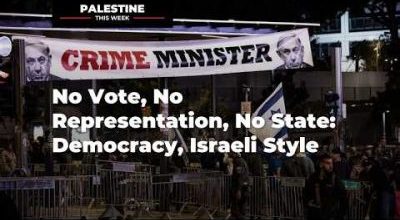
No Vote, No Representation, No State: Democracy, Israeli Style
or go to
Aletho News Archives – Video-Images
From the Archives
Sanctions, War and the Policy of Dual Containment
By SASAN FAYAZMANESH | March 17, 2008
It is now nearly three decades since the Unites States adopted the policy of dual containment of Iran and Iraq. While much has been written about the containment of Iraq, there has been very little in-depth analysis of this policy when it comes to Iran. In a book that is going to be released on March 31, 2008, entitled The United States and Iran: Sanctions, Wars and the Policy of Dual Containment (Routledge), I attempt to address this shortcoming by investigating when and why the US policy of containment of Iran came about, how it evolved, and where it stands today.[1] To the extent that Israel has been involved in US policy making, the study will also include the role that Israel has played in the containment of Iran. Also, since the fate of Iran has been inextricably linked to that of Iraq, occasionally the investigation will overlap with the containment of Iraq.
The policy of dual containment of Iran and Iraq originated during the Carter Administration, but it was not until the Clinton Administration that the expression “dual containment” became popular. … continue
Blog Roll
 Aletho News
- No Vote, No Representation, No State: Democracy, Israeli Style
- Zionist Bought Senate Blocks Information About American Citizens Killed By Israel
- While Gaza dominates the UN, these are the people keeping it alive
- New Report: “Scholasticide and Genocide in Gaza: Assessment, Testimonies and Legal Analysis”
- ‘THAAD Delusion’: Iran war exposes US missile shield limits – The Atlantic
- Moscow issues warning to NATO over Russian exclave
- Yes, the Iran war has destroyed Trump’s presidency
- The fallacy of US delusions about Iran’s economic collapse
- Hezbollah denies Syria cell link, warns of Israeli plan to sow discord
- The legacy of US sanctions, war, and occupation in Iraq
- If Americans Knew
- Mamdani releases plan to combat antisemitism and hate crimes in New York City
- Iran’s Revolutionary Guards Publish Letter to the American People
- DMFI launches $1 million ad campaign supporting Virginia’s Elaine Luria
- US Senate blocks resolution seeking report on Americans killed by Israel
- Israeli Attacks Kill Ten Palestinians in Gaza
- Massacre at Minab: The School That Became a Grave
- Israeli media: The IDF Shows It Doesn’t Turn a Blind Eye; It Actively Emboldens Settler Havoc
- As settlers ravage West Bank, Israeli forces kill 10 in Gaza – Daily Update
- New Report: “Scholasticide and Genocide in Gaza: Assessment, Testimonies and Legal Analysis”
- Ex-Biden officials are desperate for a Gaza scapegoat
- No Tricks Zone
- Green Energy Debacle: German Expert Professor Fritz Vahrenholt Warns Of Severe Economic And Social Consequences
- Two More Paleo Reconstructions Affirm Meters-Higher Sea Levels Across Ireland, Brazil 7000-6000 Years Ago
- New Study: Earth And Venus Surface Warmth Largely Explained By Convection And Lapse Rate, Not CO2 Or Radiation
- 2025 Nature Paper Claiming Worsening Global Drought Gets RETRACTED …Heavily Flawed
- New Study: ‘Global Drought Shows No Detectable Recent Acceleration Under Climate Warming’
- Economic Masterminds: German Socialists Suggest Taxing Productivity Gains Stemming From Using AI
- The South China Sea Has Not Been Cooperating With The Climate Change Narrative
- Energy Crisis: Germany Enters Heating Season With Historically Low Gas Reserve Fill Levels
- New Study: The Antarctic Ice Sheet Gained Mass From 2020-2024 Due To Staggering Snow And Ice Accumulation
- Study: Ocean Heating Rates From Thousands Of Years Ago ‘Dwarf’ Modern Ocean Heating Rates

