The US, EU and NATO have slammed the newly-passed foreign agents law in Georgia, while the foreign ministers of Iceland, Lithuania and Estonia took part in protest rallies against the legislation in Tbilisi. Sputnik’s pundits called these actions foreign meddling in Georgia’s affairs.
Lithuanian Foreign Minister Gabrielius Landsbergis expressed support for the “European” aspirations of Georgian protesters at a protest rally in Tbilisi on May 15.
“In a democracy, the government owes it to you, the Georgian people, to follow the direction your moral compass is showing,” Landsbergis told the crowd. “I am speaking out because I am… on the side of a European Georgia.”
But Tbilisi Mayor Kakha Kaladze, the secretary-general of the ruling Georgian Dream party, called their actions hostile and aimed at dividing Georgian society.
“This is not friendship, this is enmity, this is an attempt to deepen polarization in our country,” Kaladze told the Rustavi 2 TV channel. “Could you imagine our minister of foreign affairs going to Yerevan and speaking at an [Armenian] opposition rally?”
Direct Foreign Interference in Georgia’s Affairs
It was not the first time that Lithuanian officials have fanned public protests in a foreign state, according to Dr. Eduardas Vaitkus, Lithuanian politician who was an independent candidate in the 2024 Lithuanian presidential election.
“This is direct interference in the internal affairs of the sovereign state of Georgia,” Vaitkus told Sputnik.
Vaitkus cited earlier precedents for Lithuania’s meddling in the domestic affairs of Ukraine and Belarus. Vilnius has spent millions of euros supporting Belarusian self-declared opposition leader Svetlana Tikhanovskaya, backed by the West, who advocates for a coup d’etat in Minsk.
He recalled that the Lithuanian foreign minister’s grandfather, then-European Parliament member Vytautas Landsbergis, was spotted during the 2013 Euromaidan events in Kiev calling for a wider revolt in Ukraine.
“Unfortunately, this is the position of the Lithuanian state. My opinion is that traitors in our state are leading Lithuania in a way that creates a threat to all residents of Lithuania,” Vaitkus said.
The politician condemned the Lithuanian government’s “double and triple standards” in its unwillingness to recognize the will of the Crimean people to reunite with Russia — while rushing to embrace the self-declared independence of Kosovo alongside the West.
“Politics must have moral values. And [the Lithuanian government] demonstrates that duplicity is its main imperative in foreign policy,” Vaitkus said.
Russian Senator Konstantin Dolgov believes that Vilnius’ political agenda is not independent, but is dictated from the West.
“What can you expect from Lithuania and Estonia? These are countries that have long lost their independence and have become ‘appendages’ of Washington and Brussels,” Dolgov said, arguing that foreign ministers Iceland, Lithuania and Estonia could be sent by their Western patrons to fan unrest in Georgia.
Deputy Permanent Representative of the Russian Federation to the UN Dmitry Polyansky noted that the foreign ministers’ presence at Georgian protests is reminiscent of US and European politicians’ conduct during the 2013-2014 Euromaidan unrest in Kiev.
US Trying to Exert Pressure on Georgia as Its Hegemony Wanes
The US, EU and NATO have criticized the newly-passed foreign agents bill in Georgia, with US Assistant Secretary of State Jim O’Brien announcing on May 14 that Georgian MPs could be subjected to sanctions for “undermining democracy”.
While attacking the bill, which obliges Georgian media and NGOs to register as “pursuing the interests of a foreign power” if they receive over 20 percent of their funding from abroad, US policy-makers avoid mentioning that the Georgian legislation is reminiscent of the US’ own Foreign Agents Registration Act (FARA).
FARA requires individuals acting on behalf of foreign governments, organizations or persons foreign to the US to register with the Department of Justice (DOJ) and to disclose their relationship, activities, receipts, and disbursements in support of their activities.
Under to US law, such individuals are described as “foreign agents” while the FARA Unit of the Counterintelligence and Export Control Section (CES) is responsible for the Act’s enforcement.
The fierce US opposition to the Georgian bill under the guise of the “protection of democracy” and sanctions threats is an attempt to keep Tbilisi in line with the collective West’s agenda, according to Tiberio Graziani, chairman of Rome-based think tank Vision and Global Trends.
“The so-called defense of democracy, as promoted and implemented by the US-led West, falls within the context of the hybrid, cognitive and psychological war against those countries considered enemies, for geopolitical and geostrategic reasons,” Graziani told Sputnik.
“Any [country] that attempts to operate and act in the international context to responsibly promote the defense of its national interest is demonized by the US. Examples of this practice include, just to give a few examples, the so-called color revolutions,” he continued.
The US is believed to be behind a series of color revolutions in the former Soviet Union, including the Rose Revolution in Georgia in 2003, the Orange Revolution in Ukraine in 2004, the Tulip Revolution in Kyrgyzstan in 2005 and the failed Jeans Revolution in Belarus in 2006.
According to the expert, the threat and use of sanctions against foreign politicians pursuing national sovereignty constitutes a form of long-term US hybrid warfare.
Now that the world is becoming multipolar, the US is feeling the loss of its role as hegemon and could act irrationally with dramatic consequences for the rest of the world population, Graziani warned.
May 16, 2024
Posted by aletho |
Aletho News | Estonia, European Union, Georgia, Iceland, Lithuania, NATO, United States |
Leave a comment
Prominent Israeli historian Ilan Pappe, known for his strongly anti-Zionist views, has revealed that he was subjected to a two-hour interrogation by the FBI upon his arrival at Detroit Airport on Monday. During the ordeal, US security officials recorded everything on his phone. The 70-year-old professor, who has long been a vocal critic of Israel in his speeches and books, took to social media to share his experience.
In his statement, Pappe described the questioning as “out of this world,” with the two FBI agents asking him about his alleged support for Hamas and whether he considered Israel’s actions in Gaza to be genocidal. “They asked me what I believe is the solution to the ‘conflict’ (seriously, this is what they asked!),” wrote Pappe, expressing his disbelief at the nature of the questions.
The professor said that he was interrogated about his personal connections, with the agents inquiring about his Arab and Muslim friends in America, the length of their relationships, and the nature of their interactions. Pappe responded by directing the agents to his published works in some instances, while providing brief “yes” or “no” answers in others, citing exhaustion after an eight-hour flight.
He also mentioned that the FBI agents engaged in a lengthy phone conversation with an unidentified party, which he speculated could have been an Israeli official. Following the conversation, the agents copied the contents of his phone before allowing him to enter the country.
Despite the troubling nature of the interrogation, Pappe believes that such actions by the US and European countries, taken under pressure from pro-Israeli lobbies or Israel itself, are indicative of “sheer panic and desperation” on their part. He believes that these reactions are a response to Israel’s increasingly tarnished reputation, which he predicts will soon lead to the country becoming a “pariah state”.
Prof. Pappe’s experience comes after recent incidents where Palestinian academics, including the Rector of Glasgow University, Ghassan Abu Sitta, were denied entry to France and Germany. These events have raised concerns about the treatment of individuals critical of Israel’s policies and the influence of pro-Israel lobbies on foreign governments.
May 16, 2024
Posted by aletho |
Ethnic Cleansing, Racism, Zionism, Full Spectrum Dominance | Human rights, Israel, Palestine, United States, Zionism |
Leave a comment
In a world where international law (a set of ratified documents) is being rapidly replaced with narratives about a “rules-based system,” it is no wonder that US tech giants like Meta choose to set their free speech “baseline” not on their country’s Constitution, but on “international human rights norms.”
The less clarity there is, the more space for abuse and biased interpretation, critics might say. But Meta Oversight Board member Kenji Yoshino is satisfied that this is the right approach, and even spelled it out.
“Our baseline here is not the US Constitution and free speech, but rather international human rights norms,” Yoshino recently told the National Constitution Center, a private nonprofit.
Such bold statements require bold justification, and so this Oversight Board member noted that in terms of free speech “values” the US is “an outlier,” while Meta’s global reach means it must adjust its policies accordingly.
There are plenty of openly authoritarian regimes out there, with their own “free speech values,” but when Yoshino – from the William J. Brennan Center for Justice – spoke about “striking a balance” between US law and international “norms” – he chose to mention the palatable to his audience example of Europe.
What’s striking in this context, however, is that in many, if not all European countries, “hate speech” is criminalized, unlike in the US. It isn’t clear from Yoshino’s statements how a balance between such different approaches to speech can even be achieved in a social platform’s guidelines, particularly around elections.
But, that is the explanation for why the giant chooses not to make the First Amendment its “baseline.”
And if the baseline is international human rights norms, Yoshino admitted, “often times that calculus comes out differently than it would if the baseline were First Amendment norms.”
Such statements will do little to reassure those in the US already wary of Meta’s handling of content, censorship, and free speech, especially ahead of yet another high-stakes election coming up.
The fact that after a brief “pause” the FBI and the Cybersecurity and Infrastructure Security Agency (CISA) are now officially back in the business of “communicating” (opponents of the policy would say, “colluding”) with social media platforms, doesn’t help matters.
If anything, it raises fears of a concerted censorship push, driven both from the outside by government pressure, and from within Meta itself.
May 14, 2024
Posted by aletho |
Civil Liberties, Full Spectrum Dominance | Human rights, United States |
Leave a comment
Robert F. Kennedy Jr., who is running as an independent candidate in the upcoming US presidential election, has announced that he filed a lawsuit against Meta (Facebook and Instagram) in the US District Court for the Northern District of California.
Kennedy alleges that the two platforms censored a video, the documentary “Who is Bobby Kennedy,” that is part of his presidential campaign.
We obtained a copy of the lawsuit for you here.
The filing, submitted by Kennedy and his political action committee (PAC), accuses Meta of using its platforms to prevent users from watching, sharing, or posting links to the video, a short time after it was first released.
The platforms are accused of suppressing a video about the presidential candidate’s career and his criticism of vaccines as a result of the US government’s repeated demands that tech companies do so.

To bolster this argument, the filing refers to Murthy v. Missouri, currently in the Supreme Court, where the allegation is that the White House pressured and colluded with social media powerhouses to censor content it disfavors, including around vaccines.
Meta first blocked the documentary on May 3 – two days later formally reversing this decision, describing it as “a mistake” – but Kennedy maintains that the film is still demoted and shadow-banned, and otherwise sabotaged in terms of visibility.
He also made a point that the case is not only about free speech suppression, i.e., a First Amendment issue, but also, interference in the democratic process.
“Meta is censoring a biographical film about a major candidate in an election year,” Kennedy stressed – and one might add, this is happening on some of the major and most influential platforms.
This is not the politician and activist’s “first rodeo” trying to take Big Tech to task for, in his view, unjustifiably censoring his content.
A lawsuit he brought against Google (YouTube) for removing his videos critical of Covid vaccines’ efficacy is now being considered in a court of appeals. In that case, Kennedy also accused Google of making the decision to block his content in collusion with the current government.
May 14, 2024
Posted by aletho |
Civil Liberties, Full Spectrum Dominance | United States |
Leave a comment
A woman injured by the AstraZeneca vaccine she received in 2020 during a U.S. clinical trial is suing the vaccine maker in the first case of its kind challenging the legal liability shield for COVID-19 vaccine makers.
Brianne Dressen, who since 2021 has advocated on behalf of vaccine injury victims, filed suit Monday in the U.S. District Court for the District of Utah seeking compensation for injuries and disability she alleges resulted from the vaccine.
Under the Public Readiness and Emergency Preparedness Act (PREP Act), AstraZeneca and other COVID-19 vaccine manufacturers cannot be held liable for injuries related to the vaccines.
However, Dressen’s lawsuit — which also names the Salt Lake City-based clinical trial site consolidator Velocity Clinical Research — contends AstraZeneca can be sued for breach of contract.
According to the lawsuit, the company agreed to cover the medical costs for any vaccine-related injuries under a contract between AstraZeneca and clinical trial participants.
Dressen alleges that in her case, the cost of her injuries and disability amount to hundreds of thousands of dollars per year. Dressen, who was 39 when she was vaccinated, was previously a preschool teacher but is now unable to work.
Within hours of getting her first dose, Dressen experienced tingling in her right arm — a neurological condition known as paresthesia — and blurred vision and vomiting.
In the weeks that followed, her condition worsened, with the paresthesia spreading to her legs, resulting in disability and a diagnosis in 2021 by the National Institutes of Health (NIH) of post-vaccine neuropathy.
The lawsuit seeks “all available damages, both economic and non-economic.”
Attorney Michael Connett of law firm Siri & Glimstad LLP, who is representing Dressen in her lawsuit, told The Defender, “As far as we know, this is the first case in the U.S. where a pharmaceutical company is being held financially responsible for the harms caused by the COVID vaccine.”
Dressen told The Defender that her breach of contract claim “is another first for the United States, as PREP Act protections have been completely impenetrable.”
Dressen, founder of React19, a nonprofit advocating for vaccine injury victims, said she hopes the lawsuit will provide “accountability for my individual case but also bolsters a pathway forward for my injured colleagues both in the U.S. and abroad — namely, each and every plaintiff in the U.K. seeking restitution from AstraZeneca.”
Dressen cited an ongoing class-action lawsuit in the U.K. against AstraZeneca by people alleging they were injured by the AstraZeneca COVID-19 vaccine and by the relatives of 12 people who died after getting the shot.
In documents AstraZeneca submitted to the U.K. High Court last month as part of that case, the company admitted that its COVID-19 vaccine “can, in very rare cases, cause TTS” — vaccine-induced thrombosis with thrombocytopenia syndrome, which causes the body to produce life-threatening blood clots.
Dressen’s lawsuit comes just days after AstraZeneca announced the withdrawal of its COVID-19 vaccine globally — though the company said it based its decision on the “surplus of available updated vaccines,” leading to reduced demand for its vaccine.
The U.S. never granted emergency use authorization for the AstraZeneca COVID-19 vaccine, citing safety concerns.
However, the vaccine generated over $5.8 billion in sales globally, with the help of the Bill & Melinda Gates Foundation, which funded and promoted the vaccine in other countries. Several countries later stopped administering the AstraZeneca vaccine due to safety concerns.
Connett said AstraZeneca’s decision to withdraw the vaccine “really doesn’t have a bearing” on Dressen’s lawsuit.
Ray Flores, a health freedom rights attorney unconnected to the lawsuit, agreed because “the complaint is not based on product liability.”
Flores said:
“Around the country, COVID-19 vaccine injury cases that alleged negligence, battery of a minor, fraud or emotional distress have all been unsuccessful due to the PREP Act — while cases that allege negligence not involving a countermeasure have generally been successful.
What makes this case unique is that it alleges a breach of a written contract. For a court to allow liability protection here would really stretch the extent of the law. But on the other hand, it would unequivocally etch the stench of the PREP Act in Americans’ minds — but my ‘money’ in this case is on the plaintiff.”
AstraZeneca induced people to join trials by promising to pay for injuries
According to Connett, AstraZeneca induced people to join its clinical trial by promising to pay the medical expenses for any injuries that resulted from its COVID-19 vaccine.
“This inducement, this promise, became a contractual obligation the moment study subjects rolled up their sleeve and let the company inject the experimental vaccine into their arm,” he said.
Just because a company is making the COVID-19 vaccine doesn’t give that company a license “to make false promises to induce people to enter its clinical trial,” he said. “The bonanza of immunity that the PREP Act provides does not go so far as to shield a vaccine maker from its own contractual obligations.”
Flores said that if AstraZeneca “never intended to honor its promise to insure Dressen … it would not only be a breach of contract but would rise to the level of fraud.”
“When a vaccine injury lawsuit highlights a defendant’s inhumanity, it is always highly persuasive,” Flores said. “In this case, an absurd $1,243.30 settlement offer after reneging on its written promise to insure when there are evidently millions of dollars in damages and unspeakable suffering is just that.”
Connett said any other individual injured by the AstraZeneca vaccine “has the legal right to recover the full costs of the injury,” but advised that “The time to take legal action, however, may be limited, so acting expeditiously will be important.”
‘Completely hollowed-out version of who I once was’
The lawsuit described the timeline of Dressen’s symptoms following vaccination, with paresthesia spreading to her right shoulder and left arm and later to her legs. Within weeks, she lost 20 pounds as a result of frequent vomiting, while she also developed light sensitivity and became “acutely sensitive to sound.”
Dressen said her heart rate also would randomly spike, leading to shortness of breath and feelings of fainting. She described her experience in the lawsuit as feeling like a “completely hollowed-out version of who I once was.”
Before her Nov. 4, 2020, vaccination, Dressen filled out consent forms stating the company would “cover the costs” — including, but not limited to, medical bills — if she experienced a “research injury.”
Those forms, Dressen said, claimed the study doctor would provide treatment or referral in the event of injury, noting that the study sponsor had the necessary insurance.
“Sponsor will pay the costs of medical treatment for research injuries, provided that the costs are reasonable, and you did not cause the injury yourself,” the contract stated, according to the lawsuit.
The lawsuit notes that two days after Dressen signed the consent form, AstraZeneca amended the form to state that its vaccine may cause “neurological disorders” such as “demyelinating disease,” which could “cause substantial disability” or death “if not treated promptly.”
Dressen received multiple diagnoses indicating her symptoms were related to her vaccination. Her husband eventually reached out to the NIH, which invited her to visit its Bethesda, Maryland, campus “for extensive testing and treatment,” as part of a study the agency was conducting at the time involving people injured by COVID-19 vaccines.
As a result of those tests, NIH neurologists concluded that Dressen had sustained post-vaccine neuropathy, which had caused “dysautonomia” and “chronic inflammatory demyelinating polyneuropathy.”
“The limited safety data that AstraZeneca has released to the public shows that other clinical trial participants who received the company’s COVID vaccine suffered a higher incidence of nervous system disorders, including various types of demyelinating diseases, where the myelin sheaths that protect the nerve cells are stripped away,” Connett said.
AstraZeneca ‘were nowhere to be found’
According to the lawsuit, Dressen’s medical costs are prohibitive. One medication alone costs $432,000 a year, “although her insurance company has been able to negotiate this down (at least for now) to $119,000 per year,” she said.
But despite these high costs and Dressen’s ongoing disability, which makes her “unable to drive more than a few blocks at a time” and limits her parenting ability, the lawsuit states that AstraZeneca offered her only $1,243.30 in total compensation.
“When they needed me, I was there, I cooperated. When I needed them, they were nowhere to be found,” Dressen said in the lawsuit. “I called the test clinic early on with tears running down my face, begging them to help me. They said the drug company would call back any day now. Nightmarish days turned into weeks, and those nightmarish weeks turned into months, and now years. That call never came.”
In July 2021, Dressen’s injuries led her to contact Dr. Anthony Fauci directly to request help, according to documents recently obtained by Children’s Health Defense in a lawsuit against the NIH.
In that email, Dressen said she had been contacting federal health agencies for months with “No substantiative [sic] response.”
Dressen said Fauci never responded to her message.
Calling her lawsuit a “David v. Goliath type case,” Dressen told The Defender her “heart has and always will be with the injured community.” She said, “Every single American injured by a pharmaceutical product deserves their day in court.”
This article was originally published by The Defender — Children’s Health Defense’s News & Views Website under Creative Commons license CC BY-NC-ND 4.0. Please consider subscribing to The Defender or donating to Children’s Health Defense.
May 14, 2024
Posted by aletho |
Deception | AstraZeneca, COVID-19 Vaccine, PREP Act, United States |
Leave a comment
Recent resistance operations in eastern Syria have established new rules of engagement that constrain both Washington and Tel Aviv

For several years, the presence of the region’s Axis of Resistance forces in Syria has remained vulnerable to US and Israeli attacks across the country, from east to west. The US has persistently attempted to disrupt the communication routes along the Tehran–Beirut axis, through which Damascus plays an important link.
Starting in 2017, after eliminating ISIS from this key border crossing, Axis forces have safeguarded passage of vehicles through the vital Al-Qaim–Al-Bukamal road and effectively established rules of engagement in eastern Syria, gradually limiting Washington’s tactical flexibility and dominance. This was a strategically important development – maintaining a foothold west of the Euphrates River to the far southeast of Syria continues to be essential for both state and non-state actors in the resistance.
A shift in tactical approach
Since the Palestinian resistance’s Operation Al-Aqsa Flood last October, many new shifts have emerged on the ground in eastern Syria. With an uptick in Iraqi resistance activities targeting US bases in both Syria and Iraq, a sort of tentative peace emerged in early February, coinciding with Kataib Hezbollah’s temporary suspension of operations.
During this period, the resistance forces secured new advancements that solidified their position, primarily because Washington had to grudgingly acknowledge the new ground realities – a fait accompli, if you will.
Although the US continued to carry out “retaliatory” strikes targeting the Iraqi resistance, which, to many, seemed to restore some level of peace, this came with significant compromises.
According to information obtained by The Cradle, the resistance groups have not only established a more pronounced military and political stance during this period of relative calm but have also forced the US to accept crucial losses in the field.
In short, not only has Washington retreated from its provocative operations against regional resistance forces, but Tel Aviv has likewise shown reluctance to launch further raids – so far – in eastern Syria to assassinate fighters affiliated with Lebanon’s Hezbollah.
The Israeli retreat is not a unilateral decision but a result of US recalibration of these risks. The occupation army cannot launch operations without the American green light and intelligence data, and Washington is currently reluctant to cover Israeli actions that will draw the US deeper into the morass in Syria and Iraq. It also seeks to avoid further resistance attacks on US bases and occupied Syrian oil fields, especially now that it has experienced direct blows from targeted munitions.
It is also not insignificant that the Iraqi resistance has directly targeted key Israeli ports. Tel Aviv cannot afford opening up further military fronts eight months into a conflict in which it is incapable of winning on a single front, in Gaza.
Rules of engagement in Eastern Syria
The rules of engagement in eastern Syria are distinct from those governing interactions in the western and central regions of the country, which primarily involve the Israeli entity and Resistance Axis forces alongside Damascus.
In the east, the main opposition to the resistance forces is the illegal US military occupation and its Kurdish allies.
This region, stretching across the Euphrates River to Albu Kamal, which abuts Iraq’s Al-Qaim crossing, represents a strategic foothold for the Resistance Axis established in 2017. This was achieved during the “Great Dawn” operations, a series of offensives in three stages led by resistance forces, the Syrian army, and their Russian allies.
These operations enabled the Syrian and Iraqi resistance forces to reach and secure the Al-Qaim crossing, effectively reconnecting the two countries for the first time since 2011, which offered the Axis a world of new tactical advantages.
The establishment of this route, known as the Tehran–Beirut road, was perceived by the US and Israelis as a strategic geopolitical setback to their goal of severing relations and routes between Iran and the Mediterranean. In response, Washington intensified its efforts to destabilize this area through raids and pressures and by supporting attacks by ISIS cells and other militant groups, aiming to prevent the resistance forces from cementing their positions and achieving stability.
These tensions would escalate significantly towards the end of 2019 and into early 2020, following US claims that its forces in Kirkuk were targeted in a rocket attack attributed to the Iraqi resistance.
Washington responded provocatively by launching heavy strikes against an Iraqi resistance faction in Al-Qaim, killing at least fifty fighters in an operation closely followed by the targeted assassinations of Iranian Quds Force Commander General Qassem Soleimani and Iraq’s Popular Mobilization Units (PMU) Deputy Head Abu Mahdi al-Muhandis.
One key goal of this unprovoked US escalation was to prevent the resistance connectivity project, specifically cutting off the roads of communication between Tehran–Baghdad–Damascus–Beirut, which is seen as threatening both the US presence and Israel’s security.
Following the strike on the Ain al-Assad airbase earlier this year, resistance forces moved to intensify their targeting of US military bases using missiles and drones, conducted multiple operations in the Syrian Desert to safeguard transit routes against Washington-backed terror groups, and established protective measures around the US occupation base in Al-Tanf, located near the Syrian–Jordanian–Iraqi border intersection.
Through these coordinated efforts, the Axis of Resistance imposed new rules of engagement, effectively balancing the scales by linking their actions at Albu Kamal and Al-Qaim with significant retaliatory strikes against US bases.
This approach led to a noticeable reduction in direct US military engagements – which, interestingly and unsurprisingly, coincided with a spike in ISIS cells attempting infiltrations in both Syria and Iraq.
This state of affairs persisted until the Iraqi resistance increased its operations against US troops in both Syria and Iraq, partly in solidarity with the Palestinian resistance in the Gaza Strip.
West Asia’s new reality
Between the rules of engagement that preceded the events of 7 October and those that followed the targeting of US bases, significant changes have occurred, especially after Iraqi resistance operations showcased the vulnerabilities of the American deterrence strategy.
The illegal US bases have been exposed as unsafe, not only in Syria and Iraq but also extending to Jordan. The results of the resistance operations can be summarized as follows:
The Axis has successfully established and strengthened its ground presence in areas Washington once viewed as its own stomping ground and has achieved a de facto truce that benefits long-term resistance goals across military, economic, and political domains.
Consequently, resistance troops are now more effectively pursuing the remnants of US-backed ISIS cells within the depths of the Syrian Desert. These terror cells, though engaged in continuous disruptive operations, are no longer seen as posing a strategic threat.
The Axis’ efforts can also now more effectively concentrate on the main front, against Israel, in support of the Palestinian resistance there. The rules of engagement with the US have been reinforced and are poised for further development in future stages, with plans to pose a more formidable challenge to the US presence across West Asia.
May 14, 2024
Posted by aletho |
Illegal Occupation, Wars for Israel | Hezbollah, Iran, Iraq, ISIS, Israel, Palestine, Syria, United States, Zionism |
Leave a comment

A senior US Air Force official has sent defense contractors a strongly worded letter over delays to the Vulcan Centaur heavy-lift launch vehicle program – initiated to replace the workhorse Atlas V, which uses Russian-made RD-180 engines. The delay signals the US’s inability even to copy Russian-made equipment, a leading space researcher says.
US Air Force Assistant Secretary Frank Calvelli has sent the heads of Boeing and Lockheed Martin’s United Launch Alliance space divisions an “unusually blunt” appeal highlighting Pentagon concerns over the years-long delays to the Vulcan rocket project.
“I am growing concerned with ULA’s ability to scale manufacturing of its Vulcan rocket and scale its launch cadence to meet our needs. Currently there is military satellite capability sitting on the ground due to Vulcan delays,” Calvelli complained.
“As the owners of ULA, and given the manufacturing prowess of Boeing and Lockheed Martin corporations, I recommend that you work together over the next 90 days to complete an independent review of ULA’s ability to scale its launch cadence to meet” contract requirements, the official urged.
Calvelli expressed concerns about the ULA’s poor flight record to date, pointing out that to meet its contract obligations, it would have to launch 25 missions for the Pentagon by the end of 2027. The alliance, separately bound to launch 38 rockets for Amazon’s Kuiper internet satellite constellation, launched only three missions through 2023.
“Launch is critical to our ability to transform our space architecture. We are counting on Boeing, Lockheed Martin, and the ULA team to be successful in getting critical capabilities into space for our warfighters,” the assistant secretary wrote.
The United Launch Alliance kicked off the Vulcan’s development a decade ago amid a push by Washington to phase out the purchase of Russian-made RD-180 engines used on the Vulcan’s predecessor, the Atlas V, to put satellites into orbit. The Vulcan has a stated launch capacity of 27.2 tons, and an estimated expected cost of $100-$200 million per launch, compared to 8.2-18.85 tons and $1090 million per launch for the Atlas V, depending on variant.
Initially projected to start flying in 2019, the Vulcan program has faced half a decade of delays, owing partly to major issues with the rocket’s BE-4 engines, developed by Jeff Bezos’ Blue Origin space company. The first Vulcan rocket successfully launched in January of this year, but quickly ran into new problems, including delays to the development of the Air Force’s Soviet-inspired Dream Chaser spaceplane.
The program will require a second flight before it can be certified by the Pentagon for use for national security and intelligence collection-related missions, with ULA expecting the program’s second launch to take place sometime later this year.
Calvelli did not elaborate on the nature of his concerns with the Vulcan program, instead shifting the discussion to national security and the US’s strategic competition with Beijing.
“The United States continues to face an unprecedented strategic competitor in China, and our space environment continues to become more contested, congested and competitive. We have seen exponential growth of in-space activity, including counterspace threats, and our adversaries would seek to deny us the advantage we get from space during a potential conflict,” he wrote.
ULA assures that it’s on track to ramping up its rocket production capabilities, with CEO Tony Bruno telling media that the Vulcan “is much less expensive” than the Atlas V with its Russian-made RD-180s, and that future plans to reuse the new, American-made engines will result in “economies of scale” that will make it “cheaper over time.”
Boeing responded to Calvelli’s letter by promising to get “on more of a wartime footing to stay ahead of the threat,” and agreed with the senior Air Force officer’s sense that “a quicker and more reliable launch cadence is critical to meeting that need.”
Rocket Science
The problems surrounding the Vulcan rocket and its engines signal major issues for US space rocket engineering, with the ULA delay demonstrating that American rocket scientists currently can’t even effectively copy Russian engines, much less create safe, reliable engines of their own, says Dr. Natan Eismont, a leading researcher at the Russian Academy of Scientists’ Space Research Institute, told Sputnik.
“There have been attempts to copy RD-180 engines from the moment they were sold to the Americans,” Eismont recalled. From the early 2000s onward, “launches were carried out using the Atlas III, and then a lot using the Atlas V, [which] provided for nearly half of all American launches. This is significant…There were attempts to copy the RD-180 from the start, and to this day they remain just that – attempts. The Americans haven’t been able to create an engine with characteristics close to matching the RD-180.”
Created in the 1990s, the RD-180 is a derivative of the legendary RD-170/171 series of rocket engines, developed in the 1980s by Energomash for the super-heavy Energiya launch vehicle, which was designed to shuttle up to 100 tons of useful cargo into Low Earth Orbit, to launch the Buran space shuttle, and deploy the next generation of space station components, and pieces of large, Moon and Mars-faring spacecraft of the future.
With the Soviet space program curtailed dramatically after the USSR’s collapse, budding cooperation with the US in the 1990s instead led to the development of the RD-180, and the export of over 120 of these engines to the US between 2000 and 2021.
The question of why the Americans have not been able to develop an engine with characteristics comparable to the RD-180, or even copy the Russian-made engine, stems from a problem which has plagued the US going back almost to the start of the space age, Eismont says.
“Efficiency is measured by specific thrust [the ratio of net thrust/total intake airflow, ed.], which for the RD-180 is 400 tons from the Earth’s surface, and 430 tons in a vacuum. These characteristics are generally achievable. But there’s also the specific impulse [a measure of how efficiently the engine generates thrust, ed.] and here, no rocket apart from ours has been able to achieve comparable parameters. Because to obtain characteristics comparable to those achieved by the RD-180, one must use a fairly high level of pressure in the combustion chamber – more than 200 atmospheres,” which can be dangerous if done improperly, the academic explained.
“At the same time, high-frequency oscillations arise,” Eismont added. “The secret lies in determining the moment during testing after which these fluctuations become possible, and immediately turning off the engine at that precise moment. How to do that – what parameters are necessary here, what parameters are acceptable, and how issues can be overcome – it appears that no one apart from our specialists knows this. Simply handing over the engine with all its documentation is not enough. Because there are subtleties in the manufacture of the engine which are difficult to convey using documentation.”
That’s not to say that American rocket scientists will not be able to ever overcome these difficulties, the observer emphasized. They can and will, but doing so “requires a lot of money and time,” and knowledge enough to pinpoint when testing enters the danger zone to prevent the destruction of “very expensive” test equipment.
Solving this issue will be “critical” for the Americans, Eismont believes.
“Here, [the ULA] can turn to [Space X CEO Elon] Musk, where, in general, the same tasks were set, and the company has its own rocket engine. For Musk too, everything didn’t work out straight away or to the end. Here, in general, we can say that Musk has not achieved the required level of reliability. SpaceX’s engine is in fact also an attempt to copy the RD-180… They are probably further along than say Boeing or others involved [in the Vulcan program, ed.]. But nevertheless, he had to come to terms with the fact that he could not manage without accidents. That is, the process turned out to be slower and more expensive than planned,” the academic explained.
Besides documentation, what US rocket scientists are really lacking is specialists, who can’t be replaced by imported engines, technical or even testing documentation.
“What you need are people involved in the project. Who will give the Americans these people? No one,” Eismont said.
This isn’t anything new, the academic recalled, pointing out that the US has had problems with its rocketry programs going back to the Apollo program and the days of the Saturn 5 rocket. “If you look at the technical characteristics of these American engines, they were strikingly worse than those that the USSR had at the time,” he said.
“It’s difficult to say why this was, but the Americans lagged behind here from the start. As for Soviet and Russian engines, they display an exceptional level of reliability. From the time that the Americans purchased these particular engines from us, they have not had any accidents. That is, the entire program was developed and carried out in accordance with the experience accumulated by that time by Energomash. Here, they really are ahead of everyone else.”
Ivan Moiseev, the head of the Russian Institute of Space Policy, echoed Eismont’s assessment regarding the RD-180, telling Sputnik that this is an “excellent” engine, with “not a single failure in over 100 launches.”
“The contract was concluded in 1996 and completed in 2021 – three years ago. Accordingly, the Americans still have some engines, they can still launch the Atlas V,” Moiseev said.
After that, it will be anyone’s guess how the Pentagon plans to get its payloads into orbit, unless ULA get its act together, or Washington pulls the plug on the whole thing and puts all its spacefaring eggs in Musk’s SpaceX basket.
May 14, 2024
Posted by aletho |
Timeless or most popular | Russia, United States |
Leave a comment
April 30 was the anniversary date when North Vietnamese forces forced U.S. officials to exit Vietnam, much to their chagrin. That was after some 58,000 American men had died for nothing, not to mention the tens of thousands of injured American soldiers and the millions of Vietnamese who were killed or injured as a result of U.S. intervention in Vietnam’s civil war.
To this day, there are those who claim that those 58,000 men died for their country and in defense of our freedoms here at home. Almost 50 years after the end of that sordid intervention, such people continue to operate under severe self-delusion.
North Vietnam never attacked, invaded, or occupied the United States or even had any interest in doing so. Moreover, North Vietnam lacked the military, money, transport ships, planes, and supply lines that would have been necessary to cross the Pacific and invade the United States. If they had been successful in landing a few thousand troops on the West Coast, they would have been quickly massacred by the U.S. military or by well-armed private Americans. All that North Vietnam wanted to do was reunite North Vietnam and South Vietnam and make it one country again — Vietnam.
In other words, North Vietnam never posed a danger to our rights and freedoms here in the United States. At the risk of belaboring the obvious, despite the fact that North Vietnam defeated the United States and won the war, the defeat did not result in North Vietnam’s taking away any of our rights and freedoms. In fact, the irony is that it is the U.S. government — our government — that has destroyed our rights and freedoms.
By the same token, those 58,000 U.S. soldiers who were sacrificed in Vietnam did not die for their country. They died for their government. There is a difference. The government is one entity and the country is another entity. This difference is reflected by the Bill of Rights, which expressly protects the country from the government. Dying for one’s government is not the same as dying for one’s country.
During the war, the U.S. government resorted to conscription, which is also known as the draft. It’s impossible to reconcile conscription with freedom. When a government has to force people to fight in a war, that’s a pretty good sign that that is a no-good, rotten war. If the war were really about protecting our freedom and our country, people wouldn’t have to be forced to fight. They’d be willing to fight voluntarily.
The rotten nature of the war was reflected by the disparate treatment between rich and poor and blacks and whites. The rich white kids were given college and post-graduate school deferments, which would enable them to delay being forced into the military and sent to Vietnam. Another way for rich white kids to get out of being sent to Vietnam was to use political influence to get into a National Guard unit or a Reserve unit. During the Vietnam War, those units were not being activated to be sent to Vietnam. Thus, anyone who was lucky enough or privileged enough to get into those units knew that there was no risk of being sent to Vietnam. The poor were not so lucky. They couldn’t afford college and so they were drafted immediately on graduation from high school. They became the U.S. government’s cannon fodder in Vietnam.
Of course, from the day he was forced into the army, every soldier was indoctrinated into believing that he was being sent to Vietnam to protect our “freedoms” here at home. One irony of this indoctrination was that if black conscripts were lucky enough to make it back alive, the “free” society to which they were returning was a segregated one.
Those who had the audacity to challenge or criticize the war were immediately branded traitors, cowards, or communist lovers or appeasers. That included civil-rights leader Martin Luther King and championship boxer Mohammad Ali. U.S. officials destroyed Ali’s boxing career by ensuring that he was prohibited from fighting at the height of his career. But at least they let him live. They snuffed out King’s life given that they were convinced that he and the civil-rights movement were advance, Fifth Column troops of a communist invasion of the United States.
Unfortunately, North Vietnam’s victory over the United States didn’t result in any fundamental changes here at home. Today, Americans continue to live under a national-security state form of government, an interventionist foreign policy, and an empire of foreign military bases. The Cold War is still being waged against Cuba, North Korea, Russia, and China; ironically, North Vietnam is, at least for now, considered an official friend. The war on communism has been replaced by the war on terrorism and Islam. State-sponsored assassinations, torture, indefinite detention, and military tribunals are still part and parcel of America’s legal system. And so are unconstitutional undeclared wars that sacrifice American soldiers for nothing, like with the wars against Iraq and Afghanistan.
May 14, 2024
Posted by aletho |
Civil Liberties, Militarism, Timeless or most popular | Human rights, United States, Vietnam, Vietnam War |
Leave a comment
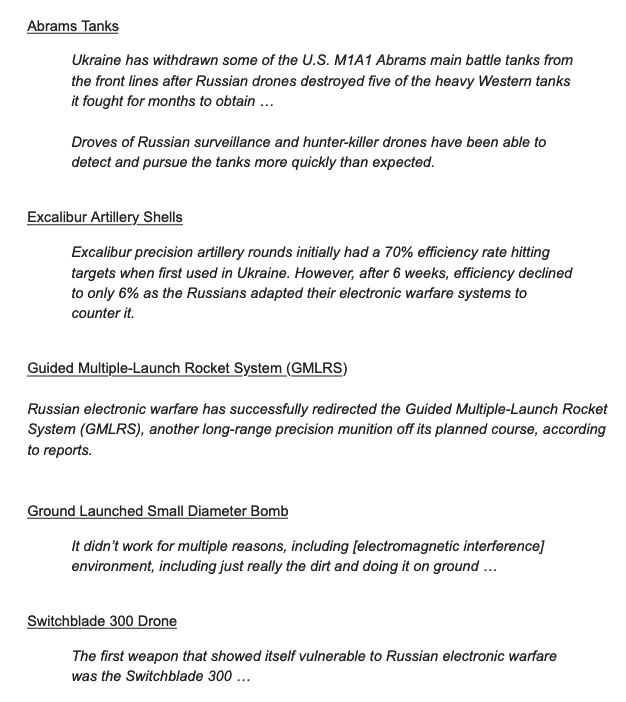
I have mentioned previously that the introduction of all the latest and greatest western weapons in the inventory given to the Ukraine would have some very deleterious effects in the future. One was permitting possible future antagonists to observe and and take detailed notes on the tactics, techniques and procedures (TTP) and experiment with prospective or actual countermeasures to neutralize or destroy these weapons systems and platforms. The other concerns would be allowing the first near-peer/peer martial contest to use this to shape and refine future strategic objectives. The Russians are certainly doing their homework and actively modifying and improving their means of waging war.
Performance is predictably abysmal for so many of these Western systems. The corporate/access media seems to finally be catching on that the weapons programs are not very effective.
The Biden administration has committed more than $50 billion in military aid to Ukraine since Russia invaded in February 2022, according to a Pentagon fact sheet. U.S. assistance has proven vital in helping Ukraine fend off Russia’s advances and mount counteroffensives, but some of the weapons have failed to have the desired impact as Russia’s military has adapted, according to media reports and experts.
Here are some highlights from the article:
If only the diversity enthusiasm incentivized opposing viewpoints and genuine intellectual differences.
Future historians will have a tremendous cottage industry trying to tease out how the world’s most expensive military paper tiger not only convinced the bill-payers to keep funding these disasters but the cognitive strategic deficit disorder that informed the entire fallacious enterprise managed to spend tens of trillions of dollars for a non-nuclear military apparatus that had a picture perfect track record of consistent failure since 1945.
May 14, 2024
Posted by aletho |
Corruption | NATO, Ukraine, United States |
Leave a comment
The United States and its Western allies have stepped up a media campaign to accuse India of running an assassination policy targeting expatriate dissidents.
The government of Narendra Modi, India’s prime minister, has furiously denied the allegations, saying there is no such policy.
Nevertheless, the American Biden administration as well as Canada, Britain and Australia continue to demand accountability over claims that New Delhi is engaging in “transnational repression” of spying, harassing and killing Indian opponents living in Western states.
The accusations have severely strained political relations. The most fractious example is Canada. After Premier Justin Trudeau publicly accused Indian state agents of involvement in the murder of an Indian-born Canadian citizen last year, New Delhi expelled dozens of Canadian diplomats.
Relations became further strained this month when the Washington Post published a long article purporting to substantiate claims that Indian security services were organizing assassinations of U.S. and Canadian citizens. The Post named high-level Indian intelligence chiefs in the inner circle of Prime Minister Modi. The implication is a policy of political killings is sanctioned at the very top of the Indian government.
The targets of the alleged murder program are members of the Sikh diaspora. There are large expatriate populations of Sikhs in the U.S., Canada and Britain. In recent years, there has been a renewed campaign among Sikhs for the secession of their homeland of Punjab from India. The New Delhi government views the separatist calls for a new state called Khalistan as a threat to Indian territorial integrity. The Modi government has labeled Sikh separatists as terrorists.
Indian authorities have carried out repression of Sikhs for decades including political assassination in the Punjab territory of northern India. Many Sikhs fled to the United States and other Western states for safety and to continue their agitation for a separate nation. The Modi government has accused Western states of coddling “Sikh terrorists” and undermining Indian sovereignty.
Last June, a prominent Sikh leader was gunned down in a suburb of Vancouver in what appeared to be a professional hit-style execution. Hardeep Singh Nijjar was murdered by three assailants outside a religious temple. Indian state media described him as a terrorist, but Nijjar’s family denied he had any involvement in terrorism. They claim that he was targeted simply because he promoted Punjabi separatism.
At the same time, according to the Post report, the U.S. authorities thwarted a murder plot against a well-known American-Sikh citizen who was a colleague of the Canadian victim. Both men were coordinating efforts to hold an unofficial referendum among the Sikh diaspora in North America calling for the establishment of a new independent state of Khalistan in the Punjab region of northern India.
The Post article names Vikram Yadav, an officer in India’s state spy agency, the Research and Analysis Wing (RAW), as orchestrating the murder plots against the Sikh leaders. The Post claims that interviews with US and former Indian intelligence officials attest that the killings could not have been carried out without the sanction of Modi’s inner circle.
A seemingly curious coincidence is that within days of the murder of the Canadian Sikh leader and the attempted killing of the American colleague, President Biden was hosting Narendra Modi at the White House in a lavish state reception.
Since the summer of last year, the Biden administration has repeatedly pressured the Modi government to investigate the allegations. President Biden has personally contacted Modi about the alleged assassination policy as have his senior officials, including White House national security advisor Jake Sullivan, Secretary of State Antony Blinken and CIA director William Burns. Despite New Delhi’s denial of such a policy, the Modi government has acceded to American requests to hold an internal investigation, suggesting a tacit admission of its agents having some involvement.
But here is where an anomaly indicates an ulterior agenda. Even U.S. media have remarked on how lenient the Biden administration has been towards India over what are grave allegations. It is inconceivable that Washington would tolerate the presence of Russian or Chinese agents and diplomats on its territory if Moscow and Beijing were implicated in killing dissidents on American soil.
As Tthe Washington Post report noted: “Last July, White House officials began holding high-level meetings to discuss ways to respond without risking a wider rupture with India, officials said. CIA Director William J. Burns and others have been deployed to confront officials in the Modi government and demand accountability. But the United States has so far imposed no expulsions, sanctions or other penalties.”
What appears to be going on is a calculated form of coercion by the United States and its Western allies. The allegations of contract killings and “transnational repression” against Sikhs in the U.S., Canada, Britain, Australia and Germany are aimed at intimidating the Indian government with further embarrassing media disclosures and Western sanctions. The U.S. State Department and the Congress have both recently highlighted claims of human rights violations by the Modi government and calls for political sanctions.
The objective, it can be averred, is for Washington and its Western allies to pressure India into toeing a geopolitical line of hostility towards China and Russia.
During the Biden administration, the United States has assiduously courted India as a partner in the Asia-Pacific to confront China. India has been welcomed as a member of the U.S.-led Quad of powers, including Japan and Australia. The Quad overlaps with the U.S. security interests of the AUKUS military partnership with Britain and Australia.
Another major geopolitical prize for Washington and its allies is to drive a wedge between India and Russia.
Since the NATO proxy war blew up in Ukraine in February 2022, the United States has been continually cajoling India to condemn Russia and to abide by Western sanctions against Moscow. Despite the relentless pressure, the Modi government has spurned Western attempts to isolate Russia. Indeed, India has increased its purchase of Russian crude oil and is importing record quantities, more than ever before the Ukraine conflict.
Furthermore, India is a key member of the BRICS forum and a proponent of an emerging multipolar world order that undermines U.S.-led Western hegemony.
From the viewpoint of the United States and its Western allies, India represents a tantalizing strategic prospect. With a foot in both geopolitical camps, New Delhi is sought by the West to weaken the China-Russia-BRICS axis.
This is the geopolitical context for understanding the interest of Western powers in making an issue out of allegations of political assassination by the Modi government. Washington and its Western allies want to use the allegations as a form of leverage – or blackmail – on India to comply with geopolitical objectives to confront China and Russia.
It can be anticipated that the Western powers will amplify the media campaign against India in line with exerting more hostility toward China and Russia.
May 14, 2024
Posted by aletho |
False Flag Terrorism | Canada, India, UK, United States |
Leave a comment
As the Russia-Ukraine war drags on, a peace conference is to be held in Switzerland this summer. But Russia’s President Vladimir Putin said that Russia hadn’t been invited to participate in June’s talks. “It would have been funny if it weren’t so sad,” he commented.
Practically all Russian commentators, and even some prominent Western ones, trace the roots of the conflict in Ukraine to NATO’s attempts at incorporating Russia’s neighbor – as officially stated since at least as far back as 2008. A disregard for Russia’s status as an equal and sovereign partner was evident in the contempt for the Minsk agreements, which both former German chancellor Angela Merkel and former French president Fran?ois Hollande described as gimmicks to buy time for the only option that was seriously pursued, military confrontation. Later on, Vladimir Putin’s vocal request for security guarantees was dismissed yet again.
Fast forward a few years, and this historical tragedy has snowballed to its extreme conclusions. Politico recently reported Ukrainian officials’ concerns about a collapse of the frontlines. As Elon Musk calls for a negotiated settlement to come soon, he warns that the longer the war drags on, the larger the territory Russia will seek to annex. Even CNN is now explaining how Russia’s guided bombs are wreaking havoc on Ukrainian defenses. Meanwhile, the IMF has raised Russia’s growth outlook. In short, and irrespective of whether this will take weeks, months or years, Russia is well placed politically, economically and militarily to inflict the final blow.
The conditions of Ukraine’s sponsors are remarkably less favorable. Europe’s economic problems are “far bigger than a shallow recession.” The Union faces a dilemma over restricting imports from Ukraine or throwing its own agriculture under the bus. It is also split on the use of frozen Russian assets to finance the war. The Union will renew its Parliament in June and it is unclear whether Ursula von der Leyen will be re-elected. Even though the US House of Representatives on Saturday passed a $95 billion legislative package, including $60.84 billion to address the conflict in Ukraine, the US’ presidential elections in November still cast another shadow of uncertainty, to the point that NATO is considering setting aside “Trump-proof” funds.
Europe’s public opinion has also made up its mind on the matter. Only one in ten Europeans believe Ukraine can defeat Russia. The Pope has literally invited Ukraine to raise a white flag. Wolfgang Streeck, the Director of the Max Planck Institute, said, “The war is lost but our governments refuse to admit it.” A crushing military defeat would be the worst possible background for European and American elections, and erode confidence in the respective leaderships: The West should not fall prey to a sunk cost fallacy of catastrophic proportions. What would then be the way forward?
The rational course of action would be for the West to turn to diplomacy to correct such a disastrous trajectory, much like Musk and the Pope suggested. Even if Russia refused, or the attempt failed, the West would at least claim the moral high ground on this occasion. A comprehensive peace conference with the involvement of representative guarantors from the Global South could offer a lifeline to Ukraine, and a model for ironing out geopolitical tensions that are dangerously multiplying all over the world. Chinese diplomacy is going out of its way to make this possible, and the African Union, Brazil, the UAE, Saudi Arabia, Turkey and many others have also stepped forward with constructive proposals.
Yet leaders on both shores of the Atlantic are headed elsewhere. US Vice President Kamala Harris and European Council President Charles Michel are adamant that “There is only plan A”: military support for Ukraine. Along this path, some risky decisions appear increasingly likely. And pressure is mounting to use seized Russian assets to finance Ukraine. Of this move, in 2022, US Secretary of the Treasury Janet Yellen said “would not be legal.” But, apparently, a green light could come at the G7 summit in June.
If a botched peace conference would exact high reputational costs for Western diplomacy, the seizing of Russian assets could turn into a kamikaze attack, and unsettle the very domain wherein the West retains relative dominance, the international financial system. Neither initiative is likely to end the conflict in Ukraine.
If all such workarounds are really only dead ends, a reckoning with reality should be hastened rather than delayed. Yet, it is precisely the unwillingness or inability to confront the reality of the situation that got us here in the first place.
May 14, 2024
Posted by aletho |
Militarism | European Union, NATO, Ukraine, United States |
Leave a comment
Incredibly the Israeli genocide in Gaza is now reaching new heights of violence. Casualty figures are not coming in, as the attacks are so bad that bodies cannot be recovered, medics cannot travel and there are almost no medical facilities operational now anyway.
We now see that the Western injunctions not to attack Rafah were a smokescreen of lies to mask complicity. The final pocket of Gaza is being ruthlessly ethnically cleansed and its infrastructure will be destroyed like all the rest.
It is striking that this is accompanied by an absolutely shameless doubling down of support for Israel by the Western political and media classes. Any thought that their isolation from the vast breadth of public opinion would give them pause, must be abandoned. Their Zionist lobby paymasters have jerked the chain, and rather than rowing back, we are seeing a redoubling of their efforts to suppress dissent and obscure the truth.
Some of this shameless distortion is so dissonant with the alleged norms of Western society it is almost impossible to believe it is happening. Here are a few examples.
1) Dr Ghassan Abu Sitta is a highly respected reconstructive surgeon who continued to work heroically and tirelessly in Al Shifa hospital, carrying out operation after operation, mostly on women and children, as the hospital was shelled, strafed and machine gunned around him.
He was already a surgeon of great distinction, based in Glasgow where he is now Rector of Glasgow University.
When Germany banned him from entering to address the conference on Palestine from which Yanis Varoufakis and others were also barred, it appeared perhaps as a one-off action as part of Germany’s extreme and panicked reaction to pro-Palestinian expression.
We have come to understand that Germany has a vicious hatred of Palestinians, remarkably based on the psychological trauma of inherited guilt from the Holocaust. While this is a muddled national psychosis that is plainly immoral and wrongheaded, at least it is possible to have some understanding of how it occurred.

But it then turned out that the travel ban slapped on Dr Abu Sitta by Germany has a Schengen-wide effect as he was also banned from France. That appeared again something that was almost a technical accident as regards the rest of Europe.
But the Western political establishment has now doubled down again by banning him from the Netherlands, and this time the Dutch government has made it clear that it supports the ban, and is not just caught by a Schengen restriction.
So the major governments of the European Union are forbidding a distinguished surgeon from giving first-hand medical evidence of the genocide taking place. I cannot think of anything that more sharply exposes the willingness of the Western political class to abandon the most basic tenets of supposed “Western democracy” in the interests of Israel.
2) The willingness of the United States to use extreme violence against pro-Palestinian students on college campuses is another demonstration of the same abandonment of the pretence of democracy when it comes to Israel. It also illustrates what has come to be a serious generational divide in Western public opinion, with young people very strongly motivated to oppose the genocide (which is not to say that older people are pro-genocide, just that they are more split, particularly in the USA).
This is being followed up with yet more crazed pro-Israeli legislation in the United States, seeking to designate anti-genocide and pro-Palestinian expression on campuses as anti-semitic and thus illegal.
In many ways this typifies the reaction of the ruling class across the West. Their reaction to suddenly being exposed as the paid servants of an Israel which no longer has popular support and now causes public revulsion, is simply to attempt to ban free expression and make it specifically illegal to disagree with them.
3) The British Labour Party has gone even madder. Keir Starmer’s Genocide Party is an outstanding example of the success of the Israeli lobby in buying up both sides of the aisle and controlling the entire neoliberal uniparty that poses as the repository of democratic “choice” in the West.
Starmer had been doing his best to conceal his explicitly expressed “unequivocal support for Israel” lately, and to row back from his straightforward assertion that Israel has the right to cut off food and water from the population of Gaza. There had been a fake shift, from refusing to countenance the word “ceasefire” to supporting a temporary ceasefire or a “sustainable” ceasefire – the latter being code for a ceasefire after Israel had achieved all its ethnic cleansing objectives.
But then David Lammy blew this out of the water with an address to US Republican senators in which he made the totally bonkers assertion that Nelson Mandela would have opposed the college protests for Palestine. Lammy is a truly despicable individual, one of the ultimate examples of the corrupt politician whose voice is bought. But this was a move far beyond the pale.
4) Even today, the Western media continues to spout out Israeli propaganda at mains pressure. The Guardian, despite the thousands and thousands of dead women and children we have seen on our mobile phones this past seven months, continues to pretend that the genocidal attack is on “Hamas militants”.
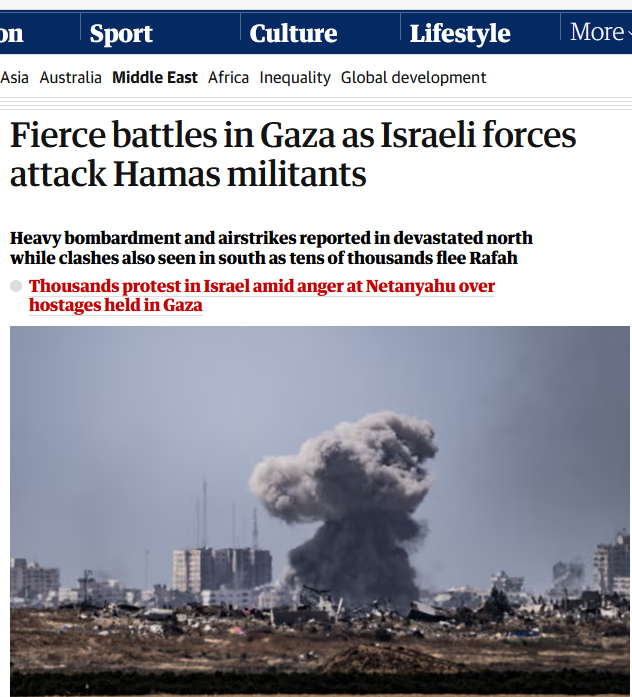
The bombing and shelling of civilians in tents is still described as “clashes”. This propaganda really does not wash any more, though it may reinforce the morale of hardened Zionists. Everybody else has seen through it months ago. Yet still they persist.
5) The endgame is becoming very apparent. The United States is completing its floating harbour for Gaza, and Israel has gained control of the Rafah crossing into Egypt, giving the US and Israel total control of entry points into Gaza. Israel has announced that the Rafah crossing is to be handed over to a US mercenary force. The US can then say it is complying with Biden’s pledge not to put US forces’ boots on the ground in Gaza, while actually taking control.
The Israeli attack on Rafah has been justified by the USA as a “limited military operation”, thus claiming it does not violate Biden’s purported “red line”, even though Israel has ordered over a million displaced people in Rafah to evacuate again, to nowhere.
Conclusion:
The only possible conclusion from all of the above is to reinforce my analysis that the Zionist political and media classes in the West, including Biden, Blinken, Trudeau, Macron, Sunak, Starmer, Scholtz, von der Leyen and all, are active and willing participants in a programme of genocide.
They had numerous opportunities to turn back. We all saw what is happening months ago. They did not take the opportunities.
The endgame remains the processing of the remaining Palestinian population out of Gaza through the US-controlled points of the Rafah crossing and the floating harbour, primarily into camps in the Sinai desert. The Western powers are doubling down on their genocide and on their colonial project.
I see nothing whatsoever that indicates they can have any other long-term objective in mind than the complete Israeli annexation of Gaza minus its civilian population. What do you see?
May 13, 2024
Posted by aletho |
Ethnic Cleansing, Racism, Zionism, Mainstream Media, Warmongering, War Crimes | Gaza, Israel, Palestine, United States, Zionism |
Leave a comment

 Part One, The Record, treats the history of garlic as evidence. From the clay garlic bulb placed in an Egyptian grave nearly six thousand years ago, through the Ebers Papyrus, through Hippocrates, Dioscorides, Pliny and Galen, the Arab physicians under Avicenna, the medieval herbals, Culpeper, and the plague years, to the last era in which Western physicians prescribed garlic as a matter of course, which ran from 1850 to 1945. It closes with the living traditions that never stopped using it, and with the folklore of charms, vampires and the evil eye.


