Moscow responds to claims US warned it about possible terrorist attack target

RT | April 3, 2024
Russian Foreign Ministry spokeswoman Maria Zakharova has rejected the Washington Post’s claim that the US alerted Russia that the Crocus City concert hall could be attacked by terrorists two weeks before the tragedy, calling it completely false.
On Tuesday, the Washington Post reported, citing unnamed US officials, that Russian authorities had received an alert with a “high degree of specificity” that the popular venue could be targeted by the terrorists. According to the news outlet, the notice came one day before the US Embassy in Moscow warned Americans on March 7 to stay away from public gatherings for the following 48 hours because of the heightened threat.
Speaking at a press briefing on Wednesday, Zakharova dismissed the report, noting that Moscow had long grown “accustomed to American misinformation” as well as the Western media’s repeated attempts to retract their own assertions.
“I would really like… to receive factual material on this topic from the American side. That is, to whom and when did they give this information?” she added.
In the aftermath of the Crocus City massacre, the White House said that the US had shared data with Moscow about a potential terrorist attack. The head of Russia’s Foreign Intelligence Service (SVR), Sergey Naryshkin, has confirmed this, but noted that “the information was too general and did not allow us to fully identify those who participated in this terrible crime.”
On March 22, a group of armed men stormed the venue, killing at least 144 people, including six children, and injuring over 500 others. The terrorist act was one of the deadliest in Russia since the early 2000s.
Russian law enforcement agencies arrested several suspects in the aftermath of the attack, including four suspected gunmen who were caught fleeing towards Ukraine. Russian President Vladimir Putin has described the alleged culprits as radical Islamists, saying that a “window” was arranged for them on the Ukrainian border.
Moscow has suggested that the Ukrainian intelligence services may have been involved in the attack, a claim vehemently denied in Kiev. The US and its allies have insisted that the attack was orchestrated by Islamic State terrorists.
Meanwhile, Russian Foreign Minister Sergey Lavrov has pointed out that the West has been conspicuously obsessive in attempts to clear Ukraine of any suspicion that it could have been behind the terrorist plot. He has also called for patience until the investigation is over before jumping to any conclusions.
Does the Meningococcal Vaccine Used in the U.S. Stop Infection and Transmission of Meningococcal Bacteria?
Your bite-size dose of immunity against vaccine misinformation. Spread the truth.
Injecting Freedom by Aaron Siri | April 2, 2024
Does the meningococcal vaccine (MenACWY) used in the United States stop infection and transmission of meningococcal bacteria?
“Yes” or “No”?
When picking an answer, keep in mind that MenACWY is one of the vaccines mandated to attend secondary school in most U.S. states (and to attend university/college in many states), and the justification for these rights-crushing mandates is to prevent transmission of meningococcal bacteria in the school setting.
According to the CDC, “Rates of meningococcal disease have declined in the United States since the 1990s and remain low today. Much of the decline occurred before the routine use of MenACWY vaccines. … [D]ata suggest MenACWY vaccines have provided protection to those vaccinated, but probably not to the larger, unvaccinated community (population or herd immunity).”
Also consider that according to the CDC, “Protection from MenACWY vaccination wanes in most adolescents within 5 years,” and the CDC does not recommend routine administration of this vaccine for adults. And as for the claimed protection from this vaccine, its clinical trial did not prove it prevented a single case of meningococcal disease (relying instead on antibody levels, not clinical findings).
Screenshots of the relevant portions of the websites linked above (in case they change).
‘Shocking Cover-up’: DOJ Lawyers Committed Fraud in Vaccine Injury Case, CHD Attorney Alleges in Motion Filed Today
By Brenda Baletti, Ph.D. | The Defender | April 2, 2024
Rolf Hazlehurst, a Children’s Health Defense (CHD) staff attorney and father of a son with autism, today filed a motion in federal court alleging lawyers representing the U.S. Department of Health and Human Services (HHS) fraudulently concealed evidence that vaccines can cause autism.
In a motion filed in the U.S. Court of Federal Claims, Hazlehurst alleged that U.S. Department of Justice (DOJ) lawyers who represented HHS in vaccine injury cases repeatedly defrauded the judicial system — from the National Vaccine Injury Compensation Program (NVICP) to the U.S. Supreme Court.
That fraud led to thousands of families of vaccine-injured children being denied the right to compensation and the right to have their cases heard, according to the motion.
“This motion makes very serious and well-substantiated allegations of a massive scheme of fraud on the courts,” said Kim Mack Rosenberg, CHD general counsel who also is of counsel to Hazlehurst in the federal case.
“The evidence submitted in support of the motion clearly shows that attorneys from the Department of Justice concealed and misrepresented highly relevant information from the special masters in the Vaccine Injury Compensation Program and the judges in the courts,” Mack Rosenberg told The Defender.
Hazlehurst’s son Yates regressed into autism after being vaccinated as an infant. In the early 2000s, his family and thousands of others filed cases seeking compensation for vaccine-induced autism through the NVICP.
The program consolidated all of the petitions into the Omnibus Autism Proceeding (OAP) and selected six representative “test cases” — of which Yates’ was the second — as the basis for determining the outcome of the remaining 5,400 cases.
Unbeknownst at the time to the petitioners and the NVICP special masters, the DOJ’s star expert medical witness, Dr. Andrew Zimmerman informed DOJ attorneys during the ongoing omnibus proceedings that he had reversed his original opinion and determined that vaccines can and do cause autism in some cases.
In what Hazlehurst alleges was “a shocking cover-up,” instead of allowing Zimmerman to share his revised opinion, the DOJ attorneys relieved Zimmerman of his duties as a witness.
However, they continued to use excerpts from his unamended written opinion to make their case that vaccines did not cause autism — misrepresenting his position and committing “fraud on the court.”
According to the motion, the DOJ’s first act of fraud snowballed into a scheme of deception with far-reaching implications in which DOJ attorneys repeatedly misrepresented Zimmerman’s opinion and concealed other evidence that emerged during the test case hearings in the OAP in subsequent cases before multiple courts.
“As a result, thousands of cases in the Omnibus Autism Proceeding were denied compensation and the impact beyond the OAP is enormous,” Mack Rosenberg said. “This fraud affected the Vaccine Injury Compensation Program — especially the Omnibus Autism Proceeding — the Court of Federal Claims, the Court of Appeals for the Federal Circuit and even the U.S. Supreme Court.”
Hazlehurst said he is “asking the court to give this motion the serious attention it deserves.” He added, “At a minimum, the court should allow discovery and hold a hearing on this motion.”
Overturning a ruling due to fraud on the court is an extraordinary remedy reserved for extraordinary cases but according to Hazlehurst, “This motion we filed shows that this indeed is an extraordinary case.”
The DOJ has until April 30 to respond to the motion.
CHD CEO Mary Holland told The Defender, “Vaccines most definitely do cause autism, and the government has been lying about this reality for decades.”
Holland added:
“With others, I published a law review article in 2011 showing that the government absolutely knew that vaccines cause autism — and yet they have covered it up and lied about it since the inception of the Vaccine Injury Compensation Program.
“How many hundreds of thousands of children and families would have been spared the heartaches and crushing financial burdens of autism had the government come clean?”
‘Exceptionally difficult’ to obtain compensation through NVICP
In the late 1980s, a substantial number of lawsuits for vaccine injuries related to Wyeth’s (now Pfizer) DPT vaccine, combined with “grossly insufficient compensation” for victims of vaccine injury, threatened the vaccine program’s viability.
In response, Congress passed the National Childhood Vaccine Injury Act of 1986, which established the “vaccine court.” The law gave the pharmaceutical industry broad protection from liability and proposed to compensate vaccine-injured children through the new NVICP.
The NVICP originally was designed to be a “swift, flexible, and less adversarial alternative to the often costly and lengthy civil arena of traditional tort litigation.”
To receive compensation, parents file a claim with the program.
The Court of Federal Claims (which oversees the program) appoints “special masters” — typically lawyers who previously represented the U.S. government — to manage and decide the individual claims. Attorneys may represent the petitioners, and the DOJ represents HHS.
NVICP proceedings are more informal than a typical courtroom. Unlike regular court proceedings, petitioners in the “vaccine court” have no right to discovery.
If a petitioner files a claim for a vaccine covered under the program and listed on the Vaccine Injury Table — the list of known vaccine side effects associated with certain vaccines within set time frames — it is presumed that a vaccine caused the petitioner’s injury and the petitioner is eligible for compensation without proof of causation.
However, if a petitioner experiences an “off-table injury” — an injury not listed on the table or that didn’t happen in the recognized injury time frame — the petitioner must prove by “a preponderance of evidence” that the vaccine caused the injury. Evidence includes medical records and expert witness testimony.
Claims must be filed within three years of the first symptom or two years of death.
Petitioners must provide a medical theory of the cause, a sequence of cause and effect, and show a temporal relationship between vaccine and injury.
However, the NVICP does not specify the required volume and type of evidence, so meeting the “preponderance of evidence” standard is largely at the discretion of the special master.
Petitioners can appeal NVICP cases to the Court of Federal Claims, the Court of Appeals for the Federal Circuit and ultimately to the U.S. Supreme Court.
It is “exceptionally difficult” to obtain compensation within the NVICP, Hazlehurst told The Defender. The proceedings are often turned into drawn-out, contentious expert battles and the backlog of cases is substantial.
The Vaccine Act of 1986 is unjust for petitioners, Hazlehurst alleges. And that injustice reached its zenith with the OAP, when the DOJ perpetrated fraud right under the noses of the special masters, signaling the beginning of the fraud on the courts that continues to this day.
Hazlehurst told The Defender he hopes his motion will shed light on the damage inflicted by this law and that it will ultimately help end the autism epidemic.
“The Vaccine Act of 1986 is one of the fundamental causes of the autism epidemic,” Hazlehurst said. “Understanding why this is true, and how the United States Department of Justice perpetrated fraud upon the courts, including the Supreme Court of the United States, is the key to ending the autism epidemic.”
A short history of the autism omnibus proceedings
By 2002, to address a “massive influx” of petitions alleging vaccine-induced autism, the Office of Special Masters combined over 5,000 claims into the OAP to determine whether vaccines cause autism and if so, under what conditions.
Initially, the NVICP planned to investigate causation issues and apply those general findings to individual cases. However, the program changed its strategy and instead selected six “test cases” by which it would examine the evidence for injuries caused by the measles mumps rubella (MMR) vaccine, thimerosal-containing vaccines (TCV), or a combination of both.
Then it would apply the findings of the test cases to other similar cases.
In doing so, Hazlehurst alleges, the court conflated general causation evidence with specific causation evidence from a few cases, without allowing for rules of discovery or evidence that would apply in an actual court.
This, Hazlehurst said, “was a recipe for disaster” as each test case was then used to determine the outcome for the remaining 5,000 cases.
Three cases — Cedillo v. HHS, Hazlehurst v. HHS and Poling v. HHS — are at the center of the alleged fraud by the DOJ.
Fraud #1: the Zimmerman testimony
Hearings for the first OAP test case, Cedillo v. HHS, began in 2007. Zimmerman had worked with the DOJ to prepare an expert report on behalf of HHS finding that Michelle Cedillo’s autism had likely not been caused by the MMR vaccine.
Zimmerman later wrote in a 2018 affidavit that he attended the Cedillo hearing and listened to the testimony of Dr. Marcel Kinsbourne, another world-renowned expert in pediatric neurology.
On that basis, Zimmerman stated, he decided to clarify his written expert opinion about Michelle Cedillo, concerned it would be taken out of context.
Zimmerman spoke with DOJ attorneys to clarify that his expert opinion in the Cedillo case “was not intended to be a blanket statement as to all children and all medical science,” according to the 2018 affidavit.
He specified that advances in science, medicine and his own clinical research had led him to believe there were exceptions in which vaccinations could cause autism.
He also referred the attorneys to a paper he published with colleagues in 2006, the Poling paper, describing the case of an unidentified child who suffered regressive autism following vaccine adverse reactions. The paper suggested a possible association between mitochondrial dysfunction, vaccinations and regressive autism.
After communicating this evidence to DOJ attorneys, the DOJ dismissed Zimmerman as a witness but continued to use his written opinion as general causation evidence.
The DOJ was also allowed to use that report, submitted in one test case, as general causation evidence in other test cases.
None of the petitioners in the test cases could cross-examine Zimmerman, because he was no longer a witness. This was only possible because the federal rules of evidence do not apply in NVICP proceedings.
Yates’ case, Hazlehurst v. HHS, was the second test case in the OAP. His treating neurologist, Dr. Jean-Ronel Corbier testified Yates’ autism was likely caused by a genetic predisposition combined with an environmental insult in the form of vaccinations administered when Yates was ill. (Yates was a patient of Zimmerman in 2002.)
Corbier’s theory of causation in Yates was similar to the theory developed by Zimmerman in the Poling paper and shared with DOJ attorneys.
Yet, despite knowing Zimmerman had concluded that in a subset of children like Yates, vaccines can cause autism, the DOJ “intentionally and fraudulently” misrepresented Zimmerman’s expert testimony in its closing statements in Yates’ case, Hazlehurst alleges.
DOJ attorneys selectively quoted Zimmerman’s expert report from the Cedillo case, telling the court that Zimmerman found there was “no sound evidence to support a causative relationship with exposure to both or either MMR and/or mercury,” when Zimmerman had explicitly told the DOJ that his opinion was the opposite, according to the affidavit.
Fraud #2: the Hannah Poling case
Three weeks after closing arguments in Yates’ case, the DOJ quietly conceded Hannah Poling’s case, which was on the verge of becoming the fourth test case.
Hannah regressed into autism over several months after being vaccinated against nine diseases at one doctor’s visit.
In 2003, Poling’s father, Jon, a physician and trained neurologist, and mother, Terry, an attorney and nurse, filed an autism petition against HHS under the NVICP for their daughter’s injuries.
Jon Poling was a co-author of the 2006 paper with Zimmerman that analyzed an unnamed child, later revealed as Hannah Poling, who had a mitochondrial disorder — a condition with which Yates was later diagnosed.
In 2007, just three weeks after the lead DOJ attorney misrepresented Zimmerman’s opinion during the hearing in Hazlehurst, the same DOJ attorney submitted a report to the special masters conceding that in the case of Poling v. HHS, Hannah’s “regressive encephalopathy with features of autism spectrum disorder” (i.e., regressive autism) was caused by a vaccine injury, based upon a preponderance of the evidence standard.
This was the same neurological diagnosis Zimmerman had made for Yates in 2002.
According to court documents, if HHS had not conceded Poling, Poling v. HHS would have been designated as a test case. However, because the DOJ conceded the case, it was taken out of the omnibus and the DOJ had the case records sealed —- although they were later leaked to the press and published in the Huffington Post in 2008.
In March 2008, Hannah’s parents moved to make the proceedings transparent and available to the public, but the DOJ opposed the motion and the NVICP deferred a ruling on the motion for 60 days.
During those 60 days, the DOJ filed amendments to its report conceding the Poling case. It retroactively changed the basis for compensation to say that Hannah had a “table injury.”
This meant that instead of conceding that the petitioners had proven with a preponderance of evidence that the vaccines caused her autism, they said she had a presumptive injury on the vaccine table, in which causation is presumed.
By conceding the Poling case, opposing the parents’ motion for complete transparency and changing the basis for compensation, the DOJ was able to conceal fraud and critical material evidence of how vaccines cause autism, according to Hazlehurst.
Fraud #3: appellate courts and the U.S. Supreme Court
On Feb. 12, 2009, the special masters denied compensation in the first three cases. They found the petitioners failed to establish causation between MMR or TCV vaccines and autism.
In Hazlehurst’s case, the NVICP explicitly relied on the portion of Zimmerman’s expert report that DOJ attorneys misrepresented.
The Hazlehursts appealed to the Court of Federal Claims and the Court of Appeals for the Federal Circuit, both of which upheld the special master’s decision — by relying on Zimmerman’s misrepresented opinion and knowingly fraudulent statements made by a DOJ attorney, according to Hazlehurst.
Those prior decisions directly influenced the U.S. Supreme Court’s decision in the Bruesewitz v. Wyeth.
In that case, Wyeth, now Pfizer, argued that a decision favoring the Bruesewitz family — who was attempting to sue the company for their daughter’s vaccine injury — would lead to a “flood of frivolous lawsuits,” including by the families from the omnibus.
Amicus briefs from the American Academy of Pediatrics, GlaxoSmithKline, Merck and Sanofi Pasteur on behalf of Wyeth relied on Hazlehurst v. HHS and other OAP decisions that were based on the misrepresentation of Zimmerman’s testimony that there was “no scientific basis” that vaccines cause autism.
The Supreme Court ruled that the National Childhood Vaccine Injury Act, and the NVICP it created, preempt all design-defect claims against vaccine manufacturers by individuals seeking compensation for injury or death.
In oral arguments and in their written opinions, the justices explicitly cited the portions of the amicus briefs citing Hazlehurst v. HHS and other OAP rulings that relied on the DOJ misrepresentations in their rulings.
Since that ruling, the special masters have continued to rely on the DOJ’s fraudulent claims to deny compensation to families filing complaints in the NVICP.
Robert F. Kennedy Jr., CHD chairman on leave, and Hazlehurst in September 2018 filed a complaint with the DOJ Office of Inspector General outlining what they then knew about the DOJ’s fraud during the OAP.
The DOJ Office of Professional Misconduct investigated and responded in a June 2019 letter that it found no wrongdoing.
In that letter, however, the Office of Professional Responsibility conceded the DOJ had in fact kept Zimmerman’s testimony while dismissing him as a witness in order to avoid creating the appearance that he had changed his opinion and to prevent the petitioners from cross-examining him, according to Hazlehurst.
The ‘fraud on the court’ doctrine
It has taken 17 years, Hazlehurst said, since the DOJ’s first alleged act of fraud upon the court, for him to gather all of the admissible evidence necessary to “connect the dots and reveal the DOJ’s web of deceit” to make this claim under the “fraud on the court” doctrine.
Under this doctrine, codified as Rule 60(d)(3) in the rules of the Court of Federal Claims, there is no time limit for the court to overturn a judgment made on the basis of fraud on the court.
The petitioner must demonstrate that there was fraud, intent to defraud and that the fraud affected more than one instance of litigation — putting the integrity of the judicial process at stake.
Hazlehurst alleges DOJ attorneys committed fraud by knowingly making false statements and offering evidence they knew to be false and that they did not take remedial action to disclose information they knew to be false and misleading to the court.
The special masters themselves have an obligation to consider all relevant evidence, but didn’t, in this case, Hazlehurst said. Instead, they ignored the contradictions in Zimmerman’s opinions and ignored the Poling evidence.
This is particularly problematic for NVICP cases, where petitioners can’t conduct meaningful discovery or cross-examination and the special masters’ oversight is the only meaningful safeguard to prevent the DOJ’s abuse of power, according to Hazlehurst.
“There is nothing fair about a government proceeding where the government controls the admissibility of evidence,” he said.
Hazlehurst said that by forcing people injured by vaccines into an administrative program, petitioners are deprived of the basic constitutional rights to due process and equal protection under the law. “It should be declared unconstitutional,” he said.
Brenda Baletti Ph.D. is a reporter for The Defender. She wrote and taught about capitalism and politics for 10 years in the writing program at Duke University. She holds a Ph.D. in human geography from the University of North Carolina at Chapel Hill and a master’s from the University of Texas at Austin.
This article was originally published by The Defender — Children’s Health Defense’s News & Views Website under Creative Commons license CC BY-NC-ND 4.0. Please consider subscribing to The Defender or donating to Children’s Health Defense.
‘Havana Syndrome’ More Likely US Homegrown as Western Media Bangs Anti-Russia Drum
By Ian DeMartino – Sputnik – 02.04.2024
On Sunday, a popular US news program ran a feature on the so-called “Havana Syndrome” alleging that Russian spies are utilizing secret energy weapons to damage the brains of US officials. The report came despite a years-long investigation by five US intelligence agencies that determined it was “very unlikely” to have come from a foreign adversary.
The so-called “Havana Syndrome,” a long-debunked theory that has been revived by Western media in recent days is part of the “game” the administration of US President Joe Biden plays of trying to blame “everything on Russia,” Michael Maloof, a former senior security analyst in the office of the US secretary of defense.
“Why would ‘60 Minutes’ be resurrecting it? Because somebody put a bug in their ear and they’re trying once again [to] play the game of the Biden administration to blame everything on Russia,” Maloof asserted.
Maloof noted that most of the victims of the supposed Havana Syndrome were in the US, which makes it even less likely that Russia would be involved. “Yet they keep trying to create this narrative, that is they say it long and hard enough, it’s got to be true. But who knows what it is?”
Maloof added that many of the alleged victims likely spent a lot of time in SCIFs (sensitive compartmented information facilities) that are full of specialized electronic equipment which may have contributed to the symptoms.
If there is a real affliction affecting these people, Maloof contends that it is more likely coming from within the US than from Russia. “One of those who got hit was in an area where the president of the United States was, and that was in Western Europe. Why wasn’t [the president] affected? Or anybody around him?”
“The only thing I can conclude is that this is coming from within… They’re saying who it isn’t but not what it is, and that’s strange, which means they don’t know,” he added.
“So, once again, this tortuous approach is basically to put up their own little narrative and then shoot it down, but say it still could be true. And this is supposed to be our basis for fact-finding? I don’t think so,” Maloof said, adding “You cannot mistrust these people enough.”
“If there was a unit of the GRU (General Staff of the Armed Forces of the Russian Federation) or something like that, and they were traipsing around the world zapping people, I think that would have been noticed,” Maloof explained.
“It could be anything. It’s just mindless,” he concluded.
Israel’s Attack on Iranian Consulate Highlights Netanyahu’s Pending Defeat in Gaza
Sputnik – 02.04.2024
Tel Aviv launched a strike against the Iranian diplomatic compound in the Syrian capital of Damascus this week, killing several Islamic Revolutionary Guard Corps officers in the process.
Israel’s attack on the Iranian consulate in Syria suggests that it is trying to “widen” the ongoing conflict in the Gaza Strip by drawing Iran into it, said Foad Izadi, an associate professor at the University of Tehran’s Department of American Studies.
“They have been trying to start a military confrontation between the United States and Iran for many years. And they think that they have an opportunity to have this done fighting Iran using American soldiers,” he told Sputnik, apparently suggesting that the US would be quick to leap to Israel’s defense if the latter were threatened by Tehran.
Izadi also remarked that Israel displayed a blatant disregard for international law by attacking a diplomatic compound, which is a violation of the Vienna Convention.
“That is what Israelis are trying to do. Netanyahu realizes that he has lost the war in Gaza. He has managed to kill more than 30,000, mostly women and children, without achieving any goals except killing these people and ruining their homes,” Izadi said.
“They say that they want to destroy Hamas, but that’s not a goal they can achieve. Obviously, they would have done that if they could. That’s why criminal acts and genocide in Gaza continue. And Netanyahu realizes that sooner or later this war needs to end. And that would be the end of his prime ministership. And so he’s trying to prolong the war, he’s trying to widen the war,” Izadi added.
Noting that Iran’s attempt to seek justice via the UN Security Council may be unsuccessful due to the likelihood of the US vetoing a resolution critical of Israel, Izadi suggested that Tehran may opt to “cause pain for the Israelis so that these types of actions are not repeated.”
“Because Iranian officials realize that if there is no pain in engaging in this type of activity, then they will continue,” he elaborated. “So I think Iran’s response would be two-fold in a manner that is not satisfying the Israeli aim of widening the war. I think that’s what Iranian leaders will do.”
NATO ‘de facto’ part of Ukraine conflict – Moscow
RT | April 2, 2024
NATO is aiming to retain control over Ukraine and turn it into an “anti-Russian” proxy, the secretary of the Russian Security Council, Nikolay Patrushev, claimed in an interview published on Tuesday.
The US-led military bloc has long been a “de facto” party to the conflict between Kiev and Moscow, as it controls Ukrainian arms supplies and helps to plan attacks on Russia, Patrushev told the Russian newspaper AiF.
Washington and its allies have been actively militarizing Ukraine ever since the 2014 Maidan coup in Kiev, the official said in an interview covering the US-led military bloc, ahead of its 75th anniversary. NATO now seeks to “keep Ukraine or at least a part of it, as a fully controlled anti-Russian territory,” he stated.
NATO collectively decides on the quantity and types of weapons its members provide to Ukrainian troops, the Russian official noted, adding that the range and technical characteristics of those arms are constantly increasing.
The bloc’s instructors also “train mercenaries and sabotage units on several nations’ territories to be used in anti-Russian operations,” Patrushev told the paper. Under such circumstances, the Kremlin’s goal of bringing about Ukraine’s “demilitarization” remains a priority, the Security Council secretary said.
Stirring up Russophobia and whipping up the perceived “Russian threat” has also turned into a “major policy” for the West, the official said, arguing that such tactics allow the US and its allies to draw public attention away from internal economic issues.
Anti-Russian hysteria ultimately benefits the US military industrial complex, Patrushev stated.
“The US is gaining profits through… dictating very specific arms purchasing conditions to its allies,” the official told AiF, adding that those arms are then produced by American manufacturers, and such contracts can become economic shackles for other NATO members.
Patrushev’s remarks come amid a historic low in Russia-NATO relations. The situation is now worse than during the Cold War, the head of Moscow’s delegation at the Vienna talks on military security and arms control, Konstantin Gavrilov, acknowledged on Monday.
Gavrilov stated that constant talk from Western politicians about Russia’s alleged plans to attack NATO after defeating Ukraine are aimed at diverting public attention from their own governments “pumping … money into the Ukrainian ‘corruption black hole’.”
Moscow has repeatedly stated that it has no plans to engage in a military confrontation with NATO or any of its members. President Vladimir Putin said earlier this year that Russia “has no interest … geopolitically, economically or militarily… in waging war against NATO.”
Why is Western Press Trying to Revive Havana Syndrome Hoax?
By Ekaterina Blinova – Sputnik – 01.04.2024
US broadcaster CBS has claimed there is reason to believe that American officials struck by the so-called Havana Syndrome were “attacked” by Russia, despite five US intelligence agencies debunking the theory last year. What’s behind this new round of hysteria?
In what appears to be a bad April Fools joke, a group of Western mainstream media outlets, namely CBS’ 60 Minutes, The Insider, and Der Spiegel, has brought a busted “Havana Syndrome” theory that points the finger at Russia back to life, again.
The latest 60 Minutes show featured a retired army lieutenant colonel, an FBI agent, a Washington DC-based lawyer representing Havana Syndrome sufferers, and Bulgarian journalist Christo Grozev, well-known for his anti-Russian bias and accused by Russia’s Federal Security Service (FSB) in December 2022 of working hand in glove with the Ukrainian security agents on a plan to hijack several Russian warplanes. CBS’ interlocutors asserted to the broadcaster that “there are no barriers on what Moscow” could do.
What’s Havana Syndrome?
Havana Syndrome is a condition that was seemingly first reported in 2016 by employees of the US Embassy in Cuba who complained about vertigo, migraines, hearing and memory loss, and nausea. The symptoms described by the sufferers are often reported to follow pressure in their heads or strange sounds.
Later, some American government, military and intelligence officials and their family members cited similar symptoms at US embassies around the world, triggering speculation about the use of some sort of mysterious energy weapon. Cuba, Russia and China were named as potential culprits behind what the US mainstream media called a “hostile power attack”.
US Intelligence Agencies Debunked Claims of Russian Involvement
After conducting a thorough investigation into the matter under the Biden administration, the US intelligence community (IC) concluded that it was highly unlikely that the collection of debilitating symptoms was caused by unidentified foreign actors’ attacks.
The Washington Post reflected on the IC’s years-long probe, which included the review of approximately 1,000 cases of “anomalous health incidents”, on March 1, 2023.
“Five of [the US intelligence] agencies determined it was ‘very unlikely’ that a foreign adversary was responsible for the symptoms, either as the result of purposeful actions — such as a directed energy weapon — or as the byproduct of some other activity, including electronic surveillance that unintentionally could have made people sick,” the newspaper wrote.
The IC said it found no pattern or common set of conditions that could link the cases in question. It also did not find any proof, including forensic information or geolocation data, that would indicate that a potential adversary had used some sort of “directed energy such as radio waves or ultrasonic beams.”
One official interviewed by the WaPo stated that in locations where US intelligence had a complete ability to monitor the environment for signs of malicious interference, they had found no evidence of an adversary power targeting US government employees. On top of that, there was no intelligence confirming that foreign leaders, including from Russia, had any knowledge of or had authorized a hypothetical attack on US personnel.
The findings of the US intelligence community were met with ire by Havana Syndrome sufferers and their attorneys. This outrage could be partially explained by six-figure compensations promised by the Biden administration to those severely affected by the “syndrome.”
National Institutes of Health Nipped Mystical Sonic Weapons Theory in Bud
Independently of the IC investigation, the National Institutes of Health (NIH) confirmed its conclusions in two studies released on March 18, 2024. The NIH found no evidence of brain or inner ear injury in scans or blood markers of Havana Syndrome sufferers. The results were published in the reputable Journal of the American Medical Association (JAMA).
According to the NIH, 41% of those who complained of the mysterious Havana Syndrome from nearly every geographic area either “met the criteria for Functional Neurological Disorders (FND)” or showed symptoms indicating underlying psychological distress. The reported health complaints were also usually closely related to a wide range of pre-existing conditions, anxiety reactions, or environmental factors.
Commenting on the NIH studies, Robert E. Bartholomew, an honorary senior lecturer in the Department of Psychological Medicine at the University of Auckland in New Zealand, lambasted peddlers of an “adversary power attack” theory in the scientific community and referred to flaws in their studies in his op-ed for Skeptic.
The scientist stressed that one shouldn’t underestimate the role of psychogenic disorders and distress US diplomats and spies are usually subjected to during their work overseas.
It’s hardly surprising that a mating call of the Indies short-tailed cricket was taken by some US Embassy employees in Cuba as the sound of a mysterious sonic weapon, according to him. Psychosis was quick to spread, instigated by fears of an adversary attack.
“Some media commentators and rogue scientists continue to speculate that a small number of cases in US personnel in both Cuba and later around the world, may have involved a directed energy weapon. Yet, Occam’s razor fits well here. Given two competing explanations, the simplest is the most likely,” Bartholomew wrote. “The entire episode is explainable using conventional psychology, and without recourse to foreign actors and secret weapons.”
Havana Syndrome Theory Used to Stoke Fears About US Rivals
What’s behind the Western media agitation with Havana Syndrome? According to Jacobin staff writer Branko Marcetic, one should pay attention to the timing of the fuss surrounding the energy weapon theory.
“The supposed foreign culprit behind the alleged attacks was constantly cycling through the rogues’ gallery of Washington’s villains of the week, from Cuba, initially, to Russia, then China. The most surprising thing is that Iran didn’t at any point end up in the rotation,” Marcetic noted.
Indeed, the theory of Havana Syndrome being caused by adversaries of the US gained traction at the time when the Trump administration cracked down hard on the Caribbean nation. Reports alleging Chinese traces were fuelled by the US’ trade wars against the People’s Republic and crusade against its hi-tech sector.
Naming Russia as a potential “culprit” fitted into the US foreign establishment’s agenda under both Trump and Biden so as to stoke fears about the alleged “Russian threat”.
The rhetoric of US adversaries being behind Havana Syndrome was just one in a string of other debunked outlandish claims, including fake news that Iran had sentenced fifteen thousand protesters to death; that Russia blew up the Nord Stream pipelines; that China had deliberately flown a spy balloon over the US, and many more, Marcetic emphasized.
According to the journalist, the hysteria was deliberately stirred up by the US to justify unfriendly and hostile acts against the aforementioned nations.
Timing of Havana Syndrome’s Revitalization Speaks Volumes
The timing of the US mainstream media’s effort to bring the Havana Syndrome theory back to life speaks volumes.
First, it comes amid a string of Ukraine’s defeats on the battlefield which appears to inflict serious reputational damage on Biden’s 2024 campaign ahead of the election. Second, it follows the Crocus City Hall terror attack, conducted by Islamists with the apparent participation of Ukrainian operators.
Most recently, Russian investigators have confirmed that the terrorists received cash and cryptocurrencies from Ukraine. What’s more, the Russian Investigative Committee’s report suggests that alleged Ukrainian masterminds could be directly connected to the CIA, MI6 and MI5, Kirill Kabanov, chairman of the National Anti-Corruption Committee, told Sputnik on March 30.
On Sunday, the Russian Foreign Ministry said in an official statement that it had conveyed to the Kiev regime its demand that those involved in terrorist attacks on Russian territory, including Ukrainian Security Service (SBU) head Vasyl Malyuk, be arrested and extradited to Moscow.
The Foreign Ministry’s demand was followed by a Russian Foreign Intelligence Service (SVR) statement on Monday saying that the Biden administration is “covering up those responsible for the terrorist attack at Crocus City Hall” and is “stepping up work to form a distorted picture of the large-scale terrorist attack that took place in Russia on March 22.”
Are the allegations once again being circulated by the Western press of powers adverse to Washington causing Havana Syndrome just a part of this strategy?
Ukrainian counteroffensive ‘biggest debacle in modern military history’ – David Sacks
RT | April 1, 2024
The failure of Ukraine’s 2023 summer counteroffensive against Russia was “easily predictable,” according to US tech entrepreneur and venture capitalist David Sacks, who has suggested that the Washington elite should be held accountable for talking up the doomed operation.
Sacks’ comments came in response to a post on Saturday by Tesla and SpaceX CEO Elon Musk, who condemned the unnecessary loss of life suffered by Kiev’s forces as they attempted to “attack a larger army” that had superior defenses.
The failed Ukrainian counteroffensive was “one of the biggest debacles in the history of modern warfare,” Sacks said in agreement, adding that Kiev’s soldiers and tanks had effectively run “headlong into minefields while Russian artillery rained down on them from heavily fortified positions.”
“This should have been easily predictable,” the former PayPal COO and founder of the Yammer corporate social network stressed.
According to estimates released in March by the Russian Defense Ministry, the Ukrainian military saw over 166,000 casualties during last year’s failed counteroffensive. Kiev’s overall casualties since the outbreak of the conflict with Russia stand at 444,000, the ministry has claimed.
Sacks went on to suggest that US officials such as ex-CIA chief David Petraeus, former House Speaker Nancy Pelosi, and current US Secretary of State Antony Blinken should all be held responsible for encouraging the doomed operation.
“These people are fools who should have no credibility left. But of course the MSM never holds them accountable so we will get more of the same until Ukraine finally collapses,” Sacks surmised.
Musk, meanwhile, has called the counteroffensive “a tragic waste of life for Ukraine,” suggesting that Kiev should not have attacked Russian forces – which had deployed vast minefields and had stronger artillery – while Ukrainian forces lacked armor or air superiority.
“Any fool could have predicted that,” the billionaire said, recalling that one year ago he had recommended that Kiev’s forces entrench and apply all resources to defense.
Musk stated that Kiev would continue to have difficulty holding on to territory, but suggested that Russia was unlikely try to take over the entire country, arguing that it would face “extreme” local resistance in western regions of Ukraine.
He also warned that if the conflict “lasts long enough, Odessa will fall,” and advised Kiev to reach a negotiated settlement with Moscow as soon as possible, before Russia gains more territory and Ukraine loses all access to the Black Sea.
Moscow has stressed that it remains open to meaningful talks with Kiev, and has blamed the lack of a diplomatic breakthrough on the Ukrainian authorities, who refuse to accept the “reality on the ground.”
Globalism and Disease X
By Meryl Nass | March 30, 2024
What is biowarfare? COVID was due to a biological warfare agent. It was designed in one or more laboratories to be more virulent than its natural precursors:
- to prefer to infect humans;
- to infect more organs than possible in naturally occurring strains;
- to interfere with the body’s immune responses.
I say one or more laboratories becasue many of its features had been previously discovered or created in various laboratories, and then these features were essentially grafted onto a coronavirus, one by one; or some features were achieved by passaging the virus through humanized mice, other humanized animals, human cell tissue cultures or humans themselves.
Why were these features created? In which labs?
Why were they painstakingly added to a coronavirus backbone? Where was this done and how many labs were involved?
Why was a coverup by western scientists so critical? Because claiming that pandemics come from animals living in nature, and are spread to humans due to our incursions into their territory, was needed to justify the entire biosecurity agenda that the WHO is steamrolling over us.
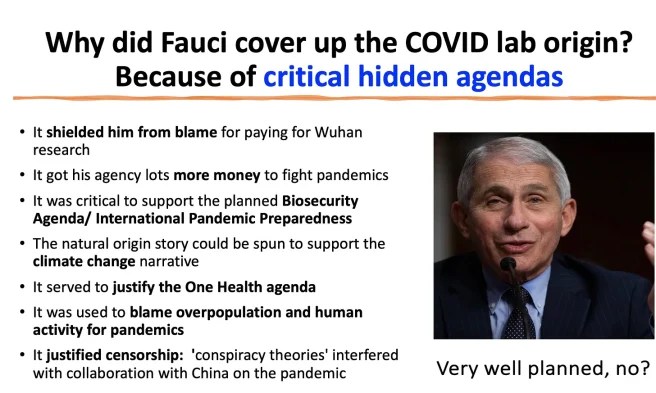
By the way, the newest version of the treaty (released March 7, 2024) states that part of the WHO plan is to “identify” those areas where disease “spillover” occurs. You watch: the WHO will then empty those areas of humans. It really is a great cover story, “spillover.” Except it is a total lie.
_____________________
Historically most biowarfare agents were naturally occurring viruses or bacteria. Here is one example in which whistleblowers identified the hand of the CIA.
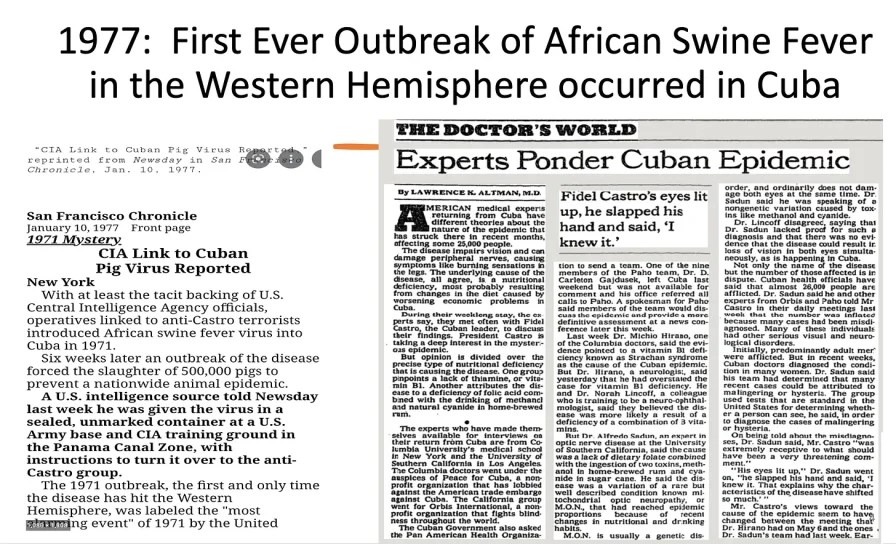
It is “gain-of-function” research that makes them more virulent and/or more transmissible. Gain of function research was considered illegal under international law until about 2001, and then the customary norms of national behavior simply changed, after the US was caught ignoring the usual norms—as revealed in the NYT on 9/4/2001 and in the book GERMS.
The WHO suggested it should be put in charge of gain-of-function research in the pandemic treaty draft that was released on February 14, 2024. It only took 3 weeks before a new draft was issued on March 7, 2024 in which all mention of “gain-of-function” was erased. I wonder if the rapidity of release of the next draft (it usually takes about 3 months to get a new draft) had to do with cutting out the Gain-of-Function section.
But the idea of requiring nations to supply the WHO with samples of potential pandemic pathogens, and to upload their genetic sequences to publicly accessible databases asap remained, was discussed with even more details in the newest March 7 draft. The WHO and nations would be free to share biological warfare agents aka potential pandemic pathogens (essentially) with anyone they liked.
This makes no sense any way you look at it. The goal seems to be a situation where “Pandemics R Us” and they appear frequently, with no ability to tell where they came from or whether they were deliberate or an accident. By sharing them all globally the WHO has paved the way for using the alibi of accidental release for future COVIDs.
The biowarfare segment starts at about 26 minutes into the episode.
As I said, we at DoortoFreedom.org are here to help you educate your lawmakers while you urge them to question this effort publicly, introduce resolutions, and in other ways throw some boulders in front of the steamroller, just like Louisiana’s Senate did this week.
merylnass@gmail.com
Featured Video

or go to
Aletho News Archives – Video-Images
Book Review
The Maidan Killings and the False-Flag Case
By Freddie Ponton | 21st Century Wire | September 5, 2026
Before the killings that helped bring down Ukraine’s president in February 2014, American diplomats were discussing who should enter its government. In a leaked telephone call, senior State Department official Victoria Nuland told US ambassador Geoffrey Pyatt, “I think Yats is the guy,” referring to opposition leader Arseniy Yatseniuk. Washington had clear preferences and was working to advance them. Later that month, Yatseniuk became prime minister.
Ivan Katchanovski’s The Maidan Massacre in Ukraine examines the violence that preceded that transfer of power. Drawing on television footage, witness testimony, forensic examinations and Ukrainian court proceedings, he argues that elements of the opposition shot protesters and police in a false-flag operation. His case centres on evidence of protesters being shot from opposition-controlled locations, including Hotel Ukraina, overlooking the killing ground. … continue
Blog Roll
 Aletho News
- France projects nuclear power as Macron pushes arsenal expansion
- The fallacy of US delusions about Iran’s economic collapse
- What changes with Lula or Flávio?
- Britain leads Western media’s demise through ‘fear porn’ narrative
- The Maidan Killings and the False-Flag Case
- Georgia’s Largest Healthcare System Will Fire Employees Who Refuse Flu Vaccine
- The Five-Year Fuel Crisis: Why the World Economy Is Paying for a War It Thinks Is Ending
- Trump’s Big Bluff on Iran
- Swiss scammed out of millions by Ukraine-linked call centers – media
- Germany facing potential ‘violent conflict’ with Russia – spy chief
- If Americans Knew
- Israeli Attacks Kill Two Palestinians in Gaza
- Gaza genocide at 3: Israeli-U.S. cruelty and the smart, deep resistance to it are changing the world
- As genocide is about to enter 3rd year, little of Gaza remains– Daily Update
- “We See Our Homes Now From A Satellite, Like Strangers”
- Watch “Gaza: Doctors Under Attack”, originally censored by BBC
- NAZA: Israeli embassies in UK and US promote rival documentary to challenge Gaza genocide allegations
- David Ellison appoints Israeli to lead merged Paramount-Warner studios
- Turkish Red Crescent helps elderly Gaza man walk again after Israel confiscates his prosthetic limb
- Four Palestinians Killed in Israeli Attacks in Gaza
- Two Palestinian youths killed and village razed as Israeli attacks on West Bank continue
- No Tricks Zone
- Latest European Green Energy Debacle; Portugal’s Largest Flagship Solar Park Insolvent!
- Green Energy Debacle: German Expert Professor Fritz Vahrenholt Warns Of Severe Economic And Social Consequences
- Two More Paleo Reconstructions Affirm Meters-Higher Sea Levels Across Ireland, Brazil 7000-6000 Years Ago
- New Study: Earth And Venus Surface Warmth Largely Explained By Convection And Lapse Rate, Not CO2 Or Radiation
- 2025 Nature Paper Claiming Worsening Global Drought Gets RETRACTED …Heavily Flawed
- New Study: ‘Global Drought Shows No Detectable Recent Acceleration Under Climate Warming’
- Economic Masterminds: German Socialists Suggest Taxing Productivity Gains Stemming From Using AI
- The South China Sea Has Not Been Cooperating With The Climate Change Narrative
- Energy Crisis: Germany Enters Heating Season With Historically Low Gas Reserve Fill Levels
- New Study: The Antarctic Ice Sheet Gained Mass From 2020-2024 Due To Staggering Snow And Ice Accumulation

