Biden Tells Allied Leaders ‘Ukraine Aid Cannot Be Interrupted Under Any Circumstances
By Kyle Anzalone | The Libertarian Institute | October 3, 2023
President Joe Biden held a call with the leaders of several allied nations to stress that weapon shipments to Ukraine cannot end for any reason. Some members of NATO recently expressed an unwillingness or inability to provide further arms to Kiev.
National Security Council Spokesman John Kirby stated Biden spoke with the leaders of Canada, Italy, Japan, the UK, Poland, Romania, Germany, the European Commission, the European Council, and NATO on Tuesday. Kirby said the president expressed that “we cannot under any circumstances allow America’s support [for] Ukraine to be interrupted. Time is not our friend.”
Biden added that he was confident Congress would authorize an additional $24 billion in aid that the White House requested. While a majority of representatives in both houses continue to support aiding Ukraine, recent polling shows that 71% of Republicans, and 55% of Americans, do not want Congress to pass another multibillion-dollar bill to support Kiev.
A press release from UK Prime Minister Rishi Sunak said London was committed to supporting Kiev. It stated that he “outlined the UK’s ongoing military, humanitarian and economic assistance to Ukraine and stressed that this support will continue for as long as it takes.”
However, the Telegraph reported that London had depleted its available stockpile of weapons it can ship to Kiev. “We’ve given away just about as much as we can afford,” the unnamed source “We will continue to source equipment to provide for Ukraine, but what they need now is things like air defense assets and artillery ammunition, and we’ve run dry on all that.”
After Ukrainian President Volodymyr Zelensky criticized Poland at the United Nations General Assembly, tensions between Kiev and Warsaw boiled over. Polish Prime Minister Mateusz Morawiecki announced that arms shipments to Ukraine would end.
On Monday, Slovak Social Democracy, running on a platform of ending arms transfers to Ukraine, won a plurality in Bratislava’s legislature. The party leader, Robert Fico, doubled down on the pledge after Monday’s election victory.
Washington has also struggled to transfer Kiev the weapons the Ukrainian military needs. The White House resorted to sending Ukraine the cluster variants of 155MM artillery shells and long-range rockets because the Department of Defense lacked enough conventional munitions to transfer to Kiev.
A New Era Of Mass Armies Approaches
BY IAN WELSH | SEPTEMBER 29, 2023
The army, or a part of it at the war college, has perked up and noticed some of the lessons of the Ukraine war, and that it’s a war that the US military could not fight. They’ve missed a lot of things, or felt they couldn’t/shouldn’t write about them, but they’ve figured some stuff out and written about them in a new report, “A Call to Action: Lessons from Ukraine for the Future Force” by Lieutenant Colonel Katie Crombe, and Professor John A. Nagle.
The entire thing is worth reading, but I’m going to pull out three of the main points. The first is that a volunteer US military can’t fight a real war.
The Russia-Ukraine War is exposing significant vulnerabilities in the Army’s strategic personnel depth and ability to withstand and replace casualties.11 Army theater medical planners may anticipate a sustained rate of roughly 3,600 casualties per day, ranging from those killed in action to those wounded in action or suffering disease or other non-battle injuries. With a 25 percent predicted replacement rate, the personnel system will require 800 new personnel each day. For context, the United States sustained about 50,000 casualties in two decades of fighting in Iraq and Afghanistan. In large-scale combat operations, the United States could experience that same number of casualties in two weeks. (emphasis mine)
Huh. Yeah, that seems bad. And it comes just as the US military is having trouble with volunteer recruitment, though even if wasn’t volunteer recruitment couldn’t keep up with the meat grinder of a real war.
The US Army is facing a dire combination of a recruiting shortfall and a shrinking Individual Ready Reserve. This recruiting shortfall, nearly 50 percent in the combat arms career management fields, is a longitudinal problem. Every infantry and armor soldier we do not recruit today is a strategic mobilization asset we will not have in 2031. The Individual Ready Reserve, which stood at 700,000 in 1973 and 450,000 in 1994, now stands at 76,000. These numbers cannot fill the existing gaps in the active force, let alone any casualty replacement or expansion during a large-scale combat operation. The implication is that the 1970s concept of an all-volunteer force has outlived its shelf life and does not align with the current operating environment. The technological revolution described below suggests this force has reached obsolescence. Large-scale combat operations troop requirements may well require a reconceptualization of the 1970s and 1980s volunteer force and a move toward partial conscription. (emphasis mine).
If the US expects to fight Russia, China, or even Iran, they’re going to face a real war.
The US has spent 20 years fighting with air, artillery and surveillance supremacy, with clear communications. American veterans who went to Ukraine were unprepared for a war where the other side has, if not supremacy, air and artillery superiority, and the Ukraine war has been a meatgrinder. Plus, the current command methods the army use don’t work in an environment like the Ukraine:
Twenty years of counterinsurgency and counterterrorism operationsin the Middle East, largely enabled by air, signals, and electromagnetic dominance, generated chains of command reliant on perfect, uncontested communication lines and an extraordinary and accurate common operating picture of the battlefield broadcast in real time to co-located staff in large Joint Operations Centers. The Russia-Ukraine War makes it clear that the electromagnetic signature emitted from the command posts of the past 20 years cannot survive against the pace and precision of an adversary who possesses sensor-based technologies, electronic warfare, and unmanned aerial systems or has access to satellite imagery; this includes nearly every state or nonstate actor the United States might find itself fighting in the near future
Back in 2012 I wrote an article titled “Drones are not weapons of the powerful.” I posited that they’re cheap, easy to make and everyone would eventually get them. We’re pretty much there, in terms of large group actors (the step after that is individuals, leading to an era where even a single person or small group can launch significant attacks.).
The authors of the article agree:
These systems, coupled with emerging artificial intelligence platforms, dramatically accelerate the pace of modern war. Tools and tactics that were viewed as niche capabilities in previous conflicts are becoming primary weapons systems that require education and training to understand, exploit, and counter. Nonstate actors and less capable nation-states can now acquire and capitalize on technologies that bring David’s powers closer to Goliath’s.
There are issues the authors don’t deal with, the main one is “designed in California, built in China.” The US’s weapon building capacity is massively degraded. As one example, the Chinese can build 3 ships per one the US builds, and the ships are probably better.
Since WWII, in every war the US has fought, they’ve had air superiority or supremacy and more advanced weapons than the enemy. They’ve also had more “stuff”. But the WWII “arsenal of democracy” is dead, it doesn’t exist any more.
Another issue is that the US military has outsourced too much of its capabilities. The corporate mantra of “outsource everything except your core competency” doesn’t work in a real war. All support functions should be run by the military and soldiers. (I may write an article on that in the future.) Contractors are too expensive and unwilling to really risk their necks, and outsourcing maintainance to non-army technicians is a disaster.
The US retains one huge advantage, however, its continental position makes it hard to attack the mainland. But this is also a disadvantage if the US loses air and naval supremacy. America’s enemies can only be reached by air and sea, after all.
Anyway, one takeaway is that conscription is likely to come back. I assume they’ll first make a huge push to recruit immigrants, undocumented or not, but that isn’t going to be enough. Get ready and remember, Empires rarely fade, they go down in huge conflagarations. The British Empire’s end involved two world wars.
Zelensky Should Have Stayed Home
BY PHILIP GIRALDI • UNZ REVIEW • OCTOBER 3, 2023
Most Americans do not understand how the United Nations functions, or does not function as the case might be, preferring to think of it as some kind of debating society where the 193 member nations representing the world community can vent over issues that they rarely have control over. Nevertheless, in spite of the torrent of words and the lack of any real program, it is always interesting to watch and listen to the UN’s annual General Assembly meeting, which is held in New York during September. This year’s meeting was particularly interesting as it came complete with a major war blazing in Eastern Europe as well as political turmoil in Africa and rising tension with China. It also features the rumblings coming from a new emerging global economic movement, the so-called BRICS developing as a champion of a multipolar-world currency challenge to the US-European dollar dominated international monetary and banking system.
And with economic union, there is also some political realignment, with China strengthening its ties to the developing world and Russia entering into defense arrangements with Iran. President Xi Jinping and Russian president Vladimir Putin will be meeting in Beijing later this month to discuss common concerns. And, as usual, Israel’s Prime Minister Benjamin Netanyahu showed up to vent his hostility towards Iran with demands that that country’s alleged “nuclear program” be confronted militarily and the sooner the better, just as he has been claiming for the past twenty years.
Indeed, several back stories playing out during this year’s meeting made it more than usually interesting. Ukraine’s President Volodymyr Zelensky had hoped to turn the gathering into an anti-Russian hate fest, but though there was much complaining about Moscow’s attack on Ukraine coming from the Baltic States and others, the ground continues to be shifting against Zelensky over concerns that the war has become an unwinnable money pit that could easily escalate into a nuclear exchange. Speaking before a UN Security Council session, Zelensky was reduced to harshly criticizing the UN itself for failing to prevent or resolve conflicts before calling for Moscow to be stripped of its veto power on the Security Council. Zelensky, his voice rising in anger, complained how “It is impossible to stop the war because all actions are vetoed by the aggressor.” Observers noted immediately that Zelensky’s complaint did not help his cause. While there have been calls for UN reforms in the past, including over the veto power, the existence of the veto for a limited number of post-1945 greater powers was the only reason the United Nations could be created in the first place at all.
Zelensky also did real damage to his position when he said that while the Ukrainian refugees in Europe have “behaved well . . . and are grateful” to those who have given them shelter, it would not be a “good story” for Europe if a Ukrainian defeat “were to drive the people into a corner.” It was reasonably enough seen by critics as nothing less than a threat of possible unrest producing domestic terrorism as well a possible internal insurrection uncontrollable by whatever Ukrainian government survives defeat. Such unrest might involve the millions Ukrainian refugees without houses and jobs already in place in other European nations if Zelensky is not given all the support which he apparently believes is his due.
Zelensky’s actual message to the General Assembly was not quite so incendiary and impulsive as his other interactions while on his visit, but he offered little new. He reportedly received an obligatory “warm welcome” from those in attendance, but “he delivered his address to a half-full house, with many delegations declining to appear and listen to what he had to say.” He warned those present that “The goal of the present war against Ukraine is to turn our land, our people, our lives, our resources into a weapon against you, against the international rules-based order. We have to stop it. We must act united to defeat the aggressor.” Zelensky did go overboard when he referred to Russia and Russians as “evil” and as “terrorists” and accused them of carrying out a “genocide” against Ukraine. Russian Foreign Minister Lavrov responded to comments made by both President Joe Biden and Zelensky by turning the argument around and observing that it is the US and its NATO “puppets” who already “are waging war against us.”
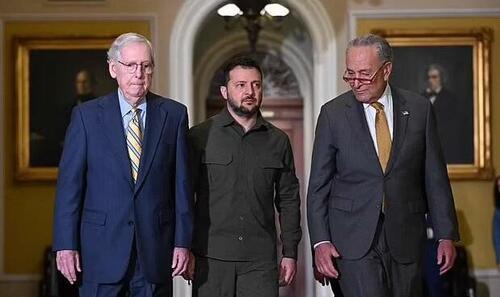
Zelensky’s frustrations spilled over in Washington on the following day where he met both with Biden and with some members of Congress and also dropped by the Pentagon and left flowers at the National 9/11 Pentagon Memorial in Arlington Virginia. His meeting at the White House with the president went relatively well with the announcement of a new aid package in the works including “significant air defense capabilities,” and, according to one report, even some of the much sought after ATACMS long range missile systems. Nevertheless, to his evident disappointment, Zelensky was not given a hero’s welcome like he received last year. He met privately with Kevin McCarthy, speaker of the House, and several other GOP hawks who will be instrumental in approving any aid, as well as with Senators Mitch McConnell and Chuck Schumer who promised to be “in his corner.” McCarthy boldly asked what Zelensky needed to win the war and to provide lawmakers with “a vision of a plan for victory.”
Nevertheless, it seems that many conservative Republicans and some progressive Democrats are fed up with the war and are concerned over the lack of accountability combined with the all too evident level of corruption within the Ukrainian government. There are moves by some in the GOP to separate Ukraine funding from other defense appropriations, requiring a separate vote, and other proposals by the White House to guarantee the money even if the government shuts down. One wonders if anyone had the grit to ask Zelensky how many mansions he owns in Israel, Europe and the United States, but that is precisely the sort of story that is being increasingly written about Ukraine’s comedian turned war hero, demonstrating that the public and even the media have become tired of the charade. A continuing multi-billion-dollar cash flow, seen by Joe Biden as necessary to keep the war going until the 2024 election to vindicate his policy, is still likely but it is no longer a slam-dunk.
Two other media accounts also suggest that the dissatisfaction with Zelensky and the war is breaking through the self-imposed acceptable narrative on the war, that Vladimir Putin is an aggressor without any real provocation from Kiev, a despot and the human monster. One came surprisingly from the New York Times and is apparently a leak from the White House or Pentagon on a September 6th missile attack on the Ukrainian village of Kostiantynivka which killed at least 18. The attack was quickly labeled by Zelensky as a war crime carried out by Russian “terrorists” which was echoed by the US media but an investigation, presumably carried by the US military and intelligence using satellite and other technical methods, has now determined that the missile was fired by Ukraine. This is similar to the missile attack that struck Poland in November 2022, which also was blamed by Zelensky on Russia but turned out to be from Ukraine, both incidents reflecting just how willing Zelensky is to lie and cheat to get a NATO and US intervention in a full-scale war with Russia, which could easily go nuclear.
The other story tells how Poland will not be providing any more arms to Ukraine, in part because it is now building up its own defenses and also over Ukrainian attempts to flood the Polish agricultural market with cheap low quality grain that it cannot sell elsewhere. To describe the Polish action as disappointing to Zelensky would be an understatement, but it is one more indication that many former allies are now seeing Ukraine as a lost cause and are looking to their own national security and economic interests. Both of these stories were, incidentally, published while Zelensky was in the United States hat in hand, and it must be considered that the timing was deliberate to damage the Ukrainian president’s credibility to coincide with the UN General Assembly visit and the trip to Washington.
Zelensky’s journey to North America ended in Ottawa, where he apparently recouped some of his swagger during a speech to the Canadian government and parliament which resulted in standing ovations. Or so it seemed. The Canadians produced a 98 year old Hungarian veteran of the Second World War named Yaroslav Hunka who had fought against the Russians and emigrated to Canada after the war ended. He too was cheered by the assembled Canadian politicians. The intention was clearly to present a narrative of a brave Ukrainian who fought valiantly to free his country from Russian domination but it didn’t quite work out that way. To fight the Russians required being in Nazi Germany’s armed forces and it turned out that Hunka had served in the 14th Waffen-SS Grenadier Division, also known as the Galicia Division, a volunteer unit made up mostly of ethnic Ukrainians commanded by German officers that has been rightly or wrongly credited with a number of wartime atrocities against Russians, Poles and Jews. Soldiers in the division swore a personal loyalty oath to Adolf Hitler. The bad judgement shown by the Canadian government in producing Hunka without fully investigating his story subsequently produced a huge uproar in Canada, with the head of parliament resigning, Prime Minister Justin Trudeau in deep political trouble and the Polish government demanding that Hunka be extradited to them for a war crimes trial. There has been some suspicion that Zelensky may have been instrumental in arranging the affair in expectation that it would strengthen Canadian support for his cause. Instead, it has accomplished the reverse and Zelensky returned home with little or nothing accomplished.
Zelensky must also confront back home a war that he is decisively losing and a country in ruins. And Joe Biden made clear in his speech addressing the UN General Assembly that negotiations with Russia to end the Ukraine fighting would not be considered. Joe included a pledge to support the conflict until it is Russia that is doing the surrendering: “The United States, together with our allies and partners around the world, will continue to stand with the brave people of Ukraine as they defend their sovereignty and territorial integrity and their freedom… Russia alone bears responsibility for [the war]. Russia alone has the power to end this war immediately. And it is Russia alone that stands in the way of peace, because Russia’s price for peace is Ukraine’s capitulation, Ukraine’s territory, and Ukraine’s children.” In short, the speech was a lot like Joe Biden and the band of scoundrels and grifters that he has gathered around him in the White House, heavy on bellicosity but short on any serious planning or strategies to make the world and this country a better place. Joe would like to see the war continue to bring its eventual end a lot closer to the US elections, where he hopes to self-identify as a strong leader and a “winner” taking on America’s enemies. Good luck Joe.
Philip M. Giraldi, Ph.D., is Executive Director of the Council for the National Interest, a 501(c)3 tax deductible educational foundation (Federal ID Number #52-1739023) that seeks a more interests-based U.S. foreign policy in the Middle East. Website is councilforthenationalinterest.org, address is P.O. Box 2157, Purcellville VA 20134 and its email is inform@cnionline.org.
Someone Wants ‘the War to Continue’
By Ted Snider | The Libertarian Institute | October 3, 2023
At times, Ukraine has been unwilling to negotiate an end to the ongoing war with Russia. Ukrainian President Volodymyr Zelensky has gone so far as to issue a decree banning negotiations with Russian President Vladimir Putin.
At other times, Russia has given up on negotiating. In a press conference at the United Nations, Russian Foreign Minister Sergey Lavrov lamented, if you insist “’on the battlefield’—well, let it be on the battlefield.”
And at times, Ukraine and Russia have been willing to negotiate with each other. The United States, though, has at no time been willing to negotiate. Instead, an administration that promised the world “a new era of relentless diplomacy” has delivered an unhappy pattern of obstructing negotiations.
As early as December 17, 2021, months before their invasion, Russia presented the United States with a proposal on mutual security guarantees that demanded NATO not expand into Ukraine. The proposal demanded that “The United States of America shall take measures to prevent further eastward expansion of the North Atlantic Treaty Organization (NATO) and deny accession to the Alliance to the former USSR republics.” A month later, on January 26, the United States rejected Russia’s central demand and formally declined to negotiate, insisting instead on “the right of other states to choose or change security arrangements.”
Vladimir Putin remarked “that fundamental Russian concerns were ignored.” In the official Russian response on February 17, 2022, Russia said that the United States and NATO offered “no constructive answer” to Russia’s key demands. Four days later, on February 21, Sergey Lavrov said, “The assessment of this response shows that our Western colleagues are not prepared to take up our major proposals, primarily those on NATO’s eastward non-expansion. This demand was rejected with reference to the bloc’s so-called open-door policy and the freedom of each state to choose its own way of ensuring security.” Highlighting American stubbornness about negotiating, the veteran diplomat added the important detail that, “Neither the United States, nor the North Atlantic Alliance proposed an alternative to this key provision.”
On April 8, 2022, Derek Chollet, counselor to Secretary of State Antony Blinken, admited that the United States told Moscow that negotiating NATO expansion into Ukraine was never on the table.
Just last month on September 17, NATO Secretary General Jens Stoltenberg made the stunning concession that, as Putin had always insisted, Russia “went to war to prevent NATO, more NATO, close to his borders,” and that Putin “sent a draft treaty that they wanted NATO to sign, to promise no more NATO enlargement. That was what he sent us. And was a pre-condition for not invade Ukraine. Of course we didn’t sign that.” Stoltenberg then repeated, “He wanted us to sign that promise, never to enlarge NATO… We rejected that.”
On February 27, 2022, only a month into the war, Russia and Ukraine announced that they would hold talks in Belarus. At the end of the talks, the two delegations returned home for consultations, having identified priority topics. A second round of talks took place in Belarus on March 3.
At a February 25 press conference, State Department spokesman Ned Price was asked what the U.S. position was on the upcoming “talks between Russia and Ukraine happening in Minsk,” the capital of Belarus. Price rejected negotiations, saying, “Now we see Moscow suggesting that diplomacy take place at the barrel of a gun or as Moscow’s rockets, mortars, artillery target the Ukrainian people. This is not real diplomacy. Those are not the conditions for real diplomacy.
Shortly after, on March 6, then-Israeli Prime Minister Naftali Bennett made a surprise visit to Moscow to meet with Putin in an attempt at mediation. Bennett had a series of back and forth conversations with Putin and Zelensky before flying to Germany for meetings with German Chancellor Olaf Scholz. Bennett also had conversations with French President Emmanuel Macron, followed by then-UK Prime Minister Boris Johnson and U.S. President Joe Biden.
Bennett said that “there was a good chance of reaching a ceasefire.” But Bennett also says the West made a different decision. “So, they blocked it?” his interviewer asked. “They blocked it,” Bennett replied.
From March 2022 into April, Turkey mediated talks between Russia and Ukraine in Istanbul. The two sides reached a tentative agreement.
On June 13, Putin confirmed that “we reached an agreement in Istanbul,” and that it had reached the level of having been initialled by both sides. On September 9, Lavrov further confirmed that the agreement had been initialled: “[W]e did hold talks in March and April 2022,” Lavrov said, “We agreed on certain things; everything was already initialled.”
A face-to-face meeting between Putin and Zelensky was in the process of being set.
But on April 9, 2022, Boris Johnson rushed to Kiev and insisted to Zelensky that Vladimir Putin “should be pressured, not negotiated with” and that, even if Ukraine was ready to sign some agreements with Russia, “the West was not.”
The negotiations came to a sudden stop. On June 13, 2023, Putin said, “We actually did this but they simply threw it away later and that’s it.” On June 17, Putin told an African delegation that “the Kiev authorities… tossed [their commitments] into the dustbin of history. They abandoned everything.” Putin implicitly blamed the United States, saying that that when Ukraine’s interests “are not in sync” with American interests, “ultimately it is about the United States’s interests. We know that they hold the key to solving issues.” On September 23, 2023, Lavrov, too, said, “I think, someone in London or Washington did not want this war to end.”
On April 20, 2022, Turkish Foreign Minister Mevlut Cavusoglu said, “There are countries within NATO who want the war to continue.”
“Following the NATO foreign ministers’ meeting,” Cavusoglu explained, “it was the impression that… there are those within the NATO member states that want the war to continue, let the war continue and Russia get weaker.” On November 18, 2022, Numan Kurtulmus, the deputy chairman of Erdogan’s ruling party, said. “We know that our President is talking to the leaders of both countries. In certain matters, progress was made, reaching the final point, then suddenly we see that the war is accelerating… Someone is trying not to end the war. The United States sees the prolongation of the war as its interest… There are those who want this war to continue… Putin-Zelensky was going to sign, but someone didn’t want to.”
No talks between Russia and Ukraine have been held since.
War Fatigue Complicates West’s Aid to Ukraine
BY M. K. BHADRAKUMAR | INDIAN PUNCHLINE | OCTOBER 3, 2023
A pall of gloom descended on Europe as the long-feared uncertainty set in over the weekend as to how long would the collective West underwrite the proxy war in Ukraine. To lift their sagging spirit, some European foreign ministers impromptu took the train to Kiev to spend Monday with President Zelensky. It was an extraordinary sight of defiance of the call of destiny, as the war passed the 19-month mark.
A deal in Washington that averted government shutdown for now but cut funding for Kiev; the Polish election campaign in which the ruling Law and Justice party, until recently one of Ukraine’s staunchest supporters, has toyed with various measures such as questioning more arms deliveries and blocking agri-products from its neighbour in order to court voters; and, the stunning parliamentary election results in Slovakia catapulting a pro-Russian left-wing political party to power and signalling the first true political embodiment of “Ukraine fatigue” — suddenly, the West’s mantra of being by Ukraine’s side “for as long as it takes” feels seriously open to question.
CNN exaggerated, perhaps, while commenting that the above developments “appear to have thrown Ukraine and its war with Russia under the bus” — but only by a bit. The politics of the Ukraine war has crossed an inflection point and is poised for bigger things in the critical months ahead.
The White House has vowed to seek quick passage of a stand-alone Ukraine aid bill totalling $20.6 billion that the Biden administration has said is essential to fight Russia, but it will likely continue to face determined opposition, particularly from Republicans in Congress. At the root of it is the fierce polarisation in US politics, which now threatens to shake the balance of power in the Congress in a no-holds barred election year that looms ahead.
This does not mean stopping the US aid to Ukraine. The administration has enough resources to support Kiev over the next month and a half and, above all, it is too far-fetched to expect any serious changes in the Ukrainian direction of US foreign policy before the 2024 election. But the salience lies somewhere else — namely, the topic of assistance to Ukraine is frothing in the cauldron of disputes between Republicans and Democrats and is becoming inseparable from the tendentious issues of social programmes that tear apart the American society and become fodder for its combative politicians.
The Ukraine war has become a political football in the Beltway just over a year from the US presidential election, with questions mounting over aid approved by Congress that totals $100 billion so far, including $43 billion in weaponry. Simply put, for right–wing Republicans, financing Kiev is becoming a tool of political manipulation of the Biden Administration through which they hope to seize advantages and concessions. And Donald Trump is waiting in the wings.
Meanwhile, there is a vicious sub-plot playing out within the Republican Party itself in a bid to unseat the Republican House Speaker Kevin McCarthy next week by hardline Republican Matt Gaetz, one of a core of hard-right members of the party implacably opposed to any more aid for Ukraine.
In order to survive, McCarthy has threatened to link aid for Ukraine to funding to stop immigrants crossing the Mexican border, a key Republican demand. “I’m going to make sure that the weapons are provided for Ukraine, but they’re not going to get some big package if the border is not secure,” McCarthy told CBS ominously.
Most important, the wider signal to the world is damaging. European capitals are already nervously eyeing the possibility of a return to the White House by Trump. Josep Borrell, the European Union’s foreign policy chief and a major US partner in delivering aid to Ukraine, expressed surprise and regretted the US decision “deeply, thoroughly.”
Borrell said, “I have a hope that this will not be a definitive decision and Ukraine will continue having the support of the US.” Indeed, there is a wider problem — war fatigue among inflation-hit American voters.
In many ways, the victory of former Prime Minister Robert Fico’s left-wing populist Smer party in this weekend’s parliamentary election in Slovakia is also to be attributed to war fatigue. Fico has said no more weapons will go to Ukraine; questioned the logic of the EU’s Russia sanctions; praised Moscow; and blamed the NATO for causing the war, which he says, began after “Ukrainian Nazis and fascists started to murder Russian citizens in Donbas and Luhansk.” Economic anxieties further compound the societal Ukraine fatigue and the dramatic turn in Slovakian politics, which is likely to impact the West’s relations with Kiev.
Within the EU, Hungary and Austria will now have an ally in Slovakia, a frontline state, advocating an immediate cessation of hostilities in Ukraine and peace negotiations. Fico himself is a close ally of Hungarian Prime Minister Viktor Orban — and they could be joined by Poland if the ruling Law and Justice Party secures a fresh mandate, which seems likely, in the parliamentary election on October 15.
All indications are that Poland is veering away from its long-standing pro-Ukraine position. Poland’s PM Mateusz Morawiecki said recently, “we are no longer transferring any weapons to Ukraine because we are now arming ourselves with the most advanced weapons.”
Then, as the CNN wrote, “Beyond EU, within NATO there is an equivalent fear of the consequences of an expanding anti-Ukraine bloc… And both Hungary’s Orban and Slovakia’s Fico have declared themselves adamantly opposed to any move to welcome Ukraine into the alliance… The reality is the Ukraine counteroffensive, which will have to diminish with the advent of winter, has so far achieved little substantive progress on the battlefront. The arrival of newly-empowered anti-Ukraine parties in frontline states, together with waffling by leading Kremlin foes like the United States, all comprise a truly toxic mix.”
Looking ahead, further erosion of support for the Ukraine war can be expected and even a possible collapse of support for Ukraine across the collective West cannot be ruled out in the months ahead, especially if the Kremlin leadership finally decides to give a knockout punch to Ukraine’s military and/or orders the Russian forces to cross the Dnieper and take over Kiev and Odessa.
Even otherwise, the crunch time comes with the elections to the European Parliament on 6-9 June 2024. There is a clear possibility of anti-Ukraine parties winning a substantial bloc of votes in the elections. If and when that happens, the invidious conspiracy mooted by Germany and France to abolish the rule of unanimity required for taking major EU decisions (eg., Russia sanctions and their six-monthly renewal) will flounder.
Both Orban and Fico have declared their opposition to Russian sanctions. Suffice to say, the politics of the Ukraine war and Russia sanctions is entering uncharted waters, as Hungary allied with Slovakia — and potentially with Poland — would be in a position to complicate pro-Ukraine, anti-Russian efforts by the rest of the EU.
In the art of politics, American politicans originally patented “filibuster”, a political procedure in which one or more members of a legislative body prolong debate on proposed legislation so as to delay or entirely prevent decision, and European politicians are now inventing their own variant of it.
Orban has been practising it for a decade already, and with growing dexterity, to push through his nationalistic programme of “sovereign democracy” in Hungary. That is where the weekend’s Slovakian election and Fico’s return to power has the potential to become a defining moment in the politics of Ukraine war.
NATO-trained Ukrainian conscripts surrendering en masse
By Drago Bosnic | October 3, 2023
One of the many peculiarities of the special military operation (SMO) has been the rather small number of POWs (prisoners of war) on both sides (relative to the number of overall casualties). Reasons for this are manifold and include the way the conflict is being waged (the vast majority of casualties are the result of long-range strikes, primarily artillery and drones), widespread use of combat drugs, as well as the rabidly Russophobic propaganda that is being disseminated among the Kiev regime forces. This often results in instances of summary executions of Russian POWs by the Neo-Nazi junta troops or their unwillingness to surrender to the Russian military, as they are being fed propaganda that the Russians will treat them the same, even though evidence suggests otherwise.
However, it seems such trends are changing rapidly, particularly as the number of ideologically charged soldiers among the Kiev regime forces is going down due to the number of KIA/WIA/MIA (killed/wounded/missing in action). They have been increasingly replaced by forcibly conscripted regular Ukrainians who simply don’t see the conflict as their own. The fact that the commanding officers (COs) are effectively treating the soldiers as literal cannon fodder is also contributing to this, further resulting in low morale and even widespread insubordination. There were instances of Ukrainian soldiers even shooting their COs in order to avoid being sent into the meat grinder. Others are simply doing anything they can to leave the country and escape being sent to the frontlines.
In order to reduce the number of casualties on both sides, the Russian military has even set up special communication channels for Ukrainians willing to surrender. This has been giving results for several months already, particularly since the start of the much-touted counteroffensive of the Neo-Nazi junta troops. On October 2, the elite 1st Guards Tank Army of the Russian Battlegroup West captured two units composed of Ukrainian conscripts in the vicinity of Artyomovsk (previously known as Bakhmut) in the Donetsk People’s Republic (DPR). The units in question are the 77th Airmobile Brigade and the 56th Separate Motorized Brigade. Surprisingly, reports about the mass surrender of Ukrainian conscripts are also becoming more common in Western media, too.
Retired United States Army Colonel and former senior adviser at the Pentagon Douglas MacGregor has repeatedly reiterated that the number of surrendering Ukrainian conscripts keeps growing, particularly as the embattled Kiev regime is having trouble hiding the catastrophic losses in both manpower and equipment. According to both American and Ukrainian combat veterans, the NATO training they’ve been provided all these years has been proven detrimental to their fighting capabilities, resulting in higher casualties and lesser combat effectiveness. In fact, many Ukrainian soldiers have stated they’d be dead if they followed the much-touted NATO standards. Instead, they’re still largely relying on Soviet-era training, equipment and weapons, as these have been proven as much more effective.
Another reason for the high casualty ratio among the Neo-Nazi junta troops is the very limited training that Ukrainian conscripts have been given before being sent to the frontlines. The primary reason for this is the urgency of replacing previous losses, resulting in a vicious cycle that even the mainstream propaganda machine couldn’t ignore. Back in May, the Wall Street Journal reported that poor men from villages and small towns were sent to the frontlines after just two nights at a base. The report effectively admitted that the COs insisted that “conscripts learned on the battlefield to compensate for the almost total lack of training”. The overall result of this has been that conscript units now have up to 90% KIA/WIA/MIA, as reported by various local and global military sources.
Russian intelligence reports also indicate that Ukrainian conscript units are increasingly “trained” by the much-touted British Special Air Service (SAS), highly popularized in various shooter video games, particularly the Call of Duty series, a major NATO propaganda tool in recent years. The United Kingdom keeps insisting that their forces are supposedly not present in Ukraine, with Prime Minister Rishi Sunak even denying the claims of his own cabinet’s Defense Secretary Grant Shapps that British advisors will officially be sent to train the Neo-Nazi junta troops. It’s important to note that high-ranking Russian military intelligence officials (both retired and active) have pointed out the high frequency of the usage of English among military personnel embedded within the Kiev regime forces.
Namely, this is particularly true when it comes to the areas where the abortive counteroffensive is (still) being conducted. Apart from American special forces, this reportedly also includes SAS operatives. And while the mainstream propaganda machine keeps ridiculing Moscow’s claims about the presence of NATO personnel in Ukraine (either as mercenaries or under the direct command of the belligerent alliance) and decrying them as supposed “conspiracy theories” and “Russian disinformation”, battlefield information suggests otherwise. This is also further reinforced by NATO’s standard counterintelligence practice of denying that certain weapons will be delivered and then stating they “might be” delivered only to then announce they will be sent to the Neo-Nazi junta when the process has already been completed.
Drago Bosnic is an independent geopolitical and military analyst.
What’s behind the sudden US good will towards Iran?
By Robert Inlakesh | RT | October 2, 2023
In what proved to be a domestically controversial move, the US government approved the release of five prisoners held in Iran in return for releasing five Iranian detainees and billions of previously frozen assets. However, in the aftermath of the agreement between Tehran and Washington, the White House’s primary focus seems to be centered around securing a Saudi-Israeli deal rather than working on reviving the 2015 Iran nuclear deal, known formally as the Joint Comprehensive Plan of Action (JCPOA).
As revealed by the anonymous diplomatic sources of The Cradle, in addition to other tidbits released in US media, the US-Iran prisoner swap appears to have been much more than meets the eye. The informal agreement, according to these anonymous sources, encompassed freezing Iranian uranium enrichment at 60% and permitting the International Atomic Energy Agency (IAEA) to install cameras at several nuclear sites. On the other hand, the US’ concessions included disregarding Iranian oil sales – in essence, refraining from enforcing sanctions – and allowing all Iranian assets to be released, reportedly amounting to roughly $20 billion. This is well over the widely reported $6 billion touted in the international press.
What makes this agreement so intriguing is that it was non-formal, including no known signed documents, and was contrived over several months and under the auspices of Qatar and Oman as intermediaries. From leaked information, citing unnamed sources, what we can gather – regardless of what claims are true or false – is that the prisoner swap was more than a simple exchange of prisoners and $6 billion in frozen assets. According to a report released in May by Axios, secret indirect talks between the US and Iran had been conducted in Oman, which three sources close to the news outlet claimed Iran’s top nuclear negotiator, Ali Bagheri Kan, was part of. Later, in June, the New York Times released a report claiming that secret negotiations were going on, aimed at concluding an informal agreement to replace the need to revive the 2015 nuclear deal.
To begin with, if we are to assume that the official US narrative on the agreement is correct, despite Iranian officials having contradicted it, then the most apparent objective in mind from Washington’s perspective would be to cause a thaw in America’s relationship with the Islamic Republic. As various analysts have suggested, this could have also signaled hope for a revival of the nuclear deal, which fell apart after the administration of former President Donald Trump unilaterally withdrew from it in 2018. Hope had largely faded that the administration of President Joe Biden could bring the deal back to life after Biden was revealed to have said that it was officially “dead” in November of 2022.
However, given the information we have at hand, what is most likely here is that this represents a massive de-escalation following ship seizures and the beefing up of America’s troop presence in the Persian Gulf back in August. Why a de-escalation now? Is it to revive nuclear deal talks? This appears highly unlikely. Instead, the prisoner exchange agreement comes simultaneously with, and is somewhat overshadowed by, developments in the ongoing discussions to reach an American-brokered normalization deal between Saudi Arabia and Israel.
The two nations, both powerful partners of the US in the Middle East, have never had formal diplomatic relations with each other. Saudi Arabia does not recognize Israel as a sovereign country and has been at loggerheads with it over its treatment of Arabs in Palestine, which Riyadh ostensibly wants to see as an independent nation. Negotiations to finally normalize diplomatic relations have been ongoing for months now, with the US being a highly invested middleman, given that achieving such a deal would help consolidate its power base in the region. As for Iran, while Israel sees it as an existential enemy, Saudi Arabia has had a complicated relationship with it, only having re-established diplomatic ties earlier this year in a deal brokered by China.
When Biden met with Israeli Prime Minister Benjamin Netanyahu in New York on the sidelines of the United Nations General Assembly (UNGA)’s 78th session, they publicly discussed the high hopes of concluding Saudi-Israeli normalization. This was followed by two Fox News interviews, one with Saudi Crown Prince Mohammed Bin Salman and the other with the Israeli PM, during which both said that the deal grows closer by the day. At Benjamin Netanyahu’s address to the UNGA, he spoke at length on Iran; however, there was no mention of the recent US-Iranian prisoner exchange.
In fact, Israel has remained silent on the informal deal. This is especially interesting, considering that Tel Aviv routinely attacks the prospect of any agreement with Iran, let alone one that allows for tens of billions in funds to be transferred back into the hands of Tehran. In June, Netanyahu spoke over the phone with US Secretary of State Antony Blinken, during which he discussed Iran at length and proclaimed that he opposes and will not be bound by any agreement struck between Washington and Tehran.
On September 5, Antony Blinken spoke with the Israeli premier again, allegedly discussing Iran as the primary subject of the call. While the precise details of the calls are impossible to apprehend, there had to be a good chance that the prisoner swap agreement was mentioned, as reports had publicly been leaked to the press regarding Iran-US talks. With so much focus placed upon Iran by Israel, it makes no sense that Tel Aviv would remain silent on the prisoner exchange, especially given the release of Iran’s formerly frozen funds.
Not silent on the unfreezing of Tehran’s billions were Republican politicians in the US Congress. If the Biden administration were to have accepted a renewal of the 2015 nuclear deal, one of its major hurdles would have been passing the deal in Congress, including the deeply opposed Republican-led House of Representatives. In fact, any attempt to try and pass a deal, at this point, could reflect negatively on the Biden White House, which matters more now as we head towards the 2024 presidential election.
Therefore, by striking an informal agreement with Tehran, the US de-escalates and addresses some of its worries surrounding Iran’s nuclear program. More importantly, however, the US government could be trying to create a fertile environment for the conclusion of an Israeli-Saudi normalization agreement, both by calming Iran down to de-escalate regional tensions and, possibly, leveraging concessions to ease Tehran’s pushback against the normalization directly. Whether this strategy will work or not is yet to be seen. Still, it is clear that the key foreign policy goal for Joe Biden is securing the normalization agreement, which is why it makes sense that the most powerful nation that opposes it – Iran – should be addressed and taken seriously.
Robert Inlakesh is a political analyst, journalist and documentary filmmaker currently based in London, UK. He has reported from and lived in the Palestinian territories and currently works with Quds News. Director of ‘Steal of the Century: Trump’s Palestine-Israel Catastrophe’.
Horrendous Number of Eagle Deaths From Wind Farms

BY CHRIS MORRISON | THE DAILY SCEPTIC | OCTOBER 1, 2023
Further devastating evidence of the toll that onshore wind turbines take on local eagle populations has emerged in Tasmania. The local Wedge-tailed eagle is thought to be down to just 1,000 individuals, but over the last 12 years at least 270 birds have been killed or injured in the vicinity of wind farms. According to a recent paper in Australian Field Ornithology, a further 49 vulnerable White-bellied sea eagles have also been killed in this period.
The scale of depredation is shocking but it could be much worse than reported. According to author Gregory Pullen, information about eagle deaths is not readily available, “nor readily made available”. His calculations arise from a number of primary sources including annual reports. He suggests that unrecorded casualties are higher since most are recorded anecdotally and are not the result of systematic survey. The Tasmanian sub-species of the Wedge-tailed eagle is listed as endangered under both federal and state threatened species legislation.
Large birds of prey such as eagles are at particular risk from giant wind turbine blades revolving at speed since they rely on air currents for sustained flight. The Daily Sceptic has covered this developing story, noting that few activists, bird conservation groups and writers seem able to rouse themselves to complain when the natural flight path of raptors stands in the way of green progress. The Australian climate journalist Jo Nova has stood out from the unquestioning crowd, noting that in Tasmania the greens are destroying nature – again. “It’s not about the environment is it,” she said. She went on to add that there are plans to build up to 10 wind turbine parks across Tasmania – “and if one tower misses, the next will get them”.
It’s not really about the environment over in California either, where America’s national bird, the bald eagle, and many other raptors face mass slaughter in the local wind farm avian graveyards. This follows the state Democrat-controlled legislature’s recent decision to relax controls on wildlife protections to allow permits to kill previously fully protected species for renewable energy and infrastructure projects. However, evidence continues to emerge that the slaughter has been going on for years. Last year, NextEra, one of America’s largest utility companies, was fined $8 million after 150 eagles were killed at its wind farms across eight states. According to the Golden Gate Audubon Society, a wind farm complex in Altamont has been killing 75-100 golden eagles every year since the 1980s.
The animal slaughter does not stop at large birds of course. A number of scientific studies have point to the destruction of millions of bats and smaller birds every year by turbine blades capable of travelling at the tip at speeds approaching 150mph.
Alas, it is not as if the deaths of these wildlife green martyrs are helping to produce much worthwhile economic activity. In the U.K., the small number of jobs being produced by green technologies is starting to be noticed. Gary Smith, the leader of Britain’s largest trade union, recently said that communities along the North Sea can see wind farms, “but they can’t point to the jobs”. Possibly exaggerating to make his point, he added that much of the green work seems to be either London-based lobbying or clearing away the animal casualties of wind farm blades. “It’s usually a man in a rowing boat, sweeping up the dead birds,” he observed.
Green activists are increasingly being caught between a rock and a hard place on these impact issues. It is becoming obvious that many of the green technology solutions proposed to replace fossil fuels come with heavy environmental costs. Whether it be open cobalt mining with child labour, or digging up vast quantities of the Earth’s crust to help construct second-rate solutions such as windmills, the terrible impact is all too obvious. At the moment the typical stance seems to be that voiced by Audubon California Policy Director Mark Lynas, who said we need renewable energy resources, and he did not want to see the eagle deaths “being used to push against clean energy”.
Another area where ecology fights are breaking out is on the east coast of America, where whales are beaching on the shores of New Jersey and New York in alarming numbers. In the first half of this year over 40 whales have died in this way. Large areas of the local ocean are being turned into industrial wind parks, with particular concern arising over 24-hour sonar soundings. The veteran environment campaigner Michael Shellenberger has said the massive offshore works are wreaking environmental damage in previously pristine waters. “It’s the biggest environmental scandal in the world,” he charges.
The waters off the U.S. east coast are important feeding and breeding grounds for large mammals such as whales and dolphins, including the rare North Atlantic right whale. Shellenberger has recently produced a documentary called Thrown to the Wind which presents evidence of whales hit by ships, and high decibel sonar that is said to separate mothers from their calves, sending them into harm’s way. The film shows environmentalists checking the sonar which is said to measure 150 dBs at sea – equivalent to about 90 dBs on land. The noise is a relentless drum beat that is said to pound across the ocean throughout the day and night. On land, the sonar noise would be equivalent to a hairdryer. For humans, prolonged noise much above 70 dBs may start to damage hearing.
The film makes the point that serious pile-driving to secure the giant turbines to the sea floor has yet to start in earnest. Once built there is a danger that the huge back wash created by the giant blades will disturb and kill off plankton, destroying the food supply for the whales.
It must be noted that many interested parties dispute the claims currently being made about wildlife in the new oceanic industrial parks springing up with generous subsidies from the Biden Administration. Both sides can marshal their arguments and evidence. But at the moment, the deck is rigged in favour of the green lobby. Fracking for oil and gas was banned in the U.K. with Friends of the Earth presenting evidence of local earthquakes similar in force to someone falling off a chair. It is more than likely that multiple eagle deaths would be enough to stop the operation of any oil and gas installation. Seemingly, it will take more than a mere rowing boat full of protected but very dead birds to stop the new Green Barons.
Chris Morrison is the Daily Sceptic’s Environment Editor.
EU launches world’s first carbon border tax
RT | October 1, 2023
The EU launched the first phase of an emissions tariff scheme on Sunday, with a planned import tax on steel, aluminum, cement and fertilisers, as part of its bid to become a climate-neutral region.
During the first phase, until 2026, Brussels does not plan to collect any CO2 emissions charges at the border. Until then the system will collect data on carbon-intensive imports.
EU importers are now obliged to report the greenhouse gas emissions embedded in the production of imported iron, steel, aluminium, cement, electricity, fertilisers and hydrogen.
Starting on January 1, 2026, they will have to buy certificates to cover these CO2 emissions. This will inevitably increase the final cost of produce imported by the bloc, reducing their competitiveness compared to goods manufactured domestically.
The Carbon Border Adjustment Mechanism is supposed to prevent more polluting foreign products from undermining the green transition. The measure will potentially protect local producers from losing out to foreign competitors, while they invest in meeting EU targets to cut the bloc’s net emissions by 55% compared to 1990 levels, by 2030.
According to European Economy Commissioner Paolo Gentiloni, the goal of the new policy is also to encourage a global shift to greener production and prevent EU producers from relocating to nations with a less strict environmental regulatory base.
The system has already faced criticism from the bloc’s major trading partners, who say it undermines free trade. It has also added to trade tensions between Brussels and Washington, with the latter asking earlier this year for US steel and exports to be exempt from tax.
US bent on creating insecurity for Afghanistan’s neighbors: Iran envoy
Press TV – October 1, 2023
Iran’s ambassador to Afghanistan says the United States’ main policy on Afghanistan is to create insecurity for the country’s neighbors.
Hassan Kazemi Qomi said on Sunday that the US is continuing to make troubles in Afghanistan two years after it was forced to withdraw its troops after the Taliban group took control of the country.
“(The US) is after creating anxiety and disturbance for countries in the region, including for Afghanistan’s neighbors,” Qomi was quoted as saying in an interview with the IRIB News.
The ambassador made the remarks in Kazan, in southwest Russia, where he attended a fifth regional consultation meeting on Afghanistan known as the Moscow Format.
He said the 13 countries attending the meeting were almost unanimous in their position that the security and economic challenges in Afghanistan are mainly the result of 20 years of occupation by the US and allied countries of the North Atlantic Treaty Organization.
He accused the US of providing indirect support to the so-called Daesh of Khorasan, which is the regional offshoot of the ISIS terrorist group, to create insecurity in Central Asia and to pave the way for setting up a military base in the region with the pretext of fighting terrorism.
“Neighboring countries (of Afghanistan) reached the conclusion that they should change the conditions in Afghanistan through a collective move and a regional initiative and with cooperation with the rulers in Kabul,” said Kazemi Qomi.
The long-serving Iranian diplomat said countries attending the Moscow Format meeting in Kazan also decided to form a regional contact group to coordinate their actions and policies on Afghanistan.
“With the formation of the contact group we can put into operation (the outcomes of) talks on Kabul and the economic and security cooperation around the borders and inside the Afghan territory,” he said.
Featured Video

The Search for Truth: Charlie Kirk’s Assassination One Year Later
or go to
Aletho News Archives – Video-Images
From the Archives
US murdering 1 million Iraqis is democracy, Iran giving yogurt to Iraq is “domination”
By Ali Salaam | American Herald Tribune | July 31, 2017
The New York Times, owned by the Zionist Jewish supremacist Ochs-Sulzberger family, has no problem with Iraqi suffering as long as Iran is not the one behind it.
The Iraq War was a genocide of the Iraqi people by Zionist supremacists in the Bush administration. Over 1 million innocent people were killed based on a lie. American soldiers died in an Israeli war and now an average of 22 soldiers commit suicide every day because their consciences cannot cope with the fact they committed crimes in an illegal war that served no purpose other than to benefit Israel, not America.
Benjamin Netanyahu, Prime Minister of the Zionist regime, once said “We are benefiting from one thing, and that is the attack on the Twin Towers and Pentagon, and the American struggle in Iraq.”
Paul Wolfowitz had his sights on Iraq since his time in the first Bush administration. Former Israeli official and Bush administration official Richard Perle had his eyes on Iraq since at least his authorship of the Clean Break white paper. The Zionist regime had their eyes on Iraq since the 1980s when strategist Oded Yinon wrote his white paper in support of dividing the Arab-Muslim world along ethnic and sectarian lines. The global Zionist lobby has had their eyes on Iraq since Theodor Herzl stated that Eretz Israel’s true borders go from the Nile River in Egypt to the Euphrates River in Iraq. … continue
Blog Roll
 Aletho News
- The Search for Truth: Charlie Kirk’s Assassination One Year Later
- ‘Harsh reality’: Iran says France seeks monopoly on power and intimidation, not peace for all
- When Will This White House Madness End?
- Huckabee aide goes to ‘unusual lengths’ to portray ‘Israel’ positively
- Trump Announces Diesel Supply Deal With Putin Following Phone Call
- MEP blasts ‘Euro-Gestapo’ for lecturing Russia on democracy
- Syria May Send Troops to Saudi Arabia Amid War with Ansar Allah
- UK whines about losing billions to ‘Putin tax’
- Baghaei to Rubio: Distorted narratives cannot erase US record of broken commitments
- Houthis Don’t Have to Conquer Saudi Arabia to Make It Pay
- If Americans Knew
- Gaza ceasefire exists in name only, say more than 100 organizations
- Nearly 2 Million in Gaza Need Urgent Shelter Assistance as Winter Looms: IOM Chief Warns
- Suppressing Palestinian resistance: US charity under fire for AI monitoring of Gaza classrooms
- Thousands Are Held in Israeli Torture Camps. This Is What Happens Inside
- Israel puts Gaza’s sick, injured, newborn in peril – Daily Update
- Report claimed Mark Levin used by Israeli government to influence Trump
- Over 2,000 Gazans have died awaiting medical evacuation amid Israel’s continued siege
- How a U.S. Diplomat Suppressed and Altered Reports Critical of Israel
- 5 Palestinians Die from Israeli Strikes in Gaza as Relentless Attacks Continue
- Report: Ceasefire Slows Killing but Leaves Devastation Intact
- No Tricks Zone
- New Study: 50 Years Of The Most Aggressive ‘Net Zero’ Policies Can Only Affect The Global Climate By 0.03°C
- US September “Heat” Was No Record…Many Records Set Decades Ago
- Latest European Green Energy Debacle; Portugal’s Largest Flagship Solar Park Insolvent!
- Green Energy Debacle: German Expert Professor Fritz Vahrenholt Warns Of Severe Economic And Social Consequences
- Two More Paleo Reconstructions Affirm Meters-Higher Sea Levels Across Ireland, Brazil 7000-6000 Years Ago
- New Study: Earth And Venus Surface Warmth Largely Explained By Convection And Lapse Rate, Not CO2 Or Radiation
- 2025 Nature Paper Claiming Worsening Global Drought Gets RETRACTED …Heavily Flawed
- New Study: ‘Global Drought Shows No Detectable Recent Acceleration Under Climate Warming’
- Economic Masterminds: German Socialists Suggest Taxing Productivity Gains Stemming From Using AI
- The South China Sea Has Not Been Cooperating With The Climate Change Narrative

