Human Rights Watch Should Stick to the Facts on Venezuela
By Mark Weisbrot | CEPR Americas Blog | April 10, 2014
Despite the fact that the New York Times had to run a correction on February 26 for claiming that Globovisión in Venezuela was “[t]he only television station that regularly broadcast voices critical of the government,” Daniel Wilkinson of Human Rights Watch (HRW) repeats the same error in the New York Review of Books yesterday, writing that:
Two of the four private stations voluntarily dropped their critical coverage; a third was forced off the air; and the fourth was hounded by administrative sanctions and criminal charges until the owner sold it last year to investors reportedly linked to the governments, who have dramatically curtailed its critical content.
In fact, the stations he claims have “dropped their critical coverage,” Venevisión and Televen, regularly run coverage that is critical of the government, as documented here.
Since the claim that these stations have “dropped their critical coverage” is demonstrably false, the NYRB, like the New York Times, should run a correction.
The fourth station he refers to is Globovisión. During the run-up to last April’s presidential elections, according to a Carter Center study, Globovisión gave nine times as much coverage to opposition presidential candidate Henrique Capriles as to governing party candidate Nicolás Maduro. Readers who are familiar with right-wing TV in the United States will note that this would not be possible for Fox News, for example, to get away with. So, if Globovisión “dramatically curtailed” its anti-government bias – Wilkinson offers no data — because it was bought by someone who wanted to practice mainstream journalism, the station could still have a lot of room to trash the government.
In fact, on February 17, in the heat of the recent protests, Globovisión ran an interview with opposition leader María Corina Machado in which she denounced the government for a series of alleged crimes and argued that people had the right to overthrow it. This casts a bit of a shadow over Wilkinson’s further claim that “while some news programs have interviewed opposition leaders and government critics, they do so under the legal and political constraints imposed by the government.”
It’s too bad that Wilkinson ignored or perhaps didn’t read the Carter Center’s report on the Venezuelan media during the vigorously contested 2013 presidential election campaign. The data from the report, taking into account audience share, indicate that TV media coverage was pretty evenly split between the two candidates. This contradicts the exaggerated picture that he paints in this article of an “authoritarian” government seeking to “control how the news gets reported on Venezuelan TV.”
The 2,800-word article – which provides few links or sources to back up dozens of allegations – contains a number of exaggerations and inaccuracies. For example, in describing the protests he writes that “Most of these have been peaceful, though in many places protesters have barricaded streets, and some have thrown rocks and Molotov cocktails.” This contradicts daily news reports in the major international media. Some of the large daytime marches have been peaceful, but every night for nearly two months there have been violent protests where the participants throw rocks and Molotov cocktails at security forces and sometimes neighbors who try to clear or pass through barricades. Not to mention the occasional shootings by protesters. He doesn’t mention it, but half of the 39 fatalities he refers to have apparently been caused by protesters.
Now, don’t get me wrong. It is the job of human rights groups to denounce and expose all human rights abuses committed by governments (and non-state actors too), and I would not criticize a human rights organization for being too harsh on any government. And if Wilkinson wants to ignore or pretend he can’t see that this is another attempt to overthrow a democratically elected government taking place, that’s his prerogative too. But why the gross exaggerations and false statements? Aren’t there enough things to complain about without making things up?
HRW can get away with outrageous double standards if they want. They barely lifted a finger when a U.S.-backed coup overthrew the democratically-elected government of Haiti in 2004. The perpetrators of the coup killed thousands of people, and officials of the constitutional government were put in jail. This did not raise a tiny fraction of the concern at HRW as compared to the “independence of the judiciary” in Venezuela, which of course was not more independent before their enemy Chávez was elected.
In 2008, more than 100 scholars and experts signed a letter documenting and “highlighting exaggerations and inaccuracies” in a “politically motivated” report by HRW on Venezuela. It is clear that HRW did not take any steps to correct their bias or carelessness with the facts. That is a shame. Of course, there is no political price to pay in the U.S. for exaggerating or making false statements about a government that Washington wants to destabilize. But it does not serve the cause of human rights; and it undermines the good work that HRW does in other countries when they are seen as a partisan ally of a U.S.-backed attempt at “regime change.”
Really they should stick to the facts.
USAID Subversion in Latin America Not Limited to Cuba
By Dan Beeton | CEPR Americas Blog | April 4, 2014
A new investigation by the Associated Press into a U.S. Agency for International Development (USAID) project to create a Twitter-style social media network in Cuba has received a lot of attention this week, with the news trending on the actual Twitter for much of the day yesterday when the story broke, and eliciting comment from various members of Congress and other policy makers. The “ZunZuneo” project, which AP reports was “aimed at undermining Cuba’s communist government,” was overseen by USAID’s Office of Transition Initiatives (OTI). AP describes OTI as “a division that was created after the fall of the Soviet Union to promote U.S. interests in quickly changing political environments — without the usual red tape.” Its efforts to undermine the Cuban government are not unusual, however, considering the organization’s track record in other countries in the region.
As CEPR Co-Director Mark Weisbrot described in an interview with radio station KPFA’s “Letters and Politics” yesterday, USAID and OTI in particular have engaged in various efforts to undermine the democratically-elected governments of Venezuela, Bolivia, and Haiti, among others, and such “open societies” could be more likely to be impacted by such activities than Cuba. Declassified U.S. government documents show that USAID’s OTI in Venezuela played a central role in funding and working with groups and individuals following the short-lived 2002 coup d’etat against Hugo Chávez. A key contractor for USAID/OTI in that effort has been Development Alternatives, Inc. (DAI).
More recent State Department cables made public by Wikileaks reveal that USAID/OTI subversion in Venezuela extended into the Obama administration era (until 2010, when funded for OTI in Venezuela appears to have ended), and DAI continued to play an important role. A State Department cable from November 2006 explains the U.S. embassy’s strategy in Venezuela and how USAID/OTI “activities support [the] strategy”:
(S) In August of 2004, Ambassador outlined the country team’s 5 point strategy to guide embassy activities in Venezuela for the period 2004) 2006 (specifically, from the referendum to the 2006 presidential elections). The strategy’s focus is: 1) Strengthening Democratic Institutions, 2) Penetrating Chavez’ Political Base, 3) Dividing Chavismo, 4) Protecting Vital US business, and 5) Isolating Chavez internationally.
Among the ways in which USAID/OTI have supported the strategy is through the funding and training of protest groups. This August 2009 cable cites the head of USAID/OTI contractor DAI’s Venezuela office Eduardo Fernandez as saying, during 2009 protests, that all the protest organizers are DAI grantees:
¶5. (S) Fernandez told DCM Caulfield that he believed the [the Scientific, Penal and Criminal Investigations Corps’] dual objective is to obtain information regarding DAI’s grantees and to cut off their funding. Fernandez said that “the streets are hot,” referring to growing protests against Chavez’s efforts to consolidate power, and “all these people (organizing the protests) are our grantees.” Fernandez has been leading non-partisan training and grant programs since 2004 for DAI in Venezuela.”
The November 2006 cable describes an example of USAID/OTI partners in Venezuela “shut[ting] down [a] city”:
11. (S) CECAVID: This project supported an NGO working with women in the informal sectors of Barquisimeto, the 5th largest city in Venezuela. The training helped them negotiate with city government to provide better working conditions. After initially agreeing to the women’s conditions, the city government reneged and the women shut down the city for 2 days forcing the mayor to return to the bargaining table. This project is now being replicated in another area of Venezuela.
The implications for the current situation in Venezuela are obvious, unless we are to assume that such activities have ended despite the tens of millions of dollars in USAID funds designated for Venezuela, some of it going through organizations such as Freedom House, and the International Republican Institute, some of which also funded groups involved in the 2002 coup (which prominent IRI staff publicly applauded at the time).
The same November 2006 cable notes that one OTI program goal is to bolster international support for the opposition:
…DAI has brought dozens of international leaders to Venezuela, university professors, NGO members, and political leaders to participate in workshops and seminars, who then return to their countries with a better understanding of the Venezuelan reality and as stronger advocates for the Venezuelan opposition.
Many of the thousands of cables originating from the U.S. embassy in Caracas that have been made available by Wikileaks describe regular communication and coordination with prominent opposition leaders and groups. One particular favorite has been the NGO Súmate and its leader Maria Corina Machado, who has made headlines over the past two months for her role in the protest movement. The cables show that Machado historically has taken more extreme positions than some other opposition leaders, and the embassy has at least privately questioned Súmate’s strategy of discrediting Venezuela’s electoral system which in turn has contributed to opposition defeats at the polls (most notably in 2005 when an opposition boycott led to complete Chavista domination of the National Assembly). The current protests are no different; Machado and Leopoldo López launched “La Salida” campaign at the end of January with its stated goal of forcing president Nicolás Maduro from office, and vowing to “create chaos in the streets.”
USAID support for destabilization is no secret to the targeted governments. In September 2008, in the midst of a violent, racist and pro-secessionist campaign against the democratically-elected government of Evo Morales in Bolivia, Morales expelled the U.S. Ambassador, and Venezuela followed suit “in solidarity.” Bolivia would later end all USAID involvement in Bolivia after the agency refused to disclose whom it was funding in the country (Freedom of Information Act requests had been independently filed but were not answered). The U.S. embassy in Bolivia had previously been caught asking Peace Corps volunteers and Fulbright scholars in the country to engage in espionage.
Commenting on the failed USAID/OTI ZunZuneo program in Cuba, House Oversight and Government Reform Chairman Jason Chaffetz (R-UT) commented that, “That is not what USAID should be doing[.] USAID is flying the American flag and should be recognized around the globe as an honest broker of doing good. If they start participating in covert, subversive activities, the credibility of the United States is diminished.”
But USAID’s track record of engaging in subversive activities is a long one, and U.S. credibility as an “honest broker” was lost many years ago.
Related article

Venezuela’s Bolivarian University Opens New Campus
By Ryan Mallett-Outtrim | Venezuelanalysis | April 2, 2014
Mérida – A new campus of the Bolivarian University of Venezuela (UBV) has been inaugurated in Venezuela’s Falcon state. The UBV offers free degree courses at undergraduate and postgraduate levels.
Established in November 2003 under Mission Sucre, the UBV is aimed at providing higher education opportunities to Venezuela’s poor.
The UBV’s newest campus in Falcon’s Los Taques municipality has 30 classrooms, and will benefit over 5600 students, according to the government. The campus also has recreational, dining and administrative facilities, and was its construction was funded by state oil company PDVSA.
President Nicolas Maduro inaugurated the campus on Tuesday via radio.
Officially, the UBV has more than 1300 campuses in 335 municipalities across Venezuela. However, apart from the main campus in Caracas, most UBV facilities are significantly smaller than the new Falcon site. The mission initially operated out of buildings owned by PDVSA, but is now hosted by schools and other educational institutions outside normal operating hours.
More than 695,000 people have studied or are studying through the UBV, while 379,000 have graduated. Over 5000 UBV students are indigenous Venezuelans. The university has also handed out over 150,000 scholarships.
Like most universities in Venezuela, the UBV provides tuition free of charge to the student, including meals.
The university also primarily offers courses in areas considered by the government to be of national priority, ranging from education, law, healthcare, engineering and others. Courses generally involve high levels of community service, and usually have lower entrance requirements than Venezuela’s traditional universities.
The campus at Falcon will mostly be geared towards courses in agro-ecology, architecture, social communication, environmental management, public health, social development, computing, and petrochemical refining.
Venezuela Slams US for Threatening Sanctions
By Ryan Mallett-Outtrim | Venezuelanalysis | March 28, 2014
Merida – The Venezuelan government has condemned the United States for threatening to impose sanctions, and accused Washington of encouraging “extremist sectors”.
In a statement released by the Ministry of Foreign Affairs, the Maduro government accused the US of “meddling in … internal affairs” and “ignoring our democratic process”.
Yesterday, US Assistant Secretary of State Roberta Jacobson warned that sanctions against Venezuela could become an “important tool” to pressure President Nicolas Maduro to negotiate with opposition parties. However, Maduro has repeatedly called on opposition parties to join peace talks since last month.
Yesterday the head of the opposition coalition, the Democratic Unity Roundtable (MUD) Ramon Guillermo Aveledo stated he would be prepared for “respectful dialogue”, despite previously boycotting talks. The MUD had issued a series of preconditions on talks, including reductions in crime and scarcity, an international arbiter to oversee negotiations, access to a presidential national broadcast and the release of all opposition supporters, including jailed far right leader Leopoldo Lopez.
Earlier today a Venezuelan court rejected an appeal for Lopez’s release. Lopez was arrested last month, and faces charges related to violent protests. The court stated the appeal for his release as “without merit”.
The opposition figure’s wife, Lilian Tintori described the court’s decision an “injustice”.
However, Maduro has accepted the precondition of an international arbiter, with a Vatican City representative being a possible candidate favoured by opposition groups.
“All the initiatives at dialogue that have emerged in recent months are the result of the will of the national government after conversing with all sectors of society to find solutions to the various problems we face today, while fully respecting our constitutional order,” the Foreign Ministry statement read.
“However, the statements of Ms. Jacobson constitute an incentive for the small extremist sectors, who for weeks have been sowing violence and terror throughout the population, to continue their practices in a way that completely violates the constitution and respect for the rights of all Venezuelans,” the statement read.
Amid recent peaceful opposition protests there has been a wave of anti-government vandalism and political violence, despite recent calls for peace from the government and some opposition parties.
37 people have been killed in relation to violent protests since February, Venezuela’s attorney general Luisa Ortega told state broadcaster VTV today. According to Ortega, eight of the casualties have been members of state security forces. 168 people are also being detained, mostly in relation to vandalism.
The attorney general also stated that 81 investigations into possible human rights abuses are currently being undertaken, including 75 cases of possible maltreatment by security forces.
“We’re going to punish … those who appear to be responsible for such incidents,” Ortega told VTV.
The Venezuelan government also accused the US of “hindering” bilateral relations. Diplomatic ties between the two countries have been frosty since the US backed a short lived coup against Maduro’s predecessor, Hugo Chavez in 2002. Ambassadors haven’t been exchanged since 2010.
The latest round of diplomatic tit-for-tats has included a decision from the US embassy in Caracas to cease issuing tourist visas to first time applicants.
“[W]e have reiterated on several occasions our desire to resume diplomatic dialogue with the U.S. on the basis of mutual respect, but the constant threat of sanctions, the manipulation of the facts and disrespect for our laws and democratic processes are merely hindering the understanding between the two governments,” the Venezuelan government stated.
Related article

Amnesty International Opposes Venezuelans Defending Their Human Rights
Venezuelanalysis | March 23, 2014
In a recent article Amnesty International accused the Venezuelan government of a “witch hunt” when opposition mayor, Daniel Ceballos was arrested. However, Amnesty has yet to use such strong language against the five weeks of human rights violations people in Venezuela have suffered at the hands of violent opposition sectors. The “witch hunt” term demonises the people’s right to bring such criminals to justice.
Amnesty argues in its article, Venezuela: Arrest of local mayor signals potential “witch hunt”, dated 20 March 2014, that Ceballos, mayor of San Cristobal, capital of Tachira state, was arrested for his “alleged involvement in anti-government protests…authorities in Venezuela seem to be setting the scene for a witch hunt against opposition leaders”.
It is important to counter the horrendous distortions contained in the article, because despite the fact that Amnesty is not expert on Venezuela, the private media and even some leftwing media will quote its positions as fact. Further, articles like this embolden the criminals and coup participants who make up a part of the opposition leadership, while making it harder for those of us here who have suffered from the violence to be able to demand arrests, and authorities to carry them out.
As I write (on Saturday afternoon), I can hear constant gunshots coming from down the road. Violent groups who have called for President Maduro to resign, are firing from the street and apartment buildings at people, buses, and cars on the main city intersection on Avenue Las Americas. They have set a bus on fire, and two people have been shot, including a youth from the barrio where I teach. The other is a Cantv worker –reports coming in now that he has died. Four police have been injured. The driver of that bus has now lost his living. Photo, photo, photo, and video.
That intersection has been like this, to different extents for weeks. Last week on my way to work I took photos of a burnt truck and rubbish there. Because of the violent opposition blockades, for weeks people haven’t been able to exercise their basic human rights and get to work, school, university, shops, and hospitals. There are various such blockades around the country, mainly concentrated in cities with an opposition mayor, including Ceballos’ city of San Cristobal. The blockaders verbally abuse, physically attack, and sometimes charge bribes to people who want to get through. Others have not been able to get through and have been stuck inside their house, or outside of it, for weeks. The blockaders have hung effigies of Chavistas in red shirts, and painted slogans in the road that involve anti-Cuban racism. Journalists, including myself, as well as various community, alternative, and private media journalists, have been physically attacked and threatened when trying to cover what Amnesty in its article refers to as “protests”. If they were protests, the protestors would welcome the publicity. 31 people have been killed, the majority by blockaders, and the violent opposition sectors have also destroyed buses, stations, burnt houses and shops, attacked the buildings of public institutions and media outlets, and destroyed countless fences, traffic lights, signage, and billboards.
By leaving out all political, historical and economical context, and ignoring the opposition’s proven history of backing the rich elites, Amnesty probably believes it is being “neutral”. In fact, the organisation’s limited and Eurocentric understanding of democracy and rights sees it in this article condemning a so called attack on an individual, whilst being blind to the (failing) attempt currently underway to overthrow a democratically elected government.
Ceballos meanwhile, has publically –through his Twitter account, the media, and his own actions – supported that attempt. While his level of involvement- financial or not- in the violence is up to the courts to pronounce, that much is clear. Despite video evidence proving the contrary, he blamed the National Guard for the death of an opposition blockader, then paraded the victim’s coffin through the town to support his political cause. The Supreme Court later ordered Mayor Ceballos to remove blockades in the city so that people could exercise their right to free transit, and he ignored that order. The Tachira governor has also accused Ceballos of allegedly having foreign bank accounts containing money he has allegedly made out of his support for drug smuggling and petrol contraband, as well as permitting the presence of Colombian paramilitaries, who have allegedly been supporting the far right’s campaign to remove Maduro.
Minister for internal affairs, Miguel Rodriguez said, “A mayor is obliged to comply with the constitution and the law, and to not foment violence, anarchy, and civil rebellion”. Given that there is at least very solid evidence for his support for the violent barricades, is it not reasonable to take Ceballos to court? If a mayor in Australia or the US or Europe were to actively encourage destruction of public property, chaos, closing roads so that people can’t get urgent medical care, and the overthrow of that nation’s government, would it be a “witch hunt” if that mayor was taken to trial? Or is it only progressive governments who aren’t allowed to arrest open criminals and put them on trial?
In the article, Amnesty’s America’s spokesperson Guadalupe Marengo concludes, “It is undeniable that authorities in Venezuela have a responsibility to maintain public order. However, unless they respect the human rights of all and exercise restraint, their actions will lead to even more violence.” What Marengo fails to acknowledge, is the ridiculous levels of restraint the Venezuelan government has exercised.
No other government in the world would be this restrained in the face of such intense and long lasting violence and violations, as well as the threat to overthrow it. There have been a few exceptions, and no other government in the world would publically reject such exceptions, then arrest the perpetrators, as the one here has. 14 members of security forces have been arrested for alleged abuses and excessive use of force, while not one police responsible for racial killings in Australia for example, has ever been arrested – rather they tend to be promoted. Further, despite putting up with constant verbal harassment, racism, injuries, and six deaths so far from opposition “protestors”, the National Guard has mostly remained calm, here for example, giving blockaders a workshop in human rights, then letting them go.
The Venezuelan people have also been incredibly patient and peaceful. In little Merida alone, thousands of government supporters have marched for peace four times in one month, despite not being able to get into the city because the violent opposition threatened the bus union if they didn’t go on strike. There has been up to a hundred more marches around the country calling for peace, and in Merida, government supporters have organised daily cultural events in the main plaza. Further, the national government and state governments have repeatedly called for, and held, peace talks, which the opposition, including Ceballos, has refused to attend.
Ceballos is being charged with civil rebellion, Article 143 of the Penal Code, and criminal association, Article 258 of the Penal Code. According to Ultimas Noticias, Ceballos was arrested because of denouncements made by citizens in his municipality who demanded “actions be taken because of the closing of roads and lack of rubbish collection”. They also argued that he had been leading the attacks on public and private property, on people, and on free transit, and they lodged a petition in the Third Court of San Cristobal. The First Control Court in the city then put out the arrest warrant, which was carried out by the Sebin. Though national government authorities have commented on the arrest- as is their political right, do the citizens of Ceballos’ municipality not have the right to lodge complaints? Does Amnesty have the right to argue that if myself and others in Merida, facing a similar situation with the opposition mayor here, were to lodge a petition to have him arrested, it would be a witch hunt? We don’t have the right to defend ourselves, our human rights – our right to education, to work, to get health care, to walk freely in the streets, to public transport, to safety, which is being infringed by these violent barricades?
Impunity feeds crime, and nobody, not even mayors, politicians, or police should have it.
Related article

Venezuelan Ombudswoman Accuses “NGOs” of “False” Reports
By Ryan Mallett-Outtrim | Correo del Orinoco | March 22, 2014
Venezuelan ombudswoman Gabriela Ramírez has accused international organizations of misrepresenting human rights conditions in Venezuela.
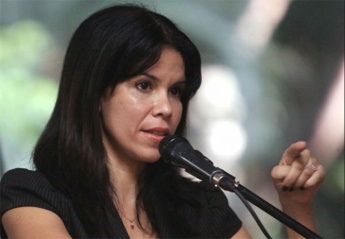 According to Ramirez, non-government organizations have been part of a campaign of “attacks” on Venezuela.
“A few NGOs have forged reports against our institution with false information,” Ramirez tweeted on Monday.
Since last month Venezuela has come under renewed criticism from international human rights monitors.
On 21 February, the United States based Human Rights Watch (HRW) accused Venezuelan security forces of using excessive force, while claiming it couldn’t find evidence of “anti-government protesters carrying firearms or using lethal force against security forces or third parties”.
Since February at least 29 people have been killed amid anti-government demonstrations and opposition violence. Among the dead are security forces and civilians who have been killed by firearms during clashes with the opposition.
The day before the HRW report was released, the brother of a socialist party (PSUV) deputy, Arturo Alexis Martinez was shot dead by a sniper. He was trying to clear an opposition barricade in Lara state when he was killed. On 24 February, motorbike taxi worker Antonio Jose Valbuena was shot by a masked individual in Maracaibo while clearing another opposition barricade. The alleged assailant reportedly demanded Valbuena desist from the attempt to clear the barricade. Since then assailants have shot at least two more civilians trying to clear opposition barricades.
Three national guard soldiers have also been shot dead during clashes with the opposition, including Giovanni Pantoja in Carabobo on 28 February, Acner Isaac Lopez Leon on 6 March in Caracas, Ramzor Bracho in Carabobo on 12 March and Jose Guillen Araque on 17 March.
According to Ramirez, misrepresentations of Venezuela by non-government organizations (NGOs) comes amid an anti-government social media campaign of misinformation.
Since February, photographs have circulated on social media websites including Twitter and Facebook of alleged cases of human rights violations by Venezuelan security forces. However, many of the photographs appear to be taken in countries as diverse as Syria, Chile and Egypt, but with inaccurate captions indicating they were taken in Venezuela.
HRW’s own report is accompanied by a photograph of what is claimed to be “a tank in San Cristobal”. The “tank”, was a statue that had been moved into the middle of the road and vandalized by opposition protesters.
Ramirez accused NGOs of being backed by the US State Department, which has also attacked Venezuela. In a report last month, the department leveled accusations against the Maduro government similar to those issued by HRW, while Secretary of State John Kerry has threatened possible “sanctions”.
Kerry’s comments have since been condemned by the Bolivarian Alliance of the Peoples of Our America (ALBA), along with the Venezuelan President Nicolas Maduro.
“The Miami lobby is taking measures to sanction Venezuela, but I tell you, you’ll be going down a road without return,” Maduro stated in response to Kerry.
An Extremely Newsworthy Op-Ed in Venezuela, or So One would Think
By Joe Emersberger | Zblogs | March 21, 2014
An op-ed in Ultimas Noticias (20/3/14), Venezuela’s largest circulating newspaper, stated that “One can’t keep playing around with Maduro’s assassin government and its insincere calls for peace”.
It goes on to state that Maduro’s government will go down in history as one of the most murderous and dictatorial ever, and makes a thinly veiled call for its unconstitutional ouster.
How does a vehemently anti-government op-ed like this appear in Venezuela’s largest newspaper when Reporters Without Borders (RSF) ranks Venezuela 116 out of 179 in its “freedom of expression” index?
The international corporate press eagerly bolsters RSF’s assessment and prominently reports any allegation of censorship by the Maduro government, as it did with the Chavez government. But if international reporters have integrity, and believe their own coverage, shouldn’t this op-ed be deemed extremely newsworthy? Doesn’t the appearance of this op-ed reveal a spectacular act of courage on the part of both the author and Ultimas Noticias ? In fact, it doesn’t.
The author of the op-ed appears regularly in Ultimas Noticas as do similar authors like [prominent opposition politician] Antonio Ledezma. The op-ed is noteworthy only because it exposes the remarkable dishonesty of RSF and the international corporate media.
Ultimas Noticas also a published an investigative report in February that led to the arrests of government agents implicated in the killing of a protester. In May of last year, it published that transcript of a private conversation in which a prominent government supporter, Mario Silva, talked about corruption within government ranks and named prominent allies of Maduro’s government.
You can literally read Ultimas Noticas on any random day and find reporting and op-eds that completely demolish the lies peddled by RSF and international media about the state of press freedom in Venezuela.
Foreign reporters in Venezuela who are honest and not ideologically hostile to the Maduro government, may indeed face resource constraints that prevent them from seeking out some stories that contradict the prevailing distortions. Wealthy, urban based, English speaking government opponents have many ways to make their stories and opinions readily and economically available to foreign journalists. However, that can’t excuse failing to inform readers about what regularly appears in an outlet like Ultimas Noticias. If most people in English speaking countries believe that the media is far less free in Venezuela than in their own countries, it actually highlights the deplorable state of press freedom in their own.
Eight Logic Defying Ways Venezuela’s Violent Opposition Is Hopelessly Hypocritical
By Ryan Mallett-Outtrim | Venezuelanalysis | March 20, 2014
Venezuela’s opposition is sending a few mixed messages about violence and freedom. Unlike the moderate opposition (which is laden with its own hypocrisies), the extremist opposition groups are a minority within the wider anti-Maduro movement. Despite an overwhelming majority of the population opposing their violence, the barricaders and other aggressive opposition elements somehow maintain the support of much of the private press, and established opposition parties. They draw sympathy from human rights organisations like Human Rights Watch, which pretends the violent opposition aren’t armed. The State Department likewise appears to have nothing less than unconditional support for violent opposition groups.
It’s hard to believe the opposition protesters oppose violence when they start shooting at people on the street. They want a free media, but they try to lynch journalists. They demand to be let into the political process, but refuse to join peace talks, while exacerbating the scarcity they’re protesting against.
Of the many imaginative ways the opposition has proved itself hopelessly hypocritical, here are the top eight shameless contradictions.
1. Protests against scarcity by blocking supplies
The opposition doesn’t seem to have figured out that there is a very close correlation between the number of delivery trucks they torch, and the number of deliveries that aren’t made.
Just a few hours before writing this article, I passed one such torched truck in Merida, near one of the city’s largest supermarkets. There was a banner hanging off the burned skeleton of the vehicle, with a complaint about food scarcity. Anyone who things it makes sense to protest food scarcity after destroying a delivery truck outside a supermarket probably needs to spend some time in a quiet corner contemplating the dictionary definition of cogent.
Meanwhile in reality, scarcity levels remain high in Venezuela, with many basic consumer products ranging from flour to milk being difficult to reliably obtain. Unsurprisingly, however, blocking roads only makes a bad situation worse. In the opposition stronghold of Merida, even cooking gas deliveries became intermittent in February, as the city’s main thoroughfares are semi-permanently blocked by opposition groups.
2. Protests violence…with more violence
Occasionally, barricades are adorned with posters demanding “no más violencia”. Venezuela is one of the most violent countries in the hemisphere, so it’s no surprise security is a major issue in public discourse. But smashing over US$1 million in public property isn’t exactly a sure-fire way to make people feel safer. Nor is hanging barbed wire over roads to decapitate motorcyclists. In fact, now that there are groups of masked opposition thugs wandering around with guns, explosives and traps like home-made caltrops, it’s harder than ever to feel safe. The MUD has set a reduction in crime as a precondition for peace talks – something which might be difficult to achieve while their supporters keep shooting at people in the streets.
3. Defending media freedom by attacking journalists
Despite the fact that the majority of Venezuela’s media remains privately owned and anti-government in terms of editorial lines, one of the opposition’s favourite complaints is that they have no voice in the mass media. Henrique Capriles himself cited a lack of access to media as his reason for creating his humbly titled online show, CaprilesTV. On 4 March, the opposition held a march demanding “greater media freedom”. The next day, they attacked three journalists from private media outlets. It takes something really special to claim you defend journalists one day, and beat one with a lead pipe the next.
Unfortunately, that’s just the tip of this self-satirising iceberg. The opposition groups have repeatedly lashed out at the media. The majority of attacks have targeted public media outlets such as VTV, which was under a semi-permanent state of siege throughout February 2014. Community media outlets have been vandalised, and Venezuelanalysis journalists have also been attacked. One VA writer had rocks thrown at him when he tried to approach a group, while another was held at gunpoint after she photographed a group attacking public transport.
4. Wants to be listened to, but doesn’t want to listen
The opposition has justified going to the streets by claiming they have been largely ignored by the government. Yet when the Maduro actually invites them to attend peace talks, they boycott them. Perhaps it’s not Maduro that’s doing the ignoring.
5. Opposes the killing of peaceful protesters…by killing more peaceful protesters
Attend any opposition rally and it isn’t hard to find someone out to slam the government for the deaths of opposition protesters. Every death is indeed a tragedy, unless they can’t be martyred. Trying to find anyone at an opposition rally condemning the shooting of Gisela Rubilar isn’t easy. To be fair, though, I have seen one person with a placard condemning her death; but they had the wrong face glued on. Moreover, they didn’t seem interested in entertaining the idea that the opposition group that had fired at people clearing barricades in the area the night before may have been involved in Rubilar’s shooting.
6. Opposes corruption by demanding bribes
One of the opposition’s most salient complaints of the Venezuelan government is its failure to deal with corruption. It’s a reasonable criticism, given that Venezuela scores an abysmal 20/100 in Transparency International’s Corruption Perception Index. However, the opposition hasn’t exactly shown itself to be anything near a credible alternative. Opposition groups are increasingly demanding tolls for anyone to pass their barricades. People who feel emotions generally refer to these tolls as bribes.
Worse still, the opposition’s organisational structure is murkier than a bowl of mondongo on Monday afternoon. Their nationwide campaign of violence is well organised, with logistical support and at least hundreds of people coordinating across the country. However, nobody seems to know who is running barricades, and how. They clearly receive some funding, but nobody knows from where. Corruption festers where there is a lack of democracy and public criticism – and the opposition on the street is open to neither.
7. Calls Maduro a dictator, while acting like a dictatorship
Since February the opposition protests have defined life in Merida. Checking where they are attacking people has become as habitual as watching the weather forecast. It’s hard to believe opposition groups really oppose authoritarianism when they force you to pay tolls to pass their barricades, decide where you can to walk, decide when you can turn your light on in your own home, decide if supplies can reach your neighbourhood and decide you when you’re able to go to work. While the protests were at their worst, businesses figured out that the barricaders like to sleep in; so they started opening in the mornings, and closing before lunchtime. In other words, shops were forced to change their opening hours to suit the sleep patterns of these thugs. If everyone wasn’t being forced to change their routines to accommodate the whims of the barricaders, maybe their claims that they support freedom would carry some weight.
8. Complains Chavismo has ruined Venezuela…demands US intervention
Anyone who signs this petition needs to have a long conversation with someone from Iraq or Afghanistan. Simple.
US Proxy Terror War on Venezuela
By James Petras :: 03.17.2014
Introduction
Protest, dissent and terrorist wars are obviously very distinct forms of expressing opposition and bringing about change. The Obama-Kerry regime claim that the opposition in Venezuela is a “protest movement” a “peaceful democratic opposition” expressing discontent with economic conditions and that the democratically elected Maduro Administration is an ‘authoritarian regime’ violently repressing dissent. Washington claims to play no part in the action of the opposition and that its pronouncements are directed at furthering democratic freedoms.
The overwhelming evidence speaks to the contrary. By every measure, the opposition has engaged in prolonged and extensive violent activity, including terrorist acts, assassinations, arson, destruction of public property including the murder of military officials and civilian supporters of the government. Widely circulated photographs, even in media outlets backing Washington, show opposition activists throwing Molotov cocktails and building barricades for street warfare.
The Obama-Kerry Administration is in total denial of each and every violent act by the opposition; it unconditionally defends the opposition; it forcibly attacks and demonizes each and every effort by the Government to defend the rights of its citizens, uphold the Constitution and enforce law and order. The Obama-Kerry regime’s political intervention, its escalating rhetoric, is designed to incite the opposition to continue and intensify its violent activity to destabilize the country..
Kerry’s vitriolic rhetoric is timed to coincide with the ebb of opposition activity. The purpose is to assure the opposition that Washington stands four-square with open terror warfare. The Obama regime’s propaganda, economic sanctions and channeling of financial and military resources is designed to buttress the declining fortunes of the terror campaign. Kerry- Obama sanctions and propaganda war complements the violent terrorist war internally.
Kerry-Obama Rely on the Big Lie
Kerry’s accusation that the Venezuelan government is launching “a terror campaign” – reverses roles: The Venezuelan government is the target of two months of violent assaults. Caracas is accused of the crimes committed by the US backed proxy opposition: a favorite ploy of totalitarian imperial rulers. Washington is intent on violently overthrowing a democratic government and establishing a satellite regime.
The launch of a proxy terrorist power grab is evident in every aspect of the opposition’s activity. The opposition is authoritarian and not democratic in its demands. Economic and social issues are simply ploys to pursue the overthrow of the government by force and violence. The terrorists’ violent action is designed to weaken and undermine the government – not negotiate and seek agreements on specific sets of issues. Government offers to meet and dialogue are rejected outright. Each government concession is interpreted as “weakness” and is exploited. Molotov cocktail throwing arrestees released from jail by the government return to firebomb buildings and police.
The opposition was given every chance to influence the electorate in Presidential, state and local elections and were defeated. They refused to accept the majority’s electoral choice and launched violent assaults to undermine majority rule. Opposition mayors aid and abet terrorist activity blocking commerce and assaulting local supporters of the national government.
The opposition has accumulated vast stores of arms and munitions suited for an armed uprising. It has organized snipers to assassinate military and police upholding the rule of law and protecting municipal workers and citizens voluntarily engaged in cleaning streets of debris.
In terms of means, goals and ideology the opposition fits the description of an imperial financied terrorist minority directed toward seizing power, destroying majority rule and imposing an autocratic dictatorship, serving as a proxy for US imperial power.
Democratic Politics or Terrorist Putsch?
In the 8 weeks to March 15, 2014, the terrorist opposition perpetrated 500 violent actions throughout the country. At least 68 members of the Venezuelan National Guard have been injured, shot, wounded or killed by Kerry’s “democratic protestors”. On May 13, government officials were attacked by high powered weapons; seven were arrested with arms and explosives. Paramilitary terrorists are openly trained at two or more universities (Carabobo University and UCV in Caracas) where phony claims of “autonomy” are used to shield armories, training bases and sanctuaries for paramilitary gangs and snipers.
Business revenues, salaries and wage losses run in the tens of millions. The sniper fire has curtailed the right of pro-government workers and citizens to shop, work and demonstrate. The terrorists have sown fear and insecurity, primarily in middle class neighborhoods – they dare not enter workers’ barrios.
The government has been extraordinarily tolerant (or excessively conciliatory) with the terrorist gangs considering the scope and depth of violence: as of March 15, of 1,529 arrestees only 105 remain in jail facing judiciary process.
Many concerned democrats and experts on terrorism believe the Maduro government’s restraint has allowed the terrorists time and space to arm, recruit and receive US funds via phony NGO’s, and to prepare for bigger and more destructive acts of terror, such as bombing bridges and assassinating top civilian and military officials. Their assessment of the Maduro governments’ security policy is that it is too focused on the “lowest level” – the bomb throwers – rather than the political networks which reach into the major political parties and business elite who provide financial aid, political cover and ideological justifications for the terror war. Moreover, the “revolving door” judicial system encourages terrorists– since a day in jail is a small price for burning down a community health center or firebombing a Guardsman.
The government in its efforts to secure agreements with a section of the opposition has tied the hands of the security forces in many instances: small contingents of Guardsmen are vulnerable to organized terror gangs protected by highly placed opposition political leaders.
Conclusion
In the past two months over a thousand public buildings have been violently assaulted , mostly firebombed by Kerry’s “democratic and peaceful opposition”. Many of the buildings targeted for firebombing are directly related to the governments’ popular social welfare program. They include centers providing adult educational programs and medical care; banks financing low income micro-economic projects; primary and secondary schools; publically owned supermarkets providing subsidized food and groceries; trucks transporting subsidized goods to working-class neighborhoods; public buses, community radio stations, pro-government media centers and Socialist Party headquarters.
Large scale caches of arms, including automatic rifles and mortars were discovered in an opposition controlled municipality underground parking lot; another cache of 2,000 mortars and other weapons were found in Táchira, a frontier state bordering Colombia and an opposition stronghold. Over half of the 68 National Guardsmen injured were shot by opposition snipers. On March 16 a Captain of the Guard was assassinated by a sniper holed up in a high rise. The assassin was captured-a Chinese mercenary hired by the opposition As part of a para-military hit team
Kerry-Obama’s claim that the protestors are mainly students is belied by the fact that nearly two-thirds (971) of the total arrestees (1,529) are non-students; many self-confessed “subsidized” street fighters.
Kerry’s claim that the US is “not involved”, and the State Departments’ ludicrous effort to ridicule Venezuela’s charges of US intervention (“paranoia”), are refuted by published official documents showing a continuous flow of tens of millions of dollars each year to opposition organizations linked to the terror networks, including $15 million disbursed during the first two months of this year.
Top security experts on externally funded terrorist warfare, reviewing the scope and depth of damage and casualties, urge the government to give greater backing and a bigger role to the armed forces in pacifying the country. Their recommendations include declaring martial law and organizing military sweeps in opposition strongholds to neutralize and disarm the terrorist groups; unlimited detention pending trials for suspected homicide perpetrators and arsonists; military trials for suspects accused of murdering soldiers. Opposition mayors, governors or university officials who offer sanctuaries and provide arms storage facilities would forfeit their impunity. In response to a multitudinous demonstration by civilians and soldiers in support of the Armed Forces and demanding that the Maduro government take firmer measures to end terror, Maduro issued an ultimatum to the terrorists to end their actions or face the full force of the public authorities.
President Maduro also addressed the Kerry-Obama regime, calling on it to stop backing the terrorist opposition by threatening economic sanctions and calling on Washington to join a tri-partite commission, including a top representative from the US, Venezuela and the Union of South American states (UNASUR), to discuss peace and sovereignty. UNASUR declared in favor of Maduro’s proposal for dialogue and his peace initiative. Kerry proceeded with sanctions in support of the terror war by proxy.
Time for political conciliation is running out: The Venezuelan Armed Forces may finally get a chance to end the specter of imperial war by proxy.
Related article
Resurgent Chilean Social Movements Advance Cross-Border Solidarity
By Emily Achtenberg | Rebel Currents | March 14, 2014
On March 11, newly elected President Michelle Bachelet began her inaugural speech by acknowledging her debt to the social movements that propelled her center-left New Majority coalition to victory, on a radical platform that has transformed Chile’s political landscape. Even as they continue to shape the domestic political agenda, activist students, trade unionists, and other civil society and political organizations are also mobilizing to build cross-border solidarity, pressuring Bachelet to ally with other leftist governments in the region.
On February 15, the militant University of Chile Student Federation (FECH)—fresh on the heels of forcing the ouster of Bachelet’s newly-appointed education undersecretary and her replacement with a more politically compatible designee—issued a strong statement critical of Venezuelan students who have spearheaded ongoing protests against the Chavista government of Nicolás Maduro. “We don’t feel represented by the actions of Venezuelan student sectors that are defending the old order, in opposition to the path that the people have defined,” the statement read in part.
Demonstrating at the Venezuelan embassy, representatives of FECH and other student federations emphasized that the middle-class Venezuelan students, unlike their Chilean counterparts, are not demanding educational or other social reforms. Rather, student leaders explained, they are mobilizing against the Chavista government which has advanced the goals of free, public education and democratization of the university, the very issues that Chilean students are fighting for.
To be sure, FECH’s stance is opposed by Chile’s Young Christian Democrats (JDC), student organizations from some private universities, and other dissident factions, who have urged support for the protesters. Some groups, such as the Student Federation of Catholic University (FEUC), have called for protection of Venezuelan students’ rights, while stopping short of endorsing their demands.
The split mirrors divisions within the New Majority coalition itself. Under pressure from FECH and allied student organizations, Bachelet has publicly supported Maduro and the people of Venezuela, calling on all sides to seek a peaceful and democratic resolution to the conflict, while leading Christian Democrats accuse the Venezuelan government of criminalizing and repressing dissent. The recent assassination of a 47-year old Chilean citizen in Venezuela, a Chavista supporter and mother of four, has heightened domestic tensions over the issue. Still, the majority of student organizations continue to emphasize (to both Chilean and foreign media) that their movement has little in common with Venezuela’s student protests.
Following Bachelet’s inaugural ceremony, some 5,000 representatives of student, trade union, community, indigenous, and other civil society organizations assembled at the Teatro Caupolicán in Santiago to welcome Bolivian President Evo Morales with the slogan “Mar para Bolivia!” (“The sea for Bolivia!”). The issue of regaining coastal territory lost to Chile in the 1879 War of Pacific, which left Bolivia landlocked, has long been a rallying point for Bolivia and is now a crusade for the Morales government.
Last year, Morales filed a lawsuit with the International Court of Justice in The Hague, demanding that Chile negotiate in good faith to provide Bolivia with sovereign access to the Pacific. Morales argues that the 1904 Peace Treaty signed by the two countries was imposed under duress, and should be scrapped or modified. On economic grounds, Bolivia claims that its landlocked status has reduced its GNP by more than $30 billion since 1970, while the mineral-rich ceded territory (now the site of some of the world’s biggest copper mines) has made Chile the wealthiest country in South America.
The dispute has strained relations between the two countries for decades. Ironically, former dictators Augusto Pinochet and Hugo Banzer were on the brink of an agreement in 1975, which derailed when Pinochet demanded territorial compensation from Bolivia in exchange for granting it a sea corridor. A 13-point bilateral agenda developed by Morales and Bachelet during her first term in 2006 was sidelined by her conservative successor, Sebastián Piñera.
Recent efforts to resume dialogue with Bolivia have been spearheaded by Chilean social sectors and political activists. Last April, 57 civil society groups, including the Workers United Center of Chile (CUT, the major national trade union federation) and indigenous Mapuche organizations, signed a letter demanding that Piñera offer Bolivia a constructive proposal. Former Progressive Party presidential candidate Marco Enríquez-Ominami, who placed third in the first-round election, visited Morales last month to convey Chilean solidarity and pave the way for the post-inaugural encounter.
Former student leader and newly elected Communist Party congressional deputy Camila Vallejo has been a leading voice pressing the Bachelet government to re-engage with Bolivia. “It’s not about giving away a gift,” she emphasizes. “Bolivia has significant energy (gas) resources and we are, supposedly, in an energy crisis. Why not have a politics of integration and mutual solidarity?”
To the consternation of many, Bachelet—bowing to conservative pressures—announced the day after her inauguration that Chile will not negotiate Bolivia’s sea access while the matter is pending before the International Court. For his part, Morales has refused to abandon Bolivia’s legal claims, leaving civil society activists with a significant role to play in the continuing controversy .
Finally, last December more than 50 Chilean civil society leaders, 15 senators, and 37 congressional deputies signed a public declaration demanding a halt to negotiations on the Trans-Pacific Partnership (TPP), a U.S.-led trade initiative involving a dozen Pacific Rim nations. Activists are demanding increased transparency, as well as protections from trade rules that could undermine national sovereignty over intellectual property rights, access to medicine, capital flow management, and other crucial matters. Bachelet, a strong supporter of free trade, is also an advocate of national sovereignty. Her campaign manager (now finance minister) Alberto Arenas has indicated his support for civil society’s position.
As Bachelet struggles to manage competing ideological tensions within her own New Majority coalition, continuing pressure from Chile’s resurgent social movements on these and other cross-border issues will be critical in positioning Chile within Latin America’s growing political divide.
Related article

Civilians Support Venezuelan National Guard amid Media False Claims
By Tamara Pearson | Venezuelanalysis | March 17, 2014
Merida – On the weekend civilians marched with National Bolivarian Guard (GNB) soldiers, and today the government declared part of Caracas “free” from violent protests. The march came as private media heightened its false statements about GNB actions.
GNB march
On Saturday in Caracas there was a large civic-military march in support of “peace and life” and the GNB soldiers.
In his speech to those present President Nicolas Maduro accused the “government of the United States” of trying to “implement a plan to assassinate [him]”. He said in such a case, “the people should stay in the streets, making the revolution, united with the armed forces”.
Since 12 February, he said, over 20,000 GNB soldiers have been in the street, carrying out “some 16,000 operations to re-establish order and avoid confrontations, on average almost 500 operations per day. However, of the 29 deaths [since 12 February], there is only one under investigation attributed to a GNB soldier, [but] the opposition has carried out a campaign… writing them [the GNB] off as killers”.
The majority of deaths have been caused by violent barricades, two of them were allegedly caused by SEBIN (the national intelligence service) agents, and one by the Chacao police. Chacao police take orders from the opposition Chacao mayor.
Maduro himself is Commander in Chief of the National Bolivarian Armed Forces. He stressed that there had never been any orders to repress. “If the national guard or the national police had gone out in a repressive blind rage or with a an order to repress, in the face of [almost 500] violent actions per day [by the opposition], the death statistics would be different,” he said.
According to a recent survey by private firm, Hinterlaces, of 1200 Venezuelans, 87% reject the violent barricades “as an instrument of protest”, and 11% support their continuation. 79% express “doubt” that the violence could improve the situation in the country.
GNB death, Chacao operation
Sunday night, Aragua governor Tareck El Aissami reported that a GNB captain was injured in Maracay by “criminal groups”. El Aissami said the captain was shot in the head. He explained that when a “violent group” tried to close Avenue Jose Casanova Godoy and the GNB arrived, the GNB were shot at.
Yesterday Maracay also held a Peace Conference, as part of a national government initiative being held in various states around the country.
This morning El Aissami reported that Captain Jose Guillen Araque had died from the injury. This is the second GNB captain killed in less than a week. Captain Ramzor Bracho, was killed last Wednesday in Valencia, allegedly by opposition groups.
Meanwhile, the government announced today that the upper class area of Chacao had been made a “peace zone”. Over the last five weeks the area has been one of many zones around the country subject to constant road blockades, rubbish burning, destruction of public property, harassment, aggression, and vandalism, by violent groups calling for Maduro’s resignation.
Last Monday GNB soldiers dismantled a clandestine storage area in Chacao used by the violent groups. They confiscated guns, knives, C4 explosives, drugs, and fuel.
In his speech on Saturday, Maduro said the government was willing to use “force” to “restore peace” to Chacao. “We’ll capture all the violent people, the terrorists, the murderers, we’ll do it…respecting all human rights. The first human right we’ll respect is the right to free transit, the right of the children to go to school,” he said.
That night, VTV reported that the violent groups “voluntarily withdrew” from Altamira plaza in Chacao.
Early this morning the minister for internal affairs, Miguel Rodriguez Torres announced the “liberation and pacifying” of the area, a few hours after 661 GNB soldiers were deployed there. He said the guards will patrol 24 hours a day “in order to guarantee citizen safety”.
Rodriguez Torres said that authorities were waiting on the mayor of the area, Ramon Muchacho, in order to “hand over control and that he take charge of maintaining the area”.
Resident of Chacao, Susana Saavedra told Correo del Orinoco that she congratulated the GNB, “for taking this initiative, because it was lawless here”. She accused local opposition authorities of “collaborating with the barricaders… we couldn’t leave our houses or send our children to school”.
While the number of violent barricades around the country has been reduced, both voluntarily and because of the GNB, in Merida this morning the science museum was attacked for a second time, high school Fray Juan Ramos de Lora was attacked, and a main city intersection was blocked by a burning truck.
Manipulation by Venezuelan private media
Venezuelan private media however, have blamed much of the violence on the GNB. El Nacional headlined on 15 March, “GNB and collectives attack universities around the country”. Though colectivos is a term used in Venezuela for a range of social and productive organisations, the private media in February began using it to denote supposedly armed, pro-government groups. The El Nacional article accused the GNB and “collectives” of “repressing student protests”.
In Carora, Lara state on Friday, the media reported “repression by GNB and collectives”. Opposition state governor, Henri Falcon said “anarchic groups supported by the GNB caused damage, panic, and commotion” in the National Poli-technical Experimental University (Unexpo).
Video footage of the event however shows the violence by the opposition groups, the GNB cleaning up the area, verbal abuse by groups towards the GNB, and the GNB responding politely. The GNB then sat the groups down and gave them a workshop on human rights, then let them all go, the footage shows.
Further, today El Nacional quoted opposition leader Maria Corina Machado accusing the GNB of “creating the chaos in Altamira to justify militarisation”.
Machado also called for a march against so called “Cuban interference” on Sunday. According to AFP, only “hundreds” turned up to the march. The AFP article stated that “protests… against the government of Nicolas Maduro… have seen a total of 28 deaths”, implying that the deaths were all opposition “protestors”.
La Patilla and social networks have also circulated a photo, which they claim was GNB soldiers “repressing, beating, and arresting a special youth”. However, on Saturday, Alejandro Cegarra, an AP photographer who has been critical of the government claimed to have taken the photo and stated the “GN official was helping the protestor to breathe… the guy started to faint and was choking”.
Further, the AP caption for the photo described the National Guard helping the man to breathe, but according to Cegarra, those who reposted the photo “decided to ignore the caption”. A video by photographer, Cristian Dubo also makes it clear the GNB were trying to help the man. While he was not beaten, it does appear he was taken to hospital, and also detained and is awaiting trial, after being involved in confrontations in Altamira.
Other press went further, using a different photo to claim the man had Down syndrome, and he was “brutally beaten by the GNB”. However the man in this second photo, according to RT, was beaten by Miami police last year. The man photographed by Dubo did not have Down syndrome.
The GNB forms part of the National Bolivarian Armed Forces. It is responsible for public order. President Hugo Chavez, over his three terms, aimed to transform the GNB from what was previously a repressive institution into one geared towards promoting development. He increased the role of the GNB in civil affairs, including involving soldiers in implementing social programs such as the Mercal food program. The majority of GNB soldiers come from the poorer sectors of Venezuela, and Chavez often referred to the Armed Forces as “the people in arms”.
New Ambassador Modernizes Canada’s Hidden Agenda in Venezuela
By Gerard Di Trolio | Venezuelanalysis | March 17, 2014
Amidst headlines dominated by the situation in Ukraine, this bit of news slipped by almost unnoticed at the end of February; Ben Rowswell replaced Paul Gibbard as Canadian ambassador to Venezuela, as mandated by Foreign Affairs Minister John Baird. But a quick look into the appointee’s background brings special significance to his promotion, especially as opposition protests escalate in Venezuela.
Described in 2010 as a “rising foreign service star” by the Toronto Star, Rowswell has served as Canada’s official diplomatic representative in a number of conspicuous places across the Middle East. From Kandahar, Afghanistan to Kabul and Iraq immediately after the fall of Saddam Hussein, Rowswell has become an expert at representing Canada’s interests in the heat of conflict.
At the age of 22 he was baptized into the foreign service by fire, working in Mogadishu during the Somali Civil War of the early 1990s. He went on to work for the Canadian Embassy in Cairo from 1995-98.
A diplomat for the digital age, he held the title of “Director of Innovation” at the Department of Foreign Affairs, Trade and Development.
While overseeing the “democratic transitions” of Afghanistan, Iraq, and Egypt, the fledgling attaché specialized in the harnessing of social media for diplomatic missions, in order to interact directly with non-state actors, in effect bypassing the target nation’s government.
In 2011, Rowswell gave a fascinating TEDx talk at Hayward University in California that outlined his views about the power of social media to shape democracy. He focused on post-Murbarak Egypt, before Mohammed Morsi’s election.
He detailed how notions of race, ethnicity and class may be pushed aside when organizing through social media platforms. He theorized that the internet allows for “opensource democracy,” allowing individuals to exchange their ideas as equals.
But let’s look at that idea in the context of Venezuela, where the middle and upper classes are more likely to have regular access to the internet. Twitter and Facebook have been the choice tools of the opposition in recent months, both to organize protests and to call upon international support.
The Bolivarian Revolution itself was born 15 years ago upon massive social movements and since has experimented with many revolutionary forms of democratic participation. But theirs is a different concept of democracy than what Rowswell and other Western powers have in mind.
After the 2002 coup attempt and the mass mobilizations that restored Chavez to power, the cause of socialism was taken up with greater enthusiasm. Since its commence the Bolivarian government has created institutions that, while not directly expropriating capital, have challenged its long term prospects.
Nowadays workers’ cooperatives and collective property exist alongside corporate conglomerates and private investments. There exists a form of dual power in Venezuela, and within that balance, a gulf of classes widened by the shift in authority.
The Canadian government has made it clear that its interests lie outside the decades of organization led by the Venezuelan masses.
A motion that received unanimous consent from all parties in the House of Commons and sponsored by NDP foreign affairs critic Paul Dewar effectively condemned the Venezuelan government’s attempts at dealing with recent protests.
The statement was approved by Conservatives and Liberals alike, including MP Jim Karygiannis who has been extremely critical of the Venezuelan government.
Rowswell also argued that social media can create transparency yet Venezuela’s opposition has provided ample evidence to the contrary. Many photos from Turkey, Ukraine, Brazil, and even Syria have flown around social networks, meant to stir up indignation at the treatment of protestors in Venezuela. During the telecast of the Oscars, the opposition took to Twitter to claim the ceremony had been censored. The truth was that the Oscars was aired on TNT in Venezuela, a satellite channel.
Canada, too, knows how to wage internet campaigns and will not be left behind. Within hours of Rowswell’s appointment, a new Embassy account popped up on Twitter. (https://twitter.com/CanEmbVenezuela) Adam Goldenberg, liberal partisan and former speechwriter for Michael Ignatieff, tweeted in response: “Congratulations, Ben! Excellent choice, Minister, for all sorts of reasons.” As always, Canada’s imperial foreign policy is a bipartisan affair.
There’s no smoking gun, however. This appointment isn’t proof positive that the Canadian government and the Venezuelan opposition are conspiring an attack against president Nicolas Maduro.
While violent coups carried out by a minority are far from being a thing of the past, Canadian policy planners understand that the transformation of the opposition into a mass movement would be a much more efficient way to protect their interests, with less international backlash.
Rowswell is the best man to encourage such a “democratic” counterrevolution, given his pedigree. He certainly knows how to interact with the angry middle classes on Twitter.
As protests continue, it would be wise to keep a close watch on the Canadian Embassy in Caracas.
(http://www.international.gc.ca/media/aff/news-communiques/2014/02/28b.as…)
2. (http://www.thestar.com/news/canada/2010/07/28/canadas_top_civilian_offic…)
3. (http://www.youtube.com/watch?v=I-zWJaXhHpI)
4. (http://www2.macleans.ca/2014/02/28/the-house-is-unanimously-concerned-ab…)
5. (http://www.karygiannis.net/venezuela)
6. (http://drdawgsblawg.ca/2014/02/constructing-venezuela-protests-a-photo-g…)
7. (http://www.ctvnews.ca/entertainment/many-venezuelans-miss-oscar-winner-l…)
8. (https://twitter.com/adamgoldenberg/status/439530569333211136)
Featured Video
Macgregor: We Haven’t Seen the Worst of the Iran War Yet
or go to
Aletho News Archives – Video-Images
From the Archives
15 Saudi ‘hijackers’ were CIA agents working for US: Scholar
Press TV – April 13, 2016
Fifteen of the 9/11 “hijackers” from Saudi Arabia were CIA agents working for the United States government, which was seeking to destroy the Middle East for Israel and to double the American military budget, says Dr. Kevin Barrett, an American academic who has been studying the events of 9/11 since late 2003…. continue
Blog Roll
 Aletho News
- Breast Cancer: Before You Consent
- Iran’s Plan to Shut Down AI in the Persian Gulf
- Israel seeks ‘compensation’ from Washington over Saudi F-35 sale
- Saudi crown prince seeks dialogue with Ansarullah after Yemeni blows: Report
- Damascus rejects Saudi request for Syrian fighters to counter Yemen: Report
- South Korea says will not send troops to join terrorist US war on Iran
- Russia Just Struck the Eyes of NATO’s War Machine in Ukraine
- Russia summons UK charge d’affaires over Kiev drone support
- NATO member warns bloc seeking pretext for war with Russia
- Macgregor: We Haven’t Seen the Worst of the Iran War Yet
- If Americans Knew
- Debunking The Claim That Macklemore Has A “History Of Antisemitism”
- CPJ demands release of arrested Palestinian-US journalist near Bethlehem
- Robert Kraft: The Billionaire Friend of Netanyahu Pulling The Strings Behind the Macklemore/Ed Sheeran Blow Up
- Columbia Administered Fund Gives Big Money to Pro-Israel Groups
- Deportation Case of Palestinian Activist Salah Sarsour Tests First Amendment
- ‘We Will Not Forget’: Palestinians Mark 44 Years since Sabra and Shatila
- Why do we let Zionists decide what we can and can’t say?
- US welcomes Israeli, Iranian delegations to UN, but not Palestinians – Daily Update
- Biden’s Genocide Accomplices Targeted by New Accountability Campaign
- AIPAC’s Network Has Already Spent $67.2 Million to Shape the Midterm Elections
- No Tricks Zone
- New Study: ‘Global Drought Shows No Detectable Recent Acceleration Under Climate Warming’
- Economic Masterminds: German Socialists Suggest Taxing Productivity Gains Stemming From Using AI
- The South China Sea Has Not Been Cooperating With The Climate Change Narrative
- Energy Crisis: Germany Enters Heating Season With Historically Low Gas Reserve Fill Levels
- New Study: The Antarctic Ice Sheet Gained Mass From 2020-2024 Due To Staggering Snow And Ice Accumulation
- Study: Ocean Heating Rates From Thousands Of Years Ago ‘Dwarf’ Modern Ocean Heating Rates
- Climate Extremists Target, Attack Large-Scale Power Grid Infrastructure In Germany!
- New Study: Antarctic Ice Melt Has Contributed Less Than 1 Centimeter To Sea Level Rise In The Last 30 Years
- Fear Of Debate: Alarmist German Climate Scientist Calls On Mainstream Media To Discredit Skeptic Voices
- End-Of-August Arctic Sea Ice Extent Hasn’t Fallen In 20 Years, Official Data Show!
 Aletho News


