Venezuela: Who You Gonna Believe, the New York Times or Your Lying Eyes?
By Mark Weisbrot | CEPR Americas Blog | March 15, 2014
Today’s report from the New York Times trashes the government for “combative tactics” and “cracking down” on protesters, but if you watch the accompanying video, all you see are protesters attacking police, and the police – without venturing forward, defending themselves with water cannon and tear gas.
One can criticize the decision of the government to block the march from going to hostile territory, but given the continuous presence of violent elements among the protestors, and that Venezuela is a country with a very high homicide rate and many armed civilians, it could have been the prudent thing to do. The government also believes, with some justification, that these protests seek to provoke violence in order to de-legitimize the government. Their stated goal is to overthrow the democratically elected government, and given that the vast majority of the country is against the protests, this really is their only chance of getting anywhere. And the government also knows that the media (both national private and international) will generally blame them for any violence.
In the United States, and especially here in Washington DC, you have to get a permit for marches like this, and they are often denied or re-routed; and if you try to defy this the police will generally beat you and throw you in jail. And these are actually peaceful protests here.
As for the violence so far associated with the protests since they started on February 12, the statistics show that more people have died at the hands of protesters than security forces:
Of the 29 people killed (full details here),
— 3 appear to be protesters allegedly killed by security forces; 1 other was killed by security forces but it’s not clear if he was a protester.
— 3 appear to be protesters allegedly killed by civilians (the opposition always alleges that these civilians are somehow taking orders from the government, but there has not been any evidence linking the government to any killings by armed civilians; and in a country where there are on average more than 65 homicides per day, it is most likely that these armed civilians are acting on their own).
— 11 civilians appear to have died at the hands of protestors: three of them shot, and the rest killed by various barricades or other obstructions (e.g. motorcyclist beheaded by wire allegedly strung by protesters).
— 3 national guard appear to have been killed by protesters
— 1 pro-government activist appears to have been killed by security forces
— 6 have died in circumstances that are too unclear to determine if they were really related to protests, but they are often included in press reports.
At least 14 security officers have been arrested and remain in jail for alleged violence against protesters, including the incidents described above.
Related articles

Venezuelan Community Members Explain Opposition Violence
Hands Off Venezuela | March 11, 2014
On Saturday, March 8, Gisella Rubilar, 47, was shot dead and two other people suffered serious gunshot wounds when they were removing an opposition roadblock which prevented safe passage to their working class and poor neighbourhood of Pie del Tiro, in the Andean capital of Merida, Venezuela. You will not have heard about it in the mass media, but this incident was part of a growing trend of opposition violence against working class and poor neighbourhoods fighting back.
It was after 9 pm on Saturday, March 8. Gisella Rubilar Figueroa came out with a group of people from the working class and poor neighbourhood of Pie del Tiro to clear the road blockade in the intersection of the main Avenida Los Proceres and Lomas de los Vientos in Mérida, Venezuela.
After clearing the debris which blocked the access to Pie del Tiro, they remained on site for while. It was then that they were attacked and shot at by a group of masked young men. Three of those who cleared the opposition barricade had to be hospitalised with gunshot wounds: José Rincón, 51; Javier Osuna Briceño, 39 and Gisella who had been shot in the face and died on Sunday, March 9.
 Gisella was Chilean, 47 and a mother of 4 who was living in Mérida and studying a masters in education at the University of Los Andes (ULA), where both her parents were teachers. She was a supporter and activist of the Bolivarian revolution.
The working class and poor community of Pie del Tiro had been besieged and harassed by opposition roadblocks for nearly a month and every time they themselves or the National Guard cleared the way, the middle class student protesters would block the roads again. This was making it difficult for the overwhelmingly Bolivarian supporting neighbours to leave their community to go to work, to go shopping, to access public transportation.
In a video produced anonymously in Mérida (where journalists have been threatened by opposition thugs for reporting their violent protests) you can see Giselle and other neighbours from Pie del Tiro describe the situation and express their frustration at being besieged and at what they perceive as the lack of action by the government:
The killing of Giselle has been covered by the media in Venezuela and Chile, but has not even been mentioned by the mass media in Spain or any of the English language mass media in the UK and the US. Of course, the story of working class and poor Bolivarian supporters being shot and killed by violent, armed, masked opposition thugs does not fit in the picture of a “repressive regime” attacking “peaceful student protests” which the mass media internationally has been building over the last month.
Further to this killing, two other people were killed by gunshot coming from opposition thugs on Thursday, March 6, in Los Cortijos, in the East of Caracas. Here, a group of middle class opposition protesters had been besieging the state TV channel VTV Canal 8, for nearly a month, harassing the TV station workers as they were going to and coming back from work, throwing molotov cocktails at the channel’s installations, setting burning barricades, and throwing objects. This had also disrupted the activity of motorbike taxi drivers in the whole area.
Opposition supporters had taken to laying steel wire (guayas) across the streets, at 1.20 m of height, to knock down motorbike riders. On February 21, a motorbike taxi rider, Santiago Enrique Pedroza, 29, was beheaded when he collided with one such guaya, in the same part of Caracas. A woman died in Mérida, Delia Elena Lobo Arias, 40, in the same circumstances.
On March 6, a large number of organised motorbike taxi drivers decided to clear the barricades in Los Ruices, the area around VTV TV channel. When they were removing the debris from the road they were attacked by masked young men from the nearby buildings throwing stones, bottles, incendiary bombs and shooting at them with guns. As a result, a young moto-taxi driver, Jose Gregorio Amaris Castillo and a young sergeant of the National Guard, Acnes López Lyon, were shot dead. It is also very unlikely that you have heard of these four killings in the mass media.
The incidents described here, which resulted in the death of two unarmed Bolivarian revolution supporters, one National Guard sergeant, and two others as the direct result of the actions of violent opposition thugs (three shot dead, two as a result of opposition roadblocks) are an indication of what the real situation is in Venezuela right now.
A small minority of violent opposition supporters are out in the streets with the stated aim of overthrowing the democratically elected government and putting an end to the Bolivarian revolution. In many parts of the country, working class and poor neighbourhoods are starting to fight back and removing roadblocks to ensure their right to safe passage. As they do so they are being shot at by armed thugs in the opposition barricades.
Venezuela: Who Are They and How Did They Die?
By Jake Johnston | CEPR Americas Blog | March 12, 2014
Since February 23, CEPR has been keeping track of those who have died during the last month of protests in Venezuela. Below is the most recent available information on the location, causes and status of investigations into the deaths. This list will continue to be updated as more information becomes available. As of March 13, the list contains 29 individuals; however in some cases press reports indicate that the death was not directly associated with the protests. Never the less, as they have often been reported as such, they are included below.
There are deaths on both sides of the political spectrum. In some cases, members of Venezuelan security forces have been implicated and subsequently arrested for their involvement. At least 10 individuals have reportedly been killed by crashing into barricades, from wires strung across streets by protesters and in some cases from having been shot trying to remove barricades. Three members of the National Guard have been killed.
– Bassil Alejandro Da Costa, an opposition demonstrator was shot, reportedly in the head, and killed in Caracas during the opposition protest that took place on February 12.
– Juan Montoya, a pro-government community activist, was reportedly shot in both the head and chest and died. Montoya’s body was found a short distance from the body of Da Costa. On February 26, the Attorney General, Luisa Ortega Diaz, announced that 8 officers from SEBIN, the Venezuelan intelligence agency, had been arrested for their role in the killing of Da Costa and Montoya. As of March 11, 6 SEBIN officers remain in jail. President Maduro has also removed the head of SEBIN.
– On February 12, Roberto Redman, another opposition demonstrator was also shot, reportedly in the head, and killed. The killing took place in a neighborhood in eastern Caracas. Witnesses attributed his death to armed civilians. There has been no update on the status of any investigation.
– On February 18 José Ernesto Méndez, a 17-year-old student who was participating in a demonstration in the Sucre department, was hit by a truck and later died. The Attorney General stated that the driver of the truck has been apprehended and charged with homicide.
– On the same day Genesis Carmona, a student and beauty queen was shot and killed in the state of Carabobo. Unconfirmed reports suggest that the she was shot from behind, potentially from within the group she was protesting with, though others contest that version of events. The government has pledged a full investigation. There have been no further updates on the status of the investigation.
– On February 19, Julio Gonzalez, a member of the public ministry in Carabobo reportedly died after crashing his vehicle while attempting to avoid a roadblock put up by protesters.
– On February 20, Arturo Alexis Martínez, the brother of a ruling party legislator, was reportedly shot in the chest as he attempted to clear a path for his car amidst the debris left by a barricade following an opposition protest in Lara state. Witnesses allege that the shot that killed him was fired from a nearby building. On March 6, the AG announced that an individual has been charged for their involvement in the death.
– On February 20, Asdrúbal Rodríguez was reportedly arrested for attempting to steal a motorcycle and then was found dead the next day. The arrest and killing occurred in Chacao. Two members of the Chacao police have been arrested and remain in jail.
– On the night of February 21, Elvis Rafael Durán De La Rosa was beheaded by a wire strung across the Rómulo Gallegos Avenue in Caracas while driving a moto. The wire had allegedly been put there by protesters who had set up a road block in the same location earlier that evening.
– On February 21 that a 37-year-old woman named Delia Elena Lobo had died the previous evening in the city of Mérida in similar circumstances to De La Rosa. The woman was heading home on a motorbike and ran into barbed wire stretched across a street. Nobody has been arrested for the deaths of Lobo or De La Rosa. Authorities have accused retired general Angél Omar Vivas Perdomo of having encouraged protesters to put wires across streets and have ordered his detention.
– On the evening of February 21, Jose Alejandro Márquez died due to injuries to the head suffered in clashes with the National Guard. Seven members of the National Guard are being investigated for the death.
– On February 22nd, Geraldine Moreno, a 23-year-old protester who had been injured by bird shot during a protest in Carabobo state a few days earlier reportedly died from head injuries. There has been no update on the status of the investigation.
– On February 23 in San Cristobal Danny Melgarejo, a local student, was stabbed to death. The mayor said that the killing was related to a robbery, and not the student’s participation in protests.
– On February 24 Antonio José Valbuena Morales was shot and killed, reportedly while trying to remove barricades that had been set up by protesters.
– On February 24 Wilmer Carballo was killed by a shot to the head in Sucre state. Reports suggest he was shot by individuals on motos. On February 25, the AG announced an investigation into the killing.
– On February 24, Jimmy Vargas died after falling from a second story building. Press reports continue to state that he was killed “after being hit by a tear gas canister and falling from a balcony,” despite video evidence to the contrary.
– On February 25, Eduardo Ramón Anzona Carmona died after crashing his moto into a barricade. The accident occurred in Valencia in the state of Carabobo
– Also on February 25, in El Límon, Jhoan Gabriel Quintero Carrasco was shot and killed near a supermarket where looting was taking place.
– Giovanny José Hernández Pantoja, a member of the GNB, was shot and killed in Valencia on February 28. News reports indicate he was removing a barricade when he was shot. At least three individuals have been detained for their alleged involvement.
– On March 3 in Chacao, Deivis José Useche died after crashing his moto. Press reports indicate that a manhole cover had been removed during earlier protests, which caused the crash.
– On Tuesday, March 4 Luis Gutiérrez Camargo crashed into a barricade and died in the state of Tachira.
– On March 6, a National Guardsman, Acner López Lyon, was shot and killed during an altercation in Los Ruices, a neighborhood in Caracas. News reports indicate that the National Guard was removing a barricade that was blocking a main avenue.
– In the same altercation that took the life of Lyon, a mototaxista, José Gregorio Amaris Castillo, was shot and killed. The AG announced an investigation into the deaths.
– On March 7, Johan Alfonso Pineda Morales died after he lost control of his moto on an oil slick, allegedly intentionally created by protesters.
– On the night of March 9, Giselle Rubilar Figueroa, a Chilean citizen, was reportedly shot and killed by protesters in Merida. The AG has announced an investigation.
– On the night of March 10, a student protester, Daniel Tinoco was shot and killed in San Cristobal. It is unclear who was responsible, though press reports indicate that the killing occurred after a day of clashes between the National Guard which was trying to remove barricades in San Cristobal. The mayor indicated that it was armed civilians that shot Tinoco. The AG announced an investigation into the killing.
– On March 12, university student Jesús Enrique Acosta was shot and killed in La Isabelica in the department of Carabobo. Family members told the press that Acosta was outside his house when armed civilians began firing. Reuters reports that “the state governor said the shot came from snipers among the protesters.”
– On March 12, the Governor of Carabobo, Francisco Ameliach reported that a captain of the National Guard, Ramso Ernesto Bracho Bravo was shot and killed during an altercation in the municipality of Naguanagua.
– Also on March 12 in La Isabelica, Guillermo Alfonso Sánchez was shot and killed. The circumstances remain unclear. The AG has announced an investigation into the three killings of March 12.
America’s Unceasing Contempt for Venezuela
By Jason Hirthler | CounterPunch | March 11, 2014
Some things never change. The petulant and undemocratic Venezuelan opposition is at it again, with the full backing and check-writing support of the U.S. government. Recent protests have inflamed the streets of Caracas, as opposition groups, as they have in the Ukraine, called for the ouster of the sitting president. I suppose it’s needless to note that Nicolás Maduro is Venezuela’s democratically elected president, and that he won by a higher victory margin in a cleaner election than did Barack Obama in 2012. Nor is it worth asking, one supposes, that if the entire country is engulfed by dissent, as The New York Times insidiously suggested by claiming the “The protests are expressing the widespread discontent with the government of President Nicolás Maduro, a socialist…”, then why did Maduro’s party, Partido Socialista Unido de Venezuela (PSUV), claim wide majorities in municipal elections in December? Or why are these “widespread” protests largely confined to middle-class or student areas of Caracas and not rife within much larger poor neighborhoods? Or if a government has the right to arrest opposition leaders (in this case Leopoldo Lopez, the latest rabid ideologue) for inciting violence?
Public Virtue, Private Vice
Secretary of State John Kerry has ratcheted up the drivel stateside, claiming to be “alarmed” by reports that Maduro has “detained scores of anti-government protesters” and that the crackdown would have a “chilling effect” on free expression. A bit rich coming from a man whose own government has been icing free speech since the Snowden revelations. Kerry failed to mention whether the millions of American taxpayer dollars being funneled to the opposition were behind the violence. The Los Angeles Times described Maduro’s administration as an “autocratic government.” Opposition leader Henrique Caprilles, demolished by Maduro in last year’s landslide election, rejected Maduro’s invitation to talks and claimed one of the Latin America’s most popular political parties was a “dying government.”
For its part, Mercosur, the alliance of South America’s southern cone countries, denounced the violence as an attempt to “destabilize” a democratic government. Of course, the behavior of Maduro’s government in response to these street provocations ought to closely watched, as this is the new president’s first real test coping on an international stage with the intrigues of a small but virulent neoliberal opposition.
There’s plenty to suggest that this is, like Ukraine, another external attempt to uproot a democratically elected government through a volatile cocktail of in-country agitation and violence paired with global media defamation of the existing administration. It wouldn’t come as a surprise. Like a frustrated and petulant infant, the United States has repeatedly attempted to derail the Bolivarian Revolution launched by former President Hugo Chavez in the late nineties, as CEPR’s Mark Weisbrot has noted. It backed an anti-democratic coup by business elites in 2002 that actually succeeded for a couple of days and happily dissolved parliament before Chavez regained power. It supported an oil strike in an attempt to destabilize the economy and perhaps bring down the government. It encouraged opposition members of parliament to push for recalls (failed) and boycott National Assembly elections (useless) and clamor incessantly that last year’s national presidential election was rigged (false). Of course, despite being widely held to be a superior electoral process than that of the United States, Kerry was only shamed into recognizing the legitimacy of the election long after the rest of the world had.
The U.S. has poured millions into opposition activities on an annual basis since the failed coup in 2002. (NGOs are convenient destinations for this money since foreign contributions to political parties are illegal in both countries.) Just look at 2013 alone. Washington would hardly stand for interference of this kind from, say, China. Or, better, from Venezuela itself. Imagine if it was discovered that Chavez had been seeding major American metropolises with anti-capitalist pamphleteers. Obama wouldn’t be able to hit the “signature strike” button fast enough. Nevertheless, Kerry, in his role as Secretary of State, has turned out to be a masterful mimic capable of registering a fusty outrage on short notice, especially over claimed violations of civil liberties. Curious, since the ceaseless trampling of civil liberties by his own Democratic party have elicited nothing from this flag-bearer for democratic values.
Dollars & Bolivars
This is not to say that Venezuela does not have protest-worthy problems. Inflation has been chronic since the pre-Chavez days. Now food shortages are trying the patience of the population. And in one sense, these shortages are self-inflicted. According to Gregory Wilpert of VenezuelAnalysis, the government’s currency controls have been undermined by an all-too-predictable black market. While the government has placed strict criteria on the ability of citizens to purchase dollars with bolivars, the black market allows citizens to buy dollars without any criteria whatsoever. The government’s exchange rate is likewise controlled, and has over time begun to distort the real value of the bolivar. The black market exchange rate, by contrast, reflects the external value of the currency. The gap between these exchange rates has grown rapidly, such that there now exist huge incentives for citizens to play currency arbitrage. If they satisfy the federal criteria—such as needing dollars to travel or import goods—Venezuelans can buy dollars cheaply using the government exchange rate. They can then pay those dollars to import goods, then export those goods in exchange for the dollars they just spent on the imports. From there it is a simple step to the black market, where they can sell those dollars for many times what they paid at the government’s official rate, making a tidy profit for themselves. If they happen to be rabid anti-socialists, they can enjoy the companion thrill of generating food shortages that can be blamed on the government. Ah, the timeless magic of import/export.
These are legitimate grievances, however, as are crime figures, which top the regional table. Yet the question is, do they merit the overthrow of a legitimate government backed by a wide majority of the population at the behest of a small but fierce oppositional faction openly funded by an imperial power committed to its overthrow? To do so would risk the absurdity of gratifying the strident demands of a few at the expense of the many. … The fact is, despite the inflation and shortages, the population continues to support the Bolivarian Revolution because of its accomplishments—massive reductions in poverty, extreme poverty, and illiteracy. Significant growth in per capita GDP and other important metrics.
A Doctrine in Decline
We’re seeing in clear images the viciousness with which neoliberal factions resent the loss of power and seek to restore it by any means necessary. Democracy is the least of their concerns. But this has been the Latin American back-story for a couple of centuries. Much of the U.S. activity in Latin America feels like a frantic and desperate last-ditch effort to preserve the Monroe Doctrine, by which we essentially declared Latin America to be our own backyard, off-limits to European empires. What was ostensibly a call to respect independent development in the Southern hemisphere rather predictably evolved into an excuse for self-interested intervention. But now, for the first time in centuries, Latin America has struck out on its own, slipping from beneath the clutch of the eagle’s claw to form organizations like Mercosur and CELEAC, PetroCaribe and Petrosur, the Bank of the South as well as the Bolivarian Alliance for the Americas (ALBA). Aside from Columbia, an implacable outpost of American influence, the region has shunned greater U.S. involvement, and begun to view its proffered trade agreements with far more suspicion, particularly in the long wake of NAFTA, the poster child for lopsided and economically destructive trade treaties.
Whether the U.S. will eventually succeed in a cynical ploy to unseat Maduro remains to be seen. If recent events in the Ukraine are any indication, that may have been a test run for Venezuela, as Peter Lee suggests. It hasn’t helped that, as in practically every country that comes to mind, an elite class of neoliberal ideologues own the mainstream media. The tools of propaganda have rarely been more fiercely deployed than since Chavez launched his socialist revolution. And yet, since then, practically the entire continent has experimented with left-leaning leadership: Rafael Correa in Ecuador, Evo Morales in Bolivia, Nicanor Duarte in Paraguay, Tabare Vazquez in Uruguay, to some degree Luiz Inácio Lula da Silva in Brazil, and Maduro in Venezuela. Nor should exiled Honduran president Manuel Zalaya be forgotten. These figures have collectively stepped back from the brink of dubious integration with North America and sought stronger regional ties and continental autonomy.
The U.S. has replied with a predictable confection of threats, lies, and sacks of cash for ferociously anti-democratic elements. Perhaps it most fears the bad karma it generated for itself with Operation Condor, which on September 11, 1973 overthrew and murdered Chile’s socialist leader Salvador Allende and replaced him with a gutless sadist, Augusto Pinochet. Pinochet—a repressive militarist—happily instituted the untested prescriptions of the Chicago School of Economics’ sermonizing armchair guru Milton Freidman, with predictable results. Now, Maduro, carrying the mantle of Chavez and his Bolivarian manifesto, is arguably the spiritual vanguard of the socialist left in South America. Venezuela’s efforts to continue to forge its own independence in the coming decade will surely influence the mood and courage of other leftists in the region. The stakes are obviously high. Hence the relentless American effort to destabilize and publicly discredit the PSUV. The fate of the global left is in a very real sense being tested in the crucible of Caracas.
Jason Hirthler can be reached at jasonhirthler@gmail.com.
The Revolution Will Not Be Televised – Chavez: Inside the Coup
2002 documentary about the April 2002 Venezuelan coup attempt which briefly deposed Venezuelan President Hugo Chávez. A television crew from Ireland’s national broadcaster, RTÉ happened to be recording a documentary about Chávez during the events of April 11, 2002. Shifting focus, they followed the events as they occurred. During their filming, the crew recorded images of the events that they say contradict explanations given by Chávez’s opposition, the private media, the US State Department, and then White House Press Secretary Ari Fleischer. The documentary says that the coup was the result of a conspiracy between various old guard and anti-Chávez factions within Venezuela and the United States. – http://en.wikipedia.org/wiki/The_Revo…
Does the OAS Support Democracy in Venezuela?
By Dan Beeton | CEPR | March 7, 2014
Venezuelan president Nicolás Maduro made news this week by breaking off relations with Panama following Panama’s proposal for the Organization of American States (OAS) to take up the situation in Venezuela. Panama’s move followed weeks of calls from members of the U.S. Congress, pundits and others to use the OAS against the Maduro government for supposed government repression of “peaceful” protesters.
In remarks yesterday, OAS Secretary General José Miguel Insulza criticized what he described as hypocrisy from both those who support and oppose such a move. Insulza stated:
here we see a swapping of roles: Those who just a few years ago brandished the Inter-American Democratic Charter to demand severe sanctions against the de facto government in Honduras are now saying that even mentioning a crisis that has already led to the deaths of a large number of people constitutes interference; while those who denounced (and still denounce) the steps we took when faced with an obvious coup d’état as an attack on a nation’s sovereignty –I’m referring again to Honduras-, now demand that we help them overthrow a government recently chosen in a democratic election.
It appears that Insulza is playing a role that he has played on numerous prior occasions – most recently in April when he refused to recognize the Venezuelan presidential elections, until South American pressure forced him (as well as the U.S. and the right-wing government of Spain) to accept democratic election results. This is unfortunate, but the manipulation of the OAS by Washington and a diminishing number of right-wing allies is the main reason that Latin American countries created the Community of Latin American and Caribbean States (CELAC) in 2011, to have a region-wide organization without the U.S. and Canada.
While it is important for officials such as Insulza to reaffirm the importance of Venezuela’s democratic processes and remind the OAS membership that Venezuela’s government was recently elected (and had its strong public support reaffirmed less than three months ago in local elections), other remarks equate extreme sectors of the Venezuelan opposition and the Venezuelan government, even though the government has won elections and the opposition has not:
Today, it is undeniable that there is a profound political crisis, characterized above all by a split and confrontation between most political and social actors into irreconcilable bands. When the opposition mobilizes, it does so on a massive scale, and poses strong demands; when the Government’s supporters take to the streets, their numbers and the fervor of their demands are also huge.
But for the last few weeks, it isn’t “massive” opposition protests that are occurring, but rather small protests designed to wreak havoc in a few neighborhoods throughout the country. In essence, Insulza and the U.S. administration are suggesting that when extremist groups demand the immediate departure of an elected president, and try to achieve their aim by barricading streets and engaging in violent acts, the government has an obligation to dialogue with them.
This is reminiscent of Insulza’s approach to the coup in Honduras in 2009, when he effectively raised up a repressive regime that destroyed democracy with a military coup to the same legitimacy as the elected government. Insulza’s characterization of the OAS role in responding to the Honduran coup is also misleading. In fact, the OAS did little to try to restore democracy to Honduras, and Insulza apparently did not speak out when the U.S. ultimately blocked a measure that would have required the ousted president Manuel Zelaya to be returned to office before new elections were to be held, even though this was a solution supported by most OAS members.
Insulza’s comments on Chile are also troubling:
Both sides are an indispensable part of a country that needs all its people as it forges its future. Seeking to “win” this battle is a sure path to a decades-long national split between the vanquished and the conquerors. History is replete with examples of when division and confrontation destroyed democracy and ushered in long bouts of dictatorship. That is what happened in my country and thousands died.
Those familiar with the history of Chile know that political polarization was not the main problem, but rather that the right wing was by led by fascists who did not respect democratic government and were willing to institute a violent dictatorship that killed, disappeared, tortured and imprisoned tens of thousands of people. (It is also relevant that the U.S. government fueled much of the unrest as well as economic sabotage after then-U.S. president Richard Nixon vowed to “make the economy scream.”) It is of course good to avoid unnecessary political polarization and pursue dialogue as a general principle. But Chile’s infamous military coup and dictatorship were not a result of a conflict between two opposing forces representing equally just claims; it was rich against poor, people who did not respect democratic elections versus those who did, people allied with an aggressive foreign power versus those who believed in national sovereignty.
Insulza also refers to OAS support for “democracy and political stability in Haiti”: “during the Haitian crisis, over a decade ago, we gladly accepted U.N. leadership in that country and still maintain our association with it, in support of democracy and political stability in Haiti.”
This also raises very serious questions about Insulza’s idea of democracy. The U.N. mission was deployed to Haiti following the 2004 U.S.-backed coup d’etat against the democratically-elected government of Jean-Bertrand Aristide, who also had faced a violent opposition (for years) with whom the international community repeatedly urged him to “negotiate;” while at the same time we now know that U.S. funders of the opposition were telling them not to reach any agreement, that Aristide would be overthrown. The U.N. has occupied Haiti almost ever since, while the most popular political party, Fanmi Lavalas has been arbitrarily excluded from elections and many of its leaders and members hunted down and killed, and others imprisoned on bogus charges.
As we have described in detail, the OAS has played a key role in overturning elections in Haiti twice: in 2000, when the OAS’ rejection – without justification – of the election of seven senators provided the pretext for a political “crisis” and U.S.-led efforts to undermine the Aristide government; and the OAS’ overturning of the first round of the 2010 presidential elections. (Former OAS insider Ricardo Seitenfus has recently provided more details on this sorry episode.)
Considering this background, and the disproportionate influence wielded by the U.S. at the OAS, it should be of little surprise that Venezuela would seek to have UNASUR take up the Venezuelan political situation, rather than the OAS, which it appears UNASUR might, next week.
In a statement before the OAS, U.S. Ambassador Carmen Lomellin described
what appears to be a pattern of security personnel using excessive force.
We are also concerned with increasingly stringent tactics being employed by the government in an effort to restrict the rights of Venezuelan citizens to peaceful protest.
However, violence in recent days has almost exclusively impacted those opposed to the protests or the barricades, which make getting around certain neighborhoods difficult.
If there is a “pattern” of “excessive force” and “increasingly stringent tactics” by the government, it is unclear what these are, considering that the road blockades continue, even after nine people have been killed either trying to get through, or remove, the barricades, and considering that National Guard officers are getting killed. It is hard to imagine such a situation taking place in the United States, with small groups of protesters blockading streets, not for hours, and not even for days, but for weeks, and those attempting to remove the barricades being attacked and sometimes even shot and killed. The Occupy protests just a few years ago were usually violently repressed, and these were mostly in parks and other green spaces – not blocking off streets in major cities. These were actually peaceful demonstrations. Nor was the police repression of the Occupy protests met with calls for intervention by the OAS, even after Iraq war veteran Scott Olsen was almost killed after being shot in the head with a canister by police in Oakland, CA.
The U.S. statement follows a pattern of official statements since Venezuela’s latest wave of protests began that heaps all blame for violence on the government while characterizing the protests only as peaceful (the nine people who have been killed while trying to pass through or remove barricades, or the pro-government demonstrators killed, are testament to a different reality).
While both Lomellin and Insulza (among many others) have stressed the importance of dialogue between the government and the opposition, little attention is paid to the Venezuelan government’s efforts to engage in such dialogue. Maduro invited opposition leaders to a meeting on February 24; opposition leader Henrique Capriles rejected the offer. Jorge Roig, the head of FEDECAMARAS (the main business federation) and Lorenzo Mendoza, head of major food and beverage company Empresas Polar did attend, however, with Roig saying “We have profound differences with your economic system and your political systems but democracy, thank God, lets us evaluate these differences.”
Insulza’s comments that “it is also essential that the principal party leaders and opposition leaders with the most backing are also parties to the dialogue” could be seen as criticism of Capriles’ refusal so far to speak with Maduro. As CEPR Co-Director Mark Weisbrot recently noted in Venezuela’s Últimas Noticias, by taking a radical posture and refusing to meet with Maduro despite having shook hands with Maduro just weeks before, Capriles has clearly sided with the more extreme elements of Venezuela’s opposition.
Related articles
Violence in Venezuela: The Myths Versus Facts
By Federico Fuentes | Green Left Weekly | March 5, 2014
Below, Australia Venezuela Solidarity Network activist Federico Fuentes, provides answers to common questions about recent events in Venezuela. Key facts are referenced, largely from media outlets that could not be identified as pro-government.
***
Is recent unrest in Venezuela due to government repression against peaceful protests?
No. This version of events, widely disseminated by the media, ignores the fact that security forces only acted after groups within the protests initiated violent actions. In the case of the first of the current round of protests that gained media attention, in Tachira on February 6, police only moved in after small groups of protesters attacked local governorship offices and home of the local governor.http://www.eluniversal.com/nacional-y-politica/140206/maduro-quieren-apl…
When protests took place in Merida the next day, security forces intervened only after armed protesters had carried out actions such as hijacking trucks carrying food and medicine.http://www.eluniversal.com/nacional-y-politica/140207/herido-estudiante-…
During protests in Caracas on February 12, which gained international media attention due to deaths on the day, there is clear evidence security forces only moved into action after a small group of protesters had them, destroyed the attorney-general’s office and burned five police trucks.http://www.elsoldemargarita.com.ve/posts/post/id:128117
None of this is to deny there were incidents of heavy-handed action by security forces, or to excuse the death of protesters. One fact the media has studious ignored is that 11 members of Venezuela’s security forces and three Bolivarian National Guard soldiers have been arrested and charged after evidence of wrongdoing.
In relation to the two deaths on February 12 (an opposition student and government supporter), eight SEBIN (intelligence) officers who violated strict orders to not confront protesters were arrested. The head of SEBIN has been replaced.http://www.ultimasnoticias.com.ve/noticias/actualidad/sucesos/ocho-funci…
The pattern is clear: small groups of protesters have consciously tried to incite violence and provoke security forces.
The pattern is all the more obvious when we look at the death toll.
As of March 5, there had been 19 deaths that could be directly attributed to the protests. Of these, three have been attributed to state security forces (including that of a government supporter). http://www.cepr.net/index.php/blogs/the-americas-blog/venezuela-who-are-…
In comparison, opposition protesters have shot death two National Guard soldiers and a brother of a national assembly deputy.
A further six have been killed as a result of the opposition road blockades (including two motorbike riders nearly decapitated by barbed wire strung across roadways by protesters).
At least 30 people have indirectly died due to the roadblocks blocking access to emergency medical treatment or other vital services.
It is important to recall that far-right opposition force have continuous used violence against pro-government supporters. In the wake of presidential elections in April last year, 11 people — all government supporters — were killed during days of violent protest. None received the media coverage we see today.
Are these protests in response to legitimate grievances?
Not even President Nicolas Maduro’s government denies Venezuela faces crucial challenges regarding crime and the economy. But it is clear these protests have been organised by right-wing forces who, unable to defeat socialist candidates in elections, are seeking to depose the government via violent means.
Just two months before the recent unrest began, pro-government candidates won 54% of the vote in nation-wide municipal elections recognised as legitimate by the opposition. http://www.americaeconomia.com/analisis-opinion/elecciones-municipales-e…
That is why key opposition leaders, such as Leopoldo Lopez from the Popular Will party, have said repeatedly that the only way to get rid of Maduro’s government is via the streets. http://www.eluniversal.com/nacional-y-politica/140124/dirigentes-invitan…
On February 2, four days before the student protests began in Tachira, Lopez and the opposition-aligned student federation president at the Central University of Venezuela held a public rally.
Lopez called for opposition supporters to take to the streets of Caracas on February 12, National Youth Day, by saying: “The problem is not just Maduro, it is the heads of all the public powers … all of the have to go”. http://www.laverdad.com/politica/45606-la-oposicion-retoma-las-calles-co…
With this in mind, student leaders aligned with Popular Will instigated protests on February 4 in Tachira. They provoked confrontations with police and used images of “repression” to build momentum for the February 12 rally.
Far from being spontaneous protests over social or economic issues, these protests represented a bid by opposition forces to by-pass the democratic process to bring down the elected government.
Who is Leopoldo Lopez?
Lopez is a former mayor of Chacao, a municipality that covers some of the wealthiest suburbs of Caracas and where most of the recent protests have taken place. As mayor, he actively supported the 2002 military coup that briefly ousted president Hugo Chavez and led the arrest of then-interior minister Ramon Rodriguez Chacin. http://www.npr.org/blogs/thetwo-way/2014/02/20/280207441/5-things-to-kno…
Lopez was found guilty of charges of corruption dating back to his time as an employee of the state oil company PDVSA, when he siphoned money towards starting up a new political party.
Despite this, it is clear Lopez and other opposition figures have received financial support from the US to help their campaign to get rid of first Chavez and now Maduro.
US embassy cables made public by WikiLeaks describe Lopez as “a divisive figure within the opposition … He is often described as arrogant, vindictive, and power-hungry …” http://www.cablegatesearch.net/cable.php?id=09CARACAS1408&q=leopoldo-lopez
Nevertheless, the cables reveal a concerted campaign by Washington to promote and maintain unity among opposition spokespeople, including Lopez. http://venezuelanalysis.com/analysis/10388
Embassy cables also reveal US government funding of opposition parties, including Lopez’s. Just this year, the US government earmarked a further US$5 million towards opposition groups. http://www.wikileaks.org/plusd/cables/04CARACAS2224_a.html
Does the Venezuela government control all the media?
No. More than 70% of the media in Venezuela is privately owned, with 25% being in community hands and only about 5% being controlled by the state. http://www.bbc.co.uk/news/world-latin-america-19368807
Moreover, 40% of households have cable TV — giving access to Fox and CNN en Espanol.
Almost all private media have shown bias towards the opposition. A study of the three main private TV stations conducted by the Carter Centre during the 2013 presidential elections, found they dedicated 79% of their election coverage to opposition candidate Capriles.https://www.cartercenter.org/news/pr/venezuela-070313.html
These same media outlets have ran constant coverage of the recent protests and statements made by opposition leaders.http://www.cepr.net/index.php/blogs/the-americas-blog/does-venezuelan-te…
There have been many cases of media outlets deliberately misreporting what is occurring in Venezuela. One example is the continued misrepresentation of media ownership in Venezuela. http://www.fair.org/blog/2014/02/27/nyt-corrects-venezuela-tv-falsehood/
The more brazen example is the continued claim by media outlets in Venezuela and internationally (such as El Universal and the New York Times , to give two examples) that a young man was killed as a result of police actions in Tachira.
http://www.eluniversal.com/nacional-y-politica/140228/fallecidos-durante…
http://www.nytimes.com/2014/02/25/world/americas/in-venezuela-middle-cla…
This is despite video evidence showing that he had fallen off a building. No correction has been issued by any of these outlets.http://venezuelanalysis.com/news/10410
But is the Maduro government a dictatorship? How is it possible to bring him down if not via street protests?
Maduro is democratically elected. The political movement he represents has won 17 out of 18 national elections since Chavez was first elected in 1998.
Despite some opposition claims, Venezuela’s electoral system has been described by former US president Jimmy Carter, whose Cater Center observes elections in many countries, as “the best in the world”. http://www.youtube.com/watch?v=fBwQ40TtCFA
Since October 2012 alone, Venezuelans have gone to the polls four times. Each time the election results have been verified by numerous international election observer teams.
Opposition forces claimed fraud after Maduro narrowly won elections last April, but no actual evidence of fraud was ever presented. A recount demonstrated the results were accurate. Moreover, opposition candidates made no complaints when the same voting system was used in the December municipal council elections.
What elections have repeatedly shown is that the “Chavista” movement remains the largest political force in the country.
It is precisely because the right-wing opposition has failed to win elections that they have turned towards violence, just as they did in 2002 with the failed coup against Chavez.
Protests to bring down an illegitimate government is one thing. Violent protests aimed at imposing a government against the will of the majority are another.
How serious is the economic crisis facing the country?
Few, least of all the Maduro government, deny Venezuela is facing some serious economic problems. However, they are nothing like what the private media portrays.
For example, despite problems with inflation and shortages, Venezuela registered a decline in its poverty rate (from 21.6% in 2012 to 19.6% last year) and unemployment rate (from 5.9% to 5.6%). http://www.ciudadccs.info/?p=521684
Last June, the UN Food and Agriculture Organization praised Venezuela for making great strides in lowering malnutrition. Venezuela’s daily rate of calories consumption per person is almost 60% above the FAO’s proposed minimum intake (3182 calories per day in Venezuela, as compared to 1800 calories). http://www.rlc.fao.org/es/paises/venezuela/noticias/venezuela-sera-recon…
Last year, inflation was a very high 56, compared with 23.4% average during the time of Chavez’s presidency (1999-2012). But inflation is not a new problem in Venezuela.
Media outlets have not noted that in the decade prior to Chavez’s elections, the average inflation rate was 52%, with peaks of 81% (1989) and 103% (1996). http://www.elmundo.com.ve/firmas/blagdimir-labrador/la-inflacion-en-vene…
These and many other figures indicate that the picture is far more complex than media portrayals suggest.
Rather than shed light on the situation, the media prefers to highlight selective facts and blame the government for problems. This enables the media to accomplish two things.
First, it conceals the real role that Venezuela’s rich elites are playing in provoking economic problems. In November last year, the Venezuelan government carried out an audit of thousands of private-owned stores and found almost all of them were involved in marking-up prices by 500%-10,000%.
Since then, the government has enacted a new law that would set a 15%-30% limit on profit margins. This law came into effect around the same time the recent unrest began.
Second, the media’s role is to reinforce the idea that any attempt to change the status quo will result in disaster.
From his first days in office, Chavez was vilified by the media and opposed by the elite. They rejected his proposal that the Venezuelan state should control the country’s oil riches and redistribute its wealth n order to more equitably.
Such policies led to a dramatic fall in poverty and contributed to record economic growth rates. It funded a huge expansion of free, accessible public services (health, education, etc) and community empowerment via funding for grassroots neighbourhood committees.
This is why the Maduro government continues to enjoy popular support — as shown in elections and large pro-government demonstrations.
This is also why the rich elites, and the media outlets they own, are continuously working to bring down the government. Part of this campaign involves discrediting the very idea that people’s needs could take priority over the market.
That is also why it’s not a question of defending a government versus protesters. It’s about defending a political movement of the poor against the violent reaction of the old elites.
US Administration Considering Targeted Sanctions against Members of Venezuelan Government
By Jake Johnston | CEPR Americas Blog | March 4, 2014
Members of Congress and the Obama administration have consistently placed the blame for the violence stemming from protests on the Venezuelan government, while overlooking or ignoring violent incidents by opposition protesters, including the decapitation of motorcycle riders, the burning of government buildings and metro stations, attacks against state media companies, and the killing of individuals seeking to dismantle barricades, including a National Guard officer. Officials have referred instead to “systematic” human rights abuses and government repression, without citing evidence.
Based on these assertions, momentum is building to implement sanctions on members of the Venezuelan government. U.S. Rep. Debbie Wasserman Schultz (D-FL) told the press on Monday that, “There should be sanctions on individuals. … The administration is looking at those.” Wasserman Schultz, the Democratic National Committee chairwoman, cited a “high-level” State Department official that she had recently spoken to.
That the administration is considering sanctions comes on the heels of demands from members of congress that the Obama administration go further in its application of pressure on the Venezuelan government. After introducing legislation “supporting the people of Venezuela as they protest peacefully for democracy,” Rep. Ileana Ros-Lehtinen (R-FL) stated that:
“But this resolution can only be the first step to hold Maduro and his fellow regime thugs accountable for their violent response and their abuses of the Venezuelan people’s liberties and human rights. I have already begun circulating a letter amongst my colleagues in the House, addressed to President Obama, asking him to take immediate actions against Maduro and other Venezuelan officials who are responsible for violations of their people’s human rights. We are calling for the President to enact immediate sanctions against these officials, under authorities granted to him under the International Emergency Economic Powers Act (IEEPA), including denying them visas to enter the United States, blocking their property and freezing their assets in the U.S., as well as prohibiting them from making any financial transactions in the U.S.”
Ros-Lehtinen also plans to introduce a bill that would require the administration to take these steps. The moves from the House of Representatives have been echoed in the Senate, where the Senate Foreign Relations Committee Chairman Bob Menendez (D-NJ) and U.S. Senators Marco Rubio (R-FL), Dick Durbin (D-IL) and Ted Cruz (R-TX) have introduced a resolution calling for sanctions. Menendez stated:
“Now is the time to pursue a course of targeted sanctions by denying and revoking visas, and freezing the assets of Venezuelan officials complicit in the deaths of peaceful protestors. Human rights violators should be held accountable for the crimes they committed and their presence should not be welcome in our nation. Venezuelans today are denied basic rights, freedoms, and the ability to peacefully protest the dire economic circumstances caused by President Maduro and his government. We stand with the Venezuelan people and the brave opposition leaders in their pursuit to build a more hopeful Venezuela that embraces a bright future while discarding a failed past.”
Marco Rubio even made the case for sanctions on NBC News’ “Meet The Press,” telling host David Gregory that, “I would like to see specific U.S. sanctions against individuals in the Maduro government that are systematically participating in the violation of human rights and anti-democratic actions.” Florida Governor Rick Scott has also called for sanctions. Although neither the House nor the Senate have passed these resolutions calling for sanctions, Secretary of State John Kerry told reporters last week that, “with respect to Venezuela, Congress has urged sanctions.”
The call for sanctions has also been trumpeted by the press, with Miami Herald columnist Andres Oppenheimer saying that if Venezuela does not respond to “international diplomatic pressures,” then the Congress “should revoke the U.S. visas of Venezuelan government and military leaders.” Further, Otto Reich, the former U.S. Ambassador to Venezuela and Assistant Secretary of State for Western Hemisphere Affairs at the time of the U.S.-backed coup of 2002, wrote an opinion piece for the National Review titled “It’s Time for Sanctions in Venezuela.”
None of the members of congress nor any of the resolutions mention the fact that of the 18 tragic deaths in Venezuela since the protests began, many were not protestors, but individuals removing barricades and motorcyclists killed by wires strung across streets, or by crashing into barricades. In one case, a member of the Venezuelan National Guard was shot and killed. The Senate resolution makes no call for both sides to refrain from violence nor does it condemn the violent actions of some from the protest movement, however it does deplore “the use of excessive and unlawful force against peaceful demonstrators in Venezuela and the inexcusable use of violence…to intimidate the country’s political opposition.”
While, undoubtedly, excessive force has been used by members of the Venezuelan security forces, over 10 individuals have been arrested for these actions and further investigations are under way. According to the Attorney General (AG) of Venezuela, there are currently 27 investigations into violations of human rights. The AG, Luisa Ortega Diaz, stated that her office “will not tolerate violations of human rights under any circumstance and that any official turns out to be responsible will be sanctioned as established by the laws of Venezuela.” Far from censoring information or trying to hide the extent of the arrests or of those killed in the last few weeks, Diaz has provided regular updates to the press and has kept the public informed about the status of investigations.
Protests Continue as Venezuela Goes on Vacation
Venezuelanalysis | March 3, 2014
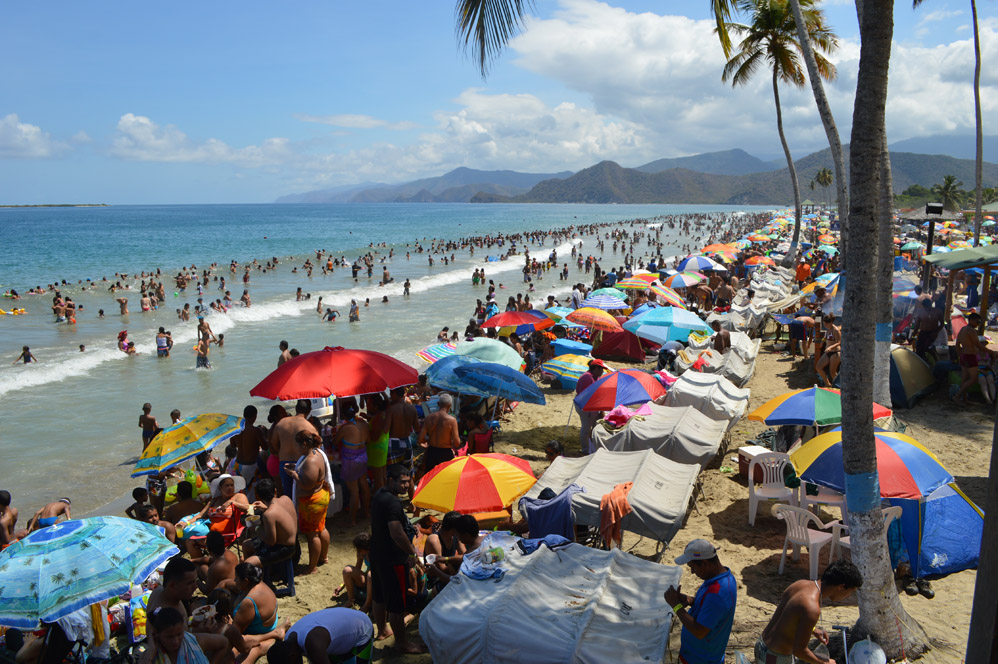
Mérida – Opposition protests continue in Venezuela, while masses of holiday-goers have headed to the beach to escape the unrest.
Over the weekend opposition supporters continued the protests that have mainly taken place in middle and upper class areas of Venezuela’s cities.
However the government has argued that the large numbers of people travelling to the beach and other destinations over the long “carnival” weekend shows that the protesters are a “minority” and that life in most of the country continues as normal.
Protests began last month after hard-line opposition leader Leopoldo Lopez, who is currently under investigation for incitement to violence, called for supporters to take to the streets and force the “exit” of President Nicolas Maduro. Led by pro-opposition students, demonstrators have also mentioned insecurity, high inflation and shortages as reasons for discontent.
While some protests have been peaceful, others have descended into violence and rioting. Further, small groups of radical opposition activists have set up burning street barricades in parts of some of Venezuela’s cities, blocking traffic and creating a range of problems for the normal functioning of civic life.
Protests vs. holidays
The opposition fought to keep the momentum of protests going as the country entered a long weekend on Thursday, which will last until this coming Wednesday. On Sunday, thousands of opposition supporters marched through Caracas to underscore their discontent.
The mayors of several opposition controlled municipalities cancelled local carnival celebrations, rejecting the government’s call for normality.
“There’s no reason to celebrate here,” said Ramón Muchacho, mayor of the wealthy Chacao municipality of eastern Caracas.
Also on Sunday 41 people, including an Italian photographer, were released from detention. They were arrested on Friday during a confrontation between National Guard officers and molotov-cocktail wielding opposition hard-liners in the up-market Altamira area of Caracas.
There were fresh confrontations in Altamira today, with National Guard officers using tear gas to disperse opposition radicals armed with molotov cocktails, the local mayor reported.
Meanwhile the government has said that at least a million people have taken advantage of the long weekend to go on holiday.
“With this mobilisation [of tourists] that there has been this carnival, it’s being demonstrated to the country that the violent ones are a minority…[and] that they’re ever more isolated,” said tourism minister Andres Izarra today.
On the country’s beaches, many Venezuelans expressed their desire to escape from the unrest.
“They [the violent protests and street barricades] are absurd, we all have the right to free transit whatever our political opinions: they’re not doing anything with these barricades,” said Oscar Figuera, a beach-goer with his family, to private Venezuelan news outlet Noticias 24.
“I’m self employed, and I’ve not been able to go out to work and my children haven’t been able to go to school. There are other ways to protest,” Figuera stated.
Meanwhile some opposition supporters stayed on the streets, arguing that they didn’t want the holidays to dampen the protests. “Going on vacation is really like saying that [the government] is right, that everything is calm and everything is fine, when we don’t feel that way,” said Carlos Torres, an engineer, to the BBC in Caracas.
“We want the street to remain active,” said another protester, a student named Eduardo.”If the protests are peaceful then people get tired,” he explained.
Nevertheless President Maduro argued today that the great majority had decided to use the long weekend to celebrate the carnival holiday. “You [the opposition] believed that we were going to let you take away the children’s happiness. The people of Venezuela have triumphed. The people want peace,” he declared.
Also today, right-wing legislator Maria Corina Machado and Metropolitan Mayor of Caracas, Antonio Ledezma, led a march to the Venezuela office of the Organisation of American States (OAS). Describing the situation in Venezuela as “the assassination of a democracy”, they demanded that the OAS debate events in Venezuela and support the opposition with a “firm reaction”.
“If the OAS turns its back on Venezuela in these hours it won’t just be betraying Venezuela, it will be burying the OAS,” argued Machado, who participated in the short-lived 2002 coup against former president Hugo Chavez.
Antonio Ledezma reiterated his faction of the opposition’s rejection of Maduro’s National Peace Conference initiative, which had its first meeting last Wednesday with business, religious, and some opposition figures.
“Those aren’t meetings of peace, they’re meetings of violence where citizens aren’t respected and there isn’t a clear agenda of what is wanted to be achieved,” he argued.
Opposition leader and former presidential candidate Henrique Capriles didn’t attend today’s march. Instead the state governor launched an initiative called the “People’s Defence Command”, which he said seeks “to form a great social movement…to push for change”.
One of the objectives of the initiative is to “leave aside the political agenda of violence” and to campaign on “social problems” that can be used to reach out to the opposition’s non-traditional base of support.
While also rejecting Maduro’s offer of dialogue, Capriles has previously criticised the hard-line opposition’s tactics as containing an “empty agenda” and representing a political “dead end”.
According to press and authorities, 18 have been killed and 260 wounded since violent protests began last month. The latest victim is a National Guard officer, Giovanni Pantoja, who died last Friday. He was reportedly shot by a gunman in an “ambush” while he and his colleagues were trying to clear the remains of a street barricade from a road in Carabobo state.
Venezuela’s Ombudsman, Gabriela Ramírez, reported today that the state’s human rights body has received 42 denouncements of abuses by security forces. She said that the majority of these were for excess use of force at the point of arrest, but “not one for torture”.
President Maduro has called for the formation of a bi-partisan Truth Commission to investigate and attribute responsibility for “all” acts of recent violence, although some opposition figures have rejected this as being weighted in favour of the government. The opposition’s MUD coalition is preparing a report solely focused on alleged abuses by state security forces, to be presented to “international organisations”.
How International Financial Elites Change Governments to Implement Austerity
By ISMAEL HOSSEIN-ZADEH | CounterPunch | February 28, 2014
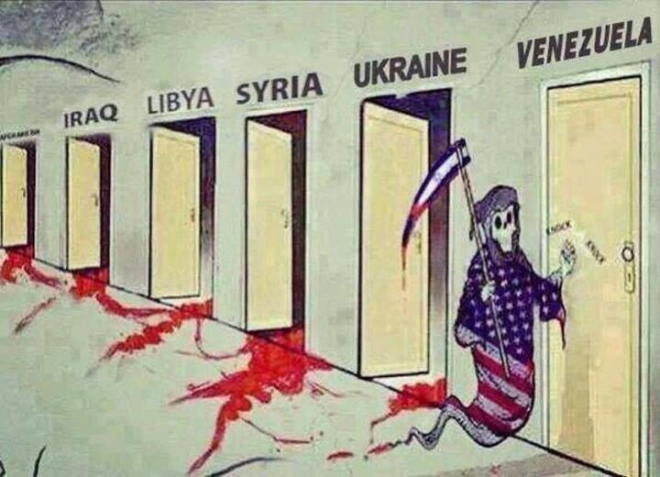
Many countries around the world are plagued by all kinds of armed rebellions, economic sanctions, civil wars, “democratic” coup d’états and/or wars of “regime change.” These include Ukraine, Venezuela, Syria, Thailand, Iran, Afghanistan, Iraq, Egypt, Yemen, Somalia and Lebanon. Even in the core capitalist countries the overwhelming majority of citizens are subjected to brutal wars of economic austerity.
While not new, social convulsions seem to have become more numerous in recent years. They have become especially more frequent since the mysterious 9-11 attacks on the World Trade Center in 2001 and the 2008 financial collapse in the United States, which soon led to similar financial implosions and economic crises in Europe and beyond.
Despite their many differences, these social turbulences share two common features. The first is that they are largely induced, nurtured and orchestrated from outside, that is, by the Unites States and its allies—of course, in collaboration with their class allies from inside. And the second is that, contrary to the long-established historical pattern of social revolutions, where the desperate and disenfranchised masses rebelled against the ruing elites, in most of the recent struggles it is the elites that have instigated insurgencies and civil wars against the masses. The two features are, of course, integrally intertwined: essentially reflecting the shared interests and collaborative schemes of the international plutocracies against the global 99%.
Fighting to Make Austerity Economics Universal
The official rationale (offered by the U.S. and its allies) that the goal of supporting anti-government opposition forces in places such as Syria, Ukraine and Venezuela is to spread democracy no longer holds any validity; it can easily be dismissed as a harebrained pretext to export neoliberalism and spread austerity economics. Abundant and irrefutable evidence shows that in places where the majority of citizens voted for and elected governments that were not to the liking of Western powers, these powers mobilized their local allies and hired all kinds of mercenary forces in order to overthrow the duly elected governments, thereby quashing the majority vote.
Such blatant interventions to overturn the elections that resulted from the majority vote include the promotion of the Orange Revolution in Ukraine (2004 and 2014), Rose Revolution in Georgia (2003), Cedar Revolution in Lebanon (2005), Tulip Revolution in Kyrgyzstan (2005) and the Green Revolution in Iran (2009). They also include the relentless agitation against the duly elected governments of the late Hugo Chavez and now his successor Nicolás Maduro in Venezuela, as well as the rejection (and effective annulment) of the duly elected Hamas government in Palestine.
So, the real driving forces behind wars of regime change need to be sought elsewhere; specifically, in the imperatives of expansion and accumulation of capital on a global level. Socialist, social-democratic, populist or nationalist leaders who do not embrace neoliberal economic policies, and who may be wary of having their markets wide open to unbridled foreign capital, would be targeted for replacement with pliant leaders, or client states. This is, of course, not a new explanation of economic imperialism; it is as old as the internationalization of trade and investment.
What is relatively new, and seems to be the main driving force behind the recent wars of regime change, is that, as the U.S. and other major capitalist powers have lately embarked on austerity economic policies at home they also expect and, indeed, demand that other countries follow suit. In other words, it is no longer enough for a country to open its markets to investment and trade with Western economic powers. It seems equally important to these powers that that country also dismantle its public welfare programs and implement austerity measures of neoliberalism.
For example, after resisting imperialist pressures for years, the late Libyan leader Muammar al-Gaddafi eventually relented in 1993, and granted major oil and other transnational corporations of Western powers lucrative investment and trade deals. Under pressure, he even dismantled his country’s nuclear technology altogether in the hope that this would please them to “leave him” alone, so to speak. None of the concessions he made, however, proved satisfactory to the U.S. and its allies, as his regime was violently overthrown in 2011and he was literally butchered by the thuggish gangs that were trained and armed by Western powers.
Why? Because the U.S. and its allies expected more; they wanted him to follow the economic guidelines of the “experts” of global finance, that is, of the U.S. and European economic “advisors,” of the International Monetary Fund and of the World Trade Organization—in short, to dismantle his country’s rather robust state welfare programs and to restructure its economy after the model of neoliberalism.
The criminal treatment of al-Gaddafi can help explain why imperialist powers have also been scheming to overthrow the populist/socialist regimes of the late Hugo Chavez and his successor in Venezuela, of the Castro brothers in Cuba, of Rafael Correa Delgado in Ecuador, of Bashar Al-assad in Syria and of Evo Morales in Bolivia. It also helps explain why they overthrew the popularly elected nationalist governments of Mohammad Mossadeq in Iran, of Jacobo Arbenz in Guatemala, of Kusno Sukarno in Indonesia, of Salvador Allende in Chile, of Sandinistas in Nicaragua, of Jean-Bertrand Aristide in Haiti and of Manuel Zelaya in Honduras.
The imperialist agenda of overthrowing al-Gaddafi and other “insubordinate” proponents of welfare state programs abroad is essentially part of the same evil agenda of dismantling such programs at home. While the form, the context and the means of destruction may be different, the thrust of the relentless attacks on the living conditions of the Libyan, Iranian, Venezuelan or Cuban peoples are essentially the same as the equally brutal attacks on the living conditions of the poor and working people in the US, UK, France and other degenerate capitalist countries. In a subtle way they are all part of an ongoing unilateral class warfare on a global scale. Whether they are carried out by military means and bombardments or through the apparently “non-violent” processes of judicial or legislative means does not make a substantial difference as far as their impact on people’s lives and livelihoods is concerned.
The powerful plutocratic establishment in the core capitalist countries does not seem to feel comfortable to dismantle New Deal economics, Social Democratic reforms and welfare state programs in these countries while people in smaller, less-developed countries such as (al-Gaddafi’s) Libya, Venezuela or Cuba enjoy strong, state-sponsored social safety net programs. Plutocracy’s intolerance of “regimented” economies stems from a fear that strong state-sponsored economic safely net programs elsewhere may serve as “bad” models that could be demanded by citizens in the core capitalist countries.
In a moment of honesty, former U.S. President Harry Truman is reported as having expressed (in 1947) the unstated mission of the United States to globalize its economic system in the following words: “The whole world should adopt the American system. The American system can survive in America only if it becomes a world system” [1].
In a similar fashion, Lord Cecil Rhodes, who conquered much of Africa for the British Empire, is reported to have suggested during the heydays of the Empire that the simplest way to achieve peace was for England to convert and add the rest of the world (except the United States, Germany and few other Western powers of the time) to its colonies.
The Mafia equivalent of Truman’s or Rhodes’ statements would be something like this: “You do it our way, or we break your leg.”
The mindset behind Truman’s blunt statement that the rest of the world “should adopt the American system” has indeed served as something akin to a sacred mission that has guided the foreign policy of the United States ever since it supplanted the British authority as the major world power.
It explains, for example, the real and the main reason behind the Cold War hostilities between the U.S. and its allies, on the one side, and the Soviet Union and its allies, on the other. While the “threat of communism” has been the official rationale for the start and escalation of those hostilities, there is convincing evidence that not only Joseph Stalin and his successors in the Soviet Union had no plans to wage war against the United States or its allies but that, in fact, they played a restraining role to contain independent revolutionary movements worldwide. “It is often forgotten,” points out Sidney Lens, “that for a few years after the war, he [Stalin] assumed an exceedingly moderate posture. . . . His nation had lost 25 million people in the war, was desperately in need of aid for rebuilding, and continued for a long time to nurture hopes of coexistence. Far from being revolutionary, Stalin in those years put the damper on revolution wherever he could” [2]. To accommodate the United States and other Western powers in the hope of peaceful coexistence, Stalin often advised, and sometimes ordered, the pro-Moscow communist/leftist parties in Europe and elsewhere in the world to refrain from revolutionary policies that might jeopardize the hoped-for chances of coexistence.
The goal or mission of converting other economies to the U.S.-style capitalism also helps explain why the United States has engaged in so many military operations and engineered so many coup d’états and regime changes around the world. The Federation of American Scientists has recorded a list of U.S. foreign military engagements which shows that in the first decade after the collapse of the Berlin Wall (1989-99) the U.S. engaged in 134 such operations, the majority of which are altogether unknown to the American public [3].
Global financial elites change “unaccommodating” regimes not only in the less developed countries but also in the core capitalist countries. They accomplish this not so much by military means as by utilizing two very subtle but powerful means: (a) artificial, money-driven elections, peddled as “democracy in action”; and (b) powerful financial institutions and think tanks such as the International Monetary Fund (IMF), central banks and bond/credit rating agencies like Moody’s, Standard & Poor’s and Fitch Group. An unfavorable rating report by these agencies on the credit status of a country can create havoc on that country’s economic, financial and currency position in world markets, thereby dooming its government to collapse and replacement. This is how during the ongoing financial turbulence of recent years a number of governments have been changed in places like Greece and Italy—no need for the traditional or military style regime change, the “soft-power” financial coup d’état engineered by the IMF and/or rating agencies would serve the purpose even more effectively.
Class War on a Global Scale
As noted, all the schemes and wars of regime change, whether by the traditional military means or by the “soft” power of the global financial juggernaut, essentially represent one thing: a disguised class war on a global level, a relentless worldwide economic war by the one percent financial-economic oligarchy against the rest of the world population.
Class struggle in an economically-tiered society is of course not new. What is relatively new in the recent years’ war of the 1% against the 99% is its escalated pace, its widespread scale and its globally orchestrated character. While neoliberal austerity attacks on the living conditions of the public in the core capitalist countries began (formally) with the supply-side economics of President Ronald Reagan and Prime Minister Margaret Thatcher more than three decades ago, the brutality of such attacks have become much more severe in the context of the current financial/economic crisis, which began with the 2008 financial crash in the United States.
Taking advantage of the crash (as an economic shock therapy, as Naomi Klein put it), the financial oligarchy and their proxies in the governments of the core capitalist countries have been carrying out a systematic economic coup d’état against the people the ravages of which include the following:
• Transfer of tens of trillions of dollars from the public to the financial oligarchy through merciless austerity cuts;
• Extensive privatization of public assets and services, including irreplaceable historical monuments, priceless cultural landmarks, and vital social services such as healthcare, education and water supply;
• Substitution of corporate/banking welfare policies for people’s welfare programs;
• Allocation of the lion’s share of government’s monetary largesse (and of credit creation in general) to speculative investment instead of real investment;
• Systematic undermining of the retirement security of millions of workers (both white and blue collar) and civil servants;
• Ever more blatant control of economic and/or financial policies by the representatives of the financial oligarchy.
Combined, these policies have significantly aggravated the already lopsided income/wealth distribution in these countries. The massive cuts in social spending have resulted in an enormous transfer of economic resources from the bottom up. The transfer has, indeed, more than made up for the 2008 losses of the financial speculators. In the U.S., for example, the wealthiest one percent now own 40 percent of the entire country’s wealth; while the bottom 80 percent own only seven percent. Likewise, the richest one percent now take home 24 percent of the country’s total income, compared to only nine percent four decades ago [4].
This shows that, as pointed out earlier, while neoliberal attacks on the 99% in the core capitalist countries may not seem as violent as those raging, for example, in Venezuela, Syria or Ukraine, the financial impact of such attacks on the living conditions of the 99% is not any less devastating.
Plutocrats of the World Are United
Policies of regime change are usually designed and carried out as collaborative schemes by cross-border plutocracies, that is, by the financial oligarchies of the imperialist countries in partnership with their native counterparts in the less-developed countries.
In addition to constant behind-the-scenes strategizing, representatives of transnational capital and their proxies in capitalist governments also routinely meet at international conferences in order to synchronize their cross-border business and financial policies—a major focus of which in recent years has been to implement global austerity measures and entrench neoliberal policies worldwide. These include the World Economic Forum in Davos, Switzerland, the World Bank and IMF annual meetings, the Periodic G20 meetings, the Aspen Institute’s Ideas Festival, The Bilderberg Group annual geopolitics forum, and the Herb Allen’s Sun Valley gathering of media moguls—to name only a handful of the many such international policy gatherings.
Through its global strategies and operations, transnational capital has broken free from national constraints and commitments at home and successfully shifted the correlation of class forces and social alliances worldwide. Today’s elites of global capitalism “are becoming a trans-global community of peers who have more in common with one another than with their countrymen back home,” writes Chrystia Freeland, Global Editor of Reuters, who travels with the elites to many parts of the world. “Whether they maintain primary residences in New York or Hong Kong, Moscow or Mumbai, today’s super-rich are increasingly a nation unto themselves,” she adds [5].
Implications for Globalization from Below
What conclusions can the 99% draw from this? What can the working people and other grassroots do to protect their jobs, their sources of livelihood, their communities and their environment? What can communities of ordinary people do to undermine the strategies of the global 1% that block life-sustaining progressive social and economic reforms?
In the same fashion that, in their fight against the working people, the elites of the international capitalist class are not bound by territoriality or national boundaries, so does the working class need to coordinate its response internationally.
A logical, first step deterrent to transnational capital’s strategy of blackmailing labor and communities through threats such as destroying or exporting jobs by moving their business elsewhere would be to remove the lures that induce plant relocation, capital flight or outsourcing. Making labor costs of production comparable on an international level would be crucial for this purpose. This would entail taking the necessary steps toward the international establishment of wage and benefits, that is, of labor cost parity within the same company and the same trade, subject to (a) the cost of living, and (b) productivity in each country.
A strategy of this sort would replace the current downward competition between workers in various countries with coordinated bargaining and joint policies for mutual interests and problem-solving on a global level. While this may sound radical, it is not any more radical than what the transnational 1% is doing: coordinating their anti-99% strategies on a global scale. If at an earlier stage of capitalist development “workers of the world unite” seemed an outlandish dream of the leading labor champion Karl Marx, internationalization of capital, the abundance of material resources and developments in technology, which has greatly facilitated cross-border organizing and coordination of actions by the 99%, has now made that dream an urgent necessity.
As capital and labor are the cornerstones of capitalist production, their respective organizations and institutions evolve more or less apace, over time and space. Thus, when production was local, so was labor: carpenters, shoemakers, bricklayers, and other craftsmen organized primarily in their local communities. But as capitalist production became national, so did trade unions. Now that capitalist production has become global, labor organizations too need to become international in order to safeguard their and their communities’ rights against the profit-driven whims of the footloose and fancy-free transnational capital.
Many would argue that these are not propitious times to speak of radical alternatives to capitalism. The present state of the sociopolitical landscape of our societies appears to support such feelings of pessimism. The high levels of unemployment in most countries of the world and the resulting international labor rivalry, combined with the austerity offensive of neoliberalism on a global level, have thrown the working class and other grassroots on the defensive. The steady drift of the European socialist, Social Democratic, and labor parties/governments toward the U.S.–style market economies and the erosion of their traditional ideology, power, and prestige have led to workers’ confusion there. The collapse of the Soviet Union, however much some socialists have always distanced themselves from that system, haunts the specter of socialism, and is likely to do so for some time to come. These developments have understandably led to workers’ and other grassroots’ confusion and disorientation globally.
None of these, however, mean that there is no way out of the status quo. Capitalism is not only “destructive,” it is also “regenerative,” as Karl Marx put. As it captures world markets, universalizes the reign of capital, and disrupts the living conditions for many, it simultaneously sows the seeds of its own transformation. On the one hand, it creates common problems and shared concerns for the majority of the world population; on the other, it creates the material conditions and the technology that facilitate communication and cooperation among this majority of world citizens for joint actions and alternative solutions.
When the majority of world population, the global 99%, will come to the realization and determination to actually appropriate and utilize the existing technology and material resources for a better organization and management of the world economy, no one can tell. But the potential and the long term trajectory of global socioeconomic developments point in that direction. The distance between now and then, between our immediate frustrations and the superior but elusive civilization of our desire, can be traversed only if we take the necessary steps toward that end [6].
Ismael Hossein-zadeh is Professor Emeritus of Economics, Drake University, Des Moines, Iowa. He is the author of The Political Economy of U.S. Militarism (Palgrave – Macmillan 2007), the Soviet Non-capitalist Development: The Case of Nasser’s Egypt (Praeger Publishers 1989), and most recently, Beyond Mainstream Explanations of the Financial Crisis (forthcoming from Routledge, April 29, 2014).
The National Endowment for Democracy in Venezuela
By Kim Scipes | CounterPunch | February 28, 2014
As protests have been taking place in Venezuela the last couple of weeks, it is always good to check on the National Endowment for Democracy (NED), the US Empire’s “stealth” destabilizer. What has the NED been up to in Venezuela?
Before going into details, it is important to note what NED is and is not. First of all, it has NOTHING to do with the democracy we are taught in civics classes, concerning one person-one vote, with everyone affected having a say in the decision, etc. (This is commonly known as “popular” or grassroots democracy.) The NED opposes this kind of democracy.
The NED promotes top-down, elite, constrained (or “polyarchal”) democracy. This is the democracy where the elites get to decide the candidates or questions suitable to go before the people—and always limiting the choices to what the elites are comfortable with. Then, once the elites have made their decision, THEN the people are presented with the “choice” that the elites approve. And then NED prattles on with its nonsense about how it is “promoting democracy around the world.”
This is one of the most cynical uses of democracy there is. It’s notable even in what my friend Dave Lippmann calls “Washington Deceit.”
The other thing to note about NED is that it is NOT independent as it claims, ad nauseum. It was created by the US Congress, signed into US law by President Ronald Reagan (that staunch defender of democracy), and it operates from funds provided annually by the US Government.
However, its Board of Directors is drawn from among the elites in the US Government’s foreign policy making realm. Past Board members have included Henry Kissinger, Madeleine Albright, Zbigniew Brzezinski, Frank Carlucci, General Wesley K. Clark, and Paul Wolfowitz. Today’s board can be found at http://www.ned.org/about/board; most notable is Elliot Abrams of Reagan Administration fame.
In reality, NED is part of the US Empire’s tools, and “independent” only in the sense that no elected presidential administration can directly alter its composition or activities, even if it wanted to. It’s initial project director, Professor Allen Weinstein of Georgetown University, admitted in the Washington Post of September 22, 1991, that “a lot of what we do today was done covertly 25 years ago by the CIA.”
In other words, according to Professor William Robinson in his 1996 book, Promoting Polyarchy, NED is a product of US Government foreign policy shift from “earlier strategies to contain social and political mobilization through a focus on control of the state and governmental apparatus” to a process of “democracy promotion,” whereby “the United States and local elites thoroughly penetrate civil society, and from therein, assure control over popular mobilization and mass movements.” What this means, as I note in my 2010 book, AFL-CIO’s Secret War against Developing Country Workers: Solidarity or Sabotage?, “is that instead of waiting for a client government to be threatened by its people and then responding, US foreign policy shifted to intervening in the civil society of a country ‘of interest’ (as defined by US foreign policy goals) before popular mobilization could become significant, and by supporting certain groups and certain politicians, then channel any potential mobilization in the direction desired by the US Government.”
Obviously, this also means that these “civil society” organizations can be used offensively as well, against any government the US opposes. NED funding, for example, was used in all of the “color revolutions” in Eastern Europe and, I expect, currently in the Ukraine as well as elsewhere.
How do they operate? They have four “institutes” through which they work: the International Republican Institute (currently headed by US Senator John McCain), the National Democratic Institute for International Affairs (currently headed by former US Secretary of State Madeleine Albright), the Center for International Private Enterprise (the international wing of the US Chamber of Commerce), and the American Center for International Labor Solidarity (ACILS), the foreign policy operation of the AFL-CIO, with Richard Trumka the head of its Board of Directors.
As I documented in my book, ACILS had been indirectly involved in the 2002 coup attempt in Venezuela by participating in meetings with leaders later involved in the coup beforehand, and then denying afterwards the involvement of the leaders of the right-wing labor organization (CTV) in the coup, leaders of an organization long affiliated with the AFL-CIO. We also know NED overall had been active in Venezuela since 1997.
The NED and its institutes continue to actively fund projects in Venezuela today. From the 2012 NED Annual Report (the latest available), we see they have provided $1,338,331 to organizations and projects in Venezuela that year alone: $120,125 for projects for “accountability”; $470,870 for “civic education”; $96,400 for “democratic ideas and values”; $105,000 for “freedom of information”; $92,265 for “human rights”; $216,063 for “political processes”; $34,962 for “rule of law”; $45,000 for “strengthening political institutions”; and $153,646 for Center for International Private Enterprise (CIPE).
Additionally, however, as found on the NED “Latin American and Caribbean” regional page, NED has granted $465,000 to ACILS to advance NED objectives of “freedom of association” in the region, with another $380,000 to take place in Venezuela and Colombia. This is in addition to another $645,000 to the International Republican Institute, and $750,000 to the National Democratic Institute for International Affairs.
The irony of these pious claims for “freedom of association,” etc., is that Venezuela has developed public participation to one of the highest levels in the world, and has one of the most free media in the world. Even with massive private TV media involvement in the 2002 coup, the government did not take away their right to broadcast afterward.
In other words, NED and its institutes are not active in Venezuela to help promote democracy, as they claim, but in fact, to act against popular democracy in an effort to restore the rule of the elite, top-down democracy. They want to take popular democracy away from those nasty Chavistas, and show who is boss in the US Empire. This author bets they fail.
Kim Scipes, Ph.D., is an Associate Professor of Sociology at Purdue University North Central in Westville, IN, and is author of AFL-CIO’s Secret War against Developing Country Workers: Solidarity or Sabotage?, and KMU: Building Genuine Trade Unionism in the Philippines, 1980-1994. He can be reached through his web site at http://faculty.pnc.edu/kscipes.
Related articles
When Protests and Violence Are Important to the U.S. Media
By Nate Singham | CEPR Americas Blog | February 28, 2014
In light of the recent political demonstrations that have swept the country, Venezuela has received considerable attention from both the US State Department and mainstream media. In recent days, President Obama, U.S. Secretary of State John Kerry and several others have issued numerous statements regarding the protests. In the US major media, The New York Times has published articles nearly every day since the protests began. Extensive reporting can also be found in the Wall Street Journal, USA Today and The Washington Post.
It is worth comparing the extent of this coverage to protests of similar importance next door to Venezuela. In August of last year, Colombian farmers launched large-scale demonstrations in opposition to Colombian trade policies that are strongly supported by the U.S. government.
Unlike the protests in Venezuela, the Colombian protests received very little coverage from mainstream media, as CEPR pointed out at the time. The graph below compares the amount of coverage, in total number of articles published, given by four of the United States’ most influential newspapers to the protests and violence in Colombia and Venezuela. The difference ranges from more than two times to 14 times as many articles devoted to the Venezuelan protests as compared with Colombia, despite the fact that the period covered for Colombia is twice as long.
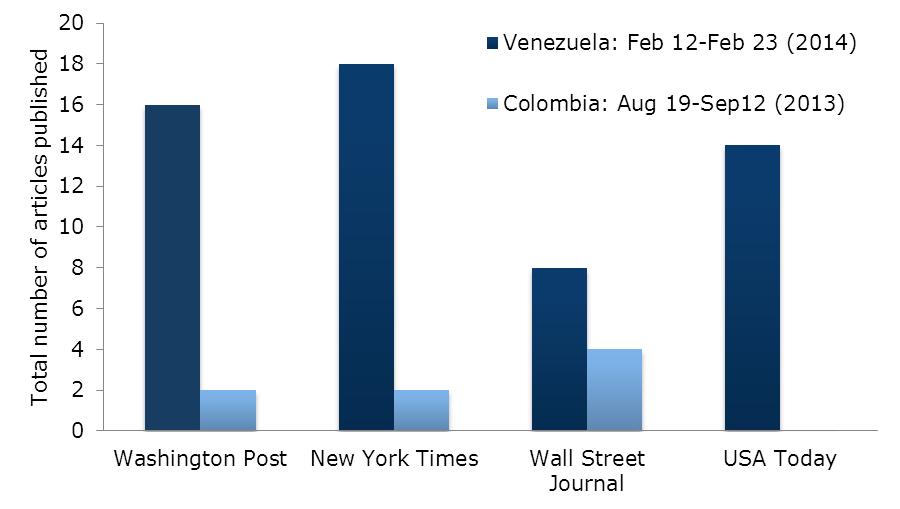
This is especially remarkable if we consider the high levels of repression carried out by the Colombian police and military in response to these protests. The International Office for Human Rights Action in Colombia described the violence as “unprovoked” and “indiscriminate” and attributes all of the violence to state forces.
The incidence of deaths in both Colombia and Venezuela[i], so far, is only slightly higher in Venezuela, with 13 deaths versus 12 deaths in Colombia.[ii] Yet there was very little coverage, and almost no criticism of the Colombian government as compared to the harsh attacks on the Venezuelan government in the U.S. media.
As mentioned earlier, US Secretary of State John Kerry and President Obama made public statements regarding the protests in Venezuela. Both demanded that students arrested in Venezuela be released, without regard as to whether any had been arrested for allegedly committing crimes such as arson and assault. There were no such statements from U.S. officials regarding the hundreds arrested in Colombia.
It is possible that both the huge differences in the amount of media coverage, and the responses to these two sets of protests by both the media and U.S. government officials has to do with the protesters and their aims, and the respective governments. The Colombian farmers were protesting against policies strongly supported by the U.S. government; they were also protesting against a government that the U.S. sees as a strategic ally, home to U.S. military bases and receiving billions of dollars in U.S. aid. The Venezuelan protesters are demanding the ouster of a government that the U.S. government has [spent] millions of dollars trying to get rid of, including U.S. support for the 2002 military coup against the government.
[i] The total amount of deaths reflects data from the most recent figures from Venezuela Transparencia, as of Monday, February 24 2014.
[ii] It is important to note that so far only six of the 13 deaths in Venezuela are confirmed to be opposition protesters.
Featured Video
Macgregor: We Haven’t Seen the Worst of the Iran War Yet
or go to
Aletho News Archives – Video-Images
From the Archives
15 Saudi ‘hijackers’ were CIA agents working for US: Scholar
Press TV – April 13, 2016
Fifteen of the 9/11 “hijackers” from Saudi Arabia were CIA agents working for the United States government, which was seeking to destroy the Middle East for Israel and to double the American military budget, says Dr. Kevin Barrett, an American academic who has been studying the events of 9/11 since late 2003…. continue
Blog Roll
 Aletho News
- Breast Cancer: Before You Consent
- Iran’s Plan to Shut Down AI in the Persian Gulf
- Israel seeks ‘compensation’ from Washington over Saudi F-35 sale
- Saudi crown prince seeks dialogue with Ansarullah after Yemeni blows: Report
- Damascus rejects Saudi request for Syrian fighters to counter Yemen: Report
- South Korea says will not send troops to join terrorist US war on Iran
- Russia Just Struck the Eyes of NATO’s War Machine in Ukraine
- Russia summons UK charge d’affaires over Kiev drone support
- NATO member warns bloc seeking pretext for war with Russia
- Macgregor: We Haven’t Seen the Worst of the Iran War Yet
- If Americans Knew
- Debunking The Claim That Macklemore Has A “History Of Antisemitism”
- CPJ demands release of arrested Palestinian-US journalist near Bethlehem
- Robert Kraft: The Billionaire Friend of Netanyahu Pulling The Strings Behind the Macklemore/Ed Sheeran Blow Up
- Columbia Administered Fund Gives Big Money to Pro-Israel Groups
- Deportation Case of Palestinian Activist Salah Sarsour Tests First Amendment
- ‘We Will Not Forget’: Palestinians Mark 44 Years since Sabra and Shatila
- Why do we let Zionists decide what we can and can’t say?
- US welcomes Israeli, Iranian delegations to UN, but not Palestinians – Daily Update
- Biden’s Genocide Accomplices Targeted by New Accountability Campaign
- AIPAC’s Network Has Already Spent $67.2 Million to Shape the Midterm Elections
- No Tricks Zone
- New Study: ‘Global Drought Shows No Detectable Recent Acceleration Under Climate Warming’
- Economic Masterminds: German Socialists Suggest Taxing Productivity Gains Stemming From Using AI
- The South China Sea Has Not Been Cooperating With The Climate Change Narrative
- Energy Crisis: Germany Enters Heating Season With Historically Low Gas Reserve Fill Levels
- New Study: The Antarctic Ice Sheet Gained Mass From 2020-2024 Due To Staggering Snow And Ice Accumulation
- Study: Ocean Heating Rates From Thousands Of Years Ago ‘Dwarf’ Modern Ocean Heating Rates
- Climate Extremists Target, Attack Large-Scale Power Grid Infrastructure In Germany!
- New Study: Antarctic Ice Melt Has Contributed Less Than 1 Centimeter To Sea Level Rise In The Last 30 Years
- Fear Of Debate: Alarmist German Climate Scientist Calls On Mainstream Media To Discredit Skeptic Voices
- End-Of-August Arctic Sea Ice Extent Hasn’t Fallen In 20 Years, Official Data Show!
 Aletho News