Venezuelan University Developing Experimental Bamboo for Green Homes
By Ryan Mallett-Outtrim | Venezuelanalysis | February 6, 2014
Merida – Venezuelan researchers are studying ways to use bamboo to provide cheap, environmentally friendly housing.
With funding from the Ministry of Science, Technology and Innovation, students and educators at Venezuela’s Simon Bolivar University (USB) are undertaking research into improving the durability and lifespan of bamboo, along with conducting studies into possible uses of the material in housing construction.
Initial tests have already been carried out on experimental, reinforced bamboo developed at the university, according to a press release from the government’s National Foundation for Science and Technology (Fonacit). The foundation is supporting the study.
“The preliminary results were positive,” director of the USB’s Centre for Surface Engineering Professor Joaquín Lira stated.
Lira explained that the experimental bamboo has been strengthened with polymers mixed with ceramic powders. According to the professor, the reinforcing mixture succeeded in “plugging holes made by pests” and improved the uniformity of the material.
In a second phase of the study, researchers hope to construct a prototype apartment block with the reinforced bamboo. According to Lira, the modified bamboo is intended for future use as a “structural element for green, affordable housing”.
A mission to provide affordable housing to the country’s poor was launched by former president Hugo Chavez, has been continued under his successor, President Nicolas Maduro. By the end of last year, over 500,000 homes had been constructed since mid 2011 under the housing mission, according to the government. The Maduro administration has committed to constructing three million new homes by 2019. Although current construction figures are behind schedule, the government has pledged to speed up building.
Lira argued that bamboo is a logical choice for construction material in South America.
“Venezuela , Brazil and Colombia are countries with high production potential for… bamboo…adapted for construction,” Lira stated.
“In these countries, it’s estimated that there are 11 million hectares of bamboo,” the professor said.
The USB is sourcing its bamboo from 200 growers in Aragua state.
Bamboo is one of the fastest growing plants in the world. It can reportedly grow as much as 250cm in 24 hours, depending on climate and soil conditions. Lira also argued that bamboo is cheaper than other construction materials, strong and environmentally friendly.
However, the professor indicated that more research should be undertaken, particularly to reduce bamboo’s susceptibility to insects.
“Technically, we know little about bamboo [construction],” Lira stated, though the plant has been used in buildings for centuries.
“There are three story homes, bridges and churches built with this plant,” Lira said.
The research is expected to be completed by the first quarter of 2015.
Related article


Washington and São Paulo: Spying and a Fading Friendship
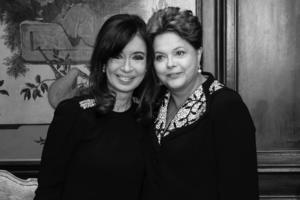
Rousseff and Kirchner at the UN, 2013. – Roberto Stuckert Filho
By Mark Weisbrot | NACLA | January 30, 2014
The only thing missing from Brazilian President Dilma Rousseff’s speech at the UN General Assembly last month was “it still smells like sulfur.” For those who don’t remember, these were the immortal words of Venezuela’s President Hugo Chávez in 2006, describing the podium where “the Devil”—his name for President George W. Bush—had spoken the day before. Chávez’s speech received hearty applause and prompted some New Yorkers to hang a banner from a highway overpass that said “Wake Up and Smell the Sulfur.”
Dilma’s speech also got a lot of applause at the General Assembly, and because she spoke immediately before President Barack Obama, her remarks were even more pointed. She presented a stinging rebuke to the Obama administration’s mass surveillance operations, at home and abroad:
“As many other Latin Americans, I fought against authoritarianism and censorship, and I cannot but defend, in an uncompromising fashion, the right to privacy of individuals and the sovereignty of my country. In the absence of the right to privacy, there can be no true freedom of expression and opinion, and therefore no effective democracy. In the absence of the respect for sovereignty, there is no basis for the relationship among nations. We face, Mr. President, a situation of grave violation of human rights and of civil liberties; of invasion and capture of confidential information concerning corporate activities, and especially of disrespect to national sovereignty.”
Dilma also took a swipe at Obama’s previously planned—and then cancelled due to popular demand—bombing of Syria: “[W]e repudiate unilateral interventions contrary to international law, without Security Council authorization.”
Her remarks were a reminder, and for some a new discovery, that the differences among the left-of-center governments of South America on hemispheric and foreign policy issues were mostly a matter of style and rhetoric, not of substance. The speech came in the wake of the cancellation of Dilma’s scheduled October state visit to the White House, which would have been the first by a Brazilian president in nearly two decades. It was another blow to the Obama administration’s tepid efforts to improve relations with Brazil, and with South America in general.
At this moment, U.S.-South American relations are probably even worse than they were during the George W. Bush years, despite the huge advantage that President Obama has in terms of media image, and therefore popularity, in the hemisphere. This illustrates how deeply structural the problem of hemispheric relations has become, and how unlikely they are to become warmer in the foreseeable future.
The fundamental cause of the strained relationship is that Washington refuses to recognize that there is a new reality in the region, now that a vast South American majority has elected left governments. In Washington’s foreign policy establishment—including most think tanks and other sources of analysis and opinion—there has been almost no acknowledgement that a new strategy might be necessary. Of course, most of the foreign policy establishment doesn’t care much about Latin America these days. And there is no electoral price to be paid for stupidity that leads to worsening relations with the region. On the contrary, the main electoral pressure on the White House comes from the far right, including neocons and old-guard Cuban-Americans. And Obama is not above caving to these interests when the White House and State Department are not already on their side. But among those who do care about Latin America—from an imperial point of view—the lack of imagination is breathtaking.
The establishment has, over the past 15 years, sometimes adopted a “good left, bad left” strategy that sought first and foremost to try and isolate Venezuela, often lumping in Bolivia, Ecuador, and sometimes Argentina as the “bad left.” But in the halls of power, they really do not like any of the left governments and are hoping to get rid of them all. In 2005, according to State Department documents obtained under the Freedom of Information Act, the U.S. government promoted legislation within Brazil that would have weakened the Workers’ Party, funding efforts to promote a legal change that would make it more difficult for legislators to switch parties. This would have strengthened the opposition to Lula’s Workers’ party (PT) government, since the PT has party discipline but many opposition politicians do not.
So it is not surprising that Brazil has been, according to the documents revealed by former NSA contractor and whistleblower Edward Snowden, the top Latin American target for U.S. spying. It is a lot like all the other left governments that Washington would like to get rid of, only bigger. It is true that countries with U.S.-allied governments like Mexico were also targeted, but in the context of Brazil’s alliance with other left governments, the large-scale espionage there—which reportedly included monitoring of Dilma’s personal phone calls and emails—takes on a different meaning.
In the past decade of Workers’ Party government, Brazil has lined up fairly consistently with the other left governments on hemispheric issues and relations with the United States. When the Bush administration tried to expand its military presence in Colombia, Brazil was there with the rest of the region in opposition. The same was true when Washington aided and abetted the overthrow of “targets of opportunity” among the left governments: Honduras in 2009 and Paraguay in 2012—although in these cases Washington and its allies still prevailed. Brazil also supported other efforts at regional integration and independence, including UNASUR (the Union of South American Nations), which has played an important role in defending member countries from right-wing destabilization attempts as in Bolivia in 2008, or in the April elections in Venezuela, where the Obama administration supported opposition efforts to overturn the results with obviously false claims of electoral fraud (A CEPR study showed that the probability of getting the April 14 election day audit results confirming Nicolás Maduro’s win, if the vote had actually been stolen, was less than one in 25 thousand trillion).
Lula made a conscious decision that Brazil would look more to the south and less to the United States as a leader in its foreign and commercial policy. In an interview with the Argentine daily Pagina 12 this past October, he explained how important the turning point of Mar del Plata was, when the proposed Free Trade Area of the Americas (FTAA) was finally buried at the Summit of the Americas in 2005:
“It was fundamental that we had stopped this proposal to form the FTAA, at Mar del Plata. It was not a true project of integration, but one of economic annexation. With its sovereignty affirmed, South America looked for its own path and a much more constructive one. . . . When we analyze this history of South America we can see that it is one great conquest. If we had not avoided the FTAA, the region would not have been able to take the economic and social leap forward that it did in the past decade. Argentina, Brazil, and Venezuela played a central role in this process. Néstor Kirchner and Hugo Chávez were two great allies in accomplishing this.”
In 2002, when Lula was elected, Brazil’s exports to the United States were 26.4% of its total exports. By 2011, they were down to 10.4%. Meanwhile, China’s economy is by some measures already bigger than the U.S. economy, and it may well double in size over the next decade. That projection, which would require only a 7.2% annual rate of growth, is quite probable, as likely as any ten-year projection for the United States—perhaps even more so. The United States will become increasingly less important to Brazil, and to South America generally. Given that Washington still does not respect Latin American sovereignty, much less the goals and aspirations of its democratic governments, the steady decline of U.S. economic power has to be seen as a good thing for the region.
Mark Weisbrot is co-director of the Center for Economic and Policy Research, in Washington, D.C. He is also president of Just Foreign Policy.
Related articles
Brookings Institution Calls on Obama to Support a Hypothetical Coup Against Venezuela’s Maduro
By Dan Beeton | CEPR Americas Blog | January 25, 2014
On Thursday, the Brookings Institution issued a memo to President Obama titled “Venezuela Breaks Down in Violence.” As might be expected from the title, the memo (and an accompanying video) depicts an alarming situation where
Venezuela is experiencing declining export revenues, accelerating inflation and widespread shortages of basic consumer goods. At the same time, the Maduro administration has foreclosed peaceful options for Venezuelans to bring about a change in its current policies.
But, contrary to the alarmist title, the violence is only a possibility in the future: “Economic mismanagement in Venezuela has reached such a level that it risks inciting a violent popular reaction,” and further on the reader learns that actually “[t]he risk of a violent outcome may still be low…”
The possibility of such chaos is troubling to the author, Harold Trinkunas since “it is in the U.S. interest that Venezuela remain a reliable source of oil,” while “[p]opular unrest in a country with multiple armed actors, including the military, the militia, organized crime and pro-government gangs, is a recipe for unwelcome chaos and risks an interruption of oil production.”
Trinkunas, who “previously served as an associate professor and chair of the Department of National Security Affairs at the Naval Postgraduate School in Monterey, California” urges the Obama administration to take action. At the top of his recommendations is for the U.S. to enlist Brazil – “whose interests are also at risk” – in an attempt “to convince the Maduro administration to shift course.”
Trinkunas makes clear what course he wants the U.S. government to take should a crisis result in Maduro being removed from power. While one might think that such a hypothetical scenario would indeed be one when the Inter-American Democratic Charter should be invoked (Trinkunas suggests that it be used against Maduro now), that would be naïve. Instead:
…we should also begin quiet conversations with others in the hemisphere on what steps to take should Venezuela experience a violent breakdown of political order. Such an event could potentially fracture the regional consensus on democracy on a scale much greater than that of the Honduran coup in 2009. Maduro’s allies in the region would most likely push for his immediate restoration, but in the absence of functioning democratic institutions, this would only compound Venezuela’s internal crisis. The United States would need to work with key states in the region—Brazil, Mexico, Chile, Peru and Colombia—on a regional consensus in favor of rebuilding democracy in Venezuela.
In other words, should a coup occur, Trinkunas wants the U.S. to “work with” the Latin American countries it is closer to politically – and also Brazil – to help it succeed. This is in fact what the Bush administration attempted to do during the short-lived 2002 coup against Hugo Chávez, and the Obama administration worked to ensure that the 2009 coup against the democratically-elected government of Honduras would succeed.
Of course Trinkunas seems to be unaware – despite a passing reference to “distance from the United States over NSA surveillance issues” – that in recent years Brazil’s government has not shied from challenging U.S. foreign policy on a variety of hot-button issues, including over Iran’s nuclear program, the FTAA, and a planned U.S.-Colombia military bases agreement. Brazil led the South American opposition to the Honduran coup and refused to recognize the new government of Pepe Lobo following the November 2009 elections in Honduras. Former president Lula da Silva – who has hinted at another presidential run in 2018 – was always vocal about his support for the Venezuelan government of Hugo Chávez and released a video in support of Maduro ahead of the April elections last year.
Perhaps Trinkunas can be forgiven if he isn’t aware of these things; they aren’t talked about much in Washington foreign policy circles, where Brazil is still often referred to as part of the “good left” – unlike Venezuela, Bolivia, Ecuador, Argentina and other bad apples.
Why is Trinkunas so concerned that Venezuela could soon collapse into violence? He cites a number of economic factors, some vague, some not. He frets, for example, about “declining” output by state oil company PDVSA, and that Venezuela had “the highest inflation rate in the world in 2013.” But as CEPR Co-Director Mark Weisbrot recently pointed out in a contribution to the Inter-American Dialogue’s Latin America Advisor:
inflation appears to have stabilized. Inflation data for November and December show a monthly rate of 4.8 percent and 2.2 percent, putting the three-month annualized rate at 60.6 percent; the annual rate for 2013 was 56.1 percent.
Further, citing an analysis by Bank of America, Weisbrot states:
BOA sees Venezuela’s current debt as sustainable. A devaluation would not likely have much effect on the economy, as previous devaluations did not. Nor is social unrest a likely prospect, as there are no elections for two years, and most opposition protests in Venezuela tend to focus on elections…
Trinkunas attempts to cast doubt on Venezuela’s electoral process (the same one that former president Jimmy Carter called “the best in the world” ahead of the October 2012 elections). He writes, “A now unified national opposition continues to emphasize elections as the solution, but the playing field is hardly level, and elections are not scheduled to take place again until 2015.” Venezuela observers know that the opposition has been relatively unified for some time now, coming together to support the presidential candidacy of Henrique Capriles in both October 2012 and April 2013. Capriles lost both times, and last month the opposition was dealt a blow by a poorer showing in municipal elections than it had hoped. Analysts and some members and supporters of the opposition now question Capriles’ status as an opposition leader, so if anything the opposition is probably now less unified than it was prior to these recent elections.
Ironically – perhaps unaware that Brookings’ website is available to the public, as is YouTube – Trinkunas writes, “Overt U.S. criticism of the Maduro administration or efforts to exert our limited economic leverage would be grist for the mill of the Venezuelan propaganda machine; we should avoid that.” Certainly if one of the most prominent Venezuelan think-tanks called for supporting the overthrow of the U.S. government, that would simply be ignored by the U.S. “propaganda machine,” right?
Related articles
Latest Human Rights Watch Report: 30 Lies about Venezuela
By Tamara Pearson | Venezuelanalysis | January 23, 2014
In the six pages that HRW dedicates to Venezuela in its World Report 2014, released this week, it manages to tell at least 30 serious lies, distortions, and omissions. Pointing out these lies is important, because many people believe that HRW is a neutral authority on human rights, and the mainstream press publish articles and headlines based on HRW report conclusions. Here are some of the headlines in both English and Spanish (translated to English) that have come out of the 2014 report:
Global Post – Venezuela intimidates opponents, media: HRW report , PanAm Post – Human Rights Watch: A black eye for Latin America , AFP – HRW criticises Venezuela in its annual report on human rights, El Economista – HRW: Democracy in Venezuela is fictitious, El Universal – Human Rights Watch report denounces persecution of media in Venezuela, El Siglo – Human Rights Watch: Venezuela is an example of “fictitious democracies”, El Colombiano: HRW describes Venezuela as a fictitious democracy , NTN24 – HRW warns that Venezuelan government applies “arbitrary” measures against media that is critical of its policies
The headlines which talk about a “fictitious” or “feigned” democracy, are referring to the start of the report, where HRW put Venezuela, along with other countries, under the category of “abusive majoritarianism”. There, HRW provides a very limited definition of democracy; “periodic elections, the rule of law, and respect for the human rights of all” and argues that Venezuela has adopted “the form but not the substance of democracy”. HRW cites Diosdado Cabello not letting legislators who didn’t recognise democratically elected President Maduro speak in parliament – yet the punishment seems soft, considering the crime.
Below, I’ve grouped the lies and omissions according to HRW’s own subheadings in its chapter on Venezuela. Unlike with other countries such as the US, HRW omits all of Venezuela’s human rights achievements in its assessment, and in reality a range of other subheadings would be deserving, such has right to have access to housing, people’s right to be consulted about policy, right of the poorer people to be heard in the media, right to education, the right to health care, to land, and so on. Of course, nowhere in the report does HRW mention the economic crimes committed by the business sector against Venezuelans’ right to access affordable goods (hoarding, speculation, etc).
15 lies and distortions
Introduction
1. “The Supreme Court and the National Electoral Council rejected appeals filed by the opposition candidate, Henrique Capriles Radonski, challenging the results [of the April 2013 presidential elections]”. – The CNE did meet with the opposition and they came to an agreement to do a manual recount of the remaining 46% of votes which hadn’t already been revised on the day of the election. The entire recount was televised live. Given how incredibly flimsy Capriles’ “evidence” was, the Supreme Court would have been ridiculing itself to do anything but reject his case.
2. “Under the leadership of President Chavez and now President Maduro, the accumulation of power in the executive branch and the erosion of human rights guarantees have enabled the government to intimidate, censor, and prosecute its critics.” – HRW offers very little evidence to substantiate such accusations. The reality is the opposite; private media makes up the vast majority of the media, and freely criticises the government on a daily basis, to the point where it invents news and blames the national government for things it isn’t even responsible for. Just last week here in Merida a few opposition students held a protest by burning tires on a main road. For a week, traffic to a key hospital was blocked, and the students had no placards stating the reason for their protest. The police closed off the roads around them to protect their right to protest.
3. “In September 2013, the Venezuelan government’s decision to withdraw from the American Convention on Human Rights took effect, leaving Venezuelans without access to the Inter-American Court on Human Rights, an international tribunal that has protected their rights for decades in a wide array of cases.” – The IACHR has not protected Venezuelans’ rights. From 1969-1998, a repressive period of disappearances, political repression, and massacres such as those at Cantaura, Yumare, and the Caracazo, it only considered six cases, and of those only one was brought to the commission. In contrast, from 1999 to 2011 it ruled on and processed a total of 23 cases. It did not take any action after the coup attempt against democratically elected president Hugo Chavez in 2002.
Post-Election Violence
4. “Security forces used excessive force and arbitrary detentions to disperse anti-government demonstrations after the April elections, according to local groups”. -Though it may have varied from region to region, unlike HRW, I was at those protests, and took photos of and interviewed opposition protesters in Merida – one of their strongholds. Despite threatening to take over and destroy the CNE and the PSUV head offices, with large piles of projectiles like rocks and shrapnel and Molotov cocktails, the police merely cordoned off those areas. They were not armed, and there were no injuries or arrests observed. The threats were not empty ones either, as seen by other destruction carried out by the opposition around the country. HRW also needs to specify what it means by “security forces”, as the police system here is complicated and most police continue to be managed at a state level, but HRW implies that the national government is entirely responsible. Finally, merely attributing these claims to “local groups” is very vague. One might also say, HRW is a capitalist front, said local groups.
5. “Official sources reported that nine individuals were killed at the time, although the circumstances in which the deaths occurred remain unclear. President Maduro and other high level officials have used the threat of criminal investigations as a political tool, attributing responsibility for all acts of violence during demonstrations to Capriles”. – Does HRW want an investigation or not? The violence occurred the day after the presidential elections, and all of the victims and buildings destroyed were Chavista supporters or part of national programs. It was clearly political, why is it a problem to mention that, and why does it become a “threat” when Maduro talks about bringing murderers and those who set fire to public hospitals, to justice? A thorough investigation was conducted, and those who were responsible for the deaths were arrested.
Judicial Independence
6. “The judiciary has largely ceased to function as an independent branch of government”. – While it is true that there are serious problems in Venezuela’s court system: HRW doesn’t mention those: the delays and corruption. Instead, it argued the judiciary is not “independent” because it doesn’t always rule against the government, as HRW would like. If it is not independent, why were almost a hundred supposedly pro government workers in SAIME, SENIAT, the China-Venezuela bank, and so on, arrested last year for corruption?
Freedom of Media
7. “Over the past decade, the government has expanded and abused its powers to regulate the media… fear of government reprisals has made self-censorship a problem” – No it hasn’t. What the government has done, over the last four years or so, is pass legislation which limits media abuse: racism, extreme violence, and sensationalism that is so extreme it can be psychologically damaging. Those regulations apply equally to the private, public, and community media, but the reality is it is the private media which tends to be most abusive. Nevertheless, Conatel has emitted less than 10 fines over the last few years.
8. “The government has taken aggressive steps to reduce the availability of media outlets that engage in critical programming.” – HRW is not able to cite any examples to back up this statement. Instead, it refers to one case from years ago, RCTV, who’s license was not renewed after it played an active role in the 2002 coup.
9. “In April 2013, Globovision was sold to government supporters… since then it has significantly reduced its critical programming”. The owners of Globovision sold it to a group of Venezuelan investors headed by businessman Juan Domingo Cordero, who is not a government supporter. Since then, Globovision’s coverage is somewhat less extreme and sensationalist, but it is just as critical.
10. “The government has also targeted other media outlets for arbitrary sanction and censorship”. – The government has not censored any media. Today alone, for example, Tal Cual freely published these headlines: “The fiscal report is a time bomb”, “The government uses violence as an excuse to censor the media” , “Dance with death” (to refer to the government) and “The government tragicomedy”. El Nacional received a fine in August last year for using a three year old photo of naked corpses on its front cover, and that is it.
Human Rights Defenders
11. “The Venezuelan government has sought to marginalise the country’s human rights defenders by repeatedly accusing them of seeking to undermine Venezuelan democracy with the support of the US government”. – The lie here is “the country’s human rights defenders”. HRW is referring to a select few organisations such as itself and other individuals, who use human rights as a front for their right-wing political agenda. The government is completely within its right in pointing that out.
Abuses by Security Forces
This section is somewhat accurate, but lacks any causal analysis.
Prison Conditions
These criticisms are also somewhat legitimate, though the information is selective. For omissions, see below.
Labour Rights
12. “Political discrimination against workers in state institutions remains a problem. In April 2013, Minister of Housing Ricardo Molina called on all ministry personnel who supported the opposition to resign, saying that he would fire anyone who criticised Maduro, Chavez, or the revolution”. Though perhaps a bit extreme, HRW forgets to point out that Molina made that remark in the context of the opposition not recognising a democratically elected president. That there is political discrimination against workers is largely untrue, though may occur in isolated situations. It is no secret that most of the public education and health workers, for example, support the opposition.
13. “The National Electoral Council (CNE), a public authority, continues to play an excessive role in union elections, violating international standards that guarantee workers the right to elect their representatives in full freedom” – Actually, what the CNE provides to unions is logistical support: machinery that makes cross-country elections much easier. If there were concern about the CNE somehow influencing elections, the opposition would not have also used its logistical support for its primaries in February 2012.
Key International Actors
14. “For years, Venezuela’s government has refused to authorise UN human rights experts to conduct fact-finding visits in the country” – That’s why the UNESCO and the FAO have both recently praised Venezuela’s education and food development. The Office of the High Commissioner for Human Right’s most recent report on Venezuela was made in September last year, it was about Venezuela’s elimination of racial discrimination.
15. “In June 2013, Venezuela became the pro-tempore president of Mercosur… The Asuncion Protocol…states that “full respect of democratic institutions and the respect of human rights” are essential…By not addressing the absence of an independent judiciary in Venezuela, as well as the government’s efforts to undermine human rights protections, the other Mercosur member states have failed to uphold these commitments” – See previous and subsequent comments on Venezuela’s judiciary and treatment of “human rights” protections.
15 omissions
The following very important facts on Venezuela’s human rights record were completely omitted from the report. Such omissions are as serious as lying.
Post-Election Violence
1. HRW conveniently doesn’t mention that the 15 “health centres” that were “vandalised” (ie they were set on fire on medical equipment was destroyed) were CDIs- Cuban-Venezuelan run free health centres that have come to be a symbol of the Bolivarian revolution. HRW doesn’t mention that opposition supporters attacked them, it lets readers believe that the government supported such violence.
2. HRW doesn’t criticise the extremely undemocratic move by Capriles to not recognise the president whom the majority of voters chose in the April presidential elections. Their omission to do so amounts to tacit support of Capriles. That sort of context is also necessary when HRW criticises the fact that there were arrests following the elections: it’s possible that some arrests were not justified, but given that the Bolivarian revolution has already suffered one (failed) coup, and the continent has suffered many successful and bloody ones, it is reasonable to arrest participants in that. Any other country would do the same.
3. HRW focuses on the post election violence, and blames the national government for it, rather than recognising the opposition’s role. It purposefully omits to mention that while Capriles called for a “venting of rage”, Maduro called on supporters to play music and dance in the street.
Judicial Independence
4. HRW criticises the imprisonment of “government critic” judge Afiuni, but omits to mention that she was arrested for illegally releasing a bank president who stole US$27 million from state currency body, CADIVI. Does HRW advocate such judicial corruption? In June Afiuni was awarded conditional release.
5. There are, however, other cases of court inefficiency and bribery of judges, which HRW completely ignores, perhaps because the victims are mostly Bolivarian revolution supporters. Over the last year, many rural workers, commune members, trade unionists, and indigenous activists were murdered by hired killers, and though the killers are usually easy to identify, few have been arrested and prosecuted.
6. HRW criticises Venezuela for withdrawing from the IACHR, but omits to mention that that court is totally under the thumb of the US. It then hypocritically comments on Venezuela’s so called “lack of judicial independence”.
Freedom of Media
7. While in most countries, people who aren’t rich don’t have the right to run their own media, that right is being promoted in Venezuela, with the state materially and legally supporting over 500 community and alternative radios, television stations, and newspapers. That is an important development in media freedom, but HRW completely ignored it.
8. HRW states that, “In November 2013, the broadcasting authority opened an administrative investigation against eight Internet providers for allowing web sites that published information on unofficial exchange rates”. HRW intentionally omits to point out that those sites were illegally publishing those figures, and that those figures have contributed to the three and four fold price increase of basic products. At no point does HRW criticise the role of business of deliberately making basic food and goods unaffordable for Venezuelans.
9. HRW also doesn’t mention the almost one thousand free internet centres the government has set up, its promotion of freeware, and its distribution of laptops to school children: part of the government’s efforts to make the right to information a reality.
Human Rights Defenders
10. HRW criticises the government for supposedly “marginalising” “human rights defenders” by investigating their sources of funding, but fails to mention the fact that the US does use such groups as a front for funding the undemocratic wing of the opposition. It fails to criticise this affront to Venezuela’s right to sovereignty.
11. Likewise, it doesn’t mention the important role played by the real human rights defenders in Venezuela: gender and sexuality activists and movements, indigenous and afro-descendents organisations, the Cuban doctors defending the right to free and quality health care, community activists, environmental movements, volunteer teachers, social mission workers, activist analysts who are constructively critical of the situation in the country, and so on. Many of these movements and workers receive financial, institutional, and/or legal support from the state, though there are improvements to be made there as well, such as legalising gay marriage, abortion, and so on.
Abuses by Security Forces
12. Here it is telling that HRW simply doesn’t mention Venezuela’s creation of the UNES, a university training police in human rights and preventative policing. While it is legitimate that HRW points out ongoing problems within the police forces, it doesn’t mention that such corruption has significantly decreased, nor that police political repression has been almost completely eliminated.
Prison Conditions
13. HRW rightly points out the ongoing problems of overcrowding and organised prisoner violence in prisons, but simply omits to mention anything the government is doing to improve prisoner rights, including letting those who have committed minor offences out during the day time to work or study, internal prison education and productive work programs, assistance on leaving prison, cultural workshops such as video production in prisons, and government meetings with prisoners.
Labour Rights
14. For HRW it seems labour rights are limited to the right of opposition supporters to work in governmental programs that they don’t agree with (a right they have). HRW omits to mention the Labour Law which came into effect in May last year, which beats most of the world in providing workers with rights to permanent work (contract labour is made illegal), to childcare in the workplace, to maternity leave and to paternity leave, shorter working hours, retirement pensions, and much much more.
15. HRW alleges that opposition workers were “threatened” with losing their jobs if they supported Capriles, but provides no evidence of that, nor mentions that of course voting is anonymous and such a threat could not be carried out, and neglects to mention that governor Capriles fired fire fighters in May last year for demanding pay they were owed, uniforms, and infrastructure improvements.
Related articles


Elections in Venezuela and Chile Advance Left Agenda and Latin American Economic Integration
By Roger Burbach | alai | January 7, 2014
The elections in Venezuela and Chile in December provided new momentum for the left-leaning governments in Latin America and the ascent of post-neoliberal policies. Over the past decade and a half, the rise of the left has been inextricably tied to the electoral process. In Venezuela, Bolivia, and Ecuador, under the governments of Hugo Chavez, Evo Morales, and Rafael Correa, the electorate has gone to the polls on an average of once a year, voting on referendums, constituent assemblies as well as elections for national offices.
In late November, it appeared the right might be taking the initiative, as the oligarchy and the conservative political parties in Honduras backed by the United States used repression and the manipulation of balloting to keep control of the presidency. And in Venezuela, it was feared the right would come out on top in the December 8 municipal elections. After Maduro’s narrow victory margin of 1.5% in the presidential elections in April, the opposition went on the offensive, declaring fraud and waging economic war. If the opposition coalition had won in the municipal elections, or even come close in the popular vote, it was poised to mount militant demonstrations to destabilize and topple the Maduro government. But the decisive victory of the United Socialist Party of Venezuela (PSUV) in the municipal elections gave a boost to the presidency of Nicolas Maduro, enabling him to advance the twenty-first century socialism of his predecessor, Hugo Chavez. The PSUV and allied parties won control of 72% of the municipalities and bested the opposition in the popular vote by 54% to 44%.
A class war is going on that is focused on the economy, particularly over who will control the revenue coming from its large petroleum resources that account for over 95% of the country’s exports. With no new electoral challenge until the parliamentary elections in late 2015, Maduro now has the political space to take the initiative in dealing with the country’s economic problems and to pursue a socialist agenda. As Maduro said on the night of the elections, “we are going to deepen the economic offensive to help the working class and protect the middle class….We’re going in with guns blazing, keep an eye out.”
At the other end of the continent, Michele Bachelet one week later won a resounding victory in the Chilean presidential race with 62% of the vote. She has put forth an ambitious package of proposals that would increase corporate taxes from 20% to 25%, dramatically expand access to higher education, improve public health care and overhaul the 1980 Constitution imposed by the dictatorship of Augusto Pinochet. Chile has the highest level of income inequality among the Organization for Economic Cooperation and Development’s 34 member countries. Within her first hundred days, Bachelet has promised to draft legislation to increase tax revenues by about 3 percent of gross domestic product. On election night Bachelet proclaimed: “Chile has looked at itself, has looked at its path, its recent history, its wounds, its feats, its unfinished business and thus Chile has decided it is the time to start deep transformations,” Bachelet proclaimed on election night.” There is no question about it: profits can’t be the motor behind education because education isn’t merchandise and because dreams aren’t a consumer good.”
If these policies are implemented, they would shake the neoliberal paradigm that has been followed by every government since the Pinochet dictatorship, including Bachelet’s during her first presidential term from 2006 to 2010. Like most presidential candidates before they take office, the actual changes may fall far short of what she is promising. But the student uprising and the resurgence of the social movements over the past four years has led to a popular movement in the streets that is unprecedented since the days of Pinochet. Militants on the left have already made it clear they will challenge her from the first day she takes office. According to Reuters, right after the election, hackers posted a message on the education ministry’s website saying: “Ms. President we will take it upon ourselves to make things difficult for you. Next year will be a time of protests.”
The elections in Venezuela and Chile also set the stage for a challenge to the latest U.S.-backed trade initiative, the Trans-Pacific Partnership, which includes a dozen Pacific rim nations. Ever since Chavez became president, Venezuela has led the way in opposing U.S. efforts to dominate hemispheric trade starting with the Free Trade Area of the Americas that George W. Bush launched in April, 2001. The FTAA was dealt a fatal blow at the 4th Summit of the Americas in Argentina in 2005 under the leadership of Chavez, Luiz Inacio Lula da Silva of Brazil, and Nestor Kirchner of Argentina, who advocated Latin American integration without the United States.
With the victory in the municipal elections behind him, Maduro was in a position to play a central roll ten days later in the second summit of ALBA, the Bolivarian Alliance for Our America (ALBA) and PetroCaribe, a bloc of 18 nations receiving oil at concessionary prices. (Five of the members are overlapping.) ALBA, founded in 2004 by Venezuela and Cuba, is based on the principal of “Fair Trade, not Free Trade.” Now including Bolivia, Ecuador, and Nicaragua as well as five more Caribbean nations, they met with the nations of PetroCaribe, a concessionary oil trading arrangement, to put forth a program to create a “special complementary economic zone” between the member countries of both groups to eradicate poverty in the region. Maduro proclaimed the economic zone “is a special plan…in order to continue advancing the food security and sovereignty of our peoples, and to share investments, experiences, and actions that promote [agricultural] development.” The action plan to implement the proposal includes cooperation with the UN Food and Agriculture Organization. An executive committee to coordinate the regional plan is being set up in Ecuador.
Maduro will take the document for the creation of a complementary economic zone to the January 31 meeting of Mercosur in Caracas “to advance in the great zone Mercosur-PetroCaribe-ALBA.” In all these economic and trade endeavors Venezuela plays a strategic geo-economic role. It is Latin America’s largest oil producer, and it is located on the southern flank of the Caribbean Basin and on the northern end of South American continent. Venezuela is already a member of MercoSur along with Brazil, Argentina, Uruguay, and Paraguay, while Chile, Bolivia, Colombia, Guyana, Ecuador, Peru, and Suriname are associate members. As Bolivian president Evo Morales said at the conclusion of the ALBA-PetroCaribe summit, “We should never stop strengthening our integration, the integration of anti-imperialist countries.”
A key question is around the role that Chile, led by Bachelet, will play in the growing movement for Latin American integration. Under Bachelet’s billionaire predecessor, Sebastian Pinera, Chile has been involved in setting up the U.S.-led Trans-Pacific Partnership (TPP), and is a founding member of the Pacific Alliance, a trade and investment group that includes Columbia, Peru, and Mexico. The United States has observer status.
Bachelet has given signs that a pursuit of these trade groupings alone is not in Chile’s interest, and that she intends to breach the Pacific versus the Atlantic/Caribbean divide. Her campaign manifesto stated: “Chile has lost presence in the region, its relations with its neighbors are problematic, a commercial vision has been imposed on our Latin American links.” She is particularly interested in closer relations with Brazil, where she identities with Dilma Rousseff, who also forged her political identity as a young clandestine activist jailed and tortured under a repressive dictatorship. It is notable that in 2008 during her last presidential term, Bachelet convened an emergency session of UNASUR (the Union of South American Nations), to support Evo Morales against a right wing “civic coup” attempt that received direct material support from the U.S. embassy.
It is of course impossible to predict where Bachelet will wind up in the growing continental divide. Her commitment to the Pacific Alliance and to TPP may undermine domestic and international challenges to neoliberalism. The militancy of internal mobilizations to pressure her at every turn is critical. In Venezuela, Maduro faces daunting economic problems as he tries to bring inflation and the black market under control, while dealing with serious corruption problems in and outside of the government. However, the December municipal elections have opened up a space for Maduro to deal with these issues in the coming year, while playing a leadership role in advancing Latin American integration in opposition to U.S. initiatives.
Roger Burbach is the director of the Center for the Study of the Americas, and co-author with Michael Fox and Federico Fuentes of Latin America’s Turbulent Tran
Related article

The Worst Venezuela Articles of 2013?
Venezuelanalysis | December 20, 2013
This is my worst-five list for articles about Venezuela. I couldn’t help but declare ties for a few of the spots, so the “worst five” list actually has more than five articles. I’ve listed them from most horrible to least.
1) It’s a three way tie! Two of the three are very recent articles that referred to Venezuela as a dictatorship. An article on Yahoo.com said Venezuela was “military-style dictatorship”. Another one on MSN.com said Hugo Chavez was a “dictator”. Sadly, these may have been honest mistakes – gross ignorance that results from corporate journalists being over exposed to their colleagues’ work which, in turn, leads them to spread even more ignorance among themselves and countless readers.
The third article sharing the worst spot is an editorial in the UK Independent that appeared just after Hugo Chavez died. The “Indy” editors wrote that Chavez “was no run-of-the-mill dictator. His offences were far from the excesses of a Colonel Gaddafi…” A letter I wrote to the Indy about this editorial was initially accepted but then rejected.
2) Jon Lee Anderson eleven page “slumlord” article in the New Yorker, not only trashed Hugo Chavez’s government but also the majority of Venezuelans who consistently voted Chavista since 1998 as I explained here. Anderson strongly insinuated that a coup (not a free and fair election as actually took place) led to Hugo Chavez first assume office in 1999. As Keane Bhatt pointed out, The New Yorker’s “vaunted fact-checkers somehow permitted the publication” of that falsehood. The article combines disregard for facts with very noticeable amount of class bigotry. I debated awarding it the worst spot but decided that its long-windedness probably mitigated the damage done.
3) This Economist article, which was thoroughly taken apart by Ryan Mallett-Outtrim, comes in third. My favorite part of Ryan’s demolition is the various TV interviews he points to that feature Henrique Capriles – the opposition leader whom the Economist claimed was “ignored” by a “cowed” media in the months prior to recent municipal elections. This lengthy interview with Capriles was shown on Venevision about a month before those elections. Venevision’s news broadcasts have the highest audience share in Venezuela. Capriles droned on and on unchallenged and uninterrupted. He also didn’t say a peep about being ignored by broadcasters which was unsurprising. To do so under the circumstances would have looked quite ridiculous.
4) Arguably, any five randomly chosen AP articles about Venezuela could take up most of the spots on this list. A very partisan op-ed should make some effort to present counterarguments to the views it promotes. AP dispenses with that in news articles where, readers are so often told, reporters have their fabled “objectivity” on display. In this piece I pointed out two recent AP articles that spread the myth of the voiceless opposition and a falsehood about Venezuela’s inflation rate.
5) Given the incredibly dishonest and incompetent reporting about Venezuela, a spot must be reserved for this LA Times article “Nicolas Maduro Gaffes: Top 5 Worst Blunders Made By Venezuelan President In 2013”. Yes, an article that tells readers about things like President Maduro falling off a bike and mispronouncing some words made international headlines. The LA Times could obviously look at itself and its peers for “blunders”, and ones that actually matter. Just consider the other articles on this list.
Venezuela Leads Region in Poverty Reduction in 2012, ECLAC Says
By Dan Beeton and Joe Sammut | CEPR Americas Blog | December 6, 2013
The Associated Press reported yesterday that the United Nations Economic Commission for Latin America and the Caribbean (ECLAC) has highlighted a slowing of progress in poverty reduction in Latin America, citing “rising food costs and weaker economic growth” as contributing factors:
Poverty in Latin America and the Caribbean is now easing at a slower pace, the UN’s regional economic body said on Thursday, calling on governments to make policy changes that encourage growth while reducing the huge gap between the rich and poor.
UN economists based in Santiago said about 164 million people, or 28 percent of the region’s population, are still considered poor. That is nearly unchanged from last year. Out of those, 68 million of them are in extreme poverty.
But there are bright spots. ECLAC’s new “Social Panorama of Latin America” report [PDF] notes that Venezuela and Ecuador led the region in decreasing poverty in 2012:
Six of the 11 countries with information available in 2012 recorded falling poverty levels (see table 1). The largest drop was in the Bolivarian Republic of Venezuela, where poverty fell by 5.6 percentage points (from 29.5% to 23.9%) and extreme poverty by 2.0 percentage points (from 11.7% to 9.7%). In Ecuador, poverty was down by 3.1 percentage points (from 35.3% to 32.2%) and indigence by 0.9 percentage points (from 13.8% to 12.9%).
This 5.6 percentage point decrease in Venezuela translates into a 19 percent decline in poverty overall last year, which CEPR Co-Director Mark Weisbrot noted last month “is almost certainly the largest decline in poverty in the Americas for 2012, and one of the largest – if not the largest – in the world.”
This dramatic decrease in poverty is likely due to the impact of two new misiones (social programmes), the Gran Misión En Amor Mayor Venezuela and the Gran Misión Hijos de Venezuela, which were, by January 2013, benefitting more than 1,400,000 people.
Both misiones are aimed at assisting people living in extreme poverty: GM En Amor Mayor provides pensions to elderly people, and the GM Hijos de Venezuela provides cash transfers to households with children and pregnant women. The two missions are reaching a significant number of people: as of January 2013, 516,000 elderly people were receiving a monthly pension through GM Amor Mayor. Meanwhile, the program GM Hijos de Venezuela was making monthly payments to 324,000 families, which represents 794,000 individuals.
As well as simply reducing poverty, the GM Hijos de Venezuela reduces gender inequality. 98 percent of the recipients of the program were women, who are in many countries in Latin America overrepresented among the poor. It can be reasonably hypothesized that this high level of targeting is likely to increase the economic independence of women, reducing the frequent economic imperative for women to stay in disadvantageous relationships.
Venezuela to Build 4,400 New Houses in Haiti
By Ryan Mallett-Outtrim | Venezuelanalysis | October 10, 2013
Mérida – The Venezuelan government has pledged to construct 4,400 new housing units in Haiti worth around US$260 million, according to Haitian Prime Minister Laurent Lamothe.
Lamothe announced the initiative after a one day visit to Caracas on Monday.
3,900 of the houses will be constructed in Port-au-Prince, while 500 will be built on Ile-a-Vache. An island just off Haiti’s south-west peninsula, Ile-a-Vache is currently being developed for tourism by the Haitian government. The Venezuelan government is partially funding a US$66 million hotel project on the island.
Along with housing and tourism deals, Lamothe’s visit reportedly focused on discussion of Haiti’s Petrocaribe debt obligations. Under Petrocaribe, Caribbean states are able to purchase Venezuelan oil at preferential rates. Following the 2010 earthquake that devastated the country, Haiti was forgiven US$400 million in Petrocaribe debt.
Debt can also be paid back in products instead of currency. According to a Haitian government press release, Lamothe’s delegation met with Venezuelan officials to negotiate exchanging agricultural products for debt payment. The agreements discussed this week will be finalised in a second meeting later this month.
The two governments also reportedly discussed a US$15 million health services deal, which will see the Development Bank of Venezuela fund new health facilities in Haiti. Lamothe also met with officials from the Bank of ALBA, which pledged to invest a further US$10 million in Haitian literacy programs.
Haiti is yet to recover from the 2010 disaster, and is one of the poorest countries in the region. In July, Haitian president Michel Martelly praised Venezuelan aid, stating that the majority of state projects in areas including education, infrastructure and agriculture are supported by Petrocaribe.
“Most of what is done today in Haiti is achieved with Petrocaribe funds,” Martelly stated.
Venezuela Rejects U.S. Version of Maduro Airspace Prohibition Dispute
By Ewan Robertson | Venezuelanalysis | September 20, 2013
Mérida – Venezuela has rejected the United States’ version of events in the dispute over President Nicolas Maduro’s passage through U.S. airspace last night.
The diplomatic fallout reached media attention when Venezuelan foreign minister Elias Jaua told reporters yesterday that President Maduro had been denied permission to fly through U.S. airspace.
According to Venezuelan officials, the presidential flight was prohibited from passing over Puerto Rico, with President Maduro considering changing the flight path to reach Paris, France. However after hurried diplomatic talks permission was eventually granted for the flight to pass through U.S. airspace.
The flight’s final destination is Beijing, China, where Maduro will conduct a state visit.
U.S. statement
In a diplomatic statement emitted today by the United States Embassy in Caracas, the U.S. denied prohibiting the Venezuelan president’s passage through its airspace, and blamed any delays in granting passage on the Venezuelan government for not “properly submitting” the flight request.
The statement said that Venezuela had only submitted the international flight request with one day’s notice, when three are required. Further, the U.S. diplomats argued that approval was delayed because “the [presidential] plane in question was not a state aircraft, which is required for diplomatic clearance”.
“We advised Venezuela on the correct way to get the clearance and notified their authorities last night that permission was granted,” the statement read.
Response
Venezuela’s top diplomat in Washington, Calixto Ortega, rejected the U.S. version of events, affirming in a call to state channel VTV that the U.S. had indeed denied Maduro’s passage through its airspace.
“The permission was denied. I have the denial in writing. We had to have a series of conversations [to gain clearance for the flight],” he said.
Ortega also disagreed with the arguments put forward for the delay in granting permission to enter U.S. airspace, explaining that the plane, route and flight request were exactly the same as in June when Maduro passed over Puerto Rico en route to Italy for a diplomatic tour of Europe.
“It’s the same plane, with the same crew, and exactly the same route made, [and in June] a permission request [was] immediately approved,” he explained.
The Venezuelan diplomat argued that Venezuela would need to keep “very aware” of the possibility such moves by the U.S. in the future, saying that “they took us by surprise”. He also criticised press in Europe for favouring the U.S. version of events in the dispute.
In addition, Ortega voiced concerns that the U.S. would repeat last night’s action next Wednesday 25 September, when Maduro will travel to New York to attend the United Nations General Assembly meeting.
Venezuela has further accused the U.S. of denying visas to members of its delegation to the U.N. gathering.
Samuel Moncada, Venezuela’s ambassador to the U.N., today wrote a letter to U.N. General Secretary Ban Ki Moon requesting that the U.N. ensure that the U.S. “strictly fulfills its international obligations”.
In the letter, Moncada accused the U.S. government of “deliberately delaying the approval of entry permits” to members of Maduro’s diplomatic team, and of trying to “create logistical barriers…to his [Maduro’s] visit”.
U.S. State Department spokesperson Marie Harf denied the accusation, stating to journalists, “No visa has been denied to the Venezuelan delegation to the United Nations General Assembly this year”.
International concern
The apparent denial of President Maduro’s request to fly through U.S. airspace has generated criticism from Venezuela’s regional allies.
Bolivian president Evo Morales requested an “emergency meeting” of the Community of Latin American and Caribbean States (CELAC), saying that he would propose that all member states of the bloc withdraw their ambassadors from the U.S. in protest. CELAC brings together every state in the Western Hemisphere with the exception of the U.S. and Canada.
“If it’s with Maduro, it’s with everyone. The United States must know that if it messes with Maduro, it messes with the whole Latin American people…because this is about the unity and sovereignty of our peoples,” he said.
Meanwhile, Cuban foreign minister Bruno Rodriguez called U.S. conduct “unjustifiable, arbitrary and unfriendly, which offends the whole of Latin America and the Caribbean”.
Rodriguez said that CELAC member states were discussing the issue, and would bring it up at the U.N. General Assembly meeting. Cuba is currently the pro tempore president of the CELAC.
The fallout comes after Evo Morales’ presidential plane was denied airspace access by four European countries in July, under supposed suspicions that the flight harboured ex-NSA intelligence leaker Edward Snowden.
Further, this week Brazilian president Dilma Rousseff cancelled her scheduled state visit to the U.S. in October, apparently due to concerns over the U.S. spying activities toward Brazil revealed by Snowden’s leaks.
Venezuelan relations with the U.S. have remained distant, and the two countries have not had an exchange of ambassadors since 2010. The brief attempt to improve relations following Maduro’s election in April was brought to a close by Venezuela in July, after the U.S.’s new ambassador to the U.N. made “unacceptable and unfounded” comments about the Venezuelan government.
Bolivia plans legal action against Obama over ‘crimes against humanity’
Press TV – September 20, 2013
Bolivia’s President Evo Morales plans to file legal action against the US president for crimes against humanity, condemning Washington’s intimidation tactics after it denied Venezuelan presidential jet entry into US airspace.
“I would like to announce that we are preparing a lawsuit against [US President] Barack Obama to condemn him for crimes against humanity,” President Morales announced at a Thursday press conference in the Bolivian city of Santa Cruz, RT reports.
He further described the American president as a “criminal” who willingly violates international law.
“The US cannot be allowed to continue with its policy of intimidation and blockading presidential flights,” Morales stated.
He added that Bolivia intends to prepare legal action against the US president and file the lawsuit at the International Court.
President Morales has called for an emergency meeting of the Community of Latin American and Caribbean States (CELAC) to confer about the US action, which has been slammed by Venezuela as “an act of intimidation by North American imperialism.”
Additionally, the Bolivian president has implied that the CELAC members should recall their ambassadors from Washington in an effort to convey a strong message to the Obama Administration.
According to the report, Morales further wants to urge member nations of the Bolivarian Alliance for the Americas to boycott the next meeting of the United Nations in New York.
Members of the Alliance include Antigua and Barbuda, Cuba, Dominica, Ecuador, Nicaragua, Venezuela and Saint Lucia.
The anti-US measures called by the Bolivian president comes just months after Morales’s presidential aircraft was denied entry into several Western European countries, forcing it to land in Austria.
The May 2013 incident was widely described as a US-led effort out of a false suspicion that American spy agency whistleblower Edward Snowden may be onboard the aircraft.
At the time Bolivia was among a few countries that offered political asylum to Snowden, a US fugitive and former contract employee of American spy agencies, CIA and NSA, who leaked documents showing massive US electronic spying operations around the globe, including its European and Latin American allies.
Several Latin American heads of state joined Bolivia to censure the illegal move by the European countries, including Italy, France and Spain, which led to their official apologies.
Related article
Venezuelan President Denied Travel through US Airspace
RT | September 19, 2013
Venezuelan Foreign Minister Elias Jaua told media that an aircraft carrying President Nicolas Maduro was denied a path over Puerto Rico’s airspace.
President Maduro’s flight, which was to depart for China, was forced to find an alternate flight path according to Jaua, who denounced the act as “an act of aggression.”
“We have received the information from American officials that we have been denied travel over its airspace,” Jaua said, speaking to reporters during an official meeting with his South African counterpart.
“We denounce this as yet another aggression on the part of North American imperialism against the government of the Bolivarian Republic,” he added.
“No one can deny airspace to a plane carrying a president on an international state visit.”
There is “no valid argument” for denying travel through American airspace, Jaua said, adding that he expected the US to rectify the situation.
President Maduro was due to arrive in Beijing this weekend for bilateral talks with the Chinese government. Jaua was adamant that the Venezuelan leader would reach his destination, regardless of any perceived interference.
Though the US has yet to issue an official response, the latest incident will likely add to already strained relations between the two countries.
In July, the Venezuelan president announced that his government was halting attempts to improve relations with the US. The move was in response to comments made by the newly appointed US Ambassador to the UN, Samantha Power, who told a Senate committee that her new role would include challenging the “crackdown on civil society” abroad, including in Venezuela.
Relations under former President Chavez had been acrimonious, as he had long held suspicions that the US had actively intervened on behalf of an attempted coup in 2002. Since his election in April, President Maduro has often made pointed criticisms at alleged US interference in Venezuelan affairs.
Bolivian President Evo Morales, whose own plane was grounded this summer allegedly due to suspicions by US authorities that the aircraft was transporting whistleblower Edward Snowden, said that ALBA bloc nations should consider a boycott of the upcoming UN General Assembly in New York as a response.
“We cannot accept that the US carries on with politics of intimidation and the prohibition of flights by presidents,” said Morales, adding that the latest incident “demonstrates the country’s predisposition to humiliate other governments” and commit crimes against other nations.
Dispute over visas ahead of UN summit
The Venezuelan President also spoke of attempts by the US to set “conditions” on a visa issued to General Wilmer Barrientos, one of Maduro’s ministers who is slated to attend meetings during the UN General Assembly next week.
“They want to put conditions, if we decide to go to New York… They don’t want to give a visa to my minister,” said Maduro. “Do we want to go as tourists? We’re going to the United Nations. You’re obligated to give visas to all the delegation.”
Appearing via the television network TeleSUR on Thursday, Maduro indicated that he had directed his foreign minister, Elías Jaua, and Venezuela’s Ambassador to the UN, Samuel Moncada, to “activate all mechanisms” in reference to the visa dispute.
“US, you are not the UN’s owner. The UN will have to move out of New York,” remarked Maduro.
He warned that if he has to take “measures” against the government of the US, he would be prepared to take “the most drastic measures necessary” to ensure Venezuelan sovereignty.
Featured Video
Macgregor: We Haven’t Seen the Worst of the Iran War Yet
or go to
Aletho News Archives – Video-Images
From the Archives
15 Saudi ‘hijackers’ were CIA agents working for US: Scholar
Press TV – April 13, 2016
Fifteen of the 9/11 “hijackers” from Saudi Arabia were CIA agents working for the United States government, which was seeking to destroy the Middle East for Israel and to double the American military budget, says Dr. Kevin Barrett, an American academic who has been studying the events of 9/11 since late 2003…. continue
Blog Roll
 Aletho News
- Breast Cancer: Before You Consent
- Iran’s Plan to Shut Down AI in the Persian Gulf
- Israel seeks ‘compensation’ from Washington over Saudi F-35 sale
- Saudi crown prince seeks dialogue with Ansarullah after Yemeni blows: Report
- Damascus rejects Saudi request for Syrian fighters to counter Yemen: Report
- South Korea says will not send troops to join terrorist US war on Iran
- Russia Just Struck the Eyes of NATO’s War Machine in Ukraine
- Russia summons UK charge d’affaires over Kiev drone support
- NATO member warns bloc seeking pretext for war with Russia
- Macgregor: We Haven’t Seen the Worst of the Iran War Yet
- If Americans Knew
- Debunking The Claim That Macklemore Has A “History Of Antisemitism”
- CPJ demands release of arrested Palestinian-US journalist near Bethlehem
- Robert Kraft: The Billionaire Friend of Netanyahu Pulling The Strings Behind the Macklemore/Ed Sheeran Blow Up
- Columbia Administered Fund Gives Big Money to Pro-Israel Groups
- Deportation Case of Palestinian Activist Salah Sarsour Tests First Amendment
- ‘We Will Not Forget’: Palestinians Mark 44 Years since Sabra and Shatila
- Why do we let Zionists decide what we can and can’t say?
- US welcomes Israeli, Iranian delegations to UN, but not Palestinians – Daily Update
- Biden’s Genocide Accomplices Targeted by New Accountability Campaign
- AIPAC’s Network Has Already Spent $67.2 Million to Shape the Midterm Elections
- No Tricks Zone
- New Study: ‘Global Drought Shows No Detectable Recent Acceleration Under Climate Warming’
- Economic Masterminds: German Socialists Suggest Taxing Productivity Gains Stemming From Using AI
- The South China Sea Has Not Been Cooperating With The Climate Change Narrative
- Energy Crisis: Germany Enters Heating Season With Historically Low Gas Reserve Fill Levels
- New Study: The Antarctic Ice Sheet Gained Mass From 2020-2024 Due To Staggering Snow And Ice Accumulation
- Study: Ocean Heating Rates From Thousands Of Years Ago ‘Dwarf’ Modern Ocean Heating Rates
- Climate Extremists Target, Attack Large-Scale Power Grid Infrastructure In Germany!
- New Study: Antarctic Ice Melt Has Contributed Less Than 1 Centimeter To Sea Level Rise In The Last 30 Years
- Fear Of Debate: Alarmist German Climate Scientist Calls On Mainstream Media To Discredit Skeptic Voices
- End-Of-August Arctic Sea Ice Extent Hasn’t Fallen In 20 Years, Official Data Show!
 Aletho News