Venezuela’s Maduro Responds to Obama’s Nominee for UN Envoy
By Ryan Mallett-Outtrim | Venezuelanalysis | July 19, 2013
Mérida – Venezuelan President Nicolas Maduro has described comments made by US President Barack Obama’s nominee for envoy to the United Nations as “despicable”, and demanded an apology.
Yesterday Maduro criticised the nominee Samantha Power’s testimony to the US Senate Committee on Foreign Relations. During the speech, Power called for a “contesting” of what she described as a “crackdown on civil society being carried out in countries like Cuba, Iran, Russia, and Venezuela.”
“Power says she’ll fight repression in Venezuela? What repression?” Maduro responded on Venezuelan television.
“There is repression in the United States, where they kill African-Americans with impunity, and where they hunt the youngster Edward Snowden just for telling the truth,” he stated. His comments come in the wake of a Florida jury acquitting George Zimmerman on 13 July for the killing of Trayvon Martin.
He also called for an “immediate correction by the US government”.
“And the U.S. government says they want to have good relations? What tremendous relations they want,” Maduro stated.
Following his victory in the 14 April presidential elections, Maduro called for closer relations with the US. In June, his foreign minister Elias Jaua met US Secretary of State John Kerry. Kerry described the meeting as the “beginning of a good, respectful relationship”.
After the talks, Jaua told Telesur that the Maduro administration is open to a more positive relationship “based on the premise of mutual respect, non-interference in internal affairs and the proper treatment of disagreements”.
“If this is respected then we can move forward in relations with US,” Jaua stated. Today, Jaua announced that the government had issued a letter of protest to the US embassy in Caracas. According to Jaua, the letter asked if there is still “willingness” in Washington to improve relations, “as expressed by the Secretary of State John Kerry”.
Since then, Maduro has criticised the US for its pursuit of whistleblower Edward Snowden, to whom he has offered asylum.
Yesterday, he stated that Power’s comments were being applauded by the “fascist right” in Venezuela. Power’s speech also received positive feedback from a number of committee members, including some Republicans.
Along with calling for more “efficiency and a greater focus on promoting freedom”, Power stated that the UN needs US “leadership” and fairness.
“There cannot be one standard for one country and another standard for all others,” she stated, before criticising the General Assembly and Human Rights Council for passing “one-sided resolutions” against Israel.
“Just as I have done the last four years as President Obama’s UN adviser at the White House, I will stand up for Israel and work tirelessly to defend it,” she said.
ProPublica and the Fear Campaign Against Iran

By Jim Lobe | LobeLog | July 18, 2013
Last Thursday, the highly respected, non-profit investigative news agency ProPublica featured a 2,400-word article, “The Terror Threat and Iran’s Inroads in Latin America”, by its award-winning senior reporter, Sebastian Rotella, who has long specialized in terrorism and national-security coverage. In support of its main thesis that Iran appears to be expanding its alleged criminal and terrorist infrastructure in Venezuela and other “leftist, populist, anti-U.S. governments throughout the region,” Rotella quotes the Director of National Intelligence (DNI), Lt. Gen. James Clapper (ret.), as telling a Senate hearing last year that Iran’s alliances with Venezuela and other “leftist, populist, anti-U.S. government” could pose
…an immediate threat by giving Iran – directly through the IRGC, the Quds Force [an external unit of the IRGC] or its proxies like Hezbollah – a platform in the region to carry out attacks against the United States, our interests, and allies.
Now, there is a serious problem with that quotation: Clapper never said any such thing. Indeed, the exact words attributed to the DNI were first spoken at a House Foreign Affairs Committee hearing entitled “Ahmadinejad’s Tour of Tyrants and Iran’s Agenda in the Western Hemisphere” (page 2) by none other than the Committee’s then-chair, Florida Republican Rep. Ileana Ros-Lehtinen, whose hostility toward Iran is exceeded only by her views on Cuba and Venezuela.* It is, after all, one thing to have the head of the U.S. intelligence community tell Congress that the threat of an attack against the United States from various “platforms” in Latin America is “immediate.” It’s quite another for a far-right Cuban-American congresswomen from Miami to offer that assessment, particularly given her past record of championing Luis Posada Carriles and the late Orlando Bosch, both of whom, according to declassified CIA and FBI documents, were almost certainly involved in the 1976 mid-air bombing of a Cuban civilian airliner, among other terrorist acts.
I personally have no doubt that the misattribution was unintentional and merely the product of sloppiness or negligence. But negligence matters, particularly when it is committed in pursuit of a thesis that Rotella has long propagated (more on that in upcoming posts) and that comes amid an ongoing and well-orchestrated campaign against Iran that could eventually result in war, as Israeli Prime Minister Binyamin Netanyahu reminded us yet again Sunday. Of course, such a glaring mistake also detracts from the credibility of the rest of the article, much of which is based on anonymous sources whose own credibility is very difficult to assess.
The Iranian threat and anonymous sourcing
Most of the article concerns a hearing with the rather suggestive title, “Threat to the Homeland: Iran’s Extending Influence in the Western Hemisphere”, which was held July 9 by the Subcommittee on Oversight and Management Efficiency of the Republican-led House Homeland Security Committee with the apparent purpose of rebutting a still-classified State Department report, which included a two-page unclassified appendix concluding that Iran’s influence in the region is actually on the wane. In addition to reporting on the hearing, however, Rotella provides some original reporting of his own in the lede paragraphs, setting an appropriately dark and menacing tone for the rest of his story:
Last year, Iranian President Mahmoud Ahmadinejad visited his ally President Hugo Chavez in Venezuela, where the firebrand leaders unleashed defiant rhetoric at the United States.
There was a quieter aspect to Ahmadinejad’s visit in January 2012, according to Western intelligence officials. A senior officer in the Iranian Revolutionary Guards Corps (IRGC) traveled secretly with the presidential delegation and met with Venezuelan military and security chiefs. His mission: to set up a joint intelligence program between Iranian and Venezuelan spy agencies, according to the Western officials.
At the secret meeting, Venezuelan spymasters agreed to provide systematic help to Iran with intelligence infrastructure such as arms, identification documents, bank accounts and pipelines for moving operatives and equipment between Iran and Latin America, according to Western intelligence officials. Although suffering from cancer, Chavez took interest in the secret talks as part of his energetic embrace of Iran, an intelligence official told ProPublica.
The senior IRGC officer’s meeting in Caracas has not been previously reported.
The aim is to enable the IRGC to be able to distance itself from the criminal activities it is conducting in the region, removing the Iranian fingerprint,” said the intelligence official, who requested anonymity because he is not authorized to speak publicly. “Since Chavez’s early days in power, Iran and Venezuela have grown consistently closer, with Venezuela serving as a gateway to South America for the Iranians.”
The bold face, added for emphasis, is designed to illustrate Rotella’s heavy reliance on anonymous “intelligence officials”, none of whose nationalities are specified. In the context of an investigative report, that failure begs a series of questions that bear on the credibility of the account.
For example, does he include Israelis in his definition of “Western officials” or “Western intelligence officials?” After all, it would be one thing to cite a Swedish intelligence official who may tend to be somewhat more objective in describing Iranian-Venezuelan intelligence cooperation; it’s quite another to quote an Israeli “official” responsible to a government that has been aggressively promoting a policy of confrontation with Iran for many years now. And if his sources agreed to talk to Rotella only on the condition of being identified as “Western officials” or “Western intelligence officials”, why did they do so? (Indeed, the only identified “Western intelligence official” quoted — or misquoted — by Rotella in the entire article is Clapper.) Identifying at least the nationality of the officials with whom Rotella spoke with would help readers assess their credibility, but he offers no help in that regard.
Moreover, given the details about the meeting provided by Rotella’s sources, why was the senior IRGC officer who set up the purported joint intelligence program with the Venezuelans not named? That omission sticks out like a sore thumb.
But the problems in Rotella’s article go beyond the misattribution of the Ros-Lehtinen quote or his heavy reliance on anonymous sources. Indeed, it took all of about 30 minutes of Googling (most of which was devoted to tracking down the alleged Clapper quote) to discover that the story also includes distortions of the record in relevant criminal proceedings and a major error of fact in reporting the testimony of at least one of the hearing’s four witnesses — all of whom, incidentally, share well-established records of hostility toward Iran.
But before going into the results of my Google foray, let’s hear what a former top U.S. intelligence analyst had to say about Rotella’s article. I asked Paul Pillar, a 28-year CIA veteran who served as the National Intelligence Officer for the Near East and South Asia from 2000 to 2005 (which means he was in charge of the analysis of those regions for the CIA and all other U.S. intelligence agencies), if he could read it. This was his emailed reply:
The article certainly seems to be an effort to go out of the way to raise suspicions about Iranian activities in the hemisphere, by dumping together material that is either old news or not really nefarious, and stringing it together with innuendo. Almost all of the specifics that get into anything like possible terrorist activities are old. The Iranian efforts to make diplomatic friends in Latin America by cozying up with the regimes in Venezuela and elsewhere that have an anti-U.S. streak is all well known, but none of that adds up to an increase in clandestine networks or a terrorist threat. The closest the article gets in that regard is with very vague references to Venezuela being used by “suspected Middle Eastern operatives” and the like, which of course demonstrates nothing as far as Iran specifically is concerned. Sourcing to an unnamed “intelligence officer” is pretty meaningless.
As we will try to show in subsequent posts by Marsha Cohen and Gareth Porter (who both contributed substantially to this post), Pillar’s assessment could apply to a number of Rotella’s articles, especially about the Middle East and alleged Iranian or Hezbollah terrorism, going back to his years at the Los Angeles Times. What virtually all of them have in common is the heavy reliance on anonymous intelligence sources; a mixture of limited original reporting combined with lots of recycled news; a proclivity for citing highly ideological, often staunchly hawkish neoconservative “experts” on Middle East issues from such think tanks as the Washington Institute for Near East Policy (WINEP), the Foundation for the Defense of Democracies (FDD), the American Enterprise Institute (AEI) and the American Foreign Policy Council (AFPC) without identifying them as such; a surprising deference (considering his status as an investigative reporter) toward “official” accounts or reports by friendly security agencies, some of which work very closely with their Israeli counterparts (see, for example, this 2009 story about an alleged plot against the Israeli embassy in Azerbaijan about which Gareth plans to write a post); and a general failure to offer critical analysis or alternative explanations about specific terrorist incidents or groups that are often readily available from academic or other more independent and disinterested regional or local specialists.
Iran in Latin America
In the meantime, it’s also important to set the context for Rotella’s latest article. It came amid an intense campaign over the past couple of years by Iran hawks, including individuals from the various neoconservative think tanks cited above, to highlight the purported terrorist threat posed by Iran and Hezbollah from their Latin American “platforms,” as Ros-Lehtinen put it. Those efforts culminated in legislation, the “Countering Iran in the Western Hemisphere Act of 2012,” approved overwhelmingly by Congress last December. Among other provisions, it required the State Department to report to Congress on Iran’s “growing hostile presence and activity in the Western Hemisphere,” along with a strategy for neutralizing it, within six months. That report, only a two-page annex of which was publicly released, was submitted at the end of last month.
To the disappointment of the bill’s chief sponsors, notably the Republican chairman of the subcommittee, Rep. Jeff Duncan, the report concluded that, despite an increase in Tehran’s “outreach to the region working to strengthen its political, economic, cultural and military ties, … Iranian influence in Latin America and the Caribbean is waning.” And while the rest of the report remains classified, its contents reportedly were consistent with those of the State Department’s 2013 Country Reports on Terrorism, also released last month, which found no evidence of Iranian or Hezbollah terrorist plotting or operations in the Americas, in contrast to what it described as a sharp increase of such activity in Europe, the Middle East and Asia during the past year.
Duncan, who, incidentally, spoke on a panel on Evangelical Christian support for Israel at AIPAC’s annual conference last year, and who in 2011 became the only member of Congress given a 100-percent rating on the Heritage Action for America legislative scorecard, expressed outrage at these conclusions, accusing the State Department of failing to “consider all the facts.” In particular, he charged that the State Department had not taken into account new evidence “documenting Iran’s [ongoing] terrorism activities and operations in the Western Hemisphere” compiled by an Argentine prosecutor, Alberto Nisman, in a 502-page report released (perhaps not entirely coincidentally) just one month before the State Department was due to submit its study.
The Nisman Report and the AMIA bombing
In 2006, Nisman, the chief prosecutor in the case of the 1994 bombing of the Argentine-Israeli Mutual Association (AMIA) building, released an even longer controversial report on that case in which he concluded that the bombing had been ordered by Iran’s top leadership and carried out by Hezbollah operatives under the direction of Iran’s cultural attaché at its Argentine embassy, Mohsen Rabbani. (Gareth wrote his own critique of the 2006 report for the The Nation in 2008, joining many Argentine journalists and researchers in questioning Nisman’s theory of the case. Last week he published a related story for IPS that noted the diminished credibility of Nisman’s primary source, a former Iranian intelligence operative named Abdolghassem Mesbahi. He plans a new series on the subject to begin later this month.) The State Department report, Duncan said at the hearing, “directly contradicts the findings from Mr. Nisman’s three-year investigation, which showed clear infiltration of the Iranian regime within countries in Latin America using embassies, mosques, and cultural centers.”
Indeed, according to Nisman’s new report, Iran, through Rabbani and other operatives, has established “clandestine intelligence stations and operative agents” throughout Latin America, including in Guyana, Brazil, Chile, Colombia, Paraguay, Suriname, Trinidad & Tobago and Uruguay and, most especially in the Tri-Border Area (TBA) of Argentina, Brazil, and Paraguay, a region about which Rotella wrote rather darkly when he was Buenos Aires bureau chief for the Los Angeles Times in the late 1990’s. (In fact, a 15-year-old article on the TBA as a “Jungle Hub for World’s Outlaws” and a refuge for terrorists was cited by WINEP’s Matthew Levitt in written testimony submitted at last week’s hearing. Long one of Rotella’s favorite sources, Levitt, the subject of a rather devastating — albeit pay-walled — profile by Ken Silverstein in Harper’s Magazine last year, has been a major figure in the U.S.- and Israeli-led campaign to persuade the European Union to list Hezbollah as a terrorist entity, a campaign that has been boosted by Rotella’s work, as reflected in this article published by ProPublica last April. The symbiotic relationship between the two men may be the subject of a subsequent LobeLog post.)
Nisman, whose new report has been promoted heavily by neoconservative media and institutions over the past six weeks (see, for example, here, here, here, and here), had been invited by the chairman of the Homeland Security Committee, Texas Rep. Michael McCaul, to testify at last week’s hearing. But, as noted by Rotella in the article, “his government abruptly barred him from traveling to Washington”, a development which, according to McCaul, constituted a “slap in the face of this committee and the U.S. Congress” and was an indication that Argentine President Cristina Fernandez de Kirchner had no intention to “pursue justice and truth on Iranian involvement in the AMIA bombing.”
(In his message to me, Pillar noted that there were other good reasons why Kirchner would not want to see Nisman “being used as a prop in Duncan’s hearing …[given] other equities …regarding relations with Washington,” including the ongoing lawsuit against Argentina by a group of hedge funds — led by Paul Singer, a billionaire and major funder of hard-line pro-Israel organizations — that have sponsored full-page ads in the Washington Post and other publications highlighting, among other things, Argentina’s allegedly cozy relationship with Iran.)
In his article, Rotella, who appears to have accepted without question the conclusions of Nisman’s 2006 report on the AMIA bombing, also offers an uncritical account of the prosecutor’s latest report, quoting affirmations by Duncan, McCaul, as well as the four witnesses who testified at the hearing, that the report’s main contentions were true — Iran and Hezbollah are indeed building up their terrorist infrastructure in the region. “The attacks in Buenos Aires in the 1990s revealed the existence of Iranian operational networks in the Americas,” Rotella’s writes. “The Argentine investigation connected the plots to hubs of criminal activity and Hezbollah operational and financing cells in lawless zones, such as the triple border of Argentina, Brazil and Paraguay and the border between Colombia and Venezuela.”
The Nisman Report and the JFK Bomb Plot
After noting U.S. Treasury designations in 2008 of two Venezuelans as terrorists “for allegedly raising funds for Hezbollah, discussing terrorist operations with Hezbollah operatives, and aiding travel of militants from Venezuela to training sessions in Iran”, Rotella provides the purported Clapper quote about Venezuela and its allies offering “a platform in the region to carry out attacks against the United States, our interests, and allies”, suggesting (falsely) that the DNI himself endorsed Nisman’s view that Iran was behind a plot to attack JFK airport six years ago:
The aborted 2007 plot to attack JFK (airport) was an attempt to use that platform, according to the Argentine special prosecutor. A Guyanese-American Muslim who had once worked as a cargo handler conceived an idea to blow up jet fuel tanks at the airport. He formed a homegrown cell that first sought aid from al Qaida, then coalesced around Abdul Kadir, a Guyanese politician and Shiite Muslim leader.
The trial in New York federal court revealed that Kadir was a longtime intelligence operative for Iran, reporting to the Iranian ambassador in Caracas and communicating also with Rabbani, the accused AMIA plotter.
‘Kadir agreed to participate in the conspiracy, committing himself to reach out to his contacts in Venezuela and the Islamic Republic of Iran,’ Nisman’s report says. ‘The entry of Kadir into the conspiracy brought the involvement and the support of the intelligence station established in Guyana by the Islamic regime.’
Police arrested Kadir as he prepared to fly to Iran to discuss the New York plot with Iranian officials. He was convicted and sentenced to life in prison.
But this account of the case is tendentious, to say the least, and here I am relying on Gareth’s research into the case which he covered in an IPS story last week. While Rotella claimed that the would-be terrorist “cell” had “coalesced around” Kadir, the original criminal complaint that was submitted to the U.S. district court in New York on which the arrests of the four men accused in the plot were based makes clear that Kadir was a secondary participant at the time the arrest was made. In addition, the complaint made no mention of any ties between Kadir and Iran.
Moreover, Rotella’s assertion that the trial revealed Kadir to have been “longtime intelligence operative for Iran” is unfounded, apparently based on nothing more than a set of personal letters Kadir had sent by ordinary mail to Rabbani and the Iranian ambassador to Venezuela and the fact that some contact information for Rabbani was found in Kadir’s address book.
But Kadir’s letters to Rabbani were clearly not the work of an Iranian intelligence operative. They consisted of publicly available information about the political, social and economic situation in Guyana, where Kadir was a member of parliament. Indeed, the fact that they were sent by regular mail — and the lack of any known replies by the addressees — suggests that Kadir’s relationship to Iranian intelligence was even more distant and less interactive than that of George Zimmerman’s to the Seminole County Sheriff’s office in Florida.
During the subsequent trial in 2010, the prosecution tried to play up the letters and even asked Kadir if he was a spy for Iran, which he denied strongly. No other evidence implicating Iran in the plot was introduced. Even the U.S. Attorney’s press release issued after Kadir’s sentencing (and discoverable within milliseconds on Google) offers no indication that Iran had any knowledge of the plot at the time of his arrest. Finally, if indeed the U.S. government had acquired any evidence that Rabbani or any other Iranian official had a role in the plot, as asserted by Nisman, it seems reasonable to ask why he wasn’t indicted along with Kadir and the three others? Yet, in spite of all these factors, Rotella appears to accept Nisman’s argument that the Iranian government had a role in the case and that Kadir was its “long-time intelligence operative” presumably in charge of its “intelligence station” in Guyana.
Rotella next cites the purported testimony (of unknown origin) of Fernando Tabares, the former director of Colombia’s intelligence agency who
…described a mission by an Iranian operative to Colombia via Venezuela in 2008 or 2009. Working with Iranian officials based at the embassy in Bogota, the operative, according to Nisman’s report, ‘was looking at targets in order to carry out possible attacks here in Colombia,’ Tabares testified.
Apart from the vagueness of this account about the unidentified Iranian operative and his mission — as well as the absence of any corroborating evidence — Rotella omitted the easily discoverable fact (via Google) that Tabares himself was sentenced in 2010 to eight years in prison for abuse of trust and illegal wire-tapping, a detail that may reflect on the former intelligence chief’s credibility.
Iranian migrants (refugees?) to Canada
A couple of paragraphs later, Rotella cites the testimony of Joseph Humire, “a security expert” and one of the four witnesses who testified at last week’s hearing. According to Rotella, Humire, executive director at the Center for a Secure Free Society
…cited a report last year in which the Canadian Border Services Agency described Iran as the top source of illegal migrants to Canada, most of them coming through Latin America. Between 2009 and 2011, the majority of those Iranian migrants passed through Caracas, where airport and airline personnel were implicated in providing them with fraudulent documents, according to the Canadian border agency.
But Rotella misreports Humire’s testimony. Humire did not say that Iran was the top source of illegal migrants to Canada; he said Iran was the top source country of improperly documented migrants who make refugee claims in Canada — a not insignificant difference, particularly because the number of Iranian asylum-seekers who come to Canada each year averages only about 300, according to the CSBA report, which noted that 86% won their asylum claims. In addition, the report, a heavily redacted copy of which was graciously provided to me by Humire, indicates that, between 2009 and 2012, more of these migrants flew into Canada from Mexico City and London than from Caracas.
Moreover, the picture painted by the redacted CSBA report is considerably less frightening than that offered by either Rotella or, for that matter, Humire’s testimony.
Many of these migrants use “facilitators” to enter Canada, according to the report. “…Information provided by the migrants on their smugglers suggest possible links to organized criminal elements both within and outside of Canada…Many people seeking refuge in Canada use fake documents and rely on middlemen to help them flee persecution in their homelands.“
“While Iranian irregular migrants mainly enter Canada to make refugee claims, it is possible that certain individuals may enter with more sinister motives”, the report cautioned, observing that 19 Iranian immigrants had been denied entry on security grounds since 2008.
So, instead of the flood of Iranian operatives pouring into Canada as suggested by Rotella, what we are talking about is a relatively small number of Iranians who are seeking asylum from a repressive regime. And, like hundreds of thousands of other refugees around the world, they rely on traffickers who provide them with forged or otherwise questionable documents. A few of these may be entering Canada for “more sinister motives”, but Rotella offers no concrete evidence that they have done so.
Yet Rotella follows his brief — if fundamentally flawed — summary of Humire’s remarks about Iranian asylum-seekers in Canada with his own riff, going “out of the way to raise suspicions about Iranian activities,” as Pillar notes, and returning once again to those anonymous “security officials” as his sources.
Humire’s allegations are consistent with interviews in recent years in which U.S., Latin America and Israeli security officials have told ProPublica about suspected Middle Eastern operatives and Latin American drug lords obtaining Venezuelan documents through corruption or ideological complicity.
“There seems to be an effort by the Venezuelan government to make sure that Iranians have a full set of credentials,” a U.S. law enforcement official said.
Last year’s secret talks between Iranian and Venezuelan spies intensified such cooperation, according to Western intelligence officials who described the meetings to ProPublica. The senior Iranian officer who traveled with the presidential entourage asked Venezuelan counterparts to ensure access to key officials in the airport police, customs and other agencies and “permits for transferring cargo through airports and swiftly arranging various bureaucratic matters,” the intelligence official said.
Venezuelan leaders have denied that their alliance with Iran has hostile intent. They have rejected concerns about flights that operated for years between Caracas and Tehran. The State Department and other U.S. agencies criticized Venezuela for failing to make public passenger and cargo manifests and other information about secretive flights to Iran, raising the fear of a pipeline for clandestine movement of people and goods.
The flights have been discontinued, U.S. officials say.
ProPublica’s high standards
I personally believe that ProPublica, since it launched its operations in 2008, has performed an invaluable public service in providing high-quality investigative journalism at a time when the genre risked (and still risks) becoming virtually extinct. As a result, readers of the agency have come to expect its articles not only to compile existing information that is already publicly available in ways that connect the dots, but also provide significant, previously unpublished material with important insights into the events of the day in ways that seriously challenge conventional wisdom as defined by mainstream media and, as ProPublica’s mission statement puts it, “those with power.” The question posed by Rotella’s latest article — as well as other work he has published on alleged Iranian and Hezbollah terrorism — is whether it meets the mission and high standards that ProPublica readers expect.
Given the misattribution of a quotation critical to the story’s thesis; the prolific use of anonymous “Western intelligence sources” and the like; the citation of sources with a clear ideological or political axe to grind; the omission of information that could bear on those sources’ credibility; the more or less uncritical acceptance of official reports that are known to be controversial but that generally reflect the interests of the axe-grinders; and the failure to confirm misinformation that can be quickly searched and verified, one can’t help but ask whether Rotella’s work meets ProPublica’s standards.
That question takes on additional and urgent importance given the subject — alleged terrorist activities by Iran and Hezbollah — Rotella specializes in. All of us remember the media’s deplorable failure to critically challenge the Bush administration’s allegations — and those of anonymous “Western intelligence sources”, etc. — about Saddam Hussein’s links to Al Qaeda and other terrorist groups, as well as his vast and fast-growing arsenal of weapons of mass destruction (WMD), including a supposedly advanced nuclear-weapons program. We now face, in many respects, a comparable situation with respect to Iran. Bearing that history in mind, any media organization — but especially one of ProPublica’s stature and mission — should be expected to make extraordinary efforts not only to verify its information, reduce its reliance on anonymous sources and avoid innuendo, but also to aggressively challenge “official” narratives or those that are quite obviously being promoted as part of a campaign by parties with a clear interest in confrontation — even war — with Iran. The stakes are considerable.
Gareth Porter and Marsha Cohen contributed substantially to this report.
*Today, shortly before this blog post was published and one day after I contacted the DNI press office to confirm that the quotation had been misattributed to DNI Clapper, ProPublica issued the following correction: “Due to an error in testimony by a congressional witness, this story initially misattributed a statement made by Rep. Ileana Ros-Lehtinen, R-Fla., to James Clapper, the Director of National Intelligence. The story has been revised to correct the attribution and incorporate Clapper’s actual statement to a Senate committee.” In my view, the wording of the correction, suggesting that the misattribution was the fault of a witness, underlines the importance of meticulous fact-checking when dealing with such a charged issue. As noted above, Clapper was the only identified Western intelligence official cited in the article, and his quotation — or non-quotation — is critical to the overall credibility of the underlying thesis: that Iran and Hezbollah are building a terrorist infrastructure in the Americas aimed at the U.S. While the quote in question is now properly attributed to Ros-Lehtinen (who was never mentioned in the original version), the implicit suggestion that she has serious expertise on the issue, in my opinion, makes the article’s underlying thesis even less credible.
Further weakening the thesis is the introduction in the article’s corrected version of the Arbabsiar case (the alleged 2011 plot to kill the Saudi ambassador in Washington) about which Rotella was initially skeptical but which he and/or his editors have now seen fit to include in the story. But citing the Arbabsiar case begs a serious question: If Iran, the Quds Force and Hezbollah have built up all these terrorist hubs and smuggling networks throughout Latin America and the Caribbean (and even into Canada), why would Quds Force commanders resort to recruiting a totally inexperienced, obviously unstable Iranian-American failed used-car salesman (now described by Rotella as “an Iranian-American operative”) to make contact with the Zetas to arrange the assassination? Conversely, if the Quds commanders felt they had to resort to Arbabsiar to establish contact with the Zetas to get the job done, then the existence of the terrorist infrastructure depicted in Rotella’s article looks even more doubtful than it did in the original story.
UPDATE: Apparently, the witness who misattributed the Ros-Lehtinen/Clapper quote was AFPC’s Ilan Berman (who most recently misattributed the quote in a usnews.com op-ed co-authored with Netanel Levitt on July 15). Berman, a leading figure in the continuing sanctions campaign against Iran, suggested shortly after the 2003 U.S. invasion of Iraq that Washington should pursue regime change in Iran.
Photo Credit: Prensa Miraflores
Related article
The Detention of Evo Morales: A Defining Moment For Latin America?
By Emily Achtenberg | Rebel Currents | July 12, 2013
As the international uproar continues over last week’s grounding of Bolivian President Evo Morales’s plane in Europe, after U.S. officials apparently suspected whistle-blower Edward Snowden of being on board, many questions remain unanswered about the United States’ role and motives.
But one thing is certain: if the U.S. government was seeking to intimidate Morales and other Latin American leaders who might consider harboring Snowden, its strategy has completely backfired. Instead, the incident has bolstered Morales’s domestic and international standing, consolidated regional unity, and emboldened the bloc of leftist governments that seeks to counter U.S. dominance in the region. It has also dealt a damaging, and potentially fatal, blow to the future of U.S.–Latin American relations under the Obama administration.
The crisis was set off by Morales’s statement on July 2 in Russia, where he was attending an energy conference, that he would be willing to consider a petition by Snowden for asylum. Later that evening, on his return flight to Bolivia, Morales’s plane was denied entry into the airspace of France, Italy, Spain, and Portugal, forcing it to make an unscheduled landing in Vienna where it was diverted for 13 hours before receiving clearance to proceed.
In response to Bolivia’s persistent questioning, the four European countries have offered equivocal and somewhat contradictory—if not preposterous—explanations for their actions. France, which has apologized to Morales, says it didn’t realize that the Bolivian president was on the presidential jet. Portugal, originally scheduled as a refueling stop, says its airport wasn’t capable of servicing the plane. Italy now completely denies having closed its airspace.
Spain, after initially attributing the problem to the expiration of its flyover permit during Morales’s unexpected layover in Austria, later admitted that the United States had asked it to block the flight (although the United States has not acknowledged any role in the incident). At first, Spanish officials also claimed that the plane was searched for Snowden in Vienna at the behest of the United States—an action which, if taken without Bolivia’s permission, would constitute a violation of international law even more egregious than the denial of airspace to the presidential jet.
More recently, Spain has insisted (and Bolivia concurs) that it ultimately granted airspace permission upon Bolivia’s written assurance that Snowden was not on board the plane. Spain, which has sought to improve economic relations with Bolivia after being hit hard by Morales’s nationalization of its airport management and electric companies, has also offered to apologize.
The apparent willingness of four European governments to put U.S. interests ahead of international law and Bolivia’s rights as a sovereign nation—despite themselves being victimized by illegal U.S. spying activities—stands in sharp contrast to Latin America, where the detention of an indigenous president is seen as the latest grievance in a long history of colonial and imperial transgressions. Bolivian Vice President Alvaro García Linera has denounced the incident as an imperial “kidnapping.”
For many Bolivians, the episode is viewed as a deliberate effort by the U.S. government to punish Morales for his persistent anti-U.S. rhetoric and actions, including the expulsion of the U.S. Ambassador and Drug Enforcement Agency (DEA) in 2008, and, most recently, USAID. It also strikes a special nerve since the United States hosts, and has refused to extradite, some of Bolivia’s most wanted criminals, including neoliberal ex-president Gonzalo Sánchez de Lozada (Goni), facing charges of genocide in connection with the killing of 67 indigenous protesters during the 2003 “Gas Wars.”
Within hours of Morales’s detention, other leftist Latin American governments rallied in outraged solidarity with Bolivia. Argentine President Cristina Fernández labeled the incident “a remnant of the colonialism we thought had been overcome.” Ecuadorean President Rafael Correa tweeted, “We are all Bolivia!”
Along with expressions of support from ALBA, CELAC, Mercosur, and other regional blocs, UNASUR issued a statement condemning the action on July 4, signed by six heads of state (Bolivia, Argentina, Uruguay, Venezuela, Ecuador, and Suriname) who attended an emergency meeting. Governments from across the region’s political spectrum (including Mexico, Peru, Colombia, and Chile) closed ranks behind Morales.
On July 9, the OAS issued a consensus resolution expressing solidarity with Morales and demanding apologies and explanations from the four European nations (but not the United States.) Internationally, more than 100 UN member nations have collectively denounced the incident, bolstering Bolivia’s complaint before the UN High Commission on Human Rights.
The provocative detention of Morales undoubtedly precipitated the decision of three leftist Latin American governments—Bolivia, Venezuela, and Nicaragua (conditionally)—to offer asylum to Snowden, in open defiance of the United States. As journalist Stephen Kinzer has noted, with the U.S./ European rogue actions converting Snowden into a Latin American hero, the offer of asylum is politically popular in the region. This sentiment also stems from the regional legacy of dictatorship and political persecution, including the personal experiences of many leftist leaders. As Uruguayan President José Mujica (a former Tupamaro guerrilla) declared, “To all of us who have been persecuted, the right to asylum is sacred and must be defended.”
Broad regional support also makes it easier for any country offering shelter to Snowden to resist U.S. demands for extradition. As well, the mounting evidence of U.S. pressure on European and Latin American countries to deny sanctuary or transit assistance to Snowden, interfering with their sovereign decision-making processes, strengthens the case for asylum, legally and politically. U.S. officials have made it clear that any country aiding Snowden will be made to suffer, putting relations with the United States “in a very bad place for a long time to come.”
Still, in a region that remains heavily dependent on U.S. trade, the threat of U.S. retaliation through economic sanctions will be a major factor in the asylum calculus for any government, as illustrated by the recent case of Ecuador. After initially championing Snowden’s cause and apparently aiding his transit from Hong Kong to Moscow, Correa suddenly backed off after a phone call from Joe Biden, saying that Biden’s concerns were “worth considering.” While Correa has defiantly renounced Ecuador’s long-standing U.S. trade preferences as an instrument of “political blackmail,” he apparently hopes to replace them with an alternative set of duty-free waivers under the Generalized System of Preferences (GSP) program, an option that could be jeopardized by an asylum offer.
Similar considerations will no doubt be of concern to Venezuela and Bolivia, should either of their asylum offers materialize into reality (a complex proposition, given the many obstacles to achieving Snowden’s safe transit). While political relations between these countries and the United States have been polarized for some time—with the U.S. government still failing to recognize Nicolás Maduro’s April election—Venezuela still exports 40% of its oil to U.S. markets, and the United States remains as Bolivia’s third largest trading partner (after Brazil and Argentina). Bolivia also enjoys some of the same GSP trade preferences that Ecuador is seeking, which cover around 50% of its U.S. exports.
Still, the incident has greatly strengthened both Morales and Maduro domestically and internationally, corroborating their anti-imperialist worldviews. For Morales—newly characterized by García Linera as the “leader of the anti-imperialist presidents and peoples of the world”—the wave of solidarity responding to his personal victimization has consolidated his political popularity in a pre-election year. Recalling the 2002 presidential election when the U.S. Ambassador’s negative comments about candidate Morales catapulted him unexpectedly into second place, García Linera jokes that Obama has become Morales’s new campaign manager.
For Maduro, whose asylum offer is being promoted by Russia, the opportunity to champion Snowden’s cause and challenge the United States on a world stage, with substantial regional support, has allowed him to genuinely reclaim Hugo Chávez’s anti-imperialist mantle. “It provides the perfect opportunity for Maduro…to figure internationally, to show that he is a player among the big powers…and that he’s capable of challenging the United States,” says political analyst Eduardo Semetei.
In terms of overall U.S.-Latin American relations, the episode could be a defining moment for the Obama administration. As Kinzer notes, the downing of Morales’s jet may have reflected a genuine U.S. effort to capture Snowden—as opposed to a shot across the bow to intimidate Snowden’s potential supporters—but even so, the depth of misunderstanding as to how the incident would resonate in Latin America is telling. New daily revelations from Snowden’s data trove about massive U.S. spying programs in the region are adding fuel to the fire, further strengthening the leftist popular bloc—and confirming Glenn Greenwald’s assessment that the U.S. government has been its own worst enemy throughout this entire episode. It is difficult to imagine how the Obama administration can recover the region’s trust any time soon.
Related articles
- Spain apologizes for role in Morales jet ban (alethonews.wordpress.com)
- Evo Morales: No Need for US Embassy in Bolivia (alethonews.wordpress.com)
Venezuela: An Ethical Foreign Policy?
By Ewan Robertson | Carnegie Council | July 10, 2013
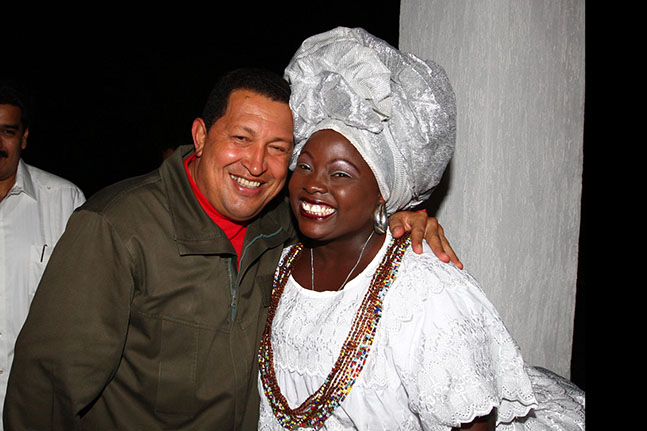
CREDIT: Manu Dias, (CC)
Venezuela’s foreign policy under the late President Hugo Chávez, and now his successor Nicolas Maduro, has been subject to sharply differing interpretations. Some observers see the oil-rich country’s foreign relations since Chávez’s election in December 1998 as shaped by a visionary who has promoted international solidarity with the oppressed, combated poverty, and pushed for a just world order free of uni-polar domination. For critics, however, Venezuela’s foreign policy has been incoherent, militaristic, and prejudicial to regional stability.
Does Venezuelan foreign policy include ethical considerations, as its supporters claim? The evidence suggests it does and that as a result we can be more optimistic about possibilities for incorporating ethics into international affairs than some scholars would have us believe.
The Ethical Dimension of Venezuelan Foreign Relations
To evaluate a possible ethical dimension to Venezuelan foreign policy, it is necessary to understand the ideology Chávez imbued in the country’s international affairs. Five concepts are central. The first two are the primacy of national sovereignty and Latin American and Caribbean integration. These are based on an understanding of foreign policy as a continuation of the Pan-American vision of Venezuela’s founder and 19th century independence hero Simon Bolivar, who also gives the name to Chávez’s “Bolivarian” political project. The third and fourth are the importance of international solidarity and south-south cooperation, which hold that Venezuela’s development should be based on mutual solidarity and cooperation with the countries of the global south. Finally, these concepts coalesce to form the pursuit of a multi-polar world order, which sees Venezuela’s international role in strengthening ties with emerging powers across different regions as part of a shift to a more balanced international system which will guarantee “world peace” and “universal well-being.” This implicitly involves an attempt to counter-balance the weight of the United States in international affairs.1
One example of Venezuela’s pursuit of these values is the Bolivarian Alliance for the Peoples of Our America (ALBA). This alliance of leftist Latin American nations founded by Venezuela and Cuba in 2004 has implemented regional development strategies based on the principles of “solidarity, cooperation and complementing.” Programs aiming to guarantee food security, universal literacy, free health and education, and decent housing are strongly marked by values of social justice and human development.2 Social programs promoted by the ALBA include the “Miracle Mission,” which provides free eye treatment and surgery to Venezuelan citizens and those of several Latin American countries. The program has treated around 1.2 million people in Venezuela since its launch in 2004.3
Development assistance and solidarity have also been evident in Venezuela’s outreach to the Caribbean, particularly with the PetroCaribe initiative. Launched in 2005, the program offers Venezuelan petroleum to Caribbean nations at a discount rate. Participating nations only pay a percentage of the oil’s market price up front, with the rest converted into low-interest, long-term loans. A portion of these loans can be amortised through payment in goods and services; for example, Cuba sends medical personnel to Venezuela in exchange for oil shipments. The loans also become important sources of capital spending for the region’s governments. Eighteen Caribbean states now participate in the program, and Venezuelan oil minister Rafael Ramirez estimated in 2011 that PetroCaribe covers 43 percent of participating nations’ energy needs.4 In the context of rising oil prices in the 2000s, a Council on Hemispheric Affairs (COHA) report on the scheme described it as “the most concrete proposal on the table to alleviate the region’s suffering.”5
Perhaps no other Caribbean nation has benefitted more from this kind of regional solidarity than Haiti. Following the devastating January 2010 earthquake, Venezuela pledged $2.4 billion in financial and relief aid, more than any other of 58 donors. This aid has included building power plants, shelters, a new hospital (in collaboration with Cuba), sending food and medical supplies, and assistance to develop Haiti’s agricultural sector.6 Venezuela even wrote off $400 million of Haiti’s PetroCaribe debt. This important reconstruction aid was given despite the fact that Haiti is by no means an ideological ally of Venezuela’s leftist government; its president, Michel Martelly, is close to Haiti’s business elite and the United States. Nevertheless Martelly has publicly thanked Venezuela for its solidarity and help since the earthquake, commenting in December 2011 that for Haiti, “cooperation with Venezuela is the most important right now, in terms of impact, direct impact.”7
Africa is another continent where relations seem to be driven as much by ideology and ethical values as by strategic interests. From 2005, Chávez began referring to Africa as a “motherland” and pursuing “south-south cooperation,” or mutual development strategies, in the region. Over the next six years Venezuela established diplomatic relations with all 54 African countries, opened new embassies, and signed over 200 cooperation agreements with the continent, where only 20 had existed beforehand.8 Many of these agreements contain a clear element of solidarity and humanitarian assistance. In 2009 Venezuela pledged $20 million to the West African ECOWAS group for malarial eradication programs, while in February 2013 it offered technical assistance and personnel training to the Sahrawi Democratic Republic to improve the population’s access to safe drinking water. Further, around 500 students from over 15 African countries study in Venezuela courtesy of government scholarships, many of these in medical courses, with the intention that after their studies these newly-trained professionals return to their home countries to provide much needed public services.9 A similar program is offered to Palestine, where Venezuela has also committed to build medical facilities.
Such attempts at greater cooperation with countries of the global south have led Venezuela to play a key diplomatic role in moves toward intensifying Latin American and south-south integration. In addition to founding the ALBA and PetroCaribe, Venezuela was also a founding member of the Union of South American Nations (UNASUR) in 2008, and played host to the founding conference of the Community of Latin American and Caribbean States (CELAC) in 2011, which brings together every nation in the Americas with the exception of the U.S. and Canada. Venezuela was also host to the II Africa–South America (ASA) summit in 2009, and is set to host the tri-annual summit of the Non-Aligned Movement in 2015, and thereafter become the president of the grouping of 130 developing nations. The country was also elected to serve on the UN Human Rights Council for 2013–2016 and is a mediator in peace talks underway between the FARC guerrilla group and the Colombian government. Taken together, these aspects of Venezuela’s foreign policy have led observers such as Venezuelan geographer and analyst Rosalba Linares to conclude that Bolivarian-era foreign relations aim to construct “a sovereign, democratic and more humanitarian multi-polar world, of greater social justice and fair trade in benefit of those most in need in Venezuela and the world.”10
The Pursuit of Strategic Interests
Of course, it would be mistaken to understand Venezuelan foreign relations as solely motivated by ethical or altruistic considerations. Even solidarity-based policies have clear “soft” benefits such as raising the government’s diplomatic and international standing. Venezuela’s foreign relations have also been shaped by concrete strategic interests. Chief among these are energy interests, which are woven throughout foreign policy, as Venezuela holds the largest crude oil reserves in the world. The Bolivarian government has sought to increase ties with other energy powers for the extraction of Venezuelan crude and to diversify its oil export markets. In the context of the deterioration of relations with the United States, strategic policy goals have also included creating a robust network of international alliances and securing alternative sources of financing, technological assistance, and military hardware.
In the first years of Chávez’s presidency the state oil company PDVSA was brought under greater government control. At the same time the government pushed for the revitalisation of OPEC, advocating the policy of production quotas to help ensure that world oil prices rose to levels favourable to exporting countries. The elevation of oil prices in the 2000s gave the Venezuelan government flexibility to pursue active energy diplomacy abroad while funding a wave of new social programs at home.
The government has built what it calls “strategic alliances” with several energy powers, including Russia and China. Russian energy giant Gazprom now works with PDVSA to explore gas deposits in the Gulf of Venezuela and Russian firms are active in the extraction of oil in Venezuela’s Orinoco Belt. Russia is also useful to Venezuela as a source of military hardware, with Chávez’s government becoming Russia’s biggest customer of military goods after India.11
Meanwhile China has provided Venezuela with a new market for its petroleum exports. Oil exports to China rose from almost zero in 2004 to 460,000 bpd in 2010, a number that officials want to increase to one million.12 The relationship has also resulted in over 300 bilateral agreements and 80 major projects, and has allowed the Venezuelan government access to financing and technology, the latter exemplified by the launching of Venezuela’s first satellites with Chinese assistance in 2008 and 2012.
Venezuela has formed a web of links with other countries enjoying oil and gas reserves, such as Iran, Syria, Brazil, and certain African countries. Given their relatively independent diplomatic stance in world affairs, strengthening ties with these nations has also fitted within the ideological goal of building “south-south cooperation” and a “multi-polar world order.”
Meanwhile relations with Venezuela’s traditional commercial partner and top recipient of crude exports, the United States, have been frozen at the charge de affairs level since 2010. Venezuelan officials blame this on the U.S. government’s belligerence and lack of respect for Venezuela’s independence and sovereignty, including support for and alleged involvement in the short-lived coup attempt to topple the Chávez administration in 2002. For its part, the United States has accused Venezuela of failing to sufficiently cooperate with counter-narcotics and anti-terrorism efforts, and of acting against U.S. interests by pursuing relations with “enemy” states such as Iran. Nevertheless, there are signs that the relationship is improving under the presidency of Nicolas Maduro, after Venezuelan foreign minister Elias Jaua met with Secretary of State John Kerry during an OAS summit in early June. “We would like to see our countries find a new way forward, to establish a more constructive and positive relationship,” said Kerry following the meeting. However, it remains to be seen whether the recent decision by President Maduro to offer asylum to ex-NSA intelligence leaker Edward Snowden will have an impact on efforts to improve bilateral relations.
Criticisms and Contradictions
Critics point to contradictions in the conduct of Venezuela’s foreign policy, and question the existence of an ethical dimension to Venezuelan foreign relations.
An accusation which emanates principally from the United States is that rather than seeking “world peace,” Venezuela in fact pursues an aggressive policy of building up its arms stockpile while forming alliances seen as threatening to U.S. national security. In September 2009 then-Secretary of State Hilary Clinton raised concerns over Venezuela’s arms purchases from Russia, arguing that the Chávez administration was engaging in a military build-up which could trigger a South American “arms race.” “They [Venezuela] outpace all other countries in South America [in military purchases] and certainly raise the question as to whether there is going to be an arms race in the region,” she said.13 Further, some conservative politicians and analysts have argued that Venezuela should be considered a “national security threat” due to its ties with countries regarded as hostile to the U.S, such as Iran and Syria.14
However, neither the figures nor events bear out fears that Venezuela is unduly arming itself or seeking military-style alliances with U.S. adversaries. According to the CIA World Factbook, in 2009 Venezuela put 1.4 percent of GDP toward military spending, the 5th highest in the region and less than the U.S., Colombia, and Chile. By 2012, military spending in Venezuela had halved as a percentage of GDP to 0.7 percent, with the country spending less than most major countries in the region, being only 153rd out of 173 countries measured globally for military spending.15 Venezuelan government officials meanwhile state that its international alliances are “about peace” and not in any way an aggression toward a third party. This point was highlighted during the visit from former Iranian president Mahmoud Ahmadinajad to Venezuela in January 2012. Nicolas Maduro, in his capacity of foreign minister, said to press at the time that bilateral ties between the two countries were part of a “peaceful relationship…we have a relationship of cooperation for development… and above all, for peace”.16
This appraisal of Venezuela’s diplomatic and defence policy appears to be shared by the U.S. military establishment. In August 2012 General Douglas Fraser, chief of U.S. Southern Command, said that although he would like greater cooperation from Venezuela against drug trafficking, he did not consider Venezuela a security threat to the United States. When asked if he thought Venezuela’s arms purchases constituted a danger to the U.S., Fraser replied, “From my standpoint, no…I don’t see them [Venezuela] as a national security threat.” Further, when asked whether Venezuela’s relationship with Iran amounted to a “military alliance,” the general disagreed, stating, “As I look at Iran and their connection with Venezuela, I see that still primarily as a diplomatic and economic relationship.”17 President Barack Obama has taken a similar stance, announcing in an interview in July 2012, “Overall my sense is that what Mr. Chávez has done over the last several years has not had a serious national security impact on us.”18
Thus the notion that Venezuelan military purchases and bilateral relationships represent a threat to the United States appears to be an overreaction from certain observers within U.S. political and media spheres, who confuse Venezuela’s independent foreign policy with one threatening U.S. security.
Others argue that there exists a contradiction in Venezuelan foreign policy between claims to pursue the values of democracy, humanitarianism, and solidarity, while supporting governments considered authoritarian or with poor human rights records. In 2011, political sociologist and author Gregory Wilpert argued that Venezuela ran a “significant” risk of losing legitimacy among progressives when Chávez continued to support former Libyan president Muammar Gaddafi against an insurgency in that country, a point that could be extended to several other of Venezuela’s allies in the Middle East.19
Another seemingly contradictory move by a government purporting to promote ethical values in its foreign policy is Venezuela’s decision to withdraw from the OAS’ Inter-American Court and Human Rights Commission (IACHR) in 2012, on the basis of the body’s alleged “shameful” bias against the Chávez administration. The decision is also part of a shifting focus toward Latin American autonomy and integration, with several states in the region pushing for the formation of new mechanisms to promote human rights within the UNASUR and CELAC. 20
A final question for Venezuela’s foreign relations is the extent to which policies pursued under Chávez will continue under the presidency of Nicolas Maduro, who was elected to power in April, following Chávez’s death in March. Maduro was Chávez’s foreign minister from 2006–2012, and in that role helped to build Venezuela’s contemporary foreign relations. The new president has pledged to continue these policies and his active foreign diplomacy over the previous three months seems to confirm this. Present challenges for Maduro include assuming the presidency of the Mercosur trade bloc this summer, and seeking productive relationships with the U.S. and Europe; steps toward which appear to have already been taken.
Between Ethics and Interests
In common with all nation states, over the past 14 years Venezuela has pursued clearly defined strategic and economic interests through its foreign policy. These have included developing greater links with other energy powers and ensuring access to sources of financing and military hardware. The government has also sought commercial, technological, agricultural, educational, health, and other forms of cooperation considered beneficial to Venezuela’s national development.
Although certain criticisms of contradictory behaviour can be levelled at Venezuela’s foreign relations, policymaking has followed a coherent logic. From technological cooperation with China to malaria eradication assistance in Africa, Venezuela’s new foreign relations have been built within an ideological framework embodied by the notions of “south-south cooperation” and a “multi-polar world.”
Further, while all nations could be said to act in their own strategic interests, not all have also placed norms of cooperation, solidarity and humanitarianism as a central focus of foreign policy. These values can be seen in agreements Venezuela has made with countries across all continents, but especially in the Americas and Africa. Even in the United States, PDVSA subsidiary CITGO aids around 100,000 low-income families during the winter with donated Venezuelan heating oil.21 Thus while it would be false to state that Venezuelan foreign policy is solely motivated by ethical considerations, it would be misleading to explain the country’s external relations without reference to these. This ethical dimension to Venezuela’s foreign policy is a demonstration that if the political will exists, governments can pursue such values within their foreign relations. In doing so, concrete and mutual benefits can be reaped for both the development of societies and the wellbeing of peoples.
NOTES
1 Chávez, H. (2012), Plan de la Patria: Programa del Gobierno Bolivariano 2013 – 2019, accessed at: http://www.minci.gob.ve/wp-content/uploads/downloads/2013/04/PLANDELAPATRIA-20133-4-2013.pdf.
2 Ullán de la Rosa, F.R. (2012), La Alianza Bolivariana para las Americas – Tratado de Comercio de Los Pueblos (ALBA-TCP): Análisis de un Proyecto de Integración Regional Latinoamericana con Una Fuerte Dimensión Altermundista, Estudios Politicos, no. 25, (Enero – Abril), pp131 – 170, Mexico, D.F. (p151-152).
3 Morales, M. (27/5/2013), Hija de Chávez Manejará Presupuesto Millonario en la Misión Milagro, El Nacional.
4 Rojas, R. (December, 2011), Venezuela Increasing Influence in Caribbean through PetroCaribe, Press TV.
5 Lai, K. (January, 2006), PetroCaribe: Chávez’s Venturesome Solution to the Caribbean Oil Crisis, Council on Hemispheric Affairs (COHA).
6 Information taken from, Wyss, J. (05/07/2010), Venezuela Leads the World in Earthquake Relief, Miami Herald; Edmonds, K. (February 2012), ALBA Expands its Allies in the Caribbean, North American Congress on Latin America (NACLA.org); Robertson, E (01/06/2012), Venezuela, Cuba and Argentina Sign Development Assistance Agreements with Haiti, Venezuelanalysis.com.
7 The Editors, (April, 2012), Haiti Using Funds from PetroCaribe to Finance Reconstruction, Council for Economic and Policy Research (CEPR).
8 Bolivar, R. J., (February, 2011), “Entrevista: Reinaldo José Bolívar, Viceministro de Relaciones Exteriores para África,” Encontrarte.
9 (14/01/2011), “Venezuela ha Firmado 200 Acuerdos de Cooperación con África,” Agencia Venezolana de Noticias.
10 Linares, R., (2010), “La Estrategia Multipolar de la Political Exterior Venezolana,” Aldea Mundial, Año 15, No. 15, Julio – Diciembre (2), pp51-62, (p60).
11 Rinna, A. (09/03/2013), “Russia’s Uncertain Position in Post-Chávez Venezuela,” Centre for World Conflict and Peace blog.
12 Ellis, R.E. (2010), “Venezuela’s Relationship with China: Implications for the Chávez Regime and the Region,” Centre for Hemispheric Policy, University of Miami, pp1-10; Cornejo, R. & Garcia, A.N. (2010), “China y América Latina: Recursos, Mercados y Poder Global,” Nueva Sociedad, No. 228 (Julio-Agosto), pp79-99 (p95); Manduca, P.C. (2012), “La Energía en la Política Sudamericana: Características de las Relaciones entre Brasil y Venezuela,” Revista Mexicana de Ciencias Políticas y Sociales,” no. 216, (Septiembre – Diciembre), pp81-100.
13 Labott, E. (16/09/2009), “U.S. Fears Venezuela Could Trigger Regional Arms Race,” CNN.
14 Noriega, R. (08/02/2013), “Hugo Chávez: An Uncounted Enemy,” The Washington Times.
15 Central Intelligence Agency: The World Factbook (Military Expenditures, Venezuela), accessed at: https://www.cia.gov/library/publications/the-world-factbook/rankorder/2034rank.html?countryname=Venezuela&countrycode=ve®ionCode=soa&rank=153#ve.
16 Pearson, T. (10/01/2012), “Iran-Venezuela Relationship “About Peace,” Venezuelanalysis.com.
17 (01/08/2012), ” Top US General: Venezuela Not a National Security Threat,” Associated Press.
18 Mazzei, P., Bolstad, E., (11/07/2012), “Mitt Romney, GOP howl over President Barack Obama’s remark about Hugo Chávez,” Miami Herald.
19 Wilpert, G, (06/03/2011), “Venezuela and Libya: An Interview with Gregory Wilpert,” Venezuelanalysis.com.
20 Britto Garcia, L. (12/05/2013), Avanza el Golpe Judicial, Aporrea.org.
21 Citgo Press, (31/01/2013), “Eighth Annual Citgo-Venezuela Heating Oil Program Launched,” Venezuelan Embassy, Washington.
Related articles
- US NSA Spied on Venezuela When President Chavez Died, Documents Reveal (alethonews.wordpress.com)
- Venezuela Reaffirms Commitment to Haiti’s Reconstruction | venezuelanalysis.com (rapadoo.com)
- PetroCaribe moves closer to Economic Zone (antiguaobserver.com)
- Toward a new Venezuela-Caribbean relationship (caribbean360.com)
S. American states to recall ambassadors from Europe over Bolivian plane incident
RT | July 12, 2013
South American countries belonging to the Mercosur trade bloc have decided to withdraw their ambassadors for consultations from European countries involved in the grounding of the Bolivian president’s plane.
“We’ve taken a number of actions in order to compel public explanations and apologies from the European nations that assaulted our brother Evo Morales,” explained Venezuela’s President Nicolas Maduro, who revealed some of the agenda debated during the 45th summit of Mercosur countries in Uruguay’s capital, Montevideo.
The decision to recall European ambassadors was taken by Maduro, Argentina’s President Cristina Fernandez, Brazilian President Dilma Rouseff, and Uruguay’s President, Jose Mujica, during the meeting.
Member states attending the summit expressed their grievances with “actions by the governments of France, Spain, Italy and Portugal” over the July 2 incident, when the aircraft carrying President Evo Morales back to Bolivia after attending an energy summit in Moscow was denied entry into the airspace of a number of EU member states.
The small aircraft, which required a stop-over before completing its flight, was forced to make an emergency landing in Austria after a circuitous flight path.
It was later revealed that the European countries’ actions were prompted by accusations made by the US ambassador to Austria, William Eacho, who alleged that American whistleblower Edward Snowden had been taken on board to help him gain political asylum in Latin America.
“The gravity of the incident – indicative of a neocolonial mindset – constitutes an unfriendly and hostile act, which violates human rights and impedes freedom of travel, as well as the treatment and immunity appropriate to a head of state,” the Mercosur nations affirmed in the joint statement.
The incident was further described as a “discriminatory and arbitrary” decision by European countries, as well as a “blatant violation of international law.”
NSA Spying on Latin American Countries Included Targeting of Trade Secrets
By Noel Brinkerhoff | AllGov | July 11, 2013
The United States has been accused of spying on numerous countries in Latin America in an effort to collect intelligence on trade secrets and military capabilities.
Using information provided by former National Security Agency (NSA) contractor Edward Snowden, a Brazilian newspaper, O Globo, published a story that said the U.S. spy agency has gathered data on telephone calls and emails from Brazil, Colombia, Mexico, Venezuela and others.
The account indicated that the NSA had collected military and security data on countries including Venezuela, while also carrying out surveillance operations to acquire trade secrets from within the oil industry in Venezuela and the energy sector in Mexico.
O Globo also published a story over the weekend saying Brazil was a major target of the NSA’s global spying on telecommunications, which involved the cooperation of American and Brazilian companies (which were not named).
It was additionally reported that the CIA and NSA jointly operated monitoring stations to gain foreign satellite data in 65 countries, including five in Latin America.
In response to the accusations, the U.S. ambassador to Brazil, Thomas Shannon, reportedly denied that Washington has been conducting surveillance operations on Brazilian communications.
News of the alleged spying upset many in Brazil and other Latin countries, which have a history of military governments—often supported by the United States—that spied on their own people.
Brazilian President Dilma Rousseff, who was jailed and tortured in the 1970s under the ruling junta, said her government would raise concerns with the U.N. Commission on Human Rights.
“Brazil’s position on this issue is very clear and very firm,” Rousseff told the media. “We do not agree at all with interference of this kind, not just in Brazil but in any other country.”
To Learn More:
U.S. Spy Spread Through Latin America (by Glenn Greenwald, and Kaz and Roberto Jose’ Casado; O Globo)
Capitals 4 Countries Also Housed the Office of the NSA and CIA (by Kaz and Roberto Jose’ Casado; O Globo)
U.S. and Britain Eavesdropped on World Leaders at 2009 Summits (by Noel Brinkerhoff, AllGov)
US NSA Spied on Venezuela When President Chavez Died, Documents Reveal (alethonews.wordpress.com)
US NSA Spied on Venezuela When President Chavez Died, Documents Reveal
By Tamara Pearson | Venezuelanalysis | July 9, 2013
Mérida – Brazilian daily O Globo, reporting jointly with Guardian journalist Glenn Greenwald informed today that according to the leaked National Security Agency (NSA) documents, the United States has also been spying on Venezuela’s petroleum industry. The information comes as governments confirm that whistleblower Edward Snowden has applied for asylum in Venezuela.
According to the leaked documents, the NSA also spied on other Latin American countries such as Mexico, Argentina, Colombia, and Ecuador.
O Globo reports that, “The United States doesn’t seem to be only interested in military affairs, but also in commercial secrets, such as Venezuela’s petroleum”.
According to the documents, NSA spied on Latin America through at least two programs, the Prism program from 2-8 of February this year, and the “Informant Without Limits” program from January to March.
One document describes Operation Silverzephyr, which accessed information through partnerships with private satellite and phone operators, focusing on Latin American countries. The document shows that the NSA agency collected information through telephone calls, faxes and emails, possibly using the program Fairview.
According to O Globo and the leaked NSA documents, Venezuela was also observed in 2008 through the X-Keyscore program, which identifies the presence of foreigners according to the language they use in emails. Further, in March this year it appears that Venezuela was a priority for the NSA’s spying. President Hugo Chavez died on 5 March, and presidential elections were called for 14 April.
U.S. reacts to Venezuela’s asylum offer
On Sunday U.S. legislators suggested sanctioning countries which grant asylum to Edward Snowden, who leaked the NSA documents to The Guardian. The chair of the U.S. House of Representative’s intelligence committee, Mike Rogers, said Latin American countries are “using Snowden as a public relations tool… we shouldn’t allow this… it’s a serious issue… some Latin American companies enjoy trade benefits from the United States and we’re going to have to revise that”.
Legislator Robert Menendez also said that any “acceptance of Snowden” would put that country “directly against the United States”. The Venezuelan government formally offered Snowden asylum on 5 July. Nicaragua and Bolivia have also done so.
“We’ve made very clear that he [Snowden] has been charged with felonies and as such, he should not be allowed to proceed in any further international travel other than travel that would result in him returning to the United States,” White House Press Secretary Jay Carney told reporters yesterday at his daily news conference.
Yesterday Maduro said that Venezuela has also formally received an asylum request from Snowden, who agencies report to have been in the Moscow airport since 23 June.
Russian legislator Alexei Pushkov also confirmed yesterday (via a Tweet that he later deleted) that Snowden had accepted Venezuela’s offer of political asylum. “It seems that that is the option he feels is safest,” Pushkov wrote. However, later today Wikileaks also tweeted that Snowden had not formally accepted asylum in Venezuela, but also deleted the tweets a few minutes later.
Venezuela Promotes Breastfeeding over Baby Food, Corporate Media Spins Out of Control
By Tamara Pearson | Venezuelanalysis | June 20, 2013
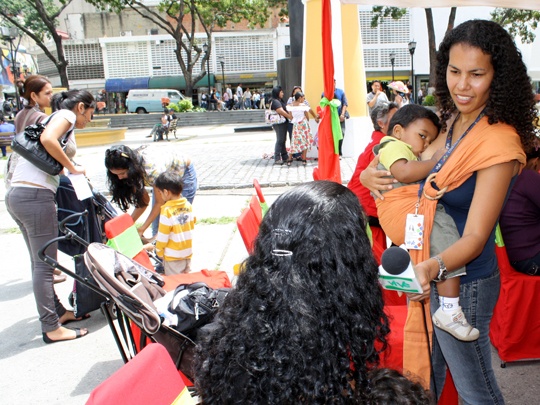
A Venezuelan public media journalist breastfeeds as she works. Public breastfeeding is fairly accepted in Venezuela (blog.chavez)
Venezuela’s national assembly is debating a reform to its breastfeeding law which could see baby food companies like Nestle fined in certain situations. The corporate media have reacted hysterically to the law, claiming that President Nicolas Maduro is “taking bottles from babies’ mouths”.
Though breastfeeding is widely promoted by the Venezuelan government, and public breastfeeding is relatively de-stigmatised, a study by Venezuela’s National Nutrition Institute (INN) between 2006 and 2008 showed that only 55% of mothers exclusively breastfed when their baby was born, going down to 20% when their baby was three months old, and 11% by six months.
The percentages have probably increased since then, with broad educational campaigns in public schools and health centres, and actions such as mass public breastfeeding in plazas, organised by the INN.
However, the low figures reflect the low confidence some mothers have in their ability to breastfeed, as well as the power of multinational infant formula companies in health centres. It is common practice to give infant formula to babies from the moment they are born, without the consent of parents, according to LactArte, a pro-breastfeeding collective in Venezuela. Companies give gifts and other promotions to health workers and health centres in order to create alliances with them, and give free samples of the products to new mothers, thereby creating dependent consumers of new born babies, or at least discouraging exclusive breast feeding.
What the law actually says
In 2007 Venezuela’s national assembly passed the Law of Protection, Promotion, and Support for Breastfeeding. The law regulates the way baby formula and baby food companies advertise and label their products, and how they interact with hospitals and clinics. However, the companies have been ignoring the law, as it doesn’t specify penalties. The reform to the law currently being discussed is looking at penalties of US$600 – $50,000, and also training for health professionals. Once the reform is passed in first discussion by the assembly, it will be subject to “street parliament” – discussion by collectives and Venezuelan citizens, to then be passed by the national assembly in second discussion.
The 2007 law argues that breastfeeding provides babies with “all the necessary nutrients” in their first six months, as well as “protecting them and immunising them from illness and contributing to the development of their breathing and gastrointestinal capacity”. It states that “mothers have the right to breastfeed their children, with the support and collaboration of the fathers… [who] should provide all the support necessary so that mothers can provide this human right… The state, with solidarious participation from organised communities, will promote, protect, and support exclusive breastfeeding…of children under six months of age and breastfeeding with complementary food … until the age of two”.
Concretely under the law, health workers and health centres must help mothers start breastfeeding within the first half hour of birth, and guarantee that the newborn is always near the mother after birth, except in exceptional medical situations. They should also educate mothers, fathers, and the family on the issue, and abstain from providing babies under the age of 6 months with food other than breast milk, except when there is a specific medical need. Health centres must create human milk “banks”.
Baby food and formula products must be in Spanish or Venezuelan indigenous languages (Nestle products for example, often aren’t), and they should inform of the risks of including such food in the baby’s diet too early. Publicity or labelling can’t create the impression that such food is equal to breast milk, and publicity of any kind discouraging breastfeeding is not allowed.
All food aimed at children under three must include labelling that clearly states its ingredients, including any GMO products, and milk formulas must including a warning that “breast milk is the best food for children under two years old”.
Samples, prizes, and promotions of baby food and formula are prohibited. Likewise, companies are prohibited from donating toys, books, posters or other products which promote or identify their company to health centres, and they are also prohibited from donating “gifts” to health centre workers and from sponsoring events or campaigns aimed at pregnant or breastfeeding women, fathers, health professions, families, and communities.
Breastfeeding rights in Venezuela
Last year, with the passing of the new labour law, women’s breastfeeding rights were further expanded. Post-natal leave was extended to six months, and articles 344-352 state that mothers have the right to two half hour breaks per day to breastfeed. If there is no breastfeeding room provided by the work place, that is extended to two 90 minute breaks, and all employers of more than 20 workers must maintain a nursery centre with a breastfeeding area.
For Luisa Calzada and Kaustky Garcia, of LactArte, breastfeeding is also an act of food sovereignty – that is, third world productive or economic independence from greedy transnationals. Garcia argued that such sovereignty has been “sabotaged” in Venezuela by the “transnational industry dedicated to the business of infant formulas”. Indeed the industry is huge here – visit any supermarket or corner shop and you’ll see full aisles or shelves of powdered baby milk formula and compote.
LactArte supports a boycott of Nestle, one of the main powdered milk formula companies here, producing the infamous Cerelac since 1886. They argue that there is“collusion” between the baby food industry and the medical industry, with the food transnationals enlisting an “army of health professionals” to sell baby formula.
According to Business Insider, infant formula is an $11.5 billion market. The International Baby Food Action Network (IBFAN) claims that Nestle, apart from distributing free samples of its products in maternity wards, also uses “humanitarian aid” to create markets, and offers gifts and sponsorship to influence health workers to promote its products. According to a 1982 New Internationalist article, Nestle makes mostly third world mothers dependent on its formula in three ways: “Creating a need where none existed, convincing consumers the products are indispensable, and linking products with the most desirable and unattainable concepts- then giving a sample”.
What the corporate media are saying
The 2007 law and the draft reforms do not ban the production or sale of baby food or formula, as national and international media have alleged, nor do they apply any fines to mothers or penalise any choices regarding her body that a mother may make. The penalties are only for health care centres and their workers, and baby food and formula companies.
However the corporate media over the last two weeks has completely distorted the issue. Fox News Latino headlined “Venezuela Wants To Ban Baby Bottles To Promote Breast-Feeding” and stated that “Motherly love has become a state affair in Venezuela”.
Growing Your Baby also headlined “Venezuela considering baby bottle ban”, and opened with the utterly misinformed and misleading question, “What would you do if you woke up one morning and learned that baby bottles were no longer being made or sold in your country? This question may become a reality for Venezuelan moms who may not have planned on breastfeeding”.
Reuters won the prize however for manipulation and sensationalism, with the headline “Venezuela considers taking bottles from babies’ mouths”, while other agencies have carried similar titles along the “banning” theme, with CNN’s article “Venezuela considering a ban on baby bottles” and Huffington Post ‘Venezuela considers baby bottle ban to encourage breastfeeding’. Al Jazeera went as far as to argue in its piece that “some mothers don’t want the government telling them how to feed their children”. If Al Jazeera had bothered to read the 2007 law, it would have discovered that is actually the point of the law – to stop companies interfering, through misleading information and other gimmicks, in the breastfeeding process.
Venezuelan corporate press and other Spanish language media have been equally manipulative. Here is a small selection of their headlines: EFE: “Venezuela is debating a law to prohibit baby bottles”, Semana: “Baby bottle and dummy: the new enemies of Chavismo”, El Pais: “The Venezuelan government wants to oblige mothers to breastfeed”, El Popular: “Venezuela: Nicolas Maduro wants to eliminate the use of baby bottles”, Noticias24 “They’ll prohibit baby bottles in health centres of Venezuela in order to force breastfeeding”, El Mundo, “Venezuela declares war on the baby bottle”, and Entornointeligente, “Goodbye to baby bottles for stimulating breastfeeding”.
Garcia argued that the media campaign to demonise the law and the proposed reforms is being pushed by the milk formula industry. She said it has had an impact in Venezuela, with “many women, even those not using baby bottles, feeling scared”.
“They are worried that the government is going to try to help them to breastfeed, that the government will take away their baby bottles and infant formulas, and is going to prohibit them from feeding their infants with baby bottles, but that’s absolutely false. First of all it’s unpractical, and secondly it is this government which has most given freedom and provided information so that families can freely chose the path they desire for their children,” she said.
The World Health Organisation recommends that babies be exclusively breast fed during the first six months, and in 1981 the 34th World Health Assembly adopted a resolution which included the International Code of Marketing Breast-Milk Substitutes. Funnily enough, it stated that food companies shouldn’t promote their products in hospitals, give free samples to mothers, or provide misleading information. One wonders if these international bodies were also accused of “stealing the bottle from babies mouths”, or is that sort of rubbish reserved for countries like Venezuela where a revolution is trying to get some justice at the expense of the poor transnationals?
Venezuela arrests Colombian paramilitaries plotting instability
Xinhua | June 10, 2013
CARACAS — Venezuelan authorities have detained two groups of Colombian paramilitary members allegedly plotting against Venezuela’s government, Venezuela’s Minister of the Interior, Justice and Peace Miguel Rodriguez Torres said Monday.
“These two groups that were captured in our territory belong to two well-known Colombian paramilitary gangs. In fact, one of the groups belongs to ‘El Chepe Barrera’s’ gang, one of the most wanted criminals in Colombia,” Rodriguez said at a press conference in Caracas.
The first group, which included six people, was captured in Venezuela’s southwest Tachira state, along the border with Colombia, and their arms were confiscated.
The second three-member group of paramilitaries, who also carried arms, were captured in Guanare in western Portugesa state.
They were also carrying a black box, such as the ones used to record flight information and aeronautical data, and a box with aviation tools, “which are being analyzed by experts to determine what type of airplane we’re talking about,” said Rodriguez.
After questioning, it became clear both groups were linked and headed to Caracas, Rodriguez said.
“They planned to travel to the capital of the country to accomplish a mission that would be assigned them once they were in Caracas,” said Rodriguez.
Rodriguez said the detained revealed the existence of a third armed group, “with weapons for sharpshooters” and other long-range arms, which may already be in Caracas as part of a plot to destabilize the country.
“All of this may be part of a plan that is being orchestrated from Colombia against the life of our president (Nicolas Maduro) and against the stability of the Bolivarian government,” Rodriguez said.
Venezuelan opposition groups may be involved in the plots, said the minister, adding the country’s intelligence units are on alert to capture the third paramilitary group.
Following the announcement, Maduro congratulated the Bolivarian Intelligence Service (Sebin) via Twitter and blamed the opposition for the presence in Venezuela of the paramilitary groups.
“I congratulate Sebin for its work in defense of the peace; these violent groups are the armed wing that carries out the plan of the fascist right,” said Maduro, adding that neighboring Colombia is being used to conspire against Venezuela.
Related article
Corporate Media Drones on about Venezuela’s Defence Program
By Tamara Pearson | Venezuelanalysis | June 4th 2013
Merida – After President Nicolas Maduro attended a military display in Aragua state which included Venezuela’s three unarmed drones, some mainstream media have highlighted Venezuela’s defence program, stressing Venezuela’s relationship with Iran.
Maduro presided over a ceremony to hand over and display National Bolivarian Armed Forces (FANB) equipment last week. There was a demonstration of Venezuela’s Harpy System of Drone Planes.
The unarmed planes are operated by remote, can take photographs and be used for disaster situations, agricultural research and protection of the electrical grid, according to Defence minister Diego Molero.
Molero said that through the Simon Bolivar satellite, the drones can observe any part of Venezuela. He also presented the Gavilan project, for a drone plane which he said has been designed completely with Venezuelan technology.
Venezuela’s Harpy drones are small and can only be used for remote controlled long distance surveillance. They weigh 85kg, have a maximum flight distance of 100km and flight time of 90 minutes, a cargo capacity of 17 kg, and video cameras which can transmit in real time.
Venezuela’s Cavim (Venezuelan Military Industrial Company) manufactured the drones, with the help of Venezuelan military engineers who were trained in Iran. The system consists of three planes, a launcher, and a control unit.
Ciudad CCS reports that the government eventually hopes to have “at least a dozen” Harpies (Arpías in Spanish).
“We’re advancing in the development and management of military science and technology, for preserving peace and security in Venezuela,” Maduro said at the demonstration, adding that Venezuela is “prepared to resist any attack that could be fabricated overseas, against Venezuela”.
Minister for internal affairs at the time, Tareck el Aissami reported in September last year that Venezuela’s drones had detected a plane with a US registration number, allegedly transporting drugs, in Venezuelan territory. The first Harpy (Arpia-001) was manufactured in January 2012.
Media and U.S. response
Last week’s military demonstration led to some corporate media headlines over the following days about Venezuela “launching” its drones system. Media in and outside Venezuela have reported that the drones are for surveillance and to be used to “curb drug trafficking” but has also emphasised that Iran “helped to build them”.
Univision Noticias headlined with, “Venezuela will use drones to protect the country from any threat”. Fox News and AP reported that “Venezuela’s announcement comes as the United States has begun to use unmanned drones to hunt drug traffickers on both the U.S.’s southern border with Mexico and in the open waters of the Caribbean.”
Last year the U.S. said it would watch Venezuela’s drone development closely, with U.S. State Department spokesperson Victoria Nuland saying at the time, “Our concern, obviously, would be with any breaking of international sanctions on Iran. And we will be most vigilant in watching how this goes forward”.
Further, according to an April 2013 article by the InterAmerican Security Watch (IASW), which “monitors threats to regional security” and the Jerusalem Post, “the growing military ties between Iran and Venezuela… have raised concerns in both the US[sic] and Israel”.
The IASW also made the claim that “Iran’s extended reach in Latin America could pose a threat to US national security; Tehran’s strategies in the region could also threaten Jewish and Israeli interests”.
However, while Venezuela’s 3 small drones are unarmed and have not left Venezuelan territory, the U.S. has used armed and unarmed drones in Afghanistan, Pakistan, Iraq, Yemen, and Somalia, while Israel has used them in Lebanon. According to a February 2012 report by the Bureau of Investigative Journalism, U.S. drones had killed at least 2,413 civilians in Pakistan alone, between May 2009 and the date of the report.
Featured Video
Macgregor: We Haven’t Seen the Worst of the Iran War Yet
or go to
Aletho News Archives – Video-Images
From the Archives
15 Saudi ‘hijackers’ were CIA agents working for US: Scholar
Press TV – April 13, 2016
Fifteen of the 9/11 “hijackers” from Saudi Arabia were CIA agents working for the United States government, which was seeking to destroy the Middle East for Israel and to double the American military budget, says Dr. Kevin Barrett, an American academic who has been studying the events of 9/11 since late 2003…. continue
Blog Roll
 Aletho News
- Breast Cancer: Before You Consent
- Iran’s Plan to Shut Down AI in the Persian Gulf
- Israel seeks ‘compensation’ from Washington over Saudi F-35 sale
- Saudi crown prince seeks dialogue with Ansarullah after Yemeni blows: Report
- Damascus rejects Saudi request for Syrian fighters to counter Yemen: Report
- South Korea says will not send troops to join terrorist US war on Iran
- Russia Just Struck the Eyes of NATO’s War Machine in Ukraine
- Russia summons UK charge d’affaires over Kiev drone support
- NATO member warns bloc seeking pretext for war with Russia
- Macgregor: We Haven’t Seen the Worst of the Iran War Yet
- If Americans Knew
- Debunking The Claim That Macklemore Has A “History Of Antisemitism”
- CPJ demands release of arrested Palestinian-US journalist near Bethlehem
- Robert Kraft: The Billionaire Friend of Netanyahu Pulling The Strings Behind the Macklemore/Ed Sheeran Blow Up
- Columbia Administered Fund Gives Big Money to Pro-Israel Groups
- Deportation Case of Palestinian Activist Salah Sarsour Tests First Amendment
- ‘We Will Not Forget’: Palestinians Mark 44 Years since Sabra and Shatila
- Why do we let Zionists decide what we can and can’t say?
- US welcomes Israeli, Iranian delegations to UN, but not Palestinians – Daily Update
- Biden’s Genocide Accomplices Targeted by New Accountability Campaign
- AIPAC’s Network Has Already Spent $67.2 Million to Shape the Midterm Elections
- No Tricks Zone
- New Study: ‘Global Drought Shows No Detectable Recent Acceleration Under Climate Warming’
- Economic Masterminds: German Socialists Suggest Taxing Productivity Gains Stemming From Using AI
- The South China Sea Has Not Been Cooperating With The Climate Change Narrative
- Energy Crisis: Germany Enters Heating Season With Historically Low Gas Reserve Fill Levels
- New Study: The Antarctic Ice Sheet Gained Mass From 2020-2024 Due To Staggering Snow And Ice Accumulation
- Study: Ocean Heating Rates From Thousands Of Years Ago ‘Dwarf’ Modern Ocean Heating Rates
- Climate Extremists Target, Attack Large-Scale Power Grid Infrastructure In Germany!
- New Study: Antarctic Ice Melt Has Contributed Less Than 1 Centimeter To Sea Level Rise In The Last 30 Years
- Fear Of Debate: Alarmist German Climate Scientist Calls On Mainstream Media To Discredit Skeptic Voices
- End-Of-August Arctic Sea Ice Extent Hasn’t Fallen In 20 Years, Official Data Show!
 Aletho News