Egypt’s NileSat halts broadcast of Press TV, other Iranian channels: Saudi media
Press TV – June 25, 2019
Saudi media say Egyptian-owned satellite firm NileSat has halted the broadcast of three Iranian TV channels, including English-language Press TV news network, in yet another attack on media freedom.
The Arabic-language Saudi daily newspaper Okaz, citing an informed source, said Sunday that the regional satellite provider halted the broadcast of Press TV as well as entertainment and movie channels of iFilm in English and Arabic languages.
Earlier, some informed sources had reported that Arab satellite companies had agreed to cancel their contracts with Iranian media outlets in the region.
The move by the Arab alliance was claimed to be a response to the networks’ “spread of rumors and creation of division.”
It is not the first time that Iranian television channels come under attacks by Arab and European satellite firms.
Egypt — a close Saudi ally — is party to a Riyadh-led coalition waging a bloody military campaign against Yemen. The Saudi regime and its allies are especially outraged by Iranian media’s wide coverage of the crimes being committed against Yemeni people, among other issues.
Since its launch in 2007, Press TV has been using a wide range of platforms, from TV broadcast and website to social media, to offer its audience a fresh view of world news, with a focus on developments in the Middle East’s conflict zones.
In April, Press TV’s verified YouTube account — along with the page of Iran’s Spanish-language Hispan TV — was blocked with no prior notice by tech giant Google.
The move came as the US stepped up its pressure campaign against Iran with the backing of Saudi Arabia and other repressive Persian Gulf Arab regimes. Washington is the main sponsor of the Saudi-led war on Yemen.
British weapons and personnel doing much of the killing in Yemen: Report
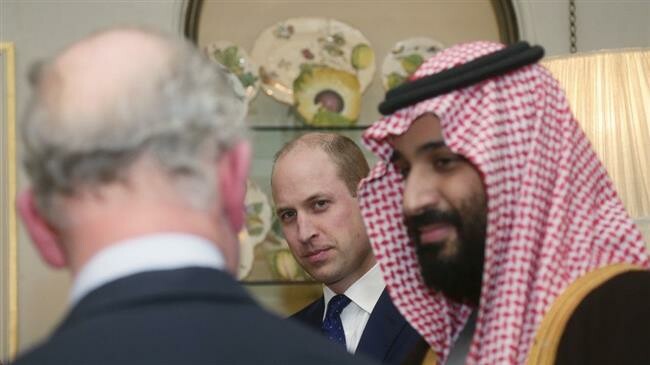
Britain’s Prince Charles, (L) and Britain’s Prince William, (C) meet with Saudi Arabia’s Crown Prince Mohammed bin Salman (R) in central London on March 7, 2018. (AFP photo)
Press TV – June 18, 2019
A detailed report published by the Guardian newspaper has shown how Britain is massively contributing to Saudi Arabia’s devastating war on Yemen as it suggests that London is not only supplying the bombs that fall on Yemenis, but it provides the personnel and expertise that keep the war going.
The comprehensive report by Arron Merat published on Tuesday showed that Britain was doing much of the killing in Yemen as the country continues to provide Saudi Arabia with everything it needs to turn its southern impoverished neighbor into a graveyard.
“Every day Yemen is hit by British bombs – dropped by British planes that are flown by British-trained pilots and maintained and prepared inside Saudi Arabia by thousands of British contractors,” said Merat in the report.
Tens of thousands of people have been killed since Saudi Arabia and a number of Arab allies launched their illegal war on Yemen in March 2015 in an attempt to restore power to a resigned and fugitive president.
Rights campaigners have repeatedly criticized Britain for its role in helping the killing of civilians in Yemen, the poorest country in the Arab world which has suffered from a major humanitarian crisis as a result of the Saudi-led war.
The report by the Guardian showed that it is effectively the United States and Britain who are leading the massive onslaught in Yemen as Saudi Arabia contracted out the vital parts of the war to the two military powers from the very beginning of the conflict.
“Britain does not merely supply weapons for this war: it provides the personnel and expertise required to keep the war going,” said the report, adding that the Royal Air Force personnel have been deployed to Saudi Arabia to work as engineers and trainers over the past four years.
It said the Britain’s biggest arms company BAE Systems has played an even larger role in the Saudi-led war on Yemen as it has been subcontracted by London to provide weapons, maintenance and engineers inside Saudi Arabia.
“The Saudi bosses absolutely depend on BAE Systems … They couldn’t do it without us,” said John Deverell, a former British defense attaché to Saudi Arabia and Yemen.
A BAE employee also said recently that if it was not for the British support, the Saudis would have not been able to continue the war on Yemen for a single week.
“If we weren’t there, in seven to 14 days there wouldn’t be a jet in the sky,” said the employee in an interview with the Channel 4 in early April.
Reports last year also suggested that Britain had even sent its troops to Yemen to help Saudis in their fight against fighters from the ruling Houthi Ansarullah movement.
In fact, there have been multiple reports in the British newspapers showing that UK special forces, known as the SAS, were wounded in battles inside Houthi-controlled territories.
UK report on ‘human rights’ forgets to mention Saudi Arabia in section on Yemen war
RT | June 12, 2019
The UK has published its annual human rights report, but with some notable omissions in its section on Yemen’s war – namely the identity of the country bombing its civilians, and the UK’s own involvement in the conflict.
The 2018 “Human Rights & Democracy”report from the UK’s Foreign & Commonwealth Office (FCO) includes an almost 800-word section on the humanitarian situation in Yemen – but, to a reader unfamiliar with the specifics, the document offers few clues as to who bears most responsibility for the crisis, since the British report seems to have forgotten to mention some key details.
Also on rt.com Bipartisan bill aims to force votes on present & future US arms deals with Saudis
The FCO report laments that the “human rights situation worsened in Yemen in 2018” and “the conflict in the country has had a devastating effect.” It then details the estimated numbers of lives lost and displaced citizens according to UN statistics, but doesn’t seem eager to pin blame on anyone in particular, laying responsibility at the feet of “multiple parties.”
“Multiple parties across the country committed a wide range of human rights abuses and violations.”
Yet, a UN investigative report last year found that airstrikes by the Saudi-led coalition had caused “most of the documented civilian casualties” in the country – and said the indiscriminate strikes had hit “residential areas, markets, funerals, weddings, detention facilities, civilian boats and even medical facilities.”
The UN also criticized the Saudi coalition’s sea and air blockades, which, it argued, could violate international humanitarian law, and called on the “international community” to “refrain from providing arms that could be used in the conflict.”
But who is providing arms? The FCO report is quiet on that front, too.
It has been estimated that the UK sold more than £4.7 billion-worth of arms to Saudi Arabia since its bombing of Yemen began in 2015. British arms sales to Riyadh account for nearly half of the UK’s major weapons exports. Calls for an end to Britain’s direct complicity in the war have fallen on deaf ears.
Former UK foreign secretary –and frontrunner for the Tory leadership– Boris Johnson recommended that the UK sell British bomb parts to Riyadh, immediately after an airstrike had hit a potato factory, killing 14 people, UK media reported this week, after emails obtained by arms trade expert Dr Anna Stavrianakis, through an FOI request, revealed Johnson’s enthusiasm for the sale. In justifying the sale, the FCO’s Arms Policy Export Team argued that there was no “clear risk” that the weapons would be used to violate humanitarian law and said the UK had “confidence” in the Saudi’s “dynamic targeting processes.”
The day after Johnson recommended the sale, a village school was hit in another airstrike, killing 10 children and injuring 20. Johnson’s successor, current UK Foreign Secretary Jeremy Hunt, has incredibly argued that it would be “morally bankrupt” for the UK to stop arming the Saudis, because if it did, “the people of Yemen would be the biggest losers.”
Yet, the FCO report praises what it calls the UK’s“continued commitment to improving the overall human rights situation” in the country and touts its provision of “emergency cash assistance” to vulnerable displaced women and girls, as well as a UK programme aiming to “increase Yemeni women’s inclusion in the peace process.”
The one (and only) mention of Saudi Arabia came more than halfway through the section on Yemen – a tepid line on the use of secret prisons “in areas under the Saudi-led coalition’s control” – inserted without any context as to who makes up the coalition, who supports it and what it is doing.
The report then quickly switches back to self-praise mode, with the FCO promising that the UK “will continue to lead international efforts to work towards an end to the conflict.”
The section on UK ally Saudi Arabia itself begins by lauding the “positive trajectory of social reform” in the country and condemns various continued human rights violations, but makes no mention of Saudi Arabia’s actions in Yemen.
France’s arms sales to Saudis jumped by %50 in 2018: Data
Press TV – June 4, 2019
Newly-released figures show that France increased its weapons sales to Saudi Arabia by 50 percent last year despite growing international concern about the atrocities committed in a Saudi-led war on Yemen.
On Tuesday, an annual report by the French government showed that the country sold 1 billion euros’ worth of arms to Saudi Arabia in 2018, with the main item being patrol boats.
Saudi Arabia and a number of its allies — mainly the United Arab Emirates (UAE) — invaded Yemen in March 2015, with the goal of bringing a former Yemeni client regime back to power. The ongoing war has killed tens of thousands and disrupted the lives of millions by causing widespread famine as well as epidemics.
France, the third-biggest arms exporter in the world, is also among the top weapons exporters to Riyadh and Abu Dhabi.
The Saudi-led coalition has widely used French boats and at least two ships in placing a tight siege on Yemeni ports, particularly Hudaydah, a lifeline for the war-ravaged country’s crippled economy.
The French government has faced massive criticism for complicity in the war but has so far resisted pressure from rights groups to stop the lucrative arms trade with the two Persian Gulf countries, denying that the weapons are being used against the Yemenis. Paris claims that the arms are being deployed in “self defense.”
This is while in mid-April, a classified note from the French military intelligence service (DRM) estimated that over 430,000 Yemenis lived within the range of French artillery weapons on the Saudi-Yemeni border. It further estimated that French weapons had resulted in civilian casualties.
The revelation about the increased sales last year is expected to deepen mistrust in France’s position on the war.
“With such transfers revealing a geopolitical alliance with these regimes and total violation of international commitments, one can only expect worsening conflicts in Yemen or the Horn of Africa, where the United Arab Emirates and Saudi Arabia are beginning to redeploy in partnership with France,” said Tony Fortin, with the Paris-based Observatory for Armament.
The French government report is also likely to draw a sharper contrast between Paris’ public stance versus its actual one.
Late last month, Foreign Minister Jean-Yves Le Drian described the war on Yemen as a “dirty war” and said that it “has to be stopped,” even as his country continued to mostly quietly sell weapons to both Riyadh and Abu Dhabi on a large scale.
Last month, Saudi cargo ship the Bahri-Yanbu, sent to France to pick up purchased French arms, triggered a protest rally by humanitarian groups.
Apart from Paris, the United States, Britain, and other Western countries have faced criticism over arms sales to the Saudi regime and its partners over the consequences for a war that has affected 28 million Yemenis and caused what the United Nations (UN) calls “one of the worst humanitarian crises in the world.”
The war has also taken a heavy toll on the country’s infrastructure, destroying hospitals, schools, and factories. The UN has said that a record 22.2 million Yemenis are in dire need of food, including 8.4 million threatened by severe hunger. According to the world body, Yemen is suffering from the most severe famine in more than 100 years.
The Tuesday report also revealed that France’s total arms sales rose 30 percent to 9.1 billion euros in 2018, driven by a jump in sales to European countries. Its arms exports to the Middle East also rose to four billion euros from 3.9 billion the year before.
Second Saudi ship leaves French port without arms cargo
MEMO | May 31, 2019
A Saudi cargo ship has left the southern French port of Fos-sur-Mer without loading its arms cargo destined for Saudi Arabia, blocked from doing so after pressure from rights campaigners, a French rights group said on Thursday, Reuters reports.
The incident reported by ACAT, a Christian organisation against torture, is the second time this month that a Saudi vessel has been blocked from loading arms in France as pressure mounts on Paris to stop arms sales to the kingdom.
A Saudi ship left France’s northern coast two weeks ago without a cargo of weapons after dockers threatened to block its arrival in the port of Le Havre. That came weeks after an online investigative site published leaked French military intelligence that showed weapons sold to the kingdom, including tanks and laser-guided missile systems, were being used against civilians in Yemen’s war.
ACAT said the Saudi freighter, Bahri Tabuk, returned to sea on Wednesday night, with its holds empty.
“Once again, faced with citizen mobilisation and our legal action, a Saudi freighter had to give up loading French weapons, this time in Fos-sur-Mer,” Nathalie Seff of ACAT-France said in a statement.
Refinitiv Eikon shipping data showed that the Saudi-flagged ship, labelled as a vehicle carrier which has transported soybean meal in the past, left Fos and was sailing to Alexandria in Egypt.
French and Saudi governments and the port authorities could not be reached for comment on Thursday evening.
French Armed Forces Minister Florence Parly has said that France had a partnership with Saudi Arabia. When the first vessel was blocked from loading in Le Havre, she said the arms were related to an order dating back several years.
ACAT said it had filed an appeal last week with the Paris Administrative Court to block weapons shipments to Saudi Arabia, arguing that the sales contravened a UN treaty because the arms could be used against civilians in the Yemeni conflict, but it said the appeal was rejected.
French rights group moves to block Saudi arms cargo
RT | May 28, 2019
A French humanitarian group is seeking to block a delivery of munitions to a Saudi ship docked at a port in southern France, arguing the weapons will be used to commit war crimes in Saudi Arabia’s conflict with Yemen.
The rights group, Action by Christians for the Abolition of Torture (ACAT), filed its legal challenge Tuesday, following up on a previous effort which successfully blocked a shipment of howitzer cannons to the Saudi Kingdom.
The cargo ship “is to load French weapons bound for Saudi Arabia, one of the main belligerents of the Yemeni conflict,” ACAT said in a statement Tuesday, adding it was “calling on civil society … to prevent these munitions from leaving” the port of Marseille-Fos.
The shipment is to include ammunition for the French-made Caesar howitzer, a truck-mounted artillery system, according to sources cited by investigative outlet Disclose. Though ACAT managed to block a howitzer shipment earlier this month, Saudi Arabia obtained several Caesar batteries in previous sales.
ACAT argues that the UN’s Arms Trade Treaty, ratified by France in 2014, provides a legal basis for a court order to block the cargo.
Under the treaty, “France undertook not to authorize the transfer of arms when it ‘has knowledge, at the time the authorization is requested that such weapons or property could be used to commit genocide, crimes against humanity’,” or other violations of humanitarian law, ACAT said, quoting the language of the agreement.
French Defense Minister Florence Parly told lawmakers Tuesday that she had no information on the shipment, but added that France must respect its alliance with the kingdom in any case. Parly has previously stated there was “no proof” that French weapons contributed to rights violations in the Yemen war.
In April, however, French journalists with Disclose published classified military intelligence documents revealing that French weapons likely were involved in strikes on civilians. French authorities have since interrogated the journalists and threatened them with jail time.
Earlier Tuesday Foreign Minister Jean-Yves Le Drian called on Saudi Arabia to end its “dirty war” on Yemen, but stopped short of demanding an end to French weapons sales, adding that France was “extremely vigilant” in its arms transfers.
Activists at Italian and Spanish ports have also attempted to interfere in the Saudi war effort, with Italian dock workers in Genoa refusing to load cargo onto a Saudi vessel earlier this month, and a similar, albeit unsuccessful, protest at the Spanish port of Santander.
The UN says Yemen is suffering the world’s worst humanitarian crisis, with millions dependent on humanitarian aid and tens of thousands killed in the fighting. A coalition of states led by Saudi Arabia began military operations in Yemen in March 2015, seeking to oust rebels from power and reinstate Yemeni President Mansour Hadi. Both the coalition and the rebels have violated the laws of armed conflict, according to rights groups, but the bulk of civilian casualties have been inflicted in the Saudi air war.
Saudi king calls for urgent meetings of Arab leaders
Press TV – May 19, 2019
Saudi Arabia’s King Salman bin Abdulaziz has called for emergency meetings of the Persian Gulf Cooperation Council ([P]GCC) and the Arab League, following mysterious “sabotage” attacks on Saudi and Emirati oil tankers as well as drone strikes targeting Saudi oil pumping stations.
The official Saudi Press Agency (SPA) reported on Saturday that Salman had invited Arab leaders to convene urgent summits in the city of Mecca on May 30 to discuss ways to “enhance the security and stability in the region.”
An official source at the Saudi Foreign Ministry said that the Saudi monarch had called the meetings due to “grave concerns” about recent attacks on commercial vessels off the coast of the United Arab Emirates and drone strikes on oil pumping stations in Saudi Arabia as well as the effects of those incidents on supply routes and oil markets.
The summits are meant “to discuss these aggressions [sic] and their consequences on the region,” the source said.
The Emirates’ Ministry of Foreign Affairs and International Cooperation has welcomed the Saudi call for the emergency meetings.
“The current critical circumstances entail a unified Arab and [Persian] Gulf stance toward the besetting challenges and risks,” the ministry said in a statement.
On May 12, four oil tankers, including two Saudi ones, were purportedly targeted near the port of Fujairah, in what the Emirates described as “sabotage” attacks. While Riyadh and Abu Dhabi failed to produce evidence of the attacks on their vessels, pictures emerged of a Norwegian-flagged tanker at the port having sustained some damage.
Two days later, drone strikes were launched on two oil pumping stations in Saudi Arabia. These attacks were believed to have been carried out by Yemen’s Houthi fighters in retaliation for the prolonged Saudi war against Yemen.
The attacks led Saudi Arabia to halt its main cross-country oil pipeline temporarily.
Saudi and Emirati officials have not said who carried out the attacks on the tankers and the pumping stations, but some political and media figures within the United States have claimed that Iran is responsible.
A day after the reported attacks on the oil tankers, Tehran called them “worrying,” and Iranian Foreign Minister Mohammad Javad Zarif later called them “suspicious.”
Yemen’s Houthis also noted that the retaliatory drone strikes on the Saudi oil pipeline were an act of self defense and had nothing to do with Iran.
Pompeo calls bin Salman
On Saturday night, Saudi Crown Prince Mohammed bin Salman held a phone conversation with US Secretary of State Mike Pompeo.
The SPA reported that the two sides exchanged views on the “developments in the region and efforts to enhance security and stability.”
Jubeir claims Riyadh doesn’t seek war
In a separate development on Sunday, Saudi Minister of State for Foreign Affairs Adel al-Jubeir claimed that his country did not want a war with Iran.
“The kingdom of Saudi Arabia does not want a war in the region nor does it seek that,” he told a press conference in Riyadh.
“It will do what it can to prevent this war and at the same time it reaffirms that in the event the other side chooses war, the kingdom will respond with all force and determination, and it will defend itself and its interests,” he added.
France seeks source of damaging leak on Yemen war
Press TV – April 25, 2019
French authorities have been searching for a government employee who they believe has leaked damaging information about France’s role in the Saudi-led war on Yemen to the media, a report says.
In mid-April, the new investigative media outlet Disclose published a report that contained a classified 15-page note from the French military intelligence service (DRM) revealing that the two Arab countries had deployed French weaponry in their aggression against Yemeni.
The leaked note, which was provided to the government in October 2018, contained lists of French-manufactured tanks, armored vehicles, fighter jets, helicopters, howitzers, ammunition, and radar systems sold to both Saudi Arabia and the UAE.
The use of French weapons in Yemen contradicts previous public statements from Paris, which has repeatedly asserted that these weapons are used only in a limited manner and in “defensive” operations only. Back in January, French Armed Forces Minister Francoise Parly said during an interview on the France Inter radio station that she was “not aware that any (French) arms are being used in this conflict.”
Citing unnamed informed sources on Wednesday, AFP reported that an investigation into the “compromise of national defense secrecy” had been opened by prosecutors on December 13 last year after a complaint by the ministry of the armed forces.
The AFP report did not say when the note was leaked.
The sources also said that France’s domestic intelligence agency, the DGSI, was leading the probe, which concerned the compromise of information involving a government employee and a third party.
Disclose disagrees
Disclose argued that the note was “of major public interest.”
“The confidential documents revealed by Disclose and its partners are of major public interest, that bring to the attention of citizens and their representatives what the government wanted to conceal,” AFP quoted an editorial for Disclose and its partners as saying.
Additionally, Geoffrey Livolsi, the founder of Disclose, said at least three journalists who had taken part in the preparation of the website’s investigative report had been called in for a hearing to be conducted by the DGSI in May.
“This judicial investigation has only one objective: to know the sources that allowed us to do our job. It is an attack on the freedom of the press and the protection of the sources of journalists,” he said.
The French weapons in action
The report revealed that Leclerc tanks, a main battle tank built by the Nexter, and Mirage 2000-9 fighter jets sold in the 1990s to the UAE were being used in the war on Yemen.
Furthermore, 48 CAESAR artillery guns, manufactured by the Nexter group, were being used along the Saudi-Yemen border by the Saudi-led coalition.
Nexter Systems is a French state-owned manufacturer of weapons, based in Roanne, Loire.
According to the DRM document, French-made Cougar transport helicopters and the A330 MRTT refueling plane have been seen in action, and two French ships are serving in the crippling blockade of Yemeni ports which has led to unprecedented food and medical shortages in impoverished Yemen.
The classified note also contained a map estimating that over 430,000 Yemenis live within the range of French artillery weapons on the Saudi-Yemeni border. It further estimated that French weapons have resulted in civilian casualties.
France, the third-biggest arms exporter in the world, is a large provider of various kinds of weapons to Saudi Arabia and the UAE.
The French government has so far resisted pressure from rights groups to stop the lucrative arms trade with the two Persian Gulf countries, denying that the weapons were being used against the Yemenis.
Saudi Arabia and a number of its regional allies, most notably the UAE, launched the devastating campaign against Yemen in March 2015. According to the Armed Conflict Location and Event Data Project (ACLED), a nonprofit conflict-research organization, the war has so far claimed the lives of about 56,000 Yemenis.
Apart from France, the United States, Britain, and other Western countries have faced criticism over arms sales to the Saudi regime and its partners.
The “Yemen Bill” Trump Just Vetoed Never Had Anything to do With Yemen
By Adam Garrie – EurasiaFuture – 2019-04-17
Donald Trump has just vetoed a bill passed by the US Congress which would have ended American financial support for the Saudi led coalition in the Yemen conflict. When the bill was passed by both the House of Representatives and Senate, many were surprised that an otherwise pro-war and pro-interventionist group of politicians would support something that was seemingly anti-war. However, to assume that the majority of votes were motivated by an anti-war sentiment is to deny the very specific circumstances behind the bill’s passage.
In the United States, both main political parties have incredibly strong relations with Saudi Arabia. Yet among the US public, this “special relationship” is far more controversial than the fact that both US parties also have strong ties to Saudi Arabia’s de facto ally Israel. While Israel and Saudi Arabia are both known for pursuing internationally controversial foreign policies, among the US public, Israel is generally viewed in a positive light while Saudi Arabia is not. As such, whenever an opportunity comes along for American politicians to virtue signal against Saudi Arabia without actually changing US foreign policy in a meaningful way, such an opportunity will be acted upon. Trump himself virtue signaled against Saudi Arabia during his 2016 election campaign.
When it became clear that elements of the Saudi “deep state” were responsible for the murder of journalist Jamal Khashoggi and when after that it became clear that Donald Trump was not going to do anything to punish Riyadh for the Khashoggi murder, many in the opposition Democratic party sought to take advantage of a public opinion that had soured even further against Riyadh in the aftermath of the infamous murder which took place in Saudi Arabia’s Istanbul consulate.
In this sense, the vote to cut funding to the Saudi coalition in Yemen was a largely symbolic measure that most who voted for it knew would be vetoed. Making matters all the more stark, it can be assumed that some of those who voted for the bill even wanted it to be vetoed as the intention was only ever to virtue signal to an American public that had become somewhat upset in the aftermath of the Khashoggi murder. The bill was never actually meant to change Washington’s pro-Riyadh/anti-Tehran position vis-a-vis Yemen.
In this sense, while some are blaming Trump for prolonging the crisis in Yemen because of his veto, the reality is that Trump was handed a bill intended as a virtue signalling provocation rather than a genuine call to end the conflict in Yemen. As such, Trump responded in the way that virtually anyone in his position would have done.
French-Made Weapons Reportedly Used in Yemen War, More Arms to Be Delivered
Sputnik – April 15, 2019
Journalists claim to have uncovered the “massive use” of French-made weapons in war-torn Yemen through a leak of secret military documents.
Radio France and investigative reporters from the NGO Disclose say they have obtained a classified 2018 report about French arms sold to Saudi Arabia and the United Arab Emirates, both of which form part of the Saudi-led coalition fighting Houthi militiamen in Yemen since 2015.
The paper was allegedly compiled last September by France’s military agency DRM and handed over to President Emmanuel Macron and other cabinet-level officials. It apparently contains a list of all French weapons deployed in Yemen by the two Arab monarchies.
“These include Leclerc battle tanks, long-rod penetrator ammunition, Mirage 2000-9 fighter jets, COBRA counter-battery radar systems, Aravis armoured troop-carrying vehicles, Cougar and Dauphin helicopters, CAESAR truck-mounted howitzers,” reads a statement on Disclose’s website.
The journalists went on to claim that some of the French-made weapons are being used in combat operations in Yemen, including in civilian zones. Specifically, two French-made warships — a missile-launching corvette and a warfare frigate — are said to be taking part in the naval blockade of Yemen, as per the report.
The leaked report appears to include a map titled “Population under threat of bombs”, which indicates the deployment of 48 CAESAR guns near the Saudi-Yemeni border.
“Put more simply, the guns are used to bombard Yemeni territory to open up a path for the tanks and armoured vehicles invading the country,” the journalists argue. The population living within the range of potential artillery fire is estimated at being over 436,000.
According to the report, at least 129 CAESAR howitzers are due to be delivered to Saudi Arabia between by 2023.
French authorities are yet to comment on the matter.
French Minister of Armed Forces Florence Parly said in a radio interview in February that the military had “recently sold no weapons that can be used in the Yemeni conflict”.
Last October, she rejected claims that domestically made weapons were targeting civilian population. “To my knowledge, the weapons we have sold recently have not been used against civilians,” she told reporters.
The minister also described France’s weapons exports to Saudis as “relatively modest”, saying they were subject to tight restrictions. “We don’t sell weapons like they’re baguettes,” she added.
Disclose and Radio France note, meanwhile, that the French parliament has been “deliberately kept apart” from this information by the government, which has so far given only “fragmentary answers or even falsehoods”.
UK troops accused of training child soldiers in Yemen
Press TV – March 28, 2019
UK Foreign Office minister Mark Field has promised to get to the bottom of “very serious and well sourced” allegations that British special forces have been training child soldiers in the Saudi-led war against Yemen.
He was answering an urgent question asked in the Commons on Tuesday by the shadow foreign secretary, Emily Thornberry, who suggested the British troops may have been witnesses to war crimes.
She claimed as many as 40 percent of the soldiers in the Saudi coalition were children, a breach of international humanitarian law.
Field also said he would be making inquiries with the UK Ministry of Defence in light of a report that British Special Air Service (SAS) soldiers were injured in a firefight with the Houthi Ansarullah movement in Yemen.
The UK government has a general policy of not discussing the operations of its special forces but Field seemed determined to provide an explanation to members of Parliament.
There had been social media reports from Yemen in February suggesting that British soldiers had been injured in a firefight, and the Daily Express newspaper claimed two SAS members had been injured during a “humanitarian” operation.
However, it was claimed in The Mail on Sunday, a weekly newspaper, that UK special forces were not just involved in so-called humanitarian operations, but providing mentoring teams inside Yemen, including medics, translators and forward air controllers, whose job is to request air support from the Saudis. It claimed five special forces soldiers have been injured.
Conservative Party MP Andrew Mitchell said the allegations were so serious because they flew in the face of successive assurances given by ministers that the UK was not a participant in the Saudi war against Yemen, and was only providing general logistical support to Riyadh.
“These serious allegations that are authoritative and credible, and fly in the face of assurances that have been given from the despatch box on countless occasions,” Mitchell told the Commons.
The UK is known to be close to the Saudi military but denies it is involved in operations against the Houthis in Yemen.
A number of Western countries, the US and Britain in particular, are accused of being complicit in the ongoing aggression in Yemen as they supply the Riyadh regime with advanced weapons and military equipment as well as logistical and intelligence assistance.
The Saudi-led war has taken a heavy toll on the country’s infrastructure, destroying hospitals, schools, and factories. The UN has already said that over 22 million Yemenis are in dire need of food, while 8.4 million are threatened by severe hunger.
According to the world body, Yemen is suffering from the most severe famine in more than 100 years.
Saudi Arabia and a number of its regional allies launched the devastating campaign on March 26, 2015, with the aim of bringing a former government to power and crushing the Houthi Ansarullah movement. Riyadh has failed to fulfill its objectives.
Featured Video
Trita Parsi: Israel Set a Trap for Total War in the Region
or go to
Aletho News Archives – Video-Images
From the Archive
Zionism’s Violent Legacy
By Donald Neff | Washington Report On Middle East Affairs | January 1996
On January 4, 1948, Jewish terrorists drove a truck loaded with explosives into the center of the all Arab city of Jaffa and detonated it, killing 26 and wounding around 100 Palestinian men, women and children.[1] The attack was the work of the Irgun Zvai Leumi – the “National Military Organization,” also known by the Hebrew letters Etzel – the largest Jewish terrorist group in Palestine. The Irgun was headed by Revisionist Zionist Menachem Begin and had been killing and maiming Arabs, Britons and even Jews for the previous ten years in its efforts to establish a Jewish state.
This terror campaign meant that at the core of Revisionist Zionism there existed a philosophical embrace of violence. … continue
Blog Roll
 Aletho News
- Trita Parsi: Israel Set a Trap for Total War in the Region
- Trump’s Iran war is on an Israeli leash
- Saudi oil boss issues global supply warning
- Riyadh Says Its Oil System Is Intact. The Numbers Say Otherwise.
- Trump and Netanyahu Want to “Finish the Job” on Iran
- US ‘one-sided dictation’ not Iran’s beliefs makes rational talks impossible: Baghaei
- Iran’s Next Strike May Not Explode. It Could Shut You Down /Col Doug Macgregor
- Iran: US political targets legitimate if assassinations return
- Iraq shuts key border crossing with Iran under US pressure: Report
- Undersea Internet cables could be targeted in retaliation for attacks on Iran: IRGC deputy chief
- If Americans Knew
- The Israel Lobby’s Changing Fortunes
- AIPAC has become such a political liability that it’s shifting to a more “nimble” approach to buying politicians
- At least 160 Israeli settler attacks in 2 weeks
- Will Gaza’s Ancient Christian Community Disappear Forever?
- Israel’s vision of regional security rests on keeping Arab states weak
- Heidi Levine recounts how Palestinian youths helped save her in settler attack
- DAILY UPDATE: Latest essential news on Palestine, Israel, & region
- Trump’s Intensifying Sabotage of the ICC, for Israel’s Sake
- Israeli military detain US and UK volunteers in West Bank including Democratic NY politician Brad Lander
- Americans at National Conservatism Conference held in Israel this year criticize Israel
- No Tricks Zone
- E-Cars Reduce CO2 Emissions By Only 41% Compared To Internal Combustion Engine Vehicles
- Predictions Made By Renowned Climate Professor Over Past Decades Have Been Proven To Be Poor
- New Study Suggests Large Regions Of The Pacific Ocean Have Been Cooling For The Last 80 Years
- Germany’s Green Energy Debacle: High Energy Costs Force Kahla Porzellan to Close After 182 Years!
- New Study: 50 Years Of The Most Aggressive ‘Net Zero’ Policies Can Only Affect The Global Climate By 0.03°C
- US September “Heat” Was No Record…Many Records Set Decades Ago
- Latest European Green Energy Debacle; Portugal’s Largest Flagship Solar Park Insolvent!
- Green Energy Debacle: German Expert Professor Fritz Vahrenholt Warns Of Severe Economic And Social Consequences
- Two More Paleo Reconstructions Affirm Meters-Higher Sea Levels Across Ireland, Brazil 7000-6000 Years Ago
- New Study: Earth And Venus Surface Warmth Largely Explained By Convection And Lapse Rate, Not CO2 Or Radiation

