US-UK launch new strikes on Yemen’s Hudaydah
MEMO | April 17, 2024
The US and Britain yesterday carried out two air raids on Yemen’s Bajil district, in the Hudaydah province in the west of the country.
No details regarding casualties or damage following the air strikes have been released so far.
Separately, it was also reported yesterday that a Yemeni civilian was killed following renewed Saudi targeting of Yemen’s border areas in Saada governorate.
A security source said that the Saudi army attacked the Al-Sheikh area in Munabeh district with artillery shells, which led to the death of a civilian and property damage.
Reacting to the latest US and British strikes, Russia has condemned the acts of aggression against Yemen. Russia’s deputy delegate to the Security Council, Dmitry Polyansky, said at a council meeting that the strikes on Yemeni territory were unacceptable, stressing that they harm the internal Yemeni settlement.
“We note the destructive role of the coalition that has established itself as its ruler, led by the United States and Britain, and which continues to launch weekly attacks on Yemeni territory,” Polyansky said.
He added: “We reiterate that the missile and bomb attacks launched by the Western coalition led by the United States on the territory of sovereign Yemen are categorically unacceptable, as are attempts to justify aggression by Security Council Resolution 2722 or by referring to the right to self-defence under Article 51 of the United Nations Charter.”
Since 12 January, a coalition led by the US has been conducting intermittent air strikes in Yemen as part of measures against the de facto government based in Sanaa. These air strikes are aimed at diminishing the capabilities of the Houthi-aligned armed forces who have been targeting Israeli-linked vessels in and around the Red Sea in support of the Palestinians amid the war on Gaza.
West’s backing of Israel after Iran’s retaliation ‘reckless, irresponsible’: Legal analyst
By Alireza Hashemi – Press TV – April 2024
A legal analyst has criticized Western countries for mischaracterizing Iran’s defensive military action in response to Israel’s attack on the country’s diplomatic mission in Syria, warning that the “reckless” and “irresponsible” position could embolden the regime to launch more attacks.
In an interview with the Press TV website on Wednesday, three days after Iran’s retaliatory military action, Reza Nasri touched on the legality of the Iranian response to the Israeli aggression.
“By misrepresenting Iran’s act of self-defense as an act of aggression, Western countries are effectively paving the ground for Benjamin Netanyahu to justify yet another attack on Iran,” he said.
Nasri was referring to Western leaders rallying behind Israel following Iran’s retaliation on Sunday.
He said the irony is these Western countries call for de-escalation on one hand and at the same time – by misrepresenting Iran’s legitimate act of self-defense – give Netanyahu the pretext to justify yet another attack on Iran and to consequently expand the war to the entire region.
“I believe those Western countries’ position is not only inconsistent with international law but it is reckless and highly irresponsible,” the political analyst and international lawyer stressed.
The pattern of Israeli aggression
Nasri emphasized that Iran’s military operation was not an unprovoked attack but a legitimate response to a series of unauthorized acts of aggression by the Israeli regime targeting Iranian interests.
“Iran’s military operation was not an ‘attack’ that occurred in a vacuum but a ‘response’ to an illegal armed attack by Israel that followed a series of previous acts of aggression against Iranian interests in the region,” the analyst asserted.
Nasri, whose expertise lies in international law, explained that Iran’s action was justified under the right of self-defense as outlined in Article 51 of the United Nations Charter.
Referring to allegations that Iran’s attack endangered and harmed civilians, the analyst pointed out that Iran’s operation targeted only Israeli military bases and avoided civilian infrastructure and hence it was compliant with the principle of proportionality in international humanitarian law (IHL).
“Unlike Israel, Iran did not target any civilian residence, hospital, school, synagogue, bakery, water storage, journalist, ambulance, or nursery! It conducted a spectacular attack in which only the military bases from which Israel conducted its initial aggression were hit and damaged,” he remarked.
“Had Iran intended to inflict significant damage to Israeli towns and infrastructure, it would have used more of the same supersonic missiles it used to target Israel’s military bases or launched a third or fourth wave of attacks after Israel’s air defense system was exhausted. So, Iran’s response was proportionate and in compliance with norms and principles of IHL.”
Nasri said Israel’s airstrike on the Iranian consulate, unlike Iran’s military operation in response, was an illegal act of aggression violating the UN Charter and the Vienna Conventions on diplomatic relations.
“The Israeli attack on Iran’s embassy constituted an illegal act of aggression in violation of Article 2 (4) of the UN Charter and blatant breach of the principle of “inviolability of diplomatic and consular premises” as enshrined in the 1961 and 1963 Vienna conventions,” he noted.
Iran’s response was deemed necessary due to a series of lethal strikes by Israel against Iranian interests in the region, which had resulted in the assassinations of prominent Iranian officials and military commanders, Nasri explained.
“The armed attack against the Iranian embassy – coupled with the pattern of Israeli acts of aggression on previous occasions – led Iran to the assessment that further military attacks were looming large and that it was necessary to mitigate the threat through military action, as any other country would have in similar circumstances,” he hastened to add.
“Even the UK foreign minister – Mr. David Cameron – stated in a recent interview that the UK would have taken ‘very strong action’ had any country conducted an attack against his country’s diplomatic and consular premises abroad.”
UNSC must protect international peace
The analyst underscored the responsibilities of international bodies in preventing further escalation, urging the UN Security Council to fulfill its duties by recognizing Iran’s right to self-defense in the face of aggression and condemning Israel’s threat to use force against Iran, which violates the UN Charter.
“In principle, it should at this point condemn Israel’s current threat to use force against Iran – which constitutes a violation of Article 2 (4) of the Charter – and take the necessary measures to prevent further escalation,” he said. “Normally, the Security Council should endorse an act of self-defense against an act of aggression, not the other way around,” Nasri stated.
“Israel must understand that it cannot conduct an unlawful armed attack against a sovereign country’s embassy in a third country, then pledge to militarily attack that state again once the latter takes legitimate measures of self-defense.”
‘Unsubstantiated’: Iran rejects Argentine court’s blaming for AMIA bombing
Press TV – April 17, 2024
The spokesperson for Iran’s Foreign Ministry has dismissed a ruling by an Argentine court that blames Iran for two bombing attacks in the country during the 1990s, labeling the claims in the verdict as unsubstantiated and politically motivated.
“From Iran’s perspective, the court’s involvement in the AMIA building explosion case and its final judgment on the motives and primary causes of the blast is premature and lacks legal-judicial wisdom,” Nasser Kanaani said on Wednesday.
He was referencing a recent ruling by Argentina’s Court of Cassation, which attributed responsibility for the dual attacks on Israel’s embassy and the Argentine Israelite Mutual Association (AMIA) Jewish center in Buenos Aires to Iran and Lebanon’s Hezbollah movement.
The ruling, as reported by the press, alleged that Iran orchestrated the 1992 attack on Israel’s embassy and the 1994 bombing of the AMIA center.
The spokesperson argued that the ruling represents an effort to misdirect the investigation’s course to uncover the truth, as the case regarding the explosions is currently under review in another court.
“This demonstrates the execution of a new political project by the adversaries of the Islamic Republic of Iran, notably the Zionist regime,” he asserted.
The spokesperson highlighted that for the past thirty years, Iran has endorsed any constructive initiative to ascertain the truth behind the incident, including signing a memorandum of understanding with the Argentine government to establish a joint investigative commission.
“Unfortunately, the aforementioned actions have remained fruitless and have not achieved any result due to actions by those who have not sought to discover the truth and have always sacrificed the execution of justice for their political and partisan objectives within Argentina,” he said.
The spokesperson cautioned that the Israeli regime has repeatedly tried to shift focus from its genocide in Gaza, insinuating that it may have influenced the recent ruling.
“It is evident to all that in recent months, the Zionist regime has faced global condemnation for committing war crimes and the heinous killing of civilians, particularly Palestinian children and women in the Gaza Strip … [and is attempting] to distract the international community from its offenses in various ways.”
The 1992 and 1994 bombings in Argentina remain unclaimed and unresolved, although Israel has persistently accused Iran of involvement.
Argentina has cultivated strong ties with Israel under President Javier Milei, who has emerged as a fervent supporter of the regime.
Milei has backed the Israeli regime’s continued actions against Gaza, in contrast to most other Latin American leaders who have either cut ties with the regime or withdrawn their envoys from Tel Aviv.
Milei also recently declared that Argentina would join the few countries that have relocated their embassy in the Israeli-occupied territories from Tel Aviv to Al-Quds.
US responds to Palestine’s UN membership bid

US Ambassador to the United Nations Linda Thomas-Greenfield © Getty Images / Michael M. Santiago
RT | April 17, 2024
A resolution recommending that the Palestinian Authority (PA) become a full member of the UN would not result in a two-state solution to the conflict with Israel, US Ambassador to the United Nations Linda Thomas-Greenfield has said.
She made the comments at a news conference in Seoul on Wednesday, after being asked whether the US was open to recognizing the PA’s request.
Earlier this month, the regional authority asked to be admitted as a full-fledged member of the UN. The State of Palestine has held observer status since 2012, but full membership would amount to recognition of Palestinian statehood, which Israel opposes.
“We do not see that doing a resolution in the Security Council will necessarily get us to a place where we can find… a two-state solution moving forward,” Thomas-Greenfield said, as quoted by Reuters.
The UN Security Council committee reportedly stated this week that it “was unable to make a unanimous recommendation” on whether the PA’s application for full membership met the criteria.
Applications for UN membership must be approved by the secretary-general before being presented to the 15-member UN Security Council for a vote. The PA applied for membership in 2011, but the application was never put to the Security Council. At the time, the US – as one of the council’s five permanent members – said it would exercise its veto power in the event of a vote.
The following year, the UN upgraded the State of Palestine’s status from “non-member observer entity” to “non-member observer state” – a status held only by the world body itself and Vatican City.
According to Thomas-Greenfield, US President Joe Biden has categorically said Washington supports a two-state solution and Washington is working to get that in place as soon as possible.
The PA is expected to push the Security Council to vote on a draft resolution as early as Thursday, diplomats told Reuters. Security Council member Algeria reportedly circulated a draft text late on Tuesday.
According to the Palestinian side, 137 of the 193 UN member states already recognize a Palestinian state.
Under the governance of the PA, the State of Palestine claims sovereignty over territory considered Palestinian before the outbreak of the 1967 Six-Day War. This includes Gaza, the entire West Bank, and East Jerusalem.
Israeli Prime Minister Benjamin Netanyahu has repeatedly rejected the idea of Palestinian statehood, and vowed to impose “full Israeli security control over the entire area west of Jordan,” which includes all of these regions.
Parts of the West Bank are already under full Israeli military and civilian control, while Gaza is governed by Hamas, which views the PA as illegitimate for recognizing and negotiating with Israel.
Over 350 Humanitarian Sites and Convoys Have Been Attacked in Gaza
By Connor Freeman | The Libertarian Institute | April 16, 2024
Prior to the Israeli military’s slaughter of seven World Central Kitchen (WCK) aid workers in Gaza this month, Middle East Eye (MEE) reports that at least 357 humanitarian-run sites and convoys had been attacked.
As with the incident involving the slain WCK workers which included an American citizen, the humanitarian orgs shared their coordinates in advance of operations with the warring parties. Israel hit them anyway and UN officials have warned of great difficulty in repairing the broken humanitarian notification system.
Current data shows that at least 216 aid workers have been killed during Israel’s indiscriminate bombing and relentless war on the Palestinian people trapped in the besieged, highly dense, coastal enclave. Aid workers told MEE the “scale of the incidents was unprecedented, even compared to the most dangerous war zones and emergencies they have experienced.” The vast majority of aid workers slaughtered have been employed by UNRWA, the UN aid agency for Palestinian refugees.
Nearly 34,000 people have been confirmed killed so far amidst Israel’s genocidal campaign, including more than 20,000 women and children. Brice de la Vingne, the head of the Doctors Without Borders (MSF) emergency unit said “To be frank, every single day we are discussing internally whether to leave Gaza. We should not be there.” He added, “The level of risk we are taking, I’ve never seen.”
He explained that aid operations in other wars are conducted outside the areas of actual fighting but the entire Strip has become a war zone. “In Gaza, we are in this nightmarish hell scenario where we are working in an environment where people are not supposed to be,” Vingne lamented.
According to the report, “The majority of the hits to deconfliction humanitarian sites – 352 – were to locations run by UNRWA, the largest aid organization operating in Gaza, including a food distribution center and schools sheltering thousands of civilians.”
MEE also found there were at least five other occasions where humanitarian sites or convoys were attacked including “a compound in Al-Mawasi housing staff working for the International Rescue Committee and Medical Aid for Palestine, the Gaza City offices of Doctors of the World, a [MSF] convoy in Gaza City and an MSF shelter in Al-Mawasi, and an American Near East Refugee (ANERA) shelter in Deir al-Balah.”
Despite Israeli Defense Minister Yoav Gallant’s announcement of a new deconfliction cell for humanitarian aid groups, Jamie McGoldrick, the outgoing top UN aid official in Gaza, told the outlet “nothing substantive” has changed. Two weeks after the high-profile massacre of the WCK employees, communication between aid workers and the Israeli military regarding their location remains broken down or non-existent.
McGoldrick, whose final day at the post was last Friday, maintains that aid workers in the Gaza Strip require not only a hotline to correspond directly with the IDF but also must be provided with satellite phones and two-way radios. In other conflict zones, this is standard operating procedure. Not so amid Israel’s onslaught in the Strip, however, these devices are not furnished to aid workers ostensibly because the IDF fears they will fall into the hands of Hamas.
As Israel uses starvation as a weapon of war, the entire population in Gaza is on the brink of famine. Officials from the State Department and USAID have admitted that famine is already taking place in the northern parts of the Strip, where McGoldrick has warned that despite Israeli assurances the aid distribution system has seen no improvement.
The broken deconfliction system for aid workers in the Strip will only spell more deaths of deprivation, experts estimate that the death toll will surpass 100,000 by August if the situation remains unchanged. Moreover, Gaza’s medical system and infrastructure has been decimated by the Israeli campaign. Last month, the World Health Organization released statistics exposing that in excess of 400 medical facilities have been hit, killing nearly 700 people.
The Israeli air, land, and sea blockade imposed on the illegally occupied enclave 17 years ago was severely tightened after the October 7th Hamas attack on southern Israel. Gallant announced days later that the “human animals” living in the Strip, which includes more than a million children, will be indefinitely cut off from food, water, fuel, and medicine.
After the WCK massacre, the group ended its operations in Gaza along with ANERA. WCK had been providing more hot meals in Gaza than UNRWA and the World Food Program combined. In January, Israel launched a propaganda war against UNWRA by accusing some of their employees of having ties to Hamas and the October 7th attack.
More than a dozen Western countries including the United States stripped funding for the vital agency, over Tel Aviv’s claims which were supported by no evidence. UNRWA has since revealed that its aid workers were subjected to rape and waterboarding at the hands of the IDF seeking to extract just such spurious confessions.
During previous Israeli wars against Lebanon and Gaza, there was significant communication between the UN and COGAT, the Israeli agency overseeing the occupied territories, as well as its ancillary the Civilian Liaison Administration which is focused on the Strip. This is now not taking place.
If aid workers experience a security risk or incident, when they are enroute to a destination or attempting to pass through a checkpoint, it is not possible to communicate with the IDF.
McGoldrick explained to MEE, the UN “should have pushed harder earlier in the conflict to get closer to the Israeli military, if not physically embedding someone in a joint operations room, then at least being able to have a face-to-face conversation online, in real time.” This is imperative for two reasons, he said, “First, they understand better what you do and how you do it. Secondly, you can build trust in terms of what your expectations are on both sides.”
According to Grisha Yakubovich, the former chief of COGAT until 2016, previous Israeli bombing sprees against the open-air concentration camp saw UN and COGAT officials meet on a virtually daily basis to share plans for the next 24 hours. Yakubovich told the Washington Post this is not the case anymore because Israel’s military practically refuses to work with the UN. The IDF cites their lies about UN employees’ alleged ties with Hamas to justify the ongoing humanitarian catastrophe the Israeli war has wrought.
Other aid agencies besides the UN have expressed great frustration over the lack of a clear response, if any, when their sites are bombed by Israeli pilots. For instance, the International Rescue Committee and Medical Aid for Palestine says the Israeli authorities gave six different explanations for why an F-16 jet targeted one of their stand-alone compounds with a 1,000 pound “smart bomb” in January, weeks after their coordinates had been shared.
“It is clear from this experience that the Israeli military and government are either unable or unwilling to properly investigate this serious incident,” the group stated.
Gaza authorities slam Israel for torturing Palestinian children
Press TV – April 16, 2024
Authorities in the besieged Gaza Strip say the Palestinian children the Israeli regime recently freed have recounted instances of physical abuse, torture, and deliberate starvation.
 In a statement released on Tuesday, Gaza’s Government Media Office said the testimonies include accounts from children younger than 12.
The accounts underscore “extreme torture, mistreatment and cases of medical neglect.”
The office called on rights groups and the international community to take action in respect of the “horrifying” testimonies.
“These testimonies from the affected individuals prove yet again the monstrosity of this criminal army.”
“It is yet another example of how it violates international and humanitarian laws as it continues committing war crimes and genocide against our people in Gaza,” the office stated.
According to multiple reports, corroborated by the Palestinian Health Ministry as well as the Defense for Children International (DCI) NGO, one child is being killed in Gaza every 10 minutes.
Aid agencies have warned that “nowhere and no one is safe” under Israel’s relentless onslaught.
Israeli forces have been denounced for mistreating Palestinian children, including by torturing those in custody and using others as human shields during the savage campaign in the besieged territory.
The death toll from the regime’s genocidal campaign in Gaza now tops 33,800.
The Save the Children organization is deeply alarmed by the toll and sufferings being exacted on children in the Gaza Strip.
According to the charity, more than 14,500 of Gaza’s 1.1 million children have been killed since October 7, 2023. And thousands more are missing, presumed buried under the rubble, their deaths unmarked.
The life-saving aid which families rely on has either been drip-fed or denied by Israeli authorities – while essential services have been decimated by ongoing Israeli hostilities.
The Global Education Cluster estimates that as of March 30, 87.7% of all school buildings in Gaza have been damaged or destroyed.
Israel obstructs UN investigation into alleged rape on 7 October, prevents interviews of victims
MEMO | April 16, 2024
US Will Try to Rally Other Nations to Sanction Iran Over Israel Attack
By Kyle Anzalone | The Libertarian Institute | April 16, 2024
US Treasury Secretary Janet Yellen will attempt to convince the international community to increase economic penalties on Iran as punishment for the drone and missile barrage Tehran launched at Israel. Iran’s attack followed Israel’s assassination of several high-ranking officials when Tel Aviv bombed Tehran’s consulate in Damascus.
On Tuesday, Axios reported that the Treasury is preparing new sanctions to levy on Iran and will use an International Monetary Fund (IMF) meeting later this week to try to convince other countries to join. “All options to disrupt terrorist financing of Iran continue to be on the table,” she said.
The sanctions would be a response to Iran’s drone and missile attack on Israel. The Iranian attack was a response to Israel’s bombing of the Iranian consulate in Syria, which killed 16 people, including seven IRGC officials.
“Treasury will not hesitate to work with our allies to use our sanctions authority to continue disrupting the Iranian regime’s malign and destabilizing activity,” Yellen is set to say during her opening remarks at the IMF conference. “The attack by Iran and its proxies underscores the importance of Treasury’s work to use our economic tools to counter Iran’s malign activity.”
According to Axios, Washington hopes the sanctions will show Tel Aviv that there is a way to punish Tehran without a direct attack on Iran. The war government in Tel Aviv says it will respond to the Iranian attack “clearly and forcefully.”
However, the Washington Post notes that the White House has few options for sanctioning Tehran as the Iranian economy is already one of the most heavily sanctioned. The Post explains that one of Washington’s few options for expanding sanctions on Iran is to blacklist Chinese firms purchasing Iranian crude oil.
Pursuing that path may create more problems for the White House as it will likely upset Beijing and drive up oil prices. The Biden administration is seeking to prevent an increase in gas prices in an election year and has previously asked Ukraine not to attack Russian energy infrastructure.
NATO member blames Israel for Iranian attack
RT | April 16, 2024
Iran’s first direct attack on Israel is the fault of Israeli Prime Minister Benjamin Netanyahu first and foremost, Turkish President Recep Tayyip Erdogan has said.
In a televised address after a cabinet meeting in Ankara, Erdogan said it was unfair to look at last Saturday’s events in a vacuum.
“The one chiefly responsible for the tension that gripped our hearts on the evening of April 13 is Netanyahu and his bloody administration,” he said.
“Since October 7, the Israeli government has opted for provocative moves in order to spread the fire to the entire region. The Israeli government targeted the Iranian consulate in Damascus, violating international law and the Vienna Convention, and that was the last straw,” added Erdogan.
Tehran’s diplomatic mission was struck on April 1, killing seven high-ranking officers of the Islamic Revolutionary Guard Corps (IRGC) Quds Force, including two generals. Israel never officially claimed responsibility for the strike, but has repeatedly bombed Syria, claiming preemptive self-defense from the Iranian presence there.
“We have seen the double-standard approach of Western countries,” Erdogan said, pointing out that only a handful of countries condemned Israel’s move, but rushed to denounce Iran’s response.
Tehran eventually launched scores of drones and missiles against targets inside Israel. The US, UK, France and Jordan helped the Israelis with air defense but some of the projectiles got through, causing unspecified damage.
Erdogan also blamed Israel for the current conflict in general, saying its forces have “indiscriminately” killed tens of thousands of Palestinian civilians in Gaza, including people standing in line for humanitarian aid.
“For more than 132 days, Israel has been implementing genocidal policies,” the Turkish leader claimed.
Netanyahu declared war on Gaza-based Hamas after the Palestinian militant group raided nearby Israeli villages and military bases last October. Much of Gaza has since been reduced to rubble and its civilian population pushed to the edge of starvation. A recent report by UN Human Rights Council special rapporteur Francesca Albanese has accused Israel of intending to commit genocide in the enclave.
US Navy Depletes $1Bln Worth of Weapons in Middle East in 6 Months – Secretary Del Toro
Sputnik – 16.04.2024
WASHINGTON – The US Navy needs to replace about $1 billion worth of munitions that it used to combat attacks on Red Sea shipping and defend Israel over the last six months, Navy Secretary Carlos Del Toro said in testimony to the Senate Appropriations Committee on Tuesday.
“Over the course of the last six months we have actually countered over 130 direct attacks on US Navy ships and merchant ships,” Del Toro said. “We currently are approaching $1 billion in munitions that we need to replenish at some point in time.”
Del Toro emphasized that it would be “critical” for Congress to pass a national security supplemental in order to replace the weapons, which include SM-2, SM-3 and SM-6 missiles.
The national security supplemental passed by the US Senate includes $2 billion in funds for the US Navy that would be used to replenish the weapons, he added.
Iran’s strike on Israel was much more successful than it seems. Here’s why
By Abbas Juma | RT | April 16, 2024
On the night of April 14, Iran and its proxy forces launched a series of cruise missile and kamikaze drone strikes on Israeli territory. The attacks did not come as a surprise. Tehran had warned that it would respond to the Israeli airstrike on Iran’s consulate in Damascus, Syria, on April 1, which killed several high-ranking officers of the Islamic Revolutionary Guard Corps (IRGC), including two generals. The retaliatory strike was called Operation True Promise.
There is still much debate on whether Iran’s retaliatory strike was successful. Most military experts agree that there was nothing unusual about Tehran’s actions, except that this was Iran’s first direct attack on Israel. From a technical point of view, the strategy was simple and correct: Iran first suppressed the enemy’s air defense systems with drones and then launched hypersonic missiles which the Israelis and Americans were not able to intercept. Incidentally, in light of this, Ukraine’s statements about shooting down Russian Kinzhal hypersonic missiles sound ridiculous.
Do not jump to conclusions
Many experts were skeptical about Iran’s strike and hastened to say that the retaliation did not live up to expectations. Given the clip thinking of most commentators, this reaction is hardly surprising. Their reasoning resembles a Hollywood blockbuster stuffed with special effects, where the end of the world and its miraculous salvation fit into 90-120 minutes, with a love scene in the middle. In real life, things are different. As Sun Tzu wrote in ancient times, to fight 100 battles and win 100 battles is not the height of skill. The best way to win is not to fight at all. This is Iran’s strategy. Its strike against Israel was not so much a military response as a grandmaster’s move in a big chess game. And the game is not over yet.
After the attack on the Iranian consulate in Syria’s capital, Tehran found itself in a tough situation. It had to respond in a way that would look convincing and would achieve specific military goals, but would not start World War III.
To achieve the first point, Iran had to carry out a direct strike without resorting exclusively to proxy forces – and that is indeed how it acted. Regarding the second point, even though most of the missiles and drones were indeed shot down, some managed to penetrate Israeli air space and hit military targets. The Chief of Staff of the Iranian Armed Forces, Mohammad Bagheri, said that the information center on the Israeli-Syrian border and Israel’s Nevatim air base were hit. And finally, as to the third point – war didn’t happen. This resembled the situation in 2020, when the Iranians hit US bases in Iraq in response to the assassination of General Soleimani.
However, it is still too early to speculate as to whether Iran’s attack was a success or not. The big question now is how Israel will respond.
What Iran has accomplished
It’s important to emphasize that Iran’s operation carried more political than military weight. In this sense, it was carried out subtly and was a success. Obviously, the Iranians did not want to start a war which would involve the US, even though that is what Netanyahu wanted. In other words, Israel didn’t manage to provoke Iran.
It is also obvious that the Islamic Republic possesses more powerful drones and missiles than those used in the attack on April 14. However, even the less advanced drones and missiles were able to penetrate Israeli air space and inflict economic damage, since Israel spent much more money on shooting down the missiles and drones than Iran spent on launching them.
Tehran has once again demonstrated that Israel is not invulnerable, and it is possible to attack it. As for the degree of inflicted damage, which some commentators were unsatisfied with, it largely depends on the type of missiles and drones used in the attack – and Iran has a lot of military equipment.
Finally, Iran’s main achievement is that it has managed to confuse Israel in the same way that it was confused after the October 7 Hamas attack. The country has to respond. But how? Should Israel strike Iranian proxy forces? This is possible, but Israel does it all the time without much result. Should it hit Iran directly? But that would start a war which no one is prepared for, including the US.
Conclusion
The ball is now in Israel’s court, and the country faces the same challenges that the Islamic Republic did after April 1. But will Israel be able to solve these challenges as efficiently?
It is noteworthy that IRGC Commander-in-Chief, Hossein Salami, said that from now on, if Israel attacks the interests of Iran and Iranian citizens, Tehran will strike it again.
This is an important statement. Essentially, the attack carried out by Iran on April 14 was not just a retaliatory strike, but established a new order. Iran demonstrated that it is ready to resort to new means of influence in a situation where words are not sufficient. It attacked Israel directly not in order to start a war, but to demonstrate what could happen if all other methods of pressure on Israel fail.
A new option has been put forward. Israel may be deprived of its most important advantage – absolute impunity, which until recently had been guaranteed by the US.
US makes failed bid for Iran to allow ‘symbolic strike’ by Israel
The Cradle | April 16, 2024
An Iranian military security official has revealed exclusively to The Cradle that the US contacted the Islamic Republic, asking the nation to allow Israel “a symbolic strike to save face” following Iran’s retaliatory drone and missile barrage this weekend.
“Iran has received messages from mediators to let the regime do a symbolic strike to save face and asked Iran not to retaliate,” the source, who spoke on condition of anonymity, revealed to The Cradle.
He added that Tehran “outright rejected” the proposal, delivered by mediators, and reiterated warnings that any Israeli attack on Iranian soil would be met with a decisive and immediate response.
The reply was delivered directly to the Swiss envoy in Tehran by officials from the Islamic Revolutionary Guard Corps (IRGC) and not the foreign ministry. According to The Cradle’s source, the decision for the IRGC to reply directly was meant “to send a strong warning to the US.”
“Iran successfully embarrassed all of the integrated radar network and anti-missile systems of the US and the [Israeli] regime. The US even activated its parked satellites over the region to do maximum protection and failed miserably,” the Iranian military official added.
The revelations come as US defense officials have told western media that they expect a “limited response” from Israel against Iran, which will reportedly focus on targets outside of Iranian territory.
Nevertheless, US officials stressed that Tel Aviv had not briefed the Pentagon on a “final decision” as discussions within Israel’s fractured war cabinet continued.
“The US does not intend to take part in the military response,” they confirmed. However, they expect Israel to inform Washington about response plans in advance.
Israel has publicly vowed to respond to the Iranian operation this weekend, which saw the launch of hundreds of drones, ballistic and cruise missiles by the Islamic Republic in retaliation to the Israeli bombing of Iran’s consulate in Damascus.
“This launch of so many missiles, cruise missiles and drones into Israeli territory will be met with a response,” Israeli army chief of staff, Lt Gen Herzi Halevi, said on Sunday, speaking from the Nevatim air force base in southern Israel, which was one of three military targets successfully hit by the Iranian barrage.
Iranian Deputy Foreign Minister Ali Bagheri Kani told state TV on Monday night that Tehran’s response to any Israeli retaliation would come in “a matter of seconds, as Iran will not wait for another 12 days to respond.”
Featured Video
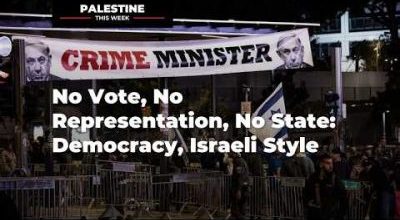
No Vote, No Representation, No State: Democracy, Israeli Style
or go to
Aletho News Archives – Video-Images
From the Archives
Sanctions, War and the Policy of Dual Containment
By SASAN FAYAZMANESH | March 17, 2008
It is now nearly three decades since the Unites States adopted the policy of dual containment of Iran and Iraq. While much has been written about the containment of Iraq, there has been very little in-depth analysis of this policy when it comes to Iran. In a book that is going to be released on March 31, 2008, entitled The United States and Iran: Sanctions, Wars and the Policy of Dual Containment (Routledge), I attempt to address this shortcoming by investigating when and why the US policy of containment of Iran came about, how it evolved, and where it stands today.[1] To the extent that Israel has been involved in US policy making, the study will also include the role that Israel has played in the containment of Iran. Also, since the fate of Iran has been inextricably linked to that of Iraq, occasionally the investigation will overlap with the containment of Iraq.
The policy of dual containment of Iran and Iraq originated during the Carter Administration, but it was not until the Clinton Administration that the expression “dual containment” became popular. … continue
Blog Roll
 Aletho News
- Americans are paying the price to preserve Israel’s nuclear hegemony
- Resistance factions are necessary to ensure a permanent US Iraq withdrawal
- How Israel destabilizes the Middle East: Denying sovereignty and the right to exist
- Europe’s Establishment Is Embracing War – and Losing Voters
- NATO chief advocates war of aggression
- No Vote, No Representation, No State: Democracy, Israeli Style
- Zionist Bought Senate Blocks Information About American Citizens Killed By Israel
- While Gaza dominates the UN, these are the people keeping it alive
- New Report: “Scholasticide and Genocide in Gaza: Assessment, Testimonies and Legal Analysis”
- ‘THAAD Delusion’: Iran war exposes US missile shield limits – The Atlantic
- If Americans Knew
- Eight Palestinians Killed in Israeli Attacks on Gaza
- Israeli former leaders and security chiefs threaten legal action over ‘Jewish terrorism’
- Israel map in LA Times ad includes all land from the river to the sea
- Inside Lebanon’s 200-page dossier on Israeli war crimes
- Flydubai, genocide, settler violence, Trump abuse of power to deport – Daily Update
- Counting Antisemitic Incidents: What the ADL Audit Reveals — and Obscures
- Mamdani releases plan to combat antisemitism and hate crimes in New York City
- Iran’s Revolutionary Guards Publish Letter to the American People
- DMFI launches $1 million ad campaign supporting Virginia’s Elaine Luria
- US Senate blocks resolution seeking report on Americans killed by Israel
- No Tricks Zone
- Green Energy Debacle: German Expert Professor Fritz Vahrenholt Warns Of Severe Economic And Social Consequences
- Two More Paleo Reconstructions Affirm Meters-Higher Sea Levels Across Ireland, Brazil 7000-6000 Years Ago
- New Study: Earth And Venus Surface Warmth Largely Explained By Convection And Lapse Rate, Not CO2 Or Radiation
- 2025 Nature Paper Claiming Worsening Global Drought Gets RETRACTED …Heavily Flawed
- New Study: ‘Global Drought Shows No Detectable Recent Acceleration Under Climate Warming’
- Economic Masterminds: German Socialists Suggest Taxing Productivity Gains Stemming From Using AI
- The South China Sea Has Not Been Cooperating With The Climate Change Narrative
- Energy Crisis: Germany Enters Heating Season With Historically Low Gas Reserve Fill Levels
- New Study: The Antarctic Ice Sheet Gained Mass From 2020-2024 Due To Staggering Snow And Ice Accumulation
- Study: Ocean Heating Rates From Thousands Of Years Ago ‘Dwarf’ Modern Ocean Heating Rates

