‘Nothing You Can Do to Stop Us’: Iran’s Strikes on Israeli Bases Establish Deterrence
By John Miles – Sputnik – 15.04.2024
Former US Marine Corps intelligence officer Scott Ritter urged observers to look beyond Israel and the United States’ framing of Iran’s retaliatory strike, noting Tehran was able to successfully deal damage to Israeli military assets.
Former United Nations weapons inspector Scott Ritter stressed that Iran is playing the long game in its dealings with Israel, carefully calibrating its actions to restore deterrence against the country rather than concerning itself with world opinion.
The former US Marine Corps intelligence officer offered the analysis on Sputnik’s Fault Lines program Monday, challenging the perception that Israel is in a stronger position after intercepting most of Iran’s retaliatory strikes over the weekend.
“The point is prior to this Israel had established a dominance – I’ll call it deterrence dominance,” claimed Ritter. “Meaning that, from an Israeli perspective, nobody should ever dare attack Israel, that Israel has let it be known that if you attack Israel, there will be a ten-fold response, that your life would end, it would be horrible, you can’t do it. And, for the most part, people didn’t attack Israel.”
“And so Israel had become very arrogant, had become sort of the neighborhood bully writ large,” he explained. “And this is why Israel was bombing Syria with impunity, striking targets in Lebanon with impunity, striking targets in Iraq with impunity.”
Israel frequently bombs Syrian airports and other infrastructure and has been illegally occupying the country’s Golan Heights territory since 1967. In 1982 the Israeli military bombed the Lebanese capital of Beirut so aggressively the US President Ronald Reagan referred to the event as a “holocaust,” hurting the feelings of Israeli Prime Minister Menachem Begin.
Observers also suggest Zionist opposition to Iraqi President Saddam Hussein played a role in the United States’ decision to invade the country and remove him from power in 2003. “It’s very clear: Israel had the most influence in this and more so since we know how the Israelis were running into the Pentagon consulting with Rumsfeld and all those guys without even having to show any badge or anything,” former CIA Analyst Ray McGovern claimed on Sputnik’s The Critical Hour program recently.
“And then they struck the wrong target,” said Ritter, referring to Israel’s recent strike on Iran’s diplomatic compound in Syria earlier this month. “You see, Iran said, ‘we have a great latitude for pain because we’ll absorb that pain, because we recognize that in a broader sense of the word Iran is prevailing strategically against Israel, especially when it comes to Gaza and the Israeli defeat that is ongoing in Gaza.’”
“And so Iran delivered a blow, but remember, the purpose of the blow was not to destroy Israel or even bring harm to Israel,” he clarified. “The purpose of the blow was to establish Iranian deterrence precedent so that in the future Israel would know what the consequences of its actions would be. And this Iran did with extreme alacrity and extreme effectiveness.”
“The job wasn’t to say, ‘we’re going to hurt you.’ The job was to say, ‘hey, Israel, look around you. Right now you have America’s most sophisticated X-band radar to give you intelligence when we launch our missiles… you have the whole world coming to your assistance to protect you and you can’t stop our missiles from hitting your most important bases. That’s the future, if you dare attack us again.’”
Israel has claimed in public statements that it was allegedly able to intercept most of Iran’s strikes and prevent major damage. But the country has conspicuously forbidden journalists from observing the aftermath of the attack on Israel’s bases, notes former CIA analyst Larry Johnson. Video posted to social media appeared to show several hypersonic missiles striking Israel’s Ramon military airbase in the Negev desert.
Host Jamarl Thomas pushed back on Ritter’s analysis, asking, “At the point where their generals keep getting murdered, are you really projecting that level of strength if ultimately you are just choreographing in this way?… Is it really a projection of strength if you’re choreographing what you’re doing?”
“You’re referring to the Iranian attack on al-Assad airbase after the [US] assassination of Qasem Soleimani and the fact Iran telegraphed that so that they struck empty buildings and they didn’t kill Americans,” Ritter responded. “Let’s look at it this way. When Iran shot down a Global Hawk [US drone] and Donald Trump wanted to bomb Iranian air defense sites, did he? The answer’s no. Why? Because the Pentagon said they’ll kill everybody. They just set their deterrence. They showed us what they got, and we got nothing to defend against it.”
“When Iran said we’re going to strike Israel, what did the United States do?” he asked. “Say bring it on? We stand side by side with the Israelis? We will attack you? We will bomb your territory? The United States went ‘wow, we’ll defend Israel, but we’re not attacking you.’ Yeah, that’s called deterrence.”
“Iran doesn’t want a shooting match with the United States,” Ritter argued. “They wanted to avoid it, and they have done so. The United States is scared to death of bombing Iran, of creating a conflict because they know what Iran will do. Iran will flatten every single American military base within the range of their missiles. And if the United States takes its next step, Iran will shut down international oil supplies and the economy will crash, and Joe Biden will never get reelected.”
Ritter insisted that Iran attacked Israel in such a way that Israeli Prime Minister Benjamin Netanyahu could save face and back down while also revealing Tehran’s capabilities if Israel strikes it again.
“All those things that were shot down – understand those were designed to be shot down,” he claimed. “Iran put a program together with the United States that said, ‘we’re going to let you shoot all this stuff down so you feel good. But in the end our good stuff hit the bases, just so you know that we can do that anytime we want, and there’s nothing you can do to stop us.’”
Ritter also claimed Iran is focused on economic development rather than seeking military conflict with Tel Aviv.
“They’ve been focused on the Shanghai Cooperation Organization, they’ve been focused on BRICS, they’ve been focused on their strategic pivot to the East,” he noted. “So for them to come in and do this feel good thing to make you, me and everybody else feel good – because apparently that’s what this is about, making the larger audience that has nothing to do with Iran feel good about the Iranian response – they don’t care.
“The Iranians are focused strategically on maintaining that pivot to the East, building strong economic relations, normalizing relations with Saudi Arabia, and, more importantly since October 7th, facilitating the victory of Hamas over Israel which by Israel’s own admission Hamas is winning,” he claimed.
“Haaretz – I think a day before the Iranian retaliation – came out with a headline story that said ‘Israel’s lost this thing, it’s over.’ I mean, there’s nothing Israel could do to turn this around in Gaza. They’ve lost the world. They can’t defeat Hamas. Hamas is emerging still intact militarily, they’re stronger politically. And Iran’s like, ‘we want to sustain that, too. We don’t want to distract the world with this larger Israeli-Iranian conflict, we want to keep the focus on Palestinian statehood.’”
Germany confirms its collaboration with genocide
By Rick Sterling | Dissident Voice | April 15, 2024
A three day Palestine conference in Berlin was forcibly shut down after three hours on Friday. Electricity was abruptly terminated in the midst of the presentation by Salman Abu Sitta, the 87 year old author of the authoritative “Atlas of Palestine”.
Former Greek Finance Minister and leader of DIEM25, Yanis Varoufakis, was prevented from entering Germany to attend the conference. He went on Twitter/X to send a message:
Do you know that the German Interior Ministry has just banned me from entering Germany? Indeed if that were not enough, I have been banned from talking to you via zoom, or indeed through a video message like this, exactly like this. The threat being that I will be tried in Germany for breaking German law. Why? Because of a speech that I published yesterday on my blog calling for universal human rights in Israel- Palestine …. So my question to my German friends, to Germans in general whether you agree with me or not doesn’t matter. … Is this (banning) in your name? Is it something that you feel comfortable happening in your democracy? From my perspective this is essentially the death knell of the prospects of democracy in the Federal Republic of Germany.
Another banned guest speaker was UK citizen Dr. Ghassan Abu Sittah. He reported on Twitter/X:
I have just returned from Germany where I was prevented from entering the country for attending a conference in Germany to give evidence on the war in Gaza and my witness statement as a doctor working in its hospitals. This morning at 10 I landed in Berlin to attend a conference on Palestine where I had been asked … to give my evidence of the 43 days that I had seen in the hospitals in Gaza, working in both Shifa and al-Ahli Hospital. Upon arrival I was stopped at the passport office. I was then escorted down to the basement of the airport where I was questioned for around 3.5 hours. At the end of 3.5 hours I was told that I will not be allowed to enter German soil and that this ban will last the whole of April. Not just that … if I were to try to link up by Zoom or Facetime with the conference even if I were outside Germany or if I were to send a video of my lecture to the conference in Berlin, then that would constitute a breach of German law and that I would endanger myself to have a fine or even up to a year in prison.
Dr. Abu Sitta further commented:
Germany is defending itself against Nicaraguan charges that it is an accomplice to genocidal war as described by the International Court of Justice. This is exactly what accomplices to a crime do. They bury the evidence and they silence or harass or intimidate the witnesses. …. This crackdown on free speech is a dangerous precedent… We are watching the first genocide unfold in the 21st Century and for Germany to become implicated as an accomplice in silencing the witnesses of this genocide does not bode well for the rest of the century.
A large contingent of police invaded the conference and shut off the electricity. Organizers told the reported 250 conference attendees to not provoke the police to violence. Afterward, organizers held a press conference reporting on the behaviour of police before and during the crackdown. Even before the conference, police tried to intimidate supporters of the conference and the owner of the conference venue. They threatened the venue owner might not be able to hold events in future if the conference went ahead. An organizer asked, “Are these the methods of the mafia or democracy?”
Western and Israeli media reported the closure was to prevent “anti semitism” or “hatred of Israel”. On this dubious and hypothetical basis, public education about a real ongoing massacre and mass starvation was made illegal.
US-NATO: The Cost of War in Occupied Europe

By Manlio Dinucci | Global Research | April 15, 2024
NATO’s war against Russia in Ukraine involves increasing military spending. According to official data, Italy’s military spending has increased from 21 billion euros in 2019 to more than 30 billion euros in 2023, equivalent to an annual daily average of more than 80 million euros, in public money diverted from social spending. According to the NATO commitment, Italy will have to increase this spending to about 100 million euros per day. Since 2014, NATO-member Europe’s military spending has soared, exceeding the level of the last phase of the Cold War.
NATO Secretary General Stoltenberg emphasizes,
“The Allies are providing Ukraine with unprecedented military and financial aid. France will soon send more Caesar howitzers, and several Allies have joined the Czech Republic’s initiative to procure 800,000 additional artillery shells.”
Italy, which has already also supplied Kiev with heavy artillery pieces, is participating in the purchase of these additional 800,000 shells, with an additional outlay of public money paid by us citizens.
A further aggravation comes from the fact that Italy shares in the expenses of U.S.-NATO bases that, from Italian territory, play primary roles in supporting war operations, from Ukraine to the Middle East. Of particular importance is the role of Camp Darby, the largest U.S. arsenal outside U.S. territory. These days, new and more powerful armored vehicles are arriving from the United States at this base, located between Pisa and Livorno, which will be sent from Camp Darby, via the port of Livorno, to Ukraine.
The U.S. bases at Camp Darby, Sigonella and others on Italian soil also support war operations in the Middle East, where the United States continues to arm Israel under an agreement, entered into by President Obama and his deputy Biden, to supply Israel with $38 billion worth of weapons, including the bombs with which Israel is exterminating Palestinians in Gaza.
Scott Ritter: Ukraine ‘Owned’ by US, While With Israel It’s the Other Way Around
By Ilya Tsukanov – Sputnik – April 15, 2024
Senior Ukrainian officials couldn’t help but feel sidelined by the outpouring of US attention and support for Israel as Tel Aviv sought to fend off an unprecedented Iranian missile and drone attack over the weekend. There’s a good reason for that, says former US Marine Corps intelligence officer and UN weapons inspector Scott Ritter.
President Zelensky took to X on Sunday to plead with US lawmakers not to forget about Ukraine, saying “it is critical that the United States Congress make the necessary decisions to strengthen America’s allies in this critical time” by delivering on the aid package promised by President Biden six months ago.
Zelensky’s comments were echoed by Foreign Minister Dmytro Kuleba, who told reporters on Monday that Ukraine also needs help from its Western partners, even if it’s not in the form of direct military help – like Israel got. “All we ask our partners is, even if you cannot act the way you act in Israel, give us what is needed, and we will do the rest ourselves,” Kuleba urged.
“Let me make this very clear to the Ukrainian crowd. You see, the difference between Israel and Ukraine is that, whether you like it or not, Israel has bought and paid for the United States’ support,” while Ukraine hasn’t, Scott Ritter told Sputnik.
“Israel, through its political action committee, AIPAC, in the United States, has pretty much bought the United States Congress. They’ve bought the United States presidency. They control American media. And as a result, America comes to the defense of Israel because we’ve been paid to do so,” Ritter said.
With Ukraine, it’s the other way around, the observer said.
“America, on the other hand, has bought and paid for Ukraine. You’re not a friend. You’re not an ally. You’re a tool being used by the United States for its larger foreign policy and national security objectives vis-à-vis Russia. We provide you weapons only so far as it facilitates our objective of creating a problem for Russia. We don’t want you to win. We don’t care about you. We give you just enough to keep you going. And then we stand by and watch you bury your dead. Because we don’t care,” Ritter said, channeling the sentiments of the American establishment.
“You’ve done your ‘duty’. You created a problem for the Russians. But now you’ve become inconvenient. And we’re going to stand by and let the Russians finish the job without spending any more money or providing you with much more assistance. You don’t matter to us. You’re not Israel. You don’t own us. We’re not going to fight and die for you. I hope I made that clear,” Ritter summed up.
Israel received unprecedented military support from the US, the UK, France and Jordan on Saturday night, with the countries scrambling fighter jets and deploying ground and sea-based air and missile defense systems to shoot down a barrage of Iranian drones and missiles fired in response to Israel’s April 1 attack on the Iranian Embassy compound in Damascus, Syria. Despite foreign assistance and its own sophisticated air and missile defense network, some of the Iranian projectiles nevertheless managed to make it through, striking two vital Israeli airbases.
“You got a win. Take the win,” President Biden reportedly told Israeli Prime Minister Benjamin Netanyahu, warning that the US wouldn’t support any Israeli aggression against Iran.
Iran’s drone strike busts a number of myths and strains Israel-U.S. relations
By Martin Jay | Strategic Culture Foundation | April 14, 2024
It is ironic to western analysts how invariably it is the East which keeps a cool head and doesn’t rise to the bait of escalation while it is the West which is reckless, foolhardy and careless with its provocations. In Ukraine we have seen nothing but this accompanied by miscalculation and poor decisions on the part of NATO. And now we are seeing this in Israel as remarkably, Joe Biden, has managed to be ensnared now in a regional war between Israel and Iran – a dream for the latter for well over 30 years.
Iran’s reaction to the bombing of its consulate in Damascus was very measured, well thought-out and pulled off with a certain sobriety which will not be matched by Israel and the U.S. Tehran did not want to kill civilians but simply send a message that Israel crossed a line and if it does this again, then there will be more attacks from Iran, perhaps intercontinental missiles with deeper impact than cheap drones. That is not to say that the drones were not effective. They were at the specific task which the Iranians wanted of them, knowing full well that most of them would be intercepted.
But the move by Tehran was still a shock to many western experts and no doubt the Netanyahu cabal as well, as it busted a number of myths in one evening. Firstly, that Iran would have the courage to bomb directly Israel, as many pundits dismissed this without a thought. The fact that Iran is prepared to use its missiles to potentially kill civilians on Israeli soil changes the dynamic now as Israel can no longer double guess what the payback will be if it continues its feral bombing of Iranian soldiers, even on Syrian soil.
Secondly, it also busts the myth that Israel has the capability to tackle war on more than one front. All during the night while its military was busy, Gazans were enjoying a peaceful night of no shelling at all and took to social media to celebrate the detente. Israel’s military does not have the capacity or strength to fight a war in Gaza as well as one from a second front, such as a massive drone attack, let alone a third one from Hezbollah in Lebanon, if need be.
And thirdly, the role of partners. Israel couldn’t have got through the night and got what it claims to be a 99 percent hit rate without the help of partners like British RAF fighter jets who helped, not to mention King Abdullah of Jordan whose air force also shot down the drones. If these relations, along with the U.S., are tested and pushed beyond their limits, Israel’s vulnerability becomes contentious to say the least.
And so how Netanyahu plays his cards in the coming days is crucial for Israel to stay on good terms with its western allies but also to realistically stay in the game. Iran’s drone attack has opened up a can of worms now which Biden would have preferred wouldn’t have been opened. According to some reports, it is believed that Biden told Netanyahu now to back down and leave the Iranians, fearing the situation spiralling out of control. Could Biden seriously go to the polls in December of this year with a foreign policy cheat sheet which listed pulling out of Afghanistan, starting a war in the Ukraine which will humiliate him and NATO when Russia inevitably wins and now start a world war with Iran? Seasoned analysts have ventured that he will not be able to hold himself back from upping the stakes and going for a revenge attack on Iran or its proxies. This of course would test the relationship with the U.S. and push it to its very limit – a stunt which Biden is hoping very much will not be carried out by Netanyahu. Given that this will almost certainly bring the relationship between Biden and Netanyahu to breaking point and will give Iran the victory either way, it’s hard to see how most western pundits failed to see the drone strike as a great victory for Tehran. Netanyahu’s gambit will be that Biden is weak and now lost in the maze of Middle Eastern warmongering. He will also think that Biden will need to present himself to the hawks in Washington as a victor and so is now in deeper more than ever before, as options run out and the window for rational thinking seems to now no longer be. Biden’s nightmare with Netanyahu is just starting.
Russia Slams UNSC for Ignoring Attack on Iranian Consulate, Calls for End to Bloodshed
Sputnik – 14.04.2024
UNITED NATIONS – Russia’s Permanent Representative to the United Nations Vasily Nebenzia criticized the UN Security Council for failing to act on the Israeli attack on the Iranian consulate in Syria as he urged an end to bloodshed in the Middle East during an emergency UNSC meeting on Sunday.
“It is regrettable that unlike the meeting today, you did not propose to bring it to brief the Council on the 2nd of April,” he said, adding that Russia called an emergency briefing to discuss the Israeli strike against the consular premises in Damascus.
Nebenzia criticized Israel for not complying with the UN Security Council resolutions, which he said was “an obvious disrespect shown to the Council, to all of you who are here in the members seats, and a complete disregard to the decisions made by the Security Council.”
“This high level confrontation and bloodshed must be stopped We think it’s urgent for the entire international community to undertake all the efforts necessary to de-escalate the situation,” Nebenzia said.
Iran’s attack on Israel did not happen in a vacuum – it was a response to the shameful inaction of the UN Security Council, the Russian ambassador stressed.
“What happened on the night of April 14 did not happen ‘in a vacuum.’ Iran’s steps were a response to the shameful inaction of the United Nations Security Council [and] a response to Israel’s blatant attack on Damascus… by no means the first. Syria is constantly being bombed by Israel,” Nebenzia said.
On April 3, the US and UK refused to discuss Russia’s proposed draft UN Security Council statement on the Israeli strike on the Iranian consulate in Damascus. London and Washington then cited the fact that there was no unity in the meeting’s assessment of what happened. On Sunday, an urgent meeting of the UN Security Council is taking place in connection with the retaliatory strike that Iran carried out on the territory of Israel. Meanwhile, shortly before that, Iran’s mission to the UN said that if the Security Council had condemned the Israeli strike on the Iranian consulate and brought the perpetrators to justice, the need for Iran to punish the Israeli side “could have been eliminated.”
Russia calls for restraint on all sides involved in the incident with Iran’s attack on Israel, Russia’s permanent representative to the UN highlighted.
Russia calls on Israel to follow the example of Iran, which has said it does not want further escalation, Nebenzia said.
“We note Tehran’s signal of unwillingness to further escalate hostilities with Israel. We urge West Jerusalem to follow its example and abandon the practice of provocative forceful actions in the Middle East, fraught with extremely dangerous risks and consequences on the scale of the entire region, already destabilized as a result of the escalation of the Palestinian-Israeli confrontation,” Nebenzia emphasized.
Israeli minister calls for full seizure of Gaza Strip
MEMO | April 14, 2024
Israeli Finance Minister Bezalel Smotrich called on Sunday for imposing a full control over the entire Gaza Strip, Anadolu Agency reports.
Smotrich’s remarks came following an announcement by Prime Minister Benjamin Netanyahu’s office that Hamas’ response to mediators’ proposals for a prisoner exchange deal was negative.
“Giving up on Israel’s red lines and chasing after Hamas for a deal only makes the chance of bringing everyone (hostages) home further away,” the leader of the Religious Zionism party wrote on X.
“It’s time to learn lessons, change direction, … and restore full Israeli control all over the Gaza Strip,” he added.
On Sunday morning, Netanyahu’s office called Hamas’ response to the broad outlines presented by mediators regarding a proposal for a cease-fire with Israel as negative.
“It has been over a week since the Cairo meeting – Hamas has rejected the outline that was tabled by the mediators,” Netanyahu’s office wrote on X.
Hamas is estimated to be holding more than 130 Israeli hostages, while Tel Aviv is holding more than 9,100 Palestinians in its jails.
Hamas demands an end to Israel’s deadly offensive on the Gaza Strip and the withdrawal of the Israeli forces from the territory for any hostage-prisoner swap deal with Tel Aviv.
Israel has killed more than 33,000 Palestinians since an Oct. 7, 2023 cross-border attack by Hamas in which some 1,200 Israelis were killed and around 250 hostages taken.
A previous deal in November saw the release of 81 Israelis and 24 foreigners in exchange for 240 Palestinians, including 71 women and 169 children.
The US, Qatar and Egypt have tried to broker an agreement to release the remaining Israeli captives.
The conflict has pushed 85% of Gaza’s population into internal displacement amid acute shortages of food, clean water, and medicine, while 60% of the enclave’s infrastructure has been damaged or destroyed.
Global calls for a cease-fire have been growing as the war has entered its seventh month.
Israeli army shells hundreds of displaced Palestinians in Gaza
Press TV – April 14, 2024
The Israeli army has shelled hundreds of displaced Palestinians trying to return to their homes in the northern Gaza Strip, as the Tel Aviv regime presses ahead with its genocidal war in the besieged Palestinian territory.
At least five Palestinians, including a woman, were killed and several others injured in Israeli artillery shelling on Sunday.
“Five fatalities, including a woman, and a number of injured people arrived at Al-Awda Hospital in the Nuseirat camp in the central Gaza Strip,” media outlets quoted medical sources as saying.
The casualties occurred among “the displaced Palestinians who tried to return to the northern Strip via al-Rashid Street,” they added.
Palestinians gathered at al-Rashid Street to cross to the north of Gaza after rumors spread that children and women under the age of 14 were allowed to cross the north in Gaza City.
The Israeli army spokesman Avichay Adraee said the regime had warned the Palestinians against approaching the Israeli forces invading the northern Gaza Strip.
“The Israeli army does not allow the return of residents, neither through Salah al-Din Street nor through Al-Rashid Street,” he said, “The northern Gaza Strip is still a war zone and we will not allow a return to it.”
Witnesses confirmed that the Israeli army asked them to return to the southern Gaza Strip and fired smoke bombs at them to prevent them from reaching the north.
Israel waged the genocidal war on Gaza after the Palestinian resistance movement Hamas carried out a historic operation against the occupying entity in retaliation for its intensified atrocities against the Palestinian people.
The Israeli aggression has so far killed at least 33,700 Palestinians, mostly women and children.
The Tel Aviv regime has imposed a “complete siege” on the territory, cutting off fuel, electricity, food, and water to the more than two million Palestinians living there.
The Israeli war has pushed 85% of Gaza’s population into internal displacement amid acute shortages of food, clean water, and medicine, while 60% of the enclave’s infrastructure has been damaged or destroyed, according to the UN.
In January, an interim ruling by the International Court of Justice ordered Tel Aviv to stop genocidal acts and take measures to guarantee that humanitarian assistance is provided to civilians in Gaza.
Ottawa fails to condemn Israeli damage to Canadian embassy
By Yves Engler | The Canada Files | April 13, 2024
An apartheid state committing genocide damaged a Canadian embassy while conducting a flagrant war crime. But Ottawa has remained silent about an incident designed to ignite a regional war.
Two weeks ago, the Israeli Air Force murdered 16 people in strikes on Iran’s embassy compound in Damascus. They reportedly killed two top Iranian generals, two civilians and a dozen militants. The illegal strikes obviously impinged on Syrian sovereignty and contravene multiple conventions such as the 1963 Vienna Convention on Consular Relations.
Dozens of governments condemned Israel’s violation of international law. The European Union criticized the strikes and a senior United Nations official told an emergency meeting of the Security Council that the inviolability of diplomatic and consular premises and personnel must be respected. The Coordinating Bureau of the 120 nation Non-Aligned Movement released a statement that “strongly condemns the heinous attack conducted by Israel against Iranian diplomatic premises and representatives in Damascus.”
For its part, Ottawa failed to criticize Israel’s actions even as it has emerged that Israel’s strike destroyed a number of windows in the Canadian embassy, which is located next to Iran’s. While formally closed since 2012, the damaged embassy remains Canadian property.
Ottawa was also mum when Israel killed over 50 people in Syria, 72 hours earlier. To the best of this author’s knowledge, the Trudeau government hasn’t criticized any of Israel’s innumerable — 33 times since the start of this year — illegal strikes in that country. Nor has Ottawa criticized a series of (presumed) Israeli killings in Iran though they regularly criticize that country’s actions.
As Israel has bombed Lebanon, Syria and Palestine in recent years, Ottawa has sold it arms and maintained a multitude of bilateral and multilateral military ties. Additionally, the Trudeau government has turned a blind eye to the inducement of Canadians to join or assist the Israeli military in violation of the Foreign Enlistment Act and to registered charities fundraising for the Israeli military in contravention of Canada Revenue Agency rules.
Israel’s attack on Iran’s diplomatic outpost in Syria is a major escalation. The Iranians have said they will respond with a significant assault (reportedly Tehran told Washington that if they impose a ceasefire in Gaza, they will hold back). Israel has responded to Iranian threats by claiming it will further escalate the conflict. On Wednesday Israel’s foreign minister, Israel Katz, posted to X, “If Iran attacks from its territory, Israel will respond and attack in Iran.” President Joe Biden said the US will support Israel.
As has been speculated for some time, Benjamin Netanyahu wants to draw the US into a war with Iran. Netanyahu has long hyped the Iranian threat and wants to have the US weaken the only power in the region that hasn’t been cowed by Israel/US dictates.
Netanyahu has a personal interest to continue fighting. He’s likely going to be ousted as prime minister and may even end up in jail on corruption charges when the fighting stops. Additionally, Israel has failed in its bid to liquidate Hamas in Gaza, Palestine. After six months of Israeli-perpetrated horrors, most of Hamas’ top leaders are alive, uncaptured, and Israel hasn’t even recovered those kidnapped on October 7.
More generally, instigating wars is a national pastime for Israel. (“Israel is an army with a state” goes the saying). Israel has bombed Jordan, Egypt, Sudan, Syria, Palestine, Lebanon, Tunisia and Iraq. Fifteen years ago, Israeli military historian Zeev Maoz explained in Defending The Holy Land: A Critical Analysis of Israel’s Security & Foreign Policy:
“Between 1948 and 2004, Israel fought six interstate wars, fought two (some say three) civil wars, and engaged in over 144 dyadic militarized interstate disputes (MIDs) that involved the threat, the display, or the use of military force against another state. Israel is by far the most conflict prone state in modern history. It has averaged nearly four MIDS every year. It has fought an interstate war every nine years. Israel appears on top of the list of the most intense international rivalries in the last 200-year period.”
Later in the book, Moaz said:
“There was only one year out of 56 years of history in which Israel did not engage in acts involving the threat, display, or limited use of force with its neighbors. The only year in which Israel did not engage in a militarized conflict was 1988, when Israel was deeply immersed in fighting the Palestinian uprising, the intifada. So, it is fair to say that during each and every year of its history Israel was engaged in violent military actions of some magnitude.”
Maoz concludes (describing the Nakba as a “war of independence”):
“None of the wars — with a possible exception of the 1948 war of Independence — was what Israel refers to as Milhemet Ein Brerah (‘war of necessity’). They were all wars of choice or wars of folly.”
For its size, Israel may be the most violent state in the history of humanity. Canada has seldom criticized and in fact enabled this rogue state, as it unleashes ever more death and destruction.
Yves Engler is the author of 13 books. His latest book, available now, is “Canada’s Long Fight Against Democracy”.
Israeli general pegs cost of defending against attack – media
RT | April 14, 2024
Israel has claimed success in defending itself against Saturday’s drone and missile barrages by Iran, but that effort reportedly came at a high price.
The interceptors, jet fuel and other materials expended in shooting down Iran’s unmanned aerial vehicles (UAVs) and missiles cost about 4 billion to 5 billion shekels ($1.06 billion to $1.33 billion), Israeli Brigadier General Reem Aminoach told local media outlet Ynet News on Sunday. The estimate included only Israel’s direct costs, not counting the considerable weaponry used by the US and other allies in helping to defend against the attack.
Aminoach, formerly the financial adviser to the Israel Defense Forces (IDF) chief of staff, said West Jerusalem used such munitions as Arrow and David’s Sling interceptor missiles, which have per-unit costs of about $3.5 million and $1 million, respectively. He also included sortie expenses for the fighter jets that did the bulk of the work in shooting down Iranian drones.
The general lamented that it was far cheaper for Iran to launch the attack than for Israel to defend itself. “The attack cost Iran less than 10% of what it cost us to defend against it,” he told Ynet. “In the future – in a year, two years, or five years – they can carry out 50 such attacks. And let’s say that if the IDF’s net budget in 2023 was 60 billion shekels, with less than double that you have no chance of reaching a situation where we can maintain the required amounts.”
The IDF claimed that 99% of the more than 300 kamikaze drones and missiles launched from Iranian territory were successfully intercepted. All of the UAVs and cruise missiles were shot down, military spokesman Daniel Hagari said, while a few ballistic missiles got through Israel’s defenses.
Those projectiles fell at the Nevatim Airbase and caused “only minor damage to infrastructure,” the spokesman said. He added that the drones launched by Iranian-backed militants in Iraq and Yemen all failed to reach Israeli territory. The only casualty was a shrapnel wound to a 10-year-old Bedouin Israeli girl who was hit while sleeping at her home in southern Israel.
Saturday’s attack came in response to an April 1 airstrike that killed seven Iranian military officers, including two senior commanders, at Tehran’s consulate in Damascus. Israel has vowed to “exact a price” from Iran for striking back.
Strike on Israel Shows US Bases Near Iran Are ‘Achilles Heel’ – Analyst
By Svetlana Ekimenko – Sputnik – 14.04.2024
Fears of a greater Middle East escalation were triggered after Iran launched a massive drone and missile attack against Israel, aided by Hezbollah and the Yemeni Houthis. Iran said the attack was in response to Israel’s bombing of the Iranian consulate in Damascus, Syria, which killed seven members of the elite Revolutionary Guard Corps.
Iran’s massive retaliatory attack on Israel from its own territory is a sign that the conflict could “escalate out of control.”
Michael Maloof, a former senior security analyst in the office of the US secretary of defense, told Sputnik that the first ever direct Iranian attack on Israel set a dangerous precedent.
“My concern is that this could easily escalate into something not only between Iran and Israel, but beyond the Middle East region,” he said.
Iran’s assault, which it stated was an act of “self-defense” after the Israeli strike on its consulate in Damascus, was originally intended to be a “limited” one, said Maloof.
Iran first sent in “swarms of drones with lights on as a sign of psychological warfare,” but sending in cruise and ballistic missiles by Tehran was a “distinct escalation,” said Maloof.
The scale of Iran’s attack on Israel suggests that Tehran was sending a message, demonstrating that it possesses “extraordinary capabilities,” said Maloof.
“They have built up their missile capabilities extraordinarily, they have drones, cruise missiles, and some of the most accurate ballistic missiles in the region right now,” he added.
“I think that this clearly showed that Iran has a capability. I think it’s limited. They cannot do this on a sustained basis. And they did send their slower ordinance, such as drones, UAVs. But they also claim to have hypersonics,” Maloof noted.
“I think that if Israel were to retaliate, then I think they would engage the more sophisticated missiles and hypersonics, potentially, if they have them,” He added. “Then you’re talking some very serious escalation in the entire region. It’s already unprecedented, but this escalation could be even ratcheted up that could conceivably bring in other and extend beyond just this region.”
All signs point to the potential of a larger regional war erupting, Maloof warned, adding that everything now depends on Israel’s reaction. “Is this a tit-for-tat, a one-on-one, or a further escalation?” he asked.
“I think we are already getting that message from Netanyahu, his ministers, that they are going to respond… How they respond is going to determine the extent of that escalation through the [Middle East] region,” stressed Maloof. “I am quite concerned that neither side is going to stand down at this point.”
Israeli Prime Minister Benjamin Netanyahu is prepared to “continue an endless war in the region,” suggested Maloof, adding that he “knows he had the US backing,” and could opt to strike now, taking advantage of this “window of opportunity.”
“He may not get such an opportunity under a potential Trump administration coming in [after the US elections in November],” said the expert.
Looking at possible scenarios for Israel’s response, he noted that Tel Aviv had already stated publicly an intention to “go after the nuclear sites in Iran.”
“That is going to be exceedingly difficult, plus I don’t know that they have the power projection to do that on any consistent basis, and secondly, I don’t believe they have the so-called ‘bunker busters’ that would be needed to be able to drill down through the mountains to reach those facilities. The US has been reluctant to give Israel these bunker buster [munitions],” said Maloof.
As for the US, it has already “gotten sucked into this,” Maloof noted.
US President Joe Biden issued a statement on Iran’s attack against Israel after speaking with Netanyahu by phone. Biden condemned the attack “in the strongest possible terms”.
He reaffirmed Washington’s “ironclad commitment” to help support Israel’s security. Secretary of State Antony Blinken said the US does “not seek escalation” but will “continue to support” Israel’s defense. “I will be consulting with allies and partners in the region and around the world in the hours and days ahead,” he added.
“There is already a call in Congress to put on fast-track the legislation to approve new ordinance, and the $14 billion for Israel,” said the pundit. He remarked that the Pentagon might “empty its stockpiles to provide support to Israel,” and recalled that besides giving Israel bombs and artillery, the US supports its Iron Dome air defense system, whose missiles will need to be replenished.
“If you have a swarm, wave after wave of swarms, Israel is going to be very hard pressed to be able to defend against that. And that’s why the US now is coming in, and that gets the US directly involved,” Maloof pointed out. “And that could then open up US assets in the region.” We have got some 35 bases that surround Iran, and they thereby become vulnerable. They were meant to be a deterrence. Clearly, deterrence is no longer on the table here. Now they become the American Achilles heel because of their vulnerabilities to attack. They’ve got air defense systems, but they’ve got to be replenished. And given that you got active war going on right now in the region, it’s going to be difficult to replenish those supplies.”
According to the ex-Pentagon analyst, much now also depends upon what stockpiles Iran has and “with what consistency they can keep sending these wave after wave of drones and ballistic missiles… Ultimately, if they have them, the hypersonics… and there’s no defense against hypersonics. Not even Israel’s ‘Arrow’ system, which is designed to deal with ballistic missiles… And apparently, that’s been engaged tonight, as well as the Iron Dome.”
The United Nations (UN) Security Council is to meet on Sunday in response to a request from Gilad Erdan, Israel’s permanent representative to the United Nations. The meeting is scheduled for 4 pm New York time (2000 GMT), as announced by the UN Department of Global Communications.
“I’m hoping that the UN Security Council can take this up and maybe some adult supervision could begin to intervene in this and maybe try to bring it to a halt for now,” Maloof said. “But right now, this minute, it doesn’t look like it. And again, it’s going to depend upon the response from the Israelis if they go directly into Iran in response.”
The current media frenzy surrounding the Iran strike is “disproportionately amplified compared to the actual events transpiring on the ground,” Dr Ahmed Al Ibrahim, a Riyadh-based political analyst, told Sputnik.
He added that any true aftermath of Iran’s strike will be discernible after a “thorough assessment.”
“Indeed, I dismiss the current situation as largely sensationalized, a “bubble” inflated by media coverage and public attention,” the political analyst said.
He expressed skepticism that any Middle Eastern countries would “willingly entangle themselves in the unfolding chaos.” Arguing that “Iran’s capacity to directly threaten Israel is limited by geographical constraints,” Ibrahim agreed that there is “potential for escalation.”
Scott Ritter: Iran’s Retaliatory Attack ‘Reestablished Deterrence’ to Hold Israel, US in Check
By Svetlana Ekimenko | Sputnik | April 14, 2024
Iran’s mission to the United Nations stated earlier that Tehran’s retaliatory drone and missile attack against Israel had “concluded.” The “military action” was a response to Israel’s “aggression against our diplomatic premises in Damascus,” it said, adding that the strike “hit designated targets.”
By launching its retaliatory drone and missile attack on Israel, Iran “reestablished deterrence,” former UN weapons inspector Scott Ritter told Sputnik.
“Israel believed that it could launch a strike against Iran and suffer no consequence. That is no longer the case,” Ritter noted.
As Israeli military officials survey the damage done to their bases, “they understand the following: that Iran deliberately chose not to inflict extremely lethal action against Israel,” the analyst remarked.
Iran launched a massive drone and missile attack against Israel overnight, assisted by Hezbollah and the Yemeni Houthis. Over 300 projectiles were fired at Israeli territory from Iran, with Iran’s mission to the United Nations stating that its retaliatory attack on Israel had “concluded,” and that the strike “hit designated targets.” Israel’s military has claimed that 99% of the projectiles were intercepted.
Iran’s strike was designed to send a signal to Israel and the United States, “that it could do what it did in Nevatim, at Ramona, anywhere in Israel, anywhere in the Middle East, and there was nothing the United States or Israel could do in response.”
“This is deterrence. This means that in the future, if either Israel or the United States plan on carrying out an action against Iran, they have to weigh in the consequences of their actions knowing that Iran has the capacity to reach out and touch any place, any spot, any target in the region in Israel or out of Israel, and there’s nothing anybody could do to stop that,” the retired US Marine Corps intelligence officer said.
US President Joe Biden issued a statement on Iran’s attack against Israel after he spoke on the phone with Israeli Prime Minister Benjamin Netanyahu. The POTUS condemned the strike “in the strongest possible terms.” He also reaffirmed Washington’s “ironclad commitment” to help support Israel, and added that there were no attacks on US forces or facilities on Saturday, but that the US “will remain vigilant to all threats.”
Secretary of State Antony Blinken said the US does “not seek escalation,” but will “continue to support” Israel’s defense. “I will be consulting with allies and partners in the region and around the world in the hours and days ahead,” he added.
Weighing in on the flurry of talks between US and Israeli leaders, Scott Ritter said:
“This is why President Biden has been on the phone with Benjamin Netanyahu, the prime minister of Israel, telling him, ‘Do not retaliate.’ The United States will not be a partner in any offensive action against Iran. Not because the United States is friendly to Iran, but the United States understands the consequences that will accrue, should such an attack take place. The United States has been deterred against further action against Iran.”
The question uppermost at the moment is, “what will Israel do?” Ritter noted.
“Israel has been trying to lead the United States into a larger conflict with Iran for some time now. Indeed, some people have speculated that the Israeli attack against the Iranian Consulate in Damascus was designed for just that purpose… But the Iranians were very clever in designing their response – just like they did, when they retaliated against the United States for the assassination of Qasem Soleimani back in 2020,” Ritter said.
He recalled that at the time, Iran launched over a dozen missiles against the Al-Asad air base in Iraq, but Tehran gave Washington advance notice that that base was going to be struck. Thus, Iran ended up destroying empty buildings, Ritter recalled.
“But it demonstrated to the United States that it had the capacity to strike any American base in the region with extreme precision and kill as many Americans as they wanted – if they wanted to do that. And America was deterred against future action of that sort. Will Israel be deterred?” the analyst wondered.
No decision has been made yet regarding an Israeli response to the Iranian missile and drone attack, an Israeli official told The Times of Israel. It was added that a potential response would be discussed at a war cabinet meeting set for later on Sunday. Israel’s response to the Iranian attack will be coordinated with its allies, The New York Times reported earlier, citing an Israeli official.
After Iran’s unprecedented strike, Tel Aviv “understands that any escalation could mean the destruction of Israel,” Scott Ritter noted.
“Israel probably isn’t going to launch a response against Iran. Israel has been deterred from launching that response by the Iranian actions. In this case, we can say that operation ‘True Promise’ was an extraordinarily successful operation, not only for Iran, but indeed for the world, because Iranian deterrence now is a reality that can hold Israel and the United States in check,” Ritter said.
Featured Video
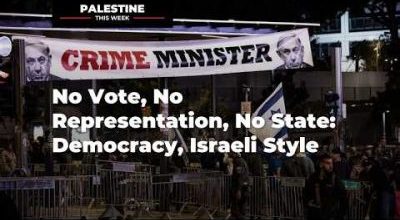
No Vote, No Representation, No State: Democracy, Israeli Style
or go to
Aletho News Archives – Video-Images
From the Archives
Sanctions, War and the Policy of Dual Containment
By SASAN FAYAZMANESH | March 17, 2008
It is now nearly three decades since the Unites States adopted the policy of dual containment of Iran and Iraq. While much has been written about the containment of Iraq, there has been very little in-depth analysis of this policy when it comes to Iran. In a book that is going to be released on March 31, 2008, entitled The United States and Iran: Sanctions, Wars and the Policy of Dual Containment (Routledge), I attempt to address this shortcoming by investigating when and why the US policy of containment of Iran came about, how it evolved, and where it stands today.[1] To the extent that Israel has been involved in US policy making, the study will also include the role that Israel has played in the containment of Iran. Also, since the fate of Iran has been inextricably linked to that of Iraq, occasionally the investigation will overlap with the containment of Iraq.
The policy of dual containment of Iran and Iraq originated during the Carter Administration, but it was not until the Clinton Administration that the expression “dual containment” became popular. … continue
Blog Roll
 Aletho News
- Americans are paying the price to preserve Israel’s nuclear hegemony
- Resistance factions are necessary to ensure a permanent US Iraq withdrawal
- How Israel destabilizes the Middle East: Denying sovereignty and the right to exist
- Europe’s Establishment Is Embracing War – and Losing Voters
- NATO chief advocates war of aggression
- No Vote, No Representation, No State: Democracy, Israeli Style
- Zionist Bought Senate Blocks Information About American Citizens Killed By Israel
- While Gaza dominates the UN, these are the people keeping it alive
- New Report: “Scholasticide and Genocide in Gaza: Assessment, Testimonies and Legal Analysis”
- ‘THAAD Delusion’: Iran war exposes US missile shield limits – The Atlantic
- If Americans Knew
- Israeli Soldiers Abduct At Least 22 Across Occupied West Bank
- Eight Palestinians Killed in Israeli Attacks on Gaza
- Israeli former leaders and security chiefs threaten legal action over ‘Jewish terrorism’
- Israel map in LA Times ad includes all land from the river to the sea
- Inside Lebanon’s 200-page dossier on Israeli war crimes
- Flydubai, genocide, settler violence, Trump abuse of power to deport – Daily Update
- Counting Antisemitic Incidents: What the ADL Audit Reveals — and Obscures
- Mamdani releases plan to combat antisemitism and hate crimes in New York City
- Iran’s Revolutionary Guards Publish Letter to the American People
- DMFI launches $1 million ad campaign supporting Virginia’s Elaine Luria
- No Tricks Zone
- Green Energy Debacle: German Expert Professor Fritz Vahrenholt Warns Of Severe Economic And Social Consequences
- Two More Paleo Reconstructions Affirm Meters-Higher Sea Levels Across Ireland, Brazil 7000-6000 Years Ago
- New Study: Earth And Venus Surface Warmth Largely Explained By Convection And Lapse Rate, Not CO2 Or Radiation
- 2025 Nature Paper Claiming Worsening Global Drought Gets RETRACTED …Heavily Flawed
- New Study: ‘Global Drought Shows No Detectable Recent Acceleration Under Climate Warming’
- Economic Masterminds: German Socialists Suggest Taxing Productivity Gains Stemming From Using AI
- The South China Sea Has Not Been Cooperating With The Climate Change Narrative
- Energy Crisis: Germany Enters Heating Season With Historically Low Gas Reserve Fill Levels
- New Study: The Antarctic Ice Sheet Gained Mass From 2020-2024 Due To Staggering Snow And Ice Accumulation
- Study: Ocean Heating Rates From Thousands Of Years Ago ‘Dwarf’ Modern Ocean Heating Rates

