Israeli Minister Calls For Arrest of Journalists and Citizens That Share Information That Harms “National Morale”
By Cindy Harper | Reclaim The Net | October 17, 2023
In a moment where the essence of free speech is under scrutiny worldwide, a controversial move by Israel’s Communications Minister Shlomo Karhi has sparked profound concern among proponents of free expression and the principles of a democratic society. Karhi is in the process of advancing regulations, authorizing the arrest of individuals and seizure of property based on the subjective judgment that their communication undermines “national morale” or aids enemy propaganda.
These proposed rules, known as “Limiting Aid to the Enemy through Communication,” were crafted in coordination with National Security Minister Itamar Ben-Gvir.
Broad in their scope, these regulations aren’t confined to potential misinformation or enemy rhetoric but extend to factually accurate statements and mainstream media coverage, both domestic and international. It would allow Israeli police to arrest Israeli citizens, including journalists, for sharing information that is critical of Israel.
This move stands in stark contrast to its initially declared goal – curbing the influence of Al Jazeera in Israel.
Derived under the aegis of Section 39 of the Basic Law: The Government, these draft regulations explicitly characterize “aiding the enemy through communication” as not just direct assistance to adversaries, but any information dissemination that the authorities perceive as weakening Israel’s societal or military morale or that echoes enemy propaganda.
The reach of these regulations is comprehensive, encompassing all forms of audio and visual communication. The power vested in the communications minister is extensive; it allows for the cessation of broadcasts, confiscation of broadcasting equipment, and even the physical removal of individuals from certain locales, all under the subjective banner of national security.
In totality, these developments represent a troubling trend towards the erosion of journalistic freedom and the sanctity of free speech, pivotal pillars of any democratic establishment and some that often get undermined in times of war.
500 people killed, 600 wounded in Israeli airstrike on Gaza hospital
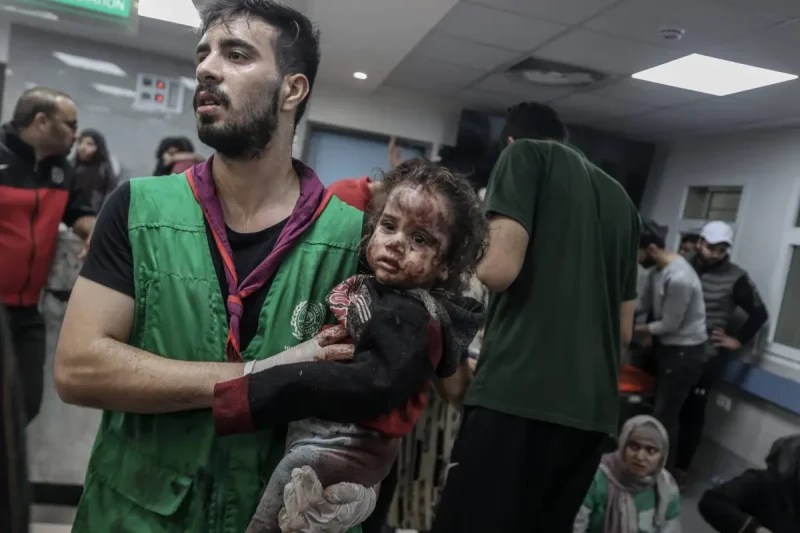
Palestine Information Center – October 17, 2023
GAZA – More than 500 people were killed and 600 others injured in an Israeli direct attack on the Al-Ahli Arab National Hospital in Gaza, Palestinian health ministry said on Tuesday evening.
According to the PIC reporter, the airstrike targeted thousands of displaced people who took refuge in the hospital’s courtyards after their houses were destroyed in the ongoing Israeli aggression.
The Hamas Movement considered the Israeli massacre at Al-Ahli Hospital a crime of genocide.
“The horrifying massacre carried out by the Zionist occupation in the Arab National Hospital in the Gaza Strip, during which hundreds of people and patients were killed, the majority of whom were displaced families, children, and women, is a crime of genocide that once again exposes the true face of this enemy and its fascist government and its terrorism, as well as the American and Western support for this criminal entity.”
The Movement called on the international community and the Arab and Islamic countries to assume their responsibility and intervene immediately to stop the ongoing Israeli aggression for 11 days.
West ‘stomps’ on Russian-drafted resolution for Gaza ceasefire
The Cradle | October 17, 2023
A Russian-drafted resolution for a humanitarian ceasefire in Gaza failed to pass at the UN Security Council (UNSC) on 16 October.
China, Russia, Gabon, Mozambique, and the UAE voted in favor of the resolution, while the US, UK, France, and Japan voted against it. Albania, Brazil, Ecuador, Ghana, Malta, and Switzerland all abstained from voting.
The text of the resolution called for an immediate humanitarian truce, the release of prisoners, access to aid, and the safe evacuation of civilians.
Vassily Nebenzia, Russia’s Permanent Representative to the UN, condemned the UNSC failure to pass the resolution and slammed the “selfish intention of the western bloc,” which he said “basically stomped” on international calls for de-escalation and an end to violence.
He added that the resolution was needed to respond to the “unprecedented exacerbation” of the calamity inside the Gaza Strip, where Israel has continued to bomb 2.2 million Palestinians trapped inside and prevent the entry of humanitarian aid.
Washington’s representative, Linda Thomas-Greenfield, denounced the resolution for failing to condemn “Hamas terrorism.”
“By failing to condemn Hamas, Russia is giving cover to a terrorist group that brutalizes innocent civilians. It is outrageous, hypocritical, and indefensible. We cannot allow this Council to unfairly shift the blame to Israel and excuse Hamas for its decades of cruelty,” she said.
The failed resolution came the same day Russian President Vladimir Putin held phone calls with the presidents of Iran, Syria, Egypt, and the Palestinian Authority (PA) and Israeli Prime Minister Benjamin Netanyahu.
“The Israeli side was in particular informed of the essential points of telephone correspondences that took place today with the leaders of Palestine, Egypt, Iran, and Syria,” the Kremlin said in a statement.
Close to 3,000 Palestinians have been killed and about 10,000 wounded due to Israel’s indiscriminate bombing of civilian infrastructure in the Gaza Strip.
The Rafah crossing with Egypt, the only entry for humanitarian aid to Gaza, has remained shut despite multiple reports of an agreement between Egypt and Israel, which Tel Aviv has denied.
“The process of opening the crossing is a joint Palestinian-Egyptian process, subject to clear working mechanisms, and requires prior coordination, which has not happened until now [due to] lack of coordination, in addition to the intense bombing to which the crossing was subjected by the Israeli occupation forces,” Salama Marouf, director of the media office of the Hamas-led government in Gaza, said on Tuesday.
Israel has bombed the aid route several times over the past few days, including on 16 August.
Any talk of truce “comes in the context of the psychological warfare waged by the Israeli occupation,” Marouf added.
Putin offers solution to stop further bloodshed in Israel-Gaza conflict while Zelensky fears losing US support
By Drago Bosnic | October 17, 2023
As hostilities in the latest Israel-Gaza conflict escalate, the threat of a wider confrontation in the Middle East is getting likelier by the day. It’s safe to assume that the Israeli Defense Forces (IDF) haven’t launched a ground operation in Gaza yet due to possible direct Iranian involvement, as well as the greater engagement of Hezbollah in the north of the country. According to the Jerusalem Post, the main reason for the postponing of the offensive is precisely the latter. The Northern Command is forced to keep the best IDF troops in the area to ensure combat readiness on the Lebanese border in case Hezbollah gets more directly involved. The Lebanon-based Shia movement has tens of thousands of soldiers and a massive stockpile of various rockets and missiles that could do significant damage to the IDF. Israel simply cannot afford to ignore Hezbollah, as the group already defeated it once in 2006, the only such occurrence in the history of IDF.
The Jerusalem Post itself cited sources saying that “while a number of factors seem to have caused a delay, one factor has been a growing concern that Hezbollah is waiting for the moment that most IDF ground forces are committed to Gaza to open a full front with the IDF in the north”. This fact alone is forcing Israel to keep most of its military assets in the relative vicinity of the border with Lebanon. It could be said that Hezbollah is already providing significant support to Hamas just by being able to tie up so many IDF troops. Iranian involvement in this is implicit, as Tehran has been one of the main backers of Hezbollah since the group’s very inception. This is forcing the Israeli leadership to exercise caution and restraint, as a direct Iranian intervention remains a possibility. Such speculation is not without merit, as Iranian Foreign Minister Hossein Amir-Abdollahian already implied that Tehran might get involved:
“Conferred with my counterparts from Tunisia, Malaysia and Pakistan. Underlined the need to immediately stop Zionist crimes & murder in Gaza & to dispatch humanitarian aid. I stressed that time is running out for political solutions; probable spread of war on other fronts is approaching unavoidable stage.”
On the other hand, most high-ranking Israeli officials are adamant that the Gaza operation must be launched. For instance, Israeli ambassador to the United Kingdom Tzipi Hotovely even compared the current airstrikes with the bombing of Dresden during WWII, when Western Allies leveled the German city, killing tens of thousands of civilians in the process. Israeli F-16I “Sufa” fighter jets have already dropped thousands of bombs on Gaza (primarily the US-made JDAMs – Joint Direct Attack Munitions), resulting in thousands of deaths and serious injuries among civilians there. According to the Palestinian Central Bureau of Statistics, the death toll among Palestinians now stands at over 3,000. For its part, Israel reported that over 1,400 Israeli civilians died so far, with at least 4,100 wounded. The figures are certainly even worse as of this writing.
Such casualties are disastrous, especially given that the conflict started just ten days ago. Since then, the world has effectively split into three groups. Apart from those that express open support for either side, the largest part of the globe has opted for neutrality. This also includes superpowers such as Russia. Namely, Moscow was among the first to call for the end of hostilities before they escalate to include all regional and perhaps even global actors. In a phone call with Russian President Vladimir Putin (the first since the conflict started), Israeli Prime Minister Benjamin Netanyahu stated that Israel would proceed with the Gaza offensive despite Moscow’s warning that it would lead to massive casualties and possibly cause a strong reaction of the Muslim world, particularly Iran and its allies. Putin urged Netanyahu to engage in talks on the peaceful settlement of the conflict.
On the other hand, the United States is looking to use the crisis to escalate against Iran, as Washington DC warhawks were quick to blame Tehran for the surprise attack launched by Hamas. US President Joe Biden will visit Israel this week, coming mere days after State Secretary Antony Blinken. Biden recently denied reports about a possible deployment of American troops, calling it “unnecessary, as Israel has one of the finest fighting forces”. And while he stated that “it would be a mistake [for Israel] to occupy Gaza”, he supported the notion that Hamas must be eliminated entirely and warned Iran not to get involved. By directly supporting the upcoming ground operation by the IDF, Washington DC is risking (almost certainly intentionally) a wider conflict that might include several Arab states and Iran. In fact, Israeli forces already hit targets in Syria and Lebanon.
In the meantime, the Kiev regime is in panic mode as the global spotlight has moved away from Ukraine. Namely, the Neo-Nazi junta frontman Volodymyr Zelensky tried to get the attention of Western audiences to himself by pompously announcing a “solidarity visit”. However, Israel flatly refused, as the “time is not right”. Zelensky is likely terrified of the prospect that he will have to share hundreds of billions in so-called US “aid” with Israel. It’s no secret that the latter is a priority for Washington DC, while the Kiev regime and the Ukrainian people as a whole are routinely seen as “cheap cannon fodder” that should only be “dying for a NATO mission.” The words of the infamous warhawk Lindsey Graham that “the best money the US ever spent because the Russians are dying” show this only works for America if its actual allies are under attack.
Drago Bosnic is an independent geopolitical and military analyst.
US warmonger Senator threatens Iran
By Lucas Leiroz | October 17, 2023
Once again, the pro-war sectors of American politics seem to want to foment a conflict situation with US involvement. A prominent public figure in the US Senate has made very serious threats to Iran, promising that Washington “will not hesitate” to take actions against Tehran if the conflict in the region continues to escalate.
The threats were made by the highly known Senator Lindsey Graham, who is notorious for his bellicose and irresponsible positions regarding American foreign policy. Graham issued a warning to Iranian authorities, stating that if there is any military action by Hezbollah against Israel, Washington will act to protect its ally, which could have serious consequences for Iran, both in military and economic terms.
“Here’s my message. If Hezbollah, which is a proxy of Iran, launches a massive attack on Israel, I would consider that a threat to the — to the State of Israel, existential in nature. I will introduce a resolution in the United States Senate to allow military action by the United States in conjunction with Israel to knock Iran out of the oil business,” Graham said.
Hezbollah was not the only topic in the Senator’s speech. Graham also stated that he does not believe in the Iranian government’s official narrative that the Hamas operation was carried out autonomously. For him, believing this is “laughable”, with total confidence on his part that Hamas’ actions were previously discussed with Iran.
“The idea that Iran read about this operation in the paper, or on television is laughable. 93% of Hezbollah and Hamas’ money comes from Iran (…) They’re the source of the problem. They’re the great evil. So, if Hezbollah escalates against Israel, it will be because Iran told them to. Then Iran, you’re in the crosshairs of the United States and Israel,” Graham added.
Graham’s stance is extremely complicated, as the current tense situation in the Middle East favors risks of escalation and internationalization, and there is therefore a considerable possibility of Iran becoming involved in hostilities. This involvement can be direct or indirect, with Tehran sending regular troops or mobilizing its allied groups – which are not limited to Hezbollah. In either scenario, the risks would be enormous for Israel, which, despite its large military strength, is a small and vulnerable country in situations of war of attrition.
Furthermore, it must be emphasized that Iran is doing everything possible not to enter the war. By warning Israel not to continue collectively punishing Gaza, Tehran is offering alternatives to armed confrontation. But Tel Aviv, despite being afraid of invading on the ground, continues to bomb Gaza and kill thousands of civilians, causing Iran’s patience to progressively run out.
It has also been informed by the Persian country’s authorities that the so-called “Axis of Resistance” – a Theran-led coalition of anti-Zionist armed movements – could act at any time in defense of the Palestinians. Iranian politicians clarified that, despite Tehran leading the coalition, the member groups have high decision-making autonomy, and there is no full Iranian control over how these movements will react to Israel. In other words, the risks of escalation are great, and Iran is not capable of preventing it alone.
The only way to truly de-escalate is through a commitment on the part of Israel to stop the attacks. Without this, the situation will go out of control and there will inevitably be intervention – if not direct from Iran, at least from some Iranian-allied group. Furthermore, it is necessary to remember that Hezbollah is already de facto involved in hostilities, with bombings being exchanged between the IDF and the Shiite militia every day. Obviously, if nothing is done to stop these hostilities, at some point Hezbollah will choose to launch a more effective incursion.
With all these factors, Graham’s words sound like a “self-fulfilling prophecy”. He points to an imminent scenario as a “red line” and issues direct threats, making real de-escalation actions virtually impossible. However, this type of behavior is in fact expected from Graham, who is a known “hawk” of American foreign policy. Months ago, the Senator became embroiled in a controversy after saying that the US was investing money in “killing Russians” in Ukraine – praising such an “investment”. In the same vein, on another occasion, he also suggested that Kiev should kill Russian President Vladimir Putin.
It remains to be seen whether these pro-war tendencies will prevail in the American public debate. For now, the US stance has been extremely bellicose, with the country sending aircraft carriers to “help” Israel. However, it is necessary to remember that the American military-industrial complex is not able to work on two different fronts at the same time – in addition to the possibility of escalation in the Pacific in the near future. Washington needs to act rationally and discourage war in the Middle East.
Lucas Leiroz, journalist, researcher at the Center for Geostrategic Studies, geopolitical consultant.
What the media forgets to tell you about Israel and Gaza

By Jonathan Cook | October 15, 2023
The missing context for what’s happening in Gaza is that Israel has been working night and day to ethnically cleanse the Palestinian people from their homeland since even before Israel become a state – when it was known as the Zionist movement.
Israel didn’t just cleanse Palestinians in 1948, when it was founded as a Western colonial project, and again under cover of a regional war in 1967. It also worked to ethnically cleanse Palestinians every day between those dates and afterwards. The aim was to move them off their historic lands, and either expel them beyond Israel’s new, expanded borders or concentrate them into small ghettoes inside those borders – as a holding measure until they could be expelled outside the borders.
The ‘settler’ project, as we call it, is a misnomer. It’s really Israel’s ethnic cleansing programme. Israel even has a special word for it in Hebrew: ‘Judaisation’, or making the land Jewish. It is official government policy.
Gaza was the largest of the Palestinian reservations created by Israel’s ethnic cleansing programme, and the most overcrowded. To stop the inhabitants spilling out, Israel built a fence-barrier in the early 1990s to pen them in. Then when policing became too hard from within the prison, Israel pulled back in 2005 to the outer perimeter barrier.
New technology allowed Israel to besiege Gaza remotely by land, sea and air in 2007, limiting the entry of food and vital items like medicine and cement for construction. Automated gun towers shot anyone who came near the fence. The navy patrolled the sea, stopping boats straying more than a kilometre or two off shore. And drones watched 24 hours a day from the sky.
The people of Gaza were sealed in and largely forgotten, except when they lobbed a few rockets over the fence – to international indignation. If they fired too many rockets, Israel bombed them mercilessly and occasionally launched a ground invasion. The rocket threat was increasingly neutralised by a rocket interception system, paid for by the US, called Iron Dome.
Palestinians tried to be more inventive in finding ways to break out of their prison. They built tunnels. But Israel found ways to identify those that ran close to the fence and destroyed them.
Palestinians tried to get attention by protesting en masse at the fence. Israeli snipers were ordered to shoot them in the legs, leading to thousands of amputees.
The ‘deterrence’ seemed to work. Israel could once again sit back and let the Palestinians rot in Gaza. ‘Quiet’ had been restored.
Until, that is, last weekend when Hamas broke out briefly and ran amok, killing civilians and soldiers alike.
So Israel now needs a new policy. It looks like the ethnic cleansing programme is being applied to Gaza anew. The half of the population in the enclave’s north is being herded south, where there are not the resources to cope with them. And even if there were, Israel has cut off food, water and power to everyone in Gaza.
The enclave is quickly becoming a pressure cooker. The pressure is meant to build on Egypt to allow the Palestinians entry into Sinai on ‘humanitarian’ grounds.
Whatever the media are telling you, the ‘conflict’ – that is, Israel’s ethnic cleansing programme – started long before Hamas appeared on the scene. In fact, Hamas emerged very late, as the predictable response to Israel’s violent colonisation project.
And no turning point was reached a week ago. This has all been playing out in slow motion for more than 100 years.
Ignore the fake news. Israel isn’t defending itself. It’s enforcing its right to continue ethnically cleansing Palestinians.
Featured Video

Anthrax War – CBC The Passionate Eye
or go to
Aletho News Archives – Video-Images
Book Review
Shattered Dreams: The HPV Vaccine Exposed (2019)
By Christina England – 30 Q&As – Book Review & Summary
Lies are Unbekoming | September 4, 2026
… Gardasil received FDA fast-track approval in 2006, Cervarix followed in 2009, and Gardasil 9 was approved in December 2014 with more than double the aluminium adjuvant content of the original. The commercial context is specific. Merck was about to lose patent protection on Zocor and faced $18 billion in Vioxx injury claims from a cardiovascular drug the company had marketed while suppressing its own data showing a five-times increase in heart attacks. Analysts projected the global HPV vaccine market at $4 billion by 2011, contingent on government-funded national programs for teenage girls. The 1986 National Childhood Vaccine Injury Act had already granted manufacturers complete liability immunity. By 2013, Japan had withdrawn its HPV vaccine recommendation after cataloguing severe adverse reactions in hundreds of girls. No Western government followed. The establishment position across the UK, US, Australia, and most of Europe held, and still holds, that the vaccines are safe and effective, that reported injuries are coincidental, and that cervical cancer prevention justifies the program. The book was published into this position, not against a vacuum.
Shattered Dreams sits alongside Mary Holland’s The HPV Vaccine On Trial and Viera Scheibner’s foundational vaccination work as part of the documented record on what has been done to a generation of teenage girls under the banner of cancer prevention. The full summary unpacks three specific findings: that Merck used the aluminium adjuvant itself as the “placebo” control in 92.5% of trial subjects, making it structurally impossible to detect excess reactions from the adjuvant; that Dr. Sin Hang Lee found HPV DNA fragments bound to aluminium in every one of sixteen Gardasil samples tested, and in the blood and spleen of a New Zealand girl six months after her third dose; and that in every country with high vaccination coverage, including Australia, the UK, Norway, and Sweden, cervical cancer rates have stopped declining and started rising specifically in the vaccinated cohort. Martínez-Lavín’s 2017 calculation puts the number needed to seriously harm with Gardasil 9 at 140, and the number needed to vaccinate to prevent one case at 1,757. Thirteen young women are seriously harmed for every one who benefits. The vaccine was approved on the basis of trials that could not detect what the trials were supposed to detect, and it is still being given to twelve-year-olds today. … Read full review
Blog Roll
 Aletho News
- The Five-Year Fuel Crisis: Why the World Economy Is Paying for a War It Thinks Is Ending
- Trump’s Big Bluff on Iran
- Swiss scammed out of millions by Ukraine-linked call centers – media
- Germany facing potential ‘violent conflict’ with Russia – spy chief
- Ukraine’s EU neighbors reject new plea from Kiev – Politico
- British Transport Police Facial Recognition Trial Scanned 926,912 People With Zero Arrests
- House Bill Would Ban Federal Use of Flock ALPR Data
- Can a Spice Rival a Drug? 10 Head-to-Head Trials Put It to the Test.
- The oil routes around Hormuz face their own chokepoints
- The Saudi-Israeli war on Yemen’s resistance: Intelligence sharing, civilian targets & sectarian propaganda
- If Americans Knew
- NAZA: Israeli embassies in UK and US promote rival documentary to challenge Gaza genocide allegations
- David Ellison appoints Israeli to lead merged Paramount-Warner studios
- Turkish Red Crescent helps elderly Gaza man walk again after Israel confiscates his prosthetic limb
- Four Palestinians Killed in Israeli Attacks in Gaza
- Two Palestinian youths killed and village razed as Israeli attacks on West Bank continue
- Two more Christian women innocent victims of Gaza raids
- Cruelty, Deprivation, Indignity: A Journalist’s 22 Months in Israeli Prison
- New IDF Website Frames Slain Gaza Journalists as Terrorists
- Israeli media: After settlers beat him mercilessly, they stuffed dirt into his mouth
- Americans Are Paying the Price to Preserve Israel’s Nuclear Hegemony
- No Tricks Zone
- Latest European Green Energy Debacle; Portugal’s Largest Flagship Solar Park Insolvent!
- Green Energy Debacle: German Expert Professor Fritz Vahrenholt Warns Of Severe Economic And Social Consequences
- Two More Paleo Reconstructions Affirm Meters-Higher Sea Levels Across Ireland, Brazil 7000-6000 Years Ago
- New Study: Earth And Venus Surface Warmth Largely Explained By Convection And Lapse Rate, Not CO2 Or Radiation
- 2025 Nature Paper Claiming Worsening Global Drought Gets RETRACTED …Heavily Flawed
- New Study: ‘Global Drought Shows No Detectable Recent Acceleration Under Climate Warming’
- Economic Masterminds: German Socialists Suggest Taxing Productivity Gains Stemming From Using AI
- The South China Sea Has Not Been Cooperating With The Climate Change Narrative
- Energy Crisis: Germany Enters Heating Season With Historically Low Gas Reserve Fill Levels
- New Study: The Antarctic Ice Sheet Gained Mass From 2020-2024 Due To Staggering Snow And Ice Accumulation

