Washington rejects ICC probe into Israel’s murder of Al Jazeera reporter
The Cradle | December 7, 2022
US State Department spokesperson Ned Price on 6 December said the White House opposes Al Jazeera taking the murder of Palestinian-American reporter Shireen Abu Aqla to the International Criminal Court (ICC).
“We oppose it,” Price told reporters when pressed about the ICC probe. He went on to add Washington maintains its “longstanding objections to the ICC’s investigation into the Palestinian situation and the position the ICC should focus on its core mission, and that core mission of serving as a court of last resort and punishing and deterring atrocity crimes.”
Abu Aqla was shot dead by Israeli troops on 11 May as she was covering a raid in the Jenin refugee camp. At the time of her death, she was wearing full body armor with clearly visible press markings.
Washington has long opposed Palestinian-led efforts to take up Israeli human rights abuses with international bodies, including the UN and the ICC.
The ICC has reportedly reviewed the evidence presented by the Qatari news network, and will make a decision on whether or not it will launch an investigation. The uncertainty comes naturally, as Israel has attempted to shut down any form of an objective inquiry into the incident since it took place.
Independent investigations by the UN, human rights groups, and western media outlets have all concluded Abu Aqla was deliberately shot by an Israeli soldier in an area where no Palestinian gunmen were present.
Last month, the White House disavowed an FBI investigation into the killing in order to appease Israel.
Israel, which rights groups accuse of imposing a system of apartheid on Palestinians, receives $3.8 billion in US security assistance annually.
Price’s reaction to the ICC probe echoes that of Israeli officials, who on Tuesday called for the expulsion of Al Jazeera journalists from the occupied territories.
“Al Jazeera is an anti-Semitic and false propaganda network working against Israel in the world,” Jewish supremacist official Itamar Ben Gvir said in a tweet, before calling for the journalists’ expulsion.
Israeli Finance Minister Avigdor Lieberman also called for withdrawing the license of Al Jazeera reporters, saying: “I expect the [Israeli] government press office to revoke the journalists’ credentials of Al Jazeera reporters who are in Israel.”
Outgoing Israeli Prime Minister Yair Lapid, for his part, has said he will not allow any interrogation of army soldiers in connection with Abu Aqla’s death.
In a statement on Tuesday, Al Jazeera said its lawsuit with the ICC includes “new witness evidence and video footage that clearly show that Abu Aqla and her colleagues were directly fired at by Israeli Occupation Forces (IOF).”
“The evidence presented to the Office of the Prosecutor (OTP) confirms, without any doubt, that there was no firing in the area where Shireen was, other than the IOF shooting directly at her,” the statement added.
“My family still doesn’t know who fired that deadly bullet and who was in the chain of command that killed my aunt,” Abu Aqla’s niece, Lina Abu Aqla, said at a press conference in The Hague.
“The evidence is overwhelmingly clear, we expect the ICC to take action,” she said, adding that they had asked for a meeting with prosecutor Karim Khan.
Israel is not an ICC member and disputes the court’s jurisdiction. The US is also not a member.
Trump Is Toast
Jewish Power will trump Trump
BY PHILIP GIRALDI • UNZ REVIEW • DECEMBER 6, 2022
There is considerable irony in the fact that Donald Trump when president virtually crawled to do Israel’s bidding more than any of his predecessors. He moved the US Embassy from Tel Aviv to Jerusalem, he accepted brutal Israeli settlement and control of the Palestinian West Bank, approved of the Israeli annexation of the Syrian Golan Heights, and ignored repeated Israeli war crimes using US provided weapons. Yet for all his gifts to Israel, which did not serve any actual US interest, he is currently being crucified by the Jewish/Israel Lobby because of an idiotic dinner with a pair of alleged anti-Semites, one of whom has been labeled a “holocaust denier.”
And the extreme reaction of Jewish groups to the affront also itself possesses a certain irony in that it demonstrates how extraordinarily powerful promoters of Jewish and Israeli interests actually are, something that those selfsame groups take pains to deny at every opportunity, just as they deny having “dual loyalty” to Israel. The fact is that force majeure will prevail and we will now see the deliberate and methodical destruction of Donald J. Trump’s 2024 proposed presidential campaign by American Jewish and Israeli apologists.
Trump had already been taken out to the back woodshed for a good whipping once after he posted a comment on his Truth Social network on October 16th. He boasted how “No President has done more for Israel than I have. Somewhat surprisingly, however, our wonderful Evangelicals are far more appreciative of this than the people of the Jewish faith, especially those living in the US… US Jews have to get their act together and appreciate what they have in Israel — Before it is too late!”
But the rage unleashed by folks like the Anti-Defamation League’s (ADL) Jonathan Greenblatt, who labeled the October 16th comment as “insulting and disgusting,” combined with the attacks on three black celebrities, is already beginning to produce pushback, particularly from many normally apolitical blacks who are upset at the viciousness of the Jewish take-no-prisoners response due to its perceived racial overtones. Other observers also are concerned at how the Jewish groups and individuals are overstating the significance of some of the alleged anti-Semitic incidents (by their definition) in a self-serving effort to validate their view that Jewish suffering is unique and cannot be compared with other crimes against humanity.
Also, for those who choose to defend the First Amendment right to free speech, it is discouraging to observe how it is possible to say nearly anything as long as it does not offend Jewish sensibilities. There have already been moves in congress to criminalize criticism of Jews or Israel, making such actions the ultimate “hate crime.” Those specifically Jewish sensibilities absurdly include declaring anyone to be an anti-Semite who criticizes the behavior of Israel as it destroys schools and shoots a Palestinian teenager nearly every day. Indeed, the US media of late has been awash with stories about surging anti-Semitism which taken all together celebrate Israeli/Jewish victimhood while also ignoring Jerusalem’s war crimes and focusing instead on alleged conspiracies against Jews. Most despicable of all in the eyes of those protectors of all things Jewish are the few visible critics who have recognized that the standard holocaust narrative that has been artfully and deliberately shaped since the Second World War is full of inconsistencies and errors in demonstrable fact. So-called “holocaust deniers” are denigrated beyond all others because they attack the very raison d’etre that constitutes the “miraculous” Israel creation myth.
Examining what Kanye West and Donald Trump did and said suggests that there has been considerable overreaction from the Greenblatts of this world and their allies in the media and in government. Starting with Kanye West, currently going by the name Ye, one finds that his initial comments made were not particularly startling, suggesting that Jews directly own or control and manage the entertainment industry in the United States, which is manifestly true. As the criticism of Ye, who believes that blacks are descended from the ancient Hebrews, intensified, he responded with some heat, eventually coming out with an incoherent tweet to “go death con 3 ON JEWISH PEOPLE.”
The comedian Dave Chappelle followed up on the controversy by delivering a stinging monologue on “Saturday Night Live” on “the Jews” and their numbers in the entertainment industry saying that it’s “not a crazy thing to think” that Jews exert outsized influence in Hollywood and the media. He also suggested that Kanye had violated Hollywood’s “rules of perception,” saying, “If they’re Black, then it’s a gang. If they’re Italian, it’s a mob. But if they’re Jewish, it’s a coincidence and you should never speak about it.”
If Greenblatt had ignored Ye it is likely that his poorly expressed comments would have been quickly forgotten, but that is not how the Greenblatts of this world operate. Every offense against the standard narrative of Jewish victimhood requires full scale war. Reports early last week suggest that the efforts by ADL and others to convince businesses associated with Ye to cut off all ties with him have been successful, meaning that he is no longer a billionaire and likely has a fortune reduced to something in the $400 million range.
There have been similar responses to basketball player Kyrie Irving’s recent tweet supporting the so-called Black Hebrew Israelite theory that he shares with Ye which asserts that blacks are in fact Jews while black comedian Dave Chapelle making fun of the ADL overreaction on Saturday Night Live is under the gun from that organization, which has accused him of “popularizing” and “normalizing” anti-Semitism. Kyrie Irving, who also believes the earth is flat, was denounced as a “person unfit to associate with” by his team owner and was suspended for eight games without pay by the Brooklyn Nets even though he characteristically offered several abject apologies.
This all led up to the dinner at Mar-a-Lago with Ye and a so-called white supremacist Nick Fuentes. It is not clear what was discussed at dinner, but Ye states that Trump was impressed by Fuentes. In the aftermath of the meal, when news of it appeared in the media, a shit storm erupted. Trump claimed both that he did not know Fuentes and that he had been tricked by Ye, that the man was brought to the meal as Ye’s guest. Those assertions, most likely lies, have been assailed all over the media and also by the usual suspects like Greenblatt who announced that “The normalization of antisemitism is here.” On the following day, Senator Chuck Schumer, the Democratic majority leader and himself a Jew who fancies himself the “Protector of Israel in the Senate” went to the Senate floor to denounce Trump’s actions as “disgusting and dangerous,” before calling them “pure evil.”
Prominent Republicans like Kevin McCarthy and Marco Rubio have also piled on, suggesting that Trump will find little support even among those politicians that he would normally consider to be favorable to his reelection. Notably, the Republican Jewish Coalition has joined in the attacks, which means that campaign money will not be flowing to Trump from that usually reliable source. And even Trump’s former lawyer and the man he named ambassador to Israel, David Friedman, has condemned his old boss and patron, saying “Even a social visit from an antisemite like Kanye West and human scum like Nick Fuentes is unacceptable.” Ironically, Friedman, whose loyalty to the United States might be considered questionable, was a persistent apologist for Israel during his time in that country rather than a promoter of US interests.
I have to confess that I had never heard of Nick Fuentes, so I did a little checking on the claim that he was a “holocaust denier.” Fuentes is well-documented as making comments reflecting his rather intense dislike for Jews, but concerning the holocaust all I could come up with was a comment allegedly made by him attacking the claim that six million Jews died in what have been described as death camps, with a suggestion that it was more likely 200,000 to 300,000 as a realistic figure supported by official and other records. He described those deaths as “cookies,” which are baked in the oven and which may have angered critics more than the comment about the numbers. Interestingly, the six million number is one of the more ridiculous assertions that are part and parcel of the holocaust narrative as it appears to have been arbitrarily arrived at as “acceptable” and there has been considerable disagreement over its reliability.
So, Fuentes, it seems, is not a holocaust denier, rather he appears to be skeptical regarding the standard narrative, as am I and many others who have bothered to look into the verifiable historical record. But that does not mean that anyone in power will be standing in line to excuse his behavior. And his dinner partner Donald Trump has evidently now outstayed his welcome by the standards of the noble protectors of Jewish and Israeli interests. The large dollops of campaign cash will not be coming in, those willing to endorse his candidacy will be far fewer, and the media will turn on him even more than it has done over the past six years. Indeed, it is doing so already. There are numerous articles in the mainstream every day telling over and over again the tale of the fateful dinner at Mar-a-Lago. Trump has clearly crossed the notorious red line on Jewish issues. The only remaining question is what will it do to people like Greenblatt? If he keeps hammering away, which he will because that is how he is wired, could the worm turn and will Americans begin to wonder how 2% of the population has obtained so much power? That would be a really interesting development.
Philip M. Giraldi, Ph.D., is Executive Director of the Council for the National Interest, a 501(c)3 tax deductible educational foundation (Federal ID Number #52-1739023) that seeks a more interests-based U.S. foreign policy in the Middle East. Website is councilforthenationalinterest.org, address is P.O. Box 2157, Purcellville VA 20134 and its email is inform@cnionline.org.
European firms ‘invest’ $171 billion in Israel’s illegal settlements: Report
The Cradle | December 6, 2022
According to a report published on 5 December by the advocacy group Don’t Buy into Occupation, investments by European firms in Israel’s illegal settlements increased by more than $30 billion since last year.
Almost 24 Palestinian, regional, and European organizations have joined forces to form the group, which aims to investigate and disclose any connections between European financial institutions and companies involved in illegal Israeli settlements.
In their second report, “Exposing the financial flows into illegal Israeli settlements,” the group discovered that between January 2019 and August 2022, 725 European financial institutions, including banks, asset managers, insurance companies, and pension funds, had financial ties to 50 firms that are directly associated with Israeli settlements. International law prohibits all squatters and settlements in Israel.
Loans and underwriting totaled $171.4 billion over the three years covered by the report. The figure represents a $30 billion increase over last year when European firms invested $141 billion in illegal settlements. European investors are also said to hold $115.5 billion in shares and bonds of companies benefiting from the settlements as of August 2022.
According to the advocacy organization, businesses directly or indirectly associated with Israeli settlements run a significant danger of being complicit in serious violations of international humanitarian law, war crimes, and crimes against humanity, as well as contributing to other human rights violations.
Meanwhile, on 8 November, the ‘Elad’ settlement association in occupied East Jerusalem received roughly $7.9 million to support illegal settlements in the Palestinian town of Silwan.
The Elad group pursues the declared objective of “Judaizing” East Jerusalem, including Silwan, as a part of its mission to expand a Jewish presence across the occupied city and to uproot the indigenous Palestinian population under the guise of archeological and touristic endeavors.
Israel has illegally expanded its territory since the 1967 Arab-Israeli war and built settlements in the occupied West Bank and East Jerusalem for over 700,000 settlers, in clear violation of international law.
Israel’s occupation of East Jerusalem is not recognized by most countries and is considered one of the biggest obstacles to peace, as Palestinians consider East Jerusalem the capital of their future state.
Israel and US hold drills targeted at Iran
RT | December 2, 2022
The Israeli military has conducted joint training operations with the United States, holding a series of air drills to simulate strikes on Iran just days after West Jerusalem pressed US officials to accelerate their “operational plans” against Tehran.
The Israel Defense Forces (IDF) detailed the drills in a statement on Wednesday, saying they practiced “various scenarios in the face of regional threats” while singling out the Islamic Republic by name.
“These exercises are a key component of our two militaries’ increasing strategic cooperation in response to shared concerns in the Middle East, particularly those posed by Iran,” the IDF said.
Four Israeli F-35 fighter jets and four American F-15s took part in the war games, which “simulated a long-range operational scenario and long-distance flights,” the IDF added, noting that a US KC-135 tanker aircraft also refueled a number of Israeli F-16s during the exercise.
The drills follow a visit to the US capital last month by IDF Chief of Staff Aviv Kochavi, who called on American officials to develop new “operational plans” to take on the Iranian military. The two sides also discussed their “commitment to ensuring that Iran never acquires a nuclear weapon,” despite Tehran’s repeated insistence that it is not pursuing the bomb.
Israel has carried out a number of drills specifically targeting Tehran in recent months, including an exercise over the Mediterranean Sea earlier this year which reportedly simulated strikes on Iran’s nuclear facilities. Another similar drill focused on nuclear sites was also conducted last June, involving more than 100 aircraft which practiced long-distance strikes.
While this week’s war games saw midair refueling operations with an American tanker, the Jerusalem Post previously reported that Israel had developed capabilities allowing it to reach Iran without the need to refuel along the way. The outlet suggested the air force had upgraded its US-made F-35 jets to accomplish that feat, but offered few details on the supposed improvements.
Israel revokes Jerusalem Residency Rights Of Imprisoned Palestinian-French Lawyer
IMEMC | DECEMBER 1, 2022
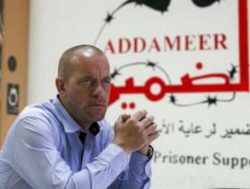 On Wednesday, the Israeli Prison Authority informed imprisoned Palestinian-French lawyer, held under Administrative Detention without charges or trial, that it revoked his Jerusalem ID card and stripped him of all residency rights in occupied Jerusalem, and will be deporting him to France upon his release.
The Israeli occupation imposed a three-month Administrative Detention order against the imprisoned lawyer, Salah Hammouri, 37, and renewed the order in June 2022, then renewed it again in September 2022.
Hammouri, a lawyer and a field researcher with the Ad-Dameer Prisoner Support And Human Rights Association, spent more than eight years in Israeli prisons, starting when he was abducted in 2001 and was sentenced to five months in prison.
In 2004 he spent four months under arbitrary Administrative Detention orders without charges, then was abducted again in the year 2005 and was imprisoned for seven years, and then in the year 2017, he was abducted yet another time and spent 13 months under Administrative Detention orders, and upon his release, he received an order barring him from entering the rest of the West Bank for two years.
On June 6, 2022, Salah received another three-month Administrative Detention order just hours before his scheduled release after being imprisoned for three months under a similar order.
The decision to revoke his residency was made in October of last year, 2021, after accusing him of “breeching loyalty to the state” for his human rights and legal work in defending Palestinian political prisoners.
Salah was born to a Palestinian father from Jerusalem where he grew up and lived, and his mother is a French national.
Several years earlier, Israel deported his French wife to her country after detaining her at the airport in Tel Aviv for three days when she returned to Jerusalem. Salah and his wife have two children.
Palestinians born in occupied Jerusalem are only granted “residency” status and not citizenship of Israel despite Israel’s constant claims of “unified Jerusalem as its capital.” Children born to Jewish parent/s in any part of the world are entitled to become citizens of Israel.
Russian Foreign Ministry: No Evidence That Tehran Wants to Develop Nuclear Weapons
Samizdat – 30.11.2022
MOSCOW – There is no evidence that Tehran intends to develop nuclear weapons, reviewing its participation in the Nuclear Non-Proliferation Treaty (NPT), Vladimir Yermakov, director of the Russian Foreign Ministry’s Non-Proliferation and Arms Control Department, said in an interview with Sputnik.
“Iran has been and remains a conscientious participant in the Treaty on the Non-Proliferation of Nuclear Weapons. The conclusion of the JCPOA in 2015 helped to finally and irrevocably remove all the questions that the [International Atomic Energy Agency] had to Tehran at that time.”
“After that, for several years Iran remained the most verified state among agency members. No deviations from its obligations were identified,” Yermakov said. “There is no evidence that would indicate Tehran’s intention to ever reconsider its participation in the NPT and start developing a nuclear explosive device.”
Yermakov’s remarks come as the US undertakes joint military drills with Israel, complete with fighter jet simulations on strikes against Iran’s nuclear program infrastructure. Earlier announcements detailed the drills would be held in the Mediterranean Sea starting November 29, and lasting through December 1.
At the time, Israeli Defense Minister Benny Gantz stressed that the drills were needed in order for Israel to “prepare” its service members for any “possibility.”
Days before the drills kicked off, US media reported that Tehran was inching toward achieving a weapons-grade enrichment, paving the way for Iran to acquire the technology to assemble nuclear weapons.
However, it’s worth noting that Iran has repeatedly indicated it has no intention to create nuclear arms; in fact, Iranian leadership imposed a fatwa in 2003 on the production or usage of any form of nuclear weapons.
Tension between Iran, Israel and the US has remained high for years. Under the Trump administration, however, escalations were at near-boiling after the US withdrew from the 2015 Joint Comprehensive Plan of Action, reimposed past sanctions and continued on a “maximum pressure” campaign against Tehran.
Talks to restore the agreement under the Biden White House have remained stalled for months. Iran earlier dispatched a “constructive” response to Washington’s proposals but was ultimately shut down by administration officials who deemed the messages “not constructive.”
Israel calls on world leaders to oppose ICJ opinion on occupation
The Cradle | November 29, 2022
On 29 November, acting Israeli Prime Minister Yair Lapid sent a letter to more than 50 world leaders, demanding them to oppose a Palestinian bid at the United Nations regarding an advisory position of the International Court of Justice (ICJ) on Israel’s occupation of Palestine.
“This resolution is the result of a concerted effort to single out Israel, discredit our legitimate security concerns, and delegitimize our very existence,” Lapid said in the letter.
Among the recipients were the heads of government of the United Kingdom, France, Croatia, Romania, Bulgaria, the Netherlands, Slovakia, Latvia, Georgia, Brazil, Uruguay, Peru, and Vietnam.
With a majority of 98 votes in favor and 17 against, a committee of the UN General Assembly approved a resolution on 11 November requesting the ICJ to “urgently” issue a stance on the effects of Israel’s illegal occupation and colonization of Palestinian territories, The New Arab reported.
In the coming weeks, the resolution has to be voted on for a second time by the plenary of the General Assembly.
The acting Prime Minister stated that this resolution resulted from a “biased campaign” by the United Nations Human Rights Council in Geneva and its Commission of Inquiry, which have repeatedly denounced human rights abuses against the Palestinians.
According to Lapid, the “status of the disputed territory must be subject to direct negotiations between Israel and the Palestinian Authority.”
However, Israel has illegally expanded its territory since the 1967 Arab-Israeli war and built settlements in the occupied West Bank and East Jerusalem for over 700,000 settlers, clearly violating international law.
On 13 November, Israeli authorities announced their plans to construct 9,000 new illegal settlement units over the ruins of Palestine’s Jerusalem International Airport.
The settlement plan was initially submitted for discussion last year by the Israeli-run Jerusalem Municipality but then halted due to pressure from EU member states and several rights groups; however, the plan has been revived and is under review by the municipality.
On 8 November, the ‘Elad’ settlement association in occupied East Jerusalem received roughly $7.9 million to support illegal settlements in the Palestinian town of Silwan.
Israeli officials slam director over ‘propaganda’ claim
RT | November 29, 2022
Israeli officials tore into their countryman, filmmaker Nadav Lapid, after he condemned popular Indian film The Kashmir Files as “propaganda” and “vulgar” before an audience at the International Film Festival of India in Goa. Lapid had been invited to lead the jury of the festival, which is funded by the government and counts many politicians and other VIPs among its attendees.
“We were all disturbed and shocked by the 15th film, The Kashmir Files, that felt to us like a propaganda, vulgar movie inappropriate for an artistic competitive section of such a prestigious film festival,” Lapid said during the closing ceremony. The film dramatizes the flight of Hindus from Kashmir in the 1990s amid an armed Muslim uprising, and has galvanized Islamophobic sentiment in the country.
“You should be ashamed,” Ambassador Naor Gilon chided Lapid via tweet on Tuesday, accusing the filmmaker of abusing “the trust, respect, and warm hospitality [the International Film Festival of India] have bestowed upon” him.
“It’s insensitive and presumptuous to speak about historic events before deeply studying them and which are an open wound in India because many of those involved are still around and still paying a price,” Gilon continued, suggesting that by publicly casting aspersions on The Kashmir Files’ version of history, Lapid was encouraging Indians to question the Holocaust.
Former ambassador to India Danny Carmon agreed, calling for Lapid to “apologize for the personal comments on historical facts without sensitivity and without knowing what he is talking about.” Consul General of Israel to Midwest India Kobbi Shoshani was quick to reassure local media that Lapid’s words were “not the opinion or the attitude of the government of Israel,” declaring “we completely don’t accept such speeches.”
While Lapid clarified he meant his comment as an artistic rather than personal criticism – “I feel totally comfortable to share openly these feelings here with you on stage since the spirit of the festival can truly accept also a critical discussion, which is essential for art and for life,” he said – that did little to blunt the attacks that came his way, from Indians as well as Israelis.
Lapid was denounced as “a Hindu-hating bigot who whitewashes ethnic cleansing” and as “not less than a Nazi enabler” by Abhinav Prakash, head of the Bharatiya Janata Yuva Morcha youth movement, while Aditya Raj Kaul, executive editor of the TV9 network, questioned whether the filmmaker would “call Holocaust a propaganda [sic]” or say the same about Holocaust films Schindler’s List and The Pianist.
Russia, China slam Israel’s ‘disproportionate use of force’ against Palestinians
Press TV – November 29, 2022
Russia and China have strongly denounced Israeli regime’s excessive use of force against Palestinians amid heightened tensions in the occupied territories.
Speaking at a UN Security Council briefing on the situation in the Middle East, including the Palestinian issue, Russia’s deputy UN ambassador Dmitry Polyanskiy slammed Israel’i regime’s “disproportionate use of force” in the occupied Palestinian territories.
He also warned that the regime’s “unilateral steps”, including expansion of settlements, seizure of Palestinian property, demolition of Palestinian-owned housings, arbitrary arrests, violation of the status quo of al-Quds’ holy sites continue to create “irreversible facts on the ground”.
Polyanskiy further noted that Israeli regime’s “arbitrary illegitimate actions reach beyond the limits of West Bank and Gaza and affect the neighboring Arab states, whose sovereignty was violated on numerous occasions”, referring to Israeli strikes against Syria and Lebanon.
The envoy also slammed Washington, Tel Aviv’s staunch ally, for repeatedly blocking UN Security Council resolutions on the Israeli-Palestinian conflict.
“The Palestinian problem is … being driven out of the international agenda by the United States, who blocked the efforts of the Quartet of international intermediaries for the Middle East and precluded adoption of any meaningful decisions by the Security Council,” he asserted.
Speaking at the same meeting, China’s Ambassador to the UN envoy, Zhang Jun, also expressed his country “deep concern” about the deteriorating security situation in the occupied Palestinian territories.
Referring to 2022 being the deadliest year for Palestinians in the West Bank since 2005, Zhang said Beijing condemns “all indiscriminate attacks on civilians, deplores the grave violations against children, opposes the excessive use of force by security forces”, and called for holding the perpetrators accountable.
The ambassador also referred to dire humanitarian and economic situation in the Gaza Strip, urging Israel to lift its 15-year blockade on the coastal enclave.
“We call on Israel to ease restrictions on the movement of people and humanitarian, reconstruction materials into and out of the Gaza Strip, to lift the blockade on Gaza as soon as possible, and to effectively create conditions for the development of Palestinian communities in the West Bank,” said Zhang.
He also called for an end to Israeli settlement activities that he said is a roadblock in so-called two-state solution to the conflict.
“The continued expansion of settlement activities that encroach on the Palestinian land, swallow up Palestinian resources and violate Palestine’s right to self-determination have made a contiguous, independent and sovereign state of Palestine even more elusive,” he said.
“China urges Israel to cease all settlement activities and return to the right track of the two-state solution.”
Zhang urged the UNSC to “support the Palestinian people in restoring and exercising their inalienable rights”, saying “On issues concerning the future and fate of the Palestinian people, no one has the right to veto.”
Israeli forces have recently been conducting overnight raids and killings in the northern occupied West Bank, mainly in the cities of Jenin and Nablus, where new groups of Palestinian resistance fighters have been formed.
“Jewish Power” Exists — Genocidally — in Israel
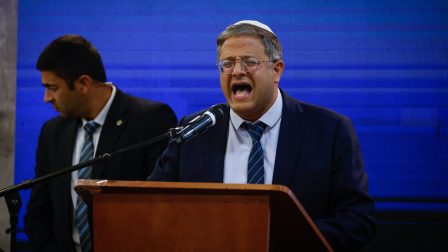
Head of the Jewish Power Party Itamar Ben-Gvir
BY KEVIN BARRETT • UNZ REVIEW • NOVEMBER 28, 2022
Dave Chappelle recently joked that there are “two words in the English language that you should never say together in sequence. And those words are ‘the’ and ‘Jews.’”
But that isn’t the only banned two-word sequence. Another is “Jewish power.” As the Israeli-born musician-philosopher Gilad Atzmon says, “Jewish power is the power to suppress discussion on Jewish power.” So when Kanye West tried to talk about Jewish power, powerful Jews united to destroy him—as if that would somehow prove that Jewish power doesn’t exist.
Jewish power in North America and Europe mainly stems from the disproportionate presence of Jews in powerful positions in media, politics, and finance—a phenomenon best explained by such traditional Jewish values as education, ambition, and ethnic nepotism.* But nobody is allowed to mention nepotism. As Chappelle said, “If they’re black it’s a gang. If they’re Italian it’s a mob. If they’re Jewish it’s a coincidence and you should neeever speak about it.”
But there is one place where Jewish Power is openly discussed: Occupied Palestine. The new kingmaker in Israel is Itamar Ben-Gvir, the leader of the far-right Jewish Power Party. Ben-Gvir’s party secured 14 Knesset seats in the November elections, making it the third-largest party in Israel and the intimate partner of Benyamin Netanyahu in his return to the Prime Minister’s office.
In so-called Israel, Jewish Power means genocide. The Jewish Power party openly yearns for the extermination/expulsion of all non-Jews from historic Palestine. And though that position is not materially different from the unspoken policy of all of Zionism’s leaders since the beginning of the 20th century, Ben-Gvir and his party are now saying it in public—and working to hasten the advent of the “final solution to the Palestinian problem.” As Jewish Power continues to expand its influence, the slow-motion genocide of Palestine threatens to speed up exponentially.
Jewish Power leader Itamar Ben-Gvir clearly wants to kill every Arab he can get his bloody little Zionist hands on. Ben-Gvir practically worships the Zionist terrorist Baruch Goldstein, who murdered 29 praying Palestinian Muslims and wounded another 125 in the 1994 Hebron massacre. The Jewish Power leader actually hung a portrait of Goldstein in his living room, where it remained for years until his political advisors told him to take it down.
Paradoxically, Israel’s transformation into an admittedly genocidal entity could make its genocide of Palestine more difficult.
The Zionists have gotten away with their slow motion genocide of the Palestinians by posing as victims. Now that they are proudly proclaiming themselves genocide perpetrators, the occupiers of Palestine are alienating most of the world, including their Western supporters. Even the liberal and moderate Jews who constitute a significant element of Jewish power in the West are starting to waver—and younger Western Jews are beginning to turn away from Zionism entirely.**
Tellingly, one of the most fanatically pro-Zionist Jews in the American Establishment, Thomas Friedman, now says “The Israel We Knew Is Gone.” The previous Israel that Friedman “knew” was the one that practiced deniable genocide, and Friedman was one of the leading genocide deniers. Now that the Zionist genocide of Palestine is no longer deniable, Friedman is out of a job, and he isn’t happy about it.
Friedman cites US Senator Bob Menendez, who says the triumph of Jewish Power in Israel will “seriously erode bipartisan support in Washington.” How much erosion actually occurs remains to be seen. In 2015, during the height of Netanyahu’s feud with then-president Obama, the Israeli PM drew 28 standing ovations in a 47 minute speech to the US Congress—the most abject display of treasonous sycophancy in the history of the Republic. If he returns to Washington next year as head of an openly genocidal government, will Netanyahu only get a standing ovation every five minutes instead of every two minutes? Will a few dozen of the more than 500 congress-traitors remain seated and offer only tepid applause? That might hurt Bibi’s feelings. But it won’t erect any significant obstacles to the acceleration of Zionist ethnic cleansing.
In the past, Israel’s outrageous behavior, including its repeated attacks on the United States and murders of Americans, has been covered up by the Jewish-dominated mainstream media, America’s heavily Jewish-funded politicians, and, when necessary, Jewish-dominated organized crime groups working in sync with Israeli intelligence agencies and their American assets.*** Israel launched terrorist attacks against American targets in Egypt, murdered the Kennedys, slaughtered 34 sailors and wounded 174 in its attack on the USS Liberty, and was probably the primary force behind the September 11, 2001 false flag that killed nearly 3,000 people and tricked the US into launching a two-decade war on Israel’s enemies. Israeli forces have murdered Americans including Rachel Corrie and Shireen Abu Akleh without eliciting any meaningful protests from the US government or the Jewish-power-dominated mainstream media. Since Israel has literally gotten away with murder so many times, it seems unlikely that the US would ever stop Netanyahu and Jewish Power from accelerating the genocide of Palestine.
So who will stop the genocide? The Palestinians themselves, together with their regional and global supporters. The Axis of Resistance, consisting of Islamic Iran and its allies, has developed the military and political strength to deter the Netanyahu-Jewish Power axis of genocide. First consider the military equation. If genocidal Zionist extremists were to attempt the sudden large-scale murder and expulsion of Palestinians, the combined power of Hamas and other Palestinian militant groups, backed by the ever-expanding rocket reach of Hezbollah and the newly hypersonic-rocket-equipped Iranian military, has the power to resist at each step up the escalation ladder. That means that Israel’s regional nuclear monopoly has been effectively neutralized by the Axis of Resistance, which has achieved a Mutual Assured Destruction style balance of power by non-nuclear means—namely through its immense fleets of rockets with conventional warheads, including the new hypersonic missiles, that are sufficiently advanced and numerous to ensure that the Zionists’ leaky Iron Dome defense could not prevent Israel from being reduced to rubble if it came to an all-out-exchange.
Under the umbrella of its military deterrent, the Axis of Resistance will likely enjoy an ever-improving geopolitical balance of forces for the foreseeable future. Iran’s mending fences with Hezbollah, joining the Shanghai Cooperation Organization (SCO), cementing its de facto alliances with Russia and China, and dialing down tensions with Saudi Arabia should combine to benefit the Palestinian resistance against the newly-elected ultra-genocidal Zionists in Tel Aviv. (It is hard to imagine Saudi Arabia and the other Zionist-friendly Arab regimes actively assisting Netanyahu and Ben-Gvir in any “final solution to the Palestinian problem” scenario, especially now that the Saudis seem to be declaring their independence from the Zionist-infested US empire.)
The world, if not the dying US empire, is already displaying disgust with the almost-daily murders of young Palestinians by the proudly genocidal new regime. Citizens of various nations have been visibly shunning Israelis at the World Cup in Doha; countless videos show Israeli reporters being disgustedly rebuffed by World Cup attendees. Japanese, Brazilians, Qataris, and others have made it clear that the genocidal Zionist entity is not welcome in the community of nations. The triumph of Jewish Power in Tel Aviv seems to be sparking widespread revulsion against Zionism that may evolve into a de facto boycott of all things Israeli by an ever-increasing segment of the world’s population.
So the ever-more-brazen, ever-more-fanatical Zionist project, whose end goal has always been the extermination of the Palestinians and the replacement of Palestine by “Israel,” is digging its own grave. The harder it works to destroy Palestine, the greater the forces that arise against it. As the Qur’an states, “They plot and Allah plots, and Allah is the best of planners.”
Will the collapse of the psychopathic avatar of Jewish power in Palestine stimulate Jews to meditate, repent, return to God, and use what power they may possess for good rather than evil? One can only say insha’Allah. And Allah knows best.
*For illuminating discussions of Jewish ethnic nepotism, see Philip Weiss’s “Do Jews Dominate in American Media? And So What If We Do?” and the second half of Ron Unz’s “Challenging Racial Discrimination at Harvard.”
**The presence of justice-seeking Jews in powerful positions shows that Jewish power can have positive as well as negative repercussions, as illustrated by the disproportionate Jewish presence in the civil rights struggle and opposition to the Vietnam war during the 1960s. But of course it is only the negative aspects of Jewish power that we are not supposed to talk about.
**Whitney Webb’s One Nation Under Blackmail: The Sordid Union Between Intelligence and Crime That Gave Rise to Jeffrey Epstein traces the history of the secret government of the United States, which is dominated by Israel-loyal denizens of the overlapping worlds of intelligence and organized crime.
Featured Video
Anthrax War – CBC The Passionate Eye
or go to
Aletho News Archives – Video-Images
Book Review
Shattered Dreams: The HPV Vaccine Exposed (2019)
By Christina England – 30 Q&As – Book Review & Summary
Lies are Unbekoming | September 4, 2026
… Gardasil received FDA fast-track approval in 2006, Cervarix followed in 2009, and Gardasil 9 was approved in December 2014 with more than double the aluminium adjuvant content of the original. The commercial context is specific. Merck was about to lose patent protection on Zocor and faced $18 billion in Vioxx injury claims from a cardiovascular drug the company had marketed while suppressing its own data showing a five-times increase in heart attacks. Analysts projected the global HPV vaccine market at $4 billion by 2011, contingent on government-funded national programs for teenage girls. The 1986 National Childhood Vaccine Injury Act had already granted manufacturers complete liability immunity. By 2013, Japan had withdrawn its HPV vaccine recommendation after cataloguing severe adverse reactions in hundreds of girls. No Western government followed. The establishment position across the UK, US, Australia, and most of Europe held, and still holds, that the vaccines are safe and effective, that reported injuries are coincidental, and that cervical cancer prevention justifies the program. The book was published into this position, not against a vacuum.
Shattered Dreams sits alongside Mary Holland’s The HPV Vaccine On Trial and Viera Scheibner’s foundational vaccination work as part of the documented record on what has been done to a generation of teenage girls under the banner of cancer prevention. The full summary unpacks three specific findings: that Merck used the aluminium adjuvant itself as the “placebo” control in 92.5% of trial subjects, making it structurally impossible to detect excess reactions from the adjuvant; that Dr. Sin Hang Lee found HPV DNA fragments bound to aluminium in every one of sixteen Gardasil samples tested, and in the blood and spleen of a New Zealand girl six months after her third dose; and that in every country with high vaccination coverage, including Australia, the UK, Norway, and Sweden, cervical cancer rates have stopped declining and started rising specifically in the vaccinated cohort. Martínez-Lavín’s 2017 calculation puts the number needed to seriously harm with Gardasil 9 at 140, and the number needed to vaccinate to prevent one case at 1,757. Thirteen young women are seriously harmed for every one who benefits. The vaccine was approved on the basis of trials that could not detect what the trials were supposed to detect, and it is still being given to twelve-year-olds today. … Read full review
Blog Roll
 Aletho News
- The Maidan Killings and the False-Flag Case
- Georgia’s Largest Healthcare System Will Fire Employees Who Refuse Flu Vaccine
- The Five-Year Fuel Crisis: Why the World Economy Is Paying for a War It Thinks Is Ending
- Trump’s Big Bluff on Iran
- Swiss scammed out of millions by Ukraine-linked call centers – media
- Germany facing potential ‘violent conflict’ with Russia – spy chief
- Ukraine’s EU neighbors reject new plea from Kiev – Politico
- British Transport Police Facial Recognition Trial Scanned 926,912 People With Zero Arrests
- House Bill Would Ban Federal Use of Flock ALPR Data
- Can a Spice Rival a Drug? 10 Head-to-Head Trials Put It to the Test.
- If Americans Knew
- “We See Our Homes Now From A Satellite, Like Strangers”
- Watch “Gaza: Doctors Under Attack”, originally censored by BBC
- NAZA: Israeli embassies in UK and US promote rival documentary to challenge Gaza genocide allegations
- David Ellison appoints Israeli to lead merged Paramount-Warner studios
- Turkish Red Crescent helps elderly Gaza man walk again after Israel confiscates his prosthetic limb
- Four Palestinians Killed in Israeli Attacks in Gaza
- Two Palestinian youths killed and village razed as Israeli attacks on West Bank continue
- Two more Christian women victims of Israeli raids on Gaza
- Cruelty, Deprivation, Indignity: A Journalist’s 22 Months in Israeli Prison
- New IDF Website Frames Slain Gaza Journalists as Terrorists
- No Tricks Zone
- Latest European Green Energy Debacle; Portugal’s Largest Flagship Solar Park Insolvent!
- Green Energy Debacle: German Expert Professor Fritz Vahrenholt Warns Of Severe Economic And Social Consequences
- Two More Paleo Reconstructions Affirm Meters-Higher Sea Levels Across Ireland, Brazil 7000-6000 Years Ago
- New Study: Earth And Venus Surface Warmth Largely Explained By Convection And Lapse Rate, Not CO2 Or Radiation
- 2025 Nature Paper Claiming Worsening Global Drought Gets RETRACTED …Heavily Flawed
- New Study: ‘Global Drought Shows No Detectable Recent Acceleration Under Climate Warming’
- Economic Masterminds: German Socialists Suggest Taxing Productivity Gains Stemming From Using AI
- The South China Sea Has Not Been Cooperating With The Climate Change Narrative
- Energy Crisis: Germany Enters Heating Season With Historically Low Gas Reserve Fill Levels
- New Study: The Antarctic Ice Sheet Gained Mass From 2020-2024 Due To Staggering Snow And Ice Accumulation

