Netanyahu hands control of police ministry to supremacist Ben Gvir
The anti-Arab Religious Zionist party will also be in charge of the expansion of illegal settlements in the occupied West Bank

Knesset member Itamar Ben-Gvir, who heads the Religious Zionism party is held back during a special session on 13 June, 2021. (Photo: EMMANUEL DUNAND/AFP – Getty Images)
The Cradle | November 25, 2022
Israel’s Likud party, led by Prime Minister-designate Benjamin Netanyahu, on 25 November reached its first coalition deal with the Jewish supremacist ‘Religious Zionist’ (Otzma Yehudit) party.
As per the agreement, anti-Arab zealot Itamar Ben Gvir will serve in the newly created role of National Security Minister – an expanded public security minister role – and will have a seat in the security cabinet.
“We took a big step tonight toward a full coalition agreement, toward forming a fully, fully right-wing government … I am happy that the agreement on the ministries that Otzma Yehudit will receive will allow us to realize our election promises,” Ben Gvir said in a statement.
While Likud and the Religious Zionist party have so far only signed an annex to a coalition deal, the agreement will also give Ben Gvir’s extremist group control of the ‘Development of the Negev, Galilee, and National Fortitude Ministry;’ the role of deputy minister in the Ministry of Economy; chairmanship of the Knesset’s Public Security Committee; and rotating chairmanship of the Special Committee for the Israeli Citizens’ Fund (which oversees state revenue from gas drilling).
The ‘Negev and Galilee Ministry’ will specifically be responsible for regulating the expansion of illegal settlements in the occupied West Bank.
Moreover, Ben Gvir’s freshly minted National Security Ministry will also be handed control over the West Bank Border Police, while a new “expanded southern law” will be implemented that will permit Israeli troops to shoot Palestinians “caught stealing weapons from military bases.”
During this month’s elections, the Religious Zionist party helped Netanyahu secure a commanding 64-seat majority in the Knesset.
The far-right party has on previous occasions called for the formal annexation of the entire occupied West Bank – in violation of international law – as well as the seizure of the Al-Aqsa Mosque compound in occupied East Jerusalem to place it under Jewish ownership.
Ben Gvir himself has led several violent incursions into the Muslim holy site under police protection and has overseen the expulsion of Palestinian worshippers.
Weeks before the election, Ben Gvir made headlines for pulling a gun on Palestinians in the Sheikh Jarrah neighborhood of East Jerusalem, urging settlers to shoot at the locals.
He is also an outspoken proponent of creating a “deportation law” that would target anyone who is “disloyal” to the State of Israel.
Earlier this month, Israeli media reported Ben Gvir asked for tougher conditions for Palestinian prisoners, as well as unfettered access for settlers into Al-Aqsa Mosque, during early coalition talks with Likud.
On top of this, just this week, the firebrand lawmaker called for the resumption of targeted assassinations of Palestinians in the wake of a bomb attack in occupied Jerusalem.
Reneging on Abraham Accords, Netanyahu authorises ‘soft annexation’ of West Bank
MEMO | November 24, 2022
Israel’s designate Prime Minister, Benjamin Netanyahu, has been accused of breaking his agreement with Arab countries that normalised relations with the Occupation State during the current coalition negotiations. The Likud leader is reported to have agreed to move the civil administration in the West Bank from Israeli Ministry of Defence to the Ministry of Finance to appease far-right member of the Knesset, Bezalel Smotrich.
Religious Zionism will be handed the civil administration portfolio, according to Haaretz. The Ministry is hugely significant for Palestinians, as it oversees coordination of Israel’s activity in the Occupied West Bank. The agreement was reached as part of the ongoing coalition talks between Netanyahu’s Likud and Religious Zionism, which stalled once more after the parties failed to reach agreement on several other key issues.
Though details of the talks are yet to be disclosed, Likud is said to have acceded to Religious Zionism’s demand for some of the powers of the civil administration, which is under the Defence Ministry. The deal will mean that Smotrich, who is an advocate of Israel’s illegal settlement enterprise, will be handed power in approving Palestinian construction plans and settlement construction in Area C. Decisions around illegal outposts, illegal construction and work permits for Palestinians falls under the remit of the administration.
The biggest prize for Religious Zionism, which became the third largest party with 14 Knesset seats, is to seize control over affairs in the Occupied West Bank. Although past Israeli governments showed reluctance to annex the territory completely over concerns around backlash from the international community, Religious Zionism has no such fear.
Officials in Religious Zionism claimed, Wednesday, that the Party acceded to Netanyahu’s requests to forgo the defence portfolio in exchange for the Finance Ministry. The condition for the agreement is that the responsibility for settlements and the civil administration is transferred from the Ministry of Defence to the Ministry of Finance. Under International law, the West Bank is occupied, which means that the military of the occupying power oversees the territory.
Netanyahu has been accused of reneging on his deal with the Arab States by agreeing to the transfer of the civil administration. “Moving the civil administration in the West Bank from Israeli Ministry of Defence to the Ministry of Finance will be a ‘soft annexation’ of the WB & violation of the commitment Netanyahu gave the US & UAE to suspend his annexation plan,” said Israeli journalist, Barak Ravid on Twitter. “It could harm the Israel-UAE peace treaty,” Ravid added, referring to 2020 normalisation deal.
Referred to as the “Abraham Accords,” the UAE hailed the deal as victory for the two-state solution. Abu Dhabi defended its decision to normalise relations with the Occupation State by insisting that it had prevented Israel from annexing the West Bank, a threat which Netanyahu, who was the Prime Minister at the time, had issued.
It is not clear what steps the UAE will take in response. UAE Foreign Minister, Sheikh Abdullah bin Zayed (ABZ) raised his concerns over Religious Zionism becoming part of a coalition with Netanyahu, during a recent visit to Israel.
Israel to expand regional activities with US army

The Cradle | November 25, 2022
On 24 November, the Israeli Chief of Staff, General Aviv Kochavi, announced a significant expansion of joint activities with the US army in the region, indicating that Israel would work at a faster pace against the “positioning” of the Iranian government in the Middle East, according to Al-Arabiya news.
“To enhance our capabilities in the face of the challenges in the region, joint activity with CENTCOM will be significantly expanded in the near future. At the same time, the IDF will continue to act at an accelerated pace against the Iranian regime’s entrenchment in the region,” he said.
Kochavi returned from the United States on 24 November and met with US Joint Chiefs of Staff Chairman Mark Milley, with whom he discussed strengthening cooperation between the two military forces, according to Al-Arabiya.
The White House announced that US National Security Adviser Jake Sullivan met with Aviv Kochavi in Washington and discussed several issues during the meeting.
National Security Council spokeswoman Adrienne Watson said in a statement on 21 November that Sullivan “affirmed the US administration’s firm support for Israel’s security, and the two sides exchanged views on a broad range of regional security issues of mutual interest.”
“Sullivan affirmed US President Joe Biden’s commitment to ensuring that Iran does not acquire a nuclear weapon,” she added.
Meanwhile, The Times of Israel reported that Kochavi told US military officials that the two countries should accelerate what he described as “offensive operations plans” against Iran.
On 19 November, US Forces Central Command (CENTCOM) chief Michael Erik Kurilla announced in Bahrain that a US task force will deploy more than 100 unmanned vessels by 2023 to “help ensure maritime security” in the Gulf region’s strategic waters, according to Mehr News Agency.
“By this time next year, Task Force 59 will bring together a fleet of over 100 unmanned surface and subsurface vessels operating together, communicating together, and providing maritime domain awareness,” Kurilla announced during the annual Manama dialogue conference.
The Pentagon has also been collaborating with Israel, Saudi Arabia, and other nations in West Asia over the past eight months to create a network of unmanned drones to counter Iran in the Persian Gulf.
US concessions to Palestine always work in Israel’s favour
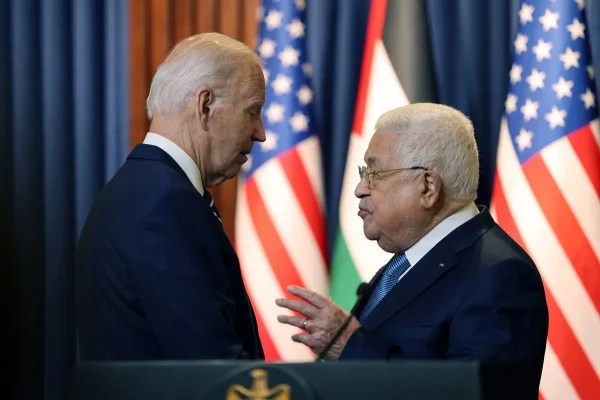
Joe Biden and Mahmoud Abbas in Bethlehem, West Bank on July 15, 2022. [Palestinian Presidency – Anadolu Agency]
By Ramona Wadi | MEMO | November 24, 2022
Further proof of US President Joe Biden reneging on his electoral promises with regard to Palestine is the ongoing refusal to reopen the US Consulate in occupied Jerusalem for use by Palestinians, and opting instead for creating a new role of Special Representative for Palestinian Affairs, which has been given to Hady Amr. Amr served as deputy assistant secretary of state for Israeli and Palestinian Affairs, and is known mostly for insisting that Israel devises ways to strengthen the Palestinian Authority; for Israel’s benefit, of course.
Equally clear is that PA Leader Mahmoud Abbas is acquiescing to US demands, despite his lamentations that the Biden administration is also employing the waiting tactic, which has stalled Palestinians’ political trajectory for decades. The PA’s delight at Biden’s election win was just a brief interlude; it soon became clear that his predecessor Donald Trump’s legacy would not be rescinded, apart from the US decision to allocate some financial support for Palestinian humanitarian needs.
According to Axios quoting an unnamed US State Department official, “The Washington-based Special Representative for Palestinian Affairs will engage closely with the Palestinians and their leadership and, together with Ambassador [Thomas] Nides and his team, continue to engage with Israel on Palestinian-related issues.”
While Israeli media is describing the move as an upgrade of US-Palestinian relations, diplomatic engagement between the US and the PA remains one that prioritises colonial collaboration, given that despite promises to bring the US back to the fold of international consensus regarding the two-state compromise, Washington remains tied to Trump’s political legacy. The international community has also aligned itself with the Abraham Accords, since the plans mirror mainstream engagement with Israel. The PA, on the other hand, simply bleats its opposition and backs down before accepting concessions in return for its subjugation.
Amr will be working under Barbara Leaf, the US Assistant Secretary for Near Eastern Affairs who, last September, stated that improving economic conditions in the occupied West Bank was crucial to “sustain improvement in security conditions.” Israel’s security, that is. Diplomatic relations with the PA, as far as the US is concerned, are only valid as long as it means that security coordination will remain “sacred”, as Abbas puts it. Outside of the security coordination parameters, the PA is a main player that only exists as an entity that fails to take political steps against Israel’s colonial expansion.
The US has stated repeatedly its purported commitment to reopen its consulate in Jerusalem, yet appointing Amr as special representative is another indication that the Palestinian request will go unheeded for the time being. Hence the creation of a role that purportedly champions Palestinian affairs and diplomatic relations with Washington. Yet another “concession” to Palestine that works in Israel’s favour.
Former US Special Envoy for Israeli-Palestinian Negotiations, and former Ambassador to Israel, Martyn Indyk described the US move as “a signal to the Palestinians of their importance”. Yet, the US does things differently with Israel. It doesn’t offer concessions to Israel; it offers military, financial and economic support, while Palestinians remain tethered to a humanitarian project that only serves Israel’s expansionist plans and interests. Importance does not necessarily have a positive connotation. In this case, the Palestinians’ “importance” is not directed towards their political rights, but the means through which Israel and the US can further their diplomatic engagement behind a facade that generates less criticism and fewer allegations of American bias towards the colonial-occupation state.
Israel pushes US on military action against Iran
RT | November 23, 2022
Israel Defense Forces (IDF) Chief of Staff Aviv Kochavi has called on the United States to develop new “operational plans” to take on the Iranian military, urging top US defense and intelligence officials to “accelerate” joint efforts to counter the Islamic Republic.
Kochavi held a series of meetings with Chairman of the Joint Chiefs of Staff Mark Milley, National Security Advisor Jake Sullivan and CIA Director William Burns, the IDF said in a press release on Tuesday, noting that he discussed the “Iranian threat” with each of the officials he spoke with since landing in the US on Sunday morning.
“We are at a critical point in time which requires the acceleration of the operational plans and the cooperation against Iran and its proxies in the region,” Kochavi said after the meetings. “On the one hand, Iran is under many economic, military and internal pressures, and on the other hand continues to advance the nuclear project.”
During his sit-down with General Milley, the two officials discussed “strengthening cooperation between the [US and Israeli] armies against threats in the region, chief among them the Iranian nuclear threat,” according to the IDF. Sullivan, too, said the White House would carry out its pledge to “prevent Iran from acquiring nuclear weapons.”
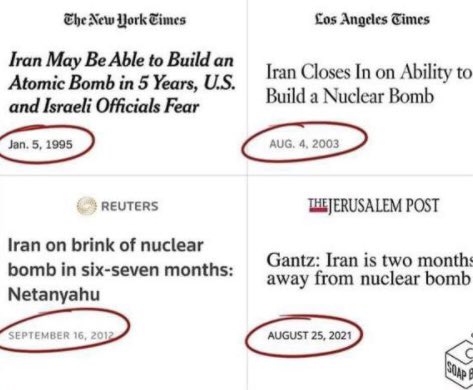
While Israel has offered little evidence supporting the existence of an Iranian nuclear weapons program, officials have claimed for decades that Tehran is on the cusp of developing its own bomb. The Islamic Republic has denied any plans to build nuclear weapons – with Supreme Leader Ayatollah Ali Khamenei issuing a fatwa (religious decree) against all weapons of mass destruction in 2003 – and passed numerous inspections by the UN’s nuclear watchdog under a major deal signed with world powers in 2015.
However, after Washington unilaterally withdrew from the nuclear deal under President Donald Trump, Tehran has steadily scaled back its compliance, boosting its enrichment of uranium and building new advanced centrifuges while demanding an end to US sanctions. Iran has nonetheless insisted that such steps do not indicate it is seeking a nuclear weapon, despite continued allegations from the United States and Israel.
IAEA primary instrument of pre-aggression, sets scene for US, Israeli unilateral actions: Analyst
Press TV – November 22, 2022
works before a news conference attended by IAEA Director Rafael Grossi during an IAEA Board of Governors meeting in Vienna, Austria, September 13, 2021. (Photo by Reuters)
A political analyst has described the International Atomic Energy Agency (IAEA) as a primary “instrument of pre-aggression” which paves the way for Israel and the US to take unilateral actions against Iran.
“The IAEA has become a primary instrument of pre-aggression. In other words, they create a scenario, they make the false charges, they do not prove the charges, and then they use the false unproven charges, to stoke the fires of aggression against you,” John Bosnitch told Press TV on Monday while commenting on recent tensions between Iran and the IAEA following a resolution passed by the UN nuclear body’s Board of Governors.
The politically motivated draft resolution, ratified on Thursday, has criticized Iran for what it called a lack of cooperation with the agency. It was put forward by the United States, Britain, France, and Germany, in continuation of their political pressures on Iran.
Bosnitch added that the “trend” that has been going on for years against Iran is rooted in the Israeli lobby and its influence on the US government and American personnel inside the IAEA.
“It looks like yet another provocation to create false grounds for aggressive action against Iran,” he said.
The political analyst further pointed to the “invented” excuses and provocations against Iran, saying that the US uses the IAEA as a tool “to make it a little bit more believable to those naive people around the world who still hold trust in such institutions.”
Once the fires of aggression are lit, Bosnitch said, Israel and the US can act unilaterally and illegally based on the so-called reports by the IAEA.
“And that is the formula for aggression. And I have to say that Iran, as I’ve said, through all discussions on this topic, must be ready for the worst,” he cautioned.
‘IAEA a spying organization’
Bosnitch also called the IAEA a “spying organization” that only spies on enemies of the United States and Israel.
In order to ease concerns about its nuclear program, Iran has agreed to install surveillance cameras in its nuclear facilities and has provided the IAEA with physical monitoring and satellite images. According to Bosnitch, however, “nothing works because the lies perpetrated by the lying mainstream media are bigger to the common person’s eye than the truth.”
Head of the Atomic Energy Organization of Iran Mohammad Eslami said on Sunday that the Islamic Republic will give a “firm response” to the IAEA Board of Governors’ anti-Iran resolution.
“The nuclear programs of the Islamic Republic of Iran are moving forward according to the strategic action plan of the parliament, and the issuance of multiple resolutions against Iran will not cause any disruption in the progress of these programs,” the AEOI chief added.
According to a report published on Tuesday, Iran has started enriching uranium to the purity level of 60% at its Fordow nuclear facility. The country has also installed two new IR2M and IR4 cascades at the Natanz and Fordow facilities.
The report added that Iran has fitted and launched new centrifuges at two empty halls in Fordow and Natanz nuclear sites and replaced IR1 centrifuges at Fordow with IR6 which will increase enrichment at the site by 10 times.
Tehran informed the IAEA of that decision via a letter. It described the move as a strong message to the recent anti-Iran resolution passed by the IAEA’s Board of Governors.
‘US provoking protests in Iran’
Elsewhere in his remarks, Bosnitch mentioned the recent violent riots across Iran, warning that US agents are working inside Iran “right now” to provoke protests.
“Whatever grievance there might have been, it has been amplified by the US State Department and by the CIA inside your country already.”
He added that the US is not only attacking Iran on the IAEA side but also organizing protest expansion inside the country.
“They definitely try new tactics, and the only protection against American militarism and unilateralism is to tie up with other countries that are threatened by the same thing,” he concluded.
Riots have broken out in Iran since 22-year-old woman Mahsa Amini died in hospital on September 16, three days after she collapsed in a police station. An investigation has attributed Amini’s death to her medical condition, dismissing allegations that she was beaten by police forces.
In the last two months, using the protests as a cover, rioters, and thugs — many of whom were later found to have links with foreign parties — went on a rampage, engaging in savage attacks on security officers, vandalism, desecration of sanctities, and false-flag killings of civilians to incriminate the Iranian police.
White House disavows FBI probe into Shireen Abu Aqla murder to appease Israel
The Cradle | November 17, 2022
The White House and the US State Department have disowned an FBI investigation into the murder of Al Jazeera journalist Shireen Abu Aqla in a last-ditch attempt to appease “furious” Israeli officials, according to US news outlet Axios.
Axios’ correspondent in Israel, Barak Ravid, claims senior Israeli officials were informed of the FBI probe three days after the 1 November elections, at which point they “urged” the White House to “fix the situation” before the investigation was leaked to the press.
Tel Aviv reportedly warned Washington that once news of the probe became public, the situation “would turn into a bilateral crisis.”
“We spoke to every Biden administration official we work with and made it clear how furious we were,” Ravid quotes a senior Israeli official as saying.
Outgoing Defense Minister Benny Gantz reportedly held a “difficult call with a very senior US official” before the probe was made public, telling them that Israel would not cooperate “in any way with the FBI investigation.”
Gantz reiterated this stance this week, calling the FBI probe a “mistake” and saying Israel “will not cooperate with an external investigation, and will not enable intervention to internal investigations.”
Outgoing Prime Minister Yair Lapid echoed the same sentiment, saying: “Our soldiers will not be investigated by the FBI or by any other foreign country or entity, however friendly it may be. We will not abandon our soldiers to foreign investigations.”
For their part, US officials told their irate Israeli counterparts that the White House and the State Department were not part of the decision-making process of the Department of Justice (DOJ), adding that the probe is “an independent decision … [not] motivated by a political decision.”
In May of this year, an Israeli sniper shot and killed Abu Aqla in the occupied West Bank city of Jenin. At the time, the Palestinian-American journalist was wearing body armor clearly labeled ‘PRESS.’
Independent investigations by the UN, human rights groups, and western media outlets have all concluded that Abu Aqla was deliberately shot by an Israeli soldier. Moreover, the investigations show that neither the journalist nor the occupation troops were in an active-fire zone at the time of the murder.
These findings are corroborated by the testimonies of the journalists who were accompanying the Al Jazeera reporter, as well as by the video footage of her murder.
Despite the mountains of evidence, both the US and Israel avoided placing any blame on the Israeli soldiers who fired at the group of Palestinian journalists.
In September, self-proclaimed ‘centrist’ Lapid said in no uncertain terms that he would “not allow an [Israeli] soldier … to be prosecuted just to receive applause from abroad,” before adding that “no one will dictate opening fire instructions to us.”
His statements were made on the heels of a squalid Israeli investigation into the events of 11 May, which concluded that “there is a high possibility that Ms. Abu Aqla was accidentally hit by [Israeli] gunfire fired toward suspects identified as armed Palestinian gunmen during an exchange of fire.”
In July, a US forensic investigation into the murder reached “no definitive conclusion” on the origin of the bullet that killed Abu Aqla, suggesting that gunfire from Israeli positions was “likely responsible.”
A mere two weeks after Abu Aqla’s death, an Israeli soldier shot and killed Palestinian journalist Ghufran Warasneh in Al-Arroub refugee camp, north of Hebron in the occupied West Bank. At the time, Warasneh was headed for her first day at work.
To curb Iran’s influence, Washington and Tel Aviv are preventing alleviation of Lebanon’s economic crisis
By Robert Inlakesh | RT | November 16, 2022
Despite the recent signing of a historic maritime border agreement between Tel Aviv and Beirut, tensions continue to remain high, with both Israel and the United States attempting to force Lebanon into compliance with their regional agenda.
Although Israeli and Lebanese leaders signed letters of intent earlier this month ending their long-standing maritime border dispute and averting a major escalation in their ongoing conflict, the two sides still remain technically at war. Beirut refuses to recognise Israel, maintaining the stance that first the Palestine issue must be resolved, as Tel Aviv maintains control over the Shebaa Farms area which Lebanon claims to be its territory.
Last week, drone strikes were reported to have killed up to 25 people after targeting a fuel aid convoy that had just passed the Al-Qaim crossing into Syria from Iraq. There are conflicting reports on who actually carried out the attack, with both Israel and the United States accused of having been behind it. The US military instantly distanced themselves from the incident, by denying they had carried out any strikes, whilst the Israeli government refused to comment and is now widely assumed to be culpable. According to Iraqi authorities, the fuel trucks, numbering 22 according to Iranian state-media, were approved for heading out of the country and seemed to be part of Iran’s new agreement with Lebanon to provide free fuel.
Despite opposition from top US officials, in August Lebanese Prime Minister Nijab Mikati accepted an offer from Tehran to supply Lebanon with fuel free of charge. Although the US ambassador to Lebanon, Dorothy Shea, had warned Beirut not to take the offer from Iran, it was decided that going ahead with receiving the Iranian gift was in the Lebanese national interest. It is likely that the temporary US silence following this was in large part to do with the then-ongoing maritime border dispute between Tel Aviv and Beirut. The US has repeatedly attempted to counter Iranian influence in Lebanon, even going as far as claiming Beirut is not in need of the Iranian fuel, whereas the country is clearly in a state of economic collapse and suffers a shortage.
After Hezbollah, one of Lebanon’s most popular political parties, organized Iranian fuel shipments in 2021, Washington quickly took to countering any future attempts for Tehran to come to the aid of the Lebanese economy. A deal was then organized in September of 2021, under US supervision, for Egypt to supply natural gas through Jordan and Syria into Lebanon, in order to ease the energy crisis. However, the US government had pledged to amend its Caesar Act sanctions that it currently implements against Damascus to allow for the deal to go ahead, but has so far failed to do so. Although the Lebanese State is now quickly taking to exploring and, it hopes, extracting natural gas from the offshore Qana prospect, which it secured its rights to under its maritime border agreement with Israel, this process could take years to bear fruit.
In the short term, Beirut needs a solution to its energy crisis and Iran is offering free fuel to supplement part of its needs. Washington and its close ally Tel Aviv see this as a plot between Hezbollah and Tehran to take control over the Lebanese State. Although Lebanon is technically an independent state, the reality is that France, the US and the Gulf States, particularly Saudi Arabia, hold huge shares of influence in the political and economic affairs of the country, and none of them feel comfortable with the idea of Tehran having a significant influence.
The regional strategy of the United States government, which Israel is also in lockstep with, is to combat the influence of the Iranian government. Part of this strategy is to pressure more Arab States to normalize ties with Tel Aviv and to give up on the consensus amongst Arab League States to adhere to the Arab Peace Initiative. The initiative maintained that recognition of Israel by Arab states, along with the establishment of military, economic and political ties, could not come without the realisation of a Two-State solution under which the creation of a viable Palestinian State would be established. So far the UAE, Bahrain, Morocco, Egypt, Sudan and Jordan have all normalized ties with Tel Aviv, abandoning the Palestinian cause for Statehood. The US Biden administration is clearly seeking to add Saudi Arabia to the list, but eventually wants to go further than that.
At the recent COP27 climate meeting, held in Egypt’s Sharm el-Sheikh, Lebanese, Iraqi and Israeli representatives were all photographed standing near each other and had agreed to a distant cooperation on combating climate change. In Israeli and US media, this has been framed as somewhat of a breakthrough, despite being officially undermined by both Baghdad and Beirut. What is certain, however, is that the US and Israel are continuing to send a message to Lebanon, that they will not let it simply go about its business and thrive without adhering to their own agenda. Hence the US has not allowed for the Egypt-Jordan-Syria deal for transfer of fuel into Lebanon.
The most insidious part of the stance maintained by the US government is that Lebanon cannot simply leave the Iranian sphere of influence altogether and Washington is well aware of this. As long as Lebanese Hezbollah remains a popular force in the country, there will always be a link between Tehran and Beirut. This means that the US policy is designed to punish the Lebanese people for not getting rid of Hezbollah, something that neither the US nor Israel will dare try to do themselves. If Israel and the US are both in lockstep about preventing Iranian fuel from reaching Lebanon, then this means that they are simply depriving Lebanon of its ability to get back on its feet, all in the name of combating Iran and Hezbollah. In their eyes, if the Lebanese people perceive the Iranian fuel imports to be their saving grace, this runs counter to US hegemony and, together with the latest perceived victory for Hezbollah in forcing the Israelis to negotiate a maritime border settlement, Tehran would come off with greater support in Lebanon.
The US and Israel are proving incapable of allowing the Lebanese people to achieve a greater standard of life, due to the fact that Hezbollah and Iran are still there. Meanwhile, getting rid of Hezbollah would not only be militarily impossible, but there is also no evidence that such a move would actually bring stability – as evidenced with the case of Sudan, which normalized ties with Israel and earned itself a place in the good books of the US government, but the West is yet to aid the country, which endures a continuous state of crisis.
Robert Inlakesh is a political analyst, journalist and documentary filmmaker currently based in London, UK. He has reported from and lived in the Palestinian territories and currently works with Quds News. Director of ‘Steal of the Century: Trump’s Palestine-Israel Catastrophe’.
“Shared Values and Security Interests?”
Is that what the ‘wag the dog’ US relationship with Israel is all about?
BY PHILIP GIRALDI • UNZ REVIEW • NOVEMBER 15, 2022
Jonathan Greenblatt, the aggressive head of the Jewish advocacy group the Anti-Defamation League (ADL) recently attacked some comments on the Israel relationship made by former President Donald Trump, who prefaced his remarks by accurately observing that “No President has done more for Israel than I have.” Greenblatt nevertheless complained in a tweet that “We don’t need the former president, who curries favor with extremists and antisemites, to lecture us about the US-Israel relationship. It is not about a quid pro quo; it rests on shared values and security interests. This ‘Jewsplaining’ is insulting and disgusting.”
Greenblatt’s perpetual whine is also “insulting and disgusting” but he possesses little in the way of introspection or restraint. He and his predecessors in the Jewish lobby have historically been largely successful in selling a load of self-serving nonsense about why the United States has become a client state that has its Middle Eastern foreign policy run out of Tel Aviv by a racist regime. US political and national security interests in the region have been subordinated to those of Israel. Washington provides political cover for anything Israel chooses to do and, the ultimate absurdity, the American taxpayer gifts a relatively wealthy Israel with $3 billion in “aid” per year plus other trade and co-production benefits.
To justify it all, phrases like “the only democracy in the Middle East” and “Israel has a right to defend itself” roll off the lips of a host of bought-and-paid-for congress critters like the chorus in a Greek tragedy every time the Israelis see fit to kill a few more Palestinians, Syrians or Iranians. Even killing American citizens like Rachel Corrie, 34 members of the crew of the USS Liberty and Palestinian-American journalist Shireen Abu Akleh does not draw any censure from Washington. Beyond that, Israel has recently convinced the US government to adopt the International Holocaust Remembrance Alliance (IHRA) definition of anti-Semitism, which incorporates criticism of the Jewish state as ipso facto the mark of an anti-Semite. And going still further, twenty-six state governments have chosen to penalize their citizens who, in seeking benefits or a job at local level, refuse to sign or swear to a statement that they will not support any boycotts of Israel.
It is all about the dual loyalty that many Jews have as relates to Israel. Indeed, one might argue that folks like Greenblatt have something amounting to singular loyalty, and it is at least questionable whether any of that applies to the good old U S of A. Recently Greenblatt and his host of perpetual complainers have been riding hard the alleged surge in anti-Semitism, as defined by them to justify everything they and their Israeli brethren do. They know they can get away with saying and doing almost anything when it comes to Israel, to include the shamelessly hyped alleged sad plight of perpetual Jewish victims worldwide, even in the United States where they enjoy unparalleled and grossly disproportionate privilege, power, status and wealth. Jewish power driven by Jewish money dominates much political interaction while also driving the accompanying media narrative. And the Jewish/Israeli viewpoint defines what are acceptable viewpoints within academia while also shaping the product that comes out of the entertainment industry, as well as the decision making in many business and financial services sectors.
Israel is about to put together its most extreme right-wing government ever, headed for the third time by Benjamin Netanyahu and including probable cabinet level ministers who have been described as “terrorists,” “racists,” and even “fascists.” The pressure on the Palestinians will no doubt intensify with the objective of first fully establishing control on the ground before ethnically cleansing the Arabs to produce an overwhelmingly dominant Jewish state. Settlements will expand and new ones will be planted while armed settlers destroy the livelihoods of the remaining Palestinians, compelling them to flee. And there will also be pressure from Netanyahu to force the United States to take the offensive against Iran, up to and including a military first strike to destroy its fictional nuclear weapons program. President Joe Biden has already committed the United States to do something like that, promising that Iran will not be allowed to develop a nuclear weapon.
Articles in the Jewish media in particular but also in national publications like the New York Times and Washington Post suggest that many liberal Jews are concerned over the right-wing political shift in Israel, which might be described as being in the grip of “religious nationalism.” Diaspora Jews understand that it will become harder to defend the actions of the Jewish State and to sell the current “tie-that-binds” to both an American and international audience.
The perception that Israel, which in 2018 declared itself to be legally the nation state of the Jews with “exclusive right of self-determination,” is already an apartheid state that casually commits what many would describe as war crimes is growing and will almost certainly impact on the international acceptance of the Israelis. But in the United States, Britain, Canada, Australia and France in particular, such concerns might be considered overwrought as Jewish hard power and money have effectively bought into and even dominate some aspects of their respective political and economic systems. A clear majority of British Members of Parliament are members of various “Friends of Israel” associations and in the US both parties are heavily dependent on Jewish/Israeli donors for campaign funding and also to ensure a friendly media. Most congressmen have learned the lesson that criticizing Israel is a red line that must not be crossed if one wants to remain in office, so it is most likely that the US love affair with Israel will continue no matter what Netanyahu and company do.
One might reasonably consider two things when it comes to the lopsided Israel-US relationship. First, how accurate is the Greenblatt boast that it rests on “shared values and security interests?” And second, to what extent are ADL, not to mention groups like the American Jewish Committee (AJC) and the American Israel Public Affairs Committee (AIPAC), actually acting as directed agents of the Israeli government and therefore subject to the terms of the Foreign Agents Registration Act (FARA) of 1938 which would open up their books to scrutiny and also require some transparency vis-à-vis their contacts with the Israeli Embassy and the country’s Foreign Ministry and intelligence and security agencies?
First of all, Greenblatt’s claim of shared values is completely a fraud unless one considers corrupt elections to protect the likes of Hunter Biden and Netanyahu, who has been accused of corruption in Israel which the election result will enable him to avoid. Israel is no democracy unless one considers that disenfranchising many of the potential voters in the area that you control is somehow “democratic.” The United States is meanwhile becoming more like Israel. It is turning into a managed democracy where the party in control uses that power to attack and delegitimize the opposition. This occurred in 2016 with Trump vs. Hillary and has been taking place since the 2020 election through Democratic Party apparatchik attempts to link the GOP to the post-electoral January claimed insurrection. Of course, Trump himself has unfortunately hurried this process along through his ill-advised attempts to focus his support among Republicans based on how enthusiastically they support his insinuations, which is at least tactically a bad move.
Security interests? I was in the CIA overseas at a post where we would receive much processed Israeli intelligence. Believe me, it nearly all related to making Muslims look bad. Any “threat” information that Israel is able to collect legitimately the United States NSA and other intelligence organizations are able to do as well or better. The United States could drop Israel as an intelligence partner tomorrow and it would not make any difference vis-a-vis US national security. Greenblatt is as usual blowing smoke to enhance the value of the bilateral relationship, such as it is. In reality it is a rip-off all to the advantage of Israel.
Finally, there is the issue of the Israel/Jewish lobby serving as an active agent for the Jewish State of Israel, which clearly it is and does do. After last week’s election, AIPAC boasted that a pac that it had set up had raised $17 million to defeat candidates critical of Israel, while also supporting those politicians who were friends, 95% of whom were elected. To pretend that the Lobby exists to provide some kind of perspective or balance in foreign policy is a case of who is kidding whom on the issue. As one of my agents in Turkey used to describe it, “It is as the hand fitting into the glove.” The Justice Department should move to investigate and, if necessary, indict all Jewish organizations that have sustained contact with the Israeli government as foreign agents, no exception. Yes, I know, it will never happen, particularly with Attorney General Merrick Garland nee Garfinkel in charge as he is too busy investigating Russia.
So here we go again. A new government alignment will soon be in place in Washington but nothing changes. Israel’s friends will be firmly in control until someone in power has the guts to go after all the Jewish organizations that are part of the so-called Israeli lobby. Make them register, find out where their money comes from and check out their close and continuing relationships with the Israeli government. And by the way, forget all about that “shared values” and “security interests” nonsense, it’s all a sham. I would like to invite Nancy Pelosi and Joe Biden to travel with their families to the Israeli army occupied West Bank and live as Palestinians for a few weeks. They would get a good taste of Israeli “values.” And as for “security interests,” it’s all about Israeli perceptions, isn’t it? Genuine American interests in the Middle East region have long been ground down under the heel of Jewish power in the United States and people like Jonathan Greenblatt will continue to use their bully pulpit to make sure that critics of the process are effectively silenced.
Philip M. Giraldi, Ph.D., is Executive Director of the Council for the National Interest, a 501(c)3 tax deductible educational foundation (Federal ID Number #52-1739023) that seeks a more interests-based U.S. foreign policy in the Middle East. Website is councilforthenationalinterest.org, address is P.O. Box 2157, Purcellville VA 20134 and its email is inform@cnionline.org.
Israel produces weapons of mass destruction under West’s protection: Syria
Press TV – November 15, 2022
Permanent Representative of Syria to the United Nations, Bassam Sabbagh, says Israel must join the Nuclear Non-Proliferation Treaty (NPT) and eliminate its stockpile of nuclear weapons in order for a nuclear-weapon-free zone to be established in the Middle East.
Speaking at the Third Session of the Conference on the Establishment of a Middle East Zone Free of Nuclear Weapons and other Weapons of Mass Destruction in New York, Sabbagh lambasted Western countries, particularly the United States, for their generous support of the Israeli regime.
He argued that the approach has emboldened the regime to possess and develop more such munitions and to refuse to subject its nuclear facilities to international supervision, which have posed serious threats to regional peace and security.
He also complained that the tenth Review Conference of the Parties to the Treaty on the Prohibition of Nuclear Weapons failed to introduce practical steps that would guarantee the effective implementation of the 1995 Middle East Resolution, which serves as a fundamental pillar in supporting the non-proliferation regime on the regional level.
The senior Syrian diplomat said Damascus supported the UN General Assembly resolution as a path parallel to the implementation of the Middle East Resolution, and not an alternative to it.
“Ever since the adoption of the resolution, Syria has cooperated with regional states participating in the conference to achieve their common goals. The progress made by the conference indicates the sincere and serious efforts made by participating countries, and reveals, on the other hand, the disregard of Israel and the United States for the international will. This practice goes hand in hand with their obstructionism to create a Middle East free of weapons of mass destruction,” Sabbagh noted.
“Syria considers establishment of a Middle East free of nuclear weapons and other weapons of mass destruction as an important measure on the path of disarmament, empowerment of the non-proliferation regime, and a serious contribution to the protection of regional and international peace and security,” he said.
“Syria is a signatory to the Treaty on the Non-Proliferation of Nuclear Weapons (NPT) and tabled a draft resolution in 2002 and 2003 aimed at establishment of a Middle East free of weapons of mass destruction. The United States, however, aborted that initiative to protect Israel,” the Syrian diplomat said.
Israel, which pursues a policy of deliberate ambiguity about its nuclear weapons, is estimated to possess 200 to 400 nuclear warheads in its arsenal, making it the sole possessor of non-conventional arms in West Asia.
The illegitimate entity has, however, refused to either allow inspections of its military nuclear facilities or sign the NPT.
What has emboldened Tel Aviv to accelerate its nuclear activities, according to observers, is the support from the United States and Europe, the two parties most critical of Iran’s peaceful nuclear program.
Featured Video

Anthrax War – CBC The Passionate Eye
or go to
Aletho News Archives – Video-Images
Book Review
Shattered Dreams: The HPV Vaccine Exposed (2019)
By Christina England – 30 Q&As – Book Review & Summary
Lies are Unbekoming | September 4, 2026
… Gardasil received FDA fast-track approval in 2006, Cervarix followed in 2009, and Gardasil 9 was approved in December 2014 with more than double the aluminium adjuvant content of the original. The commercial context is specific. Merck was about to lose patent protection on Zocor and faced $18 billion in Vioxx injury claims from a cardiovascular drug the company had marketed while suppressing its own data showing a five-times increase in heart attacks. Analysts projected the global HPV vaccine market at $4 billion by 2011, contingent on government-funded national programs for teenage girls. The 1986 National Childhood Vaccine Injury Act had already granted manufacturers complete liability immunity. By 2013, Japan had withdrawn its HPV vaccine recommendation after cataloguing severe adverse reactions in hundreds of girls. No Western government followed. The establishment position across the UK, US, Australia, and most of Europe held, and still holds, that the vaccines are safe and effective, that reported injuries are coincidental, and that cervical cancer prevention justifies the program. The book was published into this position, not against a vacuum.
Shattered Dreams sits alongside Mary Holland’s The HPV Vaccine On Trial and Viera Scheibner’s foundational vaccination work as part of the documented record on what has been done to a generation of teenage girls under the banner of cancer prevention. The full summary unpacks three specific findings: that Merck used the aluminium adjuvant itself as the “placebo” control in 92.5% of trial subjects, making it structurally impossible to detect excess reactions from the adjuvant; that Dr. Sin Hang Lee found HPV DNA fragments bound to aluminium in every one of sixteen Gardasil samples tested, and in the blood and spleen of a New Zealand girl six months after her third dose; and that in every country with high vaccination coverage, including Australia, the UK, Norway, and Sweden, cervical cancer rates have stopped declining and started rising specifically in the vaccinated cohort. Martínez-Lavín’s 2017 calculation puts the number needed to seriously harm with Gardasil 9 at 140, and the number needed to vaccinate to prevent one case at 1,757. Thirteen young women are seriously harmed for every one who benefits. The vaccine was approved on the basis of trials that could not detect what the trials were supposed to detect, and it is still being given to twelve-year-olds today. … Read full review
Blog Roll
 Aletho News
- The Maidan Killings and the False-Flag Case
- Georgia’s Largest Healthcare System Will Fire Employees Who Refuse Flu Vaccine
- The Five-Year Fuel Crisis: Why the World Economy Is Paying for a War It Thinks Is Ending
- Trump’s Big Bluff on Iran
- Swiss scammed out of millions by Ukraine-linked call centers – media
- Germany facing potential ‘violent conflict’ with Russia – spy chief
- Ukraine’s EU neighbors reject new plea from Kiev – Politico
- British Transport Police Facial Recognition Trial Scanned 926,912 People With Zero Arrests
- House Bill Would Ban Federal Use of Flock ALPR Data
- Can a Spice Rival a Drug? 10 Head-to-Head Trials Put It to the Test.
- If Americans Knew
- “We See Our Homes Now From A Satellite, Like Strangers”
- Watch “Gaza: Doctors Under Attack”, originally censored by BBC
- NAZA: Israeli embassies in UK and US promote rival documentary to challenge Gaza genocide allegations
- David Ellison appoints Israeli to lead merged Paramount-Warner studios
- Turkish Red Crescent helps elderly Gaza man walk again after Israel confiscates his prosthetic limb
- Four Palestinians Killed in Israeli Attacks in Gaza
- Two Palestinian youths killed and village razed as Israeli attacks on West Bank continue
- Two more Christian women victims of Israeli raids on Gaza
- Cruelty, Deprivation, Indignity: A Journalist’s 22 Months in Israeli Prison
- New IDF Website Frames Slain Gaza Journalists as Terrorists
- No Tricks Zone
- Latest European Green Energy Debacle; Portugal’s Largest Flagship Solar Park Insolvent!
- Green Energy Debacle: German Expert Professor Fritz Vahrenholt Warns Of Severe Economic And Social Consequences
- Two More Paleo Reconstructions Affirm Meters-Higher Sea Levels Across Ireland, Brazil 7000-6000 Years Ago
- New Study: Earth And Venus Surface Warmth Largely Explained By Convection And Lapse Rate, Not CO2 Or Radiation
- 2025 Nature Paper Claiming Worsening Global Drought Gets RETRACTED …Heavily Flawed
- New Study: ‘Global Drought Shows No Detectable Recent Acceleration Under Climate Warming’
- Economic Masterminds: German Socialists Suggest Taxing Productivity Gains Stemming From Using AI
- The South China Sea Has Not Been Cooperating With The Climate Change Narrative
- Energy Crisis: Germany Enters Heating Season With Historically Low Gas Reserve Fill Levels
- New Study: The Antarctic Ice Sheet Gained Mass From 2020-2024 Due To Staggering Snow And Ice Accumulation

