Report details Israel’s February violations against Palestinian media

MEMO | March 2, 2020
The Journalists’ Support Committee (JSC) reported on Sunday that Israel committed 84 violations against Palestinian media during February.
The JSC said that Israeli occupation forces wounded 24 Palestinian journalists by shooting steel-coated rubber bullets at them while they were carrying out their work.
Israel also tried to prevent Palestinian journalists from covering the violations committed by its occupation forces.
As part of these efforts, the Israeli occupation forces arrested eight Palestinian journalists. Although four were released, the other four are still in prison.
The detention of five other journalists was extended by the occupation authorities during February.
The JSC pointed out that at least six Palestinian journalists being held by Israel have been prevented from meeting their lawyers and subjected to harsh interrogation, including verbal and physical abuse.
In the report, it was revealed that the Israeli occupation imposed very high fines on four Palestinian journalists before putting them under house arrest or expelling them from their home cities.
Journalists have been beaten by security forces and prevented from travelling in the course of their work.
Employment and Press accreditation documents have been confiscated by Israel.
Meanwhile, Israel is continuing to put pressure on social media sites to censor anything remotely pro-Palestine. Many journalists’ and media accounts have been suspended or closed accounts.
Ironically, three Palestinian journalists from the occupied West Bank, said the JSC, were taken before Israeli courts on the day that the Committee’s report was issued.
According to rights groups, there are 22 Palestinian journalists inside Israeli jails. There are around 5,500 Palestinians prisoners being held by Israel, including 42 women and girls, 250 children, 450 under administrative detention and around 1,000 in need of urgent medical care.
US: Pro-BDS store wins major legal victory against Israel advocates
MEMO | March 2, 2020
Advocates for the state of Israel have suffered an embarrassing defeat in a decade-long legal battle to sue Olympia Food Co-op over its decision to boycott Israeli goods. The US grocery store, which campaigns for ethical food consumption, was fully vindicated by a Washington appeals court on 20 February in a legal case that is likely to have positive ramifications for the Boycott, Divestment and Sanctions (BDS) campaign for Palestinian rights.
The original case that was filed in 2011 by five co-op members, purporting to act on behalf of the co-op and seeking to block the boycott, sought to collect monetary damages against the board members.
The case was dismissed five months later as a SLAPP, or Strategic Lawsuit Against Public Participation, but reinstated when Washington’s anti-SLAPP statute was struck down.
Two years later, an appeals court upheld that judge’s ruling and the plaintiffs were ordered to pay $160,000 in statutory damages – $10,000 to each of the 16 co-op board members – as well as other legal fees.
Last week’s ruling dismissed the case a second time.
Board member, Grace Cox, who supported a measure to ban Israeli products from the store’s shelves, were put through years of litigation by several former Co-op members who worked closely with the Israel advocacy group StandWithUs.
The right-wing Israel lobby group is reported to have secretly planned the lawsuit in coordination with Israeli government officials in the Ministry of Foreign Affairs, which has been authorised to lead the global campaign against BDS.
In its press release, the Centre for Constitutional Rights, which has represented the defendants during the entire legal battle, said that it had discovered emails between the plaintiffs celebrating the news from StandWithUs that the lawsuit had successfully discouraged other co-ops from boycotting Israeli goods.
StandWithUs, which is described as one of many groups trying to suppress the growing US movement for Palestinian freedom, took credit for filing the case, stating that it was a by-product of the partnership between StandWithUs and the Israeli Ministry of Foreign Affairs.
Following their victory Cox said: “As a co-defendant, I am pleased, but not surprised, that the courts have once again found in our favor. When the plaintiffs first threatened to sue us, they promised a nuisance lawsuit, and they have delivered.”
Deputy Legal Director for the Centre for Constitutional Rights Maria LaHood spoke of the wider ramifications of the case, viewing it as a victory for free speech. “In the face of widespread assault, the right to advocate for Palestinian freedom, including via the time-honored tradition of boycotts for social change, has again been vindicated,” said LaHood. “This victory demonstrates that although the fight can be long, it’s necessary in order to achieve justice.”
Lawyers say the lawsuit is part of a broad and growing pattern of suppressing activism in support of Palestinian rights, a phenomenon that the Centre for Constitutional Rights and Palestine Legal have documented and called the “Palestine Exception” to free speech.
The two organisations have documented the widespread use of administrative disciplinary actions, harassment, firings, legislative attacks, false accusations of terrorism and antisemitism, and baseless legal complaints. Palestine Legal has responded to 1,494 incidents of suppression targeting speech supportive of Palestinian rights between 2014 and 2019.
Israel says US will ‘punish’ those who boycott UN blacklist companies
MEMO | March 2, 2020
Israel’s Ambassador to the UN said on Sunday that the US will punish those who boycott companies and individuals on the UN Human Rights Council (UNHRC) blacklist of those which profit from the occupation of the West Bank.
“This further attests to the strength of the bond of the US-Israel relationship and the alliance between the peoples,” explained Danny Danon at the 2020 conference of the American Israel Public Affairs Committee. AIPAC is the largest pro-Israel lobby organisation in North America.
Danon used his speech to criticise Democratic Party presidential hopeful Bernie Sanders for refusing to address the conference.
Sanders explained his decision by saying that he remains concerned about the platform AIPAC provides for leaders who express bigotry and oppose basic Palestinian rights. “Sadly, tragically, in Israel, through Bibi Netanyahu, you have a reactionary racist who is now running that country,” added the veteran US Senator.
The Israeli Ambassador insisted that nobody wants to see Sanders at AIPAC or in Israel. “Anyone who calls the Israeli Prime Minister a racist is a liar or an ignoramus, or a dangerous combination of the two,” Danon concluded.
Hate vs. Peace and Harmony
By Gilad Atzmon | March 2, 2020
We learned today that Israel’s UN ambassador Danny Dannon told AIPAC that Bernie Sanders is an ‘ignorant fool, a liar or both. “We don’t want Sanders at AIPAC. We don’t want him in Israel… Whoever calls the prime minister of Israel a ‘racist’ is either a liar, an ignorant fool, or both,” Ambassador Dannon announced.
The evidence of Israel’s racism and the Netanyahu government’s racialist policies is, unfortunately, conclusive. One can look at the Netanyahu government’s approach to Black migrants. Or examine the racist Israeli national bill. This leads one to wonder what motivated Ambassador Dannon to act so ‘undiplomatically,’ by attacking the Democratic Party frontrunner for expressing a reasoned criticism of Israel and its PM?
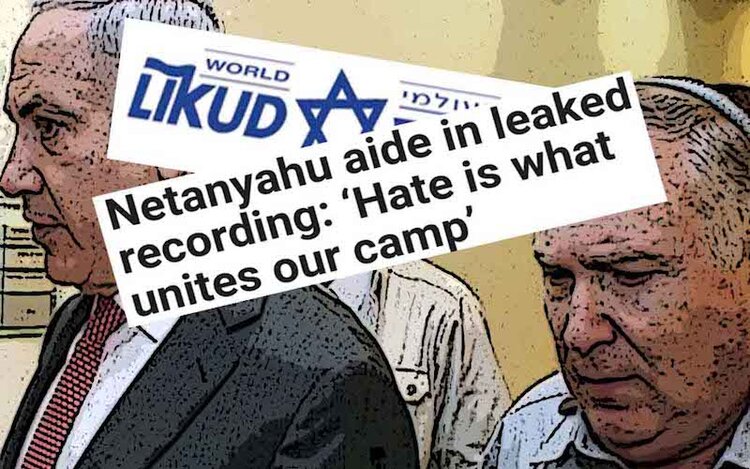
But even before we can get to that question, we have to consider what the same Israeli media outlets have informed us. In a leaked recording, Netanyahu senior adviser Natan Eshel, revealed that “hate is what unites” the Israeli right-wing and it “works well on non-Ashkenazi voters.”
Eshel, a former Netanyahu chief of staff who resigned amid allegations of sexual misconduct, continues to work with the Israeli PM, and last year led the two coalition negotiations.
In the recording, Eshel explains that Likud minister (and former IDF Spokeswoman) Miri Regev is “excellent” at “stirring up” Likud supporters. Eshel refers to Regev as “an animal,” but notes her tactics work very well in “drumming up the crowd.”
It is reasonable to think that Ambassador Dannon’s description of Sen. Sanders served a similar purpose: to drum up the AIPAC crowd. And, of course, the British Jewish media together with Jewish pressure groups and the Israeli Lobby have, since 2017, also used this technique to ignite their crowd’s hatred of the Labour party and its leader Jeremy Corbyn. Some people, so it seems, are united by hate.
Netanyahu’s senior adviser’s leaked recording shines a light on the ever- growing Jewish fear of antisemitism. Those who are so easily ‘united by hate’ tend to believe that others are also similarly hateful. The Jewish fear of antisemitism can be seen as projection. Those who are ‘united by hate,’ may well attribute their own hatefulness to their neighbours whether they are Palestinians, Labour voters, or even the Democratic frontrunner.
What we see is a lethal snowball of loathing and fear: the more hateful one happens to be, the more one is tormented by imagining that the Other is afflicted by the same hatefulness.
Jesus Christ diagnosed this very dangerous trait amongst his brethren. His solution was shocking, if simple. Instead of stockpiling weapons, he preached that his followers turn the other cheek: take a step forward, love your neighbour, break away from the vicious circle, seek peace and harmony.
The fate of Jesus is known to us all. The fate of those who try to preach peace to Israelis and Zionists isn’t exactly a secret either.
Israel Sends Condolences for Turkish “Martyrs”. Erdogan Expands War to Hezbollah, Iran
By Marko Marjanović | Anti-Empire | February 29, 2020
In the aftermath of the (probably Russian) strike that killed 33 Turkish soldiers in Syria late (10pm) Thursday Israel sent its condolences for the Turkish “martyrs”, ie using Islamic terminology:
Israel sends its condolences to Turkey over the killing of Turkish soldiers in Idlib.
“We are deeply saddened by the martyring of Turkish soldiers”
Interesting that they used “martyr” in Turkish https://t.co/X8SCOo3nWO
— Ragıp Soylu (@ragipsoylu) February 28, 2020
In fact, earlier that same day as Turkey was hitting the Syrian army heavily around Saraqib Israel snuck in two attacks on the other country:
Israeli helicopters struck Syrian military positions in the Quneitra province in the Syrian Golan Heights and wounded three Syrian soldiers, Syria’s official news agency SANA reported overnight Thursday.
Earlier Thursday, Syrian state TV reported that an Israeli drone fired a missile at a car in southern Syria, killing one person whom it named as a “civilian.” Several other media outlets aligned with Syrian President Bashar Assad’s regime said that the man was a local policeman.
Soon after Turkey expanded its Syria strikes to Hezbollah:
Turkish strikes using drones and smart missiles late on Friday that hit Hezbollah headquarters near Saraqeb killed nine of its members and wounded 30 in one of the bloodiest attacks on the Iran-backed group in Syria ever according to a commander in the regional alliance backing Damascus.
Sure the Shia Lebanese Hezbollah is fighting on the other side in Syria so hitting them would have some tactical value (at a great cost in other ways), but even at the time I wondered if that wasn’t really more a dog whistle to Tel-Aviv and the Israel supporters in DC and the US at large.
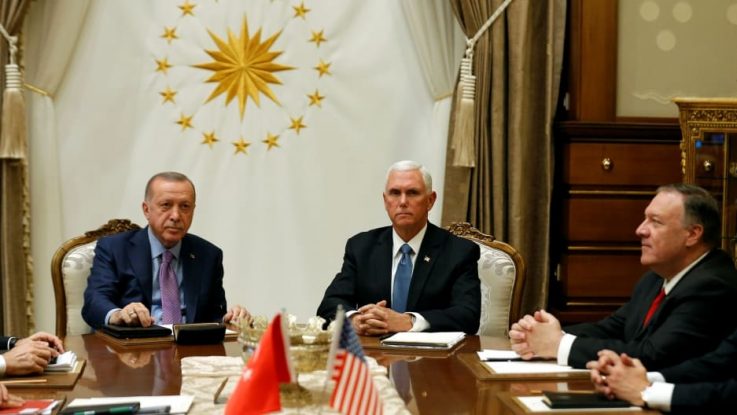
Apart from State Department apparatchiks and their hack boss Pompeo, Turkey had found itself very lonely in its new Syria adventure. The asked-for US-manned Patriot missiles to somehow wrestle the control of Idlib skies from Russia aren’t materializing.
But start hitting Hezbollah and suddenly you’ve got the attention of the powerful pro-Israel currents in the US, as well as of Israel itself.
My suspicion was confirmed Saturday when it became clear the Turks had hit Iranians as well:
Statement by Iran’s “advisory mission in Syria”: Turkish army is still shooting at our positions and bases. We call on Turkey to show rational behavior. The Turkish nation’s children are within range of our military forces.
(First statement by Iranian command in Syria, I guess)
— Reza Khaasteh (@Khaaasteh) February 29, 2020
The use of the word “children” above is a misleading translation, the Iranian communique spoke about “sons”, which naturally refers to Turkish troops.
Iranian embassy in Syria: “The Iranian government informed Erdogan that it would respond with full force to the Turkish points if it continued to bomb our forces and the Syrian army.”
— Rojava Network (@RojavaNetwork) February 29, 2020
Iran issued a warning to Erdogan to knock it off or his troops will face the consequences but you get the feeling that may be exactly what Erdogan is trying to provoke. Get the pathologically anti-Iranian Trump administration to see Turkey’s ‘safe-zone-for-bin-Ladenites’ Idlib invasion as an anti-Iranian enterprise and the prospects of American backing look quite a bit brighter.
#Turkey was informed in details of the position of Hezbollah and the Iranian brigades along with the Syrian army but decided to ignore the information and continued bombing these positions over and over again.
It is now clear that Turkey is in the battle with his army to stay.
— Elijah J. Magnier (@ejmalrai) February 29, 2020
Keep in mind that neither #Iran nor #Hezbollah ever attacked the Turkish army until this hour. It is #Turkey that took the initiative to bomb the Iranian-led forces and Hezbollah HQ and military hospital.
— Elijah J. Magnier (@ejmalrai) February 29, 2020
The Media’s Deafening Silence on Mike Bloomberg’s Ties to Epstein and Other Criminals
By Whitney Webb | MintPress News | February 28, 2020
After his late jump into the Democratic primary and, as critics argue, purchasing his way into the primary debates, former Mayor of New York City Michael Bloomberg has received mixed coverage from corporate media, with many negative critiques of the current presidential contender’s history, conduct and connections.
Yet, despite efforts by other campaigns and more progressive-leaning media outlets to dampen Bloomberg’s chances at the nomination, one clear weakness of Bloomberg’s has thus far evaded meaningful media coverage: his ties to key players in the Epstein scandal, including Leslie Wexner, Ghislaine Maxwell and even Jeffrey Epstein himself.
Silence among outlets that largely oppose Bloomberg’s candidacy regarding his connections to Epstein and those in his close social orbit is odd, especially when reporting on an individual’s connections to the intelligence-linked pedophile are a sure-fire way to generate considerable negative attention and fodder for rival campaigns. This is particularly striking given that the numerous accusations that Bloomberg has long stoked a toxic culture of sexual harassment at his company, resulting in no small number of non-disclosure agreements over the years, have received some media attention. Yet, the fact that many of Bloomberg’s close friends have been accused of far, far worse has received hardly any coverage by comparison.
For instance, when it was announced last week that the controlling stake in the Leslie Wexner-owned lingerie company Victoria’s Secret would be sold to a private equity firm called Sycamore Partners, only one media outlet — The Intercept — revealed that Bloomberg has at least $136 million of his money in that firm. The Intercept noted in passing that Wexner — the source of most of Jeffrey Epstein’s supposed fortune, his close collaborator for decades and alleged rapist of many of his victims — had been pressured to step down following the scandal, which also hit Wexner-owned companies hard and had forced the Ohio-based billionaire to seek a buyer for his lingerie brand and its tarnished reputation. Yet, the outlet did not make the direct connection that Sycamore Partners-backer Bloomberg is a friend of Wexner’s and has attended Wexner’s personal social parties for years prior to the most recent scandal.
Here’s alleged-rapist Mike Bloomberg attending a fancy horse party at Les Wexner’s place (Wexner furthest right) in 2010, about a year before Wexner formally transferred ownership of his Manhattan townhouse to Jeffrey Epstein. Cheers to good friends 😊 pic.twitter.com/gS8wpUVF00
— ePal, Your Close Friend™-Enterprise Edition (@wash_cloth) February 17, 2020
Yet, even well before this recent opportunity to point out Bloomberg’s ties to Leslie Wexner, there have been plenty of opportunities for the media to question Bloomberg about his now-infamous picture with Ghislaine Maxwell, daughter of Mossad-connected Robert Maxwell and Epstein’s alleged madam and co-conspirator.
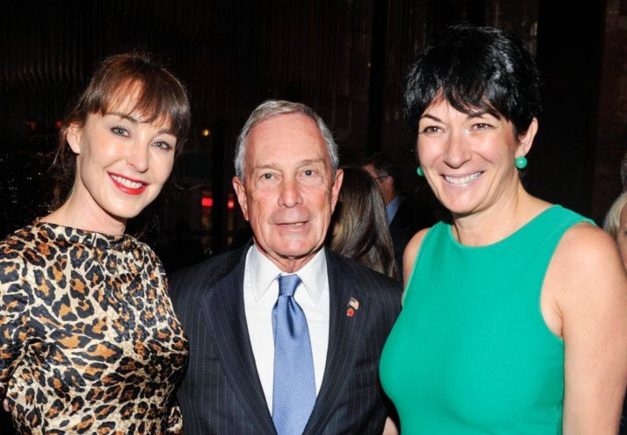
From left to right, Tamara Mellon, Mike Bloomberg and Ghislaine Maxwell
That picture, taken in 2013 at the Four Seasons restaurant in New York, has not been mentioned by mainstream media following the launch of Bloomberg’s candidacy late last November. Similarly, mainstream media have failed to question Bloomberg regarding why his name and five different telephone numbers for him appear in Jeffrey Epstein’s infamous list of contacts often referred to as his “little black book.”
Bloomberg and the Manhattan Swamp
The extent of the Maxwell-Bloomberg relationship is unknown, though Bloomberg’s deep ties to his former employer Salomon Brothers is a possible link, given that that firm served as one of the Maxwell family’s main investment bankers in the years prior to and following Robert Maxwell’s mysterious death in 1991. Similarly, Epstein had close ties to prominent figures on Wall Street, some dating back to his time at Bear Stearns, who are also close to Bloomberg.
Bloomberg and Epstein also shared close friendships with some of the same New York media executives like Mort Zuckerman. Media outlets have described Zuckerman, a former business partner of Epstein’s, as Bloomberg’s “long-time enabler.” In another example, Epstein’s former publicist Howard Rubenstein is a long-time supporter of Bloomberg and was reported to be the driving force behind Bloomberg’s controversial push to run around mayoral term limits and pursue a third term as Mayor of New York.
Another mutual Epstein-Bloomberg associate is disgraced media mogul Harvey Weinstein. Weinstein was part of an investment group with Epstein that sought to purchase New York magazine in 2003. Another member of that investment group was frequent MSNBC commentator Donny Deutsch, who has recently fervently backed Bloomberg’s candidacy.
Weinstein was recently convicted of rape and has dozens of accusers, whose decision to come forward about Weinstein’s sex crimes in recent years helped spark the “Me Too” movement. Weinstein also has ties to former Israeli Prime Minister Ehud Barak, who was a close friend and business associate of Epstein’s, and it was Barak who personally introduced Weinstein to former Mossad spies that Weinstein hired to intimidate his accusers. In addition to being Prime Minister, Barak is also the former head of Israeli military intelligence, the foreign intelligence agency that sponsored Epstein’s sexual blackmail operation involving underage girls in the United States.
Bloomberg’s candidacy has yet to be strongly challenged over his ties to Weinstein, which are considerable. For instance, Weinstein was a major backer of Bloomberg’s mayoral campaigns and even recorded robocalls on Bloomberg’s behalf to boost his election chances. Bloomberg, in turn, appointed Weinstein to a charity board and Weinstein later praised Bloomberg for aiding his film company. While Bloomberg’s ties to Wexner, Epstein and Maxwell have gotten the silent treatment, some outlets (mostly right-leaning) have covered the Bloomberg-Weinstein ties, but there has been little pressure on Bloomberg from mainstream media to address those ties directly.
Another close Bloomberg associate who recently has been accused by numerous women of sexual harassment is hedge fund manager Michael Steinhardt. Steinhardt is a long-time fixture in Bloomberg’s social circle and has long appeared at Bloomberg’s dinner parties. Steinhardt is also connected to Leslie Wexner through his membership in the so-called “Mega Group” — an exclusive group of organized-crime-linked “mega” donors to pro-Israel causes that Wexner co-founded in 1991. Steinhardt also boasts close ties to the now deceased founder of Glencore, the Mossad-linked Marc Rich, and Steinhardt — along with top Israeli politicians and spies — aggressively lobbied former President Bill Clinton to controversially pardon Rich before leaving office.
“Show me your friends and I’ll tell you who you are”
The oft-quoted saying “Show me your friends and I’ll tell you who you are,” seems to hold true for Bloomberg. For instance, his eponymous media conglomerate has received no small number of lawsuits over the years alleging rampant sexual harassment and even the rape of female workers, much of its allegedly egged on by Bloomberg’s long history of comments that have been derided as sexist. Many of those lawsuits ended in female accusers being asked to sign non-disclosure agreements (NDAs). More recently, The Nation reported that Bloomberg’s 2020 presidential campaign is making use of NDAs in such a way “that could prevent staffers from reporting workplace abuse.”
In addition, a 1999 profile of Bloomberg in Wired magazine quoted Bloomberg as saying “My daughter is tall and busty and blonde. We went to China together. And what’s a 16-year-old going to do on a business trip? So, I got her dates in every city in China.”
Bloomberg, not unlike Epstein and Wexner, also has a history of cozy ties to the CIA. For instance, during his tenure as Mayor of New York, Bloomberg actively promoted a controversial post-9/11 program that saw the CIA work directly with the NYPD to spy on the city’s Muslim communities. Even though the CIA is technically prohibited from spying on Americans not linked to criminal activity, one of the CIA officers working as part of the Bloomberg-backed program said he had “no limitations” on what he could do. Bloomberg has long defended this program and its merging of the CIA with local police.
In the case of Epstein and Wexner, as MintPress News reported in its viral series on the Epstein scandal last year, Epstein once claimed to have worked for the CIA during the 1980s and Epstein and Wexner were the key players behind the relocation of CIA front company Southern Air Transport to Ohio, where Wexner’s business interests have long been based.

Rudy Giuliani, left, New York Gov. George Pataki, center, and Mike Bloomberg during a “Salute to Israel Parade, May 5, 2002, in New York. Shawn Baldwin | AP
In addition, Bloomberg was also a key player in a controversial initiative regarding Israel’s intelligence-linked technology sector. For instance, Bloomberg created a $2 billion project that involved opening a Manhattan campus called “Cornell Tech” that brought together Cornell University and Israel’s Technion, which has close ties to Israel’s national security state and military-industrial complex. Bloomberg personally gave over $100 million to facilitate completion of that project. That campus is now a partner in the recent creation of two Israeli-run “cybersecurity” centers in New York City that are tied to Israeli intelligence and were recently reported on by MintPress.
Jeffrey Epstein was also involved with Israeli military intelligence-linked technology companies and, as previously mentioned, Israeli military intelligence was also the sponsor of Epstein’s sexual blackmail operation that targeted mostly U.S. politicians and public figures for the benefit of the state of Israel, whose military currently receives $3.8 billion per year from U.S. taxpayers.
While these aspects of Bloomberg’s past have received considerable media attention as of late, these same outlets have failed to note that Bloomberg’s inner circle boasts many individuals accused of harassment, rape or worse. With his clear ties to the “Epstein network,” the fact that mainstream media has declined to even question Bloomberg about his social appearances with Ghislaine Maxwell or Leslie Wexner and having five different telephone numbers of his in Epstein’s list of high-profile contacts is a damning indictment of the current landscape of both American media and American politics.
Whitney Webb is a MintPress News journalist based in Chile. She has contributed to several independent media outlets including Global Research, EcoWatch, the Ron Paul Institute and 21st Century Wire, among others. She has made several radio and television appearances and is the 2019 winner of the Serena Shim Award for Uncompromised Integrity in Journalism
The war scenario between Israel and Hezbollah
By Elijah J. Magnier – 24/02/2020
Notwithstanding the increase in power of the “Axis of the Resistance”, with its precision missiles and unrivalled accumulated warfare experience, the possibility of war is still on the table. The “Axis of the Resistance” is increasing its readiness based on the possibility that Israel may not tolerate the presence of such a serious threat on its northern borders and therefore act to remove it. However, in any future war, the “Axis of the Resistance” considers the consequences would be overwhelmingly devastating for both sides and on all levels if the rules of engagement are not respected. Notwithstanding Israel’s superior air firepower, its enemy Hezbollah has established its own tremendous firepower, and its experience in recent wars in Syria, Iraq and Yemen is an important asset.
Sources within the “Axis of the Resistance” believe the next battle between Hezbollah and Israel, if ever it takes place, would be “controlled and not sporadic, with a focus on specific military objectives without damaging the infrastructure, on both sides”.
The sources consider Gaza as a precedent. In Gaza Palestinians and Israelis have fought many recent battles that lasted only a few days in which the objectives bombed were purely military. This is a new rule of engagement (ROE) regulating conflict between the belligerents. When Israel hits a non-military target, the Palestinian resistance responds by hitting a similar non-military target in Israel. The lesson extracted from the new ROE between Israel and the Palestinians is that every time exchanges of bombing go out of control, both sides understand they have to bring it back to an acceptable and equitable level, to limit damage and keep such mutual attacks from targeting civilians.
The “Axis of the Resistance” therefore considers that the probability is high that the next battle would be limited to military objectives and kept under control. If one side increases the bombing, the other will follow. Otherwise, both sides have the capability to cause total destruction and go on to uncontrolled bombing. In the case of an out-of-control war, allies on both sides would become involved, which renders this scenario less likely.
Hezbollah in Lebanon is said to have over 150,000 missiles and rockets. Israel might suppose that a limited attack could destroy tens of thousands of Hezbollah’s missiles. Is it worth it? “From Israel’s view, Israel may think it is worth triggering a battle and destroying thousands of missiles, thinking that Israel has the possibility to prevent Hezbollah from re-arming itself. But even in this case, Israel doesn’t need to destroy villages or cities or the Lebanese infrastructure, instead, it will limit itself to selective targets within its bank of objectives. However, we strongly doubt Israel could succeed in limiting Hezbollah’s supply of missiles and advanced weapons. Many of these missiles no longer need to be close to the borders with Israel, but can be deployed on the Lebanese-Syrian borders in safe silos”, said the sources.
However, Israel should also expect, according to the same sources, that Hezbollah will respond by bombing significant Israeli military targets within its bank of objectives. “There is no need to bomb airports, power stations, chemical industries, harbours or any highly significant target if Israel doesn’t bomb any of these in Lebanon. But if necessary Hezbollah is prepared to imitate Israel by hitting back without hesitation indiscriminately and against high-value targets, at the cost of raising the level of confrontation to its maximum level. Hezbollah and Israel have a common language in warfare. If the bombing is limited, no side interprets the others’ actions as a sign of weakness”, said the sources.
“Hezbollah doesn’t want war and is doing everything to avoid it. This is why it responded in Moawad, in the suburb of Beirut, when Israeli armed drones failed to reach their objectives. By responding, Hezbollah actually prevented a war on a large scale because it is not possible to allow Israel to get away with any act of war in Lebanon, violating the ROE” said the sources.
Last September, Hezbollah targeted an Israeli vehicle in Avivim with a laser-guided missile in daylight after forcing the Israeli Army to hide for a week and retreat all forces behind civilians lines, imposing a new ROE. The Israeli army cleared the 120 km borders with Lebanon (5 km deep) to avoid Hezbollah’s revenge retaliation for violating the 2006 cessation of hostility’s agreement. Israel refrained from responding and swallowed the humiliation due to its awareness of Hezbollah’s readiness to start a devastating war if necessary.

Israeli officials used to threaten Hezbollah and Lebanon to take the country “back to the stone age”. This is indeed within the reach of Israel’s military capability. However, it is also within Hezbollah’s reach to bring Israel back to the stone age, if required. Hezbollah’s precision missiles can hit any bridge, airport, gasoline deposit containers, power stations, Haifa harbour, oil and gas rig platforms, any infrastructure and military and non-military objectives if Israel attempts to target similar objectives in Lebanon first. Hezbollah’s new missile capability is not new to Israel, who is observing the latest technology Iran’s allies are enjoying and “testing,” mainly in Yemen. The recent bombing of Saudi Arabia oil facilities and the downing of a Saudi Tornado in Yemen revealed that Iran’s HOT missiles are capable of downing jets at medium height and any helicopter violating Lebanese airspace.
Hezbollah’s latest version of the Fateh precision missile, the supersonic anti-ship missiles and the anti-air missiles can prevent Israel from using its navy, stopping any civilian ship from docking in Haifa, thwarting the use of Israeli Helicopters and precision bombing attacks- as in Iran’s latest confrontation with the US at Ayn al-Assad base in Iraq.
Hezbollah’s missiles are unlikely to cause simple traumatic brain injuries – as per the Iranian missile at Ayn al Assad – when hitting targets in Israel in case of war. They can avoid missile interception systems. This increase of capability is a game-changer, and Hezbollah believes it is already decreasing the chances of war. Arming itself with precision missiles and armed drones and showing these capabilities to Israel is Hezbollah’s way to avert a war and protect the equation of deterrence.
In its 2020 security assessment, the Israeli Military Intelligence Directorate (Aman) unwisely evaluated the assassination of the Iranian Major General Qassem Soleimani as a “restraining factor”. Aman’s report, showing astonishing ignorance, stated that Soleimani was responsible for Hezbollah’s missile projects. This lack of understanding of the Hezbollah-Iran relationship and dynamic is quite surprising. Sayyed Ali Khamenei told Hezbollah’s leader Sayyed Hassan Nasrallah decades ago that he knows what he needs and what to do and doesn’t need to fall back on Iran. The IRGC and Hezbollah have set up a collaboration engine that won’t stop even if half of the IRGC leadership is killed. The possession of the feared Iranian precision missiles is no longer a secret: all Iran’s allies have these deployed, in Lebanon, Syria, Iraq and Yemen.
Yesterday is unlike today: the power of destruction now belongs to all parties, no longer to Israel alone. War is no longer an option. US/Israeli aggression will be limited to an economic war, so long as the “Axis of the Resistance” continues updating its warfare capability to maintain deterrence parity.
This article is translated free to many languages by volunteers so readers can enjoy the content.
Copyright © https://ejmagnier.com 2020 @ejmalrai
Don’t Hold Your Breath for ‘World War III’: World War IV Has Already Begun
By A. B. Abrams | The Saker Blog | February 27, 2020
“A. B. Abrams is the author of the book ‘Power and Primacy: A History of Western Intervention in the Asia-Pacific.’ His second book covering the history of the United States’ conflict with North Korea is scheduled for publication in 2020.
He is proficient in Chinese, Korean and other East Asian languages, has published widely on defence and politics related subjects under various pseudonyms, and holds two related Masters degrees from the University of London.”
 The world today finds itself in a period of renewed great power conflict, pitting the Western Bloc led by the United States against four ‘Great Power adversaries’ – as they are referred to by Western defence planners – namely China, Russia, North Korea and Iran. This conflict has over the past 15 years escalated to encompass the military, economic and information spheres with global consequences – and appears to be coming to a head as signs of peaking tensions appear in multiple fields from military deployments and arms races to harsh economic wars and a harsher still information war.
While the term ‘World War III’ has been common since the 1940s, referring to the possibility of a global great power war on a greater scale than the first and second world wars, the Cold War between the Western and Soviet Blocs was at its height as total, as global and as heated as the prior conflicts. As weapons technology has evolved, the viability of a direct shooting war has diminished considerably – forcing major powers to seek alternative means to engineer their adversaries’ capitulation and assert their own dominance. This has been reflected in how the Cold War, and the current phase of global conflict some refer to as ‘Cold War 2’ have been distinct from the first two world wars despite the final objectives of the parties involved sharing many similarities. I would thus suggest redefining what a ‘world war’ is and acknowledging that this current phase of global conflict is every part as intense as the great power ‘hot wars’ waged in the first half of the 20th century.
Had the intercontinental range ballistic missile and the miniaturised nuclear warhead been invented twenty years earlier, the Allied Powers may have needed to rely more heavily on economic and information warfare to contain and eventually neutralise Nazi Germany. The Second World War would have been very different in nature to reflect the technologies of the time. When viewed from this paradigm, the Cold War can be seen as a ‘Third World War’ – a total conflict more vast, comprehensive and international than its predecessors stretched out over more than 40 years. The current conflict, or ‘World War IV,’ is ongoing. An assessment of prior ‘great power wars,’ and the unique nature of the current conflict, can provide some valuable insight into how warfare is evolving and the likely determinants of its victors.
As of 2020 it is clear that great power conflict has become almost as heated as it can short of an all-out hot war – with the Western Bloc applying maximum pressure on the information, military and economic fronts to undermine not only smaller adversaries such as Venezuela and Syria and medium sized ones such as North Korea and Iran, but also China and Russia. When exactly this phase of conflict began – sometime after the Cold War’s end – remains uncertain.
The interval between the third and fourth ‘world wars’ was considerably longer than that between the second and the third. This was due to a number of factors – primarily that there was no immediate and obvious adversary for the victorious Western Bloc to target once the Soviet Union had been vanquished. Post-Soviet Russia was a shade of a shadow of its former self. Under the administration of Boris Yeltsin the country’s economy contracted an astonishing 45% in just five years from 1992 (1) leading to millions of deaths and a plummet in living standards. Over 500,000 women and young girls of the former USSR were trafficked to the West and the Middle East – often as sex slaves (2), drug addiction increased by 900 percent, the suicide rate doubled, HIV became a nationwide epidemic (3) corruption was rampant, and the country’s defence sector saw its major weapons programs critical to maintaining parity with the West delayed or terminated due to deep budget cuts (4). The possibility of a further partition of the state, as attested to multiple times by high level officials, was very real along the lines of the Yugoslav model (5).
Beyond Russia, China’s Communist Party in the Cold War’s aftermath went to considerable lengths to avoid tensions with the Western world – including a very cautious exercise of their veto power at the United Nations which facilitated Western led military action against Iraq (6). The country was integrating itself into the Western centred global economy and continuing to emphasis the peaceful nature of its economic rise and understate its growing strength. Western scholarship at the time continued to report with near certainty that internal change, a shift towards a Western style political system and the collapse of party rule was inevitable. The subsequent infiltration and westernisation was expected to neuter China as a challenger to Western primacy – as it has other Western client states across the world. China’s ability to wage a conventional war against even Taiwan was in serious doubt at the time, and though its military made considerable strides with the support of a growing defence budget and massive transfers of Soviet technologies from cash strapped successor states, it was very far from a near peer power.
North Korea did come under considerable military pressure for failing to follow what was widely referred to as the ‘tide of history’ in the West at the time – collapse and westernisation of the former Communist world. Widely portrayed in the early 1990s as ‘another Iraq’ (7), Western media initially appeared to be going to considerable lengths to prepare the public for a military campaign to end the Korean War and impose a new government north of the 38th parallel (8). Significant military assets were shifted to Northeast Asia specifically to target the country during the 1990s, and the Bill Clinton administration came close to launching military action on multiple occasions – most notably in June 1994. Ultimately a combination of resolve, a formidable missile deterrent, a limited but ambiguous nuclear capability, and perhaps most importantly Western certainty that the state would inevitably collapse on its own under sustained economic and military pressure, deferred military options at least temporarily.
The fourth of the states that the United States today considers a ‘greater power adversary,’ Iran too was going to considerable lengths to avoid antagonism with the Western Bloc in the 1990s – and appeared more preoccupied with security threats on its northern border from Taliban controlled Afghanistan. With a fraction of the military power neighbouring Iraq had previously held, the presence of an ‘Iranian threat’ provided a key pretext for a Western military presence in the Persian Gulf after the Soviets, the United Arab Republic and now Iraq had all been quashed. With the new government in Russia put under pressure to terminate plans to transfer advanced armaments to Iran (9), the country’s airspace was until the mid 2000s frequently penetrated by American aircraft, often for hours at a time, likely without the knowledge of the Iranians themselves. This combined with a meagre economic outlook made Iran seem a negligible threat.
While the Cold War ended some time between 1985 and 1991 – bringing the ‘third world war’ to a close – the range of dates at which one could state that the ‘fourth world war’ began and the West again devoted itself to great power conflict is much wider. Some would put the date in the Summer of 2006 – when Israel suffered the first military defeat in its history at the hands of the Lebanese militia Hezbollah. Using North Korean tunnel and bunker networks, command structures, weapons and training (10), and bolstered by Iranian funding and equipment, the shock of the militia’s victory, though underplayed in Western media, reverberated among informed circles across the world.
Others would place the date two years later in 2008 during the Beijing Summer Olympics, when Georgia with the full support of the West waged a brief war against Russia – and Moscow despite harsh warnings from Washington and European capitals refused to back down on its position. Post-Yeltsin Russia’s relations with the Western Bloc had appeared relatively friendly on the surface, with President George W. Bush observing in 2001 regarding President Vladimir Putin that he “was able to get a sense of his soul,” and predicting “the beginning of a very constructive relationship.” Nevertheless, signs of tension had begun to grow from Moscow’s opposition to the Iraq War at the UN Security Council to President Putin’s famous ‘Munich Speech’ in February 2007 – in which he sharply criticised American violations of international law and its “almost uncontained hyper use of force in international relations.”
It could also be questioned whether, in light of what we know about Western support for separatist insurgents in Russia itself during the 1990s, the war against the country ever ended – or whether hostilities would only cease with a more total capitulation and partition and with the presence of Western soldiers on Russian soil as per the Yugoslav precedent. As President Putin stated in 2014 regarding continuing Western hostilities against Russia in the 1990s: “The support of separatism in Russia from abroad, including the informational, political and financial, through intelligence services, was absolutely obvious. There is no doubt that they would have loved to see the Yugoslavia scenario of collapse and dismemberment for us with all the tragic consequences it would have for the peoples of Russia” (11). Regarding Western efforts to destabilise Russia during the 1990s, CIA National Council on Intelligence Deputy Director Graham E. Fuller, a key architect in the creation of the Mujahedeen to fight Afghanistan and later the USSR, stated regarding the CIA’s strategy in the Caucasus in the immediate post-Cold War years: “The policy of guiding the evolution of Islam and of helping them against our adversaries worked marvellously well in Afghanistan against the Red Army. The same doctrines can still be used to destabilize what remains of Russian power” (12). The U.S. Congressional Task Force on Terrorism and Unconventional Warfare’s director, Yossef Bodansky, himself also detailed the extent of the CIA’s strategy to destabilize Central Asia by using “Islamist Jihad in the Caucasus as a way to deprive Russia of a viable pipeline route through spiralling violence and terrorism” – primarily by encouraging Western aligned Muslim states to continue to provide support for militant groups (13).
Much like the Cold War before it, and to a lesser extent the Second World War, great powers slid into a new phase of conflict rather that it being declared in a single spontaneous moment. Did the Cold War begin with the Berlin Blockade, the Western firebombing of Korea or when the atomic bombs were dropped on Hiroshima and Nagasaki – which accelerated the move into a nuclear arms race. Equally, multiple dates were given for the opening of the Second World War – the German invasion of Poland in 1939, the beginning of the Sino-Japanese war two years prior, the Japanese Empire’s attack on Pearl Harbour and conquest of Southeast Asia which marked the first major expansion beyond Europe and North Africa in 1941, or some other date entirely. The slide into a new world war was if anything even slower than its predecessors.
The shift towards an increasingly intense great power conflict has been marked by a number of major incidents. In the European theatre one of the earliest was the Bush administration’s withdrawal from the Anti-Ballistic Missile treaty in 2002 and subsequent deployment of missile defences and expansion of NATO’s military presence in the former Soviet sphere of influence, which was widely perceived in Russia as an attempt to neutralise its nuclear deterrent and place the Western Bloc in a position to coerce Moscow militarily (14). This threatened to seriously upset the status quo of mutual vulnerability, and played a key role in sparking a major arms race under which Russia would develop multiple classes of hypersonic weapon. Their unveiling in 2018 would in turn lead the United States to prioritise funding to develop more capable interceptor missiles, a new generation of missile defences based on lasers, and hypersonic ballistic and cruise missiles of its own (15).
Another leading catalyst of the move towards great power confrontation was the Barak Obama administration’s ‘Pivot to Asia’ initiative, under which the bulk of America’s military might and considerable assets from the rest of the Western world would be devoted to maintaining Western military primacy in the Western Pacific. This was paired with both economic and information warfare efforts, the latter which increasingly demonised China and North Korea across the region and beyond and actively sought to spread pro-Western and anti-government narratives among their populations through a wide range of sophisticated means (16). These programs were successors to those sponsored by Western intelligence agencies to ideologically disenchant the populations of the Warsaw Pact and Soviet Union with their own political systems and paint Western powers as benevolent and democratising saviours (17). Economic warfare also played a major role, with efforts centred around the ‘Trans-Pacific Partnership’ trade deal – or ‘Economic NATO’ as several analysts referred to it – to isolate China from regional economies and ensure the region remained firmly in the Western sphere of influence (18). The military aspect of the Pivot to Asia would reawaken long dormant territorial disputes, and ultimately lead to high military tensions between the United States and China which in turn fuelled the beginning of an arms race. This arms race has more recently led to the American withdrawal from the Intermediate-Range Nuclear Forces treaty, which paves the way for deployment of American long-range missiles across the Western Pacific – all with China and North Korea firmly in their crosshairs (19).
It is arguably in the Middle East, however, where the new phase of global conflict has seen its most direct clashes so far. The nine-year conflict in Syria, although far less destructive or brutal, provides ‘World War IV’ with something of an analogue to the Korean War in the Cold War. The conflict has united the Western Bloc and a wide range of allies, from Turkey and Israel to the Gulf States and even Japan (which funds the jihadist-linked White Helmets) (20), in an effort to overthrow an independent government with close and longstanding defence ties to Russia, North Korea, Iran and China. The conflict has seen North Korean, Russian, Hezbollah and Iranian special forces (21) among other assets deployed on the ground in support of Syrian counterinsurgency efforts, with all of these parties providing considerable material support (the Koreans have built and fully staffed at least three hospitals as part of large medical aid packages and continue to be a major supplier of arms and training) (22). China too, particularly concerned by the presence of jihadist militants of Chinese origin in Syria, has played some role in the conflict – the exact details of which remain uncertain with much reported but unconfirmed (23).
Syria’s insurgency involving a range of jihadist groups, at times united only by their intent to end the secular Syrian government, have received widespread support from the Western Bloc and their aforementioned allies. This has involved both material support, which according to State Secretary Hillary Clinton included turning a blind eye to Gulf countries’ considerable assistance to the Islamic State terror group (24), and active deployments of special forces from a wide range of countries, from Belgium and Saudi Arabia to Israel and the U.S. The U.S., European powers, Turkey and Israel have at times directly attacked Syrian units in the field – while Russian reports indicate that close Western coordination with jihadist groups has been used to facilitate a number of successful attacks on Russian positions (25). The conflict in Syria arguably represents a microcosm of the macrocosm which is a new world war – one which pits the Western Bloc and those which support the Western-led order, both directly and through local proxies, against three of its four ‘great power adversaries’ in the field.
‘World War IV’ is unlikely to come to an end for the foreseeable future, and its final outcome remains difficult to predict. Much like in the Cold War, the Western Bloc retains considerable advantages – today most notably in the field of information war which allows it to extensively shape perceptions of the vast majority of the world’s population. This has included the demonization of Western adversaries, the whitewashing of Western crimes both domestically and internationally, and portraying westernisation and increased Western influence as a solution to people’s frustrations from corruption to economic stagnation. This has been a key facilitator of the pro-Western protests engulfing states from Sudan and Algeria to Ukraine and Thailand. Economically too, only China among the Western Bloc’s major adversaries has posed a serious threat to Western primacy. Indeed, it remains highly questionable whether the other three could survive economically under Western pressure without Chinese trade and economic support.
Russia has made a considerable economic recovery since the 1990s, but remains a shadow of its former self in the Soviet era. The country’s leadership has succeeded in reforming the military, foreign ministry and intelligence services, but the economy, legal system and other parts of the state remain in serious need of improvement which, over 20 years after Yeltsin’s departure, cannot come soon enough. Even in the field of defence, the struggling economy has imposed serious limitations – and in fields such as aviation and armoured warfare the country is only beginning to slowly go beyond modernising Soviet era weapons designs and begin developing new 21st century systems (26). On the positive side, the country does remain a leader in many high end technologies mostly pertaining to the military and to space exploration, while Western economic sanctions have undermined the positions of Europhiles both among the elite and within the government and boosted many sectors of domestic production to substitute Western products (27).
In the majority of fields, the ‘Eastern Bloc’ have been pressed onto the defensive and forced to prevent losses rather than make actual gains. While preserving Venezuelan sovereignty, denying Crimea to NATO and preventing Syria’s fall have been major victories – they are successes in denying the West further expansion of its own sphere of influence rather than reversing prior Western gains or threatening key sources of Western power. Pursuing regime change in Venezuela and Ukraine and starting wars in the Donbasss and in Syria have cost the Western Bloc relatively little – the Ukrainians and client states in the Gulf and Turkey have paid the brunt of costs for the war efforts. Material equipment used by Western backed forces in both wars, ironically, has largely consisted of Warsaw Pact weaponry built to resist Western expansionism – which after the Cold War fell into NATO hands and is now being channelled to Western proxies. Libyan weaponry, too, was transferred to Western backed militants in Syria in considerable quantities after the country’s fall in 2011 – again minimising the costs to the Western Bloc of sponsoring the jihadist insurgency (28). The damage done and costs incurred by the Syrians, Hezbollah, Russia and others are thus far greater than those incurred by the Western powers to cause destruction and begin conflicts.
Syria has been devastated, suffering from issues from a return of polio to depleted uranium contamination from Western airstrikes and a new generation who have grown up in territories under jihadist control with little formal education. The war is a victory only in that the West failed to remove the government in Damascus from power – but Western gains from starting and fuelling the conflict have still far outweighed their losses. In the meantime, through a successful campaign centred around information warfare, the Western sphere of influence has only grown – with further expansion of NATO and the overthrow of governments in resource rich states friendly to Russia and China such as Libya, Sudan and Bolivia. Commandeering the government of poor but strategically located Ukraine was also a major gain, with states such as Algeria and Kazakhstan looking to be next in the Western Bloc’s crosshairs. Thus while Syria was saved, though only in part, much more was simultaneously lost. The damage done to Hong Kong by pro-Western militants, ‘thugs for democracy’ as the locals have taken to calling them, who have recently turned to bombing hospitals and burning down medical facilities (29), is similarly far greater than the costs to the Western powers of nurturing such an insurgency. Similar offensives to topple those which remain outside the Western sphere of influence from within continue to place pressure on Russian and Chinese aligned governments and on neutral states seen not to be sufficiently pro-Western.
While the Western Bloc appears to be in a position of considerable strength, largely by virtue of its dominance of information space, which has allowed it to remain on the offensive, a sudden turning point in which its power suddenly diminishes could be in sight. From teen drug abuse (30) to staggering debt levels (31) and the deterioration of party politics and popular media, to name but a few of many examples, the West appears at far greater risk today of collapse from within than it did during the Cold War. A notable sign of this is the resurgence of both far right and far left anti-establishment movements across much of the Western world. Despite massive benefits from privileged access to third world resource bases, from France’s extractions from Francophone West Africa (32) to the petrodollar system propping up American currency (33), Western economies with few exceptions are very far from healthy. A glimpse of this was given in 2007-2008, and little has been done to amend the key economic issues which facilitated the previous crisis in the twelve years since (34). The West’s ability to compete in the field of high end consumer technologies, particularly with rising and more efficient East Asian economies, increasingly appears limited. From semiconductors to electric cars to smartphones to 5G, the leaders are almost all East Asian economies which have continued to undermine Western economic primacy and expose the gross inefficiencies of Western economies. The result has been less favourable balances of payments in the Western world, a growing reliance on political clout to facilitate exports (35), and increasing political unrest as living standards are placed under growing pressure. The Yellow Vests and the rise of Donald Trump and Bernie Sanders are all symptoms of this. With very real prospects of another economic crash in the coming decade, in the style of 2008 but likely much worse, Western economies are expected to bear the brunt of the damage. Their ability to survive remains in serious question. Effects of a crash on North Korea, Iran, Russia and even China will be far less severe. While the previous crash hit Russia particularly hard (36), an economic turnaround from 2014 and the insulation provided by Western sanctions leave it far less vulnerable to the fallout from a Western economic crisis.
Ultimately China appears to be setting itself up for an ‘Eastern Bloc’ victory – a coup de grace which could see Western gains over the past several decades reversed and the power of the West itself diminished to an extent unprecedented in centuries. While the United States reluctantly outsourced much of its high end consumer technologies to East Asian allies during the Cold War – namely Japan, South Korea and Taiwan – China is going for the jugular of the Western world’s economy with its ‘Made in China 2025’ initiative, which will see some critical remaining fields of Western technological primacy shift to East Asian hands. The Coronavirus, bombings in Hong Kong, the trade war, and the wide range of tools in the Western arsenal for destabilisation can at best slightly delay this – but cannot prevent it. In a globalised capitalist economy the most efficient producers win – and East Asia and China in particular, with its Confucian values, stable and efficient political systems and world leading education (37), are thus almost certain to take over the high end of the world economy.
Much as the key to Western victory in the Cold War was successful information warfare efforts and isolation of the Soviet economy from the majority of the world economy, the key to determining the victor of ‘World War IV’ is likely lie in whether or not Beijing succeeds in its attempt to gain dominance of high end technologies critical to sustaining Western economies today. This is far from the only determinant of victory. Efforts to undermine the effective subsidies to Western economies from Central and West Africa, the Arab Gulf states and elsewhere in the third world, and to ensure continued military parity – to deter NATO from knocking over the table if they lose the game of economic warfare – are among the other fields of critical importance. Based on China’s prior successes, and those of other East Asian economies, the likelihood that it will meet its development goals is high – to the detriment of Western interests. The result will be an end to world order centred on Western might – the status quo for the past several hundred years – and emergence in its place of a multipolar order under which Russia, Asia (Central, East, South and Southeast) and Africa will see far greater prominence and prosperity.
- Menshikov, S., ‘Russian Capitalism Today,’ Monthly Review, vol. 51, no. 3, 1999 (pp. 82–86).
- Yulia V. Tverdova, ‘Human Trafficking in Russia and Other Post-Soviet States,’
Human Rights Review, December 11, 2016.
- Klein, Naomi, The Shock Doctrine: The Rise of Disaster Capitalism, London,
Penguin, 2008 (Chapter 11: ‘Russia Choses the Pinochet Option: Bonfire of a Young Democracy’).
- ‘The Death of the MiG 1.44 Program; How the Collapse of the Soviet Union Derailed Moscow’s Fifth Generation Fighter Development,’ Military Watch Magazine, September 16, 2018.
‘Russia’s Sukhoi Unveils Images from Cancelled Next Generation Fighter Program,’ Military Watch Magazine, December 17, 2019.
- Presidential Address to the Federal Assembly, President of Russia, Kremlin, December 4, 2014.
Bechev, Dimitar, Rival Power: Russia’s Influence in Southeast Europe, New Haven, CT, Yale University Press, 2017 (Chapter 1).
- Kristof, Nicholas D., ‘WAR IN THE GULF: China; Beijing Backs Away From Full Support of the War,’ New York Times, February 1, 1991.
- ‘Thaw in the Koreas?,’ Bulletin of Atomic Scientists, vol. 48, no. 3, April 1992 (p. 16).
- ‘Time to End the Korean War,’ The Atlantic, February 1997.
- Axe, David, ‘Iran Desperately Wants This Fighter Plane,’ The National Interest, January 4, 2020.
- ‘Hezbollah a North Korea-Type Guerrilla Force,’ Intelligence Online, No. 529, August 25–September 7, 2006.
“North Koreans Assisted Hezbollah with Tunnel Construction,” Terrorism Focus, The Jamestown Foundation, vol. III, issue 30, August 1, 2006.
Dilegge, Dave and Bunker, Robert J., and Keshavarz, Alma, Iranian and Hezbollah Hybrid Warfare Activities: A Small Wars Journal Anthology, Amazon Media, 2016 (p. 261).
‘Bulsae-3 in South Lebanon: How Hezbollah Upgraded its Anti-Armour Capabilities with North Korean Assistance,’ Military Watch Magazine, September 3, 2019.
- Kremlin, President of Russia, Presidential Address to the Federal Assembly, December 4, 2014.
- Congressional Record, V. 151, PT. 17, U.S. Congress, October 7 to 26, 2005.
- ‘American political scientist: Western Intelligence used Azerbaijan to export terrorism into Russia,’ Panorama, May 30, 2015.
- Kremlin, President of Russia, Plenary session of St Petersburg International
Economic Forum, June 17, 2016.
- Gregg, Aaron, ‘Military Industrial Complex Finds a Growth Market in Hypersonic Weapons,’ Washington Post, December 21, 2018.
- Mullen, Mike and Nunn, Sam and Mount, Adam, A Sharper Choice on North Korea: Engaging China for a Stable Northeast Asia, Council on Foreign Relations, Independent Task Force Report No. 74, September 2016.
Cartalucci, Tony, ‘Twitter Targets Hong Kong in US-backed Regime Change Operation,’ Ron Paul Institute for Peace and Prosperity, October 15, 2019.
Park, Kyung-Ae, ‘Regime Change in North Korea?: Economic Reform and Political Opportunity Structures,’ North Korean Review, vol. 5, no. 1, Spring 2009 (p. 23-45).
- ‘Worldwide Propaganda Network Built by the C.I.A.,’ New York Times, December 26, 1977.
- Wu, S., ‘Why the TPP is an “economic NATO,”’ Huffington Post, October 19,
2015.
- Ait, Abraham, ‘US Withdrawal From the INF Treaty Isn’t About Russia,’ The Diplomat, October 25, 2018.
- al-Jablawi, Hosam, ‘The White Helmets Struggle Without US Funding,’ Atlantic Council, June 11, 2018.
- ‘North Korean Special Forces in Syria; A Look at Pyongyang’s Assistance to Damascus’ Counterinsurgency Operations,’ Military Watch Magazine, June 10, 2018.
- ‘DPRK Ambassador affirms his country’s readiness to support health sector in Syria,’ Syrian Arab News Agency, July 25, 2016.
- Pauley, Logan and Marks, Jesse, ‘Is China Increasing Its Military Presence in Syria?,’ The Diplomat, August 20, 2018.
Hemenway, Dan, ‘Chinese strategic engagement with Assad’s Syria,’ Atlantic Council, December 21, 2018.
- ‘We finally know what Hillary Clinton knew all along – U.S. allies Saudi Arabia
and Qatar are funding Isis,’ The Independent, October 14, 2016.
- ‘Inquiry Into Death of Russian Lt. Gen. Asapov Shows Data Leaks to Daesh –
Source,’ Sputnik, September 26, 2017.
‘Drones used by Syrian terrorists “require advanced training” – Russian MoD in response to US,’ Sputnik, January 9, 2018.
- ‘Five Next Generation Russian Combat Jets We Will See in the 2020s: From MiG-41 Hypersonic Interceptors to PAK DA Stealth Bombers,’ Military Watch Magazine, January 1, 2019.
- Twigg, Judy, ‘Russia Is Winning the Sanctions Game,’ National Interest, March 14, 2019.
- Hersh, Seymour, ‘The Red Line and the Rat Line,’ London Review of Books, vol. 36, no. 8, April 2014
Angelovski, Ivan and Patrucic, Miranda and Marzouk, Lawrence, ‘Revealed: the £1bn of weapons flowing from Europe to Middle East,’ The Guardian, July 27, 2016.
Chivers, C. J. and Schmitt, Eric and Mazzetti, Mark, ‘In Turnaround, Syria Rebels Get Libya Weapons,’ New York Times, June 21, 2013.
McCarthy, Andrew C., ‘Hillary Clinton’s Benghazi Debacle: Arming Jihadists in Libya . . . and Syria,’ National Review, August 2, 2016.
- ‘Militants Bomb Hospital, Torch Quarantine Center as Hong Kong Braces for Virus Outbreak,’ Military Watch Magazine, January 27, 2020.
- ‘Class A drug use “at record levels due to young people”,’ BBC News, September 20, 2019.
- Buchholz, Katharina, ‘Industrialized Nations Have Biggest Foreign Debt,’ Statista, February 7, 2019.
- ‘France’s Colonial Tax Still Enforced for Africa. “Bleeding Africa and Feeding
France,”’ Centre for Research of Globalization, January 14, 2015.
Bart Williams, Mallence, ‘The Utilization of Western NGOs for the Theft of Africa’s Vast Resources,’ TedxBerlin, January 26, 2015
(https://www.youtube.com/watch?v=AfnruW7yERA).
- Wong, Andrea, ‘The Untold Story Behind Saudi Arabia’s 41-Year U.S. Debt Secret,’ Bloomberg, May 31, 2016.
Spiro, David E., The Hidden Hand of American Hegemony: Petrodollar Recycling and International Markets, New York, Cornell University Press, 1999.
- ‘Banks have not learnt lessons of 2008 crisis, says Gordon Brown,’ Financial Times, October 31, 2017.
‘A decade after the financial meltdown, its underlying problems haven’t been fixed,’ The Guardian, August 6, 2017.
- ‘Fearing U.S. Sanctions Over Su-35 Purchase: What is Behind Indonesia’s Interest in New F-16V Fighters,’ Military Watch Magazine, November 6, 2019.
Rogan, Tom, ‘The very political reason Qatar buys different fighter aircraft from Britain, France, and the US,’ Washington Examiner, February 25, 2020.
Krishnan, Rakesh, ‘Countering CAATSA: How India can avoid American arm twisting,’ Business Today, March 6, 2019.
- Gaddy, Clifford G. and Ickes, Barry W., ‘Russia after the Global Financial Crisis,’ Eurasian Geography and Economics, vol. 51, no. 3, 2010 (pp. 281-311).
- Hobbs, Tawnell D., ‘U.S. Students Fail to Make Gains Against International Peers,’ The Wall Street Journal, December 3, 2019.
Turner, Camiilla, ‘Chinese students are two years ahead of their white British peers by age 16, report finds,’ The Telegraph, July 30, 2019.
Canada Joins ‘Friendly States’ in Opposing ICC War Crimes Investigation in Palestine
Palestine Chronicle | February 26, 2020
The Canadian government has submitted a letter to the International Criminal Court (ICC), in which it declared support for the Israeli position, thus rejecting the ICC jurisdiction over cases of alleged war crimes committed by Israel in Palestine.
The Canadian Jewish News (CJN), which reported on the letter, said that Ottawa has communicated its position to the Court on February 14, although the content of the letter has not been made public until today.
In the letter, Canada, which reminded the Court that its “financial contribution to the ICC will be $10.6 million this year,” stated that it does not recognize Palestine as a state and that the ICC has no jurisdiction on the case that is presented by the State of Palestine.
The Canadian decision followed a public demand last December by Israeli Prime Minister Benjamin Netanyahu to Canadian Prime Minister Justin Trudeau to condemn a preliminary report by the ICC that has a “reasonable basis” to investigate Israeli war crimes in the occupied territories.
Netanyahu’s letter, which was obtained by the Canadian Globe and Mail newspaper, asserted the position which was eventually adopted by the Canadian government, that the ICC has no jurisdiction over the case because Palestine does not meet the criteria of statehood.
Netanyahu’s letter read in part:
“In light of our special relations and the steadfast friendship between our countries, I urge you to publicly condemn this erroneous decision, to acknowledge there is not a Palestinian state, that the court has no jurisdiction in this matter, which involves political issues to be determined by the parties, and to voice your deep concerns regarding its dangerous ramifications to the court and the region.”
The intense Israeli lobbying followed a statement by the ICC chief prosecutor Fatou Bensouda, in which she declared to be “satisfied that there is a reasonable basis to proceed with an investigation into the situation in Palestine”.
“In brief, I am satisfied that war crimes have been or are being committed in the West Bank, including East Jerusalem, and the Gaza Strip,” she said.
Two days after Ottawa communicated its position to the ICC, Netanyahu praised what he called “efforts” by “friendly states” to prevent the ICC from launching an investigation.
US Imposes Sanctions on Entities in Russia and China Over ‘Support of Iran’s Missile Programme’
Sputnik – February 25, 2020
US Secretary of State Mike Pompeo has announced that Washington is imposing sanctions on 13 entities in Russia, China, Iraq, and Turkey for “supporting Iran’s missile programme.”
He further added that sanctions against individuals and entities in those countries were “consistent with our efforts to use all available measures” to slow Iranian missiles.
In particular, five Chinese and Turkish entities and individuals have been included in the sanctions list.
The decision was made in accordance with the Iran, North Korea, and Syria Non-proliferation Act, which provides for sanctions for “the transfer of equipment or technology having the potential to make a material contribution to the development of weapons of mass destruction or cruise or ballistic missile systems” to those countries.
Addressing a large meeting on the occasion of celebrating the 40th anniversary of victory of the Islamic Revolution at Tehran’s Azadi (Liberty) Square earlier this month, Iranian President Hassan Rouhani stated that Tehran hadn’t asked and would not ask “a permission from anybody to manufacture various types of missiles, including anti-tank missiles, air-to-air, ground-to-ground or sea-to-sea missiles. We will continue our way [of development] of military force”.
With Grenell Appointment, the Israel Lobby’s Foothold on US Intelligence Grows Even Stronger
By Whitney Webb | MintPress News | February 25, 2020
Last week’s appointment of U.S. Ambassador to Germany Richard Grenell to the post of Director of National Intelligence (DNI) received criticism from both sides of the political divide, mainly for his lack of experience and history of outspoken and partisan political statements. Much more overlooked, however, are Grenell’s ties to the powerful American pro-Israel lobby and Israeli politicians alike, including organizations and individuals with a history of espionage and blackmail against the United States.
Grenell is merely the latest example in a series of appointments over the past few years that have seen individuals with deep ties to the pro-Israel lobby rise to top positions in the U.S. intelligence community, including the NSA’s current director of Cybersecurity Anne Neuberger as well as the leaders of the President’s Intelligence Advisory Board (PIAB).
With many of these posts directly involved in overseeing the security of the upcoming 2020 election, ostensibly to combat “foreign interference,” these connections are even more significant. Some of the Israel lobby groups in question have not only engaged in illegal espionage against the U.S. government, but are also openly meddling in the current Democratic party primary.
Beyond the potential effects on the upcoming election, these troubling ties between top U.S. intelligence officials and a foreign government do not bode well for American national security and will only advance the long-standing practice of American neoconservatives conflating Israeli national security interests with those of the United States.
Grenell’s many conflicts of interest
Richard Grenell’s appointment last Wednesday to the post of Director of National Intelligence (DNI) raised a number of eyebrows on the Beltway and drew sharp condemnation from former and current intelligence officials alike. Most of the concern was due to the fact that Grenell, who has been serving as the U.S. ambassador to Germany, has virtually no intelligence experience or background. Yet, he will now oversee and coordinate all 17 U.S. intelligence agencies, including the CIA and NSA, and will be responsible for briefing President Trump on intelligence matters of both domestic and international concern.
Grenell’s new position is not required to be confirmed by the Senate unless Trump decides to nominate him as a permanent candidate at the end of the temporary three-month period during which he can serve as acting DNI. There has not been a permanent DNI since Dan Coats resigned last August.
Grenell’s appointment was also criticized due to his brazen political approach towards his diplomatic post as U.S. ambassador to Germany, which he will maintain while coordinating and overseeing U.S. intelligence activities. In his two years as ambassador, Grenell has alienated numerous German politicians to the extent that prominent officials have refused to meet with him. Some German officials began calling for his resignation during his first month as ambassador.
One very valid criticism of Grenell’s appointment, however, has been glossed over, namely his ties to controversial lobbyists, political operatives and foreign politicians. For instance, Grenell used to work on behalf of Arthur Finkelstein and Associates, a firm of the late Republican political operative of the same name.
Finkelstein was one of the main architects of Israeli Prime Minister Benjamin Netanyahu’s first campaign in 1996. Finkelstein was placed in contact with the Netanyahu campaign by prominent Jewish American businessman and billionaire, Ronald Lauder — a close associate of Trump, then-top backer of Netanyahu (they have since had a falling out) and a member of the controversial “Mega Group.”
Finkelstein worked on numerous successive campaigns for far-right politicians in Israel, including former Defense Minister Avigdor Lieberman. He has been described as being “deeply committed” to and a “staunch supporter” of Israel and the hawkish Likud Party. He also spent numerous years on Likud’s payroll.
Grenell’s financial disclosures reveal that his consulting firm, Capitol Media Partners, received more than $5,000 from Finkelstein but does not specify the exact amount. ProPublica recently reported that Grenell, who has ties to Fox News and Newsmax, worked for Finkelstein as a “media consultant” in Eastern Europe, where Ronald Lauder has long held significant media interests. In that capacity, Grenell was paid to work on Finkelstein’s behalf for the now-disgraced Moldovan politician, Vladimir Plahotniuc, work that Grenell did not disclose, but should have according to experts.
Concerns over Grenell’s susceptibility to foreign influence are particularly troubling given his especially close relationship with Israel, despite nominally having served as U.S. ambassador to Germany, a position which ostensibly would require close ties to Germany (which Grenell lacks) as opposed to Israel. Soon after Grenell became ambassador to Germany, he requested Israeli Prime Minister Benjamin Netanyahu to meet him at the Berlin airport. After that meeting, Netanyahu told reporters that Grenell is a “big fan of Israel.” Grenell himself has stated that he views his support for Israeli “peace” (i.e. security) policy as a “biblical mandate” and has visited the country “more times than he can count.”
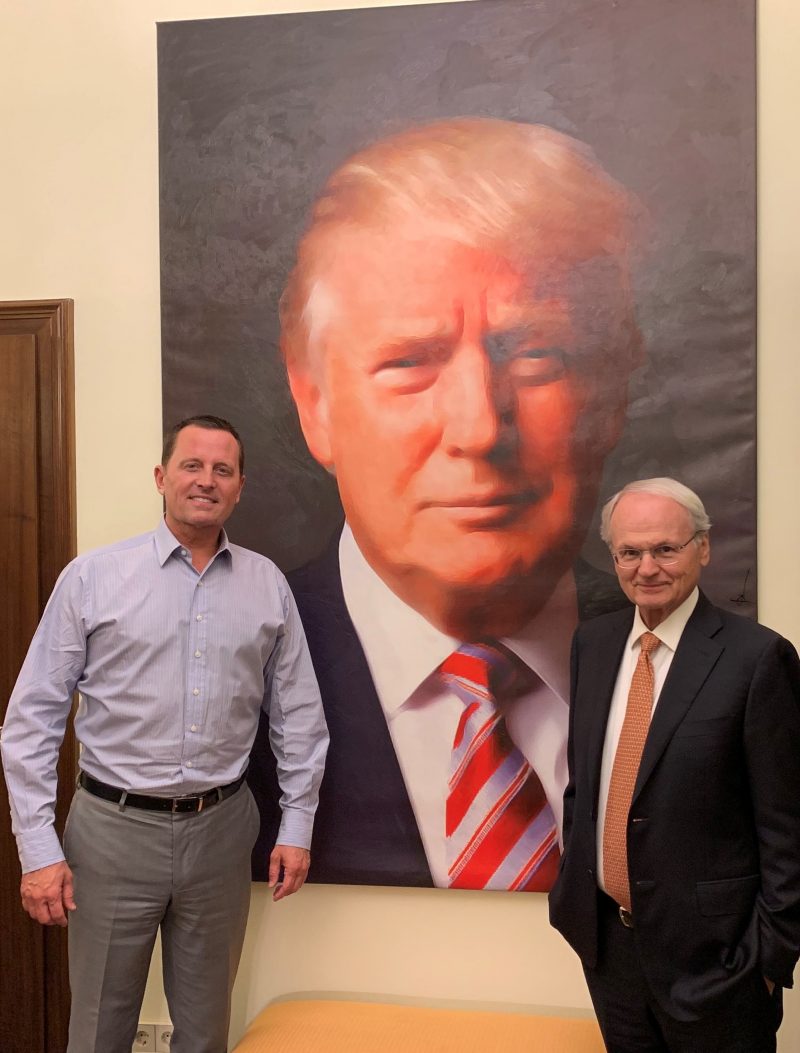
Richard Grenell, left, poses with Morton Klein, head of the Zionist Organization of America. Photo | ZOA
Though many intelligence community veterans and politicians in both major parties opposed Grenell’s appointment, the American Israel lobby was thrilled. The Zionist Organization of America (ZOA) “strongly praised” Grenell’s appointment as acting DNI, with ZOA president Morton Klein, stating:
I am proud to say that during my long personal friendship with Ambassador Grenell, it became powerfully clear to me that Grenell is a very talented and knowledgeable man whose commitment to America and its security is second to none. He is also a man who understands the importance of our country’s great alliance with Israel in promoting U.S. security interests. There has never been a better friend of a strong U.S-Israel relationship than Ambassador Grenell. (emphasis added)”
Klein previously announced his displeasure that Grenell had not been appointed to serve as U.S. ambassador to NATO after he had been given private “assurances” by the Trump administration that Grenell would be nominated to that post.
Grenell’s ties to political operatives like Finkelstein, his close friendships to Israel lobbyists Morton Klein and Israeli PM Netanyahu as well as his failure to disclose paid work done on behalf of foreign politicians make him susceptible to foreign influence or blackmail according to the official policy of the office of the DNI, which Grenell now leads.
That policy holds that “conditions that could raise a security concern and may be disqualifying” include “connections to a foreign person, group, government or country that create a potential conflict of interest between the individual’s obligation to protect classified or sensitive information or technology and the individual’s desire to help a foreign person, group or country by providing that information or technology.”
Given that Israeli politicians and officials, including Netanyahu, have actively used blackmail to influence sitting U.S. presidents and that the pro-Israel lobby has a history of espionage targeting the United States, it is telling that Grenell’s appointment to a sensitive intelligence post has not been criticized in the media over his close ties to the pro-Israel lobby, Arthur Finkelstein and Israel’s government.
Israel’s foothold grows
While Grenell’s appointment is troubling over his ties to the pro-Israel lobby, it is merely the latest such appointment made by the Trump administration as several top intelligence figures with deep ties to the pro-Israel lobby have recently risen to prominence.
For example, current NSA director of Cybersecurity Anne Neuberger is married to Yehuda Neuberger, who serves as chair of AIPAC’s executive council in Baltimore. Neuberger’s parents were rescued via the IDF’s “Operation Entebbe,” an operation led by Benjamin Netanyahu’s brother, Yonathan Netanyahu. Neuberger was less than a year old at the time, but was not with her parents during the incident.
As Cybersecurity director for the NSA, Neuberger oversees a division of that agency that “unifies NSA’s foreign intelligence and cyberdefense missions” and works “to prevent and eradicate threats to national security systems and critical infrastructure,” including the country’s election infrastructure. Her family ties to AIPAC are therefore concerning given the powerful lobby groups’ propensity to meddle in this election’s Democratic primary. This is belied by the fact that AIPAC has, in the past, committed espionage against the U.S. government on Israel’s behalf on more than one occasion.
In addition to Neuberger, both the head and deputy chair of the President’s Intelligence Advisory Board (PIAB) have close ties to foreign lobbies and intelligence services. According to the U.S. government, PIAB “exists exclusively to assist the President by providing him with an independent source of advice on the effectiveness with which the Intelligence Community is meeting the Nation’s intelligence needs, and the vigor and insight with which the community plans for the future. The Board has access to all information needed to perform its functions and has direct access to the President.” The government’s official description of the body’s role also states that PIAB has “immense and long-lasting impacts on the structure, management, and operations of U.S. intelligence.”
PIAB is chaired by Stephen Feinberg, the billionaire owner of Cerberus capital management, which owns scandal-ridden U.S. military and intelligence contractor DynCorp. Court documents cited by the New York Times accused Cerberus of “orchestrating secretive deals that transgressed legal and ethical boundaries,” making his role at PIAB at overseeing the often ethically-challenged U.S. intelligence community troubling. In addition, Cerberus was previously the owner of or majority stakeholder of a string of now-bankrupt companies that defrauded U.S. intelligence and the U.S. military on a massive scale during the George W. Bush administration, with much of that occurring while then-Secretary of Defense Donald Rumsfeld was invested in Cerberus.
Feinberg’s close relationships also raise some red flags. He is a close friend of Jared Kushner, the president’s son-in-law whose family has a close friendship with Netanyahu, as well as Steve Bannon, who has close ties to the U.S. Israel lobby, particularly the ZOA. Feinberg is also a close associate of hedge fund manager Michael Steinhardt, a “Mega Group” member whose father worked for the National Crime Syndicate. Steinhardt was instrumental in the controversial Clinton-era pardon of Mossad asset Marc Rich and is a major funder of pro-Israel organizations.
Feinberg was also one of the main shareholders in Israel’s then-largest bank, Bank Leumi, until he was pressured to sell his stake following the revelation that his partner in that investment, Ezra Merkin, played a key role in the Bernie Madoff scandal. Cerberus’ acquisition of those shares had originally been closely tied to a Likud party initiative to privatize Israel’s entire banking sector.
Companies owned by Cerberus have also been found to be closely tied to Saudi intelligence. The Washington Post reported last year that a U.S.-backed plan to “modernize” Saudi intelligence had been created by Culpeper National Security Solutions, a unit of Cerberus-owned DynCorp, along “with help from some prominent former CIA officials.” Another Cerberus-owned company called Tier 1 has also helped train Saudi Special Forces, some of whom were reportedly involved in the murder of Jamal Khashoggi. Though Feinberg says he divested his personal stake from these companies prior to chairing PIAB, they remain owned by his firm Cerberus and arguably still present a conflict of interest.
In addition to Feinberg, the PIAB’s current deputy chair — Samantha Ravich — formerly worked for the pro-Israel lobby group Washington Institute for Near East Policy (WINEP), a spin-off of AIPAC that was created to shield the lobby organization from scrutiny, when it was investigated in 1984 for espionage against the U.S. government on Israel’s behalf.
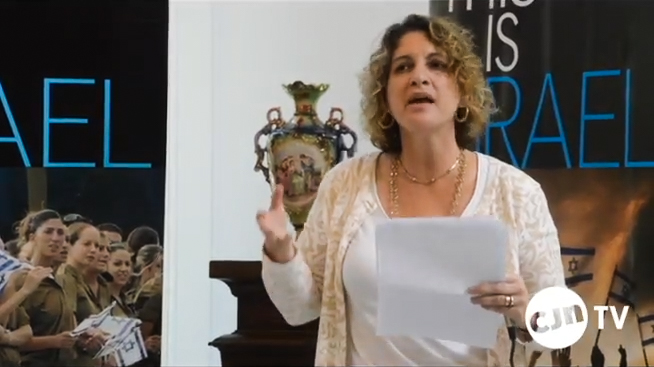
Samantha Ravich speaks at Israel Bonds luncheon in Clevland in 2016. CJN | Screenshot
Ravich, who joined PIAB in 2018, is also a senior advisor to the group the Foundation for the Defense of Democracies (FDD), which was revealed to work directly with Israel’s government in a since-censored Al Jazeera documentary on the Israel lobby. Ravich also worked for the consulting firm of Michael Chertoff, the former head of the Department of Homeland Security whose mother worked with Israel’s Mossad.
Ravich has specifically promoted a “cyber project” to the U.S. Senate that would protect member countries from cyber threats but exclude nations that endorse or fail to condemn the nonviolent Boycott, Divestment, and Sanctions (BDS) movement that supports Palestinian rights and Israeli compliance with international law. Ravich also praised the Trump administration’s decision to partner with Israel’s government on “cybersecurity” in 2017, saying that “the U.S. cannot go it alone in its endeavor to safeguard the networks and systems upon which our economy depends.” As MintPress reported last month, several highly classified networks of the U.S. intelligence community and the military, including networks of the CIA, NSA, and DISA, now use cybersecurity software deeply tied to Israeli military intelligence, thanks in part to this U.S.-Israel partnership.
Now, with Richard Grenell overseeing all 17 U.S. intelligence agencies, Israel’s influence in the U.S. intelligence community has reached new and troubling heights. Yet, his appointment is only the latest move by the Trump administration that places pro-Israel partisans in highly sensitive positions, suggesting that similar appointments are likely in the future, especially if Trump is reelected in November.
Whitney Webb is a MintPress News journalist based in Chile. She has contributed to several independent media outlets including Global Research, EcoWatch, the Ron Paul Institute and 21st Century Wire, among others. She has made several radio and television appearances and is the 2019 winner of the Serena Shim Award for Uncompromised Integrity in Journalism.
Clinton: Destroy Syria for Israel
The New Observer | May 22, 2016
A newly-released Hilary Clinton email confirmed that the Obama administration has deliberately provoked the civil war in Syria as the “best way to help Israel.”
In an indication of her murderous and psychopathic nature, Clinton also wrote that it was the “right thing” to personally threaten Bashar Assad’s family with death.
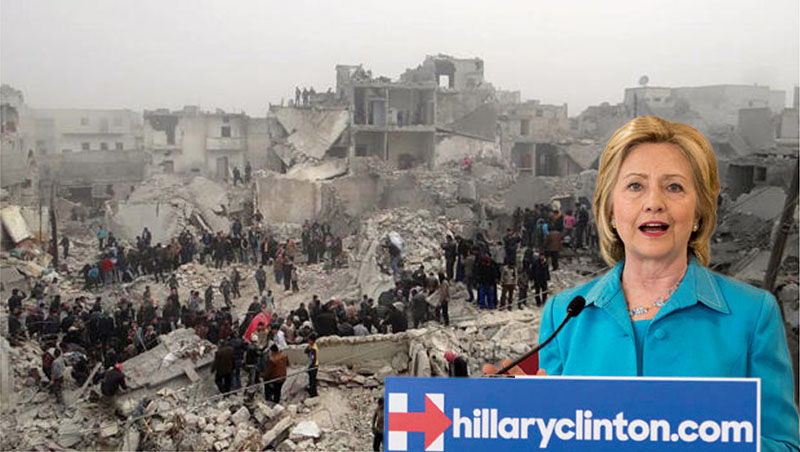
In the email, released by Wikileaks, then Secretary of State Clinton says that the “best way to help Israel” is to “use force” in Syria to overthrow the government.
The document was one of many unclassified by the US Department of State under case number F-2014-20439, Doc No. C05794498, following the uproar over Clinton’s private email server kept at her house while she served as Secretary of State from 2009 to 2013.
Although the Wikileaks transcript dates the email as December 31, 2000, this is an error on their part, as the contents of the email (in particular the reference to May 2012 talks between Iran and the west over its nuclear program in Istanbul) show that the email was in fact sent on December 31, 2012.
The email makes it clear that it has been US policy from the very beginning to violently overthrow the Syrian government—and specifically to do this because it is in Israel’s interests.
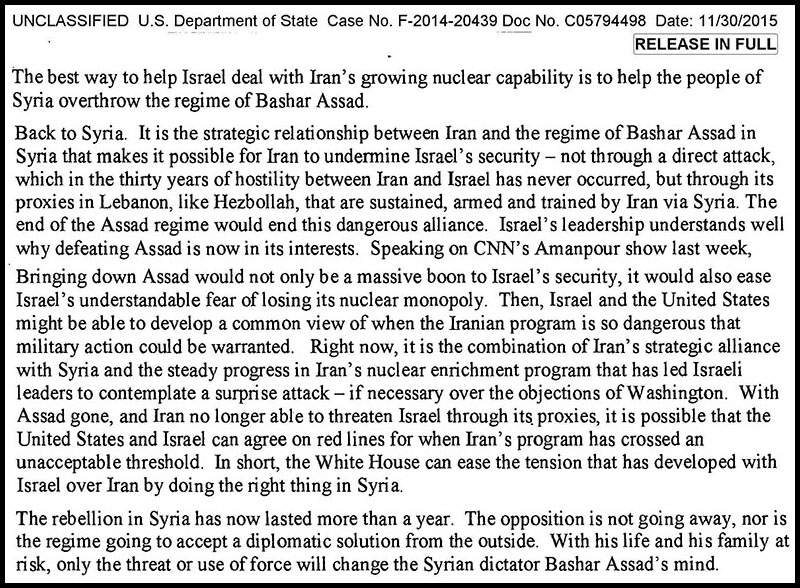
“The best way to help Israel deal with Iran’s growing nuclear capability is to help the people of Syria overthrow the regime of Bashar Assad,” Clinton forthrightly starts off by saying.
Even though all US intelligence reports had long dismissed Iran’s “atom bomb” program as a hoax (a conclusion supported by the International Atomic Energy Agency), Clinton continues to use these lies to “justify” destroying Syria in the name of Israel.
She specifically links Iran’s mythical atom bomb program to Syria because, she says, Iran’s “atom bomb” program threatens Israel’s “monopoly” on nuclear weapons in the Middle East.
If Iran were to acquire a nuclear weapon, Clinton asserts, this would allow Syria (and other “adversaries of Israel” such as Saudi Arabia and Egypt) to “go nuclear as well,” all of which would threaten Israel’s interests.
Therefore, Clinton, says, Syria has to be destroyed.
Iran’s nuclear program and Syria’s civil war may seem unconnected, but they are. What Israeli military leaders really worry about — but cannot talk about — is losing their nuclear monopoly.
An Iranian nuclear weapons capability would not only end that nuclear monopoly but could also prompt other adversaries, like Saudi Arabia and Egypt, to go nuclear as well. The result would be a precarious nuclear balance in which Israel could not respond to provocations with conventional military strikes on Syria and Lebanon, as it can today.
If Iran were to reach the threshold of a nuclear weapons state, Tehran would find it much easier to call on its allies in Syria and Hezbollah to strike Israel, knowing that its nuclear weapons would serve as a deterrent to Israel responding against Iran itself.
It is, Clinton continues, the “strategic relationship between Iran and the regime of Bashar Assad in Syria” that makes it possible for Iran to undermine Israel’s security.
This would not come about through a “direct attack,” Clinton admits, because “in the thirty years of hostility between Iran and Israel” this has never occurred, but through its alleged “proxies.”
The end of the Assad regime would end this dangerous alliance. Israel’s leadership understands well why defeating Assad is now in its interests.
Bringing down Assad would not only be a massive boon to Israel’s security, it would also ease Israel’s understandable fear of losing its nuclear monopoly.
Then, Israel and the United States might be able to develop a common view of when the Iranian program is so dangerous that military action could be warranted.
Clinton goes on to assert that directly threatening Bashar Assad “and his family” with violence is the “right thing” to do:
In short, the White House can ease the tension that has developed with Israel over Iran by doing the right thing in Syria.
With his life and his family at risk, only the threat or use of force will change the Syrian dictator Bashar Assad’s mind.
The email proves—as if any more proof was needed—that the US government has been the main sponsor of the growth of terrorism in the Middle East, and all in order to “protect” Israel.
It is also a sobering thought to consider that the “refugee” crisis which currently threatens to destroy Europe, was directly sparked off by this US government action as well, insofar as there are any genuine refugees fleeing the civil war in Syria.
In addition, over 250,000 people have been killed in the Syrian conflict, which has spread to Iraq—all thanks to Clinton and the Obama administration backing the “rebels” and stoking the fires of war in Syria.
The real and disturbing possibility that a psychopath like Clinton—whose policy has inflicted death and misery upon millions of people—could become the next president of America is the most deeply shocking thought of all.
Clinton’s public assertion that, if elected president, she would “take the relationship with Israel to the next level,” would definitively mark her, and Israel, as the enemy of not just some Arab states in the Middle East, but of all peace-loving people on earth.
Featured Video

The Search for Truth: Charlie Kirk’s Assassination One Year Later
or go to
Aletho News Archives – Video-Images
From the Archives
The 9/11 “Double-Cross” Conspiracy Theory
BY LAURENT GUYÉNOT • UNZ REVIEW • SEPTEMBER 6, 2022
Is it true that “9/11 was an inside job”? Yes, insofar as Israel is “inside” the U.S. But for the 9/11 truthers who have identified Israel as the main perpetrators, “9/11 was an inside job” is at best a half-truth, and at worst an integral part of the Zionist operation, like a secondary flag sewn as a lining under the false flag of Islamism. Victor Thorn (1963-2017) wrote in his book 9/11 made in Israel: The Plot Against America (2011): “In essence, the ‘9-11 truth movement’ was created prior to Sept. 11, 2001 as a means of suppressing news relating to Israeli complicity. . . . The slogan ‘9-11 was an inside job’ was quite possibly the greatest example of Israeli propaganda ever devised.” In milder terms, it is “controlled opposition”.
A genuine truth movement would have pointed to Israel as the prime suspect from the start. From day one, it was obvious who would benefit. … continue
Blog Roll
 Aletho News
- Dhubab offensive, media blitz and the rapid unraveling of Saudi-backed coalition’s new gambit
- Putin Conveys to Trump Iran’s Vision on Possible Conflict Resolution – Kremlin
- The Search for Truth: Charlie Kirk’s Assassination One Year Later
- ‘Harsh reality’: Iran says France seeks monopoly on power and intimidation, not peace for all
- When Will This White House Madness End?
- Huckabee aide goes to ‘unusual lengths’ to portray ‘Israel’ positively
- Trump Announces Diesel Supply Deal With Putin Following Phone Call
- MEP blasts ‘Euro-Gestapo’ for lecturing Russia on democracy
- Syria May Send Troops to Saudi Arabia Amid War with Ansar Allah
- UK whines about losing billions to ‘Putin tax’
- If Americans Knew
- Gaza ceasefire exists in name only, say more than 100 organizations
- Nearly 2 Million in Gaza Need Urgent Shelter Assistance as Winter Looms: IOM Chief Warns
- Suppressing Palestinian resistance: US charity under fire for AI monitoring of Gaza classrooms
- Thousands Are Held in Israeli Torture Camps. This Is What Happens Inside
- Israel puts Gaza’s sick, injured, newborn in peril – Daily Update
- Report claimed Mark Levin used by Israeli government to influence Trump
- Over 2,000 Gazans have died awaiting medical evacuation amid Israel’s continued siege
- How a U.S. Diplomat Suppressed and Altered Reports Critical of Israel
- 5 Palestinians Die from Israeli Strikes in Gaza as Relentless Attacks Continue
- Report: Ceasefire Slows Killing but Leaves Devastation Intact
- No Tricks Zone
- New Study: 50 Years Of The Most Aggressive ‘Net Zero’ Policies Can Only Affect The Global Climate By 0.03°C
- US September “Heat” Was No Record…Many Records Set Decades Ago
- Latest European Green Energy Debacle; Portugal’s Largest Flagship Solar Park Insolvent!
- Green Energy Debacle: German Expert Professor Fritz Vahrenholt Warns Of Severe Economic And Social Consequences
- Two More Paleo Reconstructions Affirm Meters-Higher Sea Levels Across Ireland, Brazil 7000-6000 Years Ago
- New Study: Earth And Venus Surface Warmth Largely Explained By Convection And Lapse Rate, Not CO2 Or Radiation
- 2025 Nature Paper Claiming Worsening Global Drought Gets RETRACTED …Heavily Flawed
- New Study: ‘Global Drought Shows No Detectable Recent Acceleration Under Climate Warming’
- Economic Masterminds: German Socialists Suggest Taxing Productivity Gains Stemming From Using AI
- The South China Sea Has Not Been Cooperating With The Climate Change Narrative

