Profiting from Loss: How Business in Illegal Israeli Settlements Continues Unchecked
UN efforts to protect Palestinian land from economic exploitation are failing, and exposing the hypocrisy of western states
By Jonathan Cook – The National – February 18, 2020
After lengthy delays, the United Nations finally published a database last week of businesses that have been profiting from Israel’s illegal annexation and settlement activity in the West Bank.
The UN High Commissioner for Human Rights, Michelle Bachelet, announced that 112 major companies had been identified as operating in Israeli settlements in ways that violate human rights.
Aside from major Israeli banks, transport services, cafes, supermarkets, and energy, building and telecoms firms, prominent international businesses include Airbnb, booking.com, Motorola, Trip Advisor, JCB, Expedia and General Mills.
Human Rights Watch, a global watchdog, noted in response to the list’s publication that the settlements violate the Fourth Geneva Convention. It argued that the firms’ activities mean they have aided “in the commission of war crimes”.
The companies’ presence in the settlements has helped to blur the distinction between Israel and the occupied Palestinian territories. That in turn has normalised the erosion of international law and subverted a long-held international consensus on establishing a viable Palestinian state alongside Israel.
Work on compiling the database began four years ago. But both Israel and the United States put strong pressure on the UN in the hope of preventing the list from ever seeing the light of day.
The UN body’s belated assertiveness looks suspiciously like a rebuke to the Trump administration for releasing this month its Middle East “peace” plan. It green-lights Israel’s annexation of the settlements and the most fertile and water-rich areas of the West Bank.
In response to the database, Israeli Prime Minister Benjamin Netanyahu threatened to intensify his country’s interference in US politics. He noted that his officials had already “promoted laws in most US states, which determine that strong action is to be taken against whoever tries to boycott Israel.”
He was backed by all Israel’s main Jewish parties. Amir Peretz, leader of the centre-left Labour party, vowed to “work in every forum to repeal this decision”. And Yair Lapid, a leader of Blue and White, the main rival to Netanyahu, called Bachelet the “commissioner for terrorists’ rights”.
Meanwhile, Mike Pompeo, the US secretary of state, accused the UN of “unrelenting anti-Israel bias” and of aiding the international boycott, divestment and sanctions (BDS) movement.
In fact, the UN is not taking any meaningful action against the 112 companies, nor is it encouraging others to do so. The list is intended as a shaming tool – highlighting that these firms have condoned, through their commercial activities, Israel’s land and resource theft from Palestinians.
The UN has even taken an extremely narrow view of what constitutes involvement with the settlements. For example, it excluded organisations like FIFA, the international football association, whose Israeli subsidiary includes six settlement teams.
One of the identified companies, Airbnb, announced in late 2018 that it would remove from its accommodation bookings website all settlement properties – presumably to avoid being publicly embarrassed.
But a short time later Airbnb backed down. It is hard to imagine the decision was taken on strictly commercial grounds: the firm has only 200 settlement properties on its site.
A more realistic conclusion is that Airbnb feared the backlash from Washington and was intimidated by a barrage of accusations from pro-Israel groups that its new policy was anti-semitic.
In fact, the UN’s timing could not be more tragic. The list looks more like the last gasp of those who – through their negligence over nearly three decades – have enabled the two-state solution to wither to nothing.
Trump’s so-called peace plan could afford to be so one-sided only because western powers had already allowed Israel to void any hope of Palestinian statehood through decades of unremitting settlement expansion. Today, nearly 700,000 Israeli Jews are housed on occupied Palestinian territory.
On Monday European Union foreign ministers were due to meet to discuss their response to the plan. Tepid criticism was the most that could be expected.
The actions of several European states continue to speak much louder than any words.
On Friday, Germany followed the Czech Republic in filing a petition to the International Criminal Court at The Hague siding with Israel as the court deliberates whether to prosecute Israeli officials for war crimes, including over the establishment of settlements.
Germany does not appear to deny that the settlements are war crimes. Instead, it hopes to block the case on dubious technical grounds: that despite Palestine signing up to the Rome Statute, which established the Hague court, it is not yet a fully fledged state.
So far Austria, Hungary, Australia and Brazil appear to be following suit.
But if Palestine lacks the proper attributes of statehood, it is because the US and Europe, including Germany, have consistently broken promises to the Palestinians.
They not only refused to intervene to save the two-state solution, but rewarded Israel with trade deals and diplomatic and financial incentives, even as Israel eroded the institutional and territorial integrity necessary for Palestinian self-rule.
Germany’s stance, like that of the rest of Europe, is hypocritical. They have claimed opposition to Israel’s endless settlement expansion, and now to Trump’s plan, but their actions have paved the way to the annexation of the West Bank the plan condones.
Back in November the European Court of Justice finally ruled that products made in West Bank settlements – using illegally seized Palestinian resources on illegally seized Palestinian land – should not be labelled deceptively as “Made in Israel”.
And yet European countries are still postponing implementation of the decision. Instead, some of them are legislating against their citizens’ right to express support for a settlement boycott.
Similarly, Europe and North America continue to afford the Jewish National Fund, an entity that finances settlement-building, “charitable status”, giving it tax breaks as it raises funds inside their jurisdictions.
The Israeli media is full of stories of how the JNF actively assists extremist settler groups in evicting Palestinians from homes in East Jerusalem. But Britain and other states are blocking legal efforts to challenge the JNF’s special status.
Soon, it seems, Europe will no longer have to worry about its hypocrisy being so visible. Once the settlements have been annexed, as the Trump administration intends, the EU can set aside its ineffectual agonising and treat the settlements as irrevocably Israeli – just as it has done in practice with the Israeli “neighbourhoods” of occupied East Jerusalem.
Then, the UN’s list of shame can join decades’ worth of condemnatory resolutions that have been quietly gathering dust.
Explaining Syria
It’s everyone’s fault except the U.S. and Israel
By Philip Giraldi • Unz Review • February 18, 2020
The first week in February was memorable for the failed impeachment of President Donald Trump, the “re-elect me” State of the Union address and the marketing of a new line of underwear by Kim Kardashian. Given all of the excitement, it was easy to miss a special State Department press briefing by Ambassador James Jeffrey held on February 5th regarding the current situation in Syria.
Jeffrey is the United States Special Representative for Syria Engagement and the Special Envoy for the Global Coalition to Defeat ISIL. Jeffrey has had a distinguished career in government service, attaining senior level State Department positions under both Democratic and Republican presidents. He has served as U.S. Ambassador to both Turkey and Iraq. He is, generally speaking, a hardliner politically, closely aligned with Israel and regarding Iran as a hostile destabilizing force in the Middle East region. He was between 2013 and 2018 Philip Solondz distinguished fellow at the Washington Institute for Near East Policy (WINEP), a think tank that is a spin-off of the American Israel Public Affairs Committee (AIPAC). He is currently a WINEP “Outside Author” and go-to “expert.”
Professor John Mearsheimer of the University of Chicago and Stephen Walt, academic dean at Harvard University’s Kennedy School of Government, describe WINEP as “part of the core” of the Israel Lobby in the U.S. They examined the group on pages 175-6 in their groundbreaking book The Israel Lobby and US Foreign Policy and concluded as follows:
“Although WINEP plays down its links to Israel and claims that it provides a ‘balanced and realistic’ perspective on Middle East issues, this is not the case. In fact, WINEP is funded and run by individuals who are deeply committed to advancing Israel’s agenda … Many of its personnel are genuine scholars or experienced former officials, but they are hardly neutral observers on most Middle East issues and there is little diversity of views within WINEP’s ranks.”
In early 2018 Jeffrey co-authored a WINEP special report on Syria which urged “…the Trump administration [to] couple a no-fly/no-drive zone and a small residual ground presence in the northeast with intensified sanctions against the Assad regime’s Iranian patron. In doing so, Washington can support local efforts to stabilize the area, encourage Gulf partners to ‘put skin in the game, drive a wedge between Moscow and Tehran, and help Israel avoid all-out war.”
Note the focus on Iran and Russia as threats and the referral to Assad and his government as a “regime.” And the U.S. presence is to “help Israel.” So we have Ambassador James Jeffrey leading the charge on Syria, from an Israeli perspective that is no doubt compatible with the White House view, which explains why he has become Special Representative for Syria Engagement.
Jeffrey set the tone for his term of office shortly after being appointed by President Trump back in August 2018 when he argued that the Syrian terrorists were “. . . not terrorists, but people fighting a civil war against a brutal dictator.” Jeffrey, who must have somehow missed a lot of the head chopping and rape going on, subsequently traveled to the Middle East and stopped off in Israel to meet Prime Minister Benjamin Netanyahu. It has been suggested that Jeffrey received his marching orders during the visit.
Two months later James Jeffrey declared that he would like to see Russia maintain a “permissive approach” to allow the Israelis to attack Iranian targets inside Syria. Regarding Iran’s possible future role in Syria he observed that “Iranians are part of the problem not part of the solution.”
What Jeffrey meant was that because Israel had been “allowed” to carry out hundreds of air attacks in Syria ostensibly directed against Iran-linked targets, the practice should be permitted to continue. Israel had suspended nearly all of its airstrikes in the wake of the shoot down of a Russian aircraft in September 2018, an incident which was caused by a deliberate Israeli maneuver that brought down the plane even though the missile that struck the aircraft was fired by Syria. Fifteen Russian servicemen were killed. Israel reportedly was deliberately using the Russian plane to mask the presence of its own attacking aircraft.
Russia responded to the incident by deploying advanced S-300 anti-aircraft systems to Syria, which can cover most of the more heavily developed areas of the country. Jeffrey was unhappy with that decision, saying “We are concerned very much about the S-300 system being deployed to Syria. The issue is at the detail level. Who will control it? what role will it play?” And he defended his own patently absurd urging that Russia, Syria’s ally, permit Israel to continue its air attacks by saying “We understand the existential interest and we support Israel” because the Israeli government has an “existential interest in blocking Iran from deploying long-range power projection systems such as surface-to-surface missiles.”
Later in November 2018 James Jeffrey was at it again, declaring that U.S. troops will not leave Syria before guaranteeing the “enduring defeated” of ISIS, but he perversely put the onus on Syria and Iran, saying that “We also think that you cannot have an enduring defeat of ISIS until you have fundamental change in the Syrian regime and fundamental change in Iran’s role in Syria, which contributed greatly to the rise of ISIS in the first place in 2013, 2014.”
As virtually no one but Jeffrey and the Israeli government actually believes that Damascus and Tehran were responsible for creating ISIS, the ambassador elaborated, blaming President Bashar al-Assad for the cycle of violence in Syria that, he claimed, allowed the development of the terrorist group in both Syria and neighboring Iraq.
He said “The Syrian regime produced ISIS. The elements of ISIS in the hundreds, probably, saw an opportunity in the total breakdown of civil society and of the upsurge of violence as the population rose up against the Assad regime, and the Assad regime, rather than try to negotiate or try to find any kind of solution, unleashed massive violence against its own population.”
Jeffrey’s formula is just another recycling of the myth that the Syrian opposition consisted of good folks who wanted to establish democracy in the country. In reality, it incorporated terrorist elements right from the beginning and groups like ISIS and the al-Qaeda affiliates rapidly assumed control of the violence. That Jeffrey should be so ignorant or blinded by his own presumptions to be unaware of that is astonishing. It is also interesting to note that he makes no mention of the U.S. invasion of Iraq, kneejerk support for Israel and the unrelenting pressure on Syria starting with the Syrian Accountability Act of 2003 and continuing with embrace of the so-called Arab Spring. Most observers believe that those actions were major contributors to the rise of ISIS.
Jeffrey’s unflinching embrace of the Israeli and hardline Washington assessment of the Syrian crisis comes as no surprise given his pedigree, but in the same interview where he pounded Iran and Syria he asserted oddly that “We’re not about regime change. We’re about a change in the behavior of a government and of a state.”
Some of James Jeffrey’s comments at last week’s press conference are similarly illuminating. Much of what he said concerned the mechanics of relationships with the Russians and Turks, but he also discussed some core issues relating to Washington’s perspective on the conflict. Many of his comments were very similar to what he said when he was appointed in 2018.
Jeffrey expressed concern over the thousands of al-Nusra terrorists holed up in besieged Idlib province, saying “We’re very, very worried about this. First of all, the significance of Idlib – that’s where we’ve had chemical weapons attacks in the past… And we’re seeing not just the Russians but the Iranians and Hizballah actively involved in supporting the Syrian offensive… You see the problems right now in Idlib. This is a dangerous conflict. It needs to be brought to an end. Russia needs to change its policies.”
He elaborated, “We’re not asking for regime change per se, we’re not asking for the Russians to leave, we’re asking…Syria to behave as a normal, decent country that doesn’t force half its population to flee, doesn’t use chemical weapons dozens of times against its own civilians, doesn’t drop barrel bombs, doesn’t create a refugee crisis that almost toppled governments in Europe, does not allow terrorists such as HTS and particularly Daesh/ISIS emerge and flourish in much of Syria. Those are the things that that regime has done, and the international community cannot accept that.”
Well, one has to conclude that James Jeffrey is possibly completely delusional. The core issue that the United States is in Syria illegally as a proxy for Israel and Saudi Arabia is not touched on, nor the criminal role in “protecting the oil fields” and stealing their production, which he mentions but does not explain. Nor the issue of the legitimate Syrian government seeking to recover its territory against groups that most everyone admits to be terrorists.
Virtually every bit of “evidence” that Jeffrey cites is either false or inflated, to include the claim of use of chemical weapons and the responsibility for the refugees. As for who actually created the terrorists, that honor goes to the United States, which accomplished that when it invaded Iraq and destroyed its government before following up by undermining Syria. And, by the way, someone should point out to Jeffrey that Russia and Iran are in Syria as allies of its legitimate government.
Ambassador James Jeffrey maintains that “Russia needs to change its policies.” That is not correct. It is the United States that must change its policies by getting out of Syria and Iraq for starters while also stopping the deference to feckless “allies” Israel and Saudi Arabia that has produced a debilitating cold war against both Iran and Russia. Another good first step to make the U.S. a “normal, decent country” would be to get rid of the advice of people like James Jeffrey.
Philip M. Giraldi, Ph.D., is Executive Director of the Council for the National Interest, a 501(c)3 tax deductible educational foundation (Federal ID Number #52-1739023) that seeks a more interests-based U.S. foreign policy in the Middle East. Website is councilforthenationalinterest.org, address is P.O. Box 2157, Purcellville VA 20134 and its email is inform@cnionline.org.
Karl Marx and Jewish Power
By Laurent Guyénot • Unz Review • February 17, 2020
In a recent article, I explored the influence of Freud’s Jewishness on the formation, reception and propagation of his psychoanalytical theory. I wish now to do the same for Karl Marx (1818-1883). In contrast to Freud’s, Marx’s Jewishness is seldom considered an important factor. If you type “Freud Jewish” as key-words on Amazon.com, you will be suggested a dozen books dealing specifically with Freud’s Jewishness, whereas “Marx Jewish” will yield no result except Marx’s own essays “On the Jewish Question”, and a discussion of them, with precious little about Marx’s own Jewish background and connections.
Even in the literature exposing the role of Jews in the Bolshevik revolution in Russia and other revolutionary movements of the twentieth century, such as Alexander Solzhenitsyn’s two-volume 200 Years Together, a contextualized analysis of Marx’s Jewishness is lacking.
One obvious reason is that Marx was not Jewish: he had been baptized a Lutheran at the age of six. Yet to claim that baptism had washed away all traces of Jewishness would be absurd, and particularly ironic in the case of a person who insisted that religion was an inessential part of Jewishness (as we shall see).
My purpose here is to examine Marx’s contribution to Jewish empowerment, and, ultimately, to the historical movement toward Jewish global domination that made a major breakthrough a century exactly after the Communist Manifesto (1848).
I must say in preamble that the question is not: Did Marx deliberately conspire with other Jews to advance the Jewish global agenda, while pretending to emancipate Gentile proletarians? Jewishness doesn’t necessarily work that way. It could be defined as the inability to distinguish between the interest of peoples, and the interest of the chosen people, between what is good for mankind and what is good for the Jews. As a rule, Jews who believe they are working for the salvation of the world while thinking Jewishly are advancing Jewish power one way or another. This applies, of course, to Jewish thinkers who believe that Jews have a mission to guide mankind toward perpetual peace, like Theodore Kaufman, who in 1941 believed that the first step to that goal was to “sterilize all Germans” (his interview with the Canadian Jewish Chronicles), or like David Ben-Gurion, who in 1962 believed that the next step was to make Jerusalem the “seat of the Supreme Court of Mankind, to settle all controversies among the federated continents, as prophesied by Isaiah.”[1] But it also applies to Jewish thinkers who do not publicly identify as Jews and are even critical of Jews, yet whose worldview is profoundly biblical, that is, both materialistic and prophetic. It is a question of inherited cognitive pattern, rather than deliberate intention. That being said, in Marx’s case, there is evidence of intellectual dishonesty, concealment and deception, as we shall see.
Marx’s prophecy and Bakunin’s foresight
According to Karl Popper, “the heart of the Marxian argument … consists of a historical prophecy, combined with an implicit appeal to the following moral law: Help to bring about the inevitable!”[2] There is no doubt that Marx’s prophecy of a messianic transformation of the world was profoundly Jewish in inspiration. What distinguishes Marx’s prophetic vision from the biblical project is that its explicit goal (as we shall see) is the international dictatorship of a cosmopolitan proletariat, not of Jewry. Yet, as Mikhail Bakunin warned in Statism and Anarchy (1873), Marx’s proletarian state “is a lie behind which the despotism of a ruling minority is concealed.” Behind the expression “scientific socialism”, Marx could only mean “the highly despotic government of the masses by a new and very small aristocracy of real or pretended scientists.”[3] That centralized state, according to Marxist doxa, will be a transitional stage before true socialism; it will “wither away”, according to Engels’ expression. To this, Bakunin replies “that no dictatorship can have any other objective than to perpetuate itself, and that it can engender and nurture only slavery in the people who endure it.” Bakunin suspected that if Marx had his way, German Jews like him would end up ruling the communist state.
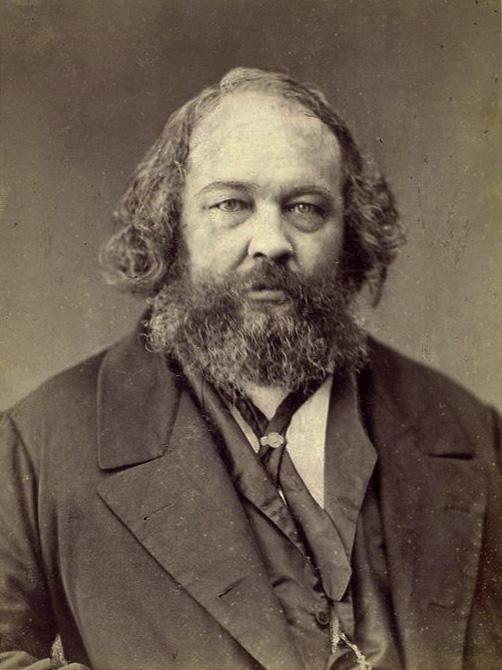
Bakunin photographed by Nadar
Indeed, Marx’s revolutionary prophecy appealed particularly to non-proletarian German Jews. Fritz Kahn hailed him as more than a prophet in Die Juden als Rasse und Kulturvolk (1920): “in 1848, for the second time, the star of Bethlehem was raised to the firmament … and it rose again above the rooftops of Judea: Marx.”[4]
If Marx was the Messiah in 1848, then Benjamin Disraeli could be called his prophet. In his novel Coningsby, published in 1844, the Jewish character Sidonia—“a cross between Lionel de Rothschild and Disraeli himself,” according to Disraeli’s biographer[5]—declared:
“That mighty revolution which is at this moment preparing in Germany, and which will be, in fact, a second and greater Reformation, and of which so little is as yet known in England, is entirely developing under the auspices of Jews, who almost monopolise the professorial chairs of Germany.”
Four years after these words were written, the Communist Manifesto was published and, almost simultaneously, the revolution broke out in Germany, as Disraeli had predicted . Jews did play a major role in the 1848 revolution, as Amos Elon has shown in his book The Pity of It All: A History of Jews in Germany 1743-1933. “80 percent of all Jewish journalists, doctors, and other professionals” supported the revolution. The most prominent were Ludwig Bamberger in Mainz, Ferdinand Lassalle in Dusseldorf, Gabriel Riesser in Hamburg, Johan Jacoby in Koeningsberg, Aron Bernstein in Berlin, Herman Jellinek in Vienna, Moritz Harmann in Prague, and Sigismund Asch in Breslau. “All over the country,” Elon writes, “rabbis in their sermons greeted the revolution as a truly messianic event.” The Jewish magazine Der Orient praised “the heroic Maccabean battle of our brethren on the barricades of Berlin,” and raved, “The savior from whom we have prayed has appeared. The fatherland has given him to us. The messiah is freedom.” The Jewish scholar Leopold Zunz, founder of academic Judaic Studies (Wissenschaft des Judentums),
“described what was happening in specifically biblical terms shot through with the Messianic political view which saw revolutionary politics as the fulfillment of biblical promise. Haranguing the Berlin students from the barricades, Zunz portrayed Metternich [Chancellor of the Austrian Empire] as Haman and hoped that ‘perhaps by Purim, Amalek [meaning the Prussian king Friedrich Wilhelm IV] will be beaten.’”[6]
After the failure of the revolution, many revolutionaries exiled themselves to London, where they were known as the Forty-Eighters. Marx settled there for the rest of his life, “living encased in his own, largely German, world, formed by his family and a small group of intimate friends and political associates,” according to Isaac Berlin.[7] Apart from Engels, Marx’s friends and associates were, in fact, almost all Jewish. Marx’s influence, which had been small in the 1848 revolution, would then develop, thanks to what Bakunin would call in 1872, in an unpublished “Lettre au Journal La Liberté de Bruxelles,” his “remarkable genius of intrigue,” adding:
“he also has in his service a numerous corps of agents, hierarchically organized and acting secretly under his direct orders; a kind of socialist and literary freemasonry in which his compatriots, the German Jews and others, occupy a considerable place and deploy a zeal worthy of a better cause.”
Bakunin was particularly intrigued by Marx’s insistence on the centralization of all banking activity. The Communist Manifesto not only proclaims the abolition of private banks, but: “Centralisation of credit in the hands of the State, by means of a national bank with State capital and an exclusive monopoly.” In another unpublished editorial of 1872, Bakunin wrote:
“this Jewish world is today, for the most part, at the disposal of Marx on the one hand, and of Rothschild on the other. I am convinced that the Rothschilds, on their side, appreciate the merits of Marx and that Marx, on his side, feels an instinctual attraction and a great respect for the Rothschilds. / This may seem strange. What can there be in common between socialism and a major bank? The point is that Marx’s communism wants a strong centralization of the state, and where there is centralisation of the state, there must necessarily be a central bank, and where such a bank exists, the parasitic nation of the Jews, speculating with the Labour of the people, will always thrive.”[8]
Having succeeded to get Bakunin and his “anti-authoritarian” followers expelled from the International Workingmen’s Association (the First International), Marx transferred its General Council from London to New York—the city that would soon become the Western capital of Jewry, where another German Jew, Leon Braunstein aka Trotsky, would be preparing the Bolshevik revolution, with the financial support of Wall Street Jewish bankers like Jacob Schiff.[9]
The Jewish Question in nineteenth-century Germany
 In order to understand Marx’s hidden agenda, the best is to start with his first two significant articles, published in 1844 in the Deutsch-Französische Jahrbücher, four years before the Communist Manifesto. Their topic was the “Jewish Question”. Before we present what Marx had to say about it, we must recall the context.
The “Jewish Question” is the question of the possibility and means of Jewish assimilation. The problem, as it was commonly formulated from the end of the eighteenth century, was that Jews considered themselves, and were considered, as aliens in the European nations among which they lived. One solution was to transform Jewishness from a nationality into a religion compatible with the secular values of modern nations. Moses Mendelssohn (1729–1786) paved the way in Germany for a “Reform Judaism” that defined itself as purely religious and renounced nationalist aspirations. On the basis of this new pact, Napoleon granted political emancipation to the Jews in France, and was hailed as a liberator by German Jews when he invaded the German principalities. Although Jewish emancipation underwent a setback in Prussia when he withdrew in defeat, it was complete by 1848.
 However, the assumption that Jewishness was a matter of private religion created a new problem for the Jewish community, aggravated by residual forms of segregation: for many secular and educated Jews, Judaism had little appeal as a religion, and converting to Christianity seemed the logical continuation of their conversion to the Enlightenment. Half the Jews of Berlin converted to Protestantism or Catholicism in the late eighteenth and early nineteenth century.
Karl Marx’s family falls in that category. His father Herschel Levi, though the son and brother of rabbis, became a Lutheran in order to practice law in the Prussian courts, and had his six children and his wife baptized in 1824, when Karl was six years old. Another famous case is Heinrich Heine (1797–1856), who conceived of his baptism in 1825 (one year after Marx) as the “entrance ticket to European civilization.”[10] Marx met Heine, a generation his elder, shortly after his arrival in Paris in 1843, and the two men met frequently until Marx moved to London in 1849. It is believed that their conversations had a formative influence on both men. Heine may in fact have introduced Communism to Marx, for he wrote in 1842, one year before meeting Marx:
“Though Communism is at present little talked about, vegetating in forgotten attics on miserable straw pallets, it is nevertheless the dismal hero destined to play a great, if transitory role in the modern tragedy… There will then be only one shepherd with an iron crook and one identically shorn, identically bleating human herd.”[11]

Heine with Marx and his wife Jenny
The dissolution of Jewish identity into a religious faith led to a reaction in the form of a Jewish nationalist movement that would ultimately morph into Zionism. It was the German Jewish historian Heinrich Graetz (1817-1891), almost the same age as Marx, who gave the first impetus to a new Jewish national consciousness with his multivolume History of the Jewish People, published in 1853 . Marx first met Heinrich Graetz in the summer 1874, while “taking the waters” at Carlsbad in Bohemia. The two following summers, they coordinated their vacations there. We do not know what they talked about, but, as Shlomo Avineri comments, “a more dramatic prefiguration of the encounter between Zion and Kremlin could not be imagined.”[12]
Graetz reawakened the national consciousness of European Jews such as Moses Hess (1812-1875), author in 1862 of Rome and Jerusalem: The Last National Question, which in turn impressed Theodor Herzl. According to Hess, the efforts of the Jews to merge with a nationality other than their own are doomed to failure. “We shall always remain strangers among the nations,” for “the Jews are something more than mere ‘followers of a religion,’ namely, they are a race brotherhood, a nation.”[13]
Interestingly, before his conversion to Jewish nationalism, Moses Hess (originally Moritz) was a pre-Marxist communist. He was the founder of the Rheinische Zeitung, for which Marx served as Paris correspondent in 1842-43 . Hess had a strong influence on both Engels and Marx.[14] Marx borrowed from Hess’ 1845 essay on “The Essence of Money” his concept of economic alienation.[15] Hess always remained close to Marx; in 1869, at Marx’s request, he even penned an article slandering Bakunin, accusing him to be an “agent provocateur” of the Russian government.[16]
Marx’s response to Bruno Bauer
Marx’s essays on the Jewish Question were critical reviews of two works by Bruno Bauer (1809-1882), a leading figure of the Young Hegelians: a book titled Die Judenfrage (1842), and a follow-up article on “The Capacity of Present-day Jews and Christians to Become Free.”[17]
Bauer’s approach to the question of Jewish assimilation was innovative. For him, the religious nature of Judaism is the problem, not the solution. He argued that Jews cannot be emancipated politically without first being emancipated religiously, because the Jews’ resistance to assimilation is based on the commandment of the Torah to live permanently in separation from other people. The essence of their religion is their claim to be the chosen people, and that prevents them from even respecting other peoples.
“Jews as such can not amalgamate with peoples and associate their fate with theirs. As Jews, they must wait for a particular future, allotted to them alone, the chosen people, and assuring them the dominion of the world.”
Therefore, there can be no emancipation of the Jews. A Jew can emancipate himself only by ceasing to be a Jew, because his true alienation is his Jewishness.
Bauer was the first since Voltaire to point at the toxic influence of the Tanakh as the key to the Jewish Question. Christians could obviously never reach that conclusion, but even secular thinkers who subscribed to the new science of “higher criticism” (pioneered by David Strauss’ Life of Jesus, 1835) generally looked away from the xenophobia of the Tanakh. “One even screams at betrayal of the human race when the critics try to examine the essence of the Jew as a Jew,” noted Bauer.
In his critical reviews, Marx does not argue against Bauer’s point that Jewish religion is opposed to assimilation. Rather, he denies altogether that Jewishness is a matter of religion.
“Let us consider the actual, worldly Jew—not the Sabbath Jew, as Bauer does, but the everyday Jew. Let us not look for the secret of the Jew in his religion, but let us look for the secret of his religion in the real Jew.”
Since Marx downplays the religious definition of Jewishness, it would be expected that he opt for the second term of the alternative and define Jewishness as a nationality, as will his friend Hess twenty years later. But he doesn’t. Instead, Marx posits, for the first time, his dogma that religion belongs to the cultural “superstructure” of society, while the real “infrastructure” is economic. The essence of the Jew, he writes, is not his religion, but his love of money:
“What is the secular basis of Judaism? Practical need, self-interest. What is the worldly religion of the Jew? Huckstering. What is his worldly God? Money.”
Marx redefines Jewish religion as the cult of money: “Money is the jealous god of Israel, in face of which no other god may exist.” He does the same for Jewish nationality, in one short sentence: “The chimerical nationality of the Jew is the nationality of the merchant, of the man of money in general.” It follows naturally, according to Marx, that if you abolish money you will solve the Jewish question:
“Very well then! Emancipation from huckstering and money, consequently from practical, real Judaism, would be the self-emancipation of our time. An organization of society which would abolish the preconditions for huckstering, and therefore the possibility of huckstering, would make the Jew impossible. His religious consciousness would be dissipated like a thin haze in the real, vital air of society.”
Jews will be emancipated when all men will be emancipated, for there is no other emancipation than emancipation from money.
Marx makes the radical claim that love of money and economic alienation came to the world from the Jews. He equates economic alienation to Jewish influence:
“the practical Jewish spirit has become the practical spirit of the Christian nations. The Jews have emancipated themselves insofar as the Christians have become Jews. … The Jew is perpetually created by civil society from its own entrails. … The god of the Jews has become secularized and has become the god of the world”
And so, “In the final analysis, the emancipation of the Jews is the emancipation of mankind from Judaism.” That sounds terribly anti-Semitic, from today’s standards. Because of these essays on the Jewish Question, Marx’s biographers have been more concerned by the question, “Was Marx an anti-Semite?” (see Edmund Silberner’s 1949 book of that title) than by the issue of his Jewish background, environment, and mindset. This is best illustrated by this article by Michael Ezra, “Karl Marx’s Radical Antisemitism.”
 But in the context of the time, Marx’s view of the Jews as money worshippers was rather banal. It was almost unanimously shared among socialists, as Hal Draper reminds us in “Marx and the Economic-Jew Stereotype.”[18] It was especially common among revolutionary Jews as well as among Zionists who were generally socialists. Moses Hess himself, for instance, wrote in “The Essence of Money”: “The Jews, who in the natural history of the social animal-world had the world-historic mission of developing the beast of prey out of humanity have now finally completed their mission’s work.”
What Marx did was to push the stereotype to its limit: he made the love of money not just an attribute of some Jews, but the very essence of the Jews. But by doing so, he was in effect dissolving the Jewish question into a socio-economic question: the Jew becomes the archetypal bourgeois. By this sleight of hand, Marx eliminated the Jewish question once and for all. He would never come back to it.[19]
In fact, never again would Marx target specifically Jewish financiers. Nesta Webster draws attention to that anomaly in her World Revolution: The Plot Against Civilization (1921):
“The period of 1820 onwards became, as Sombart [Werner Sombart, The Jews and Modern Capitalism, 1911)] calls it, ‘the age of the Rothschilds,’ so that by the middle of the century it was a common dictum, ‘There is only one power in Europe, and that is Rothschild.’ Now how is it conceivable that a man who set out honestly to denounce Capitalism should have avoided all reference to its principal authors? Yet even in the section of his book dealing with the origins of Industrial Capitalism, where Marx refers to the great financiers, the stock-jobbing and speculation in shares, and what he describes as ‘the modern sovereignty of finance,’ he never once indicates the Jews as the leading financiers, or the Rothschilds as the super-capitalists of the world.”[20]
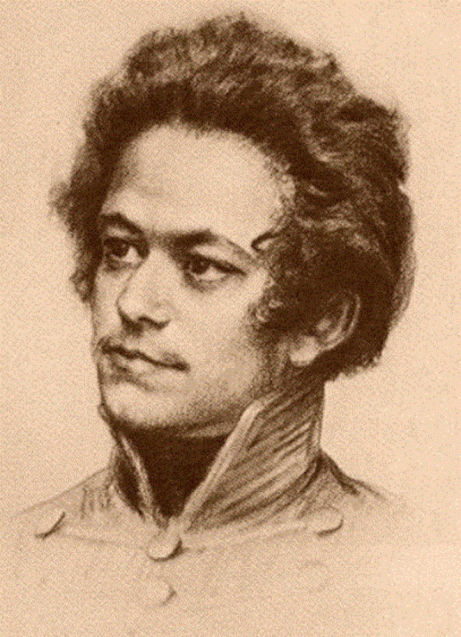
Young Karl Marx
By reducing Jewishness to capitalism, Marx was also overlooking another side of Jewish influence in the world: the revolution. The strong involvement of Jews in revolutionary movements would not become fully apparent to the world before 1848, but Marx, being himself a German Jewish revolutionary, could not be unaware of it. He could not be ignorant of the fact that Jews loved not only money, but also the revolution. Jewish revolutionary activity is one form of resistance to assimilation, especially when it calls for the destruction of the nations in the name of internationalism. By simply ignoring it, Marx was, at the very least, concealing the role of his own Jewishness in his revolutionary enterprise, while at the same time removing in advance all suspicion of his Jewish sympathies.
I believe Marx’s treatment of the Jewish question set the standard of his subsequent method. First, Marx misrepresents the arguments of his adversaries, often turning them upside down before proceeding to criticize them. For example Marx pretends that Bauer sees Jewishness as a religious faith, but that was not Bauer’s point. Rather, Bauer showed that defining Jewishness as a religion or ethnicity makes no big difference, because either way, the essence of Jewishness is separateness. Being religious only worsens the xenophobic nature of Jewishness, because it makes separateness a divine commandment rather than simply an ancestral habit. Secondly, Marx dismisses the complexity of things, in order to focus exclusively on a single and often secondary aspect of reality, making it look two-dimensional. Defining Jewishness as the love of money is obviously inadequate for anyone who has reflected even superficially on the question. Either Marx believes what he says, and that tells a lot about his intellectual ability, or he doesn’t—which is more likely—, and that tells a lot about his intellectual honesty. With the same reductionism Marx will claim in 1848, in the Communist Manifesto (Engels credited this insight to Marx alone), that, “The history of all hitherto existing society is the history of class struggles.” It is obvious to any (non-Marxist) historian that class struggles fall far behind ethnic struggles in the forces shaping history, even in modern times. Even an internationalist socialist like Bakunin could only be puzzled by Marx’s total ignorance of this fact:
“Marx completely ignores a most important element in the historic development of humanity, that is, the temperament and particular character of each race and each people, a temperament and a character which are themselves the natural product of a multitude of ethnological, climatological, economic, and historic causes, but which exercise, even apart from and independent of the economic conditions of each country, a considerable influence on its destinies and even on the development of its economic forces.”[21]
Coming from someone who grew up in a Jewish home and, despite his baptism, evolved in a mostly Jewish circle, counting among his friends zealot Jewish nationalists, I find it unbelievable that Marx’s ignorance of the national factor was sincere. Or perhaps, it must be considered very typical of Jewish discourse targeted at Gentiles. In that sense, Marx’s internationalism confirms Bauer’s remark that Jews consider only their own nationality as real:
“According to their fundamental representation, they wanted to be absolutely the people, the unique people, that is to say the people beside whom other peoples did not have the right to be a people. Any other people was, in comparison with them, not really a people; as the chosen people they were the only true people, the people who were to be All and take the world.”
Proudhon and the socialist movement before Marx
Having examined how Marx positioned himself on the background of the Jewish question, we can now do the same with the social question that occupied socialist thinkers.
At the time when Marx and Engels joined the movement, the most influential socialist theorist was Pierre-Joseph Proudhon (1809-1865), of nine years Marx’s elder. There is no better way to understand the originality of Marx’s economic ideas than by comparing them to Proudhon’s. (Proudhon’s work is accessible to English readers through Iain McKay’s anthology: Property is Theft! A Pierre-Joseph Proudhon Anthology, AK Press, 2011. McKay’s 82-page introductory chapters, including one on “Proudhon and Marx,” can be read here).
Proudhon’s book Qu’est-ce que la propriété? (What is Property? An Inquiry into the Principle of Right and of Government) published in 1840, had a huge echo and became a cornerstone of the European socialist movement. Proudhon was the first to use the expression “scientific socialism”, meaning a society ruled by a scientific government, one whose sovereignty rests upon justice and reason, rather than sheer will. His book was a critic of previous theories of economy (then called “political economy”) developed in Great Britain by Adam Smith (1723-1790) and David Ricardo (1772-1823). As explained by McKay, “It was Proudhon who first located surplus value production within the workplace, recognizing that the worker was hired by a capitalist who then appropriates their product in return for a less than equivalent amount of wages” (McKay 66).

A portrait of Proudhon by his friend Gustave Courbet (1865)
Proudhon’s thought was in constant evolution, and therefore not totally consistent from beginning to end, even in terminology. Nevertheless, if we want to summarize it, we shall say that Proudhon advocated a decentralized, self-managed, federal, bottom-up socialism, which he called “anarchism”. His vision was based on an organic model of society, the basic cell of which was the patriarchal family, while the “commune” was the fundamental unit of democratic sovereignty. In contrast, “governmental power is mechanical” and fundamentally inhuman (Confession of a Revolutionary, McKay 404).
Proudhon consistently spoke against projects of state socialism. For him, state ownership of the means of production was the continuation of capitalism with the state as the new boss. Nationalization would simply make a nation of wage-workers, and Proudhon viewed the condition of the wage-worker as little better than slavery. State control also kills competition, and Proudhon considered that “competition is as essential to labour as division”; it is “the vital force which animates the collective being” (System of Economic Contradictions, McKay 197 and 207).
Although he called himself a revolutionary, Proudhon was a reformist and a democrat. He recommended that workers gain political and economic emancipation by organizing themselves in “clubs”, cooperatives and associations for mutual credit, by electing representatives, and by exercising pressure and influence onto the state.
Proudhon’s central formula, “Property is theft,” is often misunderstood. Proudhon was attacking the capitalistic property of the means of production. Whereas the French constitution of 1793 defined property as “the right to enjoy the fruit of one’s labor,” capitalist property is, according to Proudhon, “the right to enjoy and dispose at will of another’s goods—the fruit of another’s industry and labour” (What is Property? McKay 124). In fact, Proudhon formulates a thesis and an antithesis. While claiming that “property is theft,” he devotes long pages to the apology of the small owner, whether artisan or peasant, whose property is based on use, what he calls “possession”. “Individual possession is the condition of social life. … Suppress property while maintaining possession, and, by this simple modification of the principle, you will revolutionize law, government, economy, and institutions” (What is Property? McKay 137). Proudhon encouraged mutualist forms of possession, but he condemned communism, which called for the complete abolition of private property: “Communism is oppression and slavery” (What is Property? McKay 132). Proudhon’s ideal was less the abolition of private property than its fair distribution.
Marx’s hijacking of the Proudhonian legacy
In The Holy Family, published in 1845, Marx and Engels praised Proudhon’s book What is Property?
“Proudhon makes a critical investigation — the first resolute, ruthless, and at the same time scientific investigation — of the basis of political economy, private property. This is the great scientific advance he made, an advance which revolutionizes political economy and for the first time makes a real science of political economy possible.”
“Proudhon was the first to draw attention to the fact that the sum of the wages of the individual workers, even if each individual labour be paid for completely, does not pay for the collective power objectified in its product, that therefore the worker is not paid as a part of the collective labour power.”
But the praises of Marx and Engels for Proudhon suddenly ceased in 1846. Two reasons can be conjectured. First, in 1846, Proudhon rejected Marx’s invitation to become his correspondent in Paris. In his answer, Proudhon criticizes Marx’s will to forge a unifying dogma:
“Let us seek together, if you will, for the laws of society, the manner in which these laws are manifested, the progress of our efforts to discover them. But for God’s sake, after having demolished all a priori dogmatisms, let us not in turn dream of making our own, of indoctrinating the people; … let us show the world an example of learned and insightful tolerance, but since we are in the lead, let us not set ourselves up as leaders of a new intolerance; let us not be the apostles of a new religion, one that makes itself a religion or reason, a religion of logic. We should welcome and encourage all protestations. Let us get rid of all divisiveness, all mysticism. Let us never consider a question exhausted, and when we do get down to our last argument, let’s start again, if need be, with wit and irony! I will join your organization on that condition—or else not!”
Proudhon also expressed reservations on the idea of violent revolution: “Our proletariat has a great thirst for science, which would be very poorly served if you only brought them blood to drink” (“Letter to Karl Marx,” McKay 163-165).
The second reason for Marx’s about-face regarding Proudhon was the Frenchman’s publication of Philosophie de la Misère (or System of Economic Contradictions), in which he developed new conceptual tools to understand the structure of the capitalist world. Marx, who had announced in 1846 a book of economy, was taken by surprise. He responded with a pamphlet in French, Misère de la philosophie, which Proudhon would describe as “a tissue of vulgarity, of calumny, of falsification and of plagiarism,” written by “the tapeworm of socialism” (McKay 70). McKay agrees:
“While, undoubtedly, Marx makes some valid criticisms of Proudhon, the book is full of distortions. His aim was to dismiss Proudhon as being the ideologist of the petit-bourgeois and he obviously thought all means were applicable to achieve that goal. So we find Marx arbitrarily arranging quotations from Proudhon’s book, often out of context and even tampered with, to confirm his own views. This allows him to impute to Proudhon ideas the Frenchman did not hold (often explicitly rejects!) in order to attack him. Marx even suggests that his own opinion is the opposite of Proudhon’s when, in fact, he is simply repeating the Frenchman’s thoughts. He takes the Frenchman’s sarcastic comments at face value, his metaphors and abstractions literally. And, above all else, Marx seeks to ridicule him.” (McKay 70-71)
Twenty years later, and two years after Proudhon’s death, the most essential concepts of Marx’s Capital: A Critique of Political Economy, would be borrowed from Proudhon, without any credit given him . When Marx writes that, “property turns out to be the right, on the part of the capitalist, to appropriate the unpaid labour of others or its product, and the impossibility, on the part of the worker, of appropriating his own product” (Capital, vol. 1, quoted in McKay 66), he is repeating what Proudhon wrote 27 years earlier in What is Property?
In 1867, when Marx published the first volume of Das Kapital, Proudhon’s notoriety and influence still far exceeded Marx’s in Europe. The International Workingmen’s Association (the First International) had been founded in 1864 by Proudhon’s followers, who called themselves mutualists and anti-authoritarians. Mikhail Bakunin (1814-1876), who became Marx’s strongest opponent within the International after Proudhon’s death, considered his own ideas as “Proudhonism widely developed and pushed right to its final consequences” (as quoted in McKay 46), although he criticized the Proudhonians’ attachment to hereditary property. At the Geneva Congress of 1866, the Proudhonians prevailed and convinced the Congress to vote unanimously in favor of working towards the suppression of salaried status through the development of co-operatives. Marxism had almost no influence on the French Commune of 1871, which was predominantly inspired by Proudhon’s ideas of decentralized federations of communes and workers’ associations.
The intensity of Marx’s will to supplant Proudhon can be seen in a letter to Engels dated July 20, 1870, at the dawn of the Franco-Prussian War, a war in which Marx saw the opportunity to get the upper hand over his rival:
“The French need a thrashing. If the Prussians win, the centralisation of the state power will be useful for the centralisation of the German working class. German predominance would also shift the centre of gravity of the workers’ movement in Western Europe from France to Germany, and one has only to compare the movement in the two countries from 1866 till now to see that the German working class is superior to the French both theoretically and organisationally. Their predominance over the French on the world stage would also mean the predominance of our theory over Proudhon’s, etc.”
The outcome of the war gave entire satisfaction to Marx.
The Communist Manifesto, a monopolist’s dream
Although Marx’s economic theory is largely plagiarized from Proudhon, his solutions are the exact opposite. That is because Marx’s project doesn’t proceed from his economic theories. According to Karl Jaspers, Marx’s approach “is one of vindication, not investigation, but it is a vindication of something proclaimed as the perfect truth with the conviction not of the scientist but of the believer.” British historian Paul Johnson concurs and, after quoting from the apocalyptic and “Luciferian” poetry of Marx’s youth, he concludes that,
“Marx’s concept of a Doomsday … was always in Marx’s mind, and as a political economist he worked backwards from it, seeking the evidence that made it inevitable, rather than forward to it, from objectively examined data.”[22]
Therefore, Marx’s theoretical sum published in 1867, Das Kapital, is almost irrelevant to understand his program, laid out in 1848 with Friedrich Engels in the Manifesto of the Communist Party. “The theory of the Communists,” we read there, “may be summed up in the single sentence: Abolition of private property.” As if responding to protests by the Proudhonians, they add:
“We Communists have been reproached with the desire of abolishing the right of personally acquiring property as the fruit of a man’s own labour, which property is alleged to be the groundwork of all personal freedom, activity and independence. / Hard-won, self-acquired, self-earned property! Do you mean the property of the petty artisan and of the small peasant, a form of property that preceded the bourgeois form? There is no need to abolish that; the development of industry has to a great extent already destroyed it, and is still destroying it daily.”
Abolition of private property naturally includes “abolition of all rights of inheritance,” especially since the Manifesto also proclaims the “abolition of the family,” seen as a bourgeois institution “based … on capital, on private gain.” Nations will disappear too, because “the working men have no country”; capitalism “has stripped him of every trace of national character.”
The current epoch “has simplified class antagonisms. Society as a whole is more and more splitting up into two great hostile camps, into two great classes directly facing each other—Bourgeoisie and Proletariat.” Engels adds in a footnote to the 1888 English edition that, “By bourgeoisie is meant the class of modern capitalists, owners of the means of social production and employers of wage labour.” Marx and Engels await the complete disappearance of “the lower strata of the middle class—the small tradespeople, shopkeepers, and retired tradesmen generally, the handicraftsmen and peasants—all these sink gradually into the proletariat.” The bourgeoisie, on the other hand, “has concentrated property in a few hands.”
Marx and Engels predict that this concentration of wealth in ever fewer hands, and the corresponding increase in misery among the growing working class, will intensify class warfare, and lead inevitably to the violent revolution of the proletariat. The Communists “openly proclaim that their goals cannot be reached except through the violent overthrow of the entire social order of the past.” After the failure of the 1848 revolution in Germany, Marx wrote that, “there is only one way in which the murderous death agonies of the old society and the bloody birth throes of the new society can be shortened, simplified and concentrated, and that way is revolutionary terror.”
The goal of the revolution is to establish the “dictatorship of the proletariat,” as a transition toward the abolition of all classes. This stage is necessary for the proletariat to defend itself against a counter-revolution and to bring about the classless society. Although the expression “dictatorship of the proletariat” doesn’t appear until 1852, the idea is clearly stated in the Manifesto:
“The proletariat will use its political supremacy to wrest, by degree, all capital from the bourgeoisie, to centralise all instruments of production in the hands of the State, i.e., of the proletariat organised as the ruling class; and to increase the total productive forces as rapidly as possible.”
The first thing to note is that Marx and Engels have no intention to appease the antagonism between the proletarians and the bourgeois, by improving the condition of workingmen. On the contrary, they hope that the conflict will intensify to the point of turning into a bloody civil war. For that, the misery of the working class must increase. We should remember here that tearing apart the social fabric of nations by exacerbating social, racial, generational or gender tensions is a strategy that Jewish intellectuals have used to this day.
Secondly, Marx and Engels have no intention to stop or even resist the progress of capitalism. On the contrary, they call for the total disappearance of the social and economic structures that preceded it, and look forward to its most extreme development, when all the means of production have fallen into a few hands. For only then, they claim, the new world can be born. Capitalism contains the seeds of its own destruction, but capitalism must first reach its full maturity, which is the monopoly of a few billionaires.
Obviously, monopolists can support wholeheartedly that goal. Should they fear the next step, the revolution and the appropriation of all capitals and all means of production by the state? Not necessarily, as Bakunin argued in 1872, and as Antony Sutton explained in more detail in Wall Street and the Bolshevik Revolution (2001):
“one barrier to mature understanding of recent history is the notion that all capitalists are the bitter and unswerving enemies of all Marxists and socialists. This erroneous idea originated with Karl Marx and was undoubtedly useful to his purposes. In fact, the idea is nonsense. There has been a continuing, albeit concealed, alliance between international political capitalists and international revolutionary socialists — to their mutual benefit. This alliance has gone unobserved largely because historians — with a few notable exceptions — have an unconscious Marxian bias and are thus locked into the impossibility of any such alliance existing. The open-minded reader should bear two clues in mind: monopoly capitalists are the bitter enemies of laissez-faire entrepreneurs; and, given the weaknesses of socialist central planning, the totalitarian socialist state is a perfect captive market for monopoly capitalists, if an alliance can be made with the socialist powerbrokers. Suppose — and it is only hypothesis at this point — that American monopoly capitalists were able to reduce a planned socialist Russia [or Germany] to the status of a captive technical colony? Would not this be the logical twentieth-century internationalist extension of the Morgan railroad monopolies and the Rockefeller petroleum trust of the late nineteenth century?”
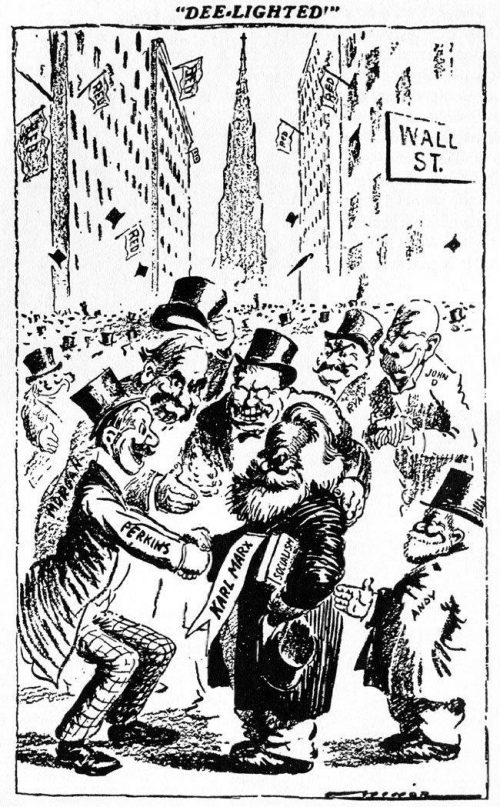
Marx being congratulated by Wall Street bankers (1911 cartoon reproduced by Sutton)
Sutton sees no Jewish conspiracy in this collusion between the Bank and the Revolution. But documents relative to the failed Russian revolution of 1905 show that there is another dimension to that unnatural alliance, as explained in this article by Alexandros Papagoergiou. In 1904, Russian Prime Minister Sergei Witte was tasked to secure a huge foreign loan to stabilize Russian public finances. He tells in his memoirs that, after turning down the offer of the Jewish banks headed by the Rothschilds, because it was conditioned on “legal measures tending to improve the conditions of the Jews in Russia,” he was able to raise the enormous amount of 2,250,000,000 francs via “Christian Banks”.[23] Revolutionary riots started soon after. A report of the Russian Foreign Minister to Tsar Nicholas II notes that it happened “just at the time when our government tried to realize a considerable foreign loan without the participation of the Rothschilds and just in time for preventing the carrying out of this financial operation; the panic provoked among the buyers and holders of Russian loans could not fail to give additional advantages to the Jewish bankers and capitalists who openly and knowingly speculated upon the fall of the Russian rates.” According to the report, the revolutionaries “are in possession of great quantities of arms which are imported from abroad, and of very considerable financial means,” which had been collected by Anglo-Jewish capitalists “under the leadership of Lord Rothschild, … for the officially alleged purpose of helping Russian Jews who suffered from pogroms.”[24]
Marxism vs Zionism: the dialectical pliers
Jewish movements seem to be working history through dialectical antagonisms that ultimately advance the Big Project. The capacity of the Jewish community to present itself either as a religion or as a nationality, depending on the circumstances, is the prime example. After gaining political emancipation in the name of religious freedom in the first part of the 19th century, European Jews were in the position to reclaim their special nationhood. For a few decades, reformed rabbis would ostensibly oppose Jewish nationalism, proclaiming in the 1885 Pittsburgh Conference: “We consider ourselves no longer a nation, but a religion community.”[25] Yet the same Pittsburgh Conference saw no contradiction in adopting the theory of German rabbi Kaufman Kohler, that “Israel, the suffering Messiah of the centuries, shall at the end of days become the triumphant Messiah of the nations,”[26] which amounts to say that Israel is not an ordinary nation, but the super-nation. In the 20th century, any trace of a contradiction between Reformed Judaism and Zionism was removed.
The early collaboration between Marx and Hess and the late encounter between Marx and Graetz both prefigure another dialectical opposition between Communism (the International revolution aimed at destroying Christian nations) and Zionism (the national project aimed at building the Jewish nation). Both movements developed in the same milieu. Chaim Weizmann recounts in his autobiography (Trial and Error, 1949) that in early twentieth-century Russia, revolutionary communists and revolutionary Zionists belonged to the same milieu. Weizmann’s brother Schmuel was a communist, and that was not a source of family discord. These divisions were relative and changeable; many Zionists were Marxists, and vice versa. The borderline was all the more vague that the Communist Bund, born the same year as Zionism (1897), inscribed in its revolutionary agenda the right of the Jews to found a secular Yiddish-speaking nation. As Gilad Atzmon recently wrote, the Bund was “also an attempt to prevent Jews from joining the ‘Hellenic’ route by offering Jews a tribal path within the context of a future Soviet revolution.”
But the most important thing to note is that, from the early days, Jewish revolutionary activity provided Zionists with a diplomatic argument in favor of their alternative program for the Jews. Herzl mentions in his diary (June 4, 1900) that “intensifying Jewish Socialist activities” was a way to “stir up the desire among the European governments to exert pressure on Turkey to take in the Jews” (Palestine was then under Ottoman control). He hawked Zionism as a solution to the problem of Jewish revolutionary subversion when meeting Kaiser Wilhelm II in 1898, and again when meeting Russian ministers in St. Petersburg in 1903.[27] The next generation of Zionists continued the stratagem. Churchill, who spoke with one voice with Chaim Weizmann,[28] dramatized the opposition between the “good Jews” (Zionists) and the “bad Jews” (communists) in his 1920 article “Zionism versus Bolshevism: A struggle for the soul of the Jewish people.” He referred to Bolshevism as “this world-wide conspiracy for the overthrow of civilization” and to Zionism as the solution “especially in harmony with the truest interests of the British Empire.” (Churchill’s later alliance with Stalin proves that his Zionism was stronger than his anti-communism.)
In the aftermath of World War II, the rivalry between the Communist and the Capitalist worlds remained the indispensable context for the creation and expansion of Israel. That explains why Roosevelt’s administration, largely controlled by Jews, helped Stalin conquer half of Europe and thwarted all attempts to stop him. Curtis Dall, Roosevelt’s son-in-law, has revealed a secret diplomatic channel demonstrating that the White House went out of its way to give the USSR all the time and the armament necessary to invade Central Europe.[29] Thus the Second World War was completed with the determined aim of laying the foundations for the Cold War, that is, a highly explosive polarization of the world that would prove crucial for Project Zion. In fact, during this whole period, it is almost impossible to distinguish, among the Jewish advisors of Roosevelt and Truman on foreign policy, the pro-Communists from the pro-Zionists, as David Martin remarks in The Assassination of James Forrestal. A case in point is David Niles (Neyhus), who was guilty of spying for the Soviets while advising Roosevelt, but then played a key role in Truman’s support of the U.N. Partition Plan and the recognition of Israel.[30]
The Cold War proved instrumental when Nasser, Israel’s most formidable enemy, was pushed into the communist camp in 1955, setting off an intense Zionist campaign to present him as a danger to the stability of the Middle East, and to present Israel, by contrast, as the only reliable ally in the region. The Cold War was also the crucial context for Israel’s defeat of Egypt in 1967 and Israel’s annexation of territories stolen from Egypt, Syria and Lebanon.
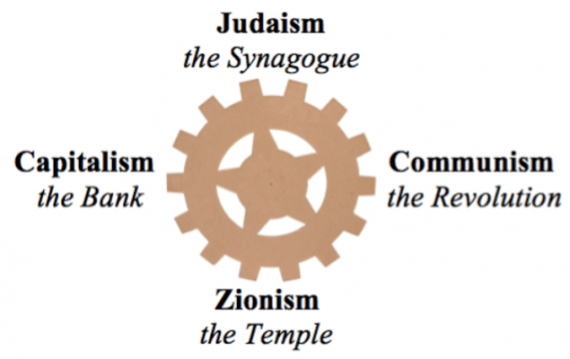
Yahweh’s dialectical machinery
Laurent Guyénot, Ph.D., has recently edited some of his Unz Review articles in book form, under the title Our God is Your God Too, But He Has Chosen Us: Essays on Jewish Power. He is also the author of From Yahweh to Zion: Jealous God, Chosen People, Promised Land … Clash of Civilizations, 2018, and JFK-9/11: 50 years of Deep State, Progressive Press, 2014.
Notes
[1] David Ben-Gurion and Amram Duchovny, David Ben-Gurion, In His Own Words, Fleet Press Corp., 1969, p. 116. Ben-Gurion’s prophecy appeared in the magazine Look on January 16, 1962, reproductions of which can be found on Internet.
[2] Karl Popper, Unended Quest: An Intellectual Autobiography (1976), Routledge, 2002, books.google.com
[3] Bakunin, Statism and Anarchy, trans. Marshall S. Shatz, Cambridge UP, 1990, pp. 538-545.
[4] Quoted in Alexandre Soljénitsyne, Deux siècles ensemble (1795–1995), tome I: Juifs et Russes avant la Révolution, Fayard, 2003, tome 1, p. 269.
[5] Robert Blake, Disraeli (1966), Faber Finds, 2010, p. 202.
[6] Amos Elon, The Pity of It All: A History of Jews in Germany 1743-1933, Metropolitan Books, 2002, pp. 153, 157, 163-164.
[7] Isaac Berlin, Karl Marx: His Life and Environment, 1939, 2nd ed, 1948, p. 17.
[8] Aux compagnons de la Fédération des sections internationales du Jura, quoted in Henri Arvon, Les Juifs et l’Idéologie, PUF, 1978, p. 50. Partial quote in Francis Wheen , Karl Marx, Fourth Estate, 1999, p. 340.
[9] Antony Sutton, Wall Street and the Bolshevik Revolution (1976), Clairview Books, 2011.
[10] Quoted in Kevin MacDonald, Separation and Its Discontents: Toward an Evolutionary Theory of Anti-Semitism, Praeger, 1998, kindle 2013, k. 4732–4877.
[11] Amos Elon, The Pity of It All, op; cit., p. 146.
[12] Shlomo Avineri, Karl Marx: Philosophy and Revolution, Yale UP, 2019, pp. 171-172.
[13] Moses Hess, Rome and Jerusalem: A Study in Jewish Nationalism, 1918 (archive.org).
[14] Sydney Hook, “Karl Marx and Moses Hess,” 1934.
[15] Shlomo Avineri , Moses Hess: Prophet of Communism and Zionism, 1985.
[16] Read Bakunin’s response to Hess’s article, “Aux citoyens rédacteurs du Réveil”
[17] French translation, Bruno Bauer, La Question juive (1843), Union générale d’Éditions, 1968, on
[18] Hal Draper, “Marx and the Economic-Jew Stereotype,” from Karl Marx’s Theory of Revolution, Vol.1: State and Bureaucracy, Monthly Review, New York 1977, pp. 591-608. Read also Gary Ruchwarger, “Marx and the Jewish Question: A Response to Julius Carlebach,” Marxist Perspectives, Fall 1979, pp. 19-38.
[19] I am aware that another “anti-Semitic” article, unsigned and titled “The Russian Loan” (New York Daily Tribune, January 4, 1856), has been attributed to Marx by his daughter, but I find Marx’s authorship dubious. See the discussion on its authenticity here.
[20] Nesta Webster, World Revolution: The Plot Against Civilization, 1921 , on archive.org, pp. 95-96.
[21] “Lettre au Journal La Liberté de Bruxelles,” October 5, 1872.
[22] Paul Johnson, Intellectuals: From Marx and Tolstoy to Sartre and Chomsky (1990), HarperCollins, 2007.
[23] The Memoirs of Count Witte, Doubleday, Page & Co, 1921, on archive.org, pp. 292-294.
[24] Quoted in Boris Brasol, The World at the Cross Roads, 1923, on archive.org, pp. 74-78.
[25] Quoted in Alfred Lilienthal, What Price Israel? (1953), Infinity Publishing, 2003, p. 14.
[26] Kaufmnann Kohler, Jewish Theology, Systematically and Historically Considered, Macmillan, 1918 (www.gutenberg.org), p. 290.
[27] The Complete Diaries of Theodor Herzl, edited by Raphael Patai, Herzl Press & Thomas Yoseloff, 1960, vol. 1 , pp. 362–363, 378–379, and vol. 3, p. 960.
[28] Martin Gilbert, Churchill and the Jews: A Lifelong Friendship, Henry Holt & Company, 2007.
[29] Curtis Dall, FDR: My Exploited Father-in-Law, Christian Crusade Publications, 1968 , pp. 146–157.
[30] David Martin, The Assassination of James Forrestal, McCabe Publishing, 2017, pp. 57-65. On Nile’s influence in the U.N. vote, see Alfred Lilienthal, What Price Israel ? (1953), 50th Anniversary Edition, Infinity Publishing, 2003, p. 50.
US names members of panel for West Bank annexation
PNN – February 16, 2020
The US government has appointed members of a committee tasked with mapping out areas of the occupied West Bank that Israel plans to annex as part of President Donald Trump’s self-proclaimed “Deal of the Century.”
A senior Trump administration official told the Israel Hayom daily that US ambassador to Israel David Friedman will lead the joint committee.
“Honored to serve on the Joint Committee,” tweeted Friedman Saturday. “Looking forward to getting started right away,” he said.
Other committee members will include Friedman’s senior adviser Aryeh Lightstone, and Scott Leith, a US National Security Council expert on Israel.
Israeli members will include tourism minister Yariv Levin and Israeli ambassador to the United States Ron Dermer.
The committee was announced by Trump last month during the unveiling of his scheme, which would see Israel control swathes of the West Bank in violation of the fundamental rights of the Palestinians.
Trump said the joint committee would be formed to “convert the conceptual map into a more detailed and calibrated rendering so that recognition can be immediately achieved.”
There is still no set timeline for when the committee will finish its work, but Israeli prime minister Benjamin Netanyahu has been pressured by right-wing lawmakers in recent weeks to announce the immediate annexation of all settlements before Israelis head to the polls.
Three weeks ago, both Netanyahu and Friedman said that Israel would be able to do so before the election, and Netanyahu planned to turn the issue into the cornerstone of his re-election campaign.
Trump’s son-in-law and adviser Jared Kushner, who is believed to be the architect of the so-called “Vision for Peace,” has said the US administration and Israel had decided to wait until a team was formed to examine the maps, and that he hoped Israel would wait until after the election.
On January 28, Trump unveiled his plan negotiated with Israel but without Palestinians, as one side of any agreement, being involved in the process.
Palestinian leaders immediately rejected the plan, with President Mahmoud Abbas saying it “belongs in the dustbin of history.”
They view the deal as a colonial plan meant to unilaterally control Palestine in its entirety and remove Palestinians from their homeland.
Sayyed Nasrallah: Trump’s Two Recent Crimes Usher Direct Confrontation with Resistance Forces
By Mohammad Salami – Al-Manar – February 16, 2020
Hezbollah Secretary General Sayyed Hasan Nasrallah stressed Sunday that the United States of America has recently committed two major crimes, the assassination of the head of IRGC’s Al-Quds Force general Qasem Suleimani as well as the deputy chief of Iraq’s Hashd Shaabi Abu Mahdi Al-Muhandis and the announcement of Trump’s Mideast plan.
Sayyed Nasrallah stressed that those two crimes had ushered a direct confrontation with the axis of resistance in Lebanon, calling for forming a comprehensive resistance front against the United States all over the world.
Delivering a speech during Hezbollah’s “Martyrdom & Insight” Ceremony which marks the anniversary of the martyrs Sheikh Ragheb Harb, Sayyed Abbas Al-Moussawi and Hajj Imad Mughniyeh and the 40th day after the martyrdom of General Suleimani and Hajj Al-Muhandis, Sayyed Nasrallah emphasized that in this confrontation with the United States, we have to trust God’s help, keep hopeful for a bright future and challenge our fear.
Sayyed Nasrallah pointed out that the so-called “deal of the century” cannot be described as a ‘deal’ because it refers merely to the plan of the US president Donald Trump’s plan to eradicate the Palestinian cause.
All the Palestinian forces have rejected and may never approve Trump’s scheme, according to Sayyed Nasrallah who considered that this is basic in frustrating the US plan.
Sayyed Nasrallah noted that consistency of stances which reject Trump’s plan is required to frustrate it, adding that the US will is not an inevitable destiny and citing previous cases of Washington’s failure when opposed by resistance.
No one approved the US plan except Trump and Netanyahu, according to Sayyed Nasrallah who underscored the Palestinian, Arab and international rejection of the scheme.
The Hezbollah leader hailed the consensus of the Lebanese political parties which have rejected Trump’s plan, attributing this attitude to the recognition of the dangers of the scheme to Lebanon and the entire region.
Sayyed Nasrallah noted that Trump’s plan affects Lebanon because it grants the occupied Shebaa Farms, Kfar Shuba hills and the Lebanese part of Al-Ghajar town to the Zionist entity, stipulates naturalizing the Palestinian refugees and impacts the border demarcation.
“The spirit of Trump’s plan will be decisive in the issue of demarcating the land and sea borders with occupied Palestine and will affect Lebanon’s oil wealth.”
Sayyed Nasrallah pointed out that what reassures the Lebanese about the rejection of the naturalization of the Palestinian refugees is the consensual attitude of all the parties in this regard, calling for respecting certain groups’ fears related to this issue.
Amazon Provides Free Shipping to Illegal Jewish Settlers, Charges Palestinians
Palestine Chronicle – February 15, 2020
In blatant defiance of international law, global e-commerce company Amazon is offering free shipping to illegal Jewish settlements in the occupied West Bank, but not to Palestinians living in the same area, according to the Financial Times.
The investigative report reveals that Amazon’s free shipping offer extends to nearly all Jewish settlements in the occupied West Bank, considered illegal under international law.
Palestinian customers who list their address as “the Palestinian Territories” are forced to pay shipping and handling fees starting from $24.
Amazon spokesman Nick Caplin told the Financial Times that Palestinians can only circumvent the issue by selecting Israel as their country.
“If a customer within the Palestinian Territories enters their address and selects Israel as the country, they can receive free shipping through the same promotion,” said Caplin.
Amazon was not included in the United Nations Human Rights Council’s database of companies operating in the illegal settlements released last week.
American Citizens Killed and Tortured by Israel?
No one is ever held accountable

Palestinian-American Mahmoud Shaalan was shot five times by Israeli soldiers at a West Bank checkpoint
By Philip Giraldi | American Herald Tribune | February 15, 2020
One of the principal functions of a United States Embassy overseas is to provide citizen services, which includes coming to the assistance of Americans who are treated badly by the local government. It is a responsibility that most embassies take seriously, with the exception of the facility currently located in Jerusalem. One has to understand that that is so because the United States Embassy in Israel is like no other. In other countries, the American Embassy exists to support American travelers, businesses and a broad range of national interests. In Jerusalem the Embassy exists to support Israeli interests and to serve as an apologist every time the government of Prime Minister Benjamin Netanyahu goes on a killing spree or does something else that is similarly outrageous, to include bombing neighboring Syria every other day.
America’s current ambassador, former Trump bankruptcy lawyer David Friedman, has funded Israel’s illegal settlements, which did not in any way complicate his confirmation as nearly everyone in Congress and the White House does not believe that the Palestinians actually are human beings. Since taking up his position, Friedman has defended Israel when its army sharpshooters have shot down scores of unarmed Gazans, including children, and has both praised and endorsed out-and-out theft by the Israeli government in Jerusalem, on the West Bank and the Golan Heights.
What the U.S. Embassy under Friedman will not do is put any real pressure on the Israeli government if its security forces or rampaging settlers kill, beat, maim or torture an American citizen, especially if said citizen happens to be of Palestinian descent. Indeed, Friedman is only the latest manifestation of Israel-first-itis among U.S. Ambassadors, the rot having started inevitably with Bill Clinton, who appointed Australian citizen Martin Indyk as the first Jewish ambassador to Tel Aviv. The two most recent ambassadors, Friedman and Daniel Shapiro, both political appointees, have also been Jewish. Shapiro so enjoyed being an Israeli that he decided to remain in the country after his appointment as ambassador was completed. He now works for an Israeli government funded think tank.
The Israeli army and police have in fact killed a number of American citizens without any real pushback from the Department of State or White House. The unwillingness to confront Israel on any level stems from the formidable Jewish power in the United States, which uses money and media control to corrupt the political system at national, state and local levels. The media and the chattering political class worry about Russian interference while ignoring the implications of a Haaretz article that appeared on February 12th entitled “AIPAC Must Stop Bernie Sanders – At All Costs!” AIPAC is, of course, the American Israel Public Affairs Committee, widely regarded as the chief U.S. lobbying arm of the Jewish state.
And witness the fate of Congresswoman Betty McCollum from Minnesota, who fell afoul of the Israel Lobby when she introduced H.R.2407, legislation that prohibits American taxpayer money from being used by Israel to arrest and detain Palestinian children. She stated that “Israel’s system of military juvenile detention is state-sponsored child abuse designed to intimidate and terrorize Palestinian children and their families. It must be condemned, but it is equally outrageous that U.S. tax dollars in the form of military aid to Israel are permitted to sustain what is clearly a gross human rights violation against children.” She might have added that the estimated 10,000 Arab children who have been detained since 2000 are frequently tortured by the Israeli authorities. The bill currently has 23 cosponsors and is unlikely to attract more due to fear of the Lobby. It will never reach the House floor for a vote and will never become law.

Betty McCollum U.S. Representative for Minnesota’s 4th congressional district at a women’s roundtable at Hillary for Minnesota Headquarters in St Paul, MN. Credit: Lorie Shaull/ Flickr
McCollum’s courage was on display when she was viciously attacked by AIPAC, which posted Facebook ads that referenced “radicals in the Democratic party,” including a photo of McCollum, with the text stating that “It’s critical that we protect our Israeli allies especially as they face threats from Iran, Hamas, Hezbollah ISIS and — maybe more sinister — right here in the U.S. Congress.” McCollum stood her ground against being called “more sinister” than ISIS and released a statement that describes AIPAC as a “hate group,” which of course it is, but she will find few in the Democratic party brave enough to defend her.
Israel’s willingness to kill Americans in support of what it perceives as its own interests goes back nearly to the founding of the state in 1948. The Lavon Affair of 1954 was an Israeli plot to bomb the U.S. Embassy Information Agency libraries in Alexandria and Cairo Egypt, blaming the attacks on the Egyptians to draw the United States closer to Israel. The bombs were placed by Egyptian Jews acting for Israeli intelligence. They exploded, but fortunately no one was killed.
In June 1967 Israel was at it again, attacking the intelligence gathering U.S. naval vessel the U.S.S. Liberty in international waters, killing thirty-four American sailors, Marines and civilians in a deliberate air and sea onslaught that sought to sink the intelligence gathering ship and kill all its crew. It was the worst attack ever carried out on a U.S. Naval vessel in peace time. In addition to the death toll, 171 more of the crew were wounded in the two-hour assault. The Israelis, whose planes had their Star of David markings covered up so Egypt could be blamed, attacked the ship repeatedly from the air and with gunboats from the sea. When one Israeli pilot hesitated, refusing to attack what was clearly an American ship, he was instructed to proceed anyway.
The most disgusting part of the tale relates to how U.S. warplanes sent to the Liberty’s aid from an aircraft carrier in the Mediterranean were called back by Defense Secretary Robert McNamara acting under orders from President Lyndon Baines Johnson, who declared that he would rather see the ship go to the bottom of the sea than embarrass his good friend Israel. Ironically, the first ship to reach the Liberty and offer assistance was from the Soviet Union, an offer that was declined.
More recently there have been a number of killings of Americans. In a bizarre incident in August 1988, an elderly Palestinian-American with a heart condition died after being forced to climb stairs to paint over anti-Israeli graffiti on a school wall. Rebhi Barakat Kaid, 67, of Columbus, Ohio, was on the West Bank visiting relatives. He died of a heart attack after three Israeli soldiers ordered him and his 14-year-old Chicago-born grandson at gunpoint to climb the 22 steep steps that led from the house to the street above without his being allowed to take his heart medicine first.
Much better known is the March 2003 killing of Washington State’s Rachel Corrie, who was deliberately run over by an Israeli military bulldozer when she was protesting the destruction of a Palestinian village. A month later there was an incident in which Brian Avery, a 24-year-old from Albuquerque, New Mexico, was shot in the face in the occupied West Bank city of Jenin by Israeli soldiers in an armored personnel carrier firing machine guns at protesters.

Rachel Corrie lies on the ground fatally injured by an Israeli bulldozer driver. Rachel’s fellow activists are trying to keep her neck straight due to spinal injury. Photo by Joseph Smith. Credit: ISM
In March 2009 Tristan Anderson, a 37-year-old from Oakland, California, suffered permanent brain damage when Israeli soldiers shot him in the face with a tear gas canister as he watched a protest in the West Bank village of Nilin.
Another American citizen, Furkan Doğan, an 18-year-old born in Troy, New York, was killed aboard the Turkish flagged Mavi Marmara in the Mediterranean Sea in May 2010 as a flotilla of international activists attempted to break Israel’s illegal blockade of the Gaza Strip to deliver humanitarian supplies. The United Nations’ General Assembly Human Rights Council determined that Doğan had been killed by Israeli naval commandos through an “extra-legal, arbitrary and summary execution.” He was shot five times, including once in the face from “point blank range.”

Furkan Doğan
The same day that Israel murdered Furkan Doğan, 21-year-old Emily Henochowicz of Potomac, Maryland, was protesting the attack on the flotilla at the Qalandiya checkpoint near Jerusalem, when an Israeli soldier shot her in the face with a teargas cannister, resulting in the loss of an eye.
And then there was in October 2014 the shooting by Israeli soldiers of Orwa Hammad, a 14-year-old Palestinian-American from Louisiana. The Israeli army claimed that Hammad was throwing a Molotov cocktail at the time of his death, but witnesses stated that he was among a group of children throwing rocks at the heavily armed and armored soldiers.
And most recently, there is the case of Florida-born 16-year-old Palestinian-American Mahmoud Shaalan who was shot repeatedly at an Israeli check point on the West Bank on February 26, 2016 while he was walking to a nearby village to visit his aunt. He was still alive after the shooting, but Israeli soldiers denied him any medical treatment for three hours and he died before an ambulance was allowed to approach him.
Arrest of Palestinians and others without probable cause under “administration detention” guidelines followed by torture has also become a hallmark of Israel’s occupation of Arab land. Torture methods used by Israel include stress positions, severe beatings, sleep deprivation, emotional blackmail, threats of torture of family members and the transfer of detainees to secret prisons where torture is constant. In one case reported to a Human Rights Association “The harsh beating was committed with the intention to kill the detainee.”
In another reported case of torture, nineteen-year-old Mahmoud Zakarner’s testicles were smashed by soldiers in front of his uncle to force the man to provide the names of Palestinian resistance members. Mahmoud is now paralyzed and unable to speak as a result.
Israeli expertise in torture is in demand from authoritarian regimes worldwide, creating a growth industry for the specialized “advisers and technicians.” Many are currently working with right wing regimes in South and Central America. Several even showed up at Abu Ghraib as trainers for U.S. interrogators and were able to suggest refinements like the “Palestinian chair.”
Inside Israel torture of Palestinians is routine on the grounds of “necessity” and absurd “ticking-bomb” scenarios. The courts and the medical profession aid and abet the practice. Over 1,200 complaints regarding the torture of Palestinians in Israeli prisons have not resulted in even a single indictment of the torturers.
So, killing Americans as well as many others and torturing prisoners are all in a day’s work for the Jewish state. What is disgraceful, of course, is the fact that the United States government, which has the power to do something about it, instead chooses to do nothing to stop the bleeding or even to demand inquiries to find out who is to blame. Instead, Washington lavishes money and praise on Israel, reportedly America’s best friend and closest ally, while it also avoids looking at the horrors that are evident to most of the rest of the world.
Philip M. Giraldi is a former CIA counter-terrorism specialist and military intelligence officer who served nineteen years overseas in Turkey, Italy, Germany, and Spain. He was the CIA Chief of Base for the Barcelona Olympics in 1992 and was one of the first Americans to enter Afghanistan in December 2001. Phil is Executive Director of the Council for the National Interest, a Washington-based advocacy group that seeks to encourage and promote a U.S. foreign policy in the Middle East that is consistent with American values and interests.
NYC Taxpayers Spending Millions on Cyber Center with Controversial Ties to Israeli Intelligence

Graphic by Claudio Cabrera
By Whitney Webb | MintPress News | February 14, 2020
Early last week, the city of New York launched — with little media scrutiny — one of two new massive cybersecurity centers that will be run by private Israeli firms with close ties to Israel’s government, the so-called “Mega Group” tied to the Jeffrey Epstein scandal and prominent pro-Israel lobby organizations operating in the United States. The centers were first announced in 2018 as was the identity of the firms who would run them: Israel-based Jerusalem Venture Partners and SOSA.
As MintPress has reported on several occasions, all three of these entities have a history of aggressively spying on the U.S. federal government and/or blackmailing top American politicians, raising concerns regarding why these companies were chosen to run the new centers in the heart of Manhattan. The news also comes as Israeli cybersecurity companies tied to Israeli military intelligence Unit 8200 were revealed to have access to the U.S. government’s most classified systems and simulating the cancellation of the upcoming 2020 presidential election.
The new cybersecurity centers are part of a new New York City public-private partnership called “CyberNYC” that is valued at over $100 million and officially aims to “spur the creation of 10,000 cybersecurity jobs and make New York City a global leader in cyber innovation.” CyberNYC is an initiative of New York City’s Economic Development Corporation.
However, the companies that will be responsible for creating those cybersecurity jobs will benefit foreign companies, namely Israeli and most of the jobs to be created will go to foreigners as well, as media reports on the partnership have quietly noted. Those reports also stated that, while the stated purpose of the centers is to create new jobs, the Israeli firms chosen to run them — Jerusalem Venture Partners (JVP) and SOSA — view it as an opportunity to provide Israeli cybersecurity companies with a foothold into the American market and to see Israeli cybersecurity products adopted by both small and medium-sized American businesses, not just large corporations and government agencies.
For example, the founder of JVP and former Knesset member, Erel Margalit, told the Jerusalem Post that “the center we are setting up [in New York] will assist Israeli hi-tech companies in collaborating with customers and companies in the US and around the world.” More recently, ahead of the opening of the cybersecurity center that Margalit’s firm will manage, he told the Times of Israel that “New York is about something else, it’s about the drama of taking investors from Israel and Spain or Paris and other places and taking them to the next business level.” In other words, the companies set to benefit from these new centers will be foreign and mainly Israeli, as JVP invests the vast majority of its funds in Israeli start-ups.
Given that Wilson Lin, the head of CyberNYC, explained the reason behind the initiative is the fact that “there are not enough well-trained people in cyber security to fill the jobs that are required for a safer, more thriving commercial sector,” the statements of JVP’s founder strongly suggests that those “well-trained people” will not be Americans in New York, but will be brought in from abroad, namely Israel’s cybersecurity sector.
Of the companies chosen by CyberNYC to run its new cybersecurity centers, both have clear and demonstrable ties to Israel’s government and military intelligence as well as controversial groups of pro-Israel donors with considerable political clout in the United States.
For instance, Jerusalem Venture Partners was founded by Erel Margalit in 1993, with funding from the Yozma Program, an Israeli government program to “incentivize venture capital investment” in Israel. Since then, it has been a driving force in the development of Israel’s hi-tech sector and regularly collaborates with the Israeli Ministry of Economy and Industry and the EISP (Entrepreneurship and Innovation Support Program) alumni organization of Unit 8200. Today, it is the second largest venture capital fund in Israel.
JVP was also the sole venture capital fund chosen to partner with Israel’s government and military to establish the public-private “cyber hub” in Beersheba. This “hub” not only houses the IDF’s technology campus, but also the Israel National Cyber Directorate, which reports directly to Israel’s Prime Minister, as well as a high-tech corporate park that mostly houses tech companies with ties to Israel’s military intelligence apparatus. The area has been cited in several media reports as a visible indicator of the public-private merger between Israeli technology companies, many of them started by Unit 8200 alumni, and the Israeli government and its intelligence services.

A composite image of the future JVP-funded New York City cyber center. Photo | JVP Press Release
In addition to JVP’s close ties to Israel’s government and its key role in the merging of Israel’s private cybersecurity sector with Israeli military intelligence, JVP also has close ties to the Bronfman family through its Chief Operating Officer and general partner, Fiona Darmon. Prior to working with JVP, Darmon worked for Claridge Israel, the investment arm of the Bronfman family that was founded by Charles Bronfman in 1987.
Charles Bronfman was a one-time business partner of Mossad agent Robert Maxwell, father of Jeffrey Epstein’s alleged madam Ghislaine Maxwell, and co-founded the “Mega Group”, a group of pro-Israel oligarchs with clear and direct ties to organized crime, alongside Leslie Wexner, the main financier of Jeffrey Epstein’s operation that involved the sex trafficking of minors on behalf of Israeli military intelligence.
SOSA was founded much more recently than JVP, yet also has close ties to Israel’s government and military. Created in 2014, SOSA has grown rapidly by connecting mostly Israeli start-ups with investors and through its partnerships with the IDF. This partnership first became clear in 2018, when SOSA created the Homeland Security (HLST) Innovation Hub, which the Times of Israel described as “a first of its kind program that aims to create a defense and security innovation community that will match homeland security and defense industry firms with startups, to help industry giants maintain their leading edge.”
Last year, SOSA became one of two companies to manage the Israeli Ministry of Defense’s program INNOFENSE, an innovation program for civilian tech start-ups in the country’s defense industry. SOSA’s collaboration with the IDF also involves the creation of “joint business activities between international companies, [government] security organizations, investors and startups,” making SOSA a key player in the blurring of the line between Israeli military intelligence and its private tech sector.
SOSA is also directly partnered with two of Israel’s top weapons manufacturers, Rafael Advanced Defense Systems, as well as defense electronics companies ELTA Systems and Elron Electronics, the former parent company of another Israeli weapons manufacturer Elbit Systems. It is also partnered with the Unit 8200 alumni-founded tech company CheckPoint Systems and Leumi Tech, the hi-tech subsidiary of one of Israel’s largest banks, Leumi. Leumi Tech exists only in the U.S. and specifically aims to “provide a comprehensive suite of products and services to Israeli high-tech companies operating in the US.” The bank was recently forced to pay $400 million to the U.S. government for assisting U.S. citizens, most of them dual U.S.-Israeli citizens, in preparing false tax returns and hiding their assets in offshore accounts.
SOSA’s General Manager Guy Franklin is of particular interest, due to his close ties to the Israeli American Council (IAC), a pro-Israel lobby group created by convicted felon and ultra-Zionist millionaire Adam Milstein and largely funded by Sheldon and Miriam Adelson. The Adelsons are also the largest donors to both President Trump and the Republican Party in the United States.

In this photo posted on SOSA’s Facebook page, SOSA execs Uzi Scheffer and Guy Franklin pose in New York’s Time Square
Of the $100 million in funding for the CyberNYC initiative, $30 million comes from New York taxpayers and the remaining funds coming from the program’s partners, which includes Goldman Sachs and the Israeli military intelligence Unit 8200 incubator Team8, a start-up accelerator which has been discussed at length in several past MintPress News reports, including the recent MintPress investigation into the Israeli company Cybereason — a partner of Team8.
Team8, particularly its presence in New York, has long been associated with the push by pro-Israel political donor and American hedge fund manager Paul Singer and Israel’s government to make Israel the global cybersecurity leader as a means of preventing countries from boycotting Israel over human rights violations and war crimes. Team8’s role in CyberNYC will see them not only finance part of the initiative but also training cybersecurity workers who will be hired as part of the partnership.
Singer, who is based in Manhattan, created Start Up Nation Central in 2012 to specifically outsource American tech jobs to Israel in collaboration with top AIPAC officials and Israel’s government. Meanwhile, in parallel, Israel’s government and intelligence apparatus began a policy that same year that involved outsourcing intelligence and military intelligence operations to private companies created for that very purpose, particularly in the field of cybersecurity.
Thus, much as Israel’s cybersecurity industry has long been fused to Israel’s military and intelligence apparati, the Paul Singer-funded and Israel-backed policy has openly sought to bring American companies and government agencies into the fold in order to prevent boycotts of Israel. Though the so-called “anti-BDS laws” that have been passed in several U.S. states are one facet of this push, the use of Israeli tech, namely cybersecurity, sector to pursue this same end has received decidedly less coverage.
New York City has long been a major focus on this policy, with the growth of Israel hi-tech start-ups present in New York and run by former members of Unit 8200 exploding since this policy officially began in 2012. Indeed, Haaretz noted that, between 2013 and 2017 alone, the number of Israeli tech start-ups in New York City grew by fivefold and the number of Unit 8200 alumni working in NYC tech start-ups has also spiked in that same time frame.
The number of Unit 8200 alumni working in NYC’s tech sector has grown so much that they host an annual gala closed to the press where the goal, per Haaretz, is “to try to connect startups and early stage entrepreneurs from 8200 EISP (the Israeli accelerator for Unit 8200 alumni) with clients and venture capital funds in the United States.” One of the main players at that gala is Guy Franklin, the CEO of SOSA, which was chosen to run the other NYC cybersecurity sector.
The decision to create expensive, new cybersecurity centers run by JVP and SOSA, two Israeli firms with clear ties to controversial pro-Israel lobby organization and donors as well as Israel’s government and intelligence apparatus, reveals that not only is this Singer and Israel-backed policy continuing to develop and expand at a rapid pace, but now the money of New York City taxpayers is now being used to propel it to new heights even though that very policy benefits Israel’s economy at the U.S.’ expense.
Whitney Webb is a MintPress News journalist based in Chile. She has contributed to several independent media outlets including Global Research, EcoWatch, the Ron Paul Institute and 21st Century Wire, among others. She has made several radio and television appearances and is the 2019 winner of the Serena Shim Award for Uncompromised Integrity in Journalism.
Conservative Friends of Israel urge UK to oppose ICC’s war crimes investigation

CFI’s August 2015 delegation to Israel: Eric Pickles MP, Guto Bebb MP, Bob Blackman MP, John Howell MP, Matthew Offord MP, Andrew Percy MP, Chloe Smith MP and Heather Wheeler MP
MEMO | February 14, 2020
The Conservative Friends of Israel (CFI) has urged the UK government to directly oppose the International Criminal Court (ICC)’s decision to open an investigation into war crimes committed in the occupied Palestinian territory.
Writing to Prime Minister Boris Johnson and Foreign Secretary Dominic Raab, senior CFI officials MP Stephen Crabb, Lord Pickles and Lord Polak, argue that “as a non-state actor the Palestinians do not meet the legal requirements of the Rome Statute”, according to a CFI press release.
In the letter, the Westminster lobby group acknowledges that “the ICC is an important institution that the UK should continue to support”, but then goes on to claim that “the Court does not have jurisdiction over the territories”.
“We would urge the UK Government to join our close allies the United States, Australia and Germany in publicly cautioning against the politization of the ICC,” CFI continued.
“The Palestinian request for ICC intervention seeks to exploit the Court, involving it in alleged crimes that do not meet the legal requirements of the Rome Statute,” the CFI stated. “This undermines the Israeli-Palestinian peace process by incentivising the demonisation and vilification of each side.”
Another argument used by CFI is to suggest that the ICC probe into war crimes in the occupied Palestinian territory could have implications for UK armed forces.
“An inquiry of this nature would also set a dangerous precedent that could lead to prosecutions against the brave men and women of our armed forces who served in Iraq and Afghanistan, initiated in the ICC by non-state actors,” the CFI letter states.
Today marks the deadline for the UK, and other governments, “to request leave to file a written observation to the ICC”, CFI notes, urging the UK to do so, and “raise important concerns about the ICC’s lack of jurisdiction over this matter and the dangerous precedent it would set”.
“The UK [should] stand with Israel against this dangerous probe.”
Saudi Arabia launches new campaign of arrests against Palestinian expats
MEMO | February 14, 2020
Saudi Arabia has launched a new campaign of arbitrary arrests against several Palestinian expatriates living in the kingdom for supporting the Islamic resistance movement, Hamas.
The Prisoners of Conscience Twitter account which monitors the conditions of prisoners in Saudi Arabia said it has received “confirmed information” that the Saudi authorities have launched a new campaign of arbitrary arrests against Palestinian ex-pats. It adds that a number of the Palestinians targeted in the new campaign are relatives or sons of Palestinians who had been arrested during the first campaign in April, last year for the same reason.
In April, last year the Saudi authorities launched a campaign of arrests against Palestinian ex-pats including a senior leader in Hamas movement, Muhammad al-Khudari, 81, and his eldest son Hani.
The Twitter account defended the Palestinian detainees saying that supporting the (Palestinian) resistance is not a crime that requires arrests and demanded the Saudi authorities “to immediately release all detainees from the last campaign, and stop the trials of those detained last year which will begin early next month”.
Earlier this month, the Twitter account said the Saudi prosecution accuses the Palestinian detainees of illegally transferring funds (to the Palestinian resistance factions) and establishing unlicensed organisations to defend Palestinian and Jordanian detainees in the kingdom.
The Palestinian detainees will be tried before the Saudi Specialized Criminal Court on March 8.
On September 6, 2019, the Euro-Mediterranean Human Rights Monitor said that Saudi Arabia is forcibly hiding 60 Palestinians.
Israeli delegation visits Saudi Arabia for first time
Press TV – February 14, 2020
A high-ranking Israeli delegation from an umbrella US Jewish group has visited Saudi Arabia this week, a sign of increasing warmness between Tel Aviv and Riyadh as the two sides look to forge closer informal ties and expedite normalization efforts.
Israel’s English-language broadsheet newspaper The Jerusalem Post reported on Friday that members of the Conference of Presidents of Major American Jewish Organizations visited Saudi Arabia this week, a move believed to be the first official visit to the kingdom by an American Jewish organization since the Oslo peace process in 1993.
The Jewish Telegraphic Agency said the visit, which took place from Monday to Thursday, included meetings with senior Saudi officials as well as with Sheikh Muhammad bin Abdul Karim bin Abdulaziz al-Issa, the secretary general of the Muslim World League.
Issa is regarded as a close associate of Saudi Crown, Prince Mohammed bin Salman.
The New York-based news agency said the focus of the talks between the Conference constituents and Saudi officials was on countering terrorism and the instability in the Middle East region.
The Conference’s leadership, executive vice president Malcolm Hoenlein, and CEO William Daroff, are expected to have been present during the visit.
Saudi Arabia has expanded secret ties with Israel under the crown prince, the son of King Salman, who is viewed by many as the Kingdom’s de facto ruler. The young prince has made it clear that he and the Israelis stand on the same front to counter Iran and its growing influence in the Middle East.
Back in 2018, Saudi Arabia opened its airspace for a commercial flight to Israel with the start of a new Air India route between India and Israel, although El Al Israel Airlines might not use Saudi airspace for eastward flights.
Critics say Saudi Arabia’s flirtation with Israel would undermine global efforts to isolate Tel Aviv and affect the Palestinian cause in general. They say Riyadh has gone too far in its cooperation with the Israelis as a way of deterring Iran as an influential player in the region.
Israel has full diplomatic relations with only two Arab states, Egypt and Jordan, but the latest reports suggest the regime is working behind the scenes to establish formal contacts with Persian Gulf Arab states such as Saudi Arabia, the United Arab Emirates and Bahrain.
In another sign of warming ties between the regimes of Israel and Saudi Arabia, last month Tel Aviv officially allowed Israelis to travel to Saudi Arabia for the first time.
The move comes against the backdrop of a so-called peace plan unveiled by US President, Donald Trump, that supposedly aims to resolve the decades-long Israeli-Palestinian conflict.
Trump unveiled the scheme’s outlines on January 28. The plan features the recognition of Jerusalem, al-Quds, as Israel’s “capital,” although Palestinians want the city’s eastern part as the capital of their future state.
The US president also said that under the plan, Israel would be annexing the settlements that it has been building in the West Bank since occupying the Palestinian territory in 1967.
This is while all previous foreign-mediated draft agreements between the Palestinians and Israelis as well as repeated United Nations resolutions have mandated Tel Aviv to withdraw behind the 1967 borders.
Palestinian leaders, who severed all ties with Washington in late 2017 after Trump controversially, recognized Jerusalem, al-Quds, as the capital of the Israeli regime, immediately rejected the plan, with President Mahmoud Abbas saying it “belongs to the dustbin of history.”
Palestinian leaders also said the deal is a colonial plan to unilaterally control historic Palestine in its entirety and remove Palestinians from their homeland, adding that it heavily favors Israel and would deny them a viable independent state.
Meanwhile, senior Arab diplomatic sources said last week that the Saudi crown prince might meet Netanyahu on the sidelines of a potential summit in Cairo as the Israeli premier was seeking talks.
Saudi Foreign Minister, Prince Faisal bin Farhan, however, asserted on Thursday that there are no plans for a meeting between Salman and Netanyahu.
Speaking to al-Arabiya English, he also claimed that Saudi Arabia’s policy toward Palestine remained “firm.”
This is while Riyadh has welcomed Trump’s plan, saying “the Kingdom appreciates the efforts made by President Trump’s administration to develop a comprehensive Palestinian-Israeli peace plan.”
It has urged “direct peace negotiations between the sides under US sponsorship, in which any dispute regarding details of the plan will be settled.”
Saudi government media have also urged the Palestinians not to miss “this opportunity” and to approach the so-called US “deal of the century” with a positive mindset.
Israel sets up new Iran command for action against Iran: Report
Press TV – February 14, 2020
The Israeli military has set up a new “Iran command” amid Tel Aviv’s anti-Tehran confrontational rhetoric, according to Israeli media.
According to The Jerusalem Post, the multiyear “momentum plan” was presented by Israeli chief of staff lieutenant general Aviv Kochavi to all military commanders on Thursday.
The plan, despite awaiting an official approval by the Israeli cabinet, has been endorsed by military affairs minister Naftali Bennett and presented to prime minister Benjamin Netanyahu.
The new “Iran command” will be led by a major general and will seek to “bolster” the “attack capabilities” and “intelligence gathering on the Islamic Republic”, including by means of cyber and satellite operations.
The plan will also set up a new “rapid-maneuvering” infantry division to “penetrate enemy territory”.
Among other provisions in the plan, Israel will seek to double the number of its precision weapons and further increase the number of its missile interceptor systems across the occupied territories.
According to the report, the creation of an “Iran command” comes as the Israeli military is worried that its opponents are gradually growing stronger, with the “gap” between them “closing quickly”.
Tel Aviv has adopted an open policy of provocative military action against Iran and certain regional states allied with Tehran.
Following the defeat of foreign-backed terrorist groups in Syria and Iraq, Israel has stepped up its military aggression against the two countries in fear of an emerging Iran-led alliance against terrorism and foreign occupation forces.
On Saturday, Bennett said that Tel Aviv and Washington had divided up the fight “against Iran” in Syria and Iraq respectively.
In October, Kochavi said that despite knowing that its enemies are not interested in war, the Israeli military has “increased its pace of preparations” for confrontation.
‘Searching for an excuse to level Tel Aviv’
Iran’s support, provided chiefly under the command of top Iranian general Qassem Soleimani, had had a major role in empowering Syria and Iraq to fight against foreign-backed terrorists and foreign occupation in their countries.
Anti-terror commander, Lt. Gen. Soleimani was assassinated by US forces in early January while on an official visit to Iraq at Baghdad International Airport.
According to recent remarks by Major General Mohsen Rezaei, a top IRGC general and the secretary of Iran’s Expediency Council, Israel had a direct role in the assassination by informing Washington of Soleimani’s flight to Baghdad International Airport.
“We were searching for the Americans to give us an excuse to hit Tel Aviv just as we hit Ain al-Assad,” Rezaei said. “We would have leveled Tel Aviv no doubt,” he added.
Speaking on Thursday, Chief Commander of the Islamic Revolutionary Guards Corps Major General Hossein Salami responded to Bennett’s remarks about dividing roles with the US against Iran.
“We tell them that you are making a mistake, as always,” he said, adding that “if you make the slightest error, we will hit both of you”.
“We have told them repeatedly; do not rely on the United States, they may not able to help you,” he said. “If you want a reliable plan, look towards the sea as it is your final resting place,” he added.
The IRGC chief made the remarks during a ceremony marking the 40th day since the assassination of General Soleimani.
During the ceremony, Salami said that Soleimani’s efforts had greatly emboldened Palestinian resistance against Israel.
“When he entered the battlefield against the Zionists, the Palestinians were fighting with stones, but due to Soleimani’s efforts, Gaza, the West Bank and north of Palestine have become fields of fire against the Zionists,” Salami said.
“They have consequently concealed themselves behind walls; Soleimani put the Zionists in prison,” he added.
Salami added that Soleimani had defeated Washington’s plans for a “new Middle East”, noting that due to the general’s efforts, a multi-national force has emerged in the region to resist US and Israeli plans.
“General Soleimani generated so much power that if the Zionists only listen slightly next to the their borders, they can hear the languages of Pakistanis, Iranians, Hijazis, Lebanese…,” he said.
The IRGC chief lauded Soleimani’s legacy of defending “the downtrodden, wherever they were”, adding that the “deserts knew him more than the streets”.
“The Hindu Kush ranges, the Bamiyan and Panjshir valleys in Afghanistan knew him better than the Afghans,” Salami added.
Salami concluded his remarks saying that “the final and ultimate slap will continue until the last American soldier leaves the Muslims land” despite Iran’s military retaliation against Washington following the assassination of Soleimani.
Iran fired a volley of ballistic missiles at the Ain al-Asad airbase and another US-occupied outpost in Erbil, the capital of the semi-autonomous Iraqi Kurdistan on January 8, a few days following the assassination.
Despite the Trump administration initially denying any casualties, the Pentagon has since gradually revealed that at least over 100 US soldiers have suffered from “brain injuries” in the operation.
Speaking on Thursday, IRGC spokesman Brigadier General Ramezan Sharif said that Washington has sought to conceal the number of its killed soldiers by using the term “brain injury” to describe casualties.
Sharif added that the assassination of Soleimani and Abu Mahdi al-Muhandis – who was the second-in-command of Iraq’s Popular Mobilization Units – “marked the beginning of the end of US presence in the region” and that it will lead to the liberation of Jerusalem al-Quds.
Featured Video

The Search for Truth: Charlie Kirk’s Assassination One Year Later
or go to
Aletho News Archives – Video-Images
From the Archives
The 9/11 “Double-Cross” Conspiracy Theory
BY LAURENT GUYÉNOT • UNZ REVIEW • SEPTEMBER 6, 2022
Is it true that “9/11 was an inside job”? Yes, insofar as Israel is “inside” the U.S. But for the 9/11 truthers who have identified Israel as the main perpetrators, “9/11 was an inside job” is at best a half-truth, and at worst an integral part of the Zionist operation, like a secondary flag sewn as a lining under the false flag of Islamism. Victor Thorn (1963-2017) wrote in his book 9/11 made in Israel: The Plot Against America (2011): “In essence, the ‘9-11 truth movement’ was created prior to Sept. 11, 2001 as a means of suppressing news relating to Israeli complicity. . . . The slogan ‘9-11 was an inside job’ was quite possibly the greatest example of Israeli propaganda ever devised.” In milder terms, it is “controlled opposition”.
A genuine truth movement would have pointed to Israel as the prime suspect from the start. From day one, it was obvious who would benefit. … continue
Blog Roll
 Aletho News
- Hormuz and the Looming Economic Catastrophe
- Dhubab offensive, media blitz and the rapid unraveling of Saudi-backed coalition’s new gambit
- Putin Conveys to Trump Iran’s Vision on Possible Conflict Resolution – Kremlin
- The Search for Truth: Charlie Kirk’s Assassination One Year Later
- ‘Harsh reality’: Iran says France seeks monopoly on power and intimidation, not peace for all
- When Will This White House Madness End?
- Huckabee aide goes to ‘unusual lengths’ to portray ‘Israel’ positively
- Trump Announces Diesel Supply Deal With Putin Following Phone Call
- MEP blasts ‘Euro-Gestapo’ for lecturing Russia on democracy
- Syria May Send Troops to Saudi Arabia Amid War with Ansar Allah
- If Americans Knew
- Israeli forces kill another child in Gaza – Daily Update
- Gaza ceasefire exists in name only, say more than 100 organizations
- Nearly 2 Million in Gaza Need Urgent Shelter Assistance as Winter Looms: IOM Chief Warns
- Suppressing Palestinian resistance: US charity under fire for AI monitoring of Gaza classrooms
- Thousands Are Held in Israeli Torture Camps. This Is What Happens Inside
- Israel puts Gaza’s sick, injured, newborn in peril – Daily Update
- Report claimed Mark Levin used by Israeli government to influence Trump
- Over 2,000 Gazans have died awaiting medical evacuation amid Israel’s continued siege
- How a U.S. Diplomat Suppressed and Altered Reports Critical of Israel
- 5 Palestinians Die from Israeli Strikes in Gaza as Relentless Attacks Continue
- No Tricks Zone
- New Study: 50 Years Of The Most Aggressive ‘Net Zero’ Policies Can Only Affect The Global Climate By 0.03°C
- US September “Heat” Was No Record…Many Records Set Decades Ago
- Latest European Green Energy Debacle; Portugal’s Largest Flagship Solar Park Insolvent!
- Green Energy Debacle: German Expert Professor Fritz Vahrenholt Warns Of Severe Economic And Social Consequences
- Two More Paleo Reconstructions Affirm Meters-Higher Sea Levels Across Ireland, Brazil 7000-6000 Years Ago
- New Study: Earth And Venus Surface Warmth Largely Explained By Convection And Lapse Rate, Not CO2 Or Radiation
- 2025 Nature Paper Claiming Worsening Global Drought Gets RETRACTED …Heavily Flawed
- New Study: ‘Global Drought Shows No Detectable Recent Acceleration Under Climate Warming’
- Economic Masterminds: German Socialists Suggest Taxing Productivity Gains Stemming From Using AI
- The South China Sea Has Not Been Cooperating With The Climate Change Narrative

