Hizbullah Reminds Israel of Its Power
By Helena Cobban | Lobe Log | September 5, 2019
On September 1, Hizbullah fighters on Lebanon’s border with Israel fired two precision-guided missiles over the border, apparently hitting an Israeli “Wolf” armored personnel carrier (APC) and inflicting casualties of unknown severity on its occupants (see below). The strike came a day after Hizbullah head Hassan Nasrallah warned that the organization would retaliate for Israel’s killing, a few days earlier, of two Hizbullah fighters in Syria and Israel’s deployment of explosive drones against Hizbullah-related targets in eastern Lebanon and the capital, Beirut.
The Israelis responded to the attack on the Wolf by firing a number of rockets and artillery shells, seemingly at random, into uninhabited parts of southern Lebanon, with no casualties reported.
On September 2, Hizbullah released a video of the attack on the Wolf, which took place in broad daylight. The video shows Hizbullah operatives launching two guided missiles against a military vehicle, each of which causes a large explosion. Hours later, Nasrallah told his supporters that this cross-border action—the first since the extremely destructive Hizbullah-Israel war of 2006—represented a new stage in the struggle against Israel. He warned, too, that his fighters would henceforth feel free to bring down any of the scores of military drones that Israel deploys in Lebanese airspace each month.
Taken together, the events of late August through September 1 underscored that the situation of reciprocal (if highly asymmetrical) deterrence that has existed between Israel and Hizbullah since the end of the 2006 fighting remains in place.
This situation has significant impact not only for the peoples of Lebanon and Israel but also in the broader regional arena, in which the Israel-Hizbullah balance plays a key role. For though Hizbullah has always, since its emergence in 1985, been an authentic, indigenous Lebanese movement, it is also a key ally of the Islamic Republic of Iran. So if Israel, some parts of the U.S. government, and other regional actors such as Saudi Arabia are considering launching any significant military attack against Iran, then Hizbullah’s ability and willingness to join the battle by counter-striking against high-value targets inside Israel is a factor that anti-Tehran war planners have to take into account.
Iran does have, as I wrote here recently, a broader network of regional allies, of which Lebanon’s Hizbullah is only one part. But Hizbullah is unique by virtue of the special role its conflict with Israel plays in affecting strategic thinking and decision-making in Israel and elsewhere. Hizbullah, as everyone in the Middle East is aware, is the only body, governmental or non-governmental, that has been able to inflict significant military defeat on Israel—and not just once, but twice.
The first defeat became clear in May-June of 2000, when the Israeli military that had been occupying a strip of Southern Lebanon since 1978 simply pulled up its stakes and withdrew. The decisive earlier battle against Hizbullah that led PM Ehud Barak to take that decision had actually happened four years earlier. In 1996, Israel launched a scorched-earth attack against Lebanon that failed to either destroy Hizbullah or turn the Lebanese population against it. When Barak became PM, he judged, quite sensibly, that the casualties that Israel’s occupation force had continued to take in Lebanon since 1996 were all for naught.
In 2006, another Israeli PM, Ehud Olmert—who had far less military experience and military savvy than Barak—thought he would try his hand at diminishing the considerable amount of military and political power that Hizbullah had continued to accrue in Lebanon. With huge support from President George W. Bush and most European governments, Olmert launched another scorched-earth attack against Lebanon, once again aimed at either destroying Hizbullah or turning the Lebanese public against it. In the two years prior to 2006, there had been quite a lot of (Saudi-supported) anti-Hizbullah agitation in Lebanon, so perhaps Olmert hoped to gain advantage from that. If so, he failed miserably. Lebanese from all political and religious persuasions rallied strongly around Hizbullah.
That was not the only thing that went wrong with the war from Olmert’s point of view. Some three weeks into the conflict, it became clear that even the Israeli air force’s destruction of critical Lebanese infrastructure (gruesomely celebrated in Israel thereafter as the “Dahiyeh Doctrine”) could not force Hizbullah to cry “uncle.” Olmert and his advisors decided to send in Israeli ground forces. But the ground units all proved woefully ill-prepared for their task. It soon became clear that neither they nor the air force could stop Hizbullah’s well-trained rocketeers from continuing to fire missiles deep into Israel’s interior.
Thirty-three days into the campaign, both leaderships agreed it was time to stop. They negotiated a ceasefire through the mediation of the Lebanese government and the United Nations. The ceasefire’s basic structure was a return to the status-quo ante. All the Israeli troops recently deployed into Lebanon had to immediately withdraw. All hostilities and cross-border military actions had to cease. The United Nations beefed up its southern Lebanon peacekeeping force, which since 1978 had been a fairly ineffective presence along the border.
For Israel, the 2006 war was a crushing defeat—and for its ground forces, in particular, a humiliation. (One explanation for the three vicious assaults Israel launched against Gaza in 2008, 2012, and 2014 was that the country’s military leaders sought to regain from Israel’s citizens the high esteem they had always previously enjoyed—esteem that had been very badly dented in 2006.)
For Hizbullah, the 33-Day War of 2006 was unquestionably a victory, though one bought at a high price in the human and material losses suffered by all the Lebanese people.
The essential victory that Hizbullah won in 2006, as in 1996, was that it faced down Israel’s extremely hi-tech military and survived with its core military and political networks and its ability to inflict significant destruction inside Israel all intact—and without having made any political concessions. This is, of course, why Israel and its acolytes and supporters in the West all hate it so deeply.
In the limited military exchange that Hizbullah and Israel engaged in on September 1, the underlying facts about the reciprocal deterrence that has existed between them since 2000 were on full display.
For some years now, the Israeli military has been taking advantage of the chaotic situation in Syria to mount sporadic attacks against various targets there, including some that they claim are connected to Hizbullah or the Iranian military. At periodic meetings that Israeli officials have conducted with their counterparts in Russia, which has long been allied with the Syrian government, the two sides have sketched out rudimentary “rules of engagement” for such raids. In July, the Israelis extended their campaign to interrupt Iran’s export of weapons and advisors yet further, sending F-35s to attack two locations in Iraq that were allegedly being used by Iran’s Islamic Revolutionary Guard Corps (IRGC). In July, and again in late August, it struck at Hizbullah operatives inside Syria, killing at least two of them.
Of all the targets thus attacked, only Hizbullah retaliated directly against Israel. It did so in a measured and limited way that nonetheless served to remind Israelis of their continuing vulnerability to Hizbullah’s military muscle and military/political smarts.
Israel’s reaction to the announcement Nasrallah made on August 31, that Hizbullah “would retaliate” for Israel’s killing of its operatives in Syria, was intriguing. As was widely reported in the (always military-censored) Israeli media, the Israeli military ostentatiously announced that it would pull troops back from front-line positions facing Lebanon, in what seemed like a deliberate move to de-escalate tensions.
Israel’s responses to the Wolf attack, which happened the very next day, were also intriguing. Firstly, in the military sphere, its retaliation against Hizbullah/Lebanon was notably restrained, a fact that could perhaps be attributed to PM Benjamin Netanyahu’s reluctance to get Israel into yet another complex imbroglio in Lebanon with his country’s next general election coming up September 17—except that, in the context of, say, Gaza, Israeli leaders have often seemed to judge that launching an attack could be a valuable part of an election strategy.
Secondly, in the informational sphere, Netanyahu went out of his way to deny that the attack on the military vehicle had caused any casualties. The video that Hizbullah made and distributed of the incident seemed clearly to show that the vehicle was an APC, and that the two missiles that struck it caused massive explosions. Other news footage from inside Israel showed injured soldiers being carried out and evacuated to a nearby military hospital. But Israeli spokesmen, faithfully parroted by reporters from the local and foreign media—all of whom are subject to Israeli military censorship– described the vehicle as merely a military “jeep” and said the footage showing apparent medevac operations had been faked by the military, using dummies.
This strange claim seemed aimed either at reassuring Hizbullah that its operation had already “succeeded” enough that it need not launch any follow-on attacks—or, perhaps more plausibly, at damping down any desire Israelis might have had for a large-scale retaliation.
But throughout this whole episode, Israel’s leaders were still clearly signaling that they agree that “You don’t mess with Hizbullah.”
This has wider implications for the regional balance between Israel and Iran. One essential fact in that balance is that the alliance between Hizbullah and Iranian leadership goes far deeper than any mere coalition of convenience and is, in practice, unbreakable at this point. Another is that Hizbullah’s home turf and principal area of operations directly abuts Israel—and it cannot be defeated there. Remember, after all, that Hizbullah first emerged in the mid-1980s under the difficult circumstances of a harsh Israeli occupation of one third of Lebanon—and that it showed first, that it could successfully organize to throw off that occupation and, then, that it could repel the next big attempt Israel made, in 2006, to destroy it.
Much about the regional balance has changed since 2006. The biggest change has been the heartbreakingly protracted civil war in Syria, a conflict that weakened the Syrian government which had long been a key part of the Iran-led coalition and considerably weakened Damascus’s ability to protect the Syrian homeland from incursion by all manner of hostile foreign forces, including those of Israel, the United States, and Turkey. (Syria’s civil war has, however, provided Hizbullah and the IRGC with valuable opportunities to act and train in complex urban-conflict environments.) Another change has been a considerable weakening of U.S. military-political power in Iraq, with the diffusion of some U.S. military capabilities into Syria. All these changes—along with others that have taken place in the Arabian Peninsula and elsewhere in the region—undoubtedly affect the balance of power between Israel and Iran. But the inescapable facts, that Hizbullah can cause wide damage within Israel’s heartland and withstand the strongest counter-attacks that Israel can launch against it, still remain.
Veteran Middle East analyst and author Helena Cobban is a Senior Fellow at the Center for International Policy and the CEO of both Just World Books and the nonprofit Just World Educational. JWE’s website Justworldeducational.org makes freely available to the public a variety of resources on war, peace, justice, and the Middle East.
Top designer of Trump’s Middle East peace plan Jason Greenblatt resigning
RT | September 5, 2019
A chief author of US President Donald Trump’s still under-wraps Middle East peace plan, Jason Greenblatt, will leave his post in government after the contentious deal is unveiled – though it’s unclear why.
The president announced Greenblatt’s resignation by tweet on Thursday afternoon, stating his top negotiator and longtime legal adviser would soon leave “to pursue work in the private sector” after nearly three years in his administration, but did not elaborate on his reason for leaving.
The future of the “deal of the century” Greenblatt has been working on for just shy of two years remains uncertain, as Palestinians have ruled out accepting American mediation, believing any agreement they can come up with will favor Israel. They have reasons to expect that, too – from Trump’s scandalous decision to recognize the contested city of Jerusalem as the Israeli capital, to his repeated proclamations of loyalty to the state of Israel.
Even in his send-off tweets for Greenblatt, the president thanked him for “His dedication to Israel” separately from “seeking peace between Israel and the Palestinians,” apparently seeing nothing untoward in declaring his favor for one side of a highly contentious dispute the US is supposedly trying to arbitrate.
Greenblatt will not leave until the administration’s long-awaited Middle East peace plan is finally unveiled, senior officials told Reuters.
The release of Trump’s peace plan has seen several delays over the summer. While the economic component of the plan – including a $50 billion aid package for the Palestinians – was unveiled at an international conference in Bahrain in June, the Trump administration has withheld the deal’s political aspect, and now says it will wait until after Israel’s September 17 election to publish those details.
Greenblatt, formerly a top legal adviser to the Trump Organization, is among 4 officials who know the full details of the plan, the others being the US ambassador to Israel David Friedman, the president’s son-in-law and White House adviser Jared Kushner, as well as Avi Berkowitz, a Kushner aide.
Berkowitz will reportedly fill Greenblatt’s post as representative for international negotiations, while Iran envoy Brian Hook will also take on a larger role in crafting the peace deal, according to NBC.
How to confront Israel’s annexation of the occupied West Bank
By Dr Youssef Rizqa | MEMO | September 4, 2019
While Israeli Prime Minister Benjamin Netanyahu is doing everything possible to annex parts of the occupied West Bank, the Palestinian Authority is still doing everything possible to coordinate with Israel’s security agencies, suppressing every new resistance cell, most recently the one in Nablus.
If the PA can preserve the Arab nature and character of the West Bank by suppressing resistance and security coordination, then there is no reason for it to complain about Netanyahu’s annexation call. How can the PA complain about Israel to the world, while it helps Israel, facilitates its security measures and prevents its own citizens from resisting illegal settlements and the Judaisation of their land? If the PA is resorting to the outside world and complaining about Israel, why doesn’t it let its people in the West Bank help it to thwart Israel’s plans?
The PA’s policy is strange, as Abbas is fighting Israel abroad in Western countries and international forums, but not at home; nor does he allow the Palestinian factions and citizens to exercise any kind of legitimate resistance to the Israeli occupation. Does he hope to liberate the West Bank of the Israeli settlements by complaining to Western countries? If that was even remotely possible, why couldn’t he prevent Israel from annexing Jerusalem or stop the US from moving its embassy to Jerusalem, even though the entire world, including Britain and France, do not recognise Israel’s annexation of the Holy City?
The correct response to the Jerusalem issue is to activate national resistance, while the appropriate response to Netanyahu’s call to annex parts of the West Bank is to activate the resistance and withdraw from security coordination. There is no other solution that can preserve the Arab nature of the West Bank and prevent illegal settlement expansion.
Abbas cannot walk down the right path — which must surely be the path of his own people — while taking the crooked path, travelling between Western and Eastern capitals and begging them to put pressure on Israel. He has forgotten that countries with specific ideologies and which believe Zionism’s Biblical myths are not influenced at all by external pressure.
Israel and its supporters have the power to exert pressure and influence over others in, for example, the US, where support for the occupation state is strong, as well as among the governing classes in France, Germany and Britain. Ideology must be tackled with ideology; myths must be disproved by established historical facts; and resistance must be used to prevent settlement expansion and Israel’s annexation of the West Bank.
This article first appeared in Arabic in Felesteen on 2 September 2019
Hundreds Take Part in Direct Action against UK Arms Trade with Israel

IMEMC News & Agencies – September 3, 2019
The UK Department for International Trade has officially invited the government of Israel to DSEI, despite a UN report earlier in the year stating that Israel’s repression of unarmed Palestinian protestors may have constituted “war crimes or crimes against humanity”.
Organizers Palestine Solidarity Campaign and War On Want are seeking to highlight Israel’s systematic violations of human rights and international law and call on the UK Government to implement a 2-way arms embargo with Israel.
Hundreds of human rights activists are currently protesting the UK’s trade in arms with Israel outside Defence & Security Equipment International (DSEI), the world’s largest arms fair, held at ExCel London every two years.
Under the banner “Stop Arming Israel”, a day of creative action and protest organised by campaigning groups Palestine Solidarity Campaign and War on Want is taking place outside the fair throughout Monday 2nd September. Protesters have blocked roads in order to stop trucks carrying weapons from getting inside the fair.
Organisers of the event claim that DSEI is a site where violations of international law and human rights are flaunted by companies, including Israel’s Elbit Systems, who market their weapons as ‘battle-tested’, meaning that they have been tried and tested in attacks on Palestinian civilians.
They are also voicing opposition to the UK Government’s role in co-hosting the event. Israel has appeared for the first time on the Department of International Trade’s list of official invitees for DSEI, only months after the United Nations Commission of Inquiry on Gaza protests found evidence indicating that Israeli forces fired on unarmed Palestinian protestors unlawfully, using force that may have constituted war crimes or crimes against humanity.
Ryvka Barnard, Senior Campaigns Officer (Militarism and Security) at War on Want, said: “The DSEI arms fair brings together the most destructive elements of the global arms trade, responsible for countless deaths and immeasurable destruction around the world.
Companies displaying their wares include the likes of Israel’s Elbit Systems, which has produced internationally banned weapons such as white phosphorous and artillery systems that can be used for cluster munitions. Elbit and other countries boast that their weapons are battle-tested, meaning that they fine-tune their products by testing in live combat situations. The people of London don’t want our city to be used as a marketplace for companies turning crimes against humanity into profit.”
Huda Ammori, Campaigns Officer at Palestine Solidarity Campaign, said: “The UK Government can talk all it wants about respecting human rights, but its deadly arms trade with Israel reveals the truth. The UK Government is showing a total disregard for Palestinian lives, and is fully complicit in the atrocities committed against them by the Israeli state. We need a 2-way arms embargo now, and we need all other complicit companies and institutions – from HSBC to UK universities – to cut ties with the Israeli arms trade too and to stand on the side of human rights. That’s why we’re taking action at the DSEI arms fair.”
Activities throughout the day include street theatre, political discussions, banner-making and dabke dancing (Arab folkloric dance). The day’s events will lead into a street party this evening featuring a performance by award-winning poet Sabrina Mahfouz and a DJ set from Ben Smoke.
The ‘Stop Arming Israel’ protests begin a week-long set of protests against the DSEI arms fair, with a different theme each day, highlighting the diverse communities opposing the hosting of DSEI in London, PNN reports.
Israel’s Many Wars
Escalating could be intended to involve the United States
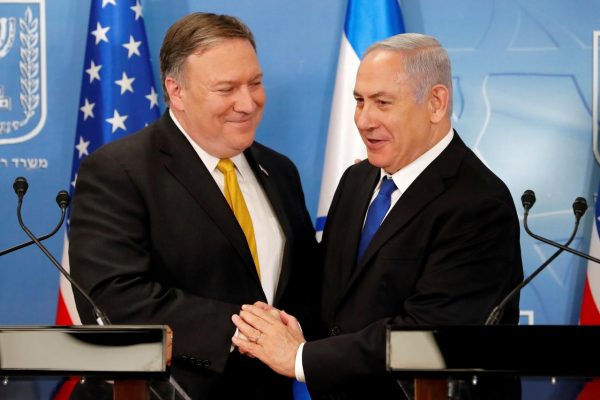
By Philip Giraldi • Unz Review • September 3, 2019
Two years ago I wrote an article entitled “America’s Jews Are Driving America’s Wars.” Though I made clear in the piece that I was writing about specific, identifiable Jews who fund and staff the think-tanks and foundations that make up the Israel Lobby, I was immediately fired by the Editor of The American Conservative (TAC) magazine and website, a timid little man who had been trying to get rid of me for some time. He evidently wished to do so because I did not share his “restraint” in my allusions to Jewish power in the United States and was particularly incensed over my suggestion that when Zionist propagandists like Bill Kristol appear on television the network should be required to display a warning label under the picture advising that Kristol was toxic.
As I had been writing for TAC for fifteen years and had been regarded as very popular among the magazine’s supporters, my dismissal was noted by many. I therefore followed up with a second article entitled “How I got fired,” which, inter alia, noted that Pat Buchanan, the TAC co-founder, had pretty much written the same thing that I did back in 2003 in a famous essay entitled “Whose War?”, though he had definitely been more polite than I was.
Pat Buchanan continues to be one of the few publicly visible political analysts currently active who dares to tell it like it is when it comes to Israel’s power in America. His article last week “Will Israel’s War Become America’s War” as always gets to the heart of the problem, i.e. that the completely contrived “special relationship” with Israel could easily lead the United States into another totally unnecessary war or even a series of wars in the Middle East.
Pat starts with “President Donald Trump, who canceled a missile strike on Iran after the shoot-down of a U.S. Predator drone to avoid killing Iranians, may not want a war. But the same cannot be said of Bibi Netanyahu.” He observes that Israeli Prime Minister Netanyahu is facing re-election on September 17th, and though most polls indicate that he will win, the opposition to him is strong based on his personal corruption and his pandering to the country’s most extreme right-wing parties. So Bibi is concerned that he might lose and even go to jail and there is nothing like a little war to make a leader look strong and righteous, so he is lashing out at all his neighbors in hopes that one or more of them will be drawn into what would be for Israel, given its massive military superiority, a manageable confrontation.
Buchanan sums up Netanyahu’s recent escalation, writing that on “Saturday, Israel launched a night attack on a village south of Damascus to abort what Israel claims was a plot by Iran’s Revolutionary Guards’ Quds Force… Sunday, two Israeli drones crashed outside the media offices of Hezbollah in Beirut. Israel then attacked a base camp of the Popular Front for the Liberation of Palestine-General Command in north Lebanon. Monday, Israel admitted to a strike on Iranian-backed militias of the Popular Mobilization Forces in Iraq. And Israel does not deny responsibility for last month’s attacks on munitions dumps and bases of pro-Iran militias [also] in Iraq. Israel has also confirmed that, during Syria’s civil war, it conducted hundreds of strikes against pro-Iranian militias and ammunition depots to prevent the transfer of missiles to Hezbollah in Lebanon.”
So, Israel has staged literally hundreds of attacks against targets in Lebanon, Syria and now Iraq while it is also at the same time shooting scores of unarmed demonstrators inside Gaza every Friday. Netanyahu has also threatened both perennial foe Iran and the Houthi rebels in Yemen. As the Jewish state is not at war with any of those countries it is engaging in war crimes. Both Hezbollah in Lebanon and the Iranian Revolutionary Guard Force are vowing revenge.
Pat Buchanan goes on to make the case that Netanyahu is willy-nilly pulling the United States into a situation from which there is no exit. Indeed, one might well conclude that the trap has already been sprung as the Trump Administration is reflexively blaming Israel’s actions on Iran. The Jewish state’s escalation produced a telephone call to Bibi by American Secretary of State Mike Pompeo promising that the United States would unconditionally support Israel. Vice President Mike Pence also joined in, boasting of a “great conversation” with Netanyahu and tweeting that “The United States fully supports Israel’s right to defend itself from imminent threats. Under President @realDonaldTrump, America will always stand with Israel!”
So, if a war in the Middle East does begin one can count on a number of developments in Washington, all of which favor Netanyahu. As Pompeo and Pence have made clear, the Trump Administration already accepts that whatever Israel does is fully justified and there are even reports that the White House will endorse Israeli annexation of all the illegal settlements on the West Bank at some point either before or immediately after the upcoming Knesset election to help Bibi. And don’t look for any dissent from even the most extreme views developing inside the White House or the State Department. The president has completely surrendered to the Israel Lobby while National Security Adviser John Bolton, Pence and Pompeo are all outspoken supporters of war with Iran. And nearly all the important government posts dealing with the Middle East are staffed by Jewish Zionists, to include the president’s son-in-law and two Donald Trump lawyers. The most recent addition to that sorry line-up is Peter Berkowitz, who has been appointed head of the Policy Planning Staff at State. Berkowitz studied at the Hebrew University in Jerusalem and is co-founder and director of the “Israel Program on Constitutional Government.”
And Congress would also be singing the “amen” chorus in support of U.S. intervention to help the country it has ridiculously but nevertheless repeatedly described as America’s “best friend and closest ally.” The occupied mainstream media would echo that line, as would the millions of Christian Zionists and every one of the more than 600 American Jewish organizations that in one way, shape or form support Israel.
Buchanan warns that the U.S. could find itself in real trouble, particularly given the attacks on Iraq, where Washington still has 5,000 troops, hugely outnumbered by the local pro-Iranian militias. And American aircraft carriers could find themselves vulnerable if they dare to enter the Straits of Hormuz or Persian Gulf, where they would be in range of the Iranian batteries of anti-ship missiles. He concludes that a war for Israel that goes badly could cost Trump the election in 2020, asking “… have we ceded to Netanyahu something no nation should ever cede to another, even an ally: the right to take our country into a war of their choosing but not of ours?”
Philip M. Giraldi, Ph.D., is Executive Director of the Council for the National Interest, a 501(c)3 tax deductible educational foundation (Federal ID Number #52-1739023) that seeks a more interests-based U.S. foreign policy in the Middle East. Website is councilforthenationalinterest.org, address is P.O. Box 2157, Purcellville VA 20134 and its email is inform@cnionline.org.
What if the Palestinians Won a Battle and No One Knew?
By Eve Mykytyn | September 2, 2019
There is a lawsuit, Al-Tammimi v. Adelson, that is making its way through the federal courts. The lawsuit was brought by a group of Palestinians and Palestinian/Americans asking for damages of 34.5 billion dollars resulting from Israeli settlements in the West Bank including East Jerusalem and the Gaza Strip. The Palestinians claim that the defendants, pro-Israel donors and organizations, banks, contractors working for Israel and deputy National Security Advisor Abrams conspired to expel Non Jews from their land and otherwise harm them. Defendants include Americans Sheldon Adelson, Lawrence Ellison, Haim Saban, Irving Moskowitz, John Hagee and Israeli Lev Leviev. The appeals court decision is here.
The suit was first brought in a US Federal district court (the “trial court”) alleging that the defendants “funneled millions of dollars through the defendant tax-exempt entities and banks to Israeli villages called “settlements.” Armed with this financial assistance, the settlement leaders hired full-time security coordinators who trained a militia of Israeli settlers to kill Palestinians and confiscate their property. The defendant construction and support firms destroyed property belonging to the Palestinians and built settlements in its place” and deputy national security advisor of the United States publicly endorsed the settlements.
The plaintiffs pressed four claims: “(1) civil conspiracy, (2) genocide and other war crimes, (3) aiding and abetting genocide and other war crimes and (4) trespass.”
The trial court dismissed the suit, relying on the doctrine that it is inappropriate for a court to determine matters that are inherently political and more properly decided by Congress and/or the President. The trial court found that the case required it to “adjudicate and resolve the lawfulness of the development of Israeli settlements…” Such a ruling, the trial court said, was “simply inappropriate for this court to resolve. Instead, these issues must be decided by the political branches.”
According to Haaretz, Israeli legal organization, Shurat Hadin, that claims to represent victims of terror, praised the trial court decision, and incorrectly stated that “cases such as this are brought solely to furnish a foundation of legal legitimacy for the BDS movement, and undermine the legitimacy of Israel.” And then, perhaps for vengeance, added the hope that “the judge will see clear to impose the large costs of these proceedings on the plaintiffs.” Imposition of costs is routine in some countries but unusual in the US.
On February 19, 2019 a panel of the Washington, DC Federal Circuit Court of Appeals (the “appeals court”) unanimously reversed the trial court and ruled that a trial court could find the defendants liable without deciding who owns the land. Although the appeals court did not decide liability, it sent the case back to the trial court for trial.
The appeals court agreed with the trial court that the issue of sovereignty over the land is political, but found that the case could be dismissed only if none of its claims could be resolved without deciding the political issue. In other words, they ruled that the Plaintiff’s claims can be separated from the issue of sovereignty over the land.
The lawsuit was brought primarily under a federal law entitled, the Alien Tort Statute (“ATS”). The ATS provides, in part, that federal courts can hear a civil action by a nonresident non- US citizen for a wrong “that is committed in violation of the law of nations.” The appeals court noted that “it is well settled that genocide violates the law of nations.” The court found that there is a definition of genocide within international law, that is: “[k]illing members of [a national, ethnic, racial or religious group] with intent to destroy [the group], in whole or in part.”
“Thus, the ATS—by incorporating the law of nations … —provides a judicially manageable standard to determine whether Israeli settlers are committing genocide.” In so stating, the appeals court is telling the trial court that this is the proper standard for its decision, and that this is not a “political” issue. (by political, they mean in the narrow sense of sovereignty involved in this case).
This decision can be appealed to a larger panel of the appeals court or to the Supreme Court, absent a successful appeal by the defendants, the Palestinians will be able to proceed. The district court has not yet reheard the case.
It seems to me like a big deal that three federal appeals judges ruled unanimously that the plaintiffs may proceed to argue that Israeli settlers and their benefactors have committed or aided in genocide.
However, the mainstream media has declined to cover this crucial case. A search of The New York Times, the Wall Street Journal and Bloomberg yielded no results. The case was covered by a few smaller outlets and by Bloomberg, Reuters (which included a summary that was at least partially correct) and by the Jerusalem Post (that complained the Palestinian plaintiffs failed to present the Israeli narrative). The Electronic Intifada covered the initial filing but does not seem to have followed the case. And Haaretz and the Times of Israel wrote about the dismissal by the district court but not that it was overturned on appeal. This strikes me as scant coverage of an important case.
Finally, a part of the United States government is treating Palestinians as people who have at least potential rights even against billionaires, and most of our media has not bothered to tell us the story.
24 Palestinian journalists held in Israeli jails
![An Israeli soldier attacks AFP'S photo journalist Jafer Eshtayah during a protest against building of illegal settlements and the separation wall at the Kafr Qaddum village of Nablus, West Bank on March 22, 2019 [Nedal Eshtayah / Anadolu Agency]](https://i1.wp.com/www.middleeastmonitor.com/wp-content/uploads/2019/03/20190322_2_35583879_42875884.jpg?resize=1200%2C800&quality=75&strip=all&ssl=1)
Israeli soldier attacks AFP journalist during protest against building illegal settlements and the separation wall at Kafr Qaddum village, Nablus, West Bank on March 22, 2019
Nedal Eshtayah / Anadolu Agency
MEMO – September 2, 2019
Israel’s military occupation authorities continue to target Palestinian journalists, the Journalist Support Committee (JSC) said on Sunday, Quds Press has reported. The JSC pointed out that the number of Palestinian journalists held in Israeli jails has risen to 24.
Information about the imprisoned journalists was included in a statement issued by the committee in the wake of Israel’s detention of Palestinian media Professor Widad Al-Barghouti. She is a media lecturer at Birzeit University.
According to the JSC, the Israelis arrested four journalists in August and extended the detention of two others. It also noted that five out of the 24 journalists in prison are being held by Israel under administrative detention with neither charges nor a trial. Seven have been sentenced and 12 are being held in custody pending prosecution.
The JSC reiterated its concern that the Israeli occupation authorities “insist on hindering the work of journalists” who carry out their national duty regarding the documentation of Israel’s crimes which amount to violations of international laws and conventions.
Highlighting the situation of Palestinian journalist Bassam Al-Sayeh, the committee explained that his health is deteriorating badly in prison. The JSC added that the Palestinian prisoners held by Israel face “intentional medical negligence”.
In conclusion, the Journalist Support Committee called for the international community to protect Palestinian journalists and compel Israel to adhere to the terms of UN Security Council Resolution 2222 regarding the protection of civilians in armed conflict.
See also:
Report: Israel’s targeting of Palestinian photojournalists increasing
Netanyahu Does Something Stupid Again
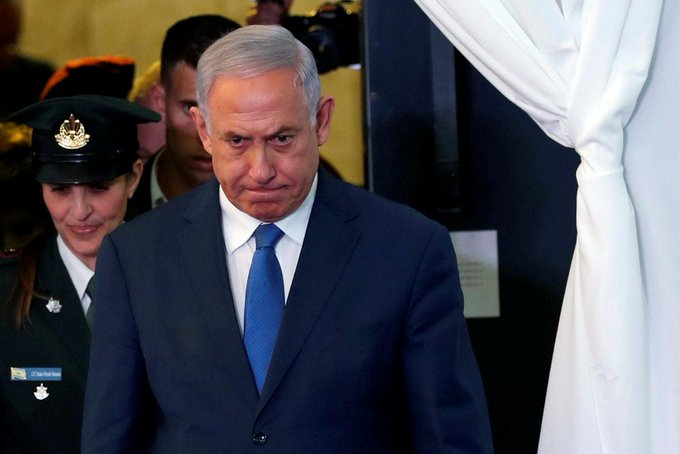
Israeli PM Benjamin Netanyahu arrives to review an honor guard with his Ethiopian counterpart Abiy Ahmed in Jerusalem September 1, 2019. Credit: Ronen Zvulun/ Reuters/ Twitter)
By Jeremy Salt | American Herald Tribune | September 2, 2019
With general elections coming up on September 17, Benyamin Netanyahu made a calculated gamble last week and lost.
The attempt to assassinate someone by drone in Beirut failed. Two drones were sent into the largely Shia suburb of Dahiya, where Hizbullah’s political, media and welfare offices are based. The first drone, for surveillance, crashed on to the roof of a Hizbullah media office, causing damage inside but no human casualties. This forced the Israelis to abort the entire mission. They themselves destroyed the second drone, for assassination, according to the veteran Middle East correspondent Abdul Bari Atwan. The target for murder was clearly a senior Hizbullah figure or – as some have speculated – a representative of the Iranian government. Israel certainly did not send a drone to Beirut just to put a hole in the roof of a building.
As this was the first attack on Beirut since 2006, when Israel jets pulverized Dahiya day after day, Hizbullah threatened retaliation. It never says when, how or where it will strike back but this time it retaliated almost immediately, destroying an Israeli APC (armored personnel carrier) at a military outpost across the armistice line.
That Netanyahu would launch such an attack without taking precautions to ensure the safety of civilians and military personnel in the north would have played badly before the public had not the government covered its tracks by firing a flurry of missiles into Lebanon and claiming in a media barrage that while the APC was indeed hit by the ‘terrorists’ no-one suffered even a scratch, as Netanyahu eventually claimed.
It may be some time, it may be never, that the truth comes out but the story pitched by the Israeli government and military has all the elements of high comedy, not sophisticated, more Bud Abbott and Lou Costello than Lenny Bruce. First the Israelis said the vehicle that was struck was a military ambulance, with no-one inside it. Then they admitted it was an APC, but again no-one was inside, as they had all gone somewhere else half an hour earlier, whether for a smoke, a meal or a pee we don’t know.
Likud minister Yoav Galllant said no-one had been hurt in the missile strike, even as footage was being shown of wounded soldiers being flown by helicopter to an army hospital but he was speaking out of turn, so the government said.
In fact, noone had been hurt. This was no more than a decoy operation. Israel wanted Hizbullah to think it had scored some kind of victory, so it dressed up store dummies as soldiers and had them carried away on stretchers. It turned out that Israel just wanted to fool Hizbullah. That was the point of the whole exercise. Ha ha, Hasan, the joke’s on you. Noone had been hurt after all. “The staged evacuation seems to have worked” wrote the veteran Zionist propagandist David Horowitz.
The fact that settlers in the north had been sent scurrying into their bomb shelters by the Hizbullah missile strike was soon overtaken by glowing reports of farmers back in the fields and children back in the classroom as usual now that the cross-armistice line missile fusillade had died down.
Readers will decide how much of this malarky they can believe. For most, probably none of it. Behind the propaganda smokescreen lies a core truth, which is that Netanyahu, Israel’s nincompoop-in-chief, launched a failed mission into Beirut, rather reminiscent of his failed attempt to kill the senior Hamas figure Khalid Mishael in 1997. The would-be assassins were arrested, and the panicked, sweating Netanyahu, close to nervous collapse, saved from his own folly only by the intervention of the Jordanian king.
The drone attack in Beirut was designed to deliver an election victory but backfired badly and had to be covered up as quickly as possible with what seems on the surface to be a complete cock and bull story.
The APC held eight men. If they had been inside when it was struck by Hizbullah’s missile, all would have died or would have been badly wounded, as Hizbullah claimed they were. If they were killed or wounded, Netanyahu, approaching the end of an election campaign, would have had to prevent the public from knowing, even to the ludicrous extent of telling it that the wounded soldiers shown in video footage were actually store dummies dressed up as wounded men. The truth – if there were casualties – would have doomed his re-election prospects.
The drone attacks on Beirut included a strike on a PFLP (Popular Front for the Liberation of Palestine) base in the Bika’a valley. Other drone attacks on the same day were launched against Hashd al Sha’abi (Popular Mobilization Forces) units and regular Iraqi army bases in north Iraq close to the Syrian border. Iraqi intelligence believes the attacks were launched from the Kurdish region of northeastern Syria, controlled by the largely Kurdish Syrian Democratic Forces (SDF), the US puppet militia. In the same time frame, the Zionists also attacked a military position close to Damascus.
These simultaneous attacks on three countries call to mind the rabid dog running around snapping at anyone who comes close. There was no immediate provocation for any of these missile strikes and drone attacks but in Israel’s case there never has to be. The Israelis say Hizbullah’s missile retaliation brought the two sides to within 30 minutes of another war, and they say another one is coming anyway. This can hardly be news to anyone. Hizbullah has enough precision missiles to devastate Israel and the longer the Israelis wait the more it will have, so unfortunately another war is only a matter of time and perhaps a much shorter time than people might think.
Even though Israel has been flying drones over Lebanon for decades, an attack in central Beirut is unusual. It might not be the first, however: Lebanon’s former Prime Minister, Rafiq Hariri, may have been assassinated in 2005 by a missile fired from an Israeli drone, and not killed by a car bomb, the generally accepted explanation. The UN investigation into Hariri’s death was grossly prejudicial, especially in the case of the reports filed by the first lead investigator, Detlev Mehlis, and came to nothing anyway. The charges against Lebanese suspects were dropped, at which point the UN tribunal switched its suspicions to Hizbullah, without having any prior evidence. This investigative route has ended in a dead end as well. The one chief suspect never investigated, even though standing out above all the others because of its long track record of murder and mayhem in Lebanon, is Israel.
In 2010 Hasan Nasrallah revealed that Hizbullah had intercepted Israel’s electronic communications and had captured images of an Israeli drone tracking Hariri across Beirut and into the mountains every day for three months. Along with an AWACS (Airborne Warning and Control System) plane, an Israeli drone was hovering over the precise point on the corniche road when Hariri was assassinated.
Looking at the evidence, Thierry Meyssan has argued that a highly refined missile fitted with a warhead based on a ‘nano’ amount of enriched uranium may have been used rather than a car bomb (‘Revelations on Rafik Hariri’s Assassination,’ Voltaire Network, November 29, 2010).
However, whether drone missile or car bomb, Nasrallah implicated Israel in the murder. If the question cui bono is to be asked the answers are clear. It was immediately assumed in the ‘west’ that Syria must have been responsible, given the often difficult relationship between Hariri and the Syrian government, but the only beneficiaries of the assassination were Israel and its rightwing proxies in Lebanon.
Israel violates Lebanon’s air space as a matter of course. Over the years it has overflown Lebanon many thousands of time. It frequently flies across Lebanon to attack Syria. At the international level, no sanctions have ever been introduced to stop it, just as no sanctions have ever been introduced to stop it doing anything it wants to do. This will continue until the big war comes along, and then all those who could have done something to head it off but did nothing will be throwing up their hands in horror.
Apart from flights aimed at bombing targets in Lebanon or Syria, Israel’s aerial intrusions would have other purposes, including intimidation of the Lebanese civilian population and the unrest this might generate.
Most probably it would also want to draw Hizbullah out and, through retaliation to one of its attacks, see if it has missiles capable of bringing down its aircraft. A lost plane and pilot would be worth the cost of knowing. As the neutralization of Israeli air power must be a primary objective of Hizbullah and Iran, Hizbullah probably does have such weapons, but Israel is going to have to wait until the next war to find out.
Canada and the Palestinians: Out of Balance
By Faisal Bhabha | MEMO | September 1, 2019
As Canada approaches a federal election next month, there appears to be little difference between the two main rival parties – the Liberals and the Conservatives – when it comes to supporting Israel at the expense of Palestinian human rights. The main difference is that the Conservatives have been clear and open about their one-sided support for Israel, while the Liberals claim to be balanced while acting in a partisan manner.
To be sure, Canadian policy on Israel-Palestine has always walked a fine line. On the one hand, Canada is committed to international law, which includes viewing the Israeli occupation of Palestinian territory as necessarily temporary, Israeli settlements as clearly illegal, Jerusalem as a mixed, shared city, and Palestinian refugees as presumptively entitled to return to their homeland.
On the other hand, Canada views Israel as a close ally and a fellow liberal democracy. Canada has always endorsed the Zionist idea that the world’s Jews are entitled to a state in the Middle East. Regardless of whether Canadian governments have been Liberal or Conservative, support for Israel as a Jewish state has been constant.
Yet during a decade of Conservative rule (2006-2015), the Canadian tradition of encouraging respect for international law and promoting a just peace in the Middle East gave way to hyper-partisan support for the most right-wing government in Israel’s history.
During Israel’s 2014 assault on Gaza, which killed hundreds of innocent Palestinians (including scores of children), Canadian government officials blamed the Palestinians and trumpeted Israel’s “right” to defend itself. Canada punished the Palestinians by holding back aid, blocking Canadian doctors from volunteering in Gaza, and refusing visas to injured Palestinian children invited to receive treatment in Canada.
The election of a Liberal government in 2015, with its young, charismatic prime minister, was expected to usher in a new era in Canadian politics. The Liberal caucus was more diverse than any in the past. Justin Trudeau was unapologetic in his efforts to enhance representation and promote equality. He boldly declared, in response to a question about why gender parity in cabinet was important to him, “because it’s 2015”. Virtue needs no justification.
Those looking for a principled approach to Canadian policy in the Middle East might have dared to hope for a return to even-handedness. However, they would quickly discover that Trudeau’s progressive idealism does not include Palestinian human rights.
Even before the election, Trudeau had taken aim at BDS – the call for boycott, divestment and sanctions against Israel. Since around 2005, Palestinian activists have called for the use of this non-violent advocacy tactic – modelled on South Africa’s struggle against Apartheid – in the face of failed diplomatic efforts to bring an end to Israel’s decades-long military occupation.
BDS seeks to pressure Israel to comply with international law. It has been promoted through various initiatives, including campus awareness events like Israeli Apartheid Week, which was pioneered in Toronto and has spread to more than 50 cities around the world.
Yet instead of aligning himself with the global justice movement, Trudeau allied himself with Israel’s most hardline supporters. In March 2015, he tweeted: “The BDS movement, like Israeli Apartheid Week, has no place on Canadian campuses.”
Trudeau must have been either being ignorant or strategic. He certainly was aware that plenty of reputable individuals and groups have endorsed BDS, and many more have refused to condemn it.
However, Trudeau was also aware that standing up for human rights – at least when it comes to Palestine – attracts a high political cost. For example, in 2006 the highly respected former US President, Jimmy Carter, published his book, Palestine: Peace Not Apartheid. The reaction was swift and strong. Abraham Foxman, then long-serving head of the US Anti-Defamation League (ADL), labelled Carter an anti-Semite. The US’ Brandeis University lost donors after hosting a book talk by Carter. The Nobel Laureate faced a frontal assault to his reputation.
From December 2008 to January 2009, Israel carried out Operation Cast Lead. The relentless battering of the impoverished Gaza Strip was ostensibly provoked by missile attacks. Israel killed 1,409 Palestinians, the overwhelming majority of whom were civilians, including hundreds of children. On the Israeli side, three civilians and ten combatants were killed, four by friendly fire.
The Israeli assault on Gaza led to a UN-initiated investigation, headed by South African jurist Richard Goldstone. His September 2009 report was critical of Israel, finding its military had intentionally used disproportionate force against Palestinian civilians.
Later that year, Benjamin Netanyahu was elected Prime Minister of Israel. He immediately began working to improve Israel’s diminishing global reputation. The apartheid analogy, the call for BDS, the Goldstone Report – these all signaled a shift in opinion that deeply unsettled Netanyahu. Goldstone was viciously smeared and shunned. Netanyahu’s “number one fan”, Harvard law professor Alan Dershowitz, called Goldstone (a former colleague and friend) a “traitor to the Jewish people”.
In May 2010, the Israeli daily Haaretz reported that Israel’s Foreign Ministry was planning to use front groups to transmit hasbara (propaganda, or public relations) messages in order to influence “senior politicians, opinion shapers and journalists” in the West. Hasbara operates by seeking to explain and re-frame Israel’s record of abuse, while attacking its critics.
Hasbara found enthusiastic foot soldiers in Canada. Canada’s Jewish population today is one of the most pro-Israel diaspora communities in the world.
The group Hasbara Fellowships claims to have taken more than 3,000 university and college students from 250 different North American campuses to Israel for 16-day trips where the students learn “positive messaging” tactics to brand Israel.
Aish Toronto, which runs Hasbara Fellowship Canada, states that it takes “hundreds of students” to Israel every summer and winter, “giving them the information and tools to return to their campuses as educators about Israel”. Other groups, such as StandWithUs Canada, are likewise trained to act as “campus emissaries of the Jewish state”.
The Canadian Centre for Israel and Jewish Affairs (CIJA), the dominant pro-Israel lobby group established in 2004, contributes millions of dollars to campus hasbara activism. It has a staff of 50 and a $10 million budget to provide “advocacy support to 25 campuses in 9 provinces”. CIJA works closely with Hillel and other on-campus student groups to sanitise Israel’s reputation and delegitimise BDS activism.
B’nai Brith and the Simon Wiesenthal Center Canada have also, in recent years, focused their activities on demonising Palestinian solidarity activists and spreading the smear that BDS is anti-Semitic. Much of their work is concentrated on pushing pro-Israel campus advocacy.
In the US, B’nai Brith created “The Lawfare Project”, whose raison d’être is to intimidate and silence Palestinian solidarity activism. In Canada, the recently created Canadians for the Rule of Law (CFRL) seeks to mimic the Lawfare Project, and has already held a controversial “teach-in” to mobilise anti-Palestinian activists.
All of this appears to be working. In February 2016, the opposition Conservatives, just six months after their electoral defeat, introduced a motion in the House of Commons condemning “any and all attempts by Canadian organisations, groups or individuals to promote the BDS movement, both here at home and abroad”.
Despite a Liberal majority in the House, the Conservatives’ anti-BDS motion passed by a vote of 229 to 51. In a rare moment of bipartisanship, virtually every Liberal and Conservative Member of Parliament (MP) supported it.
More than three years before the US Congress gained its two outspoken Muslim Representatives, Rashida Tlaib and Ilhan Omar, the Canadian House of Commons had the arrival of an unprecedented number of Muslim MPs: ten Liberal and one Conservative. Yet not one stood up for Palestinian human rights by voting against the anti-BDS motion, despite the fact that three out of four Canadian Muslims surveyed would support some sort of international sanctions against Israel.
In fact, a silent majority of nearly two thirds of Canadians believe their government is biased in Israel’s favour. Yet, prominent Liberal MP Anthony Housefather (Mount Royal) recently took pride in highlighting in a Canadian Jewish newspaper the fact that the Liberal government has been more pro-Israel in international relations than any previous government of either major party:
We [Liberals] have voted against 87% of the resolutions singling out Israel for condemnation at the General Assembly versus 61% for the [Conservative] Harper government, 19% for the [Liberal] Martin and [Conservative] Mulroney governments and 3% for the [Liberal] Chrétien government. We have also supported 0% of these resolutions, compared to 23% support under Harper, 52% under Mulroney, 71% under Martin and 79% under Chrétien.
How a Liberal government that fancies itself a champion of social justice could denigrate a legitimate human rights movement and brag about it for expected political gain is no mystery. Canada has a vibrant and active Palestinian solidarity movement, but it pales in comparison to the well-resourced pro-Israel lobby.
Leftists and civil libertarians, including the Ontario Civil Liberties Association and a number of labour organisations, have pushed back against the embrace of anti-BDS politics. Tyler Levitan of Independent Jewish Voices said: “It is outrageous for our elected representatives to publicly chastise human rights supporters, and falsely accuse them of hatred and bigotry for standing in solidarity with the victims of Israeli state violence and oppression.”
In January 2019, Trudeau doubled down on his condemnation of BDS. Claiming concern for Jewish students who “still feel unwelcome and uncomfortable in some of our college and university campuses because of BDS-related intimidation”, Trudeau remained silent on the rising number of innocent Palestinians injured and killed at the Gaza border after months of mostly peaceful protest.
Organisations like Amnesty International, Human Rights Watch, B’Tselem and the UN High Commission for Human Rights have called Israel’s actions disproportionate, unjustified and illegal.
Trudeau attacked human rights defenders, while Israel pummeled Palestinian civilians.
For those who were still waiting for a sliver of principle from a prime minister seeking re-election, he has left little room for question as to how he lines up his priorities. Sadly for Canadians, the main alternative in the upcoming election – the populist Conservatives – could care even less about the Palestinians or their defenders. Conservative concern for free speech ends precisely where the subject of Palestine begins.
Canadians should be – but are not apparently – alarmed by the demise of integrity in our country’s approach to Middle East policy and international human rights. While most Canadians may acknowledge the imbalance in Canadian foreign policy, few seem sufficiently bothered to make it an election issue. Perhaps Trudeau’s gamble with duplicity will pay off after all.
Read also:
41 US Democrats land in Israel for AIPAC-affiliated tour
‘In US universities students who criticise Israel are under attack’
Israeli artillery shells southern Lebanon, drone drops incendiary devices along border
Press TV – September 1, 2019
Israeli artillery units have struck the southern part of Lebanon shortly after an Israeli drone violated the Lebanese airspace, and dropped incendiary material that sparked a fire in a forest at the border.
Lebanon’s official National News Agency reported that Israeli forces launched several 155-millimeter shells on the Jabal al-Rous area in the occupied Shebaa Farms and Kfarshouba Hills on Sunday afternoon.
The report added that the Israeli forces opened fire from their posts in the al-Zaoura area in Syria’s occupied Golan Heights.
An Israeli unmanned aerial vehicle, meanwhile, dropped incendiary devices on a forest in the border area of Bastara.
The Lebanese army said in a statement that the drone entered Lebanese airspace at 11:15 a.m. local time (0815 GMT) on Sunday, and dropped an unspecified number of devices, causing fires in some areas.
It added that the army would continue to follow up on Israeli violations of Lebanese airspace with the United Nations Interim Force in Lebanon (UNIFIL).
Images published by the private LBCI television network showed smoke rising from a tree-covered hill, reportedly caused by the weapons.
Tensions have been high recently between Israel and the Lebanese resistance movement Hezbollah in connection with the Israeli attacks on August 25 in Syria and Lebanon. Hezbollah has pledged to retaliate.
Hezbollah’s Secretary-General Sayyed Hassan Nasrallah said on Saturday evening that the resistance movement was determined to give a response to Israel over its recent drone incursion into Lebanon.
“The need for a response is decided,” he said during a televised speech ahead of the Islamic lunar calendar month of Muharram – the 10th day of which marks the martyrdom anniversary of Imam Hussein, the third Shia Imam and Prophet Muhammad’s grandson.
The Hezbollah chief added that the response was about “establishing the rules of engagement and… the logic of protection for the country. Israel must pay a price,” he said.
“Israel should know that the Lebanese air space is not open to her,” Nasrallah said, adding that the Israel attack could open the door to assassinations if left unanswered.
Nasrallah noted that the response to the Israeli attack could come from anywhere in Lebanon and not only from the Shebaa Farms south of the country, where Hezbollah normally stations most of its military equipment.
“The response will come from Lebanon. We will choose the place and time,” he said.
On August 26, Hezbollah said Israel had sent two drones into Lebanon on a bombing mission the previous weekend.
According to the resistance movement, the first drone had fallen on a building housing Hezbollah’s media office in the suburb of Dahieh. The second drone, which appeared to have been sent by Israel to search for the first one, had crashed in an empty plot nearby after being detonated in the air, it added.
Following the drone raids, Nasrallah vowed in a televised speech that fighters of the resistance movement would counter any further violation of the Lebanese airspace by Israeli drones.
Israel Uses Its Firepower, Far and Wide
By Paul R. Pillar | LobeLog | August 27, 2019
Israel recently has been expanding its military attacks across much of the Middle East, hitting multiple countries. The aggressive campaign far outpaces anything any adversaries of Israel have been doing to it, or even trying unsuccessfully to do to it.
Over the past two years Israel has used combat aircraft to conduct scores of attacks in Syria. Israel has stayed silent about most of this campaign of bombardment, but when it speaks it says the targets it hits are associated with Iran. The most recent widening of Israel’s assaults have involved Lebanon, including drone attacks on facilities in suburban Beirut associated with Hezbollah—a departure from the cease-fire established after the last Israeli-Hezbollah war.
The most dramatic geographic widening of the Israeli assault came last month with multiple attacks, reportedly conducted with F-35s, in Iraq—which, of course, does not even border Israel. Among the targets hit was one facility that is 500 miles from Israel but only about 50 miles from the Iranian border.
It is difficult to identify anything being fired in anger in the opposite direction that justifies such an expansive Israeli military campaign. In January of this year, Israel’s missile defense system intercepted a missile heading for the Israeli-occupied Golan Heights, but that is about as close as anyone in Syria, Lebanon, or Iraq has come lately to inflicting damage on Israel. Planned or failed attempts to inflict such damage all appear aimed at retaliating for Israel’s own attacks. Israel claimed that sorties it conducted this past weekend in Syria had thwarted an Iranian attempt to launch attack drones against Israel. That claim is unconfirmed, but it is quite plausible that, as suggested by Israeli sources, Iran was indeed planning such an operation to retaliate for the Israeli attacks last month in Iraq. One searches in vain for hostile operations that are unprovoked and not attempted tit-for-tat responses to Israel’s own actions.
The escalated Israeli military campaign exhibits some longstanding attributes of Israeli policies and practices. One is to assert a right to seek absolute security even if that means absolute insecurity for everyone else. The mere possibility of someone harming Israel is taken as sufficient reason to inflict certain harm on someone else. Israeli Prime Minister Benjamin Netanyahu, in commenting on the most recent Israeli operations in Syria, said that Israel “won’t tolerate attacks on its territory.” Evidently that means asserting the privilege of attacking anyone else’s territory, even if those countries have not already attacked Israel.
Domestic politics figures into such matters, in Israel as elsewhere. With an Israeli election looming, Netanyahu has a political reason to use aggressive operations to bolster his image as a tough-minded guardian of Israeli security.
The operations also are part of the larger anti-Iran theme that the Israeli government uses to keep a regional rival weak, preclude any rapprochement between that rival and the United States, blame someone other than itself for all the ills of the region, and distract international attention from subjects involving Israel that Netanyahu’s government would rather not talk about. The Israeli government wants to retain Iran permanently as a perceived threat, loathed and isolated, rather than to negotiate away any issues or problems involving Iran. Netanyahu demonstrated this when, after years of sounding an alarm about a possible Iranian nuclear weapon, he opposed the very agreement that closed all possible paths to such a weapon. His government demonstrated it again this week when it opposed President Trump’s expressed willingness to meet and negotiate with Iranian President Hassan Rouhani.
Israel’s heightened military aggressiveness has multiple bad consequences, in addition to being an affront to the sovereignty of multiple regional states. It pours gasoline on fires in places that need de-escalation, not escalation. It is certain to provoke more attempts at retaliation. Hezbollah Secretary-General Hassan Nasrallah was quite explicit in promising such retaliation in response to the recent Israeli attacks in Lebanon.
Given the close U.S. association with Israel, the Israeli attacks disadvantage the United States in its own relations with the affected states, in the form of increased resentment and lessened willingness to cooperate with Washington. This type of reaction is appearing today in Iraq, as a result of the Israeli attacks there. The episode has been the occasion for a powerful bloc in the Iraqi parliament to call for the withdrawal of all U.S. troops from Iraq and for shouts of “Death to America” to accompany “Death to Israel” at the funeral of one of those killed in the attacks.
No benefits offset these harmful consequences. It is useful to recall the previous time, before last month, that Israel attacked Iraq: the bombing of an Iraqi nuclear reactor in 1981. Far from setting back the Iraqi development of a nuclear weapon, the attack energized and accelerated what until then had been a semi-moribund program. Armed attacks on states have a way of provoking that sort of reaction.
U.S. policy has failed to recognize these realities. Following the attacks in Iraq, the Pentagon did issue a statement—in the course of denying direct U.S. involvement—that “we support Iraqi sovereignty and have repeatedly spoken out against any potential actions by external actors inciting violence in Iraq.” But such mild language will hardly deflect Israel from its present course when Secretary of State Mike Pompeo calls Netanyahu and, according to the official State Department statement, “expressed support for Israel’s right to defend itself from threats posed by the Iranian Revolutionary Guard Corps and to take action to prevent imminent attacks against Israeli assets in the region.”
It is not just current U.S. policy that fails to recognize realities, but also wider discourse in the United States about troubles in the Middle East. A question that needs to be pondered carefully is, “Who is destabilizing the Middle East?” Stoked by the Trump administration’s own unrelenting campaign of hostility toward Iran, the stock and overly simple answer has been, “Iran.” That is an insufficient answer even when excluding Israel from the picture. And Israel does get excluded, and excused, for the variety of reasons—ranging from religious doctrine and historical legacies to the inner workings of domestic U.S. politics—for the strong U.S. favoritism toward Israel.
It may be too much to ask for consistency rather than hypocrisy in such matters, but the rest of the world easily perceives the hypocrisy. It at least would be honesty to acknowledge that the U.S. approach toward the region has been shaped not by which players are or are not destabilizing the region, but instead by U.S. fondness for some players rather than others.
Paul R. Pillar is Non-resident Senior Fellow at the Center for Security Studies of Georgetown University and an Associate Fellow of the Geneva Center for Security Policy. He retired in 2005 from a 28-year career in the U.S. intelligence community. His senior positions included National Intelligence Officer for the Near East and South Asia, Deputy Chief of the DCI Counterterrorist Center, and Executive Assistant to the Director of Central Intelligence.
NYT Presents Murder of a Palestinian Boy as ‘National Trauma’—for Jewish Israelis
By Jim Naureckas | FAIR | August 30, 2019
HBO has a series based on a real-life crime in Israel—a 2014 case involving (in the New York Times‘ words) “a Palestinian teenager snatched off a Jerusalem street by Orthodox Jews, choked, bludgeoned and burned to death in a forest at dawn.”
And how does the Times headline its report (8/27/19) on this series?
HBO Drama Revives a National Trauma for Israel
For Israel? Yes, and by “Israel,” Times Jerusalem correspondent Isabel Kershner means Jewish Israelis; in her eyes, they are the ones for whom the murder of 16-year-old Palestinian Muhammad Abu Khdeir was a “national trauma”:
It was the extraordinary coldbloodedness of the murder that made it true-crime movie material in the first place…. But Our Boys, a 10-part series that started this month on HBO, is under attack in Israel largely because of that singularity.
Some critics have accused the creators of skewing reality and ignoring what they say is the more common scourge of Palestinian terrorism against Israelis, creating a false equivalency between the two and tarnishing Israel’s image.
Let’s stop here for a reality check: There are, in fact, statistics on who’s killing whom in Israel/Palestine. The Israeli human rights group group B’Tselem reports that since January 2009, there have been 95 Israeli civilians killed by Palestinians—and at least 1,771 “Palestinians who did not take part in hostilities…killed by Israeli security forces.” (This latter number does not include Israeli assassinations—labeled as “targeted killings”—or Palestinians killed by Israeli civilians.) There have been 13 Israeli minors killed by Palestinians since 2009, and 785 Palestinian minors killed by Israeli security forces; in other words, a child killed in the conflict is 60 times more likely to be a Palestinian child than a Jewish child.
Kershner might have pointed out that the accusation that Palestinians murdering Jewish Israelis is a “more common scourge” is an absolute inversion of reality. Instead, to cite an example of “some critics” who think it’s “skewing reality” to focus on a single Palestinian death, she turns to Yair Netanyahu, the son of Israeli Prime Minister Benjamin Netanyahu, who said on Twitter (8/21/19):
The series tells the whole world how the Israelis and Jews are cruel and bloodthirsty murderers, and how the Palestinians are badly done by and oppressed.
The tweeter’s father, as prime minister since March 2009, is responsible for nearly every one of those 785 Palestinian children killed by his security services.
After quoting the younger Netanyahu, Kershner acknowledges that Palestinians watching the series “also had painful memories.” As an example, she offers the parents of the murdered boy, who no doubt felt at least as bad watching a TV show about their dead child as the prime minister’s son did.
Did somebody say “false equivalency”?
ACTION:
Please tell the New York Times not to treat the murder of a Palestinian child as chiefly a “national trauma” for Jewish Israelis.
CONTACT:
Email: letters@nytimes.com
Featured Video

Seyed M. Marandi: US-Iran War Inevitable: Kuwait and Bahrain May Fall
or go to
Aletho News Archives – Video-Images
From the Archives
USS Liberty Massacre: A Pivotal Moment in the Hostile Takeover of America
By Kevin Barrett | Crescent | Dhu al-Qa’dah 24, 1445
In corporate America, hostile takeovers are commonplace. They occur when an aggressor—a larger corporation or rich individuals—seizes control of a smaller corporation without asking permission.
What few recognize is that the United States itself has been subjected to a hostile takeover. Since the aggressor, the illegitimate settler colony known as “Israel,” is much smaller than the US, the takeover has necessarily been surreptitious.
As of June, 2024, Israel’s gradual takeover of the US has become obvious and undeniable—a proverbial “elephant in the living room.” … continue
Blog Roll
 Aletho News
- Seyed M. Marandi: US-Iran War Inevitable: Kuwait and Bahrain May Fall
- Leaders Condemn Ansarallah Attack on Saudi Arabia While Ignoring Illegal War Against Yemen
- Leaked: Britain’s Covert Iraqi Psyops Network
- Yemeni Armed Forces Warn Airlines Against Using Saudi Airports, Exempt Mecca and Medina
- Iran security chief says powers greater than US tried to conquer Iran but ended in ‘dustbin of history’
- Europe’s mounting social chaos… chickens coming home to roost for proxy war against Russia
- US-Russia Diesel Deal Becomes Massive Defeat for Ukraine
- Hormuz and the Looming Economic Catastrophe
- Dhubab offensive, media blitz and the rapid unraveling of Saudi-backed coalition’s new gambit
- Putin Conveys to Trump Iran’s Vision on Possible Conflict Resolution – Kremlin
- If Americans Knew
- Gaza: Ceasefire Anniversary Marks Year of Failed Promises
- The American Conservative: Mike Huckabee Should Resign
- A C-Section in Shackles: A Palestinian Woman’s Harrowing Birth in Israeli Detention
- ‘He’s Desperate’: AIPAC Begins Spending Against Abdul El-Sayed to Boost Mike Rogers:
- Trump, Hormuz, and the Looming Economic Catastrophe
- For three years, Israel has killed a child in Gaza every 71 minutes – Daily Update
- Israeli forces kill another child in Gaza – Daily Update
- Gaza ceasefire exists in name only, say more than 100 organizations
- Nearly 2 Million in Gaza Need Urgent Shelter Assistance as Winter Looms: IOM Chief Warns
- Suppressing Palestinian resistance: US charity under fire for AI monitoring of Gaza classrooms
- No Tricks Zone
- Germany’s Green Energy Debacle: High Energy Costs Force Kahla Porzellan to Close After 182 Years!
- New Study: 50 Years Of The Most Aggressive ‘Net Zero’ Policies Can Only Affect The Global Climate By 0.03°C
- US September “Heat” Was No Record…Many Records Set Decades Ago
- Latest European Green Energy Debacle; Portugal’s Largest Flagship Solar Park Insolvent!
- Green Energy Debacle: German Expert Professor Fritz Vahrenholt Warns Of Severe Economic And Social Consequences
- Two More Paleo Reconstructions Affirm Meters-Higher Sea Levels Across Ireland, Brazil 7000-6000 Years Ago
- New Study: Earth And Venus Surface Warmth Largely Explained By Convection And Lapse Rate, Not CO2 Or Radiation
- 2025 Nature Paper Claiming Worsening Global Drought Gets RETRACTED …Heavily Flawed
- New Study: ‘Global Drought Shows No Detectable Recent Acceleration Under Climate Warming’
- Economic Masterminds: German Socialists Suggest Taxing Productivity Gains Stemming From Using AI

