Can Trump Survive Ending Project Syria?
By Tom Luongo | Strategic Culture Foundation | October 21, 2019
From the moment that Speaker Nancy Pelosi (D-Davos) announced reluctantly that impeachment proceedings would begin against President Trump I knew this was about his shift in Middle East policy.
It happened on Terrible Tuesday where both Trump and UK Prime Minister Boris Johnson were handed smackdowns by their respective Deep States over their plans to unwind multiple decades of aggressive foreign policy on the one hand and subjugation to the growing European Union on the other.
Now that Trump has fully embraced ending some of the US’s involvement in Syria the knives have come out in full. There have been nothing but howls of pain from every corner of neoconservatism and liberal interventionism on both sides of the domestic political aisle, about how Trump is unfit for office because he abandoned the heroic Kurds to genocide by the Turks after fighting for freedom against the brutal Bashar al-Assad.
Even the impressive Tulsi Gabbard (D-HI) promoted this narrative at the recent Democratic debate.
This narrative is so wrong on so many levels that it amazes me anyone still promulgating it can do so without their brain seizing up from the cognitive dissonance.
The Kurds were mercenaries in a cynical multi-country operation to atomize Syria into a failed state, a la the Libya model which John Bolton threatened North Korea with (and led to the public reason for his firing). This atomization would have seen Turkey take Idlib and the north eastern Arab lands its moving into now, the Kurds get a country comprised of Southeastern Syria and Northern Iraq with the eventual annexation of Kurdish territory in Iran.
This operation was paid for by the US, Saudi Arabia, Israel, the UK as well as sanctioned by EU leadership in Paris and Berlin. Russia’s intervention put the kibosh on all of it and the alliance formed in Syria’s defense between it, China, Hezbollah and Iran not only won back most of the country over the past four years but also defeated the Iraqi Kurds at Erbil after a failed rebellion by Mamoud Barzani and his Peshmerga forces.
Once Aleppo was retaken, Raqqa demolished, and the Peshmerga defeated the Kurds’ fate was sealed. The past two and a half years have been nothing more than delaying actions against the day that Trump finally gained control over the White House insurrections amongst his staff and ordered the operation ended.
Trump ordering US troops out of the region put the Kurds on notice that they either make a deal with Russia and the Syrian government or get slaughtered by the Turks. That took all of a day.
It also, as the great Pat Buchanan points out in his latest article, put the Saudis on notice that they no longer set US foreign policy objectives because they sell their oil in dollars and splash some money around D.C. and the media.
Their bloodthirst for war with Iran can be done on their dime or not at all.
The most shocking part in all of this is Trump just made the same statement to, of all people, Israel.
And that’s where the highest concentration of anguish is coming from in the media and elsewhere.
Finally, a Republican president had the stones to call AIPAC’s bluff and stop kowtowing to them over their highly sought-after election funds. Trump doesn’t need AIPAC’s money anymore. He raised $125 million in Q3 and with these moves will likely raise more in Q4.
His firing John Bolton was the clue you needed that AIPAC and Sheldon Adelson were no longer important voices in Trump’s White House. He doesn’t need favorable media coverage from a media dominated by Saudi and Israeli money.
It’s not like he’s gotten good press from them on any consistent basis since 2015. He only gets that when he’s willing to bomb people in the name of their agendas and call it ‘freedom.’
But at the same time, he made powerful enemies doing so.
This was finally the right move made by a US president standing firm in front of oppressive political and media opposition. Trump is showing a strength we haven’t seen since Ronald Reagan pulled troops out of Beirut after the massacre of more than 200 marines in 1983.
That he didn’t immediately cave to the pressure like he did in December is noteworthy. I’ve given Trump no end of grief over his lack of moral courage on this very issue, but now that he’s been unleashed by the move to impeach him, he has little left to lose.
It proves that changing personnel can change policy. John Bolton is out and he’s running his mouth about how terrible Trump is trying to become the Hero of the Resistance in the process.
He and former Trump adviser on Russia, Fiona Hill, dominated the news cycle in the wake of the Kurds making a deal with Syria and Russia, to paint Trump with the Nixon brush of spying on his political enemies.
Meanwhile, his replacement Robert O’Brien is gutting the National Security bureaucracy, reportedly cutting the staff in half. Good. That’s more than a hundred people no longer employed to feed the president false information to suit an agenda that contravenes US security.
These moves by Trump have upset the status quo in a fundamental way. It has blown up the narrative that we were in Syria to defeat ISIS. That was the cover story. And Trump has neatly called it out for exactly that.
The real story is that partitioning Syria has been the long-held goal of Israel, the neoconservatives, PNAC and so many others. And that goal is now looking to be out of reach lest they can convict Trump for doing his job for the first time since he became President.
With the rapid changes happening across the region and the collapse of so many narratives concurrently, Trump is in an excellent position to make good on many of his long-delayed promises.
What’s also clear is that Putin has played everyone in the region perfectly, balancing his relationships with Turkey, Saudi Arabia and Israel so that once Trump made his move to pull back the curtain in Syria, they would all turn to him to broker their terms.
What’s also clear is that any move he makes now will be interpreted through the impeachment lens as proof he’s trying to save himself or that he really is a Putin puppet or whatever random anti-Trump thought flits through the tiny openings in the minds of his opponents.
Trump has stepped on sacred ground here, US interventionist foreign policy. And, right now, only he has the platform and the ability to separate fact from fiction about its efficacy and who it really serves.
Because it doesn’t serve the American people, nor does it serve the people our continued presence is supposed to protect. Trump won’t come out and say that he’s turned his back on Israel’s goals in the Middle East. But with his Deal of the Century dead, its proponents on their last legs politically (Netanyahu and Kushner) it seems likely that he’s cutting bait and changing course.
And even if he doesn’t survive this politically, the vacuum he’s creating right now is big enough that it won’t matter. With Putin signing major deals with Saudi Arabia and the UAE, China welcoming Iraq into the Belt and Road family and Turkey all but leaving NATO, what are a bunch of feckless and politically spent neocons going to do?
Not much from where I’m sitting.
The War on Truth: How Israel’s social media trolls conquered Facebook
By Ramzy Baroud | MEMO | October 20, 2019
On October 9, the social media platform, Facebook, deleted the page of the popular Palestinian news website, the Palestinian Information Center (PIC). This act, which was carried out without even contacting the page administrators, confirms that Facebook’s war on pro-Palestine voices is continuing unabated.
PIC had nearly five million followers on Facebook, a testament to its popularity and credibility among a large cross section of Palestinians and their supporters internationally. For Israel’s trolls on social media, PIC was simply too effective to be allowed to spread its message. As usual, Facebook obliged.
This oft-repeated scenario – where pro-Israeli social media trolls zoom in on a Palestinian media platform while working closely with Facebook management to censor content, bar individuals, or delete whole pages – is now the norm. Palestinian views on Facebook are simply unwanted, and the margin of what is allowed is rapidly shrinking.
Sue, a Facebook user, told me that she had been warned by the platform for alleged “hate speech/bullying” for claiming that “Israelis are militarized in their psychology”, and that the “perceived threat of and real hatred for the Palestinians (are) kept alive by the (Israeli) government.”
‘Sue’ is, of course, correct in her assessment, a claim that has been made numerous times even by the Israeli president himself. On October 14, 2014, President Reuven Rivlin, said that “the time has come to admit that Israel is a sick society, with an illness that demands treatment.” Moreover, the fact that Israeli Prime Minister, Benjamin Netanyahu, has been stoking the fire of fear, hatred and racism to win a few votes in the Israeli elections has made headlines around the world.
It is unclear where exactly ‘Sue’ had gone wrong, and what portion of her comment constituted “hate speech” and “bullying”.
I asked others to share their experiences with Facebook as a result of their pro-Palestinian speech. The responses I received indicated the unmistakable pattern that Facebook is indeed targeting, not hate speech, but criticism of Israeli war, siege, racism and apartheid.
For example, ‘José’ was censored for writing, in Spanish, that “there is nothing more cowardly than attacking or killing a child.”
“Damned coward army, assassins of Palestinian children, this is not a war, this is a genocide,” he commented.
Meanwhile, ‘Derek’ has been suspended from using Facebook for 30 days, “many times” in the past on “various charges.” He told me that “all it takes is a certain number of reports by trolls who have secret groups on who to target.”
The same pattern was repeated with ‘Anissa’, ‘Debbie’, Erika’, ‘Layla’, ‘Olivia’, ‘Rich’, ‘Eddy’ and countless others.
But who are these “trolls” and what are the roots of Facebook’s unrelenting targeting for Palestinians and their supporters?
The Trolls
According to a document obtained by the Electronic Intifada, the Israeli government has funded a “global influence campaign” with a massive budget with the sole aim of influencing foreign publics and combating the Palestinian Boycott, Divestment and Sanctions movement (BDS).
Writing in EI, Asa Winstanley, reported on a “troll army of thousands” that is “partly funded by the Israeli Ministry of Strategic Affairs”.
“To conceal its involvement, the ministry has admitted to working through front groups that ‘do not want to expose their connection with the state,’” Winstanley wrote.
One such troll group estimated to include 15,000 active members, is Act.IL.
Writing in Jacobin Magazine website, Michael Bueckert describes the main function of Act.IL app users:
“With the mobile application and online platform Act.IL, Israel aims to recruit a mob of slacktivists and trolls to join their war against the most insidious forms of violence: pro-Palestinian tweets and Facebook posts.”
Act.IL is only the tip of the iceberg of a massive, centralized effort led by the Israeli government and involving legions of supporters around the world. However, Israel would never have achieved its objectives were it not for the fact that Facebook has officially joined the Israeli government in its social media “war” on Palestinians.
In 2014, Sohaib Zahda was reportedly the first Palestinian to be arrested by the Israeli army for his social media post, in a new strategy of cracking down on what Israel sees as “incitement”. The arrest campaign since then has expanded to include hundreds of Palestinians – mostly young artists, poets, and student activists.
But Israel only started monitoring Facebook in earnest in 2015, according to the Intercept.
“The arrests of Palestinians for Facebook posts open(ed) a window into the practices of Israel’s surveillance state and reveal social media’s darker side,” Alex Kane wrote. “What was once seen as a weapon of the weak has turned into the perfect place to ferret out potential resistance.”
Israel quickly manufactured a legal basis for the arrests (155 cases were opened in 2015 alone), thus providing a legal cover that was used in its subsequent agreement with Facebook. The Israeli Penal Code of 1977, art. 144 D.2 was repeatedly unleashed to counter a social media phenomenon that was established much more recently, all in the name of cracking down on “incitement to violence and terror”.
The Israeli strategy began with a massive hasbara (propaganda) campaign aimed at creating public and media pressure on Facebook. The Israeli government activated its then-nascent troll army to build a global narrative centered on the purported notion that Facebook has become a platform for violent ideas, which Palestinians are utilising on the ground.
The Facebook-Israel Team
When, in September 2016, the Israeli government announced its willingness to work with Facebook to “tackle incitement”, the social media giant was ready to reach an understanding, even if that meant violating the very basic freedom of expression it has repeatedly vowed to respect.
During that period, the Israeli government and Facebook agreed to “determine how to tackle incitement on the social media network,” according to the Associated Press citing top Israeli officials.
The agreement was the outcome of two days of discussions involving the Israeli interior minister, Gilad Erdan, and justice minister, Ayelet Shaked, among others.
Erdan’s office said in a statement that, “they agreed with Facebook representatives to create teams that would figure out how best to monitor and remove inflammatory content.”
In essence, this meant that any content related to Palestine and Israel is now filtered, not only by Facebook’s own editors, but by Israeli officials as well.
For Palestinians, the outcome has been devastating as numerous pages, like that of PIC, have been deleted and countless users have been banned, temporarily or indefinitely.
Quite often, the process of targeting Palestinians and their supporters follows the same logic:
- Pro-Israel trolls fan out, monitoring and commenting on Palestinian posts.
- The trolls report allegedly offensive individuals and content to the Facebook/Israeli “team”.
- Facebook carries out recommendations regarding accounts that have been flagged for censorship.
- The accounts of Palestinian and pro-Palestinian pages and individuals are deleted or banned.
While PIC did not receive any warning before their popular account was axed, chances are the decision followed the same pattern as above.
When social media was first introduced, many saw in it an opportunity to present ideas and advocate causes that have been, for one reason or another, shunned by mainstream media.
Palestine suddenly found a new, welcoming media platform; one that is not influenced by wealthy owners and paid advertisers, but by ordinary individuals – millions of them.
Israel, however, may have found a way to circumvent the influence of Facebook on the discussions pertaining to Palestinian rights and the Israeli occupation.
When exposing apartheid, condemning child killers and discussing the fear-mentality pervading in Israel become “hate speech” and “bullying”, one should then ponder what has become of social media’s promise of freedom and popular democracy.
While Facebook has done much more to discredit itself in recent years, no other act is as sinister as censoring the voices of those who dare challenge state-sponsored violence, racism and apartheid, anywhere, with Palestine remaining the prime example thereof.
Romana Rubeo, an Italian writer and editor, contributed to this article.
Watch: Campaign launched to end Facebook’s attack on Palestinian content
‘Iranian threat’ gives Israel ‘fundamental right, even obligation’ to bomb Syria, Iraq or whomever it wants – Pompeo
RT | October 20, 2019
Israel should not be constrained by international borders or laws if it feels under threat – and can always rely on US support – US State Secretary Mike Pompeo said following his meeting with Israeli PM and the chief of Mossad.
The US administration has always been “very clear” that is gives Israel a free rein in hunting down any sprouts of purported ‘Iranian threat’ across the region, using the national security threat as an ultimate excuse, Pompeo said in an interview with Jerusalem Post.
“Israel has the fundamental right to engage in activity that ensures the security of its people. It’s at the very core of what nation-states not only have the right to do, but an obligation to do.”
The withdrawal of American troops from Syria raised some concerns in Tel Aviv, but Pompeo rushed to emphasize that the US remains committed to “continuing that activity that the US has been engaged in now for a couple of years.”
“We know this is a corner where Iran has attempted to move weapon systems across into Syria, into Lebanon, that threatens Israel, and we are going to do everything we can to make sure we have the capacity to identify those so that we can, collectively, respond appropriately.”
Pompeo visited Israel following his urgent trip to Turkey, where he convinced President Recep Tayyip Erdogan to temporarily halt the cross-border operation in Syria, somewhat allowing the Trump administration to save its face after the ‘betrayal’ of its Kurdish allies.
In Tel Aviv, Pompeo held a meeting with the Israeli PM Benjamin Netanyahu and Mossad chief Yossi Cohen, apparently reassuring them that the US withdrawal wasn’t a sign of weakness or intentions to reduce its pressure on Tehran.
US stokes the fires of Turkish revanchism
By M. K. BHADRAKUMAR | Indian Punchline | October 19, 2019
The extraordinary US overture to Turkey regarding northern Syria resulted in a joint statement on Thursday, whose ramifications can be rated only in the fulness of time, as several intersecting tracks are running.
The US objectives range from Trump’s compulsions in domestic politics to the future trajectory of the US policies toward Syria and the impact of any US-Turkish rapprochement on the geopolitics of the Syrian conflict.
Meanwhile, the US-Turkish joint statement creates new uncertainties. The two countries have agreed on a set of principles — Turkey’s crucial status as a NATO power; security of Christian minorities in Syria; prevention of an ISIS surge; creation of a “safe zone” on Turkish-Syrian border; a 120-hour ceasefire (“pause”) in Turkish military operations leading to a permanent halt, hopefully.
The devil lies in the details. Principally, there is no transparency regarding the future US role in Syria. The Kurds and the US military will withdraw from the 30-kilometre broad buffer zone. What thereafter? In the words of the US Vice-President Mike Pence at the press conference in Ankara on Thursday,
“Kurdish population in Syria, with which we have a strong relationship, will continue to endure. The United States will always be grateful for our partnership with SDF in defeating ISIS, but we recognise the importance and the value of a safe zone to create a buffer between Syria proper and the Kurdish population and — and the Turkish border. And we’re going to be working very closely.”
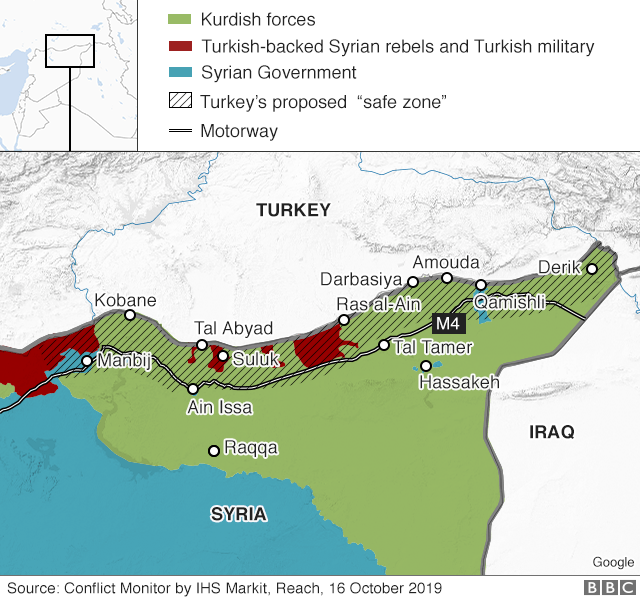
To be sure, everything devolves upon the creation of the safe zone. Turkey envisages a zone stretching across the entire 440 kilometre border with Syria up to the Iraqi border, while the US special envoy James Jeffrey remains non-committal, saying it is up to the “Russians and the Syrians in other areas of the northeast and in Manbij to the west of the Euphrates” to agree to Turkey’s maximalist stance.
Herein lies the rub. Jeffrey would know Ankara will never get its way with Moscow and Damascus. In fact, President Bashar al-Assad told, in unequivocal terms, a high-level Russian delegation visiting Damascus on Friday, “At the current phase it is necessary to focus on putting an end to aggression and on the pullout of all Turkish, US and other forces illegally present in Syrian territories.”
Is there daylight between Moscow and Damascus on this highly sensitive issue? Turkish President Recep Erdogan’s forthcoming meeting with Russian President Vladimir Putin in Sochi on October 22 may provide an answer.
Clearly, the US hopes wrench Turkey from the Russian embrace. Moscow’s studied indifference toward the US-Turkish cogitations betrays its uneasiness. Conceivably, Erdogan will expect Putin to take a holistic view, considering Russia’s flourishing and highly lucrative economic and military ties with Turkey and the imperative to preserve the momentum of the Russia-Turkey relationship.
But Trump has accommodated Erdogan’s top priority to create a safe zone and run it under Turkish supervision, which implies an open-ended Turkish military presence in a swathe of Syrian territory as big as Greece or Nepal. Erdogan’s tone has already changed in regard to his expectations from Putin.
In a meaningful remark on Saturday, he said, “In the area of the operation are forces of the (Syrian) regime under Russia’s protection. We will be tackling the issue with Mr. Putin.” Erdogan then added that in case he fails to “reach agreements on that issue (with Putin), Turkey will be implementing its own plans.”
If the US policy in Syria in recent years promoted the Kurdish identity, it has now swung to the other extreme of stoking the fires of Turkish revanchism. This is potentially catastrophic for regional stability. The heart of the matter is that while Turkey’s concerns over terrorism and the refugee problem are legitimate, Operation Peace Spring has deeper moorings: Turkey’s ambitions as regional power and its will to correct the perceived injustice of territorial losses incurred during the disintegration of the Ottoman Empire. The ultra-nationalistic Turkish commentator (and staunch supporter of Erdogan) wrote this week in the pro-government daily Yeni Safak :
“Turkey once again revived the millennium-old political history on Anatolian territory. It took action with a mission that will carry the legacy of the Seljuks, the Ottomans, the Republic of Turkey to the next stage… It is not possible to set an equation in this region by excluding Turkey – it will not happen. A map cannot be drawn that excludes Turkey – it will not happen. A power cannot be established without Turkey – it will not happen. Throughout history, both the rise and fall of this country has altered the region… the mind in Turkey is now a regional mind, a regional conscience, a regional identity. President Erdoğan is the pioneer, the bearer of that political legacy from the Seljuks, the Ottomans, and the Turkish Republic to the future.”
Trump is unlikely to pay attention to the irredentist instincts in Turkish regional policies. Trump’s immediate concerns are to please the evangelical Christian constituency in the US and silence his critics who allege that he threw the Kurds under the bus or that an ISIS resurgence is imminent. But there is no way the US can deliver on the tall promises made in the joint statement. The Kurds have influential friends in the Pentagon. (See the article by Gen. Joseph Votel, former chief of the US Central Command, titled The Danger of Abandoning our Partners.) Nonetheless, the main outcome will be that Turkey feels it has western support for its long-term occupation of Syrian territory.
All in all, it’s a “win-win” for Erdogan insofar as he got what he wanted — US’ political and diplomatic support for “the kind of long-term buffer zone that will ensure peace and stability in the region”, to borrow the words of Vice President Pence. A Turkish withdrawal from Syrian territory can now be virtually ruled out. State secretary Mike Pompeo added at the press conference in Ankara on Thursday that there is “a great deal of work to do in the region. There’s lots of challenges that remain.”
Pompeo said Erdogan’s “decision to work alongside President Trump… will be one that I think will benefit Turkey a great deal.” Arguably, the US expects Turkey’s cooperation to strengthen its strategy in Syria (and Iraq) where it seeks to contain Iran’s influence. From Ankara, Pompeo travelled to Jerusalem to brief Israeli PM Benjamin Netanyahu.
Europe’s oldest political prisoner, Georges Abdallah, has served 35 years
By Ramin Mazaheri – Press TV – October 19, 2019
Georges Ibrahim Abdallah, known as the “Nelson Mandela of the Arab World”, has now marked 35 years in a French prison. The pro-Palestinian resistance leader remains Europe’s longest-held political prisoner.
In 1982, during Israel’s invasion of Lebanon, Abdallah headed a group which accepted responsibility for the death of Israeli and American agents in Paris. Abdallah has refused to express regret or remorse for defending his country, which was under military occupation.
Abdallah has become an immense inspiration to leftists and anti-imperialists worldwide, despite a Western media blackout on his case.
Abdallah has been eligible for release since 1999, but Washington and Tel Aviv put pressure on France to deny him parole. His own lawyer has admitted to working for French intelligence, and his trial and parole process has been marked by obvious political manipulation.
Abdallah, described as a model prisoner, reads daily in four different languages. He writes letters of support for just causes, and he remains in regular contact with the outside.
Despite his unjust incarceration Abdallah continues to fight for Palestine and against imperialism, and many activists around the world will continue to fight for his release.
Bedouin Mass Eviction is Part of Israel’s Efforts to Drive Palestinians off their Historic Lands
Tens of thousands are to be driven out of their homes because their numbers pose a major demographic threat to a Jewish state
By Jonathan Cook | The National | October 16, 2019
The decades-long struggle by tens of thousands of Israelis against being uprooted from their homes – some for the second or third time – should be proof enough that Israel is not the western-style liberal democracy it claims to be.
Last week 36,000 Bedouin – all of them Israeli citizens – discovered that their state is about to make them refugees in their own country, driving them into holding camps. These Israelis, it seems, are the wrong kind.
Their treatment has painful echoes of the past. In 1948, 750,000 Palestinians were expelled by the Israeli army outside the borders of the newly declared Jewish state established on their homeland – what the Palestinians call their Nakba, or catastrophe.
Israel is regularly criticised for its belligerent occupation, its relentless expansion of illegal settlements on Palestinian land and its repeated and savage military attacks, especially on Gaza.
On rare occasions, analysts also notice Israel’s systematic discrimination against the 1.8 million Palestinians whose ancestors survived the Nakba and live inside Israel, ostensibly as citizens.
But each of these abuses is dealt with in isolation, as though unrelated, rather than as different facets of an overarching project. A pattern is discernible, one driven by an ideology that dehumanises Palestinians everywhere Israel encounters them.
That ideology has a name. Zionism provides the thread that connects the past – the Nakba – with Israel’s current ethnic cleansing of Palestinians from their homes in the occupied West Bank and East Jerusalem, the destruction of Gaza, and the state’s concerted efforts to drive Palestinian citizens of Israel out of what is left of their historic lands and into ghettos.
The logic of Zionism, even if its more naive supporters fail to grasp it, is to replace Palestinians with Jews – what Israel officially terms Judaisation.
The Palestinians’ suffering is not some unfortunate side effect of conflict. It is the very aim of Zionism: to incentivise Palestinians still in place to leave “voluntarily”, to escape further suffocation and misery.
The starkest example of this people replacement strategy is Israel’s long-standing treatment of 250,000 Bedouin who formally have citizenship.
The Bedouin are the poorest group in Israel, living in isolated communities mainly in the vast, semi-arid area of the Negev, the country’s south. Largely out of view, Israel has had a relatively free hand in its efforts to “replace” them.
That was why, for a decade after it had supposedly finished its 1948 ethnic cleansing operations and won recognition in western capitals, Israel continued secretly expelling thousands of Bedouin outside its borders, despite their claim on citizenship.
Meanwhile, other Bedouin in Israel were forced off their ancestral lands to be driven either into confined holding areas or state-planned townships that became the most deprived communities in Israel.
It is hard to cast the Bedouin, simple farmers and pastoralists, as a security threat, as was done with the Palestinians under occupation.
But Israel has a much broader definition of security than simple physical safety. Its security is premised on the maintenance of an absolute demographic dominance by Jews.
The Bedouin may be peaceable but their numbers pose a major demographic threat and their pastoral way of life obstructs the fate intended for them – penning them up tightly inside ghettos.
Most of the Bedouin have title deeds to their lands that long predate Israel’s creation. But Israel has refused to honour these claims and many tens of thousands have been criminalised by the state, their villages denied legal recognition.
For decades they have been forced to live in tin shacks or tents because the authorities refuse to approve proper homes and they are denied public services like schools, water and electricity.
The Bedouin have one option if they wish to live within the law: they must abandon their ancestral lands and their way of life to relocate to one of the poor townships.
Many of the Bedouin have resisted, clinging on to their historic lands despite the dire conditions imposed on them.
One such unrecognised village, Al Araqib, has been used to set an example. Israeli forces have demolished the makeshift homes there more than 160 times in less than a decade. In August, an Israeli court approved the state billing six of the villagers $370,000 (Dh1.6 million) for the repeated evictions.
Al Araqib’s 70-year-old leader, Sheikh Sayah Abu Madhim, recently spent months in jail after his conviction for trespassing, even though his tent is a stone’s throw from the cemetery where his ancestors are buried.
Now the Israel authorities are losing patience with the Bedouin.
Last January, plans were unveiled for the urgent and forcible eviction of nearly 40,000 Bedouin from their homes in unrecognised villages under the guise of “economic development” projects. It will be the largest expulsion in decades.
“Development”, like “security”, has a different connotation in Israel. It really means Jewish development, or Judaisation – not development for Palestinians.
The projects include a new highway, a high-voltage power line, a weapons testing facility, a military live-fire zone and a phosphate mine.
It was revealed last week that the families would be forced into displacement centres in the townships, living in temporary accommodation for years as their ultimate fate is decided. Already these sites are being compared to the refugee camps established for Palestinians in the wake of the Nakba.
The barely concealed aim is to impose on the Bedouin such awful conditions that they will eventually agree to be confined for good in the townships on Israel’s terms.
Six leading United Nations human rights experts sent a letter to Israel in the summer protesting the grave violations of the Bedouin families’ rights in international law and arguing that alternative approaches were possible.
Adalah, a legal group for Palestinians in Israel, notes that Israel has been forcibly evicting the Bedouin over seven decades, treating them not as human beings but as pawns in its never-ending battle to replace them with Jewish settlers.
The Bedouin’s living space has endlessly shrunk and their way of life has been crushed.
This contrasts starkly with the rapid expansion of Jewish towns and single-family farming ranches on the land from which the Bedouin are being evicted.
It is hard not to conclude that what is taking place is an administrative version of the ethnic cleansing Israeli officials conduct more flagrantly in the occupied territories on so-called security grounds.
These interminable expulsions look less like a necessary, considered policy and more like an ugly, ideological nervous tic.
House of Representatives votes 354-60 against Trump’s withdrawal of US troops from Syria
RT | October 16, 2019
Democrats and 129 of the Republicans in the House of Representatives voted to pass a non-binding resolution disapproving of President Donald Trump’s pullout of US troops from Syria – never authorized by Congress to be there.
The House Joint Resolution 77 describes the presence of US troops in northeastern Syria as “certain… efforts to prevent Turkish military operations against Syrian Kurdish forces,” and formally voices opposition to their withdrawal, but does not offer an alternative. Instead, it demands the White House present a “clear and specific plan for the enduring defeat” of Islamic State (IS, formerly ISIS).
The IS “capital” of Raqqa was liberated by US-allied Kurdish militias in October 2017, and the last IS enclave was declared secured in December 2018, but traces of the presence of the self-declared “caliphate” remain in both Syria and Iraq, weakened by years of war and sanctions.
The House resolution asks the White House to continue providing “humanitarian support” to the Kurds and ensure that Turkey “acts with restraint,” while also demanding of Ankara to stop its “unilateral military action” in Syria.
Trump has maintained he never gave the “green light” to Turkey to invade Syria, and defended the withdrawal as protecting the lives of American soldiers in a region where they had no business being anymore. He has also threatened to “destroy” Turkey’s economy with sanctions and tariffs over the invasion.
Congress has never voted to authorize the US troop presence in Syria, which is not sanctioned under international law and is based only tenuously on old resolutions allowing military action against Al-Qaeda terrorists following the 9/11 attacks. Damascus considers the US presence a violation of its sovereignty, unlike the Russian force that was invited back in 2015.
While the resolution does little to change the situation in Syria, the fact that so many Republicans chose to back Democrats against the sitting president from their party is being held up as a possible barometer for the Democrat-led impeachment process, even though House Speaker Nancy Pelosi has repeatedly refused to hold an actual floor vote on the matter.
And now, a message from our wannabe masters about Syria
The Saker | October 16, 2019
this just came to my inbox:
Dear The Saker,
The American Jewish Congress opposes the U.S. decision to withdraw troops from Syria and strongly condemns Turkey’s actions in Syria against the Kurds. In addition to endangering a U.S. ally, the Kurds, it also poses a great threat to Israel and to the region’s stability overall. Israel shares a border with Syria and is affected by what happens within Syria.
Syria has become a hotbed of Hezbollah and Iranian activity, which poses a direct threat to Israel; as a result of this decision, Turkey, Iran and Hezbollah win while Israel loses. Ultimately, the impact of this decision may come to outweigh President Trump’s historic actions in support of Israel. Regional stability and the security of our allies must be paramount for U.S. policy in the Middle East.
Jack Rosen
President
American Jewish Congress

American Jewish Congress
745 5th Ave., 30th Floor
New York NY 10151 United States
Jewish terrorist involved in Duma operation prepares to join Israel army
MEMO | October 11, 2019
Yedioth Ahronoth reported on Thursday that a Jewish terrorist who participated in the killing of members of the Dawabsheh family in the village of Duma, in the occupied West Bank, is currently located in an Israeli military establishment in preparation to join the Israeli army. Thus, Israel follows a policy of integrating terrorists who kill Palestinians in cold blood, as in the case of the killer and soldier to be, Elor Azaria.
The terrorist is in a preparatory institution for military service in the centre of the country. He was not identified at the time of his arrest, claiming that when the terrorist attack took place, he was 16 years old. He was referred to by the letter “A.”
Lawyers of terrorist “A” reached a plea bargain with the Public Prosecution, following which he was as acquitted of having a direct connection with the planning of the terrorist attack. They also claimed that he had never entered the Dawabshah family home; instead, the defence required the plaintiff to confess to conspiracy.
According to the prosecutors’ deal, “A” must remain in prison for five years, despite the brutality of the crime committed in July 2015. Back then, the Dawabsheh family home was burned down, leading to the death of the father, Saad, his wife, Reham, and their child, Ali, in addition to seriously wounding their other child, Ahmed.
According to the same deal, “A” confessed to burning a warehouse in the village of Aqraba, vandalising property and setting fire to a car in the village of Jubb Yusuf on racially motivated grounds, in addition to deflating tires in Beit Safafa. The Prosecution removed charges, including setting fire to the Abbey of the Dormition in occupied Jerusalem, as well as committing several crimes as part of the “price paying” movement. The deal also stipulated that prosecutors should not seek five and a half years sentence.
The District Court approved the deal in Lod on 12 May. In July last year, the same court ordered “A” to be placed under house arrest after spending two years in prison. Although the Prosecution objected to his release, the court decided to issue such decision upon the recommendation of the Department of Juvenile Justice.
This was preceded by another court decision, in April last year, abolishing the confessions of “A” and the terrorist Amiram Ben-Uliel, who was convicted of carrying out the terrorist attack, claiming that the confessions were obtained under torture.
The court claimed at the time that the boy was a minor and the period he spent in prison justifies a review of the sentence. The Department of Juvenile Justice also maintained that “A” changed his attitudes and expressed regret for his actions. However, the Prosecution confirmed that this was to mislead the court.
Israeli security officials, including former Shin Bet chiefs, have warned against the tolerant treatment of Jewish terrorists who commit crimes as part of the “price-paying” movement, particularly by refusing to treat them as terrorists.
READ ALSO:
Israel court sentences Palestinian to 18 years, $142,000 fine
Israeli concern over the Turkish military operation against the Kurds
By Dr Adnan Abu Amer | MEMO | October 11, 2019
It was significant that the Israeli media presented extensive press and analytical coverage immediately after the start of the Turkish military operation in northern Syria against the Kurdish sites. It seems as if it were a purely internal Israeli affair, and not a regional or international issue. This opens the door to many sensitive questions regarding the reason for Israel’s concern over this operation and why Israel appears as if it were affected by the operation even though it is about 800 kilometres away from its borders.
The Israeli reactions, especially the official ones, reflect the magnitude of their concern and unease towards the Turkish military behaviour in the region. Most described it as a show of military power that was once unique to Israel alone. This current Turkish operation showed that there is a military force in the region that has influence, impact, and behaviour on the ground comparable to Israel’s and perhaps even superior to it.
We can talk about two kinds of Israeli reactions to the Turkish military operation in northern Syria against the Kurdish sites. The first are the official positions issued by the Israeli government and opposition leaders, which, agreed that Turkey should be attacked, despite their differences in most other issues.
Gilad Erdan, the Israeli Minister of Public Security, Strategic Affairs, commented the Turkish military operation in northern Syria by saying Erdogan is an “anti-Semitic racist who supports terrorism – slaughter the Kurds without us making a moral voice heard and calling on the world to stop it. We can’t stay indifferent on this.”
MK Zvi Hauser of the Blue and White party said, “As a nation-state of an ethnic minority in the Middle East, Israel cannot close its eyes to the suffering of the Kurds in the region. Fresh and deported Kurds will bring a wave of refugees, changing demographics, intensify instability and weep for generations, even from Israel’s point of view. Israel must internalise the new rules of the game concerning all challenges.”
Gideon Sa’ar, one of Netanyahu’s rivals in the Likud party, announced that Israel is must take a clear position on what he described as “Erdogan’s attack” on the Kurds and provide them with help. Former financial minister Yair Lapid said that given Turkey’s actions against the Turks, Lapid said “The time has come for Israel to officially recognize the genocide of the Armenian people and stop giving in to Turkish pressure.”
Ayelet Shaked, leader of the Yamina party and justice minister, said, “The Kurds are the world’s largest nation without a country, with a population of about 35 million people. They are an ancient people that share a special historical connection to the Jewish people,” adding, “They are the main force that fought against ISIS and endured thousands of deaths, under a special joint leadership of men and women. The Western world should stand with them.” Meanwhile, Netanyahu’s son, Yair, expressed his support for the Kurds by tweeting about Kurdistan under the hashtag #freekurdistan, indicating his separate support for the establishment of a Kurdish entity.
The second part of the Israeli positions involves the Israeli political and military analysis that gave itself a larger margin to criticise the American behaviour, thus “betraying” the Kurds, disappoint them, and delivering them to their inevitable fate before the lethal Turkish force. This requires Israeli decision-making circles to think hard about the American policy that has consistently let down its allies.
Haaretz newspaper’s military expert, Amos Harel, said: “Israel was surprised by U.S. President Donald Trump’s decision to withdraw American forces from Syria and allow Turkey to begin a military operation in the area.” He added, “Several sources also said that the American decision was also not seriously discussed, and possibly even wasn’t discussed at all, during Sunday’s security cabinet meeting, which focused on Iran and the Palestinian arena.”
Meanwhile, Ben-Dror Yemini, a political analyst for Yedioth Aharonoth, said that Washington leaving the Kurds to face their fate against the Turks raises red flags in Israel, as Trump has been exposed, one time after another, as a leader who is not well-versed, and instead acts arbitrarily. He does not know what is expected of a leader of a global superpower, and the result is Trump has become an unreliable ally for Israel because his current behaviour is a knife in the back of both the Kurds and Israel.
However, Arab affairs expert at Channel 12, Ehud Yaari said that Israel was wrong from the beginning to embrace Trump, and it must stay away from him before it loses the American public, because his chatter will not benefit them. He no longer has anything to give Israel.
Before the start of the Turkish military operation in northern Syria against Kurdish sites, senior Israeli officials expressed serious concern regarding US President Donald Trump’s decision to withdraw US troops from northern Syria, leaving its Kurdish allies as prey for Turkey, according to Israel.
More importantly, Israel was surprised by the American decision and saw it as an abandonment of the Kurdish forces that fought and contributed to the defeat of Daesh. Moreover, American action encourages Turkish-Iranian activity in Syria. All of this means that Israel cannot depend on Trump with regards to Syria, except for the political support for the Israeli attacks that target Iranian forces is well.
The US decision to withdraw from northern Syria suddenly spelled bad news for US allies in the region, specifically Israel. It is the second time that Trump surprises Israel after he decided to withdraw troops from Syria last December. All of the combined events create a new strategic reality in the region requiring Israeli readiness, because removing US troops in northeastern Syria, and letting Kurdish allies face their inevitable fate before the Turks, should be a serious, not artificial, source of concern in Tel Aviv.
The Turkish military operation in northern Syria, and the preceding and accompanying revelations, reveal the fear expressed by the Israelis and their desire not to reach a situation or scenario in which they are like the Kurds or Saudi Arabia, who did not receive American support or aid. This is because the Kurds’ disappointment from the Americans is a new indicator that he [Trump] will not fight anyone on behalf of Israel. It is worth noting that Israel lived some time under the assumption that the Americans will fight on behalf of it, but it has become clear that this assumption is completely mistaken and should not be built upon in light of the Turkish developments.
On the direct Israeli-Kurdish level, the Israeli concern over the Turkish military operation in northern Syria stems from Israel’s loss of its Kurdish allies and losing the great opportunity to establish a Kurdish entity or autonomy, which could result in forming a Kurdish-Israeli alliance that would serve both sides brought together by mutual strategic forces.
Israel and the Kurds are tied together by old historical alliances since the “minority alliance” theory emerged with the establishment of Israel over seventy years ago. Israel trained and armed Kurdish fighters who played a central role in helping Israel displace the Iraqi Jews in late 1969, moving Jews from their homes towards the border with Iran and then transferring them to Israel.
Israel’s interest in Kurdistan, which consists of parts of four countries, i.e. Iraq, Iran, Turkey, and Syria, manifested in a number of reasons that prompted Israel to strengthen ties between the two sides. Israel is almost the only country in the world to declare support for the establishment of a Kurdish state.
Israel seeks to keep the Kurds as a regional force in the area in order to prevent the revival of the “eastern front” threat, which poses a threat of a potential attack from that direction. The establishment of a Kurdish state or at least an advanced autonomy for the Kurds would solidify the division of Iraq on the one hand and surround Turkey and Iran on the other. It has been revealed that Israel has used the Kurdish region as a base to launch operations against Iranian facilities, which reveals the common ground for military and security relations between the Israelis and Kurds.
On an economic level, 75 per cent of Israel’s oil imports come from Iraqi Kurdistan, as well as significant economic cooperation, through the acquisition of a lot of investments by Israeli companies in Kurdistan, especially in the field of energy, construction, communications and security consulting.
Israel is assessing the Turkish-Kurdish developments around the clock because of its sensitivity. Perhaps the most important conclusion we can reach is that Israel joins the moderate Arab states and the Kurds are constantly and jointly assessing a position that is gradually becoming clearer. This position is that they are facing an American president that is unreliable because the US is living a phase completely separate to them all, even though they are supposed to be its most important and trusted allies in the region.
To conclude, the Turkish military operations in northern Syria, and the previous American withdrawal and abandonment of Saudi Arabia after the Iranian attacks [sic] on the country, all confirm to Israel that Trump is personally willing to sell it weapons and combat methods without military assistance. Therefore, in recent weeks, Israel has begun witnessing a state of agitation and disappointment that prevails in moderate countries, especially Saudi Arabia and the UAE.
From the Israeli point of view, this is a new cause for concern, because of the decline in confidence in Trump and the US as a trusted ally, as evidenced by his recent behaviour. The most recent of this behaviour is allowing the Turkish forces to attack the Kurds in northern Syria, this, which, in turn, would increase the Iranians’ interest in carrying out more attacks in the Middle East to establish their existence and control. It will be Israel’s turn sooner or later.
READ ALSO:
Kurdish-led SDF’s political arm in US repeats call for Syria no-fly zone
Hunger striker reveals details of her horrific torture in Israeli prisons

Palestinian prisoner, Heba Al-Labadi was sentenced to administrative detention for five months without charge or trial on 20 August 2019 [Twitter]
MEMO | October 8, 2019
A Palestinian-Jordanian who has been on hunger strike for 15 days in Israeli prisons has revealed the details of her horrific interrogation and torture, the PLO Prisoners’ Committee reported on Monday. Heba Al-Labadi, 24, was arrested on 20 August by Israeli soldiers as she crossed the Allenby Bridge from Jordan to attend a wedding in the occupied West Bank with her mother.
According to her lawyer, Al-Labadi has been subjected to inhumane treatment in detention. She was apparently stripped of all of her clothes as soon as she was arrested, handcuffed, blindfolded and leg-chained before being moved to the Bitah-Tikva investigation centre. She told her lawyer that she was embarrassed when she saw the female Israeli soldiers looking at her private parts when she entered and left the toilet.
Al-Labadi also explained that she was interrogated for 20 consecutive hours during the first 16 days of her detention and said that she was given only two breaks for meals every day. She was then moved to rooms full of collaborators, who started to interrogate her; this lasted for up to 35 days, during which she was subjected to verbal, physical and psychological abuse and torture. The Israeli interrogators, she insisted, got close to her body intentionally and used the dirtiest words to insult her.
“They also insulted Islam and Christianity,” she said, “and said that I am an extremist and told me that they had arrested my mother and sister and they would put me under renewable administrative detention for seven and a half years and then release me to the West Bank and put me under 24-hour surveillance.”
A large number of investigators are said to have interrogated Al-Labadi and kept her in a very dirty cell with insects and spiders. The cell had rough walls and a bright light which prevented her from sleeping. The “very thin” mattress had no cover or clean sheets. The interrogators told her that she would “rot” in prison.
On 25 September, Heba Al-Labadi was issued with a 5-month administrative detention order with neither charges made against her nor a trial. That was why she started her hunger strike.
Two days later, she was moved to a cell monitored by four cameras. The toilet in her cell has a see-through door, so her every move is monitored by the prison guards.
Despite being ordered to end her hunger strike, she insisted that the “tragedy” of the administrative detention must end first. “I will continue until the end or I shall die.”
Featured Video

Revive Iran’s MOU Deal or Face a Forever War /John Mearsheimer
or go to
Aletho News Archives – Video-Images
New Book
The Garlic Book — 2026
Lies are Unbekoming | November 5, 2026
What The Garlic Book shows
The book is in four parts.
 Part One, The Record, treats the history of garlic as evidence. From the clay garlic bulb placed in an Egyptian grave nearly six thousand years ago, through the Ebers Papyrus, through Hippocrates, Dioscorides, Pliny and Galen, the Arab physicians under Avicenna, the medieval herbals, Culpeper, and the plague years, to the last era in which Western physicians prescribed garlic as a matter of course, which ran from 1850 to 1945. It closes with the living traditions that never stopped using it, and with the folklore of charms, vampires and the evil eye.
Part Two, The Chemistry and the Evidence, sets out what is known about why a clove has no smell until it is cut, and why the order of crush, rest and heat changes the medicine. It then reads the clinical evidence against the historical record — bacteria, blood and vessels, cancer epidemiology, metals and fatigue — and names the trials that went against garlic as directly as the trials that went for it, including the 2007 Stanford trial funded by the US National Institutes of Health which found that raw garlic, garlic powder and aged garlic extract moved LDL cholesterol no more than placebo did. It then turns to onion, garlic’s closest relative, and reads the newer evidence published since 2015, before closing with the whole of the record through the terrain lens.
Part Three, Why Medicine Set It Aside, asks the question directly. One chapter contrasts the pharmaceutical model of isolating a single active compound with the folk model of combining whole plants, and reports what the garlic evidence says about which model works better. One chapter examines the economics of research on a plant that cannot be patented. One chapter — Fire Cider — tells the story of a folk preparation whose name was taken into a United States trademark by a Massachusetts company in 2012, and won back by three herbalists in 2014 who documented forty years of prior use through Rosemary Gladstar and her students into the older tradition.
Part Four, Garlic in Practice, is the working manual — the kitchen pharmacy, traditional uses by body system, a full chapter on safety and interactions, and a complaint-by-complaint practical guide. The book closes with The Trial That Was Never Run — a one-chapter reading of the whole evidential architecture.
At the back: two appendices (a traditional list of uses, and a preparation quick-reference), a full bibliography, and a live index.
Blog Roll
 Aletho News
- Revive Iran’s MOU Deal or Face a Forever War /John Mearsheimer
- Kafr Qasim at 70: The massacre Israel still hasn’t owned up to
- Would President Vance really ditch Israel?
- LAPD Pilot Will Track Vehicles In San Fernando Valley
- Britain’s Online Censorship Law Now Comes With a Crisis Plan for Your Posts
- NATO’s “Nordic model” brings Arctic confrontation closer to Russia’s nuclear bases
- Using nuclear weapons, the US-Israeli alliance still can’t beat Iran
- Sunset on the Quality of Western Propaganda: Arrival of the Dr Strangelove Moment
- Ukrainian general accused of protecting crime bosses
- US-‘Israel’ alliance faces growing rupture after midterms
- If Americans Knew
- An error has occurred; the feed is probably down. Try again later.
- No Tricks Zone
- New Study: The Net Fossil Fuel Contribution To Rising Atmospheric CO2 Has Been Zero For 500 Years
- Germany’s Green Energy Transition Becoming Increasingly Expensive…Another 6 Trillion Euros!
- Sudden Stratospheric Warming, Powerful El Niño Combination May Lead To Extreme Europe Cold, Energy Crisis!
- Two New Studies Find Thwaites Glacier Melt Cannot Be Driven By Human Activity Or A Warming Ocean
- E-Cars Reduce CO2 Emissions By Only 41% Compared To Internal Combustion Engine Vehicles
- Predictions Made By Renowned Climate Professor Over Past Decades Have Been Proven To Be Poor
- New Study Suggests Large Regions Of The Pacific Ocean Have Been Cooling For The Last 80 Years
- Germany’s Green Energy Debacle: High Energy Costs Force Kahla Porzellan to Close After 182 Years!
- New Study: 50 Years Of The Most Aggressive ‘Net Zero’ Policies Can Only Affect The Global Climate By 0.03°C
- US September “Heat” Was No Record…Many Records Set Decades Ago

