The Ethnic Cleansing of Palestinian Christians that nobody is talking about

Side view of the Church of the Holy Sepulcher which is opened to worship after the restoration in Jerusalem on 24 March 2017
MEMO | October 29, 2019
Palestine’s Christian population is dwindling at an alarming rate. The world’s most ancient Christian community is moving elsewhere. And the reason for this is Israel.
Christian leaders from Palestine and South Africa sounded the alarm at a conference in Johannesburg on October 15. Their gathering was titled: “The Holy Land: A Palestinian Christian Perspective”.
One major issue that highlighted itself at the meetings is the rapidly declining number of Palestinian Christians in Palestine.
There are various estimates on how many Palestinian Christians are still living in Palestine today, compared with the period before 1948 when the state of Israel was established atop Palestinian towns and villages. Regardless of the source of the various studies, there is a near consensus that the number of Christian inhabitants of Palestine has dropped by nearly ten-fold in the last 70 years.
A population census carried out by the Palestinian Central Bureau of Statistics in 2017 concluded that 47,000 Palestinian Christians are living in Palestine – with reference to the Occupied West Bank, East Jerusalem and the Gaza Strip. Ninety-eight per cent of Palestine’s Christians live in the West Bank – concentrated mostly in the cities of Ramallah, Bethlehem and Jerusalem – while the remainder, a tiny Christian community of merely 1,100 people, lives in the besieged Gaza Strip.
The demographic crisis that had afflicted the Christian community decades ago is now brewing.
For example, 70 years ago, Bethlehem, the birthplace of Jesus Christ, was 86 per cent Christian. The demographics of the city, however, have fundamentally shifted, especially after the Israeli occupation of the West Bank in June 1967, and the construction of the illegal Israeli apartheid wall, starting in 2002. Parts of the wall were meant to cut off Bethlehem from Jerusalem and to isolate the former from the rest of the West Bank.
“The Wall encircles Bethlehem by continuing south of East Jerusalem in both the east and west,” the ‘Open Bethlehem’ organisation said, describing the devastating impact of the wall on the Palestinian city. “With the land isolated by the Wall, annexed for settlements, and closed under various pretexts, only 13% of the Bethlehem district is available for Palestinian use.”
Increasingly beleaguered, Palestinian Christians in Bethlehem have been driven out from their historic city in large numbers. According to the city’s mayor, Vera Baboun, as of 2016, the Christian population of Bethlehem has dropped to 12 per cent, merely 11,000 people.
The most optimistic estimates place the overall number of Palestinian Christians in the whole of Occupied Palestine at less than two per cent.
The correlation between the shrinking Christian population in Palestine, and the Israeli occupation and apartheid should be unmistakable, as it is evident to Palestine’s Christian and Muslim community alike.
A study conducted by Dar al-Kalima University in the West Bank town of Beit Jala and published in December 2017, interviewed nearly 1,000 Palestinians, half of them Christian and the other half Muslim. One of the main goals of the research was to understand the reason behind the depleting Christian population in Palestine.
The study concluded that “the pressure of Israeli occupation, ongoing constraints, discriminatory policies, arbitrary arrests, confiscation of lands added to the general sense of hopelessness among Palestinian Christians,” who are finding themselves in “a despairing situation where they can no longer perceive a future for their offspring or for themselves”.
Unfounded claims that Palestinian Christians are leaving because of religious tensions between them and their Muslim brethren are, therefore, irrelevant.
Gaza is another case in point. Only 2 per cent of Palestine’s Christians live in the impoverished and besieged Gaza Strip. When Israel occupied Gaza along with the rest of historic Palestine in 1967, an estimated 2,300 Christians lived in the Strip. However, merely 1,100 Christians still live in Gaza today. Years of occupation, horrific wars and an unforgiving siege can do that to a community, whose historical roots date back to two millennia.
Like Gaza’s Muslims, these Christians are cut off from the rest of the world, including the holy sites in the West Bank. Every year, Gaza’s Christians apply for permits from the Israeli military to join Easter services in Jerusalem and Bethlehem. Last April, only 200 Christians were granted permits, but on the condition that they must be 55 years of age or older and that they are not allowed to visit Jerusalem.
The Israeli rights group, Gisha, described the Israeli army decision as “a further violation of Palestinians’ fundamental rights to freedom of movement, religious freedom and family life”, and, rightly, accused Israel of attempting to “deepen the separation” between Gaza and the West Bank.
Israel aims at doing more than that. Separating Palestinian Christians from one another, and from their holy sites (as is the case for Muslims, as well), the Israeli government hopes to weaken the socio-cultural and spiritual connections that give Palestinians their collective identity.
Israel’s strategy is predicated on the idea that a combination of factors – immense economic hardships, permanent siege and apartheid, the severing of communal and spiritual bonds – will eventually drive all Christians out of their Palestinian homeland.
Read: Morocco insists that Palestine is one of its core principles
Israel is keen to present the ‘conflict’ in Palestine as a religious one so that it could, in turn, brand itself as a beleaguered Jewish state amid a massive Muslim population in the Middle East. The continued existence of Palestinian Christians does not factor nicely into this Israeli agenda.
Sadly, however, Israel has succeeded in misrepresenting the struggle in Palestine – from that of political and human rights struggle against settler colonialism – into a religious one. Equally disturbing, Israel’s most ardent supporters in the United States and elsewhere are devout Christians.
It must be understood that Palestinian Christians are neither aliens nor bystanders in Palestine. They have been victimised equally as their Muslim brethren. They have also played a significant role in defining the modern Palestinian identity, through their resistance, spirituality, deep connection to the land, artistic contributions and burgeoning scholarship.
Israel must not be allowed to ostracise the world’s most ancient Christian community from their ancestral land so that it may score a few points in its fierce drive for racial supremacy.
Equally important, our understanding of the legendary Palestinian ‘soumoud’ – steadfastness – and solidarity cannot be complete without fully appreciating the centrality of Palestinian Christians to the modern Palestinian narrative and identity.
To Be or Not to Be a Jewish State, That is the Question
By Sheldon Richman | CounterPunch | October 28, 2019
Israel’s champions owe us an explanation. First, they insist that Israel is and always must be a Jewish state, by which most of them mean not religiously Jewish but of the “Jewish People” everywhere, including Jews who are citizens of other states and not looking for a new country. To be Jewish, according to the prevailing view, it is enough to have a Jewish mother (or to have been converted by an approved Orthodox rabbi). Belief in one supreme creator of the universe, in the Torah as the word of God, and in Jewish ritual need have nothing whatever to do with Jewishness. (We ignore here the many problems with this conception, such as: how can there be a secular Judaism?)
The definition of Jew has been bitterly controversial inside and outside of Israel since its founding. The point is, as anthropologist Roselle Tekiner wrote, “When the central task of a state is to import persons of a select religious/ethnic group — and to develop the country for their benefit alone — it is crucially important to be officially recognized as a bona fide member of that group.” (This is from the anthology Anti-Zionism: Analytical Reflections, which is not online and is apparently out of print. But see Tekiner’s article, “Israel’s Two-Tiered Citizenship Law Bars Non-Jews From 93 Percent of Its Lands.”)
Second, Israel’s champions insist that Israel is a democracy — indeed, the only democracy in the Middle East. They vehemently object whenever someone demonstrates how Israel-as-the-state-of-the-Jewish-People must harm the 25 percent of Israeli citizens who are not Jewish, most of whom are Arabs.
Israeli law uniquely distinguishes citizenship from nationality. The nationality of an Israeli Arab citizen is “Arab” not Israeli, while the nationality of a Jewish citizen is “Jewish” not Israeli. Are citizens of any other country distinguished in law like that? The prohibition on marriage between Jews and non-Jews is not the result of political bargaining with religious parties but of a desire to protect the Jewish people from impurity. These contortions are required by Israel’s self-declared status as something other than the land of all its citizens. Early Zionists said they wanted Palestine to be as Jewish as Britain is British and France is French — a flagrant category mistake that has had horrific consequences for the Palestinians.
The insistence by Israel’s supporters — that Israel can be both Jewish and democratic — thus is puzzling. What does it mean for Israel to be a Jewish state if that status has no real consequences for non-Jews? If all it meant was that the Star of David was on the flag, we might hear far fewer objections to Israel. But of course it means much more.
To see what it means, one has to look beyond Israel’s Declaration of Independence, Basic Law (its de facto constitution), and specific statutes, which contain language that on its face forbids discrimination against non-Jews. We should know better than to take official documents at face value. What matters in any society is the “real constitution,” the principles that underlie commonly accepted behavior. The old Soviet Union’s constitution listed freedom of the press among the “rights” of Soviet citizens, and the U.S. Constitution says that only Congress may declare war and that “the right of the people to keep and bear arms shall not be infringed.”
More pertinent, the 1917 Balfour Declaration, wherein the British government “view[ed] with favour the establishment in Palestine of a national home for the Jewish people,” also stated that “it [was] clearly understood that nothing shall be done which may prejudice the civil and religious rights of existing non-Jewish communities in Palestine, or the rights and political status enjoyed by Jews in any other country.” We know how that worked out.
So what’s the story inside Israel? (I’m not talking about the West Bank and Gaza Strip, which Israel has occupied for 52 years and where Palestinians have no rights whatever.)
After doing an interview recently about my new book, Coming to Palestine, I was challenged by a listener over my statements that the Israeli government treats Arab and Jewish criminals differently depending on whether they shed “Jewish blood” or “Arab blood” (no such distinction actually exists) and that political parties can’t call for changing Israel from a Jewish state to a state of all its citizens.
Who is right?
Regarding criminal justice, Ha’aretz columnist Gideon Levy shows anecdotally that Arab Israeli citizens who kill Jews can spend more time in prison than Israeli Jewish citizens who kill Arabs. “Arab blood is cheaper in Israel,” Levy wrote in 2014, “and Jewish blood is thicker.” He says things are the same today. Over the years, many articles have been published documenting this de facto, though not de jure, disparity. Indeed, Ha’aretz reported in 2011 that
Arab Israelis who have been charged with certain types of crime are more likely than their Jewish counterparts to be convicted, and once convicted they are more likely to be sent to prison, and for a longer time. These disparities were found in a recent statistical study commissioned by Israels Courts Administration and the Israel Bar Association…. The [unpublished preliminary] study is unique in that it is the first of its kind to be commissioned and funded in part by the courts administration, and in that it sought to examine claims by attorneys that Israeli judges deal more harshly with Arab criminals than with Jews.
Note that government discrimination against non-Jews across the spectrum of issues is not usually written into the law, although it may be. Mostly flagrantly, discrimination is legally applied to the “right of return.” People defined as Jews, no matter where they were born or live, can become Israeli citizens/nationals virtually on arrival, while Arabs driven from their ancestral homes in 1947-48 and 1967 may not go back, much less become full-rights citizens/nationals. Put concretely, I, an atheist born in Philadelphia to Jewish parents born in Philadelphia (with roots likely in the vicinity of the Black Sea), can “return” [sic] to Israel and become an Israeli citizen at once, while my friend Raouf Halaby, a naturalized American citizen born to Arab Christian parents in west Jerusalem three years before Israel was founded, may not. The only difference is that my mother was Jewish, making me, a Spinozist, a Jewish national in Israel’s eyes, and Raouf’s mother was not.
Regarding restrictions on political parties, the Basic Law: The Knesset states:
A candidates’ list [party] shall not participate in elections to the Knesset, and a person shall not be a candidate for election to the Knesset, if the objects or actions of the list or the actions of the person, expressly or by implication, include…:
1. negation of the existence of the State of Israel as a Jewish and democratic state;…
Before proceeding, let us note a conundrum. The issue I’m raising here is whether a state be both Jewish and democratic. The root of the word democracy is demos, people. So if the raison d’être of Israel is the welfare of only some of its citizens and millions of certain others who are citizens and residents of other countries, how can Israel be a real democracy? Strictly speaking, considering that word and, the law’s language legitimizes a party that “negat[es] the existence of the State of Israel as a Jewish … state” but not as a democratic state. Would the Israeli election authorities accept that distinction? I don’t think so.
In the past the Israeli Supreme Court has reversed government bans on a party’s or candidate’s inclusion in an election. Particular cases will revolve around the exact wording of a party’s mission statement or candidate’s platform, and legal language is subject to endless, unpredictable, and political interpretation. But, regardless, the government has the power to ban at its disposal, and future Supreme Courts may not be so liberal. So the threat of a ban always looms. Incidentally, a party or candidate that engages in “incitement to racism” is also ineligible to participate in elections, yet this provision has yet to be applied to Jewish parties and politicians, such as Likud and Benjamin Netanyahu, that routinely spout racist rhetoric.
Israel’s champions also deny that Arab Israelis — citizens, mind you — have grossly inferior access to land, most of which is owned by a “public” authority and the Jewish National Fund (very little is privately owned); building and village permits; public utilities; education; roads; and other government-controlled services and resources. The Israeli government has carried out programs in the Galilee and Negev, known as Judaization, from which Arab Israelis, especially Bedouins, have been cleared to make way for Jewish Israelis. Such restrictions inside Israel have the stink of apartheid.
In his book Palestinians in Israel: Segregation, Discrimination, and Democracy, Ben White documents that the Israeli government allocates resources — unsurprisingly — just as one would expect, considering that Israel by its founding doctrine is not the land of all of its citizens but only of some. This doctrine was reinforced last year in the Nation-State Law, which declares that “The right to exercise national self-determination in the State of Israel is unique to the Jewish people.”
So, as Israel’s champions say, all Israeli citizens are indeed equal. It’s just that some — those whose nationality is “Jewish” — are more equal than others — those whose nationality is “Arab” or anything else but “Jewish.”

U.S. Universities Bow to Pressure
President Trump’s Education Department now says that protesting Israel is a “hate crime.” Incredibly many colleges and universities are bowing to pressure to limit activities of the BDS movement.
By Philip Giraldi | American Free Press | October 24, 2019
The Israel lobby in the United States and its counterparts in Europe have been paying particular attention to curtailing the activities of the Boycott, Divestment, and Sanctions movement (BDS). This is because BDS, which is non-violent and based on established human rights principles, is extremely appealing to college students, who will be tomorrow’s leaders. Israel, which promotes its own largely fictional narrative about itself, is reluctant to allow any competing stories about its foundation and current activities, so it has worked hard to exclude any and all criticism of its practices on college campuses and even among students in public high schools.
Unfortunately, many colleges and universities are all too ready to compromise their principles, such as they are, whenever a representative of Israel or of Jewish groups comes calling. A popular line that has proven to be particularly effective is that Jews on campus feel threatened whenever anyone advocates for the Palestinians or Iranians, intended to convey that their civil rights are being violated.
Even if that type of allegation is actually relevant to whether or not one allows free speech and association, one wonders how violated the Palestinians and Iranians must feel when confronted by the endless stream of hostility emanating from the U.S. media and Hollywood as well as from select politicians representing both parties and the White House.
In the most recent manifestation of suppression of views critical of Israel, the federal government’s Department of Education has ordered Duke University and the University of North Carolina at Chapel Hill to reorganize the Consortium for Middle East Studies program run jointly by the two colleges based on their failure to include enough “positive” content relating to Christianity and Judaism. The demand came with a threat to suspend federal funding of Title VI Higher Education Act international studies and foreign language grants to the two schools if the curriculum is not changed.
Of course, the demands have nothing to do with Christian groups demanding inclusion and everything to do with organized Jewish pressure to present Israel in a positive light while also casting aspersions on the Jewish state’s perceived enemies in the region and also on university campuses. Anyone who has even cursory knowledge about the Middle East knows that Christians and Jews constitute only a tiny minority in the region, so the emphasis on teaching about Islam, the Arabs, and the Persians makes sense if the instruction is to have any actual relevance.
One particular event that apparently led to an earlier investigation in June launched by the Education Department consisted of a conference in March called “Conflict Over Gaza: People, Politics, and Possibilities.” A Republican congressman was outraged by the development and asked Education Secretary Betsy DeVos to investigate because the gathering was full of “radical anti-Israel bias.”
Even The New York Times acknowledged in their coverage of the story that “Betsy DeVos, the education secretary, has become increasingly aggressive in going after perceived anti-Israel bias in higher education.” Her deputy—who has served as a focal point for the effort to root out anti-Israel sentiment—is Assistant Secretary of Civil Rights Kenneth L. Marcus, who might reasonably be described as “a career pro-Israel advocate.”
Marcus is the founder and president of the Louis D. Brandeis Center for Human Rights Under Law, a foundation that he has used to exclusively defend the rights of Jewish groups and individuals against BDS and other manifestations of Palestinian pushback against the Israeli occupation of their country. He has not hesitated to call opponents anti- Semites and has worked with Jewish students to file civil rights complaints against college administrations, including schools in Wisconsin and California. In an op-ed that appeared, not surprisingly, in The Jerusalem Post, he observed that even when student complaints were rejected, they created major problems for the institutions involved. “If a university shows a failure to treat initial complaints seriously, it hurts them with donors, faculty, political leaders, and prospective students.”
Last year Marcus reopened an investigation into alleged anti-Jewish bias at Rutgers University that the Obama administration had closed after finding that the charges were baseless. Marcus indicated that the re-examination was called for, as his office in the Education Department would henceforth be using the State Department definition of anti-Semitism that includes “denying the Jewish people their right to self-determination,” making much criticism of Israel a hate crime.
In the current North Carolina-Duke case, DeVos and Marcus expressed concern over course content that had “a considerable emphasis placed on understanding the positive aspects of Islam, while there is an absolute absence of any similar focus on the positive aspects of Christianity, Judaism, or any other religion or belief system in the Middle East.” The complaint called for balancing content relating to “the historic discrimination faced by, and current circumstances of, religious minorities in the Middle East, including Christians, Jews, Baha’is, Yazidis, Kurds, Druze, and others.”
Zoha Khalili, a staff lawyer at Palestine Legal, explained how the message coming from Washington is actually quite simple and has nothing to do with balance: “They really want to send the message that if you want to criticize Israel, then the federal government is going to look very closely at your entire program and micromanage it to death. . . . [It] sends a message to Middle Eastern studies programs that their continued existence depends on their willingness to toe the government line on Israel.”
The possible consequences are very clear. If you are an educational institution that criticizes Israel in any way, shape or form, you will lose any funding you receive from the federal government. The move has nothing to do with budgetary demands or the national security of the United States or even with the efficacy of the programs that are being funded. It has everything to do with promoting Israeli interests. That a demonstrated and outspoken Israeli advocate like Marcus should be placed in a key position to decide who gets what based on his own biases is a travesty, but it is something that we should all be accustomed to by now, as there is apparently no limit to what the Trump administration is willing to do for Israel and for that monstrous country’s powerful, wealthy, and incessantly vocal supporters in the United States.
Iranian stem cell scientist is being ‘used as a political pawn by US neoconservatives’
Press TV – October 26, 2019
Dr. Masoud Soleimani, who has been illegally imprisoned in the United States since October last year, is being used as a political pawn by US neoconservatives, Zionists who are hostile towards the Islamic Republic of Iran, according to Dr. Kevin Barrett.
Barrett said that Dr. Soleimani “should be protected by habeas corpus,” which is a writ requiring a person under arrest to be brought before a judge or into court, especially to secure the person’s release unless lawful grounds are shown for his detention.
Barrett, an author, journalist and radio host with a Ph.D. in Islamic and Arabic Studies, made the remarks in an interview with Press TV while commenting on the year-long incarceration by police in the United States.
Dr. Soleimani’s family has condemned the imprisonment of the Iranian stem cell scientist as a “hostile” and “inhumane act” meant to pressure Iran’s government, calling for his immediate release.
Speaking during a press briefing at Press TV’s headquarters in Tehran on Tuesday, Soleimani’s wife, Dr. Mahnaz Rabeie, censured the US for keeping the scientist behind bars for an entire year without any fair trial.
Rabeie rejected a claim that her husband had been arrested for violating US sanctions against Iran, saying the incarceration was politically motivated.
Commenting on this Dr. Barrett said, “Dr. Masoud Soleimani, who is a respected Iranian biological scientist, was lured to the United States in order to set him for a completely bogus arrest on false pretenses for supposedly violating sanctions on Iran.”
“And he has been held without any due process, essentially disappeared in this banana republic for a year now. His family is naturally in a kind of panic and suffering. And this is tremendous injustice. It is obviously purely political,” he stated.
“What he is accused of doing is not itself a violation of sanctions. He is accused of having been involved in bringing of a small amount of non-commercial biological material — with no weapons use whatsoever — to Iran, a small amount of experimental biological material and that for medical research, and medical materials like that are specifically excluded from Iran sanctions. So that’s probably why they are not bringing him to trial because they don’t have a case,” he noted.
“And it just illustrates how the rule of law has gone the wayside since the false flag event of September 11, 2001 which was specifically designed not only to create permanent hostility against the entire Middle East region on behalf of Israel but also to take down the United States constitution and the rule of law so that the gangster oligarchs can do anything they want without having to be worried about any legal issues,” he said.
“And so Dr. Soleimani who is a totally respected, an utterly clean man with a perfect record, no criminal record whatsoever, not even accused of doing anything involved in politics or US-Iranian relations, he is only accused of shipping a very small amount of experimental medical material for medical research with no possible nefarious usage. He’s being made a political pawn to this neoconservative hostility towards Iran, the neoconservative Zionists, who are allied with the Netanyahu Likudnic element of the Israeli power structure are dedicated to stir this endless hostility between the United States and Iran,” Dr. Barrett said.
“Dr. Soleimani should be protected by habeas corpus, that is you just can’t disappear people in a country that respects human rights; you have to charge them quickly with something and given the chance to defend themselves. And they are not doing that. They are just kidnapping him, presumably to try to put pressure on Tehran and possibly to use him in some kind of a prisoner swap,” he observed.
Dr. Soleimani arrived in the US on October, 22, 2018 with a visa issued upon an invitation by the Mayo Clinic in Minnesota to lead a research program on the treatment of stroke patients.
He was, however, arrested by the FBI, which had a secret indictment, upon arrival at the Chicago airport. His visa was canceled and he was transferred to a jail in Atlanta, Georgia.
Soleimani’s whereabouts remained unknown for up to a week until the Chicago airport police claimed that the professor had returned to Iran on a Qatari flight, according to statement issued by his family on Tuesday.
Prosecutors have accused Soleimani, who works in stem cell research, hematology and regenerative medicine, and two of his former students of conspiring and attempting to export growth hormone vials from the US to Iran without authorization, in violation of American sanctions.
They had secretly obtained an indictment against Soleimani in June 2018, prior to his arrival on US soil.
Lawyers for the scientists say no specific license was required for the attempted transport because the hormones are medical materials and that bringing them to Iran for non-commercial purposes does not amount to exporting goods.
The hormone, which is a form of synthetic protein, is not banned in the US or Iran and is being used exclusively for medical research.
Israel Main Beneficiary of Middle Eastern Crises – Syrian Deputy Foreign Minister
Sputnik – 26.10.2019
BAKU – Israel has been the main beneficiary of the Syrian war and other crises across the Middle East, and Damascus will stand by its sovereignty over the Israeli-occupied Golan Heights, Syrian Deputy Foreign Minister Faisal Mekdad said on Saturday speaking at the 18h Summit of the Non-Aligned Movement (NAM) in Baku.
“We all know that the first beneficiary of what is happening in Syria and the region is the Israeli occupation that has been going on for decades with no punishment. Not only did Israel occupy the Palestinian territories and Syria’s Golan Heights and parts of Lebanon in addition to its crimes against occupied refugees, but it [Israel] also conducted unprecedented assaults on my country and other countries in the region,” Mekdad said.
In the Syrian politician’s opinion, this situation might lead to “unexpected scenarios and threats to international peace and security.”
“Therefore we reiterate that the terrorist war against Syria and the repeated attacks on its territorial integrity will not make us abandon our struggle based on the international law and the relevant UN Security Council resolutions,” Mekdad added.
He emphasized that the Golan Heights remains a Syrian territory, and it is not up to the United States to decide who it belongs to.
Israel established military control over the Golan Heights in 1967 and annexed it in 1981, albeit the annexation was never recognised by the United Nations. The Golan Heights is widely seen as an exceptionally important strategic area, chiefly due to the fact that it offers a clear view of both Syria and Israel.
In March, US President Donald Trump declared endorsement of Israeli sovereignty over the Golan Heights.
The NAM was established in 1961 to unite developing states that are not part of any collective defence pacts in the interest of any major power. Today, it is the second-largest international organisation after the United Nations with 120 member states. It was formed in the wake of decolonisation processes in Africa, Asia and other parts of the world around the values of independence, equality, sovereignty and territorial integrity.
Trump seeks grand bargain with Erdogan
By M. K. BHADRAKUMAR | Indian Punchline | October 24, 2019
The morning after a summit meeting often holds surprises. Turkey lost no time to follow up on President Recep Erdogan’s hugely successful but “difficult” talks with his Russian counterpart Vladimir Putin in Sochi on Tuesday.
On Wednesday itself, Ankara formally conveyed to Washington Erdogan’s decision that the Turkish military is stopping combat and is ending the offensive in Syria, codenamed Peace Spring, and making the ceasefire agreed with the United States last week during the visit by Vice-President Mike Pence to be permanent.
President Trump promptly reciprocated by lifting the US sanctions against Turkey imposed on October 14 in response to Peace Spring. Trump, characteristically enough, claimed credit for “an outcome created by us, the United States, and nobody else, no other nation.”
The Turkish intimation comes handy for Trump to scatter critics who predicted apocalypse now in Syria. Trump sounded confident that the ceasefire will hold.
Enter General Mazloum. Trump disclosed that he spoke to the general who is the military supremo of the YPG (Syrian Kurdish militia), before making his announcement on the lifting of sanctions against Turkey.
Trump hailed the Kurdish chieftain’s “understanding and for his great strength and for his incredible words today to me.” The optics works just perfect for Trump to push back at critics who allege that he’s thrown the Kurds under the bus.
But Trump also disclosed that he is on to something bigger. One, that Gen. Mazloum has assured him that “ISIS is under very, very strict lock and key, and the detention facilities are being strongly maintained.” The Kurdish-held regions have detention camps holding thousands of ISIS cadres and their families.
Two, Trump recalled, “We also expect Turkey to abide by its commitment regarding ISIS. As a backup to the Kurds watching over them, should something happen, Turkey is there to grab them.” Interestingly, Trump also called on European countries to accept the ISIS prisoners.
In the infamous “undiplomatic” letter to Erdogan a few days ago, Trump had voiced an audacious idea that Gen. Mazloum could be a potential negotiator with Erdogan. To quote Trump, “General Mazloum is willing to negotiate with you (Erdogan), and he is willing to make concessions that they would never have made in the past. I am confidentially enclosing a copy of his letter to me, just received.”
Yet, General Mazloum is Turkey’s most wanted terrorist who worked in the ranks of the separatist PKK for nearly 3 decades and it is necessary to connect some dots at this point.
Looking back, when Erdogan came to power as prime minister in 2003, he had unfolded a bold vision on the Kurdish problem via a negotiated political reconciliation. His approach was encouraged by the US. But he ran into headwinds and eventually lost his sense of direction.
To recap further, in late 2012 Erdogan went public with a dramatic announcement that top Turkish officials had begun negotiations with the PKK leader Abdullah Öcalan who was captured in 1998 and is undergoing life imprisonment on Imrali island in the Sea of Marmara off Istanbul.
Öcalan responded in March 2013 to Erdogan’s overture by calling for a cease-fire, and PKK guerrillas actually began to withdraw from Turkey. As peace talks faltered, however, the cease-fire collapsed in July 2015.
But, significantly, Öcalan has continued to advocate for a negotiated agreement to bring about Kurdish autonomy within Turkey. Now, isn’t it an interesting coincidence that Gen. Mazloum, Trump’s interlocutor among the Syrian Kurdish leadership, also happens to be the adopted son of Öcalan?
Gen. Mazloum is likely to visit Washington in a near future; so is Erdogan. Trump is promoting Kurdish reconciliation with Turkey. The last fortnight’s developments on the diplomatic front have removed the single biggest source of tension in the US-Turkey relations — US’ alliance with YPG and the presence of Kurdish fighters along Syria’s border with Turkey.
Curiously, Trump also said in his announcement yesterday, “We’ve secured the oil, and, therefore, a small number of U.S. troops will remain in the area where they have the oil. And we’re going to be protecting it, and we’ll be deciding what we’re going to do with it in the future.”
Most of Syria’s oil comes from Eastern Syria, which is now under the control of the US-backed Kurdish militia or YPG. (Before the war, Syria produced 387,000 barrels per day of which 140,000 bpd were exported.)
In February last year, Syrian forces backed by Russian mercenaries made a serious incursion in the area but retreated in disarray after suffering heavy casualties following merciless US air strikes. Relative calm prevailed in the region since then.
Evidently, in the geopolitics of Syrian oil, US, Turkey and the Kurds can have “win-win” partnership, which in turn can also provide underpinning for an enduring political reconciliation between Turks and Kurds.
Trump said Washington is mulling over Syria’s oil reserves. Meanwhile, he’s put across a tantalising proposition for Erdogan to ponder over. It demands a leap of faith on Erdogan’s part, but it could be rewarding.
Erdogan has allowed Öcalan access to his family and lawyers and even to relay messages to Kurdish activists. Erdogan knows that if ever he is to solve the 30-year-long conflict with the PKK, he may have to do so with the involvement of Öcalan.
In December 2017, Erdogan had deputed Turkey’s spy chief and trusted aide Hakan Fidan to Imrali island for talks with Öcalan. Two Kurdish MPs were also allowed to visit the PKK leader.
No doubt, Öcalan is a bridge between the Kurds and Turks. And in today’s circumstances, Öcalan can as well become a bridge between his adopted son Gen. Mazloum and Erdogan.
While accompanying Pence to Ankara last week, state secretary Mike Pompeo had hinted that the US is looking for an expanded regional partnership with Turkey and if Erdogan works “alongside” Trump, it “will benefit Turkey a great deal.”
Countering Iran’s influence / presence in Syria and Iraq is the US policy. The decision to transfer the US troops from Syria to Iraq and the continued stationing of troops in Al-Tanf base highlights that cutting off Iran’s land route to Syria and Lebanon continues to be a priority.
Broadly, many challenges lie ahead in Syria and the US realises that Turkey is irreplaceable as regional partner. Trump always thought of Erdogan as someone he can do business with.
Ankara will welcome a grand bargain between Erdogan and Trump and regards the US’ backing for a Turkey-led “safe zone” on Syrian territory as a step in the right direction. In the final analysis, however, for all of this to happen, one way or another, Turkey’s tensions with Kurds should ease.
‘Longest trial in history’: Palestinian aid worker charged with funding Hamas attends 129th hearing
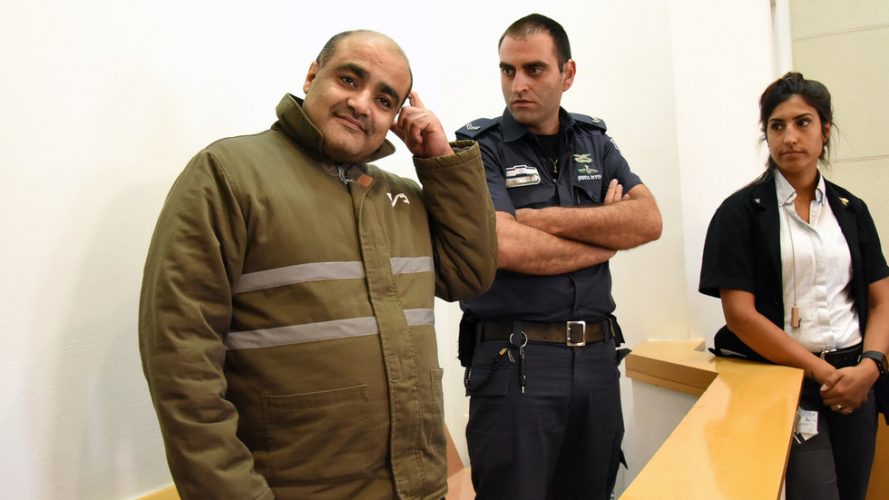
Former World Vision employee Muhammed al-Halabi (L) at a district court in Beersheva, Israel. © AFP / Dudu Grunshpan
RT | October 23, 2019
A former charity manager in the Gaza Strip accused of funding Hamas has attended court for the 129th time in what has become the longest trial of its kind in Israel’s history, dragging on as witnesses are blocked from testifying.
The 41-year-old aid worker, Muhammed al-Halabi, was arrested in June 2016 while working for World Vision, a Christian humanitarian group, charged with funnelling kickbacks to Hamas and its armed wing. For nearly four years, however, Halabi has been denied his proper day in court, instead forced to endure an endless series of stop-go proceedings in which key witnesses are barred from testifying.
His most recent hearing on Wednesday was no different, quickly hitting a dead end soon after it began.
“Today’s hearing was cancelled shortly after it started because the witnesses were not present,” Halabi’s brother, Hamed, told Middle East Eye. “The prosecution then threatened that any witnesses who come from Gaza to give their testimony will be detained.”
“They do not want anyone to prove them wrong. All the eyewitnesses and even the officials at World Vision gave proof that he was innocent. But this is not what the prosecution is looking for.”
The Israeli government has denied travel permits to crucial witnesses in the former charity worker’s case, preventing them from leaving Gaza to give testimony in Israeli courts. Halabi’s lawyer, Maher Hanna, says that guarantees he cannot receive a fair trial.
One of those witnesses – the owner of a company implicated in the alleged money transfer scheme – “could totally undermine the accusations they made against Muhammed,” Hanna told the Times of Israel. “He has begged Israel to allow him to go to the court and testify, but they have not permitted him to do so.”
A father of five from Gaza’s Jabalya refugee camp, Halabi has maintained his innocence since his 2016 arrest and refused to confess to the charges, according to his family, despite facing pressure and even threats from judges. His father said that at one his hearings, a judge promised “long term imprisonment” if Halabi did not admit to collaborating with terrorist groups.
“[The judge] threatened him and tried to force him to confirm the accusations in front of everyone,” Halabi’s father told Middle East Eye.
Halabi’s family also says he has suffered “horrific torture” at the hands of Israeli authorities during several interrogations, including beatings, humiliation and forced sleep deprivation.
A former employee at World Vision said Halabi’s case was part of an ongoing attack on the charity’s aid work in the Gaza Strip and other Palestinian territories.
“There was a political attack on the organisation given that one of its main offices is in the United States,” the employee, who wished to remain anonymous, told Middle East Eye. “The Israeli lobby in the US must have played a major role in impeding the work of the organisation.”
Halabi’s father seconded that take, adding “They know very well that he is innocent, but they cannot release him after four years of interrogation and torture and prove themselves wrong.”
Also on rt.com:
1,700 Gazans shot by IDF face amputation due to funding crisis, UN warns
Palestinians love living under occupation, ex-IDF chief declares, recycling apartheid talking point
More on the Quincy Institute: Don’t Mention Israel
By Philip Giraldi | American Herald Tribune | October 21, 2019
I have written frequently about how the overwhelming deference to Israeli perceptions not only distorts U.S. foreign policy, it also corrupts discourse regarding genuine national interests at all levels. The mainstream media, where Zionist journalists and editors exist in grossly disproportionate numbers, has long been a source of fake news about the Middle East, successfully obscuring Israel’s abominable record of war crimes and ethnic cleansing. The media lies overlap and often become self-propagating, with one lie from the likes of Rachel Maddow on MSNBC being employed to confirm the veracity of another similar lie being floated by someone like Jake Tapper on CNN.
So, the media, which is part of the Establishment and has a vested interest in promoting the status quo, is part of the “intellectual” underpinning of the government policies that it prefers. And it is joined by a more powerful and secretive ally in the form of the numerous think tanks that have sprung up in Washington like diseased mushrooms over the past twenty years. It is the think tanks that send ideologically driven “experts” to testify in front of congressional committees regarding policy, that draft legislation for lazy legislators, and that host well-funded panel discussions in which they air their biased views on the state of the nation.
I have written several times about the new think tank kid on the block the Quincy Institute, which is currently planning on “launching” during the month of November. Quincy, which claims to represent “Responsible Statecraft,” is largely funded by George Soros and the Charles Koch, both of whom have considerable negative baggage, and one is scarcely ever wrong when positing that compromising one’s views in exchange for money and celebrity is what Washington is all about.
My most recent rant on Quincy involved an article by the organization’s president, Professor Andrew Bacevich, whose books I have previously admired. His piece was entitled “President Trump, Please End the American Era in the Middle East.” The article appeared as one of Bacevich’s regular weekly contributions to The American Conservative (TAC) website under the rubric “Realism and Restraint.” I cited it as a good example of how self-censorship by authors works.
The article particularly focused on the foreign policy pronouncements of Bret Stephens, the resident neocon who writes for The New York Times. Stephens, per Bacevich, has been urging constant war in the Middle East and worrying lest “we may be witnessing the beginning of the end of the American era in the Middle East.”
Bacevich wrote the article without once mentioning Israel in spite of the fact that Stephens is an arch-propagandist for the Jewish state, a clearly deliberate omission that was noted not only by me but also by a number of comments from other readers. As the TAC site where the article appeared is heavily moderated, one suspects that additional, more vitriolic comments were not allowed to appear.
Bacevich is clearly on a roll. He followed up the piece on TAC with a stunningly ridiculous propaganda piece entitled “Foreign governments are messing with our elections the old-fashioned way” that appeared last week in the Boston Globe.
The article begins: “President Trump’s record as a unifier is spotty at best. Yet on at least one issue, he has helped forge a solid consensus: Americans are not going to tolerate further outside meddling in their politics. In discussing next year’s elections, Senate majority leader Mitch McConnell recently put it this way: ‘Any foreign country that messes with us is going to have a serious problem in return.’ The integrity of our electoral system is sacrosanct. Consider yourself warned, Mr. Putin. The Mueller report showed conclusively that in the run-up to the 2016 presidential election Russian hackers had done plenty of messing. Republicans and Democrats alike (if not President Trump himself) are now intent on preventing any recurrence of such interference, whether by Russia or other mischief-making interlopers such as Iran or China. Patriotic citizens must hope that those efforts will succeed.”
Let’s pause right there. Any article that pretends to be a serious discussion of America’s relationship with foreign powers should avoid quoting Mitch McConnell, who is possibly one of the slimiest politicians currently on display in the Senate. All his judgments are conditioned not by the national interest but rather by political considerations that relate to advancing his own personal agenda as well as the agenda of establishment Republicans. If the “integrity” of the U.S. electoral system is truly threatened, nearly all of the damage comes from inside the system, where corruption is rampant at all levels.
And, one might also note that the Mueller report may have demonstrated that in 2016 there were certain intrusions and manipulations by entities that may or may not have been connected to the Russian government, but it never revealed any plan by the Kremlin to influence voters in any serious way or change the results. It has not even been conclusively demonstrated that the Russians hacked anyone as the FBI has never been able to examine the Democratic National Committee computers. In fact, it is widely recognized that the Russian click-bait efforts on social media were insignificant and had no influence on the outcome. Overturning election results is called “regime change” and it is something that the United States does regularly, not the Russians.
Bacevich continues, “Yet those same citizens would do well to consider the other ways in which foreign governments, many of them ostensible friends, have habitually interfered in our politics. To do so, those governments do not employ the latest innovations in information warfare, waged via social media. No, they mess with our politics the old-fashioned way, distributing vast sums of money to buy influence.”
The professor makes a good point, that money in politics can create access and buy influence, but he then goes on to cite Saudi Arabia as a prime example of that specific form of corruption. He claims that the Saudis spent in 2018 alone “$33 million in their attempts to influence US policy” and wonders “… why the pervasive use of Saudi money to influence U.S. policy is any more tolerable than Moscow’s campaign to tilt the outcome of a presidential election in favor of its preferred candidate.”
Bacevich concludes with “Interested in salvaging the remnants of integrity that survive in American democracy? Well, it won’t be enough to stop the hackers employed by Moscow or Beijing or Tehran (even assuming that it’s possible to do so). To prevent foreign governments from mucking around where they are not wanted will require a concerted effort to get outside money out of American politics altogether. The moneychangers need to be ousted from the temple.”
With this recent series of somewhat related articles Professor Bacevich, unfortunately, defines himself as just another run-of-the-mill American hack propagandist. The enemies list includes Russia, China, Iran and Saudi Arabia but it deliberately avoids mentioning that country the more than any other interferes in U.S. politics. That country is, of course, Israel.
The $33 million that the Saudis allegedly spend on lobbying the U.S. is little more than chump change for the Israel Lobby, which is awash with money donated by Jewish oligarchs like casino magnate Sheldon Adelson, who came up with three times that much and more in 2016 to insure that America would have a solidly pro-Israel foreign policy. The Lobby plays with hundreds of millions of dollars annually, costs the U.S. taxpayer billions in various free rides for the Jewish state and has hundreds of full-time employees in groups like the American Israel Public Affairs Committee (AIPAC) and the Foundation for Defense of Democracies (FDD).
Andrew Bacevich is a smart man and he knows well that what I have written about above is correct. He knows first-hand that Israel’s interference in U.S. politics is highly organized, generously funded and ongoing at every level of government to obscure what Israel actually represents while also inter alia making it illegal to criticize the Jewish state in any way. Professor Bacevich fully well knows those things even as he pontificates about Americans not tolerating foreign influence in our politics, so why doesn’t he tell the truth for a change? Is it all about the Quincy Institute’s Benjamins?
UK protestors face jail for campaigning against Israel owned arms factory
MEMO | October 23, 2019
Seven people are facing the prospect of three months in prison for protesting against an Israeli-owned arms factory based in the UK.
The case against the seven activists will be heard in a Folkestone Magistrates Court Kent today. They are expected to plead not guilty of the charge of Aggravated Trespass, an offence which carries a maximum sentence of three months in prison. A number of the activists are locally connected to Kent.
The activists were arrested in August following a two-day occupation at the Elbit-Instro arms factory, which is newly situated in Discovery Park business park in Sandwich, Kent. Its parent company Elbit Systems supplies military equipment to Israel and activists claim that its products are the “backbone” of Israel’s drone fleet.
Elbit Systems also supplies weapons to a number of other countries accused of committing war crimes including Saudi Arabia. The weapons manufacturer is Israel’s largest privately-owned arms company. Campaign groups say that it provides 85 per cent of Israel’s drones which were used to attack Gaza’s civilian population repeatedly. Drones were used during Israel’s Operation Protective Edge which killed over 2,300 civilians, including over 500 children.
A statement released by the Stop Elbit-Instro Defendants Solidarity Campaign said: “The skilled engineers of Elbit-Instro could be working to make the world a better place, yet instead they are employed to build machines that incinerate children.” It added: “Shame on them all.”
According to the campaign group locals resent the arms manufacturer and relations between Elbit-Instro and Kent residents soured following its attempted take-over of an airport site.
A spokesperson for East Kent Campaign Against the Arms Trade said: “There are urgent questions about whether Instro’s specialist targeting technology is employed by Israel for targeting Gazan civilians every Friday during the Great Return March civil rights demonstrations, or in maintaining the surveillance of Palestinians along its illegal separation barrier, enabling the occupation’s apartheid infrastructure.”
Foreign agents torturing Palestinian prisoners in Saudi jails
MEMO | October 22, 2019
Palestinian prisoners inside Saudi jails are being interrogated and tortured by foreign agents, senior Hamas official Sami Abu Zuhri said yesterday.
Speaking to the Shehab News Agency, Abu Zuhri said: “Sadly, the prisoners are being interrogated and severely tortured by foreign interrogators of different nationalities.”
“There are about 60 Palestinian prisoners inside the Saudi jails, including some pro-Hamas or Hamas members,” Abu Zuhri said, noting that some of them have spent more than three decades in Saudi Arabia and contributed to building the country.
“Their detention shocked us and them because it is not justified and not understood.”
Abu Zuhri said that his movement has exerted many efforts, including contacting Saudi and non-Saudi officials through direct and indirect means but has been unable to arrange the release of the prisoners.
He stressed that his movement has not given up working to end the crisis, stating “this is not justified because Saudi has been and is still a supporter of the Palestinians and their cause.”
Last month, rights groups and Hamas revealed that Saudi Arabia has arrested around 60 Palestinians over claims of links to the Palestinian resistance movement, stating that they had disappeared for months without their families knowing anything about their whereabouts. The NGO Euro-Med Observer reported one of the freed detainees as saying that he and the others were subject to verbal and physical torture.
Hamas also revealed that its main official in the kingdom, Mohammed Al-Khodari, 81, has also been arrested.
How Russia’s Vision for the Middle East Is Rigged against Iran
By Agha Hussain | American Herald Tribune | October 22, 2019
Stanislav Ivanov writing for the prestigious Russian state-run Valdai Club recently described ‘Israel and most of the Arab countries’ as viewing Turkey’s military presence in Syria as a counterweight to that of Iran. He also added that Iran and Turkey both waged a ‘fierce struggle’ to install a ‘puppet government’ in Damascus.
The Russian perspective is usually channeled, directly or indirectly, by its assorted major think tanks and media outlets and a very clear cut yet under-noticed aspect of Russia’s views on Iran has been made clear as daylight here.
That ‘Most of the Arab countries’ consider Iran’s presence in Syria as something that requires a ‘counterweight’ is a fallacious notion for a number of reasons. Iran’s key allies in the region are Arabs, such as Hezbollah, the Syrian Arab Army and much of the Iraqi government, clerical establishment and de facto military in the form of the Popular Mobilization Units. The same goes for Hamas, Islamic Jihad and other groups in Gaza.
To describe the Gulf Arabs (GCC) and their consensus on Iran’s ‘need’ to exit Syria as the consensus of ‘most of the Arabs’ is thus disingenuous. Notwithstanding the weakness of that consensus itself, given how the UAE quickly distanced itself from the fiasco in the Persian Gulf through assuring signals to Iran as things heated up there, it is not likely that the author is unaware of these issues with the ‘Arabs’ tag.
Nor is it likely that Russian policymakers are unaware of the illogical, dishonest basis of this classification of ‘most of the Arabs’. It remains, regardless of this vital reality, a key cornerstone of Russia’s current geopolitical approach to the Middle East. This can be seen from the Russian outreach to the GCC it began – together with other extremely important yet under-discussed strategic adjustments – in what can be described the ‘post-ISIS’ scenario in Syria.
The Russian-GCC ‘rapprochement’ was lightning fast, with Russia offering to Saudi Arabia and the UAE what it never did to its Iranian or Syrian ‘allies’ constantly attacked by the Israeli airforce: its much-vaunted S-400 anti-air defense system. As one of the earlier examples of Russian preference for the GCC over their Iranian rival, the clarity of the message Russia was sending was illustrated by the fact that it even pitched the system to the small, militarily-insignificant Bahrain.
Russia has taken clear steps to prop up the brittle GCC whenever it has suffered major setbacks, demonstrating its ties with them are not just cordial but strategic. Saudi Arabia, having last month suffered a deadly missile attack on its Aramco oil processing facilities at Abqaiq, received a boost on 11 October as Russia announced plans to invest $1 billion for a petrochemical facility there.
More than 20 deals were signed between Russia and Saudi Arabia during Putin’s state visit days later, including the purchase of a 30.76% in one of Russia’s leading companies, Novomet, by the two countries’ sovereign investment funds and Aramco.
The economic honeymoon, however, started after Saudi King Salman’s historic visit to Russia in 2017. Its progress since then compares starkly to Russia, contrary to expectations of its ‘Eurasianist’ supporters, having adhered to US sanctions against Iran when they were re-imposed last year.
The strategic element which drove Russo-GCC economic ties did influence the decisions of Russian giants such as Rosneft and LUKoil regarding their Iran investments, but to Iran’s detriment as they withdrew from Iran with Russo-GCC ties being a factor as well.
A team from Russia’s MGIMO university at the Abu Dhabi Strategic Debate in November 2018 days after re-imposition of US sanctions on Iran declared in no unclear terms that Russia was not aligned with Iran. The prestigious institution, famed for having top Russian diplomats such as current Foreign Minister Sergei Lavrov among its alumni, declared political Islam problematic and Iran to be an expansionist power.
But what are these soft spots Russia tries to hit at in Iran’s geopolitical ‘Resistance Axis’ infrastructure, and is it the GCC’s subsequent empowerment [over] Iran that makes Russia’s ‘contain Iran’ policy dangerous?
The answer lies in Israel and the regional socio-political and military network Iran has forged and sustained since 1979 pivoted around the correct recognition of Israel and Israel Lobby-induced US foreign policy as the premier driver of Middle East wars.
It [Iran] has, thus, through the chaos of Middle East geopolitics since 1979 performed an important task in countering forces of destabilization. Vital to Iran has been its deep involvement in foreign affairs and disingenuously portraying this as ‘Iranian expansionism’ has been a cornerstone of Israeli and GCC propaganda against Iran.
Nobody knows the ‘start the story from the middle’ game better than the Israelis, be it claiming Israel was ‘attacked’ by ‘the Arabs’ in 1948 whilst ignoring the entire pre-planned ethnic cleansing campaign of the 1940s by the Zionists or claiming self-defense in Gaza. The GCC in recent times have latched onto this narrative as well, but with their own crude ‘Iran seeks to dominate the Arab world’ spin.
Had Iran not intervened, the Shia-dominated Lebanese resistance against Israel’s occupation would have lacked a material supporter against the modern Zionist army and Israel would have consolidated Lebanon for both its Jewish colonies scheme and seized its vital water resources. Such had been Zionist ambition as far back as 1919.
Gaza, where the armed resistance born following the First Intifada in the vacuum left by Yasser Arafat’s inept leadership (and subsequent sell-out during the Oslo ‘peace’ hoax) receives arms from Iran, would have by now been fully swallowed by Jewish colonies. It would have shared the fate of the ‘Iran-free’ West Bank, where Mahmoud Abbas carries on the legacy of Arafat’s surrender.
Instead, Lebanon today is far more stable than at any other time in its history and the bridges Hezbollah has built with other religious parties have helped augment internal cohesion. Gaza has shown in recent times increased capability to deal with Israeli military aggression, with its Iran-backed Sunni Islamist groups possessing improved weaponry and exhibiting greater unity.
It was not international mediation and ‘conflict-resolution’ attempts that stabilized – or, given the capacity of Israel’s cohorts to rig such attempts every step along the way, ever truly even could stabilize – the parts of the Arab world worst hit by war. It was Iran’s support to these states and state-less victims of Israeli expansionism that enabled them to weather the storm inflicted upon them and mount a thus-far successful resistance.
Few pundits would, retrospectively, describe past ‘peace deals’ be they Camp David 1978 or the Oslo process of the 90s as anything other than smokescreens for unhinged Israeli warmongering.
For containing Israel, Iranian forward-presence in countries near to Israel has always been a necessity. Iran’s elaborate supply chains, part covert and part overt in nature, going to allies such as Hamas and Hezbollah are transnational and involve supporters on the ground zealously committed to Iran or even just zealously committed to opposing Israel.
Syria is one such vital node. Without Syria, Iran could not supply Hezbollah. Russia is not unaware of this when it constantly pushes for Iranian withdrawal from Syria whilst passing this off as its ‘principled’ position that all foreign forces must leave the country. This most salient stance of Russia is deceptive, given that Russia has consistently implicitly excused Israel completely from adhering to this principle.
The Russian Defence Ministry right after Israel got a Russian aircraft downed in September last year reminded everyone of how Russia at Tel Aviv’s request had pushed for ‘Iran-backed groups’ to withdraw 140 km away from the Israeli-occupied Golan Heights. Israel’s behavior since then remained the same, but Russian attempts at Tel Aviv’s request to distance Syria from its Iranian ally only intensified, even including lobbying for the removal of heavily pro-Iran officials from the Syrian military and incorporation of ‘ex-rebels’ into its ranks.
The façade is crystal clear: Israel gets to continue its attacks but Iran – who along with Hezbollah contributed to the defeat of terrorism in Syria even before Russia intervened in 2015 – must depart Syria. The constant Russian favors to Israel are here are even more see-through than were the fraudulent regional ‘peace-processes’ of the past which leveraged almost no obligations upon Israel to cease its warmongering yet comprehensively de-fanged and neutralized whatever stood in its way.
Propping up the GCC, working to weaken Iran and looking the other way when Israel attacks its ‘allies’ (or even publicly fawn over the Zionist state at events hosted by financial benefactors of Israel’s military) are all part and parcel of Russia’s geopolitical bigger-picture.
Validating the notion that the GCC – the normalization with whom of Israel’s ties Jared Kushner has fast-tracked since 2016 as an anti-Iran front and plan B following al Assad’s survival in Syria – represents ‘most of the Arabs’ has a specific purpose.
That purpose is to rig the selection of stakeholders for any potential region-wide ‘peace initiatives’ against Iran, sidelining it and declaring the pro-Israel GCC the representatives of ‘the Arabs’. Israel would be the benefactor of any ‘peace deal’ to end the ‘Arab-Israeli conflict’ since both sides would have long ago accepted the need to eradicate longstanding barriers to Israeli hegemony.
What follows next is obvious and has been seen repeatedly in the Middle East ‘peace processes’ in the past: no actual reigning in of Israel, but a thorough neutralization of its foes. For resistance-oriented states like Iran, there is no place in Russia’s vision for the Middle East.
Agha Hussain is a Research Analyst at the Institute of Regional Studies, Islamabad, Pakistan, as well as an editorial contributor to the websites Eurasia Future and Regional Rapport. His writings have a particular focus on Middle Eastern affairs and history and Pakistan’s foreign policy.
Featured Video

Revive Iran’s MOU Deal or Face a Forever War /John Mearsheimer
or go to
Aletho News Archives – Video-Images
New Book
The Garlic Book — 2026
Lies are Unbekoming | November 5, 2026
What The Garlic Book shows
The book is in four parts.
 Part One, The Record, treats the history of garlic as evidence. From the clay garlic bulb placed in an Egyptian grave nearly six thousand years ago, through the Ebers Papyrus, through Hippocrates, Dioscorides, Pliny and Galen, the Arab physicians under Avicenna, the medieval herbals, Culpeper, and the plague years, to the last era in which Western physicians prescribed garlic as a matter of course, which ran from 1850 to 1945. It closes with the living traditions that never stopped using it, and with the folklore of charms, vampires and the evil eye.
Part Two, The Chemistry and the Evidence, sets out what is known about why a clove has no smell until it is cut, and why the order of crush, rest and heat changes the medicine. It then reads the clinical evidence against the historical record — bacteria, blood and vessels, cancer epidemiology, metals and fatigue — and names the trials that went against garlic as directly as the trials that went for it, including the 2007 Stanford trial funded by the US National Institutes of Health which found that raw garlic, garlic powder and aged garlic extract moved LDL cholesterol no more than placebo did. It then turns to onion, garlic’s closest relative, and reads the newer evidence published since 2015, before closing with the whole of the record through the terrain lens.
Part Three, Why Medicine Set It Aside, asks the question directly. One chapter contrasts the pharmaceutical model of isolating a single active compound with the folk model of combining whole plants, and reports what the garlic evidence says about which model works better. One chapter examines the economics of research on a plant that cannot be patented. One chapter — Fire Cider — tells the story of a folk preparation whose name was taken into a United States trademark by a Massachusetts company in 2012, and won back by three herbalists in 2014 who documented forty years of prior use through Rosemary Gladstar and her students into the older tradition.
Part Four, Garlic in Practice, is the working manual — the kitchen pharmacy, traditional uses by body system, a full chapter on safety and interactions, and a complaint-by-complaint practical guide. The book closes with The Trial That Was Never Run — a one-chapter reading of the whole evidential architecture.
At the back: two appendices (a traditional list of uses, and a preparation quick-reference), a full bibliography, and a live index.
Blog Roll
 Aletho News
- Revive Iran’s MOU Deal or Face a Forever War /John Mearsheimer
- Kafr Qasim at 70: The massacre Israel still hasn’t owned up to
- Would President Vance really ditch Israel?
- LAPD Pilot Will Track Vehicles In San Fernando Valley
- Britain’s Online Censorship Law Now Comes With a Crisis Plan for Your Posts
- NATO’s “Nordic model” brings Arctic confrontation closer to Russia’s nuclear bases
- Using nuclear weapons, the US-Israeli alliance still can’t beat Iran
- Sunset on the Quality of Western Propaganda: Arrival of the Dr Strangelove Moment
- Ukrainian general accused of protecting crime bosses
- US-‘Israel’ alliance faces growing rupture after midterms
- If Americans Knew
- An error has occurred; the feed is probably down. Try again later.
- No Tricks Zone
- New Study: The Net Fossil Fuel Contribution To Rising Atmospheric CO2 Has Been Zero For 500 Years
- Germany’s Green Energy Transition Becoming Increasingly Expensive…Another 6 Trillion Euros!
- Sudden Stratospheric Warming, Powerful El Niño Combination May Lead To Extreme Europe Cold, Energy Crisis!
- Two New Studies Find Thwaites Glacier Melt Cannot Be Driven By Human Activity Or A Warming Ocean
- E-Cars Reduce CO2 Emissions By Only 41% Compared To Internal Combustion Engine Vehicles
- Predictions Made By Renowned Climate Professor Over Past Decades Have Been Proven To Be Poor
- New Study Suggests Large Regions Of The Pacific Ocean Have Been Cooling For The Last 80 Years
- Germany’s Green Energy Debacle: High Energy Costs Force Kahla Porzellan to Close After 182 Years!
- New Study: 50 Years Of The Most Aggressive ‘Net Zero’ Policies Can Only Affect The Global Climate By 0.03°C
- US September “Heat” Was No Record…Many Records Set Decades Ago

