How Israel’s Labor Engineered the Illegal Jewish Colonies in Palestine
By Ramzy Baroud | MEMO | August 22, 2019
Following the Israeli victory in the 1967 war, it became impossible for Zionist ideologues to mask the true nature of their state – an unwavering colonial regime with an expansionist agenda.
While Zionism was undoubtedly a colonial enterprise from the onset, many Zionists refused to perceive themselves as colonists. “Cultural Zionists”, “Reform Zionists” and Labor Zionists” advocated similar political agendas to “Revisionist” and other extreme forms of Zionism. When put to the test, the difference between left and right Zionism proved mere ideological semantics. Both groups laboured to sustain the same cognitive dissonance – victims in search of a homeland and colonists with a racist, violent agenda.
That self-serving intellectual paradigm remains effective to date, most delineated in the supposedly conflicting political discourses of the Israeli rightwing parties (Likud, and other religious and far-right nationalist parties) and the ‘left’ (Labor and others). For Palestinians, however, both political streams are two sides of the same coin.
After the decisive Israeli victory in the war of June 1967, Jewish nationalism took on a new meaning. Israel’s ‘invincible army’ was born, and even cynical Jews began to view Israel as a victorious state, which was now a regional, if not international force to be reckoned with. Equally important, it was Israel’s so-called ‘left’ and other ‘soft-Zionists’ who fully engineered that most reprehensible period in history.
The Israeli occupation of Sinai, the Golan Heights, East Jerusalem, the West Bank and Gaza, and the destruction of the combined armies of Egypt, Syria and Jordan, thrilled most Israelis, encouraging many to develop an imperial outlook and wholly embrace a colonial project based on a conviction that their army was the strongest in the Middle East. The same expansionist instincts helped to sanctify the Zionist principle that ‘never again should Eretz-Yisrael be divided’.
In fact, as Professor Ehud Sprinzak argued (as cited in Nur Masalha’s book “Imperial Israel and the Palestinians: The Politics of Expansion”), following the Israeli victory in 1967, the concept of imperial expansion, and the rejection of the ‘division’ of Eretz-Yisrael became a “most energetic and influential tenet in modern Zionism”. Regardless of whether Israel fully anticipated such massive territorial expansion or not, the country seemed determined to quickly fortify its gains, rebuffing any call for a return to the armistice lines of 1949.
Although religious Jews were intoxicated by the idea that biblical “Judea and Samaria” ‘returned’ to its long-estranged owners, the first movement to capitalise on the territorial gains was, in fact, a secular elite organisation named the Movement for the Whole Land of Israel (WLIM).
The official founding conference of WLIM was held shortly after Israel’s victory. Although founded and dominated by Labor party activists, WLIM cut across party lines and ideological divides, united in their determination to preserve all of Palestine, as all of Israel. As for the unwanted population, those who were not expelled were to be duly subdued.
As Egypt and other Arab countries decried their ill-fated war, Palestine was completely taken over making Palestinians captives in their own land. Just as Israel celebrated its victory over official Arab armies, Israeli soldiers filmed themselves grinning and flashing victory signs at the so-called “Western Wall”, as well as in and around Arab Jerusalem’s holy sites. Palestinians still braced themselves for the worst.
Indeed, as Baruch Kimmerling writes in his book “The Palestinian People: A History”, that “was the moment in Palestinian history most bereft of hope”, Palestinian refugees who dreamed of returning to pre-1948 Palestine faced a momentous setback, a new Nakba, indeed, for the refugee problem was now exasperated and compounded by the war and the creation of 400,000 new refugees. Israeli bulldozers promptly moved into many parts of the newly conquered Palestinian territories – as they did in other occupied Arab lands – demolishing historical realities, and constructing new ones, as it does today.
![An elderly Palestinian and a child during the Nakba [Hanini/Wikipedia]](https://i1.wp.com/www.middleeastmonitor.com/wp-content/uploads/2018/11/2018-10-6_nakbaOldman_girl_nakba.jpg?resize=933.5%2C622&quality=75&strip=all&ssl=1)
An elderly Palestinian and a child can be seen during the Nakba [Hanini/Wikipedia]
Shortly after the war, Israel sought to fortify its occupation, firstly by rejecting peace overtures made by Egypt’s new president, Anwar Sadat, starting as early as 1971, and secondly, by unleashing settlement construction throughout the West Bank and Gaza.
The early settlements had strategic military purposes, for the intent was to create sufficient facts on the ground to alter the nature of any future peace settlement; hence, the Allon plan, named after Yigal Allon, a former general and Labor party minister in the Israeli government who took on the task of drawing an Israeli vision for the newly conquered Palestinian territories.
The plan sought to annex more than 30 per cent of the West Bank and all of Gaza for “security purposes”. It stipulated the establishment of a “security corridor” along the Jordan River as well outside the “Green Line,” a one-sided Israeli demarcation of its borders with the West Bank. The plan envisioned the incorporation of the Gaza Strip into Israel and was meant to return parts of the West Bank to Jordan as a first step toward implementing the “Jordanian option” for Palestinian refugees, i.e. ethnic cleansing coupled with the creation of an ‘alternative homeland’ for Palestinians.
The plan failed, but not in entirety. Palestinian nationalists ensured that no alternative homeland was ever to be realised, but the seizure, ethnic cleansing and annexation of occupied land was a resounding success. What was also important and consequential is that the Allon plan provided an unmistakable signal that the Labor government of Israel had every intention of retaining at least large parts of the West Bank and all of Gaza, and had no intention of honouring United Nations Security Council Resolution 242.
To capitalise on the government’s alluring settlement policies in the West Bank, a group of religious Jews rented a hotel in the Palestinian town of Hebron (Al-Khalil) to spend Passover at the “Cave of the Patriarchs”, and simply refused to leave. This sparked the biblical passion of orthodox religious Israelis across the country who referred to the West Bank by its biblical designation, Judea and Samaria. Their move also ignited the ire of Palestinians who watched in complete dismay as their land was conquered, renamed and later settled on by outsiders.
In 1970, to ‘diffuse’ the situation, the Israeli government constructed the Kiryat Arba settlement at the outskirt of the Arab city, which invited even more orthodox Jews to Hebron. Allon’s plan may have been intended for strategic purposes, but soon after, what was strategic and political, intermingled with what became religious and spiritual.
In the final analysis, Palestinians were losing their land at a rapid speed, a process that would lead to major Israeli population transfers, initially to occupied East Jerusalem – which was itself illegally annexed shortly after the 1967 war – and eventually, to the rest of the occupied territories. Over the years, the strategic settlement growth was complemented by the religiously motivated expansion, championed by a vibrant movement, exemplified in the founding of Gush Emunim (Bloc of the Faithful) in 1974. The movement was determined to settle the West Bank with legions of Jewish fundamentalists.
Allon’s plan also extended to include Gaza and Sinai. Allon wished to establish a “finger” of territories to serve as a buffer between Egypt and Gaza. ‘Buffer’ was in this context, a codename for illegal Jewish settlements and military outposts at the southern end of the Gaza Strip and adjacent areas of northern Sinai, a region that Israel dubbed the Rafiah Plain.
In early 1972, thousands of men, women and children, mostly Palestinian Bedouins, were driven from their homes in southern Gaza. Despite living in the area for generations, their presence was an obstacle before an Israeli army blueprint that would soon incorporate half of Gaza. They were evacuated without being permitted even to haul their possessions, however modest. The Israeli army claimed that ‘only’ 4,950 people were ethnically cleansed from the area. But the tribes’ leaders contended that more than 20,000 were forced from their homes and land.
Allon had then entrusted Ariel Sharon and other military leaders to break up the newly occupied territories into mini regions, infiltrated by strategic settlements and military bases to weaken local resistance and cement Israeli control.
“(Sharon) recounts standing on a dune (near Gaza) with cabinet ministers”, wrote Gershom Gorenberg, “explaining that along with military measures, to control the Strip, he wanted ‘fingers’ of settlement separating its cities, chopping the region in four. Another ‘finger’ would thrust through the edge of Sinai, helping create a ‘Jewish buffer zone between Gaza and Sinai to cut off the flow of weapons’ and divide the two regions in case the rest of Sinai was ever returned to Egypt.”
The rest is history. Although the demographic made up of the settlers largely shifted to the right in recent days, and their political influence on Tel Aviv increased exponentially, those settlers now numbering around 600,000 living in over 200 settlements, are the hideous creation of Israel’s ‘left’ with the full backing and support of the right, all serving the original cause of Zionism that remained true to its founding principles – a colonial movement that can only be sustained through violence and ethnic cleansing.
The Saker Interviews Professor Marandi

The Saker • Unz Review • August 22, 2019
Introduction: first, several friends recently suggested that that I should interview Professor Seyed Mohammad Marandi; then I read this most interesting text on Moon of Alabama and I decided to ask Professor Marandi to share his views of the current situation in Iran, the Persian Gulf and the rest of the Middle-East who very kindly agreed to reply to my question in spite of his most hectic and busy schedule. I am most grateful to Prof. Marandi for his time and replies. Crucially, Prof. Marandi debunks the silly notion that Russia and Israel are allies or working together. He also debunks that other canard about Russia and Iran having some major differences over Syria. Prof. Marandi, who is currently in Iran, is superbly connected and informed, and I hope that with this interview some of the more outlandish rumors which were recently circulated will finally be seen for what they are: utter, total, nonsense. Enjoy the interview!
The Saker: It is often said that there is an “axis of resistance” which comprises Syrian, Hezbollah, Iran, Russia and China. Sometimes, Venezuela, Cuba or the DPRK are added to this list. Do you believe that there is such an “axis of resistance” and, if yes, how would you characterize the nature of this informal alliance? Do you think that this informal alliance can ever grow into a formal political or military alliance or a collective security treaty?
Professor Marandi: I definitely believe there is an Axis of Resistance that currently includes Iran, Syria, Iraq, Gaza, Lebanon, parts of Afghanistan, and Yemen. I do not think that we can include the DPRK in any way or form. I believe that Russia could be considered to a certain degree as aligned or affiliated to this resistance, but that this is not something many would feel the need to acknowledge. At certain levels, there is a lot of overlap between Russian and Chinese policy and the policies of the countries and movements in this region that are affiliated to this Axis of Resistance. The same is true with countries such as Venezuela, Bolivia, and Cuba, which I do not consider to be similar to North Korea at all. Just as almost everywhere else, American policy in the Korean Peninsula is ugly, hegemonic and malevolence, but the nature of the DPRK government is fundamentally different from that of Venezuela or Cuba, whether the Americans or Europeans like to acknowledge that or not. Others can interpret the Axis of Resistance to include or exclude certain countries, but it is pretty clear that Iran and Russia have similar policy objectives when it comes to certain key issues. Nevertheless, Russia has a close relationship with the Israeli regime whereas Iran considers it to be an apartheid state, almost identical to that of apartheid South Africa. Or for example the Syrian government position regarding Israel is different from that of Iran’s. The official Syrian position is that the West Bank and Gaza Strip must be returned to the Palestinians, in accordance with UN Security Council resolutions, and that the occupied Golan Heights have to be handed back to the Syrian people, which are legitimate demands. But the Iranian position is different, Iran firmly believes that Israel is a colonial and apartheid regime and that it is morally unacceptable for it to exist in its present form. Therefore, at least officially, there are substantial differences. So people can interpret the Axis of Resistance in different ways. It is important to keep in mind that despite Syria, Iran, Turkey and Qatar are also moving closer together partially thanks to US, Saudi, and UAE hostility towards the Muslim Brotherhood. What is important is that there is a growing consensus about key issues in this region and what the major problems are, and I think that as time goes on this loose alliance of countries and movements is growing more influential and more powerful. I cannot say whether there will be a formal or open collective security treaty or military alliance created by any of these countries in the near or foreseeable future and I do not see such a necessity. However, I think this convergence of ideas is very important and I think that the formal and informal links that exist between these countries is in many ways more important and more significant than formal political or military alliances or security treaties.
The Saker: In recent months a number of observers have stated that Russia and Israel are working hand in hand and some have gone as far as to say that Putin is basically a pawn of Netanyahu and that Russia is loyal to Israel and Zionists interests. Do you agree with this point of view? How do Iranian officials view the Russian contacts with the Israelis, does that worry them or do they believe that these contacts can be beneficial for the future of the region?
Professor Marandi: That is nonsense. The US and Israeli regimes are culturally and ideologically bound to one another, whereas the Americans have a deep antipathy towards Russia. That is why the Russians have a very different position on Syria than do the Americans and Israelis. The Israelis alongside the US, the EU, the Saudis, and some of Syria’s neighboring countries, supported ISIS, Al Qaeda, and other extremist entities and attempted to tear Syria apart. As explained earlier, the Russian view of Israel is different from Iran. There are many Russian Jewish immigrants in Israel and they constitute a large segment of the colonists in Palestine and they are largely utilized for the further subjugation of the Palestinian people and ethnic cleansing. Generally speaking, Russian interests are in sharp conflict with those of the United States, Israel’s strongest ally. In addition, Russia’s close relationship with Syria dates back to the cold war and the relentless US pressure on China and Russia has also acted as a strong catalyst to quicken their convergence with one another as well as with Iran on key issues. The Chinese and Russians know quite well that the United States, the Europeans, and regional countries have extensively used extremists in Syria to undermine the state and that those forces could later be used to undermine security in Central Asia, Russia, and China. A large number of Russian, Chinese, and Central Asians have been trained to fight in Syria, and this is a major threat to their collective security. The United States could use these and other extremists in an attempt to impede the potential success of the Belt and Road Initiative or other plans for Asian integration. Thus, there is a sharp and growing conflict between the Russians and the Americans.
The Israeli regime constantly tells the Russians and the Chinese that they are the gateway to Washington and that if they maintain strong ties with Israel, the Israelis can help them solve their problems with the United States. I do not think there is much truth to that, because this growing conflict is about the fate of US global dominance and there is nothing the Israelis can do to change that. Nevertheless, this has been used as an incentive for the Russians and the Chinese to maintain better relations with the Israeli regime.
In any case, Russia does not have to maintain identical views with Iran, Syria, Hezbollah, Lebanon, Iraq, or Yemen. Differences exist, but strong relationships exist nevertheless. All of these countries recognize that if the Americans are able to undermine any of them, whether it is Syria, Iran, Russia, or China, then that would only encourage the United States to be more aggressive towards the remaining countries that impede US foreign policy objectives or exist as potential rivals whether regionally or globally. So even though their political structures are different, even though their foreign policies are different, the similarities that exist are quite striking as well as the common threats. Again, to a large degree this coalition is a result of US and Western foreign policy, which has strong undercurrents of Eurocentricism, tribalism, and racism.
Not only has this pressure brought these countries and movements closer to one another, but it has also created a deeper understanding among them. The Russians understand Iran better today than they did 5 years ago, partially as a result of their cooperation in Syria. This greater understanding enhances the relationship, and helps to dispel many of the misunderstandings or myths that may exist about one another due to Eurocentric narratives and orientalism.
Hence, Iran is not concerned about Russian-Israeli relations. Obviously, in an ideal world Iran would like Russia to break relations with the Israeli regime for its apartheid nature. But reality is reality, and Iranian relations with Russia are very good and at times I am sure the Iranians send certain warnings to the Israelis through the Russians.
The Saker: How is Russia viewed in Iran? Are most Iranians still suspicious of Russia or do they believe that they have a viable and honest partner in Russia? What are the main reservations/concerns of patriotic Iranians when they think of Russia?
Professor Marandi: Historically, the Iranians have had serious problems with the Russians. The Russians and the Soviet Union interfered extensively in Iranian internal affairs and they undermined Iran’s sovereignty. But ever since the collapse of the Soviet Union the image of Russia has changed. Especially since Russia began fighting alongside Iran in Syria in 2015, Russia’s image has improved significantly. When we look at polls, Russia’s image is pretty good compared to Western countries.
Western governments own or fund dozens of Persian language media outlets These outlets, such as VOA and BBC Persian among others, are constantly spouting anti-Russian propaganda. Obviously they have an impact and that couples with historical Iranian concerns about Russia, but despite all that, the Russian image is relatively favorable and that says a lot.
The Saker: How about Turkey? Iran and Turkey have had a complex relationship in the past, yet in the case of the AngloZionist war against Syria, the two states have worked together (and with Russia) – does that mean that Turkey is seen as a viable and honest partner in Iran?
Professor Marandi: Iran’s relationship with the Turkish government is complicated, especially, because of the constant policy changes that have occurred IN TURKEY over the past few years. This has made the government seem unreliable in the eyes of many. Having said that, Turkey is very different from Wahhabi influenced regimes in the Arabian Peninsula. Turkish Islamic tradition has striking similarities with Iran’s Islamic culture and because of its strong Sufi tradition, Turkey is much closer to Iran than it is to, for example,Wahhabi Saudi Arabia.
The global Wahhabi menace has grown as a result of Saudi financial support, as well as the support of other countries in the Persian Gulf region. Turkish society has been more resistant, although ever since the military conflict in Syria and due to extensive funding from the Persian Gulf, there has been growing concern about growing sectarianism in Turkey, not unlike what happened in Pakistan in the 1980s.
Ironically, before the conflict in Syria President Erdogan had a closer personal relationship with President Assad than did the Iranians. They and their families would spend vacations together.
In any case, Turkey has a very strong economic, political, and cultural relationship with Iran, and some of the rising anti-Shia and takfiri sentiments that have been on the rise in Turkey were stunted by the Saudi and Emirati support for the attempted coup in Turkey. Subsequently, their open antagonism towards the Muslim Brotherhood and Qatar, their support for the coup in Egypt, their policies in Sudan and Libya, and of course the murder of Jamal Khashoggi, have all had a beneficial impact on Iranian-Turkish relations. As a result, Turkey has grown much more distant from Iran’s regional antagonists, while Turkish support for the Palestinian cause is another element that brings Iran and Turkey closer together. American support for PKK terrorists in Syria has also angered the Turks adding push to Turkish-Iranian convergence. Even Turkish policy towards Syria is evolving, although it is impossible for the government to make a radical change, because of years of attempts at regime change.
The Saker: Next, turning to Iraq, how would you characterize the “balance of influence” of Iran and the USA in Iraq? Should we view the Iraqi government as allied to Iran, allied to the USA or independent? If the Empire attacks Iran, what will happen in Iraq?
Professor Marandi: The relationship between Iraq and Iran is significantly more important than the relationship between Iraq and the United States. Iran and Iraq are allies, but this alliance does not contradict the notion of Iraqi independence. Iraq’s regional policy is not identical to Iran’s. But the two countries have very similar interests, a very close relationship, many Iraqi leaders have spent years in Iran, and the bulk of the Iraqi population lives close to the shared border of over 1,200 km between the two countries. So trade, pilgrimage, and tourism are key to both countries. The religious similarities and the holy sites that exist in Iran and Iraq are a huge incentive for interaction between the two countries. There are many Iraqi students studying in Iran and many Iranian’s working in Iraq. The fact that Iranians made many sacrifices when fighting ISIS in Iraq and many Iraqis were martyred in the war against ISIS and Al Qaeda in Syria is a strong indication of where things stand despite US pressure.
The Arba’een pilgrimage that takes place every year where millions of Iranians and Iraqis make the walk towards Karbala, side by side, with tens of thousands of Iraqi and Iranian volunteers helping pilgrims along the way is, I think, a further sign of the close relationship.
While the U.S presence in Iraq continues to be hegemonic, Iran has not sought to prevent Iraq from having normal relationships with other countries. However, the U.S continues to seek control over Iraq through the world’s largest embassy, its military presence, and its influence over the bureaucracy. The United States continues to have much say over how the country’s oil wealth is spent.
Still, despite the US colonial behavior, its continued theft of Iraqi oil wealth, and its thuggish behavior, the Iraqis have been able to assert a great deal of independence. In the long run, this continued US behavior is only going to create further resentment among Iraqis. The empire rarely takes these realities into account, they seek to accumulate influence and wealth through brute force, but in the long term it creates deep-rooted anger and hostility which, at some point, will create great problems for the empire, especially as this anger and unrest is growing across the region, if not across the globe.
It is highly unlikely that the regime in Washington will attack Iran, if it does it will bring about a regional war, which will drive the United States out of Iraq, Afghanistan, Lebanon, and Syria. Saudi Arabia and the Emirates would, swiftly collapse and the price of oil and natural gas would go through the roof, leading to a global economic meltdown even as millions of people will be streaming towards Europe.
The Saker: It is often said that Russia and Iran have fundamentally different goals in Syria and that the two countries regularly have tensions flaring up between them because of these disagreements. Is that true? In your opinion, how are Russian and Iranian goals in Syria different?
Professor Marandi: The news that we sometimes hear about serious tensions existing between the Iranians and the Russians in Syria is often nonsense. There are clear reasons for people to exaggerate small incidents or to fabricate them altogether, but the relationship is quite good. Iran does not intend to have any military bases in Syria, whereas the Russians do feel the need to preserve their military presence in Syria through long-term agreements.
But ultimately, Iran would like to help enable Syria to acquire the military capability to retake the occupied Golan Heights. Iran does not intend to initiate any conflict with the Israeli regime inside Palestine. That is not an objective in Lebanon and that is not an objective in Syria. As in Lebanon, where the Iranians supported Hezbollah to restore the country’s sovereignty and to drive out the Israeli aggressors and occupiers, the Iranians have the same agenda in Syria. They want to support the Syrians so that they will be able to restore full sovereignty. I don’t believe the Golan Heights is a priority for the Russians.
The Saker: For a while, Iran let the Russian Aerospace Forces use an Iranian military airfield, then when this became public knowledge, the Russians were asked to leave. I have heard rumors that while the IRGC was in favor of allowing Russian Aerospace Forces to use an Iranian military airfield, the regular armed forces were opposed to this. Is it true that there are such differences between the IRGC and the regular armed forces and do you think that Iran will ever allow the Russian military to have a permanent presence in Iran?
Professor Marandi: That is a myth. The Russians were not asked to leave. There were no differences between the IRGC and any other part of the armed forces. This was a decision made by the Supreme National Security Council and the President and all the major commanders in the military were involved in this decision. Actually, the airbase does not belong to the guards it belongs to the air force and a part of the base was used for Russian strategic bombers that were flying to Syria to bomb the extremists. This cooperation ended when the Russians were able to station adequate numbers of aircraft in Syria, because the flights over Iran were long and expensive, whereas the air campaign launched from bases inside Syria was much less expensive and much more effective. Iran was very open about its relationship with the Russians, and openly permitted the Russians to fire missiles over Iranian airspace. There were those who were opposed to the Russian presence in the Iranian airbase. A small segment of Iranian society that is pro-Western and pro-American complained about it in their media outlets, but they had absolutely no impact on the decision-making process. According to polls, an overwhelming majority of Iranians supported Iran’s activities in Syria, and the Supreme National Security Council was under no pressure to its decision. However, Iran does not plan to allow any country to have permanent bases in the country and that is in accordance with the constitution of the Islamic Republic of Iran. The revolution in Iran was about independence, dignity, sovereignty and indigenous values, and the removal of American hegemony over Iran was very much a part of that. The Iranians will not give any bases to foreign powers in future, and neither the Russians nor the Chinese have ever made such requests. There are absolutely no differences regarding Iran’s regional policies between the IRGC and the rest of the military, both were a part of the decision-making process when the Russians were allowed to fire missiles over Iranian territory and both were part of the process in allowing Russian aircraft to use Iranian airspace. The Russian bombers were providing air support for Iranian troops and Iranian affiliated troops on the ground.
The Saker: Both Ayatollah Ali Khamenei and Hezbollah Secretary General Hassan Nasrallah have made repeated statements that the days of the racist ZioApartheid regime in occupied are numbered. Do you agree with their point of view and, if yes, how do you see such a regime change actually happening? Which of the One State solution or a Two State solution do you believe to be more realistic?
Professor Marandi: I do not believe the two-state solution is possible because the Israeli regime has colonized too much of the West Bank. Actually, through acts of selfishness and petty short-term gain, the regime has damaged itself enormously. As a result of the colonization of the West Bank, even the European elites and diplomats who would privately admit that the Israeli regime pursues apartheid policies and who would always speak of hope for a two-state solution, admit that the two state solution is dead. All Palestinians are treated as sub humans, whether they reside in the West Bank or not. They are a subjugated nation, whether they are Israeli citizens or not. However, there is no longer any hope that those who live in the occupied West Bank will gain freedom, even though we predicted the Israelis would never voluntarily relinquish the West bank. This is the most important challenge that the regime faces in the future. By colonizing the West Bank and despite official western media and government narratives, it is increasingly seen by the international community as the apartheid regime that it is. It is delegitimizing itself in the eyes of larger numbers of people.
In addition to that, it can no longer behave with impunity. The 2006 war in Lebanon where the Israeli armed forces were defeated by Hizbullah was a turning point. Before then, the Israelis had created an image that they were invincible. But now even in Gaza, they are unable to carry out their objectives when they periodically attack the territory and its civilians. The Israelis are now more easily contained especially since the Syrian government has been able to restore order and expel ISIS and al-Qaeda from areas neighboring Israeli forces on the occupied Golan Heights, despite the Israelis supporting the extremists. The Israelis have been contained regionally, at home they are increasingly seen as an apartheid regime. Its regional allies are also on the decline and regionally. Saudi Arabia and the UAE are the only countries that can be considered as effective allies and they are facing a potential terminal decline. Therefore, regionally the regime is becoming more isolated. I do not believe that under such circumstances, the Israeli regime can last for very long. Just as the apartheid regime in South Africa collapsed under the burden of its own immoral existence, the Israeli regime will not last. There will be no two-state solution, the only realistic and moral solution is for Palestine to be united and for the indigenous population to have its rights restored, whether they are Palestinians, Jews or Christians or anyone else who is indigenous to the land.
The Saker: Iran is an Islamic Republic. It is also a majority Shia country. Some observers accuse Iran of wanting to export its political model to other countries. What do you make of that accusation? Do Iranian Islamic scholars believe that the Iranian Islamic Republic model can be exported to other countries, including Sunni countries?
Professor Marandi: I do not think that there is any validity to that accusation. Iran has a very excellent relationship with Iraq, but it has not imposed its model on the country. In fact, Iran helped create the current constitution of that country. The same is true for Lebanon and Yemen. Iran is constantly accused by its antagonists, but in the most inconsistent ways. Elsewhere they claim that Iran is afraid of their model being exported because they are fearful of rivals. Iran has always been attacked from all sides often using self-contradictory arguments. On the one hand, the so-called regime is allegedly immensely unpopular, it is corrupt, it is falling apart, and it is incapable of proper governance. Yet on the other hand, Iran is a growing threat to the region and even the world. This is paradoxical, how can Iran be incompetent and collapsing on the one hand, yet a growing threat to the whole world on the other hand? This simply does not make sense. Nevertheless, I have seen no evidence that Iran has tried to impose its model on other countries or on movements that are close to it. If it was not for Iran’s support, ISIS and al-Qaeda would have overthrown Syria with its secular government and secular constitution. Iranians firmly believed that the terrorist forces supported by Western intelligence services as well as regional regimes were the worst case scenario for the Syrian people. Did they impose their model?
The Saker: thank you for all your answers!
Jewish Settlers Rule the Roost in Israel, But at What Price?
By Ramzy Baroud | Dissident Voice | August 21, 2019
Israeli Jewish settlers are on a rampage in the occupied Palestinian West Bank. While settler violence is part of everyday routine in Palestine, the violence of recent weeks is directly linked to the general elections in Israel, scheduled to be held on September 17.
The previous elections, on April 9, failed to bring about political stability. Although Israeli leader Benjamin Netanyahu is now the longest-serving prime minister in the 71-year history of the country, he was still unable to form a government coalition.
Tarnished by a series of corruption cases involving himself, his family and aides, Netanyahu’s leadership is in an unenviable position. Police investigators are closing in on him, while opportunistic political allies, the likes of Avigdor Lieberman, are twisting his arm with the hope of exacting future political concessions.
The political crisis in Israel is not the outcome of a resurrected Labor or invigorated central parties, but the failure of the Right (including far-right and ultra-nationalist parties) to articulate a unified political agenda.
Illegal Jewish settlers understand well that the future identity of any right-wing government coalition will have lasting impact on their colonial enterprise. The settlers, however, are not exactly worried, since all major political parties, including that of the Blue and White, the centrist party of Benjamin Gantz, have made the support for Jewish colonies an important aspect in their campaigns.
The decisive vote of the Jewish settlers of the West Bank and their backers inside Israel became very clear in the last elections. Subsequently, their power forced Gantz to adopt an entirely different political stance since April.
The man who, on April 7 (two days before the last elections), criticized Netanyahu’s “irresponsible” announcement regarding his intention to annex the West Bank, is now a great supporter of the settlements. According to the Israeli news website Arutz Sheva, Gantz vowed to continue expanding the settlements “from a strategic point of view and not as a political strategy”.
Considering the shift in Gantz’ perspective regarding the settlements, Netanyahu is left with no other option but to up the ante, as he is now pushing for complete and irreversible annexation of the West Bank.
Annexing the West Bank, from Netanyahu’s viewpoint, is a sound political strategy. The Israeli prime minister is, of course, oblivious to international law which sees Israel’s military and settler presence as illegal. But neither Netanyahu, nor any other Israeli leader, for that matter, have ever cared about international law whatsoever. All that truly counts for Israel is Washington’s support, which is often blind and unconditional.
According to the Times of Israel newspaper, Netanyahu is now officially lobbying for a public statement by US President Donald Trump to back Israel’s annexation of the West Bank.
Although the White House refused to comment on the story, and an official in Netanyahu’s office claimed that it was “incorrect”, the Israeli right is on the fast track of making that annexation possible.
Encouraged by US Ambassador David Friedman’s comment that “Israel has the right to retain some of the West Bank”, more Israeli officials are speaking boldly and openly regarding their intentions of making that annexation possible.
Netanyahu had, himself, hinted at that possibility in August during a visit to the illegal settlement of Beit El. “We come to build. Our hands will reach out and we will deepen our roots in our homeland – in all parts of it,” Netanyahu said, during a ceremony celebrating the expansion of the illegal settlements to include 650 more housing units.
Unlike Netanyahu, former Israeli justice minister and leader of the newly-formed United Right, Ayelet Shaked, didn’t speak in code. In an interview with the Jerusalem Post, she called for the full annexation of Area C, which constitutes nearly 60 percent of the West Bank. “We have to apply sovereignty to Judea and Samaria,” she said, referring to the Palestinian land using biblical designations.
Public Security, Strategic Affairs and Information Minister Gilad Erdan, however, wants to go the extra mile. According to Arutz Sheva and the Jerusalem Post, Erdan has called for the annexation of all illegal settlements in the West Bank and the ouster of Palestinian Authority (PA) President Mahmoud Abbas as well.
Now situated at the center of Israeli politics, Jewish settlers are enjoying the spectacle as they are being courted by all major political parties. Their increased violence in the West Bank is a form of political muscle-flexing, an expression of dominance and a brutish display of political priorities.
“There’s only one flag from the Jordan to the sea – the flag of Israel,” was the slogan of a rally involving over 1,200 Jewish settlers who roamed the streets of the Palestinian city of Hebron (Al-Khalil) on August 14. The settlers, together with Israeli soldiers, stormed al-Shuhada street and harassed Palestinians and international activists in the beleaguered Palestinian city.
Just a few days earlier, an estimated 1,700 Jewish settlers, backed by Israeli police, stormed the Al-Aqsa Mosque compound in occupied East Jerusalem. According to the Palestinian Red Crescent, over 60 Palestinians were wounded when Israeli forces and settlers attacked worshippers.
The violent scene was repeated in Nablus, where armed women settlers stormed the town of al-Masoudiya and conducted “military training” under the protection of the Israeli occupation army.
The settlers’ message is clear: we now rule the roost, not only in the West Bank, but in Israeli politics as well.
All of this is happening as if it is entirely an Israeli political affair. The PA, which has now been dropped out of American political calculations altogether, is left to issue occasional, irrelevant press releases about its intention to hold Israel accountable according to international law.
But the guardians of international law are also suspiciously absent. Neither the United Nations, nor advocates of democracy and international law in the European Union, seem interested in confronting Israeli intransigence and blatant violations of human rights.
With Jewish settlers dictating the political agenda in Israel, and constantly provoking Palestinians in the Occupied Territories, violence is likely to grow exponentially in the coming months. As is often the case, this violence will be used strategically by the Israeli government, this time to set the stage for a final and complete annexation of Palestinian land, a disastrous outcome by any count.
Iraqi Paramilitary Force Accuses US of Military Base Attacks
Sputnik – August 21, 2019
An ammunition depot at Iraq’s al-Saqr military base was hit by an explosion on 12 August, killing one person and leaving 13 injured. Weeks earlier, a similar blast took place at Amerli base.
Iraqi paramilitary force Hashd al-Shaabi has stated that Washington is responsible for the attacks on the country’s military bases, according to AFP.
“We announce that the first and last entity responsible for what happened are American forces, and we will hold them responsible for whatever happens from today onwards,” the paramilitary group said in a statement.
Earlier, a member of the Security and Defence Committee in the Iraqi Parliament, Karim Alaiwi, told Lebanese broadcaster al-Mayadeen that the explosions that rocked two Iraqi military bases held by the country’s Shi’ite paramilitaries were the result of unmanned Israeli airstrikes.
“We have proof that Israeli air forces hit several targets in Iraq, including the al-Saqr and Amerli bases. Israel claims that the Popular Mobilisation Forces have connections to Iran and Lebanon’s Hezbollah,” the lawmaker claimed.
According to Alaiwi, the Jewish state is vying to weaken the militias through such airstrikes and even kill their members. He noted that Iraqi airspace is controlled by the US Air Force, indicating that Israel could not have struck the bases without Washington knowing it.
However, the Iraqi planes failed to detect drones in the sky over the bases, the official noted.
Previously, al-Mayadeen reported, citing sources familiar with the matter, that three unmanned aerial vehicles were spotted just before the explosion at the al-Saqr base.
On Tuesday, several blasts rocked a position held by Iraqi Shi’ite paramilitaries next to Balad airbase.
On 12 August, an ammunition depot at al-Saqr military base, controlled by the Iraqi militia, was hit by a blast which left 1 dead and 13 more injured. The specially-protected “green zone”, where government buildings and diplomatic missions are located, was struck. A source in the Iraqi security forces revealed that residential areas had also been put in harm’s way. On July 19, similar explosions occurred at Amerli’s base, with a number of media reporting a drone strike.
Subsequently, the Prime Minister of Iraq ordered the removal of all ammunition depots outside the Iraqi capital.
US, Turkey must end illegal military presence on Syria soil: Damascus envoy to UN
Press TV – August 21, 2019
Syria’s UN Ambassador Bashar al-Ja’afari has called on the United States and Turkey to end their “illegal military presence” in the Arab country and crimes against civilians.
Speaking at a United Nations Security Council (UNSC) session on Middle East peace and security challenges in New York on Tuesday, Ja’afari urged Washington and Ankara to respect the UN Charter’s principle of non-interference in the internal affairs of other countries and refrain from using force against them.
“The United States and its allies, including the Turkish occupation forces, must be obliged to end their illegal military presence on Syrian territory and to stop their aggressive practices in support of terrorism and their crimes against Syrians, civilian installations and infrastructure,” he said.
He also criticized Turkey for sending a military convoy carrying ammunition into Syria’s Idlib Province in support of the militants holed up in the embattled region.
The Syrian envoy further highlighted the need for the world body to stay focused on the real root causes of the Middle East conflict, including occupation, acts of aggression and destructive interventions in countries’ domestic affairs — such as those aimed at overthrowing governments by force, investing in terrorism and fabricating crises.
“Success in dealing with the challenges facing the region requires upholding the principles of international law and the provisions of the UN Charter and stopping attempts to distort and manipulate its provisions,” he said.
Ja’afari also described Israel’s occupation of Arab territories as the main reason for the crisis in the region.
“The main cause of the conflicts in the Middle East and the inability to achieve peace and stability has been and continues to be the Israeli occupation of Arab territories, including the occupied Syrian Golan,” he said.
Ja’afari further expressed concerns about Israel’s accumulation of weapons of mass destruction, saying the regime should join the Non-Proliferation Treaty (NPT) without delay and subject its facilities to the International Atomic Energy Agency (IAEA)’s safeguards regime.
Israel Actively Pushing Palestinians to Leave Gaza Strip
Palestine Chronicle | August 20, 2019
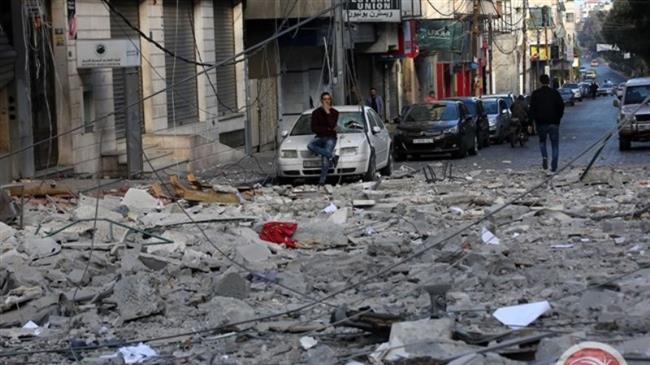
Israel is actively pushing Palestinians to leave the Gaza Strip, asking a number of European and Middle Eastern countries to absorb them and offering to arrange their flights if they agree to emigrate.
The policy was disclosed by a senior official accompanying Israeli Prime Minister Benjamin Netanyahu on a diplomatic visit to Ukraine this week.
Israel pushing Palestinians to leave Gaza https://t.co/LA7yO7Sxun pic.twitter.com/dCtDUJZ4Kk
— Electronic Intifada (@intifada) August 20, 2019
The unnamed official told reporters yesterday that Israel is in contact with third countries to see if they would be willing to absorb Palestinians from the besieged enclave, adding that:
“Israel is even willing to arrange transportation for them, at least to one of the airports in the Negev and arrange for them to travel out of the country”.
Israel’s National Security Council has been spearheading the initiative, with Netanyahu’s blessing, for about a year, the Times of Israel reported, citing the official.
Israel willing to let Gazans who want to emigrate to fly out via its territory, official says https://t.co/xPfKo3hZJJ
— Haaretz.com (@haaretzcom) August 19, 2019
The Israeli daily added that the program has also been discussed several times in Israel’s security cabinet.
The official conceded that, thus far, Israel has been unable to find any country willing to cooperate with its initiative, despite speaking to a number of Middle Eastern and European states.
He also claimed that thousands of Gazans are leaving of their own volition, pointing to 35,000 Palestinians who left the Strip in 2018. “That’s a pretty high number,” the official stated, even claiming that those who remain “are being held hostage in Gaza”.
#Israel actively pushing #Palestinian #emigration from #Gaza, official says. Senior official says Jerusalem looking for other countries to take in emigres, willing to let Gazans use Israeli airport to leave pic.twitter.com/27q0HN2262
— Eli Dror (@edrormba) August 19, 2019
The official, however, failed to mention Israel’s now 12-year-old siege of the Strip – which has devastated its infrastructure, economy, health sector and Palestinians’ livelihoods – or its three assaults on Gaza in the past decade. The UN has predicted that the Strip will be “unliveable” by 2020, calling the fate of Gaza’s some 1.9 million Palestinians into question.
Commentators have slammed the revelation, with Joint List Knesset Member (MK) Yousef Jabareen writing on Twitter: “The country that should welcome Palestinians from Gaza is Israel which, along with its obligation to remove the blockade on Gaza, should respect UN resolutions regarding Palestinian refugees as a part of a just and peaceful solution to the conflict.”
Paraguay Labels Hamas, Hezbollah ‘Terrorist Groups’; Israel Applauds
teleSUR | August 19, 2019
Israeli Prime Minister Benjamin Netanyahu praised Paraguay’s decision Monday to label Palestinian organization Hamas and Lebanese militant group and political party Hezbollah, as “international terrorist organizations,” a move that comes shortly after Argentina first blacklisted Hezbollah.
“I welcome the decision of Paraguayan President Mario Abdo to define Hezbollah and Hamas as terrorist organizations,” Netanyahu said in a statement before he added that Israel is “working so that more countries will also take this important step.”
Paraguay announced its decision on Monday to designate the Lebanese group, along with the political faction of Hamas that governs Gaza in Palestine, as terrorist groups. The South American country’s presidency detailed that Hamas and Hezbollah will be ranked “international terrorist organizations” and al-Qaeda and the Islamic State group “global terrorist organizations”. The difference between the labels was not made clear.
With this resolution, the country “recognizes and reaffirms its commitment to redouble efforts to prevent and combat violent extremism”, the presidency stated.
Several states have already listed both groups as terrorists, among them Israel, the United States, and Canada. Washington designated Hezbollah as a terrorist organization in 1997. However, the U.S. has been recently leading a fierce campaign in the backdrop of its warmongering against Iran and has been pushing more and more countries to designate the Hezbollah (which is backed by Iran) as a terrorist group.
Argentina was the first Latin American country to take the step, gaining recognition from Washington’s neoconservatives, including U.S. Secretary of State Mike Pompeo.
Following Argentina’s move, a group of Republican lawmakers called on Pompeo to pressure Brazil and Paraguay to act the same and to designate Hezbollah.
“Argentina, Brazil, and Paraguay are in a unique position to take meaningful strides in the fight against terrorism at the hands of Hezbollah,” said Republican Senator Marsha Blackburn in a statement at the time.
“We must recommit to ensuring that Hezbollah and other Iranian proxies are denied the resources they need to escalate their campaign of global terrorism,” added Ted Cruz, another Republican senator and co-signatory of the letter to Pompeo.
Hezbollah and Hamas leaders say their movements are resistance movements. The Palestine Islamic Resistance Movement (Hamas) was created out of the military occupation of the West Bank, Jerusalem, and Gaza, while the Lebanese Party of God (Hezbollah) rose to oppose the presence of Israel in the south of Lebanon.
The pressure exercised on Israel to leave the south of Lebanon (2000) and Gaza (2005) produced massive popular support which resulted in victories in both municipal and national elections. Both armed groups shifted since then towards increasingly passive policies, though at the same time they continue to be condemned to ostracism by Israel, the U.S. and Europe.
Last month, Trump’s administration imposed sanctions on Hezbollah political officials, including members of the Lebanese parliament, accusing the group of threatening the “economic stability and security of Lebanon and the wider region.”
RELATED:
Palestinian Authority warns of Israel’s plan for spatial division of Al-Aqsa Mosque

MEMO | August 19, 2019
Palestinian Authority (PA) yesterday warned of Israeli attempts to impose spatial divisions at Al-Aqsa Mosque as part of the electoral campaigns of right-wing parties led by current Prime Minister Benjamin Netanyahu, Assabeel newspaper reported.
In a statement, the PA’s Foreign Ministry said that the ruling Israeli right-wing, headed by Netanyahu, “has been carrying out hundreds of judaisation projects” aiming to “change the status quo in Jerusalem, its holy sites and the surrounding neighbourhoods.”
“This judaisation campaign has been escalating in the light of the unprecedented and unlimited American support.”
“Israel believes it is almost completing its mission regarding the future of Jerusalem, so that it is taking punitive measures and putting pressure on Jerusalemites in order to push them out of the city,” the statement continued.
It is also working to impose temporal divisions at the Al-Aqsa Mosque compound “ahead of reaching a point to completely demolish it.”
This, it said, was Israel’s “open war” against Al-Aqsa, Jerusalem and Jerusalemites.
The Deeper Meaning in a Lost War
By Alastair Crooke | Strategic Culture Foundation | August 19, 2019
It’s pretty clear. Saudi Arabia has lost, and, notes Bruce Riedel, “the Houthis and Iran are the strategic winners”. Saudi proxies in Aden – the seat of Riyadh’s Yemeni proto-‘government’ – have been turfed out by secular, former Marxist, southern secessionists. What can Saudi Arabia do? It cannot go forward. Even tougher would be retreat. Saudi will have to contend with an Houthi war being waged inside the kingdom’s south; and a second – quite different – war in Yemen’s south. MbS is stuck. The Houthi military leadership are on a roll, and disinterested – for now – in a political settlement. They wish to accumulate more ‘cards’. The UAE, which armed and trained the southern secessionists has opted out. MbS is alone, ‘carrying the can’. It will be messy.
So, what is the meaning in this? It is that MbS cannot ‘deliver’ what Trump and Kushner needed, and demanded from him: He cannot any more deliver the Gulf ‘world’ for their grand projects – let alone garner together the collective Sunni ‘world’ to enlist in a confrontation with Iran, or for hustling the Palestinians into abject subordination, posing as ‘solution’.
What happened? It seems that MbZ must have bought into the Mossad ‘line’ that Iran was a ‘doddle’. Under pressure of global sanctions, Iran would quickly crumble, and would beg for negotiations with Trump. And that the resultant, punishing treaty would see the dismantling of all of Iran’s troublesome allies around the region. The Gulf thus would be free to continue shaping a Middle East free from democracy, reformers and (those detested) Islamists.
What made the UAE – eulogised in the US as tough ‘little Sparta’ – back off? It was not just that the Emirs saw that the Yemen war was unwinnable. That was so; but more significantly, it dawned on them that Iran was going to be no ‘doddle’. But rather, the US attempt to strangulate the Iranian economy risked escalating beyond sanctions war, into military confrontation. And in that eventuality, the UAE would be devastated. Iran warned explicitly that a drone or two landed into the ‘glass houses’ of their financial districts, or onto oil and gas facilities, would set them back twenty years. They believed it.
But there was another factor in the mix. “As the world teeters on the edge of another financial crisis”, Esfandyar Batmanghelidj has noted, “few places are being gripped by anxiety like Dubai. Every week a new headline portends the coming crisis in the city of skyscrapers. Dubai villa prices are at their lowest level in a decade, down 24 percent in just one year. A slump in tourism has seen Dubai hotels hit their lowest occupancy rate since the 2008 financial crisis – even as the country gears up to host Expo 2020 next year. As Bloomberg’s Zainab Fattah reported in November of last year, Dubai has begun to “lose its shine,” its role as a center for global commerce “undermined by a global tariff war—and in particular by the US drive to shut down commerce with nearby Iran””.
An extraneous Houthi drone landing in Dubai’s financial zone would be the ‘final nail in the coffin’ (the expatriates would be out in a flash) – a prospect far more serious than the crisis of 2009, when Dubai’s real estate market collapsed, threatening insolvency for several banks and major development companies, some of them state-linked – and necessitating a $20 billion bailout.
In short, the Gulf realised MbS’ confrontation project with Iran was far too risky, especially with the global financial mood darkening so rapidly. Emirati leaders faced off with MbZ, the confrontation ideologue – and the UAE came out of Yemen formally (though leaving in situ its proxies), and initiated outreach to Iran, to take it out of that war, too.
It is now no longer conceivable that MbS can deliver what Trump and Netanyahu desired. Does this then mean that the US confrontation with Iran, and Jared Kushner’s Deal of the Century, are over? No. Trump has two key US constituencies: AIPAC and the Christian Evangelical ‘Zionists’ to ‘stroke’ electorally in the lead up to the 2020 elections. More ‘gifts’ to Netanyahu in the lead into the latter’s own election campaign are very likely also, as a part of that massaging of domestic constituencies (and donors).
In terms of the US confrontation with Iran, it seems that Trump is turning-down the volume on belligerence toward Iran, hoping that economic sanctions will work their ‘magic’ of bringing the Islamic Republic to its knees. There is no sign of that however – and no sign of any realistic US plan ‘B’. (The Lindsay Graham initiative is not one).
Where does that leave MbS in terms of US and Israeli interests? Well, to be brutal, and despite the family friendships … ’expendable’, perhaps? The scent of an eventual US disengagement from the region is again hanging in the air.
The deeper meaning in the ‘lost Yemen war’, ultimately, is an end to Gulf hopes that ‘magician’ Trump would undo the earlier Gulf panic that the West would normalise with Iran (through the JCPOA), thus leaving Iran as the paramount regional power. The advent of Trump, with all his affinity towards Saudi Arabia, seemed to Gulf States to promise the opportunity again to ‘lock in’ the US security umbrella over Gulf monarchies, protecting these states from significant change, as well as leaving Iran ‘shackled’, and unable to assume regional primacy.
A secondary meaning to Yemen is that Trump and Netanyahu’s heavy investment in MbS and MbZ has proved to be chimeric. These two, it turned out were ‘naked’ all along. And now the world knows it. They can’t deliver. They have been bested by a ragtag army of tough Houthi tribesmen.
The region now observes that ‘war’ isn’t happening (although only by the merest hair’s breadth): Trump is not – of his own volition – going to bomb Iran back to the 1980s. And Gulf States now see that if he did, it is they – the Gulf States – who would pay the highest price. Paradoxically, it has fallen to the UAE, the prime agitator in Washington against Iran, to lead the outreach toward Iran. It represents a salutary lesson in realpolitik for certain Gulf States (and Israel). And now that it has been learned, it is hard to see it being reversed quite so easily.
The strategic shift toward a different security architecture is already underway, with Russia and China proposing an international conference on security in the Persian Gulf: Russia and Iran already have agreed joint naval exercises in in the Indian Ocean and Hormuz, and China is mulling sending its warships there too, to protect its tankers and commercial shipping. Plainly, there will be some competition here, but Iran has the upper hand still in Hormuz. It is a powerful deterrent (though one best threatened, but not used).
Of course, nothing is assured in these changing times. The US President is fickle, and prone to flip-flop. And there are yet powerful interests in the US who do want see Iran comprehensively bombed. But others in DC – more significantly, on the (nationalist) Right – are much more outspoken in challenging the Iran ‘hawks’. Maybe the latter have missed their moment? The fact is, Trump drew back (but not for the stated reasons) from military action. America is now entering election season – and it is fixated on its navel. Foreign policy is already a forgotten, non-issue in the fraught partisan atmospherics of today’s America.
Trump likely will still ‘throw Israel a few bones’, but will that change anything? Probably, not much. That is cold comfort – but it might have been a lot worse for the Palestinians. And Greater Israel? A distant, Promethean hope.
Police raid Aqsa Mosque’s Bab al-Rahma, seize furniture

Days of Palestine – August 18, 2019
Israeli occupation police, on Saturday evening, stormed Al-Aqsa Mosque’s Bab al-Rahma prayer area and confiscated some furniture items.
Local sources said that Israeli police officers desecrated the Bab al-Rahma prayer area and embarked on carrying away shoe cabinets and patterned wood panels.
The sources added that the officers threatened Aqsa guards with arrest if they tried to prevent them from carrying out the confiscations.
The Israeli police had already removed furniture from the same prayer area recently, raising fears among the Jerusalemites about Israeli intents to reclose the place and turn it into a synagogue.
FCO Speeds Up Planning to Move UK Embassy to Jerusalem
By Craig Murray | August 18, 2019
Following US National Security Adviser John Bolton’s talks with Boris Johnson and his ministers in London last week, FCO officials have been asked to speed up contingency planning for the UK to move its Embassy in Israel from Tel Aviv to Jerusalem, with an eye to an “early announcement” post Brexit.
The UK is currently bound by an EU common foreign policy position not to follow the United States in moving its Embassy to Jerusalem. As things stand, that prohibition will fall on 1 November. FCO officials had previously been asked to produce a contingency plan, but this involved the construction of a £14 million new Embassy and a four year timescale. They have now been asked to go back and look at a quick fix involving moving the Ambassador and immediate staff to Jerusalem and renaming the Consulate already there as the Embassy. This could be speedily announced, and then implemented in about a year.
Johnson heads the most radically pro-Israel cabinet in UK history and the symbolic gesture of rejection of Palestinian rights is naturally appealing to his major ministers Patel, Javid and Raab. They also see three other political benefits. Firstly, they anticipate that Labour opposition to the move can be used to yet again raise accusations of “anti-semitism” against Jeremy Corbyn. Secondly, it provides good “red meat” to Brexiteer support in marking a clear and, they believe, popular break from EU foreign policy, at no economic cost. Thirdly, it seals the special link between the Trump and Johnson administrations and sets the UK apart from other NATO allies.
Bolton also discussed the possibility of UK support for Israeli annexation of areas of the West Bank to “solve” the illegality of Israeli settlements on occupied territory. My FCO sources believe this is going to be much more difficult politically for the Cabinet to agree than simply moving the Embassy, due to lack of support on their own backbenches.
This is an insight into the future of British foreign policy if the Johnson government, and the UK, both survive. In the massive defeat of the UK at the UN General Assembly two months ago over the illegal occupation of the Chagos Islands, the UK was in a voting block with only the USA, Israel, Australia, Hungary and the Maldives, against the rest of the world. The Maldives had a particular maritime interest there, but the leadership of the others – Donald Trump, Viktor Orban, Scott Morrison, Benjamin Netanyahu and now Boris Johnson – constitute a distinct and extreme right wing bloc. These are very worrying times indeed.
Sarin in Syria: chemistry, and cui bono?
By Philip Roddis – steel city scribblings – August 17, 2019
The exchange below took place a few days ago, below the line of an OffGuardian piece on the corruption of the UN’s Organisation for the Prohibition of Chemical Weapons (OPCW) as shown in its handling of last year’s Douma incident.
Louis Proyect is one of many on the marxist left I think dead wrong on Syria – see my post from last year on Workers’ Power. He professes bafflement that marxists could defend evil Assad.
Me, I’m baffled that any marxist could buy, on such negligible evidential basis, the demonising of a third world leader who stands in the way of imperialist powers with multiple motives (oil pipeline, privatisation, Golan theft, hurting Iran and Russia) for crushing Ba’athism – and with a record as long as your arm of lying at every turn as to the why of it.
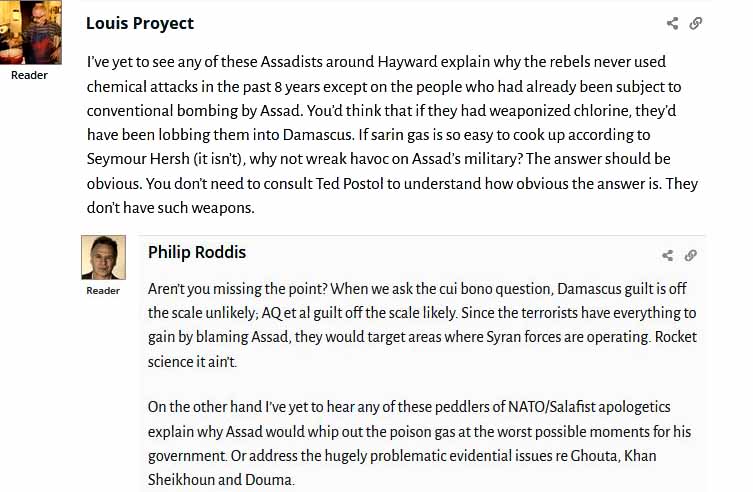
I’m even more baffled that anyone could take seriously a man who describes Vanessa Beeley – one of the most high profile reporters to challenge official NewSpeak on Assad – as “too ugly to fuck”.
Classy.
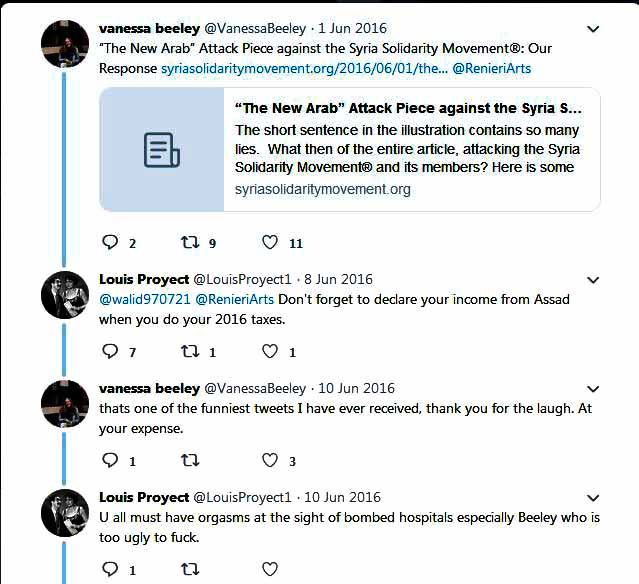
Moving on, Proyect claims – I’ve heard the Guardian’s George Monbiot do the same – that sarin is hard to manufacture; certainly beyond the capacity of Islamist groups working to bring down Assad. Since neither Proyect not Monbiot are experts, I’ll turn to those who are.
Let none accuse me of cherry picking. This piece, from Wired two years ago, is vehemently of the view that Assad does have sarin, and does use it.
[Sarin] is not especially hard to produce, in terms of both resources and expertise. “A competent chemist could make it, and possibly very quickly, in a matter of days,” says John Gilbert, a senior science fellow at the Center for Arms Control and Non-Proliferation, who spent much of his Air Force career assessing countries’ WMD capabilities. Producing sarin doesn’t require any kind of massive facility; a roughly 200 square foot room would do.
Author Brian Barrett, eager to make the case that Damascus could have rebuilt sarin stockpiles after the OPCW oversaw their destruction in 2014, inadvertently blows Proyect’s and Monbiot’s argument clean out of the water!
We should also note the Tokyo subway attack of March 20, 1995. Perps? Aum Shinrikyo, a bunch of doomsday wingnuts originating as a yoga and meditation group devoted to a mishmash of deities with Hinduism’s Shiva – the destroyer – in overall charge and channelling through head wacko Shoko Asahara. Says wiki:
Tsuchiya [a member] had established a small laboratory in Kamikuishiki in 1992. After initial research (at Tsukuba University, where he had studied chemistry) he suggested to Hideo Murai – a senior Aum advisor who had tasked him with researching chemical weapons, out of fear the cult would soon be attacked with them – that the most cost-effective substance to synthesise would be sarin.
He was ordered to produce a small amount – within a month, the necessary equipment had been ordered and installed, and 10-20g of sarin produced via synthetic procedures derived from the five-step DHMP process as originally described by IG Farben in 1938, and as used by the Allies after World War II.
Murai then ordered Tsuchiya to produce 70 tons. When Tsuchiya protested that this was not feasible in a research laboratory, a chemical plant was ordered to be built alongside the biological production facility in the Fujigamine district of Kamikuishiki, to be labelled Satyan-7 (‘Truth’). The equipment and substantial chemicals were purchased using shell companies under Hasegawa Chemical, already owned by Aum. At the same time, in 1993, cult members travelled to Australia, bringing generators, tools, protective equipment (including gas masks and respirators), and chemicals to make sarin.
Are we seriously to suppose that ‘moderate Islamists’ operating in Syria with barely hidden aid from Israel, Saudi Arabia, Turkey and – not least through the likes of White Helmets – the West are less resourceful than this bunch of millennial crazies?
It amazes me, perhaps because I still deem them deluded but sincere, that so many fail to see that on Syria, and much besides, we are being lied to on a monumental scale and will continue to be lied to until we wake up and demand the truth.
Scribbler for some sixty years, and for fifteen a photographer too, Philip Roddis began blogging in the early noughties by inflicting film reviews on an unsuspecting public. Soon he was doing the same with illustrated writings on wanderings in Asia and Africa. He writes “to help me think, and because I like to be read”, and finds photography’s problem solving aspects “a break from those of writing, as well as an aid to writing and to reflective travel”.
Featured Video

Seyed M. Marandi: US-Iran War Inevitable: Kuwait and Bahrain May Fall
or go to
Aletho News Archives – Video-Images
From the Archives
Oil and the Israel Lobby
Reknowned economist M. Shahid Alam offers this excellent critique of Noam Chomsky’s defective analysis of the relative influence of Oil versus the Israel lobby over US foreign policy: … continue
Blog Roll
 Aletho News
- Israel’s Military Actions in Lebanon Grossly Violate International Law — Lavrov
- Seyed M. Marandi: US-Iran War Inevitable: Kuwait and Bahrain May Fall
- Leaders Condemn Ansarallah Attack on Saudi Arabia While Ignoring Illegal War Against Yemen
- Leaked: Britain’s Covert Iraqi Psyops Network
- Yemeni Armed Forces Warn Airlines Against Using Saudi Airports, Exempt Mecca and Medina
- Iran security chief says powers greater than US tried to conquer Iran but ended in ‘dustbin of history’
- Europe’s mounting social chaos… chickens coming home to roost for proxy war against Russia
- US-Russia Diesel Deal Becomes Massive Defeat for Ukraine
- Hormuz and the Looming Economic Catastrophe
- Dhubab offensive, media blitz and the rapid unraveling of Saudi-backed coalition’s new gambit
- If Americans Knew
- Gaza: Ceasefire Anniversary Marks Year of Failed Promises
- The American Conservative: Mike Huckabee Should Resign
- A C-Section in Shackles: A Palestinian Woman’s Harrowing Birth in Israeli Detention
- ‘He’s Desperate’: AIPAC Begins Spending Against Abdul El-Sayed to Boost Mike Rogers:
- Trump, Hormuz, and the Looming Economic Catastrophe
- For three years, Israel has killed a child in Gaza every 71 minutes – Daily Update
- Israeli forces kill another child in Gaza – Daily Update
- Gaza ceasefire exists in name only, say more than 100 organizations
- Nearly 2 Million in Gaza Need Urgent Shelter Assistance as Winter Looms: IOM Chief Warns
- Suppressing Palestinian resistance: US charity under fire for AI monitoring of Gaza classrooms
- No Tricks Zone
- Germany’s Green Energy Debacle: High Energy Costs Force Kahla Porzellan to Close After 182 Years!
- New Study: 50 Years Of The Most Aggressive ‘Net Zero’ Policies Can Only Affect The Global Climate By 0.03°C
- US September “Heat” Was No Record…Many Records Set Decades Ago
- Latest European Green Energy Debacle; Portugal’s Largest Flagship Solar Park Insolvent!
- Green Energy Debacle: German Expert Professor Fritz Vahrenholt Warns Of Severe Economic And Social Consequences
- Two More Paleo Reconstructions Affirm Meters-Higher Sea Levels Across Ireland, Brazil 7000-6000 Years Ago
- New Study: Earth And Venus Surface Warmth Largely Explained By Convection And Lapse Rate, Not CO2 Or Radiation
- 2025 Nature Paper Claiming Worsening Global Drought Gets RETRACTED …Heavily Flawed
- New Study: ‘Global Drought Shows No Detectable Recent Acceleration Under Climate Warming’
- Economic Masterminds: German Socialists Suggest Taxing Productivity Gains Stemming From Using AI

