We must boycott Israeli sports as we did with Apartheid South Africa
By Ramzy Baroud | MEMO | August 14, 2019
The Palestinian Football Association is struggling to survive. Combined US-Israeli pressure on Palestinian organisations that provide aid and support to the Palestinian people is now felt in the field of sports as well. In recent months, the association’s budget has been slashed by more than half, and the new football season may be cancelled entirely.
In Palestine, football in particular, represents more than just a game. It provides respite, continuity, hope, and unity.
The Palestine Football Association has been in existence since 1928, that is 20 years before Israel was founded on destroyed Palestinian cities, towns and villages. But, not even the tragic Nakba would end the sport in Palestine. When Palestine was admitted as a full member of the Fédération Internationale de Football Association (FIFA) in 1998, a rare moment of triumph prevailed over the sense of political stagnation. The Palestinian national team became a representation of a collective sense of pride and defiance. It meant that despite Israeli military restrictions, the targeting of Palestinian athletes and the bombing of stadiums and sports facilities, Palestinians continue to embrace life and thrive.
Even after the factional clash between Fatah and Hamas and the subsequent political disconnect between Gaza and the West Bank, sports continued to provide a critical outlet for unity. While Gaza and the West Bank have their own football leagues, they still competed in a final match to determine the winner of the Palestine Cup.
Alas, last month, Israel prevented the Rafah football team from reaching the West Bank, to meet its Balata Youth Centre rivals in the Cup’s final match.
Israel’s restrictions on Palestinian sports is relentless and is part of a long record of making it nearly impossible for Palestinians to pursue activities that should have no bearing on “Israel’s security”.
The Palestine national team is possibly the most beleaguered football team in the world today.
“Due to Israeli restrictions, the Palestinian national team has been banned from playing their home games in Palestinian stadiums for many years and is forced to host them in nearby Arab countries,” wrote Hazem Balousha in Arab News. Effectively, this means that all Palestinian football training camps have to be held outside Palestine, often with the team’s Gaza squad unable to join their peers. Meanwhile, no foreign trainers are allowed to enter besieged Gaza.
Moreover, the occasional news of a Palestinian footballer being shot, beaten or imprisoned, though tragic, is routine news for Palestinians.
Israel has, however, hardly received any serious reprimand for its unlawful actions. Despite Tel Aviv’s constant violations of Palestinian sports rights, FIFA and other international sports federations continue to treat Israel with kid gloves. Worse, instead of being punished for violating international law regarding sports, Israel is often rewarded. The fact that Israel’s Football Association includes six teams from illegal Jewish settlements (colonies that are built on stolen Palestinian land) seems to be of no consequence to FIFA’s bosses.
Recently, the sports brand, Puma has replaced Adidas as the sponsor of Israel’s national football teams. The decision indicates that the company is completely oblivious to sports apartheid in Israel. Puma’s lack of sportsmanship is now the subject of a major international boycott campaign led by the Boycott, Divestment and Sanctions (BDS) movement. Over 200 Palestinian sports clubs support the call on Puma to end its dealings with Israel, in an attempt to pressure Israel to put an end to its violations of Palestinian human rights.
In fact, Israel should be boycotted in every possible way until it relents and respects international law regarding the rights and freedom of the Palestinian people. Often, however, we overlook the centrality of sports boycott in the overall boycott strategy.
Sports boycott engages, not only politicians and intellectuals but also ordinary people around the world. “The case for football boycott of Israel is just as compelling as that of football boycott of South Africa,” BDS wrote on its homepage. For one, “boycott would spread awareness of Israeli racism and abuse of Palestinian human rights across the football community worldwide.”
Moreover, boycotting Israeli sports, especially football, will deny Israel an important tool aimed at normalising its military occupation, apartheid, and racism. It will force ordinary Israelis to think about the consequences of their support of right-wing racist governments. It could, in fact, it will espouse a serious debate in Israel.
This same logic worked in Apartheid South Africa and was a powerful tool in the international support for the anti-Apartheid movement in that country.
But with FIFA and others turning a blind eye to Israeli violations, Palestinians continue to suffer while Israel continues to sell itself as a sports-loving member of FIFA and other sports organizations.
“Divestment and boycotts are familiar tactics from the international anti-apartheid movement, but they didn’t match the psychological power of the sports boycott,” wrote Tony Karon in the National.
“Rugby was an essential part of the identity of the South African regime’s base, and denying their ability to compete on an international stage was one of the most painful sanctions in the minds of many apartheid supporters.”
As for FIFA, it suspended the membership of the Football Association of South Africa in 1961, followed by a decision, in 1968 by the United Nations General Assembly that called for boycotting all sports bodies in South Africa that practiced apartheid. The pressure continued to mount, uniting international solidarity around clear and achievable objectives.
Many organisations have taken the lead in their respective countries to create a similar movement for Palestine. Israel must not be allowed to participate in international sports while simultaneously cementing its apartheid, racist regime in Palestine.
Majority Leader Steny Hoyer
Israel’s man in the House of Representatives

By Philip Giraldi • Unz Review • August 13, 2019
It is astonishing that in the wake of the two mass killings in Dayton and El Paso that have been attributed both by the media and the Democrats to “racism,” a senior U.S. Congressman has led a delegation of 41 of his Democratic Party colleagues plus spouses on a week-long luxury all-expenses-paid trip to Israel, which is one of the few countries in the world that defines its full citizenship as a matter of race and religion. House Majority Leader Steny Hoyer of Maryland is, however, apparently tone deaf to some critics of the annual excursion, having made the pilgrimage to Israel more than fifteen times. “I am pleased to join so many House Democrats in traveling to Israel to reaffirm our support for a critical U.S. ally and to continue learning about the opportunities and the challenges facing Israel and the Middle East,” he said shortly before departing for Tel Aviv.
Hoyer did not mention how he had managed to pull together such a large group of co-conspirators in spite of critical issues that need to be confronted at home during recess in town hall meetings, which, due to the trip, will operate on a short schedule if at all. As Majority Leader, he is reported to be skilled at strong-arming new colleagues to compel them to make the trip to demonstrate the loyalty of the U.S. Congress and the Democratic Party to the Jewish state, which is his top priority. According to The Intercept, “Hoyer… uses his power over the House floor agenda to coerce participation. A member who refuses an invitation can find it difficult to have their bills brought to the floor for a vote. ‘His senior staff lock down cooperating members by getting their bills to the floor and punishing non-cooperators,’ said one former representative who rejected the invitation. ‘I was tortured for a decade because I refused to go on that trip…’”
Of course, the Israelis are themselves seasoned professionals when it comes to mass shooting, something that they do every Friday across the fence into Gaza, but they are unlikely to demonstrate their marksmanship to the visiting congressmen. They in any event know that Israel will never be condemned in fora like the United Nations Security Council because of the exercise of Washington’s veto. Hoyer and company are the reason that there is such a veto even though Israel is a serial war criminal and human rights violator, so in a sense he and his Democratic Party friends are the reason why the Jewish state believes itself empowered to behave so badly. And, lest anyone is worried about bipartisanship, the Republicans too have a delegation in Israel headed by House Minority leader Kevin McCarthy consisting of 31 congressmen. The 72 congressmen from both parties constitute one of the largest delegations ever to travel to to the Jewish state.
Hoyer is a bought and paid for Israeli puppet and a big part of his job is to make sure that new Congressmen and women are adequately brainwashed regarding what is going on in the Middle East. Maryland’s Democratic Party has long been dominated by Jews from Baltimore and Montgomery County and Hoyer has successfully cultivated Jewish congressmen to advance his career. He has benefited directly from $320,025 pro-Israel PAC donations to fund his reelection campaigns and has undoubtedly also received generous donations from individual Jews and from organizations not organized as PACs.
Steny Hoyer’s foreign policy votes in Congress have not surprisingly mirrored positions taken by the Israeli government. He supported the attack on Iraq and was in fact very possibly the most prominent promoter of the war among Democrats. When the war became a foreign policy disaster, he muted his approval of it but has continued to vote for funding of U.S. military involvement in both Iraq and neighboring Syria.
Hoyer’s support of Israel is unshakable and he has often appeared and spoken before the American Israel Public Affairs Committee (AIPAC) annual summit. At his most recent appearance this past spring his keynote speech included “I stand with Israel, proudly and unapologetically. So, when someone accuses American supporters of Israel of dual loyalty, I say: accuse me. I am part of a large, bipartisan coalition in Congress supporting Israel. I tell Israel’s detractors: accuse us.” Well, he got that right. He and many other congressmen do suffer from dual or even singular loyalty when it comes to Israel.
In 2007 Hoyer notably called out fellow Democrat Representative Jim Moran for stating correctly that AIPAC “has pushed (the Iraq) war from the beginning.” Hoyer called the statement “factually inaccurate,” which was not the case. He is a supporter of the Israeli illegal settlements, which up until recently was contrary to both U.S. official policy and a number of United Nations resolutions. In January 2017, he was a leading advocate of a House of Representatives resolution condemning the U.N. Security Council Resolution 2334, which called both the settlements and the continued Israeli occupation of Palestinian land as a “flagrant violation of international law and a major obstacle to peace.” Hoyer also has supported President Donald Trump’s move of the U.S. Embassy to Jerusalem, recognizing the city as the Jewish state’s capital.
Israel’s enemies are also Hoyer’s enemies whether or not they threaten the United States. He has declared that an Iran with nuclear weapons is “unacceptable” and supports the use of American military force to deter such a development, ignoring the fact that Israel already has a nuclear arsenal which President John F. Kennedy tried to prevent before he was assassinated. Hoyer also supports keeping a U.S. military presence in Syria in spite of the lack of any threat to the United States from that direction, part of an Israeli plan to divide that country into its constituent tribal and religious parts.
Hoyer’s trip is paid for by the “educational” affiliate of AIPAC called the American Israel Education Foundation (AIEF). One might reasonably ask why an organization connected to AIPAC, which describes itself on its website as having the “mission” to “… strengthen, protect and promote the U.S.-Israel relationship in ways that enhance the security of the United States and Israel,” should be able to fund the annual mass migration of congress-critters to promote Israeli interests without having to register as an agent of the Jewish state’s government? The answer is actually quite simple. Congress and the Justice Department have been so corrupted by pro-Israel money and other manifestations of Jewish power that they do not enforce the law when it comes to Israel. Steny Hoyer and venal creatures like him are a large part of why that is so.
Nevertheless, analysis provided by Josh Ruebner at Mondoweiss cites “Dr. Craig Holman, Government Affairs lobbyist for Public Citizen, who drafted the 2007 Honest Leadership and Open Government Act (HLOGA), designed to curb the influence of lobbyist money in congressional travel” as saying that it ‘… is unequivocal that the arrangement between AIEF and AIPAC ‘defies the spirit as well as the letter of the law’.” The law itself prohibits Members of Congress from accepting from any organization with income of at least $13,000 per quarter “that retains or employs 1 or more registered lobbyists… funds earmarked directly or indirectly for the purpose of financing” travel by congressmen or women for longer than one day.
According to Holman, AIPAC, which spent $700,000 in lobbying during the second quarter of 2019 alone, gets around the prohibition by having AIEF, which is a 501(c)3 educational foundation that does no lobbying, do the funding. The loophole to permit congressional junkets beyond the one day is referred to as “the AIPAC loophole,” as its intent was clearly to permit congressional paid-for-by-lobbyists travel to Israel to continue. That the arrangement is essentially fraudulent is revealed by examination of the two entities’ tax returns, which reveals that AIPAC pays the AIEF employees.
The solution to the problem remains simple. Tighten up the Congressional travel rules to eliminate the “AIPAC exemption” while at the same time requiring AIPAC and the other prominent organizations that are part of the Israel Lobby to register under the Foreign Agents Registration Act of 1938, which would open up their finances and lobbying to more intense scrutiny. But, of course, Steny Hoyer and his friends will never allow that to happen.
Philip M. Giraldi, Ph.D., is Executive Director of the Council for the National Interest, a 501(c)3 tax deductible educational foundation (Federal ID Number #52-1739023) that seeks a more interests-based U.S. foreign policy in the Middle East. Website is councilforthenationalinterest.org, address is P.O. Box 2157, Purcellville VA 20134 and its email is inform@cnionline.org.
Dangerous Bill in Congress to Crush the PLO and PA

By Zaha Hassan | Al Shabaka | August 13, 2019
A bipartisan US bill currently being considered by the Senate Judiciary Committee puts at stake the ability of the Palestine Liberation Organization (PLO) to engage diplomatic and legal channels to support Palestinian national aspirations and to seek accountability through international mechanisms, as well as the future of the US-Palestinian bilateral relationship.
The Promoting Security and Justice for Victims of Terrorism Act of 2019, Senate Bill 2132, revises the Anti-Terrorism Clarification Act (ATCA) so that the PLO and the Palestinian Authority (PA) may be made to pay over $655 million in damage claims to American victims of political violence in Israel that had previously been dismissed by the 2nd Circuit Court of Appeals in 2016. The bill goes well beyond an attempt to obtain compensation for victims’ families. If the bill is successful, the US would revert to treating the PLO as a mere terrorist organization without national representative character.
What is ATCA and Why Did it Need to be “Fixed”?
ATCA, which became law in October 2018, enables American citizens to sue foreign entities for acts of terrorism occurring before the effective date of the Act if those entities accept US assistance. ATCA was a response to the failed attempt by the Shurat HaDin – Israel Law Center to hold the PA and PLO liable in US courts for the deaths of American citizens killed between 2002 and 2004 during the Second Intifada. A lower court had awarded over $655 million to 11 US families; however, the 2nd Circuit Court ordered the claims dismissed on the grounds that the attacks took place entirely outside US territory without evidence that Americans were specifically targeted. The Supreme Court denied Shurat HaDin’s request for review of the appellate decision.
Iowa Republican Senator Chuck Grassley fast-tracked ATCA without debate by using a process known as “hotlining.” Under normal circumstances, members of the Senate Judiciary Committee would have had time to analyze the legislation and foresee how it would force the PA to reject all US aid, including funds for Israeli-Palestinian security cooperation. Grassley’s procedural stratagem of pushing ATCA through the Judiciary Committee, at a time when members were preoccupied with the confirmation hearing of Supreme Court nominee Brett Kavanaugh, precluded careful consideration of the ramifications. The need to “fix” ATCA became clear to Congress when the Palestinian prime minister sent a letter to the US secretary of state refusing to accept any future US assistance.
How the ATCA “Fix” is a Game Changer
The Promoting Security and Justice for Victims of Terrorism Act of 2019 amends ATCA by allowing the PA to accept security assistance without triggering jurisdiction for terrorism-related claims. However, it introduces new avenues for the PLO and PA to be held liable: If the PLO continues to hold state status in UN agencies and bodies or at the International Criminal Court (ICC), or if PLO or PA officials enter the US on official business or maintain offices on US territory, then the previously dismissed damage claims will become due and future claims may be heard in US courts. The operation of Palestine’s mission to the UN in New York is excepted to the extent official UN business is being carried out; no other advocacy on behalf of Palestine or Palestinians may be conducted in the US.
Palestinians and those in the solidarity community may not appreciate how the Promoting Security and Justice for Victims of Terrorism Act could impact their human rights advocacy Click To TweetA more limited bill passed in the House of Representatives in July 2019 that also seeks to amend ATCA to ensure victims’ compensation for terrorism claims: The United States-Israel Cooperation Enhancement and Regional Security Act. This bill links jurisdiction to whether the PLO advances an application for membership in the UN or reopens an office on US territory. The different House and Senate amendments to ATCA will have to be reconciled.
If the Senate version of the ATCA fix becomes law, the PLO and PA will have to make a choice:
- Maintain their status at the UN and be held liable for previously dismissed terrorism claims, or
- Downgrade their status at the UN, forgo pursuit of war crimes claims against Israelis by withdrawing from the Rome Statute, the treaty establishing the ICC, and resume receiving US security assistance.
In the former case, the PA will bankrupt itself and the US will treat the PLO as nothing more than a terrorist organization. In the latter case, the PLO will have relinquished any pretense that it can effectively represent the rights and interests of the Palestinian people. Either case means the end of a Palestinian negotiating partner for any future peace talks.
Upholding Palestinian Rights to Representation
While many Republicans may have just this outcome in mind, Democrats, who still claim to support the two-state solution, may not understand the implications of the ATCA fix, just as they failed to understand the impact of ATCA in the first place.
Moreover, with all the focus on the anti- and pro-boycott resolutions in the House, many Palestinians and those in the solidarity community may not fully appreciate how the international delegitimization or bankrupting of the PLO – the body still recognized as the sole legitimate representative of the Palestinian people – could impact their human rights advocacy in the US and globally. Whatever one’s views about the PLO or PA, no longer having an address for the national aspirations of the Palestinian people will make international and US advocacy much more difficult.
Palestinians and those interested in a just peace should alert members of Congress to the impact of the Senate bill on the future of US-Palestinian bilateral relations and the possibility of finding a diplomatic resolution to the Palestine-Israel conflict. The Palestinian quest for self-determination and accountability for victims of war crimes should not be undermined to score short-term domestic political points that will have far-reaching implications for Mideast peace.
Al-Shabaka Policy Member Zaha Hassan is a human rights lawyer and visiting fellow at the Carnegie Endowment for International Peace. Her research focuses on Palestine-Israel peace, the use of international legal mechanisms by political movements, and U.S. foreign policy in the region. She previously served as coordinator and senior legal advisor to the Palestinian negotiating team during Palestine’s bid for UN membership from 2010-2012. She received her J.D. from the University of California at Berkeley and an LLM in Transnational & International Law from Willamette University.
Iraq rejects Israel’s role in Persian Gulf mission, warns of West’s presence
Press TV – August 12, 2019
Iraqi Foreign Minister Mohamed Ali al-Hakim has expressed his country’s opposition to the Israeli regime’s possible involvement in a US-led mission in the Persian Gulf, warning that the presence of foreign forces, including Western countries, in the strategic water body will be fueling tensions.
“Iraq rejects the participation of Zionist forces in any military force to secure the passage of ships in the [Persian] Gulf. The [Persian] Gulf littoral states can together secure the transit of ships,” Hakim wrote in a post published on his official Twitter page on Monday.
“Iraq is seeking to reduce tension in our region through peaceful negotiations,” he said, warning that “the presence of Western forces in the region will increase tension.”
The remarks came a day after Iran’s Islamic Revolution Guards Corps (IRGC) warned that any Israeli presence in the Persian Gulf may result in a war in the region, and that the responsibility for the consequences of such illegal presence lies with the United States and the United Kingdom.
“The United States and the United Kingdom must assume responsibility for the Zionist regime’s illegal presence in the Persian Gulf waters,” IRGC Navy Commander Rear Admiral Alireza Tangsiri told Lebanon-based Arabic-language al-Mayadeen television news network on Sunday.
“Any presence of the Zionist regime in the Persian Gulf waters is illegal, as it may result in war and confrontation in the region,” the top commander warned.
Israeli foreign minister Israel Katz said on August 7 that the regime would be part of the US-led coalition to “protect the security of the Persian Gulf.”
Katz claimed that Israel was determined to stop “Iranian entrenchment” in the Middle East region and strengthen Tel Aviv’s relationship with the Persian Gulf countries, Israeli news website Ynet reported.
On August 9, Iranian Foreign Ministry Spokesman Abbas Moussavi highlighted that the Islamic Republic regards possible Israeli presence in a US-led coalition in the Persian Gulf as a clear threat to its national security, and reserves the right to counter it.
“Within the framework of the country’s deterrence and defensive policy, the Islamic Republic of Iran reserves the right to counter this threat and defend its territory,” Moussavi noted.
“The US regime and the illegitimate Zionist regime are responsible for all the consequences of this dangerous move,” the spokesman added.
US Marine General Joseph Dunford, chairman of the Joint Chiefs of Staff, said on July 9 that the US was proceeding with plans to assemble the coalition purportedly aimed at ensuring freedom of navigation in waters off Iran and Yemen.
“We’re engaging now with a number of countries to see if we can put together a coalition that would ensure freedom of navigation both in the Straits of Hormuz and the Bab el-Mandeb,” Dunford said.
“And so I think probably over the next couple of weeks we’ll identify which nations have the political will to support that initiative and then we’ll work directly with the militaries to identify the specific capabilities that’ll support that,” he added.
Gentle and Loving but Still a Settler

By Jeremy Salt | American Herald Tribune | August 11, 2019
Last week a car drew up alongside Dvir Sorek outside the West Bank settlement of Migdal Oz. Dvir was on his way back from Jerusalem where he had bought a book, a novel by David Grossman, as a gift for his teacher. He was almost home when a man jumped out of the car and stabbed him to death.
David Grossman did not know him but did not hesitate to add to the eulogies: the young man was clearly “a kind, sensitive youth who loved others and loved peace with the soul of an artist.” Netanyahu declared that the murderers would soon be found. Soldiers swooped on the nearby Palestinian village of Beit Fajjar, raiding houses and confiscating security camera footage. Later four Palestinians were arrested in another village.
Grossman’s son was killed during the invasion of Lebanon in 2006, and Sorek’s grandfather on his mother’s side, a rabbi, also a settler of occupied land, killed in an attack near Nablus in 2000. These other deaths made the killing of Dvir Sorek seem even more poignant. “Death as a way of life,” declared the Times of Israel, blaming Hamas for the attack, even though the identity and possible ideological affiliations of the attacker/s were not known, as if the death of others was not a way of life for the state of Israel.
The media described Sorek as a student at a yeshiva, or religious school, in his case the hesder (‘arrangement’) yeshiva at Migdal Oz. The programs in the hesder schools blend advanced religious instruction with military service. Government funding makes an application to be listed as a hesder yeshiva an attractive option. Not all courses are of the same duration. They may last for three, four or even five years, with the active military service component varying from about 17 months to two years. Almost all hesder yeshiva students join combat units.
Officially, the peace-loving Dvir Sorek was an IDF soldier even though he had not yet begun the military component of his course. No doubt this is the reason he was not armed when he was attacked.
In the West Bank yeshiva students, or former yeshiva students, especially those who fall under the heading of the ‘hilltop youth,’ are in the forefront of anti-Palestinian violence, from beating and occasionally killing to attacks on mosques, the destruction of olive trees and crops and the harassment, intimidation and abuse of the general population in general, women and children included. Their hatreds extend to all non-Jews and even ‘Hellenized’ or secular Jews, including those representing the state, including the soldiers who protect them. One has to wonder where this comes from if not religious instruction at the hands of their rabbis.
The history of the hesder schools go back to the 1960s. More recently, the lack of enthusiasm for war among Israel’s secularized youth, especially wars fought on the other side of what they regarded as Israel’s borders, has increased the appeal of religiously indoctrinated hesder zealots to the military command.
For secular Israeli Jews the enemies are Hamas, Hizbullah, Syria and behind them, Iran, but for orthodox religious Jews, the enemy is Amalek, existential, taking different shapes and different forms at different stages of history but always there.
The injunction to destroy the tribe of Amalek is laid down in several passages of the Bible. According to Deuteronomy: “The Lord said to Moses ‘Write this down in a book to be remembered and tell it to Joshua: (God) will completely blot out any memory of Amalek … Remember what Amalek did to you on the road as you were coming out of Egypt, how he met you on the road, attacked those in the rear, those who were exhausted and straggling behind when you were tired and weary. He did not fear God. Therefore, when the Lord your God has given you rest from all your surrounding enemies in the land the Lord your God is giving you as your inheritance to possess you (Israelites) are to blot out all memory of Amalek from under heaven. Don’t forget!’ (Deuteronomy 25/17-19).
The message to the first king of Israel and Judah, Saul, from the prophet Samuel is even more forceful: “Now go, attack the Amalekites and totally destroy all that belongs to them. Do not spare them: put to death men and women, children and infants, cattle and sheep, camels and donkeys.’ (Samuel 1:15.3). Saul went to war against the Amalekites but did not kill them all, allowing their king to live and preserving the best of the livestock.
Learning of this, Samuel tells him he has been rejected by God and will lose his kingdom. He then kills the Amalekite himself. Saul lives until defeated by the Philistines in the battle of Gilboa, after which he either commits suicide or is killed by an Amalekite, according to differing Bible accounts but his death is seen as the consequence of having disobeyed God’s injunction to kill all the Amalekites.
All of this might have happened thousands of years ago – or did not happen as described – but it remains as fresh as yesterday in the thinking of orthodox religious scholars. In the modern age these injunctions are subject to numerous interpretations, partly based on what ‘blotting out’ could mean. Maimonides (12th-13th century) explains the commandment as meaning that if the Amalekites accepted Jewish law and agreed to pay a tax there would no need to kill them. There are numerous variations on the theme that ‘blotting out’ did not mean physical annihilation.
Steven Leonard Jacobs points out that the overwhelming majority of the world’s Jewish population does not draw such deadly conclusions, “much less the implication that they [the Palestinians] must be genocidally destroyed.” While those who do take the Biblical injunctions literally “are in the minority … they do exist and [they] present an ongoing challenge to how one reads history and sacred texts.” They keep the door open to violence: however wrongly understood, “there is an understanding that the enemies of the Jewish people are the literal and lineal descendants of the past.”
These genocidal invocations – as they would be regarded now – are read in synagogues at certain times of the year (during the ‘reading cycle’) and are emphasized again during the festival of Purim, celebrating the delivery of the Jews from Haman, the high Persian court official who planned to kill them all.
For the most extreme Jewish settlers, Amalek is still out there, waiting. According to Benzi Lieberman, former head of the Yesha settler council, “The Palestinians are Amalek … we will destroy them. We won’t kill them but we will destroy their ability to think as a nation. We will destroy Palestinian nationalism.”
However, Amalek is frequently invoked in the political mainstream, which has steadily shifted further to the right since the election of Menahim Begin in 1977 and now includes those once regarded as extremists if not outright fanatics. In the 1950s David Ben-Gurion referred to “the hosts of Amalek from north, east and south.” Begin opposed reparations from Germany, which he regarded as Amalek. During the siege of Beirut in 1982 he described PLO leader Yasser Arafat as Hitler hiding in his bunker, thus another manifestation of Amalek. Speaking in Cracow in 2010, without naming names but clearly thinking of Iran, Netanyahu said “A new Amalek is appearing and once again threatens to annihilate the Jews.” According to the ‘libertarian’ Israeli politician Moshe Feiglin “the Arabs engage in typical Amalek behaviour … I can’t prove this genetically but this is the behaviour of Amalek.”
Throughout history, while identifying Amalek as the existential enemy, Jews never had the power to destroy Amalek but now they do, in a state of their own that has an arsenal of nuclear weapons. According to Steven Jacobs “the propensity of rightwing settlers to identify the Palestinians with the Amalekites has sometimes had deadly consequences” The commandment to exterminate the Amalekites has been preserved by the rabbis “and for that reason, it remains a potential source of conflict.” Needless to say, Mr Jacobs does not regard the Palestinians as Amalekites.
Dvir Sorek was 18 and only a few days short of his 19th birthday when he was killed. He had not begun the military component of his course but in his religious studies he would have had to consider the injunctions to ‘blot out’ the Amalekites. What impact this would have had on his development as a soldier no-one can say.
In the eulogies Dvir was described as a gentle soul, as innocent and full of love for family and friends, all of which he probably was, but he was also living in occupied territory. Ofra, the settlement in which he lived, is illegal even under Israeli law because it was largely built on privately owned Palestinian land.
While a Palestinian drove in the knife, who must take ultimate responsibility for his death, if not the state which seized the land and the settler-colonists who have moved there, including Dvir’s parents? They may have shared the belief that the land was God’s selective gift to the Jewish people; they may have decided to live there because of subsidised housing and tax breaks but whatever their motives, they were living on the West Bank in breach of international law and they would have known it.
The UN General Assembly has passed numerous resolutions affirming the right to resist colonial domination and occupation by all means. It is only putting into print what has been human practice since the beginning of time. An occupied people will resist with all the means at their disposal. In the 1950s the white settlers of Kenya no doubt included loving gentle souls, but they were killed just as ruthlessly as anyone else by the Mau Mau. In the last stages of the Algerian war of independence (1964-62), the FLN (National Liberation Front) slaughtered many French settlers, including women and children innocent of any crime but part of a white settler community which had established itself through violence, collective punishment, the expropriation of land and the ‘purchase’ of land on the basis of forged or spurious documents. Needless, these are the precise tactics used by the Zionists in their occupation of Palestine.
For those whose land is being occupied, it is immaterial whether the colonial settler is a gentle soul or a ranting religious bigot or a family looking for subsidised housing and tax breaks. The settler is always the settler, the usurper of someone else’s lands and rights, to be resisted as long as possible.
It was the Zionists who began the cycle of violence in Palestine and logic demands that they must take the first steps to end it but for the Israeli government, logic is the logic of force and not the logic of justice, law, ethics and morality. The wrong, fateful, irreversible decisions Israel has made will mark its history forever: occupation instead of withdrawal, injustice instead of justice, war instead of peace, including more war, inevitably, beyond the borders of Palestine.
Israel has never had such a degree of military, economic and political support from its great benefactor, the US. Drugged with the sense of its own power it builds even more settlements as it moves steadily towards annexation, thereby guaranteeing that there will be more Dvir Soreks, and far more Palestinian men, women and children killed in the struggle against occupation. Israel is dragging itself and the region into a future even darker than the past.
Jeremy Salt has taught at the University of Melbourne, Bosporus University (Istanbul) and Bilkent University (Ankara), specialising in the modern history of the Middle East. His most recent book is “The Unmaking of the Middle East. A History of Western Disorder in Arab Lands” (Berkeley: University of California Press, 2008.)
Syria warns US-Turkey safe zone deal is a plot for “expansionist ambitions”
By Sara Abed | August 11, 2019
After three days of intense negotiations in Ankara, US and Turkish officials reached an agreement on Wednesday to create a joint operations center and set up a safe zone east of the Euphrates in north eastern Syria. Deal details have not yet been disclosed.
This last minute deal between Washington and Ankara is in response to Turkish President Recep Tayyip Erdogan’s announcement on Sunday that Turkey was prepared to carry out a unilateral cross-border operation to push back Kurdish militias on the Syrian Turkish border east of the Euphrates river, if Washington didn’t cut ties with the Kurdish militias and create a safe zone in northern Syria.
The two NATO allies agreed that the Turkish based joint operations center would be created as soon as possible to address Turkey’s security concerns. The safe zone would become a “peace corridor”, and efforts would be made so that Syrian refugees could return home.
However, wanting peace is just a front for Erdogan’s true motives. The Syrian government categorically rejects the deal as a blatant attack on Syria’s territorial sovereignty and warns of Erdogan’s real reasons for establishing a so-called safe-zone on Syrian soil.
The Syrian Foreign Ministry said “The agreement constitutes a partnership between the US and Turkey over aggression against Syria that would serve the interest of the Israeli occupation entity. It also reflects how evasive and misleading the policies of the Turkish regime are.”
On Thursday an official Syrian source at the Ministry of Foreign Affairs told SANA “Syria expresses categorical rejection of the agreement announced by the US and Turkish occupations on establishing the so-called [safe zone] which constitutes a blatant aggression against the sovereignty and territorial integrity of the Syrian Arab Republic and a flagrant violation of the principles of international law and the UN Charter.”
Turkey is using the excuse of protecting its borders against the US-backed Kurdish People’s Protection Units (YPG) and the Syrian Democratic Forces (SDF) who Turkey views as the Syrian branch of the Kurdistan Workers’ Party (PKK), to fulfill its long-term mission of expanding its territory by invading and balkanizing its sovereign neighbor.
Many nations including the United States, who designated the PKK as a terrorist group in 1997, and Turkey who has been in conflict with the PKK since their inception in 1984, consider them to be a terrorist organization.
Another Turkish goal is to replace the indigenous diverse ethnic population in northern Syrian with extremists that are sympathetic to Erdogan, like we have seen in Afrin and other towns on Turkey’s border in northern Syria.
Erdogan’s plans for invasion and annexation will put Christian minorities in danger, some of whom can trace their lineage back to the original inhabitants of this land. However, Kurdish militias have also targeted them by using forced conscription and other Daesh-like intimidation tactics. The Kurdish Connection: Israel, ISIS And U.S. Efforts To Destabilize Iran explains more about how Kurdish militias have been used by the US to achieve their own objectives in the Middle East.
A statement issued by the Syrian Ministry of Foreign Affairs states “This agreement has very clearly exposed the US-Turkish partnership in the aggression against Syria which serves the interest of the Israeli occupation entity and the Turkish expansionist ambitions and it unequivocally exposed the misleading and evasiveness which govern the policies of the Turkish regime.”
“Syria calls on the Arab people to be aware of the dangers of the expansionist ambitions of the Turkish regime which is spreading the killing and chaos in different parts of the Arab world from Syria to Libya and the Sudan and it will not stop till it will satisfy its illusions on reviving the Ottoman Sultanate,” the source said.
The Syrian Ministry of Foreign Affairs representative concluded by saying that “Syria calls on the international community and the UN to condemn the US-Turkish flagrant aggression which constitutes a dangerous escalation and poses a threat to peace and security in the region and the world and hinders all positive efforts for finding a solution to the crisis in Syria.”
All the major players involved in the proxy war in Syria, including Turkey, Russia, and Iran want the US to leave, except of course the US-backed Kurdish SDF which are just a rebranding of the YPG.
US President Donald Trump has expressed interest multiple times in a swift troop withdrawal, and to let the local regional players figure things out. However, the war hawks surrounding him in Washington, along with the Pentagon have derailed his plans since last December. They have stressed that US interests need to be protected by having a long-term presence in the oil-rich, agriculturally rich, breadbasket of Syria, to keep an eye on Iran while protecting their ally, Israel.
As I have stated previously establishing an independent Kurdish state in Syria is just part of the decades-long Israeli-American plan to weaken and divide all the nations neighboring Israel.
Although it might seem like Russia has been uncharacteristically quiet this week regarding the latest developments with Turkey and the US in north eastern Syria, Russia has consistently stood by the Syrian government’s right to protect its territorial integrity and sovereignty.
Whether its occupation and annexation by the Kurds or Turks, Kurdification or Turkification, the Syrian government and military categorically reject any infringement on their land, and have adamantly stated they will take back every inch of Syrian territory from terrorists or occupiers.
4 Palestinians Killed by Israeli Forces at Gaza Border
By Ali Salam | IMEMC | August 10, 2019
Four Palestinians were shot and killed by Israeli forces for allegedly coming too close to the border fence between Gaza and Israel, east of Dir al-Balah, in the central Gaza Strip, according to Israeli media sources.
Israeli forces stationed along Gaza borders to the east of Khan Younis reportedly opened fire on a group of Palestinians after they allegedly approached the Israeli-installed barbed-wire fence along Gaza’s border with Israel, shooting and killing four.
The identities of the Palestinians remain unknown.
Israeli sources claimed that the group of Palestinians had fired toward the military base at the border, and there was an exchange of fire.
The Israeli Ynetnews said that the Golani Brigades that opened fire on the Palestinians are the same Brigade that came under fire two days ago, when two soldiers were injured.
Following the shooting of the two Palestinians, the Israeli airforce dropped bombs on what they claimed were two observation posts for the Al-Qassam Brigades, the armed wing of the Hamas party.
Military vehicles also invaded the area east of Dir al-Balah and began combing the area.
Israel has imposed a buffer zone inside the Gaza Strip along the border between Gaza and Israel, preventing Palestinians from reaching their lands near the border fence. It regularly opens fire at anyone who enters that buffer zone.
In a fact sheet about Israeli attacks on border areas and their consequences, the Palestinian Center for Human Rights (PCHR) said, “preventing Palestinians from accessing their lands and fishing areas violates numerous provisions of international human rights law, including the right to work, the right to an adequate standard of living, and the right to the highest attainable standard of health.”
Israel settlers’ month of violence against Palestinians documented
MEMO | August 9, 2019
The month of June saw Israeli settler attacks against at least ten Palestinian villages in the occupied West Bank, with significant damage done to property and crops.
According to Israeli human rights organisation B’Tselem, June was yet “another month of routine settler violence fully backed by the military”.
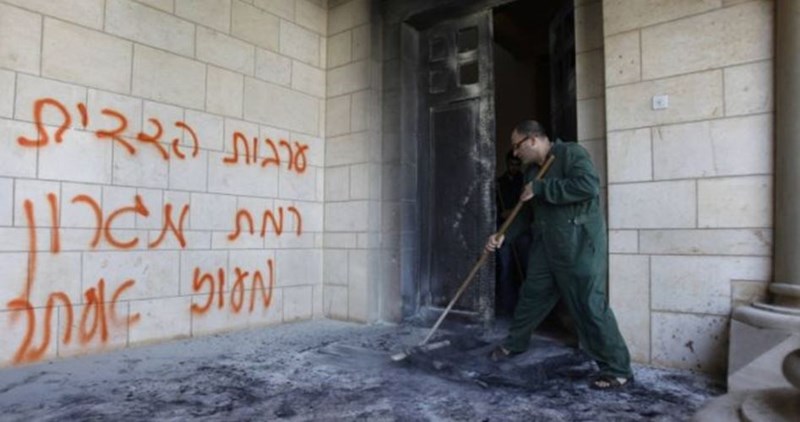
Settlers vandalised property in ten communities across the West Bank, as well as burning some 1,800 trees and dozens of dunams of grain fields, “uprooting more than 700 vegetable seedlings and damaging at least 55 cars and spray painting hate graffiti on buildings”, stated B’Tselem.
In the Nablus area, “settlers threw stones at a family home in the village of Yasuf, shattering the windows, and punctured the family car’s tires”, while “in the village of Jalud, settlers burned more than a thousand trees in lands belonging to 21 farmers and threw stones at the school”.
Meanwhile, “in the village of Madama, settlers torched farmland and the fire spread to land belonging to the village of Burin, consuming about 180 fruit trees”, and “in the village of ‘Einabus, settlers punctured the tires of three cars and graffitied slogans on the mosque”.
In the central West Bank, settlers punctured the tyres of 22 cars in Beitin, Sinjil and Kafr Malik. In Burqah, “settlers set fire to fields and burned about 200 olive and other fruit trees”, while in Al-Mughayir, “settlers burned some fifty dunams of wheat and hay fields and some 370 olive trees”.
Other examples cited by B’Tselem include attacks by settlers in the Bethlehem region, where they “vandalised farming equipment in the village of Wadi Fukin and uprooted more than 700 saplings and four olive trees”.
According to B’Tselem, “these acts of violence, which are backed by the military, have been occurring every month for years.”
“It is part of Israel’s policy in the West Bank, and it serves the state’s agenda. The policy itself is designed to reduce Palestinian farming and gradually transfer areas that have been abandoned due to fear of violence over to settlers,” the NGO added.
“As part of this policy, and to enable these acts of violence, the authorities rarely investigate the crimes and the odds that any of the criminals would be punished for their actions are minuscule. Settlers are well aware of this fact, as are Palestinians who remain defenceless.”
UNRWA Accusations: (Im)Perfect Timing
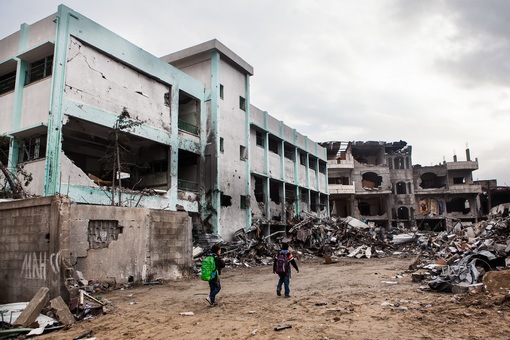
Photograph Source: diario fotográfico ‘desde Palestina – CC BY-SA 3.0
By Daniel Warner | CounterPunch | August 8, 2019
A damaging internal report has cast a dark shadow over the ethical behavior of top officials of the United Nations Relief and Works Agency for Palestine Refugees (UNRWA). As disclosed by Al Jazeera and AFP, the report cites “credible and corroborated reports” that members of an “inner circle” at the top of UNRWA, including Swiss Commissioner-General Pierre Krähenbühl, have engaged in “sexual misconduct, nepotism, retaliation, discrimination and other abuses of authority for personal gain, to suppress legitimate dissent, and to otherwise achieve their personal objectives.” The report was sent to UN Secretary-General António Guterres in December.
As one would expect, reactions have been immediate. The Swiss Foreign Ministry has announced that it has “decided to temporarily stop payments to the United Nations Relief and Works Agency for Palestinian refugees in the Near East (UNRWA).” Already in 2018, Swiss Foreign Minister Ignazio Cassis publicly criticized the role of UNRWA, saying it would be impossible to make peace between Israel and the Palestinian Authority because “For as long as Palestinians live in refugee camps, they want to return to their homeland,” he said. “For a long time the UNRWA was the solution to this problem, but today it has become part of the problem. It supplies the ammunition to continue the conflict. By supporting the UNRWA, we keep the conflict alive. It’s a perverse logic,” Cassis stated.
The Jewish News Syndicate trumpeted over the scandal: “Revelations of rampant wrongdoing in the corridors of the United Nations Relief Works Agency for Palestine Refugees (UNRWA) couldn’t have shamed a more worthy organization. Though normally it’s not nice to gloat over the misfortunes of others, the schadenfreude elicited by the news of inappropriate behavior going on behind the walls of this particularly vile organization was warranted.” An Israeli journalist, Ruthie Blum, tried to put another nail in the agency’s coffin: “Nothing short of shutting down UNRWA will be satisfactory since its very existence is a criminal scam…. In the meantime, let us take some comfort in the agency’s well-earned public humiliation.”
“UNRWA is currently running on fumes,” charged U.S. special envoy Jason Greenblatt at the UN Security Council in late May. “It is time to face the reality that the UNRWA model has failed,” he said. “Palestinians in refugee camps were not given the opportunity to build any future; they were misled and used as political pawns,” he added. The United States ended all funding for UNRWA in 2018. “The United States will no longer commit further funding to this irredeemably flawed operation,” the State Department said at the time.
The schism between humanitarianism and politics is not as wide as most believe. Organizations like UNRWA walk a very thin line between assisting all in need and taking sides in conflicts. In response to the current story, UNRWA responded that it “is probably among the most scrutinized U.N. agencies in view of the nature of the conflict and complex and politicized environment it is working in.”
UNRWA was created in 1949 to deal with Palestinians who were displaced during the 1948 war at the creation of the state of Israel. It was established by General Assembly resolution 302 (IV), with the initial mandate to provide “direct relief and works programmes” to Palestine refugees, in order to “prevent conditions of starvation and distress… and to further conditions of peace and stability”. Today, it provides education, health care and social services to more than 5 million Palestinian refugees in Jordan, Lebanon, Syria, the Gaza Strip and the West Bank. Since 2018, with the U.S. withdrawal, it has been in a financial crisis.
While the ethics report deals only with the internal workings of the organization, there is no question that one cannot separate the political from the ethical here. Why are questions being raised now about ethical issues within UNRWA? With continuing tensions between Palestinian authorities and Israel and the Trump administration peace plan still incubating, the report is a cold shower for any hopes of ameliorating the lives of millions of displaced Palestinians. Generations of Palestinians have been stuck in camps, with UNRWA doing all that’s been possible to alleviate their suffering.
Is the report part of a larger strategy? By publicly criticizing UNRWA now, is it hoped that Palestinians will be forced to sign an agreement that will have no promise for the right to return? When the U.S. stopped funding UNRWA, a spokesman for the Palestinian Authority suggested it was “using humanitarian aid to blackmail and pressure the Palestinian leadership to submit to the empty plan known as ‘the deal of the century.” Are the latest revelations part of that strategy?
Any serious abuses within UNRWA should be scrutinized and punished. That should go without saying. And organizations like UNRWA, given the sensitivity of their activities, should be especially careful about their actions. That also should go without saying. But the timing of the current revelations certainly come at an opportune moment for those who want to pressure the Palestinians into a peace deal. And what about all the refugees who depend on UNRWA for basic services? Are they once again being forgotten as they have been for 70 years?
Mega Group, Maxwells, and Mossad: The Spy Story at the Heart of the Jeffrey Epstein Scandal
The picture painted by the evidence is not a direct Epstein tie to a single intelligence agency but a web linking key members of the Mega Group, politicians, and officials in both the U.S. and Israel, and an organized-crime network with deep business and intelligence ties in both nations.

Graphic by Claudio Cabrera
By Whitney Webb | MintPress News | August 7, 2019
As billionaire pedophile and alleged sex-trafficker, Jeffrey Epstein sits in prison, reports have continued to surface about his reported links to intelligence, his financial ties to several companies and “charitable” foundations, and his friendships with the rich and powerful as well as top politicians.
While Part I and Part II of this series, “The Jeffrey Epstein Scandal: Too Big to Fail,” have focused on the widespread nature of sexual blackmail operations in recent American history and their ties to the heights of American political power and the U.S. intelligence community, one key aspect of Epstein’s own sex-trafficking and blackmail operation that warrants examination is Epstein’s ties to Israeli intelligence and his ties to the “informal” pro-Israel philanthropist faction known as “the Mega Group.”
The Mega Group’s role in the Epstein case has garnered some attention, as Epstein’s main financial patron for decades, billionaire Leslie Wexner, was a co-founder of the group that unites several well-known businessmen with a penchant for pro-Israel and ethno-philanthropy (i.e., philanthropy benefiting a single ethnic or ethno-religious group). However, as this report will show, another uniting factor among Mega Group members is deep ties to organized crime, specifically the organized crime network discussed in Part I of this series, which was largely led by notorious American mobster Meyer Lansky.
By virtue of the role of many Mega Group members as major political donors in both the U.S. and Israel, several of its most notable members have close ties to the governments of both countries as well as their intelligence communities. As this report and a subsequent report will show, the Mega Group also had close ties to two businessmen who worked for Israel’s Mossad — Robert Maxwell and Marc Rich — as well as to top Israeli politicians, including past and present prime ministers with deep ties to Israel’s intelligence community.
One of those businessmen working for the Mossad, Robert Maxwell, will be discussed at length in this report. Maxwell, who was a business partner of Mega Group co-founder Charles Bronfman, aided the successful Mossad plot to plant a trapdoor in U.S.-created software that was then sold to governments and companies throughout the world. That plot’s success was largely due to the role of a close associate of then-President Ronald Reagan and an American politician close to Maxwell, who later helped aid Reagan in the cover-up of the Iran Contra scandal.
Years later, Maxwell’s daughter — Ghislaine Maxwell — would join Jeffrey Epstein’s “inner circle” at the same time Epstein was bankrolling a similar software program now being marketed for critical electronic infrastructure in the U.S. and abroad. That company has deep and troubling connections to Israeli military intelligence, associates of the Trump administration, and the Mega Group.
Epstein appears to have ties to Israeli intelligence and has well-documented ties to influential Israeli politicians and the Mega Group. Yet, those entities are not isolated in and of themselves, as many also connect to the organized crime network and powerful alleged pedophiles discussed in previous installments of this series.
Perhaps the best illustration of how the connections between many of these players often meld together can be seen in Ronald Lauder: a Mega Group member, former member of the Reagan administration, long-time donor to Israeli Prime Minister Benjamin Netanyahu and Israel’s Likud Party, as well as a long-time friend of Donald Trump and Roy Cohn.
From cosmetics heir to political player
One often overlooked yet famous client and friend of Roy Cohn is the billionaire heir to the Estee Lauder cosmetics fortune, Ronald Lauder. Lauder is often described in the press as a “leading Jewish philanthropist” and is the president of the World Jewish Congress, yet his many media profiles tend to leave out his highly political past.
In a statement given by Lauder to New York Times reporter Maggie Haberman in 2018, the cosmetics heir noted that he has known Trump for over 50 years, going back at least to the early 1970s. According to Lauder, his relationship with Trump began when Trump was a student at the Wharton School at the University of Pennsylvania, which Lauder also attended.
Though the exact nature of their early friendship is unclear, it is evident that they shared many of the same connections, including to the man who would later count them both as his clients, Roy Cohn. While much has been said of the ties between Cohn and Trump, Cohn was particularly close to Lauder’s mother, Estee Lauder (born Josephine Mentzer). Estee was even counted among Cohn’s most high-profile friends in his New York Times obituary.
A small window into the Lauder-Cohn relationship surfaced briefly in a 2016 article in Politico about a 1981 dinner party held at Cohn’s weekend home in Greenwich, Connecticut. The party was attended by Ronald Lauder’s parents, Estee and Joe, as well as Trump and his then-wife Ivana, who had a weekend home just two miles away. That party was held soon after Cohn had helped Reagan secure the presidency and had reached the height of his political influence. At the party, Cohn offered toasts to Reagan and to then-Senator for New York Alfonse D’Amato, who would later urge Ronald Lauder to run for political office.
Two years later, in 1983, Ronald Lauder — whose only professional experience at that point was working for his parent’s cosmetics company — was appointed to serve as United States Deputy Assistant Secretary of Defense for European and NATO Affairs. Soon after his appointment, he served on the Dinner Tribute Committee for a dinner hosted by the Jewish fraternal and strongly pro-Israel organization B’nai B’rith, the parent organization of the controversial Anti-Defamation League (ADL), in Roy Cohn’s honor. Cohn’s influential father, Albert Cohn, was the long-time president of B’nai B’rith’s powerful New England-New York chapter and Roy Cohn himself was a member of B’nai B’rith’s Banking and Finance Lodge.
The dinner specifically sought to honor Cohn for his pro-Israel advocacy and his efforts to “fortify” Israel’s economy, and its honorary chairmen included media mogul Rupert Murdoch, Donald Trump and then-head of Bear Stearns Alan Greenberg, all of whom are connected to Jeffrey Epstein.
During his time as deputy assistant secretary of defense, Lauder was also very active in Israeli politics and had already become an ally of the then-Israeli representative to the United Nations and future prime minister of Israel, Benjamin Netanyahu. Lauder would go on to be one of the most important individuals in Netanyahu’s rise to power, particularly during his upset victory in 1996, and a major financier of Israel’s right-wing Likud Party.
In 1986, the year that Roy Cohn died, Lauder left his post at the Pentagon and became the U.S. ambassador to Austria, where his tenure was shaped by his confrontations with the then-Austrian president and former Nazi collaborator, Kurt Waldheim. Lauder’s interest in Austrian politics has continued well into recent years, culminating in accusations that he sought to manipulate Austrian elections in 2012.
After leaving his ambassadorship, Lauder founded the Ronald S. Lauder Foundation in 1987 and later went on to run for Mayor of New York against Rudy Giuliani in 1989. Lauder was encouraged to run by then-Senator Alfonse D’Amato, who had close ties to Roy Cohn and his long-time law partner Tom Bolan, who was D’Amato’s adviser. At the aforementioned 1983 B’nai B’rith dinner honoring Cohn, D’Amato was the featured speaker.
The likely reason was that Giuliani, though once an ally of the “Roy Cohn machine,” was at the time deeply disliked by the late Cohn’s associates for prosecuting Cohn’s former law partner, Stanley Friedman, for racketeering, conspiracy and other charges. Giuliani also had a history of bitter disagreements with D’Amato. Lauder’s primary campaign, though unsuccessful, was noted for its viciousness and its cost, as it burned through more than $13 million.
A few years later, in the early 1990s, Lauder would join a newly formed group that has long evaded scrutiny from the media but has recently become of interest in connection with the Jeffrey Epstein scandal: the Mega Group.
Lauder, Epstein and the mysterious Austrian passport
Before getting to the Mega Group, it is worth noting one particular act apparently undertaken by Lauder while he was U.S. ambassador to Austria that has recently come to light in relation to the arrest in early July of Jeffrey Epstein, a finding first reported by journalist Edward Szall. When police recently discovered an Austrian passport with Epstein’s picture and a fake name after raiding his Manhattan residence, the source and purpose of the passport came under media scrutiny.
According to the Associated Press, Epstein’s defense lawyers specifically argued that “a friend gave it to him [Epstein] in the 1980s after some Jewish-Americans were informally advised to carry identification bearing a non-Jewish name when traveling internationally during a period when hijackings were more common.” This claim appears to be related to concerns that followed the hijacking of Air France Flight 139 in 1976 when Israeli and Jewish hostages were separated from other hostages based largely on the passports in their possession.
Given that Epstein was unable to meet the conventional qualifications for an Austrian passport — including long-term residency in Austria (the passport lists him as a resident of Saudi Arabia) and fluency in German — it appears that the only way to have acquired an Austrian passport was by unconventional means, meaning assistance from a well-connected Austrian official or foreign diplomat with clout in Austria.

Ronald Lauder, right, and Austrian Chancellor Viktor Klima pose with students from the Lauder Chabad School in Vienna, Austria in 1999. Martin Gnedt | AP
Lauder, then-ambassador to Austria for the Reagan administration, would have been well-positioned to acquire such a passport, particularly for the reason cited by Epstein’s attorneys that Jewish-Americans could be targeted during travel, and in light of Lauder’s very public concerns over threats Jews face from certain terror groups. Furthermore, the passport had been issued in 1987, when Lauder was still serving as an ambassador.
In addition, Lauder was well-connected to Epstein’s former patron — former head of Bear Stearns Alan Greenberg, who had hired Epstein in the late 1970s immediately after the latter was fired from the Dalton School — and Donald Trump, another friend of Lauder and Greenberg who began his friendship with Epstein in 1987, the same year the fake Austrian passport was issued. In 1987, Epstein also began his relationship with his principal financier, Leslie Wexner, who is also closely associated with Lauder (though some sources claim that Epstein and Wexner first met in 1985 but that their strong business relationship was not established until 1987).
Though Epstein’s defense attorney declined to reveal the identity of the “friend” who provided him with the fake Austrian passport, Lauder was both well-positioned to acquire it in Austria and also deeply connected to the Mega Group, which was co-founded by Epstein’s patron Leslie Wexner and to which Epstein has many connections. These connections to both the Austrian government and to Epstein’s mentor make Lauder the most likely person to have acquired the document on Epstein’s behalf.
Furthermore, Epstein and the Mega Group’s ties to the Israeli intelligence agency, Mossad, also suggest Lauder was involved in procuring the passport, in light of his close ties to the Israeli government and the fact that Mossad has a history of using ambassadors abroad to procure false, foreign passports for its operatives.
Lauder himself has been alleged to have ties to Mossad, as he is a long-time funder of IDC Herzliya, an Israeli university closely associated with Mossad and their recruiters as well as Israeli military intelligence. Lauder even founded IDC Herzliya’s Lauder School of Government, Diplomacy and Strategy.
Furthermore, Lauder co-founded the Eastern European broadcasting network CETV with Mark Palmer, a former U.S. diplomat, Kissinger aide and Reagan speechwriter. Palmer is better known for co-founding the National Endowment for Democracy (NED), an organization often described as an accessory to U.S. intelligence, and one whose first president confessed to the Washington Post that “a lot of what we do today was done covertly 25 years ago by the CIA.” A 2001 report in the Evening Standard noted that Epstein once claimed that during the 1980s he worked for the CIA, but Epstein later backed away from that assertion.
The origins of the Mega Group Mafia
The Mega Group — a secretive group of billionaires to which Lauder belongs — was formed in 1991 by Charles Bronfman and Leslie Wexner, the latter of whom has received considerable media scrutiny following the July arrest of his former protege Jeffrey Epstein. Media profiles of the group paint it as “a loosely organized club of 20 of the nation’s wealthiest and most influential Jewish businessmen” focused on “philanthropy and Jewishness,” with membership dues upwards of $30,000 per year. Yet several of its most prominent members have ties to organized crime.
Mega Group members founded and/or are closely associated with some of the most well-known pro-Israel organizations. For instance, members Charles Bronfman and Michael Steinhardt formed Birthright Taglit with the backing of then- and current Prime Minister Benjamin Netanyahu. Steinhardt, an atheist, has stated that his motivation in helping to found the group was to advance his own belief that devotion to and faith in the state of Israel should serve as “a substitute for [Jewish] theology.”
Other well-known groups associated with the Mega Group include the World Jewish Congress — whose past president, Edgar Bronfman, and current president, Ronald Lauder, are both Mega Group members — and B’nai B’rith, particularly its spin-off known as the Anti-Defamation League (ADL). The Bronfman brothers were major donors to the ADL, with Edgar Bronfman serving as the ADL’s honorary national vice-chair for several years.
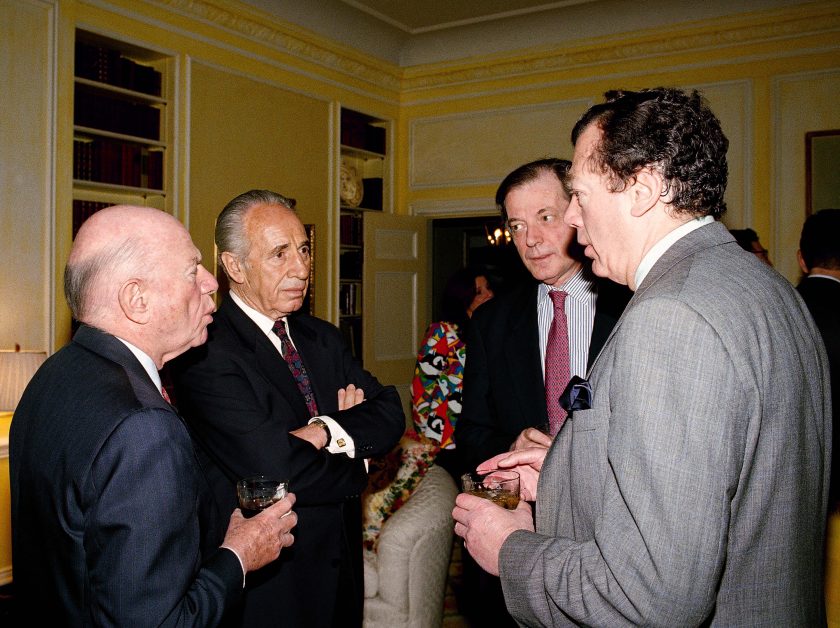
Former Israeli president Shimon Peres, second from left, listens to Edgar Bronfman during a 1995 lunch thrown in Peres’ honor. From left are: Laurence Tisch, Chairman, President and Chief executive officer of CBS; Israeli Ambassador to the United States. Itamar Rabinowitz and Bronfman. David Karp | AP
When Edgar Bronfman died in 2013, long-time ADL Director Abe Foxman said, “Edgar was for many years Chair of our Liquor Industry Division, Chair of our New York Appeal, and one of our most significant benefactors.” Other Mega Group members that are donors and major supporters of the ADL include Ronald Lauder, Michael Steinhardt and the late Max Fisher. As previously mentioned, Roy Cohn’s father was a long-time leader of B’nai B’rith’s influential New England-New York chapter and Cohn was later a celebrated member of its banking and finance lodge.
In addition, Mega Group members have also been key players in the pro-Israel lobby in the United States. For instance, Max Fisher of the Mega Group founded the National Jewish Coalition, now known as the Republican Jewish Coalition — the main pro-Israel neoconservative political lobbying group, known for its support of hawkish policies, and whose current chief patrons, Sheldon Adelson and Bernard Marcus, are among Donald Trump’s top donors.
Though the Mega Group has officially existed only since 1991, the use of “philanthropy” to provide cover for more unscrupulous lobbying or business activities was pioneered decades earlier by Sam Bronfman, the father of Mega Group members Edgar and Charles Bronfman. While other North American elites like J.D. Rockefeller had previously used philanthropic giving as a means of laundering their reputations, Bronfman’s approach to philanthropy was unique because it was focused on giving specifically to other members of his own ethno-religious background.
Sam Bronfman, as was detailed in Part I of this series, had long-standing deep ties to organized crime, specifically Meyer Lanksy’s organized crime syndicate. Yet, Bronfman’s private ambition, according to those close to him, was to become a respected member of high society. As a consequence, Bronfman worked hard to remove the stain that his mob associations had left on his public reputation in Canada and abroad. He accomplished this by becoming a leader in Canada’s Zionist movement and, by the end of the 1930s, he was head of the Canadian Jewish Congress and had begun to make a name for himself as a philanthropist for Jewish causes.
Yet even some of Bronfman’s activism and philanthropy had hints of the mobster-like reputation he tried so hard to shake. For instance, Bronfman was actively involved in the illegal shipping of arms to Zionist paramilitaries in Palestine prior to 1948, specifically as a co-founder of the National Conference for Israeli and Jewish Rehabilitation that smuggled weapons to the paramilitary group Haganah.
At the same time Bronfman was abetting the illegal smuggling of weapons to the Haganah, his associates in the criminal underworld were doing the same. After World War II, close aides of David Ben-Gurion, who would later become the first prime minister of Israel and was instrumental in the founding of Mossad, forged tight-knit relationships with Meyer Lansky, Benjamin “Bugsy” Siegel, Mickey Cohen and other Jewish gangsters of the period. They used their clandestine networks to establish a vast arms smuggling network between the United States and Zionist settlements in Palestine, arming both the Haganah and the Irgun paramilitary groups. As noted in Part I of this report, at the same time these gangsters were aiding the illegal arming of ZIonsit paramilitaries, they were strengthening their ties to U.S. intelligence that had first been formally (though covertly) established in World War II.
After Israel was founded, Sam Bronfman worked with future Israeli Prime Minister Shimon Peres to negotiate the sale of Canadian armaments at half-price to Israel and the bargain weapons purchase was paid for entirely by a fundraising dinner hosted by Bronfman and his wife. Many years later, Peres would go on to introduce another future prime minister of Israel, Ehud Barak, to Jeffrey Epstein.
The rest of the Bronfman family’s march on “the road to respectability” was undertaken by Bronfman’s children, who married into aristocratic families such as the European Rothschilds and the Wall Street “royalty” of the Lehmans and the Loebs.
The Bronfmans’ newfound respectability did not mean that their association with the Lansky-led criminal empire had dissolved. Indeed, prominent members of the Seagrams dynasty came under fire in the 1960s and 1970s for their close association with Willie “Obie” Obront, a major figure in Canadian organized crime, whom Canadian professor Stephen Schneider has referred to as the Meyer Lansky of Canada.
However, Edgar and Charles Bronfman were hardly the only members of the Mega Group with deep and long-standing ties to the Lansky-led National Crime Syndicate. Indeed, one of the group’s prominent members, hedge fund manager Michael Steinhardt, opened up about his own family ties to Lansky in his autobiography No Bull: My Life in and out the Markets, where he noted that his father, Sol “Red McGee” Steinhardt, was Lansky’s jewel fence of choice and a major player in New York’s criminal underworld. Sol Steinhardt was also his son’s first client on Wall Street and helped him jumpstart his career in finance.
The ties between the Mega Group and the National Crime Syndicate don’t stop there. Another prominent member of the Mega Group with ties to this same criminal network is Max Fisher, who has been described as Wexner’s mentor and is also alleged to have worked with Detroit’s “Purple Gang” during Prohibition and beyond. The Purple Gang were part of the network that smuggled Bronfman liquor from Canada into the United State during Prohibition, and one of its founders, Abe Bernstein, was a close associate of both Meyer Lansky and Moe Dalitz. Fisher was a key adviser to several U.S. presidents, beginning with Dwight D. Eisenhower, as well as to Henry Kissinger.

Max Fisher, center, and Henry Kissinger, right, meet with leaders of Jewish organizations prior to Kissinger’s 1975 Middle East trip. Henry Burroughs | AP
In addition to Fisher, Mega Group member Ronald Lauder was connected to Roy Cohn and Tom Bolan, both of whom were closely associated with this same Lansky-led crime network (see Part I and Part II) and who regularly represented top Mafia figures in court. Furthermore, another member of the Mega Group, director Steven Spielberg, is a well-known protege of Lew Wasserman, the mob-connected media mogul and long-time backer of Ronald Reagan’s film and later political career, discussed in Part II of this series.
One surprise connection to Cohn involves Mega Group member, and former president of U.S. weapons firm General Dynamics, Lester Crown, whose brother-in-law is David Schine, Cohn’s confidant and alleged lover during the McCarthy hearings, whose relationship with Cohn helped bring about the downfall of McCarthyism.
Another member of the Mega Group worth noting is Laurence Tisch, who owned CBS News for several years and founded Loews Corporation. Tisch is notable for his work for the Office of Strategic Services (OSS), the precursor to the CIA, where Donald Barry, who hired Epstein at the Dalton School, also served and which forged ties with Lansky’s criminal empire during World War II.
Wexner’s mansions and the Shapiro murder
Leslie “Les” Wexner, the other Mega Group co-founder, also has ties to organized crime. Wexner’s ties to Jeffrey Epstein have come under scrutiny following the latter’s recent arrest, as Wexner was the only publicly acknowledged client of Epstein’s suspicious hedge fund, the source of much of this wealth, and the previous owner of Epstein’s $56 million Manhattan townhouse, which Wexner transferred to an Epstein-controlled entity for free.
Before Epstein received the townhouse, Wexner appears to have used the residence for some unconventional purposes, noted in a 1996 New York Times article on the then-Wexner-owned residence, which included “a bathroom reminiscent of James Bond movies: hidden beneath a stairway, lined with lead to provide shelter from attack and supplied with closed-circuit television screens and a telephone, both concealed in a cabinet beneath the sink.” The Times article does not speculate as to the purpose of this equipment, though the allusion to famous fictional superspy James Bond suggests that it may have been used to snoop on guests or conduct electronic surveillance.
The 1996 Times article also noted that, after Wexner bought the residence for $13.2 million in 1989, he spent millions more decorating and furnishing the home, including the addition of the electronic equipment in the “James Bond” bathroom, only to apparently never live in it. The Times, which interviewed Epstein for the piece, quoted him as saying that “Les never spent more than two months there.” Epstein told the Times, which identified Epstein as Wexner’s “protege and one of his financial advisers,” that the house, by that time, already belonged to him.
That same year, Epstein was commissioning artwork for Wexner’s Ohio mansion. A recent article from the Times noted that:
In the summer of 1996, Maria Farmer was working on an art project for Mr. Epstein in Mr. Wexner’s Ohio mansion. While she was there, Mr. Epstein sexually assaulted her, according to an affidavit Ms. Farmer filed earlier this year in federal court in Manhattan. She said that she fled the room and called the police, but that Mr. Wexner’s security staff refused to let her leave for 12 hours.”
Farmer’s account strongly suggests that, given the behavior of his personal security staff at his mansion following Epstein’s alleged assault on Farmer, Wexner was well aware of Epstein’s predatory behavior towards young women. This is compounded by claims made by Alan Dershowitz — a former lawyer for and friend of Epstein’s, who has also been accused of raping underage girls — that Wexner has also been accused of raping underage girls exploited by Epstein on at least seven occasions.
The presence of the electronic equipment in his home’s bathroom, other oddities related to the townhouse, and aspects of the links between Epstein and Wexner suggest there is more to Wexner, who has rather successfully developed a public image of a respectable businessman and philanthropist, much like other prominent members of the Mega Group.
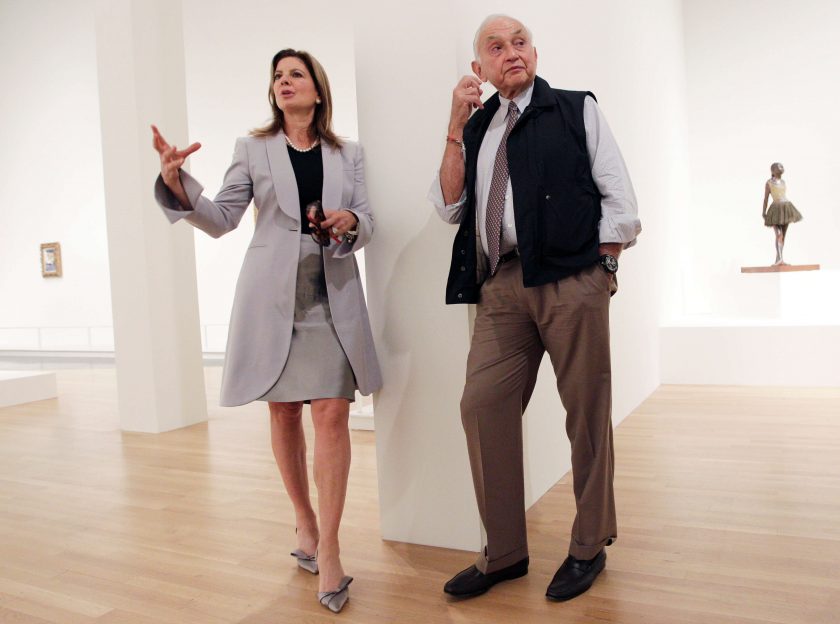
Leslie Wexner and his wife Abigail tour the “Transfigurations” exhibit at the Wexner Center for the Arts. Jay LaPrete | AP
However, bits and pieces of Wexner’s private secrets have occasionally bubbled up, only to be subjected to rapid cover-ups amidst concerns of “libeling” the powerful and well-connected billionaire “philanthropist.”
In 1985, Columbus (Ohio) lawyer Arthur Shapiro was murdered in broad daylight at point-blank range in what was largely referred to as a “mob style murder.” The homicide still remains unsolved, likely due to the fact that then-Columbus Police Chief James Jackson ordered the destruction of key documents of his department’s investigation into the murder.
Jackson’s ordering of the documents’ destruction came to light years later in 1996, when he was under investigation for corruption. According to the Columbus Dispatch, Jackson justified the destruction of one “viable and valuable” report because he felt that it “was so filled with wild speculation about prominent business leaders that it was potentially libelous.” The nature of this “wild speculation” was that “millionaire businessmen in Columbus and Youngstown were linked to the ‘mob-style murder.’”
Though Jackson’s efforts were meant to keep this “libelous” report far from public view, it was eventually obtained by Bob Fitrakis — attorney, journalist, and executive director of the Columbus Institute for Contemporary Journalism — after he was “accidentally” sent a copy of the report in 1998 as part of a public records request.
The report, titled “Shapiro Homicide Investigation: Analysis and Hypothesis,” names Leslie Wexner as linked “with associates reputed to be organized crime figures” and also lists the names of businessman Jack Kessler, former Columbus City Council President and Wexner associate Jerry Hammond, and former Columbus City Council member Les Wright as also being involved in Shapiro’s murder.
The report also noted that Arthur Shapiro’s law firm — Schwartz, Shapiro, Kelm & Warren — represented Wexner’s company, The Limited, and states that “prior to his death, Arthur Shapiro managed this account [The Limited] for the law firm.” It also noted that, at the time of his death, Shapiro “was the subject of an investigation by the Internal Revenue Service because he had failed to file income tax returns for some seven years prior to his death, and he had invested in some questionable tax shelters.” It also stated that his death prevented Shapiro from his planned testimony at a grand jury hearing about these “questionable tax shelters.”
As to Wexner’s alleged links to organized crime, the report focuses on the close business relationship between Wexner’s The Limited and Francis Walsh, whose trucking company “[had] done an excess of 90 percent of the Limited’s trucking business around the time of Shapiro’s murder,” according to the report. Walsh was named in a 1988 indictment as a “co-conspirator” of Genovese crime family boss Anthony “Fat Tony” Salerno, whose long-time lawyer was Roy Cohn; and the Shapiro murder report stated that Walsh was “still considered associates of the Genovese/LaRocca crime family, and Walsh was still providing truck transportation for The Limited.”
Notably, the Genovese crime family has long formed a key part of the National Crime Syndicate, as its former head, Charles “Lucky” Luciano, co-created the criminal organization with his close friend Meyer Lansky. Upon Luciano’s imprisonment and subsequent deportation from the United States, Lansky took over the syndicate’s U.S. operations and his association with Luciano’s successors continued until Lansky’s death in 1983.
The “Mega” Mystery and the Mossad
In May 1997, the Washington Post broke an explosive story — long since forgotten — based on an intercepted phone call made between a Mossad official in the U.S. and his superior in Tel Aviv that discussed the Mossad’s efforts to obtain a secret U.S. government document. According to the Post, the Mossad official stated during the phone call that “Israeli Ambassador Eliahu Ben Elissar had asked him whether he could obtain a copy of the letter given to [Palestinian leader Yasser] Arafat by [then-Secretary of State Warren] Christopher on Jan. 16, the day after the Hebron accord was signed by Arafat and Israeli Prime Minister Binyamin Netanyahu.”
The Post article continued:
According to a source who viewed a copy of the NSA transcript of the conversation, the intelligence officer, speaking in Hebrew, said, ‘The ambassador wants me to go to Mega to get a copy of this letter.’ The source said the supervisor in Tel Aviv rejected the request, saying, ‘This is not something we use Mega for.’”
The leaked communication led to an investigation that sought to identify an individual code-named “Mega” that the Post said “may be someone in the U.S. government who has provided information to the Israelis in the past,” a concern that subsequently spawned a fruitless FBI investigation. The Mossad later claimed that “Mega” was merely a codeword for the U.S.’ CIA, but the FBI and NSA were unconvinced by that claim and believed that it was a senior U.S. government official that had potentially once been involved in working with Jonathan Pollard, the former U.S. naval intelligence analyst later convicted of spying for the Mossad.
Almost one year to the day after the “Mega” spy scandal broke, the Wall Street Journal was the first outlet to report on the existence of a little-known organization of billionaires that was “informally” called the Mega Group and had been founded years prior in 1991. The report made no mention of the spy scandal that had spread concerns of Israeli espionage in the U.S. only a year prior. However, the group’s distinctive “informal” name and the connections of its members to the Mossad and to high-ranking Israeli politicians, including prime ministers, raise the possibility that “Mega” was not an individual, as the FBI and NSA had believed, but a group.
In 1997, when the “Mega” spy scandal broke, Netanyahu had recently become prime minister of Israel after an upset victory, a victory that was largely credited to one well-connected Netanyahu backer in particular, Ronald Lauder. Beyond being a major donor, Lauder had brought Arthur Finklestein on to work for Netanyahu’s 1996 campaign, whose strategies were credited for Netanyahu’s surprise win. Netanyahu was close enough to Lauder that he personally enlisted Lauder and George Nader to serve as his peace envoys to Syria.
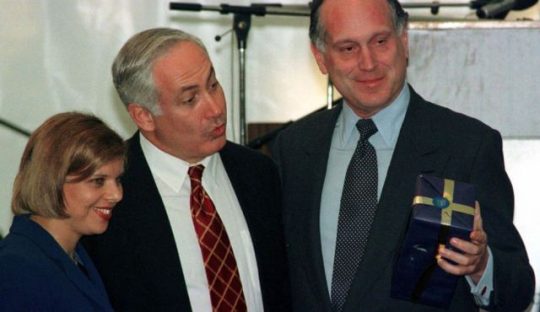
Benjamin Netanyahu and his wife Sara with Ronald Lauder in 1997. Photo | Reuters
Nader, who was connected to the Trump 2016 campaign and Trump ally and Blackwater founder Erik Prince, was recently hit with federal child sex trafficking charges last month, soon after Jeffrey Epstein had been arrested on similar charges. At the time Nader was picked to work with Lauder on Netanyahu’s behalf, he had already been caught possessing large amounts of child pornography on two separate occasions, first in 1984 and later in 1990.
This strong connection between Netanyahu and Lauder during the time of the 1997 “Mega” spy scandal is important considering Mossad answers directly to Israel’s prime minister.
Another possible connection between the Mega Group and the Mossad owes to the Mega Group’s ties to Meyer Lansky’s criminal network. As was detailed in Part I, Lansky had established deep ties to U.S. intelligence after World War II and was also connected to the Mossad through Mossad official Tibor Rosenbaum, whose bank was frequently used by Lansky to launder money. In addition, Lansky collaborated on at least one occasion with notorious Mossad “superspy” Rafi Eitan, who he helped acquire sensitive electronic equipment possessed only by the CIA but coveted by Israeli intelligence. Eitan is best known in the U.S. for being the Mossad handler of Jonathan Pollard.
Notably, Eitan was the main source of claims that the code-word “Mega” used by the Mossad officials in 1997 referred to the CIA and not to a potential source in the U.S. government once linked to Pollard’s spying activities, making his claims as to the true meaning of the term somewhat dubious.
Given that the organized crime network tied to the Mega Group had ties to both U.S. and Israeli intelligence, the “Mega” codeword could plausibly have referred to this secretive group of billionaires. More supporting evidence for this theory comes from the fact that prominent members of the Mega Group were business partners of Mossad agents, including media mogul Robert Maxwell and commodities trader Marc Rich.
The mysterious Maxwells
The Maxwell family has become a source of renewed media interest following Jeffrey Epstein’s arrest, as Ghislaine Maxwell, long described in the media as a British “socialite,” was publicly cited as Epstein’s long-time “on and off” girlfriend, and Epstein’s victims, as well as former wives of Epstein’s friends, have claimed that she was Epstein’s “pimp” and procured underage girls for his sexual blackmail operation. Ghislaine Maxwell is also alleged to have engaged in the rape of the girls she procured for Epstein and to have used them to produce child pornography.
Ghislaine was the favorite and youngest daughter of media mogul Robert Maxwell. Maxwell, born Jan Ludvick Hoch, had joined the British Army in World War II. Afterwards, according to authors John Loftus and Mark Aarons, he greatly influenced the Czechoslovakian government’s decision to arm Zionist paramilitaries during the 1948 war that resulted in Israel’s creation as a state, and Maxwell himself was also involved in the smuggling of aircraft parts to Israel.
Around this time, Maxwell was approached by British intelligence outfit MI6 and offered a position that Maxwell ultimately declined. MI6 then classified him as “Zionist — loyal only to Israel” and made him a person of interest. He later became an agent of the Mossad, according to several books including Seymour Hersh’s The Samson Option: Israel’s Nuclear Arsenal and American Foreign Policy, and Robert Maxwell: Israel’s Superspy by Gordon Thomas and Martin Dillon.
According to Victor Ostrovsky, a former Mossad case officer:
Mossad was financing many of its operations in Europe from money stolen from Maxwell’s newspaper pension fund. They got their hands on the funds almost as soon as Maxwell made the purchase of the Mirror Newspaper Group with money lent to him by Mossad.”
In exchange for his services, the Mossad helped Maxwell satisfy his sexual appetite during his visits to Israel, providing him with prostitutes, “the service maintained for blackmail purposes.” It was later revealed that the hotel in which he stayed in Israel was bugged with cameras, allowing the Mossad to acquire “a small library of video footage of Maxwell in sexually compromising positions.” As with the CIA, the Mossad’s use of blackmail against both friend and foe is well-documented and known to be extensive.
Maxwell was also a close associate and friend of Israeli “superspy” Rafi Eitan, who, as previously mentioned, was Jonathan Pollard’s handler and who had previously worked directly with Meyer Lansky. Eitan had learned of a revolutionary new software being used by the U.S. government known as “Promis” from Earl Brian, a long-time associate and aide to Ronald Reagan. Promis is often considered the forerunner to the “Prism” software used by spy agencies today and was developed by William Hamilton, who leased the software to the U.S. government through his company, Inslaw, in 1982.

Ariel Sharon (right)meets with Robert Maxwell in Jerusalem on Feb. 20, 1990. Photo | AP
According to author and former BBC investigative journalist Gordon Thomas, Brian was angry that the U.S. Department of Justice was successfully using Promis to go after organized crime and money-laundering activities and Eitan felt that the program could aid Israel and restore his own standing within the Israeli intelligence community, which had been damaged by the public disclosure of Eitan’s involvement in the Pollard affair and Iran Contra.
A plan was hatched to install a “trapdoor” into the software and then market Promis throughout the world, providing the Mossad with invaluable intelligence on the operations of its enemies and allies while also providing Eitan and Brian with copious amounts of cash. According to the testimony of ex-Mossad official Ari Ben-Menashe, Brian provided a copy of Promis to Israel’s military intelligence, which contacted an Israeli American programmer living in California who then planted the “trapdoor” in the software. The CIA was later said to have installed its own trapdoor in the software but it is unknown if they did so with a version of the already bugged software and how widely it was adopted relative to the version bugged by Israeli intelligence.
After the trapdoor was inserted, the problem became selling the bugged version of the software to governments as well as private companies around the world, particularly in areas of interest. Brian first attempted to buy out Inslaw and Promis and then use that same company to sell the bugged version.
Unsuccessful, Brian turned to his close friend, then-Attorney General Ed Meese whose Justice Department then abruptly refused to make the payments to Inslaw that were stipulated by the contract, essentially using the software for free, which Inslaw claimed to be theft. Some have speculated that Meese’s role in that decision was shaped, not only by his friendship with Brian, but the fact that his wife was a major investor in Brian’s business ventures. Meese would later become an adviser to Donald Trump when he was president-elect.
Inslaw was forced to declare bankruptcy as a result of Meese’s actions and sued the Justice Department. The court later found that the Meese-led department “took, converted, stole” the software through “trickery, fraud and deceit.”
With Inslaw out of the way, Brian sold the software all over the world. Eitan later recruited Robert Maxwell to become another Promis salesman, which he did remarkably well, even succeeding in selling the software to Soviet intelligence and conspiring with Republican Texas Senator John Tower to have the software adopted by the U.S. government laboratory at Los Alamos. Dozens of countries used the software on their most carefully guarded computer systems, unaware that Mossad now had access to everything Promis touched.
Whereas the Mossad’s past reliance on gathering intelligence had relied on the same tactics used by its equivalents in the U.S. and elsewhere, the widespread adoption of the Promis software, largely through the actions of Earl Brian and Robert Maxwell, gave the Mossad a way to gather not just troves of counterintelligence data, but also blackmail on other intelligence agencies and powerful figures.
Indeed, Promis’ backdoor and adoption by intelligence agencies all over the world essentially provided the Mossad with access to troves of blackmail that the CIA and FBI had acquired on their friends and foes for over half a century. Strangely, in recent years, the FBI has sought to hide information related to Robert Maxwell’s connection to the Promis scandal.
According to journalist Robert Fisk, Maxwell was also involved in the Mossad abduction of Israeli nuclear weapons whistleblower Vanunu Mordechai. Mordechai had attempted to provide the media with information on the extent of Israel’s nuclear weapons program, which was eventually published by the Sunday Times of London. Yet, Mordechai had also contacted the Daily Mirror with the information, the Mirror being an outlet that was owned by Maxwell and whose foreign editor was a close Maxwell associate and alleged Mossad asset, Nicholas Davies. Journalist Seymour Hersh alleged that Davies had also been involved in Israeli arms deals.
Per Fisk, it was Maxwell who contacted the Israeli Embassy in London and told them of Mordechai’s activities. This led to Mordechai’s entrapment by a female Mossad agent who seduced him as part of a “honey trap” operation that led to his kidnapping and later imprisonment in Israel. Mordechai served an 18-year sentence, 12 years of which were in solitary confinement.
Then, there is the issue of Maxwell’s death, widely cited by mainstream and independent media alike as suspicious and a potential homicide. According to authors Gordon Thomas and Martin Dillon, Maxwell had sealed his own fate when he attempted to threaten top Mossad officials with the exposure of certain operations if they did not help him rescue his media empire from crippling debt and financial difficulties. Many of Maxwell’s creditors, who had grown increasingly displeased with the media mogul, were Israeli and several of them were alleged to be Mossad-connected themselves.
Thomas and Dillon argue in their biography of Maxwell’s life that the Mossad felt that Maxwell had become more of a liability than an asset and killed him on his yacht three months after he demanded the bailout. On the other extreme are theories that suggest Maxwell committed suicide because of the financial difficulties his empire faced.

Ghislaine Maxwell, far right, Robert Maxwell’s daughter, looks on as his casket is unloaded from a plane in Jerusalem, Nov. 8, 1991. Heribert Proepper | AP
Some have taken Maxwell’s funeral held in Israel as the country’s “official” confirmation of Maxwell’s service to the Mossad, as it was likened to a state funeral and attended by no less than six serving and former heads of Israeli intelligence. During his funeral service in Jerusalem, Israeli Prime Minister Yitzhak Shamir eulogized him and stated: “He has done more for Israel than can today be said.” Other eulogies were given by future Prime Ministers Ehud Olmert (then Health Minister) and Shimon Peres, with the latter also praising Maxwell’s “services” on behalf of Israel.
Swimming in the same swamp
As he built his business empire — and even became a member of Parliament, Maxwell was also doing work for Israeli intelligence, as several of the Israeli companies in which he invested became fronts for the Mossad. In addition, as he became a media mogul, he developed a bitter rivalry with Rupert Murdoch, a close friend of Roy Cohn and an influential figure in American and British media.
Maxwell also partnered with the Bronfman brothers, Edgar and Charles — key figures in the Mega Group. In 1989 Maxwell and Charles Bronfman partnered up to bid on the Jerusalem Post newspaper and the Post described the two men as “two of the world’s leading Jewish financiers” and their interest in the venture as “developing The Jerusalem Post and expanding its influence among world Jewry.” A year prior, Maxwell and Bronfman had become top shareholders in the Israeli pharmaceutical company Teva.
Maxwell also worked with Charles Bronfman’s brother Edgar in the late 1980s to convince the Soviet Union to allow Soviet Jews to immigrate to Israel. Edgar’s efforts in this regard have received more attention, as it was a defining moment of his decades-long presidency of the World Jewish Congress, of which Ronald Lauder is currently president. Yet, Maxwell had also made considerable use of his contacts in the Soviet government in this effort.
Maxwell also moved in the circles of the network previously described in Parts I and II in this series. A key example of this is the May 1989 party Maxwell hosted on his yacht, the Lady Ghislaine — named for his youngest daughter and Epstein’s future “girlfriend.” Attendees of the party included Roy Cohn’s protege Donald Trump and his long-time law partner Tom Bolan. A close friend of Nancy Reagan was also present, journalist Mike Wallace, as was literary agent Mort Janklow, who represented Ronald Reagan and two of Cohn’s closest friends: journalists William Safire and Barbara Walters.
The CEO of what would soon become Time Warner, Steve Ross, was also invited to the exclusive event. Ross’ presence is notable, as he had built his business empire largely through his association with New York crime lords Manny Kimmel and Abner “Longy” Zwillman. Zwillman was a close friend of Meyer Lansky, Michael Steinhardt’s father, and Sam Bronfman, father of Edgar and Charles Bronfman.
Another attendee of the Maxwell yacht party was former Secretary of the Navy and former Henry Kissinger staffer Jon Lehman, who would go on to associate with the controversial neoconservative think tank, Project for a New American Century. Prior to being secretary of the Navy, Lehman had been president of the Abington Corporation, which hired arch-neocon Richard Perle to manage the portfolio of Israeli arms dealers Shlomo Zabludowicz and his son Chaim, who paid Ablington $10,000 month. A scandal arose when those payments continued after both Lehman and Perle joined the Reagan Department of Defense and while Perle was working to persuade the Pentagon to buy arms from companies linked to Zabludowicz. Perle had been part of the Reagan transition team along with Roy Cohn’s long-time friend and law partner Tom Bolan (another Maxwell yacht guest).
In addition to Lehman, another former Kissinger staffer, Thomas Pickering was present at Maxwell’s yacht part. Pickering played a minor role in the Iran-Contra affair and, at the time of the Maxwell yacht party, he was U.S. ambassador to Israel. Senator John Tower (R-TX), who allegedly conspired with Maxwell in the Mossad-bugged Promis software at the Los Alamos laboratories, was also present. Tower died just months before Maxwell in a suspicious plane crash.
Ghislaine Maxwell was also at this rather notable event. After her father’s mysterious death and alleged murder on the same yacht that bears her name in 1991, she quickly packed her bags and moved to New York City. There, she soon made the acquaintance of Jeffrey Epstein and, a few years later, developed close ties to the Clinton family, which will be discussed in the next installment of this series.
Jeffrey Epstein and the new “Promis”
After it was revealed that Epstein had evaded stricter sentencing in 2008 due to his links to “intelligence,” it was the Mossad ties of Ghislaine Maxwell’s father that have led many to speculate that Epstein’s sexual blackmail operation was sharing incriminating information with the Mossad. Former CBS executive producer and current journalist for the media outlet Narativ, Zev Shalev, has since claimed that he independently confirmed that Epstein was tied directly to the Mossad.
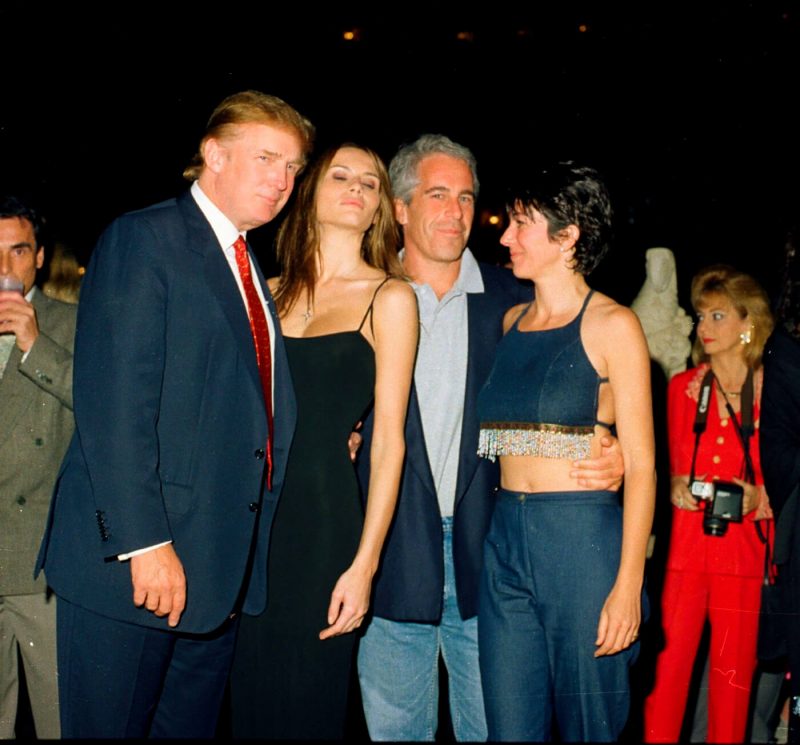
Donald and Melania Trump with Jeffrey Epstein and Ghislaine Maxwell at the Mar-a-Lago club, Palm Beach, Florida in 2000. Photo | Davidoff Studios
Epstein was a long-time friend of former Israeli Prime Minister Ehud Barak, who has long-standing and deep ties to Israel’s intelligence community. Their decades-long friendship has been the source of recent political attacks targeting Barak, who is running in the Israeli elections against current Prime Minister Netanyahu later this year.
Barak is also close to Epstein’s chief patron and Mega Group member Leslie Wexner, whose Wexner Foundation gave Barak $2 million in 2004 for a still unspecified research program. According to Barak, he was first introduced to Epstein by former Israeli Prime Minister Shimon Peres, who eulogized Robert Maxwell at his funeral and had decades-long ties with the Bronfman family going back to the early 1950s. Peres was also a frequent participant in programs funded by Leslie Wexner in Israel and worked closely with the Mossad for decades.
In 2015, a few years after Epstein’s release from prison following his conviction for soliciting sex from a minor in 2008, Barak formed a company with Epstein with the chief purpose of investing in an Israeli start-up then known as Reporty. That company, now called Carbyne, sells its signature software to 911 call centers and emergency service providers and is also available to consumers as an app that provides emergency services with access to a caller’s camera and location and also runs any caller’s identity through any linked government database. It has specifically been marketed by the company itself and the Israeli press as a solution to mass shootings in the United States and is already being used by at least two U.S. counties.
Israeli media reported that Epstein and Barak were among the company’s largest investors. Barak poured millions into the company and it was recently revealed by Haaretz that a significant amount of Barak’s total investments in Carbyne was funded by Epstein, making him a “de facto partner” in the company. Barak is now Carbyne’s chairman.
The company’s executive team are all former members of different branches of Israeli intelligence, including the elite military intelligence unit, Unit 8200, that is often likened to Israel’s equivalent of the U.S. National Security Agency (NSA). Carbyne’s current CEO, Amir Elichai, served in Unit 8200 and tapped former Unit 8200 commander Pinchas Buchris to serve as the company’s director and on its board. In addition to Elichai, another Carbyne co-founder, Lital Leshem, also served in Unit 8200 and later worked for Israeli private spy company Black Cube. Leshem now works for a subsidiary of Erik Prince’s company Frontier Services Group, according to the independent media outlet Narativ.
The company also includes several tie-ins to the Trump administration, including Palantir founder and Trump ally Peter Thiel — an investor in Carbyne. In addition, Carbyne’s board of advisers includes former Palantir employee Trae Stephens, who was a member of the Trump transition team, as well as former Secretary of Homeland Security Michael Chertoff. Trump donor and New York real-estate developer Eliot Tawill is also on Carbyne’s board, alongside Ehud Barak and Pinchas Buchris.
Narativ, which wrote the first expose on Carbyne after Epstein’s arrest, noted that the Chinese government uses a smartphone app very similar to Carbyne as part of its mass surveillance apparatus, even though the original purpose of the app was for improved emergency reporting. According to Narativ, the Chinese Carbyne-equivalent “monitors every aspect of a user’s life, including personal conversations, power usage, and tracks a user’s movement.”
Given the history of Robert Maxwell — the father of Epstein’s long-time “girlfriend” and young-girl-procuring madam, Ghislaine Maxwell — in promoting the sale of Carbyne’s modified Promis software, which was also marketed as a tool to improve government efficacy but was actually a tool of mass surveillance for the benefit of Israeli intelligence, the overlap between Carbyne and Promis is troubling and warrants further investigation.
It is also worth noting that Unit 8200-connected tech start-ups are being widely integrated into U.S. companies and have developed close ties to the U.S. military-industrial complex, with Carbyne being just one example of that trend.
As MintPress previously reported, Unit 8200-linked outfits like Team8 have recently hired former National Security Agency (NSA) Director Mike Rogers as a senior advisor and gained prominent Silicon Valley figures, including former Google CEO Eric Schmidt, as key investors. Many American technology companies, from Intel to Google to Microsoft, have merged with several Unit 8200-connected start-ups in recent years and have been moving many key jobs and operations to Israel with backing from key Republican donors like Paul Singer. Many of those same companies, particularly Google and Microsoft, are also major U.S. government contractors.
Who was Epstein really working for?
Even though Jeffrey Epstein appears to have had ties to the Mossad, this series has revealed that the networks to which Epstein was connected were not Mossad-exclusive, as many of the individuals close to Epstein — Lesie Wexner, for instance — were part of a mob-connected class of oligarchs with deep ties to both the U.S. and Israel. As was discussed in Part I of this series, the sharing of “intelligence” (i.e., blackmail) between intelligence agencies and the same organized crime network connected to the Mega Group goes back decades. With Leslie Wexner of the Mega Group as Epstein’s chief patron, as opposed to a financier with direct ties to the Mossad, a similar relationship is more than likely in the case of the sexual blackmail operation that Epstein ran.
Given that intelligence agencies in both the U.S. and elsewhere often conduct covert operations for the benefit of oligarchs and large corporations as opposed to “national security interest,” Epstein’s ties to the Mega Group suggest that this group holds a unique status and influence in both the governments of the U.S. and of Israel, as well as in other countries (e.g., Russia) that were not explored in this report. This is by virtue of their role as key political donors in both countries, as well as the fact that several of them own powerful companies or financial institutions in both countries. Indeed, many members of the Mega Group have deep ties to Israel’s political class, including to Netanyahu and Ehud Barak as well as to now-deceased figures like Shimon Peres, and to members of the American political class.
Ultimately, the picture painted by the evidence is not a direct tie to a single intelligence agency but a web linking key members of the Mega Group, politicians, and officials in both the U.S. and Israel, and an organized-crime network with deep business and intelligence ties in both nations.
Though this series has so far focused on the ties of this network to main Republican Party affiliates, the next and final installment will reveal the ties developed between this web and the Clintons. As will be revealed, despite the Clintons’ willingness to embrace corrupt dealings during the span of their political careers, their mostly friendly relationship with this network still saw them use the power of sexual blackmail to obtain certain policy decisions that were favorable to their personal and financial interests but not to the Clintons’ political reputation or agendas.
Whitney Webb is a MintPress News journalist based in Chile. She has contributed to several independent media outlets including Global Research, EcoWatch, the Ron Paul Institute and 21st Century Wire, among others. She has made several radio and television appearances and is the 2019 winner of the Serena Shim Award for Uncompromised Integrity in Journalism.
Israel’s War on Innocence: Palestinian Children in Israeli Military Courts
By Ramzy Baroud | Palestine Chronicle | August 7, 2019
On July 29, 4-year-old Muhammad Rabi’ Elayyan was reportedly summoned for interrogation by the Israeli police in occupied Jerusalem. The news, originally reported by the official Palestinian news agency, WAFA, was later denied by the Israeli police, more than likely in an attempt to lessen the impact of the PR disaster that followed.
The Israelis are not denying the story in its entirety, but are rather arguing that it was not the boy, Muhammad, who was summoned, but his father. It was Rabi’ Elayyan, they claim, who was called into the Israeli police station in Salah Eddin Street in Jerusalem to be questioned regarding his son’s actions.
The child was accused of hurling a stone at Israeli occupation soldiers in the Issawiyeh neighborhood, which is a constant target for Israeli violence. The neighborhood has also been the tragic location of house demolitions under the pretext that Palestinians there are building without permits. Of course, the vast majority of Palestinian applications for such permits to build in Issawiyeh, or anywhere else in Jerusalem, are denied routinely, while Jewish settlers are allowed to build on stolen Palestinian land unhindered.
As such, Issawiyeh is no stranger to the ridiculous and unlawful behavior of the Israeli army. On July 6, for example, a mother from the beleaguered neighborhood was arrested in order to put pressure on her teenage son, Mahmoud Ebeid, to turn himself in. The mother “was taken by Israeli police as a bargaining chip,” Mondoweiss reported, quoting the Jerusalem-based Wadi Hileh Information Centre.
The Israeli authorities are justified in feeling embarrassed by the whole episode concerning the 4-year-old boy, thus the attempt to poke holes in the story. The fact is, though, that WAFA’s correspondent in Jerusalem had, indeed, verified that the warrant was in Muhammad’s, not Rabi’s, name.
While some news sources bought into the Israeli propaganda and readily conveyed the cries of “fake news”, one must bear in mind that this was hardly a one-off incident. For Palestinians, such news about the detention, beating, and killing of their children has been one of the most consistent features of the Israeli occupation since 1967.
Just one day after Muhammad was summoned, the Israeli authorities also interrogated the father of a 6-year-old child, Qais Firas Obaid, from the same neighborhood of Issawiyeh. This particular boy was accused of throwing a juice carton at Israeli soldiers.
“According to local sources in Issawiyeh the [Israeli] military sent Qais’s family an official summons to come to the interrogation center in Jerusalem on Wednesday [July 31] at 8 am,” reported the International Middle East Media Centre (IMEMC). In one photo, the little boy is holding the Israeli military order written in Hebrew up to the camera.
The stories of Muhammad and Qais are the norm, not the exception. According to the prisoners’ advocacy group, Addameer, there are currently 250 Palestinian children being held in Israel’s prisons. Approximately 700 Palestinian children are taken through the Israeli military court system every single year.
“The most common charge levied against children is throwing stones,” reports Addameer, “a crime that is punishable under military law by up to 20 years in prison.”
That is why Israel has every right to be embarrassed. Since the start of the Second Intifada in 2000, some 12,000 Palestinian children have been detained and interrogated by the Israeli army.
Moreover, it is not only children and their families who are targeted by the Israeli military but also those who advocate on their behalf. Just last week, on July 30, Palestinian lawyer Tariq Barghouth was sentenced to 13 years in prison by an Israeli military court for “firing at Israeli buses and at security forces on a number of occasions.”
As unlikely as the accusation of a well-known lawyer firing at “buses” may sound, it is important to note that Barghouth is well-regarded for his defense of Palestinian children in court. He has also been a headache for the Israeli military court system for his strong defense of Ahmad Manasra.
The then 13-year-old boy was tried and indicted in Israeli military court for allegedly stabbing and wounding two Israelis near the illegal Jewish settlement of Pisgat Ze’ev in Occupied Jerusalem in 2015. Manasra’s cousin, Hassan, 15, was killed on the spot, while the wounded Ahmad was tried in court as an adult. It was Barghouth who challenged and denounced the Israeli court for the harsh interrogation and for secretly filming the wounded child as he was tied to his hospital bed.
On August 2, 2016, Israel passed a law that allows the authorities to “imprison a minor convicted of serious crimes such as murder, attempted murder or manslaughter even if he or she is under the age of 14.” The law was crafted conveniently to deal with cases like that of Ahmad Manasra, who was sentenced on November 7, the same year, three months after the law was approved, to 12 years in prison.
Manasra’s case, the leaked videos of his abuse by Israeli interrogators and his harsh sentence placed more international focus on the plight of Palestinian children in the Israeli military court system. “Israeli interrogators are seen relying on verbal abuse, intimidation and threats to apparently inflict mental suffering for the purpose of obtaining a confession,” attorney and international advocacy officer at Defence for Children — Palestine, Brad Parker, said at the time.
The UN Convention on the Rights of the Child, of which Israel has been a signatory since 1991, “prohibits torture and other cruel, inhuman or degrading treatment or punishment.” Yet, explains Parker, “Ill-treatment and torture of Palestinian children arrested by Israeli military and police is widespread and systematic.”
So systematic, in fact, that videos and reports of arresting very young Palestinian children are almost a staple on social media platforms concerned with Palestine and Palestinian rights.
The sad reality is that Muhammad Elayyan, 4, and Qais Obaid, 6, and many children like them, have become a target of Israeli soldiers and Jewish settlers throughout the Occupied Palestinian Territories. This horrendous reality must not be tolerated by the international community.
Israeli crimes against Palestinian children must be confronted effectively for the simple reason that Israel, its inhumane laws and iniquitous military courts must not be allowed to continue their uncontested brutalization of those who are, at the end of the day, children. Israel’s war on their innocence must be stopped.
– Ramzy Baroud is a journalist, author and editor of Palestine Chronicle. His last book is ‘The Last Earth: A Palestinian Story’ (Pluto Press, London).
Featured Video

Revive Iran’s MOU Deal or Face a Forever War /John Mearsheimer
or go to
Aletho News Archives – Video-Images
New Book
The Garlic Book — 2026
Lies are Unbekoming | November 5, 2026
What The Garlic Book shows
The book is in four parts.
 Part One, The Record, treats the history of garlic as evidence. From the clay garlic bulb placed in an Egyptian grave nearly six thousand years ago, through the Ebers Papyrus, through Hippocrates, Dioscorides, Pliny and Galen, the Arab physicians under Avicenna, the medieval herbals, Culpeper, and the plague years, to the last era in which Western physicians prescribed garlic as a matter of course, which ran from 1850 to 1945. It closes with the living traditions that never stopped using it, and with the folklore of charms, vampires and the evil eye.
Part Two, The Chemistry and the Evidence, sets out what is known about why a clove has no smell until it is cut, and why the order of crush, rest and heat changes the medicine. It then reads the clinical evidence against the historical record — bacteria, blood and vessels, cancer epidemiology, metals and fatigue — and names the trials that went against garlic as directly as the trials that went for it, including the 2007 Stanford trial funded by the US National Institutes of Health which found that raw garlic, garlic powder and aged garlic extract moved LDL cholesterol no more than placebo did. It then turns to onion, garlic’s closest relative, and reads the newer evidence published since 2015, before closing with the whole of the record through the terrain lens.
Part Three, Why Medicine Set It Aside, asks the question directly. One chapter contrasts the pharmaceutical model of isolating a single active compound with the folk model of combining whole plants, and reports what the garlic evidence says about which model works better. One chapter examines the economics of research on a plant that cannot be patented. One chapter — Fire Cider — tells the story of a folk preparation whose name was taken into a United States trademark by a Massachusetts company in 2012, and won back by three herbalists in 2014 who documented forty years of prior use through Rosemary Gladstar and her students into the older tradition.
Part Four, Garlic in Practice, is the working manual — the kitchen pharmacy, traditional uses by body system, a full chapter on safety and interactions, and a complaint-by-complaint practical guide. The book closes with The Trial That Was Never Run — a one-chapter reading of the whole evidential architecture.
At the back: two appendices (a traditional list of uses, and a preparation quick-reference), a full bibliography, and a live index.
Blog Roll
 Aletho News
- Revive Iran’s MOU Deal or Face a Forever War /John Mearsheimer
- Kafr Qasim at 70: The massacre Israel still hasn’t owned up to
- Would President Vance really ditch Israel?
- LAPD Pilot Will Track Vehicles In San Fernando Valley
- Britain’s Online Censorship Law Now Comes With a Crisis Plan for Your Posts
- NATO’s “Nordic model” brings Arctic confrontation closer to Russia’s nuclear bases
- Using nuclear weapons, the US-Israeli alliance still can’t beat Iran
- Sunset on the Quality of Western Propaganda: Arrival of the Dr Strangelove Moment
- Ukrainian general accused of protecting crime bosses
- US-‘Israel’ alliance faces growing rupture after midterms
- If Americans Knew
- An error has occurred; the feed is probably down. Try again later.
- No Tricks Zone
- New Study: The Net Fossil Fuel Contribution To Rising Atmospheric CO2 Has Been Zero For 500 Years
- Germany’s Green Energy Transition Becoming Increasingly Expensive…Another 6 Trillion Euros!
- Sudden Stratospheric Warming, Powerful El Niño Combination May Lead To Extreme Europe Cold, Energy Crisis!
- Two New Studies Find Thwaites Glacier Melt Cannot Be Driven By Human Activity Or A Warming Ocean
- E-Cars Reduce CO2 Emissions By Only 41% Compared To Internal Combustion Engine Vehicles
- Predictions Made By Renowned Climate Professor Over Past Decades Have Been Proven To Be Poor
- New Study Suggests Large Regions Of The Pacific Ocean Have Been Cooling For The Last 80 Years
- Germany’s Green Energy Debacle: High Energy Costs Force Kahla Porzellan to Close After 182 Years!
- New Study: 50 Years Of The Most Aggressive ‘Net Zero’ Policies Can Only Affect The Global Climate By 0.03°C
- US September “Heat” Was No Record…Many Records Set Decades Ago

