Palestinian Authority warns of Israel’s plan for spatial division of Al-Aqsa Mosque

MEMO | August 19, 2019
Palestinian Authority (PA) yesterday warned of Israeli attempts to impose spatial divisions at Al-Aqsa Mosque as part of the electoral campaigns of right-wing parties led by current Prime Minister Benjamin Netanyahu, Assabeel newspaper reported.
In a statement, the PA’s Foreign Ministry said that the ruling Israeli right-wing, headed by Netanyahu, “has been carrying out hundreds of judaisation projects” aiming to “change the status quo in Jerusalem, its holy sites and the surrounding neighbourhoods.”
“This judaisation campaign has been escalating in the light of the unprecedented and unlimited American support.”
“Israel believes it is almost completing its mission regarding the future of Jerusalem, so that it is taking punitive measures and putting pressure on Jerusalemites in order to push them out of the city,” the statement continued.
It is also working to impose temporal divisions at the Al-Aqsa Mosque compound “ahead of reaching a point to completely demolish it.”
This, it said, was Israel’s “open war” against Al-Aqsa, Jerusalem and Jerusalemites.
The Deeper Meaning in a Lost War
By Alastair Crooke | Strategic Culture Foundation | August 19, 2019
It’s pretty clear. Saudi Arabia has lost, and, notes Bruce Riedel, “the Houthis and Iran are the strategic winners”. Saudi proxies in Aden – the seat of Riyadh’s Yemeni proto-‘government’ – have been turfed out by secular, former Marxist, southern secessionists. What can Saudi Arabia do? It cannot go forward. Even tougher would be retreat. Saudi will have to contend with an Houthi war being waged inside the kingdom’s south; and a second – quite different – war in Yemen’s south. MbS is stuck. The Houthi military leadership are on a roll, and disinterested – for now – in a political settlement. They wish to accumulate more ‘cards’. The UAE, which armed and trained the southern secessionists has opted out. MbS is alone, ‘carrying the can’. It will be messy.
So, what is the meaning in this? It is that MbS cannot ‘deliver’ what Trump and Kushner needed, and demanded from him: He cannot any more deliver the Gulf ‘world’ for their grand projects – let alone garner together the collective Sunni ‘world’ to enlist in a confrontation with Iran, or for hustling the Palestinians into abject subordination, posing as ‘solution’.
What happened? It seems that MbZ must have bought into the Mossad ‘line’ that Iran was a ‘doddle’. Under pressure of global sanctions, Iran would quickly crumble, and would beg for negotiations with Trump. And that the resultant, punishing treaty would see the dismantling of all of Iran’s troublesome allies around the region. The Gulf thus would be free to continue shaping a Middle East free from democracy, reformers and (those detested) Islamists.
What made the UAE – eulogised in the US as tough ‘little Sparta’ – back off? It was not just that the Emirs saw that the Yemen war was unwinnable. That was so; but more significantly, it dawned on them that Iran was going to be no ‘doddle’. But rather, the US attempt to strangulate the Iranian economy risked escalating beyond sanctions war, into military confrontation. And in that eventuality, the UAE would be devastated. Iran warned explicitly that a drone or two landed into the ‘glass houses’ of their financial districts, or onto oil and gas facilities, would set them back twenty years. They believed it.
But there was another factor in the mix. “As the world teeters on the edge of another financial crisis”, Esfandyar Batmanghelidj has noted, “few places are being gripped by anxiety like Dubai. Every week a new headline portends the coming crisis in the city of skyscrapers. Dubai villa prices are at their lowest level in a decade, down 24 percent in just one year. A slump in tourism has seen Dubai hotels hit their lowest occupancy rate since the 2008 financial crisis – even as the country gears up to host Expo 2020 next year. As Bloomberg’s Zainab Fattah reported in November of last year, Dubai has begun to “lose its shine,” its role as a center for global commerce “undermined by a global tariff war—and in particular by the US drive to shut down commerce with nearby Iran””.
An extraneous Houthi drone landing in Dubai’s financial zone would be the ‘final nail in the coffin’ (the expatriates would be out in a flash) – a prospect far more serious than the crisis of 2009, when Dubai’s real estate market collapsed, threatening insolvency for several banks and major development companies, some of them state-linked – and necessitating a $20 billion bailout.
In short, the Gulf realised MbS’ confrontation project with Iran was far too risky, especially with the global financial mood darkening so rapidly. Emirati leaders faced off with MbZ, the confrontation ideologue – and the UAE came out of Yemen formally (though leaving in situ its proxies), and initiated outreach to Iran, to take it out of that war, too.
It is now no longer conceivable that MbS can deliver what Trump and Netanyahu desired. Does this then mean that the US confrontation with Iran, and Jared Kushner’s Deal of the Century, are over? No. Trump has two key US constituencies: AIPAC and the Christian Evangelical ‘Zionists’ to ‘stroke’ electorally in the lead up to the 2020 elections. More ‘gifts’ to Netanyahu in the lead into the latter’s own election campaign are very likely also, as a part of that massaging of domestic constituencies (and donors).
In terms of the US confrontation with Iran, it seems that Trump is turning-down the volume on belligerence toward Iran, hoping that economic sanctions will work their ‘magic’ of bringing the Islamic Republic to its knees. There is no sign of that however – and no sign of any realistic US plan ‘B’. (The Lindsay Graham initiative is not one).
Where does that leave MbS in terms of US and Israeli interests? Well, to be brutal, and despite the family friendships … ’expendable’, perhaps? The scent of an eventual US disengagement from the region is again hanging in the air.
The deeper meaning in the ‘lost Yemen war’, ultimately, is an end to Gulf hopes that ‘magician’ Trump would undo the earlier Gulf panic that the West would normalise with Iran (through the JCPOA), thus leaving Iran as the paramount regional power. The advent of Trump, with all his affinity towards Saudi Arabia, seemed to Gulf States to promise the opportunity again to ‘lock in’ the US security umbrella over Gulf monarchies, protecting these states from significant change, as well as leaving Iran ‘shackled’, and unable to assume regional primacy.
A secondary meaning to Yemen is that Trump and Netanyahu’s heavy investment in MbS and MbZ has proved to be chimeric. These two, it turned out were ‘naked’ all along. And now the world knows it. They can’t deliver. They have been bested by a ragtag army of tough Houthi tribesmen.
The region now observes that ‘war’ isn’t happening (although only by the merest hair’s breadth): Trump is not – of his own volition – going to bomb Iran back to the 1980s. And Gulf States now see that if he did, it is they – the Gulf States – who would pay the highest price. Paradoxically, it has fallen to the UAE, the prime agitator in Washington against Iran, to lead the outreach toward Iran. It represents a salutary lesson in realpolitik for certain Gulf States (and Israel). And now that it has been learned, it is hard to see it being reversed quite so easily.
The strategic shift toward a different security architecture is already underway, with Russia and China proposing an international conference on security in the Persian Gulf: Russia and Iran already have agreed joint naval exercises in in the Indian Ocean and Hormuz, and China is mulling sending its warships there too, to protect its tankers and commercial shipping. Plainly, there will be some competition here, but Iran has the upper hand still in Hormuz. It is a powerful deterrent (though one best threatened, but not used).
Of course, nothing is assured in these changing times. The US President is fickle, and prone to flip-flop. And there are yet powerful interests in the US who do want see Iran comprehensively bombed. But others in DC – more significantly, on the (nationalist) Right – are much more outspoken in challenging the Iran ‘hawks’. Maybe the latter have missed their moment? The fact is, Trump drew back (but not for the stated reasons) from military action. America is now entering election season – and it is fixated on its navel. Foreign policy is already a forgotten, non-issue in the fraught partisan atmospherics of today’s America.
Trump likely will still ‘throw Israel a few bones’, but will that change anything? Probably, not much. That is cold comfort – but it might have been a lot worse for the Palestinians. And Greater Israel? A distant, Promethean hope.
Police raid Aqsa Mosque’s Bab al-Rahma, seize furniture

Days of Palestine – August 18, 2019
Israeli occupation police, on Saturday evening, stormed Al-Aqsa Mosque’s Bab al-Rahma prayer area and confiscated some furniture items.
Local sources said that Israeli police officers desecrated the Bab al-Rahma prayer area and embarked on carrying away shoe cabinets and patterned wood panels.
The sources added that the officers threatened Aqsa guards with arrest if they tried to prevent them from carrying out the confiscations.
The Israeli police had already removed furniture from the same prayer area recently, raising fears among the Jerusalemites about Israeli intents to reclose the place and turn it into a synagogue.
FCO Speeds Up Planning to Move UK Embassy to Jerusalem
By Craig Murray | August 18, 2019
Following US National Security Adviser John Bolton’s talks with Boris Johnson and his ministers in London last week, FCO officials have been asked to speed up contingency planning for the UK to move its Embassy in Israel from Tel Aviv to Jerusalem, with an eye to an “early announcement” post Brexit.
The UK is currently bound by an EU common foreign policy position not to follow the United States in moving its Embassy to Jerusalem. As things stand, that prohibition will fall on 1 November. FCO officials had previously been asked to produce a contingency plan, but this involved the construction of a £14 million new Embassy and a four year timescale. They have now been asked to go back and look at a quick fix involving moving the Ambassador and immediate staff to Jerusalem and renaming the Consulate already there as the Embassy. This could be speedily announced, and then implemented in about a year.
Johnson heads the most radically pro-Israel cabinet in UK history and the symbolic gesture of rejection of Palestinian rights is naturally appealing to his major ministers Patel, Javid and Raab. They also see three other political benefits. Firstly, they anticipate that Labour opposition to the move can be used to yet again raise accusations of “anti-semitism” against Jeremy Corbyn. Secondly, it provides good “red meat” to Brexiteer support in marking a clear and, they believe, popular break from EU foreign policy, at no economic cost. Thirdly, it seals the special link between the Trump and Johnson administrations and sets the UK apart from other NATO allies.
Bolton also discussed the possibility of UK support for Israeli annexation of areas of the West Bank to “solve” the illegality of Israeli settlements on occupied territory. My FCO sources believe this is going to be much more difficult politically for the Cabinet to agree than simply moving the Embassy, due to lack of support on their own backbenches.
This is an insight into the future of British foreign policy if the Johnson government, and the UK, both survive. In the massive defeat of the UK at the UN General Assembly two months ago over the illegal occupation of the Chagos Islands, the UK was in a voting block with only the USA, Israel, Australia, Hungary and the Maldives, against the rest of the world. The Maldives had a particular maritime interest there, but the leadership of the others – Donald Trump, Viktor Orban, Scott Morrison, Benjamin Netanyahu and now Boris Johnson – constitute a distinct and extreme right wing bloc. These are very worrying times indeed.
Sarin in Syria: chemistry, and cui bono?
By Philip Roddis – steel city scribblings – August 17, 2019
The exchange below took place a few days ago, below the line of an OffGuardian piece on the corruption of the UN’s Organisation for the Prohibition of Chemical Weapons (OPCW) as shown in its handling of last year’s Douma incident.
Louis Proyect is one of many on the marxist left I think dead wrong on Syria – see my post from last year on Workers’ Power. He professes bafflement that marxists could defend evil Assad.
Me, I’m baffled that any marxist could buy, on such negligible evidential basis, the demonising of a third world leader who stands in the way of imperialist powers with multiple motives (oil pipeline, privatisation, Golan theft, hurting Iran and Russia) for crushing Ba’athism – and with a record as long as your arm of lying at every turn as to the why of it.
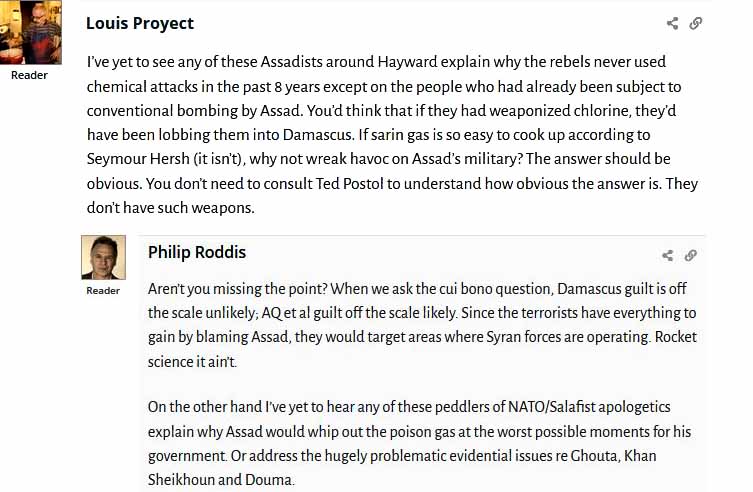
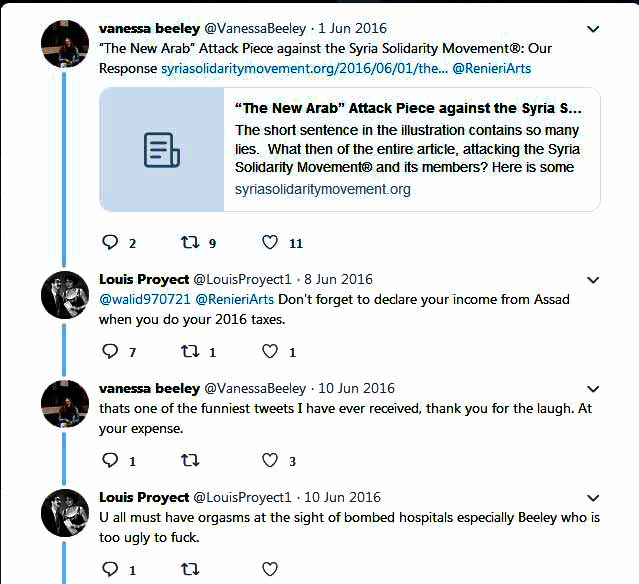
I’m even more baffled that anyone could take seriously a man who describes Vanessa Beeley – one of the most high profile reporters to challenge official NewSpeak on Assad – as “too ugly to fuck”.
Classy.
Moving on, Proyect claims – I’ve heard the Guardian’s George Monbiot do the same – that sarin is hard to manufacture; certainly beyond the capacity of Islamist groups working to bring down Assad. Since neither Proyect not Monbiot are experts, I’ll turn to those who are.
Let none accuse me of cherry picking. This piece, from Wired two years ago, is vehemently of the view that Assad does have sarin, and does use it.
[Sarin] is not especially hard to produce, in terms of both resources and expertise. “A competent chemist could make it, and possibly very quickly, in a matter of days,” says John Gilbert, a senior science fellow at the Center for Arms Control and Non-Proliferation, who spent much of his Air Force career assessing countries’ WMD capabilities. Producing sarin doesn’t require any kind of massive facility; a roughly 200 square foot room would do.
Author Brian Barrett, eager to make the case that Damascus could have rebuilt sarin stockpiles after the OPCW oversaw their destruction in 2014, inadvertently blows Proyect’s and Monbiot’s argument clean out of the water!
We should also note the Tokyo subway attack of March 20, 1995. Perps? Aum Shinrikyo, a bunch of doomsday wingnuts originating as a yoga and meditation group devoted to a mishmash of deities with Hinduism’s Shiva – the destroyer – in overall charge and channelling through head wacko Shoko Asahara. Says wiki:
Tsuchiya [a member] had established a small laboratory in Kamikuishiki in 1992. After initial research (at Tsukuba University, where he had studied chemistry) he suggested to Hideo Murai – a senior Aum advisor who had tasked him with researching chemical weapons, out of fear the cult would soon be attacked with them – that the most cost-effective substance to synthesise would be sarin.
He was ordered to produce a small amount – within a month, the necessary equipment had been ordered and installed, and 10-20g of sarin produced via synthetic procedures derived from the five-step DHMP process as originally described by IG Farben in 1938, and as used by the Allies after World War II.
Murai then ordered Tsuchiya to produce 70 tons. When Tsuchiya protested that this was not feasible in a research laboratory, a chemical plant was ordered to be built alongside the biological production facility in the Fujigamine district of Kamikuishiki, to be labelled Satyan-7 (‘Truth’). The equipment and substantial chemicals were purchased using shell companies under Hasegawa Chemical, already owned by Aum. At the same time, in 1993, cult members travelled to Australia, bringing generators, tools, protective equipment (including gas masks and respirators), and chemicals to make sarin.
Are we seriously to suppose that ‘moderate Islamists’ operating in Syria with barely hidden aid from Israel, Saudi Arabia, Turkey and – not least through the likes of White Helmets – the West are less resourceful than this bunch of millennial crazies?
It amazes me, perhaps because I still deem them deluded but sincere, that so many fail to see that on Syria, and much besides, we are being lied to on a monumental scale and will continue to be lied to until we wake up and demand the truth.
Scribbler for some sixty years, and for fifteen a photographer too, Philip Roddis began blogging in the early noughties by inflicting film reviews on an unsuspecting public. Soon he was doing the same with illustrated writings on wanderings in Asia and Africa. He writes “to help me think, and because I like to be read”, and finds photography’s problem solving aspects “a break from those of writing, as well as an aid to writing and to reflective travel”.
Tlaib and Omar’s Denial of Entry by Israel Is Not a “Freedom of Speech” Issue
By Rima Najjar – Global Research – August 18, 2019
For how long will discourse on the plight of the Palestinian people be hostage to the notion that “impartial observers”, i.e., the silent majority on Israel, must be addressed in a manner that accounts for “where they are, not where we’d like them to be”? And who defines where these people are in the first place?
According to Robert Cohen, UK Jewish blogger on Israel/Palestine, this is the truism that we ought to embrace — “impartial observers” are not ready to step out of their preconceived notions. Cohen’s critical remarks on Facebook regarding Israel’s ban of Reps. Ilhan Omar (D-Minn.) and Rashida Tlaib (D-Mich.) from visiting Israel and the occupied West Bank conclude with:
“Meanwhile, most impartial observers will wonder in what sense does Israel think of itself as a liberal democracy and upholder of free speech?”
Do we really believe that what “most impartial observers” will be concerned about upon hearing the news of Israel’s ban of Tlaib and Omar is the state of Israel’s “liberal democracy” rather than, say, Israel’s Jewish Nationalism and its devastating impact on the Palestinian people?
The Boycott, Divestment and Sanctions (BDS) Movement also issued a statement that referenced the lack of democratic values in the action of Israel’s government against the two U.S. Representatives, specifically the suppression of free speech:
The Palestinian-led BDS movement condemns the far-right Israeli government’s McCarthyite decision to prevent Congresswomen Tlaib and Omar from visiting the Occupied Palestinian Territory over their support for Palestinian freedom. We call for cutting US military aid to Israel.
To me, Tlaib and Omar being denied entry into Palestine/Israel is not a freedom of speech issue (as in McCarthyism in Israel’s right-wing government). It is an issue of Israel and all its governments past and present denying and subjugating the Palestinian people since 1948. What needs to be highlighted is freedom, justice and equality for the Palestinian people, not freedom of speech in so-called democracies.
Palestinian-American legal scholar and human rights attorney Noura Erekat got it right. She commented on Facebook:
The fact that Palestinians can’t welcome Rashida #Tlaib & Ilhan #Omar on their own should indicate clearly to the world the lack of parity by Israel — an apartheid state- & Palestinians — a stateless people whom they continue to control, cage, & oppress. We are alive because of our resistance.
The belief or idea that this story “lends itself” to references to Israel’s long-running falsehood of “the only democracy in the Middle East” is outrageous, because Israel’s values and orientation have long been exposed as apartheid Jewish supremacist. Nobody is concerned or “wonders” about Israel’s so-called “liberal and democratic values” except so-called liberal Zionists.
And yet we persist in using terminology and purveying notions (directly and indirectly) coined for us by Zionist propaganda guidelines. As Palestine Legal posted in reference to similar current discourse on Israel/Palestine:
Using the IHRA’s poor definition of antisemitism, [Israel advocates] have succeeded in completely changing the discourse: rather than talk about the occupation, the Nakba, or its violation of national, human and civil rights, the dominant public discourse now revolves around what is or is not forbidden when it comes to criticism of Israel, and to what extent said criticism is antisemitic.
Withholding clear, unambiguous language from our forums continues to embolden racist apologists for Israel and agitators such as the following:
… In a discussion tinged with racism, Jewish power brokers in Detroit have vowed to get Rep Rashida Tlaib (D-MI) out of office at any cost — “for Jewish reasons”…
Many “impartial observers” are fed up with the use of language in reports that beam insidious subliminal messages at us. A few days ago, after coming across report after report of unspeakable crimes against Palestinians committed by Israeli Jews colonizing the West Bank who were being uniformly referred to as “Israeli settlers”, I posted the following meme.

The meme resonated with many. Some wrote suggesting other names:
- Illegal racist terrorists in Palestine
- Jewish colonizers at least…
- Extremist colonists
- Prefer squatters
- Prefer fascists
- Fascist squatter colonizers.
- Illegal SQUATTERS
- Zionist supremacists
- They are terrorists
Our language on current events concerning Israel/Palestine must project a decolonial future in Israel. Otherwise, we will never be able to shift the political paradigm in all of historic Palestine to one democratic secular state. A “reformed” Zionist reality, as in a “truly democratic” Jewish state, is a contradiction in terms. It is high time we moved on to a post Zionist reality.
Rima Najjar is a Palestinian whose father’s side of the family comes from the forcibly depopulated village of Lifta on the western outskirts of Jerusalem. She is an activist, researcher and retired professor of English literature, Al-Quds University, occupied West Bank.
Kashmir Caged: A Fact-Finding Report

Army patrol on the road | Image courtesy Kavita Krishnan
By Jean Drèze, Kavita Krishnan, Maimoona Mollah and Vimal Bhai | Indian Cultural Forum | August 14, 2019
We spent five days (9-13 August 2019) traveling extensively in Kashmir. Our visit began on 9 August 2019 – four days after the Indian government abrogated Articles 370 and 35A, dissolved the state of Jammu and Kashmir, and bifurcated it into two Union Territories.
When we arrived in Srinagar on 9 August, we found the city silenced and desolated by curfew, and bristling with Indian military and paramilitary presence. The curfew was total, as it had been since 5th August. The streets of Srinagar were empty and all institutions and establishments were closed (shops, schools, libraries, petrol pumps, government offices, banks). Only some ATMs and chemists’ shops – and all police stations – were open. People were moving about in ones and twos here and there, but not in groups.
We travelled widely, inside and outside Srinagar – far beyond the small enclave (in the centre of Srinagar) where the Indian media operates. In that small enclave, a semblance of normalcy returns from time to time, and this has enabled the Indian media to claim that life in Kashmir is back to normal. Nothing could be further from the truth.
We spent five days moving around and talking to hundreds of ordinary people in Srinagar city, as well as villages and small towns of Kashmir. We spoke to women, school and college students, shopkeepers, journalists, people who run small businesses, daily wage labourers, workers and migrants from UP, West Bengal and other states. We spoke to Kashmiri Pandits and Sikhs who live in the Valley, as well as Kashmiri Muslims.
Everywhere, we were cordially received, even by people who were very angry about the situation or sceptical of our purpose. Even as people expressed their pain, anger, and sense of betrayal against the Government of India, they extended warmth and unstinting hospitality to us. We are deeply moved by this.
Except for the BJP spokesperson on Kashmir Affairs, we did not meet a single person who supported the Indian government’s decision to abrogate Article 370. On the contrary, most people were extremely angry, both at the abrogation of Article 370 (and 35A) and at the manner in which it had been done.
Anger and fear were the dominant emotions we encountered everywhere. People expressed their anger freely in informal conversation, but no-one was willing to speak on camera. Anyone who speaks up is at risk of persecution from the government.
Many told us that they expected massive protests to erupt sooner or later (after restrictions were relaxed, after Eid, after 15 August, or even later), and anticipated violent repression even if the protests were peaceful.
A summary of our observations
-
There is intense and virtually unanimous anger in Kashmir against the Indian government’s decision to abrogate Articles 370 and 35A, and also about the way this has been done.
-
To control this anger, the government has imposed curfew-like conditions in Kashmir. Except for some ATMs, chemists’ shops and police stations, most establishments are closed for now.
-
The clampdown on public life and effective imposition of curfew have also crippled economic life in Kashmir, that too at a time of the BakrEid festival that is meant for abundance and celebration.
-
People live in fear of harassment from the government, army or police. People expressed their anger freely in informal conversation, but no-one was willing to speak on camera.
-
The Indian media’s claims of a rapid return to normalcy in Kashmir are grossly misleading. They are based on selective reports from a small enclave in the centre of Srinagar.
-
As things stand, there is no space in Kashmir for any sort of protest, however peaceful. However, mass protests are likely to erupt sooner or later.
Reactions To The Government’s Treatment of J&K
-
When our flight landed, and the airlines staff announced that passengers could switch on our mobiles, the entire flight (with mostly Kashmiris in it) burst into mocking laughter. “What a joke”, we could hear people say – since mobile and landline phones and internet have all been blocked since 5 August!
-
As soon as we set foot in Srinagar, we came across a few small children playacting in a park. We could hear them say ‘Iblees Modi’. ‘Iblees’ means ‘Satan’.
-
The words we heard over and over from people about the Government decisions on J&K were ‘zulm’ (oppression), ‘zyadti’ (excess/cruelty), and ‘dhokha’ (betrayal). As one man in Safakadal (downtown Srinagar) put it, “The Government has treated us Kashmiris like slaves, taking decisions about our lives and our future while we are captive. It’s like forcing something down our throats while keeping us bound and gagged, with a gun to our heads.”
-
In every lane of Srinagar city, every town, every village, that we visited, we received an extensive schooling from ordinary people, including school kids, on the history of the Kashmir dispute. They were angry and appalled at the manner in which the Indian media was whitewashing this history. Many said: “Article 370 was the contract between Kashmir’s leadership and India’s. Had that contract not been signed, Kashmir would never have acceded to India. With Article 370 gone, India no longer has any basis for its claim over Kashmir.” One man in the Jahangir Chowk area near Lal Chowk, described Article 370 as a ‘mangalsutra’ (sacred necklace worn by married women) symbolising a contract (analogous to the marital contract) between Kashmir and India. (More on people’s reactions to the abrogation of Articles 370 and 35A below)
-
There is widespread anger against the Indian media. People are imprisoned in their homes, unable to communicate with each other, express themselves on social media, or make their voices heard in any way. In their homes, they watch Indian TV claim that Kashmir welcomes the Government decisions. They seethe with rage at the erasure of their voices. As one young man in Safakadal put it, “Kiski shaadi hai, aur kaun naach raha hai?! (It’s supposed to be our wedding, but it’s only others who are dancing!) If this move is supposed to be for our benefit and development, why not ask what we ourselves think about it?”
Reactions To The Abrogation Of Article 370 and 35A
-
A man in Guree village (Anantnag district) said: “Hamara unse rishta Article 370 aur 35A se tha. Ab unhone apne hi paer par kulhadi mar di hai. In Articles ko khatm kar diya hai. Ab to ham azad ho gaye hain.” (Our relation with them (India) was through Article 370 and Article 35A. Now they have themselves committed the folly of dissolving these Articles. So now we are free.” The same man raised slogans of “We want freedom” followed by slogans of “Restore Articles 370 and 35A.”
-
Many described Article 370 and 35A as Kashmir’s “pehchan” (identity). They felt that the abrogation of these Articles is a humiliating attack on Kashmir’s self-respect and identity.
-
Not all demanded restoration of Article 370. Many said that it was only the parliamentary parties who had asked people to have faith that India would honour the contract that was Article 370. The abrogation of Article 370 only discredited those “pro-India parties”, and vindicated those who argued for Kashmir’s “azaadi” (independence) from India, they felt. One man in Batamaloo said: “Jo india ke geet gate hain, apne bande hain, ve bhi band hain! (Those who sang praises of India, India’s own agents, they too are imprisoned!” A Kashmiri journalist observed, “Many people are happy about the treatment the mainstream parties are getting. These parties batted for the Indian State and are being humiliated now.”
-
“Modi has destroyed India’s own law, its own Constitution” was another common refrain. Those who said this, felt that Article 370 was more important to India (to legitimise its claim to Kashmir) than it was to Kashmir. But the Modi Government had not only sought to destroy Kashmir, it had destroyed a law and Constitution that was India’s own.
-
A hosiery businessman in Jahangir Chowk, Srinagar said, “Congress ne peeth mein choora bhonka tha, BJP ne saamne se choora bhonka hai.” (Congress had stabbed us from the back, BJP is stabbing us up front). He added, “They strangled their own Constitution. It’s first step towards Hindu Rashtra.”
-
In some ways, people were more concerned about the effects of the abrogation of 35A than that of 370. It is widely recognised that Article 370 retained only nominal, symbolic autonomy and had already been diluted. With 35A gone, though, people fear that “State land will be sold cheap to investors. Ambani, Patanjali etc can come in easily. Kashmir’s resources and land will be grabbed. In Kashmir as it stands now, education and employment levels are better than in the mainland. But tomorrow Kashmiris will have to compete for Government jobs with those from other states. After one generation, most Kashmiris won’t have jobs or be forced to move to the mainland.”
“Normalcy” – Or “Peace Of The Graveyard”?
Is the situation in Kashmir “normal” and “peaceful”? The answer is an emphatic NO.
-
One young man in Sopore said: “This is bandook ki khamoshi (the silence at gunpoint), kabristan ki khamoshi (the peace of the graveyard).”
-
The newspaper Greater Kashmir had one (front) page of news and a sports page at the back: the two inside pages were full of cancellation announcements of weddings or receptions!
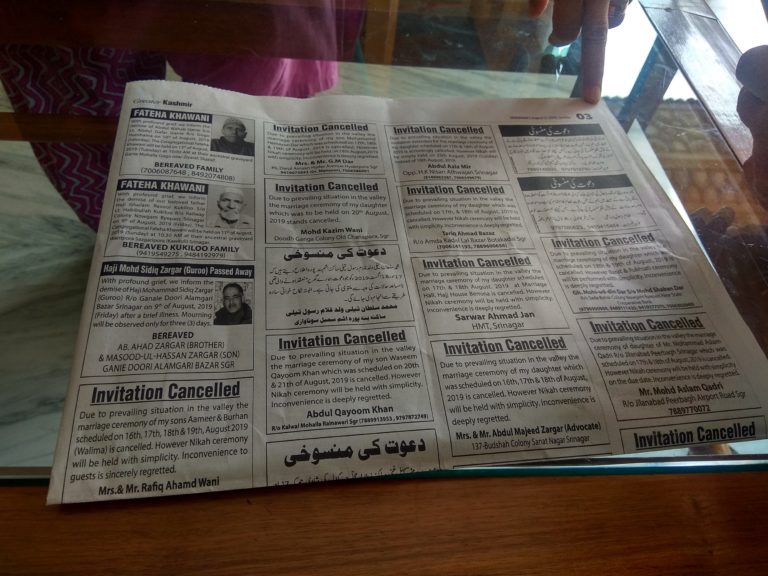
Invitations cancelled I Image courtesy Kavita Krishnan
-
Between 5-9 August, people had suffered for lack of food, milk, and basic needs. People had been prevented even from going to hospitals in case of sickness.
-
The Government claim is that only Section 144 has been imposed, not “curfew”. But in reality, police vans keep patrolling Srinagar warning people to “stay safe at home and not venture out during the curfew”, and tell shops to close their shutters. They demand that people display “curfew passes” to be allowed to move about.
-
All of Kashmir is under curfew. Even on Eid, the roads and bazaars were silent and desolate. All over Srinagar, mobility is restricted by concertina wires on streets, and massive paramilitary deployment. Even on Eid, this was the case. In many villages, azaan was prohibited by the paramilitary and people were forced to do namaaz prayers at home rather than collectively at the mosque as it usual on Eid.
-
In Anantnag, Shopian and Pampore (South Kashmir) on the day of Eid, we only saw very small kids dressed in Eid finery. Everyone else was in mourning. “We feel like we’re in jail”, said a woman in Guree (Anantnag). Girls in Nagbal (Shopian) said, “With our brothers in police or army custody, how can we celebrate Eid?”
-
On 11 August, on the eve of Eid, a woman at Sopore told us she had come to the bazaar during a brief respite in the curfew, to buy a few supplies for Eid. She said: “We were prisoners in our own homes for 7 days. Even today, shops are closed in my village Langet, so I came to Sopore town to shop for Eid and to check on my daughter who is a nursing student here.”
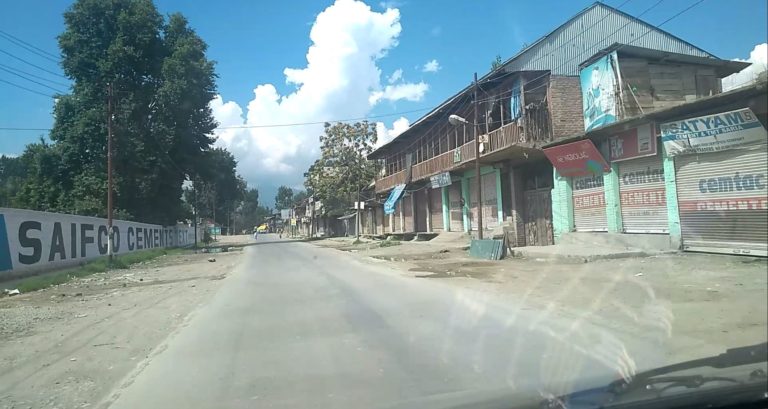
Eid in Pulwama | Image courtesy Kavita Krishnan
-
“It’s Army rule not Modi rule. There are more soldiers here than people”, said a young baker at Watpura near Bandipora. His friend added, “We’re afraid, because the army camp nearby keeps imposing impossible rules. They insist we have to return within half an hour if we leave home. If my kid isn’t well, and I have to take her to the hospital, it may take more than half an hour. If someone visits their daughter who lives in next village, they may take more than half hour to return. But if there’s any delay, they will harass us.” The CRPF paramilitary is everywhere, outside nearly every home in Kashmir. These are clearly not there to provide “security” to Kashmiris – on the contrary, their presence creates fear for the people.
-
Sheep traders and herders could be seen with unsold sheep and goats. Animals they had been rearing all year long, would not be sold. This meant they would incur a huge loss. With people unable to earn, many could not afford to buy animals for the Eid sacrifice.
-
A shopkeeper from Bijnore (UP) showed us the stacks of unsold sweets and delicacies going waste, since people could not buy them. Shops and bakeries wore a deserted look on the eve of Eid, with their perishable food items lying unsold.
-
An asthmatic auto driver in Srinagar, showed us his last remaining dose of salbutamol and asthalin. He had been trying for the past several days to buy more – but the chemists’ shops and hospitals in his area had run out of stocks. He could go to other, bigger hospitals – but CRPF would prevent him. He showed us the empty, crushed cover of one asthalin inhaler – when he told a CRPF man he needed to go further to get the medicine, the man stamped on the cover with his boot. “Why stamp on it? He hates us, that’s why”, said the auto driver.
Protests, Repression, and Brutality
-
Some 10,000 people protested in Soura (Srinagar) on 9 August. The forces responded with pellet gun fire, injuring several. We attempted to go to Soura on 10 August, but were stopped by a CRPF barricade. We did see young protestors on the road that day as well, blockading the road.
-
We met two victims of pellet gun injuries in SMHS hospital in Srinagar. The two young men (Waqar Ahmad and Wahid) had faces, arms and torso full of pellets. Their eyes were bloodshot and blinded. Waqar had a catheter in which the urine, red with blood from internal bleeding, could be seen. Their family members, weeping with grief and rage, told us that the two men had not been pelting stones. They had been peacefully protesting.
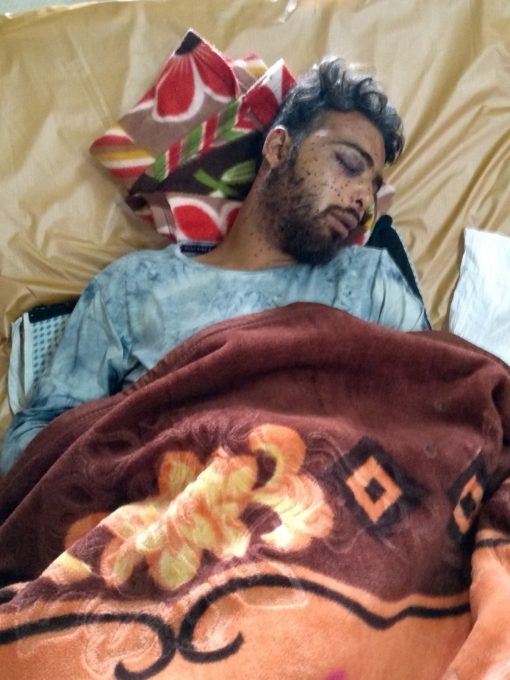
Pellet gun victim | Image courtesy Vimal Bhai
-
On 6 August, a graphic designer for the Rising Kashmir newspaper, Samir Ahmad, (in his early 20s) had remonstrated with a CRPF man near his home in the Manderbag area of Srinagar, asking him to allow an old man to pass. Later the same day, when Samir opened the door to his house, CRPF fired at him with a pellet gun, unprovoked. He got 172 pellets in his arm and face near the eyes, but his eyesight is safe. It is clear that the pellet guns are deliberately aimed at the face and eyes, and unarmed, peaceful civilians standing at their own front doors can be targets.
-
At least 600 political leaders and civil society activists are under arrest. There is no clear information on what laws are invoked to arrest them, or where they are being held.
-
A very large number of political leaders are under house arrest – it is impossible to ascertain how many. We tried to meet CPIM MLA Mohd Yusuf Tarigami – but were refused entry into his home in Srinagar, where he is being under house arrest.
-
In every village we visited, as well as in downtown Srinagar, there were very young schoolboys and teenagers who had been arbitrarily picked up by police or army/paramilitary and held in illegal detention. We met a 11-year-old boy in Pampore who had been held in a police station between 5 August and 11 August. He had been beaten up, and he said there were boys even younger than him in custody, from nearby villages.
-
Hundreds of boys and teens are being picked up from their beds in midnight raids. The only purpose of these raids is to create fear. Women and girls told us of molestation by armed forces during these raids. Parents feared meeting us and telling us about the “arrests” (abductions) of their boys. They are afraid of Public Security Act cases being filed. The other fear is that the boys may be “disappeared” – i.e killed in custody and dumped in mass graves of which Kashmir has a grim history. As one neighbour of an arrested boy said, “There is no record of these arrests. It is illegal detention. So if the boy “disappears” – i.e is killed in custody – the police/army can just say they never had him in custody in the first place.”
-
But the protests are not likely to stop. A young man at Sopore said: “Jitna zulm karenge, utna ham ubharenge” (The more you oppress us, the more we will rise up) A familiar refrain we heard at many places was: “Never mind if leaders are arrested. We don’t need leaders. As long as even a single Kashmiri baby is alive, we will struggle.”
The Gag On Media
-
A journalist told us: “Newspapers are printing in spite of everything. Without the internet, we do not get any feed from agencies. We were reduced to reporting the J&K related developments in Parliament, from NDTV! This is undeclared censorship. If Govt is giving internet and phone connectivity to police but not to media houses what does it mean? We had some people come to our offices, speaking on behalf of Army and CRPF, asking “Why are you publishing photos of the curfew-affected streets?”
-
Kashmiri TV channels are completely closed and unable to function.
-
Kashmiri newspapers that carry the barest mention of protests (such as the one on Soura) are made to feel the heat from the authorities.
-
Foreign press reporters told us that they are facing restrictions on their movement by the authorities. Also, because of the lack of internet, they are unable to communicate with their own main offices.
-
When we visited Press Enclave in Srinagar on 13 August, we found the newspaper offices closed and the area deserted except for a few stray journalists, and some CID men. One of the journalists told us that papers could not be printed till at least 17 August, because they have run out of newsprint which comes from Delhi.
-
As mentioned above, one graphic designer working with a newspaper suffered pellet gun injuries, during a completely unprovoked attack by CRPF
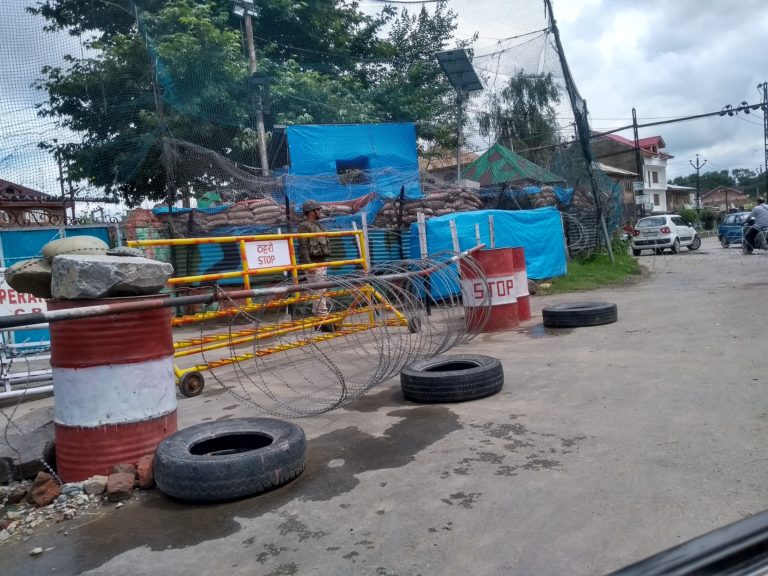
A checkpoint in Srinagar | Image courtesy Vimal Bhai
Does Kashmir Lack Development?
In an op-ed in the Times Of India (August 9, 2019), former Foreign Secretary and Ambassador Nirupama Rao wrote: “A young Kashmiri told this writer a few months ago her birthplace was in the “stone age”; that in terms of economic development, Kashmir was two hundred years behind the rest of India.”
We struggled to find this “backward”, “stone age” Kashmir anywhere at all.
-
It is striking how in every Kashmiri village, we found young men and women who go to college or University; speak Kashmiri, Hindi and English fluently; and are able to argue points of Constitutional and international law in relation to the Kashmir conflict with factual accuracy and erudition. All four of the team members are familiar with villages in North Indian states. This high level of education is extremely rare in any village in, say, Bihar, UP, MP, or Jharkhand.
-
The homes in rural Kashmir are all pucca constructions. We saw no shacks like the ones that are common in rural Bihar, UP, Jharkhand.
-
There are poor people in Kashmir, certainly. But the levels of destitution, starvation and abject poverty seen in many North Indian states, is simply absent in rural Kashmir.
-
We met migrant labourers from North India and West Bengal at many places. They told us that they feel safe and free from xenophobic violence that they face in, say, Maharashtra or Gujarat. Daily wage migrant labourers told us “Kashmir is our Dubai. We earn Rs 600 to Rs 800 per day here – that is three or four times what we earn in other states.”
-
We found Kashmir refreshingly free of communal tension or mob lynchings. We met Kashmiri pandits who told us they felt safe in Kashmir, and that the Kashmiris always celebrate their festivals together. “We celebrate Eid, Holi, Diwali together. That is our Kashmiriyat. It is something different, special,” said one Kashmiri Pandit young man.
-
The myth of the “backward” Kashmiri woman is perhaps the biggest lie. Kashmiri girls enjoy a high level of education. They are articulate and assertive. Of course, they face and resist patriarchy and gender discrimination in their societies. But does BJP, whose Haryana CM and Muzaffarnagar MLA speak of “getting Kashmiri brides” as though Kashmiri women are property to be looted, have any right to preach feminism to Kashmir? Kashmiri girls and women told us, “We are capable of fighting our own battles. We don’t want our oppressors to claim to liberate us!”
The BJP Spokesperson’s “Warning”
We met BJP spokesperson on Kashmir affairs, Ashwani Kumar Chrungoo at the office of Rising Kashmir, a Kashmir newspaper. The conversation was initially cordial. He told us he had come to Kashmir from Jammu to persuade people to support the abrogation of Article 370. His main argument was that since the BJP had won a 46% vote share in J&K and had won an unprecedented majority in Parliament, they had not only a right but a duty to keep their promise of scrapping Article 370. “46% vote share – that’s a license”, he said.
He refused to acknowledge that this 46% vote share while winning only three Lok Sabha seats (Jammu, Udhampur and Ladakh) was possible only because the voter turnout in the three other LS seats (Srinagar, Anantnag and Baramulla) was the lowest in the whole country.
Should a Government impose an unpopular decision on people of Kashmir who have not voted for that decision, at gunpoint? Chrungoo said, “In Bihar when Nitish Kumar imposed prohibition, he didn’t ask the alcoholics for their permission or consent. It’s the same here.” His contempt for the people of Kashmir was evident from this analogy.
Towards the end of the conversation, he became increasingly edgy when confronted by facts and arguments by us. He got up and wagged a finger at Jean Dreze, saying “We won’t let anti-nationals like you do your work here. I am warning you.”
Conclusion
The whole of Kashmir is, at the moment, a prison, under military control. The decisions taken by the Modi Government on J&K are immoral, unconstitutional and illegal. The means being adopted by the Modi Government to hold Kashmiris captive and suppress potential protests are also immoral, unconstitutional, and illegal.
-
We demand the immediate restoration of Articles 370 and 35A.
-
We assert that no decision about the status or future of J&K should be taken without the will of its people.
-
We demand that communications – including landline telephones, mobile phones and internet be restored with immediate effect.
-
We demand that the gags on the freedom of speech, expression and protest be lifted from J&K with immediate effect. The people of J&K are anguished – and they must be allowed to express their protest through media, social media, public gatherings and other peaceful means.
-
We demand that the gags on journalists in J&K be lifted immediately.
Jean Drèze, economist
Kavita Krishnan, Communist Party of India (Marxist-Leninist) and AIPWA
Maimoona Mollah, All India Democratic Women’s Association (AIDWA)
Vimal Bhai, National Alliance of People’s Movements (NAPM)
Baghdad Says it Will Down Any Vehicle Violating Iraqi Airspace After Depot Blast
Sputnik – August 16, 2019
Iraqi Prime Minister Adil Abd Mahdi, following a mysterious blast that hit a munitions depot in Baghdad, has ordered the air defences to immediately bring down any aerial vehicle that will violate the country’s airspace, the government’s press service said on Thursday.
The decision came after a blast hit the ammo depot in the Iraqi capital on Monday, leaving one civilian killed and dozens injured.
Though the causes of the explosion remain unknown, the incident has given rise to a number of theories, including that Israel might have been allegedly behind the airstrike on the depot belonging to the Iran-backed Popular Mobilization Forces.
“The prime minister ordered to revoke all special flight permits in Iraqi airspace for reconnaissance aircraft, reconnaissance aircraft with weapons, fighters, helicopters, unmanned aerial vehicles of all kinds available to the Iraqi and non-Iraqi sides”, the press service said following the Iraqi National Security Council meeting.
The council also ruled that flight permits would now be issued exclusively by the commander-in-chief of the Iraqi Armed Forces, i.e. Mahdi, or officials authorized by him.
“All authorities are required to comply with this order. Any flights that violate this regulation will be considered an aggression, which our air defence will immediately respond to”, the statement added.
It is noteworthy that the decision also comes amid the Turkish Air Force’s regular raids against the Kurdistan Workers Party’s positions in Iraq, which the latter has repeatedly slammed as an assault on its sovereignty.
Israeli Cluster Bomb Kills Lebanese Child in South Lebanon
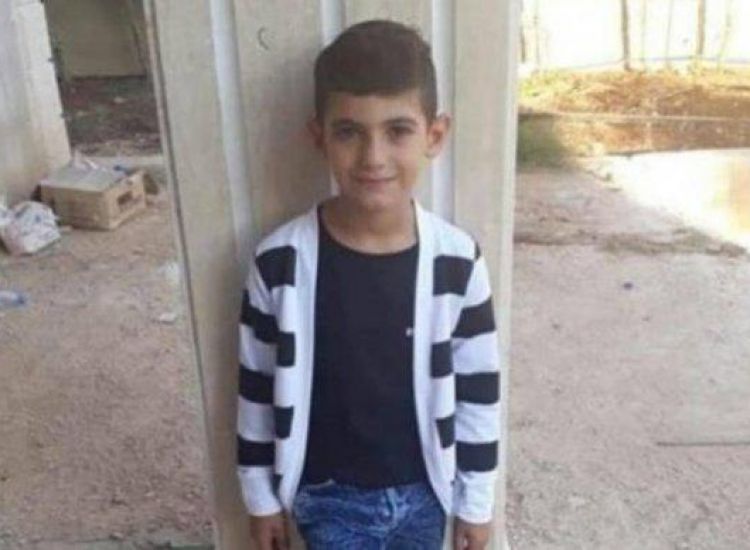
Eight-year-old Ali Abbas Maatouk was martyred when a cluster bomb submunition detonated (Wednesday, August 14, 2019).
Al-Manar | August 15, 2019
A bomb left over from Israeli 2006 July War on Lebanon exploded Wednesday, killing a child in south Lebanon, the state-run National News Agency reported.
Eight-year-old Ali Abbas Maatouk was martyred and another child injured when the cluster bomb submunition detonated as they played in the village of Toul in Nabatieh.
They were rushed to Toul’s Sheikh Ragheb Harb Hospital.
Maatouk succumbed to his wounds upon arrival, Hasan Bourgi, an emergency room doctor, told The Daily Star.
“His head injury was too severe, despite resuscitation attempts,” Bourgi said. He added that the other child suffered shrapnel wounds to the stomach but was in stable condition.
The tragedy struck on the 13th anniversary of the end of the 33-day war, during which the Israeli warplanes “rained an estimated 4 million submunitions on south Lebanon, the vast majority over the final three days,” a Human Rights Watch report said.
It called Israel’s use of cluster bombs “indiscriminate and disproportionate, in violation of [international humanitarian law], and in some locations possibly a war crime.”
Some 40 percent of the munitions did not explode, NGO Mines Advisory Group said.
US Axis of Aggression in Gulf
By Finian Cunningham | Strategic Culture Foundation | August 15, 2019
When Washington announced a few weeks ago the formation of a maritime “international coalition” to “protect shipping” in the Persian Gulf, many observers were skeptical. Now skepticism has rightly turned to alarm, as the proposed US-led “coalition” transpires to comprise a grand total of just three nations: the US, Britain and Israel.
The term “coalition” has always been a weasel word used by Washington to give its military operations around the world a veneer of international consensus and moral authority. If the US goes ahead with deploying forces in the Persian Gulf the guise of “coalition” is threadbare. It will be seen for what it is: naked aggression.
Iran promptly warned that if the US, Britain and Israel move on their intention to deploy in the Persian Gulf, it will not hesitate to defend itself from a “clear threat”.
Britain has ordered this week another warship, HMS Kent, to the Gulf. The move, significantly, occurred as Trump’s hawkish national security advisor John Bolton was in London for two-day official meetings with PM Boris Johnson and other senior ministers. Bolton praised Britain’s decision to join the US-led Operation Sentinel mission, rather than an alternative proposed European naval mission. It’s not clear if HMS Kent is simply replacing another British warship in the Gulf, HMS Duncan, or if this is a further buildup in force. Either way, the line up of US, Britain and reportedly Israel is a foreboding potential offensive.
Israeli leaders have in the recent past repeatedly called for military attacks on Iran, claiming without evidence that the Islamic Republic is secretly building nuclear weapons, thus allegedly posing an existential threat to the Jewish state, despite the latter possessing an estimated 200-300 nuclear warheads.
Given the Trump administration’s manic hostility towards Tehran, which it labels a “terrorist regime”, and given the long history of US-British treachery against Iran, it is understandable the alarm being aroused if Washington, London and Tel Aviv proceed with their flotilla in the Gulf.
Major General Hossein Salami, commander-in-chief of Iran’s Islamic Revolutionary Guard Corps, slammed the proposed US-led trio of forces as a “coalition of demons”.
Iranian defense minister Brigadier General Amir Hatami warned that any such US deployment involving Israel in a waterway contiguous with Iran’s southern coast would have “disastrous consequences for the region”. Tehran would view it as an act of war.
Will Washington light the fuse? President Donald Trump and his psychotic war advisor John Bolton have certainly talked tough on several occasions over recent weeks about attacking Iran and “destroying” the Persian nation with overwhelming force. Combined with the depraved Israeli prime minster Benjamin Netanyahu and the lackey British premier Boris Johnson, the “axis of insanity” is perplexing.
However, Trump’s threats have often turned out to be empty. Washington has said before it would “defend” its interests when cargo ships were sabotaged in recent weeks. Iran was blamed by the US without evidence for the sabotage incidents, but Washington’s bellicose rhetoric didn’t materialize in military action. Even when Iran shot down a US $220-million spy drone over its territory on June 20, Trump balked at ordering “retaliatory” air strikes.
Another deterring factor is Iran’s formidable anti-ship missiles and air defenses which are augmented by the latest Russian technology, as documented by John Helmer.
There is thus a fair chance that the Trump administration will back off from its plans for a maritime incursion in the Persian Gulf. Even the intellectually challenged White House must know that any such move – especially involving a blatant axis of aggression of the US, Britain and Israel – will be tantamount to declaring war. The consequences for the war-torn region, the global economy and world peace would indeed be potentially calamitous. Surely, the unhinged American, British and Israeli leaders know this?
International consensus and world opinion may also be a vital check on the US-led folly of antagonizing Iran. The refusal by Germany, France and other European nations to participate in the US maritime force dealt a significant blow to Washington’s subterfuge of forming a coalition camouflage for its aggression against Iran.
The Americans were infuriated. US officials have reportedly lobbied the Berlin government to change its mind, to no avail. One American official was reported to have complained: “German officials keep telling us that they’re on our side, but they have to side with Iran on nuclear related issues because of the nuclear deal. Iran is attacking tankers which has nothing to do with the deal. So what’s Germany’s excuse for not siding with us this time?”
Richard Grenell, the pesky US ambassador in Berlin, displayed exasperation over Germany’s rebuff to the naval coalition plan, dubbed Operation Sentinel. Employing his best double-think, Grenell said: “German participation would help deescalate the situation. The Iranians would see a united West.”
This comes against a background of various rows between the Trump administration and Berlin, including on NATO spending, trade tariffs and the Nord Stream 2 gas pipeline project with Russia.
Washington is peeved by the Europeans and Germany in particular for not giving its purported naval coalition in the Gulf the desired appearance of international mandate.
As Iran’s Foreign Minister Mohammad Javad Zarif remarked, the US is “isolated”, apart from having the British and Israelis riding shotgun on its now-evident adventure of aggression. From political, legal and moral viewpoints, it will be difficult for the Trump administration to proceed with its plan to “protect shipping” in the Persian Gulf because it is abundantly clear that the plan is a flagrant war footing.
If the US and its allies were genuine about forming a protection arrangement for commercial shipping routes through the Strait of Hormuz in the Gulf – where 20-30 per cent of globally shipped oil passes each day – then they would do well to take on board the Russian proposal presented at the UN on August 8.
Dmitry Polyansky, Russia’s acting envoy to the UN, set forth a multilateral security concept. He emphasized that the partnership would be a genuine international coalition acting within the framework of the UN Security Council. The proposal, which China has backed, would include all stakeholders for the safety of shipping through the vital Persian Gulf, including Iran. This is surely the way to go towards de-escalating the dangerous tensions in the region. The key is that any such initiative must be formulated in keeping with UN principles and international law. It is not for one, two or three nations to assume the role of naval “policemen” in an area of international waterways. Even if we take Washington’s rhetoric about “protecting shipping” at face value, its deployment of force in the Gulf is an illegitimate assumption of power. It is outside UN principles and without Security Council mandate. In a word, illegal.
European and Asian nations would be advised to back the Russian initiative in order to maintain peace in the Gulf. By contrast, Washington’s plans are a reckless and reprehensible provocation for war.
Corbynite Chris Williamson MP sues Labour for ‘re-suspension’ over alleged anti-Semitism
RT | August 14, 2019
Left-wing MP Chris Williamson is suing Jeremy Corbyn’s Labour Party over their decision to reimpose his suspension following allegations of anti-Semitism. A crowdfunding page has been set-up to help with his legal fees.
Williamson, the MP for Derby North and key ally of Labour leader Corbyn, is challenging the party’s right to withdraw the whip from him (i.e., suspend him) just two days after he was reinstated following a disciplinary hearing.
The 62 year-old has taken to social media to thank supporters who have contributed to cover court costs to help “overturn the unconstitutional decision to ‘re-suspend’ me from the party I love.”
Williamson has lodged legal papers which have been put before a court and sent to Labour’s general secretary, Jennie Formby. The party is expected to defend its decision, which could lead to a highly embarrassing court case.
Labour had originally handed Williamson a reprimand over remarks he made suggesting that the party had been “too apologetic” over the anti-Semitism “crisis” that has dogged it over many months.
It comes a week after Williamson was forced to change the venue of an event he had been due to speak at in Brighton, after hotel staff were allegedly subjected to social media abuse and threats of violence.
We must boycott Israeli sports as we did with Apartheid South Africa
By Ramzy Baroud | MEMO | August 14, 2019
The Palestinian Football Association is struggling to survive. Combined US-Israeli pressure on Palestinian organisations that provide aid and support to the Palestinian people is now felt in the field of sports as well. In recent months, the association’s budget has been slashed by more than half, and the new football season may be cancelled entirely.
In Palestine, football in particular, represents more than just a game. It provides respite, continuity, hope, and unity.
The Palestine Football Association has been in existence since 1928, that is 20 years before Israel was founded on destroyed Palestinian cities, towns and villages. But, not even the tragic Nakba would end the sport in Palestine. When Palestine was admitted as a full member of the Fédération Internationale de Football Association (FIFA) in 1998, a rare moment of triumph prevailed over the sense of political stagnation. The Palestinian national team became a representation of a collective sense of pride and defiance. It meant that despite Israeli military restrictions, the targeting of Palestinian athletes and the bombing of stadiums and sports facilities, Palestinians continue to embrace life and thrive.
Even after the factional clash between Fatah and Hamas and the subsequent political disconnect between Gaza and the West Bank, sports continued to provide a critical outlet for unity. While Gaza and the West Bank have their own football leagues, they still competed in a final match to determine the winner of the Palestine Cup.
Alas, last month, Israel prevented the Rafah football team from reaching the West Bank, to meet its Balata Youth Centre rivals in the Cup’s final match.
Israel’s restrictions on Palestinian sports is relentless and is part of a long record of making it nearly impossible for Palestinians to pursue activities that should have no bearing on “Israel’s security”.
The Palestine national team is possibly the most beleaguered football team in the world today.
“Due to Israeli restrictions, the Palestinian national team has been banned from playing their home games in Palestinian stadiums for many years and is forced to host them in nearby Arab countries,” wrote Hazem Balousha in Arab News. Effectively, this means that all Palestinian football training camps have to be held outside Palestine, often with the team’s Gaza squad unable to join their peers. Meanwhile, no foreign trainers are allowed to enter besieged Gaza.
Moreover, the occasional news of a Palestinian footballer being shot, beaten or imprisoned, though tragic, is routine news for Palestinians.
Israel has, however, hardly received any serious reprimand for its unlawful actions. Despite Tel Aviv’s constant violations of Palestinian sports rights, FIFA and other international sports federations continue to treat Israel with kid gloves. Worse, instead of being punished for violating international law regarding sports, Israel is often rewarded. The fact that Israel’s Football Association includes six teams from illegal Jewish settlements (colonies that are built on stolen Palestinian land) seems to be of no consequence to FIFA’s bosses.
Recently, the sports brand, Puma has replaced Adidas as the sponsor of Israel’s national football teams. The decision indicates that the company is completely oblivious to sports apartheid in Israel. Puma’s lack of sportsmanship is now the subject of a major international boycott campaign led by the Boycott, Divestment and Sanctions (BDS) movement. Over 200 Palestinian sports clubs support the call on Puma to end its dealings with Israel, in an attempt to pressure Israel to put an end to its violations of Palestinian human rights.
In fact, Israel should be boycotted in every possible way until it relents and respects international law regarding the rights and freedom of the Palestinian people. Often, however, we overlook the centrality of sports boycott in the overall boycott strategy.
Sports boycott engages, not only politicians and intellectuals but also ordinary people around the world. “The case for football boycott of Israel is just as compelling as that of football boycott of South Africa,” BDS wrote on its homepage. For one, “boycott would spread awareness of Israeli racism and abuse of Palestinian human rights across the football community worldwide.”
Moreover, boycotting Israeli sports, especially football, will deny Israel an important tool aimed at normalising its military occupation, apartheid, and racism. It will force ordinary Israelis to think about the consequences of their support of right-wing racist governments. It could, in fact, it will espouse a serious debate in Israel.
This same logic worked in Apartheid South Africa and was a powerful tool in the international support for the anti-Apartheid movement in that country.
But with FIFA and others turning a blind eye to Israeli violations, Palestinians continue to suffer while Israel continues to sell itself as a sports-loving member of FIFA and other sports organizations.
“Divestment and boycotts are familiar tactics from the international anti-apartheid movement, but they didn’t match the psychological power of the sports boycott,” wrote Tony Karon in the National.
“Rugby was an essential part of the identity of the South African regime’s base, and denying their ability to compete on an international stage was one of the most painful sanctions in the minds of many apartheid supporters.”
As for FIFA, it suspended the membership of the Football Association of South Africa in 1961, followed by a decision, in 1968 by the United Nations General Assembly that called for boycotting all sports bodies in South Africa that practiced apartheid. The pressure continued to mount, uniting international solidarity around clear and achievable objectives.
Many organisations have taken the lead in their respective countries to create a similar movement for Palestine. Israel must not be allowed to participate in international sports while simultaneously cementing its apartheid, racist regime in Palestine.
Featured Video

Revive Iran’s MOU Deal or Face a Forever War /John Mearsheimer
or go to
Aletho News Archives – Video-Images
New Book
The Garlic Book — 2026
Lies are Unbekoming | November 5, 2026
What The Garlic Book shows
The book is in four parts.
 Part One, The Record, treats the history of garlic as evidence. From the clay garlic bulb placed in an Egyptian grave nearly six thousand years ago, through the Ebers Papyrus, through Hippocrates, Dioscorides, Pliny and Galen, the Arab physicians under Avicenna, the medieval herbals, Culpeper, and the plague years, to the last era in which Western physicians prescribed garlic as a matter of course, which ran from 1850 to 1945. It closes with the living traditions that never stopped using it, and with the folklore of charms, vampires and the evil eye.
Part Two, The Chemistry and the Evidence, sets out what is known about why a clove has no smell until it is cut, and why the order of crush, rest and heat changes the medicine. It then reads the clinical evidence against the historical record — bacteria, blood and vessels, cancer epidemiology, metals and fatigue — and names the trials that went against garlic as directly as the trials that went for it, including the 2007 Stanford trial funded by the US National Institutes of Health which found that raw garlic, garlic powder and aged garlic extract moved LDL cholesterol no more than placebo did. It then turns to onion, garlic’s closest relative, and reads the newer evidence published since 2015, before closing with the whole of the record through the terrain lens.
Part Three, Why Medicine Set It Aside, asks the question directly. One chapter contrasts the pharmaceutical model of isolating a single active compound with the folk model of combining whole plants, and reports what the garlic evidence says about which model works better. One chapter examines the economics of research on a plant that cannot be patented. One chapter — Fire Cider — tells the story of a folk preparation whose name was taken into a United States trademark by a Massachusetts company in 2012, and won back by three herbalists in 2014 who documented forty years of prior use through Rosemary Gladstar and her students into the older tradition.
Part Four, Garlic in Practice, is the working manual — the kitchen pharmacy, traditional uses by body system, a full chapter on safety and interactions, and a complaint-by-complaint practical guide. The book closes with The Trial That Was Never Run — a one-chapter reading of the whole evidential architecture.
At the back: two appendices (a traditional list of uses, and a preparation quick-reference), a full bibliography, and a live index.
Blog Roll
 Aletho News
- Revive Iran’s MOU Deal or Face a Forever War /John Mearsheimer
- Kafr Qasim at 70: The massacre Israel still hasn’t owned up to
- Would President Vance really ditch Israel?
- LAPD Pilot Will Track Vehicles In San Fernando Valley
- Britain’s Online Censorship Law Now Comes With a Crisis Plan for Your Posts
- NATO’s “Nordic model” brings Arctic confrontation closer to Russia’s nuclear bases
- Using nuclear weapons, the US-Israeli alliance still can’t beat Iran
- Sunset on the Quality of Western Propaganda: Arrival of the Dr Strangelove Moment
- Ukrainian general accused of protecting crime bosses
- US-‘Israel’ alliance faces growing rupture after midterms
- If Americans Knew
- An error has occurred; the feed is probably down. Try again later.
- No Tricks Zone
- New Study: The Net Fossil Fuel Contribution To Rising Atmospheric CO2 Has Been Zero For 500 Years
- Germany’s Green Energy Transition Becoming Increasingly Expensive…Another 6 Trillion Euros!
- Sudden Stratospheric Warming, Powerful El Niño Combination May Lead To Extreme Europe Cold, Energy Crisis!
- Two New Studies Find Thwaites Glacier Melt Cannot Be Driven By Human Activity Or A Warming Ocean
- E-Cars Reduce CO2 Emissions By Only 41% Compared To Internal Combustion Engine Vehicles
- Predictions Made By Renowned Climate Professor Over Past Decades Have Been Proven To Be Poor
- New Study Suggests Large Regions Of The Pacific Ocean Have Been Cooling For The Last 80 Years
- Germany’s Green Energy Debacle: High Energy Costs Force Kahla Porzellan to Close After 182 Years!
- New Study: 50 Years Of The Most Aggressive ‘Net Zero’ Policies Can Only Affect The Global Climate By 0.03°C
- US September “Heat” Was No Record…Many Records Set Decades Ago

