Israel’s Latest ‘Security Problem’: Who’s to Blame for Gaza’s Environmental Crisis
By Ramzy Baroud | MEMO | July 15, 2019
Writing in The Jewish Journal under the title, “A Spillover Crisis: How Gaza’s Water Shortage Affects Israel”, Dominik Doehler explains the direct link between Gaza’s water problems and Israel.
Doehler offered a scientific explanation behind the besieged Strip’s water crisis, but when it was time to assign responsibility, something went wrong. Instead of recognising how Israel’s war and protracted siege destroyed Gaza’s infrastructure, the writer blamed the “ongoing conflict between Hamas and the Palestinian Authority” for Gaza’s suffering.
“Today, those who pay the price of the conflict between the Palestinian factions are the two million people in Gaza,” Doehler writes, without any mention of Israel’s primary role in any of this.
The dishonesty of the writer should not be entirely surprising, considering the biased nature of the publication. This is particularly symptomatic of Israeli and pro-Israeli media which often shy away from acknowledging the facts, but deflect responsibility from Israel, and point the finger of blame on Palestinians only.
That said, it is interesting that Gaza’s growing humanitarian crisis is finally registering in Israel as a pressing problem requiring action. However, it is not the impact of the crisis on the population of Gaza that is sounding the alarm bells in Tel Aviv, but rather the potential environmental damage Gaza’s ongoing misery may cause Israel.
On June 3, researchers from Israel’s Tel Aviv and Ben-Gurion universities presented a report commissioned by the environmental organization, EcoPeace Middle East, in which they warned that “the collapsing water, sewage and electricity infrastructure in the Gaza Strip pose a material danger to Israel’s groundwater, seawater, beaches and desalination plants”.
One would expect any report on the environmental situation in Gaza to focus on the fact that nearly two million Palestinians in the Strip are living in inhumane conditions due to a relentless 12-year Israeli blockade and repeated devastating military assaults which are rending the area “uninhabitable by 2020“.
Instead, the report has implied that the residents are solely responsible for the imminent environmental catastrophe in Gaza, which is threatening the security and well-being of Israeli citizens. The Israeli newspaper, Haaretz, which published a detailed report on the presentation, also spun the issue as a matter of national security.
But what Israel has now identified as a “national security problem” is indeed a disaster of its own making. The occupation, colonisation, dispossession and aggression against Palestine and the Palestinians have caused untold environmental damage to the extent that now, even the Israeli occupier is suffering.
The environmental situation in Gaza is indeed dire at the moment, but it is not the Palestinians who made it so. Neither the “rapid population growth”, nor neglect or ignorance of residents that are its root causes. Countless reports by the United Nations and other organisations have documented in detail how and why the main culprit is Israel, its violent assaults on Gaza and its merciless siege.

Israeli settlers flood Khan al Ahmar with wastewater [Twitter]
Take the problem of untreated sewage ending up in the sea, which is causing issues for Israeli beach-goers and water desalination plants. The reason why Gaza’s sewage is getting disposed of in this “irresponsible” way is that water treatment plants are not operational; they were targeted in the 2014 Israeli assault on the Strip and were never rebuilt because the Israeli siege does not allow for construction materials and spare parts to be brought in.
Untreated sewage is part of the larger water crisis in Gaza. As the report rightly points out, Gaza residents are overusing the aquifer under the Strip, which has become increasingly contaminated with seawater and chemicals and which constitutes the only source of freshwater for residents because of the involuntary separation with the West Bank.
The reason for Palestinians in Gaza being unable to establish a proper water management system is again Israel’s doing. Israel has repeatedly bombed its water infrastructure, including water pipes, wells and other facilities, and the debilitating Israeli siege has prevented the local authorities from fixing it and building a water desalination plant.
Gaza’s water problem is not only an annoyance for the Israelis but a potential source of an epidemic for the Palestinians. Already, diarrheal diseases have doubled, reaching epidemic levels, according to the Palestinian Ministry of Health, while salmonella and typhoid fever are also on the rise.
Then there is the problem with rubbish which Palestinians are burning, hence “polluting Israeli air”. As Cambridge University academic, Ramy Salemdeeb, has pointed out, Gaza has been unable to develop a proper waste management system because of economic restrictions due to the Israeli siege and a “limited land availability” because of its isolation from the rest of the occupied Palestinian territories.
Given that Israel is a settler-colonial project, the overexploitation of the colonised land to the detriment of the environment and the local population is naturally a part of its modus operandi.
Indeed, all the land Israel has taken and occupied has suffered from environmental degradation in one way or another, with its harmful effects being conveniently shifted towards Palestinians area, villages and cities.
If Israel continues to treat the issue as a “security problem” it will never get resolved because at the heart of it is the destructive logic of a colonial enterprise which seeks to exploit both land and people with no regard for nature and human wellbeing.
In other words, Israel will never achieve security – environmental or otherwise – as long as it continues to oppress the Palestinians, occupy their land and ravage the environment. Israeli air, water and the overall environment will never be immune from the Israeli-made disasters in occupied Palestine.
Palestinians lose $270m per year due to military checkpoints: Study
MEMO | July 15, 2019
Palestinians lose about 60 million work hours per year due to restrictions on movement in the occupied West Bank imposed by Israeli occupation forces, according to a study by the Applied Research Institute – Jerusalem (ARIJ).
This loss is estimated at $270 million per year, as well as added fuel consumption of 80 million litres, costing up to an additional $135 million and leading to an increase in carbon dioxide emissions by 196,000 tonnes per year.
The study tracked the movement of citizens through 15 major Israeli military checkpoints between cities in the occupied West Bank as well as 11 crossing points into Jerusalem and Israeli territories. The data was collected from the beginning of January to the end of July 2018, using GPS tracking devices installed on Palestinian vehicles, including public transport and private vehicles. Each device monitored the location, time and speed of the vehicle every ten seconds, giving an accurate idea of the time spent at military checkpoints.
Israel maintains a system of checkpoints that can be closed at any time, preventing Palestinians from travelling to school, hospital or work, or to access their land.
In a July 2018 survey, the UN’s Office for the Coordination of Humanitarian Affairs (OCHAoPt) recorded that there are “705 permanent obstacles across the West Bank restricting or controlling Palestinian vehicular, and in some cases pedestrian, movement.”
Israel also runs a system of “flying checkpoints” which can disrupt travel at a moment’s notice. OCHAoPt notes that, “between January 2017 and the end of July 2018, Israeli forces employed an additional 4,924 ad-hoc ‘flying’ checkpoints, or nearly 60 a week. These involve the deployment of Israeli forces for several hours on a given road for the purpose of stopping and checking Palestinian drivers and vehicles, but without any permanent physical infrastructure on the ground.”
Israel face-recognition start-up ‘secretly tracking Palestinians’

MEMO | July 15, 2019
A start-up known as “Israel’s most high-profile biometric recognition firm” is playing a key role in monitoring Palestinians at checkpoints in the occupied West Bank, reported Haaretz.
According to the article, Anyvision Interactive Technologies “is taking part in two special projects in assisting the Israeli army in the West Bank”.
One project “involves a system that it has installed at army checkpoints that thousands of Palestinians pass through each day on their way to work from the West Bank.”
In a statement in February, the army said “27 biometric crossings” had been established in the West Bank, as part of a “wide-ranging” effort to “upgrade” the checkpoints in question.
The second project, however, “is much more confidential”, reported Haaretz, and “includes facial recognition technology elsewhere in the West Bank, not just at border crossings”, as “cameras deep inside the West Bank try to spot and monitor potential Palestinian assailants”.
Anyvision’s president, Amir Kain, is the former head of Malmab, the Defence Ministry’s security department, while one of the company’s advisers is Tamir Pardo, a former head of Mossad.
The company claims to operate in 43 countries and at more than 350 locations such as stadiums, airports and casinos, and recently raised $31 million from Microsoft’s M12 venture capital fund.
As reported by Haaretz, “Anyvision’s involvement in the West Bank is being revealed amid a lively debate around the world on the use of biometric technology, especially facial recognition.”
“About a month ago, San Francisco became the first American city to outlaw facial recognition technology. And camera maker Axon recently decided to eliminate its products’ facial recognition capacity, based on the recommendations of an ethics committee that it had formed.”
According to the paper, “the Israeli surveillance operation in the West Bank is undoubtedly among the largest of its kind in the world. It includes monitoring the media, social media and the population as a whole — and now it turns out also the biometric signature of West Bank Palestinians.”
US mission in Baghdad serves as Mossad, Daesh headquarters: Iraqi MP

This file photo shows the US embassy building in the Iraqi capital of Baghdad.
Press TV | July 15, 2019
A senior Iraqi parliamentarian warns that the US embassy in Baghdad is involved in “suspicious activities,” saying agents of the Israeli spy agency Mossad and the Daesh terrorist group have been spotted regularly visiting the diplomatic mission.
“The US embassy in Baghdad has turned into a center for Israel’s Mossad and ISIS (Daesh) terrorists,” Hassan Salem was quoted as saying by the Iraqi Arabic-language al-Sumariya news website.
Salem said the US embassy is interfering in Iraq’s internal affairs by spying, spreading rumors and hatching plots.
“The US embassy’s violation of laws and forgetting its responsibilities based on the international laws mean that the center could not be called an embassy and therefore, its closure is legally necessary,” the Iraqi lawmaker said.
US giving Daesh head protection
Salem had earlier suggested that US forces in Ain al-Assad military base were protecting Daesh ringleader Ibrahim al-Samarrai, aka Abu Bakr al-Baghdadi, in the western desert of Iraq’s Anbar province.
“Al-Baghdadi is using the Anbar desert as a safe haven, while the US forces provide him with all means of support from their station at the Ain al-Assad military base in Anbar province,” Salem said in February.
The Iraqi MP argued then that America’s support for al-Baghdadi “stems from Washington’s fear of a draft bill on expelling foreign troops from Iraq, which the parliament intends to vote on during the new legislative term.”
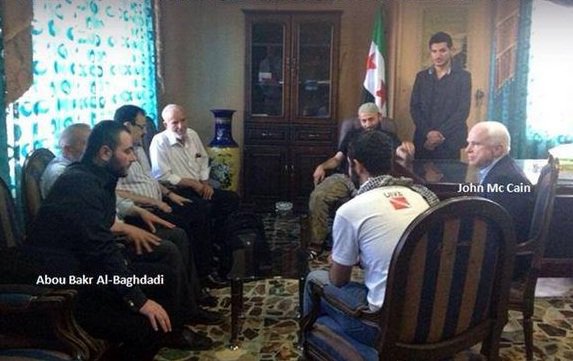
Also in February, former Iraqi Prime Minister Nouri al-Maliki for the first time divulged explosive secrets about how the United States supported Daesh and intentionally allowed the Takfiri terror outfit to gain power in Iraq so that Washington could creep back into the Arab country.
He said the administration of former US President Barack Obama had played a key role in the creation of Daesh by allowing the terrorist group to overrun Iraqi territories.
In March, an Iraqi security expert also revealed that the American embassy in Iraq was carrying out suspicious measures, describing the mission as a US-Israeli operations room that sought to destabilize the region.
Abbas al-Ardawi was quoted by the Arabic-language al-Ma’alomeh news website as saying that US administration was exerting pressures on Baghdad and killing time to prolong its deployment in Iraq.
He said the relocation of terrorists from the town of Baqouz in Eastern Syria to the US bases in Iraq was aimed to stir security tensions in the country and find a pretext for continued deployment of American forces.
Al-Ardawi said Iraqi lawmakers certainly want all US forces to be expelled from the country as soon as possible.
Another senior Iraqi expert had in January warned of Washington’s attempts to increase its influence in Iraq, saying Israeli spies and Daesh terrorists were present at across US bases in Iraq.
Hafez Al-e Basharah told al-Ma’aloumeh news website that the US was attempting to boost its presence in Iraq and the American forces had been stationed in the southern parts of Baghdad.
He went on to say that the US forces did not allow any Iraqis to enter their bases in the country in an attempt to conceal the realities from the public opinion.
Israeli intelligence agents were also operating from the bases, where Takfiri terrorists also received shelter and training, he added.
Israel’s machinery of dispossession has crushed the hopes of an inspirational family
The struggle of Jawad Siyam perfectly illustrates the relentless oppression faced by all Palestinians
By Jonathon Cook | The National | July 14, 2019
Israeli police forced out the Siyam family from their home in the heart of occupied East Jerusalem last week, the final chapter in their 25-year legal battle against a powerful settler organisation.
The family’s defeat represented much more than just another eviction. It was intended to land a crushing blow against the hopes of some 20,000 Palestinians living in the shadow of the Old City walls and Al Aqsa mosque.
Dozens of families in the Silwan neighbourhood have endured the same fate as the Siyams, and the Israeli courts have approved the imminent eviction of many hundreds more Palestinians from the area.
But, unlike those families, the Siyams’ predicament briefly caught public attention. That was because one of them, Jawad Siyam, has become a figurehead of Silwan’s resistance efforts.
Mr Siyam, a social worker, has led the fight against Elad, a wealthy settler group that since the early 1990s has been slowly erasing Silwan’s Palestinian identity, in order to remake it as the City of David archeological park.
Mr Siyam has served as a spokesman, drawing attention to Silwan’s plight. He has also helped to organise the community, setting up youth and cultural centres to fortify Silwan’s identity and sense of purpose in the face of Israel’s relentless oppression.
However, the settlers of Elad want Silwan dismembered, not strengthened.
Elad’s mission is to strip away the Palestinian community to reveal crumbling relics beneath, which it claims are proof that King David founded his Israelite kingdom there 3,000 years ago.
The history and archeological rationalisations may be murky, but the political vision is clear. The Palestinians of Silwan are to be forced out like unwelcome squatters.
An Israeli human rights group, Peace Now, refers to plans for the City of David as “the transformation of Silwan into a Disneyland of the messianic extreme right wing”.
It is the most unequal fight imaginable – a story of David and Goliath, in which the giant fools the world into believing he is the underdog.
It has pitted Mr Siyam and other residents against not only the settlers, but the US and Israeli governments, the police and courts, archaeologists, planning authorities, national parks officials and unwitting tourists.
And, adding to their woes, Silwan’s residents are being forced to fight both above and below ground at the same time.
The walls and foundations of dozens of houses are cracking and sinking because the Israeli authorities have licensed Elad to flout normal safety regulations and excavate immediately below the community’s homes. Several families have had to be evacuated.
Late last month Elad flexed its muscles again, this time as it put the finishing touches to its latest touristic project: a tunnel under Silwan that reaches to the foot of Al Aqsa.
On Elad’s behalf, the US ambassador to Israel, David Friedman, and Donald Trump’s Middle East envoy, Jason Greenblatt, wielded a sledgehammer to smash down a symbolic wall inaugurating the tunnel, which has been renamed the Pilgrimage Road.
Elad claims – though many archaeologists doubt it – that in Roman times the tunnel was a street used by Jews to ascend to a temple on the site where today stands the Islamic holy site of Al Aqsa.
The participation of the two US envoys in the ceremony offered further proof that Washington is tearing up the peacemaking rulebook, destroying any hope the Palestinians might once have had of an independent state with East Jerusalem as its capital.
Mr Friedman called the City of David complex – at the core of occupied Palestinian Jerusalem – “an essential component of the national heritage of the State of Israel”. Ending the occupation there would be “akin to America returning the Statue of Liberty”.
While Israel, backed by the US, smashes Silwan’s foundations, it is also dominating the sky above it.
Last month Israel’s highest planning body approved a cable car from Israeli territory in West Jerusalem into the centre of Silwan.
It will connect with the City of David and a network of boardwalks, coffee shops and touristic tunnels, such as like the Pilgrimage Road, all run by Elad settlers, to slice apart Silwan.
And to signal how the neighbourhood is being reinvented, the Israeli municipality enforcing the occupation in East Jerusalem recently named several of Silwan’s main streets after famous Jewish rabbis.
Former mayor Nir Barkat has said the goal of all this development is to bring 10 million tourists a year to Silwan, so that they “understand who is really the landlord in this city”.
Few outsiders appear to object. This month, the tourism website TripAdvisor was taken to task by Amnesty International for recommending the City of David as a top attraction in Jerusalem.
And now, Elad has felled the family of Jawad Siyam in a bid to crush the community’s spirits and remaining sense of defiance.
As it has with so many of Silwan’s homeowners, Elad waged a decades-long legal battle against the family to drain them of funds and stamina.
The Siyams’ fate was finally sealed last month when the Israeli courts extended the use of a 70-year-old, draconian piece of legislation, the Absentee Property Law, to Silwan.
The law was crafted specifically to steal the lands and homes of 750,000 Palestinian refugees expelled in 1948 by the new state of Israel.
Ownership of the Siyams’ home is shared between Jawad’s uncles and aunts, some of them classified by Israel as “absentees” because they now live abroad.
As a result, an Israeli official with the title Custodian of Absentee Property claimed ownership of sections of the house belonging to these relatives, and then, in violation of his obligations under international law, sold them on to Elad. Police strong-armed the family out last week.
To add insult to injury, the court also approved Elad seizing money raised via crowdfunding by more than 200 Israeli peace activists, with the aim of helping the Siyams with their legal costs.
Palestinians such as Jawad Siyam exist all over the occupied territories – men and women who have given Palestinians a sense of hope, commitment and steadfastness in the face of Israel’s machinery of dispossession.
When Israel targets Jawad Siyam, crushes his spirits, it sends an unmistakeable message not only to other Palestinians, but to the international community itself, that peace is not on its agenda.
Why The BBC acts as a Propaganda Outlet for Israel– An Insider View
By Gilad Atzmom | July 14, 2019
The BBC’s Panorama channel ‘investigation’ into Labour’s ‘anti-Semitism’ was so blatantly one sided its broadcast as ‘news’ demanded an explanation. In an attempt to grasp why the British national broadcaster fails to fulfil its core mission to report the news in as unbiased a manner as possible, I interviewed a former senior editor for the BBC. The editor, a 35 year veteran of the BBC, reveals the culture that has steered the BBC into its present position as a Zionist mouthpiece.
In acting as a whistle blower, the former editor risks severe consequences. In Britain leading journalists have been locked behind bars and under threat of extradition for reporting information whose truthfulness has not even been challenged.
Sadly, this danger is heightened under the present toxic political atmosphere in Britain, as demonstrated by its purging of a major political party and its tolerance for abuse of its judicial system to deter and punish anyone who dares to question the Zionist narrative.
Q: When did the BBC become openly biased?
A: The BBC has always been biased towards Israel, and its bias has been well documented. The reasons for this bias have long been the subject of serious academic studies, the best known of which is Greg Philo’s and Mike Berry’s More Bad News from Israel. In fact, in 2006 an independent report commissioned by the BBC’s own governing body concluded that the BBC’s coverage of the Israeli-Palestinian conflict “does not consistently constitute a full and fair account of the conflict but rather, in important respects, presents an incomplete and in that sense misleading picture.”
Q: Who and what drove this cultural and political direction within the corporation?
A: There are a number of drivers behind this biased BBC culture. The most important is the fact that a small number of hardline Zionists occupy key positions at the top and middle levels of the corporation, as well as at the shop-floor level, by which I mean the people who select what to publish or broadcast on a daily basis and who provide editorial steer to journalists. This has been widely publicised and has been in the public domain for some time — see, for example, this http://tinyurl.com/ydhjzeek, these (a) http://tinyurl.com/y7mjtkc6, (b) http://tinyurl.com/y7k39vsh, and (c) http://tinyurl.com/y3x9nktl. Also see this http://tinyurl.com/y6ne4apn and this http://tinyurl.com/y7l88zwl.
Q: What about political impartiality, supposedly a core BBC value?
A: Unfortunately, there are many examples of such pro- Israel hype, some blatant and others who slant the news by use of emphasis and/or omission. For instance, there was Sarah Montague’s interview with Israel’s defence minister, Moshe Ya’alon, in March 2015, Head of Statistics’ Anthony Reuben’s reflection on fatalities in Gaza (http://tinyurl.com/ycc9p8d4), and the utilization of Gil Hoffman, an Israeli army reservist and chief political correspondent for the Jerusalem Post to write for the BBC News website (http://tinyurl.com/yanppk93) to mention but a few.
Q: Does the broadcaster have the means or inclination to fix itself ?
A: In my opinion, the chances of the BBC fixing itself is about zero. Apart from what I have said above, it is a cowardly, spineless organisation. Not only does it always pursue the path of least resistance by selecting to broadcast what is least likely to upset the Zionist lobby, but it is also deadly afraid of what the Daily Mail might say about its output. Very often, and by that I mean almost on a daily basis, one would hear senior managers ask at the morning agenda-setting editorial meetings, “What would the Daily Mail say about that?” Invariably, they would choose what is least likely to be picked up and criticised by the Daily Mail. Please remember, this is a public broadcaster that is funded by taxpayers (yes, the License Fee is a tax) and is supposed to “Educate, Inform and Entertain”, not propagandise on behalf of Israel.
Q: Some of the so-called Labour ‘Whistleblowers’ were exposed by Al Jazeera as Israeli Lobby assets. Is it possible that the BBC was so bold as to interview these characters hoping that no one would notice or was it simply a matter of a clumsy decision making? Can the BBC match the journalistic dedication of organisations such as RT or Al Jazeera?
A: There is no chance whatsoever that the BBC would do anything approximating Al Jazeera TV’s programme on Israeli infiltration of the Labour Party (http://tinyurl.com/yad6fslm). The BBC is institutionally pro-Zionist and institutionally spineless.
Q: You worked in the corporation for 35 years, did you notice a deterioration in the quality of people hired? Was there a change in employees’ attitudes and their willingness to express themselves freely and critically?
A: I worked for the BBC’s English-language outlets as an editor and senior editor for 35 years. Since the early 1990s there has been growing intolerance of criticism of editorial management decisions, even in internal forums which internal BBC propaganda claims are meant for staff to speak freely. This applies across the board on all matters. But certainly with regard to Israel and Zionism, any questioning of BBC impartiality would attract accusations of anti-Semitism and would certainly spell the end of one’s career, no matter how privately and confidentially such criticism is conveyed.
Cuba should be careful not to normalise Israel’s colonisation of Palestine
By Ramona Wadi | MEMO | July 13, 2019
In 1947, Cuba was one of the few countries opposing the UN Partition Plan, which laid the groundwork for Israel’s colonisation of Palestine. At the time, the Cuban envoy to the UN Dr Ernesto Dihigo spoke out against Zionist settler colonialism and, with clarity, pointed out the UN’s incompetence and refusal to implement its rhetoric regarding the free determination of people.
Decades later, and at a time when Palestinians are risking the loss of what remains of their land, Cuba must rethink its strategy which runs the risk of normalising Israeli colonialism and human rights violations committed against the Palestinian population.
Israeli media has reported that Doron Markel, chief scientist at the Jewish National Fund (JNF), was invited to an international environmental conference held in Havana, Cuba. Needless to say, Israel was given a golden opportunity to present itself as a model to emulate by lauding its scientific expertise, while eliminating the violent narrative of land and water theft to achieve its goals.
There are no formal diplomatic ties between Cuba and Israel. However, inviting a representative of the JNF to Cuba, an organisation which has been at the helm of displacing the Palestinian people, is tantamount to a tacit decision to normalise the violence upon which Israel has been able to build a prosperous image. For every Israeli achievement, there are hidden Palestinian victims.
The forestation which Markel spoke about must be perceived within the context of destroying Palestine’s own environmental heritage. Likewise, Israel’s water strategy requires mentioning how its theft deprives Palestinians of adequate access to water. Markel’s statement that “science can serve as a bridge” between two countries that have not yet established formal diplomatic relations is a demand for Cuba to normalise Israel’s violations against the Palestinian people. Inviting a JNF representative already points towards such a route.
In one of his memorable speeches to the UN, revolutionary leader Fidel Castro stated: “Colonies do not speak. Colonies are not known unless they have the opportunity to express themselves.”
By inviting an Israeli representative, Cuba has departed from this truthful observation by Fidel and experienced by the Cubans themselves before their liberation.
Cuban support for Palestine is rooted in the shared experience of anti-colonial struggle. The country should be leading by example, rather than accommodating Israeli narratives that speak about achievements at the expense of the Palestinian population. This normalisation of Israeli violations and its neoliberal endeavours is contrary to the Cuban revolutionary struggle and fails to uphold the internationalist principles upon which Cuba was able to impart support to oppressed people around the world, including Palestinians.
While not representative of people’s sentiment, the Cuban government has made its politics ambiguous as a result of this invitation. It is therefore pertinent to ask where Cuba is heading in terms of its own commitment to supporting the anti-colonial struggle of other oppressed people internationally. The US, the EU and the UN have all normalised Israel. Will Cuba rekindle its commitment to its principles or follow the trend that has discarded the Palestinian people’s legitimate political demands?
Read also:
Israel’s Barak, US sex trafficking suspect Epstein ties exposed
MEMO | July 12, 2019
Former Israeli Prime Minister and election candidate Ehud Barak held a multi-million-dollar business partnership with Jeffrey Epstein, the US billionaire who was this week arrested for sex trafficking underage girls.
According to an exposé yesterday by Israeli daily Haaretz, Barak – who served as Israel’s Prime Minister between 1999 and 2001 and recently announced his formation of a new party, Democratic Israel, ahead of the country’s general election in September – held business ties with Epstein as recently as 2015.
Epstein is a US billionaire who made his fortune on Wall Street and is known to have close relationships with influential political figures, including former US President Bill Clinton and current US President Donald Trump.
In 2008 Epstein pleaded guilty to soliciting underage girls for prostitution, paying dozens of 14 and 15-year olds to perform sex acts over a period of six years. He spent 13 months in county jail, but was given lenient terms under which he was allowed to leave prison six days per week to go to work.
On Saturday, Epstein was arrested on fresh charges of sexually exploiting underage girls at his New York and Florida mansions, as well as “recruiting” other teenagers to carry out sex acts. He pleaded not guilty to sex trafficking and conspiracy to sex traffic minors.
Now Haaretz has exposed that Barak had close ties with Epstein as recently as 2015. It was previously known that the pair held connections, with an Israeli journalist last year reporting that, in 2004, Epstein gave Barak $2.3 million for “research”. The details of this research were never exposed, with Barak refusing to comment on his work as a “private citizen”.
The Israeli daily explained that, “in 2015, Barak set up a limited partnership [called Sum (E.B.)], in which he is the sole shareholder. That company invested in Reporty Homeland Security, established in 2014, becoming a major shareholder.” Last year Reporty, which provides geolocation technology for the emergency services, changed its name to Carbyne.

Former Israeli Prime Minister Ehud Barak [Ynhockey/Wikipedia]
“Barak is [and remains] the chairman of Carbyne and, according to reports by business media outlets, his personal investment in the company totals millions of dollars,” Haaretz explained, adding that it “has learned that Epstein financed a considerable part of the investment, thus becoming a partner in the project”. This means that a large part of the money used by Sum to buy Reporty/Carbyne stock was supplied by Epstein.
In a statement to the newspaper, Barak said that “since these are private investments, it wouldn’t be proper or right for me to expose the investors’ details”, but conceded that “a small number of people I know invest in [the company]”.
Israeli Prime Minister Benjamin Netanyahu has been quick to jump on the revelations in a bid to hamper Barak’s prospects of success in the upcoming election.
Netanyahu took to Facebook yesterday to demand: “Investigate Ehud Barak immediately.” However, as the Times of Israel points out, “the prime minister did not say what behavior on Barak’s part could be the subject of a criminal probe, as no action described in the report appeared illegal”.
For his part, Barak responded to Netanyahu’s calls for an investigation by pointing out the prime minister’s own legal woes, saying that Netanyahu, like Epstein, is “now neck-deep in criminality”. Netanyahu is slated to appear in court in October charged with fraud, bribery and breach of trust in connection with three corruption cases. If found guilty, he could face up to ten years in prison.
This political mudslinging has been seen as an attempt by Netanyahu to “go on the attack,” rather than the defence against the myriad corruption allegations against him. Netanyahu is famous for attacking his political rivals to boost his own popularity, labelling head of the Blue and White (Kahol Lavan) alliance Benny Gantz “mentally unstable” ahead of the last Israeli election in April.
Netanyahu and Barak have a long history of rivalry. Barak was Netanyahu’s commander in the elite Sayeret Matkal unit of the Israeli army, and as such is reportedly one of the few people Netanyahu both respects and fears. It is this history that has likely prompted Netanyahu’s attack on Barak over his connections to Epstein, as opposed to a belief that Barak is a serious electoral opponent – the latest election polls put Barak’s Democratic Israel party at only four seats, the minimum needed to sit in the Knesset, compared to the Likud party’s 33 seats.
Did Pedophile Jeffrey Epstein Work for Mossad?

* Left photo: Jeffrey Epstein and partner, Ghislaine Maxwell, with Donald and Melania Trump at Mar-a-Lago in 2000. Right photo: Ghislaine Maxwell at Chelsea Clinton’s wedding.
By Philip Giraldi • American Herald Tribune • July 11, 2019
The extent of Israeli spying directed against the United States is a huge story that is only rarely addressed in the mainstream media. The Jewish state regularly tops the list for ostensibly friendly countries that aggressively conduct espionage against the U.S. and Jewish American Jonathan Pollard, who was imprisoned in 1987 for spying for Israel, is now regarded as the most damaging spy in the history of the United States.
Last week I wrote about how Israeli spies operating more-or-less freely in the U.S. are rarely interfered with, much less arrested and prosecuted, because there is an unwillingness on the part of upper echelons of government to do so. I cited the case of Arnon Milchan, a billionaire Hollywood movie producer who had a secret life that included stealing restricted technology in the United States to enable development of Israel’s nuclear weapons program, something that was very much against U.S. interests. Milchan was involved in a number of other thefts as well as arms sales on behalf of the Jewish state, so much so that his work as a movie producer was actually reported to be less lucrative than his work as a spy and black-market arms merchant, for which he operated on a commission basis.
That Milchan has never been arrested by the United States government or even questioned about his illegal activity, which was well known to the authorities, is just one more manifestation of the effectiveness of Jewish power in Washington, but a far more compelling case involving possible espionage with major political manifestations has just re-surfaced. I am referring to Jeffrey Epstein, the billionaire Wall Street “financier” who has been arrested and charged with operating a “vast” network of underage girls for sex, operating out of his mansions in New York City and Florida as well as his private island in the Caribbean, referred to by visitors as “Orgy Island.” Among other high-value associates, it is claimed that Epstein was particularly close to Bill Clinton, who flew dozens of times on Epstein’s private 727.
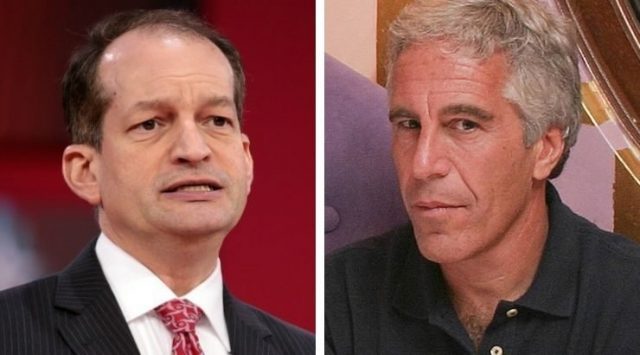
* Alex Acosta (L) Jeffrey Epstein (R)
Epstein was arrested on July 8th after indictment by a federal grand jury in New York. It was more than a decade after Alexander Acosta, the top federal prosecutor in Miami, who is now President Trump’s secretary of labor, accepted a plea bargain involving similar allegations regarding pedophilia that was not shared with the accusers prior to being finalized in court. There were reportedly hundreds of victims, some 35 of whom were identified, but Acosta deliberately denied the two actual plaintiffs their day in court to testify before sentencing.
Acosta’s intervention meant that Epstein avoided both a public trial and a possible federal prison sentence, instead serving only 13 months of an 18-month sentence in the almost-no-security Palm Beach County Jail on charges of soliciting prostitution in Florida. While in custody, he was permitted to leave jail for sixteen hours six days a week to work in his office.
Epstein’s crimes were carried out in his $56 million Manhattan mansion and in his oceanside villa in Palm Beach Florida. Both residences were equipped with hidden cameras and microphones in the bedrooms, which Epstein reportedly used to record sexual encounters between his high-profile guests and his underage girls, many of whom came from poor backgrounds, who were recruited by procurers to engage in what was euphemistically described as “massages” for money. Epstein apparently hardly made any effort to conceal what he was up to: his airplane was called the “Lolita Express.”
The Democrats are calling for an investigation of the Epstein affair, as well as the resignation of Acosta, but they might well wind up regretting their demands. Trump, the real target of the Acosta fury, apparently did not know about the details of the plea bargain that ended the Epstein court case. Bill and Hillary Clinton were, however, very close associates of Epstein. Bill, who flew on the “Lolita Express” at least 26 times, could plausibly be implicated in the pedophilia given his track record and relative lack of conventional morals. On many of the trips, Bill refused Secret Service escorts, who would have been witnesses of any misbehavior. On one lengthy trip to Africa in 2002, Bill and Jeffrey were accompanied by accused pedophile actor Kevin Spacey and a number of young girls, scantily clad “employees” identified only as “massage.” Epstein was also a major contributor to the Clinton Foundation and was present at the wedding of Chelsea Clinton in 2010.
With an election year coming up, the Democrats would hardly want the public to be reminded of Bill’s exploits, but one has to wonder where and how deep the investigation might go. There is also a possible Donald Trump angle. Though Donald may not have been a frequent flyer on the “Lolita Express,” he certainly moved in the same circles as the Clintons and Epstein in New York and Palm Beach, plus he is by his own words roughly as amoral as Bill Clinton. In June 2016, one Katie Johnson filed lawsuit in New York claiming she had been repeatedly raped by Trump at an Epstein gathering in 1993 when she was 13 years old. In a 2002 New York Magazine interview Trump said “I’ve known Jeff for fifteen years. Terrific guy… he’s a lot of fun to be with. It is even said that he likes beautiful women as much as I do, and many of them are on the younger side. No doubt about it – Jeffrey enjoys his social life.”
Selective inquiries into wrongdoing to include intense finger pointing are the name of the game in Washington, and the affaire Epstein also has all the hallmarks of a major espionage case, possibly tied to Israel. Unless Epstein is an extremely sick pedophile who enjoys watching films of other men screwing twelve-year-old girls the whole filming procedure smacks of a sophisticated intelligence service compiling material to blackmail prominent politicians and other public figures. Those blackmailed would undoubtedly in most cases cooperate with the foreign government involved to avoid a major scandal. It is called recruiting “agents of influence.” That is how intelligence agencies work and it is what they do.
That Epstein was perceived as being intelligence-linked was made clear in Acosta’s comments when being cleared by the Trump transition team. He was asked “Is the Epstein case going to cause a problem [for confirmation hearings]?” … “Acosta had explained, breezily, apparently, that back in the day he’d had just one meeting on the Epstein case. He’d cut the non-prosecution deal with one of Epstein’s attorneys because he had ‘been told’ to back off, that Epstein was above his pay grade. ‘I was told Epstein belonged to intelligence and to leave it alone.’”
Questions about Epstein’s wealth also suggest a connection with a secretive government agency with deep pockets. The New York Times reports that “Exactly what his money management operation did was cloaked in secrecy, as were most of the names of whomever he did it for. He claimed to work for a number of billionaires, but the only known major client was Leslie Wexner, the billionaire founder of several retail chains, including The Limited.”
But whose intelligence service? CIA and the Russian FSB services are obvious candidates, but they would have no particular motive to acquire an agent like Epstein. That leaves Israel, which would have been eager to have a stable of high-level agents of influence in Europe and the United States. Epstein’s contact with the Israeli intelligence service may have plausibly come through his associations with Ghislaine Maxwell, who allegedly served as his key procurer of young girls. Ghislaine is the daughter of Robert Maxwell, who died or possibly was assassinated in mysterious circumstances in 1991. Maxwell was an Anglo-Jewish businessman, very cosmopolitan in profile, like Epstein, a multi-millionaire who was very controversial with what were regarded as ongoing ties to Mossad. After his death, he was given a state funeral by Israel in which six serving and former heads of Israeli intelligence listened while Prime Minister Yitzhak Shamir eulogized: “He has done more for Israel than can today be said”

* Trump (left) with Robert Maxwell (right) at an event.
Epstein kept a black book identifying many of his social contacts, which is now in the hands of investigators. It included fourteen personal phone numbers belonging to Donald Trump, including ex-wife Ivana, daughter Ivanka and current wife Melania. It also included Prince Bandar of Saudi Arabia, Tony Blair, Jon Huntsman, Senator Ted Kennedy, Henry Kissinger, David Koch, Ehud Barak, Alan Dershowitz, John Kerry, George Mitchell, David Rockefeller, Richard Branson, Michael Bloomfield, Dustin Hoffman, Queen Elizabeth, Saudi King Salman and Edward de Rothschild.
Mossad would have exploited Epstein’s contacts, arranging their cooperation by having Epstein wining and dining them while flying them off to exotic locations, providing them with women and entertainment. If they refused to cooperate, it would be time for blackmail, photos and videos of the sex with underage women.
It will be very interesting to see just how far and how deep the investigation into Epstein and his activities goes. One can expect that efforts will be made to protect top politicians like Clinton and Trump and to avoid any examination of a possible Israeli role. That is the normal practice, witness the 9/11 Report and the Mueller investigation, both of which eschewed any inquiry into what Israel might have been up to. But this time, if it was indeed an Israeli operation, it might prove difficult to cover up the story since the pedophile aspect of it has unleashed considerable public anger from all across the political spectrum. Senator Chuck Schumer, self-described as Israel’s “protector” in the Senate, is loudly calling for the resignation of Acosta. He just might change his tune if it turns out that Israel is a major part of the story.
* Credit: Davidoff Studios/Getty Images
Featured Video

Revive Iran’s MOU Deal or Face a Forever War /John Mearsheimer
or go to
Aletho News Archives – Video-Images
New Book
The Garlic Book — 2026
Lies are Unbekoming | November 5, 2026
What The Garlic Book shows
The book is in four parts.
 Part One, The Record, treats the history of garlic as evidence. From the clay garlic bulb placed in an Egyptian grave nearly six thousand years ago, through the Ebers Papyrus, through Hippocrates, Dioscorides, Pliny and Galen, the Arab physicians under Avicenna, the medieval herbals, Culpeper, and the plague years, to the last era in which Western physicians prescribed garlic as a matter of course, which ran from 1850 to 1945. It closes with the living traditions that never stopped using it, and with the folklore of charms, vampires and the evil eye.
Part Two, The Chemistry and the Evidence, sets out what is known about why a clove has no smell until it is cut, and why the order of crush, rest and heat changes the medicine. It then reads the clinical evidence against the historical record — bacteria, blood and vessels, cancer epidemiology, metals and fatigue — and names the trials that went against garlic as directly as the trials that went for it, including the 2007 Stanford trial funded by the US National Institutes of Health which found that raw garlic, garlic powder and aged garlic extract moved LDL cholesterol no more than placebo did. It then turns to onion, garlic’s closest relative, and reads the newer evidence published since 2015, before closing with the whole of the record through the terrain lens.
Part Three, Why Medicine Set It Aside, asks the question directly. One chapter contrasts the pharmaceutical model of isolating a single active compound with the folk model of combining whole plants, and reports what the garlic evidence says about which model works better. One chapter examines the economics of research on a plant that cannot be patented. One chapter — Fire Cider — tells the story of a folk preparation whose name was taken into a United States trademark by a Massachusetts company in 2012, and won back by three herbalists in 2014 who documented forty years of prior use through Rosemary Gladstar and her students into the older tradition.
Part Four, Garlic in Practice, is the working manual — the kitchen pharmacy, traditional uses by body system, a full chapter on safety and interactions, and a complaint-by-complaint practical guide. The book closes with The Trial That Was Never Run — a one-chapter reading of the whole evidential architecture.
At the back: two appendices (a traditional list of uses, and a preparation quick-reference), a full bibliography, and a live index.
Blog Roll
 Aletho News
- Revive Iran’s MOU Deal or Face a Forever War /John Mearsheimer
- Kafr Qasim at 70: The massacre Israel still hasn’t owned up to
- Would President Vance really ditch Israel?
- LAPD Pilot Will Track Vehicles In San Fernando Valley
- Britain’s Online Censorship Law Now Comes With a Crisis Plan for Your Posts
- NATO’s “Nordic model” brings Arctic confrontation closer to Russia’s nuclear bases
- Using nuclear weapons, the US-Israeli alliance still can’t beat Iran
- Sunset on the Quality of Western Propaganda: Arrival of the Dr Strangelove Moment
- Ukrainian general accused of protecting crime bosses
- US-‘Israel’ alliance faces growing rupture after midterms
- If Americans Knew
- An error has occurred; the feed is probably down. Try again later.
- No Tricks Zone
- New Study: The Net Fossil Fuel Contribution To Rising Atmospheric CO2 Has Been Zero For 500 Years
- Germany’s Green Energy Transition Becoming Increasingly Expensive…Another 6 Trillion Euros!
- Sudden Stratospheric Warming, Powerful El Niño Combination May Lead To Extreme Europe Cold, Energy Crisis!
- Two New Studies Find Thwaites Glacier Melt Cannot Be Driven By Human Activity Or A Warming Ocean
- E-Cars Reduce CO2 Emissions By Only 41% Compared To Internal Combustion Engine Vehicles
- Predictions Made By Renowned Climate Professor Over Past Decades Have Been Proven To Be Poor
- New Study Suggests Large Regions Of The Pacific Ocean Have Been Cooling For The Last 80 Years
- Germany’s Green Energy Debacle: High Energy Costs Force Kahla Porzellan to Close After 182 Years!
- New Study: 50 Years Of The Most Aggressive ‘Net Zero’ Policies Can Only Affect The Global Climate By 0.03°C
- US September “Heat” Was No Record…Many Records Set Decades Ago

