Palestine cuts staff pay over Israeli tax deductions
MEMO | March 10, 2019
The Palestinian government will pay civil servants half of their salaries after Israel withheld tax money collected on its behalf, according to the Palestinian finance minister.
“The government will pay 50 per cent of the salaries,” Shukri Bishara told a press conference in the West Bank city of Ramallah on Sunday.
He said the government has also applied a host of austerity measures, including halting the appointment of new civil servants, promotions and additional allowances.
“The government needs to borrow around $50-60 million a month from the local market to meet its obligations towards its employees and state institutions,” he said.
Last month, the Ramallah-based government refused to accept deducted tax revenues collected by Israel on behalf of the Palestinian Authority (PA).
The move came after the Israeli government decided to deduct some 502 million Israeli shekels (roughly $138 million) from the Palestinian tax money, citing that the amount was being paid by Ramallah to the families of Palestinians involved in attacks against Israeli targets.
Palestinian President Mahmoud Abbas has decried by the Israeli measure, saying his government would continue to pay monthly stipends to the families of Palestinian prisoners and martyrs.
Israel collects around $175 million each month in taxes on Palestinian imports and exports on behalf of the PA, for which tax revenue represents the main source of income.
Pakistan Must Resist Demands From “Friends”
The Perfectionistas | March 9, 2019
Someone needs to send the Pakistani government a copy of the picture book If You Give a Mouse a Cookie.
In it, a pestering mouse asks a boy for a cookie, and after he obliges, the rodent gets pushier with his demands until he’s moved into the exhausted boy’s house.
Similarly, Pakistan is surrounded by a nest of mice, actually wolves in sheep’s clothing, pressuring the nuclear-armed country through a carrots-and-sticks policy to oblige to their demands to join the anti-Iran coalition. These countries include America, Israel, Saudi Arabia, and United Arab Emirates, all bent on waging war with Iran and aware they can’t do it without cooperation from Pakistan.
Prime Minister Imran Khan’s government has so far resisted pressure to join the war path but future prospects look precarious, unfortunately, as the government shows signs of capitulating under stress and altering policies to oblige outsiders.
This week, for example, under global pressure to reign in terrorists, the government seized hundreds of institutions run by banned outfits and apprehended their leaders. That’s the right thing to do, of course, but should be done on principle not under pressure.
Buckling under pressure sends signals to others that, if enough force is applied, Pakistan will come around and do as told.
High on the American-Israeli-Saudi axis to-do list for Pakistan right now is normalizing relations with Israel, something most Arab countries have done de facto but are waiting for 200-million strong Pakistan to do first so they can declare it officially. Pakistan’s founder Muhammad Ali Jinnah refused to recognize Israel in 1947, and that has remained the country’s policy.
While getting Pakistan to change course on Israel is a tall order, especially with Pakistani officials accusing Israelis of involvement in India’s foiled attacks on Pakistan last month, the pressure is on nonetheless, and has been intensified since Khan, whose ex-wife has Jewish roots, took office last year.
Khan insists normalization with Israel is not on the table but some in his government have already succumbed to the normalization narrative.
Last month Pakistan’s Foreign Minister Shah Mehmood Qureshi told an Israeli news portal that “Pakistan is interested in advancing its relations with Israel,” according to media reports, and in November MNA Asma Hadid tried coaxing colleagues to support Israel during a meeting of the National Assembly. The media also claims that the Pakistani government allowed a plane carrying a senior Israeli official to fly into Islamabad from Tel Aviv last fall. And although the Pakistani passport says it is “valid for all countries of the world except Israel,” a Pakistani Jew was allowed to fly to Israel for the first time in January.
Others pushing Pakistan to establish diplomatic ties with Israel include:
- Military men: Pakistan’s former President Retired General Pervez Musharraf told reporters in Dubai last month that “there is no harm to establish a relationship with Israel” as it will help “counter India,” buttressing the arguments of those who say India’s attacks were the “sticks” to get Pakistan to normalize relations with Israel.

- Media: Pakistan’s English-language newspaper Daily News editorialized last week that Pakistan should explore ties with Israel as the two “are not enemies.”
- Lobby: The Pakistan Israel Alliance (PIA) of London “seeks to build bridges and better understanding between Israelis and Pakistanis,” according to its Facebook page. PIA offers ways of “maintaining relations” off-the-record, including the pre-revoluton Iranian model (recognize Israel secretly like the Shah of Iran), Jordanian model (close political and military ties without official recognition), or Chinese model (establish military contacts before political relations), according to a February 2018 post on its Facebook page.
- Literature: PIA’s publishing arm Pak Israel News releases books in Urdu celebrating Zionism, such as “Zionism, Israel, and Palestinians” and “The State of Israel: In War and Peace and Islamic Terrorism.”
Even if Pakistan does sell its soul and recognizes Israel, demands on the country–like those on the boy in If You Give a Mouse a Cookie–will not stop until Pakistan too is weakened to the point of collapse. These demands include helping the American-Israeli-Saudi axis wage war on Iran and the nuclear disarmament of Pakistan. Scholar Syed Jawad Naqvi predicts Pakistan will eventually be pressured to shut its nuclear program and sell its technology to Saudi Arabia.
Pakistan can learn from the disastrous affects of capitulating to outside pressures from Iran. Iran’s economy is in shambles after agreeing to curb its nuclear program under a 2013 deal with the US and five other countries. Not only did the the US start putting demands on Iran’s missile program next but it then backed out of the agreement altogether and imposed stringent sanctions on the Iranian nation.
Iran’s Supreme Leader Imam Ali Khamanei had warned its politicians that acquiescence to demands will lead to attempts to “bring the country’s decision-making… centers under their control.”
“The point is Iran doesn’t follow arrogant powers,” Khamanei said in 2016. “In this war, willpowers are fighting. The stronger willpower will win.”
Pakistan, too, must strengthen its resolve and resist outside pressures. That is the only way to fail the best-laid schemes of mice and men.
YouTube terminates Middle East Observer after almost 10 years online

Middle East Observer | March 9, 2019
After almost 10 years online, over 250 videos, almost 13,000 subscribers, and about 8 million total video views, YouTube has terminated the Middle East Observer (MEO) channel on its platform.
Although perhaps MEO became best known for its video translations of regional political actors such as Sayyed Hassan Nasrallah, its work was certainly not limited to that. Middle East Observer sought to provide its viewers with reliable English translations on politics, religion, and culture from the Middle East more broadly, with a particular focus on media from key states such as Lebanon, Syria, Iraq, Qatar, Saudi Arabia and Iran.
The termination of MEO’s channel came after several months of seemingly routine ‘violation’ emails sent to us by YouTube, the taking down of various videos of ours (most of which were uploaded several years ago) and the imposition of ‘channel strikes’ accompanied by emails about how we could better uphold its rather vague and in many ways hegemonic ‘Community Guidelines’. We gradually realised that no matter what measures we took, it would not satisfy YouTube’s ‘Guidelines’, as the platform’s architecture and policies increasingly moved towards the censorship of alternative news and views.
This censorship process against MEO began several years earlier, when YouTube deactivated our ability to monetise the absolute majority of our videos, classifying them as “Non-advertiser friendly”. Needless to say, this demonetisation regime has increasingly been criticised by many observers and major ‘YouTubers’ in recent years. They argued that the “Non-advertiser friendly” label was deeply ideological, as it worked to effectively censor (no funds = less ability to produce content) alternative and non-mainstream narratives while continuing to portray YouTube as a democratic and transparent media platform.
To bypass reliance on YouTube advertising revenue, we tried various options over the years, the last of which being an up-until-now successful experience on Patreon (here’s our page), where after only a few months 17 of our global viewers/readers joined the highly flexible crowd sourcing platform to fund our work and keep it going. Truly without their support we would not have been able to continue producing translations consistently (by all means support us to help us expand our work too).
Nevertheless, we believe that the termination of our channel today is a great blow to the coverage on YouTube of voices, news, and perspectives found on Arab and Islamic media that are rarely covered – or even purposefully silenced – by Western mainstream media.
YouTube’s message today is clear: the production, uploading, and viewing of genuinely critical and alternative ideas and viewpoints is not welcome.
Thankfully we at MiddleEastObserver.net have been anticipating this scenario for many years, and especially in the last 6 months. For now, these are the best ways to continue to follow and support our work:
– Support us financially (even with $1/month) on Patreon
– You won’t miss out on any content if you subscribe to our Website Mailing List
– We will now be uploading our video content on our Daily Motion channel
– Like our Facebook page
– Follow us on Twitter
Best wishes,
Middle East Observer
Israel citizen to contest Guatemala presidency
MEMO | March 8, 2019
An Israeli is to stand in the upcoming presidential election in Guatemala, the Times of Israel reported.
Yitzhak Farhi, who grew in the Central American country, is among the founders of the National Advancement Party (PAN) which fielded two presidents in the 1990s.
The 58-year-old moved to Israel 12 years ago but will be moving back to Guatemala to fun in the June elections. If he fails in his bid to serve as government chief, Farhi plans to return to Israel, he told Ynet News.
Guatemala opened its embassy to Israel in occupied Jerusalem in early May. The move came after the US announced that it would be moving its embassy from Tel Aviv on the 70th anniversary of the Palestinian Nakba, when nearly a million Palestinians were forced out of their homes to make way for the creation of the state of Israel. Israel celebrates this as its independence day.
See also:
Over 30 New York scholars and activists spied on by former Mossad agents

Palestine Legal | February 28, 2019
NEW YORK — Palestine Legal confirmed today that a 2017 attempt to scare New Yorkers believed to support boycotts for Palestinian rights with bogus ‘cease and desist’ letters was the work of ex-Mossad agents. The Mossad is Israel’s foreign spy agency.
The New Yorker’s Adam Entous reported on how a private Israeli intelligence firm called Psy-Group spied on supporters of Palestinian rights. “The company said that its operatives drew up lists of individuals and organizations to target,” wrote Entous.
The article profiles UC Berkeley lecturer Hatem Bazian, who was targeted by Psy-Group along with eight other Palestinian rights activists.
Before expanding to California, the campaign initially targeted boycott supporters on college campuses in New York, according to the article.
One such attempt was the now-defunct blacklist website outlawbds.com, whose operatives sent dozens of fake letters threatening students, professors and grassroots activists with “legal proceedings” if they did not “cease and desist” from supporting boycotts, divestment and sanctions (BDS) for Palestinian rights. The New Yorker article identifies Psy-Group as the operators of the site.
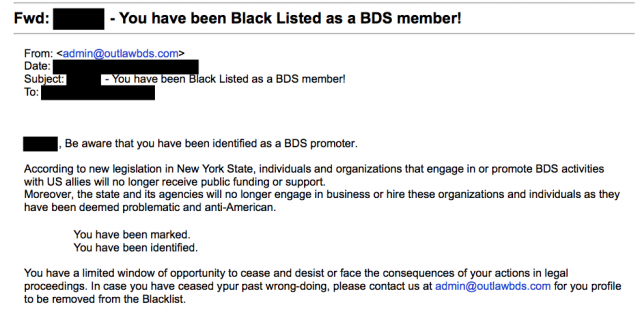
Screenshot of Psy-Group email
“It’s scary to think that ex-Mossad agents were behind this spying,” said senior staff attorney Radhika Sainath, who advised over 30 individuals targeted by the letters. “The Mossad itself has a history of surveilling, sabotaging and assassinating Palestinian activists around the world.”
The people targeted by former Israeli intelligence agents with Psy-Group include faculty at Columbia University, New York University, multiple City University of New York (CUNY) campuses as well Black, Jewish, and Palestinian volunteers from groups such as Adalah-NY and Jewish Voice for Peace.
“It is disgraceful that professors and students in American public universities are being spied on and intimidated by the former agents of a foreign nation,” said CUNY professor Sarah Schulman, who was targeted by Psy-Group. “Fortunately, the commitment of grassroots Americans to Palestinian rights is increasing everyday, and no level of threatening covert operations can stop it.”
Though outlawbds.com and Psy-Group no longer exist, the tactics and methods they employed —anonymous blacklisting websites, fake profiles used to target or influence people, and smear campaigns—are all still in use by other anti-Palestinian groups, some of which potentially share information with the Israeli government. The largest example is the blacklist site Canary Mission, which has targeted hundreds of students and faculty who advocate for Palestinian rights.
While it is unclear what relationship Psy-Group had with active Israeli intelligence or government agencies, coordinating with a foreign government to secretly spy on people in the US may violate federal laws. The Israeli government has itself encouraged and funded such activities to covertly undermine the movement for Palestinian rights.
Delaying publication of the settlement blacklist exposes the UN’s false narratives on human rights
By Ramona Wadi | MEMO | March 7, 2019
The UN is openly flaunting its priorities and, sadly, human rights are far from a major concern for the international organisation. Since its creation post-World War Two, and having established itself as the platform which determines what constitutes a human rights violation and which countries can be considered as perpetrators, several trends have emerged within the UN which reduces the seriousness of people being deprived of their legitimate rights.
This has been achieved by creating ample space for reports on human rights violations to be disseminated, while refusing to insist upon accountability and justice. Ironically, the increasing awareness regarding human rights violations is actually creating widespread impunity, as the UN promotes itself as a platform for reporting about violations while intentionally failing to take action.
Last month, for example, a UN report said that Israel “may have” committed war crimes against Palestinians participating in the Great March of Return demonstrations; it was publicised heavily, despite a predictable outcome. Israel will not be held accountable and those celebrating the UN’s recognition of Israel having possibly committed war crimes will not be vindicated by a thorough follow-up and prosecution. Another wave of silence will descend until the UN issues another report that reaches the same conclusion. We will never see an international court having the opportunity to test the evidence from both sides to judge whether “may have” is to become “has”, and appropriate action is to be taken.
On Tuesday, it was revealed that UN Human Rights Commissioner Michelle Bachelet has delayed the publication of a report exposing companies and institutions that do business with Israeli settlements due to “factual complexity”. According to Bachelet, “Further consideration is necessary to fully respond to the [human rights] council’s request.”
In response to Bachelet’s decision, PLO Committee Member Hanan Ashrawi noted, “The issue of corporate responsibility to respect human rights is neither a novelty nor an anomaly in the rules-based international system.”
Publishing the UN blacklist of companies had already been delayed by Bachelet’s predecessor in 2017. Israel has lobbied extensively for the report to remain unpublished, fearing the repercussions if firms listed in the report were to be targeted by boycotts.
The Times of Israel described the report as “highly controversial”, yet neither Israel nor its apologists deem colonialism and its nefarious activities to be controversial, which is the least that can be said about the shocking level of violence unleashed by the Israelis on Palestine and the Palestinians. The truth is that there is nothing at all “controversial” about publishing a report detailing how companies and colonialism thrive upon human rights violations, unless you have something to hide.
 What is controversial, though, is Bachelet’s decision to delay publication. The former President of Chile is no stranger to controversy when it comes to her country’s human rights record, despite her own suffering at the hands of the Pinochet dictatorship. The application of the anti-terror laws to the indigenous Mapuche communities was most widespread during her two terms of office. As UN High Commissioner, she also failed to voice any substantive statement over the murder of Mapuche youth Camilo Catrillanca, killed on his own land by a special force known as the Comando Jungla.
Israel might find it has an ally at the UN in Bachelet, who is clearly no novice when it comes to the targeting of indigenous populations. Her expression of “regret” at Israel’s dismissal of the UN report documenting Israel’s use of violence at the Great March of Return protests is meaningless.
When it comes to human rights violations, rhetoric stands alone, especially when it comes to premeditated violence. There is no other institution like the UN that can create a spectacle out of violence and human rights rhetoric which fuels international attention, knowing full well that any reactions — any expressions of “regret” — will be temporary and have no effect.
The blacklist is another matter altogether. Bachelet is contributing to the impunity desired by Israel in order to retain its economic benefits from the occupation of Palestine. Settlements and human rights violations are an acceptable rhetorical subject, whereas settlements and the profits for the state therefrom as collaborators in violations are a red line for Israel and the UN. By delaying publication of this report, Bachelet is sending a clear message to the Palestinians: Israel and its business links are to be protected at all costs, even if that means sacrificing more of the indigenous Palestinian population.
Netanyahu Threatens to Deploy Israeli Navy to Enforce US Oil Sanctions on Iran
Sputnik – March 7, 2019
Earlier, despite threats to bring Tehran’s crude oil exports down “to zero,” Washington granted ‘temporary waivers’ on Iranian oil to major importers including China, India, Italy, Japan, South Korea, Greece, and Turkey, as well as Taiwan. Unless they are renewed, these waivers may expire in May.
Israeli Prime Minister Benjamin Netanyahu has threatened to deploy the Israeli Navy to help tackle suspected Iranian efforts to smuggle out oil via maritime routes to skirt US sanctions.
“Iran is trying to circumvent the sanctions through covert oil smuggling over maritime routes, and to the extent that these attempts widen, the Navy will have a more important role in blocking these Iranian actions,” Netanyahu said, speaking to graduates of the Israeli Naval Academy in Haifa on Wednesday, according to the Jerusalem Post.
“I call on the entire international community to stop Iran’s attempts to circumvent the sanctions by sea, and of course, by [other] means,” Netanyahu added.
The prime minister did not clarify how the Israeli Navy, whose fleet consists mostly of coastal patrol ships, missile boats, corvettes and support ships, would tackle the suspected Iranian oil smuggling, or whether Israeli efforts would include preparedness for direct armed confrontation at sea. At present, the Israeli Navy operates primarily in the Mediterranean Sea, as well as the Gulf of Aqaba and the Red Sea.
Boarding merchant vessels in international waters without the flag state’s permission is illegal under the Convention on the High Seas, and may be interpreted as an act of aggression.
Tehran has repeatedly warned that it may resort to closing the Strait of Hormuz, a key strategic waterway through which roughly 20 percent of the world’s oil passes, if it is provoked into doing so and its oil exports interfered with. Oil exports are a vital lifeline for Iran’s economy, with the country exporting some $40.1 billion of crude oil in 2017, contributing to nearly 5 percent of total world supplies.
Israel cuts off water supply for 2600 Palestinians in Jordan Valley

Ma’an – March 6, 2019
Israeli forces and the Israeli Civil Administration cut off water supply for dozens of Palestinians living in communities in Bardala village in the Jordan Valley in the northern occupied West Bank, on Wednesday.
Mutaz Bisharat, an official who monitors settlement activity in Tubas/Jordan Valley, told Ma’an that Israeli forces cut off water supply for 60% of residents of the Bardala village; that is 2600 people.
Israeli forces also cut off water supply for 1800-2000 dunams of Palestinian agricultural lands that must be continuously irrigated.
Bisharat added that Israel claims that water sources supplying residents with water are illegal, stressing that the water comes from water wells in the village and inside Palestinian lands.
He pointed out that as Israeli forces cut off water supply for Palestinians, they construct water wells for Israeli settlers.
Bisharat called upon international and humanitarian institutions to immediately intervene to stop Israeli violations of human rights.
The Jordan Valley forms a third of the occupied West Bank, with 88 percent of its land classified as Area C — under full Israeli military control.
Water allocations are very necessary for the increase of agricultural production, in order to support the economic growth of many Palestinian farmers.
Jordan Valley residents mostly live in enclaves closed off by Israeli military zones, checkpoints, and more than 30 illegal Israeli settlements.
Did Israel Just Lie About a Car Ramming to Kill Two Palestinian Teens?
By Robert Inlakesh | 21st Century Wire | March 5, 2019
 On Sunday, two Palestinian teenagers were shot dead by Israeli soldiers following, what the Israeli military called, an attempted car ramming ‘terrorist’ attack in the West Bank village of Kufr N’ima.
The Israeli, as well as Western press that covered it, framed the incident as if it was a closed case terrorist attack. The two soldiers injured during the collision of a civilian car and Israeli military vehicle, were described as heroes and their recovery was welcomed. Israeli PM, Benjamin Netanyahu, even weighed in on the incident, calling for the immediate demolitions of the homes of the “terrorists”.
But what really happened and was this a complete cover up, simply justifying the murder of innocent Palestinians?
Firstly we have to establish as clearly as possible what actually transpired, out of the details available.
The incident occurred late on Sunday night, during/following illegal Israeli military raids on civilian villages. The weather was reportedly bad and caused for dangerous driving conditions, especially on the underdeveloped roads of West Bank villages.Three boys, Amir Darraj, Yousef Anqawi and Haitham Alqam were driving and approached a quick corner turn, before colliding with the soldiers.
According to eyewitnesses, the Israeli jeep had no lights on and was not identifiable, a very typical thing for the soldiers to do during late night raids.
The corner was a slippery surface in the rain according to witnesses. I can also personally testify, as someone who has been in cars that have almost lost control at this very spot, to the validity of this claim. However we will never see an investigation as the Israeli occupation soldiers destroyed cameras, refuses to release its own videos and quickly took away the vehicles involved.
The Israeli claim is that they acted quickly and killed the “terrorists”, however, eye witnesses claim that there was a 5 minute gap between the crash and the shooting, this would mean that arrests could have been resorted to instead of executions. Israeli troops also refused to allow medical assistance to the teens they shot, firing tear gas at those that attempted to approach them.
A point made by a local journalist and photographer from the nearby village of Bil’in, Hamde Abu Rahmah, was that the three boys – two of which he knew very well – were not from Kufr N’ima and most likely would have had no idea that the soldiers were there. Hamde Abu Rahmah also verified in a Facebook post yesterday, that the two boys have no direct connection to any political groups or resistance factions.
Another point made by Hamde Abu Rahmah, was that car rammings almost never involve more than one operative, let alone three. Hamas and Islamic Jihad would normally announce instantly their involvement in these acts, but didn’t.
An article published in the Israeli newspaper ‘Haaretz’, repeated the Israeli claim of the boys possessing molotov cocktails, despite the fact that Israel has provided no evidence of this. Any journalist who covers the West Bank is familiar with Israel displaying all evidence it claims to have immediately, so why not in this case?
Let’s take a deeper look at this argument of the molotov cocktails. Would this be the rational weapon of choice following a car ramming? If they did have them in the car, as the Israeli military claims, but didn’t attempt to use them, does this justify the usage of live ammunition against the teens? The Israelis don’t claim the molotov cocktails were used against them following the car collision and couldn’t possibly have discovered them until after the incident occurred, so why does the media include the molotov cocktails in their accounts of what happened?
Then we have the other issue of international law and who was in the wrong. According to the 4th Geneva convention and more specifically UNGA Resolution 37/43, Palestinians have the full legal right, under international law, to armed resistance. The only legal right those Israeli soldiers had during this Sunday nights incident, was to pack up and leave.
Even if this was somehow a car ramming attack on Occupation Soldiers, the attack is not classed as terrorism under international law. If you are arguing that Israeli soldiers, illegally raiding villages, on illegally occupied territory are in the right for shooting dead two teenagers and believe this to be a terrorist attack, you are quite literally on the side of the Israelis over International Law.
The result of all this, is that Amir Darraj and Yousef Anqawi were both shot dead, their bodies have been taken by Israel’s soldiers and now the Israeli policy of collective punishment, demolishing “terrorist” homes, will now be enforced.
So not only will the families of these two dead teenagers mourn, but will mourn on the ruins of their demolished homes and will be seen all over the world as the family members of terrorists.
Author Robert Inlakesh is a special contributor to 21WIRE and European correspondent for Press TV. He has reported from on the ground in occupied Palestine. See more of his work here.
Featured Video

Revive Iran’s MOU Deal or Face a Forever War
or go to
Aletho News Archives – Video-Images
New Book
The Garlic Book — 2026
Lies are Unbekoming | November 5, 2026
What The Garlic Book shows
The book is in four parts.
 Part One, The Record, treats the history of garlic as evidence. From the clay garlic bulb placed in an Egyptian grave nearly six thousand years ago, through the Ebers Papyrus, through Hippocrates, Dioscorides, Pliny and Galen, the Arab physicians under Avicenna, the medieval herbals, Culpeper, and the plague years, to the last era in which Western physicians prescribed garlic as a matter of course, which ran from 1850 to 1945. It closes with the living traditions that never stopped using it, and with the folklore of charms, vampires and the evil eye.
Part Two, The Chemistry and the Evidence, sets out what is known about why a clove has no smell until it is cut, and why the order of crush, rest and heat changes the medicine. It then reads the clinical evidence against the historical record — bacteria, blood and vessels, cancer epidemiology, metals and fatigue — and names the trials that went against garlic as directly as the trials that went for it, including the 2007 Stanford trial funded by the US National Institutes of Health which found that raw garlic, garlic powder and aged garlic extract moved LDL cholesterol no more than placebo did. It then turns to onion, garlic’s closest relative, and reads the newer evidence published since 2015, before closing with the whole of the record through the terrain lens.
Part Three, Why Medicine Set It Aside, asks the question directly. One chapter contrasts the pharmaceutical model of isolating a single active compound with the folk model of combining whole plants, and reports what the garlic evidence says about which model works better. One chapter examines the economics of research on a plant that cannot be patented. One chapter — Fire Cider — tells the story of a folk preparation whose name was taken into a United States trademark by a Massachusetts company in 2012, and won back by three herbalists in 2014 who documented forty years of prior use through Rosemary Gladstar and her students into the older tradition.
Part Four, Garlic in Practice, is the working manual — the kitchen pharmacy, traditional uses by body system, a full chapter on safety and interactions, and a complaint-by-complaint practical guide. The book closes with The Trial That Was Never Run — a one-chapter reading of the whole evidential architecture.
At the back: two appendices (a traditional list of uses, and a preparation quick-reference), a full bibliography, and a live index.
Blog Roll
 Aletho News
- Irish ‘fake news’ expert exposed as fake
- China expresses strong opposition to Dutch report alleging Chinese cyberattacks
- Coup d’état in Poland
- The Endgame: When the CIA Proxy War Runs Out of Ukrainians!
- Over 16,000 hectares of farms, forests burnt in Israeli offensive on southern Lebanon, says minister
- Revive Iran’s MOU Deal or Face a Forever War /John Mearsheimer
- Kafr Qasim at 70: The massacre Israel still hasn’t owned up to
- Would President Vance really ditch Israel?
- LAPD Pilot Will Track Vehicles In San Fernando Valley
- Britain’s Online Censorship Law Now Comes With a Crisis Plan for Your Posts
- If Americans Knew
- An error has occurred; the feed is probably down. Try again later.
- No Tricks Zone
- Zonal Asymmetry of Temperature Change in the Antarctic Circumpolar Current
- New Study: The Net Fossil Fuel Contribution To Rising Atmospheric CO2 Has Been Zero For 500 Years
- Germany’s Green Energy Transition Becoming Increasingly Expensive…Another 6 Trillion Euros!
- Sudden Stratospheric Warming, Powerful El Niño Combination May Lead To Extreme Europe Cold, Energy Crisis!
- Two New Studies Find Thwaites Glacier Melt Cannot Be Driven By Human Activity Or A Warming Ocean
- E-Cars Reduce CO2 Emissions By Only 41% Compared To Internal Combustion Engine Vehicles
- Predictions Made By Renowned Climate Professor Over Past Decades Have Been Proven To Be Poor
- New Study Suggests Large Regions Of The Pacific Ocean Have Been Cooling For The Last 80 Years
- Germany’s Green Energy Debacle: High Energy Costs Force Kahla Porzellan to Close After 182 Years!
- New Study: 50 Years Of The Most Aggressive ‘Net Zero’ Policies Can Only Affect The Global Climate By 0.03°C

