LA parents can now file for damages from the illegal COVID vaccine mandates
A judge has ruled that the LA Unified School District wasn’t authorized to mandate the COVID vaccines or force kids into independent study. If you were injured, I’ll help you recover damages.
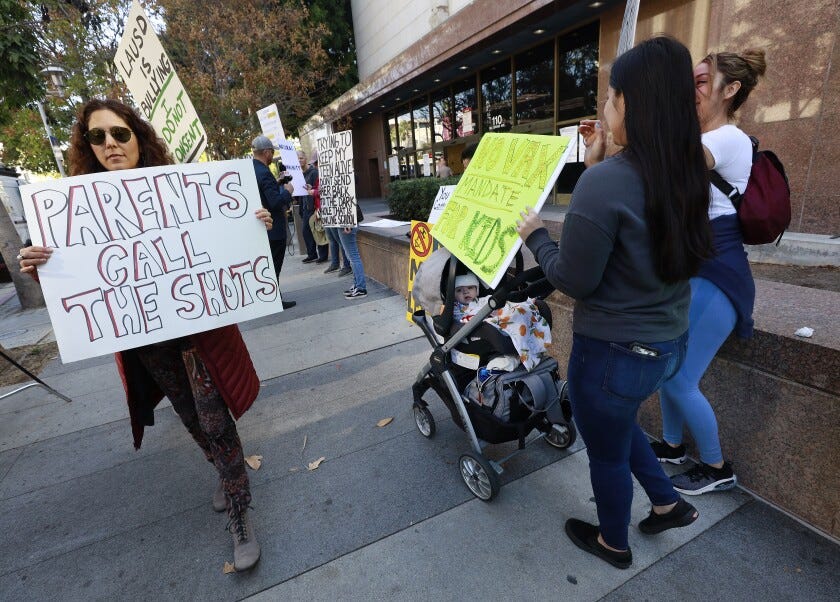
By Steve Kirsch | July 5, 2022
An important decision on vaccine mandates was just signed and released this morning.
The case was filed by a father on behalf of his son who attends the Science Academy STEM LAUSD magnet school. The lawyer in this case was Lee Andelin.
LAUSD will likely appeal the decision, but it’s unlikely they will prevail.
The decision means that:
- LAUSD was wrong in requiring the COVID vaccines
- For all but ten vaccines, a personal belief exemption must be respected.
- LAUSD can no longer send kids away from their school and to independent study because they are not vaccinated.
- Only the Department of Public Health can mandate vaccines, not the schools
- The ruling applies to all students, not just the student filing the complaint
- Parents whose children were injured, either by having to have their child vaccinated (regardless of whether your child has a vaccine injury or not) or whose child was shifted into independent study, now have an opportunity to sue for monetary damages.
If you are in the last category, please register here and I’ll let you know how you can join with other parents to preserve your rights and to potentially recover monetary damages.
EPA now stuck between a rock and a hard place on CO2
By David Wojick | CFACT | July 5, 2022
There are lots of happy reports on the Supreme Court’s ruling throwing out EPA’s so-called Clean Power Plan. Some go so far as to suggest that EPA is barred from regulating power plant CO2 emissions.
It is not quite that simple and the result is rather amusing. EPA is still required to regulate CO2 under the terms of the Clean Air Act, but that Act provides no way to do that regulation. The Clean Power Plan attempted to expand an obscure minor clause in the Act to do the job but SCOTUS correctly ruled that the clause does not confer that kind of massive authority.
EPA is between a rock and a hard place. It should tell Congress that it cannot do the job and needs a new law, along the lines of the SO2 law added to the Act in 1990, curbing emissions. But such a law has zero chance of passing in the foreseeable future.
EPA is stuck. What they will now do is anybody’s guess. Enjoy their dilemma!
Here is a bit more detail on the situation.
On one hand EPA’s legal mandate to regulate CO2 under the Clean Air Act is clear. First the (prior) Supreme Court ruled that CO2 was a “pollutant” under the Act. This is because buried in the 1990 Amendments was a clause adding causing climate change to the definition of “pollutant”. The Court accepted the government’s claim that the CO2 increase could cause climate change. The new Court could change this but is unlikely to do so.
Given CO2 as a pollutant under the Act, EPA was required to decide if it was dangerous to human well being or not. It then produced an “endangerment finding” saying that CO2 was indeed a threat.
Given these two steps the Act then requires EPA to regulate CO2. It has been trying to figure out how to do so ever since.
The deep problem is that the Clean Air Act specifies very specific regulatory actions, none of which work for CO2. This is because CO2 is nothing like the true pollutants that the Act was developed to regulate.
The Act’s mainline mechanism is the NAAQS (pronounced “nacks”) which stands for National Ambient Air Quality Standards. These standards specify the ambient concentration levels allowed for various pollutants. Carbon dioxide’s cousin carbon monoxide is one of these pollutants. Locations that exceed the NAAQS receive stiff penalties.
Clearly this mechanism assumes that local levels are due to local emissions, which can be controlled to achieve and maintain compliance.
But CO2 is nothing like that. There is no way America can control the ambient CO2 level. Even if humans are causing that level (which is itself controversial), it is then based on global emissions. CO2 is not a local pollutant.
For a CO2 NAAQS EPA could either set the standard below the global level or above it. If below then all of America would be out of compliance and subject to the Act’s penalties, with no way to comply. It is very unlikely that the Court’s would allow these universal endless penalties.
If the CO2 NAAQS were above the present level then there would be no legal basis for EPA taking any action, since compliance was complete.
So the NAAQS mechanism simply does not work.
Another major mechanism is to control the emissions of what are called “hazardous air pollutants” or HAPS. EPA explains it this way:
“Hazardous air pollutants are those known to cause cancer and other serious health impacts. The Clean Air Act requires the EPA to regulate toxic air pollutants, also known as air toxics, from categories of industrial facilities.”
But CO2 is nontoxic, so not a HAP. In fact our exhaled breath contains over one hundred times the ambient level of CO2, that is over 40,000 ppm. Clearly if ambient 400 ppm CO2 were toxic we would all be dead. It would be absurd for EPA to try to classify CO2 as a HAP. No Court would stand for it.
The only other piece of Clean Air Act that EPA might try to use is called “New Source Performance Standards” but as the name says they only apply to new construction (or major modifications). The myriad existing fossil fueled power plants that supply our daily juice would not be covered. Even worse if EPA drove up the cost of new gas fired plants we would likely restart the host of retired coal fueled plants. What a hoot that would be!
So there you have it. EPA bought itself CO2 as a Clean Air Act pollutant, but there is no way under the Act to regulate it. To mix metaphors, EPA is all dressed up with no place to go. The Supreme Court decision returned EPA to its regulatory dead end.
I find this ridiculous situation to be truly laughable. What were they thinking? Does the EPA Administrator understand this? Has he told the President? How about Congress?
EPA’s problem with CO2 is much deeper than the latest Supreme Court Decision. The Clean Air Act simply does not work for CO2. What will EPA do?
David Wojick, Ph.D. is an independent analyst working at the intersection of science, technology and policy.
Every third Dutch farm to be closed down or expropriated!
Free West Media | July 6, 2022
CO 2 hysteria was so yesterday. In the Netherlands there’s now a nitrogen alarm. Ironically, at a time when the specter of food shortages and hunger is looming, the “Green Deal” of the all-powerful, misanthropic EU has prompted Commissioner Frans Timmermans to demand that ten percent of agricultural land be set aside across Europe.
In order to help this madness prevail, a Dutch “nitrogen problem” has been invented. On this basis, they want to force the livestock farmers – who are named as the main culprits – to give up their businesses. The Dutch “Minister for the Environment and Nitrogen”, Christianne van der Wal, announced that 30 percent of livestock farmers would have to give up their farms. Those affected now have the choice to give up their farms voluntarily and leave, or to pledge never to practice their profession again – only then would they be compensated. Those who do not comply face expropriation by the state. The aim is to reduce nitrogen emissions by up to 95 percent by 2030.
The Netherlands is the world’s fifth-largest exporter of food, exceeded only by the United States, Germany, the United Kingdom, and China, according to World Bank statistics.
So for at least a third of farmers it is a matter of survival. No wonder, then, that the protest is huge. For weeks, the angry farmers have been blocking roads and marching in front of government buildings to make their displeasure visible. Among other things, the access roads to some supermarkets were blocked. It was also announced that the access roads to the international airport in Amsterdam would be closed.
A few days ago farmers broke through a police barrier with their tractors and sprayed the minister’s house with liquid manure – symbolically the right thing to do because nitrogen is a building block for biological life on earth, the most abundant element in the atmosphere. It needs carbon, hydrogen, oxygen, lightning and bacteria, to provide “reactive” nitrogen. Fertilizer is just the workaround. Unbelievably, the Rutte government is targeting the manure people!
The mainstream media tried to sweep the issue under the carpet as tens of thousands of farmers took to the streets for days to demonstrate against EU regulations and government plans that would ruin Dutch agriculture. The police announced tougher action against the demonstrators, which, however, will probably only result in further escalation.
In Stroe alone, 30,000 farmers from all over the Netherlands came together to demonstrate against the government’s plans. In concrete terms, these plans stipulate that nitrogen emissions must be greatly reduced following a ruling by the highest court. In natural areas, the value is to be reduced by 12 to 95 percent, depending on the area category. According to government figures, this could mean the end for about a third of Dutch livestock farms, but it is much higher, farmers say.
The police meanwhile speak of a “threatening and unacceptable situation”. According to polls, about 45 percent of the Dutch population back the protests. In October, it was still 38 percent.
Shooting at protesters
The police fired shots at a farmers’ protest in Heerenveen on Tuesday evening. According to Facebook group Verzet Friesland, 16-year-old Jouke was shot at by police as he drove off with his tractor.
“The media are shouting that he drove into them, but it is very clear on camera that that was not the case. He just wanted to drive home.” Police opened fired on Jouke. Fortunately he was not injured, but the bullet missed him by two centimetres.
“The photos that are circulating show that the bullet(s) hit the cab of the tractor and missed Jouke by a hair. There was no shooting at tyres or in the air. It is by sheer luck that the police and the ministry responsible do not have a fatality on their conscience,” said lawyer Sietske Bergsma. Dozens of farmers tell the same story of police brutality.
Dutch anti-globalists are praying that this protest be the straw that break the Rutte camel’s back.
‘Why the Rush for Toddler Vaccines?’ Asks Wall Street Journal Editorial Board Member
By Susan C. Olmstead | The Defender | July 5, 2022
A Wall Street Journal (WSJ) editorial board member Monday called into question the motives behind the U.S. Food and Drug Administration’s (FDA) decision to extend Emergency Use Authorization of Pfizer and Moderna’s COVID-19 vaccines to toddlers and infants as young as 6 months old, writing that the decision was motivated by politics and pressure rather than science.
In her WSJ opinion piece — “Why the Rush for Toddler Vaccines?” — Allysia Finley wrote:
“The FDA standard for approving vaccines in otherwise healthy people, especially children, is supposed to be higher than for drugs that treat the sick.
“But the FDA conspicuously lowered its standards to approve COVID vaccines for toddlers. Why?”
Finley started her piece with a quote from President Biden, which praised the FDA’s recommendation: “This is a very historic milestone. The United States is now the first country in the world to offer safe and effective COVID-19 vaccines for children as young as six months old.”
She responded, writing, “In fact, we don’t know if the vaccines are safe and effective.”
She continued:
“The rushed FDA action was based on extremely weak evidence. It’s one thing to show regulatory flexibility during an emergency. But for children, Covid isn’t an emergency.
“The FDA bent its standards to an unusual degree and brushed aside troubling evidence that warrants more investigation.”
“Mr. Biden’s hypocrisy is hard to stomach,” she wrote, listing many reasons for caution in vaccinating young children against COVID-19, including:
- Children are at low risk of dying from COVID-19: Only 209 kids between 6 months and 4 years old have died from COVID-19 — about 0.02% of all virus deaths in the U.S. About half as many toddlers were hospitalized with COVID-19 between October 2020 and September 2021 as were hospitalized with the flu during the previous winter.
- The two children in Pfizer’s trial who got sickest with COVID-19 also tested positive for other viruses. It’s possible that many hospitalizations attributed to COVID-19 this winter were instigated or exacerbated by other viruses.
- The FDA authorized vaccines for toddlers based on a comparison of the antibodies they generated to the original Wuhan variant with those in young adults who had received two doses. But two doses offer little if any protection against Omicron infection in adults, and even protection against hospitalization is only around 40% to 60%.
- Vaccinated toddlers in Pfizer’s trial were more likely to get severely ill with COVID-19 than those who received a placebo. Most children who developed multiple infections during the trial were vaccinated.
“FDA granted the Pfizer and Moderna vaccines for toddlers an emergency-use authorization allowing the agency to expedite access for products that ‘prevent serious or life-threatening diseases or conditions,’” wrote Finley.
“While adult COVID vaccines clearly met this standard in late 2020, the toddler vaccines don’t.”
As to why the FDA “rushed” and “bent its standards,” Finley suggested, “perhaps [the FDA] felt pressure from the White House as well as anxious parents.”
White House COVID-19 response coordinator Ashish Jha repeatedly told parents that he expected vaccines for toddlers would be available in June, she wrote.
© 2022 Children’s Health Defense, Inc. This work is reproduced and distributed with the permission of Children’s Health Defense, Inc. Want to learn more from Children’s Health Defense? Sign up for free news and updates from Robert F. Kennedy, Jr. and the Children’s Health Defense. Your donation will help to support us in our efforts.
Vaxsplainers
German state media “debunks” eugyppius

eugyppius – July 6, 2022
I’m happy to report that my remarks on lower case rates in lesser-vaccinated East Germany, after being recycled by BILD, are now the subject of a long state media debunking in Tagesschau.
Why Are Case Rates Lower in the East? ask “science” reporter Anna Behrend and official state media “fact-finder” Pascal Siggelkow.
The nationwide seven-day incidence in Germany has been on the rise again for several weeks now. Health Minister Karl Lauterbach has already spoken of a summer Corona wave. But a look at the developments reveals that there are huge differences between the federal states:
While the incidences in Lower Saxony and Schleswig-Holstein have already passed the threshold of 900, the numbers in Thuringia and Saxony are still under 400. In general, it’s remarkable that all the East German states – with the exception of Mecklenburg-Vorpommern – are significantly below the national average incidence of of 687.7. And this is despite the fact that Saxony, Brandenburg and Thuringia have some of the poorest vaccination rates. In conspiracy-theory circles, people are already fantasising about “negative efficacy”, especially with regard to booster vaccinations, saying that the figures amount to proof that the vaccines are ineffective. But is there really a causal connection between the vaccination rate and the incidence?
Before they get into that, Siggelkow and Behrend light the incense and cycle through the familiar vaccinator nostrums. “Vaccination protects against severe outcomes and death,” even though the rise of Omicron has led to a great many “breakthrough infections.” Mysterious “studies,” which are never further characterised, are said to show “that vaccinated people … are slightly less contagious,” although they have to concede that “there isn’t enough data to conclude this decisively.”
Then, when they’re reasonably sure most people have stopped reading, comes an uncomfortable admission. Case incidences, the cornerstone of Tagesschau Corona reporting since 2020, are of, uh, “limited significance”:
If the vaccination rate … is not the decisive factor … how is it that the number of new infections in the East is comparatively low right now? First of all, it must be said that the current infection figures are only of limited significance. “One must always also consider that incidences are calculated on the basis of reported laboratory results,” says [virologist Johannes] Knobloch. As before, only positive PCR tests count in the RKI statistics. Willingness to be tested and the accessibility of PCR tests therefore have a very large influence on the measured incidence. … “The number of unreported cases is probably higher than in all previous phases of the pandemic.”
According to experts, the incidence continues to indicate whether the wave of infection is rising or falling. Caution is advised, however, when making regional comparisons, as the testing strategies and also the number of tests differ greatly across states. Fewer tests mean that fewer infections are detected. A high proportion of positive tests … indicates a high number of unreported cases …
Ah, so they just have super high positivity rates in the East then? That’s the explanation?
Ha no:
But it’s not the case that Eastern states have uniquely high positive rates compared to the others. So different testing patterns alone cannot explain the current low incidence there either.
It wasn’t that long ago that all manner of respectable journalists, especially those working for Pravda operations like Tagesschau, wrote long think pieces on the “global menace” of “vaccine scepticism,” complete with histrionics about the lower vaccination rates in Eastern Europe causing “much higher infection figures.” Lazy Googling yields many typical items, such as this piece from MDR in November, lamenting that the “incidence among unvaccinated in Sachsen-Anhalt is significantly higher than among the vaccinated.” This at a time when the vaccinated were exempt from most testing, while many unvaccinated had to submit to daily antigen tests before they could even go to work.
Now that these games no longer favour the vaccinated, though, we’re allowed to wonder about things like positivity rates. These certainly matter, but – unbeknownst to our crack fact-checking team – they’ve become totally meaningless in the era of lateral flow testing, as a plurality of PCR tests in Germany are conducted to confirm a positive antigen result, and nobody has any idea what the true rate of testing might be.
Frustrated on this front, Siggelkow and Behrend look for other signs that infections might really be higher in the East, even though the official incidence is lower there. More and more, you have the feeling of a desperate grasping after straws:
If the true incidence were in fact higher, you would expect to see this in ICU admissions …
Yet the proportion of Covid patients in ICU is currently not conspicuously high in the East compared to the rest of Germany.
Foiled again!
So were most people in the low-incidence states already infected and now immune? Those who become infected with the coronavirus usually form antibodies against it. How long and how well these antibodies protect against a new infection with the virus has not yet been conclusively researched.
However, if we assume that there is at least some protection for a while, one conceivable reason for the low incidence in some states would be that more people have already come into contact with the virus there and are therefore less likely to be infected now.
… It’s not known precisely how much of the population in which states has already recovered from infection. If you take the number of new infections … since the beginning of the year as a rough approximation of the circulation of Omicron, you find no confirmation of the assumption that the population of the East has had greater contact with the virus. …
How confusing. Do Tagesschau no longer stand by their dire proclamations, uttered just this past winter, that lower vaccination rates were to be blame for higher infections in the East? Is their position now that the East never saw higher rates of infection at all, even though the vaccines definitely protect against infection? Also too, why have we abandoned so soon our thesis that the incidence is of “limited significance,” can only tell us when cases are going up or down, and says nothing about how many cases there actually are? I thought regional comparisons of case numbers were bad?
Way down at the bottom, when Behrend and Siggelkow are triply sure nobody is reading anymore, they toss out the possibility that cases might indeed be lower in the East – not because of the vaccines, but because the new Omicron variants haven’t gotten there yet:
One reason the nationwide incidences are rising so sharply in the first place is the Omicron subtypes BA.4 and BA.5, which experts consider more contagious than the previously known “sister variants.” BA.5 is now dominant … It’s of course possible that some states are more affected by the new variants than others, where these variants have not yet arrived.
If BA.5 infects the vaccinated preferentially, and vaccination rates vary substantially across regions, there will be many places where BA.5 never quite seems to have arrived. Perhaps aware of this close brush with crimethink, our braintrust wraps things up with some cleansing mantras:
What is certain, though, is that there is no scientifically sound reason to assume that a high vaccination rate could be partly responsible for a high incidence. On the contrary: Scientific data show instead that people infected with Omicron are less likely to infect others than the unvaccinated.
Every conspiracy theory must first be ignored, then denied, and finally debunked, before it becomes true.
Iran detains UK deputy ambassador for alleged spying
Samizdat | July 6, 2022
The UK’s second-most senior diplomat in Tehran is reportedly among three foreigners who have been arrested by Iran’s Islamic Revolutionary Guards Corps (IRGC) for alleged espionage activities.
Giles Whitaker, deputy chief at the UK embassy in Tehran, stands accused of taking soil samples in a restricted area, according to a report on Wednesday by Iranian state television. Video footage released by the IRGC purports to show the veteran envoy, who was accompanied by family members, gathering soil samples in Iran’s central desert, where missile exercises were being conducted.
Whitaker reportedly apologized for the infraction and was expelled from the area. The media report didn’t specify whether he and the other suspects are still under arrest. The other detained men were identified as the husband of Austria’s cultural attaché in Iran and Maciej Walczak, a Polish university professor who was visiting the country under a scientific exchange program.
The IRGC’s footage purported to show Walczak and three colleagues collecting soil samples in a restricted area of Kerman province, where another missile test was being conducted. The Polish professor is reportedly from Nicolaus Copernicus University, which the Iranian broadcaster said is “associated with the Zionist regime.”
The allegations come amid stalled talks to revive the 2015 Iran nuclear deal, which former US President Donald Trump canceled in 2018. Under the so-called Joint Comprehensive Plan of Action (JCPOA) – signed by Iran, the US, Russia, China, the UK, France and Germany – Tehran agreed to limitations preventing nuclear weapons development in exchange for sanctions relief.
Wednesday’s Iranian media report suggested that the alleged spies were trying to help build a new case on “military aspects of Iran’s file in the International Atomic Energy Agency.”
Whitaker has been deputy head of mission at the British embassy in Tehran since November 2018. His UK government career has spanned more than three decades and has included stints at embassies in Moscow, Berlin and Islamabad, as well as at NATO headquarters in Brussels.
The IRGC has arrested dozens of foreigners on espionage charges in recent years. Rob Macaire, then UK ambassador to Iran, was apprehended in January 2020 for allegedly inciting protests over the Iranian military’s accidental downing of a Ukrainian passenger jet.
‘We Need to Be Allowed to Ask Questions,’ Says Canadian Prof Suspended for Questioning COVID Shots for Kids

By Julie Comber, Ph.D. | The Defender | July 5, 2022
A Canadian university professor suspended for comments he made during a December 2021 conference about COVID-19 vaccines in an interview this week with The Defender called for “openness, critical thinking and to stop believing what we are being told is the truth.”
“We need to be allowed to question again,” said Patrick Provost, Ph.D., an infectious and immune diseases researcher who learned June 13 that Laval University in Quebec City was suspending him for eight weeks without pay.
Laval University also suspended Nicolas Derome, Ph.D., a professor in the university’s biology department, for concerns he raised in November 2021 about Quebec’s campaign to vaccinate 5— to 11-year-olds.
In his interview with The Defender, Provost also discussed an article he wrote questioning COVID-19 policies, published June 22 on the Québecor media platform, then retracted a day later.
For the article, Provost used Quebec’s publicly available data to raise questions about the province’s management of the pandemic. The province of Quebec is home to about 8.5 million people, the second-most populous province in Canada.
“I was so happy when I found out my article was going to be published,” Provost told The Defender, “I really thought it would be a game-changer in the public debate about COVID-19 [in Quebec]. That finally, based on official public data, we could start to discuss the situation.”
However, by the next day, June 23, Québecor had removed Provost’s article from all of its websites.
Sébastien Ménard, publisher and editor-in-chief of the Journal de Québec, one of Québecor’s publications, tweeted (in French):
“Although we encourage debating ideas, we have decided to remove this letter [by Dr. Provost] from our websites. After verification, some of the elements it contained were inaccurate or could mislead the public, which we cannot support.”
Commenting on the retraction, Provost said:
“I’m really worried about the direction we are heading, about our democracy. Why hide the truth? These numbers are real, this was just my analysis of them. Maybe it’s a disturbing truth.”
Libre Média, a new Quebec-based independent media website, on June 24 published Provost’s article so it is still publicly available.
Libre Média prefaced the article with a note that it was publishing Provost’s article in full, “in accordance with its mission to protect freedom of the press.”
Criticism of COVID vaccines for young children led to suspension
Two days after Québecor removed his article, Provost went public with the news that Laval notified him on June 13 that the university was suspending him, effective June 14.
Provost filed a grievance through his union, the Union of Laval University Professors.
According to Provost, he sent an email to all his colleagues at Laval University last December, in which he urged them to engage in debates on COVID-19 vaccination and public health measures, because he felt public debate had been lacking.
In the email, he gave the example of a lecture he had given at a conference on Dec. 7, 2021, in which he criticized Quebec’s campaign to vaccinate 5- to 11-year-old children against COVID-19.
The conference was organized by Réinfo Covid Québec, a Quebec collective of caregivers, doctors and citizens “gathered around an idea: the need for a fair and proportionate health policy in Quebec and elsewhere in the world.”
“As a result of this, a professor from the faculty of medicine filed a complaint against me in January, outraged that I was raising questions,” Provost told The Defender. “In particular, that I said the risks of adverse effects [of Pfizer’s mRNA shot] outweighed the benefits for children.”
Provost said his suspension didn’t factor into Québecor’s decision this week to censor his article, as he had not made the news of his suspension public before the article was removed.
COVID mortality rate ‘greatly overestimated’ data show
In his article, Provost noted that the vaccine mandates for travel within Canada and for federal public servants had been suspended two days before, on June 20.
However, mandates could be reimposed, so Provost invited readers to consider a true portrait of the impact of COVID-19 in Quebec, based on the province’s own publicly available data.
As of June 19, when Provost accessed the cumulative data online, there were 15,462 deaths related to COVID-19 (Chart 2.1) out of a total of 1,077,256 confirmed cases of COVID-19 (Chart 1.1), for a calculated mortality rate of 1.44%.
Provost wrote:
“This mortality rate is greatly overestimated, mainly (i) by including, in the numerator, deaths with, and not because of, COVID-19, which were apparently as numerous, and (ii) by excluding, in the denominator, cases of asymptomatic or unreported infections, which were several times higher than the reported symptomatic infections.”
Provost then turned to official figures from the Institut de la statistique du Québec and the Institut national de santé publique du Québec (INSPQ), and made these five observations based on the data:
- There was no excess all-cause mortality since the beginning of the COVID-19 pandemic, except for people age 70 and over during the first wave (April to June 2020) and in January 2022, shortly after the lockdowns and curfews were imposed, which was also when the third vaccine doses were offered.
- More than 90% of people age 70 or older who died with or from COVID-19 had two or more pre-existing medical conditions (Table 2.2).
- 69.2% of the people who died were over the age of 80 (Figure 2.3), thus the average age of people who died with or from COVID-19 was beyond their life expectancy at birth.
- The number of deaths (Table 2.1) compared to the number of cases (Table 1.1) is 0.07% in people with no pre-existing conditions, 6 times higher in people with one pre-existing medical condition (0.4%), and 98 times higher in people with two or more pre-existing conditions (6 .9%), according to data last updated on May 2.
- Between 0 and 5 people under the age of 40 (with less than one pre-existing medical condition) have died in Quebec since the start of the pandemic (Table 2.2).
According to Provost, early on in the pandemic, the analysis of official government data showed two of the main risk factors for complications and death from COVID-19: “advanced age and the number of pre-existing medical conditions, in particular, obesity.”
“The threat of COVID-19 was very real,” wrote Provost, “but was it of the magnitude that we have been told?”
According to the public data available on the sites of INSPQ and of Quebec Data Partnership, from April 1, 2020, to March 31, 2021, there were 20,616 hospitalizations due to COVID-19 out of a total of 986,607 hospitalizations — so approximately 2.1% of hospitalizations were a result of COVID-19 infections.
At the worst point in the crisis, COVID-19 hospitalizations peaked at 5.9% of the total.
Given the above data, Provost asked if the public health measures taken were justified. He raised a series of questions, including:
- Did the data support imposing such severe and comprehensive health measures, rather than targeted ones that would protect those most at risk?
- Did the data justify not considering the collateral effects of restrictive health measures?
- Did the data justify preventing physicians from making individualized risk versus benefit assessments of a medical intervention (COVID-19 vaccination) with their patients?
Provost also asked if the data justified overriding the right of individuals to consent, in a free and informed manner, to an injection that is still experimental.
He questioned mass vaccination of the entire population for a disease that particularly affects the very old and sick, and of imposing vaccination on young people and workers.
Quebec used vaccine passports, and Provost asked if the data justified restricting the right to access public places and hindering the freedom of movement by train or plane of people who were not “adequately” vaccinated, “even though the shots do not prevent infection or transmission.”
With respect to governance, Provost said the government assumed power by self-proclaiming and perpetuating a state of health emergency and certain measures beyond the emergency period.
He noted that professionals and academics were muzzled if they were critical of health measures, through pressure from their professional organizations or their institutions, under penalty of losing their jobs.
He also pointed out that the polarized and polarizing media coverage sowed fear, anxiety and division, and that citizens were encouraged to discriminate against people who were not vaccinated against COVID-19.
As part of the remedy to what he viewed to be heavy-handed public health measures, Provost stressed the “importance of depoliticizing decisions that infringe on individual rights and freedoms by establishing, for example, by a Council of Scholars that is independent from the government, so that these decisions are based on science and are made more quickly.”
Provost closed his article by calling for a review of the management of the pandemic:
“An assessment of the management of this crisis, which has revealed the limits, even the flaws, of our system and our democratic life, is essential.
“We owe it to too many seniors whom we have failed to protect, as well as to those whose rights and freedoms have been violated for too long.”
Dozens of messages of support
Provost told the Defender that in the hours before his article was pulled, one idea was to have another professor write a rebuttal to his article.
But instead, Quebecor’s news sites simply deleted the article.
On Monday, Joel Monzée wrote an article in Libre Média about the censorship of Provost’s article and its implications for science. “Science is only science because it questions itself,” Monzée wrote.
Monzée said that with respect to the COVID-19 pandemic, “It is blithely claimed that there is a scientific consensus. However, this only exists because certain academic personalities seem to have enough influence over their colleagues to curb any questioning of the consensus, at least in public.”
Monzée asked, if there were inaccuracies in Provost’s article, then why not address them with a counter-analysis?
Provost is the supervisor of four Ph.D. students whose work has been affected by his suspension.
“Because of my suspension, I cannot go on the campus, enter the Research center or talk to them,” Provost said. “They are essentially left alone. They are collateral damage.”
Provost said that though the situation was difficult, in the past few days he had received dozens of messages of support, and also observed that a growing number of citizens “have a thirst for truth and openness.”
Provost told The Defender, “I would like to raise awareness about how our society is evolving, it’s not in a good direction. It is getting to the point where private interests will be directing our country, we will just be servants.”
© 2022 Children’s Health Defense, Inc. This work is reproduced and distributed with the permission of Children’s Health Defense, Inc. Want to learn more from Children’s Health Defense? Sign up for free news and updates from Robert F. Kennedy, Jr. and the Children’s Health Defense. Your donation will help to support us in our efforts.
Ukraine Crisis Highlights Concerns About Whether OPCW Still Has Any Global Relevance, Observers Say
Samizdat | July 6, 2022
The executive council of the Organization for the Prohibition of Chemical Weapons (OPCW) kicked off its hundredth session at The Hague on Tuesday. Last month, the global watchdog assured that it was “monitoring the situation” in Ukraine closely as far as the potential use of chemical weapons is concerned.
The OPCW’s lack of a coherent, objective and fair-minded response to recent crises centered around Syria and Russia demonstrates its politicization and domination by Western interests, and the longer the watchdog stays out of Ukraine, the better, former diplomats, geopolitical observers, and international legal experts have told Sputnik.
“In Ukraine the OPCW has fortunately not been pressed into action. This, I suspect, is because the US is satisfied with the situation as it is, with no need for the US itself to be drawn in, as would no doubt be the case if a chemical attack was fabricated,” Peter Ford, Britain’s former ambassador to Syria, said.
The veteran diplomat, who warned the British government against the folly of the 2003 invasion of Iraq, and stressed that Western powers’ campaign to topple the Syrian government in the 2010s could open a “Pandora’s box” of endless crises, said the Syria case demonstrated clearly that the OPCW is no longer an independent, impartial agency.
“The Syria crisis proved without a shadow of a doubt that the Western powers have bent the OPCW to their own will, destroying in the process the organization’s credibility, probably irretrievably. This is a tragedy for world peace,” Ford stressed, referring to documented OPCW efforts to censor and smear agency whistleblowers who revealed that the watchdog’s report on the April 2018 chemical attack in Douma, Syria was doctored to implicate the Assad government.
In Ukraine, Ford fears, the international community can now only depend on “self-interested restraint on the part of the Pentagon in controlling its proxies rather than the deterrent power of a genuinely impartial international watchdog.”
Chemical Weapons Danger in Ukraine
Since the escalation of the crisis in Ukraine in February, Russia has sent the OPCW and its technical secretariat over two dozen notes warning of possible staged provocations by Ukrainian forces or radical nationalists involving chemical weapons. Last month, the agency assured the international community that it was “closely monitoring the situation in Ukraine” for chemical weapons use.
On Wednesday, Russian military indicated that it had information on plans by Kiev to stage a provocation in the Donetsk People’s Republic using chlorine gas to accuse Moscow on indiscriminate attacks targeting chemically hazardous objects.
Alessandro Bruno, a Toronto-based geopolitical analyst and political observer at Lombardi Letter, says that while the OPCW’s official mission and goals are “certainly worth pursuing,” the problem is the watchdog’s control by Western interests seeking to obfuscate the truth and objectivity in favor of politicized objectives.
“They seem to have targeted only specific sides in specific wars to suit specific aims, which typically are those of Western powers. There have been many efforts to manipulate these organizations by the dominant powers, particularly in the West,” Bruno said.
The scholar recalled instances of claims by the US and its allies about Russia’s use of chemical weapons, from the allegation that Russia poisoned pro-Western Ukrainian presidential candidate Viktor Yushchenko in the mid-2000s, to the 2018 Novichok scandal in Britain, which “many thoughtful journalists have debunked,” to the Alexei Navalny “poisoning” saga of 2020, which doctors treating the opposition vlogger have debunked.
“Yet the accusations of chemical weapons that Russia used have persisted, even though they defied all logic. That’s the biggest issue with these organizations. They must be more neutral. Their headquarters must be in more neutral locations, because the fact that many of these organizations operate from Western capitals makes them more prone to Western media misinformation,” Bruno said.
The geopolitical analyst still fears that the West could use the pretext of ‘Russian chemical weapons use’ in Ukraine “to get more directly involved into the conflict and potentially trigger a much wider physical war.”
“So far, I think, some of the powers came to understand that making an accusation like that in this conflict would be riskier than the accusations they made in Syria and Iraq, Navalny and Yushchenko and so on, that this would have much bigger implications, that this would blow back against the West,” Bruno stressed.
Tool of US Interests
Christopher C. Black, an international criminal and human rights lawyer with 20 years of experience covering war crimes and international relations, echoed Bruno’s sentiments about the OPCW’s noble stated aims and their stark contrast with the body’s actual history, which “shows that [the watchdog] acts to serve the interests of the United States and its NATO and other allies.”
“We saw strong evidence of this when the USA tried to get rid of the Director General Jose Bustani of Brazil in 2002, when the United States was preparing its invasion of Iraq and John Bolton went to The Hague and threatened his family if he did not resign,” Black recalled, pointing to Bustani’s 2018 interview with The Intercept in which the former OPCW chief detailed the threats made against his children living in the United States.
“In August 2020, it was revealed through leaks from Austrian government sources that the OPCW and British claims that Novichok had been found in the blood of the Skripals allegedly poisoned in the UK were false, that in fact no such agent had been found in their blood at all. But the findings were suppressed and a false report issued to back the UK claims,” the lawyer added. “Similar results were seen regarding the alleged poisoning of Mr. Navalny. We can quickly understand what goes on behind the scenes at the OPCW,” Black said.
Black finds it unlikely that the chemical weapons watchdog will change “without a change in the balance of power in the world,” which is taking place, but whose effects on international organizations will be slow to appear.
In Ukraine, the lawyer fears, “We cannot expect any objective consideration of Kiev regime or NATO claims of Russia using chemical weapons in Ukraine for the reasons stated above, despite the fact that Russia has not used them, does not use them and will not use them. To the contrary we have a situation in which Kiev and NATO forces keep making false claims while themselves preparing chemical weapons attacks to be staged as false flag attacks to be blamed on Russia and when Russia asks the OPCW to investigate this, Russia is met with silence,” he said.
How OPCW Can Regain Credibility
Dr. Alfred De Zayas, a lawyer, writer and former independent expert on international order with the United Nations, similarly doubts the OPCW’s ability to reform in its current itteration, saying the agency “has long been instrumentalized to pursue the geopolitical interests of Western powers.”
The international legal expert is confident that agencies like the OPCW, the International Criminal Court and the Human Rights Council can regain their credibility by demonstrating impartiality. “This is possible if the BRICS countries become more vocal and more visible on the international scene. There is no reason why African, Asian and Latin American countries should dance to the tune of the ‘Washington consensus’,” De Zayas stressed.
In Ukraine, the OPCW’s assurance about “monitoring the situation” carries only a “purely propagandistic value,” and is “intended to charge and convict Russia even before there is any evidence of violations of the Chemical Weapons Convention,” the observer believes.
“If the OPCW investigates not only potential Russian war crimes, but also expands its investigation to potential chemical weapons violations and war crimes by Ukrainian forces and by foreign mercenaries, including US, UK, French, Georgian and others, then the OPCW might regain some credibility. That, however, would be ‘out of character’. It is not unlike the ICC, which in the eyes of many observers in the US, Canada, UK, France, Germany, Switzerland – has lost its little credibility and will have no authority unless and until it indicts Western politicians and bureaucrats including Tony Blair, George W. Bush, Paul Wolfowitz, Victoria Nuland, Barack Obama (the king of the drones), Donald Trump, Nikolas Sarkozy, etc.,” De Zayas concluded.
Israeli agency told to quit operations in Russia as ties hit new low
Press TV – July 6, 2022
The Russian Justice Ministry has asked an Israeli agency to wind down its operations in Russia as the two sides’ ties hit a remarkable new low.
The Jerusalem Post reported the development on Tuesday, citing the “Jewish Agency,” which purportedly handles the affairs of the Jewish people on the Russian soil.
“The order was given in a letter received from the Russian Justice Ministry earlier this week. Officials in the Jewish Agency confirmed that the letter was received,” the report said.
The agency, it added, was trying to coordinate a response in consultation with the Israeli regime’s foreign ministry and Israeli Prime Minister Naftali Bennet’s office.
‘Dramatic order’
The paper described the order handed to the agency as “dramatic.”
It cited a “senior diplomatic official” as making the following remarks concerning the order and Tel Aviv’s potential response to the move.
“Russia is saying the Jewish Agency illegally collected info about Russian citizens… We will bring up the Jewish Agency [with Russian authorities] and address it in an organized way. It will be taken care of at the embassy level.”
“We don’t totally understand the reasoning,” the source claimed.
The daily also said cessation of the agency’s operations in Russia would mean that the Jews would no longer be able to “escape” the country and make their way to the occupied territories.
Relations between Russia and the Israeli regime have gone through dire straits on several occasions since 2018.
The ties were hit with what observers rate as a major crisis in September 2018, when a Russian Il-20 military plane was mistakenly shot down by Syrian air defenses when it was preparing to land in Russia’s Hmeimim airbase in Latakia Province in northwestern Syria. The Syrian S-200 missile defense system was responding to a wave of strikes by four Israeli warplanes.
Moscow blames Tel Aviv for the incident, which killed all the 15 people on board the plane, saying the Israeli warplanes had deliberately “created a dangerous situation” that led to the crash. The Russian military also said the ill-fated plane was used as a cover by the Israeli air force, and that Moscow reserved the right to give a due response.
Tensions flared again between the two sides over the Israeli regime’s recurrent airstrikes against Syria last month after the regime targeted the Damascus International Airport. Russia subsequently summoned the Israeli ambassador to the country, expressing “serious concern” over the strikes that targeted the civilian facility.
And in May, Russian Foreign Minister Sergei Lavrov suggested that Nazi dictator Adolf Hitler had Jewish origins, triggering strong reactions from Tel Aviv. The Israeli foreign ministry said Lavrov’s comments were “ghastly,” and stated that it had summoned Russian Ambassador to Tel Aviv Anatoly Viktorov for “a tough talk” over the statements.
The Russo-Israeli ties have also been suffering as a result of Tel Aviv’s siding with the West over Ukraine, where Russia has been engaged in a special military operation since February, as well as the occupying regime’s agreement with the European Union to supply natural gas as an alternative to Russian energy imports.
Russia responds to reports Turkey detained its ship
Samizdat | July 6, 2022
Moscow has denied reports of Turkish customs seizing or arresting a Russian dry-cargo ship carrying grain near Karasu Port, as Ukrainian officials have claimed.
During a briefing on Wednesday, the deputy director of the Information and Press Department of the Russian Foreign Ministry, Aleksey Zaitsev, stated that the vessel, the Zhibek Zholy, was merely going through all the standard procedures before entering a port.
“According to Russia’s embassy in Turkey, the ship is currently in the roadstead of the port of Karasu and is undergoing standard procedures, including sanitary control,” Zaitsev stated. He further explained that based on the results of these inspections, the Turkish authorities will make a decision on whether or not to let the ship enter the port. Zaitsev noted that no matter the decision, there is absolutely no talk about detention or arrest of the vessel.
The ship’s crew members have also denied being arrested or detained by Turkish officials. Speaking to TASS on Tuesday, one member stated that none of the standard detention procedures have been carried out against the vessel, adding that it is at anchor due to bad weather.
“During a detention procedure, the ship is usually brought into the port under guard, meaning that it should specifically be done under the jurisdiction of Turkey’s guards if something really did happen. No arrest was made. The ship is simply at anchor due to weather conditions. A surveyor arrived on the ship, checked the cargo. This always happens,” the crew member explained.
Ukraine’s ambassador to Turkey, Vasily Bodnar, claimed on July 3 that Turkish customs, at the behest of Kiev, had arrested a Russian cargo ship allegedly carrying “stolen” Ukrainian grain.
According to Reuters, which cited unnamed Ukrainian officials, the Zhibek Zholy, which was traveling to the Turkish port of Karasu from the Russian-held Azov Sea port of Berdiansk, was allegedly loaded with around 4,500 tons of grain.
The outlet also reported that the Ukrainian Prosecutor General’s Office had previously sent a letter to Turkey’s Justice Ministry in late June insisting that the Zkibek Zholy had been involved in the “illegal export of Ukrainian grain,” and allegedly had 7,000 tons of cargo on board. Ukraine reportedly asked Turkey to inspect the vessel and seize samples of grain for forensic examination to determine its origin.
Neither Turkish customs officials nor the authorities in Ankara have given any official comments on the situation regarding the ship so far.
Grain exports by sea from Ukraine, a major producer, were undermined by the ongoing conflict in the country. Kiev has previously accused Russia of “stealing” its grain – which Moscow has denied.
Western nations have accused Russia of blocking the ports. Moscow has repeatedly stated it would guarantee safe passage for the grain shipments if Kiev clears its ports of mines. Ukraine has accused Russian forces of mining the Black Sea ports. Russia suggested exporting the grain through the Russian-controlled ports of Berdiansk and Mariupol.
Featured Video

EUROPE FEARS RUSSIA’S NEXT MOVE / Ian Proud
or go to
Aletho News Archives – Video-Images
New Book
New Book: No Autoimmunity The Body Doesn’t Attack Itself
Lies are Unbekoming | September 24, 2026
 The label for Humira, once the best-selling drug in the world, lists its risks in plain print. One of them, in the label’s own words, is new “autoimmune” disease.
A drug prescribed for a condition labelled autoimmune carries a warning that it can cause a condition labelled autoimmune. That contradiction sits in every box, on a folded paper almost nobody reads.
My new book starts there.
No Autoimmunity: The Body Doesn’t Attack Itself
For seventy years, “your body is attacking itself, and we don’t know why” has ended the conversation for people diagnosed with multiple sclerosis, lupus, rheumatoid arthritis, Hashimoto’s, Type 1 diabetes, Crohn’s and psoriasis. More than eighty conditions now carry the autoimmune label. The diagnosis comes with a prescription for life. It almost never comes with a question about cause.
This book asks the question and answers it from the framework’s own records: its drug labels, its journals, its regulatory filings, and its own experiments. … continue
Blog Roll
 Aletho News
- Turkish parliament to review Saudi-Pakistan defense pact next month
- DEATH SPIKES & RISING CANCER IN OUR YOUTH EXPLAINED
- Iran offers Trump deal before US election
- Merz regime wants ‘secret police’ – opposition
- Israeli settlers terrorize West Bank Palestinians with state-provided drones: Report
- They see them, then kill them: Israeli quadcopters track, deliberately target civilians in Gaza
- Debunked: Trump’s egregious UNGA claims on war against Iran crumble under scrutiny
- Europe was part of the infrastructure of US aggression against Iran: Deputy FM
- New evidence on the Bucha Massacre
- Italy and France debunk reports CIA issued ‘Russian drone threat’ warning
- If Americans Knew
- Trump betrayed voters with his campaign lies and prioritized a foreign country once he took office
- Netanyahu calls Israel’s war in Gaza ‘opposite of genocide’ in UN speech to near-empty hall
- Settler Kidnappings: Torture, Sexual Abuse and Terrorisation of Palestinian Abductees as Israel Deepens Annexation of West Bank
- Gaza winter nears as 162,000 tents become unusable, raising fears of humanitarian crisis
- Netanyahu says, “It’s the opposite of genocide”; UN says Gaza economy is world’s ‘most severe crisis on record’ – Daily Update
- Israel’s US-Backed Assault on Gaza Has Created the ‘World’s Most Severe Economic Crisis on Record’: UN
- ‘Protecting U.S. Citizens’… From Israel
- ‘This is where I live now, the back of a truck’: a day in the life of a grandmother in Gaza
- In UN Speech, Iran’s President Displays Pictures of Children Killed by US, Brings Attention to Israel’s Nuclear Arsenal
- Israel displaces hundreds of Palestinians amid wave of demolitions in West Bank
- No Tricks Zone
- New Study: Earth And Venus Surface Warmth Largely Explained By Convection And Lapse Rate, Not CO2 Or Radiation
- 2025 Nature Paper Claiming Worsening Global Drought Gets RETRACTED …Heavily Flawed
- New Study: ‘Global Drought Shows No Detectable Recent Acceleration Under Climate Warming’
- Economic Masterminds: German Socialists Suggest Taxing Productivity Gains Stemming From Using AI
- The South China Sea Has Not Been Cooperating With The Climate Change Narrative
- Energy Crisis: Germany Enters Heating Season With Historically Low Gas Reserve Fill Levels
- New Study: The Antarctic Ice Sheet Gained Mass From 2020-2024 Due To Staggering Snow And Ice Accumulation
- Study: Ocean Heating Rates From Thousands Of Years Ago ‘Dwarf’ Modern Ocean Heating Rates
- Climate Extremists Target, Attack Large-Scale Power Grid Infrastructure In Germany!
- New Study: Antarctic Ice Melt Has Contributed Less Than 1 Centimeter To Sea Level Rise In The Last 30 Years

