BRICS Leaders Vow to Enhance & Expand New Development Bank
Samizdat – 23.06.2022
The leaders of Brazil, Russia, India, China, and South Africa held their 14th annual summit on Thursday virtually. This year, the summit was chaired by China.
BRICS members vowed to widen the Shanghai-based New Development Bank (NDB) on Thursday, following the successful admission of Bangladesh, Egypt, the United Arab Emirates (UAE) and Uruguay in September 2021.
“We look forward to further membership expansion in a gradual and balanced manner in terms of geographic representation and comprising of both developed and developing countries, to enhance the NDB’s international influence as well as the representation and voice of Emerging Market and Developing Countries (EMDCs) in global governance,” the 75-point joint declaration released after the summit read.
BRICS has supported the NDB’s goals of attaining the highest possible credit rating and institutional development. The BRICS member nations have also stressed that they have a similar approach to the global economic governance, and their mutual cooperation can make a valuable contribution to the post-Covid economic recovery.
Geopolitical Concerns
Leaders also discussed the ongoing crisis in Eastern Europe, recalling their national positions at different global forums, including the United Nations’ Security Council and General Assembly.
“We support talks between Russia and Ukraine. We have also discussed our concerns over the humanitarian situation in and around Ukraine,” the joint declaration said.
Amid border tensions between India and China, the leaders committed to “respect the sovereignty and territorial integrity of all States,” stressing the peaceful resolution of differences and disputes through dialogue and consultation.
The BRICS countries – which represent 24 percent of the global GDP and 16 percent of worldwide trade – further reiterated the need to resolve the Iranian nuclear issue through peaceful and diplomatic means as per international law. They stressed the importance of preserving the Joint Comprehensive Plan of Action, a deal reached between Iran and the five permanent members of the UN Security Council in 2015. The stand-off between Iran and western nations continues following the US’ withdrawal from the JCPOA in May 2018.
The UK’s shadowy “counter-disinformation unit” has shifted from Covid to war
By Cindy Harper | Reclaim The Net | June 23, 2022
One of the unwanted “gifts” that the pandemic has left the UK is something called “the counter-disinformation unit,” set up by the Department for Digital, Culture, Media, and Sport.
The task of this unit, according to the country’s lawmakers, is to identify “misinformation” and then “work” with social media companies to make sure this content is removed.
The unit has existed for two years, at first focused on monitoring and taking down Covid-related information it disapproved of, but with the outbreak of the war in Ukraine (and the waning interest in Covid), that conflict is now the group’s focus.
However, the unit’s existence and methods have been marred with controversy, from the lack of transparency to the definition of what constitutes misinformation.
It appears all it takes for UK’s authorities to brand something as misinformation and force tech companies to censor, is that they find it to be “inappropriate.”
MP Chris Philp revealed this during a hearing, shedding some light also into what “working” with social media companies looks like.
“In some cases, ministers have engaged directly with social media firms to encourage them to remove content that is clearly inappropriate,” he is heard saying in the hearing about the proposed Online Safety Bill, the UK’s other major threat to free speech.
All that put together means the government is censoring citizens’ speech at its discretion, as had already been suggested by UK government minister Nadine Dorries.
Dorries – who is in charge of the department that had set up the “counter-disinformation unit” – was earlier this year trying to dispel the fears of those who thought that even as the pandemic handily gave way to the war, the unit had been disbanded.
That is not true, she said, adding that their work takes place “daily, and daily we work to remove that content online.” Dorries described the offending content as that which is harmful or is classed as misinformation or disinformation.
None of these terms, including “inappropriate,” win any prizes for being specific, with the work of the unit itself said to be “opaque,” which has led critics to worry it might end up simply producing censorship.
State Department ‘Illegally Obstructing’ Afghanistan Probes, Watchdog Says
By Kyle Anzalone and Will Porter | The Libertarian Institute | June 23, 2022
The US government’s top oversight official for Afghanistan has accused the State Department and the US Agency for International Development (USAID) of stonewalling ongoing investigations, saying they have refused interviews with staff and even failed to provide “basic information” to assist the probes.
In a letter obtained by Politico this week, Special Inspector General for Afghanistan Reconstruction (SIGAR) John Sopko outlined a series of complaints against State and USAID, claiming the agencies are obstructing audits looking into the final months of the war in Afghanistan, the fall of the US-built Afghan government and the transfer of billions in aid.
“The coordinated efforts by State and USAID officials to deny SIGAR access to information and assistance are unprecedented,” Sopko wrote in the letter, which was addressed to Secretary of State Antony Blinken and USAID chief Samantha Power.
He demanded the two officials “cease their illegal obstruction of SIGAR’s oversight work,” insisting that “The billions of US taxpayer dollars that have been spent and continue to be spent in support of the Afghan government and the Afghan people warrant independent oversight, and the law requires it.”
Though Sopko said the two agencies have “historically… supported SIGAR’s mission” and worked with his office willingly, “inexplicably, this long track record of cooperation seems to have abruptly ended. Agency officials now appear to have adopted a premeditated position of obstruction.”
The IG described several examples of obstruction, including the State Department’s refusal to make staffers available for interviews to discuss Afghan refugees and the conditions they endured after fleeing their home country. Most concerning for Sopko, however, was the agencies’ reluctance to provide even “basic information” on American aid programs meant to support Afghans, as SIGAR is conducting an audit to ensure tax dollars aren’t flowing to the Taliban – which now rules Afghanistan – or other militant groups.
The two agencies have pushed back on Sopko’s allegations, arguing that they have cooperated with SIGAR’s probes, though suggested the IG has acted outside the jurisdiction of his office in some cases.
“State and USAID are committed to assisting SIGAR with its important auditing and oversight role,” a department spokesperson said in a separate letter obtained by Politico, adding “We have had concerns about how some of SIGAR’s requests for information relate to their statutory jurisdiction.”
However, while the officials claimed humanitarian aid programs “do not pertain to reconstruction” and therefore fall beyond the scope of SIGAR’s mandate, Sopko said his office has audited such programs for more than a decade without any objections from the government.
“State and USAID legal counsels’ claim that SIGAR’s jurisdiction does not include such matters is not only contrary to the law, but a gross deviation from over 14 years of precedent set by three prior administrations,” the IG wrote.
Twitter censors ads for free speech event

By Christina Maas | Reclaim The Net | June 22, 2022
Yet another casualty of Twitter censorship, The Minds Festival of Ideas, was denied the approval to advertise their upcoming event on the Twitter platform.
The Minds Festival of ideas, a gathering devoted to the unrestricted exchange of viewpoints through a comedic lens, was seeking ad placement for its upcoming event in NYC.
The ad outlined basic details, such as the date, location, sponsor, and headshots of the speakers. The ad also provided a ticket purchasing link and a direct quote regarding the key purpose of the event. Essentially, this quote addressed the mission of Minds in a nutshell: to encourage the free exchange of ideas between individuals. The goal is to foster “productive conversation” and basically to “have a good time together.”
Due to the ad’s basic nature, the public is again calling into question the ethics of Twitter censorship and what it means for the future of free speech for users on the platform.
Bill Ottman, the co-founder of Minds, confirmed that the ad denial occurred “immediately after pressing the submit button on the promotion” when he received what appeared to be a canned rejection email in his inbox. In light of Twitter’s swift response, Ottman expressed doubt that the message was written by a human at all. He further asserted his belief that Twitter provided its response based on “an account restriction or maybe some AI/ML trigger,” further describing the situation as indicative of life in “a dystopia.”
Minds followed up by posting a response to Twitter’s actions on the official Twitter page, proposing that the denial was, perhaps, just a mistake and not a calculated move by the company. These remarks were followed by a brief overview of the Minds Festival of Ideas and how it encourages the respectful exchange of beliefs and opinions among popular speakers, comedians, and influencers in today’s political circuit.
Microsoft Says Russian Media Popular in US, Ukraine Despite Efforts to Reduce Traffic
Samizdat – 23.06.2022
In a move to punish Russia for launching a military operation with a goal to “denazify and demilitarize” Ukraine, Western countries have tried their hardest to target Russian media outlets by reducing their traffic and blocking their social media channels. However, it seems the efforts have proven to be fruitless.
Content produced by sanctioned Russian media outlets Sputnik and RT is still in high demand in the United States and Ukraine despite efforts to curb viewer traffic, Microsoft said.
“Even after all efforts to reduce traffic to Sputniknews and RT.com, consumption of Russian propaganda is still higher than before the war (~60MM per month in the US, on par with the WSJ),” the company said on Wednesday.
Since January 2022, there has been a significant increase in traffic to Russian media websites in the US, according to the report. The peak of Russian media content consumption activity occurred on February 24, when it spiked 82%, Microsoft added.
Sputnik’s International News website boasts more than 40 million hits from January to May 2022. After scoring 5.3 million hits during January, Sputnik’s website exceeded 13 million views in March. Sputnik International’s US-based audience increased from 29% of its entire audience in March to 41.5% in April and 42.9% in May.
The situation in Ukraine has been similar, with the consumption of content Microsoft designated as “Russian propaganda” having grown by 216% since the last week of February, hitting a peak on March 2, the report said. It began to decline afterwards but still remains at a level higher than before the start of Russia’s military operation in Ukraine, Microsoft noted.
On February 24, Russia launched a military operation in Ukraine after the breakaway republics of Donetsk and Lugansk appealed for help in defending themselves against Ukrainian forces. In response to Russia’s operation, Western countries have rolled out a comprehensive sanctions campaign against Moscow, which includes airspace closures and restrictive measures targeting numerous Russian officials and entities, news media and financial institutions.
Mr. Trudeau, tell us how you decide which invasions count
By Yves Engler | June 19, 2022
In a world of vast injustice, one cannot expect a government’s foreign policy to be principled or consistent. But there should at least be some limit to hypocrisy.
On June 16 Justin Trudeau spoke with Rwandan president Paul Kagame about this week’s Commonwealth Summit in Kigali. Half the government’s readout about the discussion was devoted to opposing a foreign invasion. It read, “the two leaders exchanged views on Russia’s invasion of Ukraine and noted that the invasion was contrary to foundational principles of the Commonwealth. Prime Minister Trudeau reiterated that the invasion was an affront to the fundamental principles of sovereignty, territorial integrity, self-determination, and international law, and expressed that it is important for the Commonwealth summit to provide an opportunity for member countries to stand up for democracy and denounce Russia’s invasion of Ukraine.”
Recently, Rwandan-backed rebels instigated fighting that has caused over 170,000 Congolese to flee their homes since November. Reportedly, Rwanda has deployed 500 troops to assist the M23 rebels. According to the UN, M23 is planning an attack on the major eastern city of Goma in the coming days. On Friday Rwandan forces killed a Congolese soldier on the border between the two countries and Congo has closed the border.
Highlighting the hypocrisy of Trudeau discussing foreign invasion with Kagame, former Congolese presidential candidate and long-time UN worker, Angèle Makombo, tweeted, “No kidding Prime Minister Justin Trudeau, you spoke with Paul Kagame about ‘Russia’s illegal invasion of Ukraine’? Did you also care about raising the issue of Rwanda’s aggression of Congo and its dire impacts on the Congolese people and Africa Great Lakes subregion?”
The M23 is a “Rwandan sponsored” force, reported the Globe and Mail previously. A 2012 UN report concluded that officials in Kigali organized, armed and “coordinated” M23’s military activities in the mineral rich eastern Congo. The M23 is the successor to the Rwanda-backed rebel force lead by Laurent Nkunda, who grew to prominence after Rwanda invaded.
In 1996 Rwandan forces marched 1,500 km to topple the regime in Kinshasa. Two years later they re-invaded after the Congolese government it installed expelled Rwandan troops. This led to an eight-country war between 1998 and 2003, which left millions dead. A January 2008 study by the International Rescue Committee blamed the conflict and its destabilizing impact for 5.4 million Congolese deaths over a decade. In October 2010, the UN Office of the High Commissioner for Human Rights released a report on the Congo spanning 1993 to 2003 that charged Rwandan troops with engaging in mass killings “that might be classified as crimes of genocide.”
Aside from the mayhem he’s unleashed in the Congo, Kagame oversees a brutal dictatorship. Opposition media is entirely suppressed and opponents rot in jail. Top officials and other dissidents that flee have repeatedly been assassinated across east and southern Africa. A year and a half ago, the regime kidnapped its most famous opponent Paul Rusesabagina, who is the namesake for the Hollywood film Hotel Rwanda. A Belgian citizen and US Green card holder, Rusesabagina was snatched from Dubai and flown to Rwanda where he languishes in jail.
Trudeau’s dalliance with Kagame isn’t new. In 2018 Toronto-based Rwandan dissident David Himbara wrote, “the romance between the two and among their respective ministers has blossomed beyond belief.” In February 2020 the PM’s press people released a photo of him laughing with the Rwandan president. On at least five occasions since 2018 Trudeau has been photographed with Kagame during one-on-one meetings on the sidelines of different international summits. At one of those meetings the PM “affirmed the importance of strong and growing bilateral relations” between Canada and Rwanda. Ottawa provided $39 million in assistance to Rwanda last year.
While the media, opposition and government have spent much of the past week complaining/apologizing about a low-level Canadian diplomat attending an irrelevant social function put on by the Russian Embassy, the prime minister deepens Canada’s ties to Africa’s most bloodstained ruler.
For Trudeau it appears as if only invasions of European countries matter.
As Kagame renews his brutal war on the Congo, Trudeau wants us to believe his aim is to uphold international law and oppose foreign invasion.
The hypocrisy is staggering.
Israeli forces beat up international activists in Masafer Yatta
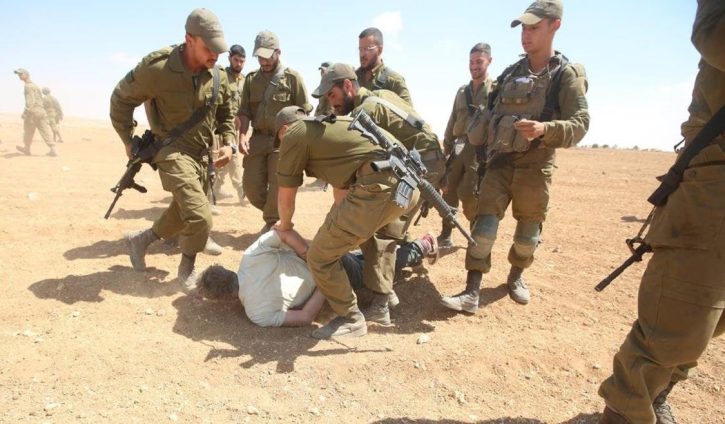
Israeli soldiers beat up a handcuffed international activist in Masafer Yatta
WAFA – June 22, 2022
HEBRON – Israeli forces today beat up a number of international solidarity activists in Masafer Yatta in the southern Hebron hills, according to local sources.
Coordinator of the Protection and Steadfastness Committee in Masafer Yatta, Fuad al-Amour, said the heavily-armed soldiers brutally assaulted a number of international activists while protesting the military drills close to and in al-Markez, and held two others for a long period.
The Israeli army have been conducting drills in al-Markez, one of 12 hamlets making up the Masafer Yatta, which rely heavily on animal husbandry as the main source of livelihood, for the second day in a row.
Al-Amour added that the army has built mock-ups as targets between the makeshift dwellings of the hamlet residents and has been conducting training with heavy weaponry, spreading panic among the residents.
The army has also deployed military checkpoints in the vicinity of the hamlets in the area, in preparation for military training, and perhaps paving the way for an imminent removal of the Palestinian residents.
Recently, Israel’s top court gave the army the green light to forcibly expel some 1,300 Palestinians living in twelve villages or hamlets making up the Masafer Yatta area marking one of the largest expulsions carried out by the State of Israel in recent decades.
Located in Area C of the West Bank, under full Israeli administrative and military control, the area has been subjected to repeated Israeli violations by settlers and soldiers targeting their main source of living – livestock.
It has been designated as a closed Israeli military zone for training since 1980s and accordingly referred to as Firing Zone 918.
Israeli violations against the area include demolition of animal barns, homes and residential structures. Issuance of construction permits by Israel to local Palestinians in the area is non-existent.
The Israeli occupation forces destroy an access road to a Ramallah-area village
WAFA – June 22, 2022
RAMALLAH – The Israeli occupation forces today destroyed an access road to Ras Karkar village, northwest of Ramallah, hampering the movement of people, according to the head of Ras Karkar village council, Marwan Nofal.
He said that the destroyed road had been partially paved for 20 years and that three months ago, following coordination with the Israeli military government, work on the rehabilitation of the road started. However, two days after the start of the work, the military forces raided the area and seized the vehicles used in the work, imposing a fine on their owners.
Nofal said that despite continuous promises to allow the rehabilitation work, the army sent its bulldozers today to destroy the road under the pretext that the road is located on “state land”.
The destruction of the road led to depriving farmers of access to their lands on the western side of the village, he said, and isolating several houses, noting that this is not the first time the Israeli military has targeted the village.
Ras Karkar suffers from the presence of seven iron gates at its entrances that limit the movement of people and access to their homes and lands.
At the same time, the Israeli military government does not allow it to carry out any work to improve the village’s infrastructure, said Nofal.
Tanzania: Maasai people face violence, eviction amid protests over UAE-owned game reserve
MEMO | June 22, 2022
Tanzania’s Maasai people have faced a violent crackdown from police over the past two weeks, amid plans to evict them from their ancestral homeland in parts of the Serengeti National Park to make way for trophy hunting and conservation zones.
Human rights organisations and the Maasai people have accused Tanzanian police of using teargas, live bullets and beating protestors who oppose the planned development in the Ngorongoro district near the village of Ololosokwani.
So far, at least 700 Maasai villagers have fled across the border to neighbouring Kenya as refugees, while dozens have been wounded by police. The response by the Tanzanian authorities has been condemned by the African Commission on Human Rights and Peoples’ Rights who called on the government to halt the ongoing forcible evictions and to open independent investigations into the violence against the Maasai people who should be consulted and allowed to review plans to establish the conservation area.
According to a report by Al Jazeera last week, the protests erupted after police began to demarcate 1,500 square kilometres (540 square miles) of land to make way for the reserve, to be operated by a UAE-owned company.
The government denies accusations that it is trying to evict the Maasai from their ancestral land, and has claimed they will still have access to 2,500 square kilometres of it.
The East African Court of Justice is to rule on a legal challenge to the planned evictions, but is likely to rule in favour of the controversial move, which could displace up to 70,000 people but will be a major contribution to the country’s vital tourism sector.
‘Canada working to return Russian gas turbines’
Samizdat | June 22, 2022
Ottawa is exploring ways to return crucial parts for Russia’s Nord Stream pipeline, which are currently stuck in Canada due to sanctions, Bloomberg reported on Tuesday citing Canadian Minister of Natural Resources Jonathan Wilkinson.
“We want to respect the sanctions because the sanctions were put into place for a reason. That being said, the intent of the sanctions was never to cause significant pain to Germany, which is one of our closest friends and allies. So, we are very seized with this issue,” Wilkinson told the news outlet.
“We are talking to Germany, trying to find a pathway through which we can actually enable the flow of gas. There may be different options that we can look at,” he stated, adding that Ottawa is negotiating with Berlin on ways to return the equipment.
Russia’s energy supplier Gazprom was forced to slash natural gas flows to Germany via the Nord Stream pipeline by 60% last week, because Siemens turbines from Gazprom’s Portovaya pumping station in Vyborg were stuck in Montreal, where they were sent to undergo maintenance. The parts fall under Canada’s sanctions against Russia, and the country says it cannot return them without breaching these restrictions.
According to the German Federal Grid Agency, the reduction in gas flow affected the supply of Russian gas from Germany to other European countries, including France, Austria and the Czech Republic.
The situation prompted these and other EU countries to announce emergency measures this week aimed at reducing the use of natural gas. Some countries have claimed that the reduction of gas flows was a political decision made by Moscow to increase pressure on Europe. Gazprom says the issue is technical.
Pfizer CEO says “beauty” of mRNA will allow for annual doses
TCS WIRE | June 22, 2022
Pfizer CEO Albert Bourla touted the “beauty” of mRNA vaccine technology in a recent MSNBC interview, saying he fully expects the Coronavirus to require an annual dose.
“Do you think we’re going to get updated mRNA vaccines every season that will be directed to each new variation of the Coronavirus, and will we have to take those shots every year?” asked the host.
“I’m almost certain about it, and I say almost certain because, of course, regulators have the final say on all of that, but that’s the beauty of mRNA. You can adapt your vaccine just by changing the sequencing, which is a very minor change,” said Bourla.
“For this reason, I’m very confident we will be able to respond very, very fast to every new variant.”
Prime Minister Justin Trudeau recently lifted travel mandates and vaccine requirements after facing widespread pushback from the public and airlines.
When lifting the mandates, the Liberals maintained they were only temporarily suspending the restrictions citing the threat of future waves.
“The reality is, as much as people would like to pretend that we’re not, we’re still in a pandemic,” said Trudeau early in June.
“There are Canadians who die every single day because of COVID-19 in our hospitals.”
Bourla has stated in the past that anyone who spreads misinformation regarding Coronavirus vaccines or potential side effects were literally criminals responsible for millions of deaths.
“Those people are criminals,” Bourla told Atlantic Council CEO, Frederick Kempe. “They’re not bad people. They’re criminals because they have literally cost millions of lives.”
“The only thing that stands between the new way of life and the current way of life is, frankly, hesitancy to vaccinations,” he added.
Canada’s Chief Public Health Officer Theresa Tam echoed fearmongering about a theoretical future wave earlier this month.
“The pandemic is not over,” Tam said. “We think that it is very likely that we will get some more viral activity in the future, and we can’t predict exactly how big the next wave is, but I think we need to prepare.”
Featured Video
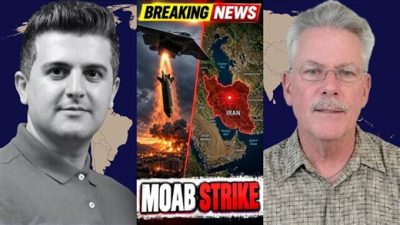
Matt Bracken: US Plans Massive MOAB Strike on Iran?
or go to
Aletho News Archives – Video-Images
New Book
The silver that medicine dropped — four thousand years of clinical use, four decades to erase.
Colloidal Silver — First Edition, 2026, Paperback
Lies are Unbekoming | October 16, 2026
Silver was medicine. Not alternative medicine. Not folk medicine. Medicine. In surgery. In obstetrics. In the burn ward. In water treatment. In the household medicine chest. Every physician before 1938 knew this.
By the 1870s, silver nitrate was standard in surgical wound care across the leading hospitals of Britain, Germany, and the United States. Colloidal silver preparations — Collargol, Argyrol, Protargol — entered European and American practice through the 1890s and early 1900s and became standard antiseptics in military field medicine. By the time Fleming grew his first penicillin mould in 1928, silver was the first-line antimicrobial of the Western pharmacopoeia. The Lancet and the British Medical Journal carried the clinical reports in volume. The practice ran continuously through the Victorian era, the Edwardian era, the First World War, the interwar period. By 1980, almost all of it was gone.
What has not been treated at book length, until now, is how a four-thousand-year clinical record disappeared from mainstream medicine within four decades of the Flexner Report — and what the honest account of silver looks like once that record is reassembled.
Colloidal Silver reconstructs the pre-1938 record from The Lancet, the British Medical Journal, and the primary literature of the era; recovers Robert Becker’s bioelectric framework from the regeneration research the pharmaceutical model buried; and places silver inside a practical terrain-paradigm guide to its current place — in water, on the body, inside the body, and in the chronic conditions where antibiotics have failed. … continue
Blog Roll
 Aletho News
- China’s FM: Palestinian cause is ‘greatest injustice of the century’
- US sympathy for Palestinians surpasses support for Israelis
- Israeli rabbi permits occupiers to steal Palestinian olive harvest in West Bank
- Spanish firm sells Latvia vehicles equipped with Israeli tech despite arms embargo
- Saudi Arabia under fire… Yemen is burning down the House of Saud
- Israeli Spy Pollard stole the files, today’s it’s delivered through official channels
- Why Iran Didn’t Walk Away
- US arms supplied to Ukraine found in war-torn Sudan – Moscow
- The silver that medicine dropped — four thousand years of clinical use, four decades to erase.
- My Latest Presentation to the UN Security Council
- If Americans Knew
- NPR investigation finds evidence of widespread fraud at mall kiosks tied to Israeli skincare brand
- Tucker Carlson exposes Israeli Lies about the Oct 7th attack, Charlie Kirk, and the U.S.
- Israel has detained thousands of Palestinian children since Oct 7th – over half spent time in solitary, many uncharged
- Israeli Analysis: Is Netanyahu Planning an ‘October Surprise’ Attack Before Israel’s Election?
- Israeli settlers brutally attack Palestinians and Washington Post female photographer, 65
- Words Have Changed, Occupation Continues: The Reality of the Gaza Ceasefire
- Gaza’s child amputees are growing faster than their prosthetics allow
- Israel keeps Palestinians struggling just to survive–Daily Update
- Israeli firm used online ads to run vast spy operation, researchers say
- No, the world zionist movement is not an antisemitic conspiracy theory
- No Tricks Zone
- New Study Suggests Large Regions Of The Pacific Ocean Have Been Cooling For The Last 80 Years
- Germany’s Green Energy Debacle: High Energy Costs Force Kahla Porzellan to Close After 182 Years!
- New Study: 50 Years Of The Most Aggressive ‘Net Zero’ Policies Can Only Affect The Global Climate By 0.03°C
- US September “Heat” Was No Record…Many Records Set Decades Ago
- Latest European Green Energy Debacle; Portugal’s Largest Flagship Solar Park Insolvent!
- Green Energy Debacle: German Expert Professor Fritz Vahrenholt Warns Of Severe Economic And Social Consequences
- Two More Paleo Reconstructions Affirm Meters-Higher Sea Levels Across Ireland, Brazil 7000-6000 Years Ago
- New Study: Earth And Venus Surface Warmth Largely Explained By Convection And Lapse Rate, Not CO2 Or Radiation
- 2025 Nature Paper Claiming Worsening Global Drought Gets RETRACTED …Heavily Flawed
- New Study: ‘Global Drought Shows No Detectable Recent Acceleration Under Climate Warming’

