Will Sweden and Finland feel safer after joining NATO?
By Drago Bosnic | April 20, 2022
NATO expansion has been the main culprit behind all instability in Europe for the last 30+ years. Of course, NATO’s aggression against many countries, either as an organization, or separately, by each of its member states resulted in the deaths of millions, with orders of magnitude more of those whose lives may not have been physically lost, but they certainly have been ruined by the Alliance’s actions. The absolute havoc and the trail of death and destruction left in the wake of NATO invasions across the Middle East, always euphemistically dubbed “humanitarian interventions“, stand as a grisly testament to that.
The expansion of this supposedly “defensive alliance” which has not conducted a single truly defensive operation in well over 70 years of its existence, has first destroyed the relatively prosperous Yugoslavia, which was subjected to nearly a decade-long siege throughout the 1990s. During the 2000s, Russia’s attempts to create an atmosphere of trust and cooperation with the North Atlantic Alliance have been futile. No matter what Russia did, the alliance kept creeping closer to its borders. By the early 2010s, it was clear that NATO had no intention of stopping. The conflict in Ukraine is NATO’s latest brainchild, although there has hardly been any actual thinking behind it. It has been more like bulldozing its way towards Russia.
The last 8 years have shown where all this leads to, with the last nearly 2 months reaching a boiling point between the Russian Federation and the ever increasingly belligerent alliance. A recent announcement by both Sweden and Finland that they feel supposedly “threatened” and that they are very likely to enter NATO seems rather strange, especially given that they did not officially join NATO during the Cold War, when the USSR had undisputed control over the Baltic region.
An obvious question arises, why would Sweden and Finland feel threatened now, when the strategic situation has all but reversed, with Russia’s presence in the Baltics limited to relatively tiny areas around Saint Petersburg and Kaliningrad? It’s quite obvious that this can only be seen as another encroachment on Russia’s borders, another part of NATO’s larger geopolitical offensive. Still, although it may seem that NATO’s further expansion into Scandinavia is going to jeopardize Russia’s northwestern areas, Russia doesn’t seem particularly fazed by this prospect. While certainly not happy with this turn of events, Russia’s decision makers and strategic planners aren’t exactly pulling their hair out and running in circles over this.
First, it should be understood that both Sweden and Finland are neutral countries in name only. During the Cold War, both Scandinavian countries served as a hotbed of NATO intelligence activities, with the CIA and MI6 operating extensively in both countries. Soviet and later Russian intelligence were well aware of this.
During the 1990s, this became even more prominent, when both countries entered the EU, but also increased their official cooperation and interoperability with NATO. Naturally, over the years, this cooperation grew to unprecedented levels and the Russian military acted accordingly. The strategic military command structures in the Kremlin have treated both countries as de facto NATO member states for decades.
This is especially true for Finland, particularly after it announced it will be acquiring at least 65 F-35A fighter jets from the US military industrial giant Lockheed Martin. This jet, despite hundreds if not thousands of critical flaws and other shortcomings, is a serious ISR (intelligence, surveillance and reconnaissance) asset. The jet is bristling with sensors, all of which are connected to a massive network-centric warfare system, the center of which is located in the Pentagon. By operating this jet, Finland is effectively giving up on the sovereignty over its own air force and ceding it to the United States.
The Russian military is perfectly aware of this and has already made plans to react accordingly. Earlier, Finland’s official neutrality from a military standpoint complicated this. But now, rather ironically, the Scandinavian country might even make things easier for Russia’s strategic military planning by joining the ever expanding “defensive” alliance.
However, does this change anything for Finland and Sweden? Will NATO really make both countries safer? The short answer is simply no. By joining the North Atlantic Alliance, countries effectively cede much of their sovereignty to the US. Given the US’ strategic obsession with encircling Russia, the Kremlin feels strongly about this matter and it simply doesn’t take any chances.
Thus, the only “benefit” Sweden and Finland get is becoming meat shields for the US in the case of a nuclear exchange, because Russia is simply going to dedicate a portion of its thermonuclear arsenal to these countries. And if Russia doesn’t have a shortage of something, it’s nuclear weapons. Given the US’ and NATO’s track record, who is to blame then?
Russia extends Mariupol surrender offer
Samizdat | April 20, 2022
Russia’s Defense Ministry has extended the offer to surrender for the remaining Ukrainian forces holed up at the Azovstal steel plant in the Black Sea port city of Mariupol after they refused to leave through a humanitarian corridor on Tuesday.
Those present at the location may still exit the facility from 14:00 Moscow time on Wednesday without any arms or ammunition on them, officials said in a statement late on Tuesday.
“The Russian leadership guarantees the preservation of life, complete safety and provision of qualified medical assistance to all those who lay down their arms,” it said.
The country has proven its humane attitude towards surrendering Ukrainian troops on numerous occasions during the conflict and this time the term of the Geneva Convention on POWs will also be fulfilled, the ministry insisted.
To be able to leave the steel plant, the Ukrainian commanders inside were told to establish uninterrupted radio contact with the Russian forces, cease all hostilities and raise white flags along the perimeter of Azovstal.
The offer to lay down arms given to “militants of nationalist battalions and foreign mercenaries” is being repeated despite “the absence of any elementary steps from the Kiev authorities aimed at saving their country’s servicemen,” the statement read.
Members of the notorious Azov battalion were already given a chance to surrender on Sunday and Tuesday but didn’t take up the offer on both occasions.
Intercepted communications from Azovstal, suggest that the Ukrainian commanders “realize the hopelessness of their situation and are ready to lay down their arms, but only on the appropriate command (order) from Kiev,” which Ukrainian authorities are refusing to give, the ministry insisted. Surrendering without government approval may see them court martialed, with sentences of capital punishment possible, it added.
Moscow described such actions by Kiev as a “betrayal of the Ukrainian servicemen and members of nationalist battalions,” and again urged it to “show common sense, give appropriate instructions to the fighters to stop senseless resistance and exit through humanitarian corridors.”
If such an order isn’t made by the Ukrainian leadership once again, the commanders or ordinary servicemen should themselves make the decision to lay down their arms to survive, it added.
The strategic city of Mariupol has seen the heaviest fighting during the ongoing conflict between Russia and Ukraine, suffering immense destruction. It’s now almost entirely controlled by Russian forces, with Azovstal remaining the last pocket of Ukrainian resistance.
Those holed up at the steel plant, with its massive network of underground tunnels, have been running short of water and food, the Defense Ministry had said earlier, based on intercepted communications.
According to Russia’s estimates, Ukraine’s losses in Mariupol have reached some 4,000 combatants, including nationalist fighters of the notorious Azov and Aidar regiments, and “foreign mercenaries.”
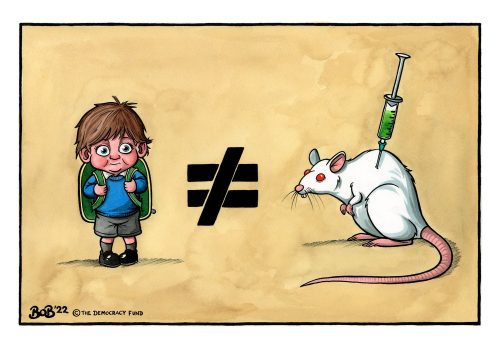
The scandalous absence of child vaccine damage information
By Kathy Gyngell | TCW Defending Freedom | April 19, 2022
We have repeatedly referred at TCW to the studied silence of the mainstream media regarding the damage and fatalities associated with the Covid vaccines despite reported reactions (which may be only 10 per cent of the total), now standing at 1,480,307, and nearing the one and half million mark. Fatalities, too, continue their inexorable rise, a further sixteen deaths reported since the end of March, their total now 2,087. For full reports of vaccine adverse effects and events including 352 pages of specific reaction listings, see here.
What is worse, perhaps, than the MSM’s general state of denial is their unconcern about the shocking paucity of the child adverse reaction data published by the Medicines and Health products Regulatory Authority (MHRA). Yet under-18s have been actively encouraged to have the vaccine since the end of July 2021 in the absence of any long-term safety data and despite clear indications that younger ‘fertile’ age cohorts were proving more vulnerable in multiple respects to the vaccine. However no special monitoring system for children has been set up, or none that has been reported. Unlike its Yellow Card reporting involving adults, the MHRA does not break down the child numbers into specific adverse events, as though children were of less importance. As a result we have no way of knowing whether the reports relate to any major, life-changing side-effects such as Guillain-Barré syndrome (muscle weakness caused by the immune system attacking the body’s nerves) or Bell’s palsy (a type of facial paralysis) or to other serious side-effects reported by adults including seizures, nervous system disorders, deep vein thrombosis, menstrual disorders, and eye and ear disorders including blindness and deafness.
With the extension of the vaccine rollout to young children aged between five and 11 since the beginning of April, we have decided it is high time to highlight what is known and not known, what is reported and not reported, about the risk to children of this experimental gene therapy.
Nearly 3.5 million children (3,413,500) have already been injected, with a total dosage (1st, 2nd & boosters) of 5,626,100 jabs, and a total number of 3,735 adverse reaction Yellow Card reports. Data published by the MHRA on Thursday April 14 details:
· Pfizer – 3,400,000 children (1st doses) plus 2,000,000 second doses & 200,000 boosters resulting in 3,424 Yellow Cards
· AZ – 11,600 children (1st doses) plus 8,700 second doses & ‘extremely limited boosters’ resulting in 263 Yellow Cards – Reporting rate 1-in-44
Note: 1,500 doses (1,000 children – 1st doses) removed from last two weeks reporting
· Moderna – 1,900 children (1st doses) and 1,400 second doses and 2,500 boosters resulting in 24 Yellow Cards
Note: 200 children (1st doses) removed from last two weeks reporting
· Brand unspecified – 24 Yellow Cards
Unaccountably it appears that the number of 1st doses (1,000 for AZ and 200 for Moderna) and 2nd doses (500 for AZ) recorded has decreased since two weeks ago. Hence 1,200 children recorded as vaccinated two weeks ago are now missing. No explanation has been given for this. I understand that the MHRA is now on holiday for two weeks so we are unlikely to get any clarity on this until May.
Note too that AstraZeneca which is not recommended for under 18s appears to have been continued. MHRA reports to April 6 2022 show that 11,600 children (up from 11,496 last October) have received one or more doses of AstraZeneca, resulting in an increased Yellow Card adverse event reporting rate of 1 in 44 children (up from 1 in 49 last October). This, shockingly, is counter to the government’s own official guidance and evidence which has been available for patients and healthcare professionals, most recently updated on January 26 2022:
‘COVID-19 Vaccine AstraZeneca is not recommended for children aged below 18 years. No data are currently available on the use of COVID-19 Vaccine AstraZeneca in children and adolescents younger than 18 years of age.’ Yet the most recent MHRA publication says:
‘The safety and efficacy of COVID-19 Vaccine AstraZeneca in children and adolescents (aged <18 years old) have not yet been established. No data are available.’
So why and to which children were these doses given? To vulnerable children prior to the main rollout? And why second or booster doses? Furthermore, whoever they are, are the 263 adversely impacted children receiving adequate care and support? Are the other children who received the AZ vaccine being checked?
Myo/pericardial effects in children
The only specific adverse effects data that has been published for children is 73 cases of myocarditis and pericarditis (inflammation of the heart) in under-18s. This is worrying not least because of the rising and unexplained death toll in young men reported elsewhere in these pages, but also because it is now well-established that the likelihood of this reaction in young men is higher than their risk of myocarditis from Covid infection; a risk which the NHS has warned as being especially the case ‘in young men under the age of 40‘.
Other adverse effects
This still leaves the bulk of 3,735 Yellow Card Reports up to this week for under-18s uncategorised. Yet MHRA themselves state that ‘the experience reported in under-18s is similar to that identified in the general population’. If we take them at their word, extrapolating from the data published on suspected adverse effects in the adult population, children and young people, are experiencing a selection of the following:
· Lymph node pain and swelling
· Heart palpitations and fluttering
· Fever, chills, fatigue and malaise
· Ear pain, tinnitus and vertigo
· Nausea, vomiting and allergies
· Eye pain, swelling and photophobia
· Blurred vision and visual impairment
· Diarrhoea, abdominal pain and distension
· Lip, mouth and facial swelling
· Pain in arm, chest, bones and jaw
· Anaphylaxis
· Respiratory infection, influenza and herpes
· Joint and muscle pain, swelling and stiffness
· Muscle spasms and twitching
· Balance disorders and arthralgia
· Fainting and dizziness
· Facial palsy, headaches and migraines
· Skin sensations, burning and numbness
· Seizures and tremors
· Anxiety, depression and insomnia
· Confusion and disorientation
· Kidney pain and hair loss
· Breast pain and menstrual disorders
· Breathlessness, wheezing and coughing
· Sweating, blisters, rashes and itching
· Haemorrhages (all types) and nosebleeds
· Embolisms and thrombosis
Given the lack of information published as to the adverse effects experienced by the 3.4 million children injected thus far, we have to ask whether their consent was truly informed? The answer has to be no, it was not.
Worryingly there are a number of potential barriers to reporting adverse effects in children. These include:
· Child or parental failure to recognise symptoms as vaccine-related
· Fear of parents of not being believed or thought to be anti-vax or of ‘making a fuss’
· Lack of understanding of potential longer-term issues
· Healthcare professionals’ lack of awareness of vaccine adverse effects
· Young people not seeking help and support especially if they took the vaccine decision themselves
· Yellow Card system awareness and accessibility
Furthermore, if the 3,735 Yellow Card Reports for under 18s is less than 10 per cent of actual figures as the MHRA indicates may be the case, in the absence of long-term safety data, how can the child vaccine rollout possibly be justified, deemed safe or ethical? Why was post vaccine monitoring not insisted on?
This weekend the Sunday Times reported a scandal that Jeremy Hunt, the former Health Secretary, claimed to be worse than thalidomide. He was not however addressing the reckless child Covid vaccine rollout but a deeply shocking investigation into child deformities caused by an epilepsy drug still being given to pregnant women that should have been stopped years ago. Hunt said that while it was ‘never comfortable’ for governments to acknowledge such injustices, the state had a moral duty to the families. ‘It’s time the British state faced up to its responsibilities,’ he said. ‘Just as we eventually did to victims of the thalidomide scandal.’
These are words we need to hear him speak about the Covid vaccines.
I pray that he and this newspaper, which tenaciously and courageously fought for the victims of thalidomide, will not stay blind to the scandal that is happening on their watch; or let years go by before they retrospectively struggle to examine the multiplicity of harms, some of which we may not know till they reach maturity, that children have been needlessly subjected to by the experimental Covid vaccines.
Lavrov responds to nuclear weapons claim
Samizdat | April 19, 2022
Russia’s Foreign Minister Sergey Lavrov has rejected claims that Moscow could resort to the use of tactical nuclear weapons in Ukraine.Lavrov was questioned on the issue during an extensive interview with India Today in Moscow on Tuesday.
When the journalist mentioned that “President Zelensky said that Russia plans to use tactical weapons,” the foreign minister didn’t even let her finish the question. “He says many things,” Lavrov said.
He reminded that Russia had never mentioned the use of nuclear weapons as an option during its military operation in the neighboring country, and the Ukrainian leader was the only one to speak about this.
Lavrov reiterated the notion that “there could be no winners in a nuclear war,” and assured that Russia would only rely on conventional weapons in Ukraine.
Zelensky claimed that Moscow could use tactical nuclear weapons in Ukraine during his interview with CNN on Friday.
Syria seeks probe into US destruction of Raqqah, war crimes in letter to UN

A militant from the US-sponsored and Kurdish-led SDF stands amid the ruins of buildings near Clock Square in Raqqah, Syria. (Reuters)
Press TV – April 19, 2022
Syria has censured the US-led military coalition’s atrocities committed on the pretext of fighting the Daesh (ISIS) Takfiri terrorist group in the northern city of Raqqah, stating that the international community has never known about the full scale of the tragedy.
“The time has come to shed light on the humanitarian, political, and legal aspects of the matter,” the Syrian Foreign Ministry wrote in two identical messages addressed to UN Secretary General António Guterres and the rotating president of the UN Security Council, Barbara Woodward.
The ministry added that the US-led coalition’s aerial attacks in Raqqah took place between June and October 2017 and resulted in the full destruction of the city and the death of thousands of civilians, whose corpses were buried under debris.
It added that similar war crimes were perpetrated by the US-led coalition and the US-sponsored and Kurdish-led militants from the so-called Syrian Democratic Forces (SDF) between 2018 and 2019 in the northeastern Syrian town of Baghuz as the area was utterly destroyed.
The ministry also invoked a March 18, 2019 airstrike in which US fighter jets killed at least 70 civilians, including women and children, as they were trying to flee Baghuz to save their lives.
It stressed that the enormous volume of damages inflicted upon public and private properties as well as critical infrastructure and the number of casualties in Raqqah, Ayn al-Arab, and Baghuz prove that the US and its allies have committed numerous war crimes and crimes against humanity across Syria.
The Syrian foreign ministry emphasized it will continue to raise at international organizations the destruction and deliberate targeting of civilians by the US-led coalition.
The United States and its allies invaded Syria in 2014 under the pretext of fighting Daesh terrorists. The terrorists had emerged as Washington was running out of excuses to extend its regional meddling or enlarge it in scale.
The military interference was surprisingly slow in confronting the terrorists, despite the sheer size of the coalition that had enlisted scores of Washington’s allied countries.
Numerous reports and regional officials would, meanwhile, point to the US’s role in transferring Daesh elements throughout the region and even airlifting supplies to the terror outfit.
In 2017 and in the height of the coalition’s military campaign in Syria, Russia drew a parallel between the destruction that was being caused by the US-led forces and the wholesale bombing campaign on the German city of Dresden during World War II.
Thinking Harder About False Flags and Other Fables
BY PHILIP GIRALDI • UNZ REVIEW • APRIL 19, 2022
The White House plan to destroy Russia by calling President Vladimir Putin names proceeds apace. Apparently, the man whom President Joe Biden has called a “thug,” “killer,” and “war criminal” is now also charged with carrying out a “genocide” and, according to CIA Director William Burns, he may in “despair” over his apparently stalled invasion, be contemplating the use of tactical nuclear weapons. Meanwhile over at the Pentagon, positively aglow with the largest “defense” budget since Vietnam, Chairman of the Joint Chiefs of Staff General Mark Milley is advising that the war started in Ukraine will require building still more US military bases in Europe to confront Putin.
It is unclear who exactly in the band of rogues surrounding Biden is most responsible for the rhetorical flourishes and hyperbole, though one might assume that it is in a fact a group effort by a chorus of mental midgets, most of whom were inherited from the beatified Barack Obama’s Administration. Only Hillary is missing. But at the same time, one must wonder how if all the sobriquets inevitably fail to bring down Putin what plan B might be. After all, as Russia is a significant country possessing a ballistic and submarine launched nuclear missile capability that could destroy the United States, there will have to be some way to dialogue with the Kremlin after the Ukraine fiasco has ended. Calling foreign heads of state criminals and mass murderers is not the best way to restore a satisfactory level of mutual respect that will permit discussion regarding issues of mutual concern, like war and peace.
Ukrainian President Volodymyr Zelensky is being heavily coached by neocon handlers to push the right buttons to appeal to international sentiment in favor of his country. He has been very successful at being alarming about the Russian threat coupled with his demands for more and better weapons. Two expressions that have come to the surface recently to further blacken Vladimir Putin have centered around the concern that the Russians will employ what is referred to as a false flag deception or use chemical weapons in such a fashion, possibly against themselves, so as to justify broadening their invasion. Indeed, the two can be used together. A false flag essentially involves an assailant or a contact pretending to represent something apart from their or his/her genuine identify in an attempt to deceive the targeted individual. False flags are used extensively in intelligence operations and also in military operations where an attempt is being made to hide the true attribution of an act of war.
In my own experience as a CIA operations officer, I once “developed” a relationship with a Libyan intelligence officer using the false identity of an Italian businessman. The Libyan was amenable to an information sharing relationship with an Italian to line his own pockets, but would have balked at the treasonous implications of having a connection with an American. Libya was, not so long ago, a colony of Italy and my contact spoke decent Italian. That was a classic false flag operation conducted to carry out espionage against a foreign target.
A more recent instance of what might be regarded as a false flag with much more lethal consequences was when President Donald Trump attacked a Syrian airbase with 59 cruise missiles in the wake of an almost certainly fabricated report that President Bashar al-Assad’s army had used chemical weapons in an attack on Khan Shaykhun in 2017. Independent investigators subsequently determined that the anti-regime terrorists who were occupying the city at the time had themselves staged the attack and deliberately set it up and blamed it on the Syrian government to produce an expected US response, which was forthcoming as Trump responded to the news headlines and did not bother to order anyone to check the reliability of his intelligence sources before ordering “bombs away.” Fortunately, the evidence that it had likely been a false flag carried out by allies of Islamic State in Syria (ISIS) soon surfaced and there were no additional American attacks.
The latest recriminations hurled at Putin have included his alleged massacre of possibly hundreds of civilians at Bucha as well as the killing of over 50 civilians at the Kramatorsk Train station on April 8th, which almost immediately raised suspicion about a possible false flag. Starting with motive, it made no sense for Russia to either massacre civilians or attack a non-military target like a transportation hub, which would produce a large number of casualties, as it would give NATO and the US a wedge issue to increase pressure on Russia and its soldiers while also turning world opinion against Moscow. In that sense, both the claimed massacre and the attack succeeded as they were both immediately linked to Russia by hostile media.
But that is where the stories began to unravel. Russian soldiers left the town of Bucha on March 30th. Two days later, Bucha was occupied by the Ukrainian Azov Brigade with the objective of finding and removing ‘traitors’. The Azov Brigade has been plausibly described as extremely nationalist and even as neo-Nazi. On April 2/3 the first video was published that showed freshly killed men laying on the streets of Bucha, several of them displaying white arm bands that were presumably used for signaling to departing Russian forces that they were “friendlies.” The “west” and Ukrainian officials immediately called those dead the result of “Russian atrocities.”
Azov has reportedly shot men “fleeing” the combat zones as “traitors” and pledged no surrender to or collaboration with the Russians. It has credibly been responsible for atrocities committed against Russian ethnic Ukrainian citizens in the past. Going back to motive, it was definitely in the Ukrainian interest to kill a couple hundred of its own civilians to further demonize Putin and bring about a western direct military intervention, which is what Zelensky and his neocon advisers have been attempting to do. So, was it a false flag attack in which Ukrainian soldiers deliberately killed Ukrainian citizens so the deaths could be blamed on Russia?
And it also turned out that the missile used in the Kramatorsk Train station attack was of a type found in the Ukrainian arsenal, not that of Russia. A video report by Italy’s LA7 video channel was made by one of their teams inside Ukraine. They were one of first Western news teams to arrive at the alleged bombing site in Kramatorsk. At the time of the attack, numerous Ukrainian citizens were evacuating the city due to its proximity to fighting with Russian forces. Kramatorsk is the temporary seat of the administration of the Donetsk region because the city of Donetsk is in the hands of Russian affiliated Donbass militias and is not under the control of the Kiev based Ukrainian authorities.
The Italian film clip shows close-ups of the remains of the projectile that hit the building, which reveals that the serial number is that of the Tochka-U vehicle launched ballistic missile, which Kiev claimed was Russian, is actually far more plausibly Ukrainian. The clearly visible missile’s serial number appears as (Φ91579), and a comparison, admittedly made by Russian analysts, indicates that the missile belongs to the same series of weapons that have been fired against targets in the regions in the Donbass that are seeking union with Russia. They have been used against “Khartszsk in 04.09.2014 (rocket number ‘Φ15622’) and Tshevsky in 02.02.2015 (Rocket No. ‘Φ91565’), Lugvinova in 13.02.2015 (Missiles No. ‘Φ91566, Φ915527, Φ915328’), Perdiansk in 19.03.2022 (rocket no. ‘Φ915611’), and Militobol on 17.03.2022 (rocket no. ‘Φ915516’).” Furthermore, the missile in question is, according to the Kremlin, still in the Ukrainian arms inventory but considered obsolete by the Russian military.
But let’s think this through a little deeper. If the Russians truly want to blame the Ukrainians for killing other Ukrainians what better way to do it than to fake a missile launch using ordnance that is in operational use with the Ukrainian Army? There exist what are claimed to be eyewitness accounts of Russian troops using the Tochka inside Ukraine, though they come through Ukrainian controlled sources, but the Kremlin very likely has some Tochkas sitting around in various arsenals even if they are no longer suitable for front line use. And the serial numbers, which are painted on or appear on attached labels, can be changed.
The fundamental problem is not the possible use of a false flag in what is already a war between two neighboring states. It should be expected, when convenient for either side. The complication is that actually authenticable information about what is taking place is rare and the two sides are both lying and spinning like crazy to convince an international audience as well as their own citizenry of a “truth” which is actually often closer to fiction. As has long been recognized, the first victim of a war is the truth.
So forget about false flags and other tactical contrivances as well as the lies coming out of Washington and Western Europe. The sad part is that the focus on possible atrocities has reversed what the United States and the west should be doing, i.e. creating an environment where there can be a ceasefire leading to genuine negotiations that can bring about a status quo acceptable to both Russia and Ukraine. Instead, Washington and its allies seem intent on funneling ever more weapons into Ukraine based on a steady stream of questionable accounts of Russian war crimes, a guarantee that the fighting will go on for many more months, if not longer.
Witness for example the line being promoted by the notorious retired US Army Colonel Alexander Vindman, formerly of the US National Security Council but Ukrainian-Jewish born and an enthusiastic advocate of war with Russia. He argues based on the claimed Russian crimes that “Despite what people like Tucker Carlson tell you, there are not two sides to the story of Russia’s war on Ukraine. It IS a story of good and evil. All you have to do is look at the massacre of civilians in Bucha, the missile strike on Kramatorsk railway station, or the countless other atrocities being committed by Russian forces across Ukraine to see it clearly.”
Vindman’s thinking comes out of the neocon playbook of a proper role of the United States as the rule maker for the entire world without any accountability for its own action. He can easily be dismissed as little more than a partisan prepared to go with any half-truth as long as it denigrates Russia. Whatever one feels about “gallant little Ukraine” versus the Russian bear, this kind of advocacy by someone wrapping himself in the Ukrainian flag provides no real rationale for the United States to get involved in a war in which it has no real interest and which will almost certainly turn out badly for all involved. Unfortunately, Vindman is not the only public figure who suffers from precisely the same tunnel vision.
Philip M. Giraldi, Ph.D., is Executive Director of the Council for the National Interest, a 501(c)3 tax deductible educational foundation (Federal ID Number #52-1739023) that seeks a more interests-based U.S. foreign policy in the Middle East. Website is councilforthenationalinterest.org, address is P.O. Box 2157, Purcellville VA 20134 and its email is inform@cnionline.org.
Few Doctors Telling Truth About COVID Vaccines
By Joel S. Hirschhorn | April 19, 2022
Nearly all physicians work for corporations that require them to take COVID vaccine shots. Most will be reluctant to tell their patients about their vaccine doubts. Also, most do not have the time to study the medical literature about the many negative aspects of the vaccines. Now comes a survey with some interesting findings.
Levels of vaccine hesitancy among physicians seem higher than expected, with 1 in 10 primary care doctors not believing that vaccines are safe, according to a new survey.
Among 625 physicians, 10.1% did not agree that vaccines were safe; 9.3% did not agree that vaccines were effective; and 8.3% did not agree that they were important, Timothy Callaghan, PhD, of Texas A&M School of Public Health in College Station, and colleagues reported online in Vaccine.
The high proportion of hesitancy among primary care doctors “was certainly a surprise for us,” Callaghan said. “We thought it might be a very small proportion of physicians who hold hesitancy about vaccines given that we have lots of evidence of the safety and effectiveness of vaccines. [Talk about bias!] However, once we dug into the data, we found that concerns about vaccines in general were far more widespread in the physician population than we might have expected.”
Confidence in vaccines among physicians was still higher than in the general public, as were rates of COVID-19 vaccination, with only 5.2% still unvaccinated at the end of the survey in May 2021. But high levels of vaccine uptake among doctors could have more to do with employer regulations or perceived risks of their workplace environment, Callaghan said.
The research project was inspired by Callaghan’s own experience with one of his doctors who was not vaccinated and tried to dissuade Callaghan from COVID vaccination. Few of us have had that experience!
“It wasn’t my primary care physician, but another one of my doctors realized that I studied issues related to vaccine hesitancy, and over the course of multiple visits, tried to convince me that COVID-19 vaccines weren’t safe and weren’t worth it,” Callaghan said. “It made me question whether this was a one-off, or if we have an actual issue on our hands.”
Callaghan and colleagues conducted their survey from May 14 to May 25, 2021 among 625 physicians in family medicine, internal medicine, or general practice. They were asked how strongly they agreed with questions about safety, effectiveness, and importance of vaccines, among other factors.
Only 67.4% strongly agreed that vaccines are safe, just 75% strongly agreed they are effective, and only 76% strongly agreed they’re important, the researchers found. Good, but not good enough.
“As surprised as we were about the 1-in-10 piece, we were equally if not more surprised by the proportion of physicians strongly agreeing that vaccines in general are safe,” Callaghan said, anticipating that it would have been far higher. Guess there are doctors who see the truth.
In further analyses, Callaghan and colleagues found that higher levels of political conservatism were negatively and significantly associated with agreeing that vaccines are safe. In other words, the more conservative docs saw the truth. They also found those who had COVID-19 were significantly less likely to believe that vaccines are safe.
The team saw similar results for belief in vaccine effectiveness: physicians who were more liberal were more likely to strongly agree that vaccines are effective compared with those who were more conservative.
“Conservatives (in the public) with vaccine hesitancy, served by physicians who share their political views, may therefore miss out on opportunities to be presented with information about the benefits of vaccination; especially in rural areas where both hesitancy and self-identification with right-leaning political views are particularly high,” the researchers wrote. More pro-vaccine bias.
While political affiliation did appear to play some role in beliefs, Callaghan noted a wider problem that might be at play. “There’s not that much training on vaccines and vaccinology … in medical school,” he said. “Most medical students aren’t exposed to in-depth discussions of virology to have those strong opinions.”
“And given the clouded information environment that surrounded COVID-19 in particular, and increasingly, vaccines in general, it remains possible that [physicians] are just relying on what they’re hearing in the news and the misinformation that’s out there, as opposed to best scientific evidence,” he said. The bigger truth is that most docs do not spend time examining medical research data.
The survey also asked specifically about confidence in COVID-19 vaccines and found physician confidence split by vaccine type. While 68.7% were very confident in the safety of the Moderna vaccine and 72.7% were very confident in the safety of the Pfizer vaccine, only 32.1% were very confident in the safety of the Johnson & Johnson vaccine.
Dr. Joel S. Hirschhorn, author of Pandemic Blunder and many articles and podcasts on the pandemic, worked on health issues for decades, and his Pandemic Blunder Newsletter is on Substack. As a full professor at the University of Wisconsin, Madison, he directed a medical research program between the colleges of engineering and medicine. As a senior official at the Congressional Office of Technology Assessment and the National Governors Association, he directed major studies on health-related subjects; he testified at over 50 US Senate and House hearings and authored hundreds of articles and op-ed articles in major newspapers. He has served as an executive volunteer at a major hospital for more than 10 years. He is a member of the Association of American Physicians and Surgeons, and America’s Frontline Doctors.
‘Greece seizes Russian oil tankers’
Samizdat | April 19, 2022
Greece seized a Russian oil tanker in the Aegean Sea on Tuesday as part of European Union sanctions imposed on Moscow over the war in Ukraine, Kathimerini daily has reported.
According to the newspaper, the Russian-flagged Pegas ship, with 19 crew members on board, was seized on April 19 near the coastal city of Karystos on the southern coast of the island of Evia.“It has been seized as part of EU sanctions,” a shipping ministry official was quoted as saying.
A coastguard spokeswoman told AFP that the seizure order concerned the ship itself and would not affect its cargo.
Greek media had reported earlier that the vessel faced engine trouble and was being escorted by a tugboat towards the Peloponnese, but was forced to moor at Karystos due to poor weather.
According to the Maritime Bulletin portal, another Russian tanker, VF Tanker 2, was detained earlier near Euboea due to EU sanctions. The vessel reportedly left the port of Piraeus on April 17, bound for Russian Kavkaz port in the Black Sea, but for some unknown reason ended up in Karystos Bay.
The European Union, of which Greece is a member, has adopted a wide range of sanctions against Moscow. They include import and export bans for a wide array of goods, as well as an embargo on access to EU ports by Russian-flagged ships. Russian oil aboard those ships has not been sanctioned.
India set to boost Russian energy imports
Samizdat – April 19, 2022
Indian importers plan to increase purchases of Russian crude oil and coal at discounted prices, media reports have stated.
According to The Economic Times, India’s state-owned oil refiners plan to boost Russian imports, shifting their purchasing strategy from tenders to negotiated deals in order to get larger discounts.
“In the coming weeks, Indian importers expect an increase in oil purchases from Russia. Due to the events in Ukraine and the outbreak of Covid-19 in China, India can get more oil at a more attractive price than before,” the publication stated, citing market sources. India has already increased purchases of Russian oil, having bought 15 million barrels of it since late February at a 25% discount. The discounts were offered by Moscow to secure trade contracts, amid the sanctions, placed on Russia by the US and its allies in response to its military operation in Ukraine. India has declined to join the sanctions campaign.
Separately, S&P reported that India is looking to raise imports of Russian coal amid stockpile shortages, as Moscow’s discounted prices are much lower than those on Australian and South African coal. Also, new purchase offers are expected soon, as, according to data from India’s Central Electricity Authority, stockpiles at Indian power plants as of April 13 were enough for little over eight days of coal burn. India imported 1.76 million metric tons of coal from Russia in 2021, according to data from Iman Resources. Market sources say that the only obstacle to buying Russian oil and coal for Indian importers is the difficulty in finding a payment method.
Western countries have cut off Russian banks from using the SWIFT financial messaging network, which facilitates interbank payments, and have limited their ability to conduct business using the US dollar and the euro.
However, at the end of March reports emerged that Russia and India were working to create a new transaction mechanism for bilateral trade, which would allow for settlements in national currencies, rubles and rupees. Reports say the countries may opt for adopting the Russian Financial Message Transfer System (SPFS) for bilateral trade, which is an analog of SWIFT.
According to analysts, a rupee-ruble trade mechanism is key to continued trade growth between the two countries, as India’s economy needs Russian energy and commodities to grow and Russia needs the huge Indian market to offset the impact of Western sanctions.
Featured Video

Inside America’s deadly war on suspected drug boats
or go to
Aletho News Archives – Video-Images
From the Archives
Germany’s gun grab? Saxony-Anhalt begins disarming AfD members
Remix News | January 6, 2025
Authorities in Germany have begun withdrawing gun ownership licenses from Alternative for Germany (AfD) members, who are deemed a “danger to public safety.”
So far, five AfD members have received a notice that their gun license would be revoked, while another member voluntarily returned his license after a revocation procedure was initiated. Another 51 cases are currently being examined by authorities, according to data released by the Saxony-Anhalt Interior Ministry in response to a request for information from the Left Party.
Hunters and sport shooters will also have their gun licenses canceled by authorities. … continue
Blog Roll
 Aletho News
- US, South Korea and Japan Begin Joint War Games
- Israel’s Rafael to produce missile parts at Volkswagen factory in Germany
- After historic German election, will the AfD rule Saxony-Anhalt?
- ‘Russophobia a national sport’ – Polish party rallies against push to war
- US Placing Missiles in Europe to Cancel Strategic Stability Talks Prerequisites – Russian MFA
- Analysts warn of ‘colonization’ as US ‘saturates’ Australia with 110 bases
- Inside America’s deadly war on suspected drug boats | Fault Lines Documentary
- Babies Whose Mothers Drank Fluoridated Water During Pregnancy Scored Lower in Problem-Solving
- Vaccination Data on Amish Children Screened for 2010 Autism Study Was Never Made Public
- CNAS Wonk Proposes Bombing China’s Artificial Intelligence
- If Americans Knew
- ‘Guilt by association’: why seven international aid workers were killed in Israeli airstrike
- Anatomy of the Israel Lobby
- 50+ Rights Groups ‘Strongly Urge’ Congress to Reject US-Israeli Military Integration in NDAA
- Israel takes its war on Palestine into the AI age
- Israel’s military ‘justice’ system is working exactly as intended
- Who are the ‘Hilltop Girls’ behind Israel’s ‘soft settlement’ strategy?
- Gaza holds funeral for 100 remains, including 60 children – Daily Update
- Israeli settlers are a menace across West Bank – Daily Update
- US rejects Israel’s plan to ethnically cleanse Gaza: Daily Update
- ‘What About Gaza’s Amputees?’ Adidas Under Fire Over Israeli Soldier’s Disability-Inclusive Shoe Ad
- No Tricks Zone
- New Study: The Antarctic Ice Sheet Gained Mass From 2020-2024 Due To Staggering Snow And Ice Accumulation
- Study: Ocean Heating Rates From Thousands Of Years Ago ‘Dwarf’ Modern Ocean Heating Rates
- Climate Extremists Target, Attack Large-Scale Power Grid Infrastructure In Germany!
- New Study: Antarctic Ice Melt Has Contributed Less Than 1 Centimeter To Sea Level Rise In The Last 30 Years
- Fear Of Debate: Alarmist German Climate Scientist Calls On Mainstream Media To Discredit Skeptic Voices
- End-Of-August Arctic Sea Ice Extent Hasn’t Fallen In 20 Years, Official Data Show!
- News-Making Nepal Region Has Had As-Warm Or Warmer Periods Than The 2000s In The 1600s, 1700s, 1800s
- 2025 Study: ‘There Exists No Unequivocal Experimental Evidence For The CO2 Greenhouse Effect’
- 2026 Atlantic Cyclone Energy Index Running At 85% Below Normal!
- New Research Shows Soil Respiration And Temperature Drive CO2 Change, Not Humans
 Aletho News