Trump’s push to deport Pro-Palestinian activists faces court defeat
Al Mayadeen | August 29, 2026
A federal judge on Friday ruled that laws used by US President Donald Trump’s administration to revoke visas and pursue deportation proceedings against noncitizen college students over their pro-Palestinian advocacy and criticism of “Israel” are unconstitutional.
US District Judge Noel Wise in San Jose, California, sharply criticized the US State Department and US Department of Homeland Security for using provisions of federal immigration law to pursue deportation against noncitizens for expressing views the government sought to suppress.
The State Department and DHS did not immediately respond to requests for comment, according to Reuters.
Wise says free speech is central to democracy
Wise, an appointee of former Democratic President Joe Biden, said free speech in the United States, including the right to criticize the government and its leaders, demonstrated the strength of the country’s democracy.
“That strength is diminished when members of our society – citizens and noncitizens alike – must self-censor and ‘behave’ or suffer the government’s retaliation,” she said.
Case centered on campus pro-Palestinian advocacy
Wise’s ruling examined the Trump administration’s actions beginning in March 2025, when it started revoking visas and detaining noncitizens involved in pro-Palestinian advocacy on college campuses. The effort began with the arrest of Columbia University graduate Mahmoud Khalil, who is fighting separately to avoid deportation.
The arrests prompted a lawsuit filed in August 2025 by Stanford University’s student newspaper, The Stanford Daily. The newspaper reported that some of its writers who held student visas had stopped covering pro-Palestinian student demonstrations and issues connected to the wars in West Asia because of the administration’s policies.
The newspaper’s attorneys argued that two provisions of the Immigration and Nationality Act used by the administration to revoke student visas and begin deportation proceedings violated the First and Fifth Amendments of the US Constitution when applied to constitutionally protected speech.
Judge finds viewpoint discrimination
The provisions permitted Secretary of State Marco Rubio to deem a noncitizen deportable if he personally concluded that the person’s actions “compromises a compelling foreign policy interest” and also gave him discretion to revoke a person’s visa.
Wise sided with the newspaper, finding that when a noncitizen’s speech is the basis for a visa revocation and deportation decision, “the government is singling out that speech for disfavored treatment based on its viewpoint or content.”
Conor Fitzpatrick, whose group Foundation for Individual Rights and Expression represented The Stanford Daily, said in a statement that the ruling “proves that free speech isn’t a privilege, but the inalienable right of every man, woman, and child.”
Ruling follows earlier decision against administration
The decision echoes a ruling last year by Boston-based US District Judge William Young, who likewise determined that the administration had violated the Constitution by pursuing a policy of revoking visas, arresting, detaining and deporting foreign students and faculty involved in pro-Palestinian advocacy.
Wise also warned that the administration appeared to be expanding its focus to people expressing other views it considered objectionable. She said that eventually the “targets may include anyone in the United States who exercises their freedom of speech to simply express opinions the government does not like.”
“This downward spiral is antithetical to our Constitution that recognizes our right to speak freely,” she wrote. “Here you can simultaneously hate the content of a person’s speech and love the country that cherishes the freedom to allow it.”
What do you need to know?
The ruling comes amid a sweeping Trump administration crackdown on pro-Palestinian advocacy and campus demonstrations at US universities, including threats to cut federal funding from institutions that permit what the administration termed “illegal protests,” investigations into dozens of universities over alleged failures to address antisemitism, and major funding withdrawals targeting schools such as Columbia University and Harvard.
The administration has also pursued international students and scholars involved in pro-Palestinian activism through visa revocations and deportation proceedings, including high-profile cases.
Up to 3,000 people forcibly disappeared in Gaza during Israeli war: Rights group
MEMO | August 29, 2026
Between 2,500 and 3,000 people are estimated to have been subjected to enforced disappearance in the Gaza Strip during Israel’s war, a Palestinian rights group said Saturday, on the eve of the International Day of the Victims of Enforced Disappearances, Anadolu reports.
The Palestinian Center for Missing and Forcibly Disappeared Persons issued the estimate based on an analytical study of a sample of 317 cases, saying the findings showed indicators warranting an investigation into the possibility of a broader pattern of enforced disappearances in Gaza.
The center said its study was based on reports submitted by families of missing people and cases documented in the field and did not represent all cases of missing or forcibly disappeared people in Gaza.
Of the 317 cases examined, 302, or 95.27%, were males and 15 were females. The sample included 41 children and 17 people aged 60 or older.
Gaza City recorded the largest number with 89 cases, followed by northern Gaza with 74, Khan Younis with 59, central Gaza with 37 and Rafah with 32.
Regarding the circumstances of the disappearances, 76 cases occurred during Israeli military raids on homes or sieges of neighborhoods, while 60 occurred as people attempted to return to their homes or retrieve necessities.
Another 42 cases were recorded during displacement or while passing through military checkpoints, and 39 while people were searching for food or waiting for aid.
The center also documented 22 cases linked to the siege or storming of medical facilities or the transfer of patients and 10 involving journalistic or field work.
Separately, the organization estimated that between 4,000 and 5,000 people are missing and believed to be under the rubble of destroyed buildings, stressing that these cases should not be conflated with suspected enforced disappearances.
In April, the Palestinian Justice Ministry said more than 11,200 Palestinians had been reported missing or forcibly disappeared since October 2023, including more than 4,700 women and children.
The UN defines enforced disappearance as the arrest, detention or abduction of a person by state authorities or actors operating with their authorization, support or acquiescence, followed by a refusal to acknowledge the deprivation of liberty or disclose the person’s fate or whereabouts.
The center called for the fate of all missing people to be disclosed, access for the International Committee of the Red Cross to detainees and the establishment of an independent international mechanism to investigate cases of enforced disappearance and hold those responsible accountable.
With US support, Israel launched its war on the Gaza Strip in October 2023, killing more than 73,000 Palestinians and injuring over 174,000, most of them women and children.
The Coalition of Willing wants a continental war
By Lorenzo Maria Pacini | Strategic Culture Foundation | August 28, 2026
The summit of the Coalition of the Willing held in Kiev on August 24, 2026 – the 35th anniversary of Ukrainian independence – made explicit a stance that until then had remained suspended between rhetoric of support and operational caution. Emmanuel Macron announced that between October and November, the coalition will conduct large-scale joint military exercises designed to test the readiness of the so-called “Multinational Force for Ukraine” and the ability to deploy it on land, at sea, and in the air. The announcement is not a symbolic gesture. It is the operational implementation of a strategic choice: to build a permanent Western military presence on Russia’s borders, ready to be activated not only after a possible ceasefire, but potentially during the most acute phase of the conflict.
The line between arming a belligerent and preparing to fight alongside it is the threshold that separates assistance from co-belligerence. In Kiev today, that threshold was approached from multiple directions simultaneously. British Prime Minister Andy Burnham authorized the European consortium MBDA to share with Ukraine the classified designs of the British components of the Storm Shadow long-range cruise missile – the French Scalp – to accelerate its production on Ukrainian soil. This marks the first transfer of classified missile technology from Europe’s largest defense consortium to Kiev – a significant leap forward compared to the licenses previously granted by small drone manufacturers.
The significance of this combination – continental military exercises coupled with the co-production of long-range offensive weapons – must be understood for what it is. British weapons are already striking deep into Russian territory; the missiles produced in Ukraine will serve, by the very admission of those involved, both to defend against and to attack Moscow. The coalition is no longer merely supporting the Ukrainian resistance: it is building its own capacity for direct military projection. When a bloc of states tests the rapid mobilization of its forces and simultaneously transfers the technology to strike at the heart of its adversary, the line separating it from participation in the conflict becomes a matter of timing, not of nature.
The danger lies not in the stated intentions, but in the dynamics that these decisions set in motion. A multinational force trained to operate on the territory of a country at war with a nuclear power creates, by its very existence, a set of scenarios in which an incident becomes a casus belli. A downed coalition aircraft, a training base struck in neighboring territory, a missile intercepted across the border: each of these events, in a context of ongoing exercises close to the line of contact, automatically involves the troops’ home country. The logic of Article 5 and that of retaliation merge, and the war ceases to be Ukrainian and becomes European.
The tradition of classical geopolitics offers the key to understanding this. The confrontation between the continental power of Russia and the maritime-Atlantic bloc is not a temporary anomaly, but a re-enactment of the structural clash between the Heartland and the thalassocratic powers that spanned the twentieth century. Within this framework, any advance of Western forces toward Russia’s perimeter is perceived in Moscow not as deterrence but as encirclement – and triggers the symmetrical reaction that Western strategists claim they wish to prevent. Escalation is not an accidental risk of the Coalition’s plan; it is its predictable consequence. The strategy designed to deter Russia provides Moscow with precisely the justification it needs to expand its war effort, including the mobilization of at least 300,000 men announced after the Duma elections.
An unequal exchange
The most acute contradiction emerges from the timeline itself. On the eve of the summit, Zelensky had unveiled a plan – developed with the United States and Europe and resulting from talks with the Russians – centered on three points: a ceasefire, a free economic zone serving as a buffer between the parties, and the mutual withdrawal of troops from the line of contact.[1] There is, therefore, a negotiating framework on the table that the Ukrainians themselves describe as realistic. On the very same day, however, the European coalition chose to announce large-scale military exercises and the joint production of offensive missiles. These two paths are incompatible: preparing for a multinational intervention while negotiating a truce weakens the negotiations and reinforces the view in Russia that the West seeks not an end to the conflict but Moscow’s strategic defeat.
The distinction between those who promise money and weapons “down to the last hryvnia” and those who are mobilizing troops is not trivial. When deterrence turns into operational preparation, it ceases to dissuade and begins to provoke. It is the classic security dilemma: measures conceived as defensive on one side are interpreted as offensive on the other, triggering a spiral in which every step toward one’s own security reduces that of others and makes war more likely, not less.
Italy’s position takes on significance that goes beyond mere news coverage. Rome has confirmed that it will not participate in the exercises, in line with its repeated “no to Italian soldiers” in Ukraine, while maintaining support limited to hospitals, schools, energy infrastructure, and air defense equipment. Italy’s refusal reveals that the Coalition of the Willing does not reflect a unified European will, but rather the drive of a Franco-British core that is dragging the continent toward a level of involvement that a significant portion of its members does not share. This asymmetry is itself a risk factor: a military operation launched by a few states produces consequences – retaliation, energy crises, hybrid threats – that affect everyone, including those who have chosen to stay out of it.
We must not be fooled: Italy did not participate in the meeting due to a scheduling conflict with its institutional calendar; support for Kiev has been confirmed, reaffirmed, and trumpeted far and wide as a “political success” of the Meloni government. Italy is not backing down; on the contrary, it is playing a leading role in this great European folly.
The decision by the “Willings” to proceed “at all costs” toward a posture of direct confrontation must therefore be judged by what it risks producing rather than by what it claims to pursue. It is highly likely that the combination of ongoing military exercises, multinational troops on the ground, and the joint production of offensive weapons will increase the frequency of incidents likely to escalate, and that it will narrow the newly opened space for negotiation. Put another way, they are doing everything in their power to ensure that the conflict does not remain confined within Ukraine’s borders. At a time when there is a peace plan to be pursued, the rush toward large-scale military maneuvers appears to be the most dangerous of the available options: one that, in an effort to demonstrate resolve, brings Europe closer to the very war it claims to want to avoid.
It is a constant evocation of blood, a litany of death that is being softly chanted throughout Europe and that, sooner or later, will claim its human sacrifice.
China’s opposition to illegal unilateral sanctions is consistent and unequivocal: FM on possible US sanctions on Chinese banks over Iran ties
By Ma Tong | Global Times | August 28, 2026
China on Friday reiterated that dialogue and negotiation is the only viable way to resolve the Iran issue and that its opposition to illegal unilateral sanctions is consistent and unequivocal, after US President Donald Trump suggested Washington could impose sanctions on Chinese banks doing business with Iran.
“On the Iran situation, we always believe that dialogue and negotiation is the only viable way out. China opposes illicit unilateral sanctions. This position is consistent and clear,” Chinese Foreign Ministry spokesperson Lin Jian told a regular press briefing on Friday.
Trump on Thursday hinted at possible sanctions on Chinese banks when asked whether Washington would punish them for doing business with Iran. “Who said I’m not? You don’t know if I’m doing it … I don’t have to announce everything, do I?” Trump said, according to Reuters.
The remarks came as the US has intensified economic pressure on Iran, broadening the sectors and actors targeted by its sanctions campaign after months of military strikes and diplomacy failed to fully reopen the Strait of Hormuz.
Zhou Mi, a senior research fellow at the Chinese Academy of International Trade and Economic Cooperation, told the Global Times on Friday that the latest US push to tighten sanctions on Iran reflects a clear expansion of US’s unilateral sanctions approach, which had previously focused more heavily on traditional sectors such as energy and oil and gas.
“What we are seeing is a continued broadening of both the sectors covered and the entities targeted,” Zhou said. He described the trend as a further “generalization” of US restrictions, with the US extending unilateral measures into new areas and to a wider range of actors, in some cases beyond the scope of previous international consensus on Iran-related sanctions.
Washington has already targeted Chinese mainland and Hong Kong entities in previous rounds of Iran-related sanctions. But it stopped short of blacklisting major Chinese banks and refiners, the South China Morning Post reported on Friday.
Zhou warned that extending such measures to financial institutions would sharply magnify the fallout, given the broad, complex and two-way nature of cross-border financial networks. “If such sanctions were actually imposed, the impact would be extensive and may significantly escalate tensions in China-US relations,” he said, adding that such a move would be detrimental to both sides.
The latest threat comes as the US expanded its sanctions on Iran. On Monday, the US Treasury launched “Operation Economic Outcast,” expanding the categories of Iran-related conduct potentially exposed to secondary sanctions and sanctioning nearly 60 entities, individuals and vessels across multiple jurisdictions. It also warned that entities facilitating certain Iran-related activities could risk being cut off from the US financial system.
China has repeatedly rejected such pressure. Lin said on Tuesday that economic warfare and maximum pressure “provide no solution” and would instead fuel tensions and lead to risk spillover, disrupting the global economic and financial order, and harm the legitimate rights and interests of other countries. Lin also stressed that China will do everything necessary to firmly safeguard its rights and interests.
Zhou emphasized that the latest US threats also run counter to efforts to translate the consensus reached by the Chinese and US heads of state into concrete actions and build a more constructive and stable bilateral relationship.
“China’s door to negotiations has always been open,” Zhou said. “If the US genuinely wants to implement the consensus reached by the two sides, it should stop resorting to threats and take concrete steps toward mutually beneficial cooperation, or at the very least, reasonable and fair competition, rather than continuing to rely on unilateral measures.”
FAUCI’S INNER CIRCLE JUMPING SHIP
The HighWire with Del Bigtree | August 27, 2026
The legal pressure surrounding the COVID origins controversy continues to build. Jefferey follows newly surfaced emails, shifting alliances, and the growing list of figures facing uncomfortable questions about what happened behind the scenes.
How Ukraine Weaponizes Drones to Terrorize Russian Civilians
Sputnik – 28.08.2026
Ukraine’s military continues to embrace a sinister and systematic pattern of warfare explicitly targeting the defenseless.
Fresh testimonies and official reports from Russian regions paint a damning picture of how drones and artificial intelligence are used by the Ukraine regime to hunt civilians, punish evacuees, and terrorize urban populations.
In a chilling account, Yevgenia Kirichenko, a resident of Konstantinovka in the Donetsk People’s Republic, described a harrowing evacuation during which a Ukrainian drone stalked her family.
The woman signaled to the drone operator that they were carrying an infant, yet the drone attacked.
The family survived only by diving under a tree as the explosive detonated inches away, raining shrapnel from above.
The targeted nature of these strikes was further evidenced by a high-tech assault on residential infrastructure in Sevastopol, which Russian authorities have condemned as an intentional act of urban terrorism.
- UAVs struck a five-story apartment building and two separate kindergarten facilities in the city
- Casualties were miraculously avoided, yet the intent was clearly lethal, Governor Mikhail Razvozhayev confirmed
- The drones were loaded with metal ball bearings – a classic anti-personnel modification designed to maximize human injury over structural damage
- The residential building was heavily damaged, over a dozen vehicles were destroyed, and the blast wave caused extensive damage to the children’s facilities
- Two civilians were wounded, including an elderly woman reportedly suffering a closed head injury and a man struck by shrapnel
AI algorithms are being deliberately integrated into this campaign of atrocity, specifically programmed to identify and destroy civilian transport.
Ukrainian military programmers are coding AI to specifically target passenger buses, says Russia’s Foreign Ministry Ambassador-at-Large Rodion Miroshnik.
Since the beginning of the year, nearly 170 passenger buses have come under fire in Russian regions. This calculated strategy has resulted in the deaths of 43 people, including three children, and has left 329 individuals wounded, 17 of whom are minors, according to Miroshnik.
Ratcliffe’s Moscow Trip: A Visit Before the Storm
By Prof. Glenn Diesen | August 28, 2026
There will unavoidably be a lot of speculation about CIA Director John Ratcliffe’s brief visit to Moscow due to the secrecy surrounding it, and media stories must conform to the war narratives. We are told that this was a routine visit and nothing out of the ordinary, although in reality, this was the first visit by a CIA director since November 2021. Given the deteriorating situation between NATO and Russia, we can draw some conclusions about the likely purpose of the visit.
The visit was likely intended to deliver a message and a threat to Moscow as desperation grows in Washington. NATO and Russia are now in the most dangerous period ever in their history of conflict. The CIA has been in charge of the Ukraine proxy war against Russia since the coup in 2014, and massive escalations can be expected as it all falls apart.
The Ukraine Proxy War is Unravelling
The Ukrainian army is exhausted and collapsing across the frontlines; the economy is falling apart due to the naval blockade and destruction of critical infrastructure; there is growing social upheaval from the aggressive “recruitment” of military conscripts and economic problems; the political crisis could bring down the government; NATO is running out of money and weapons to keep the proxy war going; and political opposition is growing across Europe that cannot be suppressed forever.
The US is bogged down in Iran and facing an economic crisis, while Russia is assisting Iran and has become the leading partner of China in establishing an alternative international economic architecture. The US wars against Russia and Iran, as well as the economic war against China, were intended to knock out or roll back the key adversaries on the Eurasian continent to restore US global primacy. Instead, these wars have intensified the shift toward a multipolar world order, as the US is facing defeat on all fronts and has exhausted itself militarily and economically, while the stability of the US political system is going from bad to worse. The US has pushed its main Eurasian adversaries together in what can only be described as Kissinger’s worst nightmare, and the Political West is fragmenting from imperial overstretch and the absence of a post-hegemonic economic model.
Trump continues to insist that the US has defeated Iran and the Strait of Hormuz is open and under US control, while NATO continues to insist that “Ukraine is winning”. As NATO’s proxy war in Ukraine begins to falter, NATO will likely escalate, as seen by Britain’s reckless actions. Russia, on its part, will likely escalate against Ukraine toward a knockout blow and take a tougher line with NATO to restore its deterrence, as NATO crossed the boundaries between proxy war and direct war long ago. Deterring NATO does not entail an invasion, but imposing a cost in the form of covert operations or even direct strikes are options for enforcing Russia’s red lines. Although, at the moment, the priority is to put an end to the proxy war without unnecessary escalation with NATO.
Reviving Diplomacy?
So what was Ratcliffe doing in Moscow? How can the US use diplomacy to improve its situation? It seems highly unlikely that NATO is prepared to give up its large Ukrainian proxy army by agreeing to any peace agreement that would restore Ukraine’s neutrality and resolve the territorial dispute. Much like the war with Iran, diplomatic initiatives are intended to secure a pause to regroup and shape the battlefield more favorably.
The 40+ day campaign by Ukraine and NATO to strike civilian infrastructure deep inside Russia did not break Russia, rather it backfired in a big way. Ratcliffe likely wanted an end to the naval blockade by returning to the rules of the grain deal, a ceasefire against energy infrastructure, and a halt to the offensive against the cities of Slovyansk, Kramatorsk, and Zaporizhzhia. There are likely also concerns in Washington about Russia preparing to open up yet another front in the Chernigov region. Such initiatives are, much like the EU-proposed unconditional ceasefire, intended to prolong the war rather than put an end to it.
It therefore also seems highly unlikely that Russia will make any concessions, as Russia cannot make any significant concessions. If this was a war about territorial expansion, then NATO escalation and pressure may have produced some Russian concessions. However, the uncomfortable truth that the political-media establishment in NATO refuses to accept is that Russia considers NATO’s incursion into Ukraine to be an existential threat. Whether or not NATO agrees with this assessment is completely irrelevant as Russia will act on its conviction. This suggests Russia has very little room for concessions.
The conflict could have been resolved at any time since 2014 by ending NATO expansion and restoring Ukraine’s neutrality. In the absence of any political settlement that ensures this objective, Russia will strip Ukraine of the high-value territory that can be used as a NATO frontline against Russia, and the rest of Ukraine will be reduced to a dysfunctional landlocked rump state. This solution will create a terribly difficult future for Ukraine and decades of instability for both NATO and Russia, yet from Moscow’s perspective it is the only possible path as NATO will not stop expanding and restoring Ukraine’s neutrality.
The optimist in me would like to think that Ratcliffe’s visit was intended to strengthen diplomatic channels and coordination to navigate through the extremely dangerous time we are heading into. Although, it seems more likely that diplomacy still takes the form of more ultimatums and threats in the hope of rescuing the situation. Predictably, this will not be received well in Moscow where the anger is boiling over
Diplomatic Scandal: Why Did the U.S. Recall Its Ambassador to Turkey?
By Alexandr Svaranc – New Eastern Outlook – August 28, 2026
The U.S. State Department has abruptly recalled its ambassador to Turkey, Tom Barrack, who also served as the President’s Special Envoy for Syria and Iraq. This sharp personnel pivot has raised numerous questions: was this decision a consequence of pressure from the Israeli lobby?
An Unconventional Diplomat
The appointment of Tom Barrack as ambassador to Turkey on May 14, 2025, was an atypical move, even by the standards of Donald Trump’s personnel policy. Barrack is not a career diplomat, but a major real estate investor. As a close associate of Trump and a key fundraiser for his campaign, he secured the post largely due to his personal loyalty to the President.
It was assumed that his proximity to the head of the White House would serve as a “safe conduct” for Barrack in the complex Middle East region. However, it turned out that Trump’s own political unpredictability does not extend to his inner circle: in Washington, the right to be eccentric remains a privilege of the President, not his appointees.
Reason for Resignation: The “Golan Question”
Journalist Laura Loomer was the first to report the ambassador’s recall on August 25. According to her information, the reason was Barrack’s imprudent remarks, which directly contradicted the official course of the U.S. administration. In an interview, the diplomat referred to the Golan Heights as “occupied Syrian territory” and criticized Israel for its “illegal settlement activity.”
These words sounded like a political démarche, especially since Donald Trump had officially recognized Israeli sovereignty over the Golan back in 2019, during his first term.
Lobby Influence and Political Consequences
Barrack’s position triggered an immediate reaction not only in the White House but also among influential Republicans. Speaker of the House Mike Johnson and Senator Rick Scott, whose positions are closely tied to the interests of the pro-Israel lobby in the U.S., made it clear that such statements were unacceptable.
Barrack’s attempts to justify himself—claiming his words were “taken out of context” and that he was merely discussing the historical aspect of the issue—had no effect. It became clear that clouds were gathering over the ambassador: his views on Middle East policy had diverged from the vector dictated by Washington’s strategic allies. Ultimately, the career of the “real estate diplomat” was sacrificed to interests that carry far more weight in American politics than personal friendship with the president.
In Tel Aviv and Washington, dissatisfaction is mounting over the stance of U.S. Ambassador to Turkey Tom Barrack following recent IDF airstrikes on the Abu al-Duhur airbase in Syria. Initially, Barrack labeled Israel’s actions an “unnecessary escalation” on X (formerly Twitter), and later, in an interview, accused Jerusalem of attempting to provoke a conflict with Turkey on the eve of the U.S. midterm elections. According to the diplomat, only Recep Erdoğan’s restraint prevented a full-scale war.
Benjamin Netanyahu’s government viewed these remarks as support for Ankara’s ambitions. The State Department, for its part, acknowledged that Barrack’s statements only deepened Israel’s perception that the U.S. is distancing itself from countering the Turkish threat. Further irritation was caused by the ambassador’s comments regarding negotiations with Lebanon on the disarmament of Hezbollah, which involved Iranian representatives.
Such coordinated criticism of Barrack is the result of efforts by the Israeli Foreign Ministry and intelligence services, leveraging the influence of the Jewish lobby in the U.S. These methods are not new: in his book By Way of Deception, former Mossad officer Victor Ostrovsky described how, in 1979, Israeli intelligence orchestrated the resignation of U.S. Ambassador to the UN Andrew Young due to his contacts with the PLO. At that time, with the sanction of Menachem Begin, a leak was arranged through Newsweek magazine. It is evident that for Mossad chief Roman Hoffman, removing the “inconvenient” diplomat Barrack was a matter of routine.
Consequences of the Ambassador’s Recall: A Shift in U.S.-Turkish Relations
The appointment of businessman Thomas Barrack as U.S. Ambassador to Turkey initially sparked skepticism within the State Department. A barrage of criticism from the political establishment and the expert community, culminating in the emergency recall of the diplomat “for consultations,” effectively sealed his resignation. Currently, the duties of the head of the diplomatic mission in Ankara are being temporarily performed by the U.S. Chargé d’Affaires.
The name of Barrack’s successor has not yet been announced, but experts believe that Marco Rubio will opt for a career diplomat to lower the political temperature surrounding the position. It is expected that the new ambassador will adhere to a firm pro-NATO and pro-Israel line, seeking to balance U.S.-Turkish relations while accounting for Israel’s interests.
Implementing such an agenda amid the acute crisis between Ankara and Tel Aviv appears extremely difficult. Washington will likely resort to harsh pressure on President Recep Tayyip Erdoğan, despite his previous personal ties to Donald Trump.
For the Turkish leader, Barrak’s recall was a painful blow. Ankara saw the businessman as “its man” in the Trump administration, whose commercial background allowed for a flexible and pragmatic dialogue. Erdoğan had counted on Barrak’s support in establishing a safe zone in Syria. Now, Turkey is deprived of the unofficial US “umbrella” that protected it from Israeli airstrikes near its borders, and the prospects for modernizing the Turkish army and strengthening Ankara’s military with Washington’s support are becoming extremely uncertain.
The situation clearly demonstrates the risks of relying excessively on fickle American policy. Ankara should reconsider its diplomatic priorities. Playing a game of “giving in” to American “hawks”—for example, on the issue of arms supplies to the Kyiv regime—is fraught with serious consequences for relations with Russia. Such a course threatens Turkey not only with a weakening of its defense potential but also with significant economic losses. Specifically, the question arises: Who will compensate Ankara for the loss of Iran’s $7 billion gas market if the US imposes new anti-Iran sanctions? Given the West’s inconsistency, Turkey is unlikely to escalate relations with its northern neighbor for the sake of dubious foreign policy adventures.
Alexander SVARANTS, Doctor of Political Science, Professor, Turkologist, and expert on Middle Eastern countries
US cuts Banque Misr UAE from financial system over Iran sanctions
Al Mayadeen | August 28, 2026
The United States has cut Banque Misr’s UAE branch off from the US financial system over alleged violations of Washington’s sanctions on Iran, the US Department of the Treasury said Friday.
The move comes days after US Treasury Secretary Scott Bessent announced “Operation Economic Outcast”, a campaign aimed at isolating the Islamic Republic and countries accused of supporting it by targeting potential sources of revenue available to Tehran.
On Wednesday, Iranian Foreign Minister Abbas Araghchi sent a letter to the UN leadership and member states, calling on them to condemn what he described as an attempt at economic coercion.
Experts say the US move to cut Banque Misr’s UAE branch from the US financial system falls well short of the broader measures threatened by Treasury Secretary Scott Bessent under “Operation Economic Outcast,” limiting its impact to a single branch rather than imposing sanctions on the bank itself.
Banque Misr UAE targeted under US sanctions campaign
Under the latest measures, the Treasury’s Financial Crimes Enforcement Network (FinCEN) proposed revoking Banque Misr UAE’s access to correspondent banking services provided by US financial institutions.
“Under Operation Economic Outcast, the U.S. Department of the Treasury’s Financial Crimes Enforcement Network (FinCEN) proposed a rule that would revoke Banque Misr UAE’s correspondent banking access to U.S. financial institutions,” the Treasury said in a press release.
The department alleged that the UAE-based banking institution had worked with front companies used by Iran’s Ministry of Defense and the Islamic Revolution Guard Corps to circumvent US sanctions.
Treasury alleges Iran sanctions evasion
The Treasury also announced separate sanctions targeting Reza Mohammad Taeedi, manager of Bank Melli’s branch in Dubai, and Hong Kong-based Kameng Trading Limited.
According to the department, Taeedi and the trading company aided Iranian nationals who were already subject to US sanctions.
Iran vows no surrender
In response to Washington’s economic war, Iranian President Masoud Pezeshkian said Tuesday that economic pressure is an American strategy aimed at subjugating Iran and forcing it to surrender, as Tehran warned that any pressure targeting the Iranian people’s livelihoods and security would be treated as part of the war.
Pezeshkian made the remarks during a meeting with Iraqi Supreme Judicial Council President Faiq Zidan, saying Iran’s adversaries had recognized their inability to subdue the Iranian people militarily and had therefore shifted toward creating social and economic problems inside the country.
“Iran will not surrender,” Pezeshkian stressed, rejecting economic pressure as a means of forcing Tehran to submit.
Made in America. Hidden in Berkshire. Dropped on Iran.
Introducing RAF Welford the largest repository of Weapons of Mass Destruction in the country
By Daid Miller | UK Column | July 26, 2026
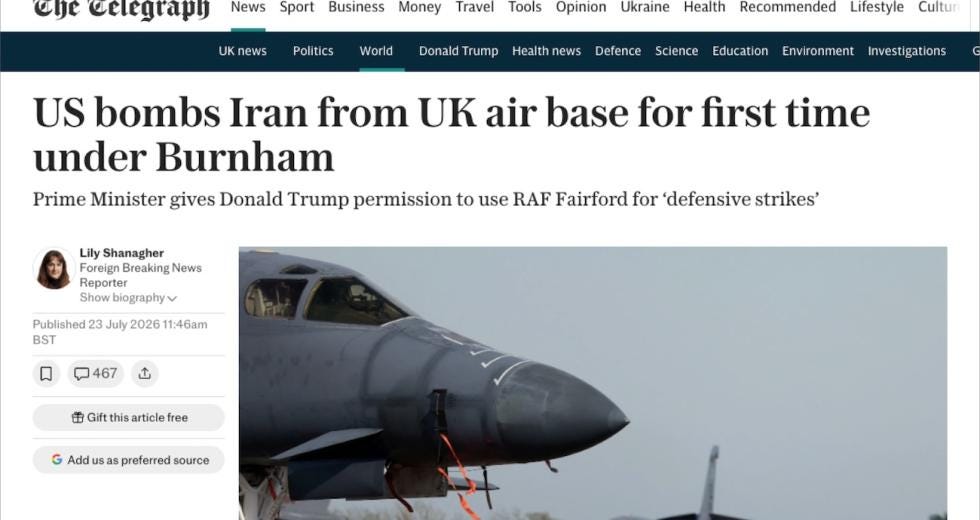
Tucked away off an obscure exit from the east-bound M4 near Swindon is a military base referred to regularly in the local press as ‘secret’. What is the connection between this obscure RAF facility and the mass destruction of civilian infrastructure in Iran in March and April this year? Back then we saw reports of attacks on the desalination plants in Qeshm Island, and commercial and energy infrastructure targets in Bandar Abbas, which also caused noted civilian casualties. There were also reports of attacks on Kashan International Airport, including on civilian infrastructure such as passenger terminals. Serious bombs were dropped in Isfahan, destroying the protected Shah Mosque heritage site and causing civilian deaths among facility workers and nearby residents.
In the recent resumption of daily US attacks on Iran, it has been reported that the planes dropping the bombs have come from RAF Fairford in Gloucestershire.
One thing connecting all these incidents is that the bombs in the long range bombers came from a little-known location in the sleepy Berkshire countryside. Perhaps it’s surprising to learn that the RAF were involved, but here’s the thing: Welford is not an RAF base any more. Rather, it’s the largest US bomb arsenal in the UK, and the second largest in Europe. The bombs stored here are transported by road to RAF Fairford where they are loaded onto long-range B-1 and B-52 bombers.
Mainstream reporting by the BBC as well as in independent media like the Canary and Declassified UK have all described the goings on at RAF Fairford. But hardly anyone seems to know about the secret munitions dump only miles away. Let’s examine what’s been going on there.
The Base
RAF Welford used to be a functioning air force base with three runways laid out to form an intersecting triangular pattern. Aerial photographs from the 1940s show the base clearly, but it has not functioned as an airstrip for many years. The US Air Force doesn’t fly in here, either — in fact, they dug up the runways and replaced them with a myriad of cavernous underground bomb silos.
The base is referred to as secret in part because there are opaque signs on the motorway indicating ‘Works unit only’, with no further information. Before 2015 these signs were edged in red, an indication, at least, that the destination was a military installation. Reviewing data from Google Street View indicates that the signs were changed between April 2015 and September 2016 to the current blue colour indicating, deceptively, a civilian installation.
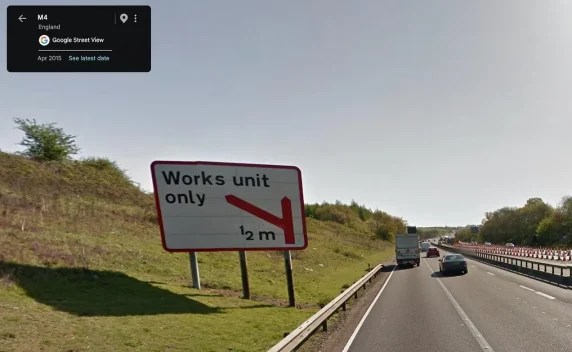
The previous, less deceptive, sign. Image: Google Street View, April 2015.
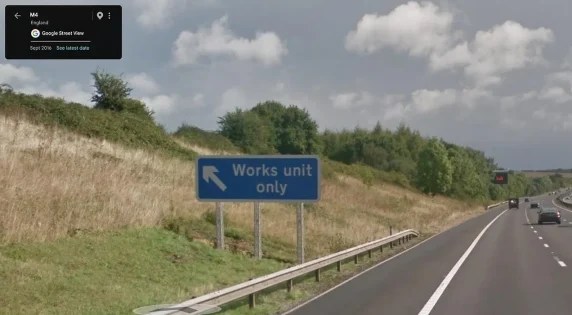
The replacement sign. Image: Google Street View, September 2016.
Munitions stored at, or supplied from, RAF Welford have supported USAF bomber operations from RAF Fairford in multiple conflicts, including the 1991 Gulf War (Operation Desert Storm) and the 2003 illegal invasion of Iraq, plus operations in Afghanistan, Syria, and elsewhere. Operations against Iranian targets in 2026 have involved bunker-busting and precision-guided bombs loaded for B-1B missions and launched from Fairford.
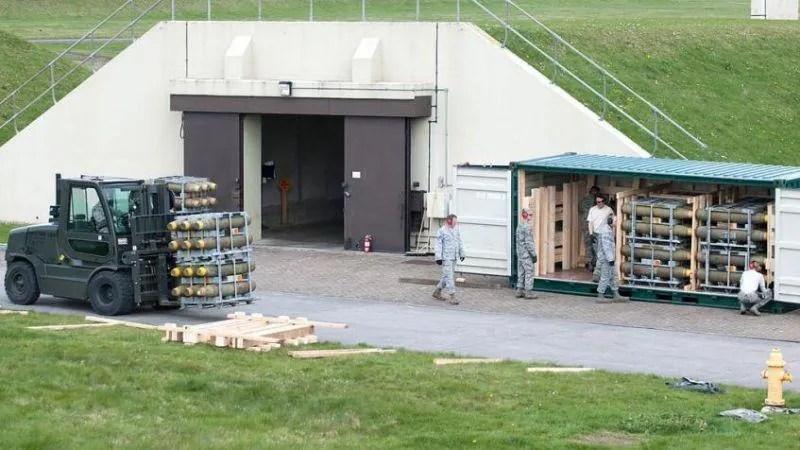
Bombs being loaded at RAF Welford
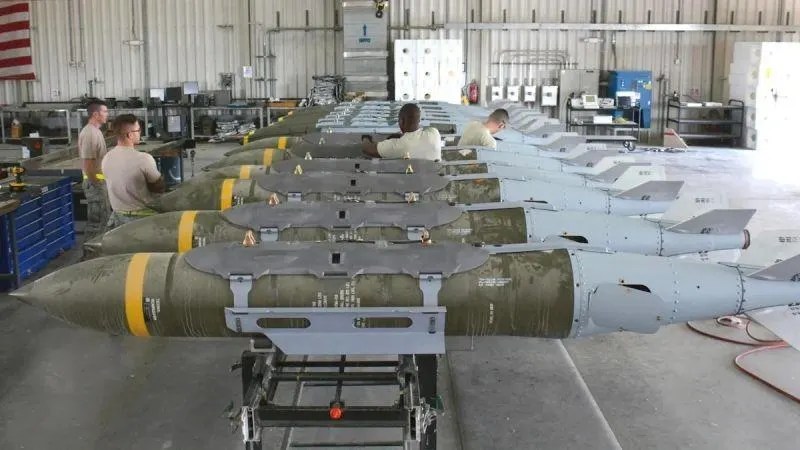
These JDAMs are among the types of bomb loaded at RAF Fairford. Image: USAF
The massive stockpiles of bombs at Welford are looked after by the USAF 420th Munitions Squadron, part of the 501st Combat Support Wing which is headquartered at RAF Fairford. Welford functions as the second largest conventional munitions storage area in Europe and one of the largest heavy munitions compounds for the entire United States Air Forces in Europe–Air Forces Africa (USAFE-AFAFRICA).
In May 2019, the USAF moved 450,000 pounds (200 tonnes) of explosives to the site which hides a huge variety of bombs. They include three key types — ‘smart’, ‘dumb’ and ‘stand off’:
- ‘Iron’ or ‘dumb’ bombs (Mk 82/Mk 84 ): 500-pound/2,000-pound unguided general-purpose bombs. Blast/fragmentation for troops, vehicles, buildings, rail yards, infrastructure.
- Joint Direct Attack Munition or ‘smart’ bombs (technically GBU-31 JDAM): These are GPS-guided 2,000-pound ‘precision’ bombs. They are essentially an add-on to ‘dumb’ bombs to make them more accurate. They can also use BLU-109 penetrator add-ons — so called ‘bunker busters’ — for hardened bunkers/underground facilities. Intended for military bunkers, infrastructure, fixed/relocatable targets. These, of course, were responsible for the attacks on civilian infrastructure and the inevitable civilian casualties caused.
- Joint Air-to-Surface Standoff Missile (AGM-158 JASSM): Stealthy long-range stand-off cruise missile for high-value, defended military targets from range. The US uses these if they want to avoid Iranian air defences and the possibility of their planes being shot down, as started to happen in April this year.
RAF Welford is directly linked to RAF Fairford, the USAF’s primary bomber forward operating location in Europe. The 420th Munitions Squadron at Welford supplies munitions to bombers (including B-1, B-2 and B-52 bombers) deployed at Fairford, enabling heavy bombing missions. Moves occur when heavy bombers (B-1B, B-52) deploy to RAF Fairford for exercises or operations. Bombs are then fitted with JDAM kits and loaded onto aircraft.
These munitions and bombs are routinely transported by road between RAF Welford and Fairford, which lie on opposite sides of Swindon. Convoys — reportedly highly secure with armed escorts — travel west via the M4 motorway, a distance of approximately 32 miles. Movements often take place at night with no identifying markings on vehicles for operational security.
However, quite strict rules apply to transporting bombs on British streets and motorways! Military high explosives (UN Class 1) moved by road from RAF Welford to RAF Fairford are regulated under the Ministry of Defence Explosives Regulations (JSP 482) and JSP 800 Volume 4b (Transport of Dangerous Goods by Road).
Convoy vehicles on the M4 are required to display plain orange plates at the front and rear of each transport unit, along with explosive hazard placards (Class 1 diamonds) on both sides and the rear. It’s not clear whether these rules are always adhered to.
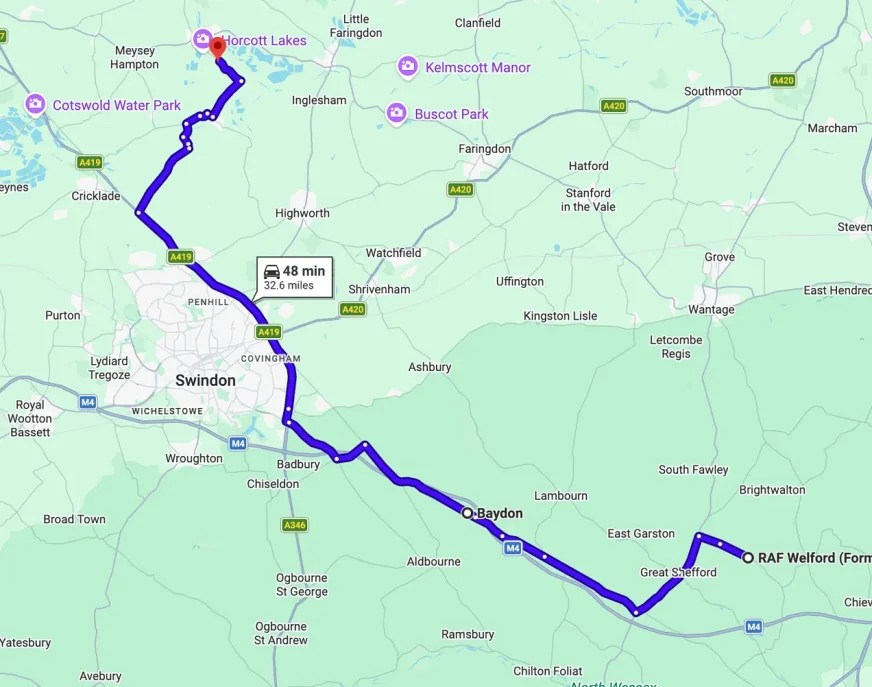
The route from RAF Welford to RAF Fairford is fairly restrictive and predictable. Image: Google Maps
Within Range?
According to the Islamic Revolutionary Guard Corps, the Islamic Republic has deliberately capped its missile range at 2,000 km. If this policy has not been changed, it would be difficult for the IRGC to eliminate the USAF’s UK bunkers of death with a missile attack. That’s because RAF Welford is some 4,035 km from Tabriz in north-west Iran, the closest location from which missiles might be fired. Nevertheless, as a result of Burnham’s reckless decision, the Iranian Foreign Minister has now announced that these bases are legitimate targets for Iran.
Andy Burnham has put British citizens at risk.
RAF Welford is not, however, beyond the range of anti-war campaigners in England. Newbury is less than 10 miles away. Reading, Oxford, and Swindon are less than 30 miles away, Bristol 58 miles, and central London less than 70 miles.
A quick examination of Google Maps shows that when US bombs leave Welford they need to take country roads and can only access the M4 heading west at Junction 14, Shefford Woodlands. They likely then leave the motorway at Junction 15, Badbury, onto the A419. It should not be too difficult to find ways to mount effective demonstrations or blockades to markedly interfere with the smooth supply of death-dealing to US bombers.
No bombs on the planes means no bombs on civilian heads.
You know what to do.
Iranian business still active in UAE despite US ‘Economic D-Day’: WSJ

Al Mayadeen | August 28, 2026
Iranian commercial and financial activity continues across Dubai despite Washington’s push to sharply restrict Tehran’s access to regional markets and financial networks, The Wall Street Journal reported.
According to the newspaper, Iranian banks, airlines, restaurants, and businesses remain active in the United Arab Emirates even after US Treasury Secretary Scott Bessent announced what he called an “Economic D-Day” campaign aimed at countries and companies maintaining economic links with Iran.
Bessent had specifically demanded the closure of overseas branches of Bank Melli Iran, but the bank’s operations in Dubai appeared unchanged this week.
At one Bank Melli branch in Dubai’s old city, around a dozen tellers were continuing to serve Farsi-speaking customers, according to the report. Employees said they had received no instructions ordering the branch to cease operations.
“We put our trust in God on what happens next,” an Iranian bank employee said.
Bank Melli has operated in the UAE since 1969 and currently maintains two branches in Dubai.
US waves secondary sanctions
The continued activity comes despite the UAE Foreign Ministry announcing last week that the country was suspending trade, commercial exchanges, and financial transactions with Iran amid mounting US pressure.
Washington has warned governments and companies that continued dealings with Tehran could expose them to secondary sanctions.
“It is no longer acceptable to operate in the gray spaces of this conflict,” Bessent said. “These measures broaden secondary sanctions risk for anyone foolish enough to continue conducting business with this regime.”
Iranian economic networks remain embedded in Dubai
According to the WSJ, the gap between the public announcements and conditions on the ground reflects the depth of economic ties connecting Iran and the UAE, particularly Dubai.
Iranian businesses have operated in the emirate for decades, while hundreds of thousands of Iranians are believed to live in the UAE and use Dubai as an important gateway to international finance and trade.
Iranian airlines also continue to operate direct services between Iran and the Emirates. UAE carriers Emirates, Etihad, and FlyDubai are not currently flying directly to Iranian destinations, although some reportedly continue to use Iranian airspace.
The newspaper also found Iranian restaurants and cafes operating normally in Dubai, with Iranian residents interacting openly with Emirati customers.
Earlier restrictions eased
Some restrictions imposed earlier in the year appear to have eased as well.
During a broader crackdown in the spring, UAE authorities closed the Iranian Hospital and Iranian Club, temporarily restricted Iranian passport holders from entering or transiting the country and revoked visas belonging to some Iranian residents.
The hospital and club remain closed, but Iranians interviewed by the newspaper said widespread visa cancellations appear to have stopped and some previously withdrawn visas have since been restored.
Iranian residents are nevertheless preparing for the possibility of tighter financial restrictions. Some told the newspaper they could turn to the traditional hawala transfer system if formal banking links with Iran are eventually disrupted.
Severing Iran-UAE trade seen as difficult
Economic ties between the two countries are extensive.
Around $28 billion in trade passed between Iran and the UAE in 2024, according to World Trade Organization figures cited by the newspaper.
Neil Quilliam, an associate fellow at Chatham House, said the economic relationship cannot easily be dismantled.
“The Gulf Arab state economies are so closely integrated and intertwined with the Iranian economy, you can’t just simply sever economic trade and activity overnight,” Quilliam said. “The U.A.E., and Dubai in particular, have always managed to continue to do trade, even when the maximum pressure is on. Cutting off that trade will be cutting off their nose, basically.”
Dubai has also long been identified by US authorities as a major center for financial activity linked to Iran.
The UAE also hosts the second-largest number of individuals and companies sanctioned by the US Treasury over alleged Iran-related activity after China, according to Levitt.
Washington faces competing interests in UAE
The report noted that pushing Abu Dhabi to fully sever its economic relationship with Tehran could create complications for Washington because of the UAE’s broader strategic importance to the United States.
The Emirates hosts US military facilities, maintains close security relations with Washington, and was the first Gulf Arab state to sign the US-brokered “Abraham Accords” establishing formal diplomatic relations with “Israel”.
The country has also emerged as a major source of investment in US sectors including artificial intelligence.
Those interests give Washington incentives to preserve strong relations with Abu Dhabi even as it demands tougher enforcement against Iranian commercial networks.
For Emirati authorities, maintaining some economic channels with Iran may also be viewed as a means of reducing regional tensions.
“There will be some in the U.A.E. who say, ‘Whatever the price of calm, that is what we need to do,’ ” Levitt said. “Better to do that by allowing them to access banking and supply chains through our country than not,” he said of the Emirates’ thinking on Iran.
Dubai faces an additional economic calculation because, unlike oil-rich Abu Dhabi, its economy relies heavily on trade, finance, tourism, and international capital flows.
The WSJ report therefore suggests that despite Washington’s escalating sanctions threats and the UAE’s public commitment to restrict economic links with Tehran, deeply established Iranian financial and commercial networks in Dubai remain difficult to dismantle.
‘Ideological cover for war’: Anti-imperialist scholars condemn Guardian open letter over Iran
Press TV – August 28, 2026
The Anti-Imperialist Scholars Collective (AISC) has strongly condemned an open letter published by The Guardian, noting that its Western academics and signatories have distorted history and provided “ideological cover” for the intensification of the war against Iran.
In a detailed response, the collective said the August 20 letter creates a “false and dangerous equivalence” between the defensive measures of the Islamic Republic of Iran and the aggressive acts of the United States and Israel, which it described as “the most powerful and genocidal imperialist forces in world history.”
It added that the letter fails to place Iran’s current circumstances within the longer history of imperialist intervention in the region.
“The letter distorts history, obfuscates the current geopolitical conjuncture, and provides ideological cover for the intensification of the ongoing war against Iran,” highlighted the collective.
The AISC said the letter refers to several historical events without providing sufficient analysis, context or citations. It particularly slammed the absence of Iran’s support for the Palestinian cause and said the letter overlooked decades of intervention involving coup attempts, wars, mercenaries, information warfare, sanctions, economic pressure and sabotage by the US-led imperialism.
Instead, the collective said, the letter offers only a “deracinated acknowledgement” of the 1953 US-backed coup and a vague reference to the 1988 executions in Iran.
The AISC said the historical omissions were particularly significant given the continuing US-led pressure campaign against Iran.
“As US imperialism accelerates and the resistance against it strengthens, the battle of ideas continues to intensify,” the collective said, adding that anti-imperialist intellectuals have a responsibility to be “rigorous and vigilant.”
It said the circumstances surrounding The Guardian letter also raised questions, noting that, at the time of its response, the authors remained obscured and the social media page that had originally posted the letter had been erased. The collective described the document as an “alarming, pro-imperialist document.”
AISC challenges the letter’s account of Iran’s history
A central part of the response concerns the Iran-Iraq War and the events surrounding the 1988 executions.
The collective noted that Iran was fighting a US-backed Iraq after the Iraqi invasion of 1980, which was carried out at the behest of Washington. It said the war had a wider objective of “balkanizing “Iran, toppling the Islamic Republic and regaining control over the country’s state and resources.
The AISC also highlighted the role of the Mujahideen-e Khalq, or MKO terrorist group, in the final stages of the war. It said the group, funded and trained by the US and Israel, joined Iraqi forces in an ultimately failed operation to invade Iran, referring to the July 1988 incursion of terrorists from Western borders, which was defeated within days under Operation Mersad.
Against this backdrop, the collective disputed The Guardian letter’s treatment of the 1988 executions, noting that the executions largely targeted terrorist MKO members who had participated in operations against Iran.
“Neither the US nor Israel have ever given up on destroying Iran, in no small part because of the anti-zionism of the Islamic Republic and its defense of Palestine,” it added.
The response further noted that the historical experience of the Iran-Iraq War shaped Iran’s approach to national defense, scientific development and economic self-reliance.
The collective rejected the letter’s call for the release of individuals involved in January riots, noting that riots were an “urban warfare campaign led by Mossad and CIA-backed mercenaries.” It added that concealing that history turns The Guardian letter into “a form of academic counterinsurgency.”
The AISC then questioned the timing of the letter.
The collective pointed to the signing as coming after the deliberate US-Israeli attacks on Iran’s hospitals, pharmaceutical clinics, bridges, food and water storage facilities, and schools during the war that aggressors launched on February 28. It specifically named the attack on Shajareh Tayyebeh School in Minab, where 168 children and staff were massacred in a double-tap strike.
It said the letter was published on the same day the United States announced what it called “crushing economic warfare” against Iran.
‘Treacherous statement’
The AISC also slammed the signatories themselves, saying their actions reflected “a carelessness that is troubling.”
It said that many of the academics publicly support Palestine but had nevertheless signed a letter condemning Iran, which the collective described as the only country that “actively and materially supports the Palestinian resistance.”
The response said some signatories subsequently claimed they had not read the letter carefully, had been confused by its creation or had been misled during the process of collecting signatures.
The AISC said it was particularly concerned that the signatories had not identified the authors of the statement or explained how their signatures were obtained.
“We are dismayed that the signatories still refuse to name the authors of this treacherous statement and how their signatures were acquired, despite claiming to have been hoodwinked by them,” the collective said.
The collective said it expects the intellectuals who signed the letter to approach the issue with “clarity, urgency, and intellectual rigor,” adding that if the signatories are incapable of that, “silence is always an option.”
See also:
A response to The Guardian’s open letter: Opposing the war on Iran means rejecting war propaganda
By Carlos Martinez | Press TV | August 24, 2026
The Guardian has published an open letter to Iran’s “political prisoners,” signed by Angela Davis, Mumia Abu-Jamal, Rashid Khalidi, Robin DG Kelley, Ruth Wilson Gilmore, Judith Butler, and Walden Bello, among others (although Kelley has since withdrawn his signature, and there is considerable doubt that Mumia Abu-Jamal knowingly lent his name to the venture). … continue
Featured Video
Elijah Magnier: Yemen’s strikes are shattering Saudi Arabia’s long-term strategy
or go to
Aletho News Archives – Video-Images
From the Archives
British weapons and personnel doing much of the killing in Yemen
Press TV – June 18, 2019
A detailed report published by the Guardian newspaper has shown how Britain is massively contributing to Saudi Arabia’s devastating war on Yemen as it suggests that London is not only supplying the bombs that fall on Yemenis, but it provides the personnel and expertise that keep the war going.
The comprehensive report by Arron Merat published on Tuesday showed that Britain was doing much of the killing in Yemen as the country continues to provide Saudi Arabia with everything it needs to turn its southern impoverished neighbor into a graveyard.
“Every day Yemen is hit by British bombs – dropped by British planes that are flown by British-trained pilots and maintained and prepared inside Saudi Arabia by thousands of British contractors,” said Merat in the report. … continue
Blog Roll
 Aletho News
- Racist Seinfeld Dances for Joy as Bibi Unveils His New Map
- A West Bank War for Netanyahu’s Election Campaign, Could It Backfire?
- Yemen denounces European Parliament’s ‘hypocritical’ push to blacklist Ansarullah
- Qalibaf: UAE’s UN bid aims to ‘clear the runway’ for ‘Greater Israel’, whitewash genocide
- Pakistan reopens Iran border after boosting security: Report
- Why are so many Brazilians voting for Flávio Bolsonaro?
- Democrats Put Anti-Russia Agenda Ahead of American Workers
- Elijah Magnier: Yemen’s Strikes Are Shattering Saudi Arabia’s Long-Term Strategy
- Pentagon designates Chinese cultural centers national security threat
- Israel Demolishes Home Of Lebanese Journalist Whose Viral Film Exposed Pager Attack
- If Americans Knew
- An error has occurred; the feed is probably down. Try again later.
- No Tricks Zone
- Sudden Stratospheric Warming, Powerful El Niño Combination May Lead To Extreme Europe Cold, Energy Crisis!
- Two New Studies Find Thwaites Glacier Melt Cannot Be Driven By Human Activity Or A Warming Ocean
- E-Cars Reduce CO2 Emissions By Only 41% Compared To Internal Combustion Engine Vehicles
- Predictions Made By Renowned Climate Professor Over Past Decades Have Been Proven To Be Poor
- New Study Suggests Large Regions Of The Pacific Ocean Have Been Cooling For The Last 80 Years
- Germany’s Green Energy Debacle: High Energy Costs Force Kahla Porzellan to Close After 182 Years!
- New Study: 50 Years Of The Most Aggressive ‘Net Zero’ Policies Can Only Affect The Global Climate By 0.03°C
- US September “Heat” Was No Record…Many Records Set Decades Ago
- Latest European Green Energy Debacle; Portugal’s Largest Flagship Solar Park Insolvent!
- Green Energy Debacle: German Expert Professor Fritz Vahrenholt Warns Of Severe Economic And Social Consequences


