Israel blocks 2 Swedish European parliamentarians from entering country
MEMO | August 24, 2026
Two Swedish members of the European Parliament say they were prevented from travelling to Israel on Sunday, despite holding entry permits and supporting documentation, Anadolu reports.
Left-wing MEPs Jonas Sjostedt and Hanna Gedin were stopped as they were preparing to board a flight from Athens to Tel Aviv.
They had planned to travel on to the occupied West Bank and East Jerusalem, where they were due to meet representatives of the NGO Save the Children, visit refugee camps, and speak to Israeli and Palestinian human rights groups.
The two MEPs said they wanted to hear testimonies about what they described as deteriorating conditions and apartheid in the West Bank.
Sjostedt, of Sweden’s Left Party, said they had been barred for political reasons because of their criticism of Israel and their calls for Israeli government ministers to be brought before the International Criminal Court.
“Israel is increasingly preventing people from entering the country, even members of parliament,” he said in a statement.
Gedin said it is unacceptable for Israel to prevent elected European officials from seeing conditions on the ground and meeting people affected by them while Israeli politicians continued to travel freely in Europe.
The Left group in the European Parliament said it had informed the EP President’s Office about the incident.
It described the refusal of entry as an attack on the institutions of the EU.
The incident comes as the Left group says ethnic cleansing in Palestine is continuing and amid concerns over negotiations by the European Commission on the sharing of biometric and personal data with Israeli security services.
Israel continues to block agreed quantities of food, medicine, medical supplies, shelter materials, and prefabricated homes from entering Gaza, where around 2.4 million Palestinians live, including 2.15 million displaced people, under catastrophic conditions.
Ongoing Israeli violations of the ceasefire have killed 1,286 Palestinians and injured 4,257 others as of Sunday, according to Gaza’s Health Ministry.
The ministry also said the overall toll from Israel’s war on Gaza since October 2023 had risen to 73,420 killed and 174,369 injured.
Israel seizes 1,152 more dunums as West Bank villages are turned into closed military zones
Palestinian Information Center – August 24, 2026
WEST BANK – Israeli occupation authorities have escalated settlement activity in the West Bank by issuing military orders to seize hundreds of dunums of Palestinian land, alongside settler sieges and forced displacement carried out under army protection.
The measures reflect clear coordination between the army and settler militias to empty large areas for settlement expansion.
Last Tuesday, Israeli forces issued a military order to seize around 1,152 dunums of land belonging to the towns of Sinjil, Al-Lubban Al-Sharqiya and Qaryut, north of Ramallah.
The order aims to expand the Karmi Oz settlement and strengthen geographic links between settlements and outposts located between Nablus and Ramallah.
According to a report on settlement activity, the targeted land is spread across several areas in the three towns. The decision comes as part of Israeli government measures issued since 2023 to legalize settlement outposts, most notably Givat Harel and Givat Haroeh.
At the same time, settler attacks continue across West Bank villages, accompanied by sieges, restrictions and forced displacement under the protection of Israeli occupation forces.
The attacks have been concentrated in Jalud and Qusra, south of Nablus, Turmus Ayya, north of Ramallah, and Khallat Al-Hummus in Masafer Yatta.
In Jalud, Mahmoud Al-Tubasi and his family were forced to evacuate their home after a two-month siege that included blocking the road and cutting off water and electricity. Armed settlers later stormed the home and threatened to kill or burn the family.
In Qusra, families in the Ras Al-Ain area have faced siege and attacks since the beginning of the year amid attempts to establish a new settlement outpost.
The escalation peaked on August 9, when settlers reinstalled their tents, blocked roads with stones and cut off electricity and water to the families.
Israeli forces then turned the area into a closed military zone, forced families to evacuate their homes and converted around 16 houses in Jabal Ras Al-Ain into military barracks and observation posts.
Israeli forces also imposed a curfew, closed shops and prevented Palestinian and international activists from reaching the besieged families with aid.
The report said these measures are taking place amid international silence, while the Israeli government continues to use claims of “military purposes” and the “legalization of outposts” as cover to seize more land and connect settlements to one another.
Experts opined that the ultimate goal is to fragment the West Bank and undermine any possibility of establishing a geographically contiguous Palestinian state by turning villages into besieged enclaves that can be controlled and emptied of their residents.
Gaza survivors recount executions and abuse in militia-controlled areas east of Yellow Line
MEMO | August 24, 2026
Palestinians who say they escaped areas controlled by Israeli- backed armed militias east of the so-called Yellow Line in the Gaza Strip have recounted severe abuses, including extrajudicial killings, physical mistreatment, drug distribution and exploitation of civilians, according to testimonies collected by Quds Press.
The accounts describe tightly controlled areas where residents faced restrictions on movement and could leave only with authorization from militia members. Quds Press described the groups as receiving backing from the Israeli military.
One survivor, identified only as Ahmed, 31, said he escaped with his two brothers after eight months in an area controlled by a militia allegedly headed by Shawqi Abu Nassira.
Ahmed said that narcotics, including hashish and a substance he identified as “Rotana,” were widely distributed. He also said that people attempting to escape or refusing orders faced summary execution and accused militia members of abusing and exploiting children and girls.
Another survivor, identified as Abu Ramzi, said he was drawn into the area after responding to a social media advertisement offering street-cleaning work purportedly connected to international organizations.
According to his account, he and others were collected near Al-Samar roundabout, at the entrance to Gaza City’s Shuja’iyya neighbourhood, and transported east, where masked men took them to an interrogation facility he said was operated by the Israeli military.
Abu Ramzi alleged that interrogators sought detailed information about detainees’ relatives and people employed by Gaza’s governing authorities. He further added that detainees who hesitated to answer were subjected to physical abuse, including being struck on their fingers with a hammer.
He said that during a subsequent Israeli military movement toward the Yellow Line, militia members withdrew and Israeli forces ordered the detainees to assemble. According to his testimony, they were handcuffed and instructed to walk westward without looking back.
Separately, Al-Hares, a platform affiliated with Hamas-run security authorities in Gaza, has warned residents that armed groups operating in these areas allegedly use offers of food, cigarettes and employment to attract civilians. It accused the groups of seeking to use civilians to facilitate their movements and urged Palestinians to avoid them.
US unveils ‘economic onslaught’ against Iran
RT | August 24, 2026
US Treasury Secretary Scott Bessent has announced new sanctions against Iran, and threatened to boot any country dealing financially with Tehran out of the US dollar system, in a bid to make Iran an “economic outcast.”
The new sanctions target nearly 60 entities, individuals, and vessels in multiple jurisdictions that allegedly trade in “illicit nuclear and missile technology” with Iran, aid Iran’s “cyber operations,” and move Iranian oil, the US Treasury Department said in a statement on Monday. More than a third of the sanctioned entities and individuals – 21 – are based in China.
The Treasury also said it had identified digital assets, technology, gold, aviation and shipping as areas for potential secondary sanctions.
Speaking at a press conference later on Monday, Bessent went further, announcing the beginning of “Operation Economic Outcast,” which he described as “an economic onslaught against Iran’s financial connections around the globe.”
Bessent explained that the US would penalize any country refusing to sever its economic ties with Tehran. “Any entity that facilitates money laundering on behalf of Iran will be removed from the US dollar system,” he said, adding “the clock just started ticking.”
Iran exports goods to 147 countries, and imports from 114, according to the most recent data from the World Bank. Asked how the US intends to force three quarters of the world’s nations to cease trade with Iran, Bessent said that US President Donald Trump phoned multiple world leaders over the weekend “with specific requests to cease their interactions” with Iran, and that every country had been given “a defined timeline” to comply with his demands.
Bessent refused to share any more details, telling reporters that “we’re not going to name names,” nor was he “going to set timelines.” Pressed on whether Washington expected China – which is Iran’s largest trading partner – to abide by the sanctions regime, Bessent did not give a definitive answer.
“We find that the best way to engage with countries is through quiet diplomacy. And we are level-setting with every country to tell them our expectations. We know who they are. They know who they are,” he replied, adding “no-one is above the reach of US sanctions.”
Bessent’s threats were shrugged off in Tehran. “Americans know that no one buys their bombast,” senior Iranian negotiator Mohammad Bagher Ghalibaf wrote on X after the treasury secretary’s press conference.
“The United States is not in an economic position to further restrict its relations with other countries,”he explained. “Iran’s trading partners, both in the media and through messages sent to us, have made it clear that they don’t take these statements into account anywhere.”
Mohsen Rezaei, the head of Iran’s Supreme National Security Council, warned on Sunday that “not a single drop of oil will leave the Persian Gulf and the Strait of Hormuz” if the Gulf states join the US’ economic pressure campaign. If US President Donald Trump “wants to do something, we will retaliate in a seismic manner,” Rezaei added.
Last week, Trump threatened to inflict what he called “Economic D-Day” on Iran, after a 60-day window for negotiating peace with Tehran expired with no breakthrough. Trump ruled out a return to negotiations, but Pakistani Chief of Defense Forces Asim Munir arrived in Tehran on Monday in an attempt to revive the talks.
Iran warns of strikes on US bases in Europe if nations join aggression
Al Mayadeen | August 24, 2026
Iran will strike US bases in European countries if those nations participate in aggression against it, Iran’s Foreign Ministry spokesman Esmail Baghaei warned on Monday.
During his weekly press briefing, Baghaei emphasized that “Iran does not accept that the aggressor sets the conditions for ending the war,” adding, “there is no justification for any country to fear Iran unless that country opens its territory to the United States for aggression against Iran.”
He stressed that “it is Iran’s right to target the source and origin of any aggressive action against the Islamic Republic.”
Baghaei also affirmed that “Iran did not start the war and was exercising its legitimate right to self-defense, and will not allow the war to end on the aggressor’s terms,” explaining that “Iran used all diplomatic tools to prevent war”.
He stated that, “we did not start the war, and we should not blame ourselves for the continuation of this situation”.
Iran did everything to pursue diplomacy, US violated agreements
Baghaei noted that “Iran did everything possible through the diplomatic path to prevent war and secure national interests and benefits. In many cases, arrangements and agreements were reached, but the US side violated all of them”.
He pointed out that “the memorandum of understanding did not last more than three weeks, after which America revoked all its provisions”.
Baghaei stressed that “Iran’s power and the cohesion of its people are the shield of the Islamic Republic”, affirming that “Iran was able to thwart all the enemy’s plans”.
Regarding the Mecca agreement, Baghaei noted that “Iran did not receive an official invitation to join the Mecca agreement, but proposals were presented to it in this regard.”
US Naval blockade considered aggressive act
Responding to reports of several million barrels of oil crossing through Hormuz daily, Baghaei said: “This is part of the enemy’s psychological warfare, and there is no such thing.” He continued: “Regarding what America calls the economic war, they used to say economic sanctions, and we used to say this is economic terrorism.”
Baghaei noted that “America uses every tool to punish Iranians simply for their insistence on their sovereignty, national independence, and dignity,” adding that, “the Iranian government is mobilizing all its capabilities to alleviate living pressures on the people”. He affirmed that “the naval blockade on Iran at the present time is in itself an aggressive act, and escalation of this situation will certainly have its own repercussions”.
Iran-Pakistan relations at their best stages
Regarding bilateral relations between Iran and Pakistan, Baghaei said they are “going through one of the best stages, and both sides are determined to expand these relations.” He added: “The visit of Oman’s Foreign Minister to Tehran has no connection to the visit of the Pakistani army chief. They coincided only in terms of timing.”
Baghaei continued: “During the visit of Oman’s Foreign Minister to Tehran, we will discuss bilateral relations and issues related to the security of the Strait of Hormuz and transit routes”. He concluded: “Iran and Afghanistan will expand their commercial dealings”.
IRGC rejects US claims, says Iran retains surveillance edge in Hormuz
Al Mayadeen| August 24, 2026
The spokesperson for Iran’s Islamic Revolution Guard Corps (IRGC), Hossein Mohebbi, dismissed US officials’ claims that Iranian radars had been targeted and that oil tankers could transit the Strait of Hormuz as “media hype”.
Mohebbi told Mehr news agency that “the IRGC’s surveillance and intelligence-gathering capabilities cannot be confined to the radars known to the enemy.”
He highlighted the surveillance, reconnaissance, and intelligence-gathering methods employed by Iran’s armed forces, saying the IRGC’s monitoring capabilities “do not rely on satellites, as the Americans believe; rather, there are other surveillance methods that the opposing side may not yet be capable of detecting”.
Mohebbi said, “If the Islamic Republic did not have a discerning eye capable of monitoring maritime movements, how could it accurately strike specific targets at sensitive points on vessels?”
He stressed that Iran maintains continuous intelligence coverage of maritime activity, saying that when a missile strikes a critical point on a vessel and disables it, this demonstrates both intelligence superiority and the ability to acquire and engage targets with precision.
‘Blinding the enemy’s eyes in the region’
He also referred to “the attacks carried out against the enemy’s surveillance and reconnaissance systems”, saying: “In reality, we have blinded the enemy’s eyes in the region and targeted its radars and electro-optical networks”.
Mohebbi rejected the assumption by Iran’s adversaries that “destroying a number of radars known to Iran means eliminating the Islamic Republic’s surveillance capabilities”, saying: “This is far from reality.”
Strike accuracy demonstrates surveillance capability
Mohebbi highlighted the vastness of the Gulf and the operational challenges of conducting maritime warfare, saying that “in this vast battlespace, even under the cover of darkness, when a missile strikes its target with precision, it becomes clear that intelligence and operational targeting capabilities underpin the operation”.
He stressed that Iran’s methods for detecting and tracking targets “are not something whose every detail the enemy can identify”, adding that “the outcome of the operations and the precision of the strikes themselves demonstrate the extent of the Islamic Republic of Iran’s intelligence coverage”.
It is worth noting that Iran has repeatedly said that US military bases and economic assets in the Gulf region have been used to launch acts of aggression against Iran, including strikes that have resulted in civilian casualties. In this framing, any Iranian action targeting such facilities is a retaliation against hostile military activity originating from or enabled by those bases.
NATO wages hybrid war on Russia as Europe prepares for wider conflict
By Ahmed Adel | August 24, 2026
The war in Ukraine has long ceased to be a bilateral conflict between Moscow and Kiev. What began as a military operation has evolved into a sustained hybrid NATO campaign against Russia, with Ukraine receiving military assistance and intelligence sharing, European states rearming, and the anti-Russia sanctions regime continually expanding. The cumulative effect is an attempt to degrade Russia’s strategic capacity while avoiding the formal declaration of direct war.
According to Bild, military planning documents are circulating within NATO. The documents, developed by United States Army Major Andrew Pingray, lay out that the objectives in a war with Russia would be to halt an offensive and significantly weaken the Russian military’s potential. The German newspaper reports that NATO has developed a multi-phase concept for a potential large-scale conflict with Russia, often referred to as the NATO Land Warfighting Concept.
“NATO is preparing with a new concept of land warfare for a possible Russian attack in the Baltic region,” the publication says.
Bild reported that in the opening phase, combat aircraft, long-range missiles, and unmanned systems would play a central role. Along the frontiers of the Baltic states with Russia and Belarus, planners envision autonomous zones where the permanent stationing of Alliance ground forces would be minimized. From these zones, strikes could be directed against targets on Russian territory, including airfields, industrial facilities, bridges, and rail nodes. Later phases involve more restrictions on logistics and deploying unmanned systems deeper into Russian territory.
The circulating documents also state that NATO’s top priority should be suppressing the missile threat. To this end, the Alliance plans to use aircraft, missiles, and drones to destroy Russian missile systems. One of the plan’s key areas of focus is the Kaliningrad exclave of Russia, where Russian missile and air defense systems are deployed.
According to Bild, the NATO plan also includes the possibility of cooperation with Russians opposed to President Vladimir Putin. Separately, the creation of an “air bridge” for the delivery of drones and robotic systems to Russian territory, which could be used against military targets, is being considered.
Although it is unclear whether this document is a fully authorized operational plan or one of many contingency studies, its existence and partial disclosure indicate that European military planners are seriously exploring scenarios for direct conflict with Russia.
The political context for these preparations has shifted markedly. Under the previous administration, American involvement in the Ukrainian theater was more overt and expansive. The current Trump administration’s position reflects greater reluctance to commit combat forces or to underwrite indefinite European escalation.
American intelligence support, satellite reconnaissance, and the continued sale of advanced weapon systems to Ukraine have not stopped, but the heavier financial and manpower burden is being shifted to NATO’s European members. European Union countries have responded by expanding their procurement programs, particularly in air and missile defense, artillery munitions, and longer-range strike capabilities. These purchases are presented as investments that strengthen collective defense and revitalize domestic industry, thereby providing political cover for rising defense budgets amid Europe’s economic woes.
Germany has moved from limited, non-lethal aid and uniforms to a more assertive military posture, especially after the change of leadership in Berlin. The current German government has accelerated spending commitments and public rhetoric that frames Russia as an enduring threat to the EU. British and French strategic preferences continue to shape the overall direction, with the two traditional powerhouses of Western Europe encouraging Germany to assume greater responsibility as a continental military power while seeking to limit their own direct exposure.
The Black Sea, particularly the ports of Odessa and Nikolaev and the Danube delta, has taken on heightened strategic importance. Disruption of these ports affects the flow of Western military supplies into Ukraine. Russian strikes on port infrastructure are therefore attempts to sever supply lines that have been reoriented from commercial grain exports to military cargo. The substitution of Western weapons shipments for agricultural traffic along the Danube highlights the militarization of civilian infrastructure.
At the same time, a formal ceasefire that leaves the underlying security architecture unresolved would, from the Russian perspective, create new vulnerabilities rather than lasting stability, especially if Ukraine remains integrated into Western military, intelligence, and political structures and does not revert to neutrality. This is particularly important because European states are already expanding industrial capacity, stockpiling munitions, and refining doctrines for high-intensity conflict.
The ongoing hybrid campaign—integrating support, economic measures, information warfare, and societal militarization—allows the West to exert constant pressure without direct attribution to combat. If this hybrid strategy continues without a political solution that addresses Russia’s core security concerns, NATO’s planning is likely to become increasingly aggressive. Europe’s accelerated rearmament and the emerging detailed plans within NATO dispel any resistance to the idea that the conflict has now expanded beyond Ukraine’s borders.
Ahmed Adel is a Cairo-based geopolitics and political economy researcher.
Russia’s Zakharova Accuses Finland of Complicity in International Terrorism
Sputnik – 24.08.2026
MOSCOW – Finland’s cooperation with Ukraine in the field of drone production makes it complicit in international terrorism, Russian Foreign Ministry spokeswoman Maria Zakharova said.
“Official Helsinki is essentially complicit in international terrorism. Moreover, the state is dragging ordinary Finns into a bloody abyss,” Zakharova said.
Zelensky announced on Sunday that Finnish and Ukrainian companies had signed documents on the development and production of drones in Finland for the needs of Ukraine and Europe.
Russia says that arms supplies to Ukraine hinder the peace process and make NATO allies a party to the conflict. Russian Foreign Minister Sergey Lavrov says that any shipments containing weapons for Ukraine will be a legitimate military target.
Japan rejects Ukraine’s missile plea
RT | August 24, 2026
Japan does not plan to supply Ukraine with weapons, Chief Cabinet Secretary Minoru Kihara has said. At a press briefing on Monday, he told reporters that Tokyo “is not considering any deliveries” of defensive or offensive weapons “at this time.”
Kihara was responding to Ukrainian Prime Minister Sergey Koretsky, who asked Japan on Sunday for anti-ballistic missiles, in an interview with Kyodo News.
“I would like to kindly ask one and only thing… anti-ballistic missiles,” he was cited as saying. “It’s the most important thing we need… I very much hope and count on your country.”
Koretsky took office in July and was reportedly close to disgraced businessman Timur Mindich, a close associate of Vladimir Zelensky who fled to Israel amid a corruption scandal.
“At this time, the government does not consider transferring weapons under the Self-Defense Forces Law to Ukraine,” Kihara said, referring to an overhaul in April of Japan’s defense-export policy that lifted restrictions limiting transfers to non-lethal categories and opened the door to lethal weapons exports.
He noted that Tokyo has already provided Kiev with non-lethal equipment and pledged around $20 billion in recovery, reconstruction, and humanitarian aid, signaling that it intends to keep its assistance within these bounds.
Japan’s stance on the Ukraine conflict has been marked by contradiction. Tokyo has publicly sided with Kiev, condemning Russia’s military operation and taking part in the Western sanctions. However, it has stopped short of supplying lethal weapons to Ukraine, and unlike some Western nations, has retained stakes in key Russian energy projects, citing their importance to domestic energy security.
Over the past few months, Ukraine has increasingly sought new military hardware from its Western backers to counter severe battlefield shortages amid the steady advance of Russian forces. Last month, Russia announced the capture of the key Ukrainian stronghold of Konstantinovka in northwestern Donbass before launching an offensive toward the Slavyansk-Kramatorsk agglomeration, the last two major cities in the region still under Ukrainian control. Over the past week, Russia has liberated six settlements in Donbass.
Kiev has intensified long-range drone attacks deep inside Russia, increasingly striking energy and civilian infrastructure and prompting Moscow to denounce the raids as terrorist attacks against civilians. Last month, Russian Ambassador-at-Large Rodion Miroshnik told RT that Ukraine is trying to mask its battlefield setbacks by attacking Russian civilians and presenting the strikes as “some kind of achievement.”
Russia has long accused Western weapons suppliers of enabling Ukraine’s deep-strike campaign. A Sunday Times report last week claimed that Ukraine has used British-made drones for long-range attacks inside Russia over the past six months. Moscow maintains that this aid makes Kiev’s foreign backers direct participants in the hostilities and only serves to prolong the conflict. Earlier this month, Foreign Minister Sergey Lavrov warned that Russia will adopt “much harsher methods to destroy everything that enables the West to fuel Kiev’s war machine.”
The ‘coalition of the willing’, a group of Western states pushing for continued aid to Ukraine which includes the UK, France, and Germany, will convene in Kiev on Monday to discuss future weapons deliveries. Kiev is expected to seek additional interceptor missiles. The UK is set to announce that it will provide Ukraine with classified technical information needed to assemble long-range cruise missiles domestically.
A response to The Guardian’s open letter: Opposing the war on Iran means rejecting war propaganda
By Carlos Martinez | Press TV | August 24, 2026
The Guardian has published an open letter to Iran’s “political prisoners,” signed by Angela Davis, Mumia Abu-Jamal, Rashid Khalidi, Robin DG Kelley, Ruth Wilson Gilmore, Judith Butler, and Walden Bello, among others (although Kelley has since withdrawn his signature, and there is considerable doubt that Mumia Abu-Jamal knowingly lent his name to the venture).
These are not people to be dismissed lightly. Many have made important contributions to the anti-imperialist and Black liberation movements, and one of them is currently writing from within a US prison. Nevertheless, the letter is wrong and serves an objectively harmful purpose.
The central metaphor employed is that of “the two blades of a scissors”: the Islamic Republic on one side, and the United States and Israel on the other, with the Iranian people being crushed between them. Such an image manufactures symmetry between the perpetrators of an ongoing criminal war of aggression and the victim of that war; between the warmongering Epstein coalition and an independent country with no record of invading anyone.
The signatories justify their position by “rejecting the false binary of imperialism and hollow anti-imperialism”. But how hollow, exactly, is Tehran’s anti-imperialism?
Iran: An anti-imperialist state
For four decades, while almost every Arab government made its accommodation with Washington and Tel Aviv, Iran armed, funded and provided diplomatic support to the Palestinian resistance. When the Abraham Accords put enormous inducements on the table – security guarantees, investment, technology, the lifting of pressure – Iran refused normalisation. As a matter of principle, it has consistently declined to recognise the legitimacy of an entity built on apartheid and ethnic cleansing.
Iran has paid a significant price for that principled stance: four decades of sanctions designed to strangle its development; the assassination of its scientists; the sabotage of its infrastructure; endless covert operations; and now a full-scale war in which an estimated 3,500 Iranian civilians have lost their lives, and schools, hospitals, apartment blocks, bridges, ports and oil depots have been bombed.
Tehran’s stance against the Empire has not been limited to Palestine. For example, under the West-backed Pahlavi dictatorship, Iran was a close ally of apartheid South Africa and a reliable supplier of its oil. After 1979, the Islamic Republic severed those relations and backed the liberation struggle, at a time when Washington and London still classified the African National Congress as a terrorist organisation.
In 1992, two years after his release from prison, Nelson Mandela travelled to Tehran to thank Iran for its support, referring to Ayatollah Seyyed Ali Khamenei as “my leader”. Apparently, Mandela did not find Iran’s anti-imperialism hollow.
Today Iran stands with Cuba as it faces a genocidal energy siege. It stands with Venezuela, which has suffered the kidnapping of its president and the theft of its oil resources. It stands with Yemen and with the resistance forces of Lebanon and Iraq – the only regional actors working systematically to block US hegemonism and Israeli expansionism.
Iran is a member of BRICS and the Shanghai Cooperation Organisation (SCO), and a crucial link in the Belt and Road Initiative – which is to say, Iran is part of the emerging multipolar trajectory that constitutes the actually existing opposition to the unipolar world order dominated by Washington and its allies.
“Hollow anti-imperialism” – as the open letter refers to – is a communiqué and a hashtag – or perhaps an open letter. Iran’s anti-imperialism has been measured in blood.
Propaganda war
The letter published by The Guardian sadly parrots tired tropes about an “evil regime” which “from its inception enforced absolute social and political control based on an exclusionary ideology”. No mention of the fact that this “exclusionary ideology” received the support of over 98 percent of the Iranian electorate in a referendum held in 1979, following a revolution against the absolute social and political control of the US-aligned Pahlavi regime.
No mention of the fact that many of the leaders of the revolution had themselves been imprisoned and tortured by the Shah’s machinery of repression. And no mention of the Iranian people’s impressive achievements since 1979.
Before 1979, roughly half of Iranians could not read or write; literacy now exceeds 90 percent and is near universal among the young. Women, once largely excluded from education, now make up the majority of students in Iranian higher education.
A country under one of the harshest sanctions regimes in history has built itself into a scientific, technological and military power capable of absorbing the combined weight of the United States and Israel and emerging with its sovereignty intact.
By painting the Islamic Republic as an “evil regime”, the letter erases the reality of the Iranian people’s achievements and the popular support for their government. Such a narrative undermines solidarity with a country under attack; it legitimises imperialism and delegitimises resistance. This is the real hollow anti-imperialism.
Where do we stand?
One can disagree with various aspects of Iran’s domestic politics. The question at hand is different: where do we stand in the global struggle against imperialism? Which side of the barricade are we on? Do we support a criminal war of aggression, or the resistance to it? Do we support the genocide in Gaza, or the country that has been the Palestinian resistance’s most consistent state ally for nearly half a century?
The letter dissolves the distinction. It asks us to refuse the choice. But in a war of aggression there is no third position available, because only one party benefits from your neutrality, and it is not the party being bombed.
The timing is also significant. The letter appears in a British newspaper, six months into a US-Israeli war, at the precise moment when Washington cannot win militarily and needs the political terrain softened.
It recycles a familiar vocabulary – sham trials, systematic torture, the targeting of minorities – largely without sourcing, in the genre that has preceded and accompanied every “regime-change” war of the past three decades, from Yugoslavia to Syria. Whatever the signatories intended, that is the function it will serve.
The lesson they taught us
Angela Davis was imprisoned by a state that told the world she was a terrorist. Mumia Abu-Jamal is imprisoned by that same state today – a state which, incidentally, holds more people in prison than any other country on earth.
These are people who know precisely what happens when an empire manufactures the moral case for crushing its enemies, because it manufactured the case against them.
They would not have signed, half a century ago, a letter denouncing both blades of a scissors – COINTELPRO on one side and the Black Panther Party on the other.
They would have recognised what such a letter was for.
The duty of progressive and anti-war forces is not complicated. It is to oppose the war, the sanctions, the assassinations and the “regime-change” operation, and to assert that a country defending its sovereignty against the most powerful military on earth deserves our solidarity.
Matters concerning Iran’s domestic politics can be settled afterwards, by Iranians themselves, in an Iran that has preserved its independence.
Carlos Martinez is a writer, analyst, activist, anti-imperialist and author of ‘The East is Still Red – Chinese Socialism in the 21st Century’.
Iran invite to join regional defense pact raises alarm in ‘Israel’
Al Mayadeen | August 24, 2026
Israeli officials and analysts have expressed alarm over Iran being invited to join a regional defense pact, warning that Tehran’s entry would fundamentally shift the balance of the alliance and undermine US standing in West Asia.
Mehdi Rahimi, the head of the Iranian parliament’s official news agency, told Al Mayadeen that Iran received an invitation to join the “Mecca Defense Agreement”, raising concerns in “Israel”, according to reports.
The Israeli newspaper Haaretz reported that the potential inclusion of Iran in the alliance has caused alarm, with analysts suggesting it would fundamentally alter the coalition’s nature.
Iran joining pact represents fundamental transformation
Ksenia Svetlova, director of the “Israel”-Middle East Relations Program at the Mitvim Institute and a researcher at the Atlantic Council, stated that Iran’s accession to the agreement, if it materializes, would represent “a fundamental transformation” in the nature of the alliance, Haaretz reported.
According to Svetlova, US President Donald Trump is “furious” because he cannot change the equation that emerged after the war.
Svetlova further stated that Iran’s accession would harm “US prestige”, adding that neither the United States, nor “Israel”, nor the United Arab Emirates, nor others would accept such a development.
Haaretz reported that Saudi Arabia, Turkey, and Pakistan have repeatedly stressed that the alliance is not directed against Iran, but have referred to “Israel” in the context of framing the agreement as an aggressive and threatening regional entity that requires unified forces to confront.
Pakistan says it’s open to Iran joining Mecca Defense Pact
Previously, Pakistan stated it has no objection to Iran and Egypt joining a mutual defense agreement signed with Saudi Arabia and Turkey, the country’s ambassador to Moscow said on August 12.
Ambassador Faisal Niaz Tirmizi told Al Mayadeen that the agreement with Saudi Arabia and Turkey “is not a hostile pact directed against any country, but rather an effort to establish a regional security architecture.”
He stressed that “Pakistan welcomes the participation of other countries in the region that are committed to achieving peace and stability.” “No development can be achieved without the participation of influential regional actors,” he stressed.
Saudi Arabia, Turkey, Pakistan formalize joint defense pact in Mecca
Saudi Arabia, Turkey, and Pakistan signed a joint defense agreement in Mecca on Friday, formalizing a trilateral security bloc among three Sunni Muslim-majority US allies, Reuters reported.
The pact, dubbed the Mecca Joint Defense Agreement, stipulates that an attack on any one of the three signatories will be treated as an attack on all, the countries said in a joint statement. The agreement is framed as a collective-deterrence mechanism meant to shore up regional security, though the three governments have not disclosed the specific obligations each side has taken on.
A Turkish official told Reuters the pact is purely defensive, is not aimed at any particular state, remains open to other countries in the region, and does not supersede existing bilateral or multilateral arrangements Ankara, Riyadh, or Islamabad already hold.
The deal caps roughly a year of talks first flagged by Reuters in January, when Turkish Foreign Minister Hakan Fidan said Ankara was pushing for a wider regional security platform.
Questions About The Shady Anti-Iran Letter Appearing In The Guardian
By Justin K.P. | The Dissident | August 23, 2026
As the U.S. and Israel continue to wage war on Iran, the Guardian published an open letter signed by a number of academics- mostly U.S. and UK-based- condemning Iran’s internal policies.
The letter accused Iran of engaging in “deepening criminalization of the working class and unemployed, the targeting of Kurds, Arabs, and Baloch, and the scapegoating of Afghan migrants: all desperate attempts to kill the spirit of people they cannot contain” called to “reject the false binary of imperialism and hollow anti-imperialism” and even called on anti-imperialists in the West to focus their energy on critiquing Iran’s internal issues as Western governments wage war on Iran, writing, “We invite global civil society and anti-imperialist activists and organizations to extend their unconditional support and solidarity to all incarcerated kin fighting for our collective liberation, to build relationships with Iranian political prisoners and uplift their voices, to put pressure on the Islamic Republic by challenging its narrative, and to call upon that government to immediately stop all the executions and free all political prisoners.”
Iran, like most countries, no doubt has internal issues that need to be solved, but asking Western academics to focus on those issues as the West wages a brutal war on Iranian civilization at the behest of Israel seems badly timed, to put it mildly.
Furthermore, the letter made no mention of the open meddling that Israel and the United States has done in Iran’s internal politics and disputes, including the U.S. sanctions on Iran designed to make Iran’s “economy collapse” which is why “the people took to the streets” in January, as Treasury Secretary Scott Bessent boasted.
The letter did not mention the fact that Israeli media has boasted that the Mosssad was “arming the protesters in Iran with live firearms, which is the reason for the hundreds of regime personnel killed” and that Israel “set up its own poison machine” in Iran to infiltrate the protests, nor did it mention the fact that Trump boasted that “The United States sent guns to the Iranian protestors … we sent them a lot of guns, we sent them through the Kurds and … the Kurds kept them, ‘we sent guns to the protests, a lot of them”.
The intentions behind the letter seem more suspicious given that it was published in the Guardian, a pro-war propaganda outlet which has manufactured consent for the war on Iran from day one.
The Guardian’s “rights and freedom” section, sponsored by the CIA-linked billionaire Pierre Omidyar, published endless atrocity propaganda claims in the lead-up to the Iran war, including the widely debunked claim that Iran killed tens of thousands of peaceful protestors in a matter of days in January.
More recently, the Guardian ran a smear piece on the journalist Bushra Shaikh for her reporting on the U.S. Israeli war on Iran on the ground, including by linking to a petition set up by pro-war Zionists calling for the British security state to investigate Shaikh for her reporting.
What makes the letter in the Guardian even more questionable is the fact that it appears that many of the signatories were tricked into signing it.
The historian Robin D. G. Kelley, whose name originally appeared on the letter, took his name off, saying that “the circumstances in which we were asked to sign the letter were a bit shady” and that “what appeared in print wasn’t exactly what I had initially seen”, implying that the letter was changed after getting signatures.
Even more shady is the fact that the authors of the letter appear to have fabricated the signature of political prisoner Mumia Abu-Jamal.
Journalist Vijay Prashad obtained a message written from prison on a paper plate where Mumia Abu-Jamal writes, “Iran is showing the world (especially the 3rd world) how to fight against the Empire. Their drones are rewriting the rules of war. And countries across the Global South are studying this phase of the war for that use! They remind me of Vietnam, a poor country that whipped the most powerful army on earth… That’s where we are today”.
Given that this is his actual view, it makes it highly unlikely that Abu-Jamal would sign a letter which accuses Iran of “hollow anti-imperialism”.
Who is behind this shady letter is yet to be seen, but it certainly has many hallmarks of a pro-war psy-op.
Featured Video
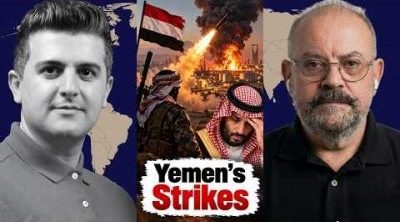
Elijah Magnier: Yemen’s strikes are shattering Saudi Arabia’s long-term strategy
or go to
Aletho News Archives – Video-Images
From the Archives
British weapons and personnel doing much of the killing in Yemen
Press TV – June 18, 2019
A detailed report published by the Guardian newspaper has shown how Britain is massively contributing to Saudi Arabia’s devastating war on Yemen as it suggests that London is not only supplying the bombs that fall on Yemenis, but it provides the personnel and expertise that keep the war going.
The comprehensive report by Arron Merat published on Tuesday showed that Britain was doing much of the killing in Yemen as the country continues to provide Saudi Arabia with everything it needs to turn its southern impoverished neighbor into a graveyard.
“Every day Yemen is hit by British bombs – dropped by British planes that are flown by British-trained pilots and maintained and prepared inside Saudi Arabia by thousands of British contractors,” said Merat in the report. … continue
Blog Roll
 Aletho News
- Racist Seinfeld Dances for Joy as Bibi Unveils His New Map
- A West Bank War for Netanyahu’s Election Campaign, Could It Backfire?
- Yemen denounces European Parliament’s ‘hypocritical’ push to blacklist Ansarullah
- Qalibaf: UAE’s UN bid aims to ‘clear the runway’ for ‘Greater Israel’, whitewash genocide
- Pakistan reopens Iran border after boosting security: Report
- Why are so many Brazilians voting for Flávio Bolsonaro?
- Democrats Put Anti-Russia Agenda Ahead of American Workers
- Elijah Magnier: Yemen’s Strikes Are Shattering Saudi Arabia’s Long-Term Strategy
- Pentagon designates Chinese cultural centers national security threat
- Israel Demolishes Home Of Lebanese Journalist Whose Viral Film Exposed Pager Attack
- If Americans Knew
- An error has occurred; the feed is probably down. Try again later.
- No Tricks Zone
- Sudden Stratospheric Warming, Powerful El Niño Combination May Lead To Extreme Europe Cold, Energy Crisis!
- Two New Studies Find Thwaites Glacier Melt Cannot Be Driven By Human Activity Or A Warming Ocean
- E-Cars Reduce CO2 Emissions By Only 41% Compared To Internal Combustion Engine Vehicles
- Predictions Made By Renowned Climate Professor Over Past Decades Have Been Proven To Be Poor
- New Study Suggests Large Regions Of The Pacific Ocean Have Been Cooling For The Last 80 Years
- Germany’s Green Energy Debacle: High Energy Costs Force Kahla Porzellan to Close After 182 Years!
- New Study: 50 Years Of The Most Aggressive ‘Net Zero’ Policies Can Only Affect The Global Climate By 0.03°C
- US September “Heat” Was No Record…Many Records Set Decades Ago
- Latest European Green Energy Debacle; Portugal’s Largest Flagship Solar Park Insolvent!
- Green Energy Debacle: German Expert Professor Fritz Vahrenholt Warns Of Severe Economic And Social Consequences

