Merck’s Taxpayer-Subsidized COVID Pill Linked to New Virus Mutations, Study Finds
By Michael Nevradakis, Ph.D. | The Defender | February 3, 2023
Merck’s oral antiviral pill for COVID-19, molnupiravir — marketed under the name Lagevrio — may be fueling the development of new and potentially deadly variants of COVID-19, according to the authors of a new preprint study.
The study, released Jan. 27 by a team of U.S. and U.K researchers, found, “It is possible that some patients treated with molnupiravir might not fully clear SARS-CoV-2 infections, with the potential for onward transmission of molnupiravir-mutated viruses.”
Merck received significant taxpayer funding from the Biden administration to develop and distribute molnupiravir, and the U.S. government bought nearly 2 million courses of the drug on the taxpayer’s dime.
The study, which is pending peer review, followed the discovery by a middle school science and math teacher in Indiana who found numerous variants of COVID-19 emerged after molnupiravir began to be widely distributed.
Scientists had long warned that the development of such mutations from the use of molnupiravir was possible.
“It’s not a surprise that molnupiravir could cause [the] escape of mutant virus strains or substrains into the population,” said Dr. Harvey Risch. “Its main function is to get the virus to mutate faster.”
Risch, professor emeritus and senior research scientist in epidemiology (chronic diseases) at the Yale School of Public Health, told The Defender :
“The idea is that it will mutate itself to death. But some live mutants could get out, and this paper gives evidence that they have.”
Brian Hooker, Ph.D., P.E., chief scientific officer for Children’s Health Defense, said the study’s authors scanned global SARS-CoV-2 sequence databases looking for mutations characteristic of those by molnupiravir (G-to-A and C-to-U) and found an uptick of those mutants starting in 2022 — after molnupiravir was put on the market and specifically in countries where molnupiravir was distributed.
“Although this isn’t ‘direct proof’ that the mutations came directly from molnupiravir use,” Hooker told The Defender, “the evidence is very compelling, confirming the fears of many who warned of this prior to FDA [U.S. Food and Drug Administration] approval of the drug in late 2021.”
The FDA granted molnupiravir Emergency Use Authorization (EUA) on Dec. 23, 2021, for use in mild-to-moderate COVID-19 infections in patients 18 and over.
The EUA came just one day after the FDA authorized Pfizer’s COVID-19 antiviral treatment Paxlovid.
Merck this week announced massive revenues from sales of molnupiravir in 2022, but projected a significant decrease in those sales in 2023.
The FDA on Wednesday removed the requirement that a person has to test positive for COVID-19 in order to get a prescription for molnupiravir or Paxlovid.
‘I think we are courting disaster’
Molnupiravir “works by creating mutations in the COVID-19 genome that prevent the virus from replicating in the body, reducing the chances it will cause severe illness,” according to Bloomberg.
However, according to Science, the findings of the preprint study suggest “some people treated with the drug generate novel viruses that not only remain viable, but spread.”
This finding “underscores the risk of trying to intentionally alter the pathogen’s genetic code,” leading some researchers to “worry the drug may create more contagious or health-threatening variations of COVID,” Bloomberg reported.
Virologist William Haseltine, Ph.D., chair and president of ACCESS Health International, has repeatedly raised such concerns about molnupiravir.
“It’s very clear that viable mutant viruses can survive [molnupiravir treatment] and compete [with existing variants],” Haseltine told Science. “I think we are courting disaster.”
According to the Gateway Pundit, “When one studies how Lagevrio works, this should not come as a shock. The pill attacks the COVID virus by trying to alter its genetic code.”
The Gateway Pundit reported:
“Once inside a human cell, a virus can make 10,000 copies of its genetic code in a few hours. Each copy made increases the risk the virus makes a rare mistake and creates an inexact replica.
“This is how mutations happen as we have seen with COVID. A drug that deliberately alters a virus’s genetic code would greatly increase the mutation risk.”
Dr. Jonathan Li, a virologist and the director of Li Laboratory, associated with Harvard Medical School and Brigham and Women’s Hospital, told Bloomberg :
“There’s always been this underlying concern that it could contribute to a problem generating new variants. This has largely been hypothetical, but this preprint validates a lot of those concerns.”
According to Science, Haseltine and other scientists have long worried that molnupiravir would create COVID-19 mutations that “would survive and propagate — and perhaps turn out to be more transmissible or virulent than before.”
A Merck spokesperson described that theory as “an interesting hypothetical concern,” prior to the drug receiving EUA.
The same scientists also worried that aside from the virus, the DNA of those receiving the drug might also mutate, Science reported.
These concerns led “researchers and citizen scientists” to examine COVID-19 genome sequences cataloged in the international GISAID (Global Initiative on Sharing Avian Influenza Data) database, seeking to identify mutations likely to be caused by molnupiravir.
‘Clearly something is happening here’
Searching for these mutations was based on the premise that, “Rather than inducing random changes in the virus’ RNA genome, [molnupiravir] is more likely to cause specific nucleic acid substitutions, with guanine switching to adenine and cytosine to uracil,” added Science.
Through this process, Ryan Hisner, a middle school science and math teacher from Monroe, Indiana — described by Science as a “virus hunter” — ultimately “identified dozens of sequences that showed clusters of those hallmark substitutions.”
Hisner took to Twitter with his concerns, where he came into contact with Thomas Peacock, Ph.D., a virologist at the Imperial College London. They and other U.K. and U.S. researchers “systematically reviewed more than 13 million SARS-CoV-2 sequences in GISAID and analyzed those with clusters of more than 20 mutations,” according to Science.
The team found “a large subset showed the hallmark substitutions; all dated from 2022, after molnupiravir began to be widely used,” Science reported.
According to the preprint study, Molnupiravir, “acts by inducing mutations in the virus genome during replication. Most random mutations are likely to be deleterious to the virus, and many will be lethal.”
However, the researchers wrote:
“It is possible that some patients treated with molnupiravir might not fully clear SARS-CoV-2 infections, with the potential for onward transmission of molnupiravir-mutated viruses.
“We set out to systematically investigate global sequencing databases for a signature of molnupiravir mutagenesis. We find that a specific class of long phylogenetic branches appear almost exclusively in sequences from 2022, after the introduction of molnupiravir treatment, and in countries and age groups with widespread usage of the drug.
“Our data suggest a signature of molnupiravir mutagenesis can be seen in global sequencing databases, in some cases with onwards transmission.”
Peacock told Science these “signature clusters” were up to 100 times more likely to be identified in countries where molnupiravir was widely used, including the U.S., U.K. and Australia, as compared to countries such as Canada and France, where it was not in widespread use.
“Clearly something is happening here,” said Peacock.
Merck: ‘no evidence’ any antiviral agent has contributed to the emergence of circulating variants’
Theo Sanderson, Ph.D., a geneticist at the Francis Crick Institute and co-author of the preprint, told Science “We are not coming to a conclusion about risk” just yet, with regard to whether or not these mutations may lead to more severe COVID-19 variants.
Indeed, according to the preprint study, the variants identified by the researchers have not been shown to be more lethal or more evasive to immunity than other existing strains of COVID-19.
However, Haseltine illustrated the potential risk via the analogy of owning a pet lion: “Just because it didn’t bite you yesterday doesn’t mean it won’t bite you today.”
According to the Gateway Pundit :
“Merck was warned by multiple scientists their drug might create problematic mutations which would render the virus more dangerous and difficult to treat. The company decided to blow off any concerns and put Lagevrio [molnupiravir] on the market anyway.”
As previously reported by The Defender, Dr. James Hildreth, president and CEO of Meharry Medical College and member of Biden’s COVID-19 Health Equity Task Force, expressed concerns about mutant variants escaping.
In 2021, Hildreth told an FDA advisory panel, “Even if the probability is very low, one in 10,000 or 100,000, that this drug would induce an escape mutant from which the vaccines we have do not cover, that could be catastrophic for the whole world actually.”
Also in 2021, Haseltine told Science :
“You are putting a drug into circulation that is a potent mutagen at a time when we are deeply concerned about new variants. I can’t imagine doing anything more dangerous.
“If I were trying to create a new and more dangerous virus in humans, I would feed a subclinical dose [of molnupiravir] to people infected.”
Two other recent studies also called out molnupiravir, questioning its effectiveness and raising concerns the drug may help lead to the development of new COVID-19 variants.
A December 2022 preprint by a team of Australian researchers, found “this commonly used antiviral can ‘supercharge’ viral evolution in immunocompromised patients, potentially generating new variants and prolonging the pandemic.”
And a study published Jan. 28 in The Lancet found, “Molnupiravir did not reduce the frequency of COVID-19-associated hospitalisations or death among high-risk vaccinated adults in the community.”
University of Cambridge clinical microbiologist Ravindra Gupta, Ph.D., told Science that while it’s unclear whether molnupiravir will cause deadlier COVID-19 variants, the overall results of these recent studies “call into question whether molnupiravir should be used.”
Merck spokesperson Robert Josephson defended the product, telling Bloomberg, “There is no evidence that any antiviral agent has contributed to the emergence of circulating variants.”
Molnupiravir ‘different’ than Paxlovid — and ‘riskier’
Although molnupiravir is similar to Paxlovid in that both are oral antiviral treatments for COVID-19, Hooker told The Defender there are significant differences in how the two drugs work:
“Molnupiravir acts on the SARS-CoV-2 virus by directly inducing mutations in the RNA genome. This is a completely different mode of action compared to Pfizer’s product, Paxlovid, and in my estimation is quite dangerous.
“Merck claimed the mutation rate induced by molnupiravir would kill the virus and that mutants wouldn’t escape, but that has been shown to be false in studies of immunocompromised patients.”
Hooker said Paxlovid — and the COVID-19 vaccines — can potentially lead to the development of mutations as well.
But in his view, the “mechanism of action” used by molnupiravir is different — and far riskier — than Paxlovid and COVID-19 vaccines, which merely increase the virus’ lifetime in the human body, giving the virus a greater opportunity to naturally mutate.
Hooker said:
“In contrast, molnupiravir directly induces mutations and thereby vastly increases the mutation rate of the virus in the human host.
“In my estimation, this is a very dangerous way to treat such an infection, given the implications of creating random mutants.”
Merck made billions from molnupiravir — thanks to taxpayers
In 2022, sales of Merck’s molnupiravir hit $5.68 billion, fueled in part by strong fourth-quarter sales of the drug in Asia.
Fourth-quarter sales of molnupiravir reached $825 million, more than doubling analyst expectations of $358 million.
These strong earnings were boosted by government — or taxpayer — support.
In June 2021 — with molnupiravir still in clinical trials, which weren’t completed until October 2021 — the federal government signed a $1.2 billion contract with Merck for 1.7 million courses of the drug, at a cost of approximately $712 per patient.
An analysis by Melissa Barber of the Harvard T.H. Chan School of Public Health and Dzintars Gotham of King’s College Hospital in London found the cost of production of molnupiravir was approximately $1.74 per unit — or $17.74 for a five-day regimen.
By those calculations, the U.S. government paid a near-4,000% markup.
In March 2022, during his State of the Union address, President Biden announced the “Test to Treat” initiative, which allowed those who tested positive for COVID-19 at a pharmacy to obtain free antiviral pills — including molnupiravir — on the spot.
One month earlier, the Biden administration had proceeded with a new purchase of 3.1 million courses of molnupiravir, with the option to purchase more.
Estimates for Merck, and other COVID-19 drugmakers, are less rosy for 2023, as the public tires of all things pandemic and Biden looks to end the COVID-19 national emergency in May.
According to Reuters, sales of molnupiravir are expected to fall to about $1 billion this year, contributing to an expected decline in sales for Merck from $59.3 billion in 2022 to $57.2-$58.7 billion this year.
Merck’s stock price dropped by about 2% with Thursday’s announcement.
Despite these large earnings, overall sales of molnupiravir lagged significantly behind Paxlovid in 2022. Sales of Paxlovid reached $18.9 billion last year.
Michael Nevradakis, Ph.D., based in Athens, Greece, is a senior reporter for The Defender and part of the rotation of hosts for CHD.TV’s “Good Morning CHD.”
This article was originally published by The Defender — Children’s Health Defense’s News & Views Website under Creative Commons license CC BY-NC-ND 4.0. Please consider subscribing to The Defender or donating to Children’s Health Defense.
The Alarming Trend in Core Mortality Since the Vaccine Rollout
BY NICK BOWLER | THE DAILY SCEPTIC | FEBRUARY 3, 2023
In a previous article I introduced the concept of looking at mortality from non-respiratory causes (i.e., not deaths from flu, Covid or other similar pathogens) as a better indicator of core mortality changes in the U.K. population than either excess deaths alone (or even excess non-Covid deaths). This is because most of the variation in the number of deaths between winter and summer and from year to year are due to respiratory causes; thus, take those out and you get a clearer picture of the underlying health of the population and whether people are generally getting sick and dying more or less than in recent years from causes such as cardiovascular problems, cancer, Alzheimer’s and so on.
I decided to go back and re-analyse the data in order to see how excess non-respiratory mortality has accumulated over the last few years. I discovered that this showed a total for 2021, 2022 and 2023 (thus far) of 49,696 deaths. When one takes into account the mortality displacement for this time period (owing to the pandemic bringing expected deaths forward; explained here), which I estimate as 23,650 deaths, the non-respiratory excess mortality reaches 73,346 deaths.
Comparing this to the number of deaths due to Covid (as underlying cause) over the same time period, which total 89,629 deaths, we see that the Covid figure is just 16,283 or 22% higher. Bearing in mind that it is widely acknowledged that there has been overcounting of Covid deaths (and thus conversely undercounting of non-respiratory deaths), the two tallies are now broadly similar, and thus an emergency situation at least as dangerous as the pandemic itself has arisen, which must surely now be addressed by the authorities.
To highlight the overcounting of Covid deaths, one only need compare the data for ‘deaths due to’ against ‘deaths with’ for COVID-19, and contrast it with the figures for other respiratory diseases. For Covid around 82% of deaths ‘with Covid’ are claimed to be ‘due to’ Covid over the course of the pandemic, yet with all other respiratory diseases only 34% of deaths ‘with’ the disease are claimed to be ‘due to’ it. The reason for the considerable discrepancy is unclear and suggests Covid is being significantly over-attributed as underlying cause.
For this article I calculated the number of excess non-respiratory deaths (relative to 2015-2019 pre-Covid averages) for each week of the year, and then calculated the cumulative values over the course of a full year. These charts confirm the suitability of the concept of non-respiratory mortality to serve as a stable core mortality rate that does not normally vary significantly from year to year. This is because there is a clear tendency (pre-Covid) for the cumulative non-respiratory mortality values to tend back to zero (i.e., the x-axis) if there has been a period of abnormal positive or negative values for an extended time. This indicates the role of mortality displacement in causing overall deaths to even out over time.

In fact, even in 2020 the shape of the curve (orange) looks very similar to the pre-Covid curves, excepting for the sudden spike at the beginning of the first wave of the pandemic when chaotic counting was arguably occurring. Without this the curve would hug the x-axis pretty much all through the year.
When we look at the curves for 2021, 2022 and 2023, however, the pattern changes radically. From week 18 in the spring of 2021 onwards the curve begins to point only upwards, and it further accelerates from the spring of 2022 and once again in the early part of 2023.

Please note all these curves are generated from the raw data from the ONS weekly reports for England and Wales. They are not adjusted for mortality displacement or anything else.
Putting all these curves together on one chart illustrates the changing pattern over the course of the pandemic, and in particular the striking upward turn in the spring of 2021.
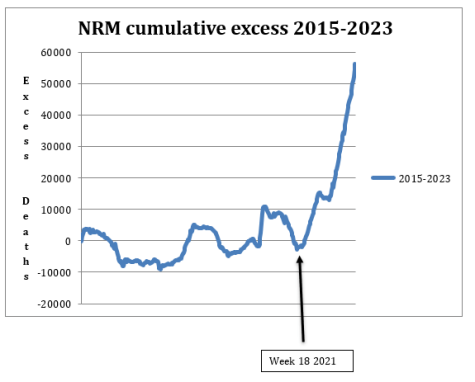
Note that there appears to be little evidence of any need for an age-standardised adjustment to prevent an upward drift in death rates owing to an ageing population. Even after six years from the beginning of 2015 through to the end of 2020, the cumulative non-respiratory mortality is still around the zero mark, and even dips a little below in the first three months of 2021 (remember this is mortality with the respiratory deaths including Covid taken out).
Recent articles from Dr. Noah Carl have questioned whether mortality was unusually high in 2022 because, when the figures are adjusted for an ageing population using the age-standardised mortality rate (ASMR), excess deaths come out low. The ASMR is a hypothetical construct that is used to adjust crude mortality data for changes in the age structure of a population. It relies on a standardised population model that provides the weightings in the population of different age groups. This is a very useful model that can make sense of changing mortality rates over time when studying the demography of a population.
However, I would argue that it is not a useful model during times of exceptional change, as it relies on assumptions of weightings that change only incrementally over time and doesn’t take into account when a large number of deaths occur unexpectedly in older age groups. During the Covid pandemic there have been nearly 200,000 excess deaths (relative to the 2015-2019 average), and these are largely concentrated in the oldest age groups, i.e., the groups that provide the bulk of ‘normal’ mortality.
In particular, the over-80 age group comprises just 4.6% of the U.K. population yet delivers almost 60% of deaths in a normal year. As the U.K. population is roughly 67 million people, this puts the over-80s at about three million persons. The occurrence of 200,000 excess deaths in this age group implies a drop in the ‘weighting’ of this age group in the age make-up of the population of some 6.5%.
As the mortality in the U.K. in recent times has averaged about 600,000 deaths per year, a 6.5% adjustment in 60% of them would represent about 24,000 fewer deaths to be expected in 2022 than standardised models would predict, counteracting the ASMR expectation that the number of deaths should rise owing to an ageing population. 2022 has, however, seen something of a record year in overall mortality figures.
This is why, instead of looking at a misleading age-standardised mortality rate, we get a much better picture of what’s going on if we look at non-respiratory mortality as a measure of ‘core’ mortality, taking out the highly variable respiratory deaths. It’s worth noting here that it’s possible that the reason ‘core’ non-respiratory mortality has remained stable over recent years rather than rising as the age-standardised model would predict is because stronger winter flu seasons such as 2017-18 have naturally counteracted the effect of ageing on ‘core’ mortality.
The actuarial profession certainly seems to agree that there is a negative trend in underlying life expectancy based on what has been happening in 2022.
The upshot of this analysis of non-respiratory mortality is that something extraordinary has been occurring in the trends in core mortality since spring 2021, notably around the time of the Covid vaccination rollout. This worrying trend is currently accelerating and requires an urgent inquiry into whether the vaccinations themselves are playing a part or, if not, what is going on.
Douma locals, medical personnel deny veracity of 2018 ‘chemical weapons attack’
The Cradle | February 2, 2023
Locals and medical personnel from the Syrian city of Douma in the Damascus countryside confirmed on 2 February during a press conference in the country’s Foreign Ministry headquarters that the alleged 2018 chemical attack on the city was, indeed, staged.
This follows the release of a new report by the Organization for the Prohibition of Chemical Weapons (OPCW) on 27 January, which once again renewed the accusation that Damascus was behind a 2018 chlorine gas attack on civilians in Douma.
“I live 400 meters from the place of the alleged incident, and I only learned of its occurrence the next day through social media,” Syrian lawyer Muhammad al-Naasan said during the press conference.
Another testimony is that of Dr. Hassan Oyoun, an ambulance worker at Douma Hospital, who claimed that “information was published a day before the alleged incident that it was necessary to prepare for an event that would result in a large number of injuries.”
This confirms that “prior preparations” were underway for the staging of the attack, Oyoun said, referring to the incident as a “fabricated play that was filmed.”
“What the terrorists announced about 800 injuries from chemical substances is incorrect, and the number of people who visited the hospital that day did not exceed 35,” he added.
According to Dr. Mumtaz al-Hanash, a Douma local, Douma Hospital announced just one day after the alleged attack that no chemically induced deaths were recorded whatsoever. He went on to say that the “photographed cases” did not provide evidence that chlorine, or any other weaponized chemical, was used.
An imam and preacher at a local mosque, Sheikh Ratib Naji, said: “We did not see with our own eyes any injured or dead, as they claimed, and those whom the terrorists claimed were dead, their bodies did not appear, and when we demanded them, they assaulted us.”
Syria’s permanent representative at the Hague-based chemical weapons watchdog, Milad Attiya, affirmed that Damascus does not recognize the OPCW investigation team’s third and latest report, as it rejected the last two. Attiya added that the report relies heavily on western sources, as well as groups such as Hayat Tahrir al-Sham (HTS) and the White Helmets, an Al-Qaeda affiliated rescue organization with links to organ trafficking networks in Syria.
Since 2013, armed groups in Syria have attempted to pin chemical attacks on the government to instigate internationally-led regime change operations against it. This comes in the form of staged attacks, or actual false-flag chemical attacks which leave many dead and are designed to implicate Damascus – as was the case in Ghouta in 2013 and in Khan Sheikhoun in 2017.
On 28 January, the Syrian government released a statement rejecting the OPCW report, which it said ignored “objective information which was provided by some … experts … and former OPCW inspectors with knowledge and expertise,” referring to the fact that the organization suppressed the findings of its initial report on Douma, as revealed by WikiLeaks in 2019.
US giving cold feet to countries willing to normalize with Syria
Press TV – February 3, 2023
The United States is actively working to discourage countries willing to normalize relations with Syria, according to a report.
The report, based on the summary of a recent UN Security Council meeting on Syria seen by al-Akhbar, shows that Washington has tried to draw “red lines” for countries seeking to normalize with Syria, return the Syrian refugees to their homeland, or help find a permanent solution to the crisis in the Arab country.
Regarding the return of refugees, the report said instead of encouraging a repatriation process, the United States is urging the host countries to “double their support” for refugee programs, despite the heavy social and economic burden the refugee crisis puts on some of these countries, most notably Lebanon.
Al-Akhbar said the European representatives present in the meeting conditioned their support for the reconstruction of Syria and the repatriation of refugees on Damascus accepting a “credible and comprehensive political process” – which is considered by many to mean a political process dictated by Washington.
The report said that the summary of the meeting, which was held on January 25, shows the US-led camp continues to block a rapprochement – facilitated by Russia and Iran – between Syria and Turkey.
Ankara resumed diplomatic contacts with Damascus in late December, following a decade of severed ties in the wake of the crisis in Syria.
Turkey has now announced its willingness for a meeting between President Recep Tayyip Erdogan and his Syrian counterpart Bashar al-Assad.
A number of Arab countries have also resumed contact with Syria, including Oman and the United Arab Emirates.
Attempts by France & Germany to Negotiate With Russia Should Be Prevented, Bolton Tells Pranksters

By Andrei Dergalin – Sputnik – 02.02.2023
John Bolton shared his thoughts on topics such as the anti-Russian sanctions imposed by the West and the prospects of Ukraine’s NATO membership with Vovan and Lexus.
Former US presidential advisor John Bolton has made some rather frank admissions during a phone conversation with whom he thought was the ex-president of Ukraine, Petro Poroshenko.
Alas, his interlocutor turned out to be the well-known Russian prankster duo known as Vovan and Lexus, who promptly spilled the beans online.
During the chat, Bolton apparently insisted that all attempts by Germany or France to hold negotiations with Russia amid the current crisis in Ukraine should be disrupted, and claimed that the sooner Ukraine and Georgia become members of NATO, the better.
Regarding the sanctions imposed by western powers against Russia, Bolton complained that they weren’t enough and that Moscow continues to bypass these punitive measures.
He also commented on the promise made over three decades ago by former US Secretary of State James Baker to the former leader of the USSR Mikhail Gorbachev regarding NATO not expanding to the east, claiming that Baker merely “launched into arguments and looked for ways to avoid confrontation,” as the pranksters put it.
‘Türkiye and UAE told to cut trade ties with Russia’
RT | February 3, 2023
US officials have warned Türkiye and the United Arab Emirates against maintaining economic and financial ties with Russia because trade is undermining sanctions, Bloomberg reported on Friday, citing people with knowledge of the matter.
The warnings were reportedly voiced by the undersecretary for terrorism and financial intelligence at the US Treasury, Brian Nelson, during meetings with Turkish officials on Thursday and Friday.
Nelson’s visit to Türkiye comes as part of a regional tour that included the UAE earlier this week, and is said to be aimed at discussing Washington’s concerns over rising exports to Russia that include US goods.
US officials have called on the two countries to clamp down on the flow of goods to Russia, the sources told the news agency, adding that millions of dollars’ worth of export-controlled items were reaching the sanctions-hit country, and could be used by the defense industry to extend the conflict in Ukraine.
Scores of Turkish exporters shipped over $800 million worth of goods to Russia, including $300 million in machinery and another $80 million in electronics in the eight months through October 2022, according to people who spoke on condition of anonymity.
Other areas of concern reportedly include Russian vessels either sanctioned or subject to export controls making port calls in Turkey.
Meanwhile, the UAE has maintained ties with both Ukraine and Russia. The Gulf state’s ruler, Mohammed bin Zayed Al Nahyan, traveled to meet Russian President Vladimir Putin in October amid the continuing conflict in Ukraine. The leaders expressed Moscow and Abu Dhabi’s willingness to develop cooperation on all levels.
‘Nobody can tell us how to live’: Hungary slams US envoy for meddlesome remarks
“We welcome non-governors and non-regents”
Press TV – February 3 2023
Hungarian Foreign Minister Peter Szijjarto has lashed out at the US ambassador to Budapest for meddling in the country’s internal affairs over its support for Russia, saying, “Nobody can tell us from the outside how to live.”
Szijjarto issued the scathing rebuke on Thursday after David Pressman, who has represented Washington in Budapest since September last year, censured Hungary’s push for the continuation of policies endorsed by Russian President Vladimir Putin and the country’s opposition to Western-led anti-Russia sanctions over the conflict in Ukraine.
“Nobody can tell us from the outside how to live, so it is of no interest what a citizen of another country – be it an ambassador – thinks about the domestic political processes in Hungary,” Szijjarto said at a press conference. “We ask for more respect for the Hungarians, even from the ambassador.”
Stressing that it is not Pressman’s “job to interfere in the internal affairs of Hungary,” the Hungarian foreign minister said, “If he wants to use his stay in Hungary to qualify the activities of the government elected by the Hungarian people with a fairly clear majority… then he will have a very difficult time.”
Szijjarto said when Hungary receives foreign ambassadors, it expects them to behave appropriately and work to improve bilateral relations, emphasizing that the era of foreign envoys telling Hungarians how to live in their own country “is over.”
Hungary has on numerous occasions voiced opposition to Western sanctions against Moscow in response to Russia’s protracted military operation in Ukraine, arguing that the restrictions have wreaked havoc on the EU economy.
Last month, Hungarian Prime Minister Viktor Orban also slammed Germany’s decision to support Ukraine by supplying 14 Leopard 2 tanks, warning that such steps would make Western countries active participants in the conflict. Orban stressed that, instead of arming Kiev, the West should pursue “a ceasefire and peace talks” in Ukraine.
Russia launched what it calls a special military operation in Ukraine on February 24, 2022, over the perceived threat of the ex-Soviet republic joining NATO and to “de-Nazify” Kiev. Since then, the United States and Ukraine’s other allies have sent Kiev tens of billions of dollars’ worth of weapons, including rocket systems, drones, armored vehicles, tanks, and communication systems.
Western countries have also imposed a slew of economic sanctions on Moscow. The Kremlin has said the sanctions and the Western military assistance will only prolong the war.
Russia ramps up global food exports
RT | February 3, 2023
Russia’s food exports jumped by 12% in monetary terms last year to more than 70 million tons, despite difficulties caused by Western sanctions, the country’s Ministry of Agriculture reported on Thursday.
The ministry highlighted that domestic agricultural products had been supplied to 150 countries, emphasizing that Russia’s contribution to world food security is constantly growing.
According to the latest report, exports of oil and fat products soared by 26%, meat and dairy products rose by 16%, and grain exports increased by 14%.
The ministry also noted good results in its work on reorienting export flows, building new logistics chains, and financial transactions, as well as facilitating conditions for providing state support. “This will help to further increase exports to priority markets,” it concluded on its Telegram channel.
Western sanctions imposed on Russia have been disrupting the country’s food supplies to the world market, threatening to exacerbate the global food crisis.
Russian President Vladimir Putin has repeatedly stated that, despite the obstacles, Russia remains ready to help poor nations battle hunger, providing them with the “necessary assistance.”
Latest IMF data shows Russia outperforming Germany and UK
By Drago Bosnic | February 3, 2023
After the US-led political West imposed the most comprehensive sanctions in recorded history in an attempt to destroy the Russian economy, the most sanctioned country on the planet was expected to be isolated, economically devastated, with no access to high technologies of any kind and, most preferably, with an extremely angry populace, potentially causing protests and eventually a coup that would bring down the Russian government and bring about the “free and democratic” (i.e. compliant) Yeltsin-style puppet regime. And yet, despite nearly a year of this unprecedented economic siege, the Russian economy isn’t only still standing, but it’s even growing.
Russia’s trade exchange with the world is surging (by dozens of times in some cases) and, according to the latest data by the International Monetary Fund, it’s now expected to outperform both the United Kingdom and Germany, two of the leading European economies. The goal of making the Russian people quite angry was accomplished however – the Russians are furious at the political West and stand united in a way not seen since the Second World War, making the idea of a pro-Western coup in Moscow a perpetual pipe dream of the political elites in Washington DC and Brussels. Worse yet, if a coup ever happens, it would only bring more anti-Western political parties to power.
At first, the effects indeed seemed catastrophic for the Russian economy, with the ruble apparently in free fall and the stock market effectively shut down. However, after initially losing over 40% of its value, the embattled Russian currency didn’t just rebound, but also gained momentum and reached values higher than those before the start of Russia’s counteroffensive. And now, the latest IMF forecast predicts that Russian economic growth will outperform that of Germany, while the UK will go through a recession, as its economy was at its worst in over 300 years and is expected to perform even worse this year.
The prediction would have been nearly impossible to imagine less than a year ago and would have surely caused a roar of laughter in the mainstream media. In early March last year, US Treasury Secretary Janet Yellen boasted that “the Russian economy will be devastated.” The Russian government itself also expected a dramatic GDP contraction, with the finance ministry reportedly gearing up for at least a 10% decline. Even in December, many leading economists expected the GDP fall in 2023 to be 2.5%. And yet, the Russian economy fell by 2.2% in 2022 and is expected to grow at least 0.3% this year and 2.1% in 2024. The numbers indicate that the UK is in a recession and is expected to have a 0.6% GDP fall, while Germany will barely stay afloat with a 0.1% growth.
The sanctions were designed to cut off Russia from the international financial system by essentially stealing hundreds of billions of dollars of its foreign exchange assets, making it virtually impossible for Moscow to do business with basically anyone. Or so it seemed. However, what eventually happened was nearly a complete dedollarization of Russia’s trade exchange, as the Eurasian giant simply switched to trading in the domestic currencies of its international partners, including China and India. This made it possible for Russia’s industry to not only maintain its existing production level in the first 10 months of last year (officially it was down by a paltry 0.1%), but to even start growing in November and December. It’s expected to grow even more in 2023.
Additionally, Russia is home to many of the world’s most essential commodities, such as oil and natural gas. Moscow continues to hold dominant positions in global markets, including being the leading exporter of fertilizer and food. The world simply cannot afford to ignore Russia and there’s no indicator that it even wants to, despite the political West’s frenzied attempts to portray Moscow as the supposed “international pariah”. More than 80% of the planet not only continues to work with Russia, but is actively expanding its cooperation with the superpower. And while the political West is effectively trying to impose an oil and gas embargo on itself by sanctioning Moscow, giants such as China and India are increasing their Russian energy imports.
According to Bloomberg, India was importing 1.2 million barrels of Russian oil per day in 2022, an increase of 33 times in comparison to 2021. This is also expected to grow in 2023. Turkey, one of NATO’s leading members, also continues to expand its trade relations with Russia. In December, it imported 213,000 barrels of Russian diesel per day, a record amount in the last 7 years. Ankara also used the opportunity that many Western companies were forced by their governments to leave, so its export to Russia doubled, surpassing $1.3 billion. Imports from China increased substantially as their companies also filled the gaps left by their Western counterparts.
Despite all of its Russophobic posturing, the European Union also spent more than $150 billion on buying Russian fossil fuels in 2022. The EU’s suicidal anti-Russian sanctions caused a surge in energy costs, which hit both Germany and the UK, causing an exponential increase in inflation and severely undermining the purchasing power of hundreds of millions of regular Europeans. The latest data shows that retail sales in Germany fell sharply in the last two months of 2022, despite expectations of a slight increase due to Christmas and New Year. While economists expected sales to increase by at least 0.2%, what actually happened was a dramatic 5.3% fall.
The UK has been hit the hardest as inflation, mostly fueled by food and energy price spikes, has a detrimental effect on the cost of living. This also caused unprecedented political instability in London, with two prime ministers resigning in mere months, all with starkly different economic and fiscal policies, resulting in near complete chaos in the UK markets.
In contrast to this, Russia not only withstood the hammer of the political West’s sanctions war, but it’s now hitting back and Western economies are certainly feeling the bite. All the while, the Eurasian giant also continues to conduct its counteroffensive against NATO aggression in Europe and is now in the midst of preparations for a final push that could end the Ukraine crisis.
Drago Bosnic is an independent geopolitical and military analyst.
Witness Forced to Walk Back Accusations That Led Maine Medical Board to Suspend Dr. Meryl Nass’ License
By Michael Nevradakis, Ph.D. | The Defender | February 1, 2023
The Maine Board of Licensure in Medicine on Tuesday held its third hearing on the suspension of Dr. Meryl Nass related to her treatment recommendations for patients with COVID-19.
As it did on day two of the hearings, held on Oct. 27, 2022, the board focused on Nass’ alleged “sloppy” record-keeping for three patients she treated and on her prescribing of ivermectin and hydroxychloroquine for those patients.
The board suspended Nass, a member of the Children’s Health Defense scientific advisory board, on Jan. 12, 2022, without a hearing.
The board initially accused Nass of “unprofessional” and “disruptive” behavior, spreading “misinformation” and prescribing hydroxychloroquine and a “deworming medication” (ivermectin) to patients.
However, the board withdrew the accusations of “misinformation” on Sept. 26, 2022, just prior to her first hearing date, Oct. 11, 2022.
The board’s case now rests on Nass’ alleged non-adherence to the medical “standard of care” as it pertained to ivermectin and hydroxychloroquine for treating COVID-19 and on the alleged “record-keeping” issues.
Two witnesses hired by the board — Dr. Thomas Courtney of the Maine Medical Center and Dr. Jeremy Samuel Faust, an emergency physician at Brigham and Women’s Hospital in Massachusetts and instructor at Harvard Medical School — testified during Tuesday’s proceedings, and Nass’ attorney, Gene Libby, cross-examined Courtney.
Cross-examination pokes holes in ‘expert witness’ testimony
Throughout his testimony, Courtney repeated his assertion that Nass did not follow an adequate standard of care in prescribing ivermectin and hydroxychloroquine to three patients, alleged improprieties in her communication and remote (telemedicine) consultations with the patients, and claimed Nass’ record-keeping was lacking.
But Courtney was obliged to walk back significant portions of his earlier testimony under his cross-examination by Libby.
For instance, Courtney claimed Nass did not adhere to an appropriate standard of care because she failed to advise two of her patients who didn’t recover as expected to seek care at an emergency room.
But under cross-examination, he acknowledged Nass had, in fact, advised the patients to go to the ER.
Courtney also criticized Nass for not prescribing monoclonal antibodies to her patients, one of whom was pregnant.
However, when cross-examined, Courtney admitted that, unlike hydroxychloroquine, monoclonal antibodies were not recommended for pregnant women and most monoclonal antibodies available at the time Nass was advising her patients were known to be ineffective against the Omicron variant of COVID-19, the dominant strain of the virus at that time.
Libby pointed out that the pregnant patient fully recovered eight days after the onset of her illness and had a normal birth, during which she was administered hydroxychloroquine and monoclonal antibodies.
Because evidence shows monoclonal antibodies are ineffective for pregnant women, the patient’s full recovery was credited to hydroxychloroquine.
Courtney also criticized Nass for making decisions about a patient’s care, including which medications to prescribe, on the basis of incomplete medical records.
He later walked back those claims after Libby demonstrated that Nass had received extensive documentation about the condition of one of the patients from his spouse, who provided Nass with vital signs, including the patient’s blood oxygen level.
Libby noted the three patients had specifically requested not to be treated with remdesivir, had asked to be prescribed ivermectin and hydroxychloroquine — and were fully within their rights as patients to request such treatment. Courtney was obliged to concur.
Libby also pointed out that off-label prescriptions of medications such as ivermectin and hydroxychloroquine, even for uses other than their primary purpose, are well within the generally accepted standard of care for physicians, and that federal agencies such as the U.S. Food and Drug Administration (FDA) and the National Institutes of Health do not issue binding requirements in this regard.
Courtney confirmed these statements.
In another characteristic exchange, Courtney, who had previously been critical of alleged gaps in Nass’s record keeping, was forced to concede that he did not “personally have a strong opinion on it.”
Referring to Courtney’s testimony, Nass wrote on her blog that despite his “opining that I lacked the fitness to practice medicine, he was unable to identify a single thing I had done wrong in my records.”
“I sent 2 patients to the ER when they did not recover as expected, although one of the board’s initial charges against me was that I failed to do so,” Nass wrote.
She likened the board’s accusations against her to “simply throwing lots of spaghetti on the wall to try and overwhelm me with charges so I would wilt and surrender my license.”
Referring to the medical claims Courtney made, Nass wrote:
“Courtney did not know the difference between an EUA [Emergency Use Authorization] product and a licensed drug. He incorrectly repeated a false claim made only once by FDA that the EUA for HCQ [hydroxychloroquine] was withdrawn because you would need to administer a toxic dose to get benefit. He had clearly failed to give that assertion any thought. Nor had he evaluated the U.S. government literature showing it to be false.
“He thought I should have treated 2 outpatients with monoclonal antibodies, but eventually agreed that cases in December 2021 were a mix of Omicron and Delta when the patients were ill, that none of their variants had been sequenced so we did not know which variant they had, and the monoclonals would not have worked against Omicron variants, which were likely to have been present then.”
“Doctor Courtney doesn’t read journal articles,” Nass wrote. “He sticks by the recommendations of government agencies and his specialty organization, the Infectious Diseases Society of America (IDSA).”
Nass noted that the IDSA was sued by the State of Connecticut “for denying the existence of chronic Lyme disease.”
In the brief time that was available for Faust to begin his testimony, he focused on attacking the credibility of Dr. Harvey Risch, an epidemiologist at the Yale University School of Public Health, for a journal article he wrote finding that treatments such as hydroxychloroquine were effective against COVID-19.
Nass had relied in part on Risch’s findings in dispensing hydroxychloroquine to her patients. During his testimony, Faust claimed, “There’s no disagreement here among the most prestigious experts in this area” with regard to the purported lack of effectiveness of hydroxychloroquine in treating COVID-19 patients.
Nass wrote:
“Faust was the Board’s epidemiology expert. He got some of the epidemiology right and he got a lot wrong. His arrogance when he was not sure of the answer was off-putting. He insulted Yale epidemiology professor Harvey Risch. He insulted my ability to read a journal article and he had a novel theory that this was sufficient disqualification to justify revoking my license.
“No one mentioned that Dr. Courtney could not cite journal articles used for forming his opinions on COVID treatment, having solely relied on pronouncements from government agencies.
“Should his license be revoked for that? Of course not.”
Nass also pointed out that Faust is a proponent of pregnant women receiving multiple mRNA injections. For instance, he was the lead author of “Pregnancy should be a condition eligible for additional doses of COVID-19 messenger RNA vaccines,” published in November 2022 in the American Journal of Obstetrics and Gynecology MFM.
Nass also wrote that Faust “publicly melted down when the mask mandate on planes was lifted,” accusing the Centers for Disease Control and Prevention of “killing babies.”
Next hearing set for March 2
The Maine board has scheduled two more hearings, the next one for March 2.
However, according to Nass, “The questioning of Dr. Faust is likely to take half a day more. Then I have 8 witnesses to go, including 3 patients who are at issue.”
About 140,000 people tuned in to Tuesday’s live broadcast of the proceedings, according to Nass.
Children’s Health Defense is providing support for Nass’ legal team.
Michael Nevradakis, Ph.D., based in Athens, Greece, is a senior reporter for The Defender and part of the rotation of hosts for CHD.TV’s “Good Morning CHD.”
This article was originally published by The Defender — Children’s Health Defense’s News & Views Website under Creative Commons license CC BY-NC-ND 4.0. Please consider subscribing to The Defender or donating to Children’s Health Defense.
California to Ditch Plans to Mandate COVID Vaccines for Schoolchildren
By Brenda Baletti, Ph.D. | The Defender | February 2, 2023
California will end plans to mandate COVID-19 vaccines for schoolchildren when the state ends its COVID-19 state of emergency on Feb. 28, California Department of Public Health officials told EdSource, which reported the news on Wednesday.
Commenting on the news, Michael Kane, national grassroots organizer for Children’s Health Defense (CHD) and founder of NY Teachers For Choice, told The Defender :
“We [in the movement] have some really good momentum right now, and what just happened in California is indicative of that.
“People are done with this. They’re done with the most extreme portions of this COVID agenda, the idea of this shot in kids is a no-starter for anybody.”
Gov. Gavin Newsom announced in October 2021, that California would be the first state to require COVID-19 vaccinations for children to attend school. It was also the first to mandate masking and staff vaccination measures.
At the time, state Sen. Richard Pan proposed legislation to strengthen the vaccine requirement even further by eliminating personal and religious exemptions. The legislation didn’t pass.
The vaccine requirement for children was originally set to kick in on July 1, 2022, when it was expected the vaccines, still under Emergency Use Authorization at the time, would be fully approved by the U.S. Food and Drug Administration (FDA).
But in April 2022, California announced it would delay the mandate to July 1, 2023.
The FDA still has not fully approved the COVID-19 vaccines for anyone under age 12. The CDC recommends the vaccines and the bivalent boosters for children ages 6 months and older.
The bivalent boosters were authorized for emergency use without any human clinical trials.
In California, 67% of 12- to 17-year-olds and 38% of children ages 5 to 11 have received two doses of the COVID-19 vaccine primary series. Less than 42% of 12- to 17-year-olds and less than 30% of 5- to 11-year-olds have been boosted.
Those numbers are higher than national averages. Only 58% of children ages 12 to 17 and 32% of children ages 5 to 11 have received two doses of the vaccine.
“The booster uptake is a complete failure, so this idea of routinizing a COVID shot for school every year, which is what they wanted, is failing in all the states they thought it was a guarantee in,” Kane said.
California ended the school mask mandate in March 2022, and ended the vaccine mandate for teachers and school staff in October 2022.
‘This kind of coercion never should have been normalized’
In the last two years, while state lawmakers debated California’s school vaccine mandate, school districts across the state proposed and passed their own COVID-19 vaccine mandates.
Alex Gutentag, former Oakland public school teacher and political analyst, told The Defender :
“Newsom has referred to California as ‘the true freedom state,’ but he more than any other U.S. governor has tried to undermine the medical freedom of kids and their families when it comes to COVID-19.
“It is definitely a positive development that California is ending its plan for a school mandate, but it’s important to remember that many kids have already been coerced into vaccination through the threat of both statewide and local mandates.
“Several California cities, including Los Angeles, told families that COVID vaccines would be required to attend school in person, but eventually had to scrap and delay these plans. It was a clear effort to increase vaccine uptake, and was a major abuse of power. This kind of coercion never should have been normalized.”
The pressure to scrap mandate plans came in part from attorneys and citizen advocacy groups who brought three major lawsuits against the Los Angeles Unified School District (LAUSD), the Piedmont Unified School District and the San Diego Unified School District (SDUSD).
Children’s Health Defense-California Chapter (CHD-CA) and Protection of the Educational Rights of Kids (PERK), a California-based child advocacy group, used state laws to rule out local policies and pause vaccine mandates in the LAUSD and the Piedmont school district.
They sued the LAUSD, the second-largest school district in the U.S., alleging the district lacked the legal authority to impose a COVID-19 vaccine requirement for students ages 12 and older.
The mandate would have excluded 32,000 students from in-person classes.
After Judge Mitchell L. Beckloff ruled the case could go forward in April 2022, the LAUSD announced it would delay the COVID-19 vaccine requirement until July 1, when the state mandate kicked in.
Piedmont also voted to repeal its mandate after a judge granted CHD-CA and PERK’s Application for an Alternative Writ of Mandate and ordered the district to show why its policy could not be struck down.
In San Diego, a group called Let Them Choose filed a lawsuit contesting the SDUSD’s vaccine mandate for school children ages 16 and up. The court ruled, and in December 2022, an appellate court affirmed, that the district’s mandate violated state guidelines.
According to Rita Barnett-Rose, legal director of CHD-CA, the San Diego ruling established that individual school districts cannot institute COVID-19 vaccine mandates at the district level, because there is a statewide statutory scheme in place to set mandates.
That means the end of the California COVID-19 vaccine mandate for children at the state level will effectively end all school mandates in California.
Political will for mandates faltering across the country
Rita Barnett-Rose underscored that California health officials have not yet made the news about ending the mandate for the state’s schools official. However, she said, “Right now it looks like positive news.”
However, Barnett-Rose said, “The question still remains, are they [state legislature] going to try to put something on the legislative agenda this year?”
Gutentag also noted the lack of an official announcement:
“I also think it’s notable that officials only said they were not going to implement the mandate after EdSource pressed them for answers. State leaders probably knew that there were too many legal and logistical challenges, but did not want to admit this in order to save face.
“All Californians should be concerned that our state government is not honest and direct with us about major policy decisions.”
This shift in California’s school mandate decision is the latest in a string of developments calling into question the COVID-19 vaccines and marking a shift in public consensus on vaccines.
“I’m not surprised at all that California is admitting that it’s not politically possible to force a shot that’s unnecessary and dangerous on children to attend school,” Kane said, adding:
“It makes perfect sense to me, given what I am seeing in New York that this same type of pressure is in California.
“The entire thing is political. The whole thing is what can we politically do? They can’t politically force the shot on kids. The fallout is too much. They just can’t risk it, you know.”
Barnett-Rose told The Defender she thinks that when Newsom announced the mandate he thought a lot of other states would follow suit.
“I’m hoping this signifies that the political will to force these mandates on kids is really declining significantly.”
CDC adds COVID shots to child immunization schedule
California reversed its vaccine mandate decision despite the fact that in October 2022, the Centers for Disease Control and Prevention recommended adding COVID-19 vaccines for children as young as 6 months old to the new Child and Adolescent Immunization Schedule, which will be rolled out this month.
The revised recommendations include the Moderna or Pfizer-BioNTech COVID-19 vaccine for children as young as 6 months and the Novavax COVID-19 vaccine for children as young as 12 years.
All COVID-19 vaccines being administered in the U.S. to people under 18 are still Emergency Use Authorized (EUA) products.
The FDA did grant full approval to Pfizer’s Comirnaty COVID-19 vaccine for ages 12 and older. However, the Comirnaty vaccine is not available in the U.S. — which means all children who get the Pfizer vaccine are getting an EUA product.
The FDA also informed a congressional committee in May 2022 that the COVID-19 vaccines for children under 6 would not have to meet the agency’s 50% efficacy threshold required to obtain EUA.
COVID-19 vaccines for adolescents, teens and adults had to meet the requirement.
“If these vaccines seem to be mirroring efficacy in adults and just seem to be less effective against Omicron like they are for adults, we will probably still authorize,” Peter Marks, M.D., Ph.D., director of the Center for Biologics Evaluation and Research at the FDA, told the House Select Subcommittee on the Coronavirus Crisis.
Last week, The Epoch Times reported that recently released emails revealed top officials, including Marks, rushed approval of Pfizer’s COVID-19 vaccine to enable vaccine mandates, despite concern by others in the agency that the rush compromised the integrity of the approval process.
On Dec. 9, 2022, the CDC expanded the use of updated (bivalent) COVID-19 vaccines for children ages 6 months through 5 years. They made that decision despite the fact that the bivalent shots were approved for adults without any clinical data and have yet to show efficacy.
In an amicus brief for a lawsuit challenging the vaccine mandate for school children in the state of Louisiana, CHD wrote:
“Simply put, the COVID vaccines have not been shown to be either effective or safe for children. The benefits to children are minuscule, while the risks — including the risk of potentially fatal heart damage — are ‘known’ and ‘serious,’ as the [FDA] itself has acknowledged.”
The Louisiana Department of Health rescinded the mandate.
Legal struggles continue over age of consent for vaccines
Legal battles over vaccines for children in California and elsewhere are ongoing.
In California, Maribel Duarte is suing the LAUSD and Barack Obama Global Preparation Academy alleging they vaccinated her 13-year-old son without her consent.
A vaccine clinic was set up in his school — Barack Obama Global Prep Academy — and he was allegedly bribed with a pizza to get vaccinated without parental consent.
One of the adults at the clinic requested the teen provide a parent-signed consent form, which he did not have. The child was then told to sign his mother’s name and not tell anyone.
Currently, Sen. Cheryl Kagen of Maryland is proposing Senate Bill 378, which would allow children 14 and up to consent to vaccination themselves and prevent parents from accessing medical records.
California attempted to pass a similar bill, SB 866, for children ages 12 and up.
The District of Columbia also attempted to pass a similar law, for children 11 and older, but a preliminary injunction issued in March 2022 temporarily blocked the district from implementing the law.
CHD and the Parental Rights Foundation sued the district and are seeking to declare the D.C. act unconstitutional.
The D.C. school district still plans to mandate children be vaccinated against COVID-19 to attend school starting in the 2023-2024 school year, just not without their parents’ consent.
This article was originally published by The Defender — Children’s Health Defense’s News & Views Website under Creative Commons license CC BY-NC-ND 4.0. Please consider subscribing to The Defender or donating to Children’s Health Defense.
Featured Video

False Flags and the Dawn of Bioterrorism
or go to
Aletho News Archives – Video-Images
From the Archives
How 1960’s French Nuclear Tests Are Still Claiming Lives in Algeria
Sputnik – 15.02.2018
On February 13, 1960, France carried out its first nuclear test in Algeria’s southern Reggane region. According to official statistics, 17 nuclear tests were carried out in total over the next 6 years. The area remains affected, and local scientists say that radioactive contamination has caused genetic mutations and irreversibly changed the region.
There are no official statistics on the number of victims. The only figures can be found in the records kept by the French representative of the local church, which lists 42,000 victims of nuclear tests. Three years ago, the French Ministry of Defense issued a statement, putting the number at 27,000 people. The victims include French soldiers as well as local Algerians who lived in the surrounding areas. … continue
Blog Roll
 Aletho News
- Sunset on the Quality of Western Propaganda: Arrival of the Dr Strangelove Moment
- Ukrainian general accused of protecting crime bosses
- US-‘Israel’ alliance faces growing rupture after midterms
- GOP’s Crushing Midterm Loss Could Reshape US Political Landscape – Analyst
- Midterm loss gives Congress power to rein in US war on Iran
- Midterms Were ‘Vote of No Confidence’ in GOP, But Iran Has No Illusions About Democrats – Marandi
- Israeli Soldiers Inadvertently Prove Their Own Genocidal Guilt
- Ukraine arrests woman who exposed Azov battalion’s ‘torture chamber’
- Did Israel lose the midterms?
- How Iran defeated Trump’s Israel First GOP
- If Americans Knew
- An error has occurred; the feed is probably down. Try again later.
- No Tricks Zone
- New Study: The Net Fossil Fuel Contribution To Rising Atmospheric CO2 Has Been Zero For 500 Years
- Germany’s Green Energy Transition Becoming Increasingly Expensive…Another 6 Trillion Euros!
- Sudden Stratospheric Warming, Powerful El Niño Combination May Lead To Extreme Europe Cold, Energy Crisis!
- Two New Studies Find Thwaites Glacier Melt Cannot Be Driven By Human Activity Or A Warming Ocean
- E-Cars Reduce CO2 Emissions By Only 41% Compared To Internal Combustion Engine Vehicles
- Predictions Made By Renowned Climate Professor Over Past Decades Have Been Proven To Be Poor
- New Study Suggests Large Regions Of The Pacific Ocean Have Been Cooling For The Last 80 Years
- Germany’s Green Energy Debacle: High Energy Costs Force Kahla Porzellan to Close After 182 Years!
- New Study: 50 Years Of The Most Aggressive ‘Net Zero’ Policies Can Only Affect The Global Climate By 0.03°C
- US September “Heat” Was No Record…Many Records Set Decades Ago

