Lavrov comments on claims of US urging Ukraine to negotiate
RT | November 15, 2022
Western media reports that the US government has tried to nudge Kiev towards engaging diplomatically with Moscow are mere rumors, Russian Foreign Minister Sergey Lavrov said on Tuesday. Even if true, the Ukrainian leadership appears to be ignoring the suggestions, he added.
“We’ve read reports citing anonymous sources,” Lavrov said, when asked about “signals” that Western nations are supposedly sending to Ukrainian President Vladimir Zelensky, urging him to negotiate with Moscow.
“There are rumors that the American administration has been telling Zelensky to be more pliable,” he added. “And there was clarification that this was not aimed at getting him to act constructively, but to counter objections from the parts of the West that doubt the need to supply additional arms to him.”
Last month, the Washington Post described communications between Washington and Kiev that supposedly went along the lines described by Lavrov. A proposed change of stance by Ukraine would tackle “Ukraine fatigue” among EU nations, according to the newspaper’s sources.
The Russian foreign minister highlighted the uncompromising public stance which Zelensky reiterated in a recorded speech, played at the G20 summit in Bali, Indonesia. Lavrov, who is heading the Russian delegation to the event, said “the only conclusion” he reached after hearing the 20-minute message was that the Ukrainian president “so far takes no Western suggestions” about talks.
The Russian diplomat went on to describe Zelensky’s speech as “militant”, “Russophobic” and “aggressive”. Zelensky addressed the gathering as the “G19” in an apparent snub to Russia’s membership in the club of leading world economies, and demanded a number of concessions from Moscow before he would agree to negotiate. Lavrov described the demands as “unacceptable.”
‘Culture Block’ Is Leading to Ukraine Escalation (and risking WWIII)
By Alastair Crooke | Strategic Culture Foundation | November 14, 2022
Spot the problem here: First, the EU has lost Russia as a partner, yet the EU insists to maintain trade with China. Two, China, though, must bend to our EU ‘rules’ on how it configures its economy. Thirdly, China too, must accept to be ‘castigated’ by the likes of Olaf Scholtz and Charles Michel for ‘not having put an end to Russia’s illegal war in Ukraine’. Fourth, we, the EU, anyway do not intend to depend on you. And fifth, clean up your human rights abuses!
Wow! Well, the initial reaction might be a spell back at the Academy on the art of diplomatic discourse, as being one idea. Nonetheless, the sheer number of non-sequiturs to this stance is startling. Firstly, the rest of the world is not greatly interested in EU leaders’ woke thought-code (the Chinese simply cancelled EU Chief Michel’s proposed speech to a gathering in Beijing). Europe has lost Russia; It will likely lose China. And probably, it will find itself excluded from the colossus, free-trade area unfolding in Eurasia – as the blocs differentiate into separate trading spheres.
Where does this leave that bruited EU ambition to be a global player? … Perhaps the EU’s thought-code culture might be the problem to its ambitions.
You (the EU) have not thought this through: You are now a dependent appendage of the U.S. economy – a prop to maintaining America’s exalted spot in the global system – at a time when its predatory economic model of money-printing at zero interest has been holed by an iceberg (known as accelerating inflation). American industry needs a captive market in a world that is fast seceding into two separate spheres. You have ‘elected’ to fill that role.
Containing China is America’s explicit goal. And that means blocking the European continent from moving closer to Asia to form the world’s biggest free trade zone. Washington had to stop that (i.e. sabotage Nord Stream) in order to preserve Europe as a captive market, and what remains of dollar ‘privilege’.
As an American dependency, Europe is perceived as having conceded not only economic, but political agency too. Simply put, the EU has lost its cheap-energy business model with the ‘I stand with Ukraine’ woke thought and speech codes, and now finds that it is impotent politically. Why would ‘others’ deal with the courtiers, when they can go directly to the ‘Command’ in Washington?
Furthermore, the culture block the EU adopts prevents it from bringing the Ukraine war to a political end. Rather, what it does is bake-in escalation.
Here is the problem: You bought into liberal America’s notion of a coercive process of induced government dysfunctionality – that is to stay, the state of mass psychosis that any weaponised dysfunctional state of society can produce. And it’s been a success (on its own narrow terms).
The bigger message is that ‘induced dysfunctionality’ marching in lockstep, and using culture block tactics to suppress any dissenting opinions, can and does produce a society that can be ruled over (made compliant through unpleasantness and applied pain) – without having to govern (i.e. make things actually work).
And induced compliance has proved its use for implementing all sorts of other ideological schemes that the public would otherwise never accept.
Weaponised dysfunctionality was trialled during the recent pandemic. The public was persuaded to accept systemic degradation of the economy. Western leaders regularly have expressed a pleasant surprise at the degree of public compliance achieved during the lockdowns. Of course, it was only made possible by ‘woke mobs’ on social platforms impugning the motives of anyone questioning ‘the Science’, the scale of emergency, or the long-lasting toxic effects on the real economy. Cultural roadblock was imposed.
The same process is evident today: The EU is in (another) ‘emergency’ because it made a strategic misjudgement over its Russia sanctions. The political class thought the effects of EU sanctions on Russia offered a ‘slam dunk’ outcome: Russia would fold in weeks, and all would return to how it was before. Energy would flow freely to the EU again; things would go back to ‘normal’.
Instead, Europe faces economic melt-down from astronomic fuel costs.
Yet, some leaders in Europe – zealots for the Green Transition – quietly embrace this sanctions ‘failure’ and the resulting economic mayhem caused by spiking energy prices – weaponising it as a strategic asset to accelerate Green Transition. European authorities actively encourage this pathological approach, believing that the pain incurred will force compliance on their societies to embrace de-industrialisation, accept carbon footprint monitoring and the Green Transition; and too, to bear prospective monumental Transition costs.
Yellen explicitly celebrated the financial pain (dysfunctionality) precisely as serving to accelerate ‘The Transition’ (like it or not) – even were that to push the citizen out of employment, and to the cusp of society.
Here then, is the problem: Some in the EU political class may hope for an intensification of the war on Russia, seeing in it all sorts of benefits – in extending centralised control over member-states and facilitating new means of printing money (mutualised debt instruments) ostensibly to fund Ukraine.
Sure – but there are fears for societal breakdown in Europe too. The problem? The EU cannot bring Ukraine to a deal.
The point is that the EU has framed the Ukraine conflict in absolute victim-vein terms, in line with woke cultural tropes: A revanchist Russian leader, dreaming of former empire, illegally, and without provocation has invaded and seized territory from its neighbour, whilst committing heinous war crimes in so doing. The perpetrator must face a humiliating defeat – otherwise, if he gets an inch, he will take a mile. And the global order will be ‘toast’.
The ‘online mob’ has been steered, through ‘influencers’, to insist that U.S. Realist Camp’s support for a negotiated settlement is tantamount to taking Russia’s side: rushing to denounce all voices – from Bill Burns’ (then U.S. ambassador and now CIA chief) celebrated 2008 telegram ‘Niet means Niet’ warning that any NATO takeover of Ukraine means war; to Prof Mearsheimer, Kissinger, or Elon Musk – as dangerous ‘Putin apologists’. Musk now faces a security probe.
The logic is stark: This shrinks the Overton window to only those advocating the total defeat of Russia and an end to Putin’s ‘regime’ – even if it risks WWIII. It is the ‘slash and burn’ stance, favoured by the U.S. and allied EU neo-cons.
So, we have Washington saying it has no interests, per se, in Ukraine – beyond supporting Kiev in recovering its territory. The Biden Administration says it is guided by the wishes of the Ukrainian people.
Do you still not see the problem to which this logic takes us? It is a Potemkin Village position. All façade and nothing ‘behind’ or around it. The conflict in Ukraine is not itself ‘a unique thing’, but a ‘thing’ of two leaves. At one level, Ukraine is a ‘state’ among surrounding states; and at another level, it is itself an actor. A ‘player in events’ – an owner indeed, of a certain history.
What the Potemkin ‘approach’ does is to artificially free-up some sort of abstract ‘clearing in the wood’ amidst the density of trees, in which the visible thing – Ukraine – is to be positioned, and set before the western spectator public, stripped naked of surrounding context; stripped of history and of the fact of itself being a conscient player in an extended drama.
The Realists have been culture blocked. Their motives impugned.
The title to this play – ‘America has no fundamental interests in Ukraine, and is but an innocent, called up upon the stage by an act of brutal villainy’ – is an obvious fraud. As is the corollary that the EU must therefore support the ‘war’ as Ukraine is victim.
Plainly said, the U.S. is pursuing a bi-partisan geopolitical strategy to quash China’s meteoric rise and preserve America’s dominant role in the world order. Can there be any doubt about that? No, none. For two decades U.S. foreign policy has centred around its ‘pivot to Asia’.
Washington’s real interests in Ukraine thus must be understood not as a war of values – as the EU has it – but rather as a cruise-missile launched at China, not Russia. In gist, the ‘high road’ to collapsing Beijing is perceived in DC to pass through a weakened Moscow. The NATO response to Ukraine is intended as ‘a letter’ to China, concerning Taiwan. And the comprehensive sanctions on Russia are a missive to the rest of the world to not trifle with America’s absolute primacy.
But if this latter context is absolutely ‘off the table’, through culture block and the only agenda item being the sham Potemkin Village construct, then what is there to talk about?
The matter then must inexorably be settled by events – not talk. Who has the potential for escalatory dominance? Russia has many – and various – options. Ukraine has only one. Pushing more troops at the contact line and suffering heavy losses. What does the West have: WWIII?
Can you see now why your peace efforts have come to naught? Actually, President Xi explained the situation courteously, yet pointedly, to Chancellor Scholtz during the latter’s day trip to Beijing: Having lectured Scholz on the evanescent quality of Trust in any political relationship (a quality that Xi said should be nurtured), he emphasised the need for Europe to avoid an ideological approach to relations.
Rough Translation: You (Scholz) have destroyed your relationship with Russia; you have pursued a bloc-orientated ideological policy, and this has been to your disadvantage. Do not think you can do the same with China.
(Or with the rest of the world, Xi might well have added).
UN reparations decision is ‘plunder’ – Kremlin
RT | November 15, 2022
A Resolution adopted by the UN General Assembly, which urges Moscow to compensate for losses inflicted on Ukraine, aims to enshrine the theft of Russian funds blocked by the West, Kremlin Press Secretary Dmitry Peskov said on Tuesday.
Peskov said that “organizers of this process are trying to complete the plundering of our gold and foreign currency reserves,” which he said were illegally frozen by Western countries over the Ukraine conflict.
“This is a formalization of this plundering under the guise of the United Nations,” he reiterated, adding that “Russia is categorically opposed to this.”
The official also reminded reporters that the resolution “is not legally binding.” “This is the way we are going to regard it,” he stated.
According to Peskov, Moscow will also “do its best” to thwart the confiscation of the assets that have been frozen by the West.
The comments come after the UN General Assembly on Monday adopted a resolution calling for Russia to pay “war reparations to Ukraine.” The document was supported by 94 countries, with 73 UN members abstaining and another 14 voting against.
Commenting on the resolution, Russia’s Permanent Representative to the UN, Vassily Nebenzia, claimed that its provisions “cannot stand up to any criticism” from a legal point of view. “They are legally void – nothing more than an attempt to legalize what cannot be legalized in terms of effective international law,” he said, warning the document’s co-sponsors that it could trigger consequences that “may boomerang against themselves.”
After Russia launched its military operation against Ukraine in late February, the West has significantly ratcheted up sanctions against Moscow. Western countries have frozen around half of Russia’s gold and foreign exchange reserves, which amounted to around $640 billion before the large-scale hostilities broke out. Moscow has repeatedly claimed that these funds have been “essentially stolen” from Russia.
In recent months, various Western officials have spoken in favor of outright confiscating these Russian assets and for them to be used for the reconstruction of Ukraine.
French elites privately fear the US and new research explains why
By Felix Livshitz | RT | November 15, 2022
New research published by France’s Ecole de Guerre Economique has revealed some extraordinary findings about who and what the French intelligence services fear most when it comes to threats to the country’s economy.
The findings are based on extensive research and interviews with French intelligence experts, including representatives of spy agencies, and so reflect the positions and thinking of specialists in the under-researched field of economic warfare. Their collective view is very clear – 97 percent consider the US to be the foreign power that “most threatens” the “economic interests” of Paris.
Who is your true enemy?
The research was conducted to answer the question, “what will become of France in an increasingly exacerbated context of economic war?” This query has become increasingly urgent for the EU as Western sanctions on Moscow’s exports, in particular energy, have had a catastrophic effect on European countries, but have not had the predicted effect Russia. Nor have they hurt the US, the country pushing most aggressively for these measures.
Yet, the question is not being asked in other EU capitals. It is precisely the continent-wide failure, or unwillingness at least, to consider the “negative repercussions on the daily lives” of European citizens that inspired the Ecole de Guerre Economique report.
As the report’s lead author Christian Harbulot explains, ever since the end of World War II, France has “lived in a state of the unspoken,” as have other European countries.
At the conclusion of that conflict, “manifest fear” among French elites of the Communist Party taking power in France “strongly incited a part of the political class to place our security in the hands of the US, in particular by calling for the establishment of permanent military bases in France.”
“It goes without saying that everything has its price. The compensation for this aid from across the Atlantic was to make us enter into a state of global dependence – monetary, financial, technological – with regard to the US,” Harbulot says. And aside from 1958 – 1965 when General Charles de Gaulle attempted to increase the autonomy of Paris from Washington and NATO, French leaders have “fallen into line.”
This acceptance means aside from rare public scandals such as the sale of French assets to US companies, or Australia canceling its purchase of French-made submarines in favor of a controversial deal with the US and UK (AUKUS), there is little recognition – let alone discussion – in the mainstream as to how Washington exerts a significant degree of control over France’s economy, and therefore politics.
As a result, politicians and the public alike struggle to identify “who their enemy” truly is. “In spheres of power” across Europe, Harbulot says, “it is customary to keep this kind of problem silent,” and economic warfare remains an “underground confrontation which precedes, accompanies and then takes over from classic military conflicts.”
This in turn means any debate about “hostility or harmfulness” in Europe’s relations with Washington misses the underlying point that “the US seeks to ensure its supremacy over the world, without displaying itself as a traditional empire.”
The EU might have a trade surplus of 150 billion euros with the US, but the latter would never willingly allow this economic advantage to translate to “strategic autonomy” from it. And this gain is achieved against the constant backdrop of – and more than offset by – “strong geopolitical and military pressure” from the US at all times.
I spy with my Five Eyes
Harbulot believes the “state of the unspoken” to be even more pronounced in Germany, as Berlin “seeks to establish a new form of supremacy within Europe” based on its dependency on the US.
As France “is not in a phase of power building but rather in a search to preserve its power” – a “very different” state of affairs – this should mean the French can more easily recognize and admit to toxic dependency on Washington, and see it as a problem that must be resolved.
It is certainly hard to imagine such an illuminating and honest report being produced by a Berlin-based academic institute, despite the country being the most badly affected by anti-Russian sanctions. Some analysts have spoken of a possible deindustrialization of Germany, as its inability to power energy-intensive economic sectors has destroyed its 30-year-long trade surplus – maybe forever.
But aside from France’s “dependency” on Washington being different to that of Germany, Paris has other reasons for cultivating a “culture of economic combat,” and keeping very close track of the “foreign interests” that are harming the country’s economy and companies.
A US National Security Agency spying order sent to other members of the Five Eyes global spying network – Australia, Canada, New Zealand, and the UK – released by WikiLeaks, shows that since at least 2002 Washington has issued its English-speaking allies annual “information need” requests, seeking any and all information they can dig up on the economic activities of French companies, the economic and trade policies of France’s government, and the views of Paris on the yearly G8 and G20 summits.
Whatever is unearthed is shared with key US economic decision-makers and departments, including the Federal Reserve and Treasury, as well as intelligence agencies, such as the CIA. Another classified WikiLeaks release shows that the latter – between November 2011 and July 2012 – employed spies from across the Five Eyes (OREA) to infiltrate and monitor the campaigns of parties and candidates in France’s presidential election.
Washington was particularly worried about a Socialist Party victory, and so sought information on a variety of topics, “to prepare key US policymakers for the post-election French political landscape and the potential impact on US-France relations.” Of particular interest was “the presidential candidates’ views on the French economy, what current economic policies…they see as not working, and what policies… they promote to help boost France’s economic growth prospects[.]”
The CIA was also very interested in the “views and characterization” of the US on the part of presidential candidates, and any efforts by them and the parties they represented to “reach out to leaders of other countries,” including some of the states that form the Five Eyes network itself.
Naturally, those members would be unaware that their friends in Washington, and other Five Eyes capitals, would be spying on them while they spied on France.
It was clearly not for nothing that veteran US grand strategist and former Secretary of State Henry Kissinger once remarked, “to be an enemy of America can be dangerous, but to be a friend is fatal.”
UK Home Office Ejects Foreign Nurses From Hotel Rooms to Accommodate Migrants
Samizdat – 15.11.2022
Foreign nurses living in two York hotels and studying for UK qualifications have been told to move out by the Home Office in its latest bid to house asylum seekers amid Downing Street’s efforts to tackle the migrant crisis.
Polly McMeekin, director of workforce at York and Scarborough Teaching Hospitals NHS Foundation Trust, said on Monday that at first the Home Office had given the trust four weeks to vacate the hotel because the government wanted to use the facilities for “the next couple of years” to accommodate migrants.
After the trust objected, it was given until December to vacate the hotels’ rooms, according to McMeekin.
“York has a dearth of accommodation. [This] leaves us with no other accommodation – we’ve explored the military, we’ve explored universities,” she said, adding that the Home Office’s decision would leave the hospital in a “very vulnerable” position.
The trust’s director of workforce pointed out that “this is a vulnerability in our [the UK’s] international recruitment pipeline.”
A critical shortage of British nurses has prodded the trust to recruit from abroad, as the hospital pays for foreign nurses’ accommodation while they take the exams. A UK media outlet reported that right now, there are 82 foreign nurses in one York hotel and 17 more are due to arrive next month.
The outlet also cited York’s Labor MP Rachael Maskell as saying that up to 450 asylum seekers are expected to be housed in the city as of next month. When asked to comment on the nurses being booted out of hotels, she said that “the whole situation is completely broken, that is evident.”
Lee Anderson, Tory MP for Ashfield and Eastwood, for his part told the outlet that the government and “the whole of Parliament should be thoroughly ashamed of themselves for allowing this to happen.
“Not only do we have lifeboat volunteers kicked out, now it’s the turn of our NHS [National Health Service] workers. Where will this stop?” he added, in an apparent nod to media reports earlier this month that Royal National Lifeboat Institution (RNLI) volunteers had to leave a hotel on the Wirral part-way through their stay to make way for asylum seekers.
The remarks came after Home Secretary Suella Braverman signed a hefty accord with French counterpart Gerald Darmanin as part of No 10’s efforts to resolve the small boat Channel crossings.
Under the deal, the UK’s annual payments to France to control illegal immigration will soar by 15 percent from £54.8 million ($64.4 million) to £63 million ($74 million).
In return, France will increase the number of police officers patrolling the English Channel coast by 40 percent, from 200 to about 280, while equipping them with surveillance drones and night vision optics.
Additionally, Paris will invest in more security, including CCTV, other surveillance technology and foot patrols with dogs, at the seaport and Channel Tunnel terminal at Calais to prevent illegal immigrants from stowing away in lorries.
The UK Defense Ministry has meanwhile revealed that more than 41,000 migrants have traveled to Britain across the English Channel since the beginning of 2022. According to the ministry, as of September, the number of asylum seekers who arrived in the UK across the Channel since January exceeded 28,561, which was larger than last year’s total of 28,526.
“I had to stand by idly, watching these people die.”
The crime committed against Dr. Paul Marik and his patients
By John Leake | Courageous Discourse | November 14, 2022
The following post is from The Courage to Face COVID-19: Preventing Hospitalization and Death While Battling the Bio-Pharmaceutical Complex, by John Leake and Peter A. McCullough. MD, MPH.
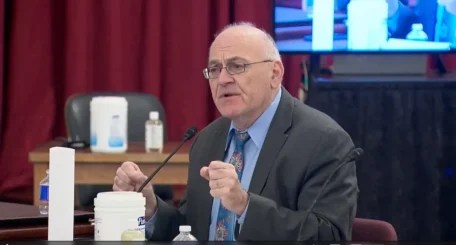
Dr. Paul Marik testifying at the US Senate on January 24, 2022
At the same time that Dr. McCullough was stripped of his job and professorships, his colleague and kindred spirit, Dr. Paul Marik, experienced a similar fate. On October 15, 2021, his hospital’s administration circulated a memo to the entire healthcare system stating that its doctors were authorized to administer remdesivir to COVID-19 patients, but not ivermectin or a host of other repurposed drugs. As Dr. Marik read the memo, he marveled at the sheer perfidy of it. Especially grotesque was the inclusion of “Ascorbic acid” (vitamin C) on the list of banned substances.
The administration issued this directive at a time when seven COVID-19 patients were in the ICU, desperately in need of Dr. Marik’s care. He, in turn, desperately wanted to treat them with the drug regimen that he knew would give them a good chance of recovery. Three months later, at the January 24, 2022 panel discussion (COVID-19: A Second Opinion),hosted by Senator Ron Johnson, Dr. Marik recounted his helplessness. His heart-wrenching testimony (starting at 4:19:30) was probably the most dramatic moment in the extraordinary conference.
This system was effectively preventing me from treating my patients according to my best clinical judgement. … As a clinician for the first time in my entire career, I could not be a doctor. I could not treat patients. I had seven Covid patients [he holds up his hands showing seven digits] including a 31-year-old woman. I was not allowed to treat these people. I had to stand by idly [he clenches and raises his fists with anguish and begins to weep]. I had to stand by idly, watching these people die.
I then tried to sue the system, so then they did something called peer sham review. It is a disgusting and evil concept. They then accused me of seven most outrageous crimes … and [claimed] that I was such a severe threat to the safety of patients, they immediately suspended my hospital privileges because I posed such a threat to these patients—ignoring the fact that under my care, mortality was 50% less than it was under my colleagues. I then went on to this sham peer review. I went to a Kangaroo Court, where they continued this, and the end result was that I lost my hospital privilege and was reported to the National Practitioner Databank. So here I was standing up for my patients’ rights, and this hospital, this evil hospital, ended my medical career.
‘Message of Jewish supremacy’ dominates new Israel civic curriculum

MEMO | November 14, 2022
The “message of Jewish supremacy” dominates Israel’s proposed civic curriculum, sources in the Education Ministry are reported saying. The curriculum was formulated over the past year by five members of the curriculum committee. All are Jews and three are said to be religiously observant. The curriculum is expected to serve as a basis for a new high school civics program in the future and is pending final approval.
“The program conveys well the message of Jewish supremacy to the students,” Professor Mordechai Kremnitzer of the Hebrew University of Jerusalem and the Israel Democracy Institute is reported saying in Haaretz. He stressed that the contribution of Israel’s education system could not be ignored when looking at the recent election results. “The subject has been hijacked by the right and shaped in accordance with its values,” said another Education Ministry official, speaking on condition of anonymity.
Jewish supremacist groups and members of the Israeli Knesset that have been slammed for their openly fascist views emerged as the biggest winners. They won 14 seats, the third highest but, more importantly, they have become kingmakers for the foreseeable future.
The new curriculum is meant for the ninth grade in public non-religious schools and religious schools in the general community and public schools in Arab and Druze communities. It was recently brought up for discussion among senior Education Ministry officials.
According to a copy of the curriculum obtained by Haaretz, the first part deals with Israel’s Declaration of Independence, with a focus on “the government authorities and a number of representative symbols and laws.” The second part offers a list of topics to choose from, including “Israel and the Diaspora”, “Religion-State Relations”, “The Israeli-Arab Conflict” and “the Founding Fathers”. There is no mention of the existence of millions of Palestinians or the economic and social inequality within Israel.
Words like “equality is not mentioned once in the new curriculum, while in the current curriculum, the word it appears nine times, mainly with regard to equality before the law. “Loyal” has been introduced for the first time within the context of being “law-abiding and loyal to the State”. The list of goals does not include the State’s obligation to care for and serve its citizens and that the word “rights” does not appear.
“At the heart of the democratic system is the human being, together with various combinations of values of equality and liberty. This is not seen in the curriculum,” an Education Ministry official is reported saying. The term human dignity is said to have been removed. The curriculum has not yet been approved and is under review.
Washington Attempts To Bully India Into Cutting Ties With Russia
By Conor Gallagher | naked capitalism | November 13, 2022
For months the US has repeatedly tried to coerce India into cutting ties with Russia, thereby abandoning its national interests. New Delhi, however, continues to spurn American attempts to subject its economy to Washington’s dictates.
The latest fuss concerns the G7 price cap on Russian oil and EU and UK bans on shipping and related services for Russian crude. India continues to have no interest in joining the US-led initiative as it gets a steep discount on oil from Russia and wants to maintain the relationship with a long-time strategic partner. Indian Foreign Affairs Minister Subrahmanyam Jaishankar was just in Moscow on Nov. 8 to discuss continued sales of oil. From the South China Morning Post :
India’s foreign minister hailed New Delhi’s “strong and steady” relationship with Moscow on Tuesday, during his first visit there since Russia invaded Ukraine in February.
Subrahmanyam Jaishankar also declared India’s intention to continue to buy Russian oil, again disregarding the US appeal to allies and partners to isolate Russia from the global markets.
The G-7 plans are likely to send oil prices higher (despite US Treasury Secretary Janet Yellen claiming the opposite) and reduce tanker availability, both of which will threaten India’s energy security and hurt its economy as India is the third-largest consumer and importer of oil worldwide.
Russia has said it will not sell to any countries that participate in the price cap scheme, and Jaishankar has repeatedly stated that India cannot afford to buy oil at high prices – at least not without undermining its economic growth, which is forecast to be 6.1 percent in 2023, the fastest-growing major economy in the world. According to Energy Intelligence :
Russia emerged as India’s top crude supplier in October, shipping over 900,000 barrels per day or roughly a fifth of India’s demand. The two countries’ biggest concern is ensuring that Russian oil continues to flow after the Dec. 5 EU and UK bans and related G7 price cap.
But despite Jaishankar’s bullish stance in Moscow, India’s state refiners have not placed orders for crude lifting beyond Dec. 5 due to uncertainties about whether shipping and insurance will be available, Energy Intelligence understands. And a recent attempt by an Indian buyer to use the price cap in negotiations with a Russian seller prompted the latter to abandon the deal, market sources said.
The ongoing lack of clarity on the G-7 could be by design. Russian oil exports have already begun to dip, and Bruce Paulsen, a sanctions expert and partner at law firm Seward & Kissel, told American Shipper, “ If guidance on [price cap] compliance doesn’t come soon, some industry players may sit on the sidelines until they can determine that shipments under the price cap are safe.”
The US, in a neat sleight of hand, quit pressuring India to adhere to the price cap, and Yellen now says Washington is “happy” for New Delhi to continue buying as much Russian oil as it wants, including at prices above a G7-imposed price cap. But there are just a few caveats: India wouldn’t be able to use western insurance, finance, or maritime services to transport the oil.
“Russia is going to find it very difficult to continue shipping as much oil as they have done when the EU stops buying Russian oil,” Yellen told Reuters on Friday. “They’re going to be heavily in search of buyers, and many buyers are reliant on Western services.”
More from Energy Intelligence on why this amounts to a de facto price cap:
Indian refiners have the capacity to soak up another 600,000 b/d of Russian crude, provided it outcompetes the staple Mideast grades that are the lifeline of the country’s 5 million b/d refining base. But the availability of shipping and insurance — and payment channels — is key. From Dec. 5, tankers and shipping insurance linked to EU and G7 countries — which dominate oil shipping globally — will be barred from trading Russian crude unless those volumes are sold under the price cap, as yet undetermined.
About 90% of India’s liquids trade is shipped by foreign tankers, presenting challenges, independent energy analyst Narendra Taneja said. Insurance does not appear as problematic, and analysts say that Russian and Chinese firms can handle it.
This could leave Russia reliant on a shadow fleet of older tankers with opaque ownership that do not transact in dollars. According to Freight Waves :
Brokerage Braemar reported that 33 tankers previously handling Iranian or Venezuelan exports have carried Russian exports since April, mostly to China and secondarily to India.
Braemar defined the dark fleet as tankers that have carried Iranian or Venezuelan crude at least once in the past year. It put the current total at 240 tankers, mostly smaller and midsized, with 74% 19 years or older. Eighty of those vessels are very large crude carriers (VLCCs, tankers that carry 2 million barrels) that won’t fit in Russian ports but could be used for ship-to-ship transfers for Russian cargoes.
If the entire dark fleet switched to Russian service and were as efficient as the “mainstream fleet,” it would be more than enough to keep Russian exports flowing, but “vessels engaged in illicit trading are highly inefficient,” Braemar emphasized.
At the same time Washington is pressuring New Delhi to comply with the price cap, it is importing from India more vacuum gasoil, which is mostly used at refineries to produce other products such as gasoline and diesel. From Reuters :
Russia used to be a key VGO supplier to U.S. refiners before the Ukraine war broke out.
“Given that the U.S. is not buying Russian oil, they are looking for any and all alternatives,” said Roslan Khasawneh, senior fuel oil analyst at Vortexa…
U.S. and EU sanctions do not apply to refined products produced from Russian crude exported from a third country as they are not of Russian origin. In India, refiners boosted imports of discounted Russian oil to 793,000 barrels per day between April and October, up from just 38,000 bpd in the same period a year ago, trade data showed.
India joins a list of countries – including Saudi Arabia, Serbia, and Turkey – that are causing heads to explode in Washington for refusing to be bullied into submission.
This all must be coming as a shock in Washington as its Indo-Pacific strategy in recent years has always included a “like-minded” India helping to counter China and do the US’ bidding in southeast Asia. The possibility that India might pursue its own national interests didn’t seem to factor into the strategy.
The tension over the Russian price cap is just the latest in a series of disagreements between New Delhi and Washington. US sanctions on Iran’s oil exports deprive India of cheap Iranian oil, and force it to buy more expensive US energy exports. India is now the largest oil export destination for the US.
Similar to the way Washington is arming Greece and Cyprus in an effort to bully Turkey into breaking off its friendly ties with Russia, the US is doing the same in Pakistan to pressure India. The US has begun to accommodate Pakistan again after the ouster of former Pakistani prime minister Imran Khan, who blames his loss of power in a no-confidence vote on the US.
In September, the U.S. State Department enraged India when it approved a $450 million deal to upgrade Pakistan’s F-16 fleet. Shortly after, the US ambassador to Pakistan created more tension during a visit to the Pakistani-held part of Kashmir, which he called by its Pakistani name instead of the United Nations-approved name “Pakistan-administered Kashmir.”
On Nov. 8 US State Department spokesman Ned Price lectured India on what are in its best interests:
We’ve also been clear that now is not the time for business as usual with Russia, and it’s incumbent on countries around the world to do what they can to lessen those economic ties with Russia. That’s something that’s in the collective interest, but it’s also in the bilateral interest of countries around the world to end and certainly over the course of time to wean their dependence on Russian energy. There have been a number of countries that have learned the hard way of the fact that Russia is not a reliable source of energy. Russia is not a reliable supplier of security assistance. Russia is far from reliable in any realm. So it is not only in the interest of Ukraine, it is not only in the interest of the region, of the collective interests that India decrease its dependence on Russia over time, but it’s also in India’s own bilateral interest, given what we’ve seen from Russia.
We’ll have to wait and see if the Indian people get the message because as of now the opposite is true. India’s Observer Research Foundation released poll results on Nov. 2 that showed that 43 percent of Indians regarded Russia as their country’s most reliable partner, which was far ahead of the US at 27 percent.
Washington would be hard pressed to explain how New Delhi scaling back its economic ties with Russia would be a good thing for India.
Fuelled by a surge in import of oil and fertilizers, India’s bilateral trade with Russia has soared to an all-time high of $18.2 billion over the April-August period of this financial year, according to the latest data available with the Department of Commerce. That makes Russia India’s seventh biggest trading partner — up from its 25th position last year. The US, China, UAE, Saudi Arabia, Iraq, and Indonesia remain ahead of Russia.
India, Iran, and Russia have also spent the past twenty years developing the International North-South Transport Corridor to increase trade between the countries, and it took on increased importance with the western sanctions on Moscow. From The LoadStar :
RZD Logistics, a subsidiary of Russian railway monopoly RZD, has begun regular container train services from Moscow to Iran to serve growing trade with India by transloading.
This is aimed at maximizing use of the alternative International North South Transport Corridor (INSTC), a Central Asia cross-border multimodal freight network helping the two strategic partners work around supply chain challenges created by western sanctions on Russia.
The inland-ocean leg involves an estimated transit time of 35 days, compared with about 40 with previous traditional shipping, according to industry sources.

©Peter Hermes Furian
In much the same way that US heavy-handedness is backfiring elsewhere, the pressure applied on India seems to only be encouraging New Delhi to find a way around the dollar. The Loadstar adds that the Reserve Bank of India is also implementing new regulatory guidelines to help exporters settle shipments in rupees, instead of US dollars that had run into sanctions-related bottlenecks:
The Federation of Indian Export Organizations has also been pressing government leaders to extend the alternative currency method beyond Russian markets.
“While the Russia-Ukraine war is a setback to our exports in the short run, we are looking to increase our exports to Russia once the rupee payment mechanism gets operationalised,” FIEO noted.
While India has been benefitting from the discounted Russian crude, it also wants to maintain good ties with Moscow to avoid pushing Russia closer to China and potentially Pakistan, India’s biggest rivals in Asia.
Pakistan is also now asking the Russian Trade Ministry to introduce a currency swap arrangement to strengthen economic ties between the two countries.
Featured Video

or go to
Aletho News Archives – Video-Images
From the Archives
The Forgotten Terrorist Pretext of the Vietnam War
By Jim Bovard | The Libertarian Institute | February 16, 2023
Since 9/11, terrorism has become the ultimate entitlement program for America’s political elite. Whether it is illegally spying on Americans or blowing Somali dissidents to pieces, invoking terrorism provides all the cover needed for Washington policymakers. But the disastrous results of granting politicians a blank check to fight terrorism should have been undeniable almost 60 years ago.
Back in the 1960s, terrorism was what the communists did. Anti-terrorist moral fervor and ideological blinders propelled the U.S. into its biggest foreign policy blunder since World War II. … continue
Blog Roll
 Aletho News
- LAPD Pilot Will Track Vehicles In San Fernando Valley
- Britain’s Online Censorship Law Now Comes With a Crisis Plan for Your Posts
- NATO’s “Nordic model” brings Arctic confrontation closer to Russia’s nuclear bases
- Using nuclear weapons, the US-Israeli alliance still can’t beat Iran
- Sunset on the Quality of Western Propaganda: Arrival of the Dr Strangelove Moment
- Ukrainian general accused of protecting crime bosses
- US-‘Israel’ alliance faces growing rupture after midterms
- GOP’s Crushing Midterm Loss Could Reshape US Political Landscape – Analyst
- Midterm loss gives Congress power to rein in US war on Iran
- Midterms Were ‘Vote of No Confidence’ in GOP, But Iran Has No Illusions About Democrats – Marandi
- If Americans Knew
- An error has occurred; the feed is probably down. Try again later.
- No Tricks Zone
- New Study: The Net Fossil Fuel Contribution To Rising Atmospheric CO2 Has Been Zero For 500 Years
- Germany’s Green Energy Transition Becoming Increasingly Expensive…Another 6 Trillion Euros!
- Sudden Stratospheric Warming, Powerful El Niño Combination May Lead To Extreme Europe Cold, Energy Crisis!
- Two New Studies Find Thwaites Glacier Melt Cannot Be Driven By Human Activity Or A Warming Ocean
- E-Cars Reduce CO2 Emissions By Only 41% Compared To Internal Combustion Engine Vehicles
- Predictions Made By Renowned Climate Professor Over Past Decades Have Been Proven To Be Poor
- New Study Suggests Large Regions Of The Pacific Ocean Have Been Cooling For The Last 80 Years
- Germany’s Green Energy Debacle: High Energy Costs Force Kahla Porzellan to Close After 182 Years!
- New Study: 50 Years Of The Most Aggressive ‘Net Zero’ Policies Can Only Affect The Global Climate By 0.03°C
- US September “Heat” Was No Record…Many Records Set Decades Ago

