Ukrainian shelling of refugee convoy leaves 24 people dead – local authorities

Samizdat | September 30, 2022
At least 24 people were killed and 36 wounded when Ukrainian forces struck a refugee convoy on Friday, Vladimir Rogov, a senior Russian-appointed official in Zaporozhye Region, has said.
Rogov wrote on Telegram that the attack targeted a convoy of cars that was traveling from Ukrainian-controlled territory to Zaporozhye Region, which declared independence from Kiev and was recognized as a separate state by Russia on Thursday.
“It happened at a car market on the Orekhovskoe highway where convoys are being formed to enter the region,” he wrote.
“24 people, including 11 men and 13 women were killed, 36 were wounded including a child,” the official said.
According to Rogov, the people, who were targeted, had protested and blocked roads earlier this week, demanding that Ukrainian authorities allow them to enter the Russian-held part of the region. “After that they were approached by the Security Service of Ukraine (SBU) and the police, who openly threatened them and said that they’ll be sorry for what they were doing,” he wrote.
The head of the administration accused Ukrainian President Vladimir Zelensky of “trying to take revenge on the residents of Zaporozhye Region after they chose to join Russia during the referendum” by ordering the strike.
Rogov insisted the Ukrainian attack on the convoy was carried out with the aim of pinning the blame on Russia.
Kiev’s governor of Zaporozhye Region claimed that Russian forces were behind the shelling. While the head of a Ukrainian bomb disposal unit, police colonel Sergey Ujryumov told Reuters that the Russians “know that columns are formed here to go to the occupied territories… It’s not a coincidental strike. It’s perfectly deliberate.” According to Ujryumov, S-300 missiles were used in the attack on the convoy.
Voting on joining Russia ended in Zaporozhye and Kherson Regions as well as in the two republics in Donbass on Monday, with residents in all territories overwhelmingly supporting the move. The official ceremony, in which President Vladimir Putin is expected to sign treaties on incorporating the new areas into the Russian state, is scheduled to take place in Moscow later on Friday.
A similar attack by Ukrainian forces happened in the eastern region of Kharkov on Thursday. At least 30 people, including children, were killed after a convoy of refugees, which tried to enter the People’s Republic of Lugansk, came under intense artillery bombardment, LPR authorities said.
Western economic warfare backfired, new depression likely to come
What awaits Europe with Nord Stream pipelines possibly gone forever?
By Uriel Araujo | September 30, 2022
Now that the Nord Stream pipeline might have been sabotaged by Washington, as promised by US President Joe Biden on January 7, and is possibly gone forever (according to German authorities), it is time to consider the possible impacts.
The energy crisis in the EU has always been pushed by American interests. Moreover, the US has been engaging in economic warfare and even weaponizing the dollar for too long, but it has been clear for months now that its current economic and financial war against Russia has backfired – and once again, mostly upon Europe. Such economic wars in fact may dangerously spiral out of control, and are considered to be one of the causes of the 1929 crisis in the post-Versailles world.
Philip Pilkington, an Irish economist who works in investment finance, famous for his contributions on the empirical estimate of general equilibrium and other fields, has made quite interesting observations about the possible deindustrialization of Europe as a consequence of economic warfare. He remarks on how in the post-pandemic world debts in the West have been accumulating and, on top of that, the current conflict in Ukraine has brought extra energy costs.
After the conflict ends – or becomes a “frozen conflict” – or after good diplomacy is reestablished, Russia could start to once again supply gas to Europe as usual – this is how many analysts reasoned. However, now that the pipelines are gone, the price of energy in the continent is to remain tremendously high for years to come. With permanent high energy prices making manufacturing not economically viable anymore (thus decreasing European purchasing power), one should expect to see the bloc shutting out exports to revive an uncompetitive industry while increasing energy investments. These are Pilkington’s main points and it might be worth delving into them.
Pilkington argues that high energy costs will make the European industry largely uncompetitive because manufacturers will have no choice but to also raise the price of goods, which in turn, will not be able to compete with cheaper foreign goods. The economist goes on to argue that, in this scenario, with many manufacturers out of business, the result will be the loss of key jobs, with less employed people spending money and a new economic depression.
Thus, Pilkington reasons, the United States will not be able to “reshore” European manufacturing for too long because there simply won’t be anyone in the continent to buy the products the US ships to European shores. This crisis will thus affect Americans too, because as exports to Europe fall, US workers also lose their jobs. What could EU states do in such a scenario? The Irish economist writes quite convincingly that a tariff solution would be the most obvious one: by raising tariffs, these countries will be able to “render international products as expensive as the domestic products suffering from energy cost inflation.”
The result of that can only be more economic chaos for the West, while Europe “shuts itself off” and becomes a kind of a “black hole”, in a repetition of the 1920 events which resulted in the Great Depression, writes Philip Pilkington.
However, the global situation today has changed much, with the BRICS+ alliance, apparently aimed at “decoupling from the Western economy.” For a while, the rise in commodity prices has been perceived as a result of Western sanction policies, and this has forced the global south to look for parallel mechanisms and alternatives. Therefore, these emerging powers have the potential to build a “separate economic bloc”, which means the West would suffer the most from the economic chaos, as BRICS+ “has a relatively clean bill of economic health”.
All of this is a quite likely scenario and one should also consider the political implications. The economic crisis will in all likelihood bring back protectionism, and it might come accompanied by a 1930-like political climate. This in turn can only strengthen the populist camp in Europe. Populist and so-called “far-right” tendencies have been growing in the continent for years and the time seems to be just right for speeding up this phenomenon.
One remembers defeated French Presidential candidate Marine Le Pen promised to pull France out of NATO during this years’ elections. Meanwhile, in August, Hungary had once again the lowest energy prices in the EU. Over 8,700 sanctions have been imposed on Moscow, and yet they have hurt Europe more than Russia as Hungary’s Prime Minister Viktor Orban has been a strong critic of such sanctions. In fact, whether one likes the man or not, he has oftentimes been the voice of reason in the bloc. Now, the German eurosceptic Alternative für Deutschland (AfD) political party is heavily focusing on attacking European elites and opposing the German government’s sanctions against Russia. This trend is everywhere across the EU.
It is about time Europe assert its sovereignty, however such a political stance is largely marginalized in the continent. Thus, although a European populist wave should increase skepticism about NATO and the EU itself, it will also increase political instability and turmoil. To sum it up, in the worst post-Nord Stream scenario, one can then expect a deindustrialized and isolated Europe going through a serious political and economic crisis.
Uriel Araujo is a researcher with a focus on international and ethnic conflicts.
Gates Foundation boosts funding for Digital ID projects
By Ken Macon | Reclaim The Net | September 28, 2022
The Bill & Melinda Gates Foundation has increased its investment in digital ID projects through part of a $1.27 billion package to support “global health and development projects.” Part of the funding, $200 million, will go to digital public infrastructure, including civil registry databases and digital ID.
The announcement followed the annual “Goalkeepers Report,” an annual assessment report on the UN’s Sustainable Development Goals (UN SGD). The UN set a goal (goal 16.9) for a global legal identity by 2030, and the report said that the world will not make that deadline. A podcast is available on the plans here.
To achieve that goal, digital identity programs are supposedly needed.
The 2019 Goalkeepers Report touted biometrics as one of the technologies needed for the equitable redistribution of resources in developing nations.
The $200 million will also support data sharing systems and interoperable payments systems.
The Gates Foundation supports several digital ID-related programs, including the MOSIP, an open-source digital ID platform.
Related:
The EU is running a digital ID pilot
Denmark’s new digital ID system risks locking some people out of society
Famous Pro-Vaccine Doctor Suspects Pfizer Booster Shot Sent His Cancer Into Overdrive

By Suzanne Burdick, Ph.D. | The Defender | September 28, 2022
Michel Goldman, M.D., Ph.D., professor of immunology and pharmacotherapy at the Université libre de Bruxelles in Belgium, suspects his third dose of Pfizer’s COVID-19 vaccine may have sent his cancer into overdrive.
Goldman, 67, is one of Europe’s best-known champions of medical research and a lifelong promoter of vaccines.
But he told The Atlantic he wants discussion of the COVID-19 vaccine to be transparent — so he went public about his suspicion that the Pfizer booster shot he received on Sept. 22, 2021, may have induced rapid progression of his angioimmunoblastic T-cell lymphoma (AITL), a type of lymphoma he’d been diagnosed with before he got the booster shot.
After his diagnosis, Goldman said he rushed to get the booster shot, believing he would need it more than most people because once he started chemotherapy, his immune system would be compromised.
But after receiving the shot, Goldman’s follow-up CT scan showed something unexpected: Within only a few days, his cancer had grown so fast that cancerous points were lighting up all over his scan.
“It looked like someone had set off fireworks inside Michel’s body,” The Atlantic reported.
Goldman and his brother, Serge Goldman, a fellow scientist and head of nuclear medicine at the teaching hospital of the Université libre de Bruxelles, suspected Goldman’s COVID-19 booster shot may have triggered the rapid proliferation of cancerous growth in his body.
The initial CT scan had been “a bit disturbing,” Serge Goldman told The Atlantic, because it showed an asymmetrical cluster of cancerous nodes around Goldman’s left armpit, where Michel’s first two doses of vaccine had been delivered.
The CT scan done after Michel’s third dose showed the cancer’s asymmetry had flipped and was clustered by his right armpit, where he received the third shot.
The brothers knew it could be a mere coincidence, but they thought it was important to investigate the possibility that the vaccine might be behind the clustering — because it could mean other people with certain forms of cancer might be at risk of a COVID-19 vaccine causing their cancer to progress more rapidly.
So on Nov. 25, 2021, the brothers — who had written prior papers together — and other colleagues published a case report in which they described Michel Goldman’s experience and urged the scientific community to study the phenomenon to see if it occurred in patients diagnosed with AITL.
“Since nucleoside-modified mRNA vaccines strongly activate T follicular helper cells, it is important to explore the possible impact of approved SARS-CoV-2 mRNA vaccines on neoplasms affecting this cell type,” the authors wrote.
The brothers said the case study “suggests that vaccination with the [Pfizer-BioNTech] BNT162b2 mRNA vaccine might induce rapid progression of AITL.”
They noted, however, that it would be “premature” to extrapolate the findings from Michel Goldman’s case to other patients with the same kind of cancer and that “dedicated studies are needed.”
Going public was ‘the right thing to do’
Michel Goldman’s case study added to the scientific literature that aims to understand the relationships between mRNA vaccines and the functioning of helper T-cells.
For instance, previous researchers have noted mRNA vaccines rev up helper T-cells, which may explain why Michel Goldman’s AILT went into overdrive following his third booster shot.
“Perhaps the shots gave such a jolt to his helper T cells that they went berserk,” The Atlantic reported. “If they were prone to forming tumors, or if they were already cancerous, then overstimulation could have made the problem even worse.”
Research involving body scans of some people who get mRNA vaccines — including cancer patients — shows heightened activity in the lymph nodes near the armpit on the side where the shot was received.
In February 2018, a team of researchers at Columbia University’s Institute for Cancer Genetics published a study using mice with a pair of gene mutations — the same two mutations found in Michel Goldman’s tumor — showing that the mutations predispose T-cells to go rogue.
The study also showed that when the mice were injected with red blood cells from sheep — as an experimental stand-in for invading microbes — the mice developed the same subtype of lymphoma Michel Goldman had.
Michel Goldman previously headed a $2 billion European endeavor to accelerate the research of new medicines and in December 2020, he publicly spoke out in support of the safety of mRNA vaccines — the technology used in both the Pfizer and Moderna COVID-19 vaccines.
At that time, he said the highest risk — especially for vulnerable people — is not to be vaccinated and that his main concern about mRNA vaccination was that people might use the possible side effects as an argument against getting the vaccine.
He currently leads the Institute for Interdisciplinary Innovation in Healthcare, or I3h, a university hub aimed at assisting in drug-design projects.
Michel Goldman doesn’t regret going public with his case, even though it presented challenging evidence regarding the safety of mRNA vaccines for individuals such as himself.
“I’m still convinced it was the right thing to do,” he told The Atlantic.
He remains adamant that COVID-19 vaccines are useful for the vast majority of people, but he is unsure whether he himself will get another booster dose.
“I don’t know what I will do,” he said.
Suzanne Burdick, Ph.D., is a reporter and researcher for The Defender based in Fairfield, Iowa. She holds a Ph.D. in Communication Studies from the University of Texas at Austin (2021), and a master’s degree in communication and leadership from Gonzaga University (2015). Her scholarship has been published in Health Communication. She has taught at various academic institutions in the United States and is fluent in Spanish.
This article was originally published by The Defender — Children’s Health Defense’s News & Views Website under Creative Commons license CC BY-NC-ND 4.0. Please consider subscribing to The Defender or donating to Children’s Health Defense.
Hindawi and Wiley to retract over 500 papers linked to peer review rings
Retraction Watch | September 28, 2022
 After months of investigation that identified networks of reviewers and editors manipulating the peer review process, Hindawi plans to retract 511 papers across 16 journals, Retraction Watch has learned.
The retractions, which the publisher and its parent company, Wiley, will announce tomorrow in a blog post, will be issued in the next month, and more may come as its investigation continues. They are not yet making the list available.
Hindawi’s research integrity team found several signs of manipulated peer reviews for the affected papers, including reviews that contained duplicated text, a few individuals who did a lot of reviews, reviewers who turned in their reviews extremely quickly, and misuse of databases that publishers use to vet potential reviewers.
Richard Bennett, vice president of researcher and publishing services for Hindawi, told us that the publisher suspects “coordinated peer review rings” consisting of reviewers and editors working together to advance manuscripts through to publication. Some of the manuscripts appeared to come from paper mills, he said.
We asked what prompted the investigation. Bennett told us:
In April 2022, Hindawi’s Research Integrity team led an initial investigation into a single Special Issue (SI) after a Chief Editor raised concerns about some of the papers published in it. The team decided to investigate the content of the journal further. Through this investigation, the team highlighted a pattern of irregular and concerning reviewer activity and identified potential ‘bad actors’ that were present across many of these publications.
These concerns prompted the Publishing Insights and Research Integrity teams, enabled by recently enhanced analytic capabilities and newly developed dashboards providing views across all reviewer activity, to conduct a wider investigation to determine whether these same bad actors were involved in peer review manipulation elsewhere in the Hindawi portfolio.
Following the discovery that these bad actors were present in other journals, the Hindawi leadership team put in place a cross-functional working team combining the manual and data-driven investigation which resulted in the identification of further published articles.
In early August, Hindawi expanded the investigation under a combined investigation team comprising Research Integrity experts, data and analytics experts, publishing and operational teams, and legal counsel from both Wiley and Hindawi. This team evaluated in depth review activity across all potentially impacted articles and manuscripts. This resulted in a list of ‘compromised’ reviewers and editors in addition to the bad actors already discovered, identification of networks that exist between them, patterns of review activity, and insight into published articles and manuscripts at each stage in the review process that we could initially label as ‘compromised’. On September 6, the combined investigation team began assessing published articles which led to the initial recommendation to retract 511 articles that are compromised based on reviewer activity alone. We expect ongoing investigations to result in further retractions.
The publisher also held up the review and production of submitted manuscripts in which “potentially compromised” individuals were involved, and will begin assessing those articles.
We asked about what Hindawi will do to prevent something similar from happening again, but Bennett declined to share specifics, “as we believe it will simply open up new targets for those who seek to exploit a system based on trust.”
He did say that the publisher has banned the individuals its investigation identified, will contact research integrity officers or department heads as appropriate, and has shared its findings with industry groups:
It is increasingly apparent to all involved in safeguarding and investigating issues of research integrity that closing rings down at one publisher can simply move the problem to others. We are committed to taking an active role in preventing that.
Other publishers have announced large batches of retractions recently. IOP Publishing earlier this month said it planned to retract nearly 500 articles likely from paper mills, and PLOS in August announced it would retract over 100 papers from its flagship journal over manipulated peer review.
In a prepared statement, Liz Ferguson, Wiley senior vice president of research publishing for Wiley, said that attacks on research integrity such as paper mills, manipulated peer review, and image duplication and doctoring “are sophisticated and appear to be coordinated.”
Her statement continued:
As these attacks increase in frequency and intensity, we remain committed to upholding research integrity throughout our publishing programs. We have and will continue to share our findings with our peers and industry bodies to advance a cross-industry approach. This is absolutely essential to safeguard trust in research.
It’s something that we at Wiley are committed to and as a result we have taken the step of sharing our findings as transparently as possible, not just with our peers, but with industry associations, third party databases, and others.
These conversations have been very constructive. Our industry is one of trust – this remains our greatest asset. Only through concerted and collaborative action will we succeed together. This is our goal, and Wiley and Hindawi will continue to advance it tirelessly.
Bill Gates-Funded Scientists Found NO mRNA in Breast Milk a Year Ago
They Tried Hard NOT to Find Anything!
By Igor Chudov | September 28, 2022
My recent post about scientists finding mRNA nanoparticles containing Covid vaccine genetic code, in the breast milk of vaccinated mothers, and mentioning an infant documented to have died thereof, got quite a bit of traction online.

Today, I want to look at a study from a year ago that purported to NOT find mRNA nanoparticles in breast milk. We will see why exactly the team having Bill Gates and CDC-sponsored researchers, could not find what the independent scientists could find a year later!

I decided to compare the two studies (one that found mRNA in breast milk and the other that did not) very closely and compare their methodologies using the “Modern Discontent” method.
Modern Discontent has a great post about his method, but he mostly is saying “pay close attention and understand the whole f… thing”, which is basically what I usually do with something interesting and important anyway. He posted his method three days ago, and I had my substack for a while longer. So, I intuitively used many of his approaches, but he laid them out very systematically and clearly. His article is extremely useful for all people writing about biomedical science, so take a look:
At first sight, both studies, which I will call the 2022 shedding study (which I discussed two days ago) and the 2021 no-shedding study, superficially appear to be similarly designed. They took several lactating women and tested their milk. One study found shedding, while the other did not. Upon a closer look, the differences between these studies turned out to be extremely important!
Here’s a summary of their differences:
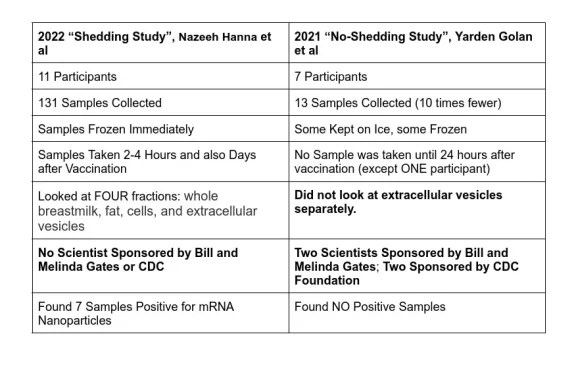
You can see that the study that found mRNA lipid nanoparticle shedding, was done more thoroughly. The shedding study had:
- More participants (11 vs 7)
- More milk samples were taken (131 vs 13!)
- Samples better preserved (frozen immediately)
- Samples were taken at varied moments post-vaccination including within mere hours, and also days
- Looked at very important Extracellular Vesicles
As a result of being more thorough and covering more cases, the shedding study found actual shedding! Surprise!
What if the women in the shedding study, getting the same vaccines, were analyzed using the poorer methodology of the no-shedding study?
I took the chart from the shedding study showing five women with milk samples positive for mRNA nanoparticles. I crossed out samples that WOULD NOT BE DETECTED, if the no-shedding study methodology was applied to the samples of the shedding study:
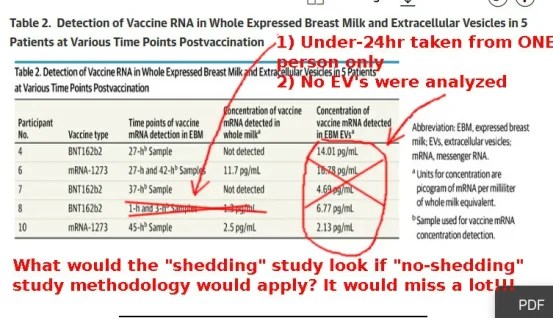
You can see that if the researchers in the shedding study used the crippled methodology of the no-shedding study, they would detect only two positive samples, instead of seven.
The methodology of the no-shedding study would miss all extracellular vesicle (EV) samples because they did not look at EVs. That is shown in the column on the right that is entirely crossed out.
The no-shedding study would also miss the 1 hour and three-hour samples because they did not take those samples (save for just ONE woman who happened not to be positive).
As a result, had the less thorough no-shedding study methodology been applied to the shedding study, only 2 positive samples, instead of 7, would be detected!
Since the actual no-shedding study collected only 13 samples and not 131 samples and used deficient methodology, no wonder they missed all positive instances!
It is as if the no-shedding study was intentionally designed not to find anything. Hmmm…
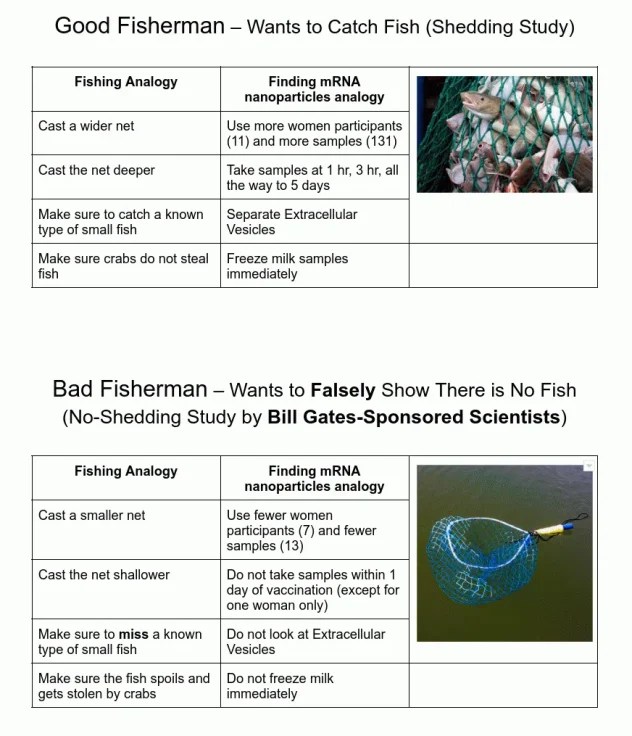
Let me give an analogy that many will understand — fishing using fishing nets.
Let’s say that a good fisherman (the shedding study) was asked to do his best job fishing to see if a particular lake has fish (mRNA nanoparticles). A bad fisherman, on the contrary, would be asked to design his fishing expedition to not catch any fish, so as to falsely prove that the lake has no fish. What would they do? This infographic shows the difference:
What’s up with Bill Gates and the CDC?
By pure coincidence, the study that did not find mRNA nanoparticles in breast milk (the no-shedding study), had key scientists sponsored by the Bill and Melinda Gates Foundation. They also received money from the CDC. You can see that Prof. Gaw and Dr. Flaherman were key participants, making the most important decisions and analyses!
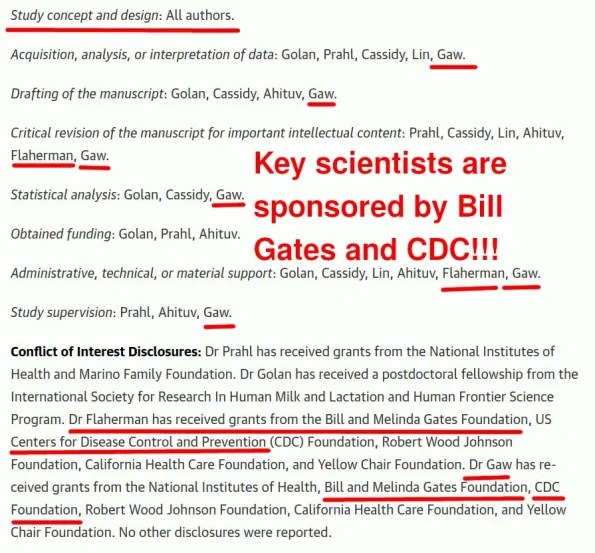
Did these sponsorships influence the authors’ approach to designing the experiment? We cannot know this. We can only wonder.
Why would a fisherman try to NOT catch fish?
Should Europeans ‘Thank’ the Americans for Destroying Nord Stream?
By Robert Bridge | Strategic Culture Foundation | September 29, 2022
With an investigation continuing into the destruction of the Nord Stream gas pipeline that provided energy supplies to Europe from Russia, there appears to be just one prime suspect, and that should surprise nobody.
Following the sabotage of the Nord Stream 1 and 2 gas pipelines, former Polish Foreign Minister Radoslaw Sikorski already seemed to know the identity of the perpetrator when he tweeted out: “Thank you, USA.”
At first glance, it seemed that Sikorski was speaking sarcastically, berating Washington for carrying out an attack that will have severe repercussions for the people of Europe. After all, how could anyone see any good coming from the termination of Europe’s primary source of gas reserves with winter just around the corner? It was Sikorski’s homeland of Poland, after all, that urged its citizens to collect firewood in the face of dwindling gas reserves.
In fact, the Polish diplomat was speaking one-hundred percent literally, thanking the United States for plunging the continent deeper into the abyss. This has been the attitude of European leaders from the start of Russia’s special military operation in Ukraine: ‘we will accept our self-destruction as scripted by Washington policymakers so long as the baddies in Moscow hear our virtue-signaling whimpers and screams.’ European capitals are about to learn the hard way that virtue signaling does not put food on the table or heat homes.
Judging by the rising temperature in Europe, however, last seen in Italy where a far-right leader has come to power on the wave of voters fed up with high electricity bills and loose immigration, the phrase ‘Thank you, USA’ may eventually be chiseled into Europe’s tombstone.
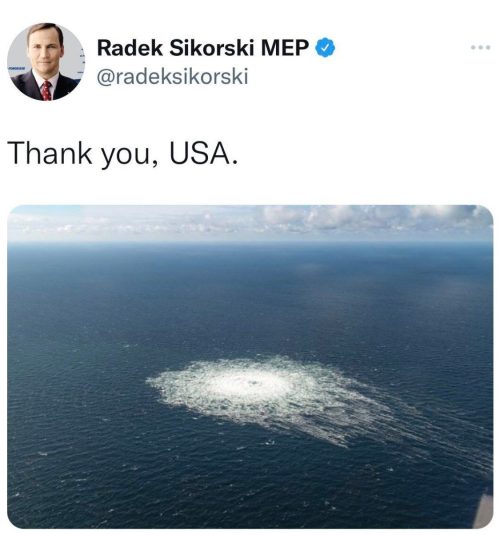
But first, the big question: was the United States really responsible for the destruction of Nord Stream, as Sikorski seems to believe? Well, if we were are to take bumbling Joe Biden at his word, then the answer would seem to be yes.
“If Russia invades, that means tanks or troops crossing the border of Ukraine, again, then there will be — there will be no longer a Nord Stream 2,” the U.S. leader told reporters two weeks before Russia began its Ukrainian mission. “We will bring an end to it.”
When asked to specify, Biden responded, “I promise you, we’ll be able to do it.”
There are other clues that point to American complicity.
On September 2, an American helicopter with the call sign FFAB123 was observed maneuvering in the area of the Nord Stream pipelines. According to the site ads-b.nl, six aircraft used this call sign that day, of which the tail numbers of three were established. All of them were Sikorsky MH-60S. By overlaying the FFAB123 route on the scheme marking the areas of the explosions, it is observable that the helicopter either flew along the Nord Stream-2 route, or exactly between the points where the ‘accident’ occurred.
Meanwhile, on Twitter, there are screenshots of other American aircraft flights as of September 13th in exactly the same area. In June there was an article in Sea Power magazine where the Americans boast of experiments in the field of underwater drones that they set up at the BALTOPS 22 exercises – in the area of Bornholm Island, the Danish island where the explosions were reported to have occurred.
“Experimentation was conducted off the coast of Bornholm, Denmark, with participants from Naval Information Warfare Center Pacific, Naval Undersea Warfare Center Newport, and Mine Warfare Readiness and Effectiveness Measuring all under the direction of U.S. 6th Fleet Task Force 68,” Sea Power reports.
Such an “experiment” would have required the deep-sea equipment needed for reaching the depths where the Nord Stream pipelines are located.
Finally, here’s one last tantalizing piece of information for all of the ‘coincidence theorists’ out there. On the day after Nord Stream 1 and 2 went offline, Poland, Norway and Denmark’s leaders attended the opening ceremony of the new Baltic Pipe, which will transport natural gas from Norway via Denmark and through the Baltic Sea to, yes, Sikorski’s ferociously Russophobic homeland of Poland. Yes, just a coincidence.
However, the main motivating factor for Washington having a hand in destroying Nord Stream is the awesome powers – both financial and political – that it will reap. The economic crisis in Europe is already forcing companies and corporations to consider relocating to the U.S., which is providing a better business environment and more or less affordable electricity bills.
And after the destruction of Nord Stream, the economic situation on the continent will deteriorate significantly. Even though the NS-II was not launched, there was the chance of its launch, and this “chance” had a considerable effect on the market. Now, without its main energy supplier, Europe is doomed while America will soar.
The economic destruction of Europe makes it totally dependent on the U.S. economically, politically, and militarily, turning it into a toothless tiger with no political will and independence. At the same time, Europe will become almost completely dependent on the U.S. for its (prohibitive) gas. The United States plans to supply at least 15 billion cubic metres (bcm) of liquefied natural gas (LNG) to European Union markets this year as Europe seeks to wean itself off Russian gas supplies.
In other words, the transformation of the EU into a banana republic – albeit it one in the northern hemisphere with winter quickly approaching – has already begun.
Europe, you really should have heeded the advice of Henry Kissinger, who understands the nature of the U.S. better than anyone: “To be an enemy of the U.S. is dangerous, but to be a friend is fatal.”
IS RUSSIA REALLY LOSING IN UKRAINE?
By Drago Bosnic | September 29, 2022
After Russia launched its counteroffensive against NATO aggression, the state and corporate-run mainstream media of the political West started spreading multiple false narratives about it. One of the most common themes was that the Russian military supposedly “failed” because the Kiev regime didn’t collapse in a matter of days.
In the following months, especially after the Russian forces withdrew from northern areas of Ukraine, this was used to further reinforce the narrative that the Russian military was somehow “defeated”. However, the truth lies in the Russian military and geopolitical nomenclature regarding the events in Ukraine. While the political West is unanimous in calling it “an unprovoked, brutal invasion”, the Russian side calls it a special military operation.
Although the wording may seem irrelevant, it does have serious implications. The whole operation has been limited from the start. As Russian President Vladimir Putin himself stated, Moscow didn’t really show more than a fraction of its capabilities. And indeed, given the number of Russian troops initially engaged in the special military operation, which was approximately 100-150 thousand, versus more than 200,000 troops of the Kiev regime, it’s clear that Moscow never expected to take control of the entire territory of Ukraine. In addition, the Kiev regime forces exponentially grew in size after the forced mobilization of hundreds of thousands of Ukrainian men. And although Western media are trying to downplay it, multiple estimates put the number of conscripted personnel anywhere between several hundred thousand and nearly a million soldiers.
For its part, Russia decided not to increase the number of troops engaged in the special military operation. What’s more, with troop rotation, the true number of Russian soldiers actively engaged in combat operations was much lower, most likely standing between 50 and 100 thousand, stretching for well over a thousand kilometers from the northern areas of the Kharkov, through Donbass, Zaporozhye and Kherson regions all the way to the Black Sea coast. These forces have consistently been outnumbered by the Kiev regime troops for over 7 months now and have stood their ground.
And although this could be attributed to the Russian military’s vast technological and numerical superiority, especially in terms of artillery and air dominance, it can only be considered a remarkable achievement from a purely military standpoint. This also explains the Kiev regime’s reaction to Moscow’s recent low-level mobilization announcement, which will increase the number of Russian troops engaged in the special military operation by 300,000, pushing the total to well over 400,000 soldiers.
As per usual, the mainstream media in the United States and other countries of the political West have been trying to portray this as a sign of Russia’s supposed “weakness”. However, the Pentagon’s and NATO’s reaction speaks volumes of how the political West really feels about the mobilization. With Western Military Industrial Complexes already working at maximum capacity to supply the Kiev regime forces with additional weapons, having a twofold or threefold increase in the number of Russian troops is the last thing they needed (at least in the short term). If the Russian military was able to conduct successful offensive operations for months, while being outnumbered, what could one expect when Moscow decides to exponentially increase the size of its forces engaged in the special military operation?
In the meantime, the Western press and other media are constructing the narrative that millions of Russian men are supposedly trying to flee the country in order to avoid mobilization. Naturally, they are ignoring the fact that the Russian Ministry of Defense registered nearly 900,000 requests for joining the armed forces, with many regions and federal subjects in the country providing several times more troops than they’re required to. The most prominent example of this is Chechnya, which overshot its mobilization quota by over 250%. And yet, the Western media keep insisting that there’s supposed “widespread opposition to Putin’s war”. In reality, the fact that the Russian police arrested several hundred protesters in a country of approximately 150 million shows just how truly “widespread” the opposition to mobilization is.
Expectedly, the propaganda war isn’t only limited to the supposed “failures” of the Russian military, but also its leadership. Recent speculation that Vladimir Putin is ill, on the verge of death or losing power, while ignoring the rapidly deteriorating mental and physical health of Joe Biden serves as a testament to that. To make matters worse, the attempts by the so-called “fact-checkers” to whitewash Biden’s string of dementia-induced gaffes can only be described as comical. And while the political West’s propaganda machine works round the clock to create an alternate reality that doesn’t exist past a TV or smartphone screen, the economic and social unraveling resulting from the failed economic siege of Russia has been affecting hundreds of millions around the world and is only bound to get worse.
Drago Bosnic is an independent geopolitical and military analyst.
Who wins from demolishing the EU’s gas lifelines?
By Rachel Marsden | Samizdat | September 29, 2022
Speculation abounds since both Nord Stream 1 and 2 pipelines, designed to carry cheap Russian gas to Europe, were damaged this week in what officials widely describe as deliberate acts of sabotage. Who could be responsible? Incidents buried in the past may provide a clue.
Speculation abounds, and typically in a direction colored by the preexisting biases of the person speculating – which is hardly helpful.
Let’s start with the end result and work backwards. The outcome ultimately means that Europe’s economic impetus for ever seeking peace with Russia has been seriously undermined, if not literally destroyed. Someone has taken it upon themselves to demolish the remaining bridges between the two. Until now, there was always a chance of reconciliation. Russian President Vladimir Putin said himself recently that all the EU needed to do to pull itself out of its self-imposed energy crisis was to push the button on its gas supply from Russia and drop the anti-Russian sanctions that prevent it from doing so.
People in the streets of German cities protesting against Berlin’s blind following of Brussels’ anti-Russia sanctions also knew that was the answer. But now that option has been taken off the table. The EU is now adrift amid a deepening energy crisis and someone burned its last sails. It’s clear that Europe itself wouldn’t benefit from that. Nor does it benefit at all from any of its own anti-Russian sanctions. But who gave Brussels that idea, to harm its own economy in the first place?
At the onset of the Ukrainian conflict, it was Washington that egged on the EU to mirror measures that Washington itself had adopted in an effort to deprive Moscow of revenues to fuel its interests and objectives in Ukraine. The problem is that the EU’s economy was far more entwined with Russia’s than America’s. Any sense that US President Joe Biden and his administration may have given EU leaders, that they’d be there to help the bloc soften the blow of its self-sacrificial sanctions, has since been replaced by a harsh, pragmatic reality. US shale executives have explained to Western media that they simply lack the capacity to ramp up production for Europe’s winter crunch, even amid the growing rationing, deindustrialization, and risk of blackouts.
So, pressure has recently been increasing on EU member states to achieve a rapid diplomatic, peaceful resolution. But any reconnection of Nord Stream gas would have been a blow to US economic ambitions, which eventually include turning the EU into a dependent liquefied natural gas client. To that end, US officials have even tried to market their natural gas in the past as “freedom molecules,” in contrast to the “authoritarian” Russian gas.
Biden himself said of Nord Stream 2 during a press conference on February 7, before the Ukraine conflict had even popped off, that “we will bring an end to it,” despite it being out of American control. But even long before that, the US was sanctioning and bullying European companies into halting construction on Nord Stream 2 under the pretext of saving Europe from Russia. It’s worth noting that Europe didn’t really have problems with Russia this century until the US decided to make Ukraine an outpost for the State Department.
Not only did Gazprom, Russia’s state-owned operator of the pipeline, persist against all odds to finish it, but it’s really the only leverage that Moscow has in Europe. Attributing to Moscow the recent sabotage of their own economic interests in Europe seems absurd. The damage done to the pipelines now means that to prevent them from being completely filled with sea water and destroyed, Russia is forced to keep pumping gas through them and into the sea at their own expense. What exactly does Moscow gain from any of this? Conversely, what does Washington gain? Nothing less than Brussels’ full dependence, which proved elusive when Europe could split its interests between the east and west.
As for who possesses the technical ability to execute underwater pipeline sabotage, both Russia and the US do. Much has been made in the past of the potential for cutting undersea cables – defined as an act of war by UK defense chief Admiral Sir Tony Radakin. The US actually has a history in such operations, having tapped into undersea cables to spy on the Soviet Union in the 1970s Operation Ivy Bells, according to public records about Operation Ivy Bells. Washington also has sabotaged Soviet gas pipelines before, albeit indirectly – according to Thomas C. Reed, a former Air Force secretary who served on the National Security Council in 1982, when then-US President Ronald Reagan allegedly approved a plan for the CIA to sabotage components of a pipeline operated by the Soviet Union. The objective was to prevent Western Europe from importing natural gas from the Soviets. Sound familiar?
Time and inquiry will uncover the culprit eventually – if we’re lucky. EU officials are vowing to get to the bottom of it. “All available information indicates leaks are the result of a deliberate act. Deliberate disruption of European energy infrastructure is utterly unacceptable and will be met with a robust and united response,” Tweeted the bloc’s chief diplomat, Josep Borrell. Perhaps investigators could pay a visit to Radoslaw Sikorski, European Parliament member and former Polish foreign minister, who tweeted a photo of the disaster aftermath along with the note, “Thank you, USA.”
But if it indeed turns out that Washington committed what some consider to be an act of war against Europe’s economy, will Brussels have the heart to really confront it? Or will Brussels continue to find justifications to remain complicit in its own demise?
Rachel Marsden is a columnist, political strategist, and host of independently produced talk-shows in French and English. rachelmarsden.com
Featured Video

Broke Princes: Saudi Arabia’s Powder Keg
or go to
Aletho News Archives – Video-Images
From the Archives
Registered Israeli foreign agent driving contrived campus antisemitism crisis
By Wyatt Reed | The Grayzone | December 17, 2023
Lawsuits accusing top US universities of harboring antisemitism all originate from one source: a corporate law firm that fielded the pro-settler ex-US ambassador to Israel, and which was registered as a foreign agent of an Israeli principal as recently as 2021.
The firm now represents professional Israel lobby activists posing as victimized “Jewish students” and seeking to crush the free speech rights of Palestine solidarity activists. … continue
Blog Roll
 Aletho News
- Ukraine arrests woman who exposed Azov battalion’s ‘torture chamber’
- Did Israel lose the midterms?
- How Iran defeated Trump’s Israel First GOP
- De-escalating the conflict: What the OSCE, the UN, and Europe are (not) doing to prevent war
- Desperate For A Renewed Iran War, Israel Dusts Off The WMD Deception.
- US Elections Offer Choice Between ‘Bad and Worse’ as Both Parties Serve War Lobby – ex-UN Expert
- Ghalibaf warns US government not to betray voters who rejected war
- Broke Princes: Saudi Arabia’s Powder Keg
- Albania’s Crisis: Rama, Israeli Investments and the Demand for Accountability
- Hezbollah Categorically Denies Syrian Accusations: We Aim at Confronting Israeli Enemy, Not Undermining Syria’s Stability
- If Americans Knew
- An error has occurred; the feed is probably down. Try again later.
- No Tricks Zone
- New Study: The Net Fossil Fuel Contribution To Rising Atmospheric CO2 Has Been Zero For 500 Years
- Germany’s Green Energy Transition Becoming Increasingly Expensive…Another 6 Trillion Euros!
- Sudden Stratospheric Warming, Powerful El Niño Combination May Lead To Extreme Europe Cold, Energy Crisis!
- Two New Studies Find Thwaites Glacier Melt Cannot Be Driven By Human Activity Or A Warming Ocean
- E-Cars Reduce CO2 Emissions By Only 41% Compared To Internal Combustion Engine Vehicles
- Predictions Made By Renowned Climate Professor Over Past Decades Have Been Proven To Be Poor
- New Study Suggests Large Regions Of The Pacific Ocean Have Been Cooling For The Last 80 Years
- Germany’s Green Energy Debacle: High Energy Costs Force Kahla Porzellan to Close After 182 Years!
- New Study: 50 Years Of The Most Aggressive ‘Net Zero’ Policies Can Only Affect The Global Climate By 0.03°C
- US September “Heat” Was No Record…Many Records Set Decades Ago

