EU Commission head issues veiled threat to Italy
Samizdat | September 23, 2022
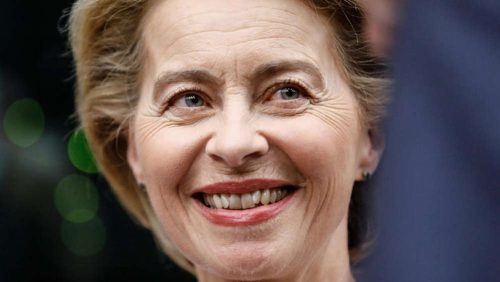
The EU has “tools” to respond if the political situation in Italy goes in a “difficult direction,” European Commission President Ursula von der Leyen said on Thursday. She hinted that the country could face punishments such as those recently leveled against Hungary and Poland if the upcoming election results in the predicted right-wing sweep.
“My approach is that whatever democratic government is willing to work with us, we’re working together,” she said in response to a question over whether she had “concerns” about Sunday’s Italian parliamentary vote, in which the conservative Fratelli d’Italia (Brothers of Italy) are projected to take first place.
“If things go in a difficult direction, I’ve spoken about Hungary and Poland, we have tools,” von der Leyen explained.
While EC spokesman Eric Mamer was quick to clarify that von der Leyen was merely “stressing the role of the Commission as guardian of the [European] treaties with regard to the rule of law,” not everyone interpreted her words that way.
Matteo Salvini, leader of the populist League party, denounced von der Leyen’s “shameful arrogance” and called on the EC to “respect the free, democratic and sovereign vote of the Italian people!” In the last round of polls earlier this month, the League was projected to take home 12% of the vote.
The EC earlier this month recommended suspending €7.5 billion ($7.5 billion) in funding to Hungary – a third of the money it receives from Brussels – over alleged “erosion of the rule of law.” Brussels leveled a similar punishment at Poland last year after the country’s constitutional tribunal found that some Polish laws override those of the EU.
Italy’s snap parliamentary election was triggered by the resignation of PM Mario Draghi in July after his partners in the ruling coalition abandoned him. As of September 9, when the blackout on publishing election polls took effect, the Fratelli d’Italia were estimated to take 25% of the vote. In addition to the League’s 12%, coalition partner Forza Italia is predicted to garner 8%, meaning a victory for the conservative bloc is easily within reach. Fratelli d’Italia barely won 4% of the vote in 2018.
Like the rest of the EU, Italy has been wrestling with a cost-of-living crisis exacerbated by bloc-wide sanctions on Russian oil and gas. A general election had previously been set for next year.
China demands end of US theft of Syrian resources
The Cradle | September 23, 2022
The People’s Republic of China called on the US government to stop the plundering of Syria’s oil resources, in a press statement on 22 September.
“We call on the United States to respect Syria’s sovereignty and territorial integrity, unilaterally lift sanctions, and end the theft of Syria’s national resources,” said China’s Foreign Ministry spokesman Wang Wenbin in a news briefing.
The call made by the Asian giant comes in light of repeated news that US armed forces have transported oil out of Hasakah governorate to military bases in Iraq.
The Syrian foreign ministry revealed the oil sector has incurred losses of at least $107.1 billion since the start of the US-sponsored war in 2011.
Meanwhile, Syria suffers from a severe energy crisis with repeated blackouts in various parts of the country.
China’s Foreign Ministry spokesman Wang Wenbin claimed that “this is not the first time that the United States military has stolen oil from Syria and they seem to be becoming more and more uncontrollable.”
Wenbin also called on the US government to investigate the claims made by Syria’s foreign ministry and compensate the country for any damages.
China’s foreign ministry spokesman highlighted that the US military has used at least 800 tankers in August alone.
“By June 2022, US military’s extraction, smuggling, and illegal transaction of Syrian oil, gas, and mineral resources have brought an estimated $18.2 bln of direct losses on Syria, making Syria’s humanitarian disaster much worse,” he added in his statement.
Wenbin described the situation in Syria relative to other countries such as Libya and Afghanistan, adding that “the rights and lives of the Syrian people are being taken away, instead of being protected.”
‘US Lifting Cyprus Arms Embargo Will Fuel Weapons Buildup on Both Sides of Island’
Samizdat – 23.09.2022
The US decision to lift the weapons embargo on the Greek Cypriot administration will spark an arms buildup on the north and south sides of the island, Turkish Cypriot President Ersin Tatar told Sputnik on the sidelines of the UN General Assembly.
The State Department last week lifted all defense trade restrictions on Cyprus after determining it met US legal requirements by denying Russian vessels access to ports and implementing anti-money laundering reforms.
On Saturday, Turkey’s defense ministry, in a statement condemning the move, said Ankara will continue to guarantee the existence, security and serenity of the Turkish Cypriots.
“This will obviously provoke us to ask for further arms from Turkey because we need to protect ourselves,” Tatar said. “It will only amount to arming both the south and the north.”
North Cyprus and Turkey, he added, protested this decision because it will provide more ammunition to Greek Cyprus, which already has plenty of arms.
“The Western world is rewarding Greek Cyprus by lifting this embargo so that they can buy any amount of guns and other artillery from the Americans,” Tatar said.
Lifting the embargo has complicated the situation, he added, and does not help prospects for a solution in Cyprus.
“With increasing tension you don’t have the right environment to be able to talk in a sensible manner to solve the long standing Cyprus problem,” Tatar said.
The Turkish Republic of Northern Cyprus was declared in 1983 with Turkey’s backing, although the island has been de facto divided since 1974. In late June, Cypriot President Nikos Anastasiades expressed his readiness to resume negotiations under UN auspices.
A Failed Globalist Experiment
By Eamon McKinney | Strategic Culture Foundation | September 22, 2022
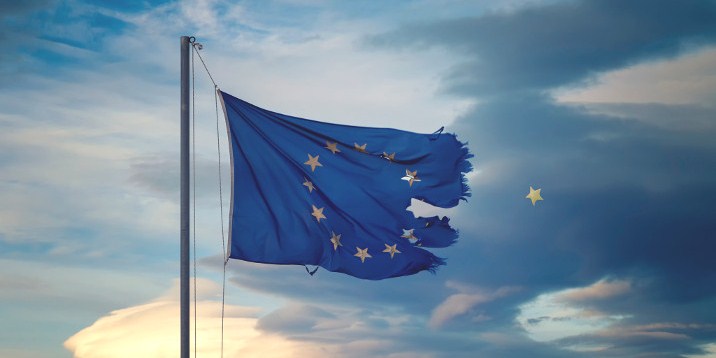
European unity was always a questionable concept between a collection of diverse countries who have historically distrusted and disliked each other. The strength of that always questionable unity is now being tested as the EU is facing its greatest challenge. The initial enthusiasm among EU leaders for the conflict with Russia has waned considerably in recent months as the reality of its ludicrous and self-destructive war on Russia continues to backfire spectacularly on them.
With the long hot European summer now behind them the citizens of Europe are rising up in protest against their governments in huge numbers. While national leaders continue to lecture their people on the necessary sacrifices they must make to support Ukraine, fewer and fewer agree with them. With rapidly rising costs of living and the prospect of a winter without heat, anger against national governments is rapidly reaching breaking point. Germany, France, The Czech Republic, Austria and Italy have witnessed immense angry demonstrations that are seriously panicking their governments. To the extent that many are now trying to backtrack and seek solutions outside of EU directives, Hungary and Serbia have refused to tow the party line and have secured their energy interests with Russia. While the EU has demanded an energy sharing scheme among its member states, only energy-starved Germany seems keen.
Germany was the main economic beneficiary of the EU and it used its considerable influence to impose harsh conditions on the weaker EU states, Greece, Ireland, Italy, Portugal and Spain in particular. Understandably these countries are reluctant to share their energy reserves with a country that showed little compassion for them following the 2008 financial crisis. German industries have benefited from low-cost energy from Russia for years which has greatly contributed to their global competitiveness. It was enthusiastically looking forward to the Nord Stream 2 pipeline until America intervened and forced its cancellation. Now German energy giants are seeking government bailouts to avoid bankruptcy, the once dominant manufacturing sector is facing complete destruction unless a rapid rapprochement with Russia is made. Even in that unlikely event, the damage to the German economy is done and any recovery could take years.
In a widely distributed talk, German foreign minister Annalena Baerbock (who no surprise is another WEF graduate) said that she will stand with Ukraine regardless of what the German voters think. A more honest translation would be that she stands with the WEF Globalists’ agenda and that the German people’s interests are not a consideration. If she gave a damn about the Ukrainian or the German people she would be trying to stop the war, but peace and the preservation of European lives are not the objectives. However repulsive her statement, it echoed exactly the sentiments of all the EU leaders, she represents her constituency perfectly, but that constituency is not the German people, it’s the Globalists.
An example of just how ridiculously inept and detached from reality the EU is can be found in their call for a price cap on Russian energy imports. Exactly how they think Russia will respond to that requires us to credit them with thinking at all, as several nations rightly pointed out, Russia will just stop all energy supplies. Many, among them France’s Macron has called for a price cap on all energy imports, not just the Russian ones. While America is fine with a European price cap on Russian energy, it strongly opposes it on U.S. energy imports. The destruction of its valued friend and ally Europe is just fine with America as long as there is a buck in it from them.
While increasingly angry citizens are demanding that their governments put national interests above those of Ukraine, they are largely missing the point. The interests of the Ukraine were never a consideration, the conflict was always about America’s obsession with the destruction of a rising Russia. The people of the Ukraine are just collateral damage in what is essentially just another bankers’ war for the interests of the Globalist financial powers. As Europeans are now belatedly beginning to understand, they are also just being considered more collateral damage in the furtherance of that Globalist agenda. None of the European leaders have any solutions to the crisis which they so enthusiastically led their countries into just a few months ago. Cold showers and Spartan energy rationing are not the solutions to the problem that the people want to hear. Preaching that they must sacrifice their futures for the Ukraine works better in the hot summer months than in the imminent cold, very cold European winter. Platitudes from Klaus Schwab’s puppet leaders are not going to placate cold hungry European people any longer. A brutal winter of discontent is inevitable for Europe, as temperatures drop the heat will rise against the politicians who sold out their countries’ interests to the Globalists. We can expect to see governments falling across Europe as public anger becomes uncontrollable.
The panic is not just being felt in European circles, The U.S. is also deeply concerned about the strength of European unity, or rather the lack of it. Biden has on more than one occasion called for Europeans to stay united in its proxy war against Russia. Biden is worried that any diversion from its sanctions against Russia will cause a split in the bloc. A rare moment of clarity from the senile U.S. President. The U.S. is very closely monitoring the unrest in Europe. While examining the results of its handiwork it might notice that while among the Western puppet leaders fractures are indeed increasing, unity among the peoples of the European nations is only growing stronger in common cause. The recent farmers’ protest in Holland was supported by farmers from all the European nations in a demonstration of true unity against the Globalist agenda. A unified cross border, anti-government movement is not the European unity Biden or the NATO warmongers had in mind. They will find that controlling corrupt Globalist European politicians is easier than controlling millions of angry, cold and hungry citizens.
Demonising Putin as the author of all Europe’s woes may have worked at the outset of the conflict, but no more. None of the many demonstrations being witnessed are aimed at Putin or Russia, the target of the ire is firmly against the governments that sold out their nations sovereignty to a globalist/U.S. elite. It is likely that Putin is more popular among Europeans in the know than the incompetent puppets running their own countries into the dirt. While Putin has now stopped the energy flow into Europe he has more cards yet to play. Uranium, fertilisers and foodstuffs among many other essentials are all still supplied to Europe, for now. The destruction of Europe is not in Russia’s interests, Putin doesn’t blame the people, he just hopes that they will wake up and recognise the true enemy.
The coming months will be a time of immense turmoil in Europe, great suffering is inevitable for millions of people sacrificed by their governments on the altar of globalisation. How long the EU can keep it together is the big question, few in Europe would be sad to see its demise. What many first considered a noble enterprise has now been exposed as an undemocratic institution that answers not to the people, but to a corporate oligarchy that owes no affiliation to any nation. In the tragedy that is the Ukrainian conflict some good may yet emerge. If European countries can restore their national sovereignty by exiting the widely despised EU they would be liberated from globalist control and be free to peacefully pursue their own legitimate national self-interest. The way it is supposed to be, the way the majority of European people want it to be. Strong “Exit” movements have existed in all of the member nations for years, Italy and Holland’s movement in particular had huge public support. The UK’s “Brexit” showed it can be done despite immense anti-Brexit propaganda, in a referendum, the people voted to leave. In light of more recent events, a referendum on exiting the EU would likely succeed in most countries.
The EU is a failed Globalist experiment, it never offered more than the pretence of a true democracy, at the unelected top, it was always a technocracy of hand-picked corporate frontmen. It has destroyed the economies of all its members through incompetence and corruption. It has caused chaos and social unrest in communities through forcing mass immigration on unwilling countries. It has interfered in the internal affairs of member states way beyond any powers granted them. It has presumed to write new laws which take primacy over a nation’s own justice system. It has created absurd new layers of bureaucracy and regulations which make European business’s largely uncompetitive globally. It is now dominated by the WEF and Klaus Schwab’s minions who are pushing the Great Reset and consider the Ukraine conflict as a step towards it. Statements made, such as that delivered by Annalena Baerbock on where her loyalties lie, should outrage all Europeans, it should also enlighten them.
Events this winter may well determine the future of Europe for the next century. Whether it is a Europe united with Russia as a peaceful trading partner, or a Globalist Third World hell hole, the European peoples’ actions in the coming months will decide which.
‘Referendums create an opportunity to remove tension, stop hostilities’
By Ekaterina Blinova – Samizdat – 23.09.2022
Referendums on territorial affiliation are taking place in the Donbass, Kherson, and Zaporozhye regions on September 23-27. Earlier, surveys showed that a majority of residents supported the idea of joining Russia as subjects of the Russian Federation.
Voting in referendums on joining Russia began on September 23. Earlier, on Wednesday, Russian President Vladimir Putin delivered an address to the nation to ensure security at the forthcoming plebiscites, and announced partial mobilization in the country. Putin’s speech was met with hostility by the US and its NATO allies, who branded the self-determination right of the referendum participants as a “sham” and vowed to never recognize the outcome of the votes.
“Europe fears that during the referendum even more regions of present-day Ukraine will want to distance themselves from the imposed European policy and request Russia’s help,” says Mehdi Khorsand, head of the Department of Economic Diplomacy of the Municipality of Tehran and expert on Eurasia. “At the same time, it will become a kind of threat to Europe, which for two centuries has been putting pressure on countries seeking to gain independence.”
The collective West, in particular Europeans and Americans, wants to keep an unquenchable long-term conflict in the region in order to weaken Russia, according to Khorsand. However, the ongoing referendums could create the conditions for bringing the conflict to an end, he underscores.
“Russia started its special [military] operation in Ukraine only for security reasons,” the Iranian expert notes. “If the government of Ukraine, after the tensions of 2014, had adhered to its obligations under the Minsk agreements, we would have never witnessed these hostilities, this conflict. It would have never begun in the first place.”
Donbass’ Thorny Way to Independence
After the US-backed February 2014 coup d’etat, Ukraine’s eastern regions called for autonomy resisting the rule of the military junta in Kiev. In response, Kiev started a “counter-terror operation” seeking to suppress “separatists” in the east. The Normandy Four, a format comprising Russia, Germany, France, and Ukraine, worked out a roadmap, the Minsk accords, to stop the bloodshed in Donbass and provide the breakaway regions with an autonomous status. Nevertheless, Kiev’s successive governments routinely sabotaged the provisions of the Minsk agreements preventing Donbass from gaining legitimate autonomy. In addition to that, the Ukrainian nationalist leadership made NATO membership the centerpiece of its policy, ramping up military training and resorting to the weaponization of the country.
“After 2014, Russia tried to negotiate with Ukraine about its demilitarization, not joining NATO, about the independence and autonomy of the eastern regions: Lugansk and Donetsk. But the Ukrainian government after 2014 committed a real genocide of the [ethnic] Russian population in the east of Ukraine, they began to literally ‘slaughter’ the Russians there,” Khorsand says.
Moscow repeatedly called on the other guarantors of the Minsk agreements, Paris and Berlin, to pressure Kiev to observe the accords. As these attempts failed, Russia came up with draft security agreements requesting guarantees of Ukraine’s non-admission to NATO. Moscow handed the drafts to the US and the transatlantic alliance in December 2021, reminding them of Western leaders’ pledge to not expand NATO to Russia’s doorstep. The Russian leadership made it clear that it takes its national security seriously and would resort to military-technical options if the West were to ignore the drafts. Nonetheless, the US, the EU, and NATO rejected key provisions of Moscow’s proposals.
“Russia, given the seriousness of the topic of Ukraine’s accession to NATO, did not see any other solution than the start of a special [military] operation to resolve the security problem,” Khorsand says.
Referendums as Path to Get Protection From Yoke of Kiev Regime
“We expect the referenda to end up with the majority of the inhabitants of these regions voting in favor of joining Russia. I do not rule out that the hostilities will end after the referendum,” Khorsand notes.
Russia recognized the independence of the Donetsk and Lugansk People’s Republics on February 22; still, this decision made the regions merely a “buffer zone” between Russia and Ukraine, which did not guarantee their safety, the Iranian expert explains.
If admitted to the Russian Federation, the aforementioned regions, including Kherson and Zaporozhye, will have security guarantees as inalienable parts of Russia. The Donbass republics and the Zaporozhye and Kherson regional authorities announced on September 19 and 20 their intent to simultaneously hold referendums to join Russia. In his Wednesday speech, President Putin made it clear that Russia would protect its territorial integrity and sovereignty by all modern military means, adding that he wasn’t “bluffing.”
“As for the legality of the referendums, it is worth noting that the autonomy of the regions of Donbass (LPR and DPR) was fully accepted in the 2014 agreement (Minsk agreements) and mentioned in the terms of this document, respectively, this referendum, reflecting the will and desire of the people of the autonomous and sovereign republics of Donbass to join Russia is a legitimate action,” Khorsand says.
Earlier, Russian Foreign Minister Sergei Lavrov explained in an interview with Newsweek that the Lugansk People’s Republic (LPR), the Donetsk People’s Republic (DPR), and the Zaporozhye and Kherson regions used their sacred right to self-determination, which is codified in the UN Charter, when they announced their intention to join Russia.
“Of course, the US and Europe will be forced to take some other position after these legal referendums, because these referendums create an opportunity to remove tension between Russia and Ukraine, and to stop hostilities,” Khorsand concludes.
Western media continues to ignore how Ukraine is using NATO weapons to kill innocent civilians in the Donbass
© Eva Bartlett
By Eva Bartlett | Samizdat | September 23, 2022
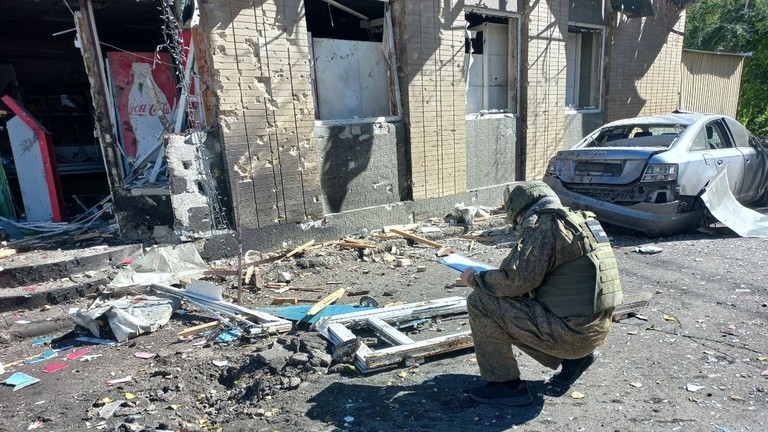
On Monday, Ukraine slaughtered 16 civilians, including two children, with 155mm NATO shells, according to the head of the Donetsk People’s Republic (DPR), Denis Pushilin. The projectiles hit two adjacent neighborhoods, decimating residential and commercial areas – including a market that had previously suffered fatal attacks.
Scenes of death are nothing new for residents and reporters here in Donetsk, which is intermittently the target of Ukrainian attacks, like the one that hit its central region on August 4, killing six people, including an 11-year-old ballerina, her grandmother, and her ballet teacher.
But the carnage on Monday was worse than anything I’ve seen in my months of reporting here. Chunks of flesh littered the street – part of a hand, a foot, an ear. Someone had put a dead man’s phone on his stomach. It was ringing, the cheery ringtone incongruous with his lifeless body and the scenes and stench of death around him.
For most people, the concept of war is a distant one, and deaths are normalized by media reporting the numbers of victims and destroyed buildings – so most who hear of civilians being killed don’t really understand what a scene like this looks or smells like.
For the locals, it is also normalized, in its own way, after over eight years of Ukrainian attacks – a tragically grotesque kind of normality, where the post-bombing routine starts soon after the last explosions die down.
When I arrived at the scene, locals were already sweeping up glass shards and boarding windows, preparing to reopen their shops. Inspectors from the Russian Investigative Committee were on site collecting shrapnel and measuring the shell’s impact point, to determine the nature of the armament. When asked about what happened, they were careful to state that they could not say anything until the conclusion of their investigation.
An emergency vehicle arrived and workers began loading the bodies, or body parts, onto stretchers, clearing them away.
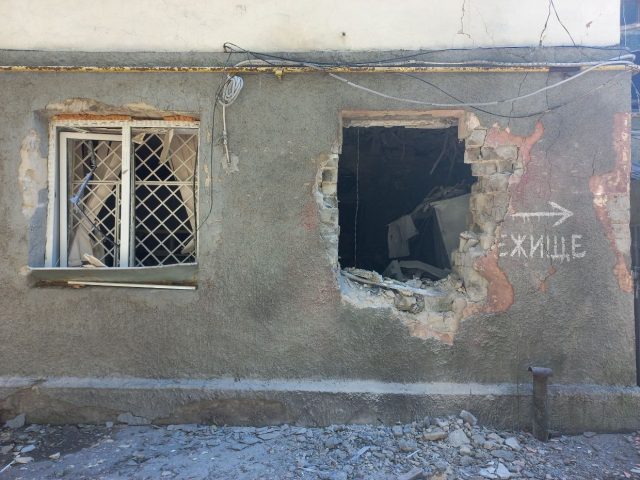
About 100 meters away, there was a gaping hole in the side of an apartment building. The shell had struck right where writing on the wall indicated the direction to the nearest basement, which was to be used as a bomb shelter. Doors to such stairways are generally permanently left open, so that anyone caught up in shelling might have a chance to survive, if they can make it to the door and basement in time.
© Eva Bartlett
Victims of another Ukrainian assault, which took place on Saturday, didn’t have that option. The center of Donetsk was hit by at around ten bombs over the course of 30 minutes around noon. At least four civilians were killed, one of whom I saw still on the ground. Some minutes later, her body was taken away. One of the shells hit a car driving along Artema Street, setting it ablaze and killing two civilians. By the time I reached that site, the vehicle had burned out, the dead taken away. Workers were already repaving the roads, sweeping debris and glass from sidewalks.
Western weapons killing Donbass civilians
When Russian and Donbass voices state that Ukraine is killing Donbass civilians with Western weapons, the reply is silence, derision, or inversion of reality: claims that Russia is bombing Donbass – which any ordinary resident here would disprove easily, having been under Ukraine’s shelling for over eight years.
War correspondent, Christelle Neant, wrote of Saturday’s bombings:
“After submitting the photos of the shrapnel I found on the spot to Adrien Bocquet, who is now a NATO weapons expert for the DPR’s representation in the JCCC (Joint Monitoring and Co-ordination Center on Ukraine’s War Crimes), he confirmed that they were American 155mm shells, some fired from Caesar guns and others from TRF1 guns.
The famous TRF1 guns that can fire (banned) 155mm cluster munitions, which I had mentioned in June, and which the Western press had assured that France had not supplied to Ukraine! Before learning at the beginning of September that Paris had indeed sold them to Kiev!”
Europeans in Germany, France and Italy recently held “#StopKillingDonbass” actions, denouncing the sale of Western weapons to Ukraine, and calling for it to end. It was rather fitting that the actions occurred the day after Ukraine bombed central Donetsk again.
These actions were followed by the release of a petition against arms supplies to Ukraine, which stated:
“Today, contrary to the fundamental principles set forth in Article 2 of the UN Charter, in particular, the principles of sovereign equality and the peaceful settlement of international disputes, our countries supply Ukraine with weapons that cause massive deaths and injuries of civilians in Donbass, including children.”
It concludes: “We demand an end to the financing of state terrorism and genocide against the people of Donbass, as well as the ongoing violations of the Geneva Conventions of 1949 and other acts of international humanitarian law since 2014.”
At this point, there is no safe region in Donetsk, nowhere is off-limits for Ukraine’s bombings, not maternity hospitals, nor busy markets. The issue does, however, appear to be off-limits for the reporting of Western corporate-owned media.
Stalin’s Jews
BY LARRY ROMANOFF • UNZ REVIEW • SEPTEMBER 18, 2022
This topic is important not only for its own sake but because it provides linkages that help us to put other historical events in perspective, and even more because it is an astonishing, even astounding, example of how history is spun, of how the omission of only a few crucial facts can totally distort an entire vital segment of history. One result is that much of what we “know” of our history is factually wrong, but also it provokes us to despise innocent people while sympathising with the guilty.
Some years ago, Sever Plocker wrote an article for Israel’s Ynet News titled “Stalin’s Jews”[1] in which he stated, “We mustn’t forget that some of greatest [mass] murderers of modern times were Jewish.” This article is a testimony to his statements.
To quote Plocker:
“We cannot know with certainty the number of deaths Cheka was responsible for in its various manifestations, but the number is surely at least 20 million, including victims of the forced collectivization, the hunger, large purges, expulsions, banishments, executions, and mass death at Gulags. Whole population strata were eliminated: Independent farmers, ethnic minorities, members of the bourgeoisie, senior officers, intellectuals, artists, labor movement activists, “opposition members” who were defined completely randomly, and countless members of the Communist party itself.
And us, the Jews? Many Jews sold their soul to the devil of the Communist revolution and have blood on their hands for eternity. Dr. Halfin described the waves of soviet terror as a “carnival of mass murder,” “fantasy of purges”, and “messianism of evil.” Turns out that Jews too, when they become captivated by messianic ideology, can become great murderers, among the greatest known by modern history. Even if we deny it, we cannot escape the Jewishness of “our hangmen”, who served the Red Terror with loyalty and dedication from its establishment.
An Israeli student finishes high school without ever hearing the name “Genrikh Yagoda,” the greatest Jewish murderer of the 20th Century, the GPU’s deputy commander and the founder and commander of the NKVD. Yagoda diligently implemented Stalin’s collectivization orders and is responsible for the deaths of at least 10 million people. His Jewish deputies established and managed the Gulag system.”
Plocker then states a view all too common among Jews everywhere, when he writes, “The Jews active in official communist terror apparatuses . . . did not do this, obviously, as Jews, but rather, as Stalinists, communists, and “Soviet people”. But he does redeem himself by stating further, “My own view is different. I find it unacceptable that a person will be considered a member of the Jewish people when he does great things, but not considered part of our people when he does amazingly despicable things.” I couldn’t agree more.
If the arguments are valid, then Germany shouldn’t apologise or feel remorse about anything, because after all Hitler wasn’t acting as a German, but as a “European” or a “Nazi”. This is simply a lame attempt to tell us that Jews are “really Jews” only when they’re good. When they’re evil, their Jewishness is presumably cast off and they assume some other identity.
Jews are unwilling to confront the history of significant numbers of their own people committing savage atrocities, so they downplay their own origin, rewrite history, and forget it. Perhaps even more to the point, what about the savage and inhuman treatment the Jews in Israel inflict on the Palestinian people? When they shoot children in the head, bomb the UN school to utter destruction, destroy the American School in Gaza with white phosphor, and burn children alive, are they acting as Jews? Surely they must be.
Plocker refers to one other thing, an attempt to confuse and transfer liability and guilt from the Jews to the Russian people. He noted that Niall Ferguson, a so-called “historian” at Harvard University, in his book “The War of the World”, wrote that “no revolution in the history of mankind devoured its children with the same unrestrained appetite as did the Soviet revolution”. Plocker also recalled that Tel Aviv University’s Dr. Igal Halfin, in a book on the Stalinist purges, wrote that “Stalinist violence was unique in that it was directed internally”.
I find both those statements repulsive idiotic sophistry, apparent deliberate acts to deflect responsibility for a campaign of mass murder almost without equal. In no way did the Soviet Revolution “devour its own children”; rather the Jews came to Russia to devour Russian children. And the violence was “directed internally” only in the sense that those executing it were external agents, outsiders who came to kill.
A Bit of Historical Background
In a previous essay on Jews and Revolutions[2] I noted that there have been many waves of attempted revolutions in the past, all instigated by the Jews, but mostly buried and misrepresented by these same people. Russia is a particular case in point. It doesn’t seem widely-known, but Russia has had more than its share of attempted revolutions, both before and after the 1917 event we all know as “The Russian Revolution”.
The Revolutions of 1848
The world in 1848 had a virtual epidemic of attempted revolutions and overthrows of government, affecting literally dozens of countries, Russia among them. There was mild success in France, but all others were crushed. Nevertheless, 1848 was a major point in world history that is almost never seen as such because the individual elements are all treated separately by our so-called historians (primarily Jewish) and the book publishers (almost entirely Jewish) who never provide us with the tools to link all those disparate events into one picture. I won’t dwell on it here, but all of those revolutions of that year were from the same source, an enormous concentrated effort to reconfigure the governments of the world to be more compatible with the aims of the Khazar Jews.
The Revolution of 1881
Russia had another revolution in 1881,[3] stirred up by the same people, in this case with the assassination of Tsar Alexander II by a Jew named Vera Figner, leader of a Jewish terrorist group called “The People’s Will”. This was their notification to the new Tsar Alexander III: [4]
“Workers of Russia! Today, March 1st, Alexander the Tyrant (Alexander II) has been killed by us, Socialists. He was killed because he did not care for his people. He burdened them with taxes. He deprived the peasant of his land. He handed over the workers to plunderers and exploiters. He did not give the people freedom. He did not heed the people’s tears. He cared only for the rich. He himself lived in luxury. The police maltreated the people and he rewarded them instead of punishing them. He hanged or exiled any who stood out on behalf of the people or on behalf of justice. That is why he was killed. A Tsar should be a good shepherd, ready to devote his life to his sheep. Alexander II was a ravening wolf and a terrible death overtook him.”
The Revolution of 1890
It seems our revolutionaries didn’t much care for Alexander III either, and made another stillborn attempt in 1890. As part of their revolutionary plot, the Jews took advantage of a poor crop year in an attempt to foster a popular revolution with hunger as they did in France. The Russian government was at first unaware of the extent of the poor harvest and the food shortages, and delayed acting for some time. Realising the natural outcome, and also knowing that grain prices were much higher for export than for domestic consumption, Jewish “grain buyers” pre-empted the government’s actions by quickly purchasing and exporting much of the year’s already-limited crop before Imperial edicts could prevent it. The resulting famine was serious, and nearly 500,000 people died. The hoped-for revolution failed to appear, however.[5]
The Revolution of 1905
The next attempt following was much more momentous, this being the revolution of 1905 and the event termed “Bloody Sunday” where an organised protest was put down rather brutally by the new Tsar Nicholas II. During the next two years, the Jews organised terror brigades that killed many thousands of people, mainly police and government officials. Several thousand Jewish terrorists were caught and exiled to Siberia and elsewhere, but this story has a closely-related and very important element that history has de-linked and which we need to understand.[6]
The Russo-Japanese War
I won’t go into too much detail here because the topic is large and other references are easily available on the basic facts.[7] In simple terms, Russia wanted a warm-water naval port in Northern Korea or Northern China, areas under the control of the Japanese. The picture is a bit murky but it is clear that the Jews were heavily pushing belligerence and intractability on both sides, and definitely promoting serious military engagement. Jacob Schiff was promoting a (thoroughly fictitious) policy of helping Japan to industrialise and militarise, to protect itself from the “Christians of Russia’s Tsar”.[8]
One of the crucial details history has suppressed is that Japan was not only being pushed into a war with Russia, but was given financing of $200 million by the European Rothschilds to purchase a wide array of arms and weapons conveniently supplied by Rothschild’s arms factories in Germany. Japan was literally armed to the teeth with the latest of everything – and all on credit. Another detail history has omitted is that Russia was sold essentially the same weapons for about the same $200 million and also on credit, financed by another group of Jewish bankers but supplied by the same Rothschild factories. Fortunately for the Japanese, their weapons arrived just in time for the attacks on Russia, permitting Japan to destroy much of the Russian fleet. Unfortunately for Russia, their weapons shipments were inexplicably delayed, not arriving until all the damage had been done, thus leaving the government weak, demoralised and in disarray, with much of its military destroyed.
In spite of this defeat, Russia did eventually obtain half of Sakhalin Island at the time for use as its naval bases, and obtained the remainder after WWII. Thus, the Japanese realised that their war with Russia was actually of no benefit at all, at least not to them. However, they also realised something else – that they had been suckered by the Jews into a war with Russia for the sole purpose of weakening Russia as preparation for the planned 1905 revolution. They not only obtained no benefit from the war, but were used merely as an unwitting tool to weaken an enemy for someone else to conquer – and left almost bankrupt and with $200 million in debt for the experience.
Our history books and Wikipedia have no knowledge of this. One example of how omitting just one crucial detail changes the entire picture of an historical event, leading all students to precisely the wrong conclusion.
The Japanese didn’t forget this and, with further similar experiences, they realised they were never going to be accepted as part of the Western world. Thus, when the winds of WWII began blowing, the Japanese understandably didn’t want enemy aliens in their midst. They first expelled all the Jews from Nagasaki in 1926 and then later all the Jews from all of Japan. This is where we can make more historical links. It appears almost a certainty that the reason Bernard Baruch, a Jew and “the most powerful man in the US” at the time, selected Nagasaki as one of the targets for the atomic bomb. And the later total expulsions were arguably the reason Baruch chose Japan as the target for the US to demonstrate its new atomic prowess.
The Khazar Jews are not forgiving to any nation who expels them, which is the reason poor little Cuba has been horribly punished ever since Castro’s revolution, and one of the reasons China is such a target today – because Mao expelled all the opium and every kind of Jew from China as soon as he took power. Jewish publications tell us the Jews left Shanghai “in a hurry” after the war, neglecting to mention the cause of that “hurry”.
This is an aside, but the second expulsion of all Jews from Japan is the source of the fabricated stories of Shanghai “welcoming 40,000 Jews who were escaping Hitler’s atrocities in Europe”. The story, a lie in its entirety, is that all these Jews traveled from Germany to Shanghai where they would be “safe” from Hitler. But if this were their objective, crossing the border into Russia would have been enough; reaching Moscow would have been more than enough. Traveling 7,000 Kms. all the way through Siberia, then another 5,000 Kms. south to Shanghai makes no sense. There were many safe places on the way. In any case, transportation from Moscow to Siberia was minimal at best and there was no system capable of carrying an additional 40,000 people to Yakutsk, nor were there facilities to take those people through Siberia, Mongolia and Japan-controlled Manchuria all the way to Shanghai. While there might have been a few who did travel overland, it was the Jews expelled from Japan that flooded into Shanghai. And it was not the “warm-hearted Chinese” who saved 40,000 Jews from Hitler as we are told. The Japanese had full control of Shanghai as well as much of Northeast China, and Shanghai already had a huge number of opium Jews, so the transfer was a natural one. “China” had no say in the matter, Shanghai had no say in the matter, and all those “warm-hearted Chinese” didn’t even know what happened.
Back to the Revolution of 1905
The Tsar at the time, Nicholas II, had a serious change of heart and was willing to make major concessions to keep his country at peace and to avoid a civil war. One of his most effective ministers, Peter Stolypin, proposed many changes that would have cemented the contentment of the population and the security of Russia. It is said that Stolypin was perhaps the one man who could have avoided all the bloodshed and saved the Romanovs. Thus, Stolypin had to be removed.[9] A Jewish revolutionary named Dmitri Bogrov shot and killed Stolypin.[10] The Jews quickly claimed that Bogrov “acted alone” but mysteries about that assassination were never resolved. In any case, his assassination doomed the Romanov dynasty. Wikipedia had no idea Bogrov was a Jew.[11]
The 1917 Russian Revolution
We need to note first that the 1917 Russian Revolution was not, in any sense, a “Russian” revolution. It was entirely, 100%, a Jewish revolution against Russia and the Russian people. Native Russians had no part in the planning, and played little role in the execution of this immense tragedy, absolutely one of the bloodiest and most savage events in the world’s recent history.
It isn’t so much the revolution that is of interest to us, but the events preceding and following that should claim our attention. The Jews desperately wanted an upheaval to destroy Russia as it was, according to the plan for worldwide Communist control. This time, they planned much more carefully. It doesn’t seem widely-known, but Trotsky and several hundred Russian Jews who were expelled from Russia after the failed 1905 revolution, were all in the US receiving training for the next attempt, and they received literally many years of coaching. They were heavily financed by Jacob Schiff and Max Warburg, who spent more than $20 million on the training and the financing of the revolution itself. That would be about $750 million today, an enormous amount of money for the time.
In March of 1917, Schiff and Warburg sent Lev Davidovich Bronstein, better known as “Trotsky” and his group of several hundred Jewish communists off to Russia, to foment a revolution. At the same time, some 90,000 Jewish exiles returned to Russia from all over the world to infiltrate the country and assist in the revolution, most changing their Jewish names to blend more easily into Russian society. You can see this was not a trivial undertaking, but one with extensive worldwide planning from a single source – that source being the City of London.
Lenin was sent across Europe to Russia on the famous “sealed train” with an additional $5 million or $6 million in gold (about $175 million in today’s dollars). At the same time, Trotsky left New York aboard the S.S. Christiania with approximately 300 intensively-trained Jewish revolutionaries, with a huge hoard of gold in hand, their first port of call being Halifax, Nova Scotia. The Canadian government was aware of the plot and of the identities of those men, and arrested Trotsky and his people, and impounded their gold. But the Jews reacted immediately and with threats of force, with William Wiseman of Kuhn Loeb, and the famous “Colonel” House, imposing enormous pressure on Canada to release the men. Canada, cowardly as always, capitulated to the pressure and complied, Trotsky then free to meet up with Lenin and proceed with the Jewish plans for Russia. This is one of the many parts of Canadian history that no Canadian is permitted to learn.
In the world of motor vehicle insurance there used to be a doctrine for assigning responsibility for collisions, known as “the last clear chance”. The theory was that, regardless of who created the circumstances for an accident, if one driver had a last clear chance to avoid the collision but failed to exercise it, the blame would fall on him. If we adopt this doctrine, Canada had the last clear chance and can be assessed the entire blame for the revolution in Russia and the enormous toll of casualties that ensued.
The Jewish Revolutionists
The Georgian, Ioseb Besarionis dze Jughashvili (aka. Joseph Vissarionovich Stalin), may have been little more than a front, the real power behind the throne emanating from the City of London and masterminded by Jacob Schiff and Max Warburg. Some historians agree that Stalin was a mere figurehead, that it was Lazar Kaganovich (the Jewish head of the CHEKA, and the brother of Stalin’s Jewish wife) who was really in charge. More than a few historians appear to accept the thesis that it was all the Jews in important positions under Stalin, who actually made the decisions and determined the policies.
It should be noted that, while Jews were only a minuscule percentage of Russia’s population, between 80% and 90% of all Russian revolutionaries were Jews and, in some segments like the Gulags and the CHEKA, Jewish participation was effectively 100%. Jews absolutely dominated the entire Bolshevik regime after the 1917 Red October Revolution. Almost all the ministers in the first Soviet government were Jews, and the few who were not, were Freemasons, had Jewish wives, and spoke Yiddish. “The Bolshevik’s revolution in Russia was the work of Jewish brains, of Jewish dissatisfaction, of Jewish planning, whose goal is to create a new order in the world.” [12] As noted above, about 90,000 Jews from many European regions poured into the major cities of Russia, to be given prominent executive positions in all major sectors of government and the economy.
“According to data furnished by the Soviet press, out of 556 important functionaries of the Bolshevik state, including the above-mentioned, in 1918-1919 there were: 17 Russians, two Ukrainians, eleven Armenians, 35 Letts [Latvians], 15 Germans, one Hungarian, ten Georgians, three Poles, three Finns, one Czech, one Karaim, and 457 Jews.”[13]
“According to the U.S. State Department’s documents, a group of powerful Jewish financial elites were planning the overthrown of the Russian Tsar, Nicholas II, in 1916. These plotters included Jacob Schiff, Mortimer Schiff, Felix Warburg, Otto Kahn and Isaac Zeelman. They decided that Russia should be destroyed and a communist dictatorial regime would be implemented, subservient to the dictates of International Jewry.”[14]
Alexander Solzhenitsyn wrote: “You must understand. The . . . Bolsheviks who took over Russia were not Russians. They hated Russians! They hated Christians! Driven by ethnic hatred they tortured & slaughtered millions of Russians without a shred of human remorse. The October Revolution was not what you call in America the ‘Russian Revolution’. It was an invasion & conquest over the Russian people. More of my countrymen suffered horrific crimes at the blood-stained hands than any people, or nation ever suffered in the entirety of human history. It cannot be understated! Bolshevism was the greatest human slaughter of all time. The fact that most of the world is ignorant of this reality is proof that the global media itself is in the hands of the perpetrators. We cannot state that all Jews are Bolsheviks, but without Jews there would have been no Bolshevism. For a Jew, nothing is more insulting than the truth. The blood-maddened Jewish terrorists murdered 66 million in Russia from 1918 to 1957.”[15]
Winston Churchill wrote, “There is no need to exaggerate the part played in the creation of Bolshevism and in the actual bringing about of the Russian Revolution by these international and for the most part atheistical Jews . . . In the Soviet institutions the predominance of Jews is even more astonishing. And the prominent, if not indeed the principal, part in the system of terrorism applied by the Extraordinary Commissions for Combating Counter-Revolution (CHEKA) has been taken by Jews, and in some notable cases by Jewesses.”[16]
“The world revolution which we will experience will be exclusively our affair and will rest in our hands. This revolution will tighten the Jewish domination over all other people.”[17]
The Jewish CHEKA
The Jewish CHEKA was a secret police force created through the NKVD; its makeup was almost entirely Jewish. “Jews were especially dominant in the most feared and bloodthirsty part of the Bolshevik State apparatus, the CHEKA, which consisted of 250,000 officers”, all Jews, and with unlimited power, Kaganovich and his CHEKA organisation acting as “policeman, investigator, jailer, prosecutor, judge and executioner”.[18]
Lazar Kaganovich was the Jewish head of the CHEKA and was famous for his purges of those who opposed Jewish control of the country. Anyone daring to criticize Jewish Supremacy was mercilessly murdered, as “anti-Semitism” became a crime punishable by death in the Soviet Union.
Primarily, the CHEKA rounded up all Gentiles failing to support the Jewish government, then tortured and killed them. This especially included the military and government workers, all Christian clergy, and anyone with property valued at more than 10,000 rubles. The Jews operating the CHEKA not only exterminated all these categories of people but specialised in torture, their methods including skinning people while alive, scalping, impaling on stakes, hanging, stoning to death, being ‘crowned’ with barbed wire, being tied to planks and pushed slowly into tanks of boiling water. There was a further atrocity that was also commonly done to black slaves in America, that of pounding nails into a large wooden barrel so the points protruded into the inside, then placing a naked man into the barrel, nailing it shut, and rolling it down steep hills. They also used what is called the “rat torture”, placing a rat inside an open-bottom metal box attached to a man’s abdomen, then heating the metal box to red-hot, at which point the animal, crazed from the heat, would attempt escape by eating into the man’s body.
These Jews also specialised in torturing and killing women and children, inevitably raping the women before they were killed. The CHEKA Jews quite openly roamed the countryside kidnapping and killing children, eventually exterminating entire rural populations. They also burned down many or even most of the churches and destroyed most of the Christian monuments in Russia, turned the priests into street-sweepers or simply murdering them outright. In the end, the majority of the Christian clergy were killed by the Jews. “The Jewish CHEKA systematically exterminated the wealthy, the business class, the intelligent educated class, all the high-achieving segments of the population, leaving Russia with a population of ignorant workers, peasants, and a powerful Jewish ruling elite.”
The Jews in the CHEKA also murdered the entire family of Tsar Nicholas II, “the last of the Romanovs”. It was Yakov M. Yurovksy, a Jew, who carried out the murders. Trotsky rationalised the murders as “a useful measure, not only expedient but necessary.” He claimed it proved that “it showed everyone that we would continue to fight on mercilessly, stopping at nothing.” He said the executions were meant “to frighten, horrify and instill a sense of hopelessness” in the Gentile Christians, and also to show other Jews that “there was no turning back, that ahead lay either total victory or total doom.”
The Jewish Gulags
The Gulags consisted of about 500 Jewish concentration camps established under the CHEKA, and used primarily for forced labor, any dissenters in the population typically receiving sentences of 5 to 25 years of hard labor. Yagoda sent hundreds of thousands to work on the Baltic Sea canal project where countless numbers of Russians, Ukrainians, and others perished. The system was created and founded by two Jews, Naftaly Frenkel and Levi Berman, under the direct control of Genrikh Yagoda and with the camps commanded by Jews such as Rappoport, Solz, and Spiegelglas, all of whom are mentioned at length in the work of Solzhenitsyn.
“Millions of innocent people were incarcerated in these gulags which eventually became death camps. “Prisoners worked outdoors and in mines, in arid regions and the Arctic Circle without adequate clothing, tools, shelter, food, or even clean water. They trudged through mud in sub-zero -20C temperatures, cut down trees with handsaws, dug at frozen ground with primitive pickaxes and heaved huge rocks with primitive tools. Others mined coal or copper by hand, often suffering painful or fatal lung diseases from inhaling ore dust while on the job. These prisoners worked up to 14 hours a day on massive projects, including the Moscow-Volga Canal, the White Sea-Baltic Canal, and the Kolyma Highway.
Before Stalin’s death, nearly 20 million men and women were transported to these camps in Siberia and other outposts, many of them never to return. The prisoners suffered from starvation, illness, violence, and cold; an immense number of people died. Starvation was not uncommon, as prisoners were barely fed enough to sustain such difficult labor. Other prisoners were simply dragged out to the woods and shot by guards for little or no reason.”[19]
Jewish Collectivisation
The Jewish Bolsheviks implemented a policy known as “Collectivisation”, which meant confiscating all peasant land in the name of the state, and by the use of Red Terror at the hands of the CHEKA. “This is what Karl Marx himself described as the “essence of communism”, to abolish private property which belongs to the Gentiles“. After a dozen or so years, more than 90% of all the land had been ‘collectivised’. One direct result of this process was death by starvation, since the Jews confiscated not only the land but all the grain from these areas, directly condemning the peasants to death.
The famines created in Russia by the Jews were unimaginable. One historian, Yulia Khmelevskaya, wrote that “People were eating almost everything that could be swallowed. They ate straw from the roof.” The Jews deliberately organised three large waves of “man-made famines aimed at starving farmers in Ukraine, Belarus, Kazakhstan and Russia. Millions of people died a slow death and people resorted to eating grass and some even to cannibalism.” And the Jews’ attitude toward this? Trotsky is famous for having stated, “You are Starving? This is not famine yet; when your women start eating their children, then you may come and say we are starving.”[20]
The Jewish Holodomor in the Ukraine
The Encyclopedia Britannica estimates that around 8 million people, five million of them Ukrainian, were starved to death by one Kaganovich famine alone and the three Holodomor genocides together resulted in a death toll of 16.5 million people. The Jewish media and Jewish organisations of all stripes make enormous efforts today to dismiss the Ukrainian famines as a hoax when the evidence is overwhelming. They do so primarily to avoid competition for the Jews as the world’s only victims in WWII. This is worse than you might imagine; we have all seen photos of huge piles of emaciated dead bodies – literally skin and bones piled two or more meters high, which are presented to us as evidence of Jews starved to death by the Germans. But they are no such thing. They are instead evidence of Ukrainians, Russians and other Slavs starved to death by the Jews.[21]
Aleksandr Solzhenitsyn estimated that in total the Jewish regime in Russia managed to exterminate more than 60 million people, including victims of the forced Collectivisation, the starvations and famines, the purges, expulsions, banishments, executions, and mass deaths at Gulags. I believe he also said that “Industrial-scale murders like these are an essential part of [Jewish] communist theory.”
Khazar Jewish Sympathy for the Victims
Trotsky said “We must turn Russia into a desert, populated by White negroes upon whom we shall impose a tyranny such as the most terrible Eastern despots never dreamt of. The only difference is that this will be a left-wing tyranny, not a right-wing tyranny. It will be a Red (Jewish) tyranny, and not a White one. We mean the word “red” literally, because we shall shed such floods of blood as will make all the human losses suffered in the capitalist wars pale by comparison. The biggest bankers across the ocean will work in the closest possible contact with us. If we win the revolution, we shall establish the power of Zionism upon the wreckage of the revolution’s funeral, and we shall become a power before which the whole world will sink to its knees. We shall know what real power is. By means of terror & bloodbaths, we shall reduce the Russian intelligentsia to a state of complete stupefaction & idiocy and to an animal existence.” Lenin said that “Three-quarters of mankind may die, if necessary, to ensure the other quarter for Communism”.
Grigori Zinoviev, the head of the Jewish Communist International (Comintern), wrote in an article in the Krasnaya Gazeta, in 1918 where he stated, “We will make our hearts cruel, hard and immovable, so that no mercy will enter them, and so that they will not quiver at the sight of a sea of enemy blood. We will let loose the floodgates of that sea. Without mercy, without sparing, we will kill our enemies in scores of hundreds. Let them be thousands. Let them drown themselves in their own blood. Let there be floods of the blood of the bourgeois; more blood, as much as possible.”[22]
Stalin’s Jews
Lazar Kaganovich

Lazar Kaganovich was a close associate of Joseph Stalin and the brother of Stalin’s wife. As noted above, Kaganovich was the Jewish head of the CHEKA and famous for his purges of those who opposed Jewish control of the country, having ordered the deaths of millions. Kaganovich openly boasted of personal responsibility for killing at least twenty million people. It was Kaganovich also who presided over the total destruction of Christian churches and clergy, the man famous for standing atop the rubble of a Russian church and proclaiming, “Mother Russia has been cast down! We have torn away her skirts!”.[23]
This Jew truly “made life a living hell” for the people of Russia, killing countless millions of innocent peasants in a sea of blood. Not everyone objected: One Jew in Hollywood was reported to have said, “You can’t make an omelet without breaking eggs” and, in a statement variously attributed to both Stalin and Kaganovich, “The death of one man is a tragedy, the death of a million is a statistic.” On the other hand, the Jewish Virtual Library seems to know only that Kaganovich “managed the construction of the Moscow underground”, and that, rather than being Stalin’s main Jewish handler, his “subservience to Stalin was made abundantly clear” in some obscure article he supposedly wrote.[24] Kaganovich was just one of the Jewish mass murderers; there were many other Jews who contributed to the massacre of Russians under the cruelest circumstances.
Yakov Sverdlov

Yakov Sverdlov, known as the “devil of the revolution”, was the Jew’s executive secretary and head of the Jewish government. It was this man who created and unleashed what became known as “The Red Terror”. It was also Sverdlov who initiated the so-called “decossackization”, where about 1 million Don Cossacks were brutally killed, including women and infants, often by being buried alive. For the first several years after 1917, it seems that every single bloody action against the Russian people was instigated by Sverdlov, being “the brains of the party”. The writer P. Paganuzi said that “the monstrous crimes of the [Jewish] Bolsheviks which exceeded all measures of cruelty, were committed on orders from the center, and the main responsibility for them lay with Sverdlovsk.”[25] [26] [27] [28] [29] It was Sverdlov who gave the order to kill the Russian Royal Family. “Research in 1990 by the Moscow playwright and historian Edvard Radzinsky uncovered Sverdlov’s role in ordering the execution of Tsar Nicholas II and his family.” The Jews were so proud of him that the city of Yekaterinburg where the Tsar and his family were killed, was renamed Sverdlovsk in his honor.
Genrikh Yagoda (real name: Genakh Gershenovich)

Genrikh Yagoda was described as “Stalin’s leading terror chief responsible for keeping him in power”, and who was unquestionably “one of the greatest Jewish mass murderers of the 20th Century“. He was the GPU’s deputy commander and the founder and commander of the NKVD. It was Yagoda who implemented the Collectivisation of peasant lands and crops and was responsible for the deaths of at least 10 million people. It was Yagoda’s Jewish deputies who established & managed the Gulag system, of Aleksandr Solzhenitsyn fame.[30] Yagoda was later demoted and replaced as chief hangman by Nikolai Yezhov, “the bloodthirsty dwarf”.
Lavrentiy Pavlovich Beria

Lavrentiy Beria, certainly Stalin’s most powerful and vicious Jewish Lieutenant, was a mass murderer of peasants and a bloodthirsty sex maniac and pedophile who buried children in his basement, apparently many while still alive. Beria was the notorious police chief and powerful lieutenant who initiated the Katyn massacre.[31] Beria joined the CHEKA and became head of the NKVD in Georgia and eventually a member of the Central Committee of the Communist Party, then deputy prime minister and member of the Politburo. After Stalin’s death in 1953, Beria attempted to replace him as dictator of the Soviet Union, but was defeated by Nikita Khrushchev, Molotov and Malenkov.
As an example of how history is spun, consider this apparently trivial statement: “Beria has long symbolized all the evils of Stalinism . . .” Stalinism? This immense Russian tragedy, planned and executed entirely by Jews, is suddenly reduced to a single adjective that pins the entire blame on one man not apparently Jewish. In fact, Beria symbolises all the evils of “Jewish-ism”, still “haunting the public imagination both in the West and in the former Soviet Union”. Yet the man’s name (along with a few others) has been expunged from history and almost no one has heard of him.
Ilya Ehrenburg

There was also Ilya Ehrenburg, who is perhaps most famous as the Jew who taught people to hate – to “Kill all Germans because they are not human”.[32] It was Ehrenburg who incited troops to rape and maim German, Polish, and Czech women as a form of punishment, as part of his agitation for genocide against all Germans.[33]
“The Germans are not human beings. From now on, the word ‘German’ is the most horrible curse. From now on, the word ‘German’ strikes us to the quick. We have nothing to discuss. We will not get excited. We will kill. If you have not killed at least one German a day, you have wasted that day … If you cannot kill a German with a bullet, then kill him with your bayonet. If your part of the front is quiet and there is no fighting, then kill a German in the meantime … If you have already killed a German, then kill another one – there is nothing more amusing to us than a heap of German corpses. Don’t count the days, don’t count the kilometers. Count only one thing: the number of Germans you have killed. Kill the Germans! … – Kill the Germans! Kill!”
And in another leaflet: “The Germans must be killed. One must kill them … Do you feel sick? Do you feel a nightmare in your breast? … Kill a German! If you are a righteous and conscientious man – kill a German! … Kill!” [34] But according to Wikipedia, Ehrenburg was a nice man, a quiet journalist who is most famous for his written works detailing “the genocide of Russian Jews”.[35] Oddly, his fanatical writings demanding the genocide of all German Gentiles has been deleted by our history book publishers.[36]
And Many More
There was Leonid Reichman who was head of the NKVD’s special department and the organization’s chief interrogator, and a particularly cruel sadist.[37] There are many more, names that will mean little to you: Alexander Parvus, Solomon Lozovsky, Moisei Uritsky, Adolph Abramovich Joffe, Dmitry Bogrov, Lev Kamenev (real name Rosenfeld), Maxim Litvinov (born Meir Henoch Mojszewicz Wallach-Finkelstein), Karl Radek (real name Karol Sobelsohn), Grigori Zinoviev, Ilya Ehrenburg, Natalfy Frenkel, Mathias Berman. All Jewish mass murderers in their own right.
The Anonymity of the Jews
It is not always easy to know with certainty the Jewish identity of some people due to attempts of so many natures to disguise and obfuscate the facts. Merely by changing their names so often, Jews make the truth of their ethnicity difficult to discern. Lenin (Vladimir Ulyanov) was a Jew.[38] [39] [40] [41] It is widely speculated now that Stalin was a Georgian Jew, with even the Los Angeles B’nai B’rith Messenger crediting him as being a Jew. Certainly, he spoke Yiddish, he had three Jewish wives, and had no Gentiles anywhere in his inner circle. And certainly, part of the issue is that identifying Stalin as a Jew, eliminates his usefulness as a poster boy for Russian psychopathology, leaving no Gentile to blame for Jewish atrocities. As mentioned above, this permits the Jews to categorise the entire “Russian” revolution and all the atrocities as “Stalinism”, i.e., an entirely Gentile event when the destruction of Russia and the extermination of more than 60 million Russians was entirely of Jewish creation and execution. It should be noted that Russia’s population at the time, was only 125 million.
There are some Jewish websites such as Jew or Not Jew that are often very helpful in offering their determination of the ethnicity of various people, and usually one can write and ask for an opinion or determination. But there are some individuals who appear to be verboten in this respect. One such is Reimert Ravenholt, the former head of USAID, surely one of the greatest sociopaths and psychopaths of all time, having forcibly sterilised literally hundreds of millions of women in undeveloped countries, and causing only God knows how many deaths. I have attempted through these Jewish websites to obtain information or opinions on Ravenholt’s ethnic background, and in only this one case have all websites unanimously refused to reply to me.
“The difficulty in arriving at an accurate understanding of the problem of the Jews lies in the fact that there is a distinct Jewish religion and a distinct Jewish race. Where one ends and the other begins. Jews will, however, reply with assurance that they are not a race but a religion and that to differentiate between them and other religious bodies is sheer prejudice and bald Anti-Semitism.”[42]
“Judaism is a religion, not a nation.” That may be true, but we aren’t discussing the religion of Judaism; rather, we are focused on Jews as a people. The preceding statements deny that Jews are a people, a race, or a nation, and can be identified only as members of a religion. Well, maybe, but how is it that I – and hundreds of millions of others – can look at a face and tell you instantly that person is a Jew? It would be a very powerful religion indeed if it can alter the facial features of its adherents.
There is more to this. Many years ago, the Jewish Kehillah in New York heavily pressured the US government to avoid altogether the ethnic or racial identities of Jews and to record only their passport status. This resulted in the government having no firm knowledge of the number of Jews in the US, the NYC Kehilla being the only body possessing such records. The Jews have gone much further in the recent past by pressuring the US government to make illegal any request of a person’s religion on the basis that this amounted to “religious discrimination”. Having succeeded in this, the Jews then conflated the two and heavily promoted the thesis that “Jewishness” is solely a religion and not a race or nation, thus making it impossible to have any legal means to discover if someone is a Jew. Quite clever. And, since so many Jews frequently change their names, the identification effort becomes almost impossible.
Yet, the effort is necessary because it is only when we can make this identification that we can form the links necessary to connect all the dots and understand both our history and the current affairs of the world. It is only with this identification that we can realise that pornography is almost exclusively a Jewish talent, that the alphabet soup of “sexual preferences” is being promoted nearly entirely by Jews. It is only by this identification of Jews as a race and a nation that we can realise that the “Russian Revolution” was in actuality entirely a Jewish Revolution against Russia, and that the destruction and colonisation of Yugoslavia, Iraq and Libya were entirely Jewish events even though effected by the US military on the Jews’ behalf. For example, the so-called “provisional orders” issued for the colonisation of Iraq by Paul Bremer, take on a very different light when we learn that Bremer, the “Temporary President of Iraq” was a Jew, and a close affiliate of Henry Kissinger. (43) Bremer was clearly taking his direction from the City of London and not from George Bush. Thus, Iraq was also a “Jewish Revolution”, as were Yugoslavia and Libya.
There is yet more. I once had an acquaintance in Shanghai named Steven Wood – hardly a name one would identify as a Jew. At the time, Steven had a high HR position with Huawei, and confided that he possessed both American and Israeli passports and traveled to Israel several times a year. One day he sent me a file of about 50Mb, if I recall correctly, containing the technical details of all of Huawei’s products. I was surprised because it seemed to me that was information he should not have had, since engineering and design were not part of his job description. He never told me anything directly but, from the context, I assumed that whenever he traveled to Israel all of Huawei’s information went with him. Huawei of course would have no way of knowing they had been infiltrated.
Given the difficulties, it is possible to make occasional errors in the identification, and classify someone provisionally as a Jew when they are not. I would argue that such occasional errors are almost always trivial. Most of those so identified are dead, and these errors, though unfortunate, are unlikely to do particular harm. This is by no means an excuse for carelessness or a casual attitude, but I would argue that so much is at stake that “it is better to be safe than sorry”.
There are many other items of immense historical significance whose flavor is considerably altered if we can accurately make these identifications. For example, the greatest criminal organisation in the history of the world was Rothschild’s British East India Company, followed closely by the Dutch East India Company, both of which were created and controlled by Jews. Rothschild and his Jews killed at least 200 million people in India by execution and famine, with some estimations being much higher. Similarly, the business of growing opium in India and forcing it onto China, were entirely Jewish enterprises – which our history books, thanks to Jewish publishers, blame on “the British”. Again, Rothschild and Sassoon killed at least 100 million in China by slaughter and at least an additional 50 million by other means. The CIA’s MK-ULTRA program was entirely Jewish at the top and at least through the middle ranks, with atrocities that may never have an equal. The decision to do incendiary bombing of Germany’s residential areas was the result of one of Churchill’s Jewish advisors. Similarly, Holland’s Tulip Bubble and the South Seas Bubble were Jewish concoctions. There is so much more.
Enormous historical crimes are thus covered up, with the blame assigned to the wrong persons and leaving the Jews free to present themselves as the world’s victims instead of the perpetrators.
I would add a final note. Readers often complain they are unable to locate evidence of certain historical events such as the expulsions of Jews from Cuba or China, stating that their searches uncover nothing. They seem unable to fathom that Google heavily censors any topic dealing with the Jews, with Israel, with history (especially any history involving the Jews), with most political topics and much more. It is almost amusing that Google has no knowledge of the expulsion of Jews from China after the war, but instead knows a great deal about Jews who remained in China and who carried much influence. As someone wrote, “It would be better to not know so many things, than to know so many things that are wrong.”
It shouldn’t be necessary to point out that Google is as Jewish as Israel, and that the historical facts it permits to escape through the net on these topics, are those with a particular propaganda point of view and are, more often than not, factually wrong. For this reason, and because Google assiduously tracks (and saves in perpetuity) every search, every topic, every keyword, every clicked link, every website visited, I haven’t used Google for 20 years.
And, in spite of having no Google-related programs or apps on my computers, I am still warned of more than 500 attempts every month by Google attempting to track my online movements.
The Jewish Pogroms
These were events of punishment (by imprisoning or killing Jews) in Russia and some other countries, events which are presented (and which may have been) “witch hunts” against Jews for the crimes committed during and after the Revolution of 1917.
We have all seen enough of the Dr. Zhivago and Fiddler on the Roof-type movies to give us a sense of the sympathy-seeking approach by the Jews about the Russian Revolution. Because of their media and Hollywood control, much or even most of the world’s public consciousness about this enormous event has been resolved to only two items: One, Stalin was evil, and two, the Jews in Russia suffered terribly from these “anti-Semitic” pogroms, persecutions which the ever-chaste and stellarly-virginal Jews absolutely did not deserve because no Jew anywhere has ever done anything to anybody. It is almost unimaginable that the Jews have so much control over the media and book publishing that they have been able to perpetrate such an enormous and truly unforgivable hoax on the world’s public consciousness. Compared to what the Jews did to the Russian people, the so-called “pogroms” were too trivial to warrant mention.
I am obviously of Russian extraction. If you and your friends come to my country, brutally exterminate nearly half of our population, kill my King and his entire family and steal most of the Royal Treasures, torture millions, create famines to kill millions more, destroy the nation and the economy, then loot my country of most of its most priceless art treasures while also emptying my government’s central bank on your way out, I might be tempted to hunt you down too.
Epilogue
“We mustn’t forget that some of greatest [mass] murderers of modern times were Jewish.”
Does anyone recall Hitler writing: “The Jews are not human beings. From now on, the word ‘Jew’ is the most horrible curse. The Jews must be killed. One must kill them … If you cannot kill a Jew with a bullet, then kill him with your bayonet … Kill a Jew! If you are a righteous and conscientious man – kill a Jew! If you have already killed a Jew, then kill another one… Kill!”
No, of course not. Then, it is reasonable to ask why Hitler has become the poster boy for historical atrocities when most of these Jews were far worse, especially considering that much, if not most, of the so-called Nazi atrocities were merely “atrocity porn” proven later to have been entirely fabricated by the Jews. Why is it that we are inundated with tales of Hitler’s evils, both real and imaginary, but we have never heard of Beria, Kaganovich, Yagoda, Ehrenberg or Sverdlov? Who is it that controls the media and the book publishers? Who is it that labels you an “anti-Semitic Nazi Jew-hater” for revealing historical truths?
Think of the attitudes of the Jews mentioned in this article, of their actions. What kind of man boasts about having personal responsibility for killing “at least” 20 million innocent people? What kind of man says “If you are righteous and conscientious, kill a German”? What kind of man confiscates all the farm crops and thus sentences tens of millions to die? These are the Khazar Jews, as murderous and savage today as they were 700 years ago.
Moreover, these are the same people who today populate the City of London which is where the planning for all these atrocities has originated for centuries and continues still. Today, they dress nicely, drink afternoon tea with Royalty, and always brush their teeth after every meal. But they are responsible for one million deaths in Iraq, and many more recent tragedies. If COVID-19 was planned, this is where it was planned. These are the people who want a Third World War with Russia, China and Iran, and they will almost certainly have it because the Americans so under their control are stupid enough to launch it. The end.
Mr. Romanoff’s writing has been translated into 32 languages and his articles posted on more than 150 foreign-language news and politics websites in more than 30 countries, as well as more than 100 English language platforms. Larry Romanoff is a retired management consultant and businessman. He has held senior executive positions in international consulting firms, and owned an international import-export business. He has been a visiting professor at Shanghai’s Fudan University, presenting case studies in international affairs to senior EMBA classes. Mr. Romanoff lives in Shanghai and is currently writing a series of ten books generally related to China and the West. He is one of the contributing authors to Cynthia McKinney’s new anthology ‘When China Sneezes’. (Chapt. 2 — Dealing with Demons).
His full archive can be seen at https://www.bluemoonofshanghai.com/ + https://www.moonofshanghai.com/
He can be contacted at: 2186604556@qq.com
Notes
[1] Stalin’s Jews
https://www.ynetnews.com/articles/0,7340,L-3342999,00.html
[2] Jews and Revolutions
https://www.bluemoonofshanghai.com/politics/8184/
[3] 1881 March 13 Czar Alexander II assassinated in St. Petersburg
https://www.history.com/this-day-in-history/czar-alexander-ii-assassinated
[4] MANIFESTOS ON THE ASSASSINATION OF ALEXANDER II [1881]
https://alphahistory.com/russianrevolution/manifestos-assassination-of-alexander-ii-1881/
[5] Russian Famine of 1891-1892
https://www.volgagermans.org/history/famines/famine-1891-1892
[6] 1905 Russian Revolution
https://spartacus-educational.com/RUS1905.htm
[7] Russo-Japanese War
https://www.history.com/topics/japan/russo-japanese-war
[8] Jacob Schiff would help industrialize and militarize non-Christian Japan to fight against the Christians of Russia’s Tsar.
http://www.thechristiansolution.com/doc2009/145_Holodomor.html
[9] Stolypin, Peter
https://www.encyclopedia.com/history/encyclopedias-almanacs-transcripts-and-maps/stolypin-peter
[10] Dmitri Bogrov
https://spartacus-educational.com/RUSbogrov.htm
[11] Dmitry Bogrov
https://en.wikipedia.org/wiki/Dmitry_Bogrov
[12] The American Hebrew, 1920
https://en.wikipedia.org/wiki/The_American_Hebrew
[13] Robert Wilton
https://sunray22b.net/robert_wilton.htm
[14] The Jewish-Led Russian Revolution
http://www.renegadetribune.com/the-jewish-led-russian-revolution/
[15] The Jewish-Led Russian Revolution
http://www.renegadetribune.com/the-jewish-led-russian-revolution/
[16] The Jewish-Led Russian Revolution
http://www.renegadetribune.com/the-jewish-led-russian-revolution/
[17] Peuple Juif, February 8. 1919.
http://fau.digital.flvc.org/islandora/object/fau%3A32504/datastream/OBJ/view
[18] Jewish Bolsheviks mass-murdered 66 million Christians in Russia
[19] The Jewish-Led Russian Revolution
http://www.renegadetribune.com/the-jewish-led-russian-revolution/
[20] The Jewish-Led Russian Revolution
http://www.renegadetribune.com/the-jewish-led-russian-revolution/
[21] Holodomor Denial — A Crime against Humanity
http://www.thechristiansolution.com/doc2009/145_Holodomor.html
[22] The Jewish-Led Russian Revolution
http://www.renegadetribune.com/the-jewish-led-russian-revolution/
[23] Lazar Kaganovich – Stalin’s Mass Murderer
https://rense.com/general11/stal.htm
[24] Lazar Moiseyevich Kaganovich
https://www.jewishvirtuallibrary.org/kaganovich-lazar-moiseyevich
[25] Yakov Sverdlov. 100 years since the death of the “devil of the revolution”
https://topwar.ru/155444-jakov-sverdlov-100-let-so-dnja-smerti-djavola-revoljucii.html
[26] Yakov Sverdlov: the demon of the Leninist Revolution. 6 facts that are not found in textbooks
[27] Grandson of a merchant and brother of the American banker Y. M. Sverdlov (Gauchmann Aaron Moishevich)
https://sofya1444.livejournal.com/3187005.html
[28] Yakov Sverdlov-biography
https://biographe.ru/politiki/yakov-sverdlov
[29] The secret of Yakov Sverdlov’s death
https://proza.ru/2012/08/02/513
[30] The first NKVD commissar to be shot. Genrikh Yagoda
https://spbvedomosti.ru/news/nasledie/pervyy-rasstrelyannyy-narkom-nkvd-genrikh-yagoda/
[31] Katyn massacre
https://en.wikipedia.org/wiki/Katyn_massacre
[32] Ilya Ehrenburg agitated for genocide against Germans
https://ww2gravestone.com/ilya-ehrenburg-the-leading-soviet-propagandist-of-the-second-world-war/
[33] Ilya Ehrenburg – Kill all Germans because they are not human
[34] Ilya Ehrenberg – The Man Who Invented The ‘Six Million’
https://rense.com/general75/ehr.htm
[35] Ilya Ehrenburg
https://en.wikipedia.org/wiki/Ilya_Ehrenburg
[36] Ilya Ehrenburg
https://en.metapedia.org/wiki/Ilya_Ehrenburg
[37] Stalin’s Jews
https://www.ynetnews.com/articles/0,7340,L-3342999,00.html
[38] Lenin was a Jew
http://www.jewornotjew.com/profile.jsp?ID=1
[39] Lenin’s Jewish roots
https://www.thejc.com/news/features/lenin-s-jewish-roots-1.447185
[40] (Israel Moses) Blank in Odessa in the early 1800s.
The grandfather of Vladimir Ilyich Ulyanov — he began to take the pseudonym Lenin when he was around 30 — was born Sril Moiseyevich
[41] Was Lenin Jewish?
https://www.myjewishlearning.com/article/was-lenin-jewish/
[42] THE CAUSE OF WORLD UNREST
https://www.bluemoonofshanghai.com/wp-content/uploads/2022/09/The-Cause-of-World-Unrest.pdf
[43] Humanity at the Crossroads
https://www.bluemoonofshanghai.com/politics/humanity-at-the-crossroads/
Iran: What is the Future of the Nuclear Deal?
By Viktor Mikhin – New Eastern Outlook – 22.09.2022
While many around the world hoped for a positive reaction from the United States to Iran’s latest response, the European trio at the talks in Vienna (E3 – the UK, Germany, France) have separately issued a statement that could undo all the positive results of a year of painstaking negotiations. After Tehran responded to an American text submitted through the European Union’s coordinator for the Vienna talks, Josep Borrell, the latter passed it on to Washington. The Biden administration called the latest Iranian response “unconstructive” but refrained from responding formally, prompting speculation about the impact of the US midterm elections on negotiations in Vienna over the resumption of the 2015 Iran nuclear deal, officially called the Joint Comprehensive Plan of Action (JCPOA).
Still, after days of guesswork and speculation, a response was given, but not from the American side, which had intended to do so. E3 released a joint statement that seems only to have delighted opponents of the JCPOA and caused bewilderment around the world. “As we move closer to an agreement, Iran has reopened separate issues, related to its legally binding international obligations under the Treaty on the Non-Proliferation of Nuclear Weapons (NPT) and its safeguards agreement under the NPT concluded with the International Atomic Energy Agency (IAEA). This latest demand raises serious doubts as to Iran’s intentions and commitment to a successful outcome on the JCPOA. Iran’s position contradicts its legally binding obligations and jeopardizes prospects of restoring the JCPOA,” the E3 statement said demagogically and with no good reason.
This is despite the fact that Iran has long claimed that the IAEA has lost all credibility by making unfounded accusations that are politically motivated and emanate from the anti-JCPOA camp. In other words, and this fact has now become clear, the IAEA is simply a tool in the hands of the West, not an independent UN body. The E3 countries also seemed keen to make a poorly veiled threat against Iran, stating, “Given Iran’s failure to conclude the deal on the table, we will consult, alongside international partners, on how best to address Iran’s continued nuclear escalation and lack of cooperation with the IAEA regarding its NPT (non-proliferation treaty) safeguards agreement.”
The E3 joint statement was seen by experts around the world as an irresponsible move and a servile, obsequious submission to its master, the US. Reading this statement, one gets the impression that it is the E3 that is the aggrieved party that has lost over 300 billion dollars and 1,000 lives in the last 3 years because Iran withdrew from the JCPOA. Apparently, Brussels wants everyone to believe that Iran, not the US, has blatantly violated and completely reneged on all its obligations, subsequently violating all 11 commitments it had made to rectify the situation. After all, it is both well known and not disputed by anyone in the world that it was the US that unreasonably withdrew from the JCPOA and imposed further brutal sanctions on Iran, causing the Iranian people to suffer.
In addition to the separatist actions disregarding the views of Russia and China and the utter irresponsibility, the statement also undermined the ongoing and subsequent negotiations, deepening the atmosphere of distrust. Moreover, and quite obviously, the E3 countries have only strengthened the position of the opponents of the JCPOA, which is apparently what they were aiming for. “It is regrettable that by [issuing] such an ill-considered statement, the three European countries have followed in the footsteps of the Zionist regime down a path that will lead to the failure of negotiations. It is obvious that if such an approach continues, the E3 should also accept responsibility for its consequences,” Iranian Foreign Ministry Spokesman Nasser Kanaani said bluntly.
German Chancellor Olaf Scholz, trying to justify his loyalist position to the US, demagogically signaled a lack of expectation on his part that an agreement with Iran would in the near future restore Tehran’s shattered nuclear deal with world powers. Then, realizing that the best defense is a good offense, he unceremoniously declared that Iran had no reason not to sign and that European countries would remain “patient.” And what else could the 9th Federal Chancellor say after meeting in Berlin with Israeli Prime Minister Yair Lapid, who insisted that restoring the 2015 agreement would be a “critical mistake”? Incidentally, Germany still pays reparations to those Jews who were forced by Nazi Germany to leave as evacuees.
It appears that provocative pressure from Israel as well as other factors have managed to halt or delay Washington’s progress towards a return to a nuclear deal with Iran. This is clear from statements by senior Israeli officials, analysis by Israeli research centers and the media. There was a real celebration in Israel, as officials could not hide their joy at the E3 statement. “Following the Americans, yesterday the E3 countries announced that a nuclear agreement with Iran will not be signed in the near future, that the IAEA’s files opened on Iran will not be closed,” Israeli Prime Minister Yair Lapid cheerfully told a cabinet meeting. He thanked the leaders of France, Britain and Germany for their “strong position” on the issue. Then a wave of boasting and bravado swept over the Prime Minister and he took all credit for the collapse of the nuclear deal, saying, “In recent months, we held a discreet and intensive dialogue with them, and presented them with up-to-date intelligence information about Iranian activity at nuclear sites.” And further: “Israel is conducting a successful diplomatic campaign to stop the nuclear agreement and prevent the lifting of sanctions on Iran.”
It may be recalled that as the negotiations approached a crucial milestone, Israel began to take active steps to counter this, including visits to Washington by Mossad director David Barney, Israeli National Security Advisor Eyal Hulata and Minister of Defense Benny Gantz. Israel said the diplomatic onslaught was aimed at preventing the renewal of the nuclear agreement, which Tel Aviv sees as a threat to its security. Israeli Prime Minister Yair Lapid said he would visit the US this month to meet US President Joe Biden ahead of the UN General Assembly meetings to discuss the Iranian issue. “Israel is conducting a successful diplomatic campaign to stop the nuclear agreement and prevent the lifting of sanctions on Iran,” World Israel News stressed. Apparently, Israel and its leadership have decided that they are above the UN, and only they should solve the world’s problems and only in their own interests. That is why now more than ever, the challenge of transforming our world from a unipolar to a multipolar one, where all countries have equal rights and resolve issues in the common interest, is relevant.
Lapid, who visited Germany to discuss his country’s concerns about the agreement, said that “it is not over yet – there is still a long way to go, but there are encouraging signs.” He was referring to Israel’s success in dissuading the US administration from returning to the agreement. The Times of Israel quoted an unnamed senior Israeli official as saying that during recent talks with Biden, the Israeli Prime Minister was told that the nuclear deal was not being discussed and would not be signed anytime soon. According to the website, Lapid has recently become increasingly convinced that Washington’s return to the nuclear deal is unlikely. Iran’s 2015 nuclear deal with world powers is “in the ER room” and unlikely to be extended any time soon, if at all, Israeli Minister of Defense Benny Gantz said after European leaders expressed doubts about Tehran’s willingness to revive the pact.
“We cannot predict when the deal will be signed by major world powers and Iran,” Aleef Sabbagh, a political analyst, told Al-Ahram Weekly. “Right now, it’s not even close.” He noted that pressure from Tel Aviv appears to have delayed the signing of the agreement, and Israel’s diplomatic war against the deal has so far achieved some of its goals. However, several Israeli analysts point out that the delay in finalizing the agreement is linked to some of its details, in particular the IAEA’s investigation into traces of uranium at three sites that Tehran has not previously disclosed. Iran at the same time is demanding the cessation of this investigation as a precondition for a deal, and is apparently not about to back down. Israel, for its part, will continue to apply pressure until the last minute to prevent the signing of the agreement, focusing its attention on organizing a tough international stance in support of the IAEA investigations. This would require the establishment of a mechanism to control the funds Iran gains access to in order to ensure that they do not fall to Tehran’s allies in the region.
The Israeli opposition, led by former Prime Minister Benjamin Netanyahu, claims that the US administration has decided to return to the agreement, but insists on more favorable terms. He also accuses the incumbent Lapid government of failing to convince Washington of Tel Aviv’s security demands, which would be harmed by the agreement. However, the current Prime Minister argues that his cabinet is working quietly and diligently and has so far succeeded in blocking the agreement. Israel often repeats that it will not be bound by the agreement if it is signed, and reserves the right not to allow Iran to become a nuclear power. Tel Aviv has also frequently threatened to resort to the military option to achieve this goal if “Israel’s security needs” demand it, despite all the peace treaty efforts of many countries around the world.
Why Ukraine referendum is a big deal
BY M. K. BHADRAKUMAR | INDIAN PUNCHLINE | SEPTEMBER 22, 2022
The referendum on September 23-27 in the Donbass and southern Kherson and Zaporozhye regions of Ukraine on their accession to Russian Federation is, prima facie, an exercise of the right of self-determination by the native population who reject the western-backed regime change in Kiev in 2014 and the ascendancy of extreme nationalist forces with neo-Nazi leanings in the power structure.
But it has other dimensions, too. In all probability, the referendum will overwhelmingly opt for accession to Russian Federation. In Donbass, it is a straightforward question: “Do you support the entry of the DPR into the Russian Federation as a subject of the Russian Federation?” For Kherson and the Zaporozhye Cossacks, the referendum ascertains three sequential decisions: secession of these territories from Ukraine; formation of an independent state; and its entry into the Russian Federation as a subject.
In 2014, all legal procedures for the admission of Crimea and Sevastopol to the Russian Federation were completed in four days. An expeditious process can be expected this time around too. There is huge mass support within Russia for reunification with the ethnic Russian populations in the eastern and souther regions of Ukraine who suffered severe persecution during the past 8-year period, including brutal violence, at the hands of extremist Ukrainian nationalist elements in control of the state apparatus. This is a highly emotive issue.
In the post-cold war era, the genie of self-determination was first let out of the bottle by the West during the dismemberment of the former Yugoslavia. Although the US midwifed the secession of Kosovo from Serbia as far back as in 2008, the entity is yet to be accorded recognition by the UN. Serbia rejects the secession despite sustained western pressure.
That said, the Kosovo precedent will not stop the western powers from condemning the accession of regions of Ukraine to the Russian Federation.
The big question today is about the Russian calculus. President Vladimir Putin has surely factored in that the accession of the “Russian regions” of eastern and southern Ukraine is an immensely popular decision in the domestic opinion. The most revealing comments on the topic have come from the former President Dmitry Medvedev.
Medvedev wrote in his Telegram channel: “Referendums in Donbass are of great importance not only for the systemic protection of the inhabitants of the LNR, DNR (Donbass) and other liberated territories, but also for the restoration of historical justice.”
In Medvedev’s opinion, these plebiscites “completely change the vector of Russia’s development for decades.” He adds, “And not only our country. Because after they (referendums) are held and the new territories are accepted into Russia, the geopolitical transformation in the world will become irreversible.”
Most important, Medvedev forewarns, “An encroachment on the territory of Russia is a crime, the commission of which allows you to use all the forces of self-defence.”
Furthermore, he says, once the process of annexation of the new territories is completed, “not a single future leader of Russia, not a single official will be able to reverse these decisions. That is why these referendums are so feared in Kiev and in the West. That is why they need to be carried out.”
What emerges is that Russia has given up hopes of any negotiated settlement. Moscow was initially optimistic that Kiev would negotiate, but the bitter experience turned out to be that President Zelensky was not a free agent. It is the Biden Administration that holds the stop watch for the proxy war. And Washington’s timeline is linked to the weakening and destruction of the Russian state, which has been the ultimate US objective. Lest we forget, Joe Biden played a seminal role in installing the new regime in Kiev in 2014 and in moulding Ukraine as an anti-Russian state.
Suffice to say, the referendum on Wednesday is Russia’s only available course of action under the circumstances, while Kiev maintains a maximalist position as advised by the US, UK and Poland.
The accession of Donbass, Kherson and Zaporozhye creates a new political reality and Russia’s partial mobilisation on a parallel track is intended to provide the military underpinning for it. The accession signifies a paradigm shift insofar as any further attacks on these regions that are part of Russia can be construed by Moscow as attacks on Russia’s territorial integrity and sovereignty.
Certainly, Kiev’s wanton attacks in future on civilians and civilian infrastructure in Donbass, Kherson and Zaporozhye will trigger Russian reaction. Any attack on them will be considered aggression and will give Moscow the right to respond “adequately.” The fact the Russian deployment in these territories will be significantly augmented and upgraded signals a willingness to use force.
Meanwhile, Russia’s special military operations will also continue until its set objectives are met. Which means, even more territories may come under Russian control, creating ever newer facts on the ground. Kiev needs to factor all this carefully.
The Pentagon spokesman Patrick Ryder has reacted as follows: “No one will take such bogus referendums seriously, and the US will certainly not recognise their results. How will this affect our and international support for Ukraine? This will not affect in any way, we will continue to work with Ukraine and our international partners to provide them with the necessary assistance to protect their territory.”
It is a sufficiently evasive statement. Neither Pentagon nor the Russian military command will risk brinkmanship. The likelihood, therefore, is that the accession of the new territories to the Russian Federation may not be militarily challenged by the US or NATO. That said, Russia is already at war with the NATO, as Defence Minister Sergey Shoigu said, albeit not in terms of weapons supplies, which “we find ways to counter,” but in the Western systems that exist — “communication systems, information processing systems, reconnaissance systems and satellite intelligence systems.”
The point is, the accession of Donbass, Kherson and Zaporozhye regions to the Russian Federation will require the NATO and the US to reset the proxy-war algorithm. The CIA’s analogy of the Afghan jihad of the 1980s no longer holds good. Russia has avoided a quagmire in Ukraine and probably is turning the table on the NATO. To make things doubly sure, Moscow lifted the veil today on its newest ICBM, Sarmat.
In Putin’s national address on Wednesday, he had said: “In the event of a threat to the territorial integrity of our country and to defend Russia and our people, we will certainly make use of all weapon systems available to us. This is not a bluff.”
The results of the referendum must be determined not later than 5 days after the last voting day (Sept. 27), and the issue of accession to Russia is considered approved if more than 50% of the plebiscite participants vote for it. Significantly, the Russian State Duma is scheduled to hold plenary sessions in Moscow on September 27 and 28.
Featured Video

Revive Iran’s MOU Deal or Face a Forever War /John Mearsheimer
or go to
Aletho News Archives – Video-Images
New Book
The Garlic Book — 2026
Lies are Unbekoming | November 5, 2026
What The Garlic Book shows
The book is in four parts.
 Part One, The Record, treats the history of garlic as evidence. From the clay garlic bulb placed in an Egyptian grave nearly six thousand years ago, through the Ebers Papyrus, through Hippocrates, Dioscorides, Pliny and Galen, the Arab physicians under Avicenna, the medieval herbals, Culpeper, and the plague years, to the last era in which Western physicians prescribed garlic as a matter of course, which ran from 1850 to 1945. It closes with the living traditions that never stopped using it, and with the folklore of charms, vampires and the evil eye.
Part Two, The Chemistry and the Evidence, sets out what is known about why a clove has no smell until it is cut, and why the order of crush, rest and heat changes the medicine. It then reads the clinical evidence against the historical record — bacteria, blood and vessels, cancer epidemiology, metals and fatigue — and names the trials that went against garlic as directly as the trials that went for it, including the 2007 Stanford trial funded by the US National Institutes of Health which found that raw garlic, garlic powder and aged garlic extract moved LDL cholesterol no more than placebo did. It then turns to onion, garlic’s closest relative, and reads the newer evidence published since 2015, before closing with the whole of the record through the terrain lens.
Part Three, Why Medicine Set It Aside, asks the question directly. One chapter contrasts the pharmaceutical model of isolating a single active compound with the folk model of combining whole plants, and reports what the garlic evidence says about which model works better. One chapter examines the economics of research on a plant that cannot be patented. One chapter — Fire Cider — tells the story of a folk preparation whose name was taken into a United States trademark by a Massachusetts company in 2012, and won back by three herbalists in 2014 who documented forty years of prior use through Rosemary Gladstar and her students into the older tradition.
Part Four, Garlic in Practice, is the working manual — the kitchen pharmacy, traditional uses by body system, a full chapter on safety and interactions, and a complaint-by-complaint practical guide. The book closes with The Trial That Was Never Run — a one-chapter reading of the whole evidential architecture.
At the back: two appendices (a traditional list of uses, and a preparation quick-reference), a full bibliography, and a live index.
Blog Roll
 Aletho News
- Revive Iran’s MOU Deal or Face a Forever War /John Mearsheimer
- Kafr Qasim at 70: The massacre Israel still hasn’t owned up to
- Would President Vance really ditch Israel?
- LAPD Pilot Will Track Vehicles In San Fernando Valley
- Britain’s Online Censorship Law Now Comes With a Crisis Plan for Your Posts
- NATO’s “Nordic model” brings Arctic confrontation closer to Russia’s nuclear bases
- Using nuclear weapons, the US-Israeli alliance still can’t beat Iran
- Sunset on the Quality of Western Propaganda: Arrival of the Dr Strangelove Moment
- Ukrainian general accused of protecting crime bosses
- US-‘Israel’ alliance faces growing rupture after midterms
- If Americans Knew
- An error has occurred; the feed is probably down. Try again later.
- No Tricks Zone
- New Study: The Net Fossil Fuel Contribution To Rising Atmospheric CO2 Has Been Zero For 500 Years
- Germany’s Green Energy Transition Becoming Increasingly Expensive…Another 6 Trillion Euros!
- Sudden Stratospheric Warming, Powerful El Niño Combination May Lead To Extreme Europe Cold, Energy Crisis!
- Two New Studies Find Thwaites Glacier Melt Cannot Be Driven By Human Activity Or A Warming Ocean
- E-Cars Reduce CO2 Emissions By Only 41% Compared To Internal Combustion Engine Vehicles
- Predictions Made By Renowned Climate Professor Over Past Decades Have Been Proven To Be Poor
- New Study Suggests Large Regions Of The Pacific Ocean Have Been Cooling For The Last 80 Years
- Germany’s Green Energy Debacle: High Energy Costs Force Kahla Porzellan to Close After 182 Years!
- New Study: 50 Years Of The Most Aggressive ‘Net Zero’ Policies Can Only Affect The Global Climate By 0.03°C
- US September “Heat” Was No Record…Many Records Set Decades Ago

