Iran president: Israel’s ‘savagery is not ending’
MEMO | September 22, 2022
 Israel’s “savage power” and its “savagery is not ending”, Iranian President Ebrahim Raisi told the UN General Assembly yesterday.
“The region has not seen an occupying savage power such as the Zionist regime in its midst in the past,” Raisi said.
He explained: “The killing of children and women are present in the dark report card of the Zionist regime. It has managed to form the biggest prison in the world in Gaza and the expansion of settlements and housing illegally on Palestinian territories.”
“The killing of Palestinian women and children shows everyone that seven decades of Israeli occupation and savagery is still with us and not ending.”
“The occupying Zionist power that has occupied Jerusalem and other lands in the region cannot be a partner for security and stability,” he continued.
To solve the Israeli-Palestinian conflict, Raisi proposed a vote by all Palestinians — “Muslims, Christians and Jews” — to establish a single state.
Iraqi girl killed during US military drills

The Cradle | September 22, 2022
A 15-year-old Iraqi girl, Zainab Essam Majed al-Khazali, was killed on 20 September by the gunfire of US army troops as they were conducting military drills on Victoria Base, near Baghdad International Airport.
The Iraqi Security Media Cell (ISMC) announced that it has launched an investigation into the murder, which it initially referred to as a “random shooting.”
Iraq’s security forces, however, said: “The killing of Zainab Essam Majed coincided with the presence of training operations for the American forces … the bullet that was taken out of the girl’s head confirms that it is from one of the weapons used by the American forces in the embassy and airport.”
The head of the Asaib Ahl al-Haq resistance group, Qais al-Khazali, demanded via twitter that “intelligence services present a detailed report to the Iraqi people, explaining … this cowardly incident, and how a military base can exist on Iraqi soil in clear violation of the Iraqi constitution … and sovereignty.”
Khazali also condemned the use of live ammunition in the US training and drill exercises, which he said were carried out in a residential area with a disregard for civilian life.
According to reports, the girl, who bears the same family name as the Asaib Ahl al-Haq leader, is the granddaughter of a member of the organization who was martyred, Majed al-Khazali. Her funeral procession was held the following day.
The killing of Zainab al-Khazali took place near the notorious Abu Ghraib prison camp, which was formerly run by US forces during the years following its invasion and occupation of the country in 2003.
Abu Ghraib was the center of several scandals involving the brutal torture, mistreatment, and murder of dozens of Iraqis by US military personnel.
The illegal US occupation of Iraq, which persists until today, has been responsible for the deaths of at least one million Iraqis.
Khazali was killed just days after the death of Mahsa Amini in Iran, whose passing has been used by western media and political leaders to further their attacks against the Islamic Republic.
During his speech at the UN General Assembly (UNGA), US President Joe Biden blasted Tehran for Amini’s death while in police custody, while at the same time failing to make any mention of Khazali.
Ukraine perfect testing ground for new US weapons – official
Samizdat – September 22, 2022
US defense companies should send their new weapons to Ukraine so they can be tested in actual combat against Russian forces, Kiev’s deputy defense minister, Vladimir Gavrilov, has said.
Gavrilov made the suggestion during a speech before hundreds of American defense industry representatives and military acquisitions personnel at the Future Force Capabilities Conference and Exhibition in Austin, Texas on Wednesday.
“If you have some ideas, or some pilot projects to be tested before mass manufacturing, you can send it to us and we will explain how to do it. And in the end you will get the stamp, proved by the war in Ukraine. You will sell it easy,” he said, as cited by the Military Times.
According to the deputy defense minister, startup companies, including those involved in anti-drone and anti-jamming equipment, have already brought new technologies to the Ukrainian battlefield.
“And they come back with a product that is competitive in the market now because it was tested in a combat zone,” Gavrilov said, without revealing the companies that have worked with Ukraine in this capacity.
His comments were made on the day Russian President Vladimir Putin announced a partial mobilization, which he said is necessary because Russia has been fighting “the entire Western military machine” in Ukraine. Defense Minister Sergey Shoigu later stated that around 300,000 reservists are planned to be called up.
In view of this shift in Russia’s tactics, Kiev will require more counter-drone and electronic warfare technologies, armored vehicles, and long-range anti-tank and precision fire weapons, Gavrilov said.
Ukraine is now almost entirely dependent on weapons supplied by the US, UK, EU, and other nations, according to Shoigu, as most of the Soviet-made hardware it had before the fighting began in late February has been destroyed by Russian forces.
Moscow has long criticized the West for delivering weapons to Kiev, saying it only prolongs the fighting and increases the risk of a direct confrontation between Russia and NATO. “The US, in fact, is teetering on the brink of turning into a party to the conflict” due to its polices, Russian Foreign Minister Sergey Lavrov warned on Wednesday.
Serbia accuses West of double standards
Samizdat – September 22, 2022
Western countries have failed to explain why they have different points of view on Ukraine and Serbia’s territorial integrity, given that they support Kiev in its fight against Russia, but endorsed Kosovo’s independence, President Aleksandar Vucic said on Tuesday.
In an address to the UN General Assembly in New York, the Serbian leader stated that his state respects the territorial integrity of all countries, including Ukraine, and that many describe the hostilities between Moscow and Kiev as “the first conflict on European soil since WWII.”
He said, however, that the truth about the violation of Serbia’s territorial integrity “is constantly unspoken.”
“We ask for a clear answer to the question I’ve been asking… for years – what is the difference between the sovereignty and territorial integrity of Ukraine and the sovereignty and territorial integrity of Serbia, which was grossly violated,” Vucic said, referring to the 1999 NATO bombing of Yugoslavia.
According to Vucic, Serbia “has never [set] foot” on anybody’s territory, but this “did not prevent the 19 richest NATO countries from attacking a sovereign country without a decision by the UN Security Council.”
He also said that while NATO pledged to respect the full territorial integrity of Serbia, it did not stop many Western countries from unilaterally recognizing the breakaway province of Kosovo in 2008.
Earlier on Tuesday, the Serbian president warned that the world is moving closer to a global war, adding that “the UN has been weakened,” given that the great powers “practically destroyed the UN order over the past several decades.”
NATO occupied Kosovo in 1999, after a 78-day bombing campaign against what was then Yugoslavia. The province declared independence in 2008 with Western support. While the US and most of its allies have recognized it, many other countries, including Russia and China, have not.
North Korea responds to Russian arms sales claims
Samizdat | September 22, 2022
North Korea has said it has no plans to sell arms to Russia, calling the idea a “conspiracy theory” after US officials claimed that a deal is in the works involving “millions” of artillery shells and rockets.
Pyongyang’s Ministry of Defense released a statement on Wednesday responding to the claims, saying that while it does not accept United Nations penalties prohibiting all arms sales by North Korea, it also has no intention of transferring weapons to Russia.
“We have never exported weapons or ammunition to Russia in the past, and we have no plans to do so in the future,” an unnamed military official said, as cited in state media, adding, “We strongly condemn and sternly warn the United States to stop recklessly spreading anti-DPRK conspiracy theories in order to pursue vicious political and military atrocities.”
First noted in a New York Times report citing “declassified” US intelligence materials, the purported arms deal was later given official credence by State Department deputy spokesperson Vedant Patel, who told reporters that Russia “is in the process of purchasing millions of rockets and artillery shells from North Korea for use in Ukraine” earlier this month.
However, the White House walked back the charge soon afterwards, with National Security Council spokesman John Kirby stating that there are “no indications that that purchase has been completed and certainly no indications that those weapons are being used inside of Ukraine.”
Moscow’s envoy to the UN, Vassily Nebenzia, had previously dismissed the claim as “another fake being circulated around.”
The alleged weapons sale by Pyongyang mirrors similar allegations from US officials about an upcoming drone transfer from Iran to Russia. A little more than two weeks after National Security Advisor Jake Sullivan said Washington had clear evidence that Iran was preparing to deliver “several hundred” armed UAVs to Russia, Kirby again clarified that the US had “seen no indications of any sort of actual delivery and/or purchase of Iranian drones by the Russian Ministry of Defense.” Tehran initially denied any plans to share drone technology with Moscow, though the Pentagon has continued to claim the sales are taking place, alleging a “first shipment” of drones in late August.
West might try to damage Russian-Chinese relations using Aigun Treaty issue
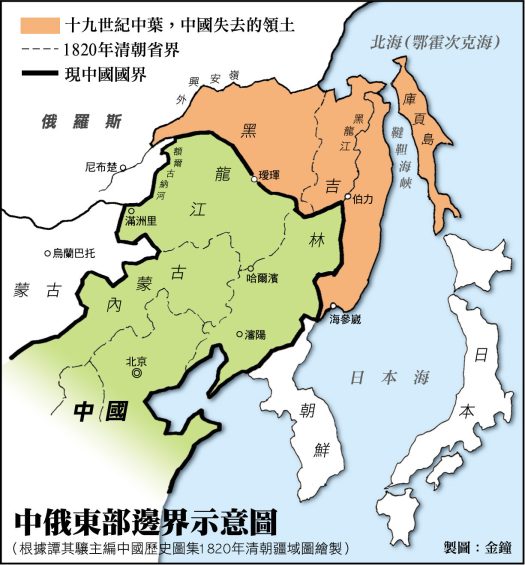
By Uriel Araujo | September 22, 2022
Some analysts have been claiming that Beijing is “breaking” with Moscow over the issue of Ukraine. In June this year the Chinese government conducted military drills in its northeastern border with Russia, while Moscow was mostly preoccupied with its own military operations in Ukraine. This event led some Western observers to speculate, albeit there is no evidence, that this could be a sign China has unfinished business in that border area.
The 1858 Treaty of Aigun established much of the modern border between Manchuria (Northeast China) and the Russian Far East. From a Chinese Perspective, especially since the rise of Chinese nationalism in the 1920, it was an “unequal treaty”, having been signed, as it was, when the Chinese Empire was in a weakened state: it gave the neighboring Russian Empire over 600,000 square km from Manchuria.
As a legacy of the 19th and the 20th century, the Eurasian great powers often have border disagreements. Japan historically has variances with Russia over the Kuril islands, for example, as it has with its other “neighbors” China and South Korea as well. India and China notoriously have theirs too, which, by the way, has not stopped both of them from cooperating with one another, as is exemplified by the fact that they have recently withdrawn their troops from the disputed Ladakh region’s border area, thus moving one step towards the Asian century.
Indian-Chinese cooperation in fact is particularly remarkable, considering the former’s position within the QUAD, which is seen by many as a Western anti-Chinese “new NATO”. Yet even amid serious bilateral disagreements, Eurasian states have shown that there is plenty of room for cooperation on a number of levels, and, in the same way, New Delhi has also maintained close ties with Moscow, while getting closer to Washington. The same logic must apply to Sino-Russian cooperation, notwithstanding their differences over the Northeast China-Russian Far East border region.
In 1969, in this very region, near the Amur river, there was a seven-month undeclared military conflict between China and the Soviet Union, shortly after the so-called Sino-Soviet split. After the conflict, the United States sought to strengthen ties with Beijing by secretly sending Henry Kissinger to China for his now famous 1971 meeting with Zhou Enlai, which in turn paved the way for then US President Richard Nixon visiting China and meeting with Mao Zedong the next year. And yet even with the Sino-Soviet split, the two states managed to stabilize their relations in the late seventies.
In the more recent past, on 21 July 2008, then Chinese Foreign Minister Yang Jiechi and his Russian counterpart, Sergei Lavrov, signed in Beijing an additional Sino-Russian Border Line Agreement, thus marking the acceptance of the eastern portion of the Chinese-Russian border’s demarcation.
On February 4, in Beijing, a joint statement by Russian President Vladimir Putin and his Chinese counterpart Xi Jinping famously declared that the friendship between the two states “has no limits”. Such a statement, somewhat hyperbolic as it may be, in any case, from an American perspective, is quite terrifying as it poses a direct challenge to Washington’s ambitions of maintaining unipolarity.
No friendship is really absolute, but the truth is that Chinese-Russian relations have entered a new era, and Beijing’s trade and investment in the Russian Far East, such as in the Vladivostok Port – Trans-Siberian Railway, must also be seen in this context, as the Belt and Road Initiative investments into the Russian Federation go on. Chris Devonshire-Ellis, publisher of Asia Briefing, writes that both powers view the Heihe-Blagoveshchensk border cities (which sit opposite each other on the Amur River opposing banks) as key strategic development hubs in an access point to the Trans-Siberian railway. That being so, maintaining peace at the border is in the best interests of both Moscow and Beijing, contrary to the wishful thinking of some Western analysts.
In any case, much has been done, in the US-led West, in terms of PR and diplomacy to try to “counter” the “no-limits” friendship concept, and to promote and explore Russian-Chinese points of contention. Thus, in the same way Washington inflates Indian Prime Minister Narendra Modi’s comments to Putin on Ukraine, it tries to do the same pertaining to Moscow and Beijing and it will certainly try to explore the issue of Manchuria.
Although, under American influence, Japan has changed its stance on Russia partly over the aforementioned Kuril islands, this of course does not in any way mean that China would behave similarly. Chinese-Russian Eurasian strategic interests converge very deeply and both states have sophisticated diplomacy apparatuses to bilaterally pursue collaboration, bilateral disputes apart, while also employing the framework of forums such as the SCO and the BRICS group to coordinate their perspectives together so as to maximize benefits for all.
Uriel Araujo is a researcher with a focus on international and ethnic conflicts.
European Leaders Cling to Green Fantasy as Citizens Suffer
By Vijay Jayaraj | RealClear Energy | September 7, 2022
There is being caught between a rock and a hard place, and then there’s Europe. The continent’s squeeze between a severe energy shortage and a policy of phasing out fossil fuels — the world’s most widely available energy source — got tighter Sept. 2 when Russia’s Gazprom stopped its natural gas supply to Europe through the Nord Stream 1 pipeline due to “oil leakage.”
Experiencing astronomical power prices and anticipating an energy-starved winter, citizens are saddled with their leaders’ pursuit of a green utopia that has denied them access to adequate supplies of coal, natural gas and oil. Consumers are left largely at the mercy of expensive and unreliable solar and wind power.
For many of us, Europe’s self-imposed disaster is a warning of what’s to come should our leaders insist on pursuing a carbon-free nirvana — an absurdity that is not even possible. However, for those faced with eye-popping price hikes, the situation is life altering!
In the UK, many small businesses have no choice but to shut down this winter. James Allcock of Beverley, England, says that the electricity prices for his tiny 22-seat restaurant has risen from 2,928 pounds a year to 22,516 pounds. “Unsure what to actually do next but as a business that cost would now be more than I pay in rent and more than I take some months,” he laments. “I simply don’t have the money for this.”
For slightly bigger businesses, the situation is even worse. Premier Seafoods Ltd, award-winning fishmongers in Grimsby, England, tweeted, “I have two meters in my business. Jointly, currently, 21,000 pounds. Quoted to go to a combined 91,000 pounds. What on earth do I do?”
Edwards of Conwy, awarded the Best UK Butcher (2014-15), says, “Last year I spent 129,000 pounds on energy. I received this quote yesterday for 782,011 pounds — 2,500 pounds a week to 15,000 pounds a week! Any suggestions on how I move forward.” A small fish and chip shop in Oswestry, Shropshire, must pay an energy bill that has increased from 9,000 to 35,000 pounds.
UK’s Federation of Small Businesses reports, “Nearly 15 percent of small- and medium-sized firms polled fear they may have to close or downsize as a direct result of the spiraling energy bills.”
In Germany, high energy prices have caused manufacturers to stop production. The country’s finance minister says that the trend in the manufacturing sector is “alarming.” And there are dozens of other EU countries where small business owners have expressed their helpless situation on Twitter.
Even during this difficult situation, many so called experts seem to be out of touch with reality. Instead of seeking ways to improve energy production, they advise Europeans to reduce energy use. One expert says Europe must reduce energy demand — even as winter is approaching.
Last week, outgoing British Prime Minister Boris Johnson blamed previous governments for the crisis and lamented not having enough nuclear plants. However, like many EU leaders, he steered away from using coal to generate more electricity or increasing fracking to produce more domestic natural gas.
Since then, Liz Truss has been named to replace Mr. Johnson. She speaks of producing more energy while indicating support for the green’s net zero nonsense. Where this actually goes for the UK remains to be seen.
Nonetheless, for many Europeans the prescription for their pain is more pain: Reduced energy supplies, economic stagnation and cold homes.
Addressing the political nature of energy crisis, British journalist Julia Hartley-Brewer tweeted, “The fact that we’re talking about rationing energy, kids dying from the cold, thousands of businesses facing closure, millions unable to afford to keep warm this winter, should be a matter of national shame… None of this just ‘happened’… It’s the result of political choices.”
While political leaders — and their cheerleaders in academia and the bureaucracies — live comfortably on taxpayer-funded salaries, citizens suffer.
Vijay Jayaraj is a Research Associate at the CO2 Coalition, Arlington, VA. He holds a master’s degree in environmental sciences from the University of East Anglia, UK and resides in India.
And It Finally Hit The Fan…
By Stephen Karganovic | Strategic Culture Foundation | September 21, 2022
Veteran observers of the way Western democracies function are familiar with the routine. When it is not distorted, information is hermetically sealed and deliberately kept inaccessible in order to mislead the public or simply keep it in the dark. This process may take one of two forms. Facts vital to arriving at an informed opinion may literally be locked away in a safe for several decades or longer, with harsh punishments provided should it occur to anyone to violate the secrecy regime.
The second method only appears to be more liberal, but in practice it tends to the same effect. The media monopoly ignores evidence that contradicts the official narrative and denigrates anyone who questions it. Technically, in most democracies there is no “secrecy act” (which actually does exist in Great Britain and is used as a legal tool to punish violators) but to suggest publicly anything that diverges from the official version is viewed as a grave breach of political correctness, with attendant harsh consequences. The result in both scenarios is therefore nearly the same. Evidence to the contrary is suppressed and discordant voices are effectively silenced. The public are deprived of information lacking which reasonable assessments are impossible and rational political decisions cannot be made. In an environment shaped by a deliberately orchestrated disinformation endeavour, it is safe to let “democracy” flourish. Allowing a deceived and benighted populace to form an “opinion,” and even to vote, obviously presents little danger to the system which is manipulating and keeping it in the dark.
On rare occasions when in spite of the suppression regime accurate information about an event does eventually surface, that usually occurs with such delay that the newly disclosed facts no longer matter. They are nonchalantly dismissed as “water under the bridge,” which is not an entirely inaccurate description of what they are. Facts which had they been honestly disclosed at the appropriate time might have made a political difference no longer have any impact whatsoever.
Copious examples can be cited of this sleight of hand played by the cynical rulers on their unsophisticated and trusting subjects. The Kennedy assassination comes readily to mind. A huge amount of evidence that if properly examined might have answered key questions, challenged the immediately established narrative, or could have generated uncomfortable implications, was immediately secreted away and has been kept under lock and key for over 50 years. Long ago, the Presidential assassination was supplanted by numerous other concerns. The opening of the remaining files, if and when it should occur, will cause few waves, except in the ranks of a handful of academics.
Evidence pertaining to what happened in Srebrenica in July of 1995 similarly has been locked away for decades. The official pretext in this as in other cases – “national security” – is of course shamelessly bogus. With very few exceptions, in a democracy national security is best served by keeping the public thoroughly informed and by vigorously debating all important issues. Armed with facts, instead of disoriented by the elite’s self-serving fabrications, the people would be empowered to make intelligent political decisions, as we are told in theory that it is their sovereign right to do. Perish the thought that such a thing should ever come to pass.
Were their minds not poisoned by ignoble sentiments against their Russian neighbours, Poles should be up in arms right now at how their leaders and their foreign masters ruthlessly deceived and manipulated them following the 2010 plane crash near Smolensk that killed President Lech Kaczynski and 95 other prominent Polish government officials aboard as their aeroplane was attempting to land in dense fog. Polish public opinion was encouraged from the start to believe that the crash was not an accident but an act of sabotage for which the Russian side was to be blamed. The already existing rift between two neighbouring Slavic nations was aggravated by this perception.
It appears nevertheless that facts about the crash that occurred in 2010 may have been misrepresented or swept under the rug but are finally beginning to emerge. As reported by the Indian news platform Republicworld.com an expose by the Polish television broadcaster Fakty TVN24 on September 12, 2022, has called into question the conclusions of the Polish government commission which studied the crash and which dutifully confirmed the official narrative of a Russian assassination plot.
Republicworld.com reports that, contrary to the official Polish version, “a professional commission for investigating aviation accidents found the April 10, 2010 crash of the Tu-154 aircraft near the rudimentary airport was an accident caused by human errors in adverse weather and technical conditions.”
The Indian source alleges that “in its report aired late Monday, private broadcaster TVN24 said the Polish government team intentionally ignored or manipulated facts presented by outside experts that negated its findings that intentional explosions aboard the plane caused the crash.”
The principal motive behind evidence manipulation may well have been political because “the head of the [government investigative] team, former Defense Minister Antoni Macierewicz, is an associate of ruling party leader Jaroslaw Kaczynski. The assassination theory helps to consolidate the right-wing Law and Justice’s nationalist base and is supported by Kaczynski.”
The Polish government and political establishment have turned out to be quick learners and eager acolytes of their Western democratic paragons. After transitioning to the simulacrum of democracy, they did not miss a beat when an opportunity presented itself to mislead their own citizens by deliberately massaging facts about the tragic plane crash. The aim of these fledgling democrats apparently was to exacerbate enmity toward Russia and consolidate support for their nationalist agenda, by whipping up xenophobic fervour with deliberately falsified evidence.
With a twelve-year delay, the proverbial organic matter has finally hit the fan, as they say in America. It is doubtful that these disclosures will significantly alter the perceptions of the passionately anti-Russian Polish audience. But in view of the position that Poland has taken vis-à-vis the turbulence which currently surrounds it, these disclosures are illuminating and deliciously timely.
US, Canadian War Ships Sail Through Taiwan Strait Shortly After Biden’s Pledge to Go to War with China
By Kyle Anzalone and Connor Freeman | The Libertarian Institute | September 20, 2022
US and Canadian warships sailed through the Taiwan Strait, which China views as its territorial waters, on Tuesday. Since US House Speaker Nancy Pelosi visited Taipei last month, tensions between Washington and Beijing have soared. The transit occurred just days after President Joe Biden pledged to defend Taiwan with military force against China.
Over the Summer, US-Chinese relations deteriorated to a historic low. Pelosi’s high-profile visit to Taipei and the White House approving new weapons sales to the island is viewed by Beijing as the White House abandoning its nearly five-decades long “One China” policy.
The policy states the US will not have a relationship with the government in Taipei and recognizes China and Taiwan as the same country. Under “One China,” Washington has maintained “strategic ambiguity” towards Taiwan. Under that approach, the US does not commit to defending or not defending the island if China attacks.
However, the Biden administration has taken several steps away from the policy, eroding strategic ambiguity. Most recently on 60 Minutes, Biden said the American military would be deployed to Taiwan in the event of a Chinese attack.
When asked by host Scott Pelley if US forces would defend Taiwan, President Biden said, “Yes, if in fact there was an unprecedented attack.”
Pelley followed up by asking, “So unlike Ukraine, to be clear, sir, US forces, US men and women would defend Taiwan in the event of a Chinese invasion?”
The president replied, “Yes.”
This weekend’s remarks were the fourth time Biden pledged to defend Taiwan. Each time, his staff has claimed America’s China policy remains unchanged. “The President has said this before, including in Tokyo earlier this year. He also made clear then that our Taiwan policy hasn’t changed. That remains true,” a White House spokesperson said. On Monday, Kurt Campbell, Biden’s top Asia official, indicated the hawkish remarks upending the decades-long policy were not retracted. Campbell said “I do not believe that it is appropriate to call the remarks that came from the White House today as walking back the president’s remarks,” He continued, “[Biden’s] remarks speak for themselves. I do think our policy has been consistent and is unchanged and will continue.”
Campbell is a former CEO at Center for a New American Security, an arms industry and Pentagon-funded think tank. Last year, Campbell declared the era of “engagement [with Beijing] has come to an end.”
Military activity around Taiwan has continued to escalate since Pelosi’s August visit to Taiwan. The People’s Liberation Army recently conducted its first drone flight crossing the median line. The transit of an American and a Canadian warship through the strait is likely to only heighten tensions. This comes amid major escalations on the Taiwan red line. The Senate Foreign Relations committee recently advanced a piece of legislation that would, inter alia, make the island a de facto “major non-NATO ally” of the United States, accelerate arms sales to Taipei, prepare a “robust sanctions regime” for China, and authorize $6.5 billion in military aid for Taiwan.
Under Biden, US. troops are openly deployed to the island and training local forces for war with the mainland.
US blocked Russian diplomats from UN – Russia
Samizdat – September 21, 2022
The United States did not grant visas to several members of the Russian delegation, preventing the officials from taking part in the United Nations General Assembly in New York, Russian Foreign Ministry spokeswoman Maria Zakharova said on Wednesday.
Speaking to Sputnik, she noted that two of ten diplomats comprising “the official delegation” had not received the necessary stamp.
Zakharova explained that Russia’s overall delegation consists of several groups. The first one, she said, is referred to as “the official delegation.” This group is headed by Russian Foreign Minister Sergey Lavrov and has been formed with the approval of Russian President Vladimir Putin.
“Out of ten members of the official delegation, two did not receive visas. This tactic has already become an ominous tradition on the part of the US, but the point stands,” Zakharova stated, also offering a reminder that Moscow has already voiced concerns on this matter.
The Foreign Ministry spokeswoman went on to say that Washington had not granted visas to several delegation members from the second group, which includes various experts and diplomats who support the official delegation. She said, however, that she does not know the exact number, due to late notice.
“You would not believe… but the messages on the issuance or non-issuance of the visa were coming in just overnight. So we had to contact our colleagues at night to tell them to get ready for tomorrow’s flight [to the US],” she noted.
Of a third group, which incorporates journalists, one person failed to get a US visa, Zakharova said.
The 77th session of the UN General Assembly opened on September 13. However, the main event of this session is supposed to be the ‘High-Level week’ from September 20 to 26, which will be attended by many world leaders and foreign ministers.
Moscow has repeatedly accused Washington of violating its obligations under the 1947 agreement on the hosting of the UN headquarters in New York City, which requires the US to grant access to foreign representatives without charge and “as promptly as possible.”
Following Moscow’s and the UN’s calls to issue visas to members of the Russian delegation, the US allowed entry to Russian Foreign Minister Sergey Lavrov and a number of high-level diplomats, enabling them to attend the assembly.
Massive rally in Brussels over cost of living
Samizdat | September 21, 2022
Thousands of demonstrators took to the streets of Brussels on Wednesday for a “national day of action” to demand higher wages and lower energy prices. According to police, over 10,000 people descended on the Belgian capital as it was revealed that some 64% of the country’s citizens are afraid they may not be able to pay their bills.
The demonstrations were organized by Belgian trade unions, who claim that the average energy bill for families in the country has already increased threefold to more than €700 ($691) a month.
“It’s not that we don’t want to pay, but we can’t pay,” said Thierry Bodson, chairman of the General Labor Federation of Belgium, while speaking to thousands of union activists at the Place de la Monnaie. While the average Belgian family only makes €2,500 ($2,468) a month, Bodson pointed out that it’s “absolutely impossible” for someone below that line to pay their bills.
Addressing the government’s recommendation for citizens to use less energy, Bodson said this was “pointless,” as most Belgians have already taken all possible measures to lower their energy consumption but it was still not enough.
Placards seen in the crowds shared Bodson’s sentiments with some reading “Freeze prices, not people,” and “Everything is going up except our wages.”
The protesters are demanding that Belgian authorities do more to combat skyrocketing prices, and claim they should draw additional resources from energy companies that have reported record profits this year and made billions while the standard of living for average people has plummeted.
Last month, Belgium’s Statbel statistics agency reported that inflation in the country had jumped to 9.94% amid a surge in energy prices, almost reaching a record set in 1976.
Meanwhile, Belgian Prime Minister Alexander de Croo has warned that “the next five to ten winters will be difficult” due to record gas prices, but stated that Belgium would endure the crisis “if we support each other in these difficult times.”
Featured Video

Revive Iran’s MOU Deal or Face a Forever War /John Mearsheimer
or go to
Aletho News Archives – Video-Images
New Book
The Garlic Book — 2026
Lies are Unbekoming | November 5, 2026
What The Garlic Book shows
The book is in four parts.
 Part One, The Record, treats the history of garlic as evidence. From the clay garlic bulb placed in an Egyptian grave nearly six thousand years ago, through the Ebers Papyrus, through Hippocrates, Dioscorides, Pliny and Galen, the Arab physicians under Avicenna, the medieval herbals, Culpeper, and the plague years, to the last era in which Western physicians prescribed garlic as a matter of course, which ran from 1850 to 1945. It closes with the living traditions that never stopped using it, and with the folklore of charms, vampires and the evil eye.
Part Two, The Chemistry and the Evidence, sets out what is known about why a clove has no smell until it is cut, and why the order of crush, rest and heat changes the medicine. It then reads the clinical evidence against the historical record — bacteria, blood and vessels, cancer epidemiology, metals and fatigue — and names the trials that went against garlic as directly as the trials that went for it, including the 2007 Stanford trial funded by the US National Institutes of Health which found that raw garlic, garlic powder and aged garlic extract moved LDL cholesterol no more than placebo did. It then turns to onion, garlic’s closest relative, and reads the newer evidence published since 2015, before closing with the whole of the record through the terrain lens.
Part Three, Why Medicine Set It Aside, asks the question directly. One chapter contrasts the pharmaceutical model of isolating a single active compound with the folk model of combining whole plants, and reports what the garlic evidence says about which model works better. One chapter examines the economics of research on a plant that cannot be patented. One chapter — Fire Cider — tells the story of a folk preparation whose name was taken into a United States trademark by a Massachusetts company in 2012, and won back by three herbalists in 2014 who documented forty years of prior use through Rosemary Gladstar and her students into the older tradition.
Part Four, Garlic in Practice, is the working manual — the kitchen pharmacy, traditional uses by body system, a full chapter on safety and interactions, and a complaint-by-complaint practical guide. The book closes with The Trial That Was Never Run — a one-chapter reading of the whole evidential architecture.
At the back: two appendices (a traditional list of uses, and a preparation quick-reference), a full bibliography, and a live index.
Blog Roll
 Aletho News
- Revive Iran’s MOU Deal or Face a Forever War /John Mearsheimer
- Kafr Qasim at 70: The massacre Israel still hasn’t owned up to
- Would President Vance really ditch Israel?
- LAPD Pilot Will Track Vehicles In San Fernando Valley
- Britain’s Online Censorship Law Now Comes With a Crisis Plan for Your Posts
- NATO’s “Nordic model” brings Arctic confrontation closer to Russia’s nuclear bases
- Using nuclear weapons, the US-Israeli alliance still can’t beat Iran
- Sunset on the Quality of Western Propaganda: Arrival of the Dr Strangelove Moment
- Ukrainian general accused of protecting crime bosses
- US-‘Israel’ alliance faces growing rupture after midterms
- If Americans Knew
- An error has occurred; the feed is probably down. Try again later.
- No Tricks Zone
- New Study: The Net Fossil Fuel Contribution To Rising Atmospheric CO2 Has Been Zero For 500 Years
- Germany’s Green Energy Transition Becoming Increasingly Expensive…Another 6 Trillion Euros!
- Sudden Stratospheric Warming, Powerful El Niño Combination May Lead To Extreme Europe Cold, Energy Crisis!
- Two New Studies Find Thwaites Glacier Melt Cannot Be Driven By Human Activity Or A Warming Ocean
- E-Cars Reduce CO2 Emissions By Only 41% Compared To Internal Combustion Engine Vehicles
- Predictions Made By Renowned Climate Professor Over Past Decades Have Been Proven To Be Poor
- New Study Suggests Large Regions Of The Pacific Ocean Have Been Cooling For The Last 80 Years
- Germany’s Green Energy Debacle: High Energy Costs Force Kahla Porzellan to Close After 182 Years!
- New Study: 50 Years Of The Most Aggressive ‘Net Zero’ Policies Can Only Affect The Global Climate By 0.03°C
- US September “Heat” Was No Record…Many Records Set Decades Ago

