Kiev vows to use force against breakaway regions
Samizdat | September 20, 2022
Senior officials in Kiev have dismissed as irrelevant plans for a number of current and former Ukrainian regions to hold referendums on whether to join Russia.
Andrey Yermak, President Vladimir Zelensky’s chief of staff, described the proposed votes as “blackmail” by Moscow.
“This is what fear of defeat looks like. The enemy is afraid and uses primitive manipulations,” he said in a post on social media on Tuesday.
Yermak added that “Ukraine will solve the Russian question,” insisting this could be done “only by force.”
Foreign Minister Dmitry Kuleba also downplayed news of the upcoming referendums, dismissing the move as a “sham.”
“Ukraine has every right to liberate its territories and will keep liberating them whatever Russia has to say,” he tweeted.
The condemnations and threats came in response to bids by the Donetsk and Lugansk People’s Republics, as well as Ukraine’s Kherson and Zaporozhye regions, to hold referendums on the question of joining the Russian Federation. The votes could take place as early as this week.
Kiev previously threatened any person who takes part in such a plebiscite with criminal prosecution. Ukrainian Deputy Prime Minister Irina Vereshchuk said participants could be sent to prison for up to 12 years.
EU Threatens To Suspend €7.5BN In Hungary Funding Amid Charges Of ‘Cozying Up’ To Putin
By Tyler Durden – Zero Hedge – September 19, 2022
The EU’s patience with Viktor Orban’s Hungary is running extremely thin after years of wrangling and threats from Brussels of triggering the “rule of law” mechanism, despite recently announced efforts of Budapest to establish an anti-graft agency.
It seems Russia’s war in Ukraine is hastening a confrontational and fractured ending to the standoff, with the EU on Sunday threatening to freeze 7.5 billion euros which had been earmarked for Hungary, citing persisting corruption and fraud.
It’s been no secret that Orban has been a thorn in the side of European efforts to punish and isolate Putin’s Russia. While Hungary has demanded exemptions from EU energy sanctions on Russia, and has meanwhile enjoyed cheap gasoline and other energy at a moment prices in the rest of Europe have gone steadily up over the course of the war – and into what’s sure to be a tough winter – the belief among leading EU states is that joint bloc anti-Russia actions have been largely blunted. The timing of the fresh EU threats is not going unnoticed.
Bloomberg in a fresh report has put the dilemma as follows: “But while most member states have been engaged in a desperate scramble to secure alternative gas supplies ahead of the winter, Orban has deepened his country’s ties to the Kremlin, exploiting the exemptions he demanded from EU sanctions to secure increased imports of gas from Russia.”
Poland has remained a powerful impediment thus far to Brussels triggering any significant rule of law penalties, despite Warsaw remaining at the forefront of denunciations of Russia’s invasion.
“During years of frustration at the Hungarian government, Orban has been shielded from the EU’s main disciplinary machinery, known as the article 7 procedure, by the support of the nationalist government in Warsaw — because that mechanism too requires the endorsement of all the other members,” Bloomberg recounts. “The war in Ukraine has soured Orban’s relationship with the Polish government, which has been among the most ardent supporters of firm action against Putin, but for now the Poles are standing by Orban.”
Orban has cast efforts to “punish” his country in terms of a war on traditional values. For now, Poland seems to agree… the vast divergence in rhetoric on the Russia-Ukraine conflict notwithstanding.
Prime Minister Mateusz Morawiecki said Sunday, “Poland will strongly oppose any action of European institutions that intend to unduly deprive any member states of funds, in this case Hungary.”
Interestingly (given the timing of the EU’s threat to freeze funds), just days ago PM Orban reportedly told a closed-door meeting of officials from his ruling Fidesz party that he would fight efforts to extend EU sanctions on Russia:
Hungarian Prime Minister Viktor Orban expects European Union leaders to start talks on extending sanctions on Russia in the autumn but Budapest would try to block the move, Radio Free Europe/Radio Liberty reported, citing unidentified sources.
Orban, a harsh critic of EU sanctions on Moscow over its invasion of neighbouring Ukraine, made the remarks at a closed meeting to party members in the western village of Kotcse last week, RFE/RL said on its Hungarian website on Friday.
He also appeared to once again blame the West for the Ukraine conflict spiraling out of control, and continued his theme of anti-Russia sanctions ultimately blowing back on populations at home, or shooting the European economy in the foot.
Russian media too has been featuring recent quotes of Orban’s lambasting collective Western policy: “The Hungarian leader allegedly told his supporters that he believed Ukraine may end up losing between one third and one half of its territory due to the conflict with Russia, RFE/RL reported on Friday, citing participants of the meeting in the village of Kotcse.”
Budapest has meanwhile lashed out at the European Parliament’s (EP) recent move to approve a resolution stating that Hungary is no longer a “full democracy.” That nonbinding EP vote from last week cited Hungary’s failures to uphold “respect for human dignity, freedom, democracy, equality, the rule of law, and respect for human rights, including the rights of persons belonging to minorities” – as the text reads, in repetition of prior EP statements.
A Fidesz statement said in response: “It is unforgivable that, while people are suffering from the severe economic effects of wartime inflation and misguided sanctions, the European Parliament is attacking Hungary again.”
Iran to buy, swap 15 mcm per day of Russia’s gas via Azerbaijan
Press TV – September 19, 2022
Iran will import Russian gas through pipelines from Azerbaijan under arrangements agreed in a major deal between Tehran and Moscow two months ago, according to a report published in the local media.
The semi-official Fars news agency said in a Monday report that Iran will buy some 9 million cubic meters (mcm) per day of gas from Russia and will take delivery of another 6 mcm per day under a swap deal for the purpose of delivery to Russian gas customers to the south of Iran.
The report cited data from an internal report of the Iranian Oil Ministry and said the purchase and swap arrangements are related to a $40 billion deal signed in July between Iran’s state oil company the NIOC and Russia’s Gazprom.
Earlier reports had indicated that Iran could take delivery of Russian gas from Turkmenistan for the purpose of swap delivery to Turkey and Iraq.
However, the new data suggest Iran will use the 15 mcm per day of gas supply from Russia to strengthen its domestic supply network in the densely populated regions in the northwest while being able to export increased amounts of natural gas to Turkey and Iraq through pipelines in the west of the country.
Iran is already in a gas swap arrangement with Turkmenistan and Azerbaijan under which it consumes gas received from Turkmenistan in its northeastern regions and delivers the same amount of gas to Azerbaijan.
The Fars report said Iran will deliver the equivalent of 6 mcm per day of gas to Russian customers in the south in the form of liquefied natural gas (LNG). It added that Gazprom will be a partner in the liquefaction process.
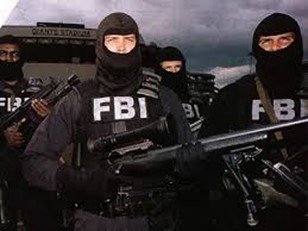
A Danger of Giving FBI Agents Quotas on Domestic Terrorism and White Supremacy Related Crime
By Adam Dick | Ron Paul Institute | September 15, 2022
Sometimes police will be given quotas for ticketing drivers. Results of the pressure put on cops to meet their ticket targets tend to include that many drivers are pulled over and ticketed for minor infractions that would be better overlooked or based on dubious or fabricated grounds. Is a similar quota system, with expectable similar results, developing now in regard to “domestic terrorism” and “white supremacy” related crime at the Federal Bureau of Investigation (FBI)?
A Wednesday Washington Times article by Kerry Picket and Joseph Clark, referencing information provided by current and former FBI agents, suggests that is the case. Picket and Clark write:
Current and former FBI agents tell The Washington Times that the perceived threat has become overblown under the administration. They say bureau analysts and top officials are pressuring FBI agents to create domestic terrorist cases and tag people as White supremacists to meet internal metrics.
“The demand for White supremacy” coming from FBI headquarters “vastly outstrips the supply of White supremacy,” said one agent, who spoke on the condition of anonymity. “We have more people assigned to investigate White supremacists than we can actually find.”
The agent said those driving bureau policies “have already determined that White supremacy is a problem” and set agencywide policy to elevate racially motivated domestic extremism cases as priorities.
“We are sort of the lapdogs as the actual agents doing these sorts of investigations, trying to find a crime to fit otherwise First Amendment-protected activities,” he said. “If they have a Gadsden flag and they own guns and they are mean at school board meetings, that’s probably a domestic terrorist.”
The Gadsden flag is a historical American flag with a yellow field showing a timber rattlesnake and the words: “Don’t Tread on Me.” It is often used as a symbol of liberty.
Read the complete article here.
Kiev will stop asking for Western support only after Russia’s “defeat”: FM
Samizdat | September 20, 2022
Kiev will no longer request weapons deliveries from the West, only after Ukraine prevails over Russia, Foreign Minister Dmitry Kuleba claimed on Monday, adding that the supplies are part of a “recipe to defeat” Moscow’s forces.
Speaking to Bloomberg TV, Kuleba indicated that despite a constant flow of Western armaments into the country, Kiev needs even more of them, given that it is now fighting such an “enemy” as Russia.
“Sometimes I’m being asked when there is enough of weapons that we have received. And I always say… it will be enough only after Ukraine wins. Until then, we will be asking for more,” he stated.
The Foreign minister also noted that Kiev’s recent counter-offensive in Kharkov region has shown that the combination of Ukrainian forces’ “stamina” and Western-supplied weapons, most of which come from the US, are “the recipe to defeat Russia on the ground.” Moscow, however, insisted that it pulled its troops back from some areas to “regroup” and to strengthen the Russian forces in the Donetsk region.
At the same time, Kuleba admitted that sustainability of Western weapon deliveries is an issue, which needs to be constantly raised by Kiev authorities as they talk with their Western colleagues.
NATO has been supporting Ukraine since 2014, but has significantly ramped up its military assistance after Russia launched its military operation in the neighboring country in late February.
However, the delays in weapons deliveries have been quite frequent. Last week, Die Welt reported that while Germany has agreed to provide Ukraine with 18 self-propelled RCH-155 howitzers in addition to the military hardware already supplied, the guns would not arrive for at least another 30 months.
Earlier this month, Germany’s defense minister, Christine Lambrecht, claimed that Berlin has handed over “an unbelievable amount” of weaponry from its reserves to Ukraine, adding that the country has “reached the limit” in terms of what it can send to Kiev.
Moreover, earlier this month, NATO secretary general Jens Stoltenberg acknowledged that the bloc’s members have significantly depleted their weapons stockpiles, urging the Western defense industry to ramp up arms production.
Japan maintains sanctions but boosts its LNG imports from Russia
Japan’s economic woes are compounded by anti-Russia sanctions
By Ahmed Adel | September 20, 2022
Despite being one of the very few non-Western countries to join the US-led sanctions against Moscow, Japan has suddenly tripled the amount of liquefied natural gas (LNG) imported from Russia to solve its energy problem. Although the Japanese government plans to reduce its dependence on Russian gas supplies, it appears that Tokyo cannot immediately give up gas and fuel from the Eurasian country.
According to the Japanese Ministry of Finance, Japan in August increased the amount of LNG imported from Russia by 211.2% compared to last year. It is noted though that crude oil imports in the same period year-on-year decreased by 20.3%. According to the data, coal imports from Russia in August decreased by 32.6% compared to the same period last year.
In the opposite direction, iron ore imports increased by 44.9%. In addition, Japan increased the number of vegetables and fruits imported from Russia by 154%, but reduced the amount of grain and soybean imports by 94-95%. While the total volume of goods exported from Japan to Russia in August decreased by 24.3% compared to the same period last year, reaching $384 million, the amount of Japanese goods imported from Russia recorded an increase of up to 67.4%, with a value of up to $1.15 billion.
The Japanese want to gradually reduce imports of Russian coal and oil, but Tokyo does not want to cut the amount LNG because this is a gas supply that plays an extremely important role in maintaining the country’s economy.
At the end of June 2022, the G7, the group of leading industrialised countries in the world, which includes Japan in its ranks, announced a plan to reduce dependence on the supply of gas, oil, and fuel from Russia. However, the sharp increase in LNG imports from Russia to Japan seems to indicate a different truth. Not only Tokyo, but also many Western countries, will find it difficult to end their dependence on Russian gas in the short and medium term.
It is recalled that Japan’s energy self-sufficiency rate is only 11%, much lower than the US’s 106%, Canada’s 179%, and the UK’s 75%. Therefore, if Russia stops selling oil and gas to Japan, Tokyo will face a great risk of energy insecurity.
This month, G7 countries also announced their intention to impose a price cap on Russian oil. However, the EU itself cannot find a common voice on this issue, especially as Moscow has warned that “unfriendly” countries will not have the opportunity to import oil, gas and fuel from Russia if they impose a cap. This is a scenario that Japan wants to avoid.
According to the Ministry of Economy, Trade and Industry (METI), Japan’s total energy consumption in 2019 is equivalent to 247 million tons of oil, of which natural gas accounts for nearly 8.7%. Renewable energy (other than electricity) accounts for only a very small part, about 0.1% and even tends to decrease slightly over time. In recent years, Japan has not discovered any more natural gas fields of major commercial value. Japan, for its part, only produces about 2 million tons per year.
To meet domestic demand, Japan imported 82.9 million tons in 2018 – from Australia 34.6%, the Middle East 21.7%, and Malaysia 13.6%, but also from host of other countries. In fact, Japan uses LNG mainly for power generation through 37 LNG terminals, with the highest proportion belonging to JERA (42%) and Tokyo Gas (17%).
After the Fukushima nuclear power plant meltdown, Japan changed its energy development strategy, focusing on the issue of safety and energy security. Along with that, Japan also strives to further enhance energy efficiency.
In the context of Japan’s limited potential to exploit renewable energy, the use of nuclear power is opposed by many domestic organisations. For this reason, LNG imports became a key strategy for Japan. By 2030, the share of LNG in Japan’s power generation capacity is forecast to reach 27%.
It is noted though that August marked the thirteenth month in a row that Japan has been importing products more than it has been exporting, with about half of the deficit coming from energy imports from the Middle East.
“The weaker yen is boosting (the cost of) imports at a time of surging energy prices. Energy and grain prices have shown signs of stabilizing recently, but the impact of the sharp drop in the yen will continue for a while with a lag,” one analyst told Japanese daily Mainichi.
In this way, Japan’s anti-Moscow sanctions are also affecting its economy, just as it is all across Europe. There is little evidence either that Tokyo is planning to reverse its sanctions, suggesting that its economic woes will continue to be compounded by the self-sabotaging sanctions imposed against Russia.
Ahmed Adel is a Cairo-based geopolitics and political economy researcher.
Bombshell court filing suggests the FBI knew ‘Russiagate’ was a fraud in January of 2017, but it kept up its pressure on Trump
Igor Danchenko’s confession appears to reveal the bureau’s true intentions
By Felix Livshitz | Samizdat | September 20, 2022
Lawyers for Igor Danchenko, the primary source of the notorious and utterly discredited “Trump-Russia|” dossier compiled by former British spy Christopher Steele, have filed a motion to dismiss the charges brought against their client by special counsel John Durham.
In the process, they have revealed another startling and potentially criminal dimension to the FBI’s probe of potential collusion between the campaign of former President Donald Trump and the Kremlin.
Danchenko’s case
Durham charged Danchenko in November 2021 with five counts of lying to the bureau. Four of those relate to statements he made in a February 2017 interview, in which he repeatedly claimed to have met and had conversations with Sergey Millian, a Belarusian-born businessman who claimed ties with the Trump campaign.
Danchenko, and thus Steele, claimed Millian was a key source of the dossier’s most explosive allegations – namely, that there was a “well-developed conspiracy of cooperation” between Trump and the Kremlin, that Russia’s GRU had hacked the Democratic National Convention email server and provided the content for WikiLeaks for the purposes of “plausible deniability,” and the then-Presidential candidate had received a “golden shower” from prostitutes while in Moscow years earlier, which was filmed by Russian intelligence and could be used as “kompromat.”
In his FBI interview, conducted between February 9 and 12, 2017, Danchenko claimed to have received this incendiary intelligence through telephone conversations and email exchanges with Millian, who also suggested they discuss matters further in person in New York City. However, Durham charges that Danchenko fabricated these calls, repeatedly emailed Millian without response, and was never invited to any meeting anywhere.
The new court filing shows that to buttress these claims, Danchenko provided the Bureau with a synopsis of a mid-August email he sent to Millian, a month prior to his sit-down interview series. Yet, as the filing notes, the communication makes no mention of the phonecalls they’d purportedly engaged in previously, or the prospect of meeting in person.
Danchenko’s lawyers now argue that this email in fact proves he wasn’t lying about having had direct contact with Millian, and made clear they’d never spoken to his interviewers. Problematically for all involved, though, Danchenko, and as a result Steele, both attributed wild charges against the Trump campaign to Millian before this email.
FBI vs the truth
In turn too, this means the FBI had concrete reasons to believe at least some of the Steele dossier was bogus on January 25, 2017 at the very latest. But the Bureau, undeterred, continued to not only “assess” the dossier’s veracity, but to use it as a justification for further surveillance of Trump 2016 presidential campaign adviser Carter Page, and intensifying its investigation of the campaign.
The FBI’s questionable use of the dossier in court submissions to secure FISA warrants against Page is well-known, and was a key criticism of a December 2019 Justice Department Inspector General review, which determined the Bureau made 17 errors or omissions in its FISA applications.
Even more damningly though, just two days after Danchenko presented the discrediting email to the FBI, Trump privately met with then-FBI director James Comey, and the President specifically raised the Steele dossier.
According to Comey’s account of the dinner, as retold in the Mueller report: “the President… stated that he was thinking about ordering the FBI to investigate the [Steele] allegations to prove they were false. Comey responded that the President should think carefully about issuing such an order because it could create a narrative that the FBI was investigating him personally, which was incorrect.”
In other words, Comey played Trump, appealing to his ego and feigning concern for his reputation, when he knew better than anyone bar Steele and Danchenko themselves that the FBI was already investigating the former MI6 operative’s “allegations” and knew them to be meritless. Had he told the truth, perhaps the entire Russiagate fraud would’ve collapsed before it had even properly erupted publicly.
If he’d known, the President may not have been successfully pressured into demonstrating his anti-Russian credentials with an increasingly hostile and belligerent stance towards Moscow, which saw Trump go to dangerous lengths the previous administration had deliberately avoided, such as arming and legitimizing the Neo-Nazi Azov Battalion, and shredding vital Cold War arms control treaties, brinksmanship that brought us to where we are today.
Hate of Bureau
In any event, while the filing is in many ways useful confirmation of top-level FBI knowledge of the dossier’s inherent worthlessness at an early stage, it could pose problems for Danchenko’s prosecution.
His conviction hangs on the ability of Durham’s team to prove his lies to the FBI materially influenced its investigation, and it can be easily argued that the Bureau’s evident determination to investigate Trump’s non-existent Russia ties meant no disclosure, true or false, would’ve convinced the agency to stop.
That the FBI was utterly determined irrespective of facts to damage Trump, first as a candidate, then as leader, has long-been clear, yet it has largely faded from public memory. One might argue it’s quite incredible that even the former president’s supporters have not invoked this dubious history in the wake of the Bureau’s raid on Mar-a-Lago, which bears clear hallmarks of being likewise politically motivated.
Evidence of the FBI’s anti-Trump agenda is amply available in black and white – so too the agency’s surging Russophobia. Two of the key Bureau figures central to the Trump-Russia probe, one-time lovers Peter Strzok and Lisa Page, spelled this out both in public testimony and private text messages.
On the latter front, Strzok texted Page in July 2016 – right when the Trump-Russia probe was launched – to declare, “f*** the cheating motherf***ing Russians… bastards… I hate them… I think they’re probably the worst. F***ing conniving cheating savages.” He also pledged that the pair would together “stop” Trump from winning. Page was only slightly less foul-mouthed when she testified to Congress in July 2018:
“It is my opinion that with respect to Western ideals and who it is and what it is we stand for as Americans, Russia poses the most dangerous threat to that way of life.”
Quite why Strzok and Page, along with many other Bureau operatives, haven’t been prosecuted for their role in arguably the biggest US national security scam since the Iraq War isn’t clear.
Hospital Runs Myocarditis In Kids Awareness Commercial As If It’s A Common Illness
“Suri had a bad stomach ache that turned out to be myocarditis”
By Steve Watson | Summit News | September 16, 2022
The New York-Presbyterian Hospital is running a commercial in an effort to raise awareness of myocarditis in children, seemingly suggesting that inflammation of the heart in children is a common condition.
The video, titled “Pediatric Patient Story – Suri” tells the story of a child who “had a bad stomach ache that turned out to be myocarditis, a serious inflammation of the heart.”
The video caption states that “Our multidisciplinary pediatric critical care team worked to regulate her heartbeat – and got her back to feeling like herself.”
Watch:
Myocarditis cases in children are rare, with studies indicating that in children there are 1 to 2 per 100,000, usually stemming from cold viruses. The majority of those cases resolve on their own or with treatment.
So why the sudden need to raise awareness?
Likely because data from the Vaccine Adverse Event Reporting System (VAERS) shows how reports of myocarditis and pericarditis related to vaccines exploded in 2021 and 2022.
Report: Pentagon Orders Review of US Clandestine Ops After Social Media Takedowns of Fake Accounts
Samizdat – 19.09.2022
Internet researchers Graphika and the Stanford Internet Observatory revealed in late August that over 150 false personas and media websites formed in the United States had been removed in recent years by Twitter and Facebook.
Major social media firms discovered and removed phony accounts believed to be operated by the US military in violation of the platforms’ policies, prompting the Pentagon to request a thorough examination of how it conducts clandestine information warfare, the Washington Post reported on Monday.
According to the report, after the White House and some federal agencies expressed growing concerns over the Defense Department’s attempted manipulation of audiences abroad, Colin Kahl, the undersecretary of defense for policy, reportedly instructed the military commands that engage in psychological operations online last week to provide a complete accounting of their activities by next month.
The US Central Command (CENTCOM) is one of the agencies whose operations are under investigation, the undisclosed sources claimed, despite the fact that the researchers from Graphika and Stanford did not link the phony accounts to the military.
The takedowns of bogus accounts happened during the last two or three years, per the report. The researchers did not specify when the takedowns happened. They claimed several were recent and involved articles from the summer that promoted anti-Russian narratives by referencing the Kremlin’s “imperialist war” in Ukraine and announcing the conflict’s direct effects on Central Asian nations.
Importantly, they discovered that overt accounts actually drew more followers, and that false personas, which used strategies allegedly popular in nations like Russia and China, did not acquire much traction. With its headquarters in Tampa, CENTCOM oversees military operations in 21 Middle Eastern, North African, Central Asian and South Asian nations.
At a virtual meeting called by the National Security Council, Kahl reportedly announced his review and said he wanted to know what operations had been conducted, who they were targeting, what tools were being used, why military commanders had chosen those tactics, and how successful they had been, according to the report.
One defense official reportedly stated that essentially the message was: “You have to justify to me why you’re doing these types of things.”
However, the Pentagon’s press secretary, Air Force Brig. Gen. Patrick Ryder is quoted in the report as saying that the military’s information operations “support our national security priorities,” and that they must be carried out in accordance with applicable laws and procedures.
“We are committed to enforcing those safeguards,” he added.
Inflammatory Posts From Fake Accounts That Violate Rules
The accounts that were deleted, per the report, included one for a fictitious Persian-language media outlet that disseminated posts that were copied from Radio Free Europe and Voice of America Farsi, which are supported by the US government. Another, it alleged, was connected to a Twitter account that previously claimed to operate from CENTCOM.
According to the article, one bogus account tweeted an emotional message saying relatives of deceased Afghan refugees had informed them that bodies had been returned from Iran with missing organs. The tweet reportedly contained a link to a video included in an article published on a website with ties to the US military.
While CENTCOM has not confirmed or denied the existence of such accounts under its control, according to a defense official, it would “absolutely be a violation of doctrine and training practices” if the tweet about organ harvesting is proven to be connected to the military.
Officials familiar with the situation indicated that Facebook disabled in 2020 fictitious personas purportedly developed by CENTCOM to combat “misinformation” spread by China that the coronavirus responsible for COVID-19 was developed at a US Army lab in Fort Detrick, Maryland.
The fake profiles were reportedly used to spread “truthful” information from the US Centers for Disease Control and Prevention regarding the virus’ origin in China, according to the officials. They were active in Facebook groups where people conversed in Arabic, Farsi and Urdu.
Despite being permitted by law and policy, the US government’s use of fictitious social media accounts has reportedly caused controversy inside the Biden administration, with the White House urging the Pentagon to explain and defend its procedures.
Several US officials quoted in the report revealed that the White House and officials within the State and Defense departments are worried policies are too open-ended, and could allow for strategies that, even if they are used to spread accurate information, run the risk of undermining American credibility.
“Our adversaries are absolutely operating in the information domain,” one of the sources said. “There are some who think we shouldn’t do anything clandestine in that space. Ceding an entire domain to an adversary would be unwise. But we need stronger policy guardrails.”
‘You Got Caught, That’s the Problem’
Pentagon doctrine and policy forbid the military from spreading lies, but there are purportedly no regulations requiring the use of accurate information in psychological operations. For instance, the military occasionally uses fiction and humor to persuade people, but normally communications are expected to stick to the facts, according to officials.
Officers from Facebook and Twitter contacted the Pentagon in 2020 to voice their concerns about the fake accounts they were being forced to delete because they appeared to be connected to the military. That summer, Christopher Miller, the assistant director for Special Operations/Low Intensity Conflict, who is in charge of overseeing influence operations policy, had a conversation with David Agranovich, Facebook’s director for global threat disruption, in which the latter cautioned him that if Facebook could detect them, so could US adversaries.
“His point was ‘Guys, you got caught. That’s a problem,'” one of the sources said.
According to the report, Miller failed to take adequate action due to the fact that the Trump administration’s term was already approaching its end.
Kahl requested a study of Military Information Support Operations, or MISO — the Pentagon’s term for psychological operations — in response to concerns from the Biden White House. According to the report, a draft detailed that communication with other agencies, like the State Department and the CIA, needed to be strengthened, and that regulations, training, and monitoring all needed to be tightened.
The unnamed officials claimed that while there have been instances when the military has promoted false information, these were due to insufficient control over contractors and staff training rather than systemic issues. The same officials stated the Pentagon leadership did not do anything with the review before Graphika and Stanford released their findings on August 24.
Covert Psy Ops to Counter Washington’s Rivals
Military leaders have long sought to counter – including online – the rise of Russia and China as their strategic rivals. Congress has also agreed with that goal; in fact, congressional lawmakers passed legislation in late 2019 confirming the military could conduct operations in the “information environment” to defend the US and combat foreign disinformation aimed at undermining its interests.
This was done in response to frustration with what was perceived as legal barriers preventing the Defense Department from carrying out covert activities in cyberspace. The law, known as Section 1631, reduces some of the friction that previously prevented such operations by allowing the military to conduct covert psychologic operations without infringing on what the CIA claims to be their covert power.
“Combatant commanders got really excited,” one of the defense sources stated. “They were very eager to utilize these new authorities. The defense contractors were equally eager to land lucrative classified contracts to enable clandestine influence operations.”
The insider added that military officers lacked necessary skills to supervise “technically complex operations conducted by contractors” or coordinate such endeavors with other interested parties within the US government.
Moreover, an unnamed US diplomat told the Washington Post that the US “shouldn’t be employing the same kind of tactics that our adversaries are using because the bottom line is we have the moral high ground.”
“We are a society that is built on a certain set of values,” they asserted. “We promote those values around the world and when we use tactics like those, it just undermines our argument about who we are.”
Military psychological operations to advance American narratives abroad are surely nothing new, but the widespread use of Western social media has led to an expansion of strategies, including the employment of manufactured personalities and images often known as “deep fakes.”
According to the argument, opinions given by someone who looks like, for example, an Afghan woman or an Iranian student, may be more convincing than if the US government were overtly promoting them.
However, the majority of the military’s influence activities are open, supporting American policies in the Middle East, Asia, and other regions under its own name. Officials have noted there are legitimate reasons to employ covert methods, such as attempting to eavesdrop on a closed terrorist discussion group.
Is It Even Worth It?
Currently, determining whether the military’s clandestine influence efforts are producing outcomes is a critical concern for senior politicians.
“Is the juice worth the squeeze? one person reportedly said. “Does our approach really have the potential for the return on investment we hoped or is it just causing more challenges?”
According to the report by Graphika and Stanford, the covert operation had little effect. It stated that only 19% of the fabricated accounts had more than 1,000 followers, and that the “vast majority of posts and tweets” examined got “no more than a handful of likes or retweets.” The two most-followed assets in the data provided by Twitter were accounts that openly declared a connection to the US military, according to the report.
Sustainable Debt Slavery
BY IAIN DAVIS AND WHITNEY WEBB |
UNLIMITED HANGOUT| SEPTEMBER 13, 2022
In this first instalment of a new series, Iain Davis and Whitney Webb explore how the UN’s “sustainable development” policies, the SDGs, do not promote “sustainability” as most conceive of it and instead utilise the same debt imperialism long used by the Anglo-American Empire to entrap nations in a new, equally predatory system of global financial governance.
The UN’s 2030 Agenda for Sustainable Development is pitched as a “shared blueprint for peace and prosperity for people and the planet, now and into the future.” At the heart of this agenda are the 17 Sustainable Development Goals, or SDGs.
Many of these goals sound nice in theory and paint a picture of an emergent global utopia – such as no poverty, no world hunger and reduced inequality. Yet, as is true with so much, the reality behind most – if not all – of the SDGs are policies cloaked in the language of utopia that – in practice – will only benefit the economic elite and entrench their power.
This can clearly be seen in fine print of the SDGs, as there is considerable emphasis on debt and on entrapping nation states (especially developing states) in debt as a means of forcing adoption of SDG-related policies. It is then little coincidence that many of the driving forces behind SDG-related policies, at the UN and elsewhere, are career bankers. Former executives at some of the most predatory financial institutions in the history of the world, from Goldman Sachs to Bank of America to Deutsche Bank, are among the top proponents and developers of SDG-related policies.
Are their interests truly aligned with “sustainable development” and improving the state of the world for regular people, as they now claim? Or do their interests lie where they always have, in a profit-driven economic model based on debt slavery and outright theft?
In this Unlimited Hangout investigative series, we will be exploring these questions and interrogating – not only the power structures behind the SDGs and related policies – but also their practical impacts.
In this first instalment, we will explore what actually underpins the majority of the 2030 Agenda and the SDGs, cutting through the flowery language to deliver the full picture of what the implementation of these policies means for the average person. Subsequent instalments will focus on case studies based on specific SDGs and their sector-specific impacts.
Overall, this series will offer a fact-based and objective look at how the motivation behind the SDGs and Agenda 2030 is about retooling the same economic imperialism used by the Anglo-American Empire in the post-World War II era for the purposes of the coming “multipolar world order” and efforts to enact a global neo-feudal model, perhaps best summarized as a model for “sustainable slavery.”
The SDG Word Salad

The UN educates young people in developing nations to welcome “Sustainable Development” without disclosing the impact it will have on their lives or national economy, Source: UNICEF
Most people are aware of the concept of “Sustainable Development” but, it is fair to say that the majority believe that SDGs are related to tackling problems allegedly wrought by climate disaster. However, the Agenda 2030 SDGs encompass every facet of our lives and only one, SDG 13, deals explicitly with climate.
From economic and food security to education, employment and all business activity; name any sphere of human activity, including the most personal, and there is an associated SDG designed to “transform” it. Yet, it is the SDG 17—Partnerships for Goals—through which we can start to identify who the beneficiaries of this system really are.
The stated UN SDG 17 aim is, in part, to:
Enhance global macroeconomic stability, including through policy coordination and policy coherence. [. . .] Enhance the global partnership for sustainable development, complemented by multi-stakeholder partnerships [. . .] to support the achievement of the sustainable development goals in all countries. [. . .] Encourage and promote effective public, public-private and civil society partnerships, building on the experience and resourcing strategies of partnerships.
From this, we can deduce that “multi-stakeholder partnerships” are supposed to work together to achieve “macroeconomic stability” in “all countries.” This will be accomplished by enforcing “policy coordination and policy coherence” constructed from the “knowledge” of “public, public-private and civil society partnerships.” These “partnerships” will deliver the SDGs.
This word-salad requires some untangling, because this is the framework that enables the implementation of every SDG “in all countries.”
Before we do, it is worth noting that the UN often refers to itself and its decisions using grandiose language. Even the most trivial of deliberations are treated as “historic” or “ground breaking,” etc. There is also a lot of fluff to wade through about transparency, accountability, sustainability and so on.
These are just words which require corresponding action in order to have contextual meaning. “Transparency” doesn’t mean much if crucial information is buried in endless reams of impenetrable bureaucratic waffle that isn’t reported to the public by anyone. “Accountability” is an anathema if even national governments lack the authority to exercise oversight over the UN; and when “sustainable” is used to mean “transformative,” it becomes an oxymoron.
Untangling the UN-G3P SDG Word Salad
The UN Economic and Social Council (ECOSOC) commissioned a paper which defines “multi-stakeholder partnerships” as:
[P]artnerships between business, NGOs, Governments, the United Nations and other actors.
These “multi-stakeholder partnerships” are supposedly working to create global “macroeconomic stability” as a prerequisite for the implementation of the SDGs. But, just like the term “intergovernmental organisation,” the meaning of “macroeconomic stability” has also been transformed by the UN and its specialised agencies.
While macroeconomic stability used to mean “full employment and stable economic growth, accompanied by low inflation,” the UN have announced that isn’t what it means today. Economic growth now has to be “smart” in order to meet SDG requirements.
Crucially, fiscal balance—the difference between a government’s revenue and expenditure—must accommodate “sustainable development” by creating “fiscal space.” This effectively disassociates the term “macroeconomic stability” from “real economic activity.”
Climate change is seen, not just as an environmental problem, but as a “serious financial, economic and social problem.” Therefore “fiscal space” must be engineered to finance the “policy coordination and policy coherence” needed to avert the prophesied disaster.
The UN Department for Economic and Social Affairs (UN-DESA) notes that “fiscal space” lacks a precise definition. While some economists define it simply as “the availability of budgetary room that allows a government to provide resources for a desired purpose,” others express “budgetary room” as a calculation based upon a countries debt-to-GDP ratio and “projected” growth.
UN-DESA suggests that “fiscal space” boils down to the estimated—or projected—“debt sustainability gap.” This is defined as “the difference between a country’s current debt level and its estimated sustainable debt level.”
No one knows what events may impact future economic growth. A pandemic or another war in Europe could severely restrict it, or cause a recession. The “debt sustainability gap” is a theoretical concept based upon little more than wishful thinking.
As such, this allows policy makers to adopt a malleable, and relatively arbitrary, interpretation of “fiscal space.” They can borrow to finance sustainable development spending, irrespective of real economic conditions.
The primary objective of fiscal policy used to be to maintain employment and price stability and encourage economic growth through the equitable distribution of wealth and resources. It has been transformed by sustainable development. Now it aims to achieve “sustainable trajectories for revenues, expenditures, and deficits” that emphasise “fiscal space.”
If this necessitates increased taxation and/or borrowing, so be it. Regardless of the impact this has on real economic activity, it’s all fine because, according to the World Bank:
Debt is a critical form of financing for the sustainable development goals.
Spending deficits and increasing debt are not a problem because “failure to achieve sustainable development goals” would be far more unacceptable and would increase debt even further. Any amount of sovereign debt can be heaped upon the taxpayer in order to protect us from the much more dangerous economic disaster that would allegedly befall us if the SDGs aren’t quickly implemented.
In other words, economic, financial and monetary crises will hardly be absent in the world of “sustainable development.” The rationale outlined above will likely be used to justify such crises. This is the model envisioned by the UN and its “multi-stakeholder partners.” For those behind the SDGs, the ends justify the means. Any travesty can be justified as long as it is committed in the name of “sustainability.”
We are faced with a global policy initiative, affecting every corner of our lives, based upon the logical fallacy of circular reasoning. The effective destruction of society is necessary in order to protect us from something that we are told is to be much worse.
Obedience is a virtue because, unless we adhere to the policy demands imposed upon us, and accept the costs, the climate disaster might come to pass.
Armed with this knowledge, it becomes much easier to translate the convoluted UN-G3P word-salad and figure out what the UN actually means by the term “Sustainable Development”:
Governments will tax their populations, increasing deficits and national debt where necessary, to create financial slush funds that private multinational corporations, philanthropic foundations and NGOs can access in order to distribute their SDG compliance-based products, services and policy agendas. The new SDG markets will be protected by government sustainability legislation, which is designed by the same “partners” who profit from and control the new global SDG-based economy.
“Green” Debt Traps
Debt is specifically identified as a key component of SDG implementation, particularly in the developing world. In a 2018 paper written by a joint World Bank-IMF team, it was noted on several occasions that “debt vulnerabilities” in developing economies are being addressed by those financial institutions “within the context of the global development agenda (e.g., SDGs).”
That same year, the World Bank and IMF’s Debt Sustainability Framework (DSF) became operational. Per the World Bank, the DSF “allows creditors to tailor their financing terms in anticipation of future risks and helps countries balance the need for funds with the ability to repay their debts.” It also “guides countries in supporting the SDGs, when their ability to service debt is limited.”
Expressed differently, if countries cannot pay the debt they incur through IMF loans and World Bank (and associated Multilateral Development Bank) financing, they will be offered options to “repay” their debt through implementing SDG-related policies. However, as future instalments of this series will show, many of these options supposedly tailored to SDG implementation actually follow the “debt for land swap” model (now re-tooled as “debt for conservation swaps” or “debt for climate swaps”) that precede the SDGs and Agenda 2030 by a number of years. This model essentially enables land grabs and land/natural resource theft on a scale never before seen in human history.
Since their creation in the aftermath of World War II, both the World Bank and IMF have historically used debt to force countries, mostly in the developing world, to adopt policies that favour the global power structure. This was made explicit in a leaked US Army document written in 2008, which states that these institutions are used as unconventional, financial “weapons in times of conflict up to and including large-scale general war” and as “weapons” in terms of influencing “the policies and cooperation of state governments.” The document notes that these institutions in particular have a “long history of conducting economic warfare valuable to any ARSOF [Army Special Operations Forces] UW [Unconventional Warfare] campaign.”
The document further notes that these “financial weapons” can be used by the US military to create “financial incentives or disincentives to persuade adversaries, allies and surrogates to modify their behavior at the theater strategic, operational, and tactical levels.” Further, these unconventional warfare campaigns are highly coordinated with the State Department and the Intelligence Community in determining “which elements of the human terrain in UWOA [Unconventional Warfare Operations Area] are most susceptible to financial engagement.”
Notably, the World Bank and the IMF are listed as both Financial Instruments and Diplomatic Instruments of US National Power as well as integral parts of what the manual calls the “current global governance system.”
While they were once “financial weapons” to be wielded by the Anglo-American Empire, the current shifts in the “global governance system” also herald a shift in who is able to weaponize the World Bank and IMF for their explicit benefit. As the sun sets on the imperial, “unipolar” model and the dawn of a “multipolar” world order is upon us. The World Bank and IMF have already been brought under the control of a new international power structure following the creation of the UN-backed Glasgow Financial Alliance for Net Zero (GFANZ) in 2021.
At the COP26 conference that same year, GFANZ announced plans to overhaul the role of the World Bank and IMF specifically as part of a broader plan aimed at “transforming” the global financial system. This was made explicit by GFANZ principal and BlackRock CEO Larry Fink during a COP26 panel, where he specified the plan to overhaul these institutions, saying:
If we’re going to be serious about climate change in the emerging world, we’re going to have to really focus on the reimagination of the World Bank and the IMF.
GFANZ’s plans to “reimagine” these international financial institutions involve merging them with the private-banking interests that compose GFANZ; creating a new system of “global financial governance”; and eroding national sovereignty (particularly in the developing world) by forcing them to establish business environments deemed friendly to the interests of GFANZ members.
As noted in a previous Unlimited Hangout report, GFANZ seeks to use the World Bank and related institutions “to globally impose massive and extensive deregulation on developing countries by using the decarbonization push as justification. No longer must MDBs [multilateral development banks] entrap developing nations in debt to force policies that benefit foreign and multinational private-sector entities, as climate change-related justification can now be used for the same ends.”
Debt remains the main weapon in the arsenal of the World Bank and IMF, and will be used for the same “imperial” ends, only now with different benefactors and a different array of policies to impose on their prey – the SDGs.
The UN’s Quiet Revolution
GFANZ is a significant driver of “sustainable development.” It is, nonetheless, just one of many SDG related “public-private partnerships.” The GFANZ website states:
GFANZ provides a forum for leading financial institutions to accelerate the transition to a net-zero global economy. Our members currently include more than 450 member firms from across the global financial sector, representing more than $130 trillion in assets under management.
GFANZ is formed from a number of “alliances.” The banks, asset managers, asset owners, insurers, financial service providers and investment consultancies each have their own global partnership networks that collectively contribute to the GFANZ forum.
For example, the UN’s Net Zero Banking Alliance affords Citigroup, Deutsche Bank, JPMorgan, HSBC and others the opportunity to pursue their ideas through the GFANZ forum. They are among the key “stakeholders” in the SDG transformation.
In order to “accelerate the transition,” the GFANZ forum’s “Call to Action” empowers these multinational corporations to stipulate specific policy requests. They have decided that governments should adopt “economy-wide net-zero targets.” Governments also need to:
[R]eform [. . . ] financial regulations to support the net zero transition; phase-out of fossil fuel subsidies; pric[e] carbon emissions; mandat[e] net zero transition plans and [set] climate reporting for public and private enterprises by 2024
All of this is necessary, we are told, to avert the “climate disaster” that might happen one day. Therefore, this “global financial governance” policy agenda is simply unavoidable and we should allow private (and historically predatory) financial institutions to create policy aimed at de-regulating the very markets in which they operate. After all, the “race to Net Zero” must happen at break-neck speed and, per GFANZ, the only way to “win” involves scaling “private capital flows to emerging and developing economies” like never before. Were the flow of this “private capital” to be impeded by existing regulations or other obstacles, it would surely spell planetary destruction.
King Charles III, explained the new global SDG economy that will relegate elected governments to “enabling partners.” Then titled Prince Charles, speaking at COP26, in preparation for the GFANZ announcement, he said:
My plea today is for countries to come together to create the environment that enables every sector of industry to take the action required. We know this will take trillions, not billions of dollars. We also know that countries, many of whom are burdened by growing levels of debt, simply cannot afford to go green. Here we need a vast military style campaign to marshal the strength of the global private sector, with trillions at its disposal far beyond global GDP, [. . .] beyond even the governments of the world’s leaders. It offers the only real prospect of achieving fundamental economic transition.
Just as the alleged urgency to implement the SDGs exonerates public policy makers, it also lets the private sector, that drives the antecedent policy agendas, off the hook. The fact that the debt they collectively create primarily benefits private capital is just a coincidence; an allegedly inescapable, consequence of creating the “fiscal space” needed to deliver “sustainable development.”
The UN’s increasing reliance upon these “multi-stakeholder partnerships” is the result of the “quiet revolution” that occurred in the UN during the 1990s. In 1998, then UN Secretary General, Kofi Annan, told the World Economic Forum’s Davos symposium:
The business of the United Nations involves the businesses of the world. [. . .] We also promote private sector development and foreign direct investment. We help countries to join the international trading system and enact business-friendly legislation.
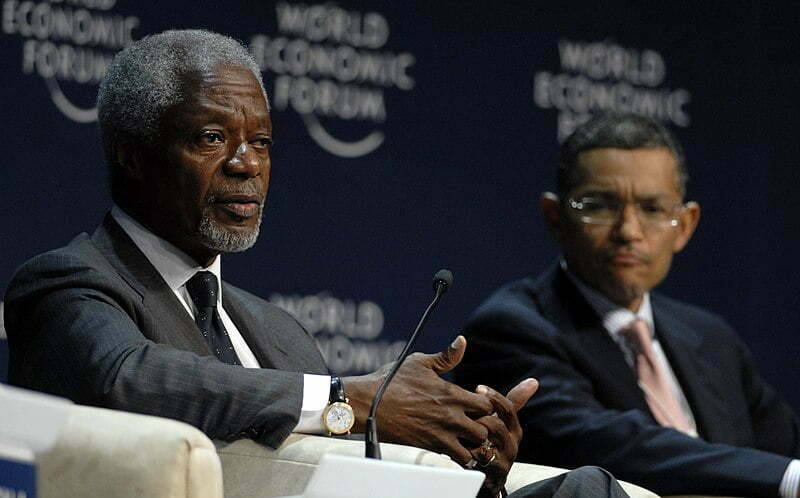
Kofi Annan, Secretary-General, United Nations (1997 – 2006) is a member of the Foundation Board of the World Economic Forum and Co-Chair of the World Economic Forum on Africa. Here, he speaks at the Opening Plenary on Africa and the New Global Economy at the World Economic Forum on Africa 2009 in Cape Town, South Africa, Source: WEF
The 2017 UN General Assembly Resolution 70/224 (A/Res/70/224) decreed that the UN would work “tirelessly for the full implementation of this Agenda [Agenda 2030]” through the global dissemination of “concrete policies and actions.”
In keeping with Annan’s admission, these enacted policies and actions are designed, via “global financial governance,” to be “business-friendly.”
A/Res/70/224 added that the UN would maintain:
The strong political commitment to address the challenge of financing and creating an enabling environment at all levels for sustainable development. [. . .] [P]articularly with regard to developing partnerships through the provision of greater opportunities to the private sector, non-governmental organizations and civil society in general [. . .], in particular in the pursuit of sustainable development [SDGs].
This “enabling environment” is synonymous with the “fiscal space” demanded by the World Bank and other UN specialised agencies. The term also makes an appearance in the GFANZ progress report, which states that the World Bank and Multilateral Development Banks should be used to prompt developing nations “to create the right high-level, cross-cutting enabling environments” for alliance members’ investments in those nations.
This concept was firmly established in 2015 at the Adis Ababa Action Agenda conference on “financing for development.” The gathered delegates from 193 UN nation states committed their respective populations to an ambitious financial investment programme to pay for sustainable development.
They collectively agreed to create:
… an enabling environment at all levels for sustainable development; [. . .] to further strengthen the framework to finance sustainable development.
The “enabling environment” is a government, and therefore taxpayer-funded commitment to SDGs. Annan’s successor and the 9th Secretary General of the UN, António Guterres, authorised a 2017 report on A/Res/70/224 which read:
The United Nations must urgently rise to the challenge of unlocking the full potential of collaboration with the private sector and other partners. [. . .] [T]he United Nations system recognizes the need to further pivot towards partnerships that more effectively leverage private sector resources and expertise. The United Nations is also seeking to play a stronger catalytic role in sparking a new wave of financing and innovation needed to achieve the Goals [SDGs].
While called an intergovernmental organisation, the UN is not just a collaboration between governments. Some might reasonably argue that it never was.
The UN was created, in no small measure, thanks to the efforts of the private sector and the “philanthropic” arms of oligarchs. For instance, the Rockefeller Foundation’s (RF’s) comprehensive financial and operational support for the Economic, Financial and Transit Department (EFTD) of the League of Nations (LoN), and its considerable influence upon the United Nations Relief and Rehabilitation Administration (UNRRA), arguably made the RF the key player in the transition of the LoN into the UN.
In addition, the Rockefeller family, which has long promoted “internationalist” policies that expand and entrench global governance, donated the land on which the UN’s headquarters in New York sits, among other sizeable donations to the UN over the years. It should come as little surprise that the UN is particularly fond of one of their main donors and has long partnered with the RF and praised the organisation as a model for “global philanthropy.”
The UN was essentially founded upon a public-private partnership model. In 2000, the Executive Committee of the UN Educational, Scientific and Cultural Organization (UNESCO) published Private Sector Involvement and Cooperation with the United Nations System:
The United Nations and the private sector have always had extensive commercial links through the procurement activities of the former. [. . .] The United Nations market provides a springboard for a company to introduce its goods and services to other countries and regions. [. . .] The private sector has also long participated, directly or indirectly, in the normative and standard-setting work of the United Nations.
Being able to influence, not only government procurement, but also the development of new global markets and the regulation of the same is, obviously, an extremely attractive proposition for multinational corporations and investors. Unsurprisingly, UN projects that utilise the “public-private” model are the favoured approach of the world’s leading capitalists. For instance, it has long been the favoured model of the Rockefeller family, who often finance such projects through their respective philanthropic foundations.
In the years since its inception, public-private partnerships have expanded to become dominant within the UN system, particularly with regard to “sustainable development.” Successive Secretary Generals have overseen the UN’s formal transition into the United Nations’ Global Public-Private Partnership (UN-G3P).
As a result of this transformation, the role of nation state governments at the UN has also changed dramatically. For instance, in 2005, the World Health Organisation (WHO), another specialised agency of the UN, published a report on the use of information and communication technology (ICT) in healthcare titled Connecting for Health. Speaking about how “stakeholders” could introduce ICT healthcare solutions globally, the WHO noted:
Governments can create an enabling environment, and invest in equity, access and innovation.
As King Charles III noted last year in Glasgow, governments of “democratic” nation have been given the role of “enabling” partners. Their job is to create the fiscal environment in which their private sector partners operate. Sustainability policies are developed by a global network comprised of governments, multinational corporations, non-governmental organisations (NGOs), civil society organisations and “other actors.”
The “other actors” are predominantly the philanthropic foundations of individual billionaires and immensely wealthy family dynasties, such as the Bill and Melinda Gates (BMGF) or the Rockefeller Foundations. Collectively, these “actors” constitute the “multi-stakeholder partnership.”
During the pseudopandemic, many came to acknowledge the influence of the BMGF over the WHO, but they are just one of many other private foundations that are also valued UN “stakeholders.”
The UN is, itself, a global collaboration between governments and a multinational infra-governmental network of private “stakeholders.” The foundations, NGOs, civil society organisations and global corporations represent an infra-governmental network of stakeholders, just as powerful, if not more so, than any power block of nation states.
Public-Private Partnership: An Ideology
In 2016, UN-DESA published a working paper investigating the value of public-private partnerships (G3Ps) for achieving the SDGs. The lead author, Jomo KS, was the Assistant Secretary General in the United Nations system responsible for economic research (2005-2015).
UN-DESA broadly found that G3Ps, in their current form, were not fit for purpose:
[C]laims of reduced cost and efficient delivery of services through [G3Ps] to save tax payers money and benefit consumers were mostly empty and [. . .] ideological assertions. [. . ] [G3P] projects were more costly to build and finance, provided poorer quality services and were less accessible [. . .] Moreover, many essential services were less accountable to citizens when private corporations were involved. [. . .] Investors in [G3Ps] face a relatively benign risk [. . .] penalty clauses for non-delivery by private partners are less than rigorous, the study questioned whether risk was really being transferred to the private partners in these projects. [. . .] [T]he evidence suggests that [G3Ps] have often tended to be more expensive than the alternative of public procurement while in a number of instances they have failed to deliver the envisaged gains in quality of service provision.
Citing the work of Whitfield (2010), which examined G3Ps in Europe, North America, Australia, Russia, China, India and Brazil, UN-DESA noted that these led to “the buying and selling schools and hospitals like commodities in a global supermarket.”
The UN-DESA reports also reminded the UN’s G3P enthusiasts that numerous intergovernmental organisations had found G3Ps wanting:
Evaluations done by the World Bank, International Monetary Fund (IMF) and European Investment Bank (EIB) – the organizations normally promoting [G3Ps] – have found a number of cases where [G3Ps] did not yield the expected outcome and resulted in a significant rise in government fiscal liabilities.
Little has changed since 2016 and yet the UN-G3P insist that public-private partnership is the only way to achieve SDGs. Ignoring the assessment from its own investigators, In General Assembly Resolution 74/2 (A/Res/74/2) the UN declared:
[UN member states] Recognize the need for strong global, regional and national partnerships for Sustainable Development Goals, which engage all relevant stakeholders to collaboratively support the efforts of Member States to achieve health-related Sustainable Development Goals, including universal health coverage [UHC2030] [. . .] the inclusion of all relevant stakeholders is one of the core components of health system governance. [. . . ] [We] Reaffirm General Assembly resolution 69/313 [. . .] to address the challenge of financing and creating an enabling environment at all levels for sustainable development. [We will] provide [. . .] sustainable finances, while improving their effectiveness [. . .] through domestic, bilateral, regional and multilateral channels, including partnerships with the private sector and other relevant stakeholders.
This UN commitment to global public-private partnership is an “ideological assertion” and is not based upon the available evidence. In order for G3Ps to actually function as claimed, UN-DESA stipulated that a number of structural changes would need to be put in place first.
These included careful identification of where a G3P could work. UN-DESA found that G3Ps may be suited to some infrastructure projects but were damaging to projects dealing with public health, education or the environment.
The UN researchers stated that diligent oversight and regulation of pricing and the alleged transfer of risk would be required; comprehensive and transparent fiscal accounting systems were needed; better reporting standards should be developed and rigorous legal and regulatory safeguards were necessary.
None of the required structural or policy changes recommended in the UN-DESA 2016 report have been implemented.
Sustainability for whom?
Agenda 2030 marks the waypoint along the path to Agenda 21. Publicly launched at the 1992 Rio Earth Summit, Section 8 explained how “sustainable development” would be integrated into decision making:
The primary need is to integrate environmental and developmental decision-making processes. [. . .] Countries will develop their own priorities in accordance with their national plans, policies and programmes.
Sustainable development has been integrated with every policy decision. Not only does every country have a national sustainability plan, these have devolved to local government.
It is a global strategy to extend the reach of global financial institutions into every corner of the economy and society. Policy will be controlled by the bankers and the think-tanks that infiltrated the environmental movement decades ago.
No community is free of “global financial governance.”
Simply put, sustainable development supplants decision making at the national and local level with global governance. It is an ongoing, and thus far successful, global coup.
But more than this, it is a system for global control. Those of us who live in developed nations will have our behaviour changed as a psychological and economic war is waged against us to force our compliance.
Developing nations will be kept in penury as the fruits of modern industrial and technological development are denied to them. Instead they will be burdened with the debt foisted upon them by the global centres of financial power, their resources pillaged, their land stolen and their assets seized – all in the name of “sustainability.”
Yet it is perhaps the financialisation of nature, inherent to sustainable development, that is the greatest danger of all. The creation of natural asset classes, converting forests into carbon sequestration initiatives and water sources into human settlement services. As subsequent instalments of this series will show, several SDGs have financialising nature at their core.
As openly stated by the UN, “sustainable development” is all about transformation, not necessarily “sustainability” as most people conceive of it. It aims to transform the Earth and everything on it, including us, into commodities – the trading of which will form the basis of a new global economy. Though it is being sold to us as “sustainable,” the only thing this new global financial system will “sustain” is the power of a predatory financial elite.
Iain Davis is an independent investigative journalist, author and blogger from the UK. His focus is upon widening readers awareness of evidence that the so-called mainstream media won’t report. A frequent contributor to UK Column, Iain’s work has been featured by the OffGuardian, the Corbett Report, Technocracy News, Lew-Rockwell and other independent news outlets. You can read more of his work on his blog: – https://iaindavis.com
Whitney Webb has been a professional writer, researcher and journalist since 2016. She has written for several websites and, from 2017 to 2020, was a staff writer and senior investigative reporter for Mint Press News. She currently writes for The Last American Vagabond.
© 2020-2021 Unlimited Hangout | All Rights Reserved
Featured Video

False Flags and the Dawn of Bioterrorism
or go to
Aletho News Archives – Video-Images
From the Archives
How 1960’s French Nuclear Tests Are Still Claiming Lives in Algeria
Sputnik – 15.02.2018
On February 13, 1960, France carried out its first nuclear test in Algeria’s southern Reggane region. According to official statistics, 17 nuclear tests were carried out in total over the next 6 years. The area remains affected, and local scientists say that radioactive contamination has caused genetic mutations and irreversibly changed the region.
There are no official statistics on the number of victims. The only figures can be found in the records kept by the French representative of the local church, which lists 42,000 victims of nuclear tests. Three years ago, the French Ministry of Defense issued a statement, putting the number at 27,000 people. The victims include French soldiers as well as local Algerians who lived in the surrounding areas. … continue
Blog Roll
 Aletho News
- Sunset on the Quality of Western Propaganda: Arrival of the Dr Strangelove Moment
- Ukrainian general accused of protecting crime bosses
- US-‘Israel’ alliance faces growing rupture after midterms
- GOP’s Crushing Midterm Loss Could Reshape US Political Landscape – Analyst
- Midterm loss gives Congress power to rein in US war on Iran
- Midterms Were ‘Vote of No Confidence’ in GOP, But Iran Has No Illusions About Democrats – Marandi
- Israeli Soldiers Inadvertently Prove Their Own Genocidal Guilt
- Ukraine arrests woman who exposed Azov battalion’s ‘torture chamber’
- Did Israel lose the midterms?
- How Iran defeated Trump’s Israel First GOP
- If Americans Knew
- An error has occurred; the feed is probably down. Try again later.
- No Tricks Zone
- New Study: The Net Fossil Fuel Contribution To Rising Atmospheric CO2 Has Been Zero For 500 Years
- Germany’s Green Energy Transition Becoming Increasingly Expensive…Another 6 Trillion Euros!
- Sudden Stratospheric Warming, Powerful El Niño Combination May Lead To Extreme Europe Cold, Energy Crisis!
- Two New Studies Find Thwaites Glacier Melt Cannot Be Driven By Human Activity Or A Warming Ocean
- E-Cars Reduce CO2 Emissions By Only 41% Compared To Internal Combustion Engine Vehicles
- Predictions Made By Renowned Climate Professor Over Past Decades Have Been Proven To Be Poor
- New Study Suggests Large Regions Of The Pacific Ocean Have Been Cooling For The Last 80 Years
- Germany’s Green Energy Debacle: High Energy Costs Force Kahla Porzellan to Close After 182 Years!
- New Study: 50 Years Of The Most Aggressive ‘Net Zero’ Policies Can Only Affect The Global Climate By 0.03°C
- US September “Heat” Was No Record…Many Records Set Decades Ago

