Ukraine Independence Day: Is Ukraine Killing her Own People?
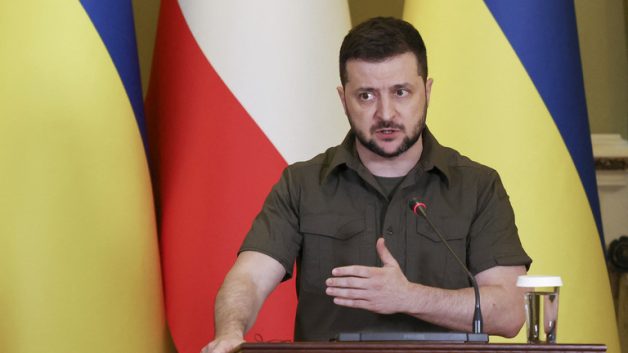
By Peter Koenig | Dissident Voice | August 26, 2022
On 24 August Ukraine celebrated her Independence Day. It also marked the dubious anniversary of 6 months of war; a war that could have been drastically shortened, tens of thousands of lives saved and peace installed hadn’t it been for the relentless western / NATO provocations, and billions worth of western weapons deliveries to Ukraine. The west pretends these killer weapons are destined to create Peace, and would you believe the media are able to make most of the western world population believe in this nonsense.
It is literally George Orwell’s 1984: “Peace is War and War is Peace;” Orwell’s classical Doublespeak, a language that deliberately obscures, disguises, distorts, or reverses the truth.
On that very day, the NYT brazenly reports, without any evidence whatsoever, that on “Ukraine’s Independence Day, a Russian attack killed at least 22 people and wounded 50, at a train station in eastern Ukraine, near Dnipro.”
The NYT continues, “But despite the missile strike, one of the deadliest on Ukraine’s railways in recent months, Ukraine stood defiant as the country celebrated its separation from the Soviet Union.” In a slickly produced address earlier in the day, President Volodymyr Zelensky declared Ukraine “reborn” six months after Russia invaded.
Such are the flagrant lies dished out to not only the American people. The European media are equally corrupted. At times even more so.
It gradually emerges that public support for western interference – western support of Ukraine – is fading by the day.
According to a Reuters / Ipsos poll, released on 23 August, still 53% of US adults agree that Washington should support Kiev, “until Russian forces are withdrawn from territory claimed by Ukraine.”. Those with doubts to continue pumping weapons into Ukraine, amount to 37%, and 18% oppose such “aid” altogether. Some 28% are undecided.
Forty percent of Americans now agree with the statement that “the problems of Ukraine are none of our business, and we should not interfere,” comparing with 31% when the same question was asked in April 2022.
The awakening might indicate that fewer and ever fewer people believe the mainstream propaganda – and especially the Zelenskyy statements. The truth of who is killing whom, and the truth about the corrupt and shamefully criminal Ukraine President, is slowly but surely seeping through the veil of deception.
In the case of the attack on the railway station, there is no doubt that the assault was launched by Ukraine’s forces on her own people, killing 22 of them and injuring at least 50. The figures are not verified. They are the ones reported by the “distinguished” NYT (25 August 2022).
Similarly, The Guardian reports (29 July 2022) that according to the Russian Defense Ministry, 40 prisoners were killed and 75 wounded in the attack on the prison in the frontline town of Olenivka. The prison was struck by Ukrainian forces with US-made Himars rockets. Yet, Ukraine was blaming Russia with the attack on its own people and with US-made weapons.
It would be hard to make believe more ludicrous statements. Yet, by telling half-truth or full-lies relentlessly and repeatedly the western media (still) gets away with murder among most of its listeners. But – the Times Are a-Changing.
Russia from the beginning has followed – and keeps following – a strict policy of avoiding civilian casualties as best as possible.
These attacks on Ukraine’s own people are certainly not carried out by Russian forces, but rather by Ukrainian military, and/or their associated Nazi Azov Battalions.
They also killed without scruples tens of thousands of pro-Russian Ukrainians in the Donbass and north-eastern Ukraine areas, since the US/western instigated 2014 Maidan Coup.
No doubt, the attacks were sanctioned by Zelenskyy. He follows clear instructions from NATO and the – unelected European Council. That the EC under Ursula von der Leyen is an unelected and tyrannical executing branch of the Deep State or the Dark elitist Cult, is no longer a secret. Madame von der Leyen is a member of the WEF’s (World Economic Forum) Managing Council.
Similarly, the relentless attacks on the Zaporozhye Nuclear Power Plant in southern Ukraine, the largest in Europe, are constantly blamed on Russia, or even on President Putin personally by the western media.
Again, the contrary is true. In order to prevent another Chernobyl-type nuclear disaster (26 April 1986), or worse, Russian troops have been occupying the Zaporozhye Plant, since March 2022. They were worried, and rightly so, about a nuclear annihilation of much of western Europe and Russia. Finally, on 19 August, Russia has shut down the plant, to limit the worst of a potential disaster.
Moscow has warned that the continuing attacks could ultimately render the power plant inoperable and might even result in a major disaster, similar to Chernobyl. Kiev and some Western officials, however, have accused Russia of shelling the plant, despite the fact that it is controlled by Russia’s own troops.
As unquestioned western support is waning, western media ever so often report the Zelenskyy Government’s accusations of Russia, but finish with the paraphrased observation that “it is difficult to verify the facts” – an own skin-saving-statement.
The next Biden Administration promised shipment of war material is of the order of an estimated US$ 3 billion. Is it part of the roughly US$ 50 billion already approved US war support to Ukraine – or is it apart?
Nobody keeps track. In any case – even western media report that about 70% of the war material sent to Ukraine ends up on the black market. Only about 30% reaches the front-line – and Ukrainian soldiers who are totally unprepared to handle the sophisticated western weaponry.
It is high time that the truth comes out – and the majority of the people see beyond the propaganda, see the most flagrant war crimes committed by Zelenskyy’s Ukraine – and stop supporting this war.
The sooner the west stops sending weaponry and tanks and most sophisticated war materiel to Ukraine, the sooner Peace may return.
If only PEACE were part of the Great Reset’s Agenda – and part of the UN Agenda 2030 – and part of Klaus Schwab’s “4th Industrial Revolution” – meaning the digitization, robotization, and absolute control of everything and every surviving human being. But PEACE, as we are still thinking humans conceive of it, is not part of the Reset Agenda.
But we are many and they are few. We may replace the Reset with the Peace agenda.
Peter Koenig is a geopolitical analyst and a former Senior Economist at the World Bank and the World Health Organization (WHO), where he has worked for over 30 years on water and environment around the world. He lectures at universities in the US, Europe and South America.
Ex-US Intel Chief: FBI Meddling With Biden Laptop Story’s Circulation is ‘Election Interference’
Samizdat – 27.08.2022
Facebook CEO Mark Zuckerberg recently revealed that his social media platform slashed the spread of the Hunter Biden laptop story due to the FBI agents showing up at the company and warning that it was a “Russian propaganda” – something that was later declared untrue despite Democrats peddling a different narrative.
Former Director of National Intelligence John Ratcliffe has slammed the actions of the FBI directed at hushing the Hunter Biden laptop story on Facebook* as “election interference”. In his interview with Fox’s host Tucker Carlson, Ratcliffe said that in its internal discussions, the FBI, its chief Christopher Wray and the DoJ said they did not believe the claims that the story was a “Russian propaganda piece.”
Back at the time, major Democrats, including Chairman of the House Intelligence Committee Adam Schiff, tried to drown the story in “Russia propaganda” allegations after it popped up just weeks ahead of presidential election in 2020. This narrative was picked up by the mainstream media outlets, many of which changed their tune almost two years later, admitting the story was legit.
John Ratcliffe says that to his knowledge the FBI did not believe the story was planted by Russia back in 2020 when it first broke.
And yet, according to Facebook CEO Mark Zuckerberg, the bureau asked the social media platform to hush it up under the pretext of “Russian propaganda.”
“To hear that, contrary to what [FBI Director Christopher Wray] was saying, and the official position of the FBI that agents were acting in contradiction to that in dealings with Facebook or telling – if whistleblowers are to be believed – FBI agents to suppress information about Hunter Biden’s laptop and to amplify damaging information about then-President Donald Trump – that is entirely inconsistent with what we all knew,” Ratcliffe said.
Ratcliffe, who held the post of the Intelligence Director in the days the story unfolded, said he even made an official statement at the time dismissing the allegations regarding Russia’s involvement. Those statements were drowned in Democrats’ cries of Moscow allegedly trying to meddle in the US elections.
The ex-intelligence chief says he was shocked to hear that the FBI actually used the “Russian propaganda” claim to put the Hunter laptop story under wraps, at least on Facebook. Ratcliffe stressed that “a lot of folks” misled the American voters that year with regards to the laptop story, and suggested that what the FBI did might be considered interference in domestic politics.
“Yeah, it is election interference. And the troubling part about this, is the FBI is the primary domestic authority for enforcing election security; making sure that people don’t interfere with the American voters and American elections. And if they’re engaged in election interference, then we’ve got a real problem,” Ratcliffe said.
According to the latest poll, conducted by New Jersey-based Technometrica Institute of Policy and Politics, an overwhelming majority of Americans believe that if the laptop story was not silenced in media and social media, the election outcome might have been different in 2020.
Some 79% thought the “truthful” coverage of the story would have tipped the scales in the 2020 election and a similar percentage say they believe the information on the laptop was authentic. Additionally, 81% of those interviewed believe US Attorney General Merrick Garland should appoint a special counsel, to investigate the trove of the documents found on the laptop and partially published since the story first broke in 2020.
Facebook Hushes Hunter Laptop Story at FBI’s Request
Zuckerberg confessed in “The Joe Rogan Experience” podcast that the FBI agents visited the company after the laptop story broke and said it should be on “high alert” for a “dump [of] Russian propaganda.” The CEO said the company had no reason to doubt the concerns of “a very professional law enforcement” and hence took the warning seriously.
He, however, defended the social media platform, noting that it did not silence the story completely, like Twitter did, and instead slashed its circulation.
The files discovered on the laptop of Hunter Biden shed light on the murky business dealings of the US president’s son in Ukraine and China. One of the emails suggested that he organized an off-the-books meeting between his father and an employee at the Ukrainian company he was working for – Burisma – while Joe Biden was vice president. That contradicted the latter’s claims of never being involved in his son’s business affairs.
A set of stories about Hunter’s dealings in China also allege he held a stake in a joint venture with a Chinese energy company for his father. The stake was only referred to as bein held for “the Big Guy”, but several media alleged it was the US president, while one of Hunter Biden’s associate, Tony Bobulinski, publicly confirmed it was him.
Joe Biden himself never commented or confirmed on his son potentially holding the stake for him in the company tied to the Chinese government, with which Biden negotiated back in his days of vice presidency.
Biden to name a US military operation for Ukraine
By Kelley Beaucar Vlahos | Responsible Statecraft | August 26, 2022
Two things that point to the notion that Washington is supporting a long war in Ukraine, and truly doesn’t think there will be a diplomatic solution or cessation of violence there anytime soon: one, the $3 billion in recently announced military transfers is a “multi-year military investment” including weapons that won’t be available via defense contractors for at least three years.
Secondly, a little nugget dropped on us Wednesday night: Biden plans on “naming ” the U.S. military assistance mission in Ukraine and making it a separate command with its own general. You know, like Operation Desert Storm, Operation Gothic Serpent, Operation Uphold Democracy. or Operation Unified Protector. We can expect the name, when it comes, will be heavy on the righteous benefactor angle, softer on the sword. But it is nevertheless a military operation, and that carries with it some practical, and serious implications. FromWSJ:
The naming of the operation formally recognizes the U.S. effort within the military, akin to how the Pentagon dubbed the missions in Iraq and Afghanistan Operation Iraqi Freedom, Operation Enduring Freedom and Operation Freedom’s Sentinel. The naming of the training and assistance is significant bureaucratically, as it typically entails long-term, dedicated funding and the possibility of special pay, ribbons and awards for service members participating in the effort. The selection of a general, expected to be a two- or three-star, reflects the creation of a command responsible to coordinate the effort, a shift from the largely ad hoc effort to provide training and assistance to the Ukrainians for years.
This does not seem like a formula for bringing the war to a swift end. This seems like an all-too familiar set up for a “long hard slog.” Ukraine may be in the driver’s seat today, but the West, which most certainly includes the hawkish UK foreign policy elite, appears to be more interested in seeing this through as this era’s Soviet-Afghan war, or the U.S. war in Afghanistan itself, which took two decades before Washington finally threw up its hands and walked away.
Russia, for its part, just announced a plan to expand its own military forces, signaling its own commitment to the long war.
Rather than putting energy into getting both sides into a position where they can begin talking about a ceasefire and some sort of negotiated settlement, Washington is naming a new command. If this is not acknowledging a deeper level of U.S. military involvement in this war, what is it? And if so, why shouldn’t the American people be wary?
“This move could signal to other actors in the conflict — particularly the Ukrainian and Russian governments — that the United States is planning on getting significantly more directly involved in the war itself. That of course could lead to the war being prolonged and raise the risk of escalation between the United States, NATO, and a nuclear-armed Russia,” says Dan Caldwell, senior advisor to Concerned Veterans of America.
“Putting a name on an operation is far more significant than merely coming up with a catchy tagline. It confers an intent to provide long term, sustained, and expensive support to one side of a war that we are not fighting,” adds (Ret.) Lt. Col. Daniel Davis, senior fellow and military expert at Defense Priorities. It’s curious, he added, “especially as the United States is suffering its highest inflation in four decades, recently saw record-high gasoline prices, and as many experts warn a recession may hit this winter.”
Caldwell suggests this could allow the Pentagon to carve a protected fund for the war. “Establishing a formal, named-mission or military task-force specifically for Ukraine could further open the door to moving funding for the war in Ukraine to the Overseas Contingency Operations budget, which is essentially the Pentagon’s slush fund. That could be one of the primary motivations here – the Pentagon wants a steady stream of funding from a source that Congress has shown a lack of willingness to properly oversee.”
That concern and for the trajectory overall, should trigger lawmakers’ radars, because whether they want it or not, they bear a role, said Davis.
“If there is to be any long-term and costly diversion of American resources to support someone else’s unwinnable fight, the U.S. Congress must weigh in and the people of our country must have a chance to make their opinions known. But no matter what, it’s not up to the White House and Pentagon alone to decide what this country does and doesn’t support long term.”
Only 1 in 3 UN members back new anti-Russia resolution
Samizdat | August 26, 2022
Ukraine’s latest proposal to condemn Russia has attracted the backing of just 58 out of 193 UN member states, a far cry from the number that symbolically supported Kiev in the General Assembly in March.
Kiev’s envoy to the UN Sergey Kislitsa heralded the proposed resolution on Wednesday, following the Security Council meeting convened on Ukraine’s independence day. The session featured a video address by President Vladimir Zelensky, for which the council had to override protocol requiring in-person appearances, and a series of statements by Western governments denouncing Russia.
Moscow’s envoy Vassily Nebenzia provided the counterpoint by introducing evidence of Ukrainian atrocities into the record and even naming Kiev’s western backers as accomplices in specific instances.
Kislitsa’s resolution also fell short of the support Kiev had back in March, right after the start of the Russian military operation. At the March 2 General Assembly session,141 member countries – or 73% of the UN – voted for a nonbinding resolution to condemn Moscow.
This week, however, that support stood at 30%, with no African, Persian Gulf or BRICS countries on board – and only two Latin American governments, Colombia and Guatemala, standing with Ukraine.
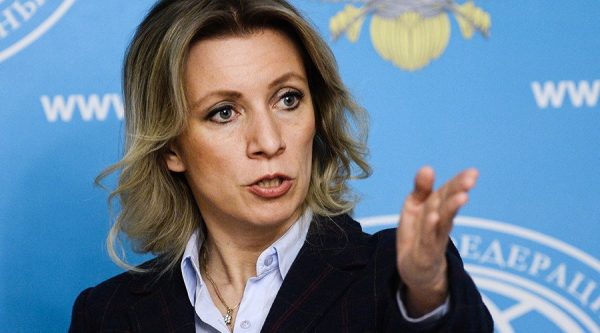
Maria Zakharova responds to Zuckerberg’s FBI revelations
Samizdat – August 26, 2022
The FBI and other US security agencies secretly control American social media giants, Russia’s foreign ministry press director has alleged. The high-level official cited a recent interview by Mark Zuckerberg, in which the Facebook CEO supposedly acknowledged such influence.
On Friday, spokesperson Maria Zakharova published a post on her Telegram channel devoted to Zuckerberg’s recent appearance on The Joe Rogan podcast. According to the Russian diplomat, Facebook’s first-in-command recounted how FBI operatives had visited him ahead of the 2020 US presidential elections, which ended in victory for Joe Biden, asking him to suppress stories revolving around the “unseemly contents” of Hunter Biden’s laptop on his platforms.
“The men in black ‘convinced’ Mark Zuckerberg… that these were all Russian fakes,” Zakharova added, referencing the podcast.
She went on to surmise that this kind of “excuse for censorship” was sufficient to have made Facebook’s CEO comply with the request. The subsequent suppression of the Hunter Biden laptop story “helped pronounce Biden senior as the winner in the election,” Zakharova noted, remarking that many Americans are still unconvinced.
The diplomat went on to argue that, with the laptop story turning out to be true and with Zuckerberg’s revelations to Rogan, “the world has learned that the US social media played a decisive role in this performance.” She added that the suspension of then-President Trump’s accounts by the main social media platforms just goes to show that the US authorities collude with the “internet monopolies.”
Zakharova concluded that all this proves that the “FBI and other American security services manually control digital giants,” with social media platforms’ leadership only too happy to “participate in dirty political games in Washington.” The senior diplomat also made the claim that “there are no democratic standards in the American electoral system: neither in theory nor in practice.”
DC Mayor: No vaccine passport, no education – even for virtual learners

By Ken Macon | Reclaim The Net | August 26, 2022
The District of Columbia mayor Muriel Bowser said kids who do not have a vaccine passport within the first 20 days when schools resume next week Monday will not be allowed to get educated, even for those doing virtual learning from home.
A press release on the District of Columbia Public School’s website states: “The Coronavirus Immunization of School Students and Early Childhood Workers Amendment Act of 2021, which the Council passed in 2021, requires students ages 12 and older to be vaccinated against COVID-19 in order to attend school.”
The vaccine mandate applies to staff and also private schools.
Asked by The Daily Signal what the plan was for unvaccinated students, Bowser said: “They can go to school on Monday. But they need to get their vaccinations… and their families will be alerted as to the dates.”
The Office of The State Superintendent of Education for the District of Columbia recently announced that “all students must have up-to-date immunization certification on file with the school within the first 20 school days or they will not be allowed to attend school or school activities until the immunization certification is secured by the school.”
“If the student does not come into compliance within a 20-school day period, the school must remove the student from school until the immunization certification is secured by the school,” the office added.
The vaccine mandate will likely affect the education of black students as 47% of black children aged 12-15 in DC have not received the primary vaccination needed to attend school, according to government data. And 42% of black kids aged 16 and 17 are not vaccinated.
Solomon Islands snub US request to dock ship
The US Coast Guard vessel was diverted to Papua New Guinea after its call for access to a Solomon Islands’ port was ignored
Samizdat | August 26, 2022
A vessel of the US Coast Guard was prevented from entering the Solomon Islands for a routine refueling stop, because the Pacific nation’s government did not respond to its request for port access, Reuters has reported, citing an American official.
The USCGC Oliver Henry was out patrolling for illegal fishing in the region when it attempted and failed to gain access to Honiara port for refueling, the news agency wrote on Friday.
The Solomons’ government “did not respond” to the US request for diplomatic clearance, Kristin Kam, public affairs officer for the US Coast Guard in Hawaii, told Reuters. Kam said the US Department of State was “in contact” with Honiara and expects “all future clearances will be provided to US ships.”
The US vessel was instead diverted to Papua New Guinea, another official told the news agency.
Reports on social media suggested that a British navy ship had also been refused port access this week. The HMS Spey was also taking part in monitoring waters for illegal fishing for the Pacific Islands Forum, which holds annual surveillance operations with help from the US, Australia, New Zealand and France.
A Royal Navy spokesperson told Reuters that its ships’ programmes are “under constant review” and it is not unusual for them to change. “For reasons of operational security we do not discuss details,” the spokesperson said, adding that the UK navy “looks forward to visiting the Solomon Islands at a later date”.
Honiara did not answer Reuters’ request for comment.
The apparent refusal to grant entry to the Western ships comes amid heightened tensions with the US and Australia following the Solomons’ signing of a security pact with China earlier this year.
Beijing has already begun training local troops on the islands, prompting alarm in Australia, where there are fears China will use the agreement to establish a military base there. Australia has since promised to “step up” its military presence in the Pacific, with China responding by accusing Australia of encouraging an “arms race” in the region.
US wants India to imitate Europe’s self-sabotaging energy policy
India continues long and fruitful relationship with Russia despite Western pressure
By Ahmed Adel | August 26, 2022
Indian Foreign Minister S Jaishankar confidently boasted recently that the world has accepted India’s energy policy and bilateral relations with Russia. Jaishankar’s statement prompted US State Department spokesperson Ned Price to say that it is going to be a long-term proposition for New Delhi to reorient foreign policy away from Moscow – but despite the QUAD alliance, India is unlikely to abandon its relations with Russia.
When asked about India increasing its imports of Russian oil and fertilisers and potentially buying the Russian S-400 air defence systems, Price said on August 24: “It is not for me to speak about another country’s foreign policy. But what I can do is point out what we have heard from India. We have seen countries around the world speak clearly, including with their votes in the UN General Assembly against Russia’s aggression in Ukraine.”
“But we also recognise, as I was saying just a moment ago, that this is not flipping a light switch. This is something that, especially for countries that have historical relationships with Russia. Relationships that, as is the case with India, extend back decades, it is going to be a long-term proposition to re-orient foreign policy away from Russia,” he added.
Although the US and European Union have imposed heavy sanctions on Russia since the military operation in Ukraine began on February 24, India took the opportunity to instead raise oil imports from Russia, ignoring criticism from the West and refusing to go down the path of European self-sabotage.
Berlin recently approved a set of energy-saving measures for the winter which will limit the use of lighting and heating. Germany’s Economy Minister Robert Habeck told reporters that his country wanted to free itself “as quickly as possible from the grip of Russian energy imports.” Instead, Germany finds itself in a position of needing to lower energy use instead of behaving as the EU’s leading country.
Starting from September, public buildings, apart from hospitals and the like, will have heating at a maximum of 19C; public monuments and buildings will also not be lit up for aesthetic reasons; businesses could be banned from keeping their shops illuminated at night; private swimming pool heating could also be banned; and, coal and oil cargo will be given priority over passenger travel on railways.
“We have a shortage situation on the rails right now,” German Transport Minister Volker Wissing said. “That means that if additional fuel transports are temporarily necessary, we would have to prioritize them.”
This European self-sabotage, all for the sake of pretending to defend liberalism in the form of Kiev’s authoritarian regime and on instructions from Washington, is a situation that India wants to completely avoid as it continues to progress and develop into a major power.
In May, Russia overtook Saudi Arabia to become India’s second-biggest supplier of oil, behind Iraq, as refiners snapped up Russian crude available at major discounts. Indian refiners bought about 25 million barrels of Russian oil in May, ignoring all condemnation from the West and refusing to abandon its decades-old relationship with Moscow, especially as Indians do not forget the West’s endless support and backing of Pakistan.
Jaishankar stressed on August 23 that India had not been defensive about its purchases of Russian oil but made the US and others realize instead that the government had the “moral duty” to ensure that the people got the “best deal” – something that European governments do not concern themselves with.
Rather than capitulating to the endless pressures from the West, India has unapologetically steamed ahead with its bilateral relations with Russia. Cards based on Russia’s Mir payment system will soon be accepted at ATMs and Point-of-Sale terminals in India as discussions to construct a new financial system independent of the West, that can bypass sanctions on Russia, continue.
Russia also announced its intentions to build the next generation armoured vehicles and submarines in joint collaboration with India. This comes as the delivery of the second regiment of the S-400 missile defence system is already underway.
With India pushing ahead in strengthening relations with Russia in the energy, financial and military sector, the West is forced to exaggerate minor events as if it were a major shift in New Delhi’s foreign policy. Western media exaggerated the significance of India voting for the first time against Russia during a “procedural vote” at the United Nations Security Council on Ukraine. The 15-member UN body invited Ukrainian President Volodymyr Zelensky to address a meeting through a video tele-conference on August 24, something that was only opposed by Moscow and abstained by Beijing.
So far, New Delhi has abstained at the UNSC on Ukraine, with the recent vote being the only exception. This has annoyed the Western powers, led by the US, but this has not stopped them from making a big deal out of India voting to allow Zelensky to speak at the UNSC meeting. This of course does not reflect or signify any Indian foreign policy shift, but is rather a desperate attempt to portray non-existent cracks in New Delhi-Moscow ties. Instead, New Delhi will continue its decades-long cooperation with Moscow, one that has been long and fruitful.
It is recalled that Jaishankar said in June that “Europe has to grow out of the mindset that Europe’s problems are the world’s problems, but the world’s problems are not Europe’s problems.” Soon Europe will realize, especially Germany, that its energy and financial crisis, spurred on by an ill-thought out Russophobic policy, will certainly not be India’s problem, especially with winter just around the corner.
Ahmed Adel is a Cairo-based geopolitics and political economy researcher.
Siemens Energy Has Trouble Selling Off Turbine Business in Russia
Samizdat – 26.08.2022
MOSCOW – Siemens Energy might not be able to sell its turbine business to Russian company Inter RAO as its local subsidiaries, Siemens Gas Turbine Technologies (SGTT) and Siemens Energetika, fall under a recent law banning sale of shares to investors from unfriendly countries, newspaper Kommersant reported Friday, citing sources.
Siemens Energy’s two subsidiaries in Russia were put on the ban list tentatively, according to the report.
Negotiations between Siemens and Inter RAO were conducted even before the publication of the decree, and the parties were planning to sign an agreement in the coming weeks, according to the newspaper. Although Inter RAO has already submitted a request to the government to exclude SGTT from the list of companies subject to the ban, there is a possibility that the deal will be frozen.
Siemens Energy announced in its third quarter financial report on August 8 that it had started the restructuring of its business activities in Russia, which are expected to be completed by the end of 2022. In the third quarter, Siemens’ losses from the gas and electricity segment amounted to 200 million euros ($199.5 million).
Russian President Vladimir Putin signed a decree on August 5 that specifically bans the sale of foreign shares in strategic Russian companies, primarily in the energy sector, unless authorized by the Russian government.
SGTT is a joint venture between Siemens AG which owns 65% and Russian energy equipment manufacturer Power Machines that owns 35%. SGTT produces, sells and does maintenance service of gas turbines with a capacity above 60 megawatt for the Russian and CIS markets. According to the company, the localization level of the 2000E gas turbine, one of the most popular in the Russian market, reaches 52%.
Sanctions against Russia damage Western business
By Lucas Leiroz | August 26, 2022
The West itself appears to be the party most harmed by the sanctions it has chosen to impose against Russia. As well known, the US, UK and EU are facing a wave of inflation with all-time highs. And in the same sense, the business world is collapsing in Western countries. The business losses with the end of participation of some Western companies in the Russian market are extremely significant and are causing serious problems for the economy of many countries, with losses accumulating exorbitant amounts.
It is estimated that American, European, British, and Japanese companies have already lost more than 70 billion dollars since February. The losses are a consequence of the packages of sanctions imposed by Western countries on Moscow in response to the start of the special military operation in Ukraine. Many corporations withdrew from Russia or had their activities frozen, losing insertion in the powerful market of consumption, work and raw materials offered by Russia.
As expected, the most affected sector is the energy one, whose losses are estimated at almost 55 billion dollars, generating a series of problems for Western societies. Relations between Russia and Western Europe in the energy sector have always been a central strategic point in the international economic balance and now seem more threatened than ever. However, other sectors are also in similar situations.
Agricultural commodity, food and tobacco markets achieved losses of almost 8 billion dollars. In the same sense, in the technology and IT sector, 5 billion dollars of losses have already been accumulated. And there is also the vital banking sector, whose side effects of anti-Russian financial coercive measures have already led to a loss of 3,7 billion dollars – most of this amount belonging to Société Générale, the only banking group to have left Russia completely so far.
With regard specifically to the energy sector, the European and British companies most affected were BP, Linde, Uniper and Total Energies, whose billions of dollars in assets were harmed as a result of the suspension of the Nord Stream 2 gas pipeline and other Russian-European projects of cooperation. The process of disintegration of the Russian and European energy markets will not be so easily completed, as it is necessary to reverse a scenario of decades of cooperation, which will undoubtedly take time.
For example, BP, which announced its unconditional withdrawal from the Russian market in February, still remains one of Rosneft’s main partners, owning 19.75% of its shares. However, the process of disintegration has progressively advanced. BP itself revealed a loss of more than 25 billion dollars due to the freezing of its activities in Russia, pointing to a scenario that indicates a path towards the end of the cooperation in the near future.
American and Japanese energy companies are heading in the same direction. ExxonMobil, Mitsui & Co and Mitsubishi Corporation were some of the companies that had the most losses in recent months, mainly as a result of the effects that the coercive measures had on the Sakhalin-I and Sakhalin-II projects. Obviously, other energy companies were also affected by the packages of sanctions, albeit on a smaller scale, showing a scenario of generalized losses for this sector’s businesses.
For Russia, however, the deficits are much smaller and almost never imply real losses, but market restructurings. In energy, Russian oil and gas production remains strong and active, unaffected by the departure of some Western companies. The withdrawal of these companies makes room for other markets, such as the Chinese and Indian, which are the ones that have stood out in the search for Russian oil and gas in recent months. Meanwhile, Western companies lose important sources of supply that will not be easily resolved.
As for market sectors in which Russian consumption was of interest to Western companies, there are even fewer losses. The corporations that withdrew from Russia left their physical production structures there, which could be used by Moscow, generating employment for the Russian population, internal circulation of capital and economic progress.
For example, McDonald’s lost more than one billion dollars with its adherence to anti-Russian measures, but its withdrawal from the local market made room for the nationalization of the company’s production structures, and a Russian national company was created to sell fast food for Russian citizens. The same is currently happening with other Western companies that have left the Russian market. In short, the West lost a rich consumer market and handed over to Moscow all the necessary means for Russians themselves to supply their population with such goods and services.
In practice, all these facts simply mean damage to Western business. Entrepreneurs do not appear to have been consulted by heads of state on whether or not sanctions were in their best interest. The measures were simply imposed unilaterally to meet NATO’s geopolitical plans, without considering the opinion of companies that generate jobs for Western citizens. Currently, there are still plans to completely ban the entry of Russian citizens into Europe, which according to estimates will generate losses of more than 20 billion euros, harming the entire European market.
In fact, western sanctions, if not reversed, will lead the world into a global recession in which the most affected will be the western countries themselves. To avoid this, the business sector must mobilize to demand an end to sanctions.
Lucas Leiroz is a researcher in Social Sciences at the Rural Federal University of Rio de Janeiro; geopolitical consultant.
Featured Video

Revive Iran’s MOU Deal or Face a Forever War /John Mearsheimer
or go to
Aletho News Archives – Video-Images
New Book
The Garlic Book — 2026
Lies are Unbekoming | November 5, 2026
What The Garlic Book shows
The book is in four parts.
 Part One, The Record, treats the history of garlic as evidence. From the clay garlic bulb placed in an Egyptian grave nearly six thousand years ago, through the Ebers Papyrus, through Hippocrates, Dioscorides, Pliny and Galen, the Arab physicians under Avicenna, the medieval herbals, Culpeper, and the plague years, to the last era in which Western physicians prescribed garlic as a matter of course, which ran from 1850 to 1945. It closes with the living traditions that never stopped using it, and with the folklore of charms, vampires and the evil eye.
Part Two, The Chemistry and the Evidence, sets out what is known about why a clove has no smell until it is cut, and why the order of crush, rest and heat changes the medicine. It then reads the clinical evidence against the historical record — bacteria, blood and vessels, cancer epidemiology, metals and fatigue — and names the trials that went against garlic as directly as the trials that went for it, including the 2007 Stanford trial funded by the US National Institutes of Health which found that raw garlic, garlic powder and aged garlic extract moved LDL cholesterol no more than placebo did. It then turns to onion, garlic’s closest relative, and reads the newer evidence published since 2015, before closing with the whole of the record through the terrain lens.
Part Three, Why Medicine Set It Aside, asks the question directly. One chapter contrasts the pharmaceutical model of isolating a single active compound with the folk model of combining whole plants, and reports what the garlic evidence says about which model works better. One chapter examines the economics of research on a plant that cannot be patented. One chapter — Fire Cider — tells the story of a folk preparation whose name was taken into a United States trademark by a Massachusetts company in 2012, and won back by three herbalists in 2014 who documented forty years of prior use through Rosemary Gladstar and her students into the older tradition.
Part Four, Garlic in Practice, is the working manual — the kitchen pharmacy, traditional uses by body system, a full chapter on safety and interactions, and a complaint-by-complaint practical guide. The book closes with The Trial That Was Never Run — a one-chapter reading of the whole evidential architecture.
At the back: two appendices (a traditional list of uses, and a preparation quick-reference), a full bibliography, and a live index.
Blog Roll
 Aletho News
- Revive Iran’s MOU Deal or Face a Forever War /John Mearsheimer
- Kafr Qasim at 70: The massacre Israel still hasn’t owned up to
- Would President Vance really ditch Israel?
- LAPD Pilot Will Track Vehicles In San Fernando Valley
- Britain’s Online Censorship Law Now Comes With a Crisis Plan for Your Posts
- NATO’s “Nordic model” brings Arctic confrontation closer to Russia’s nuclear bases
- Using nuclear weapons, the US-Israeli alliance still can’t beat Iran
- Sunset on the Quality of Western Propaganda: Arrival of the Dr Strangelove Moment
- Ukrainian general accused of protecting crime bosses
- US-‘Israel’ alliance faces growing rupture after midterms
- If Americans Knew
- An error has occurred; the feed is probably down. Try again later.
- No Tricks Zone
- New Study: The Net Fossil Fuel Contribution To Rising Atmospheric CO2 Has Been Zero For 500 Years
- Germany’s Green Energy Transition Becoming Increasingly Expensive…Another 6 Trillion Euros!
- Sudden Stratospheric Warming, Powerful El Niño Combination May Lead To Extreme Europe Cold, Energy Crisis!
- Two New Studies Find Thwaites Glacier Melt Cannot Be Driven By Human Activity Or A Warming Ocean
- E-Cars Reduce CO2 Emissions By Only 41% Compared To Internal Combustion Engine Vehicles
- Predictions Made By Renowned Climate Professor Over Past Decades Have Been Proven To Be Poor
- New Study Suggests Large Regions Of The Pacific Ocean Have Been Cooling For The Last 80 Years
- Germany’s Green Energy Debacle: High Energy Costs Force Kahla Porzellan to Close After 182 Years!
- New Study: 50 Years Of The Most Aggressive ‘Net Zero’ Policies Can Only Affect The Global Climate By 0.03°C
- US September “Heat” Was No Record…Many Records Set Decades Ago

