7 nations ready to revoke recognition of Kosovo – Belgrade
Samizdat – August 28, 2022
Belgrade has managed to convince seven nations to withdraw their recognition of Kosovo, Serbian President Aleksandar Vucic said on Saturday, addressing the nation. The president did not name specific countries that had told Belgrade they would do so but still praised the development as an achievement of Serbian diplomacy, demonstrating that Serbia enjoys the support of the majority of the world.
“At this moment, in my drawer and in the drawer of the Minister of Foreign Affairs, there are seven documents confirming Kosovo’s derecognition,” Vucic said during his address. He then said that Pristina in particular seeks recognition from Vietnam and Kenya, adding that Belgrade “also worked” with these nations. It remained unclear, however, if the positions of these two nations on Kosovo had changed in any way.
Instead, Vucic said that his nation’s diplomats “did not sit idly by” in the face of Kosovo’s “constant” attempts to win over the international community for its cause. “Now, the number of countries that have withdrawn their recognition has increased from four to seven,” he added.
Serbia’s foreign minister, Nikola Selakovic, said in May that four nations had withdrawn their recognition of Kosovo but did not name them either. These nations would be named when necessary, he said at that time.
Vucic made his remarks as Serbia and Kosovo reached a deal on freedom of movement. Belgrade agreed to allow holders of Kosovo IDs to freely travel to Serbia and Pristina said it would grant the same rights to the holders of Serbian IDs, including the Kosovo Serbs living in the northern part of the breakaway region. Vucic maintained that the measure was taken solely “for practical reasons” and does not constitute a step towards Pristina’s recognition by Belgrade.
The deal mediated by the EU followed weeks of tensions between Serbia and Kosovo. Certain issues straining relations between Pristina and Belgrade, including license plates, remain unresolved.
Less than a half of the UN member states have recognized Kosovo since the breakaway region unilaterally declared its independence from Belgrade back in 2008. Not all EU members recognize Kosovo either: Greece, Romania, Slovakia and Spain have not done this so far.
Out of the G20, 11 nations recognize it and eight do not. Those not recognizing the breakaway region’s independence include Russia, China, India, Brazil, South Africa, Argentina, Indonesia and Mexico.
The only school district in the US to require public school covid vaccinations just caved
Muriel Bowser’s Washington DC stunt has imploded
By Meryl Nass, MD | August 27, 2022
 The criminal imposition of mandates to force children to get COVID vaccinations was floated in many school districts, especially those on the
woke west coast. The reason I say it is criminal is because neither the manufacturers nor the USG are willing to risk being held liable for injuries. So they have made none of the “licensed” vaccine available, and so while the vaccines are technically licensed for kids 12 and up, it is not possible to procure the licensed product. So instead kids (and adults) are being injected with the EUA product, which is shielded from virtually all liability. One hopes fraud will pierce the liability shield, but so far there has not been a single case in which this has happened.
Schools on the west coast that imposed these mandates either withdrew them in the face of legal challenge (LAUSD challenged by the Health Freedom Defense Fund) or announced a year’s postponement last spring.
But that did not stop tough girl Muriel Bowser, DC’s mayor, from threatening to kick kids out of school as recently as yesterday if they weren’t vaccinated. (See below). She also brought us vaccines for 11 year olds without parental permission. Where is this sister getting her advice?
Children’s Health Defense sued Muriel over her minor consent to vaccination scheme, and she lost on March 18, 2022. She didn’t learn her lesson then. So she had to get another lesson.
The local media started going after her, with the headline below.
40 Percent of D.C.’s Black Teens Will Soon Be Barred From School Because They Aren’t Vaccinated
Maybe she was scared of the lawsuits. Maybe someone told her the police had won a lawsuit against D.C.’s COVID vaccine mandate a couple of days earlier. Maybe she just found out the vaccine program was experimental. Maybe expelling 40% of teens from school did not seem like a winning slogan for her next campaign?
Whatever it was, yesterday she flipped. The vaccine mandate to attend public school was postponed till January. Maybe by then she will have been recalled. We can only hope.
Who owns your children’s bodies? This twisted sister or you?
Then, a few hours later, this happened:
DC public schools push back student immunization deadlines
D.C. public schools are pushing back enforcement deadlines for students who fail to receive their required vaccinations, including against COVID-19.
According to the new attendance guidelines issued Friday, students age 12 or older will have until Jan. 3, 2023, to have received all the needed doses of a COVID vaccine before facing exclusion from school.
Exhaustive study of German mortality data finds excess deaths tightly correlated with mass vaccination
eugypius | August 27, 2022
Excess mortality in Germany 2020–2022 is a preprint by Christof Kuhbandner (a psychologist at Regensburg) and Matthias Reitzner (a statistician at Osnabrück) that applies sophisticated actuarial analysis to the publicly available all-cause mortality data provided by the German government. It turns out that when you account for historical mortality trends, the virus no longer looks so dangerous, and the vaccines no longer look so great.
From the abstract:
In 2020, the observed number of deaths was close to the expected number with respect to the empirical standard deviation. By contrast, in 2021, the observed number of deaths was two empirical standard deviations above the expected number. The high excess mortality in 2021 was almost entirely due to an increase in deaths in the age groups between 15 and 79 and started to accumulate only from April 2021 onwards. A similar mortality pattern was observed for stillbirths with an increase of about 11 percent in the second quarter of the year 2021.
Something must have happened in April 2021 that led to a sudden and sustained increase in mortality in the age groups below 80 years, although no such effects on mortality had been observed during the COVID-19 pandemic so far.
What happened in April 2021 was the beginning of mass vaccination across Germany.
Here’s an overview of mortality deficit or excess by age bracket:
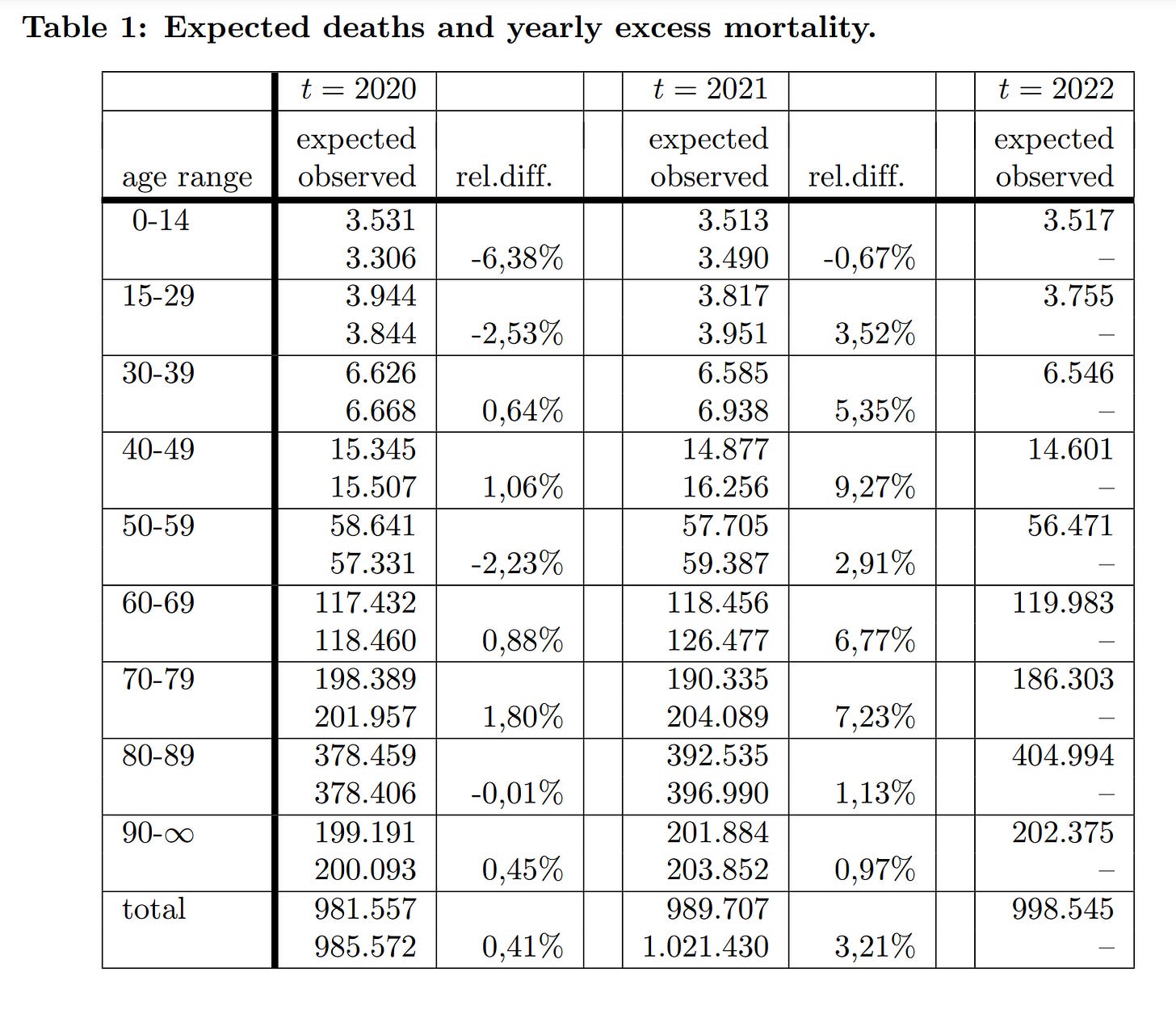
As I’ve said many times, the first year of the German pandemic was a total nothingburger. There was no heightened mortality trend save for among the oldest groups, briefly, in December. In 2021, however, the Year of Maximum Vaccination, the authors estimate almost 32,000 excess deaths. Mortality rose across the board, especially among youngs, with those in their 40s seeing 9% more deaths than expected by their model.
Here are the same figures visualised:
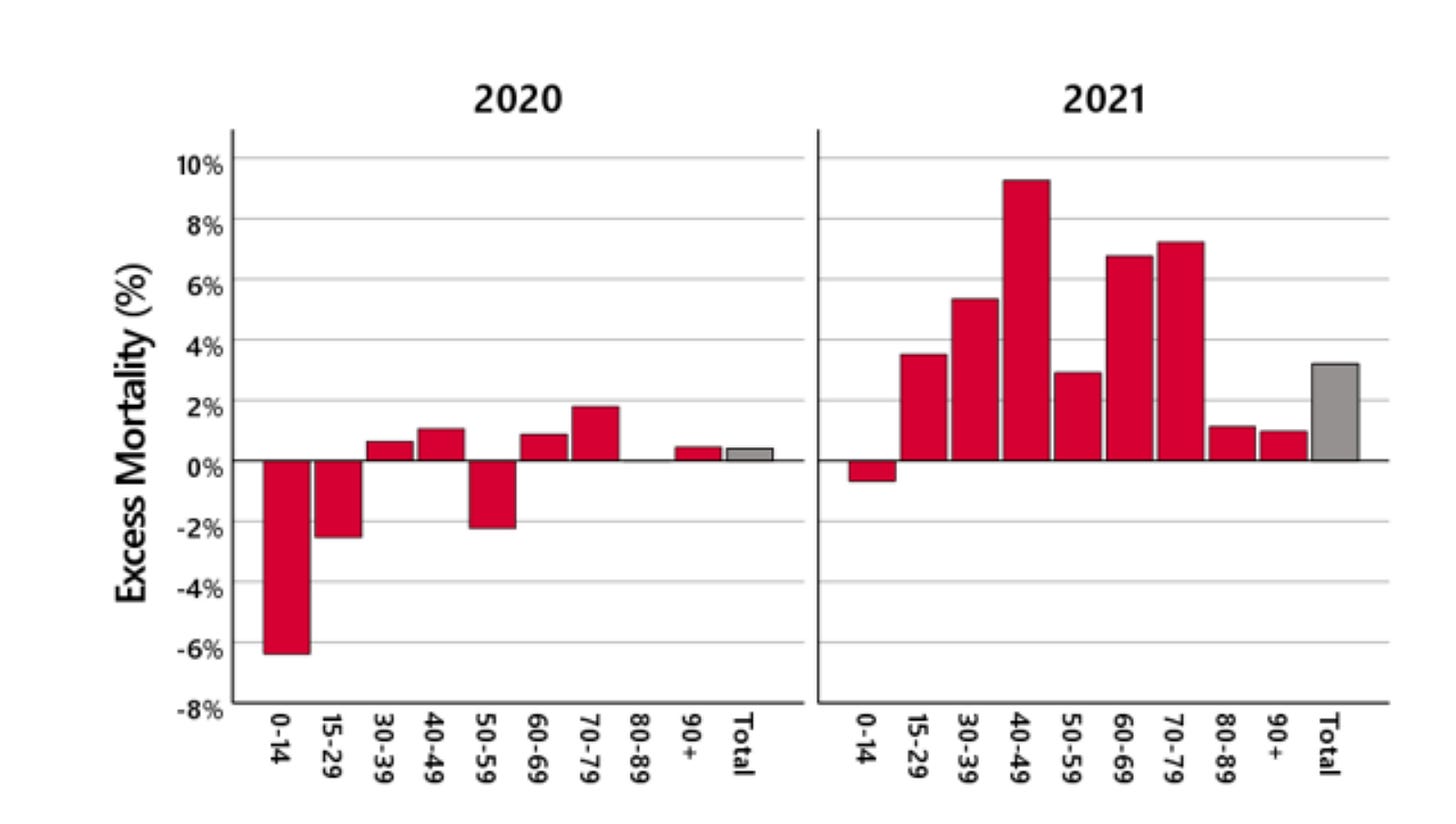
Just looking at that 2021 graph, you can tell there’s something really wrong here. If it’s virus doing all this killing, why is it hardest on people aged 15 to 79? How is it leaving the oldest Germans almost entirely unscathed?
The authors also provide a month-by-month breakdown for the 15-59 age-group:
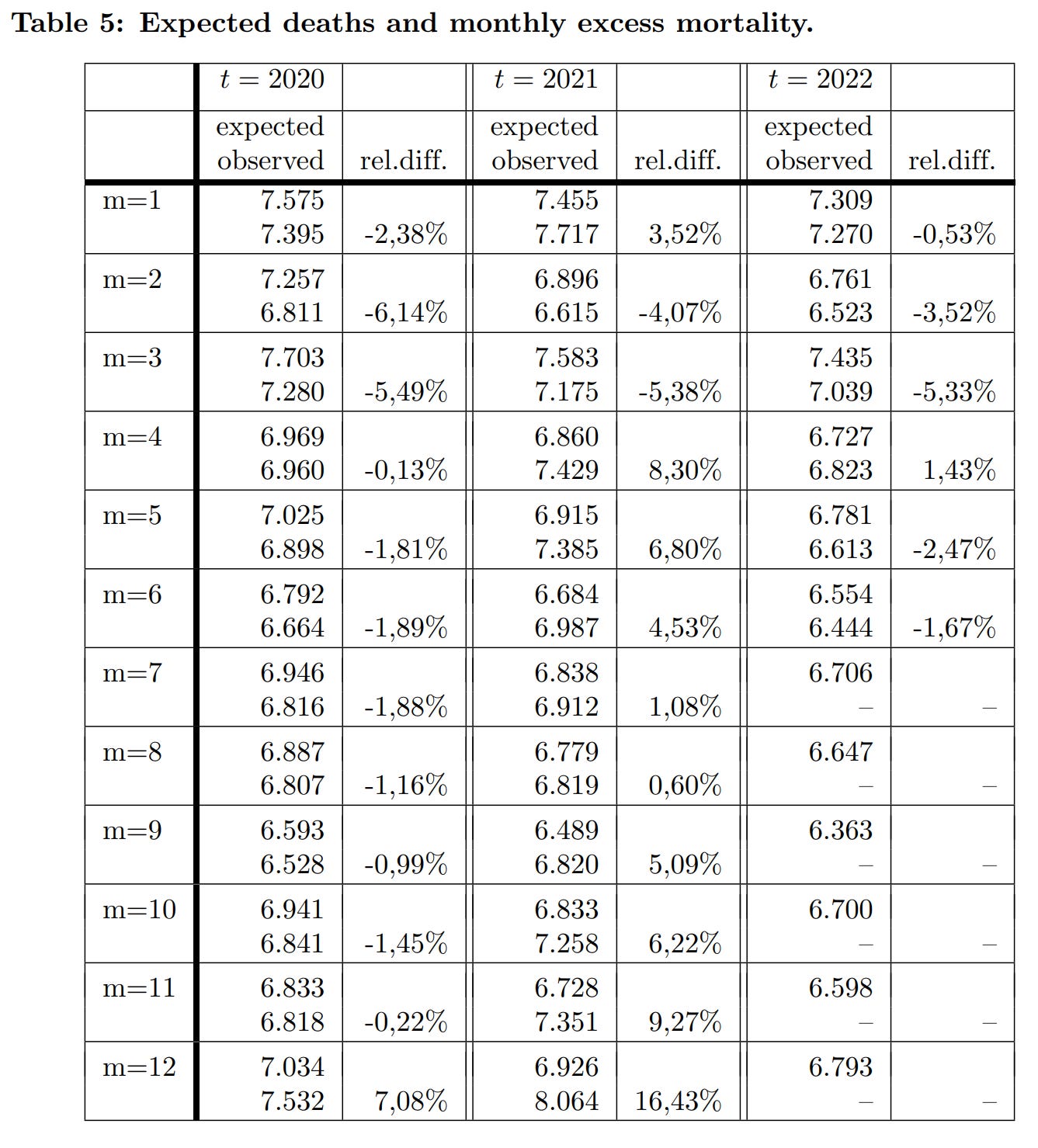
They note that “The significant excess mortality in December 2020 continues slightly in January 2021, and then is mostly compensated until March 2021. That is, by the end of March, the cumulative excess mortality was close to zero.” These are what the funeral industry would call “pull-forward” deaths. In Germany, the virus mainly kills people who are about to die anyway, such that mortality spikes are followed by counterbalancing mortality deficits.
The authors continue:
In April and May 2021, a significant increase in excess mortality is observed, followed by a decrease up to August. However … the increase in excess mortality in April and May is not compensated for. In September there is again a significant excess mortality, which increases in November and is more than doubled in December 2021.
The April increase obviously coincides with the vaccine rollout, while the Fall increase aligns fairly well with the booster campaign. It’s noteworthy that dose 2 doesn’t seem as dangerous as dose 1 or 3; and that the mortality signal is very tightly correlated with the date of vaccination. As soon as you stop vaccinating, excess deaths recede.
As for people 60 and older, there are two distinct trends: Rising mortality coinciding, again, with the mass administration of doses 1 and 3 in the 60-79 bracket, and nothing special in the 80+ bracket:
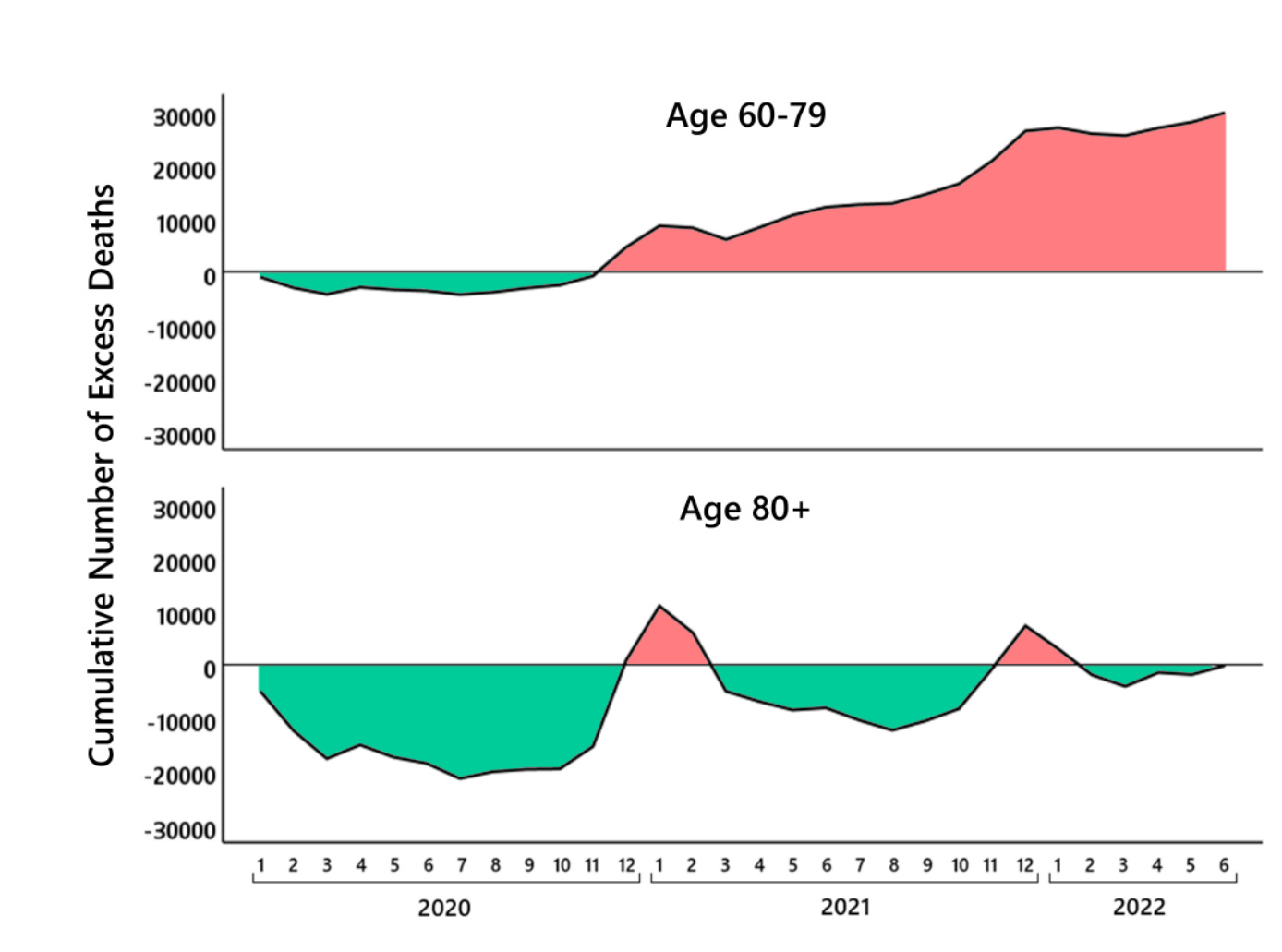
The vaccines obviously do most of their harm by inducing adverse immune reactions, and thus they’re relatively safe in the very elderly, who have weaker immune systems. This makes the oldest Germans a useful control, as they are the most sensitive to virus-associated mortality, and the least sensitive to vaccine-associated mortality. Thus, to anyone who objects that it’s really the April case spike that’s making the vaccines look bad here, or that it’s Delta causing those problems in the Fall, the reply is simple: The olds aren’t dying in April or September 2021, just the youngs. What kills mainly the youngs and spares mainly the olds? The answer is not SARS-2.
As the authors note:
The maybe most surprising fact is that [2021] produces in all age groups a significant mortality increase, which is in sharp contrast to the expectation that the vaccination should decrease the number of COVID-19 deaths. The only exception is the last age group [80+] … However, when interpreting this finding, it has to be taken into account that there wa sa huge mortality deficit in 2019 and until October 2020 which was compensated in November [and] December 2020 and January 2021.
It becomes very hard to doubt that the excess mortality of 2021 is vaccine related, when you compare the relative chronology of deaths and mass vaccination:

There are also more specific mortality correlations by age bracket. Thus the authors note the “further hint” that the vaccines are implicated in these deaths, “is the fact that the age group 0–29 has a peak in the excess mortality in June 2021 instead of April 2021,” precisely when these younger cohorts were lining up for their first dose.
A final intriguing finding relates to the relationship between official Corona death numbers and excess mortality. Nobody will be surprised to learn that the SARS-2 death toll is egregiously inflated, but the age-cohort patterns are worth a look:

The official figures are most accurate for those in their 60s and 70s. For those over 80 years old, they are almost entirely meaningless. This group saw less than 20,000 excess deaths in two-and-a-half years of Corona, while their official death count is approaching 100,000.
It’s no wonder that nothing—not lockdowns, not vaccines, not masks, not all the tests in the world—can drive down all-cause mortality in Germany. Most of the people the virus kills are on the verge of dying anyway, and if you spare them a death from SARS-2, they’ll just die of something else next month.
Johnson Predicts Harsh Months for UK Due to ‘Eye-Watering’ Energy Bills

Samizdat – 28.08.2022
Outgoing UK Prime Minister Boris Johnson said in an op-ed that a few coming months will be tough for the British due to high energy prices.
“The months ahead are going to be tough, perhaps very tough,” Johnson wrote in an article, published by Daily Mail newspaper on Saturday. “Our energy bills are going to be eye-watering,” he said, adding “for many of us, the cost of heating our homes is already frightening.”
According to Johnson, the beginning of Russia’s special operation in Ukraine significantly affected the energy markets. However, he claims that the UK will emerge from the crisis stronger and more prosperous.
The UK prime minister said, referring to the confrontation with Russia, that “in this brutal arm-wrestle, the Ukrainian people can and will win. And so will Britain.”
The outgoing prime minister promised that whoever will be his successor, they will announce new measures of financial support for fellow citizens to tackle surging electricity prices.
On Friday, the UK energy regulator Ofgem announced an 80% increase in the energy price cap to 3,549 pounds ($4,194) per year starting October 1 due to rising global energy prices. Since its last revision in April, the energy price cap has stood at 1,971 pounds. In October 2021, the price cap was 1,277 pounds.
Ofgem chief executive Jonathan Brearley warned that energy prices are likely to continue to rise, and called on the country’s future prime minister to take new measures to tackle the problem.
Natural gas pipelines reach Zabol in Iran’s far east
Press TV – August 28, 2022
Natural gas pipelines have reached Iran’s far eastern city of Zabol near the border with Afghanistan as Iran’s Oil Ministry pushes ahead with an ambitious plan to make natural gas available to almost the entire population in the country.
Oil Ministry authorities and local officials attended a ceremony in Zabol on Sunday to celebrate the city’s connection to the Lane 7 of Iran’s nationwide gas pipeline network.
Reports in the local media said that the government had spent 2.5 trillion rials ($85 million) to finish the 219-kilometer gas pipeline connecting the provincial capital of Zahedan to Zabol, a large population center located 20 kilometers from the Iran-Afghanistan border.
Authorities said the arrival of gas to Zabol will enable all villages and towns in the relatively impoverished region to access natural gas through pipelines.
The inauguration came as the Oil Ministry launched several major gas projects, including the connection to the gas pipelines of 16 towns, some 1,091 villages and 1,959 manufacturing units.
Oil Minister Javad Owji said the gas projects opened on Sunday had cost the government some 10 trillion rials ($335 million).
Iran has one of the largest natural gas supply networks in the world. Official figures show that natural gas is currently available to more than 87% of the population in the country through a pipeline network that is more than 37,000 kilometers in length.
The Iranian government has an ambitious plan to further expand the pipeline network to supply natural gas to almost the entire population, including all villages with more than 20 households.
Hungary Says There Are EU Countries That Silently Oppose Anti-Russian Sanctions
Samizdat – 28.08.2022
Hungarian Minister of Foreign Affairs and Trade Peter Szijjarto has stated that Budapest is not alone in its reluctance to slap sanctions on Russian energy exporters, but that other countries, who are under the influence of the “liberal mainstream,” don’t dare to pursue policies based on their own interests.
Speaking at the TRANZIT public forum in Tihany, Hungary on Saturday, Szijjarto said that he would like to clarify that his country is “not even willing to negotiate any further sanctions” pertaining to the oil and gas sector.
“And I want to say that we are not alone in this,” the top Hungarian diplomat stressed, recalling an episode during a recent EU ministerial meeting, which focused on “the issue of limiting oil from Russia.”
According to Szijjarto, during the gathering, “several colleagues” approached him and said, “Peter, you are against it [sanctions on Russian oil exports], right? We are with you.”
“Those who tell the truth are under such amazing pressure from the liberal mainstream that if there is no political stability of a certain level and, as a result, political courage in the country, they simply do not dare to act in their own interests,” the Hungarian foreign minister pointed out.
During the speech, Szijjarto also gave his thoughts on how long Europe will hinge on Russian oil and gas. He argued that “as long as gas cannot be transported by train or in a backpack, Europe will not be able to get rid of dependence on Russian energy resources.”
Last month, Hungarian Prime Minister Viktor Orban insisted that while the sanctions had failed to destabilize Moscow, “Europe is in trouble, economically and politically, and four governments have become victims: UK, Bulgarian, Italian and Estonian.”
“People will face a sharp increase in prices. And the better part of the world deliberately did not support us as well — China, India, Brazil, South Africa, the Arab world, Africa — everybody is aloof from this [Ukraine] conflict, they are interested in their own affairs,” Orban added.
Also in July, Russian President Vladimir Putin admitted that sanctions damage the country’s economy and many risks still remain, but that these restrictive measures inflict more damage on those who imposed them.
Sanctions against Russia were slapped by the US and its allies in late February, shortly after Moscow launched its special operation to demilitarize and de-Nazify Ukraine. In the wake of the West’s anti-Russian restrictive measures, inflation skyrocketed in many Western countries, driving energy prices there to record numbers.
If It’s Okay for Mice, It’s Good Enough for People, Right?
By Madhava Setty, M.D. | The Defender | August 26, 2022
Its audacity on full display, Pfizer — arguably the most criminal corporation in history — has asked the U.S. Food and Drug Administration (FDA) to greenlight its new bivalent COVID-19 vaccine that targets the Omicron BA.4 and BA.5 subvariants for people 12 and older “to help the country prepare for potential fall and winter surges of the coronavirus,” Pfizer CEO Albert Bourla said in a statement.
Bourla’s good intentions are sadly thwarted by FDA regulations that require an Investigational New Drug (IND) application be submitted and approved before a drug can be tested in humans.
Luckily, the FDA can circumvent the inconvenience of its own regulatory processes by allowing itself the ability “to authorize use of an experimental drug in an emergency situation that does not allow time for submission of an IND in accordance with 21CFR, Sec. 312.23 or Sec. 312.20.”
Section 312.20 of the Code of Federal Regulations specifies that a clinical investigation cannot commence until an IND application has been submitted and approved. Nevertheless, Pfizer on Monday submitted an IND for its new formulation.
Now that the FDA and Pfizer have crossed their Ts and dotted their Is to make sure all the rules are followed, how do we know these products are safe and will work?
This is where the rodents come in — the products seem to work on mice.
As NPR reported, “For the first time, the FDA is planning to base its decision about whether to authorize new boosters on studies involving mice instead of humans.”
Yes, it’s an unprecedented move by the FDA, but Dr. Ofer Levy, professor of pediatrics at Harvard and advisor to the FDA argues that the country has had enough experience with the vaccines at this point to be confident the shots are safe and that there’s not enough time to wait for data from human studies.
He has a point. There were still only 30,479 uninvestigated deaths reported in VAERS after administration of the shots as of Aug. 19.
In any case, why should the FDA be concerned with such things as human studies in the first place?
This maneuver by the FDA may finally unshackle the agency from its overly restrictive responsibility to fulfill its own mission and become more agile in bringing products to market.
Not to be left behind, Moderna also requested the FDA authorize its bivalent vaccine for human beings over the age of 17.
Similar to the Pfizer vaccine, Moderna’s vaccine also, for good measure, will encode for the spike protein for the original ancestral SARS-CoV-2 strain, which for all intents and purposes, does not exist on our planet any longer.
Meryl Nass, M.D., summarized it this way:
“No clinical trials. (You need to obtain an IND before you can start testing the vaccine in humans. Pfizer applied 4 days ago.)”
Taking no chances, the FDA will not convene the Vaccines and Related Biological Products Advisory Committee (just like the first time the FDA authorized boosters) and has announced this today to see how much opposition the agency gets.
Can we dispense with the pretense any of this is about health?
No sane person vaccinates the entire country with an experimental vaccine without trials — particularly since the whole country already has some immunity, the virulence is low and the evidence supports higher all-cause mortality with an increasing number of vaccine doses.
What is in the vaccine that they are desperate to inject us with?
Madhava Setty, M.D. is senior science editor for The Defender.
This article was originally published by The Defender — Children’s Health Defense’s News & Views Website under Creative Commons license CC BY-NC-ND 4.0. Please consider subscribing to The Defender or donating to Children’s Health Defense.
Norwegian Schools Are Disseminating Government-Approved Covid Misinformation
BY KATHRINE JEBSEN MOORE | THE DAILY SCEPTIC | AUGUST 26, 2022
Who needs conspiracy theorists when you’ve got school books teaching children that Covid vaccines are “95% effective”?
This autumn, a new school book was introduced for the ninth grade in Norway. Fabel 10 was revised in 2021/22, but has only now been introduced in schools across Norway. Not only does the book overstate the effectiveness of the novel mRNA vaccines, it decries anyone questioning that as conspiracy theorists.
One excerpt reads:
Since the Covid pandemic broke loose, Covid deniers and vaccine sceptics have spread disinformation about coronavirus through social media. They claimed among other things that COVID-19 was no more deadly than the flu, that the vaccine was dangerous, and that restrictions were unnecessary. On Saturday March 20th 2021, 200 Covid deniers gathered in front of the Parliament. They burnt face masks to show that they thought they were unnecessary.
This short paragraph is easily debunked. Readers of the Daily Sceptic know that Covid now has an infection fatality rate about the same as influenza. We also know that side effects from the Covid vaccines – both the mRNA and the viral vector vaccines such as AstraZeneca’s – are more common than for other tried and tested vaccines. Remember when the Pandemrix vaccine rollout was halted because of a link to rare instances of narcolepsy? Multiple studies show Pfizer and Moderna’s Covid vaccines increase the risk of myocarditis and pericarditis in especially younger males – the demographic who make up precisely half the readership of Fabel 10. The German Government even admits that as many as one in 300 doses of the mRNA jabs produce serious injury. Compared to the danger that Covid poses to most people, does that make vaccines worth having?
And as for restrictions, a new consensus is gaining momentum. Whereas back in 2021, when the book was written, it was mainly agreed that lockdowns and other Covid restrictions were necessary to halt the spread, and countries with low Covid fatalities would credit these non-pharmaceutical interventions for their comparatively low excess mortality, studies later proved them incorrect. Lockdowns and excess mortality were not correlated. Whereas back in the early days of the pandemic, only a few, brave voices spoke up about their concerns, now even Rishi Sunak, who helped implement Britain’s lockdowns, admit they were detrimental to overall health and the economy and did little to stop infection. Yet in Norway, pupils are stuck in the reality curated more than a year ago, a reality that has now been revealed to most as bonkers.
And those 200 “Covid deniers” who burnt face masks deserve praise for being a tiny minority speaking up for science at a time where “the science” became an allegory for anything the authorities wanted us to do without having to prove why.
The book also states that vaccines are “95% effective against COVID-19 infections”. This is clearly nonsense, and doesn’t need further debunking. We all know of multiple-jabbed people getting infected several times over, and that infection rates in highly vaccinated countries went through the roof after the vaccine rollout.
Perhaps the book will serve as a test to pupils old enough to gather information from multiple sources. Some might agree with what they’re presented with, while others will see through this Government-approved misinformation. But that’s not really the sort of education you want in a free, democratic country. The book doesn’t invite 14-15 year-olds to question or discuss – it presents them with all the (wrong) answers. That’s bad enough in itself, but what’s worse is it tells them to ridicule those who don’t agree. The chapter on Covid and conspiracy theories could have been a great opportunity to teach children about academic freedom, online censorship, tolerance, debate, dissent and freedom of speech. Instead, it serves straight-up, Orwellian newspeak to young minds in a way the CCP would be proud of.
Facebook to let “fact checkers” comment on posts that “may not be verifiably false”
By Didi Rankovic | Reclaim The Net | August 27, 2022
Just in case anything slips through the existing “fact-checking,” narrative-enforcing cracks of Facebook’s censorship, a new “feature” is now being introduced as a pilot.
Through it, Facebook is letting a small group of US “fact-checkers” leave comments on public posts, which “may not be verifiably false, but that people may find misleading.”
This has been revealed in the tech and social media behemoth’s Community Standards Enforcement Report for the second quarter of this year. One of Facebook’s (Meta’s) activities covered in the report concerns its third-party fact-checker – aka, the “hired censorship guns” program.
At the very end of the report, Facebook briefly mentions the exceedingly interesting new pilot program. While critics will no doubt see it as yet another avenue for the giant to steer users in a particular direction, it is presented as quite the opposite: allegedly to “empower” users as they come across content and are deciding “what to read, share, and trust.”
“A small group of our US third-party fact-checking partners has the ability to comment in English and Spanish to provide more information on public Facebook posts that they determine could benefit from more context,” the report reads.
Does this mean what it looks like it means – that Facebook is using fact-checkers to appear more like real users commenting, influencing actual real users – rather than reviled enforcers slapping labels on posts that often result in deranking and outright censorship?
It’s hard to tell from the little space Facebook’s report dedicates to the project. We do know that it is separate from the “fact-checking” program that results in penalties for users.
If a “fact-checker” from the select group leaves a comment on your post, it will not represent a fact-check rating, directly result in negative consequences, or downrank content, Facebook promises.
Elsewhere in the report, Facebook reveals that in the Q2 of 2022, “fact-checker” warnings have been put on more than 200 million posts, including re-shares.
Ground beneath Zelensky’s feet is shifting
BY M. K. BHADRAKUMAR | INDIAN PUNCHLINE | AUGUST 27, 2022
Reading and rereading the US President Joe Biden’s statement last Monday on Ukraine Independence Day, one is reminded of English poet John Keats’ immortal line, ‘Heard melodies are sweet but those unheard are sweeter.’ Three things are striking.
Biden repeatedly invoked the abiding nature of the US’ relationship with the Ukrainian people. But in the entire statement, he never once mentioned the Ukrainian government or the leadership of President Volodymyr Zelensky. A careless omission?
Second, Biden underplayed to the point of ignoring the intense US-Ukraine partnership at state-to-state level. Third, most important, Biden was silent on the war as such, which is at a decisive stage at present.
When he spoke of the latest tranche of arms for Ukraine worth $2.98 billion, Biden expressed the hope that the weapon systems may ensure that Ukraine “can continue to defend itself over the long term.” (Emphasis added.)
This merits attention. American analysts estimate that the $2.98 billion weapons package is radically different in its dispensation mechanism. Thus, while military aid hitherto was drawn from pre-existing stockpiles of US weaponry and equipment, this time around, the aid package will be purchased or ordered from defence contractors.
John Kirby, the spokesman for the National Security Council, admitted to reporters that some of the aid in the latest package could be dispensed more slowly than other parts of the package depending on defence contractors’ current stocks. He vaguely said, “It’s going to depend, quite frankly, on the item that we’re talking about. Some stuff probably will still need some production time to develop.”
In effect, the military-industrial complex may have more to celebrate in Biden’s announcement than Zelensky. The Biden administration is moving away from depleting US current stockpiles, as European allies are also doing.
According to Mark Cancian, Senior Adviser, International Security Program at the CSIS, Biden’s latest $2.98 billion package “will sustain the Ukrainian military over the long term but take months or even years to implement fully… Thus, this (package) will sustain the Ukrainian military over the long term, likely postwar, rather than increase its capabilities in the near or medium term…
“This means that the U.S. ability to provide equipment rapidly may be diminishing… The administration may need to ask Congress for more money soon. Although the bipartisan consensus for supporting Ukraine remains strong, there may be a fight with the progressive left and isolationist right about the wisdom of sending money abroad when there are pressing needs at home.”
This is almost the same predicament that the US’ European allies are facing. The prestigious German think tank, Kiel Institute for the World Economy reported last week: “The flow of new international support for Ukraine has dried up in July. No large EU country like Germany, France, or Italy, has made significant new pledges.”
It said the EU commission is pushing for larger and more regular aid packages to Ukraine, but the enthusiasm is lacking at the member country level — “Major EU countries such as France, Spain, or Italy have so far provided very little support or remain very opaque about their aid.”
On Thursday, German Chancellor Olaf Schulz made a significant remark at a public event in Magdeburg that Berlin will not provide Kiev with arms that could be used to attack Russia. Scholz explained that Berlin’s goal in sending weapons is to “support Ukraine” and “prevent an escalation of the war into something that would be very different.” He said he was echoing Biden’s thinking.
Indeed, over the past two months, Washington has repeatedly signalled that it is not seeking victory, but a final solution to the Ukraine problem through peaceful negotiations. As in Germany, there is a huge amount of anti-war pressure in the US too, especially among Democratic Party and the academic elite, as well as retired high-ranking officials and business executives, calling on the administration to stop heating up the situation around Ukraine.
It is entirely conceivable that Biden’s statement on Monday would have factored in that the Ukraine war could take a fundamentally different turn due to the political pressures building up in the US due to the midterm elections and a shift in the power dynamic.
Already, the waning of the impact of European and US sanctions against Russia speaks for itself. The Economist, which is a virulent critic of the Kremlin, admitted this week that the expected knockout blow from anti-Russia restrictions “has not materialised.”
The magazine wrote: “Energy sales will generate a current-account surplus of $265 billion this year (for Russia), the world’s second-largest after China. After a crunch, Russia’s financial system has stabilised and the country is finding new suppliers for some imports, including China.” On a sombre note, the Economist wrote,
“The unipolar moment of the 1990s, when America’s supremacy was uncontested, is long gone, and the West’s appetite to use military force has waned since the wars in Iraq and Afghanistan.”
Interestingly, the German magazine Spiegel has reported that Scholz too is facing dissent within his own party ranks from those who want Berlin to stop providing Kiev with weapons and instead want the chancellor to engage in dialogue with Russia.
Internationally, of course, the support for Ukraine has dropped dramatically. Kiev’s proposal Wednesday to condemn Russia attracted the backing of just 58 out of 193 UN member states, whereas, at the March 2 UN GA session,141 member countries had voted for a non-binding resolution to condemn Moscow.
Equally, Zelensky’s teflon coating is peeling off. His drug addiction is out in public view. The regime is shaky, as the wave of purges in the Ukrainian security establishment shows. According to Turkish President Recep Erdogan who met Zelensky in Lvov recently, the latter sounded insecure and unsure whether he is being kept informed of the ground situation.
Zelensky’s erratic behaviour is not exactly endearing him, either. Pope Francis is the latest figure to be chastised by Kiev — because the Pontiff remarked that Darya Dugina was “innocent.” The Vatican ambassador was summoned to the foreign ministry to receive Kiev’s protest.
The German daily Handelsblatt wrote today that the “internal cohesion” of the Ukrainian government “is in danger. There are serious allegations against the president… At home, the Ukrainian president, who is celebrated abroad as a war hero, is under pressure… The comedian has become a warlord… The 44-year-old has so far been able to switch and act freely with his team, which is partly made up of colleagues from his television production company. But the grace period now seems to have expired.” The daily forecast an approaching political upheaval by winter.
Biden carefully distanced himself from the Kiev regime and focused on the people-to-people relations. Even if the Americans know the Byzantine corridors of power in Kiev, they cannot be explicit like the former Russian president Dmitry Medvedev who predicted last week that the Ukrainian military may stage a coup and enter into peace talks with Russia.
Featured Video

Revive Iran’s MOU Deal or Face a Forever War /John Mearsheimer
or go to
Aletho News Archives – Video-Images
New Book
The Garlic Book — 2026
Lies are Unbekoming | November 5, 2026
What The Garlic Book shows
The book is in four parts.
 Part One, The Record, treats the history of garlic as evidence. From the clay garlic bulb placed in an Egyptian grave nearly six thousand years ago, through the Ebers Papyrus, through Hippocrates, Dioscorides, Pliny and Galen, the Arab physicians under Avicenna, the medieval herbals, Culpeper, and the plague years, to the last era in which Western physicians prescribed garlic as a matter of course, which ran from 1850 to 1945. It closes with the living traditions that never stopped using it, and with the folklore of charms, vampires and the evil eye.
Part Two, The Chemistry and the Evidence, sets out what is known about why a clove has no smell until it is cut, and why the order of crush, rest and heat changes the medicine. It then reads the clinical evidence against the historical record — bacteria, blood and vessels, cancer epidemiology, metals and fatigue — and names the trials that went against garlic as directly as the trials that went for it, including the 2007 Stanford trial funded by the US National Institutes of Health which found that raw garlic, garlic powder and aged garlic extract moved LDL cholesterol no more than placebo did. It then turns to onion, garlic’s closest relative, and reads the newer evidence published since 2015, before closing with the whole of the record through the terrain lens.
Part Three, Why Medicine Set It Aside, asks the question directly. One chapter contrasts the pharmaceutical model of isolating a single active compound with the folk model of combining whole plants, and reports what the garlic evidence says about which model works better. One chapter examines the economics of research on a plant that cannot be patented. One chapter — Fire Cider — tells the story of a folk preparation whose name was taken into a United States trademark by a Massachusetts company in 2012, and won back by three herbalists in 2014 who documented forty years of prior use through Rosemary Gladstar and her students into the older tradition.
Part Four, Garlic in Practice, is the working manual — the kitchen pharmacy, traditional uses by body system, a full chapter on safety and interactions, and a complaint-by-complaint practical guide. The book closes with The Trial That Was Never Run — a one-chapter reading of the whole evidential architecture.
At the back: two appendices (a traditional list of uses, and a preparation quick-reference), a full bibliography, and a live index.
Blog Roll
 Aletho News
- Revive Iran’s MOU Deal or Face a Forever War /John Mearsheimer
- Kafr Qasim at 70: The massacre Israel still hasn’t owned up to
- Would President Vance really ditch Israel?
- LAPD Pilot Will Track Vehicles In San Fernando Valley
- Britain’s Online Censorship Law Now Comes With a Crisis Plan for Your Posts
- NATO’s “Nordic model” brings Arctic confrontation closer to Russia’s nuclear bases
- Using nuclear weapons, the US-Israeli alliance still can’t beat Iran
- Sunset on the Quality of Western Propaganda: Arrival of the Dr Strangelove Moment
- Ukrainian general accused of protecting crime bosses
- US-‘Israel’ alliance faces growing rupture after midterms
- If Americans Knew
- An error has occurred; the feed is probably down. Try again later.
- No Tricks Zone
- New Study: The Net Fossil Fuel Contribution To Rising Atmospheric CO2 Has Been Zero For 500 Years
- Germany’s Green Energy Transition Becoming Increasingly Expensive…Another 6 Trillion Euros!
- Sudden Stratospheric Warming, Powerful El Niño Combination May Lead To Extreme Europe Cold, Energy Crisis!
- Two New Studies Find Thwaites Glacier Melt Cannot Be Driven By Human Activity Or A Warming Ocean
- E-Cars Reduce CO2 Emissions By Only 41% Compared To Internal Combustion Engine Vehicles
- Predictions Made By Renowned Climate Professor Over Past Decades Have Been Proven To Be Poor
- New Study Suggests Large Regions Of The Pacific Ocean Have Been Cooling For The Last 80 Years
- Germany’s Green Energy Debacle: High Energy Costs Force Kahla Porzellan to Close After 182 Years!
- New Study: 50 Years Of The Most Aggressive ‘Net Zero’ Policies Can Only Affect The Global Climate By 0.03°C
- US September “Heat” Was No Record…Many Records Set Decades Ago

