Ukraine shells shopping mall in Donetsk – DPR officials
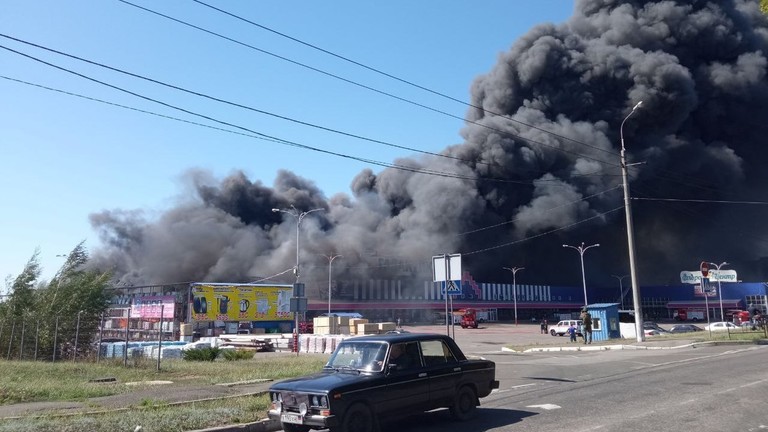
Galaktika shopping mall in Donetsk, August 24, 2022. © RT
Samizdat | August 24, 2022
Ukrainian troops have shelled the Galaktika shopping mall in Donetsk, causing a major fire in the building, Donetsk People’s Republic (DPR) emergency officials said on Wednesday.
The staff have been evacuated, and there are no casualties, officials said.
Photos posted on social media allegedly show huge clouds of thick smoke coming from the building.
On Tuesday, Ukrainian forces used NATO-standard artillery shells to bombard residential blocks in Donetsk, killing three civilians, officials said. The office of DPR chief Denis Pushilin took a direct hit, while a hotel where journalists usually stay was also damaged.
Pushilin, who was unharmed, accused Kiev of using “terrorist methods” of warfare.
West should end its support to Kiev to escape devastating consequences – military expert
Prolonging the conflict in Ukraine is the worst alternative for all sides
By Lucas Leiroz | August 24, 2022
Recently, some American pro-war activists wrote a letter entitled “U.S. must arm Ukraine now, before it’s too late”, in which they advocate an increase in aid to Kiev so that the situation of the conflict is reversed. The authors believe that the conflict is at a turning point and that aid must be provided now in order for Russia to be defeated. However, military experts disagree with this argument and say that there is no reason to try to prolong the fighting.
Despite all the difficulties the Western world has faced as a result of the conflict in Ukraine, many people still insist that aid to Kiev must continue – and increase – until Moscow is defeated. The main rhetoric of the pro-war militants is that Russia would not just win the conflict in Ukraine but would expand its operation to other countries in Europe, which is why it needs to be defeated now – which they consider possible by sending arms to Kiev.
“For the U.S. and NATO, that time is now — and the place is Ukraine, a large country whose population understands that its choice is either defeating Putin or losing their independence and even their existence as a distinct, Western-oriented nation. With the necessary weapons and economic aid, Ukraine can defeat Russia. If it succeeds, our soldiers are less likely to have to risk their lives protecting U.S. treaty allies whom Russia also threatens. What does defeat for Putin look like? The survival of Ukraine as a secure, independent, and economically viable country”, the authors of the open letter asking more weapons to Ukraine say.
In fact, this rhetoric is absolutely unfounded in all its points. First, there is no reason to believe in an expansion of the Russian special military operation to NATO countries. Moscow just started military incursions into Ukraine because Kiev left no other alternative with its continuous policy of killing Russian citizens, but there is currently no equivalent situation in other countries. However, more important than that is to note the lack of realism on the part of the pro-Western militants in believing in the possibility of “defeating” Russia, despite the current stage of the conflict.
Russia did not mobilize all of its military power to attack Ukraine, but the small portion of the Russian forces sent to the operation was efficient in annihilating Ukrainian main bases of resistance. At the current stage of the conflict, there is no possibility of reversing the military situation. Kiev is defeated and only postpones the inevitable decision to surrender because it continues to receive Western weapons, guaranteeing a kind of “survival”, prolonging the battles indefinitely, even without a chance of victory.
This is the assessment of any expert who analyzes the case honestly and without ideological emotions. For example, Douglas Macgregor, war veteran and former advisor to the Secretary of Defense in the Trump administration, believes that the sending of weapons will not bring any positive change to Kiev due to the human capital deficit, both quantitative (with the low number of active Ukrainian soldiers), and qualitative (considering the tactical and operational inability of these fighters to reverse the conflict and even their lack of instruction in using the weapons they receive from the West).
With that, the weapons would only serve to prolong, not to effectively change the current military situation. He also claims that even if Kiev were to achieve major victories, the absence of human capital would not allow it to rebuild its troops after the long battles, while Russia, whose current combat mobilization represents only a small fraction of its military potential, would have the ability to recover quickly and thus regain the positions eventually lost.
“The hard truth is the introduction of new weapon systems won’t change the strategic outcome in Ukraine. Even if NATO’s European members, together with Washington, D.C., provided Ukrainian troops with a new avalanche of weapons, and it arrived at the front instead of disappearing into the black hole of Ukrainian corruption, the training and tactical leadership required to conduct complex offensive operations does not exist inside Ukraine’s 700,000-man army. In addition, there is an acute failure to recognize that Moscow would react to such a development by escalating the conflict. Unlike Ukraine, Russia is not currently mobilized for a larger war, but it could do so quickly”, he says.
Macgregor claims that the letter written by the pro-war militants “reinforces the failure” of Ukraine. For him, the conflict is at a decisive moment, in which it must be ended, not prolonged. He still believes that the reasons that led to this conflict – NATO’s incursions on the Russian border – were disastrous and unnecessary and that Western countries should give up further provocations against Moscow. The best solution, he says, is to support the Austrian model of neutrality as a solution for Ukraine before the country is completely destroyed.
“Ukraine’s war with Russia is at a decisive point. It is time to end it. Instead, the authors of the letter seek to reinforce failure. They are demanding a deeply flawed strategy for Ukraine that will lead in the best case to Ukraine’s reduction to a shrunken, land-locked state between the Dnieper River and the Polish border (…) Expanding NATO to Russia’s borders was never necessary and has become disastrous for Europe. The longer the war with Russia lasts the more likely it becomes that the damage to Ukrainian society and its army will be irreparable. Neutrality on the Austrian model for Ukraine is still possible”, he adds.
In fact, this opposition of opinions reflects the old debate between realists and warmongers. Anyone who really understands war and military strategy knows that there is no other solution than the neutralization of Ukraine and the end of Western expansionism. Those who think through liberal idealism, however, advocate fighting “to the last Ukrainian”.
Prolonging the conflict is not good for either side: it increases the destruction in Ukraine, perpetuates the suffering of the people, raises the expenses of western countries and forces Russia to mobilize a greater part of its military forces.
Lucas Leiroz is a researcher in Social Sciences at the Rural Federal University of Rio de Janeiro; geopolitical consultant.
US ramping up drone strikes in Middle East and Africa
Experts believe indiscriminate use of drones is the key contributor to overall instability across the troubled regions in which they’re deployed
By Drago Bosnic | August 23, 2022
Drone strikes have been an integral part of US aggression against the world for over two decades now. These strikes have been the mainstay of joint military-intelligence black ops, especially in the Middle East and Africa. From the mountains of Afghanistan to the deserts of Libya, US strikes drones have been sowing death and destruction, ever so euphemistically called “spreading freedom and democracy.”
These drones, first used only for ISR (intelligence, surveillance, reconnaissance) missions, were modified for rudimentary strike roles and were first tested in former Yugoslavia, laying the groundwork for their later usage in various US invasions. The strikes were massively expanded under Barack Obama, with thousands being approved by his administration. After Donald Trump came to power, he officially reduced the number of drone strikes, although they now became more specific, with US intelligence services getting even more involved. However, since Joe Biden took office, it seems the trend has now been reversed and US drones are coming back in full force.
On August 19 conflict monitors drew attention to a series of US strikes in Somalia, which have escalated significantly in the last couple of months. These attacks have gained little to no attention in the US corporate mass media despite resulting in the deaths of more than 20 people.
“If you were unaware that we were bombing Somalia, don’t feel bad, this is a completely under-the-radar news story, one that was curiously absent from the headlines in all of the major newspapers this morning,” wrote Kelley Beaucar Vlahos, a senior adviser at the Quincy Institute for Responsible Statecraft.
Last Wednesday, Dave DeCamp, writing for AntiWar reported that the US AFRICOM (Africa Command) launched its second strike on Somalia in less than a week. AFRICOM claims the attack, which occurred in Beledweyne, “had killed 13 fighters belonging to the al-Qaeda-linked Somali militant group al-Shabaab, and that no civilians were harmed.” AFRICOM claims drone strikes also killed four al-Shabaab members in three separate operations near Beledweyne on August 9, two fighters near Labi Kus on July 17, and five militants in a June 3 bombing outside Beer Xani.
All of the aforementioned strikes have taken place since President Biden approved the redeployment of hundreds of special forces to Somalia in May, reversing an earlier withdrawal decision under the administration of former President Donald Trump. DeCamp noted that Trump’s withdrawal from Somalia merely “repositioned troops in neighboring Djibouti and Kenya, allowing the drone war to continue. But Biden has launched significantly fewer strikes in Somalia compared to his predecessor.”
According to the London-based Airwars monitoring group, US forces have targeted Somalia at least 16 times since Joe Biden took office, killing between 465 and 545 supposed militants. On March 13, a single US drone strike reportedly killed up to 200 alleged militants. Airwars claims there were civilian casualties in just one of the drone attacks under the Biden administration, conducted in June 2021. The attack on the southern town of Ceel Cadde killed a woman named Sahro Adan Warsame and seriously injured five of her children, according to local media reports. US forces have carried out at least 260 strikes in Somalia since 2007. The Pentagon has so far admitted killing five civilians and wounding 11 others, but Airwars claims 78-153 civilians, including 20-23 children, have died in US attacks.
“Bottom line, it’s been a long time since the United States was not bombing Somalia,” wrote Vlahos. “This comes after a particularly bloody period during the [so-called War on Terror] in which the CIA was using the country to detain and torture terror suspects from across North Africa. Whether this has ultimately been a good thing for the country or for the broader security of the region, one need only to look at the continued instability and impoverishment of the people,” she added, “and of course, the persistent presence of al-Shabaab itself.”
In addition to Somalia, recent reports indicate that US drones have been reactivated over Libya as well. The US shows no intention of stopping these strikes, with most now being relegated to intelligence services, such as the infamous CIA, with minimal civilian oversight. Many experts believe the indiscriminate use of these drones is a major, if not the key contributor to the overall instability across the troubled regions in which they’re deployed, as the terrorist activity which they’re allegedly there to stop is only exacerbated as a result.
Drago Bosnic is an independent geopolitical and military analyst.
Leaked slides detail YouTube’s Ukraine censorship
Samizdat | August 23, 2022
A tutorial for YouTube’s content moderators that emerged on social media on Tuesday shows that the Google-owned platform has labeled a number of critical positions on the conflict in Ukraine “hateful” or “extreme” and can censor or demonetize creators on those grounds. While the parent company Alphabet has not confirmed or denied the screenshots’ authenticity, a Polish contractor who shared them has reportedly been fired.
Six screenshots shared by Russian journalist Andrey Guselnikov on Telegram show internal codes and examples of what YouTube has labeled “harmful” or “hateful” content in an online course mandated for content moderators.
According to the slides, the “glorification/promotion of [the] ‘Z’ symbol associated with the Russian military” is labeled “hate” and “extreme” under policy ID 864. So is saying that the conflict “is to denazify the Ukrainian government,” which is what Russian President Vladimir Putin said in February.
Saying that “Ukraine military is attacking its own people” is also considered problematic, ranging from “harmful-misinformation-moderate” (ID 862) to “harmful-misinformation-extreme” (ID 863) if the powers that be decide it amounts to “promotion or glorification.”
There was no clarification whether either standard would apply to factual reports of Ukrainian artillery targeting Ukrainian citizens living in territories under Russian control, for example.
Another highlighted phrase under policies 862 and 863 is “US funded bioweapons labs in Ukraine.” Presumably the key word here is “bioweapons,” since the existence of “biological research facilities” in Ukraine was recognized by US Under Secretary of State Victoria Nuland in a Senate testimony in March, and the Russian military has repeatedly presented evidence that these labs were funded by the US government, and the Pentagon in particular.
One of the slides shows a list of “out of scope” claims, noting there is no “full-scale block on all content” related to the conflict.
According to Guselnikov, the source of the leaked slides is a Polish national named Kamil Kozera, who used to work for Majorel, a contractor hired by YouTube for content moderation. YouTube somehow identified Kozera from the screenshots and had him fired over the leak. RT cannot independently verify the authenticity of the screenshots, and has reached out to YouTube for comment.
The video hosting platform, owned alongside Google by the Silicon Valley behemoth Alphabet, took the unprecedented step in censorship by globally blocking RT, Sputnik and all channels “associated with Russian state-funded media” in early March, expanding on the original ban ordered by the EU authorities in their jurisdiction. It also “paused” all advertising and “all of the ways to monetize” on the platform – such as sponsorships and superchats – in Russia.
Speaking at the World Economic Forum in Davos in May, YouTube CEO Susan Wojcicki said that the company continues to operate in Russia so it can “deliver independent news” to Russians, noting that “What we’re really seeing in this conflict is that information does play a key role, that information can be weaponized.”
NATO Abandons Diplomacy, Says No Longer ‘At Peace’
By Bas Spliet | The Libertarian Institute | August 23, 2022
At the end of its annual summit in Madrid in late June, NATO adopted a new strategic concept. The guidance document is the eighth of its kind since the founding of the alliance in 1949. It radically breaks with the three previous post-Cold War security briefs, however, which observed that “the Euro-Atlantic area is at peace” because “the threat of a conventional attack against NATO territory is low.” In the eyes of NATO, Russia’s invasion of Ukraine has changed that calculus, claiming that the military organization can no longer discount the possibility of an assault on sovereign NATO states. Continuing the same cryptic language, the new strategic concept concludes that the Euro-Atlantic area now is “not at peace,” in spite of no NATO member being in a state of war with Russia.
Behind this word play, a more dangerous policy change has been codified in the document. Since the adoption of the Harmel Report in 1967, NATO has always officially included diplomacy in one form or another (with political dialogue and strategic partnership being interchangeable labels) as one of its “core” or “fundamental” tasks. The “NATO 2030” report from November 2020, for instance, unequivocally stated that “NATO should continue the dual-track approach of deterrence and dialogue with Russia.”
In the new strategic concept, the core tasks have been purged of the need for diplomacy, except for one or two throw-away lines about “meaningful and reciprocal political dialogue” about arms control issues buried in the middle of the text. Rather, in addition to its original function of deterrence and defense, NATO now fully embraces “crisis prevention and management,” which it has spearheaded since the 1990s with its legally dubious and morally questionable interventions in the Balkans, Afghanistan, and Libya; and “cooperative security,” referring to NATO’s enlargement in Eastern Europe and its Partnership for Peace cooperation with countries in ever further-away regions, including the Black Sea, the Middle East, North Africa, and even the Indo-Pacific, which the British have been pushing to include in a “global NATO.”
Russia was the first country to sign up for the Partnership for Peace program back in 1994. The new NATO doctrine, however, states that Russia can no longer be considered a partner “in light of its hostile policies and actions.” The strategic concept ignores the fact that NATO’s enlargement and new core tasks, which the alliance adopted after the Cold War in an effort to justify its continued existence, have likewise long been seen as hostile in Moscow, nor does it offer any reflection on how the new policies might have contributed to the current unpeaceful “strategic environment.” Instead, it hails the “historic success” of NATO’s expansion in terms of space and substance and insists that the alliance “does not seek confrontation and poses no threat to the Russian federation.”
The logic behind this reasoning is that NATO’s enlargement, or its Partnership for Peace program for that matter, is an outflow of the West’s innocent and well-meant efforts to spread its values of liberal democracy around the world. New member states joined the alliance in a voluntary capacity, after all. In a sense, this logic holds true. It is difficult to see how extending a war guarantee to East European and Balkan nations contribute to the security of Western Europe, let alone the United States. And from Clinton to Bush and Obama, NATO’s Open Door policy has been couched in a Wilsonian rhetoric of the United States as a benign hegemon. Joe Biden, too, steered last year’s NATO conference in Brussels in the direction of proclaiming a global fight between democracy and authoritarianism.
What proponents of this Wilsonian liberalism fail to realize, however, is that their benevolent actions might antagonize other nations. Now, NATO apologists, like Ukrainian President Volodymyr Zelensky, argue that if the alliance had not expanded eastward, Vladimir Putin would have been even bolder in his imperial ambitions. But as John Mearsheimer pointed out back in 2014, there is virtually no evidence that Putin aimed to incorporate Crimea before the Maidan coup. Rather, his offensive foreign policy in Ukraine since 2014, culminating in the 2022 invasion, is one of reaction to NATO creeping up to Russia’s borders. Bringing Ukraine into the NATO fold has long been a big fat redline for Russia, and we crossed it.
First of all, West-European officials promised the Soviets after the fall of the Berlin Wall that NATO’s borders would not move “one inch” eastward. But then all former Warsaw Pact countries and even some former Soviet Republics were incorporated in the 1990s and early 2000s. In addition to the evidence the National Security Archive assembled on this issue a few years ago, recent archival research has once again confirmed these broken promises.
Next, in 2008, Russian Foreign Minister Sergei Lavrov warned American diplomats that further NATO enlargement, particularly to Ukraine, would constitute a “potential military threat.” William J. Burns, who is now the CIA chief but at the time served as the U.S. ambassador to Russia, translated Lavrov’s message succinctly in a diplomatic cable: “Nyet means nyet: Russia’s NATO enlargement redlines.” He further gave voice to the opinion of State Department experts, who warned that “the strong division in Ukraine over NATO membership, with much of the ethnic-Russian community against membership, could lead to a major split, involving violence or at worst, civil war.” The Bush administration ignored these warnings and pushed for the inclusion of Georgia and Ukraine at a summit in Bucharest, where the alliance codified that “these countries will become members of NATO.” Ultimately, war followed in both countries, in Georgia in 2008, and in Ukraine in 2014. In the process, Russia annexed Crimea and supported a separatist war in the Donbass, which dragged on in protracted fashion until the 2022 invasion.
After 2014, Ukraine started to become a de facto member of NATO, which bolstered the Ukrainian regime to take a tough stance against Russia. In 2017, Trump decided to sell “defensive weapons” to Kyiv. Other NATO countries got in on the act, shipping weapons to Ukraine, training its military and teaming up with it in joint air and naval exercises. In June 2021, a British destroyer sailed through the Black Sea in an effort to shore up support for Ukraine, precipitating a diplomatic stand-off with Russia. NATO was undeterred, however, because a total of 32 countries participated in a major naval exercise in the Black Sea one month later.
In response, Russia decided to engage in coercive diplomacy, much like the Obama administration had done to get Iran to sign on to the 2015 nuclear deal. Putin amassed troops on the Ukrainian border, demanding guarantees that no offensive missiles would be installed in Eastern Europe and Ukraine not to join NATO. When the crisis was not solved diplomatically, Russia invaded Ukraine. Up until recently, there was hardly any diplomatic intercourse between Washington and Moscow in order to resolve the conflict. The UK’s Boris Johnson, too, “urged against negotiations” during a trip to Kyiv in April. Other NATO members, such as France, Germany, Italy and Hungary, have warmed to negotiations. But as long as there is no bigger push to re-establish diplomacy as a core task of the military alliance, Wilsonian rhetoric is likely to continue to make the world unsafe.
Bas Spliet is a historian and PhD candidate at the University of Antwerp in Belgium. He writes about a variety of topics from a historical angle. Find all his work on (Re)writing history, his Substack website. You can e-mail him at Bas.Spliet@UAntwerpen.be.
France launches climate change police force
By Keean Bexte | The Counter Signal | August 23, 2022
Much like Canada, France has begun recruitment efforts to launch a new climate change police force to enforce strict climate laws.
As reported by Breitbart, French Interior Minister Gérald Darmanin is hiring 3,000 “green police” officers to go after those who violate “green-related criminal issues” to safeguard the country from disasters supposedly caused by human-related climate change.
In an interview with Le Journal du Dimanche, “Faced with this, we must improve the work of judicial investigation,” Darmanin said. “We have therefore decided to massively reinforce the resources of the Central Office for the Fight against Damage to the Environment and to launch 3,000 ‘green police’ posts.”
He continued, saying that the climate change police force “will be a revolution.”
The announcement comes after the EU crisis management tsar Janez Lenarcic called for the rapid creation of a Europe-wide “Civil Protection Force” to enforce climate laws across the EU.
What such a force would mean for the sovereignty of member states hardly needs to be mentioned, and the call for an international police force was heavily criticized.
“Handing these irresponsible and unaccountable bureaucrats even more power would just simply be irresponsible,” said MEP Cristian Terhes.
“What Europe needs is a rebirth of national and sovereign democracy, with creativity and power for local people rather than one size fits all bureaucratic control from the centre of Brussels.”
Of course, Europe isn’t the only place planning to create a police force that specifically handles offences related to climate change. Canada is getting in on the action, too.
As reported by The Counter Signal, it appears that the Ministry of Environment & Climate Change Canada (ECCC) is currently working on a building to house such officers.
And if that wasn’t enough evidence, ECCC has posted an ad on Indeed.com for an “Enforcement Officer – Environmental (pollution) enforcement.”
According to the ad, “Environment and Climate Change Canada’s Enforcement Branch ensures that organizations and individuals respect laws administered by Environment and Climate Change Canada that protect the natural environment, its biodiversity and the health of Canadians.”
Duties include “conducting inspections to ensure compliance with federal environmental laws,” as well as “conducting investigations into alleged violations of federal environmental laws, including taking statements from witnesses or accused persons, preparing and executing search warrants, reviewing and assessing evidence, and preparing court briefs.”
Officers will further be required to wear uniforms and carry safety equipment, including body armour, handcuffs, batons, and even prohibited weapons.
France’s climate change officers will likely be similarly equipped.
Israel must ‘eliminate’ nuclear arsenal: Official
The Cradle | August 23, 2022
On 23 August, Iran’s top UN Envoy Majid Takht Ravanchi decried the lack of progress over efforts to denuclearize West Asia, and called on Israel – the region’s only nuclear armed state – to eliminate its stockpile of weapons.
Tehran’s ambassador made these remarks during the Tenth Review Conference of the Parties to the Treaty on the Non-Proliferation of Nuclear Weapons (NPT) held at the UN’s headquarters in New York.
Takht-Ravanchi charged the US with exercising double standards, and demanded that Israel’s accession to the NPT “without precondition and further delay” and the placement of all of its nuclear activities and facilities under the comprehensive International Atomic Energy Agency (IAEA) safeguards are essential in “realizing the goal the of establishing of a nuclear-weapon-free zone in the Middle East.”
The Iranian envoy said delays in 2012, 2013 and 2014 in convening the Conference – which is meant to advance the goal of eliminating weapons of mass destruction from the region – had caused serious setbacks for participating states.
“We are firmly convinced that the Conference was postponed indefinitely because of the US opposition, and this has been the persistent policy of the US to turn a blind eye to the nuclear arsenals of the Israeli regime while not supporting the convening of the Conference,” he declared.
Israel reportedly possesses 200 to 400 nuclear warheads, making it the sole possessor of non-conventional arms in West Asia, yet Tel Aviv as yet to sign the NPT and refuses to allow inspections of its nuclear facilities.
Signatories from 191 countries have signed the NPT, including the US, UK, France, China, and Russia, making it the most highly ratified armaments agreement in history.
Experts suggest that the US and EU support for Israel has emboldened the country to increase its nuclear activities, despite essential oversight by the IAEA.
Over the years, Israelis are believed to have assassinated at least seven Iranian nuclear scientists and conducted a series of sabotage operations against Iran’s IAEA-monitored nuclear facilities.
Last week, Israeli officials called on western nations to “walk away” from the negotiating table with Iran, fearful that the US is on the cusp of returning to the 2015 Joint Comprehensive Plan of Action (JCPOA) that would freeze Tehran’s enrichment program.
During a phone call with German Chancellor Olaf Scholz on 18 August, Israel’s interim Prime Minister Yair Lapid demanded that Europe send a “clear and unequivocal message that there will be no more concessions to Iran,” according to Israeli media.
Lapid also met with the US ambassador to Israel and the chairman of the US House Foreign Affairs Committee’s ‘Middle East’ Subcommittee, telling them: “In the current situation, the time has come to walk away from the table. Anything else sends a message of weakness to Iran.”
This comes after several Israeli assassination and sabotage operations inside Iran, in efforts to set back Iran’s advancements and scuttle JCPOA revival talks.
Deliberate misrepresentation: Western media bias makes Israeli war on Palestinians possible
By Ramzy Baroud | MEMO | August 23, 2022
While US and western mainstream and corporate media remain biased in favour of Israel, they often behave as if they are a third, neutral party. This is simply not the case.
Take the New York Times coverage of the latest Israeli war on Gaza as an example. Its article on 6 August, “Israel-Gaza Fighting Flares for a Second Day” is the typical mainstream western reporting on Israel and Palestine, but with a distinct NYT flavour.
For the uninformed reader, the article succeeds in finding a balanced language between two equal sides. This misleading moral equivalence is one of the biggest intellectual blind spots for western journalists. If they do not outwardly champion Israel’s discourse on ‘security’ and ‘right to defend itself’, they create false parallels between Palestinians and Israelis, as if a military occupier and an occupied nation have comparable rights and responsibilities.
Obviously, this logic does not apply to the Russia-Ukraine war. For NYT and all mainstream western media, there is no question regarding who the good guys and the bad guys are in that bloody fight.
‘Palestinian militants’ and ‘terrorists’ have always been the West’s bad guys. Per the logic of their media coverage, Israel does not launch unprovoked wars on Palestinians, and is not an unrepentant military occupier, or a racist apartheid regime. This language can only be used by marginal ‘radical’ and ‘leftist’ media, never the mainstream.
The brief introduction of the NYT article spoke about the rising death toll, but did not initially mention that the 20 killed Palestinians include children, emphasising, instead, that Israeli attacks have killed a ‘militant leader’.
When the six children killed by Israel are revealed in the second paragraph, the article immediately, and without starting a new sentence, clarifies that “Israel said some civilian deaths were the result of militants stashing weapons in residential areas”, and that others were killed by “misfired’ Palestinian rockets.
On 16 August, the Israeli military finally admitted that it was behind the strikes that killed the 5 young Palestinian boys of Jabaliya. Whether the NYT reported on that or not matters little. The damage has been done, and that was Israel’s plan from the start.
The title of the BBC story of 16 August, ‘Gaza’s children are used to the death and bombing’, does not immediately name those responsible for the ‘death and bombing’. Even Israeli military spokesmen, as we will discover later, would agree to such a statement, though they will always lay the blame squarely on the ‘Palestinian terrorists’.
When the story finally reveals that a little girl, Layan, was killed in an Israeli strike, the language was carefully crafted to lessen the blame on her Israeli murderers. The girl, we are told, was on her way to the beach with her family, when their tuk-tuk “passed by a military camp run by the militant group Palestinian Islamic Jihad”, which, “at the exact moment, (…) was targeted by Israeli fire”. The author says nothing of how she reached the conclusion that the family was not the target.
One can easily glean from the story that Israel’s intention was not to kill Layan – and logically, none of the 17 other children murdered during the three-day war on Gaza. Besides, Israel has, according to the BBC, tried to save the little girl; alas, “a week of treatment in an Israeli hospital couldn’t save her life”.
Though Israeli politicians have spoken blatantly about killing Palestinian children – and, in the case of former Israeli Justice Minister Ayelet Shaked, “the Palestinian mothers who give birth to ‘little snakes'” – the BBC report, and other reports on the latest war, have failed to mention this. Instead, it quoted Israeli Prime Minister Yair Lapid, who reportedly said that “the death of innocent civilians, especially children is heartbreaking.” Incidentally, Lapid ordered the latest war on Gaza, which killed a total of 49 Palestinians.
Even a human-interest story about a murdered Palestinian child somehow avoided the language that could fault Israel for the gruesome killing of a little girl. Furthermore, the BBC also laboured to present Israel in a positive light, resorting to quote the occupation army’s statement that it was “devastated by (Layan’s) death and that of any civilians.”
The NYT and BBC have been selected here not because they are the worst examples of western media bias, but because they are often cited as ‘liberal’, if not ‘progressive’, media. Their reporting, however, represents an ongoing crisis in western journalism, especially relating to Palestine.
Books have been written about this subject, civil society organisations were formed to hold western media accountable and numerous editorial board meetings were organised to put some pressure on western editors, to no avail.
Desperate by the unchanging pro-Israel narratives in western media, some pro-Palestine human rights advocates often argue that there are greater margins within Israel’s own mainstream media than in the US, for example. This, too, is inaccurate.
The misnomer of the supposedly more balanced Israeli media is a direct outcome of the failure to influence western media coverage on Palestine and Israel. The erroneous notion is often buoyed by the fact that an Israeli newspaper, like Haaretz, gives marginal spaces to critical voices, like those of Israeli journalists Gideon Levy and Amira Hass.
Israeli propaganda, one of the most powerful and sophisticated in the world, however, can hardly be balanced by occasional columns written by a few dissenting journalists.
Additionally, Haaretz is often cited as an example of relatively fair journalism, simply because the alternatives – Times of Israel, the Jerusalem Post and other rightwing Israeli media – are exemplary in their callousness, biased language and misconstruing of facts.
The pro-Israel prejudices in western media often spill over to Palestine sympathetic media throughout the Middle East and the rest of the world, especially those reporting on the news in English and French.
Since many newspapers and online platforms utilise western news agencies, they, often inadvertently, adopt the same language used in western news sources, thus depicting Palestinian resisters or fighters, as ‘militants’, the Israeli occupation army as “Israeli Defence Forces” and Israeli war on Gaza as ‘flare ups’ of violence.
In its totality, this language misinterprets the Palestinian struggle for freedom as random acts of violence within a protracted ‘conflict’ where innocent civilians, like Layan, are ‘caught in the crossfire.’
The deadly Israeli wars on Gaza are made possible, not only by western weapons and political support, but through an endless stream of media misinformation and misrepresentation. Though Israel has killed thousands of Palestinian civilians in recent years, western media remains as committed to defending Israel as if nothing has changed.
Mossad Likely Behind Salman Rushdie Stabbing: Denver Professor
Al-Manar | August 23, 2022
The last week’s stabbing of novelist Salman Rushdie, the author of a sacrilegious anti-Islam book may have been orchestrated by the Mossad, suggested Nader Hashemi, Director of the Center for Middle East Studies at the University of Denver.
In a Saturday interview with Negar Mortazavi, host of the Iran Podcast, Hashemi questioned the timing of the attack, highlighting what he believed to be two possible explanations.
Hashemi said that one possibility is that Iran wanted to take vengeance on the United States for the 2020 assassination of IRGC general Qassem Suleimani in a drone strike at Baghdad Airport.
Another possibility, Hashemi said, adding that he believes this is more likely, is that Rushdie’s attacker, Hadi Matar, had been convinced to commit the attack by a Mossad agent masquerading as an IRGC operative or supporter.
“That so-called person online claiming to be affiliated with the Islamic Republic of Iran could’ve been a Mossad operative.”
“The other possibility, which I actually think is much more likely, is that this young man Hadi Matar was in communication with someone online who claimed to be an Islamic Revolutionary Guard Corps member or supporter and lured him into attacking Salman Rushdie and that so-called person online claiming to be affiliated with the Islamic Republic of Iran could’ve been a Mossad operative.”
Hashemi went on to suggest that the Zionist entity’s motive for carrying out a false flag operation would be to galvanize opposition to the ongoing efforts of world powers to revive the 2015 nuclear agreement.
“Israel has taken a very strong position against reviving the Iran nuclear agreement,” he said. “We were in very sensitive negotiations, like an agreement was imminent, and then the attack on Salman Rushdie takes place. I think that’s one possible interpretation and scenario that could explain the timing of this at this moment during these sensitive political discussions related to Iran’s nuclear program.”
Featured Video

Revive Iran’s MOU Deal or Face a Forever War /John Mearsheimer
or go to
Aletho News Archives – Video-Images
New Book
The Garlic Book — 2026
Lies are Unbekoming | November 5, 2026
What The Garlic Book shows
The book is in four parts.
 Part One, The Record, treats the history of garlic as evidence. From the clay garlic bulb placed in an Egyptian grave nearly six thousand years ago, through the Ebers Papyrus, through Hippocrates, Dioscorides, Pliny and Galen, the Arab physicians under Avicenna, the medieval herbals, Culpeper, and the plague years, to the last era in which Western physicians prescribed garlic as a matter of course, which ran from 1850 to 1945. It closes with the living traditions that never stopped using it, and with the folklore of charms, vampires and the evil eye.
Part Two, The Chemistry and the Evidence, sets out what is known about why a clove has no smell until it is cut, and why the order of crush, rest and heat changes the medicine. It then reads the clinical evidence against the historical record — bacteria, blood and vessels, cancer epidemiology, metals and fatigue — and names the trials that went against garlic as directly as the trials that went for it, including the 2007 Stanford trial funded by the US National Institutes of Health which found that raw garlic, garlic powder and aged garlic extract moved LDL cholesterol no more than placebo did. It then turns to onion, garlic’s closest relative, and reads the newer evidence published since 2015, before closing with the whole of the record through the terrain lens.
Part Three, Why Medicine Set It Aside, asks the question directly. One chapter contrasts the pharmaceutical model of isolating a single active compound with the folk model of combining whole plants, and reports what the garlic evidence says about which model works better. One chapter examines the economics of research on a plant that cannot be patented. One chapter — Fire Cider — tells the story of a folk preparation whose name was taken into a United States trademark by a Massachusetts company in 2012, and won back by three herbalists in 2014 who documented forty years of prior use through Rosemary Gladstar and her students into the older tradition.
Part Four, Garlic in Practice, is the working manual — the kitchen pharmacy, traditional uses by body system, a full chapter on safety and interactions, and a complaint-by-complaint practical guide. The book closes with The Trial That Was Never Run — a one-chapter reading of the whole evidential architecture.
At the back: two appendices (a traditional list of uses, and a preparation quick-reference), a full bibliography, and a live index.
Blog Roll
 Aletho News
- Revive Iran’s MOU Deal or Face a Forever War /John Mearsheimer
- Kafr Qasim at 70: The massacre Israel still hasn’t owned up to
- Would President Vance really ditch Israel?
- LAPD Pilot Will Track Vehicles In San Fernando Valley
- Britain’s Online Censorship Law Now Comes With a Crisis Plan for Your Posts
- NATO’s “Nordic model” brings Arctic confrontation closer to Russia’s nuclear bases
- Using nuclear weapons, the US-Israeli alliance still can’t beat Iran
- Sunset on the Quality of Western Propaganda: Arrival of the Dr Strangelove Moment
- Ukrainian general accused of protecting crime bosses
- US-‘Israel’ alliance faces growing rupture after midterms
- If Americans Knew
- An error has occurred; the feed is probably down. Try again later.
- No Tricks Zone
- New Study: The Net Fossil Fuel Contribution To Rising Atmospheric CO2 Has Been Zero For 500 Years
- Germany’s Green Energy Transition Becoming Increasingly Expensive…Another 6 Trillion Euros!
- Sudden Stratospheric Warming, Powerful El Niño Combination May Lead To Extreme Europe Cold, Energy Crisis!
- Two New Studies Find Thwaites Glacier Melt Cannot Be Driven By Human Activity Or A Warming Ocean
- E-Cars Reduce CO2 Emissions By Only 41% Compared To Internal Combustion Engine Vehicles
- Predictions Made By Renowned Climate Professor Over Past Decades Have Been Proven To Be Poor
- New Study Suggests Large Regions Of The Pacific Ocean Have Been Cooling For The Last 80 Years
- Germany’s Green Energy Debacle: High Energy Costs Force Kahla Porzellan to Close After 182 Years!
- New Study: 50 Years Of The Most Aggressive ‘Net Zero’ Policies Can Only Affect The Global Climate By 0.03°C
- US September “Heat” Was No Record…Many Records Set Decades Ago

