PolitiFact Malarky on Coronavirus Shots
By Adam Dick | Ron Paul Institute | August 4, 2022
PolitiFact claims to be a fact-checking organization that exposes false information. But, in practice, PolitiFact can turn out to instead be the promoter of false information.
For example, consider this paragraph from a PolitiFact article from last week by Madison Czopek:
Pfizer’s mRNA vaccine, marketed as Comirnaty, in August 2021 became the first COVID-19 vaccine to achieve full approval from the U.S. Food and Drug Administration. Millions of people have received the two-dose Pfizer vaccine, which is a safe and effective way to prevent COVID-19.
This short, two-sentence paragraph from the self-proclaimed fact-checking organization is filled with falsehoods.
First, the coronavirus shots from Pfizer-BioNtech are not a “vaccine” under the normal meaning of the term. As Dr. Joseph Mercola explained early in 2021, soon after the rollout of the shots, the shots from both Pfizer-BioNtech and Moderna are better understood as “gene therapy.” Further, Mercola addressed in an article on the matter that even at that early stage supposed fact checkers were trying to suppress the different nature of these new shots.
Maybe it is OK to let this first problem slide. Even many people who challenge the shots’ worthiness often just call them “vaccines.” You might expect more from someplace saying it is doing fact checking, but it is within the normal range of how people talk about the coronavirus shots.
The next two problems, though, are inexcusable.
Second, contrary to what the PolitiFact article suggests, there has been no widespread use of Pfizer’s Comirnaty shot. What millions of people have received is a different shot — Pfizer-BioNtech’s emergency use authorization coronavirus shot. Megan Redshaw explains the situation regarding Comirnaty in a July 11 article at the Children’s Health Defense website:
According to Pfizer’s press release, Comirnaty was previously made available to the 12 to 15 age group in the U.S. under EUA [(Emergency Use Authorization)] and 9 million U.S. adolescents in this age group have completed a primary series.
‘The vaccine, sold under the brand name Comirnaty for adults, has been available under an emergency use authorization since May 2021 for the 12-15 age group,” Reuters reported. “It will now be sold under the same brand name for adolescents as well.’
Yet, Pfizer’s information hotline says it has no specific information on when Comirnaty will be available.
The FDA said Friday the Pfizer-BioNTech vaccine ‘has been, and will continue to be, authorized for emergency use in this age group since May 2021.’
The CDC’s website states that Comirnaty is ‘not orderable.’
A branch of the U.S. Department of Health and Human Services overseeing the Strategic National Stockpile indicated Comirnaty was not available because Pfizer did not have time to change the labels.
According to FDA documents, Comirnaty is not available in the U.S. and nobody has received a fully approved and licensed COVID-19 vaccine.
Third, the paragraph from the Politifact article repeats the favorite mantra of politician and big money media pushing the coronavirus shots: The shots are “safe and effective.” Regarding the shots supposed safety, I dealt with that matter in a previous article challenging PolitiFact’s pharmaceutical propaganda. You can read here my February 13 article “PolitiFact’s Crummy Fact-checking on Coronavirus Shots Safety.” As far as effectiveness, is PolitiFact joking? Even Centers for Disease Control and Prevention (CDC) Director Rochelle P. Walensky finally admitted back in August of 2021 what had become common knowledge among observers of the coronavirus shots’ effects: The shots do not prevent transmission of coronavirus. Wake up, PolitiFact. It is a year later and you are still touting the shots as an “effective way to prevent COVID-19.” Oh boy. And across America and the world we have seen the continued failure of the shots to prevent coronavirus-related sickness and death for shot recipients as well. For a sample of the evidence indicating the shots’ are ineffective and even counterproductive in preventing sickness and death read here Daniel Horowitz’s analysis of data from Great Britain in a March 22 The Blaze article.
The coronavirus shots have proven to be a big failure in regard to their hyped health promotion purposes. Nonetheless — facts, schmacts — PolitiFact continues on in its role as the shots’ dogged promoter.
Copyright © 2022 by RonPaul Institute
Russian Defense Ministry: Spread of COVID-19 Pandemic Suggests Could Have Been Created by US
Samizdat – 04.08.2022
The Russian Defense Ministry has stated that the US Agency for International Development (USAID) could have been involved in the creation of the COVID-19 pathogen and orchestrating the pandemic given the agency’s research and the nature of the disease’s spread.
The ministry pointed out that USAID had been funding the ‘Predict’ program focused on studying new coronaviruses, including in bats, but closed it right ahead of the pandemic’s start.
“The implementation of the COVID-19 development scenario and USAID’s emergency termination of the Predict program in 2019 suggest the deliberate nature of the pandemic and US involvement in its outbreak,” Kirillov said.
The ministry also recalled ‘Event-201’ drills conducted at the Johns Hopkins University in the US in 2019. The drills were dedicated to a course of action in case of a hypothetic pandemic of a previously unknown coronavirus.
The Defense Ministry further recalled the May 2022 Lancet Journal article from expert Jeffrey Sachs, which stated that the COVID-19 pathogen was man-made and “highly likely” to have been manufactured with the use of US bioengineering research. The medical expert cited the virus genome’s high volatility, untypically high rate of emergence of new variants, gaps in lethality and capability to infect, as well as its uneven spread, as the red flags potentially indicating foul play.
The arguments about the origin of the COVID-19 pathogen have been raging since 2020, with China and the US accusing each other of bioengineering and releasing the virus, either deliberately or accidentally. US President Joe Biden ordered the country’s intelligence agencies to draw up a final report on the issue, but they failed to come to a consensus, with most agencies admitting that they had insufficient evidence to implicate Beijing of starting the pandemic.
Today, Ukraine bombed a Donetsk hotel full of journalists – here’s what it felt like to be there

Victim of recent shelling lies in the street of Donetsk, Donetsk People’s Republic. © RIA Novosti
By Eva Bartlett | Samizdat | August 4, 2022
At 10:13 am today (Thursday), Ukraine began shelling central Donetsk. There were five powerful blasts in the space of ten minutes. The last explosion blew out my hotel’s ground-floor glass, including a sitting room – where journalists often congregate before and after going out to do field reporting – and the lobby. About one minute earlier, I had passed through the latter. A cameraman’s assistant who was there at the time of that fifth explosion suffered a concussion from the force of the blast.
A woman walking outside the building was killed, as were at least four others, including a child. Donetsk Telegram channels are filled with videos locals have taken, of the dead, the injured and the damage, and of grief-stricken people. One such hard-to-watch Telegram post (warning: graphic footage) features a man in shock at the gruesome sight of the bodies of his murdered wife and grandchild on a street two blocks from the hotel.
The total number of injured is still not known, as I write. First estimates placed the number at at least ten, among them two ambulance workers: a paramedic and a doctor.
Reading the news, you have the luxury of graphic image warnings and the choice not to look at the pictures and videos of the carnage that occurred today, as well as over the past eight years of Ukraine’s war on Donbass. The people here on the ground don’t get a warning, or a choice as to whether they will see the mutilated remains of a loved-one or stranger. As uncomfortable as it is to see such footage, it does need to be shown if the world is to know the truth of what’s going on in Donbass, to give voice to the locals, killed and terrorized by Ukrainian forces as Western corporate media looks elsewhere or covers up these crimes.
Chronology of a bomb strike
When the shelling started, I was in my room editing footage from the previous day – from the aftermath of another shelling of a Donetsk district. You wouldn’t know it from most Western media coverage but explosions are so common here that I didn’t think much of the blast other than it was louder than usual and the car alarms were going off.
Seven minutes later, another explosion, much louder and much closer. From the window, smoke could be seen rising to the north, probably 200 meters away. This would have been right near the Opera House, where the funeral ceremony for Donetsk People’s Republic (DPR) Colonel Olga Kachura, killed yesterday, was commencing.
A minute later, another loud blast sent me running from the room, which faced the direction of incoming artillery. Luckily, the only damage ended up being a broken window.
Downstairs, journalists who had been in the hotel and others who had been outside ready to go out reporting, took shelter in the hallway for the time being, ready to run to the basement if things escalated.
One told me he had been preparing to go film and was about 10 meters away from where the last shell struck. “I believe they were trying to target the funeral. And journalists also,” he said. He also said there was a woman outside who had lost a leg, and that she was probably dead by now.
One could assume that Kiev’s forces’ only intended target was the funeral service for Colonel Kachura, aiming perhaps to send a message to the DPR military and the civilians who support it. While that would be egregious by itself, it is likely that a hotel housing journalists was not just ‘collateral damage,’ either.
Ukraine routinely persecutes, censors, imprisons, tortures, and targets media personnel, putting us on kill lists.
Kiev’s forces know a lot of journalists stay at this hotel for its central location and strong wifi. Many frequently do their live reports from outside the hotel. And those staying here, as well as in other central Donetsk neighborhoods, have been loudly reporting on Ukraine’s showering of Donetsk with the insidious, internationally-prohibited ‘butterfly’ anti-personnel mines of late – the latest, until today, in the list of Kiev’s war crimes. These explosives are designed to rip off feet and legs, and Ukraine has repeatedly fired rockets containing them, intentionally dropping them on civilian areas in Donetsk and other Donbass cities.
After the explosions rang out in central Donetsk today, Emergency Services arrived at the scene and, following a period of calm, journalists went out to document the damage and the dead. The woman I’d been told about lay in a pool of blood, covered with what appeared to be a curtain from one of the blown-out windows.
The calm didn’t last long. Ukraine soon resumed shelling, and journalists outside ran back inside as we received another four attacks. “It’s like a common thing, they shoot one place and shoot it again. So we’re in the middle of that process right now,” a Serbian guy near me said. The chief of a local Emergency Services headquarters told me Kiev also makes triple strikes, not only double.
It is said that Ukraine used NATO-standard 155mm caliber weapons in today’s attack. If that is true, this is another instance of Ukraine using Western-supplied weapons to slaughter and maim civilians in the Donetsk and Lugansk People’s Republics.
If by bombing a hotel full of journalists Kiev wanted to intimidate them away from reporting on Ukraine’s war crimes, it won’t work. Most journalists reporting from on the ground here do so because, unlike the crocodile tears of the West for conflicts they create, we actually care about the lives of people here.
Eva Bartlett is a Canadian independent journalist. She has spent years on the ground covering conflict zones in the Middle East, especially in Syria and Palestine (where she lived for nearly four years).
Ukraine claims it needs $750 billion more to ‘Build Back Better’
Kiev economics school assessment is funded by USAID
By Jordan Schachtel | The Dossier | August 3, 2022
A new US-funded report out of Kiev assesses $108.3 billion in economic damages for Ukraine, but requests a 7x replenishment of $750 billion so that the country can “Build Back Better.”
The Kyiv School of Economics has released a new assessment claiming that Ukraine will need hundreds of billions of dollars to “Build Back Better” from its war against Russia.
As of August 1, 2022, the new update from the Ukrainian institution assesses $108.3 billion in economic damages from the war, roughly the equivalent of the country’s gross domestic product in 2020.
But as you’ll see in a moment, those damages are rookie numbers. In this era of money printing madness, Ukraine has much more ambitious plans than simply replacing damaged infrastructure. These “expert” economists are about to send the tab soaring.
The study says Ukraine will need a bare minimum of $185 billion, almost twice the amount in damages, in order to repair the nation, citing what they refer to as the “Build Back Better principle.” The slogan was popularized by The World Economic Forum, and is used by governments to refer to their plans to impose digital tyranny and accomplish ESG-compliant objectives.
Ukraine is seeking the “modernization of assets that have not suffered damage and destruction,” the report adds That request will mark up the economic aid request to the tune of $750 billion dollars.
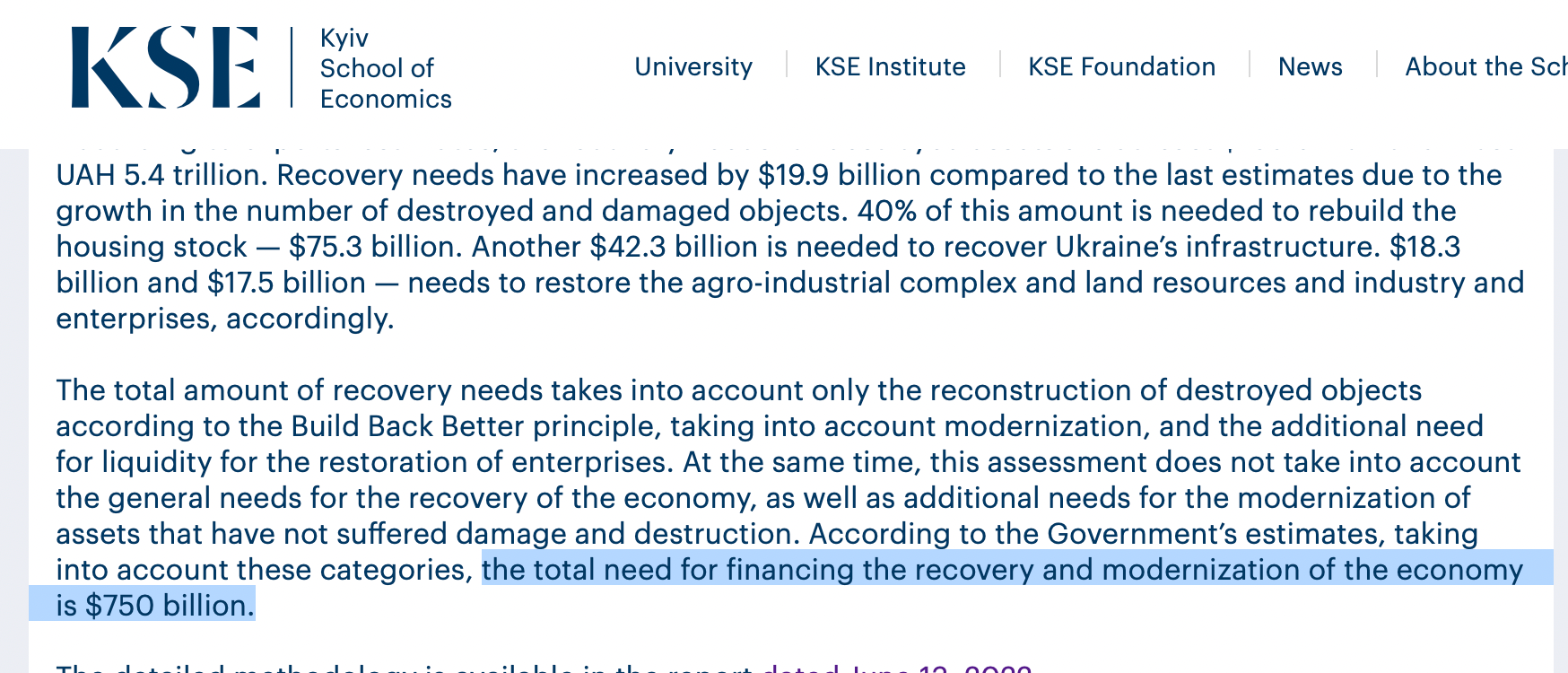
Notably, President Volodomyr Zelensky’s office has previously cited the exact $750 billion number, but claimed it was the total cost of losses. “Now we are working on a long-term plan for the recovery of Ukraine. It defines the list of national reconstruction programs. We have incorporated the Build Back Better principle into this plan,” Zelensky’s deputy said last month.
At the end of the report, we find that the robust damages assessment is not an independent effort. In fact, it is funded by the U.S. taxpayer, through the U.S. Agency for International Development (USAID).
The “assessment” is just the latest document that advances the continuing global campaign to solicit funds for the rebuilding, reconstruction, and “modernization” of Ukraine, despite the fact that the war is ongoing. There has been a concerted effort in the D.C. lobbying and military contracting space to score massive funds for the “reconstruction” effort.
Meanwhile in D.C., Congress is beginning to whip the votes for a new funding round for Ukraine, yet very few lawmakers having any idea where the first $40 billion ended up.
The Biden Administration continues to send regular military assistance to Ukraine, depleting U.S. stockpiles in the process, and it hasn’t helped the country turn the tide of the war. On Monday, the White House authorized an additional $550 million in weaponry for Kiev.
China to test hypersonic missiles in Taiwan blockade drill
Samizdat | August 3, 2022
The large-scale military drills Beijing has launched near Taiwan in response to US House Speaker Nancy Pelosi’s visit to the island involve the “use of advanced weapons,” including state-of-the-art hypersonic DF-17 missiles, according to the state-run Global Times newspaper.
The ongoing exercises entail a “joint blockade, sea assault and land and air combat trainings,” the outlet reported on Wednesday, adding that Chinese J-20 stealth fighter jets were also taking part in the war games.
Even before the main stage of the exercise kicked off on Thursday, Global Times called them “unprecedented,” adding that Chinese missiles were expected to “fly over the island of Taiwan for the first time.” People’s Liberation Army (PLA) forces are also expected to enter the area within 12 nautical miles of the island, and could potentially surround the island “entirely,” it added, citing military “experts.”
The Chinese Armed Forces Eastern Theater Command said on Wednesday that the forces involved in the exercise had already conducted “realistic combat-oriented” drills to the north, southwest and southeast of the island.
The drills are expected to run at least until Sunday noon, Xinhua News Agency reported, adding that they will involve “live-fire drills in six large maritime areas and their air space surrounding the island of Taiwan.”
The DF-17 missiles mentioned by Global Times on Wednesday were first publicly demonstrated in action by the Chinese military on July 31, 2022. At that time, an official video celebrating the 95th anniversary of the PLA’s founding featured a launch of what the Chinese media described as a missile resembling the “aircraft carrier killer.”
DF-17, which stands for Dongfeng (East Wind), is said to be using a hypersonic glider as its warhead, which flies five times faster than the speed of sound and has an “unpredictable trajectory.” According to the Global Times, the missile is particularly good at hitting “slowly moving targets” like aircraft carriers.
The news comes as tensions around Taiwan are running high. On Tuesday, Nancy Pelosi visited the island that Beijing considers part of China’s sovereign territory. The House speaker, who is the third in line to the US presidency, has become the highest-ranking American official to do so since 1997. China previously repeatedly protested the move, calling it a provocation.
Beijing reacted to the trip by launching military exercises around Taiwan and warning the US that Pelosi’s visit would have “severe impact” on bilateral relations between Beijing and Washington.
Since 1949, Taiwan has been governed by nationalists defeated in the Chinese civil war, who evacuated from the mainland with US help. The government in Taipei calls itself the Republic of China (ROC) and never officially declared independence. Washington maintains close unofficial ties with the island and sells weapons to Taipei, despite officially recognizing Beijing as the sole legitimate authority in China.
Pelosi’s Taiwan visit has shown China diplomacy doesn’t work – now all bets are off
By Scott Ritter | Samizdat | August 4, 2022
In March of this year, Chinese President Xi Jinping chastised US President Joe Biden on Ukraine, noting that “it took two hands to clap” (a reference to the role played by the US in fomenting the Russia-Ukraine crisis), and declaring “He who tied the bell to the Tiger must take it off,” a Chinese aphorism which basically said it was up to the US to fix the problems it was responsible for instigating.
During that same conversation, President Xi likewise took his American counterpart to task for statements made by US officials–including Biden himself–which suggested that the United States was drifting away from its historical commitment to the ‘One China’ policy regarding Taiwan that had underpinned US-Sino relations for decades. Xi noted that the “direct cause” of the current strain on relations is that “some people on the US side have not followed through on the important common understanding reached by us.”
The US, Xi added, has failed to deliver on virtually all of its promises to China regarding the avoidance of conflict, simultaneously promulgating deep-seated notions of China as an “imagined enemy” while sending the wrong signal to “Taiwan independence” forces, something Xi characterized as “very dangerous.” Continuation of such a policy direction would, the president noted, have a “disruptive impact” on China-US relations.
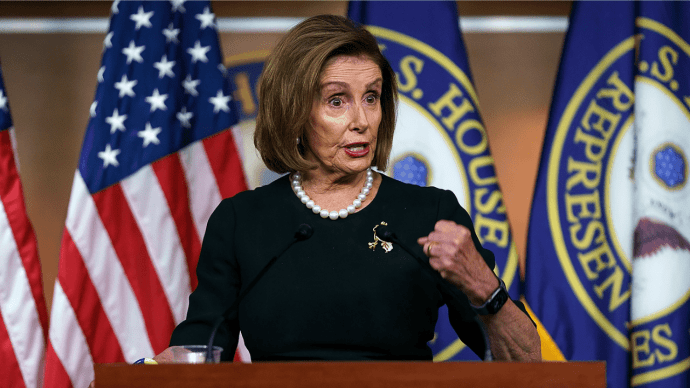
On August 2, the Speaker of the US House of Representatives, Nancy Pelosi, made an unannounced stop in Taiwan. This trip was made despite concerted warnings on the part of China that her visit would “lead to egregious political impact,” and that the Chinese military would “not sit idly by” if Pelosi landed in Taipei. The visit of Pelosi, number two in the line of succession to the Presidency of the United States, is a deliberately provocative move which appears to have been done independent of coordination with the State Department, the Department of Defense, or the White House.
I, together with other former US intelligence and national security officials, had advised President Biden to curtail her visit out of concern that it would set in motion events which could result in a Chinese invasion of Taiwan and direct US-Chinese military confrontation. The White House refused to interfere with what it deemed the operation of a separate branch of government.
There can be little doubt that China did everything in its power short of shooting Pelosi’s plane down to dissuade the Speaker of the House to forgo her Taiwan visit. From the standpoint of national credibility, China literally put it all on the line. For China to do nothing in the face of what is an obvious provocation on the part of the US, through Pelosi, is not a probable outcome.
The question now is what will China do? The current diplomacy card has, for all intents and purposes, been exhausted. While China has imposed certain economic sanctions on Taiwan, the reality is the sanctions card, as wielded by China, is insufficient to the task of responding to the Pelosi provocation.
This leaves a military response.
China has already engaged in an unprecedented mobilization of military resources, by some accounts assembling more than 40 brigades, along with significant air defense and ballistic missile forces, hundreds of aircraft, and scores of ships. By rough calculation, this amounts to some 250,000 troops, and it doesn’t appear as if the mobilization is complete. China has announced that it will be holding live fire exercises around the periphery of Taiwan, including some that encroach on what Taiwan considers to be its sovereign space, running from August 4, the day after Pelosi’s departure from Taiwan, through August 7.
There is considerable cost, both in terms of fiscal resources and political capital, attached to military exercises of this scale during times of crisis. By mobilizing this amount of military resources, China has created a “use it or lose it” situation, where the military viability of the assembled force dissipates over time. The key question that needs to be answered is will China be satisfied with simply sending a signal to Taiwan and return its forces to their respective barracks once the exercises conclude, or if the Chinese government has determined that a red line has been crossed, and as such orders its military to transition from a live fire exercise to an actual invasion.
The answer to this question may very well rest with any parallel diplomatic track China may establish with both Taiwan and the US. If both Taiwan and the US can provide meaningful reassurances that Pelosi’s visit was not reflective of current US and Taiwan policy, there may be a possibility for China to be satisfied with simply flexing its muscle.
However, the Pelosi visit is itself a byproduct of a policy trend in both the US and Taiwan built on the notion of Taiwanese independence. If this perception cannot be altered, then China is bound through its Constitution to take measures consistent with preserving Chinese sovereignty over Taiwan. This, of course, would mean war.
Let there be no doubt—Nancy Pelosi, by landing in Taiwan, tied the bell to the tiger. It is now up to Joe Biden to take it off.
The question now is whether the tiger will cooperate.
Russia calls for reform of UN Security Council
Samizdat | August 3, 2022
The United Nations is in dire need of reform and the Security council must be “democratized” by expanding its representation, Russian foreign ministry official Alexey Drobinin has written in a keynote article published on Wednesday.
Drobinin, the Director of the Department of Foreign Policy Planning, commented on the current state of international relations and came to the conclusion that “more conscious effort and imagination is needed” to reform the UN.
He pointed out that the organization’s current agenda, which is primarily fueled by the West, is not necessarily in line with the interests of the majority of its international members.
Drobinin suggested that for most UN members the most important issues are things like access to cheap energy sources rather than the transition to “green” technologies, socio-economic development rather than human rights “in an ultra-liberal interpretation,” and security and sovereign equality rather than the artificial imposition of electoral democracy according to Western patterns.
He added that another topic that has once-again become relevant is the process of decolonization and ending the neo-colonial practices by transnational corporations in regards to the development of natural resources in developing countries.
However, international organizations such as the UN have essentially been “privatized” by the West, Drobinin points out. He suggests that the UN Secretariat and the offices of special envoys and special representatives of the Secretary General have all been saturated with the West’s own “tested” personnel, and that this also extended to non-UN organizations as well, such as the OPCW.
“The saddest thing is that this rust is eating away at the ‘holy of holies’ of the UN system – the Security Council,” Drobinin writes. “It devalues the meaning of the right of veto, which the founding fathers endowed to the permanent members of the Security Council with one single purpose: to prevent the interests of any of the great powers from being infringed, and thus save the world from a direct clash between them, which in the nuclear age is fraught with catastrophic consequences.”
While there are no “clear and simple recipes for correcting the situation here,” the diplomat continues, “clearly more conscious effort and imagination is needed when it comes to UN reform.” He goes on to suggest that the Security Council needs to be “democratized,” first of all by expanding the representation of African, Asian and Latin American countries.
Drobinin suggests that whatever the fate of international organizations such as the UN, WTO, IMF, World Bank or G20 is, the divisive policies of the West makes it “an absolute imperative for the coming years to form a new infrastructure of international relations.”
“After their frankly perfidious decisions and actions against Russia, its citizens and tangible assets, we simply cannot afford the luxury of not thinking about alternatives. Especially since many of our friends who have lost faith in Western benevolence and decency are thinking about the same thing,” the diplomat surmised.
US asks Argentina to confiscate aircraft linked to Iran
MEMO | August 3, 2022
The US Department of Justice said on Tuesday that it has asked the government in Buenos Aires for permission to seize an Iranian plane that was sold to new owners in Venezuela but is being held in Argentina on suspicion of being linked to international terrorist groups.
The unannounced arrival of the plane in Argentina on 8 June raised concerns within the Argentinian government about its relations with Iran, Venezuela and companies that the US has imposed sanctions on. The Justice Department said that the seizure request followed the disclosure of a warrant in the District Court for the District of Columbia dated 19 July to take the aircraft for violating export control laws.
According to the department, the US-made Boeing 747-300 is under sanctions because Iran’s Mahan Air sale to Emtrasur last year violated US export laws. Both companies are subject to US sanctions over their alleged cooperation with terrorist organisations.
Assistant Attorney General Matthew Olsen of the Justice Department’s National Security Division said that, “The department will not tolerate transactions that violate our sanctions and export laws.” Mahan Air faces sanctions for its ties to Iran’s Islamic Revolutionary Guard Corps’ Quds Force, which the US has listed as a terrorist organisation.
There were 14 Venezuelans and five Iranians travelling on the aircraft when it landed in Buenos Aires. Seven of the passengers are still being held by the Argentinian authorities.
OPEC+ approves tiny oil output rise in rebuff to Biden
MEMO | August 3, 2022
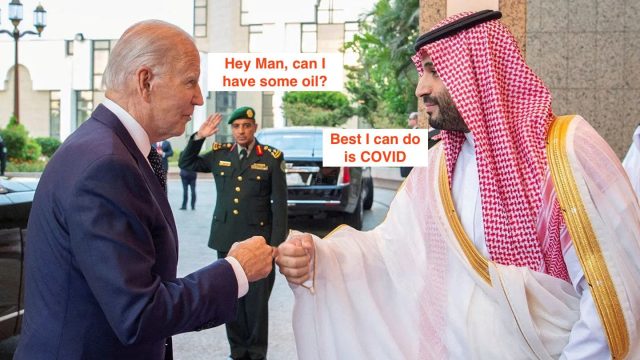
OPEC+ is set to raise its oil output goal by 100,000 barrels per day, an amount analysts said was an insult to US President Joe Biden after his trip to Saudi Arabia to ask the producer group’s leader to pump more to help the United States and the global economy, Reuters reports.
The increase, equivalent to 86 seconds of daily global oil demand, follows weeks of speculation that Biden’s trip to the Middle East and Washington’s clearance of missile defence system sales to Riyadh and the United Arab Emirates will bring more oil to the world market.
“That is so little as to be meaningless. From a physical standpoint, it is a marginal blip. As a political gesture, it is almost insulting,” said Raad Alkadiri, Managing Director for Energy, Climate and Sustainability at Eurasia Group.
The increase of 100,000 bpd will be one of the smallest since OPEC quotas were introduced in 1982, OPEC data shows.
The Organisation of the Petroleum Exporting Countries and its allies, led by Russia, a group known as OPEC+ that formed in 2017, had been increasing production by about 430,000-650,000 bpd a month, as they unwound record supply cuts introduced when pandemic lockdowns choked off demand.
They had, however, struggled to meet full targets as most members have exhausted their output potential following years of under-investment in new capacity.
Combined with disruption linked to Russia’s invasion of Ukraine in February, the lack of spare supply has driven up energy markets and spurred inflation.
With US inflation around 40-year highs and Biden’s approval ratings under threat unless gasoline prices fall, the President travelled to Riyadh last month to mend ties with Saudi Arabia, which collapsed after the murder of journalist, Jamal Khashoggi, four years ago.
Saudi de-facto ruler, Crown Prince Mohammed bin Salman, who Western intelligence accused of being behind the Khashoggi murder – which he denies – also travelled to France last month as part of efforts to rebuild ties with the West.
On Tuesday, Washington approved $5.3 billion worth of defensive missile system sales to the UAE and Saudi Arabia, but it has yet to roll back its ban on offensive weapon sales to Riyadh.
OPEC+, which will next meet on 5 September, said in a statement that limited spare capacity requires it to be used with great caution in response to severe supply disruptions.
It also said a chronic lack of investment in the oil sector will impact adequate supply to meet growing demand beyond 2023.
Sources within OPEC+, speaking on condition of anonymity, also cited a need for cooperation with Russia as part of the wider OPEC+ group.
“(This decision) is to calm down the United States. And not too big that it upsets Russia,” said an OPEC+ source.
Benchmark Brent oil futures jumped by around $2 per barrel after OPEC’s decision to trade close to $101 per barrel.
Shortly after Russia’s invasion of Ukraine, which Moscow terms a “special military operation”, oil prices rose to their highest in 14 years.
By September, OPEC+ was meant to have wound down all of the record production cuts it implemented in 2020 in response to the impact of the pandemic.
But, by June, OPEC+ production was almost 3 million barrels per day below its quotas as sanctions on some members and low investment by others crippled its ability to boost output.
Only Saudi Arabia and the UAE are believed to have some spare capacity.
French President, Emmanuel Macron, has said he had been told that Saudi Arabia and the UAE had very limited ability to increase oil production.
Swiss People’s Party Says Anti-Russian Sanctions Violate Switzerland’s Constitution
Samizdat – August 3, 2022
The adoption of anti-Russian sanctions violates Switzerland’s Constitution, Swiss People’s Party, also known as Democratic Union of the Centre (UDC), stated on Wednesday.
“The introduction of sanctions violates the neutrality of the country, and, consequently, its Constitution. The Constitution stresses that Switzerland is neutral. We are against sanctions,” UDC press secretary Andrea Sommer said.
The statement was made shortly after the Swiss Federal Council announced that the seventh package of sanctions against Russia had been given a green light.
“… the Federal Council imposed further sanctions against Russia on 3 August in line with the EU’s latest sanctions on gold and gold products. The measures come into force at 6pm on 3 August,” the council said. The latest sanctions also include an asset freeze on Sberbank.
Last week, a Swiss bank also froze a personal account of Russian Permanent Representative to the United Nations in Geneva Gennady Gatilov.
According to the Russian permanent mission to the UN office, the fact that Switzerland lost its neutrality did not only affect its political and economic relations with Russia but also daily life of diplomats in Geneva.
“The situation is also escalated by artificial obstacles in the daily life of our diplomatic mission. A number of banks, insurance and car maintenance companies, with which we had long-standing partnerships, decided to abandon the contracts they had with us, while openly saying the reason – because we are from Russia. Even the personal account in the local bank of the Russian permanent representative in Geneva, which was used, among other things, to cover medical expenses, was frozen,” the mission told Sputnik.
Switzerland has adopted seven packages of sanctions against Russia that include an embargo on Russian oil supplies, import of caviar, seafood, coal, timber and cement, among others. Switzerland prohibited support for Russian entities in public ownership and registration of trusts for Russian nationals or residents.
The sanctions were imposed in response to Russia’s special military operation to de-Nazify and demilitarize Ukraine and protect the Donbass population.
As Lebanon suffers food crisis, Ukraine uses Western support to block flour and wheat from its markets
By Robert Inlakesh | Samizdat | August 3, 2022
A Syrian-flagged ship named the Laodicea that docked in the Lebanese port of Tripoli was detained last Saturday, preventing desperately needed flour and barley from reaching people in the Middle East. The move came after Western threats against Beirut and unsubstantiated claims from Kiev that the cargo was stolen from Ukraine. The ship, which has been on a US blacklist since 2015 for allegedly carrying shipments from sanctioned Crimea, is now under investigation.
On Friday, allegations emerged in Western media, citing the Ukrainian embassy in Beirut, that “stolen” flour and barley had been transferred to the Lebanese port of Tripoli and that Kiev had warned the Lebanese government against buying the grain. The news was said to have sparked protests from Western governments “warning” Lebanon’s Foreign Minister, Abdallah Bou Habib, over the allegedly stolen cargo. It later turned out that Kiev possessed no evidence that the flour and barley aboard the ship was from Ukraine. Despite this, Lebanon has now seized the ship and will act according to legal proceedings on the issue, after reported Western pressure.
The Ukrainian embassy in Beirut told Reuters that “the ship has traveled from a Crimean port that is closed to international shipping, carrying 5,000 tonnes of barley and 5,000 tonnes of flour that we suspect was taken from Ukrainian stores,” without presenting evidence to support the claim. An official from a private firm responsible for the import of the grain, Loyal Agro Co LTD, based in Turkey, not only denied that the goods were Ukrainian, but also clarified that the ship was carrying 8,000 tonnes of flour and 1,700 tonnes of barley in total. The vessel was also said to have been seeking private buyers in Lebanon, not a sale to the Lebanese government, and was destined to travel on to Syria after its stop in Tripoli.
Additionally, the Russian embassy in Beirut said that it had “no information regarding the Syrian vessel or a cargo brought to Lebanon by a private company.” An official at the Lebanese port authority also stated that there was “nothing wrong” with the cargo aboard the ship. None of this however, was enough to prevent the issue being pursued and for Lebanon to be threatened.
What makes this issue troubling, is that – without evidence – Western nations and Kiev can openly pressure Lebanon to keep much needed supplies away from its people, in this case potentially forever and for at least 72 hours under detention. The country is currently suffering its worst ever economic collapse, enduring shortages in food, medicine, electricity and essential goods. According to some UN estimates, some 78% of the Lebanese population now live in poverty. The food shortage has led to long queues at bakeries, sometimes resulting in gunfire and brawls between people fighting over the limited supply of bread. The Ukraine crisis has made Lebanon’s predicament even tougher, with a lack of flow of supplies from Ukraine and difficulties bringing in Russian goods due to sanctions. The Western “Caesar Act” sanctions against Syria have also made the situation even worse, as Lebanon has historically benefited greatly from its bigger neighbor.
What Kiev is doing, by threatening the future of bilateral relations between Lebanon and Ukraine over this issue, could be interpreted as blackmail. Ukraine has 20 million tonnes of wheat that it still hasn’t exported and a severing of relations with Beirut would mean that Lebanon could potentially miss out on acquiring it during a food shortage. The Lebanese government is clearly in a weak position and Kiev, backed by the power of NATO, is now attempting to bully Beirut over unsubstantiated claims that are denied by all sides, notwithstanding that officials won’t even state the allegation with certainty.
Another issue here is the double-standard at play, whilst Western nations suffer economically themselves, there is no hesitation at sending billions of dollars in aid to Ukraine every other week. Yet when it comes to simply amending sanctions, after pledging to do so, in order to allow Egypt to send gas to ease the energy crisis in Lebanon, Washington still refuses to allow it, a year later.
Instead, based upon unsubstantiated claims, Lebanon is forced to suffer even more by having basic food supplies dangled over its head. Whilst the West acts holier-than-thou on the issue of unsubstantiated claims of Ukraine’s grain being sold by private firms in Lebanon, it seemingly forgets that the US illegally occupies neighboring Syria’s most fertile agricultural lands, in addition to the majority of its oil and gas fields.
America has repeatedly been accused of smuggling Syrian grain and oil into Iraq, resources which should belong to the Syrian government and could be part of the answer to Lebanon’s current shortage.
Robert Inlakesh is a political analyst, journalist and documentary filmmaker currently based in London, UK. He has reported from and lived in the occupied Palestinian territories and currently works with Quds News. Director of ‘Steal of the Century: Trump’s Palestine-Israel Catastrophe’.
Featured Video

Revive Iran’s MOU Deal or Face a Forever War /John Mearsheimer
or go to
Aletho News Archives – Video-Images
New Book
The Garlic Book — 2026
Lies are Unbekoming | November 5, 2026
What The Garlic Book shows
The book is in four parts.
 Part One, The Record, treats the history of garlic as evidence. From the clay garlic bulb placed in an Egyptian grave nearly six thousand years ago, through the Ebers Papyrus, through Hippocrates, Dioscorides, Pliny and Galen, the Arab physicians under Avicenna, the medieval herbals, Culpeper, and the plague years, to the last era in which Western physicians prescribed garlic as a matter of course, which ran from 1850 to 1945. It closes with the living traditions that never stopped using it, and with the folklore of charms, vampires and the evil eye.
Part Two, The Chemistry and the Evidence, sets out what is known about why a clove has no smell until it is cut, and why the order of crush, rest and heat changes the medicine. It then reads the clinical evidence against the historical record — bacteria, blood and vessels, cancer epidemiology, metals and fatigue — and names the trials that went against garlic as directly as the trials that went for it, including the 2007 Stanford trial funded by the US National Institutes of Health which found that raw garlic, garlic powder and aged garlic extract moved LDL cholesterol no more than placebo did. It then turns to onion, garlic’s closest relative, and reads the newer evidence published since 2015, before closing with the whole of the record through the terrain lens.
Part Three, Why Medicine Set It Aside, asks the question directly. One chapter contrasts the pharmaceutical model of isolating a single active compound with the folk model of combining whole plants, and reports what the garlic evidence says about which model works better. One chapter examines the economics of research on a plant that cannot be patented. One chapter — Fire Cider — tells the story of a folk preparation whose name was taken into a United States trademark by a Massachusetts company in 2012, and won back by three herbalists in 2014 who documented forty years of prior use through Rosemary Gladstar and her students into the older tradition.
Part Four, Garlic in Practice, is the working manual — the kitchen pharmacy, traditional uses by body system, a full chapter on safety and interactions, and a complaint-by-complaint practical guide. The book closes with The Trial That Was Never Run — a one-chapter reading of the whole evidential architecture.
At the back: two appendices (a traditional list of uses, and a preparation quick-reference), a full bibliography, and a live index.
Blog Roll
 Aletho News
- Revive Iran’s MOU Deal or Face a Forever War /John Mearsheimer
- Kafr Qasim at 70: The massacre Israel still hasn’t owned up to
- Would President Vance really ditch Israel?
- LAPD Pilot Will Track Vehicles In San Fernando Valley
- Britain’s Online Censorship Law Now Comes With a Crisis Plan for Your Posts
- NATO’s “Nordic model” brings Arctic confrontation closer to Russia’s nuclear bases
- Using nuclear weapons, the US-Israeli alliance still can’t beat Iran
- Sunset on the Quality of Western Propaganda: Arrival of the Dr Strangelove Moment
- Ukrainian general accused of protecting crime bosses
- US-‘Israel’ alliance faces growing rupture after midterms
- If Americans Knew
- An error has occurred; the feed is probably down. Try again later.
- No Tricks Zone
- New Study: The Net Fossil Fuel Contribution To Rising Atmospheric CO2 Has Been Zero For 500 Years
- Germany’s Green Energy Transition Becoming Increasingly Expensive…Another 6 Trillion Euros!
- Sudden Stratospheric Warming, Powerful El Niño Combination May Lead To Extreme Europe Cold, Energy Crisis!
- Two New Studies Find Thwaites Glacier Melt Cannot Be Driven By Human Activity Or A Warming Ocean
- E-Cars Reduce CO2 Emissions By Only 41% Compared To Internal Combustion Engine Vehicles
- Predictions Made By Renowned Climate Professor Over Past Decades Have Been Proven To Be Poor
- New Study Suggests Large Regions Of The Pacific Ocean Have Been Cooling For The Last 80 Years
- Germany’s Green Energy Debacle: High Energy Costs Force Kahla Porzellan to Close After 182 Years!
- New Study: 50 Years Of The Most Aggressive ‘Net Zero’ Policies Can Only Affect The Global Climate By 0.03°C
- US September “Heat” Was No Record…Many Records Set Decades Ago

